INTRODUCTION
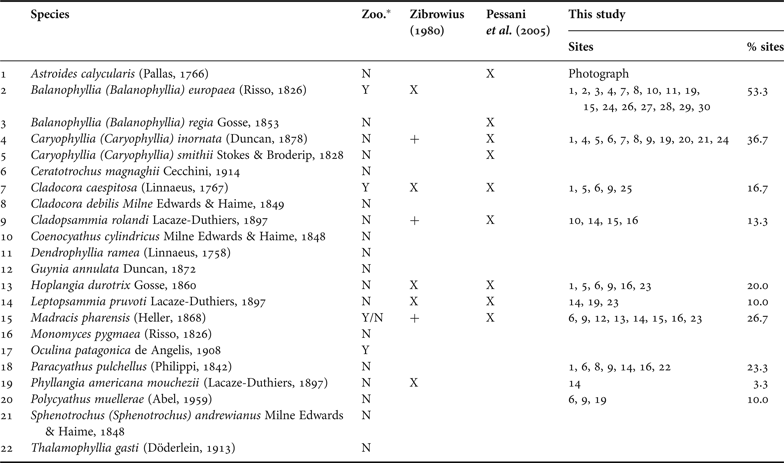
There are 33 species of scleractinian corals known in the Mediterranean according to Zibrowius (Reference Zibrowius1980), which is the most complete reference checklist of scleractinian corals for the Mediterranean. Of those, 22 have been found in shallow waters (Table 1), i.e. less than 30 m depth, which is the approximate limit of recreational SCUBA diving.
List of the 22 shallow water Mediterranean scleractinian coral species indicating those reported from the Ionian Sea (X) and explicitly on the Ionian coast of Italy (+) by Zibrowius (Reference Zibrowius1980), Pessani et al. (Reference Pessani, Morri and Esposito2005), and information on species found in this study (site identification and % of sites at which each species was recorded).

Zoo.*, zooxanthellate (Yes/No).
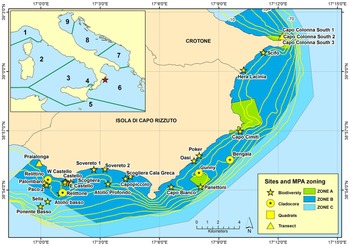
Recently, a checklist has been released by the Italian Society of Marine Biology (Pessani et al., 2005) for Italian seas, reporting nine, instead of the eight previously reported by Zibrowius (Reference Zibrowius1980), shallow water scleractinian coral species in the Ionian Sea, of which only three are explicitly reported from the Ionian coast of Italy (Table 1). The area of reference used by Pessani et al. (Reference Pessani, Morri and Esposito2005) is the biogeographic sector number 6 that includes the eastern coast of Sicily, the Ionian coast of Calabria and Basilicata, the Salento peninsula up to Otranto and the western coast of Greece (Figure 1). A description of the Mediterranean biogeographic sector used by Pessani et al. (Reference Pessani, Morri and Esposito2005) can be found in Bianchi (Reference Bianchi2007).
The inset map displays the biogeographic sectors (1–6) used as a reference by the SIBM checklist. Capo Rizzuto Marine Protected Area (MPA) is located in sector number 6. The main map shows the survey site locations and the MPA boundaries.

Zibrowius (Reference Zibrowius1980) summarized available records from various studies for 12 areas of the Mediterranean, which had a mean of 15.6 species in less than 30 m of water, with a range of 13–19 species. Looking at available literature there is a clear lack of surveys focused on Anthozoa in the Ionian Sea (Pessani et al., 2005); thus, the Ionian coast of Italy may have more coral species than reported so far. Accordingly, the present study aimed to assess the biodiversity of shallow water scleractinian corals in this poorly studied area.
MATERIALS AND METHODS
The study area was located within the boundary of the Capo Rizzuto Marine Protected Area (MPA), on the Ionian coast of the Calabria region in the south of Italy (Figure 1). Capo Rizzuto was established as a MPA in 1991 with the aim of protecting the keystone seagrass species Posidonia oceanica (Linnaeus) Delile, 1813 within its boundaries, extending along 42 km of coastline west of the city of Crotone. It covers an area of 14.721 ha, making it one of the largest MPAs in Italy.
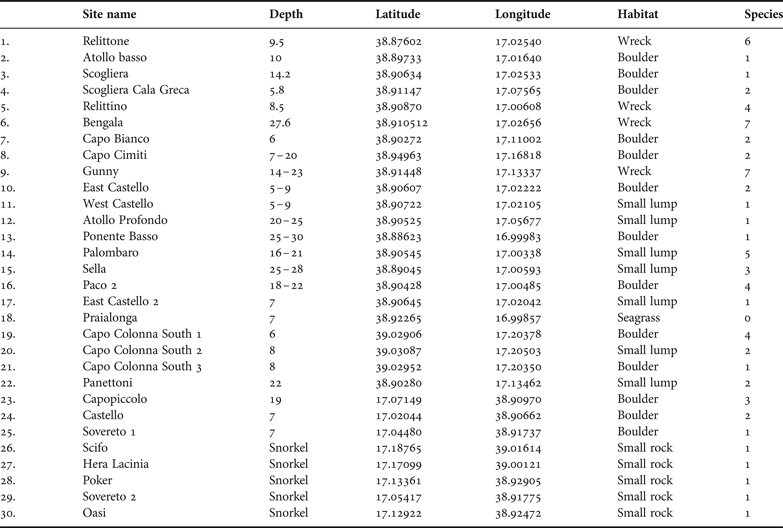
Searches for coral species were conducted at 25 sites (Figure 1) using SCUBA diving to a maximum depth of 30 m in October 2008 and August 2009. Five additional sites were surveyed with snorkelling along the shore at depths between 1 and 4 m. Some sites were visited more than once. Average survey time was 50 minutes per dive and 90 minutes per snorkel. Most sites had little slope, so the range of depths searched was limited. Four sites consisted of steel shipwrecks. Site coordinates were recorded with a portable GPS unit. Information on sites is presented in Table 2.
Information about the sites surveyed during this study.

*, number of specimens collected for laboratory identification; sites for which numerical depth data are given were sites where SCUBA was used.
At each site, searches were focused on the ceilings of overhanging hard substrata, which are the preferred habitat of most azooxanthellate corals. At most sites, such habitats were found primarily under the edges of boulders, but formations in some areas appeared as gullies or holes. Vertical and slightly overhanging surfaces were generally not searched as preliminary searches revealed no corals. Searches were concentrated on lower light level recesses where the chance of finding corals was greatest. Searching was aided by the use of underwater lights. Wrecks overhanging surfaces were also searched, primarily those with the lowest light levels. On the deepest wrecks (23–28 m) some near-vertical surfaces also had corals.
In more detail, the habitat searched at Sites 1, 5, 6 and 9 was overhanging surfaces on steel ship wrecks, at Sites 2, 3, 4, 7, 8, 10, 13, 16, 19, 21, 23, 24, 25 it was overhanging edges and cracks in large boulders and at Sites 11, 12, 14, 15, 17, 20, 22 it was cracks in smaller lumps. The top of the boulders and rocks were covered by algae while holes and overhanging surfaces were populated by encrusting coralline algae, sponges and bryozoans (diversity increased with depth and/or decreasing illumination). Site 18 was dominated by a seagrass meadow, which was also present in patches at Sites 2, 4, 8, 10, 11, 12, 17, 20, 21 and 22. Habitat at Sites 26 to 30 was formed mainly by small rocks covered by algae on flat sand.
The presence of coral species was recorded at each site. The abundance, i.e. number of colonies, or the sampled area were not estimated because surveys were conducted on specialized habitats consisting of overhanging surfaces, and thus dive time was spent searching not quantifying the area searched. Coral samples were initially collected to identify species, but once a species could be reliably identified visually, it was not sampled further. In very shallow water (~2–7 m depth) illuminated surfaces were also searched for the zooxanthellate solitary coral, Balanophyllia (Balanophyllia) europaea (Risso, 1826).
When corals were collected a numbered container was photographed and then the coral to be collected was photographed, collected and placed in the container. Tissue was removed from corals with bleach and the corals were photographed and examined under a dissecting microscope. Initial identification was made using Zibrowius (Reference Zibrowius1980), and subsequently verified by H. Zibrowius from photographs of skeletons. One species, Phyllangia americana mouchezii (Lacaze-Duthiers, 1897), was identified by H. Zibrowius from a photograph of the living coral only.
Individual sites and collected samples are described in detail in Fenner et al. (Reference Fenner, Riolo and Vittorio2009).
Collected samples will be deposited at the Oceanographic Museum of Monaco.
RESULTS
A total of 11 species of coral were found in this study: two zooxanthellate, eight azooxanthellate, and one facultative zooxanthellate (Table 1). The species Paracyathus pulchellus (Philippi, 1842) and Polycyathus muellerae (Abel, 1959) were not previously recorded in the Ionian Sea. Paracyathus pulchellus was found at 23% of the surveyed sites, settled on vertical surfaces of large boulders or wrecks with a few isolated individuals (often just a single individual per site). Polycyathus muellerae was found at 3% of the surveyed sites, forming colonies estimated to be about 10 to 30 cm in diameter, with several equal sized corallites, mostly at entrances of holes, lower parts of boulders or vertical surfaces of deep wrecks.
Madracis pharensis (Heller, 1868) colonies were present on the ceilings of several horizontal holes at deeper sites characterized by large boulders. Cladopsammia rolandi Lacaze-Duthiers, 1897 and Leptopsammia pruvoti Lacaze-Duthiers, 1897 were found at a few sites where they appeared to have moderate abundances both on small overhangs at shallower sites and in holes within large boulders at deeper sites. Caryophyllia (Caryophyllia) inornata (Duncan, 1878) was one of the most common corals, found at 11 sites and reaching densities greater than 15 individuals per 100 cm2 on some overhanging wreck surfaces sharing similar areas at some of the sites with Hoplangia durotrix Gosse, 1860. Phyllangia americana mouchezii was recorded at just one site forming a small group of about five corallites.
Among the zooxanthellate corals, Balanophyllia europaea was observed most often at shallow depths (from just below the surface down to 10 m depth), mostly in patches of a light yellow encrusting alga, on the sides of boulders. A sample of the alga was sent to Dr Davide Bassi and identified as Lithophyllum pustulatum (J.V. Lamouroux) Foslie 1904. Cladocora caespitosa (Linnaeus, 1767) was sporadically recorded at various depths (8–28 m). The colonies seen were about 15 cm or less in diameter, with half of them on wrecks.
DISCUSSION
In recent years the MPA has started a programme to assess the biodiversity present under its jurisdiction, to further identify the values of the area and the associated threats and to best direct its management plans. Within this context, the present study documented the presence of ten coral species in less than 30 m depth in the Capo Rizzuto MPA. Taking into account a photograph of corals available on the Capo Rizzuto MPA website, another species, namely Astroides calycularis (Pallas, 1766) can be added to the coral fauna inventory of the MPA (its presence was confirmed by one employee of the MPA aquarium and the photographer who took the photograph). Nevertheless, the presence of A. calycularis was not verified during this study as the coral was not found at any of the surveyed sites. If the record of A. calycularis in Capo Rizzuto is confirmed, then it would extend the known range of the species distribution (Grubelic et al., Reference Grubelic, Antolic, Despalatovic, Grbec and Beg Paklar2004) to the south-east. Astroides calycularis is listed in Annex 2 of the Protocol Concerning Specially Protected Areas and Biological Diversity in the Mediterranean (SPAMI protocol) ‘Endangered or Threatened Species’, and Appendix 2 of the Convention on the Conservation of European Wildlife and Natural Habitats (Bern Convention) ‘Strictly Protected Animal Species’, and thus is a protected species.
Two species, namely Paracyathus pulchellus and Polycyathus muellerae (Figure 2) represent new records for the Ionian Sea, while another two, Phyllangia americana mouchezii and Balanophyllia europaea, were not reported for the biogeographic sector number 6 in the checklist prepared by the Italian Society of Marine Biology.
The skeletons of two samples belonging to the species Polycyathus muellerae (left) and Paracyathus pulchellus (right).

Eight of the recorded species were not previously known from the Ionian coast of Italy (Table 1), although found in other areas of the Ionian Sea as reported by Zibrowius (Reference Zibrowius1980).
The nearest Mediterranean sites where coral diversity has been studied in shallow waters are the Naples and the Sicily areas, where 18 and 14 species, respectively, have been found (Zibrowius, Reference Zibrowius1980), and in Croatia, from which 18 species have been reported (Kruzic et al., Reference Kruzic, Zibrowius and Pozar-Domac2002). However, these sites are all in biogeographic sectors other than the Ionian Sea, whereas the greater species richness reported may be due to more research effort.
The solitary zooxanthellate coral B. europaea was found most often in patches of the light yellow coralline alga, Lithophyllum pustulatum. The larvae of this coral swim (Goffredo & Zaccanti, Reference Goffredo and Zaccanti2004) and may be attracted by a chemical released from the coralline algae, much as larvae of the Caribbean coral Agaricia agaricites are attracted by a chemical produced by bacteria on coralline algae (Morse & Morse, Reference Morse and Morse1996; Heyward & Negri, Reference Heyward and Negri1999). However, further study will be needed to verify whether B. europaea is more common in yellow patches than on other surfaces.
ACKNOWLEDGEMENTS
The authors gratefully acknowledge the support for this study of the Capo Rizzuto Marine Protected Area. We also gratefully acknowledge the assistance of Helmut Zibrowius who graciously confirmed identifications of corals and provided first identifications of other corals from photographs of collected skeletons and photographs of living corals, and provided helpful advice and information. We thank Dr Davide Bassi for the identification of the sample of coralline alga Lithophyllum pustulatum. We thank two anonymous referees for significantly improving the manuscript. We also gratefully acknowledge the assistance of Marion Florjancic for many things, Domenico Lio, Salvatore Riillo, and Giuseppe Scicchitano for diving support, and Villa Aurora for accommodation. D.F. particularly wishes to thank all of the wonderful hosts who made this work a joy.