


1. Introduction
From the textual criticism of Karl Lachmann to the Coherence-Based Genealogical Method that undergirds recent editions of the Greek New Testament, text-critical methodologies have attempted to establish relationships between New Testament witnesses.Footnote 1 In seeking to systematise the process of New Testament textual criticism, B. F. Westcott and F. J. A. Hort say their method ‘consists in ceasing to treat Documents independently of each other, and examining them connectedly as parts of a single whole in virtue of their historical relationships’.Footnote 2 Establishing genealogical relationships among documents is essential, according to Westcott and Hort, because these relationships inform our understanding of readings. They state emphatically that ‘all trustworthy restoration of corrupted texts is founded on the study of their history, that is, of the relations of descent or affinity which connect the several documents’.Footnote 3 The methods of establishing textual relationships have evolved since the days of Westcott and Hort, but scholars continue to find value in determining which witnesses are closely related and which are not. It is thus important to know which textual and paratextual features in a manuscript are genealogically significant.
Those who study Greek New Testament manuscripts know that the nomina sacra are ubiquitous in Christian literature copied from at least the second century until the advent of the printing press.Footnote 4 Certain words were often abbreviated, either via suspension or contraction. The former involved the scribe omitting all but the first two or three letters of a word, while in the latter case, the scribe includes the first and last letters of a word but omits medial letters. Divine names such as θεός, κύριος, Ἰησοῦς and Χριστός are abbreviated consistently in our earliest Christian witnesses.Footnote 5 Additional words, many of which often referred to God in the New Testament, were abbreviated with varying levels of frequency. These words include ἄνθρωπος, Δαυείδ, Ἰερουσαλήμ, Ἰσραήλ, μήτηρ, οὐρανός, πατήρ, πνεῦμα, σταυρός, σωτήρ and υἱός.Footnote 6 The scribe’s decision on whether to write these latter words as nomina sacra was sometimes based on the lexical context, such as the tendency for scribes to write plural forms of πνεῦμα plene. Yet often the pattern of abbreviation appears to be random.Footnote 7 Some words were abbreviated more frequently than others, but the exact patterns of abbreviation appear to vary from manuscript to manuscript.
This article explores the relevance of the nomina sacra in identifying genealogical relationships between Greek New Testament manuscripts. To rephrase the research question: did scribes tend to follow the abbreviation patterns of their exemplar, or did they independently make decisions about which words to abbreviate? If Manuscript A had a distinct pattern of abbreviation and was copied carefully, then its descendants should also have that distinct pattern of abbreviation. Many manuscripts with the same pattern of abbreviation could then be indicative of a group or family of witnesses. If it were the case that scribes copied the abbreviation patterns of their exemplars faithfully, it would highlight the usefulness of the nomina sacra in establishing, or at least confirming, genealogical relationships.
Previous works on the nomina sacra have either focused on abbreviation practices in the earliest Christian centuries or on individual manuscripts. Larry Hurtado’s influential article ‘The Origin of the Nomina Sacra: A Proposal’ sought to explain the motivation for early Christian scribes to innovate this abbreviation system. Because of his focus on the origins of the practice, Hurtado looks only at witnesses from the first three hundred years of the Christian age.Footnote 8 His work is representative of other studies that have sought to deduce theological or scribal mindsets in the early Christian era.Footnote 9 As Benjamin Overcash notes in his dissertation on social semiosis and the nomina sacra, ‘debate about the nomina sacra has tended to focus on their origins’.Footnote 10 A few studies have also included discussions about the nomina sacra as they appear in individual manuscripts in order to come to a better understanding of that manuscript’s attested scribal habits.Footnote 11 These are especially useful in describing the practices of individual scribes, as is the case with the several scribes who left their mark in Codex Sinaiticus.Footnote 12 Yet little work has been done on the general abbreviation tendencies of scribes in minuscule and late majuscule Greek New Testament manuscripts. The general sentiment seems to be, as Christopher Tucket puts it, that ‘Some variation is visible in the later manuscripts, but by then the standardization process may have been fairly well established.’Footnote 13 However, I will show that later manuscripts differed from each other in their abbreviation patterns in small but significant ways. Manuscripts copied after the fifth century may have less to tell us about the origins of the nomina sacra, but an understanding of general abbreviation practices can help determine genealogical relationships.
In what follows, I give evidence that scribes generally followed their exemplar when copying abbreviated words. This suggests that nomina sacra are genealogically significant. Three avenues of evidence are explored to make this determination. First, it will be shown that manuscripts within a known textual group tend to abbreviate in the same way as compared to manuscripts outside the group. Second, Abschriften typically have a very similar pattern of abbreviation to their exemplar. These pairings help to confirm the results from textual groups. Finally, certain manuscripts copied by a single scribe show changes in abbreviation patterns that coincide with changes in the corpus. These avenues of evidence together lead to my conclusion that scribes did not innovate when deciding when to abbreviate. Rather, they followed their exemplar.
2. Nomina Sacra and Textual Groupings
Known textual groupings are an effective medium for testing the genealogical significance of the nomina sacra because they provide a target to shoot for. If Manuscript A is known to agree most of the time with Manuscript B, and if nomina sacra are genealogically significant, then the abbreviation patterns in Manuscript A would be expected to closely match those of Manuscript B. On the other hand, if the abbreviations in Manuscript A were no more similar to Manuscript B than to less textually consanguineous witnesses, we would conclude that the nomina sacra are idiosyncratic to the individual scribe, and thus not genealogically relevant.
In order to test the usefulness of the nomina sacra for establishing genealogical relationships, I compared nomina sacra in thirty-four witnesses in the Gospel of Mark. Mark was chosen due to the publication of the Mark volume of the Editio Critica Maior (ECM).Footnote 14 This resource includes a global stemma for Mark’s Gospel, which shows the results from the Coherence-Based Genealogical Method. The selection of the thirty-four witnesses was based on this global stemma. In Mark, the Family 1 group contains GA 1, 118, 205, 209, 1582, 2193 and 2886 according to the ECM.Footnote 15 The Family 13 group contains manuscripts 032, 13, 28, 69, 124, 346, 543, 788, 826, 828, 837, 983, 1689 and lectionary 547.Footnote 16 A third textual grouping is headed by GA 1216, and includes 61, 152, 184, 348, 382, 555, 829, 1243, 1279, 1579, 2486 and 2726. This group roughly corresponds with Hermann von Soden’s Ib group or Frederick Wisse’s 1216 group.Footnote 17 Together, these three groups provide thirty-four witnesses to compare. With the exception of Codex Washingtonianus (032), all of these manuscripts were copied during or after the tenth century. This is advantageous for two reasons. First, these witnesses will demonstrate that abbreviation practices in the medieval period were not as standard as has been claimed. Later manuscripts are more stable than earlier manuscripts, but there is still variance. Second, later manuscripts have fewer missing links and are generally closer to one another genealogically. They lend themselves to an analysis of fine distinctions in a way that earlier manuscripts do not.
Some words were almost universally abbreviated and thus need not be compared. Specifically, Colin Roberts found that the nomina sacra generally fell into three groups. The words θεός, Ἰησοῦς, κύριος and Χριστός were almost always abbreviated from the earliest occurrence of Christian copying.Footnote 18 Ἄνθρωπος, πνεῦμα and σταυρός were abbreviated ‘relatively early and relatively frequently’. And Δαυείδ, Ἰερουσαλήμ, Ἰσραήλ, μήτηρ, οὐρανός, πατήρ, σωτήρ and υἱός were more irregularly contracted.Footnote 19 Subsequent studies by Hurtado, Charlesworth, Bokedal and Overcash all found similar trends regarding which words were universally abbreviated and which were not.Footnote 20 When looking for patterns of abbreviation, words that may or may not be abbreviated are more significant than words that are nearly always abbreviated. Thus I chose to study five words that were sometimes abbreviated: ἄνθρωπος, μήτηρ, οὐρανός, πνεῦμα and υἱός. These words represent a spectrum of likelihood for abbreviation, with ἄνθρωπος, μήτηρ and πνεῦμα abbreviated often in the chosen corpus, and οὐρανός and υἱός less often. Comparing all instances where these five words appear in Mark for these thirty-four witnesses resulted in 146 places of possible variation among 110 verses.
For this portion of the project, I created a custom base text that comprised only those 110 verses and only the tested words, eliminating all other possible variation units in order to focus specifically on abbreviation habits. I wrote each word plene as an XML transcription file using the Online Transcription Editor created by the Institute for Textual Scholarship and Electronic Editing (ITSEE).Footnote 21 I then created individual transcription files for each witness using images from the INTF’s Virtual Manuscript Room and transcribing on ITSEE’s Online Transcription Editor, using my original XML file as a base text.Footnote 22 This produced thirty-five transcription files, including the base text, showing how each witness wrote each instance of the five test words in Mark. I then used ITSEE’s Standalone Collation Editor to collate the individual transcription files into one single collation.Footnote 23 Nomina sacra were the focus of the collation. Any other variation was ignored. For those places where one of the test words involved variation aside from their abbreviation status, I regularised the readings where possible and considered the rest lacunose. Finally, using David Flood’s ‘Apatosaurus’ web application, I was able to upload my collation and analyse it using Joey McCollum’s Open-CBGM.Footnote 24 The CBGM allows for a rapid calculation for overall percentage agreement, or pre-genealogical coherence.Footnote 25 The degree to which one manuscript’s abbreviation pattern matches that of any other manuscript can be ascertained by observing its percentage agreements.
The results of the collation and analysis are below. First, Table 1 shows the overall agreement among witnesses within a group to the overall agreement between witnesses outside the group.Footnote 26 These numbers represent average percentage agreements, such that a 100% would mean two manuscripts abbreviated in the same way in every instance of the five test words in Mark. On average, a Family 1 witness agreed with another Family 1 witness in 87.3% of passages with regard to whether and how it abbreviated one of the five test words. This compared to the average Family 1 member’s agreement with a witness outside of Family 1 being 83.3%. Similarly, the average Family 13 witness agreed with other Family 13 witnesses 84.4% of the time, compared with 81% with non-family members. And Family 1216 witnesses agreed with family witnesses 80.3% of the time, compared with 79.7% with non-family witnesses. It will be observed that Family 1 attests the largest gap between intra- and inter- family agreements. The difference for Family 1216 is small enough to be meaningless.
Intra- and Inter-Family Agreement

Most of the witnesses transcribed for this study were copied after the ninth century. Abbreviation practices were more consistent than in earlier periods of transmission. This means that any differences in agreement are likely to be small across the entire corpus. The fact that witnesses in Family 1 and Family 13 agree more within their family could suggest that nomina sacra are genealogically significant. To further test this assertion, every witness was analysed to see whether its closest agreement partners were family members.
Table 2 shows the top agreement partners for the Family 1 witnesses, together with their percentage agreements. Witnesses that are Family 1 members are underlined. A few trends are noteworthy. First, 1 and 1582 are each other’s highest partner in agreement, a fact made more salient given the drop from highest to second-highest agreement partners for both manuscripts. GA 118, 205, 209 and 2886 are all similar in their patterns of abbreviation, with each having the others among their top five agreement partners. I discuss these witnesses more in the section on Abschriften. Lectionary 547 attests less than half the places of variation (49 out of 146). Given this smaller data set, the significance of its high percentages of agreement should not be overstated. Nevertheless, the data is not uniform. The highest-rated Family 1 witnesses for 2193 are 1 and 1582, tied for 8th. There is not a stark difference between intra- and inter-family agreement for 1 and 1582 after the first position, and many non-family members are rated higher than other Family 1 members. The results from Family 1 indicate that some genetic significance can be found in a manuscript’s pattern of abbreviation, but exceptions are noted as well.
Top Agreement Partners for Family 1 Witnesses

Table 2 Long description
The table is divided into two subtables. The first subtable has five columns labeled 1, 118, 205 and 1582, with approximately ten rows each. The second subtable has two columns labeled 2193 and 2886, also with approximately ten rows. Each column lists numeric identifiers paired with similarity percentage values, where higher percentages indicate closer matches to the column header identifier. All values are expressed in percent. In the first subtable, column 1 lists identifiers such as 1582 at 95.1 percent, 1689 at 85.8 percent, 28 at 85.3 percent, 983 at 85.3 percent, 829 at 85.1 percent, 1216 at 85.1 percent, 118 at 84.0 percent, 209 at 84.0 percent, 346 at 84.0 percent and 2886 at 83.9 percent. Column 118 lists pound sign 547 at 100 percent, 209 at 98.6 percent, 1689 at 98.6 percent, 2886 at 98.6 percent, 205 at 97.9 percent, 983 at 97.9 percent, 346 at 97.2 percent, 2726 at 97.2 percent, 13 at 96.4 percent and 124 at 95.1 percent. Column 205 lists pound sign 547 at 98.0 percent, 118 at 97.9 percent, 209 at 97.9 percent, 1689 at 97.9 percent, 2886 at 97.9 percent, 983 at 97.2 percent, 346 at 96.5 percent, 2726 at 96.5 percent, 13 at 95.7 percent and 124 at 94.4 percent. Column 209 lists 118 at 98.6 percent, 1689 at 98.6 percent, 2886 at 98.6 percent, pound sign 547 at 98.0 percent, 205 at 97.9 percent, 983 at 97.9 percent, 346 at 97.2 percent, 2726 at 97.2 percent, 13 at 96.4 percent and 124 at 95.1 percent. Column 1582 lists 1 at 95.1 percent, 28 at 86.0 percent, 1689 at 85.8 percent, 983 at 85.3 percent, 826 at 85.1 percent, 829 at 85.1 percent, 1216 at 85.1 percent, 118 at 84.7 percent, 209 at 84.7 percent and 346 at 84.7 percent. In the second subtable, column 2193 lists 1216 at 93.6 percent, 28 at 93.0 percent, 829 at 92.1 percent, 382 at 91.2 percent, 1243 at 90.8 percent, 1279 at 90.8 percent, 1579 at 89.4 percent, 1 at 83.9 percent, 1582 at 83.9 percent and 828 at 83.1 percent. Column 2886 lists pound sign 547 at 100 percent, 118 at 98.6 percent, 209 at 98.6 percent, 1689 at 98.6 percent, 205 at 97.9 percent, 983 at 97.9 percent, 346 at 97.2 percent, 2726 at 97.2 percent, 13 at 96.4 percent and 124 at 95.1 percent. Overall percentage ranges are 83.9 percent to 95.1 percent in column 1, 95.1 percent to 100 percent in column 118, 94.4 percent to 98.0 percent in column 205, 95.1 percent to 98.6 percent in column 209, 84.7 percent to 95.1 percent in column 1582, 83.1 percent to 93.6 percent in column 2193 and 95.1 percent to 100 percent in column 2886.
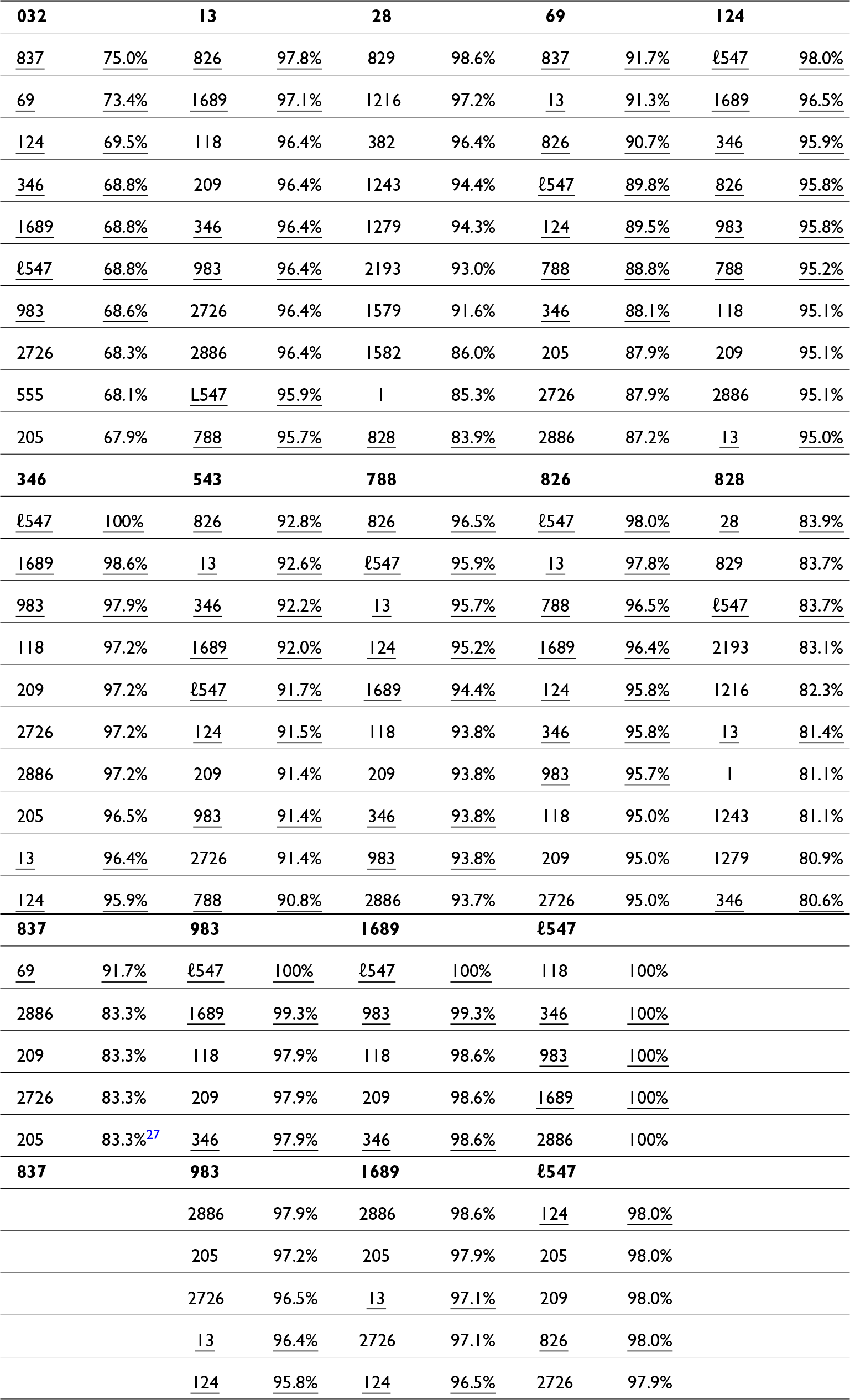
Table 3 shows a similar pattern for Family 13 witnesses, in which most witnesses are closest to fellow Family 13 members. Family 13 witnesses are underlined. Codex Washingtonianus (032) is by far the oldest witness to be collated and is the only majuscule included in these calculations. As such, its patterns of abbreviation differed significantly from the other witnesses. We can see that its closest partners agree only 68–75% in abbreviation. Nevertheless, family members are its highest agreement partners, and the same can be said for every Family 13 member save for GA 28. While a family member is its highest agreement partner, 828 also fails to show a strong distinction between family and non-family members. Of special note are 983 and 1689, which attested identical abbreviations in 141 out of 142 instances. Recall that lectionary 547 only attested 49 passages in Mark where the five test words were present. This accounts for how it can have 100% agreement with five witnesses, including three from Family 13. As with Family 1, we see in Family 13 a tendency to agree most with fellow family members, but there is rarely a stark dividing line between intra-and inter-family witnesses.
Top Agreement Partners for Family 13 Witnesses

Table 3 Long description
Five columns labeled 032, 13, 28, 69 and 124, with approximately 33 rows. Each column lists numeric identifiers paired with percentages, indicating rates or probabilities. Some rows lack percentages. Column 032 generally shows lower percentages, ranging from 67.9 percent to 100 percent. Column 13 has percentages from 90.8 percent to 100 percent, often higher than others. Column 28 ranges from 83.9 percent to 100 percent, with identifiers like 547 appearing frequently. Column 69 shows percentages from 87.2 percent to 100 percent, with identifiers such as 118 and 2886 recurring. Column 124 ranges from 80.6 percent to 98.0 percent, with identifiers like 547 and 983 appearing multiple times. Notable patterns include column 13 consistently having higher percentages and identifiers like 547 and 983 appearing across multiple columns. The table highlights variations in percentages across different categories, with some identifiers showing consistently high or low values.
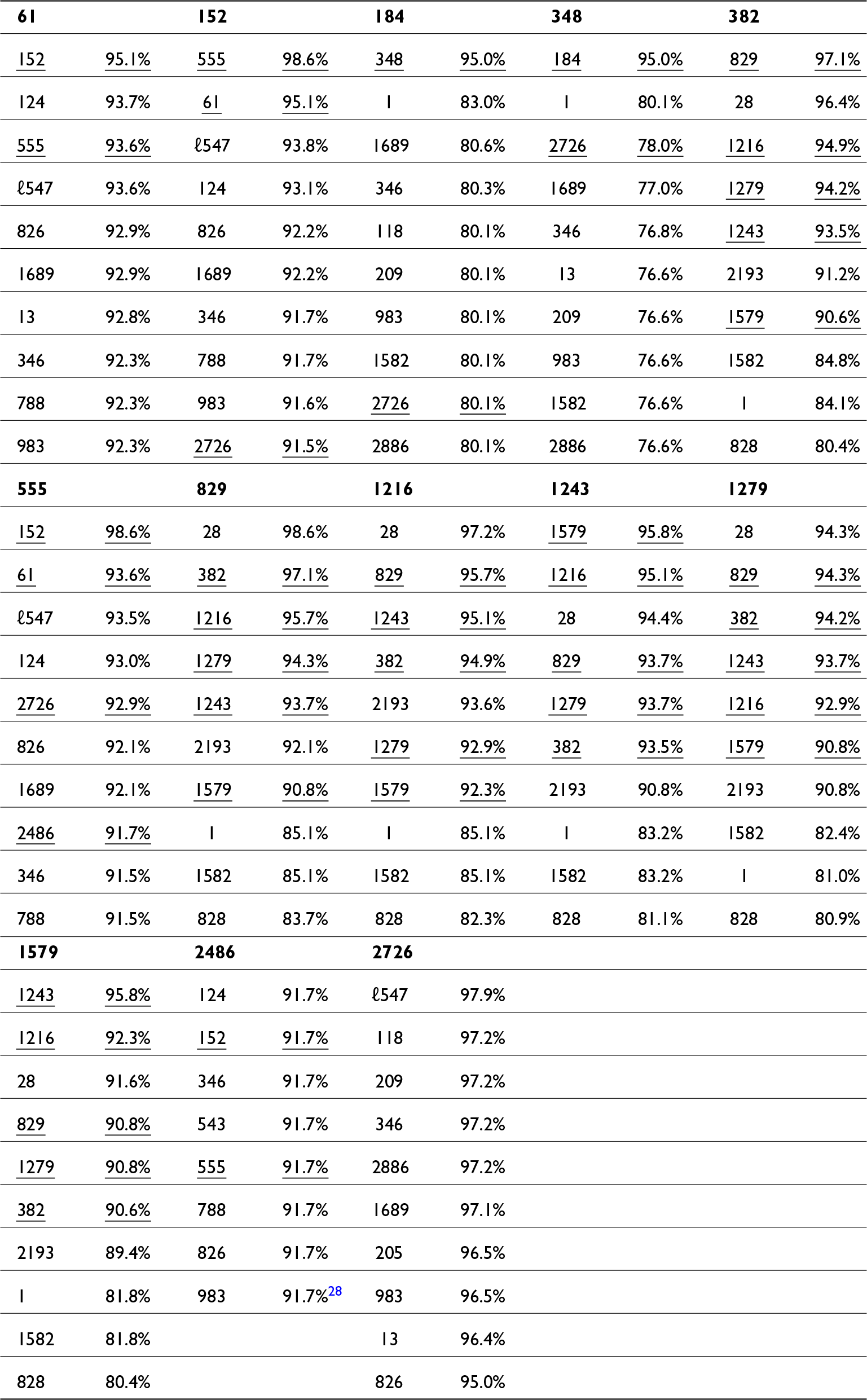
Top Agreement Partners for Family 1216 Witnesses

Table 4 Long description
The table is organized into multiple grouped sections. Each section is headed by a bold numerical ID and beneath each header is a list of other numerical IDs paired with percentage values. The section headers visible in the table are: 61, 152, 184, 348, 382, 555, 829, 1216, 1243, 1279, 1579, 2486 and 2726. Each paired percentage value appears immediately to the right of its corresponding numerical ID. Under section 61, the listed IDs and percentages are: 152 at 95.1 percent, 124 at 93.7 percent, 555 at 93.6 percent, pound sign 547 at 93.6 percent, 826 at 92.9 percent, 1689 at 92.9 percent, 13 at 92.8 percent, 346 at 92.3 percent, 788 at 92.3 percent and 983 at 92.3 percent. Under section 152: 555 at 98.6 percent, 61 at 95.1 percent, pound sign 547 at 93.8 percent, 124 at 93.1 percent, 826 at 92.2 percent, 1689 at 92.2 percent, 346 at 91.7 percent, 788 at 91.7 percent, 983 at 91.6 percent and 2726 at 91.5 percent. Under section 184: 348 at 95.0 percent, 1 at 83.0 percent, 1689 at 80.6 percent, 346 at 80.3 percent, 118 at 80.1 percent, 209 at 80.1 percent, 983 at 80.1 percent, 1582 at 80.1 percent, 2726 at 80.1 percent and 2886 at 80.1 percent. Under section 348: 184 at 95.0 percent, 1 at 80.1 percent, 2726 at 78.0 percent, 1689 at 77.0 percent, 346 at 76.8 percent, 13 at 76.6 percent, 209 at 76.6 percent, 983 at 76.6 percent, 1582 at 76.6 percent and 2886 at 76.6 percent. Under section 382: 829 at 97.1 percent, 28 at 96.4 percent, 1216 at 94.9 percent, 1279 at 94.2 percent, 1243 at 93.5 percent, 2193 at 91.2 percent, 1579 at 90.6 percent, 1582 at 84.8 percent, 1 at 84.1 percent and 828 at 80.4 percent. Under section 555: 152 at 98.6 percent, 61 at 93.6 percent, pound sign 547 at 93.5 percent, 124 at 93.0 percent, 2726 at 92.9 percent, 826 at 92.1 percent, 1689 at 92.1 percent, 2486 at 91.7 percent, 346 at 91.5 percent and 788 at 91.5 percent. Under section 829: 28 at 98.6 percent, 382 at 97.1 percent, 1216 at 95.7 percent, 1279 at 94.3 percent, 1243 at 93.7 percent, 2193 at 92.1 percent, 1579 at 90.8 percent, 1 at 85.1 percent, 1582 at 85.1 percent and 828 at 83.7 percent. Under section 1216: 28 at 97.2 percent, 829 at 95.7 percent, 1243 at 95.1 percent, 382 at 94.9 percent, 1279 at 92.9 percent, 2193 at 93.6 percent, 1579 at 92.3 percent, 1 at 85.1 percent, 1582 at 85.1 percent and 828 at 82.3 percent. Under section 1243: 1579 at 95.8 percent, 1216 at 95.1 percent, 28 at 94.4 percent, 829 at 93.7 percent, 1279 at 93.7 percent, 382 at 93.5 percent, 2193 at 90.8 percent, 1 at 83.2 percent, 1582 at 83.2 percent and 828 at 81.1 percent. Under section 1279: 28 at 94.3 percent, 829 at 94.3 percent, 382 at 94.2 percent, 1243 at 93.7 percent, 1216 at 92.9 percent, 1579 at 90.8 percent, 2193 at 90.8 percent, 1582 at 82.4 percent, 1 at 81.0 percent and 828 at 80.9 percent. Under section 1579: 1243 at 95.8 percent, 1216 at 92.3 percent, 28 at 91.6 percent, 829 at 90.8 percent, 1279 at 90.8 percent, 382 at 90.6 percent, 2193 at 89.4 percent, 1 at 81.8 percent, 1582 at 81.8 percent and 828 at 80.4 percent. Under section 2486: 124 at 91.7 percent, 152 at 91.7 percent, 346 at 91.7 percent, 543 at 91.7 percent, 555 at 91.7 percent, 788 at 91.7 percent, 826 at 91.7 percent and 983 at 91.7 percent with a superscript 28. Under section 2726: pound sign 547 at 97.9 percent, 118 at 97.2 percent, 209 at 97.2 percent, 346 at 97.2 percent, 2886 at 97.2 percent, 1689 at 97.1 percent, 205 at 96.5 percent, 983 at 96.5 percent, 13 at 96.4 percent and 826 at 95.0 percent. The highest percentage in the table is 98.6 percent, appearing in sections 152 and 829. Several entries under section 2726 cluster around 97.0 percent to 97.9 percent. Entries under sections 184 and 348 show notably lower percentages, many at or below 80.1 percent.
Finally, Table 4 shows the top agreement partners for the Family 1216 witnesses, with family members underlined. We see that 152 and 555 are very similar in their abbreviations. Even more pronounced is the agreement between 184 and 348, both of which show more than a 10% drop from each other to their next-highest agreement partner. As with the other two families, there is a single outlier: 2726. This manuscript’s closest Family 1216 witness is 555, with 92.9% agreement and ranked 13th. We also see that GA 28 has a high agreement with many in this family and is the highest agreement partner for 829, 1216, and 1279.
All three families show a similar trend, with most of the family members being closest to other family members. There are extremes on either end of the spectrum, with some witnesses showing a steep drop-off between witnesses that are part of the family and those that are not, and other members that agreed more with outsiders than insiders. This situation is complicated, as is typical for New Testament manuscripts. However, when analysing both the average group agreements and the individual witness agreements, there is enough of a trend to suggest that patterns of abbreviation are genealogical.
No variation unit was found in which families fell clearly into separate groups. The families only became noticeable in aggregate. However, hints of genealogical relationships emerge when we dig into the collation. For example, 1 and 1582 both attest the plene reading υιος in Mark 2.10, then an intermediate abbreviation υις in Mark 3.11. They both give a full abbreviation υς in 8.38. This kind of identical alteration seems highly indicative of genealogically significant readings. GA 1243 and 1579 were the only two manuscripts to write πνεῦμα plene in Mark 1.26, a pattern they both follow in the rest of Mark when πνεῦμα has a demonic referent. So while there are no readings defined by one particular family, there are readings in which two closely related witnesses share a reading against the rest of the collated manuscripts. This phenomenon also speaks to the genealogical significance of abbreviation.
3. Direct Copies and Abbreviation
Abschriften – manuscripts whose exemplars are extant – provide a ready resource for understanding scribal habits. A study of manuscript families can provide information about how a group of scribes abbreviated in toto, but a comparison of an exemplar to its direct copy will show how individual scribes chose to abbreviate. If scribes tended to follow their exemplar in abbreviation choices, we would expect Abschriften to have a much higher agreement in abbreviation with their exemplar than with other manuscripts. To test the genealogical significance of the nomina sacra, several exemplar-direct copy pairs were examined.
3.1 GA 22 and 1210
In her work on Family 1 in John’s Gospel, Alison Welsby concluded that GA 1210 (Gr. 173, St. Catherine’s monastery, Mount Sinai) is a copy of GA 22 (Gr. 72, Bibliothèque nationale de France, Paris).Footnote 29 Her conclusion is supported by findings by Amy Anderson, and the manuscripts are included in Alan Farnes’s table of Abschriften.Footnote 30 These manuscripts were not included in my initial collation because they were not a part of the CBGM calculations for the Editio Critica Maior volume of Mark. But to test their abbreviation patterns, I added them to the Mark collation. Table 5 shows the highest agreement partners in abbreviating the five test words for GA 22 and 1210.
Top Agreement Partners for GA 22 and 1210

Out of 143 possible places of variation, 22 and 1210 differ only three times in their abbreviation practices. In Mark 1.11, 22 gives the partial abbreviation υις for υἱός while 1210 has the plene υιος. The scribe of 1210 may have been expecting the plene form of υἱός, as that is what 22 attests in Mark 1.1.Footnote 31 In Mark 3.11, 22 has the plene πνευματα and 1210 abbreviates to πνα. The contraction of 22’s πνευματα to πνα could be due to parablepsis, although I see this as unlikely given that the word in 22 straddles a line break. Finally, in Mark 11.32, 22 abbreviates ἀνθρώπων to ανων, while 1210 gives the plene form. This final difference is more explicable: the first two letters come at the end of a line for 1210. The scribe of 1210 continued the word on the following line. This precluded the use of nomina sacra, as abbreviations rarely extend over a line break. These few exceptions prove the rule that 1210 is closer to 22 than any other tested manuscript in its abbreviation patterns. There is a 6.4% drop from each other to the next-highest agreement partner. The scribe of 1210 followed the abbreviation decisions of the exemplar in almost every instance.
3.2 GA 205, 209 and 2886
Three manuscripts currently housed in the Biblioteca Nazionale Marciana in Venice have been the target of some debate regarding their relationships to one another. The close similarity between the three Family 1 witnesses GA 205 (Gr. Z. 5), 209 (Gr. Z. 10) and 2886 (Gr. Z. 6) has led some to conclude that at least one is the exemplar of another. For many years, 2886 was considered an Abschrift of 205 and was called 205abs.Footnote 32 In turn, Kirsopp Lake considered 205 to be a copy of 209.Footnote 33 Josef Schmid concluded that, in Revelation, 205 and 2886 (205A in his work) were siblings, and that their exemplar was a sibling to 209.Footnote 34 Welsby reversed the traditional view by suggesting that 2886 was the exemplar for 205 due to the earlier date of 2886’s inscription and the greater number of group readings in 2886.Footnote 35 In his study of Abschriften, Farnes argues that 2886 cannot be a direct copy of 205, but remains unconvinced that 205 is a copy of 2886, following Schmid in preferring to view the two manuscripts as siblings.Footnote 36 Due to the differing conclusions, the relationships of these three manuscripts are still up for debate.
The present study makes no attempt to answer definitively the question of how these three manuscripts are related. However, because they are historically and textually connected, they provide a useful test with regard to their abbreviation patterns. The percentage agreement for these witnesses was already presented together with the other Family 1 witnesses in Table 2, but Table 6 reproduces the results for 205, 209 and 2886. Where they appear in the data, these three manuscripts are underlined.
Highest Percentage Agreement for GA 205, 209 and 2886

As mentioned above, lectionary 547 can be somewhat discounted since it only attests approximately one-third of the variation units. Removing it from consideration would mean that for each of these three manuscripts, another is tied for its highest agreement partner. While not discussed above, GA 118 is another Family 1 member connected to these three witnesses. Welsby concluded that it is a descendant of the same archetype as 2886 and 209.Footnote 37 The high ranking of GA 1689, a Family 13 witness, is unexpected and perhaps indicative of the relatively few differences between medieval manuscripts.
The findings in Table 6 lend themselves to two conclusions. First, three witnesses known to be very close, if not direct copies of each other, have very similar patterns of abbreviation. GA 205 agrees with the other two in 140 out of 143 possible abbreviations, and 209 and 2886 agree in 141 out of 143 instances. As with the larger family groups, we see that genealogic- ally close manuscripts attest similar uses of the nomina sacra. Second, the abbreviation patterns do not indicate whether any one manuscript is a copy of the others. It is a small sample size, with only two or three disagreements to analyse, but the disagreements do not point towards any particular direction of copying. There are no scribal mistakes that would best be explained via an exemplar-Abschrift relationship. An absence of evidence is not evidence of absence, but this could support Farnes’s conclusion that none of these manuscripts are direct copies of each other.
3.3 Direct Copies in the Pauline Corpus
To further test the fidelity of scribes in copying their exemplars’ nomina sacra, I collated fourteen witnesses in Romans. I used the same test words as in the previous Mark collation (ἄνθρωπος, μήτηρ, οὐρανός, πνεῦμα and υἱός). The fourteen witnesses include four pairs of manuscripts that have been described as having an exemplar-Abschrift relationship: 06 and 0319, 012 and 010, 424 and 250, and 1929 and 2889. I will discuss each pair below. For comparison purposes, I also included the following witnesses, representing a variety of dates and hands: 020, 044, 104, 945, 1243 and 1739. Collating these fourteen witnesses in Romans for the five test words resulted in seventy-three possible variation units. Table 7 gives the highest agreement partners for each witness, with exemplar-Abschrift partners underlined.
Highest Agreement Partners among Pauline Witnesses

Table 7 Long description
Numeric code identifiers grouped into 14 sections. Each section header is a numeric code and beneath it are up to five paired codes with their corresponding percentage values. The overall range of percentage values across the entire table is 70.0 percent to 98.6 percent. The sections and their top pairings are as follows. Section 06: top pairing is 0319 at 97.1 percent, followed by 010 at 82.0 percent, 012 at 80.6 percent, 945 at 75.3 percent and 2889 at 74.0 percent. Section 010: top pairing is 012 at 98.3 percent, followed by 945 at 91.5 percent, 2889 at 89.8 percent, 1243 at 87.9 percent and 1929 at 86.4 percent. Section 012: top pairing is 010 at 98.3 percent, followed by 945 at 84.6 percent, 2889 at 83.1 percent, 1243 at 81.3 percent and 06 at 80.0 percent. Section 020: top pairing is 044 at 95.9 percent, followed by 1739 at 93.2 percent, 104 at 90.4 percent, 1243 at 88.9 percent and 1929 at 87.7 percent. Section 044: top pairing is 1739 at 97.3 percent, followed by 020 at 95.9 percent, 104 at 94.5 percent, 1243 at 90.3 percent and 250 at 89.0 percent. Section 0319: top pairing is 06 at 97.1 percent, followed by 010 at 80.4 percent, 012 at 77.4 percent, 945 at 71.4 percent and 2889 at 70.0 percent. Section 104: top pairing is 044 at 94.5 percent, followed by 1739 at 94.5 percent, 020 at 90.4 percent, 1243 at 87.5 percent and 250 at 86.3 percent. Section 250: top pairing is 424 at 98.6 percent, followed by 1243 at 95.8 percent, 2889 at 94.5 percent, 945 at 93.2 percent and 1739 at 91.8 percent. Section 424: top pairing is 250 at 98.6 percent, followed by 2889 at 95.9 percent, 945 at 94.5 percent, 1243 at 94.4 percent and 1739 at 90.4 percent. Section 945: top pairing is 2889 at 98.6 percent, followed by 1243 at 97.2 percent, 424 at 94.5 percent, 250 at 93.2 percent and 1929 at 93.2 percent. Section 1243: top pairing is 2889 at 98.6 percent, followed by 945 at 97.2 percent, 250 at 95.8 percent, 424 at 94.4 percent and 1739 at 93.0 percent. Section 1739: top pairing is 044 at 97.3 percent, followed by 104 at 94.5 percent, 020 at 93.2 percent, 1243 at 93.1 percent and 250 at 91.8 percent. Section 1929: top pairing is 2889 at 94.5 percent, followed by 945 at 93.2 percent, 1243 at 93.1 percent, 424 at 90.4 percent and 250 at 89.0 percent. Section 2889: top pairing is 945 at 98.6 percent, followed by 1243 at 98.6 percent, 424 at 95.9 percent, 250 at 94.5 percent and 1929 at 94.5 percent.
Codex Sangermanensis (Gr. 20, National Library of Russia, St. Petersburg, GA 0319) is a ninth-century Greek-Latin diglot. It contains the Pauline epistles with some lacunae. Gregory calls it a poor (‘ziemlich schlechte’) copy of Codex Claromontanus (Gr. 107 AB, Bibliothèque nationale de France, Paris, GA 06).Footnote 38 Despite this ignominious description, 0319 is very close to its exemplar in its use of the nomina sacra. Its 97.1% agreement with 06 is all the more remarkable due to its many differences from the other collated witnesses. Its second-highest agreement partner, 010, only agreed 80.4% in its abbreviations. While not visible on Table 7, 0319 was the lowest partner in agreement for most collated witnesses. Although 0319 was copied in the ninth century, it abbreviates like its sixth-century exemplar. For example, in numerous instances, ἄνθρωπος and its declensions are written plene (e.g. 4.6; 5.12b, 15; 7.22) where all but 06 abbreviate. Its abbreviation patterns would make little sense without a knowledge of 06. Codex Sangermanensis is thus a quintessential example of a scribe copying the abbreviations of the exemplar faithfully.
Like that of 205 and 2886, the relationship between 010 and 012 is a matter of debate. Codex Augiensis (B.17.1, Trinity College, Cambridge, GA 010) and Codex Boernerianus (A 145b, Sächsische Landesbibliothek, Dresden, GA 012) are both Greek-Latin diglots of the Pauline letters copied in the ninth century. Some have suggested that 010 was a copy of 012.Footnote 39 Others have argued that they share a common ancestor, or possibly even a common exemplar, but that neither is a direct copy of the other.Footnote 40 Alec Fisher has recently argued that 012 is the exemplar for 010 based on ‘nonsense readings, word divisions, and compounded errors’ as well as ‘the way in which Augiensis has misinterpreted the corrections within Boernerianus’.Footnote 41 These two manuscripts were included in the collation based on Fisher’s arguments. They are both each other’s highest agreement partner by a large margin. GA 012 is especially noteworthy for the gap in agreement between 010 (98.3%) and 945, its next-highest agreement partner (84.6%).Footnote 42 These results confirm the close similarity between these two manuscripts, a fact which is well known. Furthermore, given Fisher’s arguments, we would expect that 010, as an Abschrift of 012, would match its exemplar in its abbreviation choices. This is indeed the case in Romans.
In a recent article, Jacob Peterson proposed that GA 250 (Coislin 224, Bibliothèque nationale de France, Paris) is a direct copy of GA 424 (Cod. Theol. Gr. 302, Österreichische Nationalbibliothek, Vienna).Footnote 43 After pointing out the similarities in layout and paratextual features, he shows that 424 and 250 agree in 575 of 576 Teststellen in the Text und Textwert volumes.Footnote 44 He derives the direction of copying by pointing to nonsense readings in GA 250 that are best explained by the scribe misunderstanding the corrections in GA 424, and to the emperors’ list contained in both manuscripts.Footnote 45 As with the majuscule Abschriften discussed previously, 250 and 424 were found to abbreviate the five test words in similar patterns. They were both each other’s highest agreement partner (98.6%). The gap between first and second place was not so large for these manuscripts, with 250 agreeing with 1243, 95.8% and 424 agreeing with 2889, 95.9%.Footnote 46 Yet it is notable that 250 and 424 only disagreed once in their abbreviation practices. Assuming Peterson is correct regarding their exemplar-Abschrift relationship, the abbreviation patterns of 250 and 424 in Romans give further evidence that scribes followed the nomina sacra of their exemplars.
Finally, two manuscripts held by the Bayerische Staatsbibliothek in Munich have long been known as an exemplar-Abschrift pair. The Pauline manuscript 2889 (Cod. grace. 455) was copied from 1929 (Cod. Grace. 504) and was formerly known as 1929abs.Footnote 47 This pair breaks from the pattern previously observed in which the Abschrift closely follows its exemplar. GA 1929 is tied for 2889’s fourth-highest agreement partner. This is a useful illustration of the limits of scribal fidelity. In each of the disagreements between these two manuscripts, 1929 wrote the unusual υιυ as an abbreviation for υἱοῦ. Four times, 1929 has υιυ (Rom 1.3, 9; 8.29, 32), and 2889 wrote the word plene. These are the only examples of partial abbreviation in 1929’s text of Romans. In other words, 2889 follows 1929 every time it gives a plene reading or a ‘standard’ abbreviation. Both manuscripts include interspersed Theophylact commentary, and the phenomenon of 1929 attesting υιυ and 2889 υιου is evident in the commentary as well (cf. 1929 2r and 2889 4r). It appears that the scribe of 2889 was familiar with copying Greek New Testament manuscripts and thus avoided the unusual nomina sacra. Yet where 1929 used typical abbreviation conventions, the scribe of 2889 always followed.
At the beginning of this section, it was posited that if scribes tended to follow the abbreviations of their exemplars, we would expect exemplar-Abschrift pairs to attest very similar abbreviation patterns. None of the exemplar-Abschrift pairs examined showed 100% agreement. Expecting scribes to copy their exemplars with 100% accuracy is unrealistic. Yet in nearly every instance, the Abschrift showed abbreviation patterns that were closer to the exemplar than to the manuscript tradition as a whole. This suggests that nomina sacra are genealogically significant.
4. Variation within Manuscripts
One final way to test whether scribes faithfully copied their exemplar’s abbreviation habits is to study manuscripts copied from multiple exemplars by a single scribe. This is evident when a manuscript’s textual affinities change from one corpus to the next. For example, if a manuscript is Byzantine in the Gospels but is closer to Codex Vaticanus in the Pauline epistles, this would suggest multiple exemplars or, at a minimum, multiple archetypes. If the abbreviation patterns remained consistent throughout the corpus, this would indicate that the scribe’s idiosyncrasies were controlling abbreviation choices. If, however, the patterns shifted to match the change in textual character, this would suggest that the scribe was matching the abbreviation decisions of the multiple exemplars. The latter phenomenon is observable in the Koridethi Codex and the Leicester Codex.
4.1 Koridethi Codex
The Koridethi Codex (Θ 038) is a Gospels majuscule manuscript copied in the ninth or tenth century.Footnote 48 It resides at the National Centre of Manuscripts in Tbilisi, Georgia with the shelf number Gr. 28. A single scribe copied each of the four Gospels.Footnote 49 When 038 was published and studied at the beginning of the twentieth century, it was quickly associated with a new text type that would come to be known as the Caesarean text type.Footnote 50 Many have questioned this text type, and my own research has showed that Koridethi does not belong to any special kind of text.Footnote 51 It is, rather, a mixed text with differing textual character in different Gospels. In Matthew it is closer to Family 13, in Mark it is close to 565, and in Luke and John it is Byzantine.Footnote 52 The fact that 038’s text changes from Gospel to Gospel is important for the purposes of this study because its pattern of abbreviation seems to coincide with its broader changes in textual character.
The scribe regularly wrote ἄνθρωπος, θεός, Ἰησοῦς, κύριος, πατήρ, πνεῦμα, and Χριστός as nomina sacra. Other words show an interesting alteration that seems to correspond to 038’s textual shift towards the Byzantine text, as is illustrated in Table 8. Οὐρανός is abbreviated only once in Matthew, in a nonsense reading that clearly should have been ανου, short for ἄνθρωπου (12.45). It is never abbreviated in Mark. In the Byzantine portion of the manuscript the pattern changes slightly, with three occurrences of abbreviated οὐρανός in Luke (6.23; 12.33; 15.18) and one in John (1.32). The closest the scribe came to abbreviating υἱός in Matthew was at 26.64, where υον was written. This was most likely an accidental omission of the iota, given the lack of a supra-linear line that accompanies all intentional abbreviations in the manuscript. Υἰος is not abbreviated in Mark, but it is abbreviated nine times in Luke and seven times in John. Luke’s 15.21b and John’s 5.19a are noteworthy and illustrate that abbreviation is a pattern and not a set rule. Even in one verse, the scribe could write the same word both abbreviated and plene. Neither Matthew nor Mark includes any instances of abbreviated μήτηρ, but Luke includes ten abbreviated forms and John eight. Finally, and perhaps most interesting, Matthew, Mark and John show no instances of abbreviated ‘Jerusalem’, whereas Luke shows fourteen such abbreviations.
Abbreviated Forms in the Koridethi Codex

The lack of abbreviation in Matthew and Mark is not for lack of opportunity. The word οὐρανός and its derivatives occur eighty-four times in Matthew and eighteen times in Mark.Footnote 53 Υἱός occurs eighty-two times in Matthew and thirty-five times in Mark. Μήτηρ occurs twenty-one times in Matthew and seventeen times in Mark. A version of Jerusalem occurs ten times in Matthew, ten times in Mark and twelve times in John. The scribe thus had many opportunities to abbreviate words that were instead written plene. The fact that the scribe did not follow a consistent pattern of abbreviation throughout the production of the manuscript suggests that they were following the exemplar. That the abbreviation pattern appears to change at exactly the place where the text of the manuscript becomes more Byzantine is further proof that at least two different exemplars were being used, each with their own abbreviation patterns.
4.2 Leicester Codex
The Leicester Codex, or GA 69, is a minuscule manuscript written on a mix of parchment and paper and copied in the fifteenth century. Its name comes from its current location at the Leicester Record Office, where it bears the shelf number 6 D 32.1. It was copied by a single scribe, Emmanuel from Constantinople, who lived in England during the late fifteenth century.Footnote 54 William Ferrar was the first to place this manuscript in a family with 13, 124, and 346, and it continues to be considered a part of Family 13 in the Gospels.Footnote 55 In the Pauline corpus the Alands classify the manuscript as Category III, as one with a ‘distinctive character’.Footnote 56 In Acts, the Leicester Codex, and Revelation it is Byzantine, with the Alands classifying these sections as Category V, or a manuscript ‘with a purely or predominantly Byzantine text’.Footnote 57 In short, the Leicester Codex contains a text within its pages that shifts in textual character from corpus to corpus.
As with the Koridethi Codex, there is a change in the pattern of abbreviation that corresponds to a change in textual character. Table 9 shows Emmanuel the scribe’s abbreviation practices for πνεῦμα and its declensions throughout the Leicester Codex. In the Gospels, πνεῦμα is nearly always abbreviated.Footnote 58 Only eight of the eighty-seven extant occurrences of πνεῦμα in the Gospels attest a plene reading. Most of these eight are explicable as clearly not referring to the third member of the trinity, either because the nouns are plural (Mark 5.13; 6.7; Luke 4.36; 6.18; 7.21; 8.2) or in one instance because a ‘mute spirit’ is described (Mark 9.17). The only exception to this tendency in the Gospels comes in John 19.30, which tells of Jesus giving up his breath or spirit. Here too, πνεῦμα is not abbreviated. In the corpus where GA 69 is a member of Family 13, it abbreviates πνεῦμα 91% of the time. A distinction is made throughout the Gospels between πνεῦμα as referring to the third member of the trinity versus evil or unclean πνεύματα. The former was abbreviated; the latter often was not.
Abbreviation Rate for πνεῦμα in the Leicester Codex (GA 69)

This high prevalence of abbreviation in the Gospels is especially striking when compared with other corpora within the Leicester Codex. In Acts and the Catholic Epistles, Emmanuel abbreviated fifty times out of eighty-two possible occurrences, or 61% of the time.Footnote 59 In the Corpus Paulinum, we find sixty-four abbreviations versus ninety-four plene readings, or a 41% abbreviation rate. Finally, in the portions of Revelation that are extant, the scribe abbreviated only five out of a possible nineteen times, resulting in an abbreviation rate of 26%.Footnote 60 The Corpus Paulinum precedes Acts and the Catholic Epistles, so this is not a case in which the scribe simply grew tired of abbreviating as he went along. Further work could be done to see whether this pattern for πνεῦμα holds for other abbreviatable words. The opposite tendency did happen for Ἰησοῦς, the abbreviated form of which is not used until John 21.15, and then intermittently thereafter.
The above findings are not meant to suggest that the Byzantine text tended to attest certain abbreviation patterns. The corpora in which GA 69 is separated from the Byzantine text, the Gospels and Paul, show quite different patterns of abbreviation. Rather, the corpora derive from different archetypes that passed down different abbreviation patterns along with their general textual characters. Emmanuel the scribe copied these abbreviation patterns into the Leicester Codex, which resulted in different patterns appearing in different portions of the manuscript.
5. Conclusion
This study tested whether scribes copied abbreviations faithfully. This would be indicated by closely related witnesses having similar patterns of abbreviation. Family 1 and Family 13 witnesses in Mark tended to agree more with fellow family members in their patterns of abbreviation. This suggests that information about whether a word was abbreviated is genealogically significant. Abschriften abbreviated in patterns that closely matched their exemplars, giving further proof of scribes’ fidelity in copying nomina sacra. Shifts in abbreviation patterns within a single manuscript that correspond with known textual changes provide further evidence that abbreviation was affected more by the exemplar than by the scribe’s personal proclivities. These three avenues of exploration are unanimous in supporting the genealogical significance of the nomina sacra in Greek New Testament manuscripts.
Given the abbreviation differences within the Greek New Testament tradition, scribes did occasionally stray from their exemplars in how they chose to abbreviate. The findings of this study suggest that scribes tried to follow their exemplar, which would suggest that most differences were accidental. Had scribes copied with complete fidelity, there would be no need for textual criticism. Mistakes and exceptions notwithstanding, scribes appear to have considered the nomina sacra of a piece with the wider biblical text it was their task to reproduce.
The conclusion that scribes copied abbreviations faithfully does not invalidate proven methods for determining genealogical relationships. It is my view that the CBGM remains the best method for such a task. With that stated, there are several ramifications of the present study. First, future comprehensive apparatuses should include information about abbreviation. The Revelation volume of the Editio Critica Maior specifies which witnesses abbreviate and how.Footnote 61 This is an encouraging development that should be followed by others. Second, the abbreviations attested in manuscripts should be used as additional data for the purpose of identifying genealogical relationships. Such information could be included in future CBGM calculations. Finally, researchers should be cognizant of shifts in abbreviation practices within a manuscript. This may hint at block mixture or a change in exemplar. By paying attention to nomina sacra, scholars can learn more about the history of a text.
Acknowledgements
My thanks to the members of the Novum Testamentum Graecum: Editio Critica Maior section of the Society of Biblical Literature for their helpful suggestions in response to an earlier version of this article.
Competing interests
The author declares none.