Scholars have used cultural theory (CT) to explain risk perceptions and opinion formation across an impressive array of public issues, ranging from environmental, regulatory, and energy policy to public health and economics.Footnote 1 Although disparate, all these issues concern domestic policies. This article breaks with this trend by exploring the extent to which CT can help scholars better understand public beliefs about national security.Footnote 2 Of critical importance in debates about national security are perceptions of individual versus collective threat and the appropriate role of authoritative institutions in protecting society from these threats. Because CT provides a framework that explicitly addresses these dimensions, national security issues provide an illuminating canvas for evaluating the theory's explanatory utility.
With this in mind, we use survey data to explore the relationship between CT and two highly salient issues within the broadly defined domain of national security policy: nuclear weapons and terrorist threats. Although both issues fall within the purview of national security, they elicit markedly different calculations regarding risk and the role of institutions in society. Accordingly, we compare the manner in which cultural orientations shape public beliefs and preferences across these domains. We find that CT's two-dimensional conception of political and policy space allows us to identify shifting national security coalitions on nuclear weapons and terrorist threats in the American public that are obscured in analyses relying on uni-dimensional constructs such as ideology and partisanship.
PUBLIC OPINION, CULTURAL THEORY, AND NATIONAL SECURITY POLICY
Although debates about the coherence and rationality of mass opinion continue to swirl, the last quarter century has ushered in a substantial body of evidence suggesting that members of the public are endowed with belief systems that are internally consistent and reasonably stable over time.Footnote 3 Likewise, a host of recent evidence finds that the distribution of these opinions influences policy outcomes.Footnote 4 Most efforts to characterize mass belief systems have focused on political ideology and partisanship as the fundamental bases for coherence and consistency.Footnote 5 In our research, we argue that the relatively abstract system of values advanced by CT provides at least part of this basis.Footnote 6
CT argues that four distinctive orientations or worldviews—egalitarian, hierarchical, individualist, and fatalist—provide broad social values from which individuals develop beliefs, perceptions, and opinions about risk and public policy.Footnote 7 These orientations are intersubjectively derived from relational experiences that cut across two dimensions of social organization. The first of these dimensions is “group,” which defines the degree to which individuals understand themselves to be incorporated into bounded units or social collectivities. The second dimension of CT is “grid,” which captures the degree to which individual decision making is circumscribed by externally imposed prescriptions, like rules and laws. When the group and grid dimensions are overlaid, they produce the aforementioned matrix of values.
In brief, those who are disposed to the hierarchical orientation are people with meaningful group identities who prefer binding prescriptions (high group, high grid). They place the welfare of the group before their own, and they are keenly aware of whether individuals are members of the group or outsiders. Likewise, they prefer that people have defined roles in society and place great value on procedures, expertise, social stability, and order. By contrast, people who are disposed to the individualist orientation experience little, if any, group identity and feel bound by few structural prescriptions (low group, low grid). In general, they prefer a libertarian society based on bidding and bargaining without many rules and regulations and hesitate to define themselves in terms of group memberships. Next, those who are disposed to the egalitarian orientation seek strong group identities and prefer minimal external prescriptions (high group, low grid). They prefer a society based on equality rather than differentiated status, express a powerful sense of social solidarity, and vest authority within the community rather than in externally defined experts. Lastly, those people who are disposed to the fatalist orientation consider themselves subject to binding external constraints, yet they feel excluded from membership in important social groups (low group, high grid). They believe that they have little control over their lives, equity is an unreachable goal, and that one's fate is much more a matter of chance than choice. Because they are less inclined to political action, we did not include measures of fatalists in these studies.
How would we expect these differing cultural orientations to be associated with beliefs about nuclear weapons and terrorist threats? Beginning with beliefs about nuclear weapons, we expect that hierarchs, because they value authority and view expertise as an essential component of the well-ordered society, will be comfortable with nuclear deterrence and the arsenal on which it depends. The characteristics of the institutions by which deterrence is maintained—including secrecy, clear lines of authority, highly technical and often nuanced decision criteria, and specialized jargon—are likely to appeal to hierarchs. At the same time, hierarchs place great emphasis on the preservation of order and security in society, making them sensitive to the kinds of external threats that can disrupt social order. Nuclear deterrence is justified by fear of other's intent to attack the homeland with weapons of mass destruction. Because we expect hierarchs to give credence to existential threat, we expect that hierarchs will value nuclear deterrence as an important part of US security policy and consider it important to retain nuclear weapons today.
By contrast, those people who are disposed to the egalitarian orientation tend to oppose concentrations of authority. Accordingly, the trappings of hierarchy—secrecy and classification, chains of command, obscure military jargon, and the like—are of considerable distaste to egalitarians. They believe that institutions of this kind subvert otherwise good human beings, rendering them hostile, fearful, and susceptible to manipulation by the powerful. Strong egalitarians are likely to believe that the threat to society looms largest from this type of policy. Coupled with the destructive implications of nuclear weapons, deterrence and the institutions on which it is based will be abhorrent to strong egalitarians. Therefore, we hypothesize that egalitarians will downplay the importance of deterrence and place little value on retaining nuclear weapons.
Those who are disposed to the individualist orientation believe that human beings (and countries) pursue self-interest above all else. Accordingly, they believe that other countries and/or non-state actors are willing to attack the United States if it is perceived to be in that country's best interest. Thus, individualists will recognize the need for a strong defense apparatus that protects the country from external threats. However, like egalitarians, individualists tend to be resistant to concentrations of power, which are both economically inefficient and potentially intrusive on individual liberties. Thus, we expect that people with an affinity to the individualist orientation will be conflicted in their beliefs about deterrence and retaining the US nuclear arsenal.
To fully appreciate the pattern by which cultural orientations influence beliefs about national security, we need to look beyond the domain of nuclear weapons and deterrence. Now that the Cold War has ended the policies and politics associated with nuclear weapons seldom influence our daily lives. Homeland security, however, is a different case; the general public is consistently reminded of the threat posed by terrorism and inundated with tangible measures designed to mitigate this threat. Moreover, antiterrorist policies—unlike nuclear weapons policies—often require the sacrifice of individual and collective freedoms to protect the homeland. Given these differences, the two policy domains elicit different calculations regarding risk and the role of authority in society. Accordingly, we expect to see differing patterns of cultural influence.
CT argues that those who are disposed to the hierarchical orientation place great value on group membership, social order, and stability. External threats, like terrorism, that jeopardize these values are distressing to hierarchs. Like egalitarians, hierarchs value group membership but unlike hierarchs, egalitarians distrust authority and external prescription. Because they are worried about safety and the welfare of the group, egalitarians are sensitive to the threat posed by terrorism. However, because they believe that authoritative institutions tend to be managed by those seeking to maximize their power in society, egalitarians are more suspicious of claims of external threats than are hierarchs, seeing in them justifications for the kinds of stratifications and concentrations of power they abhor. Accordingly, when asked to assess external threats to the homeland, we hypothesize that people who are inclined towards the egalitarian orientation will perceive substantially less severe threats than do hierarchs.
Individualists are loath to accept rules and prescriptions and hesitate to define themselves according to group membership. Thus, they are likely to think about individual rather than collective threat and be skeptical of the government's ability to protect them from that risk. Indeed, individualists are likely to perceive claims of risks to be “overblown” by hierarchs as a justification for greater stratification of authority (Mueller Reference Mueller2006). As such, we hypothesize that individualists' perception of risks of terrorism will be significantly weaker than those of hierarchs and that individualists will align more closely with egalitarians than hierarchs in perceptions of the threats posed by terrorism.Footnote 8
MEASURES AND DATA
The data used in this analysis were collected in surveys as part of an ongoing study of national security perspectives of US citizens.Footnote 9 The data include an RDD telephone survey conducted in 1995 by the University of New Mexico Institute for Public Policy and Internet surveys conducted using Survey Sampling International's national census-based panel (SurveySpot) in 2008, 2009, and 2010. Overall 6,167 respondents provided data.Footnote 10
To measure individual affinities for the three active cultural orientations, respondents were asked to indicate how much they agree with the following set of nine abstract statements:Footnote 11
1. What society needs is a fairness revolution to make the distribution of goods more equal.
2. Society works best if power is shared equally.
3. It is our responsibility to reduce differences in income between the rich and the poor.
4. Even if some people are at a disadvantage, it is best for society to let people succeed or fail on their own.
5. Even the disadvantaged should have to make their own way in the world.
6. We are all better off when we compete as individuals.
7. The best way to get ahead in life is to work hard and do what you are told to do.
8. Society is in trouble because people do not obey those in authority.
9. Society would be much better off if we imposed strict and swift punishment on those who break the rules.
The first three statements were designed to measure an egalitarian orientation, the second set of three statements an individualistic orientation, and the final three statements a hierarchical orientation.Footnote 12 Indices for egalitarian, individualistic, and hierarchical orientations average responses to the aforementioned statements.Footnote 13
Political ideology is measured using the standard self-identification on a seven-point scale, ranging from strongly liberal (1) to strongly conservative (7). Party identification is measured by asking respondents which party they most identify with, combined with a question that gauges the strength of that identification.Footnote 14 Variables indicating age, education, gender, income, and minority status are also included in the analysis to control for socio-demographic differences among respondents.Footnote 15
To measure beliefs about nuclear weapons we used responses to a question about the perceived importance of retaining nuclear weapons.Footnote 16 To operationalize beliefs about the threat of terrorism, we constructed a “threat index” based on answers to eight questions designed to reflect individual beliefs about the myriad threats posed by terrorism.Footnote 17
ANALYSIS
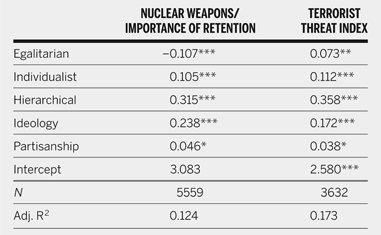
To test our hypotheses about the relationship between cultural orientations and beliefs about national security we estimate two linear models. Using the aforementioned dependent variables, the first model explains public beliefs about the importance of retaining nuclear weapons, and the second explains beliefs about threats posed by terrorism. In both models, each of the cultural orientation indices, along with ideology, partisanship, and the socio-demographic variables, are included as explanatory variables.Footnote 18 Table 1 summarizes the model results.
American Public Beliefs about National Security

The table above lists an abbreviated summary of two separate OLS Regressions; the full models included controls for age, education, gender, income, and minority status. Dependent variables are abbreviated in the first row.
* p < 0.05;
** p < 0.01;
*** p < 0.001
Beginning with beliefs about the importance of retaining nuclear weapons, our measures of cultural orientation behave in the theoretically expected fashion. All three CT coefficients exhibit a statistically significant impact, all of which are in the expected direction. Higher scores on the hierarchical index are associated with the belief that it is highly important to retain nuclear weapons. By comparison, higher scores on the egalitarian index are negatively related to beliefs about the importance of retaining the US arsenal. Lastly, as we expected, those who scored higher on the individualist index fall near the midpoint between the positions of hierarchs and egalitarians. Turning to beliefs about terrorist threats, again, all three of the CT coefficients are statistically significant and in the expected directions. Those people who score highly on the hierarchical index perceive substantially higher threats from terrorists. By contrast, those who score highly on the egalitarian and individualist indices perceive a much more moderate threat from terrorists.
The measure of political ideology was significant in both models. As compared to their liberal equivalents, conservative respondents think that retaining the US arsenal is important. Conservatism is also positively associated with perceptions of domestic terror threats. The effects of partisan scale also reached statistical significance, although with quite modest effect, in both models. The relevant import of these estimates is that the estimated effects of the cultural orientation scales were both substantively and statistically significant when regressed alongside the ideology and party measures. These effects indicate that CT makes an independent contribution to beliefs in both security domains when controlling for partisanship and ideology.Footnote 19
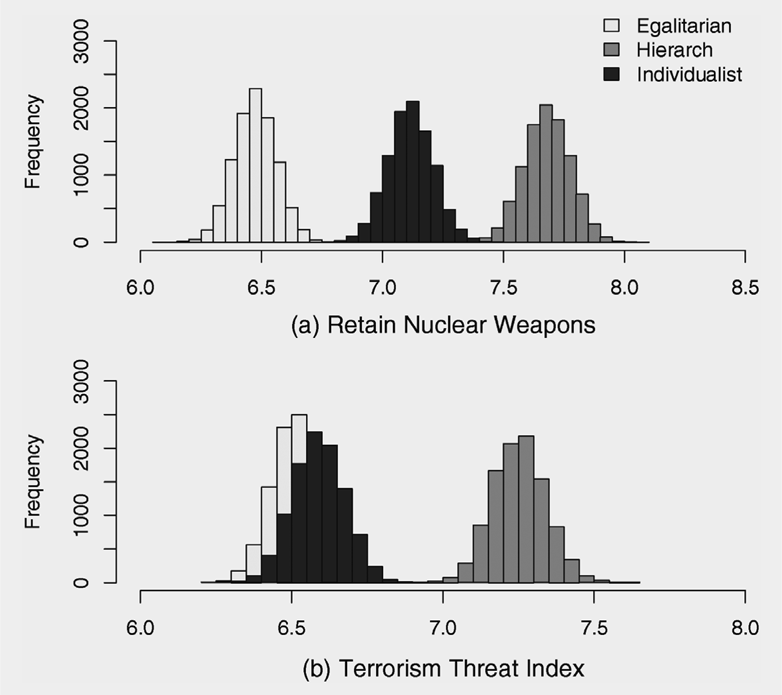
To interpret and explore the ways in which the relationships among cultural types vary across the two domains, figure 1 presents simulations based on the two models described in table 1.Footnote 20 In figure 1, the distributions represent the range of hypothetical responses that are estimated for each of the cultural types to the questions about national security.Footnote 21 For example, when looking at the simulated distributions in figure 1 (a), the hierarchical position stands in opposition to the egalitarian position on the importance of retaining nuclear weapons, while Individualists are sandwiched in the middle. Hierarchs believe that nuclear weapons are an integral part of US security policy. Egalitarians, by comparison, are less convinced that nuclear weapons continue to be important. Those with an individualist affinity are more ambivalent, perhaps reflecting their reluctant feelings about authority—even if they recognize that a degree of centralized power is a necessary precondition for maintaining a libertarian world where people are free to do as they wish. When we look at public beliefs about terrorist threats this pattern changes: individualists are no longer in the middle. Rather, as displayed in figure 1 (b), those with an individualist orientation clearly align with egalitarians, viewing terrorist threats as minimal, in contrast to hierarchs, who view these threats as more significant.
Simulated Effect of Cultural Orientations on National Security Beliefs

DISCUSSION AND CONCLUSION
This article has argued that CT, as applied in survey research, offers useful guidance for understanding public opinion as it bears on current and future beliefs about national security. Our empirical findings support the theoretical conjectures drawn from the theory, and do so while controlling for the potential confounding effects of both ideology and partisanship. What does CT offer us that theories based on partisanship or uni-dimensional political ideology do not? In our view, the unique contribution of CT lies in identifying the shifting “cultural coalitions” that are activated by varying perceptions of individual and group risks within distinct policy domains. Uni-dimensional ideological and partisan analyses, which tend to artificially collapse hierarchs and individualists into the “conservative” end of a one-dimensional spectrum, obscure the way in which these coalitions shift depending on the policy issue. This finding is precisely the kind of contribution for which Wildavsky (Reference Wildavsky1987) championed CT.
When contemplating future debates about nuclear weapons policy, our findings suggest that individualists will play a critical role that arbitrates an otherwise polar discussion between abolitionists (drawn disproportionately from those with egalitarian leanings) and nuclear advocates (who are likely to have hierarchical leanings). Individualists are therefore likely to be the “swing vote” that could be mobilized by either party. By comparison, individualists align with egalitarians in a relatively tightly knit bloc against hierarchs regarding terrorist threats, reflecting their shared aversion to intrusive government and suggesting that on this issue hierarchs stand alone and cannot expect individualists to move toward them.
Policy scholars have found it relatively easy to identify the polar positions in ongoing policy debates. The greatest payoff of the use of CT for policy analysis lies in understanding how people who hold less polarized positions may be influenced to shift coalitions by the design of policies and associated processes. William Riker described his “heresthetics” in precisely these terms, noting that skilled politicians find ways to structure the dimensions of dispute within policy debates such that formerly winning coalitions are split, and new winners arise (Riker Reference Riker1986). CT provides a more nuanced understanding than do analyses based solely on uni-dimensional conceptions of ideology or partisanship of how policy debates and processes can be shaped to appeal to those nonpolar orientations.