Introduction
Conduct disorder (CD) and attention deficit hyperactivity disorder (ADHD) are common childhood psychiatric disorders that are frequently co-morbid in clinic samples (Jensen et al. Reference Jensen, Hinshaw, Kraemer, Lenora, Newcorn, Abikoff, March, Arnold, Cantwell, Conners, Elliott, Greenhill, Hechtman, Hoza, Pelham, Severe, Swanson, Wells, Wigal and Vitiello2001). Children with both CD and ADHD have more severe symptoms and a worse prognosis in terms of adult antisocial personality disorder (ASPD) than children with either disorder alone (Barkley, Reference Barkley1998; Lahey et al. Reference Lahey, Loeber, Burke and Applegate2005). As childhood hyperactivity and CD have both been shown to be significant predictors of ASPD and criminality in early and mid-adult life (Vitelli, Reference Vitelli1998), a greater understanding of the aetiology of these disorders is paramount.
Environmental factors are influential in the development of CD (Farrington, Reference Farrington1989) but there is also evidence of heritability factors (Thapar et al. Reference Thapar, Harrington and McGuffin2001) and executive function (EF) deficits in CD and delinquency, particularly when ADHD co-morbidity has not been controlled for (Moffitt & Henry, Reference Moffitt, Henry and Miller1991; Hurt & Naglieri, Reference Hurt and Naglieri1992; Seguin et al. Reference Seguin, Pihl, Harden, Tremblay and Boulerice1995; Pennington & Ozonoff, Reference Pennington and Ozonoff1996; Morgan & Lilienfeld, Reference Morgan and Lilienfeld2000; Toupin et al. Reference Toupin, Déry, Pauzé, Mercier and Fortin2000; Dolan & Park, Reference Dolan and Park2002). In adults with ASPD, which is associated with childhood CD symptoms, there is also evidence of EF deficits (Dolan & Park, Reference Dolan and Park2002; Dolan, Reference Dolan2012) compared to healthy controls (HCs); however, none of the latter studies examined the contribution of co-morbid ADHD symptoms to EF deficits in adults with ASPD.
In the ADHD literature there is more extensive evidence of EF deficits such as planning, set shifting, response inhibition and working memory (Oosterlaan & Sergeant, Reference Oosterlaan and Sergeant1998; Murphy et al. Reference Murphy, Barkley and Bush2001; Seidman et al. Reference Seidman, Biederman, Monuteaux, Doyle and Faraone2001; Vance et al. Reference Vance, Maruff and Barnett2003; Martinussen et al. Reference Martinussen, Hayden, Hogg-Johnson and Tannock2005; Willcutt et al. Reference Willcutt, Doyle, Nigg, Faraone and Pennington2005; Barnett et al. Reference Barnett, Maruff, Vance, McStephen, Costin and Luk2009; see Rubia, Reference Rubia2011 for review). It has been suggested that one of the difficulties in understanding the nature and significance of neurocognitive deficits in CD and ADHD is the high level of co-morbidity between these disorders (Nigg et al. Reference Nigg, Carte, Hinshaw and Treuting1998; Oosterlaan & Sergeant, Reference Oosterlaan and Sergeant1998; Rubia, Reference Rubia2011). Although there are reports that co-morbidity between CD or oppositional defiant disorder (ODD) and ADHD results in greater EF impairments than in ADHD alone (Ackerman et al. Reference Ackerman, Anhalt and Dykman1986; Clark et al. Reference Clarke, Prior and Kinsella2000; Jensen et al. Reference Jensen, Hinshaw, Kraemer, Lenora, Newcorn, Abikoff, March, Arnold, Cantwell, Conners, Elliott, Greenhill, Hechtman, Hoza, Pelham, Severe, Swanson, Wells, Wigal and Vitiello2001; Hummer et al. Reference Hummer, Kronenberger, Wang, Dunn, Mosier, Kalnin and Mathews2011), there are also reports that co-morbidity between these disorders does not result in more severe EF impairments (Barkley et al. Reference Barkley, Edwards, Laneri, Fletcher and Metevia2001; van Goozen et al. Reference van Goozen, Cohen-Kettenis, Snoek, Matthys, Swaab-Barneveld and van Engeland2004; Oosterlaan et al. Reference Oosterlaan, Scheres and Sergeant2005; Sarkis et al. Reference Sarkis, Sarkis, Marshall and Archer2005; Barnett et al. Reference Barnett, Maruff, Vance, McStephen, Costin and Luk2009). The inconsistencies in the current literature on EF deficits in CD may be due to several factors including age, co-morbidity, how EF is measured and the means by which ADHD and CD diagnoses are identified.
A distinction has been made in the literature between ‘cool’ inferior frontostriatal EF and ‘hot’ ventromedial/orbitofrontal-limbic EF (Roiser et al. Reference Roiser, Rubinstein and Sahakian2003). As there are relatively few studies looking at EF in adolescents with CD with or without co-morbid ADHD, we examined cool EF (e.g. planning, set shifting and behavioural inhibition) and hot EF (including delay of gratification and a measure of response preservation) in a sample of incarcerated youth who had been characterized as having CD alone or CD + ADHD and compared them with HCs. It is thought that CD may be associated with greater impairments in motivational control and reward-based learning (hot EF) whereas ADHD is associated more with cool EF deficits (Rubia, Reference Rubia2011). We therefore hypothesized that those with CD + ADHD would have greater impairments in both hot and cool EF domains compared to HCs and those with CD alone, but also that the CD only group would have specific impairments in hot domains (delay of gratification/risk taking) than HCs. Given previous concerns over diagnostic co-morbidity and symptom overlap and the suggested benefits of a dimensional approach to understanding EF impairments (Hobson et al. Reference Hobson, Scott and Rubia2011), we also examined the relationship between EF task performance and measures of externalizing symptoms on the Child Behaviour Checklist (CBCL; Achenbach, Reference Achenbach1991) across the sample. We hypothesized that deficits in both hot and cool EF would be associated with higher scores on the externalizing scales of the CBCL across the study sample.
Method
Participants
Seventy-two male, right-handed adolescents aged between 13 and 18 years (mean age = 16.41, s.d. = 0.68 years) meeting DSM-IV criteria for CD [Kiddie Schedule for Affective Disorders and Schizophrenia (K-SADS); Kaufman et al. Reference Kaufman, Birmaher, Brent, Rao and Ryan1996] were recruited from secure care or prison establishments within the North West region of England. This CD group were screened for any current Axis I or II disorder including ADHD and substance misuse.
Thirty-five, right-handed male adolescents aged between 13 and 18 years (mean age = 15.97, s.d. = 0.96 years) meeting DSM-IV criteria for CD and ADHD (K-SADS; Kaufman et al. Reference Kaufman, Birmaher, Brent, Rao and Ryan1996) were also recruited from the same establishments. Those with ADHD co-morbidity included 15 hyperactivity/impulsive, six combined type, seven inattentive and seven not otherwise specified. Participants were also screened for current Axis I or II disorders and substance misuse.
Twenty healthy adolescent males (mean age = 15.63, s.d. = 1.50 years) were recruited from socio-economically matched schools within the local area. These HCs were screened for Axis I and II disorders including CD and ADHD (K-SADS; Kaufman et al. Reference Kaufman, Birmaher, Brent, Rao and Ryan1996). None of the three groups were on medication at the time of assessment. None of the participants had used illicit substances in the month prior to testing.
Procedure
The study was approved by the North West Multi-centre Research Ethics Committee and written informed consent was obtained from all participants, with additional parental/guardian consent for those under the age of 16 years. Participants were tested individually in an interview room attached to their ward/wing and testing took place within one 4-h session with breaks. The Wechsler Abbreviated Scale of Intelligence (WASI; Wechsler, Reference Wechsler1999) was used to measure intellectual function. EF ‘cool’ tasks used in the battery included: the Stockings of Cambridge (SOC; Owen et al. Reference Owen, Downes, Sahakian, Polkey and Robbins1990) planning task and the Intra-Dimensional/Extra-Dimensional (ID/ED; Rogers et al. Reference Rogers, Blackshaw, Middleton, Matthews, Hawtin, Crowley, Hopwood, Wallace, Deakin, Sahakian and Robbins1999) set-shifting tasks from the Cambridge Neuropsychology Test Automated Battery (CANTAB; Fray et al. Reference Fray, Robbins and Sahakian1997). Behavioural inhibition was assessed using the Go/NoGo response inhibition task (Rubia et al. Reference Rubia, Russell, Overmeyer, Brammer, Bullmore, Sharma, Simmons, Williams, Giampietro, Andrew and Taylor2001). EF tasks with a ‘hot’ component included: the Card Playing Task (CPT; Newman et al. Reference Newman, Patterson and Kosson1987) and the Delay of Gratification Task (DGT; Newman et al. Reference Newman, Kosson and Patterson1992), which were also administered on a computer fitted with a touch-sensitive monitor. Tests were administered in a set order (SOC, CPT, Go/NoGo, DGT, ID/ED) to all participants.
Measures
CBCL
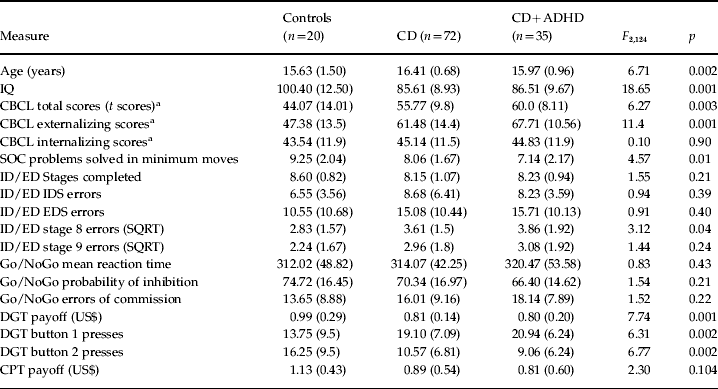
The CBCL has eight subscales (withdrawal problems, somatic complaints, anxious/depressed, social problems, thought problems, attention problems, delinquent behaviour, and aggressive behaviour) and two broad domains: internalizing (consisting of withdrawn, somatic complaints and anxious/depressed scales) and externalizing (consisting of delinquent and aggressive behaviour scales). Raw scores for the Internalizing, Externalizing and Total scores were transformed to t scores based on a normative sample of children of the same sex and age range. Past research has demonstrated the validity and reliability of the CBCL in clinical settings (Achenbach, Reference Achenbach1991). The mean CBCL overall t scores for each group are shown in Table 1. The mean CBCL total score for the entire sample was 55.74 (s.d. = 10.7).
Characteristics of the sample and mean (s.d.) scores on neuropsychological tests

CD, Conduct disorder; ADHD, attention deficit hyperactivity disorder; CBCL, Child Behaviour Checklist; SOC, Stockings of Cambridge; ID/ED, Intra-Dimensional/Extra-Dimension set-shifting tasks; IDS, intra-dimensional shift; EDS, extra-dimensional shift; SQRT, square root transformation; DGT, Delay of Gratification task; CPT, Card-Playing Task; s.d., standard deviation.
a Data available for 13 controls only (df = 2, 117).
SOC
This task measures spatial planning. Subjects are required to move coloured ‘balls’ in an arrangement on the bottom half of the screen to match a goal arrangement on the top half of the screen. Each problem has a specified minimum number of moves that increases with difficulty (from two to five moves). Subjects were instructed to examine the position of the balls at the beginning of each problem and encouraged not to make a move until they were confident that they could execute the entire sequence needed to solve the problem. Initial and subsequent latencies were recorded during each of the trials to provide an estimation of cognitive speed. For each planning trial, a ‘yoked control’ trials condition was used. During these yoked control trials, subjects were required to execute a sequence of single moves that replicate the moves made on the earlier planning trials. Measures of initial thinking times were calculated for each move by subtracting the motor initiation time for yoked control problems from the total initiation time in the corresponding test problems. Subsequent thinking times were calculated in the same manner. Test trials and yoked control trials were arranged in four blocks of six problems each. Accuracy of performance was assessed by the number of problems completed in the minimum number of moves specified (perfect solutions), the average number of moves executed above the minimum at each difficulty level (moves above the minimum), and planning times at each level. Latencies were recorded in centiseconds. Initial thinking time was the time between the presentation of the problem and the first touch minus the corresponding motor initiation time calculated from the yoked control task. The subsequent thinking time was the time between the first selection of the ball and the completion of the problem minus the total motor execution time from the control condition.
ID/ED set-shifting task
The ID/ED set-shifting task is a computerized analogue of the Wisconsin Card Sort Task (WCST; Heaton, Reference Heaton1981). It requires subjects to learn a series of visual discriminations, using feedback provided by the computer, in which one of two stimulus dimensions is relevant and the other is not. The task assesses the subject's ability to maintain attention to different examples within the same dimension (intra-dimensional stages) and then to shift attention to a previously irrelevant dimension (extra-dimensional stages). An intra-dimensional shift (IDS) occurs when a subject, trained to respond to a particular stimulus dimension (e.g. shape), is required to transfer the rule to a new set of examples of the same stimulus dimension. An extra-dimensional shift (EDS) occurs when a subject is required to shift a response set to an alternative previously irrelevant dimension. For each of the nine stages, subjects proceed to the next stage when a criterion of six consecutive correct responses has been attained. If this criterion is not reached after 50 trials, the computer automatically terminates the test. Performance was examined by the percentage of subjects reaching the criterion for each stage, the mean number of stages completed and the number of errors made at each key IDS and EDS stage.
Go/NoGo task
The Go/NoGo task assesses response selection/inhibition and is an adaptation of the Schacher & Logan (Reference Schacher and Logan1990) task developed by Rubia et al. (Reference Rubia, Russell, Overmeyer, Brammer, Bullmore, Sharma, Simmons, Williams, Giampietro, Andrew and Taylor2001) for use in ADHD samples. A motor response is either initiated (Go) or inhibited (No/Go) depending on whether an aeroplane (Go) or a bomb (No/Go) stimulus appears on the screen. Visual stimuli appear on the screen in a random order for a duration of 200 ms, with an inter-trial interval of 1600 ms. Seventy per cent of the stimulus are aeroplanes (Go stimulus) and 30% bombs (No/Go stimulus). The task was administered as two blocks of 90 trials after an initial practice block to ensure adequate understanding of the task. Subjects were instructed to press a response button as fast as they could to the Go stimuli, but not press when the No/Go stimulus appeared. Errors of commission, the percentage inhibition (primary output) and mean reaction time were computed.
CPT
A computerized modification (Newman et al. Reference Newman, Patterson and Kosson1987) of Siegel's (Reference Siegel1978) original card-playing task was used to assess the ability to inhibit a previously conditioned response set for reward in the face of changing contingencies. Subjects commenced the game with a ‘pot’ of 10 tokens, and saw only the back of the top playing card on the deck. On each trial subjects could chose to play the next card or quit the game. Subjects were told that the task did not involve a standard deck of cards so they could not predict how many of each card would appear. Subjects received a token if a picture card was turned over, but forfeited a token if a number card appeared. Unknown to the subject, the probability of losing increases linearly by 10% with each successive block of 10 cards (from 10% to 100%). Subjects could play up to 100 cards, with an option to quit at any time. Maximum earnings could be achieved by playing midway into the deck. Further card playing was taken as evidence of risk-taking behaviour. The dependent variable was the sum of money left in the ‘pot’ at the end of the task.
DGT
The DGT was used to assess the ability to tolerate delays in earning rewards. Subjects were presented with 30 trials, each involving a choice between an immediate response button (with a 40% chance of reward) and a delayed response button with a more desirable outcome (80% chance of reward). There was no cost–response on non-reward trials. Prior to commencement of the task, subjects participated in a training session to provide exposure to the workings of the task. The probability of winning or losing was identical in the practice and test trials, as were the delay intervals. Variables of interest were the number of impulsive responses (button 1 presses) and the ultimate payoff.
Data analysis
The data were analysed using SPSS version 18 (SPSS Inc., USA). Percentage data on the SOC task were arcsine transformed prior to analysis. Performance on the SOC task was compared between groups (control v. CD v. co-morbid CD + ADHD) using a group × task difficulty repeated-measures ANCOVA with IQ as covariate. Performance on the ID/ED set-shifting task was examined according to the percentage of subjects who succeeded in reaching criterion (six consecutive correct responses) at each key stage of the task. Contingency tables were analysed using the likelihood ratio method with the resulting statistic 2i being distributed as χ2. The number of stages completed and the number of errors for the EDS and EDR stages on the ID/ED task were compared between groups using ANOVAs and ANCOVAs. The number of errors was square root (SQRT) transformed prior to analysis to reduce skewness. For the Go/NoGo task, group comparisons were conducted on the probability of inhibition and errors of commission. For the CPT and DGT the primary output was total payout, but DGT data on button 1 (low delay/low reward) and button 2 (longer delay/higher reward) were also computed. IQ was a covariate in all group comparisons. Correlations between CBCL externalizing scores and performance on dimensional scores on EF tasks across the sample were examined using Spearman's r.
Results
There were significant group differences in age and IQ (see Table 1). The CD only group was significantly older than the HCs. The CD and CD + ADHD groups had significantly lower mean IQ than the HCs but did not differ significantly from each other. There was no significant correlation between age and any measures of neuropsychological function. However, IQ was correlated significantly with performance on several EF tasks so data are reported with and without statistical correction for IQ, given the debate on the appropriateness of co-varying for IQ as it may mask EF deficits in clinical samples (Arffa et al. Reference Arffa, Lovell, Podell and Goldberg1998; Mahone et al. Reference Mahone, Hagelthorn, Cutting, Schuerholz, Pelletier, Rawlins, Singer and Denckla2002; Harrier & DeOrnellas, Reference Harrier and DeOrnellas2005). Thus, group mean (s.d.) performance and statistical comparisons prior to IQ correction are summarized in Table 1. The analyses for group comparisons cited in the text, however, are corrected for IQ differences.
SOC planning task
Solutions within the minimum
Across the 12 test problems, there were significant group differences that remained significant after controlling for IQ (F 2,123 = 4.57, p < 0.05). Post-hoc testing revealed that the co-morbid CD and ADHD group solved significantly fewer problems within the minimum number of moves than CD or the HCs (mean difference −1.47, p < 0.05; mean difference −0.95, p < 0.05) but the CD group and HCs showed no difference (see Table 1). There were no significant correlations between the total moves within the minimum across all stages and the CBCL externalizing score or any of its components.
Perfect solutions
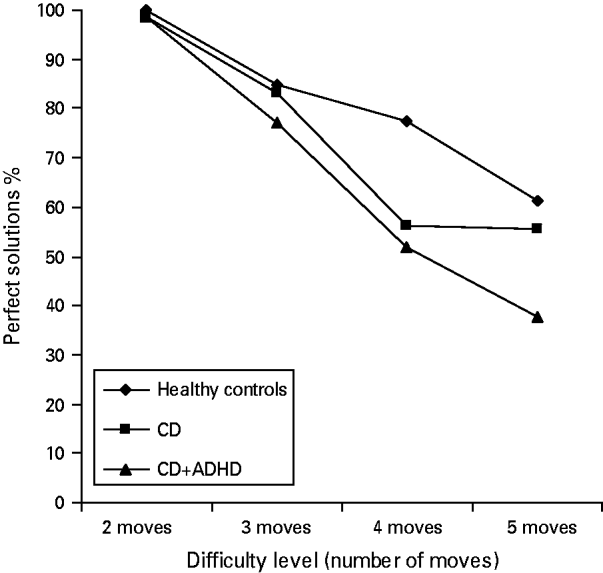
After controlling for IQ, there was a significant main effect of group (HCs v. CD v. CD + ADHD) in the number of problems solved perfectly (F 2,123 = 3.67, p < 0.05), a significant effect of task difficulty (F 3,123 = 8.31, p < 0.001), and a significant group × difficulty interaction (F 6,123 = 3.78, p < 0.001). The groups did not differ on the two- (F 2,123 = 0.01, n.s.) and three-move problems (F 2,123 = 0.74, n.s.) but there were significant group differences in performance on the four- (F 2,123 = 6.45, p < 0.01) and five- (F 2,123 = 6.65, p < 0.01) move problems, as shown in Fig. 1. For the four-move problem, post-hoc testing indicated that the HC group performed significantly better than the CD and CD + ADHD groups (mean difference 0.28, p < 0.01; mean difference 0.35, p < 0.01) but the CD and CD + ADHD groups did not differ. For the five-move problem, the CD + ADHD group performed significantly worse than both the CD and HC groups (mean difference −0.27, p < 0.001; mean difference −0.38, p < 0.001) but the CD and HC groups did not differ. There were no significant correlations with the CBCL externalizing or subscale scores.
The performance of adolescents with conduct disorder (CD), co-morbid CD and attention deficit hyperactivity disorder (ADHD) and healthy controls (HCs) on the Stockings of Cambridge (SOC) task.
Solutions within maximum moves allowed
With regard to the number of problems solved within the maximum, there was no significant effect of group (F 2,123 = 2.64, p = 0.07) but there was a task difficulty effect (F 3,123 = 8.12, p < 0.001) and significant group × difficulty interaction (F 6,123 = 4.51, p < 0.001). There were only significant group differences for problems solved within the maximum for four-move problems (F 2,123 = 8.15, p < 0.001). Post-hoc testing indicated that the CD and CD + ADHD groups were impaired on the four-move problems (mean difference 0.31, p < 0.01; mean difference 0.38, p < 0.001) compared with HCs. There were no significant correlations with CBCL externalizing and subscale scores.
Planning time
For initial planning, there was a significant effect of task difficulty (F 2,123 = 4.84, p < 0.05) but no significant effect of group (F 2,123 = 0.55, n.s.) or significant group × task difficulty interaction (F 6,123 = 0.78, n.s.). On subsequent thinking time, there was no significant effect of task difficulty (F 6,123 = 0.68, n.s.), effect of group (F 2,123 = 0.51, n.s.) or significant group × task difficulty interaction (F 6,123 = 0.90, n.s.). There were no significant correlations with CBCL externalizing and subscale scores.
ID/ED set-shifting task
Attrition rates
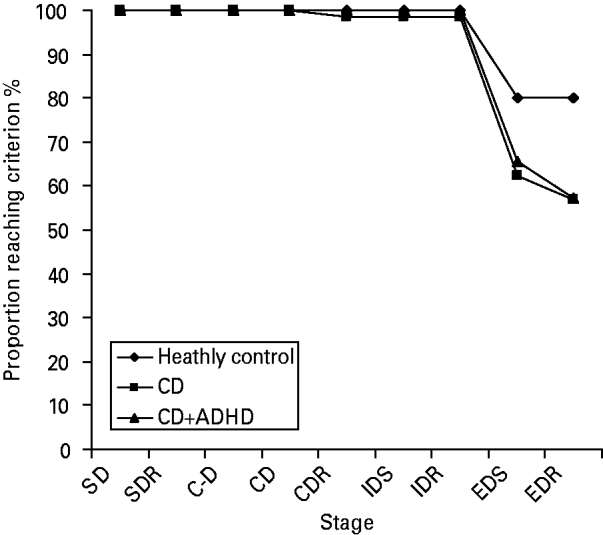
There were no significant group differences between the proportions of participants reaching criterion across the task (χ2 = 4.03, df = 2, n.s.). However, Fig. 2 shows that the CD group and the CD + ADHD group had greater rates of attrition at stage 8 (EDS) and stage 9 (EDR), although neither reached significance (EDS: χ2 = 2.29, df = 2, n.s.; EDR: χ2 = 4.03, df = 2, n.s.). There were no significant group differences in the number of stages completed (see Table 1).
Cumulative percentage of adolescents with conduct disorder (CD), co-morbid CD and attention deficit hyperactivity disorder (ADHD) and healthy controls (HCs) reaching criterion at each stage of the Intra-Dimensional/Extra-Dimensional (ID/ED) task. Stages: SD, simple discrimination; SDR, simple reversal; C-D, compound discrimination; CD, superimposed compound discrimination; CDR, superimposed compound discrimination reversal; IDS, intra-dimensional shift; IDR, intra-dimensional reversal; EDS, extra-dimensional shift; EDR, extra-dimensional reversal.
Number of errors
Participants’ performance was examined in terms of the number of errors made at each stage. The error score on each stage not completed due to failure was taken as 25 because subjects had to complete 50 trials to fail a stage and half of these could be performed by chance. There were no significant group differences for any of the stages. An analysis of the number of errors made before reaching the criterion for the EDS and EDR stages revealed no significant group differences for the EDS (F 2,123 = 2.21, n.s.) or the EDR stage (F 2,123 = 0.41, n.s.). The total errors on the overall ID/ED task, regardless of stage, were correlated positively with the CBCL externalizing score (r = 0.22, p < 0.05), which was primarily due to the delinquency subscale scores (r = 26, p < 0.01).
Go/NoGo task
There were no significant group differences on performance measures on the Go/NoGo task. However, on the correlational analyses, there were significant negative correlations between the CBCL externalizing score and percentage inhibition (r = − 0.29, p < 0.001), which were attributable to the attention (r = − 0.21, p < 0.05), delinquency (r = − 0.29, p < 0.001) and aggression CBCL scales (r = − 0.26, p < 0.01).
CPT
There were no significant group differences on the payout of the CPT. However, CBCL externalizing scores were negatively correlated with CPT payout (r = − 0.18, p < 0.05), which were primarily due to the CBCL attention (r = − 0.29, p < 0.001) and delinquency scores (r = − 0.20, p < 0.05). The correlation with the aggression scale subscale was not significant (r = − 0.11, n.s.).
DGT
There were significant group differences on the payout and the number of button 1 and 2 presses, with the CD and CD + ADHD groups having significantly lower payouts and more button 1 (low delay low reward) than button 2 (longer delay higher reward) responses than HCs. These findings survived correction for IQ [payout (F 2,123 = 2.43, p < 0.05), button 1 (F 2,123 = 3.68, p < 0.05); button 2 (F 2,123 = 3.81, p < 0.05)]. Table 1 shows the mean scores. There were significant negative correlations between the payoff score of the DGT and the CBCL externalizing subscale (r = − 0.23, p < 0.05). The latter correlations were primarily due to the delinquency (r = − 0.206, p < 0.05) and aggression subscales (r = − 0.25, p < 0.001) rather than the attentional subscale, which was not significant.
Discussion
Recently, developmental imaging studies have led to the notion that there is a distinction between cool cognitive EFs, which are thought to be mediated by lateral inferior and dorsolateral frontostriatal and frontoparietal networks, and hot EFs, which explore motivation and incentive and are thought to be associated with paralimbic-orbitomedial and ventromedial frontolimbic structure and function (for reviews, see Rubia, Reference Rubia2011; Sahakian & Morein-Zamir, Reference Sahakian, Morein-Zamir, Delgado, Phelps and Robbins2011). It is now important to attempt to map findings from neuropsychological studies looking at EF deficits in a variety of clinical disorders relevant to these neurobiological substrates.
In this study we examined a range of EFs that putatively tap cool and hot EFs in a sample of adolescents with CD with and without co-morbid ADHD and an HC sample screened for these disorders. We also examined relationships between indices of relevant psychopathology and neurocognitive profiles across the study cohort to explore dimensional relationships that might better inform the field, given concerns over diagnostic co-morbidity between disorders. Our approach should improve our understanding of both the common and distinctive neurocognitive underpinnings of these disorders and lead a better understanding of the endophenotypes. We assessed an adolescent sample because many of the published data on EF focus on younger cohorts and there are limited data on adolescent samples even though this is a key transitional phase where levels of impulsivity and attentional problems in ADHD may be abating (Biederman et al. Reference Biederman, Petty, Clarke, Lomedico and Farone2011).
Cool EF
We found significant group differences in planning ability, particularly the efficiency of problem solving (i.e. minimum number of moves; perfect solutions; excess moves). Overall, our initial contrasts indicated that the CD + ADHD groups solved fewer problems within the minimum number of moves and had lower levels of perfect solutions than HCs, particularly at higher levels of task difficulty. Results for the CD only group were not significantly different from the controls on all aspects of the task and differences only emerged for solutions within the maximum at the four-move problem. We also found no significant correlations between performance on the planning tasks and scores on the externalizing scale of the CBCL. Our findings seem to fit with the notion that ADHD rather than CD is associated with impairments in cool EFs such as planning ability (Rubia, Reference Rubia2011), but it is possible that the lack of an association between the severity of attentional problems and planning difficulties may be related to the fact that we assessed an adolescent cohort in whom attentional problems were lessening.
Set shifting
Overall, we found no significant group differences in several indices of set-shifting ability on the ID/ED task, another measure of cool EF. Despite the increased attrition rates at the EDS and EDR stages of this task in our CD + ADHD group and our CD group compared to HCs, these did not reach significance after controlling for IQ. The lack of a significant group difference in cognitive flexibility in a similar task was noted by Hobson et al. (Reference Hobson, Scott and Rubia2011) . We did, however, find that, across the sample, the number of errors on this task was positively correlated with CBCL externalizing and particularly delinquency scores but not with attentional scores. This suggests that impairments in set shifting may be related to the severity of conduct problems rather than to a specific or defining feature of either CD or ADHD. As set-shifting impairments have been noted in adults with ASPD (Dolan & Park, Reference Dolan and Park2002; Dolan, Reference Dolan2012) and habitual offenders (Moffitt & Henry, Reference Moffitt, Henry and Miller1991) and those with severe conduct problems (Lueger & Gill, Reference Luegar and Gill1990; Toupin et al. Reference Toupin, Déry, Pauzé, Mercier and Fortin2000), it may be a marker for persistent antisocial behaviour. Given our finding that cognitive inflexibility correlates with the severity of delinquency scores, future studies should include a dimensional approach to assessments; this could aid our understanding of links between neurocognitive function and psychopathology in cohorts where categorical diagnostic co-morbidity is likely to be high.
Behavioural inhibition
Although we found no group differences in indices of behavioural inhibition, we did note significant negative correlations between the ability to inhibit a response and CBCL externalizing scores, particularly the attention, delinquency and aggression scores across the sample. Previous studies have reported deficits in inhibition in CD (Oosterland & Seargent, Reference Oosterlaan and Sergeant1998; Geurts et al. Reference Geurts, Verté, Oosterlaan, Roeyers and Sergeant2004) and in ADHD (Rubia et al. Reference Rubia, Russell, Overmeyer, Brammer, Bullmore, Sharma, Simmons, Williams, Giampietro, Andrew and Taylor2001, Reference Rubia, Russell, Overmeyer, Brammer, Bullmore, Sharma, Simmons, Williams, Giampietro, Andrew and Taylor2007; Willcutt et al. Reference Willcutt, Doyle, Nigg, Faraone and Pennington2005). Differences in the nature of the samples studied may account for the divergent findings from a categorical perspective but our findings again point to the value of a dimensional approach to symptom measurement as it provides greater clarity in understanding endophenotypes in disorders that are frequently co-morbid.
Hot EF
It has been suggested that CD in particular may be associated with impairments in hot EF tasks that include a motivational component, such as CPT or DGT, which include a financial or other penalty (Newman et al. Reference Newman, Patterson and Kosson1987; van Goozen et al. Reference van Goozen, Cohen-Kettenis, Snoek, Matthys, Swaab-Barneveld and van Engeland2004; Hobson et al. Reference Hobson, Scott and Rubia2011; see Rubia, Reference Rubia2011 for review). To date, there are still a limited number of studies that have explored this issue in relation to CD/ADHD co-morbidity and externalizing behaviours (Hobson et al. Reference Hobson, Scott and Rubia2011).
Although we found no significant group differences in performance on the CPT, the CBCL externalizing scores were negatively correlated with ultimate payout and this was primarily due to the attentional and delinquency scores on the CBCL. Our findings seem to suggest that poor attention and the severity of delinquency problems (regardless of diagnostic group) influenced disadvantageous risky behaviours that resulted in financial penalty. It is possible that the conflicting findings in the literature on risk-taking behaviour may be influenced by task, as studies using the Iowa Gambling Task (IGT; Bechara et al. Reference Bechara, Damsio, Tranel and Demasio1997) suggest that ADHD (Toplak et al. Reference Toplak, Jain and Tannock2005) and CD/ODD are associated with impairments.
On the DGT, which is also a punishment-based task, we found that the CD only and CD + ADHD groups performed worse than HCs in terms of ultimate payout. We also found significant negative correlations between payout and CBCL externalizing scores in the delinquency and aggression but not attentional domains. This seems to suggest that it is the antisocial/behavioural components of these disorders that contribute to the inability to delay gratification in the face of financial penalty. Previous studies looking at the ability to delay gratification in antisocial samples highlight the importance of looking at the impact of anxiety on task performance (Newman et al. Reference Newman, Kosson and Patterson1992), so future studies should explore this issue in relation to both reward and punishment-based tasks.
Overall, our findings seem to suggest that CD with co-morbid ADHD is associated with a greater range of both hot and cool EF deficits compared to HCs. Although this is generally in line with Hummer et al. (Reference Hummer, Kronenberger, Wang, Dunn, Mosier, Kalnin and Mathews2011), who found that disruptive behaviour disorders + ADHD was associated with greater EF deficits than ADHD alone, our findings also suggest that EF task selection may be an important issue as we found some subtle differences between CD and HCs in higher-order planning ability, which was not tested in the latter study. Given the variability in findings for group comparisons on tasks that putatively assess hot and cool EFs, we suggest that the lack of consistency in distinguishing CD only from CD + ADHD and HCs on the hot versus cool task model is due to the degree of symptom overlap between clinical groups and perhaps HC groups. Indeed, the most notable findings in this study relate to our dimensional approach to assessment across disorders, which seems to offer more insight into brain–behaviour relationships as we frequently noted significant negative correlations (even in the absence of group differences) between dimensions of externalizing behaviour and performance on a range of hot and cool EFs across the sample. Given that poor decision making in gambling tasks has also been found to be related to parent-reported symptoms and disruptive behaviour in ADHD (DeVito et al. Reference DeVito, Blackwell, Kent, Ersche, Clark, Salmond, Dezsery and Sahakian2008), it is important that future studies use a combined categorical and dimensional approach to increase our understanding of the significance of observed EF deficits in clinical samples. This study was limited to incarcerated males and the sample were screened for Axis I disorders, substance abuse and current medication. Thus the findings may not be generalizable to other clinic samples that may have higher rates of co-morbid disorders.
Acknowledgements
This study was funded by the National Forensic Mental Health Program.
Declaration of Interest
None.