1. Introduction
Palaeoevironmental trends in the Cruse Formation of southern Trinidad are little understood (Jones, Reference Jones, Ali, A. Paul and Young On1998). This is largely because the foraminiferal community consists primarily of agglutinated foraminifera (Batjes, Reference Batjes and Saunders1968; Brönnimann, Reference Brönnimann1951, Reference Brönnimann1953; Bolli et al. Reference Bolli, Beckmann and Saunders1995). These have been suggested to have affinities with deep-water agglutinated foraminifera (DWAF, see Jones, Reference Jones, Ali, A. Paul and Young On1998), but their community palaeoecology has yet to be examined in detail. The few previous papers on the foraminifera of the Cruse Formation have either been taxonomic or used qualitative data. Brönnimann (Reference Brönnimann1951) described the alveolar genera Guppyella, Alveovalvulina and Discamminoides from the Cruse Formation but noted that morphologically related forms occur in the underlying Nariva, Cipero and Karamat Formations, of which Stainforth (Reference Stainforth1948) suggested the Cipero was deposited at palaeodepths of 400–500 m. Brönnimann (Reference Brönnimann1953) added Eggerella forestensis Brönnimann, Valvulina flexilis (Cushman & Renz, Reference Cushman and Renz1941), (?)Haplophragmoides aff. H. narivaensis (Brönnimann), Recurvoides obsoletum (Göes) and Recurvoides higginsi Brönnimann to the list of Cruse Formation species. He did not, however, examine the distribution of these species within the formation. Batjes (Reference Batjes and Saunders1968) interpreted the Cruse Formation as consisting of a shallowing-upwards succession that progresses from a bathyal to abyssal palaeoenvironment with Cyclammina cancellata, through a shallower delta front palaeoenvironment with entirely agglutinated Glomospira and Alveovalvulina assemblages. However, his work was based on widely spaced samples. There have not yet been any high-resolution studies of Cruse foraminiferal communities.
The Cruse Formation, although deposited in a tectonically induced foredeep developed on South American continental crust (Croce, Reference Croce1996), represents the diversion of the palaeo-Orinoco River toward the eastern Venezuela/Trinidad area. Prior to the Late Miocene, the palaeo-Orinoco flowed northwards into the Caribbean Sea through western Venezuela (Díaz de Gamero, Reference Díaz de Gamero1996). This diversion is on Trinidad marked by the virtual disappearance of planktonic and calcareous benthonic foraminifera, which were abundant in the Lengua Formation (Bolli, Reference Bolli1957) but virtually absent from the succeeding Cruse Formation (Bolli et al. Reference Bolli, Beckmann and Saunders1995). Batjes (Reference Batjes and Saunders1968) thought this exclusion was due to the influx of turbid riverine water during Late Miocene times. Planktonic and calcareous benthonic foraminifera are abundant, however, on the modern continental shelf and slope SE of the island (Drooger & Kaasschieter, Reference Drooger and Kaasschieter1958; Pocknall et al. Reference Pocknall, Wood, Geen, Harry, Hedlund, Goodman and Clarke2001; Wilson, Reference Wilson2006, Reference Wilson2010) despite this area lying within the hyperpycnal Orinoco low-salinity plume (Agard & Gobin, Reference Agard, Gobin and Sheppard2000; Wilson, Reference Wilson2007, Reference Wilson2008a ), so water clarity seems an unlikely mechanism to explain the agglutinated Miocene assemblage. Jones (Reference Jones, Ali, A. Paul and Young On1998) thought the exclusion of calcareous matter might either be (a) penecontemporaneous and due to elimination from surface water of marine phytoplankton, which serve as food for at least some planktonic and deep-water benthonic calcareous foraminifera, or (b) diagenetic and due to salinity stratification, which would reduce circulation and oxygenation of bottom waters, allowing dissolution of calcite by acids released from decaying organic matter.
Jones et al. (Reference Jones, Jones, King, Shaw, Jones and Simmons1999) examined the ecostratigraphy of the Upper Miocene of the Pedernales area of nearby eastern Venezuela. Their study was based on widely spaced (6–30 m) ditch-cutting samples augmented by a few cores. They postulated the occurrence of distinguishable clear- and turbid-water biofacies schemes, and wrote that times of turbid water were characterized by Glomospira, Alveovalvulina/Silicosigmoilina (= Spirosigmoilinella of this paper) and Cyclammina biofacies. However, they suggested (Jones et al. Reference Jones, Jones, King, Shaw, Jones and Simmons1999, fig. 6B) that the palaeodepth ranges of these biofacies overlapped, the Glomospira biofacies occurring from outer shelf (= outer neritic?) to basin (= abyssal?) palaeodepths and the Alveovalvulina/Silicosigmoilina biofacies at continental slope (= bathyal?) to basin palaeodepths. The Glomospira biofacies contained accessory Saccammina sp., Ammodiscus sp., Haplophragmoides carinatus, ?Spirosigmoilinella tenuis, Sigmoilopsis schlumbergeri and Cyclammina cancellata, while the Alveovalvulina/Silicosigmoilina biofacies contained accessory Saccammina sp., Psammosiphonella, Glomospira gordialis, C. cancellata, Martinottiella pallida and S. schlumbergeri. Jones et al. (Reference Jones, Jones, King, Shaw, Jones and Simmons1999) favoured the explanation of the exclusion of calcareous specimens as resulting from early diagenetic reactions involving the decomposition of organic matter.
Wood (Reference Wood2000) suggested she could distinguish five distinct palaeoenvironments in the marine Pliocene and Pleistocene off SE Trinidad using benthonic foraminifera, all but one of which contain a major agglutinated component:
(a) Fluvial/estuarine/transitional barrier island areas with abundant Miliammina, Arenoparrella and Ammonia;
(b) Prograding shoreface with a succession grading from Buliminella spp., Planulina foveolata and Bolivina multicostata, through increased abundances of Uvigerina on the middle shelf, to Amphistegina lessonii, Nonionella atlantica and Bolivina spinata in inner shelf sediment;
(c) Slope fan with consistent Guppyella miocenica, Trochammina trincherasensis, Cyclammina cancellata, planktonic foraminifera and occasional Haplophragmoides carinatus, H. narivaensis, Bathysiphon spp. and Reticulophragmium venezuelanum;
(d) Basin-floor fans with abundant planktonic foraminifera and benthonic species that include Recurvoides obsoletum, C. cancellata, Ammodiscus spp. and Alveovalvulina suteri;
(e) Condensed section facies with consistent and abundant Repmanina charoides, A. suteri and R. venezuelanum.
It is difficult to match Wood's (Reference Wood2000) biofacies with those postulated by Jones et al. (Reference Jones, Jones, King, Shaw, Jones and Simmons1999).
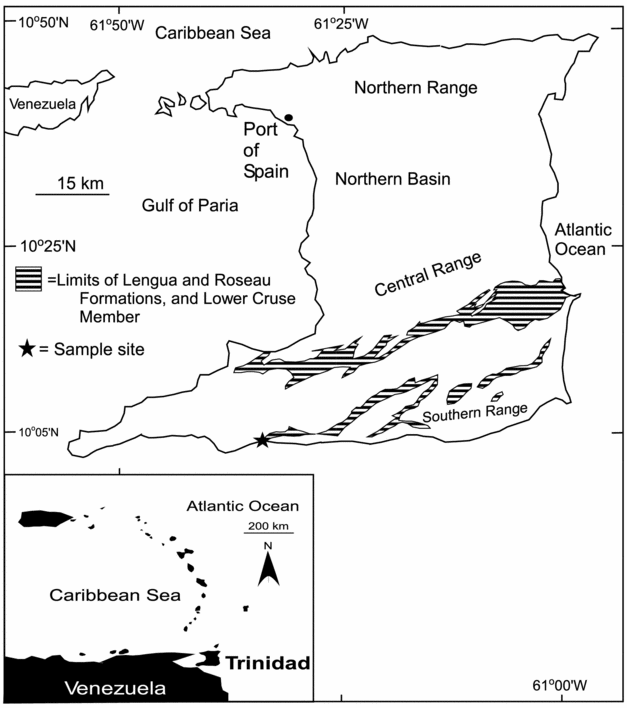
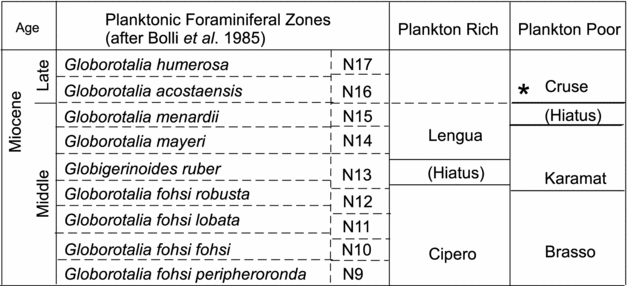
This paper reports the palaeoecology of benthonic foraminiferal assemblages in the lower part of the Cruse Formation of southern, onshore Trinidad (Figs 1, 2). This formation, although lacking planktonic foraminifera, is traditionally assigned to the Late Miocene Globorotalia acostaensis and Globorotalia humerosa planktonic foraminiferal zones (Bolli et al. Reference Bolli, Beckmann and Saunders1995, fig. 49) (= Zone M13 of Berggren et al. Reference Berggren, Kent, Swisher, Aubry, Berggren, Kent, Aubry and Hardenbol1995). These zonal assignments are based on superposition. Wade et al. (Reference Wade, Pearson, Berggren and Pälike2011) suggested M13 to range between ~9.79 and 6.0 Ma. Croce (Reference Croce1996, p. 154) thought the Cruse Formation to be part of a sequence stratigraphic unit bounded by sequence boundaries that, even though Trinidad is on a tectonically active plate margin, could be correlated with the 10.5 and 5.5 eustatic sequence boundaries on the sea-level chart of Haq et al. (Reference Haq, Hardenbol, Vail, Wilgus, Hastings, Posamentier, Van Wagoner, Ross and Kendall1988).
Trinidad, showing the extent of the Lengua and Roseau formations, and the Lower Cruse Member, with sampled site marked by an asterisk. Inset shows Trinidad in relation to the eastern Caribbean Sea and NE South America.

Middle and Upper Miocene stratigraphy of Trinidad. Asterisk shows approximate position of sampled locality.

2. Materials and Methods
Twenty-two samples of ~0.5 kg were collected from the wave-cut platform along Quinam Bay (Fig. 1) just east of Palmiste Point but west of the Coora Road. The rocks there have been mapped as ‘undifferentiated Cruse Formation’, with beds dipping to the south at approximately 70° and striking parallel to the coastline. Beds young to the west along the section sampled with sample numbers increasing with increasing age. The section overlies the contorted sandstone beds that are exposed along the coast. Proximity to a mapped exposure of the Lengua Formation suggests the section is close to the base of the Cruse Formation, but the exact field relationship with the Lengua Formation is uncertain. The examined exposure is thus tentatively assigned to the Globorotalia acostaensis Zone (= Zone M13a of Wade et al. Reference Wade, Pearson, Berggren and Pälike2011; 9.79–8.52 Ma). The samples, which comprised almost entirely bioturbated silt and clay, were taken at 0.5 m intervals and numbered Qu1 (section top) to Qu22 (section base).
The samples were soaked in tap water until disaggregated, washed over a 63-μm mesh to remove silt and clay, and air dried. The residue was picked entirely clean of foraminifera, which were sorted into species using Cushman (Reference Cushman1910, Reference Cushman1918, Reference Cushman1937), Cushman & Renz (Reference Cushman and Renz1941), Renz (Reference Renz1948), Brönnimann (Reference Brönnimann1951, Reference Brönnimann1953), Bolli et al. (Reference Bolli, Beckmann and Saunders1995), Green et al. (Reference Green, Kaminski, Sikora, Bubík and Kaminski2004), Nomura (Reference Nomura, Pisciotto, Ingle, von Breymann and Barron1992) and Kato (Reference Kato, Pisciotto, Ingle, von Breymann and Barron1992). The numbers of foraminifera N and species S per sample were recorded. For each sample the number of specimens in each species ni was counted and used to determine diversity using the information function H = –∑pi·ln(pi), where pi is the proportional abundance ni/N of the ith species (Magurran, Reference Magurran2004; Hayek & Buzas, Reference Hayek and Buzas2010). Olszewski (Reference Olszewski, Alroy and Hunt2010) has demonstrated that the variance of H is negligible where N ≥ 100. Dominance was assessed using max(pi), the proportional abundance of the most abundant species in each sample (Berger & Parker, Reference Berger and Parker1970).
Jones & Charnock (Reference Jones and Charnock1985) suggested that agglutinated foraminiferal test morphology reflects the mode of life. Akker et al. (Reference Akker, Kaminski, Gradstein and Wood2000) expanded on this when working on Cretaceous and Palaeogene foraminifera. Kaminski et al. (Reference Kaminski, Silye and Kender2005) applied the morphogroup model to Miocene DWAF assemblages from the northern Norwegian sea (Ocean Drilling Program (ODP) Site 909). Kender et al. (Reference Kender, Kaminski, Jones, Kaminski and Coccioni2008a ,Reference Kender, Kaminski and Jones b ) applied it to Oligocene and Miocene foraminifera on the deep-sea Congo Fan, offshore Angola, after whom species from this study were assigned to morphotypes. Spirosigmoilinella compressa was assigned to morphotype M3a (surficial epifauna flattened) because of its similar test shape to Glomospira gordialis. Morphotype distributions were examined and plotted in this study.
Samples were assigned to abundance biozones (ABs) using bottom-up SHE analysis for biozone identification (SHEBI; see Buzas & Hayek, Reference Buzas and Hayek1998; Wilson, Reference Wilson2008b ). In SHEBI, samples are accumulated one at a time and the values of N (number of specimens), S (species richness), H and E (equitability index, E = eH/S) calculated as each sample is added. An AB boundary is drawn at a break in the slope of a graph of lnE vs. lnN.
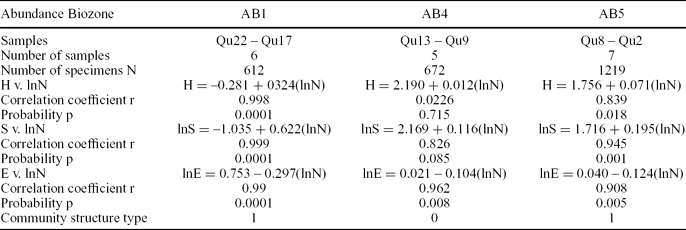
Depending on how H behaves as samples are accumulated for SHE analysis, Buzas & Hayek (Reference Buzas and Hayek2011) recognized three types of community based on their community structure. In Type 0 communities, H remains constant and the slope sH of the linear regression of H vs. lnN is zero. This community structure denotes equilibrium or stasis in a logarithmic series. Of 72 foraminiferal communities investigated by Buzas & Hayek (Reference Buzas and Hayek2011), 31 had a Type 0 structure. In Type 1 communities, the slope of the regression of lnS against lnN (sS) is greater than the absolute value of the slope of lnE against lnN, and sH is positive. This type denotes growth or expansion. Of the 72 communities investigated by Buzas & Hayek (Reference Buzas and Hayek2011), 31 had a Type 1 structure. In Type –1 communities, sS<|sE| and sH is negative. This structure indicates decline, instability or stress. Of the 72 communities examined by Buzas & Hayek (Reference Buzas and Hayek2011), only ten had a Type –1 structure. Most were at lower bathyal and abyssal depths, where the mean sH was –0.057. This system is here applied to ABs with more than three samples.
Specimens of selected species, most previously unrecorded from the Cruse Formation, were photographed using a digital microscope. Between six and twelve photographs were taken of each specimen and stacked using the online freeware CombineZP (http://www.hadleyweb.pwp.blueyonder.co.uk/CZP/Installation.htm) and pyramid image processing (Adelson et al. Reference Adelson, Anderson, Bergen, Burt and Ogden1984).
3. Results
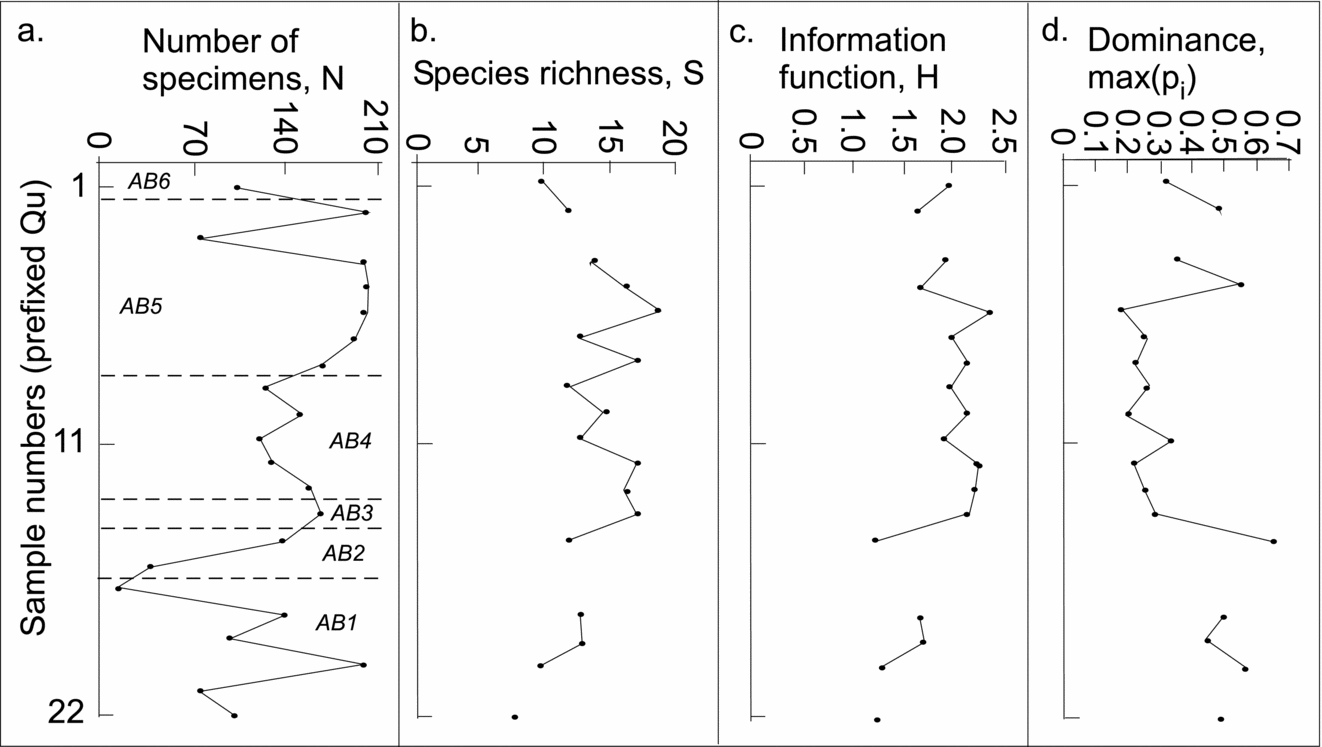
The 22 samples yielded 2938 foraminifera in 33 species (Appendix see also the online Supplementary Material available at http://journals.cambridge.org/geo). Specimen yield per sample was N = 14–197 (mean = 133, sd = 54). Sixteen samples yielded ≥100 specimens, while Qu22 and Qu19, both near the base of the section, yielded 98 and 96 specimens, respectively. Of the six samples with <100 specimens, five were concentrated in the lowest 3.5 m of the 11 m section. The majority of the specimens had been distorted post mortem.
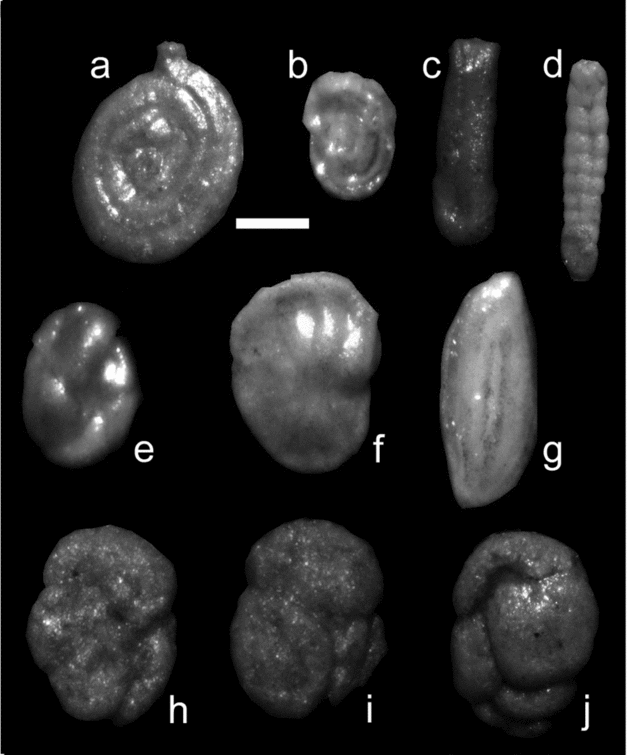
Three species each formed >10% of the total recovery: Spirosigmoilinella compressa (26.4%), Haplophragmoides carinatus (18.7%) and Haplophragmoides sp. 1 (13.2%). Another three species formed >3% of total recovery: Glomospira gordialis (7.6%), Rhizammina sp. (8.6%) and Trochammina sp. 1 sensu Green et al. (Reference Green, Kaminski, Sikora, Bubík and Kaminski2004) (6.6%). Species with an alveolar wall type (Cyclammina acutidorsata, C. cancellata, (?)Guppyella miocenica and Jarvisella karamatensis) together formed ~0.5% of total recovery. Figure 3 shows selected species.
Selected foraminifera from the Cruse Formation. (a) Ammodiscus excertus, (b) Glomospira gordialis, (c) Hyperammina friabilis, (d) Martinotiella pallida, (e) (?) Haplophragmoides aff. narivaensis, (f) Haplophragmoides carinatus, (g) Spirosigmoilinessa compressa, (h) Trochammina sp. 1, ventral view, (i) Trochammina sp. 1, dorsal view, (j) Valvulina flexilis. Scale bar = 250 μm for (b) and (e), 500 μm for all others.

The following results describe only those samples with ≥96 specimens (Fig. 4a). Within these samples species richness was S = 6–18 (samples Qu22 and Qu6, respectively, Fig. 4b) and was insignificantly correlated with N (r = 0.417, p = 0.085). As shown by a normal quantile plot test for non-normality (NQPT), the values of S were normally distributed (r = 0.977, rcrit = 0.923). However, Student's t-test showed that mean S was significantly lower in the lowest five samples (Qu22–15) than in the uppermost 13 (Qu14–1; t = 3.18, tcrit = 2.12, p = 0.006, df = 16).
Distribution of statistical measures through the Cruse Formation at Quinam Bay. (a) Number of specimens per sample, N, (b) species richness S, (c) information function H, (d) dominance measured using percentage abundance of dominant species, max(pi). Gaps in graphs (b) to (d) indicate samples with <96 specimens.

The information function was H = 1.223–2.356 (Qu22 and Qu6, respectively; Fig. 4c) and was insignificantly correlated with sample N (Pearson's r = 0.151, p = 0.549), indicating that the fluctuations in H are a real phenomenon and not a product of sample size. An NQPT showed that the values of H were normally distributed (r = 0.968, rcrit = 0.923). As with S, Student's t-test showed that H in samples Qu-22–15 was significantly lower than in samples Qu14–1 (t = 5.12, tcrit = 2.12, p = 0.0001, df = 16). H and S were significantly correlated (r = 0.79, p = 0.0001).
Dominance measured using max(pi) ranged from 0.18 to 0.65 (Qu6 and Qu15, respectively). It was negatively correlated with both H (r = –0.93, p = 0.0001) and S (r = –0.57, p = 0.02). Unlike H and S, however, max(pi) delineated three subsections within the succession (Fig. 4d). It was higher in the lowest five samples (mean = 0.53) than in the succeeding nine (mean = 0.24), and high in the last four (mean = 0.43). Student's t-test showed that mean max(pi) in the lowest five samples did not differ from that in the uppermost four (t = 1.62, tcrit = 2.37, p = 0.15, df = 7). An NQPT showed that values of max(pi) were nonetheless normally distributed (r = 0.967, rcrit = 0.923).
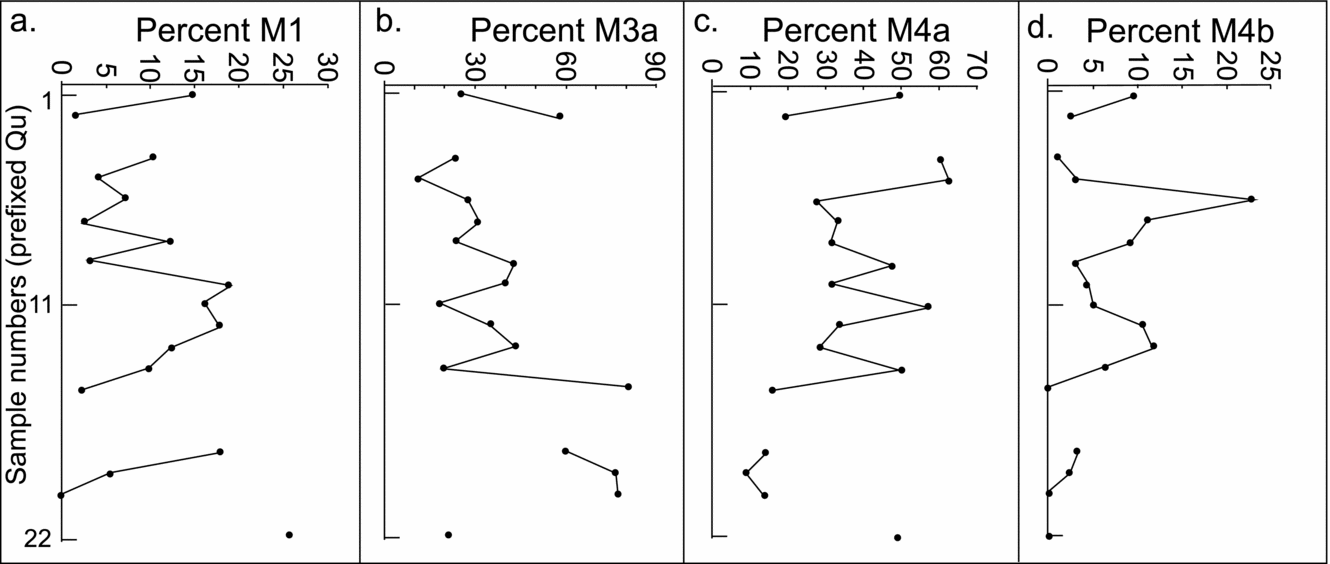
The fauna was dominated by morphotypes M3a (surficial epifauna flattened; 39.2%) and M4a (shallow infauna planispiral; 36.0%). Morphotypes M1 (erect epifauna), M2b (surficial epifauna trochospiral) and M4b (deep infauna) formed 5–10% of the agglutinated fauna each, while M2a (shallow infauna globular) formed ~2%. Pearson's correlations applied to the fluctuating percentage abundances of morphotypes between samples showed a strong negative correlation between morphotypes M3a and M4a (r = –0.84, p < 0.0001) and a negative correlation between M3a and M4b (r = –0.43, p = 0.047). All other morphotype pairs were insignificantly correlated. M3a were generally more abundant towards the base of the section, M4a towards the top (Fig. 5). M4b peaked at ~23% of the assemblage in sample Qu6.
Agglutinated foraminiferal morphotypes in Cruse Formation at Quinam Bay. (a) Morphotype M1, erect epifauna, (b) morphotype M3a, surficial epifauna flattened, (c) morphotype M4a, shallow infauna planispiral, (d) morphotype M4b, deep infauna.

All 22 samples were used in SHEBI, which indicated the presence of six ABs numbered AB1 (oldest) to AB7 (youngest) and containing between one and seven samples (Table 1). Only three ABs contained more than three samples and were amenable to analysis of community structure. Of these, AB1 was the least diverse (six samples, Qu22–17; final H = 1.80) and had a Type 1 community structure, H increasing as samples were accumulated. This AB straddled the boundary between the two intervals with low and high S and H determined using Student's t-test. AB4 (five samples, Qu13–9) and AB5 (seven samples, Qu8–2) did not differ in diversity (final H = 2.4). However, AB4 had a Type 0 community structure, whereas AB5 had a Type 1 community structure. No AB with a Type –1 community structure was found. The ABs 2 and 3 contain only two and one sample, respectively. AB7, being at the top of the section, might not have been completely sampled. The interval with high percentage abundances of morphotype M3a coincided with ABs 1 and 2 (samples Qu22–15).
Abundance biozone community structures in the Cruse Formation at Quinam Bay, Trinidad, for abundance biozones with more than three samples only

4. Discussion
The assemblages recovered were predominantly agglutinated, rare calcareous-walled miliolids being recovered from samples Qu20, 18 and 15 only. It is not clear whether the agglutinated specimens represent the entire agglutinated assemblage or whether species have been selectively preserved. Mancin (Reference Mancin2001) found four wall microstructures among agglutinated foraminifera. Microstructure I, she suggested, has a silica cement and dominant quartz and feldspar grains, and comprises most Ammodiscus, Reticulophragmium, Cyclammina, Recurvoides and Rhabdammina, while microstructure II comprises indistinct siliceous masses without agglutinated grains, as found in Repmanina, Glomospira, Ammodiscus latus, Psmammosphaera. Microstructure III has abundant calcite cement, a fine-grained texture and grains selected for size and composition (Arenobulimina, Dorothia, Eggerella, Gaudryina, Textularia, Vulvulina), while microstructure IV has scarce calcite cement, a coarse-grained texture and non-selected grains (Hyperammina, Reophax). Not all microstructures were found in the Quinam Bay section, where Ammodiscus and Cyclammina (microstructure I) and Repmanina, Glomospira and Psmammosphaera (microstructure II) were abundant. The test shape of A. exsertus resembles that of A. latus (microstructure II). Species with microstructures III and IV were not recovered. Although Mancin (Reference Mancin2001) suggested Hyperammina spp. to contain calcite and Cushman (Reference Cushman1937) suggested the wall of Martinottiella pallida to be ‘finely arenaceous, of light coloured, chalky material’, the Cruse specimens of both H. friabilis and M. pallida did not dissolve in dilute hydrochloric acid. Thus, despite the presence of occasional miliolids, no agglutinated species with calcite in their walls were recorded. This suggests that only part of the original agglutinated community was preserved, arguing in favour of the hypothesis that the original community contained calcareous species that were removed during diagenesis. It is unlikely that water chemistry affected food supply in such a way as to exclude all items except those consumed by agglutinated foraminifera lacking calcite. McNeil et al. (Reference McNeil, Issler and Snowdon1996) and Gallagher et al. (Reference Gallagher, Duddy, Quilty, Smith, Wallace, Holdgate, Boult, Boult, Johns and Lang.2004) suggested the test colour in agglutinated foraminifera reflects post-depositional thermal history. Within the Cruse Formation, however, test colour varies both within and between species. It would seem that in this formation post-mortem staining, perhaps by humic acids, has affected test colour.
Direct comparison with the qualitatively defined biofacies from Jones et al. (Reference Jones, Jones, King, Shaw, Jones and Simmons1999) is not possible, the Cruse fauna containing elements of both the outer neritic to abyssal Glomospira biofacies and the upper bathyal to abyssal Alveovalvulina/Silicosigmoilina biofacies. The fauna likewise contains elements of the slope fan, basin-floor fan and condensed section biofacies of Wood (Reference Wood2000). However, some palaeoenvironmental interpretation is possible.
The species recovered suggest that the Cruse section was not deposited below the calcite compensation depth (CCD), which at present in the tropical Atlantic Ocean lies at about 5000 m water depth. Instead, despite the absence of agglutinated species with calcareous walls, a lower bathyal to abyssal palaeodepth above the CCD is likely. Spirosigmoilinella compressa was illustrated by Nomura (Reference Nomura, Pisciotto, Ingle, von Breymann and Barron1992) from the Miocene of the Sea of Japan. He noted that S. compressa resembles modern Silicosigmoilina abyssalica, which is common in modern sediments and has peak abundances off Japan of 1850–2300 m (Matoba & Honma, Reference Matoba, Honma, Matoba and Kato1986). Kato (Reference Kato, Pisciotto, Ingle, von Breymann and Barron1992) suggested that S. compressa resembles Psamminopelta complanata, found in the present-day NW Pacific at 2700–3100 m. Cushman (Reference Cushman1918) recorded Glomospira gordialis as occurring between ~300 and 3000 m in the modern Atlantic Ocean, and Repmanina charoides between ~1000 and 3200 m. Thus, a Cruse palaeodepth of ~1800–3000 m seems likely. It is possible, however, that, due to local factors, the depth of the CCD in the tectonically active foreland basin was shallower than in the open ocean.
Not all evidence suggests this palaeodepth estimate. Murray & Alve (Reference Murray, Alve, Hart, Kaminski and Smart2000) dissolved total foraminiferal communities from the modern seafloor in acid and examined the diversity of the remnant, acid-resistant agglutinated assemblage. They found the information function H for the bathyal–abyssal remnant assemblages to range between ~1.8 and 3.0, while on continental shelves H ranged from 0.1 to 2.4. In the Cruse section, H ranged between 1.2 and 2.4 (mean 1.9), which suggests deposition on a continental shelf. Although the foraminifera recovered from the Cruse section are typically regarded as belonging to a DWAF, Koutsoukos (Reference Koutsoukos, Hart, Kaminski and Smart2000) suggested that the DWAF can occur in shallower water. However, as noted by Kugler (Reference Kugler2001), there is no modern equivalent to the Cruse palaeoenvironment. It is thus possible that Murray & Alve's (Reference Murray, Alve, Hart, Kaminski and Smart2000) model is not applicable to all ancient successions. Instead, it appears that in the Cruse Formation some undetermined form of environmental stress lowered agglutinated foraminiferal diversities at bathyal to abyssal depths.
The fauna was dominated by a mixture of flattened surficial epifauna (morphotype M3a) and planispiral shallow infauna (M4a), which together formed 73.6% of the total recovery but were negatively correlated, the abundance of M4a being low towards the bottom of the section, where deep infauna (M4b) were also rare. This might reflect fluctuations in the abundance of dissolved oxygen in the sediment, infauna being reduced when the redox front was close to the sediment water interface. The reason for the downward shift in the redox front after AB2, allowing an influx of infauna, is unclear, although such a change in the DWAF assemblage is usually interpreted as reflecting a change to higher surface productivity resulting in an enhanced organic flux to the sea floor (e.g. Cetean et al. Reference Cetean, Balc, Kaminski and Filipescu2011). Haplophragmoides, which dominated type M4a, has been interpreted as an indicator of low-oxygen environments (Green et al. Reference Green, Kaminski, Sikora, Bubík and Kaminski2004; Kuhnt & Kaminski, Reference Kuhnt and Kaminski1990), while Kaminski et al. (Reference Kaminski, Silye and Kender2005) noted that increasing proportions of M4a correlated with higher total organic carbon (particularly marine organic carbon) at ODP Site 909 in the Norwegian Sea. Trochammina, a member of the less abundant morphotype M2b, inhabit low-oxygen conditions with a high organic flux (Green et al. Reference Green, Kaminski, Sikora, Bubík and Kaminski2004). Morphotype M3a (Ammodiscus exsertus, A. incertus, A. tenuis, Glomospira gordialis, Spirosigmoilinella compressa) might prefer even lower dissolved oxygen contents in bottom waters than does M4a.
Rai & Maurya (Reference Rai and Maurya2009) found that benthonic foraminiferal diversity, measured using the information function H, was lower in the Indian Ocean during glacials than during interglacials. Their work, however, examined total (calcareous + agglutinated) faunas. Murray & Alve (Reference Murray, Alve, Hart, Kaminski and Smart2000) found that H for total and agglutinated assemblages are positively correlated. This suggests that the low H in abundance biozone AB1, near the base of the section possibly at a time of a shallow redox front, may reflect deposition during a glacial. That AB2 and AB3, respectively, contain only two and one sample each indicates rapid environmental change between the more stable conditions of AB1 (six samples) and AB4 (five samples). However, this hypothesis needs further testing, perhaps using palynology, especially to test if the Cruse Formation signal is related to any of the Milankovitch Cycle signals for the Miocene detected by Proistosescu et al. (Reference Proistosescu, Huybers and Maloof2012) at ODP Sites in the southern Atlantic and equatorial Pacific Oceans.
It is not yet known if the community structure of the agglutinated component reflects that of the total community. Perhaps this question can be resolved by looking at palynological preparations, which might show preserved foraminiferal linings. However, the community structure of the agglutinated assemblage varied within the Quinam Bay section. The Type 1 community structure was recorded in AB1 and AB5, and Type 0 in AB4. The Type –1 structure, which is more abundant at abyssal depths and indicative of environmental stress (Buzas & Hayek, Reference Buzas and Hayek2011), was not found.
5. Conclusions
Foraminifera show that the lower part of the Cruse Formation was deposited at lower bathyal to abyssal depths, although faunal diversity is less than expected for that environment. The rarity of shallow and deep infauna in the bottom part of the section at Quinam Bay is coupled with the lowest diversities within the section and indicates that the redox front was near the sediment–water interface at that time. These low diversities may also indicate deposition during a glacial. Three of the six ABs recorded contained five to seven samples, which indicates that the environment was stable for considerable periods. Two of the three ABs with one to two samples occurred near the top of the low diversity interval and may reflect rapid environmental change between stable glacial and interglacial times coupled with the downward displacement of the redox front. The presence of Type 0 and 1 community structures suggests that the agglutinated assemblage was not subjected to environmental stress during the stable periods, although the abundance of Haplophragmoides and Trochammina indicates a high organic flux and low dissolved oxygen levels. The Cruse Formation is one of Trinidad's main oil-producing formations, but lies in an area of considerable structural complexity. This paper shows that high-resolution ecostratigraphic studies of the impoverished foraminiferal assemblage have potential for elucidating Cruse architecture and geological history. Furthermore, this high-resolution study reveals that, although the Cruse foraminiferal community is impoverished, it changes markedly between closely spaced samples. This would allow biosteering of directionally drilled hydrocarbon wells, should the need arise.
Acknowledgements
This research received no specific grant from any funding agency, commercial or not-for-profit sectors. Thanks are due to Mike Kaminski and another anonymous reviewer for their kind and constructive comments.
Appendix. Foramininifera recovered from the Cruse Formation at Quinam Bay
?Guppyella miocenica (Cushman) = ?Goessella miocenica Cushman, 1936
Adercotryma glomerata (Brady) = Lituola glomerata Brady, 1878
Agglutinant indet
Ammodiscus exsertus Cushman, Reference Cushman1910
Ammodiscus incertus (d'Orbigny) = Operculina incerta d'Orbigny, 1839
Ammodiscus tenuis Brady, 1881
Bathysiphon cf. eocenicus Cushman and Hanna, 1927
Cribrostomoides bradyi Cushman, Reference Cushman1910
Cyclammina acutidorsata (Hantken) = Haplophragmium acutidorsatum Hantken, 1868
Cyclammina cancellata Brady, 1884
Glomospira gordialis (Jones and Parker) = Trochammina squammata Jones and Parker var. gordialis Jones and Parker, 1860
(?) Haplophragmoides aff. narivaensis Brönnimann, Reference Brönnimann1953
Haplophragmoides carinatus Cushman and Renz, Reference Cushman and Renz1941
Haplophragmoides sp. 1
Haplophragmoides sp. 2
Haplophragmoides sp. 3
Hormosina sp.
Hormosina sp. 2
Hormosina? sp.
Hyperammina friabilis Brady, 1884
Jarvisella karamatensis Brönnimann, Reference Brönnimann1953
Martinotiella pallida (Cushman) = Clavulina communis d'Orbigny var. pallida Cushman, 1927
Nummoloculina irregularis (d'Orbigny) = Biloculina irregularis d'Orbigny, 1839
Psammosphaera sp.
Psammosphaera sp. 2
Pyrgo comata (Brady) = Biloculina comata Brady, 1884
Pyrgo sp.
Repmanina charoides (Jones and Parker) = Trochammina squammata Jones and Parker var. charoides Jones and Parker, 1860
Rhizammina sp.
Spirosigmoilinella compressa Matsunaga, 1955
Trochammina sp. 1
Trochammina sp. 2
Valvulina flexilis Cushman and Renz, Reference Cushman and Renz1941