One way that archaeologists can focus their attention on people in the past is by considering how material remains may represent expressions of identity. In this paper, I consider identities expressed to achieve individualistic, immediate goals, particularly exploring connections between the conduct of ritual practices and the development of identities laden with possibilities for social power. I draw on a case study from the Late to Terminal Classic-period (a.d. 650–960) site of Las Canoas, Honduras, to argue that some members of the community fostered identities as ritual specialists and engaged in a range of performances associated with incensarios and ceramic figurines that were designed to construct, express, and negotiate social power. In building these arguments, I am concerned with the materiality of religion and ritual in pre-Columbian Mesoamerica, with the ability of ritual performance to both integrate communities and generate status distinctions within them, and with the nature of identity itself. The means by which these three concerns were represented and made meaningful in the past are not separate from one another but intimately intertwined. Though such issues are abstract, I do not believe that they are archaeologically inaccessible to researchers; identities were created and performed through practice in the past and thus were highly material in their expression.
RITUAL PERFORMANCE AND IDENTITY
I view identities as concepts of self and other that are based in practice and experience. This perspective on identity derives from a long historical trajectory in anthropology, over the course of which scholars have prioritized monolithic group identifications such as culture and society (Childe Reference Childe1936; Durkheim Reference Durkheim1933 [1893]; Kirchoff Reference Kirchhoff and Tax1952; Lévi-Strauss Reference Lévi-Strauss1949, Reference Lévi-Strauss1962; Mauss Reference Mauss, Carrithers, Collins and Lukes1985 [1938]; Sanders and Price Reference Sanders and Price J.1968), championed the individual as a font of identity formation and expression (e.g., Dobres and Robb Reference Dobres and Robb2000; Gell Reference Gell1998; Gillespie Reference Gillespie2001; Goodenough Reference Goodenough and Banton1965; Harris Reference Harris1986; Hill and Gunn Reference Hill and Gunn1977; Johnson Reference Johnson1989), and addressed the mediation of those two extremes via categories of experience such as age, class, sex, sexuality, gender, status, and ethnicity (Brumfiel Reference Brumfiel1992; Butler Reference Butler1990; Dowson Reference Dowson2000; Geller Reference Geller2004; Jones Reference Jones1997; Joyce Reference Joyce2000; Laqueur Reference Laqueur1990; Matthews Reference Matthews2004; Meskell Reference Meskell1999; Stockett Reference Stockett2005c; Weismantel Reference Weismantel2004). The most recent of these efforts focus on myriad aspects of identity by addressing how they shape individuals' identities and how they connect individuals into groups.
One way that identity is materially expressed and reinforced is through the practices of interacting individuals. Pierre Bourdieu's (Reference Bourdieu1977) theory of practice focuses our attention on the actions and materiality of human behavior and provides a means to negotiate the often treacherous and shifting middle ground between structure and agency. Through practice, and Bourdieu's notion of habitus, we interpret behaviors and beliefs as generated within group consciousness over many generations and shaped by something beyond the individuals who perform them. But to echo a common critique of Bourdieu, practices are also influenced by conscious choices made by individuals in the short term. Relying on insights from practice theory can help us unearth and interpret the material components of past peoples' identities, but it can also lead us to think about those material remains as static representations and thus reify our interpretations as fixed.
Past practices were contextual, and identity expression within those contexts was fluid, situational, and subject to change. Timothy Pauketat (Reference Pauketat, VanPool and VanPool2003:43) addresses this concern, noting that
practices … are situated in culturally charged fields of relations that continually change through the practices themselves, even if they seem to remain unchanged at some scales of analysis. Thus, even the most mundane act is actually a “negotiation” of meaning, power, tradition, gender, and the like…. [T]hey do not “reflect” macro-scale entities: polity, identity, landscape, culture, etc. They continuously construct those entities.
Though the enduring, repetitious, habitus-based aspect of identity is important, we must not forget that identities are neither static nor abstract but are made, reinforced, maintained, altered, or rejected through expression and action.
A political leader, for example, adopts an identity that has historical weight and meaning. But that aspect of his or her identity is mediated through the practice of leadership, through actions that are part of an identity process contingent on context, change, and the actions of others. Such an identity also incorporates many material components—for example, articles of clothing and adornment, staffs and badges of office, flags—that signal that identity to others, lend the bearer greater authenticity, and thus give the particular identity being expressed greater meaning (Wobst Reference Wobst and Cleland1977, Reference Wobst and Chilton1999). Through contingent contextualized practices that engage with and are part of the material world, identities are created. Here identity is viewed as composed of “practices of affiliation” (Stockett Reference Stockett2005a; Yaeger Reference Yaeger, Canuto and Yaeger2000): repetitive practices resulting in identities that are multiply constituted and allow for mediation between agency and structure. In other words, “practices of affiliation” emphasize the role of repetitive behaviors and actions, small scale and large, in structuring and influencing interactions between individuals and groups and perpetuating preexistent sentiments of affiliation. Through the repetition of practices, identities find enduring material expression.
In what follows, I focus on the role of ritual in identity constitution. Rituals are repetitive practices that, under certain circumstances and in particular contexts, have the power to generate the sentiments of affiliation underlying specific identities. Rituals are also highly material, and thus archaeologically observable, in that they rely on the bodily movements of a performer, the physical space in which the ritual is conducted, and the objects through which the rituals themselves are enacted. Body, space, and object become material conduits for and representations of the mediation between human and divine, for the expression of knowledge and power, and for the separation and integration of the social world binding the individual performer with (while also separating him or her from) the community. In these ways, rituals create the meaning supporting an individual performer's identity while also providing a context for the physical expression of that identity: a means to reinforce it through practice.
As alluded to earlier, it is repetition that makes ritual action potent, lending it the power to symbolize knowledge and generate identities. Evon Vogt (Reference Vogt1976:8) notes that among the Zinacanteco, “the function of this redundancy factor is twofold: to reduce ambiguity and to certify validity,” and Joyce Marcus (1990:70) echoes that “ritual must be performed over and over, in prescribed ways, to be valid.” Thus, when the practice of burning incense, speaking an incantation, or making an idol is repeated again and again, it acquires meaning extending beyond the performance of a simple action. Instead, these practices become rituals in that their repetition symbolically communicates information about traditional beliefs and values, about the past, and about social power in ways that make reference to forces beyond the scope of everyday action (Geertz Reference Geertz1965; Turner Reference Turner1969). Furthermore, through the structured enactment of the actions and words of ritual, such practices can also become a central aspect of the performer's identity.
The symbolic, repetitious nature of ritual performance also, as Lisa Lucero (Reference Lucero2003, Reference Lucero2006) has noted, creates opportunities for social and political power. Or, in Catherine Bell's (Reference Bell1992:181) words, “[R]itual constitutes a particular dynamic of social empowerment.” When religious rituals are conducted, the performer and the audience observing them are aware that tradition, knowledge, and power are being expressed. This suggests that differences related to such knowledge and power may be enough to set ritual specialists apart from others within their households and communities. The power that may emerge from this shift, however, is specific and contingent. For example, Bell (Reference Bell1992:116) notes that the “relationships of power being negotiated are based not on direct claims but on indirect claims of power conferred.” For example, in the case of rituals based in religious ideology, power is derived from the performer's claim to have knowledge of and interaction with the divine. This is not an inconsequential claim, and control over such ritual knowledge has often been linked to the power strategies of pre-Columbian elites and emerging elites (e.g. Lucero Reference Lucero2003, Reference Lucero2006; Marcus Reference Marcus, Grove and Joyce1999; Potter Reference Potter and Diehl2000; Potter and Perry Reference Potter, Perry and Mills2000; Walker and Lucero Reference Walker, Lucero, Dobres and Robb2000). In fact, Lucero (Reference Lucero2006:14) has recently suggested that “a common factor in all political success stories, whatever their origins, is ritual.”
James Potter (Reference Potter and Diehl2000:295) also argues that ritual knowledge is “a relatively enduring power resource … because authority tends to be inherent in knowledge-based power.” The authority granted to an individual based on the ritual knowledge that he or she possesses is inherent because it is largely symbolic and thus difficult for others to contest. Control over ritual action by a specialist can be directly equated with emerging control over sociopolitical and economic spheres of life (Potter Reference Potter and Diehl2000). In ancient Mesoamerica, this certainly appears to have been a means to consolidate power; both Patricia McAnany (Reference McAnany1995) and Lucero (Reference Lucero2003, Reference Lucero2006) have argued that the power of Classic-period Maya rulers originated in the earlier domestic rituals of commoners, particularly in acts of ancestor veneration and in dedication and termination rituals. Lucero (Reference Lucero2003, Reference Lucero2006; see also Walker and Lucero Reference Walker, Lucero, Dobres and Robb2000) contends that in referencing ritual traditions already deemed valuable and potent by the populace at large, emerging leaders may have been able to more effectively legitimize their claims to rule.
However, as noted earlier, the power derived from religious ritual performance and from the identity of a ritual specialist is not absolute. Bell (Reference Bell1992:222) observes that ritual
cannot turn a group of individuals into a community if they have no other relationships or interests in common, nor can it turn the exercise of pure physical compulsion into participatory communality. Ritualization can, however, take arbitrary or necessary common interests and ground them in an understanding of hegemonic order; it can empower agents in limited and highly negotiated ways.
As a result, the power that may emerge from the performance of rituals by specialists is one that is both conditional and rooted in sentiments of solidarity—sentiments that ultimately may undermine the authority of the individual specialist.
Indeed, while it certainly appears that control over ritual action and ritual knowledge provided key tools for those with political aspirations in ancient Mesoamerica, William Ringle (Reference Ringle, Grove and Joyce1999:186) exhorts us to “remember that religious rationales for inequalities of wealth and status are usually embedded in a larger vision of social cohesion.” While ritual specialization may ultimately serve to generate and perpetuate status distinctions, it is often grounded in an overtly expressed desire for community solidarity and success. Drawing on the seminal work of Victor Turner Reference Turner(1974), Ringle (Reference Ringle, Grove and Joyce1999) notes that ritual incorporates aspects of both segregation and integration; on the one hand, ritual emphasizes hierarchy and heredity, while on the other, it highlights values shared by all members of the community. This paradoxical duality, as we shall see in the case study considered here, is part of what makes the expression of identities rooted in ritual practice a powerful but precarious tool for emerging leaders.
A CASE STUDY FROM SOUTHEASTERN MESOAMERICA
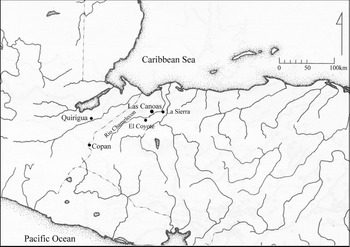
To demonstrate how these theoretical issues of identity and ritual might be archaeologically visible, I turn to a case study from southeastern Mesoamerica. Here I endeavor to show how material remains may represent the contextualized expression of identity and its relation to fledgling social power within a community experiencing significant political and economic changes. This analysis derives from research at the site of Las Canoas, Honduras, which is situated at the terminus of the Naco valley on the banks of the Chamelecon River (Figure 1). This region includes parts of modern-day Guatemala, El Salvador, and Honduras and in pre-Columbian times was occupied by a diversity of groups, including the Maya and Lenca (Campbell Reference Campbell, Campbell and Mithun1979; Lara Pinto Reference Lara Pinto and Fowler1991; Stone Reference Stone and Steward1948). The residents of Las Canoas and their neighbors were not Maya; they were most likely related to the Lenca (Campbell and Kaufman Reference Campbell and Kaufman1976; Henderson Reference Henderson1977; Joyce Reference Joyce1991; Stone Reference Stone and Steward1948). The region has a long history of pre-Columbian occupation (e.g., Ashmore Reference Ashmore and J. Robinson1987; Dixon Reference Dixon1992; Healy Reference Healy, Lange and Stone1984; Joyce Reference Joyce1991; Joyce and Henderson Reference Joyce and Henderson2001; Schortman and Urban Reference Schortman and Urban1994; Schortman et al. Reference Schortman, Urban and Ausec2001; Sharer Reference Sharer1999; Urban and Schortman Reference Geller2004; Urban et al. Reference Urban, Schortman and Ausec2002; Wells Reference Wells2002) and was most densely settled in the Late Classic period, when complex sociopolitical groups linked by ever shifting networks of alliance and trade characterized the region. I argue that some of Las Canoas's occupants attempted to take advantage of these fluctuations, claiming and legitimizing authority through the public expression of ritual knowledge.
Map of southeastern Mesoamerica denoting the location of sites discussed in the text.

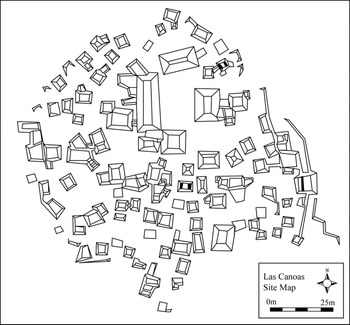
Las Canoas was a midsize site consisting of approximately 120 surface-visible mounds organized in a dense circle around a smaller cluster of monumental structures, the Main Plaza Group (Figure 2). Radiocarbon dates indicate occupation from at least a.d. 650 to a.d. 960, placing the site in the Late to Terminal Classic transition for the region. Architectural analysis suggests evidence of some Early Postclassic occupation, and recovered ceramics might indicate activity in the Early Classic period (Urban Reference Urban2006). Located approximately midway between powerful polity capitals at La Sierra in the Naco valley (Schortman and Urban Reference Schortman and Urban1994; Schortman et al. Reference Gillespie2001) and El Coyote in the Cacaulapa valley (McFarlane Reference McFarlane2005; Wells Reference Wells2002), the occupants of Las Canoas seem to have negotiated their position carefully among the shifting political and economic alliances in the region. Material expressions of regional affiliative ties indicate early connections with the Naco polity (Stockett Reference Stockett2005a) administered by paramounts at La Sierra (Schortman Reference Britain2006; Schortman and Urban Reference Schortman and Urban1994). As a result, I have suggested elsewhere (Stockett Reference Stockett2005a) that Las Canoas was built as a small ceramic-production outpost from the Naco valley. After its initial founding, Las Canoas grew in prosperity over three centuries, transforming from a subordinate site into a more autonomous community.
Schematic plan map of Late to Terminal Classic-period Las Canoas.

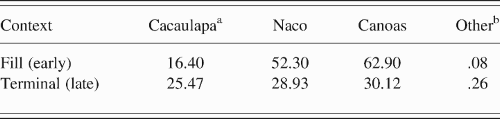
As La Sierra elites diminished in power at the end of the Late Classic, Las Canoans began expanding their sphere of interaction into the neighboring Cacaulapa valley, which was located to the north and organized around the large, centralized site of El Coyote. I contend that Las Canoans actively guided this shift with an eye toward increasing their sociopolitical and economic independence. Their ability to negotiate an intermediate standing between these two larger and more powerful places was likely due to their work as craft specialists; evidence for intensive pottery production is abundant across the siteFootnote 1 (Stockett Reference Stockett2005b). This shift in interaction emphasizing Naco connections to interaction highlighting Cacaulapa seems to be reflected materially by our preliminary understanding of the distribution of relative densities of ceramics used during early and late periods at Las Canoas (Stockett Reference Stockett2005a). These data suggest increasing trade with the Cacaulapa valley just as trade with Naco was decreasing (Table 1). I have argued elsewhere (Stockett Reference Stockett2005a) that such changes in relative ceramic densities could reflect growing independence from La Sierra.
Densities of pottery (per m3) from both terminal debris (late) and fill (early) contexts calculated for Las Canoas as a whole

aThese densities reflect ceramics traded through the Cacaulapa Valley. The “Naco,” “Canoas,” and “Other” categories reflect pottery produced in and traded from those locales.
bIncludes the Motagua Valley, Copan Valley, and Ulua Valley.
Ceramic densities, however, are not the only evidence that suggests important changes in the sociopolitical fabric at Las Canoas. Shifts in politico-economic alliances are accompanied by evidence for increasing prosperity, particularly reflected by intensified ceramic production. For example, the decrease in the density of Canoas-made vessels from early to late contexts at Las Canoas (see Table 1) is accompanied by an increase in the evidence for intensified production activity, including pottery-production debris found in a greater number of structures and in greater densities over time (Stockett Reference Stockett2005a). Taken together, these data indicate that, rather than simply using or making less of their own pottery, Las Canoans were both producing and exporting more vessels.
Increasing prosperity over time is also suggested by the expansion of the settlement's central architectural grouping, the Main Plaza Group, which was renovated several times after its initial founding. As the community of Las Canoas became more prosperous and independent, the Main Plaza Group also grew to be somewhat larger and more elaborate, and its occupants were more prominently involved in economic and religious activities. These changes are notable because they may indicate the emergence of status distinctions within a settlement that was previously unmarked (at least, materially) by such indicators of difference. As such, I argue that the residents of the Main Plaza Group may have emerged as local leaders during the Terminal Classic transition, fostering and reinforcing their elevated socioeconomic positions through the expression of identities as ritual specialists. In what follows, I argue that by using special religious objects as props and the newly expanded Main Plaza Group as a stage for the ritual performances of these identities, fledgling leaders attempted to provide a religious underpinning to their bid for political power.
RITUAL SPACES, OBJECTS, AND SPECIALISTS AT LAS CANOAS
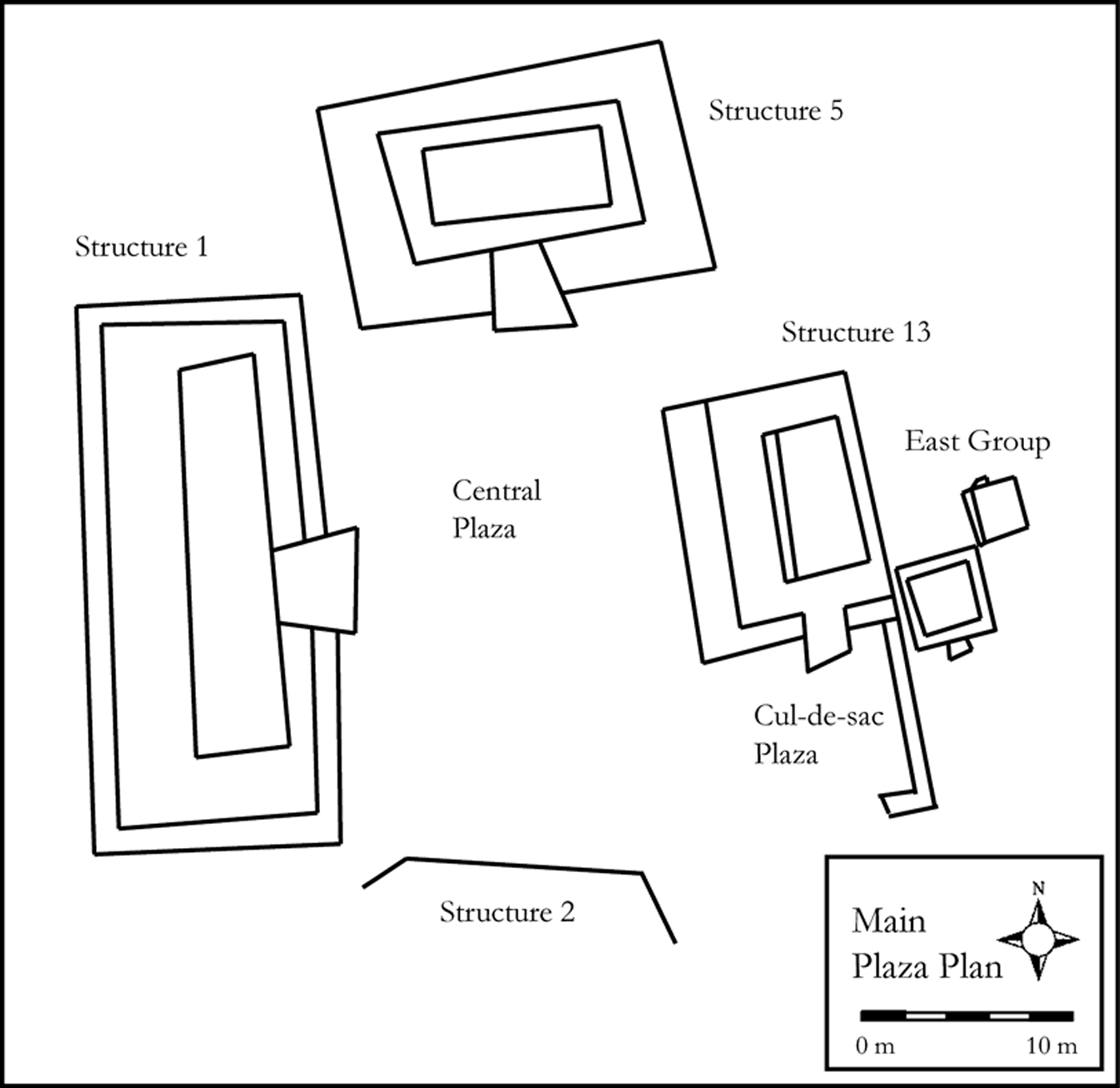
The Main Plaza Group at Las Canoas provides the primary spatial context for this discussion of identity and ritual performance, as it is the place in which objects and bodies joined in the expression of social power. It was also clearly a distinctive and special space within the Las Canoas community. Many clues point to its importance, including its central location within the settlement (see Figure 2) and its large size with respect to other buildings at the site. Its buildings were, on average, 21.03 m3 larger than other excavated structures. The same is true of the central plaza, which measured 15 m × 27 m in its final form, occupying 405 m2 of open space, as compared with the next largest patio, which measured only 6 m × 8 m, or 48 m2. That it was maintained as an open space free of architectural constructions also set the central plaza apart from other patios at Las Canoas, which were frequently encroached on by new buildings as space between structures grew tighter over time (Stockett Reference Stockett2005a). Intentionally keeping this area free of constructions made it the best (and potentially only) location in which groups of people could gather together within the settlement's confines. Thus, it would have been a practical venue for the public performance of rituals. The Main Plaza Group was also designed with very specific notions about built environment and spatial form in mind. For example, though many other built spaces at the site do not, the central plaza conforms to cardinally oriented directions. While originally built in a relatively rectangular shape, with its long axis oriented roughly north to south, the plaza was made more rectilinear during the second phase of construction through the reorientation of the plaza-facing sides of Structures 1 and 5, which caused the boundaries of the central plaza to align more closely with the cardinal directions.
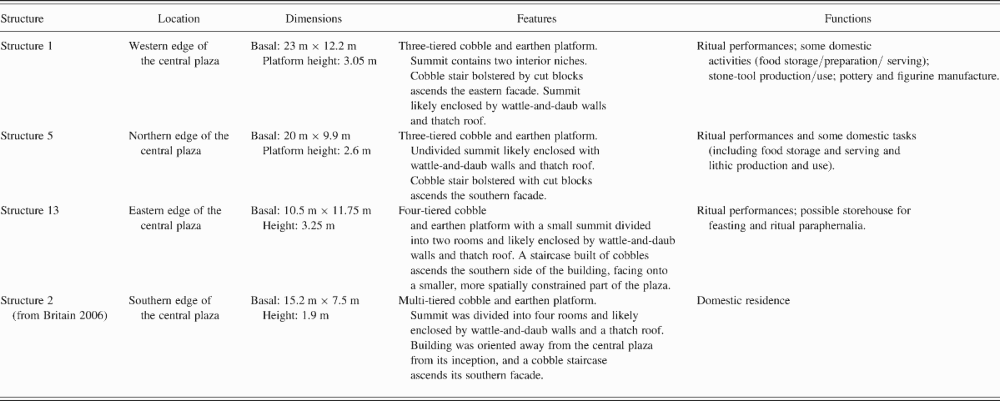
Just as the central plaza was arranged to conform to a specific design, so, too, were the surrounding buildings (Stockett Reference Stockett2005a). In particular, the buildings of the Main Plaza Group appear to have been viewed as a cohesive spatial unit rather than as a set of individual structures (Webber and Stockett Reference Webber and Stockett2003). Three of the four buildings surrounding the central plaza (Structures 1, 5, and 13) show similar patterns in their successive phases of foundation, expansion, and elaboration; each of these buildings shares distinctive architectural elements such as terraces and staircases that were added to the individual structures during consecutive construction phases (Webber and Stockett Reference Lucero2003). No other investigated household at Las Canoas seems to have been built in this manner, suggesting that a unique degree of control was exerted over the design and expansion of the Main Plaza Group. The fourth building, Structure 2, is different in a number of ways: it was raised to its full height in a single construction episode; it was designed from the outset to face fully away from the central plaza; and it continued to be occupied after Structures 1, 5, and 13 were abandoned (Britain Reference Britain2006). The role this distinctive structure played in the contextual expression of identity through ritual specialization will be addressed at the close of this essay. Table 2 provides a brief description of the final phase form of each of the buildings of the Main Plaza Group and is intended to give the reader a sense of the spatial context necessary for later discussions of ritual object distributions and ritual processions and movements. Finally, it should be noted that Structures 1, 5, and 13 were not significantly larger or more elaborate than others at the site when they were first constructed. It was only midway through the site's occupation that these buildings were expanded and elaborated into their final form—concomitantly with Las Canoas's increasing prosperity and regional influence.
Description of the final-phase form and function of the four buildings making up the Main Plaza Group at Las Canoas

The spaces within the final phase of the Main Plaza Group can be divided into a number of distinct contexts for ritual action, including spaces for bodily movement, manipulation of objects, and audience observation or participation (Figure 3). The central plaza, as noted earlier, forms a large, empty gathering space bounded by the monumental structures. Here a range of activities may have taken place, including potentially private work parties and socializing as well as more public community gatherings. A smaller, adjoining plaza south of Structure 13 is partially set apart from the central plaza and is bounded on its far exterior by a long, low wall. This space does not appear to have been physically segregated from the rest of the central plaza but makes up a more tightly bounded area within this larger entity—a cul-de-sac of sorts. Several formal staircases provide conduits for movement from the plaza onto and into the buildings. In all cases, terraces surrounded the platform summits, providing additional spaces for movement, activity, and performance. Finally, the platform summits themselves, which were likely to have been at least partially enclosed, would have functioned as more isolated and potentially more private spaces within the Main Plaza Group. All of these spaces provide a context or theater in which public ritual performances appear to have been conducted.
Schematic drawing of Las Canoas's Main Plaza Group, showing structures and spaces discussed in the text.

This claim is based not only on the distinctive nature of the spaces within the Main Plaza Group but also on the presence of special objects–incensarios, and ceramic anthropomorphic figurines–the densities of which were far greater in the Main Plaza Group than elsewhere at the site. Furthermore, there is a significant difference in the quality, degree of elaboration, and depositional significance distinguishing the incensarios and ceramic anthropomorphic figurines found in the Main Plaza Group from those found in household contexts throughout the site. These observations suggest an emphasis on the use of such objects for special purposes in the Main Plaza Group and are further validated by consideration of the individual objects and their specific contexts of recovery.
Incensarios as Ritual Objects
Incensarios form a diverse class of ceramic objects found from central Mexico to lower Central America and from the Preclassic through modern times (Benyo Reference Benyo1979; Rice Reference Meskell1999) and broadly reflect a ritual tradition shared across Mesoamerican cultures that is frequently tied to the expression of religious belief. Typically understood to have been “containers used to burn various kinds of aromatic resins, usually made of clay, most often associated with ritual” (Rice Reference Meskell1999:25; see also Rands et al. Reference Rands, Bishop, Harbottel, Robertson and Jeffers1980), incensarios may have been “closely related to Classic period … censing of buildings” (Houston Reference Houston and Houston1998:394). Stephen Houston further highlights their use to hold offerings, food, and drink for supernatural entities. The notion of feeding and sustaining the gods through incense burning in special places is central to these rituals, for incense, pom, “is the principle [sic] foodstuff given to the gods” (McGee Reference McGee1990:44). Prudence Rice (Reference Rice1999:28) further states that “incensarios and the burning of incense define boundaries of ritual space and practice, mediate transitions between sacred and profane, and invite the presence of ancestors/gods.” Incense burning within elaborated or monumental contexts and associated with elite material assemblages has been suggested “to [have been] … closely tied to kingship” among the Maya (Rice Reference Meskell1999:42). Common reasons for incense burning include foundation and termination rituals for palaces and tombs and ancestor or deity veneration.
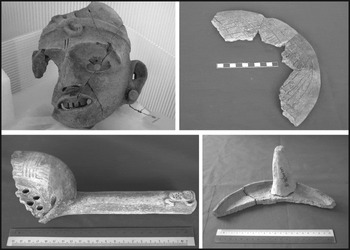
Incensarios can be divided into five major types, each with slightly different uses: effigy or modeled censers, spiked censers, ladle censers, pronged bowl-and-support censers, and scored censer lids (Benyo Reference Benyo1979; Schortman Reference Schortman1993). Incensarios from Las Canoas closely parallel these forms (Figure 4), with the exception of spiked censers, which were not recovered. Modeled censers are large, hollow ceramic containers often sculptured with anthropomorphic figures and decorated with appliqué, such as flanges. In southeastern Mesoamerica, they have been associated with public ceremonialism (Schortman Reference Schortman1993) but may not actually have been used to burn incense, serving instead as deity idols for veneration (see Ferree Reference Ferree1972; Rands et al. Reference Rands, Bishop, Harbottel, Robertson and Jeffers1980; Rice Reference Meskell1999). Complex pronged bowl-and-support censers are composed of a ceramic basal support generally attached to three prongs, upon which a ceramic bowl would rest. They were associated primarily with incense burning (Rice Reference Meskell1999) but may also have been braziers. Scored censer lids are large, round, flat ceramic plates with attached handles. One side of the plate bears scored cross-hatched designs. These may have functioned as lids for complex censers or braziers. Finally, pierced ladle censers are subhemispherical bowls that have holes in their bases and are attached to strap or tube handles; the holes aerate the charcoal used to melt copal incense (Patricia Urban, personal communication 2005).
Photographs of the four censer types recovered from Las Canoas. Top left: modeled effigy censer fragment of a life-sized human head; top right: portion of a scored censer lid; bottom left: pierced ladle censer fragment with a frog on the handle; bottom right: plate and prong portion of a complex censer.

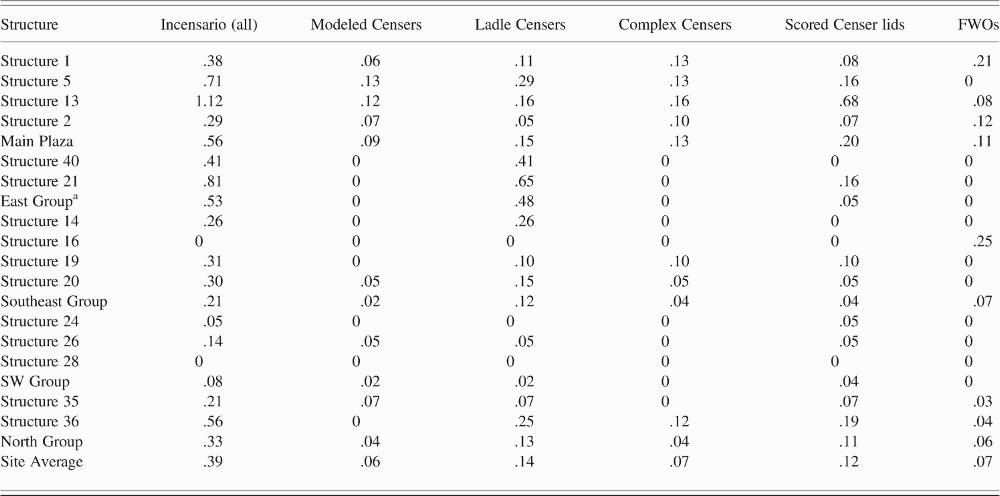
At Las Canoas, incensarios were recovered from excavated contexts across the site, suggesting their ritual significance to the whole community. The density of these objects, however, varied greatly (see Table 3), with the majority deriving from the Main Plaza Group (64%). The only other investigated group that yielded elevated densities of incensarios was the East Group, which was physically linked to the Main Plaza Group via shared architecture and routes of access and also may have shared functional qualities (Stockett Reference Stockett2005b). Further suggesting the ritual significance of the incensarios found in the Main Plaza Group is their distribution and association with other objects. While nearly all incensarios recovered from contexts outside the Main Plaza Group were found mixed with other objects in the tumbled debris of decaying buildings or in middens, those found within the Main Plaza Group were recovered from contexts more likely associated with their places of last use; specifically, incensarios from the Main Plaza Group were found (1) resting exposed directly on ancient living surfaces, having been smashed and/or crushed beneath the falling debris of buildings; (2) intentionally interred beneath floors or patio surfaces; or (3) mixed with fallen architectural elements, suggesting that they rested atop structures prior to their decay (Stockett Reference Stockett2005a). Both the relative abundance and the contexts of their recovery indicate that incensarios were used differently within the Main Plaza Group from elsewhere at the site.
Density of ritual objects (objects per m3) among excavated structures at Las Canoas

aThe East Group contains incensarios (ladle and scored) cached behind Structure 13 and discussed in association with that structure.
Structure 1 yielded primarily complex censers, which were all found crushed on the ancient ground surface on the plaza-facing side of the building along the centerline of the structure at the base of the cobble and cut-stone staircase. This suggests they were used in rituals that may bear some similarity to Maya termination rituals, although they may represent not a single ritual event but the accumulation of material from a succession of ritual activities (Clayton et al. Reference Clayton, Driver and Kosakowsky2005). Regardless, these rituals would have been observable by anyone standing in the central plaza. Pierced ladle censers associated with this building were found in similar contexts. However, rituals involving modeled censers were likely obscured from public view; these censers were found mixed within tumbled architectural elements on the side of Structure 1 that faced away from the central plaza. They appear to have been used in the enclosed, elevated summit room atop the structure in rituals that may have been designed to summon or venerate deities through the burning of incense in effigy censers. They later seem to have fallen to the ground surface during decay of the building after abandonment.
Structure 5 yielded complex, ladle, and scored censers. Approximately half of these were located on the cobble and cut-stone staircase or on the plaza surface in front of the building, suggesting rituals conducted in full view of those gathered in the central plaza. Structure 5 also yielded nearly as many incensarios from contexts likely not visible from the central plaza. These included complex, ladle, and scored censers found mixed within and crushed beneath tumbled architectural elements on the ground surface on the northern side of the building, as well as modeled incensarios—including a well-preserved portion of a life-size human-effigy censer (see Figure 4) that may have been used for deity veneration and appears to have been cast down from the rear of the summit. These incensarios would have been used on the rear terraces and/or within the enclosed summit room.
In the case of Structure 13, the density of incensarios recovered was the highest among all investigated buildings at Las Canoas and included an assortment of scored censer lids, complex censers, pierced ladle censers, and modeled censers found crushed on the ancient plaza surface along the length of the southern staircase, as well as at its base. These include an elaborate pierced ladle censer with red and white painted stripes and crosses and an appliqué frog on the handle (see Figure 4). The rituals carried out along the southern staircase may have been associated with the termination of this building and would have been visible from the small cul-de-sac plaza but probably not from the central plaza itself. The other ritual context associated with Structure 13 was the small patio adjoining the East Group to the rear (eastern side) of the building. A spatially constrained and likely private space, this patio is quite small and was accessed by passing through the interior rooms of the East Group (Stockett Reference Stockett2005b). Here a dense cache of scored and pierced ladle censers was found crushed directly on the surface of an early patio between Structure 13 and the East Group. This earlier surface was then covered by fill and capped with another patio. The presence of a dense cluster of censers on this surface, along with several broken Ulua polychrome vessels, suggests that they were cached here as part of a ritual deposit interred between construction episodes, which could suggest ceremonies related to the cycle of building termination and renewal.
In sum, incensarios were recovered in association with all of the monumental buildings in the Main Plaza Group. Some of the rituals in which they were used may be comparable to termination rituals among the Maya, employed to de-animate or de-activate structures or objects (Lucero Reference Lucero2006). Whatever their religious significance, the ritual actions these objects represent can be divided by both the context of their recovery and the type of censer used. In terms of context, incensarios were recovered from a range of spaces that would have been easily visible from the central plaza, spaces that would have been partially obscured from view, and spaces that were elevated and/or enclosed and thus hidden from view of the central plaza. In terms of censer types, complex censers tended to have been used in rituals visible from the central plaza, while modeled censers were used in rituals that would have been difficult or impossible to view from the central plaza. Ladle censers and scored censers were found in both contexts.
Ceramic Anthropomorphic Figures (FWOs) as Ritual Objects
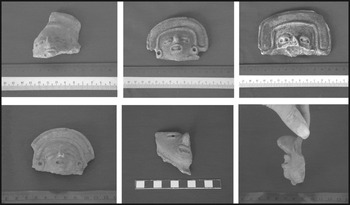
Incensarios were not the only type of artifact associated with ritual practice to have been found concentrated in high densities in the Main Plaza Group. A distinctive type of ceramic anthropomorphic figures was also found in elevated quantities within this monumental space. Primarily head fragments, these figures are generally solid, measure about the size of a human palm, and depict a human figure wearing a broad, unelaborated, banded headdress with rounded ends (Figure 5). Because they are head fragments, it is not possible to determine whether they were from figurines, ocarinas, or whistles, which had hollow bodies with fingering holes and were likely used to make music. Given this ambiguity, the ceramic anthropomorphic heads will be referred to throughout generically as FWOs (figurine/whistle/ocarina), though it should be understood that they are a subclass of the total FWO assemblage. It should also be noted that in addition to their figural and representational qualities, these objects may have been employed to produce music during rituals.
Photographs of a representative sample of the ceramic anthropomorphic figurine-head FWOs recovered from Las Canoas and discussed in the text.

The uses and meanings of FWO ceramic figures in ancient Mesoamerica have long posed interpretive difficulties for researchers. Forming a fairly diverse class of ceramic objects, they are often either assumed or directly argued to have been associated with ritual activity (e.g., Cyphers Reference Cyphers1988; Flannery Reference Flannery and Flannery1976; Marcus Reference Marcus, Grove and Joyce1999). Others propose that such figures were used as a means to negotiate and express social identities, such as those relating to age and gender (e.g., Joyce Reference Lucero2003), or that they were children's toys or tools designed to teach children appropriate gender roles (Cohodas Reference Cohodas, Gustafson and Trevelyan2002:42). The uses and meanings attributed to FWOs suggest not only their archaeological ambiguity, but also the role of depositional context in discerning their significance. Given ethnohistoric accounts from southeastern Mesoamerica (see Wonderley Reference Wonderley and Robinson1986) and the co-occurrence of FWOs with other ritual-associated objects in the Main Plaza at Las Canoas, I argue that in this context it is probable that these FWO ceramic figures were ritually charged.
Although the accounts of Spaniards in Conquest and Colonial-period Latin America are notoriously fraught with bias, particularly when referring to indigenous ritual practices, Francisco de Las Casas (quoted in Wonderley Reference Wonderley and Robinson1986) provides some potential clues about figurine usage. In a description of rituals in the Honduran pueblo of Naco, he mentions idols “the size of a hand or perhaps smaller” that could be ceramic figures similar to FWOs. Indeed, the FWO heads from Las Canoas are about this size. Those described by Las Casas are used in conjunction with incense burners and are described as representing the “Black God,” thereby possibly standing in for gods or ancestors. Given similar associations with incense burners in the Main Plaza at Las Canoas, it seems probable that these objects played a part in the performance of identities tied to ritual and the expression and invocation of power tied to ancestors or deities.
Interestingly, a great deal of variability in the manufacture and depiction of facial features is notable among the Las Canoas FWOs (see Figure 5), a lack of standardization that may suggest representation or portraiture, perhaps of venerated ancestors or deities. Supporting this point, more than half of the FWOs have T-shaped, notched teeth. Some Maya scholars have suggested that the T-shaped (Romero B) dental modification seen in artistic and iconographic depictions may represent the Sun God (Houston and Taube Reference Houston and Taube2000). Furthermore, bioarchaeologists who have recovered Maya skeletal remains with T-shaped modifications have suggested that these individuals' markings may have served to impersonate or realize the divine and, thus, they represented important, venerated members of their communities (Geller Reference Geller2004).
Although some evidence suggests their use in rituals similar to ancestor or deity veneration, several FWOs from Las Canoas had their noses bashed off (not to mention that all are head fragments broken and separated from their bodies), which may suggest intentional acts of defacement, possibly as part of termination rituals. Whether these FWOs were meant to venerate or ritually de-animate ancestors or deities is unclear, but their uneven distribution across the site does clearly suggest their importance in highly specialized ritual performances in the Main Plaza Group. Indeed, FWOs at Las Canoas have an even more pronounced distribution than incensarios: almost all were recovered from the Main Plaza Group (see Table 3), leading to the interpretation that their use may have been instituted and perhaps even controlled by emerging leaders to support their claims to power. Structure 1 in particular was an intense locus for FWO use. Nearly all of those recovered were associated with incensarios and concentrated along the front of the building, where they were deposited directly on the plaza surface or on the plaza-facing staircase. Half bore the T-shaped dental modification, and nearly a third had their noses bashed off, which may point to de-animation rituals. No FWOs were recovered from Structure 5 and only a few from Structure 13—one of which was buried directly beneath the cached incensarios in the patio of the East Group and had the T-shaped dental modification.
Ritual Performances in the Main Plaza Group
In sum, consideration of the contexts in which objects such as incensarios and FWOs were used in the Main Plaza Group suggests the intensity of ritual performance in this part of the site. In particular, the data indicate the importance of rituals conducted on or at the base of stairways in which incensarios and FWOs may have been used and then smashed or defaced in situ. The use of complex censers is the most prominent in this context, and they are often found in association with FWOs that have bashed noses, T-shaped teeth, or both. These figures could represent important ancestors or perhaps are representations of deities who may have been petitioned, venerated, or de-animated through the practice of incense burning. The relatively public nature of these rituals (all would have been visible from the central plaza) lends them a potentially performative quality. However, the use of modeled censers and some pierced ladle and scored censers was restricted to less observable, and thus potentially more private, venues. In these cases, rituals were carried out hidden from the eyes—but likely not from the knowledge—of the rest of the community. For example, modeled censers may have been used to burn incense or to stand in for deities during veneration; the lack of burning on the majority of those recovered suggests the latter function. All modeled censers were recovered from contexts that indicate their use atop structure summits in the rear sections of what were likely enclosed rooms. These rituals would not have been visible from the central plaza and could have been viewed only by those permitted to ascend the structure staircases and enter the summit rooms.
Pierced ladle and scored censers were found in contexts that also may have had restricted or limited access, the cul-de-sac portion of the central plaza being one such space. Rituals held here likely would have been observable by smaller groups of people gathered in what was a much more isolated and spatially constrained portion of the central plaza. In addition, the bulk of Structure 13's pierced ladle censers, as well as a single FWO with T-shaped dental modification, were used in what appears to have been a dedication ritual associated with the construction of a new patio linking Structure 13 to the East Group. Together, all of these ritual objects and the spaces from which they were recovered hint at potential similarities with Maya rituals related to dedication, veneration, and termination—though not always in clear and unambiguous ways. They also suggest the occurrence of ritual performances that were quite different in scale from those occurring in households throughout the site. In the latter contexts, incensarios and FWOs were recovered in far smaller densities and from less specialized contexts (largely middens). The architecture and artifacts from the Main Plaza Group thus suggest the existence of ritual specialists, some of whom privately venerated modeled censer deity idols in enclosed summit room interiors (such as Structures 1 and 5), some who performed to smaller groups by petitioning ancestors or deities with copal incense (such as along Structure 13's southern staircase), some who performed rites of renewal or de-animation within enclosed and difficult to access patios (such as that behind Structure 13), and some who incorporated incense burning and idol veneration for potentially much larger audiences gathered in the central plaza (such as along and at the bases and staircases of Structures 1 and 5).
DISCUSSION AND CONCLUSIONS
The material remains of the Main Plaza Group tell a story about the contextualized performance of distinctive identities that were contingent on claims to specialized knowledge and the tenuous social power that may have emerged from such claims. But can the inert remains of pottery and stone suggest more about the experience of ritual, the expression of identity, or the evocation of power in the past? I argue they can, provided that we consider how these ritual objects and the spaces in which they were used would have been impacted, shaped, and given meaning through performance, through the movements and actions of ritual specialists and their audiences. Bodily movements shape and are shaped by the spaces they pass through and the objects they manipulate. This relationship is recursive and, as Pauketat (Reference Lucero2003) reminded us, contingent and contextualized. In the creation of meaning and the cultural expression of knowledge and power, spaces, bodies, and objects are intimately intertwined (Sanchez Reference Sanchez2005; Turnbull Reference Turnbull2002). Through the performance of ritual within the spaces of the Main Plaza Group—spaces marked by their relative size, elaboration, and preconceived design as distinctive from all other spaces within the community—specialists ritually expressed their knowledge of and ability to communicate with the divine, thus attempting to reinforce their social power within the realm of the mundane.
We may envision specialists burning incense to feed the gods and bearing idols representative of deities or important ancestors as they ascended and descended the staircases of their monumental buildings, the interior spaces of which may have been known by community members to be locales for even more sacred and private rituals involving effigy veneration. We may envision processions moving from monumental structure to monumental structure, from the central plaza to the smaller cul-de-sac plaza, and the burning of incense or invocation of deities through idols at points along the way: the bases of staircases, the elevated terrace surfaces.
The movements and actions of ritual specialists within these varied spaces and contexts would have made diverse statements about knowledge and power and would have addressed the relationships between viewers and performers in distinctive ways. For example, some of these performances, such as the veneration of modeled effigies within enclosed summit rooms or the conducting of rituals in the East Group's spatially constrained and isolated patio, would have emphasized the performer's spatial segregation from the viewer and signaled the separation in knowledge, power, and, perhaps, status between viewers and ritual specialists. These rituals may have simultaneously evoked parallels to household rituals, thereby highlighting integration among community members. Performances in which ritual specialists ascended staircases or burned incense atop building terraces would have elevated the specialists high above the viewers, suggesting the spatial reiteration and reinforcement of an emergent sociopolitical hierarchy. Finally, those ritual performances that were conducted at the bases of stairways may have brought performers and viewers into face-to-face contact, serving the goals of community integration by minimizing the spatial and social distances between specialists and non-specialists.
It is also likely that ritual performances were not restricted to these specific contexts but consisted of more fluid processions involving descent from platform terraces and summits, proximity to and intermingling with viewers, and separation from viewers and ascent of stairways and into summit rooms. This would have emphasized the ways in which specialists were both distinguished from and integrated with the larger community through the ritual process. Via ritual repetition and performance, the identity of the ritual specialist was established and imbued with meaning and authority. For this reason, these contextualized performances refer to the potent duality of ritual practice noted earlier: that ritual incorporates aspects of both segregation and integration, making it a powerful but precarious tool for emerging leaders.
An important question that this interpretation poses, however, is why such power would be granted to individuals by the community in the first place—particularly by a community that does not appear to have previously supported a pronounced sociopolitical hierarchy. One answer, I believe, is to be found in Las Canoas's changing role in regional alliances and spheres of economic exchange in southeastern Mesoamerica. As discussed earlier, after the settlement's founding as a probable outpost of ceramic production from La Sierra, Las Canoans were eventually able to negotiate some measure of independence for their community. This appears to have been due in part to the disintegration of hierarchical rule at La Sierra, but it also resulted from increasing prosperity at Las Canoas itself—prosperity that stemmed from intensified ceramic production and the export of pottery vessels in exchange for other goods. As Las Canoans simultaneously extricated themselves from La Sierra's control and entered more prominently into regional systems of trade and exchange, the need for local leaders may have emerged.
There are several lines of evidence hinting at the possibility of increasing sociopolitical and economic complexity at Las Canoas and the resultant space this may have generated for community leaders. The intensification of pottery production and increased export of locally produced vessels may have created the need for community leaders to take charge of bartering long-distance trade. The presence of slightly elevated densities of imported ceramics and rarer objects such as earspools in the terminal (later) deposits in the Main Plaza Group also may reflect nascent status differentiation and better access to imported goods. In addition, the sudden increase in the size and grandeur of the buildings in the Main Plaza Group suggests the likelihood that their construction, elaboration, and maintenance was precipitated by these changes and that it would have required the input of labor from the community. The ability to garner such labor could indicate potentially higher status, greater power, and leadership roles for those occupying and using the Main Plaza Group (Stockett Reference Stockett2005a).
In light of these data, I suggest that emerging leaders at Las Canoas may have attempted to solidify their standing within the local community and further legitimize their claims to power through rituals based in religious ideology. In making this claim, I argue that the data from Las Canoas represent a moment in time—a moment in which identities were formed and expressly donned, in which they were performed through spaces, objects, and bodies and made meaningful within the context of sociopolitical and economic transformation. The expression of these identities, however, was not a practice that was fixed and static but, rather, contingent and malleable. The buildings, plazas, incensarios, and FWOs at Las Canoas do not reflect an unchanging past. Instead, they represent part of a process of identity expression and materialization within a specific cultural-historical context. Eventually, the circumstances in which rituals were performed changed, and sentiments of community solidarity won out over those of aggrandizement.
The spatial context of the material remains recovered at Las Canoas reflects the endgame of that process. The Main Plaza Group at Las Canoas did not stand unchanged and unaltered throughout the community's occupation. Just as it was planned and shaped, growing more elaborate and serving as a stage for religious ritual over time, so, too, was it abandoned—and apparently well before the community as a whole. In fact, data excavated in 2004 under the direction of Ellen Bell, Patricia Urban, and Edward Schortman suggest that, while occupation and craft production may have continued at Las Canoas, perhaps even into the Early Postclassic period, the power of the ritual specialists dwelling in the Main Plaza Group did not endure. Sometime not long after a.d. 960, Structures 1, 5, and 13 were abandoned, even though occupation continued in Structure 2 and other parts of the community.
Structure 2, with its back turned resolutely on the Main Plaza from the moment of its inception, appears to have become the focal point for the community in the Early Postclassic (Britain Reference Britain2006). Active construction and use of this building continued after the abandonment of Structures 1, 5, and 13. Some areas of the central plaza of the Main Plaza Group (those located directly behind Structure 2) even appear to have been used as a trash heap by the occupants of this structure (Britain Reference Britain2006), and the northwestern and northeastern entrances to the Main Plaza Group itself were sealed off with lines of cobble and rubble (Urban, personal communication 2006), effectively enclosing and preserving this abandoned, possibly ritually terminated, space.
The role of ritual specialists and their place as emerging leaders in the Las Canoas community, therefore, did not endure. The spaces in which the rituals were carried out—spaces that were, however briefly, made sacred through procession and performance—were eventually diminished through decay, defacement, and partial use as a garbage dump. How these material clues relate to the unfolding of history at Las Canoas is not entirely clear, though perhaps they are tied to the ongoing sociopolitical upheavals in this region during the Terminal Classic and Early Postclassic periods. As discussed earlier, the Terminal Classic disintegration of the elite at La Sierra appears to have allowed a measure of independence for Las Canoans, providing a space for them to make a bid for increased independence. It is possible that equally momentous events in the Early Postclassic at El Coyote in the Cacaulapa valley influenced the downfall of emerging leaders at Las Canoas. Notably, the Late Classic core of the El Coyote community was completely abandoned at the start of the Early Postclassic, and a wholly new and utterly different site core was built. This has been argued to reflect dramatic changes in, among others things, political strategies and economic spheres of exchange in the region (McFarlane Reference McFarlane2005).
Since El Coyote appears to have become an increasingly important trading partner for Las Canoas subsequent to the fall of the La Sierra elites, the rather significant shifts in power apparent in the Cacaulapa Valley may have caused similar upheavals at Las Canoas. Alternatively, or additionally, the changes reflected by the abandonment of the Main Plaza Group at Las Canoas may represent the other side of the double-edged sword of nascent power legitimized through claims to ritual knowledge: the community, in the end, may have favored integration over social differentiation. They may simply have decided that they preferred community solidarity and household observances to the pageantry of politically motivated ritual performances and the pomp of status distinctions.
In the end, the motivations of ritual specialists during the Late to Terminal Classic transition at Las Canoas, as well as the reactions and responses of the rest of the community, are likely to have been much more complex than archaeological research can ever accurately discern. But that these practices were meaningful to the past occupants of this community—and thus are meaningful to us—seems certain. Turning to Pauketat (Reference Lucero2003:45) again, we are reminded that
[p]ractices, as creative, meaningful moments are contingent on the contexts of people relating to one another, transmitting, communicating, socializing, making, doing, embodying, representing, etc. How could we isolate the diverse meanings of so many moments through time and across space? Would it not be better to seek to understand how meanings were created regardless of knowing what actor X thought something meant at some specific place and point in time? … If meanings are difficult to see, how meanings are produced is not so invisible.
At Las Canoas, we have examined one way in which meanings and the identities they may signal were made briefly visible. Examining the conjunction and contextuality of archaeologically recoverable objects and spaces and considering what they may have meant in terms of movement, experience, and practice reveals a part of the past in which people strove to express identities with the intent of building a base of power, as well as the ways in which those efforts may ultimately have failed. The broken remains of objects, tumbled walls of buildings, and heaps of trash are viewed within the context of an understanding of the recursive relationship between human beings and the material world, which allows for an invigorated analysis of the making, using, and discarding of objects and spaces. As a result, the ways that meaning was created and negotiated in the past are illuminated.
Considerations of the materiality of more abstract theoretical issues, such as the potency of ritual performance and the expression and manipulation of identity, can therefore provide us with a glimpse of how people and communities experienced their time and place in the past. As with people today, the times experienced by Las Canoans seem to have been shaped by many factors and motivations. Some of these were personal and communal, some selfish, others unselfish. Some were driven by the actions of individuals as they expressed and negotiated their identities through ritual performance or by the community as it responded to those performances—some were even fueled by the historical events in which all were inexorably swept up. The analyses and interpretations presented here are not intended as an unequivocal statement about power or ritual in the past. Instead, I have striven to demonstrate how theories of practice and identity may shed light on inert material remains, resulting in a messier, but also more nuanced, understanding of past human behaviors, motivations, and actions.
ACKNOWLEDGMENTS
I thank Edward Schortman and Patricia Urban for their support, advice, and generosity in sharing both ideas and data. The representatives of the Instituto Hondureño de Antropologia y Historía provided permission to carry out work in Honduras, and I am grateful for their guidance and logistical support. The residents of Rancho Las Canoas, Pueblo Nuevo, and Petoa gave of their wisdom and labor in completing the fieldwork at Las Canoas, which was made possible by a grant from the National Science Foundation (#0207405). A dedicated staff of students and volunteers contributed significantly to my investigations at Las Canoas, including Mara Bernstein, Leigh Anne Ellison, Alejandro Figueroa, Nick Hearth, Kassia Randzio, Bryan Robbins, and Charles Webber. I also acknowledge William McFarlane and Lauren Schwartz for their invaluable help and support in the field and lab. Finally, I thank Gregory Borgstede, Pamela Geller, and Rachel Scott for reading drafts of this essay and providing feedback that has helped shape its final form. Comments provided by reviewers from Ancient Mesoamerica were also insightful and helpful. All errors, omissions, and mistakes found herein are mine.