




No CrossRef data available.
TO DENIGRATE, IGNORE, OR DISRUPT: Racial Inequality in Health and the Impact of a Policy-induced Breakdown of African American Communities
Published online by Cambridge University Press: 01 September 2004
Abstract
In this article we seek to show that prevailing ideological viewpoints on Black health misinterpret Black behavior, and that dominant racial ideologies themselves have negative health effects on African American communities. Second, we show that public policies and practices reflecting prevailing ideological viewpoints harm African American communities. Together, these ideologies and policies undermine Black health by adversely impacting the immune, metabolic, and cardiovascular systems, fueling the development or progression of infectious and chronic disease. Third, we argue that health reform pursued within the same prevailing ideological viewpoints that misinterpret Black health problems have limited effectiveness. We argue for culturally appropriate public policies that value African American social perspectives and coping mechanisms. We suggest that substantive health reform is best pursued through a democratic movement that challenges dominant ideological commitments.
Information
- Type
- STATE OF THE DISCIPLINE
- Information
- Du Bois Review: Social Science Research on Race , Volume 1 , Issue 2 , September 2004 , pp. 247 - 279
- Copyright
- © 2004 W.E.B. Du Bois Institute for African and African American Research
The greatest danger lies not in the so-called ‘problems’ of race, but rather in the integrity of national thinking and in the ethics of national conduct.
W. E. B. Du Bois (1928). Race Relations in the United States,
Annals of the American Academy of Political and Social Science, 140: i
DuBois goes on to say, “Such a nation, if it persists in its logical contradictions, is bound to develop fools and hypocrites: fools, who in the absence of plain facts, cannot think straight; and hypocrites, who in the face of clear duty, refuse to do the right thing and yet pretend to do it.”
INTRODUCTION
Young through middle-aged adults in high-poverty urban African American populations have a high probability of dying or becoming disabled long before they are old (Geronimus 2001; Geronimus et al., 2001). As shown in Figure 1, in Harlem or Chicago's South Side, one-third of African American girls and two-thirds of boys who reach their fifteenth birthdays do not live to celebrate their sixty-fifth. In contrast, only 10% of girls and about 25% of boys nationwide fail to live to age sixty-five. Indeed, African American youth in some urban areas face lower probabilities of survival to age forty-five than White youth nationwide face of survival to old age (Geronimus et al., 1996, 2001).

Mortality calculations based on data from the 1990 U.S. Census (adjusted for coverage error) and from death certificates for 1989–1991; Harlem refers to African American residents of the Central Harlem Health Center District in New York City. Chicago refers to the African American residents of South Side community areas of Near South Side, Douglas, Oakland, Fuller Park, Grand Boulevard and Washington Park in Chicago, Illinois. See Geronimus et al., 1999, for details of calculation methods.
Stress-related chronic diseases are the primary reasons for this excess mortality in urban, African American populations (Geronimus et al., 1996, 1999). Evidence indicates that their negative impact on life expectancy is growing. For example, between 1980 and 1990 excess deaths attributed to circulatory disease or cancer each doubled among young and middle-aged men in Harlem (Geronimus et al., 1999). In contrast, the more publicized homicide rates began to decline. As a general rule, racial differences in health tend to widen after age twenty-five and become most pronounced among those aged thirty-five to sixty-four (Adler et al., 1993; Elo and Preston, 1996; Geronimus 1994; Geronimus and Bound, 1990; House et al., 1990). Although racial differentials in infant health are also stark, these often reflect differences in the health of reproductive-age women (Geronimus 1996b). That is, substantial percentages of African Americans in their twenties or early thirties already suffer from stress-related diseases that can complicate pregnancies (Geronimus 2001).
African American men and women in high-poverty, urban areas also have rates of health-induced disabilities at ages thirty-five and fifty-five that are comparable to the national averages for fifty-five and seventy-five year olds, respectively (Geronimus et al., 2001). These disabilities in young- and middle- adulthood limit capacity to work, often necessitate caregiving, and lead to premature death. Rates of death or disability are shown in Figure 2, illustrating stunning inequalities between African American residents of Harlem or Chicago's South Side, and Whites or Blacks nationwide. Only 30% of teenage girls and 20% of teenage boys residing in these urban areas can expect to be alive and able-bodied at age sixty-five.

Mortality calculations as in Figure 1. Disability calculations based on 1990 U.S. Census using Public Use Microdata Areas ((PUMAs) that most closely approximate mortality areas for Central Harlem Health Center District in New York City and Chicago's South Side community areas of Near South Side, Douglas, Oakland, Fuller Park, Grand Boulevard and Washington Park in Chicago, Illinois. See Geronimus et al., Social Science and Medicine 1999; 49(12): 1623–1636 for details of calculation methods.
Reducing the size of these and other racial inequalities in health has been a high-priority, national public health policy objective for well over two decades. Yet, racial disparities in important health indicators have persisted and, in some cases, have grown (Pappas et al., 1993). This is true even for some health disparities that have been energetically targeted for reduction, such as infant mortality rates. This failure is notable and, we argue, a major indictment of public policies aimed at African American communities.
At least since 1971, when William Ryan coined the phrase “blaming the victim,” a raft of literature has criticized public policies that concentrate on encouraging individuals to change their behavior, instead of on creating structural changes in the social environment in which people live.1
Ryan himself wrote mainly about education policies (Ryan 1971). Other scholars have criticized the individual focus in policies on drunk driving (Gusfield 1981, 1988), environmental education (Bookchin 1974, 1990), water pollution (Fitchen 1987), welfare (Rose 2000), disease prevention and risk-factor epidemiology (Crawford 1977; Tesh 1988; Link and Phelan, 1995, 1996), and housing policy (Saegert et al., 2003).
From this “fundamental cause” perspective, the only effective way to reduce or eliminate differentials in health is to address the underlying “social inequalities that so reliably produce them.” (Link and Phelan, 1996, p. 472). This is a formidable challenge that, by definition, requires going beyond the normal confines of public health policy discourse. Toward this end, we start by noting that racial inequalities in health are the predictable manifestation of linkages among:
- prevailing racialized ideologies;
- political and economic structural inequalities that follow;
- the personal and social coping mechanisms adopted to manage dominant ideologies and structural inequalities; and
- the physiological effects of these coping efforts.
Thus, before classifying policies according to whether they emphasize individual behavioral change or political-economic structural change, we ask whether similar ideological and social premises that undergird both perspectives misinterpret Black health problems, and whether they are harmful to Black health. We illustrate below that current policy ideas and proposals rely upon specific social and moral viewpoints that are racially biased towards White norms and behavior and that these viewpoints, in and of themselves, have negative implications for Black health. They stimulate race-related stress that can “weather” the cardiovascular, metabolic, and immune systems, fueling the development or progression of disease.
I. RACIALIZED IDEOLOGIES: DEVELOPMENTALISM, ECONOMISM, AND THE AMERICAN CREED
Racialized ideologies influence social science's interpretation of Black health problems, and of Black subjects more generally. Here we identify and then critique three central and mutually reinforcing American ideologies that inform common understandings of the production of health inequality: developmentalism, economism, and the American Creed.
Developmentalism
Developmentalism is the most widely used model for interpreting the relationships between age and health and among age, identity, and social expectations in the United States. Linked to the acquisition of abilities necessary to take personal responsibility, it is an individualistic and economistic model. While a full accounting of developmental theory is beyond the scope of this paper,2
For reviews of developmental theory, see the following: Berzonsky 2000; Muuss 1988, 1996; Patterson et al., 1992; Steinberg 1993.
Economism
Economism is rooted in the assumption that all adult human beings know their own needs and wants (they are internally centered), they are essentially self-interested and competitive, and they are mainly motivated by economic considerations. Economism elevates a particular version of individual agency—or “personal responsibility”—into a general social definition of what it means to behave responsibly. In this view, markets are the arbiters of social exchange; individuals can shape their placement in the social hierarchy by choosing to invest in their human capital to best position themselves to engage the market and fulfill their personal responsibilities. Economism thus divorces material context from culture (Goodwin and Emirbayer, 1994). It privileges material well-being over other contributors to human health and wholeness.
The American Creed
The American Creed combines the values of equality and personal responsibility. Equality is expressed in the Creed's promise of equal rights and equal opportunity for all citizens, but the Creed is not an ideology of equal outcomes. Instead, individual outcomes depend on personal responsibility. Thus, inequality is expected, and poverty is considered a just consequence of poor effort.4
This view underlies the traditional distinction in the U.S. between the deserving poor (e.g. widowed) and the undeserving poor (e.g., malingerers) (Katz 1993).
The Creed underlies the universalism of the developmental view that ignores fundamental differences in the life circumstances of Whites and Blacks. The Creed underlies, as well, the decontextualized individualism, i.e., the imaginary “level playing field” of the economistic perspective. The “Creed” is not only a dominant ideology; it is hegemonic. Martin Rein defines a dominant idea as one that is “normatively secure as the accepted course of action.” Hegemony is an extreme form of domination, implying, “the dominant position of the paradigm is maintained, without being engaged in a contest for dominance with other competing paradigms” (Rein 2000, p. 215). As Robert Dahl (1961, p. 317) wrote: “To reject the American creed is in effect to refuse to be an American. As a nation we have taken great pains to insure that few citizens will ever want to do anything so rash, so preposterous—in fact, so wholly un-American.”
The Effects of Prevailing Ideologies on Interpretations of Black Health Problems
Developmentalism, economism, and the American Creed are all racialized ideologies. They ignore or, worse, denigrate African American historical, social, and moral perspectives, and in their social impacts, they disrupt African American coping mechanisms. This, in turn, induces poor health and exacerbates illness, once developed.
Developmentalism frames health as a universal process of biological unfolding that is only undone or impeded by accident or by poor behavioral choices. On closer inspection, development actually reflects biological potential nurtured through a combination of resources and values that are largely restricted to members of the dominant group (Whites). The developmental understanding of the relationship between age and health expresses dominant cultural ideals, values, age-graded social expectations, and the institutions that reinforce them. Centrally, developmentalism and rigid cultural commitment to the nuclear family ideal are mutually reinforcing. Healthy development can proceed because parents are charged with supervising, supporting, and protecting children and adolescents. Cultural and parenting competence are measured by the extent to which young people can separate from their parents and establish an independent identity at the appropriate time: neither so old that they remain dependent on their parents at an age when young adults are expected to be self-sufficient, nor so young that they fall prey to the more subversive influences of their (not yet fully responsible) peers. Newly emergent adults are expected to become attached to the labor force and to marry members of their generation in order to launch and support new nuclear families. They are expected to break away from their primary reliance on parents for support and, for their part, parents are expected to “let go.”
In these ways, the dominant cultural scenario for the life course entrains the proper objects of attachment (first to parents and then to spouse and other peers) and identity development (always as an individual, first in the context of the nuclear family of origin and later in the context of peers), and it outlines the cadence of life-course demands along the axes of dependence and responsibility. Dependents (youth and the elderly) are relatively free from family (or “personal”) responsibility, while young through middle-aged adults are expected to be both independent and highly responsible.5
One caveat to this scenario is that “history” can affect life chances, but in a particular way. The opportunities for health and well-being available to members of specific generations are influenced by the general state of knowledge, prosperity, and technology in the historical period in which they live, and also by the advent of specific events (for example, wars), or macroeconomic realities (recessions, depressions, or economic booms) that occur during their lifetime. These all may affect health, but they are seen as affecting the health of entire cohorts, and, thus, do not violate the assumption of a level playing field.
Through the developmental prism, it is difficult to appreciate (1) that some cultural groups may value collectivism over individualism (or group self-sufficiency over individual self-sufficiency), or (2) that family structure, itself, is historically and culturally variable. For instance, African American urban populations often recognize an extended and multigenerational definition of family. Here, families comprise kin who may or may not be biologically related but, regardless, who share a mutual understanding that they are part of a familial network of reciprocal obligations, and who act consistently with this perception to fulfill functions the dominant ideology would reserve for nuclear families (Hicks-Bartlett 2000; Stack 1974, 1996; Stack and Burton, 1993). Indeed, the extreme economic need, experience with social exclusion, and early health deterioration that characterize African American families in high-poverty areas require a degree of multigenerational connectedness and familial responsibility and reliance throughout the life span that makes aspects of the dominant developmental ideology untenable. In high-poverty Black communities, children and youth, as well as adults, participate actively in fulfilling domestic responsibilities; individuals hold allegiance to multigenerational collectives (community or kin) rather than to biological nuclear family members alone or same-aged peers, and salient aspects of history are those that tie one to a people or community, rather than only to discrete political or economic events.6
We are not implying that multigenerational kin network systems are uniformly positive or without costs for their participants, just as no type of social arrangement or family organization is uniformly positive for all participants. The pertinent question when discussing family arrangements in specific contexts is whether the observed arrangements are, on balance, better or worse ways of supporting and caring for people than would be the alternatives that are realistic options.
In this context, the dominant cultural understanding of psychosocial development is not sensible. Instead, maintaining active family ties, cooperation, and support are especially salient to Blacks in high-poverty areas, taking priority over self-reliance and independence. African American adults often do not feel the same responsibility as their White counterparts to “let go” of youthful family members—both because they rely on their cooperative efforts and because they view society as neither level nor welcoming for African American youth. For their part, poor Black teens cannot take a moratorium from family responsibility, nor, with death and disability all around, are they likely to view themselves as invincible. These teens have ample reason to protect the ties they have to their elders because the intergenerational perspectives provided by their parents help them to make sense of ongoing social, political, and economic exclusion (Ward 2000).
Interconnections among members of social or kin networks help participants feel valued and attended to, as well as providing practical support, and through both routes can be health promoting. By feeling part of a collective that stands in opposition to the dominant culture and through the social ties that reinforce this feeling, members of the collective are able to contest the dominant culture's images of themselves as morally marred or culturally deficient.7
We are distinguishing between racist ideologies that promote racial subordination from the protective and oppositional Black racial ideologies (such as most Black nationalisms) formed in opposition to Black racial subordination. Racial ideologies, like all beliefs, have to be put in context. It makes as much sense to equate Black nationalism with White racism as it does to equate feminism with patriarchy.
For example, James (1993) speculates that this may resolve the “paradox” that low-income, Mexican immigrants enjoy better birth and other physical and mental health outcomes than other poor Americans or than first generation Mexican Americans of higher socioeconomic position (Guendelman 1998; Guendelman et al., 1990; Landale et al., 1999; Rumbaut and Weeks, 1996; Sundquist and Winkleby, 1999; Stern and Wei, 1999).
Thus, the relatively longer, healthier lives of Whites are conditioned not only on greater access to material resources, but also on the psychic benefits of having their values honored in public discourse and institutional structures and timetables. Explanations for racial health inequality must encompass the impact of pervasive insults to the personal and collective integrity of African Americans. We are here suggesting that cultural oppression is as important a structuring force in Black health as economic forces (Lamont 1997).
While material resources contribute to health in a critical way, populations vary in their strategies for achieving economic security or social mobility. The most promising avenues for any population are ones that are environmentally adaptive, responsive to socioeconomic opportunities and constraints, and culturally mediated (Geronimus 1987, 2000, 2003a). Moreover, health also comes from a sense of rootedness in and affirmation of cultural values, practices, affective ties, and beliefs that give life purpose and meaning (James 1993; James et al., 2001). These psychosocial resources may be especially important in averting stress-related disease (James 1993). The economistic assumption is problematic when considering racial disparities in health, not only because it promotes “victim blaming” or “ameliorative” interventions but also because, at best, it ignores the culturally mediated, psychosocial aspects of health. As we discuss later, this perspective can even lead to policies that are counterproductive or to structural interventions that have limited effect.
Even social epidemiologists and policy advocates who focus on structural issues unduly limit their thinking to economic interventions and metaphors. Few pay any attention to the impact of affective ties and social identity on health. They see the ultimate goal of social research and policy as providing access to material resources (e.g., income, health insurance, food stamps, good housing) or to other forms of “capital” that are commutable in a market economy (including human capital investment opportunities such as education or social capital development). This reflects the large degree to which economistic assumptions about human behavior have permeated cultural discourse. For example, recent explication by Oakes and Rossi (2003) of the “essential nature of social stratification” (emphasis added) with a view toward determining “an ideal Socioeconomic Status (SES) measure for public health research” offers insights into the rootedness of the economistic assumption in the thinking of investigators interested in the social determinants of health. Oakes and Rossi locate the definition of SES, or social structure, in “differential access (realized and potential) to desired resources.”9
Oakes and Rossi (2003) elaborate that this is a common understanding among social researchers:
“Hauser and Warren (1997) think that SES is a shorthand expression for variables that characterize the placement of persons, families, or neighborhoods with respect to the capacity to consume valued goods; Krieger et al. (1997) add that prestige or rank-related characteristics pertain to relative position in socially ranked hierarchies and chiefly concern status in relation to access to and consumption of goods, services and knowledge; and Nock and Rossi (1979) state that SES is that dimension of stratification which translates the objective distribution of societal resources into meaningful perceptions of relative desirability” (emphases added pp. 775–776).
based on two kinds of elements and two ways in which they are related: The elements are (1) actors and (2) resources, related through (3) interests and (4) control … Since resources may take the form of (1) material and monetary goods, (2) skills and capabilities, and (3) the strengths of social relationships, three dimensions may be defined. These three domains which we call material capital, human capital, and social capital, respectively, uniquely locate the status of individuals in the social structure.
Material features are central to each of these domains. Oakes and Rossi note:
material capital is observable and tangible, or at least easily convertible into such forms (e.g. stock options) … human capital refers to fixed endowments of an actor. However, human capital also refers to the education, skills, abilities, and knowledge one may acquire. It is thus mutable through “investment” of time and labor.
Furthermore, they assert: “Human capital is a critical component of SES since it is a resource that may be used to acquire socially valued goods. It is fungible in a market economy.” And finally, even social capital is stripped of affective ties and social identity:
[S]ocial capital stands for the ability of actors to secure benefits by virtue of membership in social networks and other social structures. Examples include increased educational achievement, social mobility, employment opportunities, decreased welfare dependency, and low levels of teenage pregnancy (p. 777).
Note that this highly individualistic, acquisitive, and materialistic discussion is made not by researchers who primarily advocate individual behavior change, but by those who are attempting to remedy limitations in SES measurement for health researchers who “believe that a narrow focus on individuals outside of historical, social, and biophysical contexts limits the understanding of disease etiology, health, and intervention modes” (p. 769).
Economism misunderstands Black health problems by ignoring cultural oppression. Similarly, unequal racial opportunity is commonly defined in narrow economistic terms as unequal access to the material resources and social contacts needed for economic information and individual advancement. The problem with racial segregation, in this view, is not that it represents overwhelming negative cultural ostracism of Blacks, and a colossal moral failure of the nation to rectify its horrendous racial history, but simply that it limits Blacks' access to contacts and resources or, in health terms, exposes Blacks to noxious social and physical environments. This economistic understanding of segregation skirts the moral and institutional implications of America's racial history for its current social hierarchy, imposing an individualistic and decontextualized viewpoint on Black health problems that few African Americans share.
We believe that economism also leads to misunderstandings of the Black middle class. The expansion of the Black middle class has been identified as a solid sign of economic progress and as a precursor to eventual widespread black social integration.10
The use of the term Black middle class should not be taken to imply that Blacks and Whites in the middle class are on an equal economic footing. Despite an expanded middle class as measured by income in the period between the 1960s and late 1980s (Fainstein 1993; Hochschild 1995), Blacks trail Whites significantly (12:1 overall) in wealth. Controlling for income, Blacks have only 0.57 as much wealth as Whites (Shapiro 2001).
Many middle-class Blacks are still morally allied and socially associated with the defamed Black poor, and most are segregated in the same or proximate neighborhoods (Charles 2003). Individual economic or educational success does not bring the same rewards for African Americans as for Whites (Kaufman et al., 1997). As Sikes and Faegin wrote, “African-Americans with income and occupational standing to be considered middle class sooner or later comprehend that they can never become truly middle class, or at least not in ways available to White Americans” (Sikes and Faegin, 1994, p. 35). Crime victimization is a good example of this disproportion. With Whites, crime victimization rates decline as income increases, with Blacks victimization rates rise as income increases (Kennedy 2001).
Given this context, it is not surprising that the health of middle-class Blacks and Whites differs greatly in many regards, especially in prevalence of stress-related diseases (James et al., 1992; Light et al., 1995; Williams 1999; Williams et al., 1997). Middle-class Black populations have only modestly better functional health status than high poverty Black populations (Geronimus et al., 2001). This circumstance contrasts sharply with the steep economic gradient in functional limitation prevalent among White populations (Geronimus et al., 2001; Hayward and Heron, 1999; House et al., 1990, 1994).11
Speaking to both the benefits and limitations of access to material resources for Blacks, more affluent African Americans are less likely than poor African Americans to pay the additional price of early mortality, although, unlike for more affluent Whites, their longer lives show no reduction in the years spent in poor health (Geronimus et al., 2001). One explanation is that economically better-off African Americans may have greater access to medical services and resources that help them to avert premature death, despite high morbidity (Link et al., 1998). Another (perhaps, complementary) explanation is that African Americans who enjoy socioeconomic success in the face of race-based barriers to their achievement might also be a population singularly determined to cope effectively with chronic disease, among other stressors (James 1994).
The third ideology, the American Creed, asserts the essential fairness of U.S. institutions. In so doing, it wipes away consideration of fundamental structural inequalities and cultural oppressions. The American Creed is basically a White point of view. Belief in the Creed prevails among Whites, but a large majority of Blacks hold an opposite view (Dawson 1996). This difference in group perspective reflects the continuing absence of deep public consideration of slavery, Jim Crow laws, and subsequent forms of racial discrimination in the U.S. Slavery and Jim Crow laws undermined the foundation of morality and of shared humanity in the United States. The U.S. government never instituted a national anti-racist educational program after slavery (Feagin 2000). Nor did the government institute a full employment “Marshall Plan” in the 1960s, despite Black demands for such a program to counter the effects of centuries of slavery and segregation (Hamilton and Hamilton, 1997). In thinly coded racial language, Republican Party leaders from Goldwater to Reagan to Bush attacked the 1960s Great Society programs as an unwarranted tax burden on hardworking (White) Americans for (poor Black) people who do not want to work (Edsall and Edsall, 1991).
Allowing human monstrosities of the scale of slavery and legal segregation to pass without deep ethical consideration conceals the questionable legitimacy of today's racially segregated communities and institutions. White Americans evaluate African American demands for justice from the standpoint of the Creed morality. Their belief in the essential fairness of U.S. institutions and in the equality of opportunity in social structures leads many Whites to the racially prejudiced stereotype that Blacks are lazy and culturally disposed toward poverty. Martin Gilens (1999), in his study of White opposition to welfare, argued that while some Whites may harbor general antipathy for Blacks,
… for many whites the stereotype of blacks as lazy grows out of the belief that the American economic system is essentially fair, and that blacks remain mired in poverty despite the ample opportunities available to them. These perceptions in turn are fed by media distortions that neglect the “deserving poor” in general and portray poor blacks in a particularly unsympathetic light (p. 173).
Thus, as Jennifer Hochschild (1995, p. xi) writes: “[M]any whites see middle-class blacks as making excessive demands and blaming their personal failures on a convenient but nonexistent enemy. Even more whites see poor blacks as menacing, degraded strangers.”12
In contrast, one of the damaging effects of this interpretation is the development of White racial “innocence.” This is the widely held view of many Whites that their current social status has nothing to do with past slavery and segregation, but is instead simply a result of their individual pursuit of the American Dream (Harris 1993; Waters 1990). This notion of White innocence can also lead to intellectual hubris—the view that Blacks do not yet know how to think properly, and that their interests need to be calculated for them.
Of note, in a race-conscious society, internalizing Creed ideology can be harmful to the health of Blacks who “play by the rules.” For example, Sherman James (1994) has suggested and found evidence of a predisposition among most African Americans to engage in persistent high-effort coping with social and economic adversity (“John Henryism”). In low-income African American populations, individuals who exhibit high levels of John Henryism are the ones most apt to be hypertensive (James 1994), a circumstance that directly contradicts notions that fatalism or indolence precipitate cardiovascular disease among low-income African Americans.13
Put another way, the empirical evidence on John Henryism suggests that low-income African Americans who work hard to mobilize their internal resources to cope with or surmount structural barriers to their achievement express values and take actions that are in sync with the greater American ideological emphasis on having an internal locus of control and strong work ethic. Yet, whether or not these actions are successful in producing social mobility, they can exact a profound physical toll manifested in the high prevalence of stress-related disease among young through middle-aged African American adults.
Without basic reconstruction of widespread racist stereotypes and essentialist myths regarding the virtues of American democracy, there is little intellectual foundation for scientific investigations of Black health problems that take structural and cultural aspects of racism seriously. The Creed blames Blacks for their condition, and in this way blocks understandings of broader structural and cultural causes for racial differences as well as broader social responsibilities for persistent racial inequality. Meanwhile, Blacks undergo harmful stress from powerful ideological forces valued by Whites as common sense (Geronimus 2000, 2003a).
Racial Ideologies and Black Health
Whether health is construed narrowly or broadly, developmentalism, economism, and the Creed are of limited value to public health policy advocates working to eliminate racial health inequality. Regarding developmentalism, the problem of racial health inequality leads us to ask: How do we reconcile the notion that modern Americans have the developmental potential to be healthy at least through middle age with the stark evidence that many young and middle-aged African Americans are not? Adhering to the developmental model limits our perspective, reducing instances of poor health and mortality among relatively young adults to exceptions. Calling such group-wide experiences exceptions to the rule of a long, healthy, life is an inadequate explanation. It offers little to help explain the rapid health decline of African Americans that becomes detectable in their twenties, even among the middle class (Geronimus 1996b).
As an alternative, Geronimus (1994, 2001) conceptualizes aging as a process of weathering. That is, people's health reflects the cumulative impact of their experiences from conception to their current age (Kline et al., 1989). The older they are, the more time they have had to have health-impacting experiences, and the greater the opportunity for these experiences to express any (even lagged) health effects or to accumulate or interact with others.
Weathering posits that African Americans experience early health deterioration because, relative to Whites, they have much greater and more frequent experiences with social and economic adversity. On a physiological level, persistent, high-effort coping with acute and chronic stressors has a profound effect on health and disease. While the body's ability to respond to acute stress (the “fight or flight” response) is protective in certain threatening situations, under other circumstances, the physiologic systems activated by stress (the allostatic systems) can damage the body (Sapolsky 1998). Allostatic systems enable people to respond to changing physical states and to cope with ambient stressors such as noise and crowding, as well as extremes of temperature, hunger, danger, or infection. As Bruce McEwen (1998) notes, the body's response to a stress-inducing challenge is twofold: turning on an allostatic response that introduces a complex cascade of stress hormones into the body, and then shutting off this response when the threat has receded. However, when the allostatic system is not completely deactivated, the body experiences overexposure to stress hormones. Long periods of overexposure result in “allostatic load,” which can cause wear and tear on the cardiovascular, metabolic, and immune systems.
Allostatic load may result from exposure to a series of acute short-term stressors (for example, life traumas such as job loss, eviction, or the death of a loved one), or from long-term exposure to chronic stress (such as that associated with social stigmas or persistent economic adversity).14
There is also evidence that allostatic load may result from post-traumatic stress disorder, and some evidence from animal studies that the allostatic systems of infants subjected to stress become set to overreact, increasing the probability of allostatic load throughout their lifetime. In light of this evolving evidence, it is possible that children in urban ghettos begin to experience allostatic load and its negative health impacts at a young age, due to chronically stressful living conditions or traumatic events.
- persistent material hardship;
- repeated exposure to environmental hazards and ambient or social stressors in residential and work environments;
- high psychosocial stress and high-effort coping that increase in young to middle adulthood as family leadership roles are assumed and obligations expand and compete;
- pressure to adopt unhealthy behaviors as a means to cope with growing stress, uncertainty, or persistent material hardship;
- the early development of chronic conditions and the practical, financial, and emotional difficulties associated with these;
- medical underservice or differential treatment by health care providers; and
- feelings of stigma, frustration, or anger at racial injustice.
Over the life course, weathering and allostatic load can cause the allostatic systems to wear out or become exhausted, leading to cardiovascular disease, obesity, diabetes, increased susceptibility to infection, and accelerated aging. African Americans suffer from these stress-related conditions at greater rates, at earlier ages, and with a higher probability of early death than do Whites. They are prominent contributors to racial health inequality.
Individuals can make changes in their lives to mitigate weathering and reduce allostatic load, but likely only to a small degree. The weathering model suggests that behaviors such as smoking, poor diets, and sedentary lifestyle may be secondary to the constraints or stresses of everyday life, or may interact with allostatic load to produce adverse health outcomes. Significant changes in the social, political, and physical environments are required to substantially reduce or eliminate weathering and allostatic load among the Black population.
II. IMPLICATIONS FOR PUBLIC POLICY
New public health and social policy discussions must embrace the dynamic relationship between population health and the needs of family economies and caretaking systems in high-poverty African American communities. Weathering and the pervasive health uncertainty in adulthood it implies have local social consequences as they enlarge the scope of caretaking needs in a community while simultaneously depleting the pool of caretakers and economic providers. Analysts' casual disregard of the responsiveness of local institutions, such as kin networks, and their critical function in promoting health and well-being creates racial barriers between public health professionals and those with indigenous knowledge. This disregard is, itself, a form of racism (Geronimus 2000).
An implication of the weathering framework is that policies likely to fragment or impose new obligations on already overburdened networks, that disregard the local cadence of life-course demands or norms of care across and within generations, or that rely upon or legitimize demeaning stereotypes will increase allostatic load for the urban poor, and, ultimately, further imperil their health. Policies that are logically informed by uncritical acceptance of developmentalism, economism, and the Creed are likely to have such impacts. In this section, we show that policy discourse concerning Black health outcomes is steeped in dominant ideological perspectives that valorize existing social inequalities and undermine the recognition of social and cultural strengths in Black communities.
The government's insistence on the value of low-paying work, regardless of social context is an example of the harmful effects of these racialized ideologies on Black communities. Policy makers tend to perceive unemployed young and middle-aged adults as socially atomized individuals rather than active participants in family economies and caretaking systems strained by persistent poverty and pervasive health uncertainty. Whether unemployment is viewed as malingering or as resulting from labor market discrimination, the perceived remedies revolve around getting the unemployed working, with little concern for ripple effects through kin networks or the impact of increased stress on the health of these “working age” adults.
According to our analysis, low rates of labor force participation in high-poverty, urban, African American communities represent a combination of structural barriers to employment (Wilson 1996), high rates of health-induced disability (Bound et al., 1996), and collective strategies for seeing to the considerable caretaking needs of multigenerational kin networks (Stack and Burton, 1993; Geronimus 1987, 1992, 1997). In the context of Black communities, where death and infirmity are erratically scattered across the lifespan, men and women cannot easily maintain secure positions in the workforce. Bound, Schoenbaum, and Waidmann (1996) find that health differences between Blacks and Whites can account for most of the racial gap in labor force attachment for men. They find that Black women would be substantially more likely to work than White women were it not for the marked health differences. In subsequent work, Bound et al. (2003) document that working people with health limitations typically earn between 20 and 40% less than people without such limitations. Finally, they find that health disparities can account for a significant part of the higher participation rates in public assistance programs among Blacks (and Native Americans) relative to Whites.
Additionally, practical challenges for the members of family or social networks who care for the disabled can undermine their efforts to fulfill competing obligations to family and work. In these circumstances, multigenerational families may divide kin network responsibilities among young and middle-aged adults so that some provide economically by participating in the work force, whereas others focus their energies on the caretaking and other domestic needs of the extended family (Stack and Burton, 1993).
Indeed, a pervasive theme in recent research on welfare reform is that most recipients of welfare assistance share the dominant cultural belief in the dignity of paid work, but that the jobs available to them both fail to improve their economic situation, and put great strains on their ability to fulfill responsibilities for their extended families (Edin 1995). A general conclusion of recent research is that welfare policy requiring poor people to get paid jobs does little to ease poverty. Meanwhile, Sharon Hicks-Bartlett (2000), for example, shows that African Americans in poor communities are so interdependent that when one person gets full-time employment, a cascade of social problems for others may be set in motion. Katherine Newman (2001) observes that, given the general level of poverty in Harlem, it is hard for those not on welfare to hold down jobs or go to school unless some family members stay on the welfare rolls. Ariel Kalil and her colleagues (2000) describe how requiring young Black mothers to take paying jobs puts new strains on their relationship with family members and the fathers of their children. Earlier researchers of Black family structure report findings that are consistent with and would presage such findings (Billingsley 1992; Geronimus 1992; McAdoo 1980; Hogan et al., 1990; Stack 1974; Stack and Burton, 1993).
A second example is the policy pressure for marital childbearing, which is the logical extension of developmentalism and its ties to the nuclear family ideal. Through these lenses, policy advocates see unmarried mothers as lone mothers rather than as participants in kin networks. They focus on policy remedies that encourage marital childbearing or, at least, paternity support, unaware that such remedies are meager, at best, or that they undermine complex systems for caretaking and economic provision worked out through kin networks, not nuclear families. Even some who recognize the functional, economic, importance of kin network participation often interpret tight social networks as ones that restrain people in poor African American communities, selectively highlighting Carol Stack's (1974) original observation that participation in these networks can make it hard for individuals or married couples to make and save money or get very far ahead financially as nuclear households. Overshadowed by the concern over nonmarital childbearing, the importance to health and well-being of caretaking, risk pooling, or the transmission of shared values is missed. Few people in positions to inform or make public policy see these positive contributions of Black norms and social bonds.
Yet, Tom DeLeire and Ariel Kalil (2002) found critical exceptions to the shibboleth that children raised in married families fare better than others. While teens in single-parent divorced, widowed, and step families were disadvantaged, teens with divorced mothers in multigenerational families fared no differently than those in married families. Moreover, youths living with their never-married mothers in multigenerational households—most often Black teens whose young mothers had low education and income—had social and academic outcomes that were better than those in married families. These positive child outcomes are consistent with our thesis that nonmarital childbearing as part of an extended kin network is adaptive in this population.
A third example is fertility timing. Public policy to prevent teen childbearing was both prompted and legitimated by ideas embedded in racialized perspectives of developmentalism and economism. Through the prism of developmentalism, teen mothers are perceived to be lone and immature adolescents, rather than young adult members of multigenerational kin networks. They are judged as individuals who made wrong choices with grave personal and social consequences. An additional presumption is that simply by postponing childbirth until they are past their teen years would have allowed them to be better mothers, and to accumulate sufficient “human capital” to be successful in the labor market. Although its scientific basis is open to question, this view has gathered great political momentum. It has served as a basis for important policies, including key aspects of national welfare policy (Geronimus 1997).
Despite dramatic reductions in U.S. rates of teen childbearing over the past fifty years, teen childbearing continues to occur disproportionately among low-income African Americans. Indeed, in high-poverty, urban, African American populations, such as in Detroit, Watts, or Chicago's South Side, the modal age for first childbirth is in the teenage years (Geronimus 2003a). According to our analysis, this is because early fertility remains in sync with the needs of local family economies and caretaking systems in high-poverty Black communities. Weathering challenges, even threatens, family economies and caretaking systems as it increases the probability of widowhood or orphanhood and prolonged disability in the family (Geronimus, Bound, and Waidmann, 1999). These risks and their adverse effects are reduced when childbearing occurs early and childrearing is seen as the obligation of a multigenerational kin network, rather than a biological nuclear family.
Children may fare best if their birth and pre-school years coincide with their mother's peak health and access to social and practical support provided by relatively healthy kin. This period occurs at a younger age for African American than for White women. In fact, in Harlem, infant mortality rates for teen mothers in 1990 were half those for older mothers, even though the preponderance of “older” first-time mothers in Harlem were only in their twenties (Geronimus 2001). Nor do empirical findings related to child development and school achievement provide consistent endorsement for the political viewpoint that teen childbearing harms children. For example, Moore et al. (1997) found that among Black children in their national sample of four to fourteen-year olds, those whose mothers were eighteen or nineteen at their birth performed better in reading and math than those whose mothers were in their early twenties. Geronimus, Korenman, and Hillemeier (1994) studied the performance of preschool and elementary school age children of a national sample of sisters who experienced their first births at different ages. They found evidence that children of teenage mothers in high-poverty Black populations fare as well or better on standard measures of socioemotional development, cognitive development, and school performance than children of older mothers. Although these findings on infant health and child development are consistent with others in a methodologically diverse literature that spans two decades,15
On maternal age and infant health outcomes, see, for example, Geronimus 1986, 1987, 1994, 1996b, 2003b; Geronimus and Korenman, 1993; Kline et al., 1989; McCarthy and Hardy, 1993; Rauh et al., 2001; Rich-Edwards et al., 2002. On early child development see, for example, Geronimus et al., 1994; Levine et al., 2001; Moore et al., 1997; Moore and Snyder, 1991; Rothenberg and Varga, 1981.
In contrast, qualitative evidence from ethnographies and in-depth interviews suggests that African American residents of high-poverty urban areas have socially situated knowledge of the benefits to child and family health and well-being of early childbearing, childrearing in multigenerational families, and parental respite from the labor force (Burton and Whitfield, 2003; Edin 1995; Geronimus 1996b; Hicks-Bartlett 2000; Stack 1974, 1996; Stack and Burton, 1993). The mismatch between indigenous and authoritative knowledge has made low-income African Americans appear lazy, unable to take personal responsibility, and impervious to sex education and family planning measures, as their rates of unemployment and nonmarital and/or teen childbearing continue to be what the larger public views as alarming. This alarmist interpretation has fueled public contempt for teen or nonmarital childbearing, including resentment of teen mothers, new theories that question the morality of residents of urban Black communities, and corresponding new, more punitive ideas about how to solve the “problem that hasn't gone away.”
Following developmentalist logic, policy makers discredit Black elders in high-poverty urban communities as good parents because of their seeming failure at their supervisory function. Policy makers feel entitled to act in loco parentis to entire communities, in effect, discrediting adults in these communities while meting out paternalistic and punitive policies aimed to encourage urban youth to tow the line.16
For example, reducing teenage childbearing has officially become a measure of moral renaissance. Remedies include punitive measures—such as denial of welfare benefits and reinvigoration of statutory rape laws—and national discussion of religion, culture, and public values. The premature consensus that teenage childbearing is a major social ill is now exploited to legislate abstinence education programs, while mandated support for family planning programs and abortion has eroded. Social policy (e.g. welfare policy) and health education (e.g. abstinence education) are now seen as a legitimate means to encourage, cajole, even coerce, these uneducated or “recalcitrant” individuals to assume greater “personal responsibility” (Geronimus 1997).
To make progress in this domain of public policy discussion, the social goal of enabling teens to avoid unwanted pregnancies needs to be de-coupled from welfare reform activism and abortion rights activism. Although for pro-choice advocates, abortion rights are an essential part of teen childbearing prevention, it is reductionist and unnecessarily divisive to reducing the profound goal of enlarging options for disadvantaged youth to abortion rights. And tying the two issues together so closely consigns this broader goal to being endlessly stuck in a tug of war between moral conservatives and social liberals. In its own way it adheres to the stereotypic view that the most threatening challenge to the socioeconomic success of young African American women is their sexuality and reproductive capacity.
Our analysis also has implications for policy interventions that are perceived as “structural.” So-called “structural” interventions are usually conceived in ways that do not challenge the boundaries of larger political-economic-spatial structures, and they tend to ignore fundamental issues of racial identity and Black marginalization. One example is the policy focus of many liberals and progressives on increasing the minimum wage. Arguments for and against increasing the minimum wage, including arguments for a “living wage,” are usually debated in social management terms. The main dispute in the scholarly economic literature focuses on whether increasing the minimum wage reduces poverty and encourages workers to enter the market who would otherwise shun it (because work does not pay), or whether it inadvertently increases unemployment among the very groups a minimum wage increase intends to help (Ellwood and Bane, 1994; Sessions and Stevans, 2001). This debate is technical and inconclusive. What is of interest here are the contours of the debate. It is framed in the economistic and utilitarian terms of whether raising the minimum wage will help more people than it harms in terms of income (Levin-Waldman 2000). However, the debate over the minimum wage is just as much a collective moral and political debate over the kind of society that the U.S. should be. That is, should employment policy be guided by an overarching goal of achieving a more economically and racially equal society?18
Sabel and Piore (1984) noted two decades ago that employment policy is not decided by technical calculation, but depends on social vision. They posited a choice between a “low road” economy based on cheap, low-skilled, and easily outsourced labor versus a “high road” economy with a well paid, highly skilled, and flexible workforce.
Historian Thomas Holt (2000) divides U.S. history into the pre-Fordist era of slavery and Jim Crow that launched modern society; Fordism that corresponds to Blacks' escape from rural areas for industrial jobs and unionization in the city (a promising period in retrospect); and the contemporary post-Fordist consumer oriented society in which Black labor is obsolete and Black demands are potentially anachronistic. See also Jones 1998.
Another example is the widespread perception that universal health insurance will go a long way toward the elimination of health disparities. Leading political advocates still portray universal health insurance as a rallying cry for all uninsured persons (Reich 2001). Blacks are more skeptical as health insurance proposals fall short of addressing fundamental health problems in Black communities connected to broader forces of racial subordination.20
African Americans tend to live in segregated communities with poor housing, relatively high exposure to toxic environmental hazards, high levels of violent crime, and inadequate access to healthy foods. Poor housing can contribute to infectious disease transmission, injuries, asthma symptoms, lead poisoning, and mental health problems—both directly (e.g., because of environmental hazards) and indirectly (e.g., by contributing to psychological stress that exacerbates illness). Blacks not only tend to face higher levels of pollution, crowding, inadequate housing, and inadequate community infrastructure, but, “they also frequently experience these social and environmental demands in concert” (Saegert et al., 2003).
Another example is the call for housing vouchers and other programs that enable some African Americans to move out of urban ghettos. The premise underlying such programs is that if individual Black families are freed of the environmental hazards, ambient stressors, and social and economic constraints imposed by life in racially segregated ghettos, they will find more opportunities to invest in their human capital, find jobs, and avoid stress. Certainly, several researchers have examined the relationship between residential segregation and health outcomes and found evidence that segregation is a factor above and beyond the effects of poverty, per se, or individual demographic characteristics (LaVeist 1989; Polednak 1991; Williams and Collins, 2001). Among African Americans, segregation is also positively associated with increased rates of all-cause mortality (Cooper et al., 2001; Jackson et al., 2000), chronic conditions such as cardiovascular disease (Cooper 2001), and infectious diseases such as tuberculosis (Acevedo-Garcia 2001). However, current approaches to enable the movement of ghetto residents into more affluent areas are small in scale and politically fragile.
The major program in this vein is the Moving to Opportunity Program (MTO), a national demonstration program that has been operated by the U.S. Department of Housing and Urban Development since 1994 at five sites: Baltimore, Chicago, Boston, Los Angeles, and New York. MTO involves about 4600 families nationally and has a complex design. The families were assigned by a computerized lottery system to three groups. One group of families was assigned to an experimental group that received Section 8 housing subsidies as well as additional support, and were required (for the first year of their participation) to find housing in neighborhoods with a 1990 poverty rate below 10%. A second treatment group received only a Section 8 subsidy, and a control group received no tenant-based assistance (Kling et al., 2004).
Reports on the health impacts of MTO are mixed. Early reports suggested that members of those Black households that moved out of high poverty ghettos showed signs of responding to their improved physical environments. For example, children in the experimental group had fewer asthma attacks or injuries requiring medical attention (Goering et al., 2002). Feelings of safety increased and fewer depressive/anxiety problems were reported among adults and some children (Leventhal and Brooks-Gunn, 2003). Reports based on longer-term follow-up are less clear-cut. Net positive impacts appear to be more modest as some negative health impacts have emerged. For example, while female youth appear to have benefited from the move in terms of their mental health, male youth who moved were found to engage in more risky behaviors and to experience more physical and mental health problems than those who did not (Kling and Liebman, 2004). Adults experienced a positive mental health impact and, at least, a temporary reduction in obesity, but showed no significant effects on four other aspects of physical health—general health, asthma, physical limitations, or hypertension (Kling et al., 2004).
The original program was intended to involve substantially more families, but it was scaled back after strong White suburban resistance in Baltimore, the initial program site. This gets to the heart of our critique of the MTO intervention. In so far as it is meant to inform policies aimed at desegregation of large numbers of families, it is politically naive. Previous survey research and numerous historical accounts have shown strong White resistance to living in neighborhoods that are “overly” Black (Zubrinksky and Bobo, 1996). A recent study has shown that housing “loses at least 16% of its value when located in neighborhoods that are more than 10% black” (Harris 1999, p. 476). This suggests that if sizable numbers of Blacks were to move to White neighborhoods, those Whites who could afford to leave would do so. Interestingly in this regard, the neighborhoods that MTO experimental families moved into experienced sharply increasing poverty (Kling and Liebman, 2004, footnote #21).
The MTO program skirts the basic and fundamental political issue of persistent popular racism that thwarts elevating desegregation programs to meaningful levels. Such housing programs also ignore the social and cultural strengths of urban Black communities (Bennett and Reed, 1999). These programs are usually premised either on the defaming idea that concentrating poor Blacks together leads to social pathology—and that it is in society's interest for poor Blacks to be dispersed—or that the problem of the urban, racially segregated ghetto is that it effects a spatial mismatch between poor Blacks and job or educational opportunities. Both premises fall short of addressing the racism that led to Black urban ghettos, still maintains Black ghettos, and that will likely turn Black suburban destination points into new racial ghettos (Thompson 1998).21
Black single mothers are significantly more likely than non-Black single mothers to move from a prosperous neighborhood to a poor neighborhood. In any case, “even when Black single mothers do escape poor neighborhoods, their tenure in wealthier areas is unusually tenuous” (South and Crowder, 1998).
Another concern is that the MTO evaluation findings that health problems were not consistently or significantly improved—nor were educational or employment outcomes, for that matter (Kling et al., 2004)—might be interpreted by some as support for policies of neglect, containment, or punishment rather than truly structural interventions. In the absence of alternative prisms through which to interpret such findings, most people are left to draw on prevailing racialized ideologies, leading some to reach the defaming conclusion that “you can take the resident out of the ghetto, but you can't take the ghetto out of the resident.” Similarly, those interested in the health impacts of housing voucher experiments are likely a priori to take an economistic perspective on the impact of ghetto residence on health. This limits their ability to hypothesize that important health costs may accrue from moving through voucher programs or that enduring health benefits may be more modest than anticipated. These possibilities would be clearer if a weathering perspective were taken. It would allow investigators to consider that some health problems may be exacerbated as kin networks are dispersed, fragmented, and their work disrupted; that facing interactions with Whites on a regular basis can be stressful in ways that harm Black health (Light et al., 1995), or that little, if any, health benefit accrues to ghetto residents left behind, impacting even those who move and highlighting the severe limits of such interventions.
All of these examples imply that understanding what factors shape public sentiment on race and how they might be influenced are critical public health and social policy objectives. Embedded racial biases reinforce the urban ghettoization that limits access to municipal services, health care, healthy environments, and educational and employment opportunities (Kelley 1997; Newman 1999; Wallace and Wallace, 1997); supports discriminatory hiring practices (Wilson 1996); and reduces the availability of welfare and other social insurance benefits (Bound 1989). Racialized ideologies not only affect clinical judgments to the detriment of Black patients (Chasnoff et al., 1990; Schulman et al., 1999), and fuel distrust of health care professionals and public health initiatives on the part of Blacks (Dalton 1989; LaVeist et al., 2000), but also weaken public support for initiatives to improve the health of poor Black (and other minority) populations by framing their problems as self-inflicted. This view opens the door for industries to target marginal communities for environmental hazards or unhealthy consumer products (Davis 1987; LaVeist and Wallace, 2000; Mohai and Bryant, 1992; US DHHS 2000), and it creates a mismatch between dominant cultural expectations for acting “responsibly,” and family or local community needs (Geronimus 1997, 2003a). These conditions induce race-related stress that causes wear and tear on the cardiovascular, metabolic, and immune systems, fueling the development or progression of disease. Without neutralizing pervasive racial prejudices embedded in dominant ideologies, sustaining health-enhancing political successes will be difficult, and the biological potential of African Americans to lead long, healthy, lives will continue to be subverted.
III. BUILDING A MOVEMENT FOR POLICY REFORM
We agree with analysts who argue that a broad social movement is needed to enact significant health reforms (Kilbreth and Marone, 2003). However, it is far from clear how to construct such a movement (Nathanson 2003). No doubt, numerous scholars will disagree with our support for considerations of racial difference. One familiar critique has been that emphasizing racial (and other) differences leads to divisive and counter-productive identity movements (Fainstein 1999). Critics have argued that movements for community empowerment and demands for the recognition of racial difference are largely discursive initiatives in practice, and that they have displaced a focus on structural economic inequalities at the heart of problems in marginalized communities. Moreover, some say that community empowerment often amounts to little more than formal inclusion of local groups in discussions over priorities. Such “empowerment” often occurs in concert with budget cuts and centralization of authority at broader levels of government that effectively undermine local empowerment gains.
These critics seem discomforted and frustrated by advocacy for greater community empowerment and racial representation. Such advocacy is, indeed, often polarizing and it may divert attention and resources away from efforts to unify movements of low-income groups against powerful economic and political elites. However, the critiques discussed above seem to ignore the seriousness of problems motivating Black and other identity advocates in the first place. Black advocates argue that White-led organizations—such as the Democratic Party and labor unions—continue to promote policies that, however salutary for Whites, seem unjust and of marginal benefit for Blacks, Latinos, and others.22
For example, because there are higher proportions of uninsured people among racial and ethnic minorities, universal insurance is often presented as an especially favorable approach for uniting groups across race. The Clinton administration included minorities among those who would be excited by their universal health security proposals [Peterson 1998, pp. 191–192]. However, there are strong doubts about this approach among African American community health advocates, for reasons described in an earlier endnote # 20.
Critics of identity movements make the economistic assumption that poor Whites and Blacks share common grievances—always defined in economistic terms—that White leaders of broad-based organizations understand and capably represent. The Black struggle, however, is only partially directed against White elites. That is, Black struggles are only partially about class issues, and they are not just a misdirected expression of class grievances. The essence of Blacks' race struggle is not against White elites; it is directed against the racism—intentional or institutional—that non-elite and elite Whites share.23
This is a controversial point, and we cannot fully defend it here. Suffice it to say that Black advocacy and criticism, when directed towards Whites, has historically been aimed at breaking the social and political bonds that non-elite Whites feel towards White elites. As the historian Robin D. G. Kelley (2002) put it, “White progressives have not been radical enough for Black activists.”
Black activist discourse has long recognized the potential benefits of solidarity with non-elite Whites, and that there are limits to Blacks' capacity to address major social problems on their own. This is why Black advocates bother to engage in racial criticism rather than turn entirely inward. Yet interracial solidarity is only a potential, and a long-awaited one at that. Whites' willingness to accommodate racial difference signals a stronger commitment to building interracial solidarity than appeals for Blacks to join interracial coalitions based on short-term economic interests to secure marginal benefits. Black advocates have long and unsuccessfully appealed to Whites to acknowledge and legitimize struggle against racial subordination, rather than merely asking Blacks to join what are essentially White interest-based, inter-racial economic coalitions. The surest means of reducing divisiveness within movements is to provide marginalized groups with a sense that their well-being is safeguarded by other groups (Pettit 1993).
The Politics of Building Solidarity
The Creed, we have argued, is based on belief in the essential fairness of current economic and political arrangements in American society. The Creed relegates Black experiences, demands, and criticisms to the periphery of politics, and actually cultivates racial prejudice by blaming Black poverty on a lack of personal responsibility. While American pluralism is tolerant of diversity in certain private moralities such as religious faith, it is fundamentalist with regard to defense of the basic legitimacy of political and economic structures. For example, many Blacks have argued to no avail that through the definition and enforcement of inheritance laws and property rights, the government has legitimized ill-gotten wealth from slavery and Jim Crow laws, while simultaneously perpetuating a false explanation for Black economic inequality (Dawson and Popoff, 2004). Blacks' formal right of dissent has little practical value in challenging such government-, corporate- and mass media-backed social structures. The economistic view undergirds this kind of shallow pluralism, where individuals and groups compete for audiences and resources within the context of unquestioned government rules and affirmative ontological boundaries. Economism discourages reforming these rules and boundaries, and in so doing it reduces interracial trust and the potential for cross-racial political solidarity.
Just as alternative explanations for Black health problems are precluded in dominant research paradigms, and just as alternative perspectives on American society are marginalized by beliefs in the American Dream, there are alternative possibilities for building a movement around public health issues that are constrained by norms restricting political participation. Rather than accepting rules governing participation and struggling for a redistribution of goods and services within these limits, an alternative is to build a movement for democracy that contests the boundaries of political discourse and the rules determining which groups get to participate in the political arena.
A political argument for accepting the procedural status quo is that there is little broad political support for revamping existing rules regarding political participation, and rethinking conventional policy paradigms, particularly within the White middle class. Radical demands attract narrow political constituencies, and even if they are intensely mobilized, such movements have little hope of passing legislation. Black health advocates are, therefore, encouraged to tailor their health demands to what is acceptable to the White middle class, and thereby to reforms that will be taken seriously during major political-cultural conflicts. This kind of pragmatic realism is politically shortsighted. It has produced policy ineffectiveness, and maintained racial tensions in the ghetto handled by an ever expanding criminal justice system. Narrow framing of health problems—within the normal boundaries of political and policy discourse—is likely to lose the mobilizing energies of Black activists. In addition, a victory using such an approach will likely leave Blacks' particularly severe community health problems unaddressed.
Bringing about fundamental policy reform requires imagining (within the realm of the possible) ways to bring about a movement for democracy that is both broadly appealing and intense.24
Gerald Torres and Lani Guinier (2002) write that, “Magical realists infuse ordinary situations with an enchanted quality that distorts both physical and temporal reality. This allows the narrative to take paths that would ordinarily fall outside the range of acceptable accounts.
A key aspect of racial difference is that Blacks tend to have a much broader view of the legitimate bounds of political reform than Whites. From the Black ideological perspective, their health problems are rooted in the economy, in racial segregation, in a racist political culture, and in Black political powerlessness. Healthy Black communities, from this point of view, would require fundamental restructured housing and environmental conditions, good jobs, political reform, and preceding all of this, major changes in racial discourse.
Although the Black perspective poses strategies and demands that are far removed from mainstream White opinion, political advantages exist to taking such a broad view. One is that the broad approach is highly motivating for many Blacks; it connects with their sense of justice, history, and deeply felt aspirations in a way that a narrow economistic framing of Black health problems does not. It also brings the power of intense protest. This is a power that, for example, the Clinton health initiative sorely lacked.25
Theodore Marmor (1994) wrote, “compulsory health insurance—whatever the details—is an ideologically controversial matter that involves enormous symbolic, financial, and professional stakes. Such legislation does not emerge quietly or with broad bi-partisan support, either here or elsewhere.”
Second, as mentioned previously, we believe that a logical and promising strategy for building a movement for progressive health reform would be to focus on changing the rules governing political participation to include excluded groups likely to support radical health reforms. For example, both immigrant groups and citizen slum dwellers are frequently discounted in political calculations because most immigrants cannot vote, and because many slum dwellers are former felons and cannot vote. This disfranchisement is the result of state laws restricting immigrant and ex-felon voting in state and local elections. Although immigrants had voting rights in parts of the United States from the Colonial Era until the 1920s, and although legal immigrants pay taxes and many serve in the U.S. military, they cannot vote in most states (Shin and Harper-Ho, 2000; Tienda 2002). Because immigrants tend to be poor and live in cities and inner-ring suburbs with native poor people, these areas lose voting power in relation to wealthy areas having fewer immigrants. In short, immigrant disenfranchisement weakens the capacity of the native-born poor to secure support for their schools and neighborhoods in state and local budget contests. The immigrant vote could aide low-income citizens in poor communities to win many state and local political contests and to fund needed health and social services in their neighborhoods. While enfranchising immigrants may seem like an impossibility in the present political climate, it may become more attractive as their numbers continue to swell, and as municipal leaders consider the implications of having huge numbers of poor city residents with no representation in the normal political process.26
The mayor of Washington, D.C. has recently come out in favor of immigrant voting in local elections. In New York, there is currently strong debate on the issue between the mayor and leading members of the City Council. San Francisco immigrant groups are also beginning a grass-roots campaign for the local franchise. For public discussion of this issue see, for example, “A Citizen's Right,” editorial, New York Times, April 19, 2004; Cobb 2004; Marks 2004.
A second means of expanding suffrage would be to expand the vote to ex-felons. An estimated 3.9 million U.S. citizens are disfranchised, including 1 million who have fully completed their sentences. The large scale of felony disfranchisement among the Black population is mainly the result of state drug laws and harsh sentencing policies that have been disproportionately imposed on Blacks. In the U.S., about 1.4 million African American men are disfranchised. In Alabama and Florida, more than 30% of African American men are permanently disfranchised. In Mississippi and Virginia, one in four Black men is permanently disfranchised (Project 2003).
This restricted franchise reflects the view that democracy is a privilege rewarded to noble citizens having an orientation toward moderation and consensus.27
J. A. Schumpeter's influential Capitalism, Socialism and Democracy (1943) argued that “all the interests that matter” in democracy should have strong allegiance to the “structural principles of existing society.” Schumpeter therefore argued that racial, religious, or property (class) restrictions on voting are not incompatible with democracy. While more recent consensus theorists do not defend these restrictions, they do defend his earlier thesis and use it to justify other restrictions.
As Leslie Thiele (1999, p. 8) writes, “The quandaries of moral life are seldom if ever resolved by deduction. They are negotiated by way of reflective mythologizing. We find out what is right to do by discovering what our proper roles are in a story that concretely situates us in the world. The struggle for contextual meaning and identity is thus the end for which the rational derivation of principles serves only as a means.” Being in a participatory political process enables participants to learn new stories that help them identify themselves as part of a community.
Because trying to work within the constraints of the Creed has been disadvantageous and misleading to both mainstream and marginalized groups, it has fueled intolerance between these populations. It is an important development, for example, that in recent decades Black demands are increasingly viewed as unjust to many low-income and middle-class Whites (Kinder and Sanders, 1995). How did that happen? When Black civil rights advocates moved from demands affecting Southern Whites to demands affecting Northern White liberals, such as the desegregation of schools in the North and demands for full employment (regardless of race), they lost much of their White liberal political support. Rather than engage in contentious political argument with their liberal White allies, frustrated civil rights groups and Black political leaders settled for partial concessions, such as affirmative action, as a pragmatic accommodation to White mainstream opinion (Skrentny 1996). However, because these programs provided limited help for the Black poor, Black leaders and organizations lost much of their Black grassroots support, intensity, and mobilization capacity. In their weakened state, Black civil rights advocates were unable to successfully challenge a subsequent conservative movement that attacked even minimal affirmative action programs as discriminatory against Whites. As a consequence, Black leaders are today faced with a demobilized Black public still saddled with the problems of slums and a more hostile White public. Their defense of even the minimal compensatory reforms they settled for in the past are now denounced by some White liberals as divisive and morally repugnant. By agreeing to a shallow pluralist approach rather than sticking with their broadly framed, more contentious agenda more than thirty years ago, Black advocates now find themselves in a much weaker position.29
For a history of social democratic aspirations underlying Black political movements, see Hamilton and Hamilton (1997).
After decades of avoiding the central problem of ideological and political disputes over the nature of Black poverty in favor of narrowly framed ameliorative programs, we have seen some clear results in public health. Dramatic improvements in Black health outcomes became evident during the highly contested era of the late 1960s (Almond, Chay, and Greenstone, 2003). A decade later and to the present day, progress in reducing racial disparities in health have stalled. The absence since the 1960s of vigorous contestation of the defamation of Black ghetto communities has resulted in increasing vilification, making even ameliorative interventions more stingy.
We have argued that public health failures to date stem, in part, from ideologically driven and poorly informed policy discussion about the lives of the African American poor. Given the context in which they find themselves, to accept the values or roles of economistic individuals would be self-defeating for many African Americans. The rub is that, increasingly, public policy is uncharitable to those who do not accept economistic values or roles. This results in a disconnect between larger societal expectations, policies, programs, or laws on one hand, and family or local community needs on the other. This disconnect feeds health-threatening stigmas against urban African Americans and intensifies their material hardship by leading to policies, programs, and laws that, in effect, undermine the work of social and kin networks. As we have shown, these approaches leave poor Black urbanites with fewer resources to meet increasing needs while also undermining their efforts to provide social support, identity affirmation, or pool economic risk to avert the worst consequences of material hardship (Geronimus 2000; Mayer and Jencks, 1988; Ward 2000). All of this has the potential to increase allostatic load and exacerbate weathering, leading to chronic or infectious disease, co-morbidity, and death.
With a fundamentally new type of policy discussion, not only within the public health community, but also within the broader social welfare and anti-poverty policy communities, we can lift the veil over taken-for-granted cultural processes that shape policies and programs in ways that harm African Americans.30
This point is developed in more general form by Arthur Kleinman and Joan Kleinman (1997).
Thus, a similar choice confronts Black health analysts and advocates today as was faced by Black social advocates in the mid to late twentieth century. Should they pursue an incremental, shallowly pluralist approach that will be more popular and more easily winnable within confines of existing White middle-class opinion? Or should they encourage substantive reform and intense political and policy debate, engaging in the risky work on the edges of our weakly pluralist democracy?
ACKNOWLEGMENTS
The authors gratefully acknowledge financial support from the Robert Wood Johnson Foundation through an Investigator in Health Policy Research Award to Dr. Geronimus. We are also indebted to Sylvia Tesh, Sherman James, Martin Rein, Rachel Snow, Alice Furomoto-Dawson, Dayna Cunningham, and John Bound for helpful discussions and comments on previous drafts; to Meghen Fennelly for research assistance, and to NE Barr and Diane Laviolette for help with the preparation of the manuscript. The views expressed are our own.
References
REFERENCES
Acevedo-Garcia, Dolores
(2001)
Zip code-level risk factors for tuberculosis: Neighborhood
environment and residential segregation in New Jersey,
1985–1992.
American Journal of Public Health,
91:
734–741.Google Scholar
Adler, N. E.,
W. T. Boyce,
M. A. Chesney,
S. Folkman, and
S. L. Syme
(1993)
Socioeconomic inequalities in health: No easy solution.
Journal of the American Medical Association,
269:
3140–3145.Google Scholar
Almond, Douglas,
Kenneth Chay, and
Michael Greenstone
(2003).
Civil rights, the war on poverty, and Black-White convergence in
infant mortality in Mississippi.
Unpublished Manuscript.
Bennett, L. and
A. Reed
(1999).
The new face of urban renewal: The Near North Redevelopment
Initiative and the Cabrini-Green neighborhood. In
Adolph Reed, Jr. (Ed.),
Without Justice for All,
chapter 7.
Boulder, CO:
Westview Press.
Berzonsky, M. D.
(2000).
Theories of adolescent development. In
G. Adams (Ed.),
Adolescent Development: The Essential Readings, pp.
7–28.
Oxford:
Blackwell Publishers.
Billingsley, A.
(1992).
Climbing Jacob's Ladder: The Enduring Legacy of African
American Families.
New York:
Simon and Schuster.
Bobo, Lawrence D. and
James R. Kluegel
(2001).
Perceived group discrimination and policy attitudes: The sources
and consequences of the race and gender gaps. In
C. T. Alice O'Connor,
Chris Tilly, and
Lawrence D. Bobo (Eds.),
Urban Inequality: Evidence from Four Cities.
New York:
Russell Sage Foundation.
Bookchin, Murray and
Richard A. Watson
(1995)
Which way for the environmental movement?
Environmental Ethics,
17(4):
437–440.Google Scholar
Bookchin, Murray
(1974).
Our Synthetic Environment,
Revised edition.
New York:
Harper & Row.
Bookchin, Murray
(1990).
The Philosophy of Social Ecology: Essays on Dialectical Naturalism.
Montréal: New York:
Black Rose Books.
Bound, John
(1989)
The health and earnings of rejected disability insurance applicants.
American Economic Review,
79:
482–503.Google Scholar
Bound, John,
Michael Schoenbaum, and
Timothy A. Waidmann
(1996)
Race differences in labor force attachment and disability status.
The Gerontologist,
36:
311–321.Google Scholar
Bound, John,
Timothy Waidmann,
Michael Schoenbaum, and
Jeffrey B. Bingenheimer
(2003)
The labor market consequences of race differences in health.
Milbank Quarterly,
81(3):
441–474.Google Scholar
Brown, J. D. and
E. M. Witherspoon
(2002)
The mass media and American adolescents' health.
Journal of Adolescent Health,
31:
153–170.Google Scholar
Burt, M. R.
(2002)
Reasons to invest in adolescents.
Journal of Adolescent Health,
31:
136–152.Google Scholar
Burton, Linda M. and
Keith E. Whitfield
(2003)
“Weathering” towards poorer health in later life:
comorbidity in urban low income families.
Public Policy and Aging Report,
13(3):
13–18.Google Scholar
Cobb, Kim
(2004).
Immigrants' voting rights becoming a major issue.
Houston Chronicle,
April 19, 2004.
Cooper, Richard S.
(2001)
Social inequality, ethnicity and cardiovascular disease.
International Journal of Epidemiology,
30:
S48–S52.Google Scholar
Cooper, Richard S.,
Joan F. Kennelly,
Ramon Durazo-Arvizu,
Hyun-Joo Oh,
George Kaplan, and
John Lynch
(2001)
Relationship between premature mortality and socioeconomic factors
in black and white populations of US metropolitan areas.
Public Health Reports,
116:
464–473.Google Scholar
Charles, Camille Z.
(2003).
The dynamics of racial segregation.
Annual Review of Sociology,
29.Google Scholar
Chasnoff, I. J.,
H. J. Landress, and
M. E. Barrett
(1990)
The prevalence of illicit-drug or alcohol use during pregnancy and
discrepancies in mandatory reporting in Pinellas County, Florida.
New England Journal of Medicine,
322(17):
1202–1206.Google Scholar
Crawford, Robert
(1977)
You are dangerous to your health: The ideology and politics of
victim blaming.
International Journal of Health Services,
7(4):
663–680.Google Scholar
Dahl, Robert A.
(1961).
Who Governs?: Democracy and Power in an American City.
New Haven, CT:
Yale University Press, p.
317.
Davis, R.
(1987).
Current trends in cigarette advertising and marketing.
New England Journal of Medicine,
316:
725.Google Scholar
Dawson, Michael C.
(1994).
Behind the Mule: Race, Class, and African American Politics.
Princeton, NJ:
Princeton University Press.
Dawson, Michael C.
(1996).
Black Discontent: The Report of the 1993–1994 National Black
Politics Study.
Chicago, IL:
University of Chicago.
Dawson, Michael C. and
Rovana Popoff
(2004)
Reparations: Justice and greed in Black and White.
Du Bois Review,
1(1):
47–91.Google Scholar
DeLeire, Thomas and
Ariel Kalil
(2002)
Good things come in threes: Single-parent multigenerational family
structure and adolescent adjustment.
Demography,
39(2):
393–413.Google Scholar
Dressler, W. W.
(1995)
Modeling biocultural interactions: Examples from studies of stress
and cardiovascular disease.
Yearbook of Physical Anthropology,
38:
27–56.Google Scholar
Dressler, W. W.
(1996)
Hypertension in the African American community: Social, cultural,
and psychological factors.
Seminars in Nephrology,
16(2):
71–82.Google Scholar
Dressler, W. W.
(1999).
Modernization, stress, and blood pressure: New directions in
research.
Human Biology,
71(4):
583–605.Google Scholar
Du Bois, W. E. B.
(1928).
Race relations in the United States.
Annals of the American Academy of Political and Social Science,
140.Google Scholar
Edin, Kathryn J.
(1995).
The myths of dependence and self-sufficiency: Women, welfare, and
low-wage work.
Focus,
Fall/Winter
27(2):
1–9.Google Scholar
Edsall, T. B. and
M. D. Edsall
(1991).
Chain Reaction: The Impact of Race, Rights, and Taxes on American
Politics.
New York:
W. W. Norton and Company.
Ellwood, David T. and
Mary J. Bane
(1994).
Welfare Realities: From Rhetoric to Reform.
Cambridge, MA:
Harvard University Press.
Elo, I. T. and
S. H. Preston
(1996)
Educational differentials in mortality: United States,
1979–85.
Social Science and Medicine,
42:
47–57.Google Scholar
Fainstein, N.
(1993).
Race, class and segregation: Discourses about African Americans.
International Journal of Urban and Regional Research,
17(3).Google Scholar
Fainstein, Susan S.
(1999).
Can we make the cities what we want? In
Sophie Brody-Gendrot and
Robert Beauregard (Eds.),
The Urban Moment: Cosmopolitan Essyas on the Late 20th
Century City.
CA:
Sage Publications, Inc.
Feagin, J. R.
(2000).
Racist America: Roots, current realities, and future reparations.
New York:
Routledge Press.
Fitchen, Janet M.
(1988)
Anthropology and environmental problems in the U.S.: The case of
groundwater contamination.
Practicing Anthropology,
5:
18–20.Google Scholar
Fitchen, Janet M.,
Jenifer S. Heath, and
June Fessenden-Raden
(1987).
Risk perception in community context. In
Branden B. Johnson and
Vincent T. Covello (Eds.),
The Social and Cultural Construction of Risk: Essays on Risk
Selection and Perception,
31.
Fossett, J. W. and
J. D. Perloff
(1995).
The “New” Health Reform and Access to Care: The Problem
of the Inner City.
Report prepared for the Kaiser Commission on the Future of Medicaid,
December.
Fossett, J. W.,
J. D. Perloff,
J. A. Peterson, and
P. R. Kletke
(1990)
Medicaid in the inner city: The case of maternity care in Chicago.
Milbank Quarterly,
68(1):
111–141.Google Scholar
Furstenberg, F. F.
(2000)
The sociology of adolescence and youth in the 1990s: A critical
commentary.
Journal of Marriage and Family,
62(4):
896–910.Google Scholar
Geronimus, Arline T.
(1986)
The effects of race, residence, and prenatal care on the
relationship of maternal age to neonatal mortality.
American Journal of Public Health,
76:
416–1421.Google Scholar
Geronimus, Arline T.
(1987)
On teenage childbearing and neonatal mortality in the United
States.
Population and Development Review,
13(2):
245–279.Google Scholar
Geronimus, Arline T.
(1992).
Clashes of common sense: On the previous childcare experience of
teenage mothers-to-be.
Human Organization,
51(3).Google Scholar
Geronimus, Arline T.
(1994).
The weathering hypothesis and the health of African American women
and infants: Implications for reproductive strategies and policy
analysis. In
G. Sen and
R. C. Snow (Eds.),
Power and Decision: The Social Control of Reproduction.
Cambridge, MA:
Harvard University Press.
Geronimus, Arline T.
(1996b)
Black/white differences in the relationship of maternal age to
birthweight: A population based test of the weathering hypothesis.
Social Science and Medicine,
42(4):
589–597.Google Scholar
Geronimus, Arline T.
(1997)
Teenage childbearing and personal responsibility: An alternative
view.
Political Science Quarterly,
112(3):
405–430.Google Scholar
Geronimus, Arline T.
(2000)
To mitigate, resist, or undo: Addressing structural influences on
the health of urban populations.
American Journal of Public Health,
90:
867–872.Google Scholar
Geronimus, Arline T.
(2001)
Understanding and eliminating racial inequalities in women's
health in the United States: The role of the weathering conceptual
framework.
Journal of the American Medical Women's Association,
56(4):
133–136.Google Scholar
Geronimus, Arline T.
(2003a)
Damned if you do: Culture, identity, privilege and teenage
childbearing in the United States.
Social Science and Medicine,
57:
881–893.Google Scholar
Geronimus, Arline T.
(2003b).
Weathering Chicago.
International Journal of Epidemiology,
32(1):
90–91.Google Scholar
Geronimus, Arline T.,
H. F. Andersen, and
John Bound
(1991)
Difference in hypertension prevalence among U.S. black and white
women of childbearing age.
Public Health Reports,
106(4):
393–399.Google Scholar
Geronimus, Arline T. and
John Bound
(1990)
Black/white differences in women's health status: Evidence
from vital statistics.
Demography,
27(3):
457–466.Google Scholar
Geronimus, Arline T.,
John Bound, and
Timothy A. Waidmann
(1999)
Health inequality and population variation in fertility-timing.
Social Science and Medicine,
49(12):
1623–1636.Google Scholar
Geronimus, Arline T.,
John Bound, and
Timothy A. Waidmann
(1999)
Poverty, time and place: Variation in excess mortality across
selected U.S. populations, 1980–1990.
Journal of Epidemiology and Community Health,
53(6):
325–334.Google Scholar
Geronimus, Arline T.,
John Bound,
Timothy A. Waidmann,
Cynthia G. Colen, and
Dianne Steffick
(2001)
Inequality in life expectancy, functional status, and active life
expectancy across selected black and white populations in the United
States.
Demography,
38(2):
227–251.Google Scholar
Geronimus, Arline T.,
John Bound,
Timothy A. Waidmann,
Marianne M. Hillemeier, and
P. B. Burns
(1996)
Excess mortality among blacks and whites in the United States.
New England Journal of Medicine,
335:
1552–1558.Google Scholar
Geronimus, Arline T. and
Sanders Korenman
(1993)
Maternal youth or family background? On the health disadvantages of
infants with teenage mothers.
American Journal of Epidemiology,
137(2):
213–225.Google Scholar
Geronimus, Arline T.,
Sanders Korenman, and
Marianne M. Hillemeier
(1994)
Does young maternal age adversely affect child development?
Evidence from cousin comparisons.
Population and Development Review,
20(3):
585–609.Google Scholar
Gilens, M.
(1999).
Why Americans Hate Welfare.
Chicago, IL:
University of Chicago Press.
Goering, John,
Judith Feins, and
Todd Richardson
(2002)
A cross-site analysis of initial moving to opportunity
demonstration results.
Journal of Housing Research,
13(1):
1–30.Google Scholar
Goodwin, Jeff and
Mustafa Emirbayer
(1994)
Network analysis, culture, and the problem of agency.
American Journal of Sociology,
99(6):
1411–1154.Google Scholar
Guendelman, S.
(1998).
Health and disease among Hispanics. In
S. Loue (Ed.),
Handbook of Immigrant Health, pp.
277–301.
New York:
Plenum Press.
Guendelman, S.,
J. B. Gould,
M. Hudes, and
B. Eskenazi
(1990).
Generational-differences in perinatal health among the Mexican-American
population—Findings from HHANES, 1982–84.
American Journal of Public Health,
80(suppl):
61–65.Google Scholar
Gusfield, Joseph R.
(1981).
The Culture of Public Problems: Drinking-Driving and the Symbolic
Order.
Chicago, IL:
University of Chicago Press.
Gusfield, Joseph R.
(1988).
The control of drinking-driving in the United States: A period of
transition? In
Michael Laurence,
John R. Snortum, and
Franklin E. Zimring (Eds.),
Social Control of the Drinking Driver, pp.
109–135.
Chicago, IL:
University of Chicago Press.
Hamilton, D. C. and
C. V. Hamilton
(1997).
The Dual Agenda: The African American Struggle for Civil and Economic
Equality.
New York:
Columbia University Press.
Harris, D. R.
(1999)
Property Values Drop When Blacks Move In, Because..: Racial and
Socioeconomic Determinants of Neighborhood Desirability.
American Sociological Review,
64:
461–479.Google Scholar
Hayward, M. D. and
M. Heron
(1999)
Racial inequality in active life among adult Americans.
Demography,
36(1):
77–91.Google Scholar
Hicks-Bartlett, Sharon
(2000).
Between a rock and a hard place: The labyrinth of working and
parenting in a poor community. In
Sheldon Danizer and
Ann Chih Lin (Eds.),
Coping with Poverty: The Social Contexts of Neighborhood, Work and
Family in the African-American Community.
Ann Arbor, MI:
University of Michigan Press.
Hochschild, J. L.
(1995).
Facing Up to the American Dream: Race, Class, and the Soul of the
Nation.
Princeton, NJ:
Princeton University Press.
Hogan, D. P.,
L. Hao, and
W. L. Parish
(1990)
Race, kin networks, and assistance to mother-headed families.
Social Forces,
68:
797–812.Google Scholar
Holt, Thomas C.
(2000).
The Problem of Race in the 21st Century.
Cambridge, MA:
Harvard University Press.
House, J.,
R. Kessler,
R. Herzog,
R. Mero,
A. Kinney, and
M. Breslow
(1990)
Age, socioeconomic status, and health.
Milbank Quarterly,
68:
383–411.Google Scholar
House, J.,
J. Lepkowski,
A. Kinney,
R. Mero,
R. Kessler, and
A. Herzog
(1994)
Social Stratification of Aging and Health.
Journal of Health and Social Behavior,
35:
213–234.Google Scholar
Jackson, Sharon A.,
Roger T. Anderson,
Norman J. Johnson, and
Paul D. Sorlie
(2000)
The relation of residential segregation to all-cause mortality:
A study in black and white.
American Journal of Public Health,
90:
615–617.Google Scholar
James, S.
(1993)
Racial and ethnic differences in infant mortality and low birth
weight: A psychosocial critique.
Annals of Epidemiology,
3:
130–136.Google Scholar
James, S.
(1994)
John Henryism and the health of African Americans.
Culture, Medicine, and Psychiatry,
18(2):
163–182.Google Scholar
James, S.,
N. Keenan,
D. Strogatz,
S. Browning, and
J. Garrett
(1992)
Socioeconomic status, John Henryism, and blood pressure in black
adults: The Pitt County Study.
American Journal of Epidemiology,
135(1):
59–67.Google Scholar
James, Sherman,
Amy J. Schultz, and
Juliana van Olphen
(2001).
Social capital, poverty, and community health: An exploration of
linkages. In
Susan Saegert,
J. Phillip Thompson, and
Mark R. Warren (Eds.),
Social Capital and Poor Communities.
New York:
Russell Sage Foundation Press.
Jones, C. P.
(2000)
Levels of racism: A theoretic framework and a gardener's tale.
American Journal of Public Health,
90(8):
1212–1215.Google Scholar
Jones, J.
(1998).
American Work: Four Centuries of Black and White Labor.
New York:
W. W. Norton & Company.
Kalil, Ariel et al.
(2000).
Mother, worker, welfare recipient: Welfare reform and the multiple
roles of low-income women. In
Sheldon Danizer and
Ann Chih Lin (Eds.),
Coping with Poverty: The Social Contexts of Neighborhood, Work and
Family in the African-American Community.
Ann Arbor, MI:
University of Michigan Press.
Katz, M. B.
(1993).
Reframing the “underclass debate. In
M. B. Katz,
The “Underclass Debate: Views from History.
Princeton, NJ:
Princeton University Press..
Kaufman, J. S.,
R. S. Cooper, and
D. L. McGee
(1997)
Socioeconomic status and health in blacks and whites: The problem
of residual confounding and the resiliency of race.
Epidemiolog,
8:
621–628.Google Scholar
Kelley, Robin D. G.
(1997).
Playing for keeps: Pleasure and profit on the postindustrial
playground. In
The House that Race Built.
New York:
Pantheon Books.
Kelley, Robin D. G.
(2002).
Freedom Dreams: The Black Radical Imagination.
Boston:
Beacon Press.
Kennedy, Randall
(2001).
Racial trends in the administration of criminal justice. In
Neil J. Smelser,
William Julius Wilson, and
Faith Mitchell (Eds.),
America Becoming: Racial Trends and Their Consequences.
Washington, DC:
National Academy Press.
Kilbreth, Elizabeth H. and
James A. Marone
(2003).
Power to the people? Restoring citizen participation.
Journal of Health Politics, Policy, and the Law,
28(2–3).Google Scholar
Kinder, D. R. and
L. M. Sanders
(1995).
Divided by Color: Racial Politics and Democratic Ideals.
Chicago, IL:
University of Chicago Press.
Kleinman, Arthur K. and
Joan Kleinman
(1997).
The appeal of experience; the dismay of images: Cultural
appropriations of suffering in our times. In
Arthur Kleinman and
Margaret Lock (Eds.),
Social Suffering. V. D.
Berkeley, CA:
University of California Press.
Kline, Jennie,
Zena Stein, and
Mervyn Susser
(1989).
Conception to Birth: Epidemiology of Prenatal Development.
New York:
Oxford University Press.
Kling, Jeffrey R.
(Princeton University) and
Jeffery B. Liebman
(Harvard University)
(2004).
Experimental Analysis of Neighborhood Effects on Youth.
http://www.wws.princeton.edu/kling/mto/483.pdf.
Kling, Jeffrey R.,
Jeffrey B. Liebman,
Lawrence F. Katz, and
Lisa Sanbonmatsu
(2004).
Moving to Opportunity and Tranquility: Neighborhood Effects on
Adult Economic Self-sufficiency and Health from a Randomized Housing
Voucher Experiment.
Princeton IRS Working Paper 481.
Kluegel, James R. and
Lawrence D. Bobo
(1997).
Status, ideology, and dimensions of whites' racial beliefs
and attitudes: Progress and stagnation. In
Jack K. Martin and
Steven A. Tuch (Eds.),
Racial Attitudes in the 1990s: Continuity and Change.
Westport, CT:
Praeger.
Landale, Nancy S.,
R. S. Oropesa,
Daniel Llanes, and
Bridget Gorman
(1999).
Does Americanization have adverse effects on health?: Stress, health
habits, and infant health outcomes among Puerto Ricans.
Social Forces,
78(2): 613
(30 pages).Google Scholar
Lamont, M.
(1997).
Colliding moralities between black and white workers. In
E. Long (Ed.),
Sociology to Cultural Studies.
New York:
Blackwell Press.
LaVeist, Thomas A.
(1989)
Linking residential segregation to the infant-mortality race
disparity in U.S. cities.
Sociology and Social Research,
73:
90–94.Google Scholar
LaVeist, T. A.,
K. J. Nickerson, and
J. V. Bowie
(2000).
Attitudes about racism, medical mistrust, and satisfaction with care
among African American and white cardiac patients.
Medical Care Research Review,
57(suppl):
146–161.Google Scholar
LaVeist, T. A. and
J. M. Wallace
(2000)
Health risk and inequitable distribution of liquor stores in
African American neighborhood.
Social Science and Medicine,
51:
613–617.Google Scholar
Leventhal, T. and
J. Brooks-Gunn
(2003)
Moving to opportunity: An experimental study of neighborhood
effects on mental health.
American Journal of Public Health,
93(3):
1576–1582.Google Scholar
Levin-Waldman, O. M.
(2000).
Minimum wage and justice?
Review of Social Economy,
58(1).Google Scholar
Levine, J.,
H. A. Pollack, and
M. Comfort
(2001)
Academic and behavioral outcomes among the children of young
mothers.
Journal of Marriage and the Family,
63(2):
355–369.Google Scholar
Light, K.,
K. Brownley,
J. Turner,
A. Hinderliter,
S. Girdler,
A. Sherwood, and
N. Anderson
(1995)
Job status and high-effort coping influence work blood pressure in
women and blacks.
Hypertension,
25(4):
554–559.Google Scholar
Link, B. G.,
M. Northridge,
M. Ganz, and
J. C. Phelan
(1998)
Social epidemiology and the fundamental cause concept: On the
structuring of effective cancer screens by socioeconomic status.
Milbank Quarterly,
76(3):
375–402.Google Scholar
Link, B. G. and
J. C. Phelan
(1995)
Social conditions as fundamental causes of disease.
Journal of Health and Social Behavior,
36:
80–94.Google Scholar
Link, B. G. and
J. C. Phelan
(1996)
Understanding sociodemographic differences in health—The role
of fundamental social causes.
American Journal of Public Health,
86:
471–473.Google Scholar
Marks, Alexandra
(2004).
Should noncitizens vote?
Christian Science Monitor,
April 27, 2004.Google Scholar
Marmor, T.
(1994).
The politics of universal health insurance: Lessons from past
administration.
PS: Political Science and Politics,
27(2).Google Scholar
Mayer, S. and
C. Jencks
(1988)
Poverty and the distribution of material hardship.
Journal of Human Resources,
24(1):
88–112.Google Scholar
McAdoo, H. P.
(1980).
Black mothers and the extended family support network. In
L. F. Rogers-Rose (Ed.),
The Black Woman.
Beverly Hills, CA:
Sage, 1980.
McCarthy, J. and
J. Hardy
(1993)
Age at first birth and birth outcomes.
Journal of Research on Adolescence,
3:
373–392.Google Scholar
McEwen, B. S.
(1998)
Protective and damaging effects of stress mediators.
New England Journal of Medicine,
338:
171–179.Google Scholar
Mohai, P. and
B. Bryant
(1992)
Environmental injustice: Weighing race and class as factors in the
distribution of environmental hazards.
University of Colorado Law Review,
63:
921–932.Google Scholar
Moore, K.,
D. R. Morrison, and
A. D. Greene
(1997).
Effects on the children born to adolescent mothers. In
R. Maynard (Ed.),
Kids Having Kids,
chapter 5.
Washington, DC:
Urban Institute Press.
Moore, Kristen A. and
Nancy O. Snyder
(1991)
Cognitive attainment among firstborn children of adolescent
mothers.
American Sociological Review,
56:
612–624.Google Scholar
Muuss, R. E.
(1988).
Friendship patterns and peer group influences: An ecological
perspective based on Bronfenbrenner, Kandel, and Dunphy. In
R. E. Muuss,
Theories of Adolescence.
5th Edition, pp.
300–319.
New York, NY:
McGraw-Hill, Inc.
Muuss, R. E.
(1996).
Theories of Adolescence.
Sixth Edition.
New York, NY:
The McGraw-Hill Companies, Inc.
Nathanson, C. A.
(2003).
The skeptic's guide to a movement for universal health
insurance.
Journal of Health Politics,
28(April-June).Google Scholar
Newman, Katherine S.
(1999).
No Shame in My Game: The Working Poor in the Inner City.
New York:
Knopf/Sage.
Newman, Katherine S.
(2001)
Hard times on 125th Street: Harlem's poor confront
welfare reform.
American Anthropologist,
103(3):
762–778.Google Scholar
Oakes, J. Michael and
Peter H. Rossi
(2003)
The measurement of SES in health research: Current practice and
steps toward a new approach.
Social Science & Medicine,
56(4):
769–784.Google Scholar
O'Connor, Alice
(2001).
Poverty Knowledge. Social Science, Social Policy, and the Poor in
Twentieth-century U.S. History.
Princeton, NJ:
Princeton University Press.
Pappas, G.,
S. Queen,
W. Hadden, and
G. Fisher
(1993)
The increasing disparity in mortality between socioeconomic groups
in the United States, 1960 and 1986.
New England Journal of Medicine,
329:
103–109.Google Scholar
Patterson, S. J.,
I. Sochting, and
J. E. Marcia
(1992).
The inner space and beyond: Women and identity. In
G. R. Adams,
T. P. Gullotta, and
R. Montemayor (Eds.),
Adolescent Identity Formation, pp.
9–24.
Newbury Park, CA:
Sage Publications.
Peterson, M. A.
(1998).
The politics of health care policy: Overreaching in an age of
polarization. In
M. Weir (Ed.),
The Social Divide: Political Parties and the Future of Activist
Government.
Washington, DC:
Brookings Institution Press.
Pettit, P.
(1993).
The Common Mind: An Essay on Psychology, Society, and Politics.
New York:
Oxford University Press.
Polednak, Anthony P.
(1991)
Black-white differences in infant mortality in 38 standard
metropolitan statistical areas.
American Journal of Public Health,
81:
1480–1482.Google Scholar
Polednak, Anthony P.
(1996)
Segregation, discrimination and mortality in U.S. blacks.
Ethnicity and Disease,
6:
99–108.Google Scholar
Project, T. S.
(2003).
Losing the Vote: The Impact of Felony Disenfranchisement Law,
www.hrw.org/reports98/vote/usvot98o.htm.
Rauh, V. A.,
H. F. Andrews, and
R. S. Garfinkel
(2001)
The contribution of maternal age to racial disparities in
birthweight: A multilevel perspective.
American Journal of Public Health,
91:
1815–1824.Google Scholar
Reich, R. B.
(2001).
The case (once again) for universal health insurance.
The American Prospect, 12.Google Scholar
Rein, Martin
(2000).
Dominance, contest, and reframing. In
A. Ben-Arieh and
J. Gal (Eds.),
Into the Promised Land? Issues Facing the Welfare State.
Westport, CT:
Praeger.
Rich-Edwards, J.,
S. L. Buka,
R. T. Brennan, and
F. Earls
(2002).
Diverging associations of maternal age with low birthweight for Black
and White mothers.
International Journal of Epidemiology.Google Scholar
Rose, Nancy E.
(2000)
Scapegoating poor women: An analysis of welfare reform.
Journal of Economic Issues,
34(1):
143–159.Google Scholar
Rosenzweig, M. R. and
K. Wolpin
(1995)
Sisters, siblings, and mothers: The effect of teenage childbearing
on birth outcomes in a dynamic family context.
Econometrica,
63:
303–326.Google Scholar
Rothenberg, Pearila B. and
Phyllis E. Varga
(1981)
The relationship between age of mother and child health and
development.
American Journal of Public Health,
71(8):
810–817.Google Scholar
Rowe, John W. and
Robert L. Kahn
(1998).
Successful Aging.
New York:
Pantheon Books.
Rumbaut, Ruben and
John Weeks
(1996)
Unraveling a public health enigma: Why do immigrants experience
superior perinatal health outcomes?
Research in the Sociology of Health Care,
13:
335–388.Google Scholar
Ryan, William
(1971).
Blaming the Victim.
New York:
Pantheon Books.
Sabel, Charles F. and
Michael J. Piore
(1984).
The Second Industrial Divide: Possibilities for Prosperity.
New York:
Basic Books.
Saegert, Susan C.,
Susan Klitzman,
Nicholas Freudenberg,
Jana Cooperman-Mroczek, and
Salwa Nassar
(2003).
Healthy housing: A structured review of published evaluations of US
interventions to improve health by modifying housing in the United States,
1990–2001.
American Journal of Public Health,
93(9):
1471.Google Scholar
Sapolsky, Robert M.
(1998).
Why Zebras Don't Get Ulcers: An Updated Guide to Stress,
Stress Related Diseases, and Coping.
New York:
W. H. Freeman.
Schulman, K. A.,
J. A. Berlin, and
W. Harless et al.
(1999)
The effect of race and sex on physicians' recommendations for
cardiac catheterization.
New England Journal of Medicine,
340(8):
618–626.CrossRefGoogle Scholar
Schumpeter, J. A.
(1943).
Capitalism, Socialism and Democracy.
London:
Allen and Unwin.
Scribner, R. and
J. H. Dwyer
(1989)
Acculturation and low birthweight among Latinos in the Hispanic
HANES.
American Journal of Public Health,
79:
1263–1267.CrossRefGoogle Scholar
Sessions, David N. and
Lonnie K. Stevans
(2001).
Minimum wage policy and poverty in the United States.
International Review of Applied Economics,
15(1).Google Scholar
Shapiro, Thomas M. and
Melvin L. Oliver
(2001).
Wealth and Racial Stratification. In
Neil J. Smelser,
William Julius Wilson, and
Faith Mitchell (Eds.),
America Becoming: Racial Trends and Their Consequences,
Vol. II.
Washington, DC:
National Academy Press.
Shin, Sook Young and
Virginia Harper-Ho
(2000)
Noncitizen Voting Rights: The History, The Law, and Current
Prospects for Change.
Law and Inequality,
18(2):
271–322.Google Scholar
Sikes, Melvin and
Joe Faegin
(1994).
Living with Racism.
Boston, MA:
Beacon Press.
Skrentny, J. D.
(1996).
The Ironies of Affirmative Action: Politics, Culture, and Justice
in America.
Chicago, IL:
University of Chicago Press.
South, Scott J. and
Kyle D. Crowder
(1998)
Avenues and barriers to residential mobility among single mothers.
Journal of Marriage and the Family,
60(4):
866–877.CrossRefGoogle Scholar
Stack, Carol B.
(1974).
All Our Kin.
New York:
Harper and Row.
Stack, Carol B.
(1996).
Call to Home.
New York:
Basic Books.
Stack, Carol B. and
L. M. Burton
(1993).
Kinscripts.
Journal of Comparative Family Studies,
24:
157.Google Scholar
Steinberg, L.
(1993).
Adolescence.
3rd Edition.
New York, NY:
McGraw-Hill, Inc.
Stern, Michael and
Ming Wei
(1999).
Do Mexican Americans really have low rates of cardiovascular
disease?
Preventive Medicine,
29(6): S9
(6 pages).Google Scholar
Stone, D.
(forthcoming).
Deliberate disparities: How market ideology guarantees racial
inequalities.
Wealth, Health, and the Good Society.
New York:
Oxford University Press.
Sundquist, J. and
M. A. Winkleby
(1999).
Addictive substances, including tobacco—Cardiovascular risk
factors in Mexican American adults: A transcultural analysis of NHANES III,
1988–1994.
American Journal of Public Health,
89(5):
723
(8 pages).Google Scholar
Tesh, Silvia Noble
(1988).
Hidden Arguments.
New Brunswick, NJ:
Rutgers University Press.
Thiele, L. P.
(1999)
Evolutionary narratives and ecological ethics.
Political Theory,
27(1):
6–38.CrossRefGoogle Scholar
Thompson, J. Phillip III
(1998)
Universalism and deconcentration: Why race still matters in poverty
and economic development.
Politics and Society,
26(2):
181–219.CrossRefGoogle Scholar
Tienda, M.
(2002)
Demography and the social contract.
Demography,
39(4):
587–616.CrossRefGoogle Scholar
Torres, Gerald and
Lani Guinier
(2002).
The Miner's Canary.
Cambridge, MA:
Harvard University Press.
U.S. Department of Health and Human Services
(2000).
Healthy People 2010: Understanding and Improving Health.
Washington, DC:
US Government Printing Office.
Wallace, Rodrick and
Deborah Wallace
(1997).
Socioeconomic determinants of health: Community marginalisation and
the diffusion of disease and disorder in the United States.
British Medical Journal,
314:
1341.Google Scholar
Waters, M. C.
(1990).
Ethnic Options: Choosing Identities in America.
Berkeley, CA:
University of California Press.
Ward, Janie V.
(2000).
The Skin We're In.
New York:
The Free Press.
Williams, David
(1999)
Race, socioeconomic status, and health: The added effects of racism
and discrimination.
Annals of the New York Academy of Sciences,
896:
173–188.CrossRefGoogle Scholar
Williams, David R. and
Chiquita Collins
(2001)
Racial residential segregation: A fundamental cause of racial
disparities in health.
Public Health Reports,
116:
404–416.CrossRefGoogle Scholar
Williams, D.,
Y. Yu,
J. Jackson, and
N. Anderson
(1997)
Racial differences in physical and mental health: Socioeconomic
status, stress, and discrimination.
Journal of Health Psychology,
2:
335–351.CrossRefGoogle Scholar
Wilson, W. J.
(1996).
When Work Disappears: The World of the New Urban Poor.
New York:
Alfred A. Knopf.
Zubrinksky, Camille and
Lawrence Bobo
(1996).
Attitudes on residential integration: Perceived status differences,
mere in-group preferences, or racial prejudice.
Social Forces
74:
883–909.Google Scholar
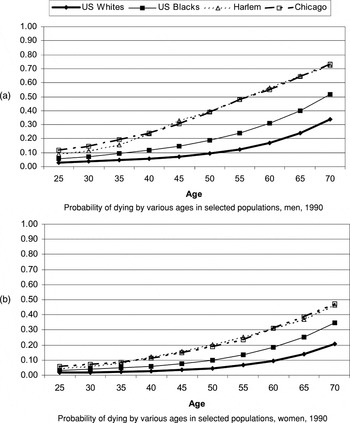
Mortality calculations based on data from the 1990 U.S. Census (adjusted for coverage error) and from death certificates for 1989–1991; Harlem refers to African American residents of the Central Harlem Health Center District in New York City. Chicago refers to the African American residents of South Side community areas of Near South Side, Douglas, Oakland, Fuller Park, Grand Boulevard and Washington Park in Chicago, Illinois. See Geronimus et al., 1999, for details of calculation methods.
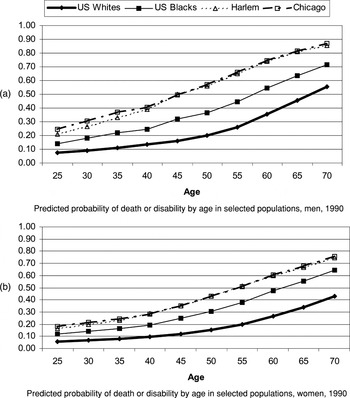
Mortality calculations as in Figure 1. Disability calculations based on 1990 U.S. Census using Public Use Microdata Areas ((PUMAs) that most closely approximate mortality areas for Central Harlem Health Center District in New York City and Chicago's South Side community areas of Near South Side, Douglas, Oakland, Fuller Park, Grand Boulevard and Washington Park in Chicago, Illinois. See Geronimus et al., Social Science and Medicine 1999; 49(12): 1623–1636 for details of calculation methods.
 You have
Access
- 117
- Cited by