Introduction
In the year 2060, the percentage of older people in the European Union (65 years and older) is expected to reach 30 per cent of the population (United Nations 2013). From an individual, as well as a societal perspective, it is important that older people will be able to stay active and independent for as long as possible. However, prerequisites for staying independent and active in society are good health and good mobility (Iwarsson, Ståhl and Löfqvist Reference Iwarsson, Ståhl, Löfqvist, Rowles and Bernard2013; Nordbakke and Schwanen Reference Nordbakke and Schwanen2014; Wessels et al. Reference Wessels, de Witte, Jedeloo, van den Heuvel and van den Heuvel2004). Even though there are some studies that show that the time spent in ill-health in old age is decreasing (Chatterji et al. Reference Chatterji, Byles, Cutler, Seeman and Verdes2014), the acknowledged health declines within the process of ageing are still present, but have transcended from the third age to the fourth age (from old to very old) (Baltes and Smith Reference Baltes and Smith2003). Moreover, with increasing age, very old people cease driving which reduces their possibilities of mobility (Hjorthol Reference Hjorthol2012). Consequently, very old people will have to rely more heavily on public transport and walking to stay mobile, active and independent. It is important that those not holding a driver's licence or those who cannot or are otherwise not willing to drive, are able to satisfy their mobility, their activity needs and stay independent (Davey Reference Davey2006; Nordbakke and Schwanen Reference Nordbakke and Schwanen2014; Stjernborg, Emilsson and Ståhl Reference Stjernborg, Emilsson and Ståhl2014). It is also important that people who want to go out for a walk to stay physically active can do so, because age-related decline of health can either be postponed or decreased through a physically active lifestyle (Bukov, Maas and Lampert Reference Bukov, Maas and Lampert2002; DiPietro Reference DiPietro2001; Erickson et al. Reference Erickson, Voss, Prakash, Basak, Szabo, Chaddock, Kim, Heo, Alves, White, Wojcicki, Mailey, Vieira, Martin, Pence, Woods, McAuley and Kramer2011; Lampinen et al. Reference Lampinen, Heikkinen, Kauppinen and Heikkinen2006; Levasseur, Desrosiers and St-Cyr Tribble Reference Levasseur, Desrosiers and St-Cyr Tribble2008; Simonsick et al. Reference Simonsick, Guralnik, Volpato, Balfour and Fried2005; Spirduso and Cronin Reference Spirduso and Cronin2001; Takata et al. Reference Takata, Ansai, Soh, Awano, Yoshitake, Kimura, Sonoki, Kagiyama, Yoshida, Nakamichi, Hamasaki, Torisu, Toyoshima and Takehara2010; Wåhlin-Larsson, Carnac and Fawzi Reference Wåhlin-Larsson, Carnac and Fawzi2014; Weuve et al. Reference Weuve, Kang, Manson, Breteler, Ware and Grodstein2004). However, it has been brought to attention that this group's mobility and out-of -home activities are often restricted due to the combination of their functional decline and the demanding design of the outdoor environment (Hovbrandt et al. Reference Hovbrandt, Fridlund and Carlsson2007). Research has shown that older people have a strong will to maintain their health, to continue to participate in activities, be active in society and maintain their sense of self as they age (Fänge and Ivanoff Reference Fänge and Ivanoff2009; Hovbrandt, Fridlund and Carlsson Reference Hovbrandt, Ståhl, Iwarsson, Horstmann and Carlsson2007; Lloyd et al. Reference Lloyd, Calnan, Cameron, Seymour and Smith2014). This highlights the importance of an outdoor environment that is designed in such a way to facilitate walking for very old individuals (Stjernborg, Emilsson and Ståhl Reference Stjernborg, Emilsson and Ståhl2014).
There are numerous changes to the body and mind that people experience as they get older. For example, muscle mass, muscle strength (Goodpaster et al. Reference Goodpaster, Park, Harris, Kritchevsky, Nevitt, Schwartz, Simonsick, Tylavsky, Visser and Newman2006; Hughes et al. Reference Hughes, Frontera, Wood, Evans, Dallal, Roubenoff and Singh2001), grip strength, chair rise time and walking speed (Cooper et al. Reference Cooper, Hardy, Aihie Sayer, Ben-Shlomo, Birnie, Cooper, Craig, Deary, Demakakos, Gallacher, McNeill, Martin, Starr, Steptoe and Kuh2011) decrease as people age. The same applies to the ability to walk long distances and ability to climb stairs (Gill et al. Reference Gill, Allore, Hardy and Guo2006). Furthermore, dizziness, falls, fractures, poor eyesight, poor hearing (Dehlin and Rundgren Reference Dehlin and Rundgren2007) and depression (Stålbrand et al. Reference Stålbrand, Svensson, Elmståhl, Hortsmann, Hagberg, Dehlin and Samuelsson2007) become more common. As the prevalence of such age-related changes increases, people start to have difficulties with performing activities of daily living, such as clothing, bathing and using transportation (Iwarsson Reference Iwarsson2005). However, as people start to experience difficulties associated with the ageing process, they use coping strategies to minimise the impact (Baltes and Baltes Reference Baltes, Baltes, Baltes and Baltes1990). This was explained in Baltes and Baltes’ (Reference Baltes, Baltes, Baltes and Baltes1990) SOC model which stands for Selection Optimisation and Compensation. The model implies that as people start to age and can no longer perform all activities important to them, they select to focus on activities most important to them, optimise the goals by redefining them with respect to their abilities and compensate by finding means to continue to perform those activities. Later, Baltes (Reference Baltes1997) found that compensation becomes even more important in the later stages of ageing. Consequently, people experience a stronger need for further support from society. In terms of mobility, this means that they are in more need of an environment that is supportive of their biological competence. Lawton explained in his Ecological Model of Ageing that the interaction between the person and the environment is a relationship where an individual with lower competence receives more pressure from the environment (Lawton and Nahemow Reference Lawton, Nahemow, Eisdorfer and Lawton1973). This means that the environment poses more environmental pressure for individuals who have started to experience more decline in their functional capacities. In accordance with Lawton's model, accessibility and usability have been conceptualised by Iwarsson and Ståhl (Reference Iwarsson and Ståhl2003), where they defined accessibility as the encounter between the person's functional capacity, and design and demands from the environment. Accessibility is defined as an objective concept, and refers to compliance with standards and official norms. Usability, however, is a subjective concept, as it also takes into account the activity factor in the given environment (Iwarsson and Ståhl Reference Iwarsson and Ståhl2003). Usability implies that a person or a group are able to perform certain activities in the given environment, such as walking. The activity component is an essential part of the concept of usability, because an environment can be accessible according to standards and norms but due to circumstances it may not be usable by that individual. For example, to comply with all accessibility standards a municipality might decide to place a bench on a popular walking route. However, due to poor maintenance the bench might be covered in snow, and therefore, it is not usable.
The relationship between a person's functional capacity and activity has also been discussed in the World Health Organization's (WHO) International Classification of Functioning, Disability and Health (ICF; WHO 2001). The ICF model shows how both activity and health are interrelated with each other and how environmental and personal factors affect activity and health. In the ICF, environmental factors make up the attitudinal, social and physical environment that a person lives in and they are classified into either factors which can facilitate activities or hinder them. Over the past decades, extensive research has identified environmental barriers that can affect older people's mobility. Amongst others, those barriers are: lack of resting places or benches, uneven pavements or high curbs, heavy traffic, fast traffic, short green light time while crossing streets, stairs, long distances to the bus stop and inconsideration of other road users (Amann et al. Reference Amann, Reiterer, Risser and Haindl2006; Banister and Bowling Reference Banister and Bowling2004; Eronen et al. Reference Eronen, Bonsdorff, Rantakokko and Rantanen2014; Hjorthol Reference Hjorthol2013; Michael, Green and Farquhar Reference Michael, Green and Farquhar2006; Nordbakke Reference Nordbakke2013; Phillips et al. Reference Phillips, Walford, Hockey, Foreman and Lewis2013; Risser, Haindl and Ståhl Reference Risser, Haindl and Ståhl2010; Rosenberg et al. Reference Rosenberg, Huang, Simonovich and Belza2013; Ståhl et al. Reference Ståhl, Carlsson, Hovbrandt and Iwarsson2008; Valdemarsson, Jernryd and Iwarsson Reference Valdemarsson, Jernryd and Iwarsson2005). It is also relevant to mention that these environmental barriers do not only result in accessibility and usability problems for older people. Environmental barriers also play an important role for their safety, especially when it comes to falls. Falls are the most frequent accident among older people in the outdoor environment and they are often caused by environmental barriers (Ståhl and Berntman Reference Ståhl and Berntman2007). In some cases, one fall is enough to trigger a fear of falling which consequently can lead to avoidance of walking which, in the long run, could lead to a further decline in physical function (Delbaere et al. Reference Delbaere, Crombez, Vanderstraeten, Willems and Cambier2004), thus creating a vicious cycle. Experiencing fear/and or anxiety while walking outdoors has been shown to increase with higher age and to impact older people's mobility and frequency of walking (Hallgrimsdottir, Svensson and Ståhl Reference Hallgrimsdottir, Svensson and Ståhl2015; Iwarsson, Ståhl and Löfqvist Reference Iwarsson, Ståhl, Löfqvist, Rowles and Bernard2013). Mobility devices can be used to compensate for difficulties and fear of moving outdoors (Samuelsson and Wressle Reference Samuelsson and Wressle2008), but accessibility problems in the outdoor environment can introduce difficulties in their usage (Brandt, Iwarsson and Ståhl Reference Brandt, Iwarsson and Ståhl2003).
On the more positive side, there is ongoing work in improving accessibility and usability in the outdoors environment all over Europe (Amann et al. Reference Amann, Reiterer, Risser and Haindl2006; ECMT 2013; ISEMOA 2013). This also applies to authorities in Sweden, which have recognised that good accessibility in the outdoor environment is an important prerequisite for people with functional limitations to be able to stay mobile. Therefore, laws in Sweden state that every public space should be accessible and usable for all (Prop. 1999/2000:79). The responsibility of ensuring accessible public spaces in Sweden has been placed in the hands of the municipalities. To enable the municipalities to eliminate environmental barriers, directives have been issued by the authorities. These directives include information on how to design new environments (Swedish Board of Housing, Building and Planning 2011) and how to eliminate barriers in existing public spaces (Swedish Board of Housing, Building and Planning 2013). Based on such directives, studies focusing on measures taken in the outdoor environment have been carried out with promising results in Sweden (Ståhl, Hortsmann and Iwarsson Reference Ståhl, Horstmann and Iwarsson2013; Ståhl et al. Reference Ståhl, Carlsson, Hovbrandt and Iwarsson2008; Wennberg, Hydén and Ståhl Reference Wennberg, Hydén and Ståhl2010) and similar studies have been executed in the United Kingdom (Curl, Ward Thompson and Aspinall Reference Curl, Ward Thompson and Aspinall2015; Ward Thompson et al. Reference Ward Thompson, Curl, Aspinall, Alves and Zuin2012). What all of these studies have in common is that they were evaluated quite shortly after the measures were taken. Results from these studies showed that the respondents were quite pleased with the measures, but frequency of walking did not increase afterwards. However, Ståhl et al. (Reference Ståhl, Carlsson, Hovbrandt and Iwarsson2008) showed that older people's perception of the environment was more positive, especially among rollator (walker) users. Previous research thus indicates that improvements in the outdoor environment which aim at facilitating walking for older people are at their advantage. However, the knowledge is scarce about whether measures taken in the outdoor environment do facilitate outdoor mobility for older people during the ageing process. Consequently, the aim of this study was to examine long-term impacts of measures taken in the outdoor environment. The specific research questions were:
-
1. What implications do measures in the outdoor environment have on older people over time regarding: frequency of walking, reported environmental barriers and valuation of the outdoor environment?
-
2. Which background characteristics influence older people over time regarding: frequency of walking, reported environmental barriers and valuation of the outdoor environment.
Method
This study is a part of a larger, ongoing project called ‘Let's Go for a Walk’ and has been reported in several articles (Hallgrimsdottir, Svensson and Ståhl Reference Hallgrimsdottir, Svensson and Ståhl2015; Hovbrandt et al. Reference Hovbrandt, Fridlund and Carlsson2007; Ståhl, Hortsmann and Iwarsson Reference Ståhl, Horstmann and Iwarsson2013; Ståhl et al. Reference Ståhl, Carlsson, Hovbrandt and Iwarsson2008). The project was conducted in a middle-sized Swedish city, Kristianstad (population approximately 40,000), in which measures in the outdoor environment, focusing on improved accessibility/usability and safety/security for older people, were carried out in one specific neighbourhood between 2003 and 2006. This paper is based on a panel study where data from questionnaires, gathered on three different occasions over a period of nine years (2002, 2006 and 2011), were used. As this is a panel study, analysis is only based on data from respondents who answered the questionnaires on all three occasions (2002, 2006 and 2011). That is, to track changes in activity and perception of the environment, only people who answered the questionnaire on all three occasions are included in this study.
This study was approved by the Regional Ethical Review Board in Lund.
Study context and data collection
The baseline data collection (T1) for this study was in 2002 when a questionnaire was sent to all residents 65 years and older in the neighbourhood of Söder which is in the city of Kristianstad, located in the southern part of Sweden. The neighbourhood was originally chosen due to its high proportion of older people (22%), structure and distance to the city centre (Ståhl et al. Reference Ståhl, Carlsson, Hovbrandt and Iwarsson2008). The neighbourhood consists mainly of apartment buildings with services, such as grocery shop, located within its vicinity. It is also close to an industrial area and health care is in a nearby neighbourhood. The main aim of the baseline questionnaire was to identify environmental barriers that the older residents experience while walking in their neighbourhood. Based on the results from the questionnaire, the older residents of Söder, the local authorities and researchers worked together in prioritising improvements to the identified environmental barriers. The prioritised improvements were mostly in accordance with the Swedish regulations (Swedish Board of Housing, Building and Planning 2013) and were: the number of benches was increased in the neighbourhood, a clearer separation was made between cyclists and pedestrians, curbs were lowered, pavements that had been poorly maintained were made more even, some streets in the neighbourhood were changed into one-way streets and at the same time the sidewalks on those streets were made wider and, finally, speed limits were lowered to 30 kilometres per hour in parts of the neighbourhood. The improvements were implemented in Söder between 2003 and 2006. The first follow-up was carried out in 2006 (T2), with the aim of evaluating the short-term improvements implemented in the neighbourhood. Therefore, the same questionnaire was sent out to all residents 65 years and older living in Söder in T2, including the people that had answered the questionnaire in T1. The questionnaire included the same questions as in T1, and also questions specifically aimed at evaluating the improvements. To evaluate the long-term impact of the improvements implemented, a second follow-up study (T3) was carried out in 2011. Again, this was executed by sending the same questionnaire as before to all residents 65 years and older and living in Söder, including the people that had answered the questionnaire in T1 and T2. The questionnaire used in T3 also included some additional questions regarding the respondent's safety and security in the outdoor environment.
Sample response rate
At baseline (T1), 556 older individuals received the questionnaire and a total of 330 filled it in and sent it back; this gave a response rate of 61 per cent. At first follow-up (T2), the sample had decreased to 251 individuals; 195 people answered the questionnaire, with a response rate of 78 per cent for the remaining population and 60 per cent for the original cohort. The most common reason for drop-outs at T2 were death, relocation to outside the study area during the five-year follow-up period, refusal to participate without giving any reason and health problems (Ståhl, Hortsmann and Iwarsson Reference Ståhl, Horstmann and Iwarsson2013). At the second follow-up (T3), the sample had decreased to 139 individuals and a total of 113 filled in and sent back the questionnaire to the researcher; this resulted in a response rate of 81 per cent for the remaining population and 34 per cent for the original cohort. At T3 the most common reason for drop-outs were death, health problems (such as poor sight that restricted participation) and relocation. Therefore, the panel sample presented in this study consists of 113 individuals who answered the questionnaire at T1, T2 and T3.
Data collection and variables
The questionnaires included several questions which accounted for individual characteristics as well as questions regarding the respondent's frequency of activity as pedestrians and perception of the outdoor environment. Variables from the questionnaire were selected to account for individual characteristics in relation to competence in Lawton's Ecological Model of Ageing and which can affect activity and perception of environment and environmental barriers as explained in the ICF (WHO 2001).
First, personal factors which have been shown to affect frequency of walking were accounted for by asking the respondents about their age, sex and the number of people living in their household (Iwarsson, Ståhl and Löfqvist Reference Iwarsson, Ståhl, Löfqvist, Rowles and Bernard2013). For descriptive statistics, the number of people living in the household was divided into two groups, those living with one or more persons and those living alone. To account for competence in relation to Lawton and body function and structure from the ICF, the respondents were asked to rate subjectively the number of functional limitations they had. The nature of functional limitations was based on items of the personal components of the Housing Enabler instrument (Iwarsson and Slaug Reference Iwarsson and Slaug2010). The instrument includes 11 different functional limitations, of which the respondents could report as many as they thought relevant. According to previous literature (Hovbrandt et al. Reference Hovbrandt, Fridlund and Carlsson2007) and to facilitate statistical analysis, the variable ‘functional limitations’ was categorised into four groups: (a) ‘movement-related limitation only’: poor balance, reduced stamina, reduced movement in neck, reduced arm movements, difficulties handling/fingering, reduced back/leg movement and overweight; (b) ‘cognition/perception-related limitation only’: difficulties interpreting information, total loss of sight, other sight deprivation and hearing deprivation; (c) ‘both movement- and cognition/perception-related limitation’; and (d) ‘no functional limitations’. For the descriptive analysis, the variable was divided into three groups instead of four. The data revealed later that there were few respondents that reported ‘cognition/perception-related limitation only’. Since results from Hovbrandt et al. (Reference Hovbrandt, Fridlund and Carlsson2007) suggest that having only reduced cognition/perception seems not to impact frequency of activity among older people, and since the respondents in this group, in this paper, resemble those having no functional limitations (according to other background variables), it was decided to combine these two groups into one, labelled ‘no/or cognition/perception-related limitation only’.
Mobility devices are assistive devices which can enhance older people's capacity for moving outdoors (Samuelsson and Wressle Reference Samuelsson and Wressle2008), but can also be problematic when used in environments with barriers (Brandt, Iwarsson and Ståhl Reference Brandt, Iwarsson and Ståhl2003). Therefore, to further account for capacity and experience of environmental barriers, the respondents could report up to four mobility devices: cane/crutch, rollator (walker), wheelchair and powered wheelchair. For descriptive statistics, a dichotomised variable was constructed called ‘use of mobility devices’ to use in the regression analysis. One group comprised non-users and the other comprised those who use one or more mobility devices. To account for health in the ICF model, the respondents were asked to rate their health subjectively with a single question on a scale from 1 (being poor) to 7 (being excellent). To facilitate the analysis, results from this question were changed into a dichotomous variable called ‘perceived health’. Those perceiving their health as 5 or more were considered perceiving their health as good and those perceiving it as 4 or less were considered as perceiving their health as poor.
To account for the activity component of the ICF, information on the respondent's mobility was collected by asking about their use of different modes of transport (car, bicycle, public transport, walking, Special Transport Service (STS)). To represent the respondent's reliance on walking as a mode of transport, a variable was constructed called ‘dependence on walking’. The objective of that variable was to identify people who rely on walking to independently (without the help of others) reach their destinations, whether the destination is a bus stop or a grocery store. Only respondents who had neither access to a car nor were entitled to STS were considered being dependent on walking as a transport mode whilst the rest were considered not. The respondents were also asked to assess their ‘frequency of walking’ with a question which read: ‘how often do you go out for a walk in your neighbourhood, with or without mobility devices such as a rollator or wheelchair’. The respondents could report their frequency of walking with seven response rates: five to seven times per week, three or four times per week, once or twice per week, three or four times per month, once or twice per month, three or four times per year and less than three times per year. This variable was categorised as follows: those walking more than once or twice per week were considered as having a ‘high frequency of walking’ and those walking once or twice per week or less were considered as having a ‘low frequency of walking’.
To account for the environmental component of the ICF model and level of pressure from Lawton's Ecological Model of Ageing, the respondents were asked whether they perceive certain environmental barriers as problematic while walking in their neighbourhood. The question included 18 environmental barriers and the respondents were able to specify none or all barriers if appropriate. The respondents were also given the opportunity to specify an environmental barrier not listed among the 18. The question on environmental barriers was dichotomous. Results at baseline (Ståhl et al. Reference Ståhl, Carlsson, Hovbrandt and Iwarsson2008) showed that the most frequent barriers were ‘poor snow removal’ followed by ‘cyclists on sidewalks’. Representatives from the municipality and older people living in the study district (Ståhl et al. Reference Ståhl, Carlsson, Hovbrandt and Iwarsson2008) prioritised and included six out of 18 barriers in an improvement plan. For the purpose of this paper, only barriers that were included in the improvement plan were analysed. To facilitate the analysis, environmental barriers were categorised into two groups: ‘infrastructure barriers’: high curbs, uneven pavement, few benches and cyclists on sidewalk; and ‘traffic barriers’: heavy traffic and fast traffic. Reporting just one of the barriers in the group was considered sufficient for having experienced that type of barrier. ‘Valuation of the outdoor environment’ was collected by asking the respondents to rate the outdoor environment on a scale of 1 (being poor) to 7 (being excellent). This variable was constructed into two groups so that those evaluating the outdoor environment as 5 or more were considered to have a ‘high valuation of the outdoor environment’ and those valuing it as 4 or less were considered as to have a ‘low valuation of the outdoor environment’.
Data analysis
Analyses concerning background characteristics, frequency of walking, infrastructure barriers, traffic barriers and valuation of the outdoor environment were performed using descriptive analysis, between data collections T1 and T2 (short-term analysis) and T1 and T3 (long-term analysis). Wilcoxon signed rank test was used in order to see whether differences between data collections were statistically significant or not, with statistical significance criteria p ⩽ 0.05.
In order to identify the impact of the improvements, binary logistic regression models were run with dependent variables ‘frequency of walking’, ‘infrastructure barriers’, ‘traffic barriers’ and ‘valuation of the outdoor environment’. Based on ICF and the Ecological Model of Ageing, the independent variables chosen in these models were variables that can either have an impact on frequency of walking or reported environmental barriers. They were: ‘dependence on walking’, ‘perceived health’, ‘functional limitations’ and ‘use of mobility devices’. To facilitate the logistic regression analysis, a dichotomous variable called ‘functional limitations’ was constructed where one of the groups comprised respondents having no/or cognition/perception-related limitation only and was labelled ‘no functional limitations’, and the other group comprised those having movement-related limitations only or both movement- and cognition/perception-related limitations and was labelled ‘functional limitations’. Other variables were also dichotomous, as previously described. Since this is a panel study and there would be expected to be individual propensity to account for, a logistic regression model with random effects relating to individuals would have been the best option to use. However, it was not possible to estimate a model with that level of dimensionality due to restrictions in the data material. That is, only one of the models returned results and, therefore, another method was chosen. The aim of the study was to see whether the measures taken had had any impact on frequency of walking, experiencing infrastructure barriers, experiencing traffic barriers and valuation of the outdoor environment. In order to do that, it was important to find out whether there were differences between each of the studies (T1, T2 and T3) and what characteristics it had an impact on, on each occasion. Therefore, it was decided to include an interaction term ‘T’ to all of the independent variables. The variable T represented each data collection (T1, T2 and T3). To limit the number of estimated parameters (due to data limitations) such interactions were, however, included one at a time. Hence, four models were analysed for each dependent variable, 16 total, where the number of independent variables was constant, but the interaction term changed on each occasion (e.g. the first model analysed for frequency of walking included independent variables: ‘dependent on walking’; ‘functional limitations’; ‘mobility devices’; ‘perceived health’, T and the first interaction term T × ‘dependent on walking’. The second model included independent variables ‘dependent on walking’, ‘functional limitations’, ‘mobility devices’, ‘perceived health’, T and the second interaction term T × ‘functional limitations’, and so on). All 16 logistic regression models were evaluated based on −2 log likelihood and they were all analysed using the statistical software SPSS version 22.
Results
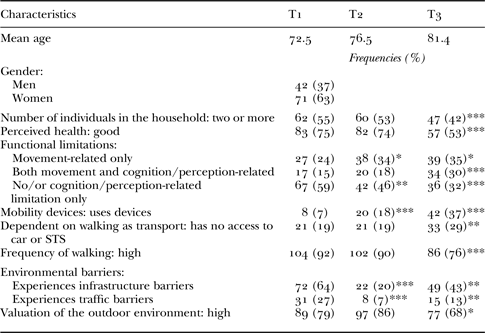
The respondents aged nine years over the course of the study and it was apparent that most of them experienced loss of cognitive and physical functioning (see Table 1). As a consequence, perceived health declined and the use of mobility devices increased significantly between T1 and T3. Also, the number of respondents who became alone in the household and became dependent on walking as a transport mode increased between T1 and T3.
Characteristics of the respondents, frequency of walking, experience of environmental barriers and valuation of the outdoor environment at baseline (T1, 2002), first follow-up (T2, 2006) and second follow-up (T3, 2011)

Notes: Percentages may not add up to 100 per cent due to missing data. Changes in characteristics, frequency of walking, etc. were analysed with T1 as the reference group. STS: Special Transport Service. Significance levels display differences between T1–T2 and T1–T3.
Significance levels: * p ⩽ 0.05, ** p ⩽ 0.01, *** p ⩽ 0.001.
Frequency of walking
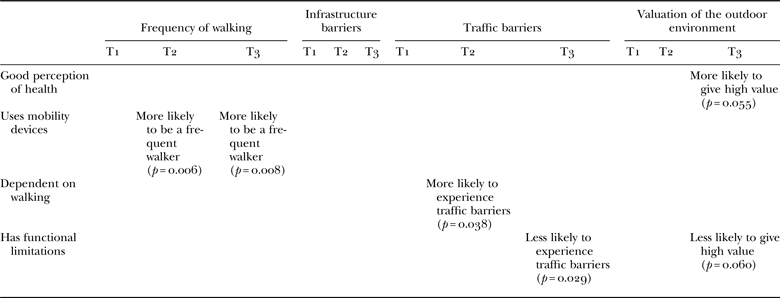
The respondents’ frequency of walking for T1, T2 and T3 are displayed in Table 1. In accordance with changes in both physical and cognitive functioning, the decrease in their frequency of walking was more drastic between T2 and T3 than T1 and T2. Results from the logistic regression models for frequency of walking are shown in Table 2. The results showed that using mobility devices was a factor that affected the older respondent's frequency of walking positively. More specifically, in comparison with non-users, respondents using mobility devices were more likely to be frequent walkers in T2 and T3 than in T1.
Results from regression models accounting for frequency of walking, infrastructure barriers, traffic barriers and valuation of the outdoor environment

Notes: T1: baseline (2002). T2: first follow-up (2006). T3: second follow-up (2011). Main effects were tested for statistical significance against the common null hypothesis β = 0. When interactions were tested, the null hypotheses were instead that the effects in T2 and T3 were identical to the effect in T1.
Environmental barriers: infrastructure and traffic barriers
Differences in reported environmental barriers are shown for each data collection in Table 1. Regarding infrastructure barriers, 64 per cent of the respondents reported at least one infrastructure barrier at T1, but at T2 the frequency decreased to 20 per cent (p = 0.000). Comparing with T2, the percentage reporting infrastructure barriers had increased to 43 per cent at T3. However, that percentage was lower than at T1 (p = 0.003). The results from the logistic regression models (Table 2) showed that none of the independent variables was associated with experiencing infrastructure barriers in a long-term perspective.
At T1, 27 per cent of the respondents reported traffic barriers, but that proportion decreased to 7 per cent at T2 (p = 0.000) and increased again, to 13 per cent, in T3 (see Table 1). Still, a smaller number of respondents reported traffic barriers in T3 than they did in T1 (p = 0.004). Results from regression models in Table 2 showed that those having functional limitations were less likely to experience traffic barriers at T3 than at T1. Conversely, it showed that those dependent on walking were more likely to experience traffic barriers in T3 than in T1.
Valuation of the outdoor environment
Overall, the respondents had quite a high valuation of the outdoor environment. At T1, 79 per cent of the respondents rated it high, but in T2 that proportion had increased to 86 per cent. However, that difference was not statistically significant. In T3, the percentage of respondents that had a high valuation of the outdoor environment had decreased to 68 per cent. Both differences, between T2 and T3 (p = 0.002) and between T1 and T3 (p = 0.034), were statistically significant. Results from the logistic regression model showed that none of the independent variables were statistically significant to a p ⩽ 0.05 level, but two of them were borderline significant (Table 2). The results showed that those who perceive their health as good were more likely to give the outdoor environment a higher value in T3 than in T1. Also, those with functional limitations were less likely to give the outdoor environment a high value in T3 than in T1.
Discussion and conclusion
The study presented in this paper offers a novel panel analysis for long-term impact of measures taken in the outdoor environment. The results are encouraging, both from an individual and a societal perspective, as they show that even though measures in the outdoor environment may not increase the frequency of walking among older pedestrians, the measures had a positive impact on their perception of the environment, alongside the ageing process. Bearing in mind that the respondents in the study aged nine years during its course, many of them going from being a relatively healthy person to a more fragile person, shows how positive the results actually are. The positive results regarding mobility device users and people with functional limitations may be viewed as especially encouraging. These results should be applicable for politicians, planners and other professionals involved in society planning and development.
Frequency of walking did not increase after the improvements, neither in the short- nor long-term perspective. Other studies focusing on measures taken in the outdoor environment, which have looked at changes in frequency of walking among older people, have reported similar results (Curl, Ward Thompson and Aspinall Reference Curl, Ward Thompson and Aspinall2015; Ståhl, Hortsmann and Iwarsson Reference Ståhl, Horstmann and Iwarsson2013; Ward Thompson et al. Reference Ward Thompson, Curl, Aspinall, Alves and Zuin2012; Wennberg, Hydén and Ståhl Reference Wennberg, Hydén and Ståhl2010). However, what is novel about the results presented in this paper is that they indicate that frequency of walking is more affected by the process of ageing than the person–environment relationship. This assumption is based on the results showing that the frequency of walking decreased less between first follow-up and baseline than between the first and second follow-ups, when many of the respondents transitioned from the third to the fourth age. At second follow-up, the respondents were experiencing more functional limitations, more were using mobility devices and more were living alone, all of which can affect older people's outdoor mobility (Brandt, Iwarsson and Ståhl Reference Brandt, Iwarsson and Ståhl2003; Cooper et al. Reference Cooper, Hardy, Aihie Sayer, Ben-Shlomo, Birnie, Cooper, Craig, Deary, Demakakos, Gallacher, McNeill, Martin, Starr, Steptoe and Kuh2011; Rosenberg et al. Reference Rosenberg, Huang, Simonovich and Belza2013; Stjernborg, Emilsson and Ståhl Reference Stjernborg, Emilsson and Ståhl2014). On the other hand, even though the improvements did not increase frequency of walking among all older people, it seems to have been a facilitator for people who started to use mobility devices between baseline and first to second follow-up. This is supported from the results showing that mobility device users were more likely to be frequent walkers than non-users after the improvements. Possibly, this means that respondents who already were frequent walkers at baseline and started using mobility devices at first or second follow-up, continued to be frequent walkers after starting to use mobility devices. However, it cannot be neglected that barriers in the outdoor environment are one of the most cited problems with use of mobility devices among older people (Brandt, Iwarsson and Ståhl Reference Brandt, Iwarsson and Ståhl2003). Therefore, the results indicate that improvements in the outdoor environment can facilitate walking for people using mobility devices.
The measures seem to have had a positive impact on the older people's perception of the outdoor environment. More specifically, it cannot be neglected that the number of respondents that experienced environmental barriers decreased significantly between baseline and first follow-up. However, at second follow-up, when the respondents started to experience more functional limitations and usage of mobility devices increased, experience of environmental barriers increased among the respondents again, but not to the same extent as at baseline. This is a positive result for improvements in the outdoor environment as other longitudinal studies have shown that barriers in the outdoor environment become even more difficult to overcome as people age (Lofqvist et al. Reference Lofqvist, Nygren, Brandt and Iwarsson2009). Moreover, it has to be mentioned that enhancing accessibility in the outdoor environment is a complex task, due to the numerous profiles of functional limitations that have to be considered (Carlsson, Iwarsson and Ståhl Reference Carlsson, Iwarsson and Ståhl2002). Measures that have positive impact on older people's perception of the outdoor environment must, therefore, be considered as positive and this emphasises the importance of authorities taking actions to eliminate environmental barriers such as those described in the Swedish directives (Swedish Board of Housing, Building and Planning 2013). Short-term evaluation of the measures showed that appreciation was quite high for all specific environmental measures taken and, most importantly, mobility device users had a higher appreciation for even pavements, lower curbs, and separation of cyclists and pedestrians than non-users (Ståhl, Horstmann and Iwarsson Reference Ståhl, Horstmann and Iwarsson2013).
Eliminating barriers, such as those recommended in the Swedish directives (Swedish Board of Housing, |Building and Planning 2011, 2013), seems to facilitate walking for older people, even as they age. Such an interpretation is supported by the results that the respondents experienced fewer infrastructure and traffic barriers at both the first and second follow-ups than they did at baseline, despite having aged nine years at the third data collection. However, results from the logistic regression models for traffic barriers were contradictory. At first follow-up, those dependent on walking were more likely to experience traffic barriers, while those having functional limitations were less likely to experience that kind of barrier at the second follow-up. At first sight these results might seem strange, but they may have some reasonable explanations. For example, other research has shown that those who walk more are more critical of the pedestrian environment (Dawson et al. Reference Dawson, Hillsdon, Boller and Foster2007; Hallgrimsdottir, Svensson and Ståhl Reference Hallgrimsdottir, Svensson and Ståhl2015; Wahl, Svensson and Hydén Reference Wahl, Svensson and Hydén2011). Therefore, results showing that those who are dependent on walking experience more traffic barriers than their counterparts might be demonstrating that they are more critical of the pedestrian environment, since that is their primary mode of transport. For example, Dawson et al. (Reference Dawson, Hillsdon, Boller and Foster2007) found that sedentary older people who started to walk more became more critical of the infrastructure. On the other hand, the results indicating that those with functional limitations were less likely to experience traffic barriers can be explained from both an environmental and a personal perspective. In terms of the environment, research has shown that as people age they start to experience more functional limitations which results in increased accessibility problems when they encounter environmental barriers (Iwarsson Reference Iwarsson2005). The authors are not aware of any other study exploring measures taken in the outdoor environment with such a long-term perspective as this study, but other studies have shown that when environmental barriers are removed in older peoples’ homes, their functional ability is enhanced (Wahl et al. Reference Wahl, Fänge, Oswald, Gitlin and Iwarsson2009). In relation to Lawton's Ecological Model of Ageing (Lawton and Nahemow Reference Lawton, Nahemow, Eisdorfer and Lawton1973), the environmental pressure has decreased for fragile persons due to the measures. However, it is possible to adapt the home environment to fit a single person's needs in terms of their functional ability, but it is more challenging with the outdoor environment as it is more prone to changes and must be accessible and usable for all, regardless of functional ability (Fänge and Ivanoff Reference Fänge and Ivanoff2009). However, in the outdoor environment, a person has more opportunities to select where to go and, therefore, has the possibility to select to avoid places where they know they will encounter environmental barriers (Lofqvist et al. Reference Lofqvist, Nygren, Brandt and Iwarsson2009; Nordbakke Reference Nordbakke2013; Shumway-Cook et al. Reference Shumway-Cook, Patla, Stewart, Ferrucci, Ciol and Guralnik2003). The result here could, therefore, be put into the perspective of Balte's (Reference Baltes1997) SOC theory, showing that the respondents are compensating for their physical and cognitive limitations by selecting to walk where they can walk, or selecting to stay at home and therefore not experiencing as many traffic barriers.
A result worth discussing is that the valuation of the outdoor environment decreased rather a lot at second follow-up. Results from the descriptive statistics showed that the respondents valued the outdoor environment higher in the first follow-up than at baseline (no significant difference), but not at the second follow-up. The logistic regression models also showed that those who perceive their health as good were more likely to give a high value while those with functional limitations were less likely to give high value to the outdoor environment at second follow-up than at baseline. There might be different explanations for these findings, both personal and environmental. Regarding the latter, it cannot be neglected that poor maintenance of the measures might have affected the results. Hallgrimsdottir, Svensson and Ståhl (Reference Hallgrimsdottir, Svensson and Ståhl2015) compared frequency of walking, activities and experience of environmental barriers among respondents 65 years and older and living in Söder (the area presented in this study where measures have been taken) with respondents 65 years and older living in another area, a reference area, which is located in the same city. That study showed that respondents living in Söder participated in more activities and walked more frequently than respondents in the reference area. However, they also found that experience of environmental barriers was higher among the respondents in the area where measures were taken than in the reference area. They concluded that poor maintenance of the improvements was one of the contributing factors to these results. Again, this emphasises that selective measures have to be properly maintained and evaluated on a regular basis, to increase usability. This conclusion is in line with results from previous research (Alsnih and Hensher Reference Alsnih and Hensher2003; Eronen et al. Reference Eronen, Bonsdorff, Rantakokko and Rantanen2014; Kerr, Rosenberg and Frank Reference Kerr, Rosenberg and Frank2012; Lavery et al. Reference Lavery, Davey, Woodside and Ewart1996; Phillips et al. Reference Phillips, Walford, Hockey, Foreman and Lewis2013; Rosenberg et al. Reference Rosenberg, Huang, Simonovich and Belza2013).
Regarding methodological issues, there are a few considerations worth mentioning. Most importantly, it would have served the purpose of this paper if it had been possible to analyse the logistic regression models using random effects models, relating to individuals. However, as described earlier, this was not possible due to restrictions in the data material. In the one case where the random effects model returned results, it gave quite similar results to the other models analysed (same main effects that were significant and similar β factors for the interaction terms; data not shown). This model was estimated with the same independent variables and interaction terms using the statistical program R version 3.1.2. This strengthens the assumption that the results presented here would be relevant. Another consideration of this study is that it is a panel study, and at baseline some of the respondents were engaged in the study. It could therefore be argued that the user involvement of older people in the study could explain the good results (Amici et al. Reference Amici, Klersy, Ramajoli, Brustia and Politi2000), but only to a certain extent. Of course, the older people living in the area were involved by answering the questionnaire, but later on, only eight people were involved in the process and discussions of what measures should be taken (Ståhl et al. Reference Ståhl, Carlsson, Hovbrandt and Iwarsson2008). Another methodological consideration from this study is that using questionnaires as a data collection method might mean that the oldest old and more fragile older people were not able to answer the questionnaire. Therefore, it is possible that the sample in this study is to some extent a biased sample and those who were more active and healthy were the ones who answered the questionnaire. Thus, it is by no means possible to state that the measures are the only contributor to the positive results in this study – there might be other reasons. For instance, older people living in more socially cohesive neighbourhoods tend to walk more (Mendes de Leon et al. Reference Mendes de Leon, Cagney, Bienias, Barnes, Skarupski, Scherr and Evans2009). The findings might have been strengthened with a comparison area where no measures would be taken. Unfortunately, a comparison area was only included at later stages of the project ‘Let's Go for a Walk’ and therefore a longitudinal comparison was not possible. Finally, it is also worth considering that subjective measurements of the outdoor environment were used in this study, and some have argued that they do not have as strong an association with walking as objective measures (Lin and Moudon Reference Lin and Moudon2010). However, the strengths of this study lie in its long-term perspective, which helps to establish causal relationships and in its practical nature. The improvements in the study area were not expensive nor were they difficult to implement (Ståhl et al. Reference Ståhl, Carlsson, Hovbrandt and Iwarsson2008), which should make it easily adaptable by other municipalities and authorities.
This paper is a contribution to the ongoing work of approving accessibility and usability in the outdoor environment for older people and other people with functional limitations. With a panel study, it was possible to look at the impact of improvements in the outdoor environment on an ageing population. The results give vital information to how supportive measures in the outdoor environment unfold in the long term. The results presented in this study emphasise how important it is to acknowledge the relationship between personal capacity and the environment while planning the outdoor environment. Hopefully, the positive results from this paper may encourage planners and designers to take actions so that the outdoor environment meets the needs of older people and increases their chances of continued mobility and better health. The results presented here indicate that walking can be facilitated for older people by employing standards and recommendations such as those presented in Easily Removed Barriers (Swedish Board of Housing, Building and Planning 2013). Most importantly, measures in the outdoor environment seem to facilitate walking for people who use mobility devices and people with functional limitations, even during the expected difficulties of transitioning from the third to the fourth age (Baltes and Smith Reference Baltes and Smith2003). Of course, it is possible that there are other contributing factors that may have influenced the results in this study. This emphasises the importance of more studies exploring the impact of measures in the outdoor environment with such a long-term perspective, to validate the results presented in this study.
Acknowledgements
The authors wish to acknowledge the financial support by the Centre for Ageing and Supportive Environments (CASE) at Lund University, financed by the Swedish Research Council for Health Working Life and Welfare (Forte). The authors would also like to thank Associate Professor Anna Lindgren at the Centre of Mathematical Sciences at Lund University and Karin Brundell-Freij, Associate Professor at the Faculty of Engineering at Lund University, for their statistical support and Dr Helena Svensson for her support during the production of this paper.