Political change often comes in waves. Pressures for a regime transition in one country tend to exert demonstration effects on other nations.Footnote 1 Protest movements or revolutionary uprisings prove similarly contagious, as the experience of “1968” suggests.Footnote 2 In all these cases, a challenge to established authorities inside a nation provides inspiration across borders; it induces people in neighboring countries to defy their government as well and seek political or socioeconomic transformation. Imitation efforts occur even in unpropitious settings, where they may well fail. Thus, the cross-national spread of political contention has been even more common than the waves of democratization, reverse waves of authoritarian backlash, and riptides of revolution discussed in the literature. Yet scholars have rarely analyzed these diffusion processes and the causal mechanisms driving them,Footnote 3 despite the flourishing of diffusion studies in other areas of the social sciences.Footnote 4
Waves of political conflict already occurred in the nineteenth century, especially the revolutions of 1830 and 1848.Footnote 5 French King Louis Philippe's ouster in February 1848 unleashed a torrent of regime contentionFootnote 6 that swept across Europe and affected Latin America as well. Within one month, many small states in Central and Eastern Europe and even the great powers of Austria and Prussia ceded to violent protest and instituted unprecedented changes in governing and regime institutions; Belgium, the Netherlands, and Scandinavia narrowly averted this fate through pre-emptive concessions. Even in the distant New World, the French precedent had repercussions, reigniting a protest movement in northeast Brazil and fueling rebellions in Chile.Footnote 7 What accounts for this tsunami of contention?
This article assesses various theoretical arguments that highlight different causal mechanisms, especially external pressure for regime change by a great power; promotion of new political principles and values by higher-status countries; careful rational learning from front-runners' experiences; and rasher inferences via cognitive short cuts from such precedents. Drawing on numerous eyewitness reports, this article shows that normative promotion, which in turn received an initial impulse from external pressure, was crucial in preparing the ground for the revolutionary wave of 1848. Moreover, rational calculations about the likely success of regime contention set outer limits to diffusion. With the stage set in these ways, the main “moving cause” of contention's spread was boundedly rational learning, which relies on simplifying heuristics that can entail distortions and biases. Due to its dramatic and vivid nature—rather than its inherent relevance—the downfall of France's July monarchy grabbed the attention of opposition leaders, citizens, and governments all over Europe and in Latin America. This singular event made many people jump to the conclusion that a similar regime change could occur in their state. This unthinking belief overwhelmed prudence, inspired enthusiasm and hope among protesters and fear among defenders of the status quo, and thus triggered a riptide of regime contention that extended far beyond the settings that rational assessments would regard as propitious. In fact, the wave of revolution quickly crested and gave way to a reflux, which brought the gradual restoration of established regimes in many states. Thus, the cognitive heuristics of bounded rationality decisively propelled the dramatic tide of regime contention in 1848.
The next section shows that this revolutionary wave did not result from common causes; contagion was crucial. As explained thereafter, this article seeks to unearth the causal mechanisms propelling diffusion rather than mapping the process and its underlying networks. The fourth section outlines major theories that propose different “moving causes,” especially external pressure, normative promotion, rational learning, and cognitive shortcuts. The subsequent sections—this article's core—demonstrate the contributions of these factors.
The present study, part of a much larger project, applies qualitative analysis, drawing inferences from the pattern of the revolutionary wave and from numerous reports by eyewitnesses and contemporary observers, which range from idealistic studentsFootnote 8 to stodgy military commanders and the mastermind of reaction from 1815–48, Clemens Metternich.Footnote 9 Research focuses on the two most important states affected by contention, Austria and Prussia.
Common Causes in the Revolutionary Wave?
In principle, common domestic causes, such as an economic crash, famine, or population pressures,Footnote 10 could explain the eruption of regime contention across a whole region. The decades before 1848 indeed saw an accumulation of economic, social, and political problems. Harvests were poor in the mid-1840s, producing rampant inflation. Early industrialization brutally exploited workers and destroyed artisans' livelihoods, creating widespread downward mobility and, in some regions, desperate poverty.Footnote 11 While proletarians in the Marxian sense were few and far between, discontented, footloose journeymen and ill-paid laborers engaged in frequent unrest, albeit locally.
Political discontent was also increasing. Advancing education and the examples of liberal if not democratic England, Belgium, Switzerland, and the United States led to a gradual spread of reformist ideas and values and a questioning of the absolutist monarchies restored and confirmed after the Napoleonic wars. The international alliance upholding these backward regimes, coordinated by Austrian Chancellor Metternich, was showing increasing cracks and weaknesses. Indeed, Switzerland progressed toward democracy through a civil war in 1847, and a wave of revolutions swept across the Italian states in January 1848.Footnote 12 The time seemed ripe for change.
All this discontent constituted a supportive and perhaps necessary condition for the revolutionary wave of March 1848. But domestic problems were not coming to a head to trigger such widespread contention; they were insufficient for producing the outburst of protest and violence. In fact, bad harvests were followed across Europe by a bumper crop in 1847, which quickly lowered food prices.Footnote 13 As basic necessities again claimed a lower income share, social discontent diminished—right before political unrest erupted. Similarly, the mid- to late 1840s saw neither tighter repression, nor a general move to liberalization and reform,Footnote 14 which according to French political thinker and historian, Alexis de Tocqueville, could have spurred contention. While counterfactual inferences are tentative, no domestic developments seemed acute and widespread enough to account for the riptide of 1848.
Moreover, domestic causes alone cannot explain political eruptions in so many different countries at precisely the same time.Footnote 15 The socioeconomic and political situation differed markedly in the states that experienced violent contention. There was a stark West-East gradient in modernization levels; whereas the Rhine Valley was quite advanced, backwardness prevailed the farther one moved east and south. Nevertheless, protests erupted not only in progressive Baden, but even in Wallachia, a Danubian principality untouched by industrialization, modern education, and liberal ideas.Footnote 16 Regime contention in such different settings clearly did not emerge from common causes.
Indeed, theorists of revolution emphasize how difficult, unlikely, and infrequent violent challenges to established authorities are.Footnote 17 Collective action problems hinder mass protest, especially where organization is missing. Governmental repression provides strong additional discouragement. Therefore, even regimes that are loathed by many people and that by any standard are highly illegitimate often manage to maintain power.Footnote 18 Given these obstacles, it is implausible that domestic conditions were conducive to revolution in so many different countries at the same moment. A “common cause” argument therefore seems insufficient for explaining the outburst of regime contention in wide swaths of Europe and some parts of Latin America.
In fact, the evidence for demonstration and contagion effects is overwhelming. As numerous eyewitnesses report, discontented people in diverse settings took inspiration from the same external event, namely Louis Philippe's fall, which was decisive for triggering the revolutionary wave. Participants of all stripes stressed the crucial importance of the Parisian events. Whether they stood on the side of reaction, reform, or revolution, contemporaries uniformly highlighted in their diaries, letters, or memoirs the impulse arising from the monarchy's fall in France.Footnote 19 This striking event instilled consternation and fear in the established authorities, gave enormous encouragement to reformists and revolutionaries, and unleashed a groundswell of enthusiasm and hope.
“On the morning of February 29,” immediately after “the first news of the Paris revolution was published in Vienna” that “electrified the Viennese,” “a placard was posted” in the city center “reading: ‘Within a month Prince Metternich will be overthrown! Long live constitutional Austria.’” Indeed, “‘Eh bien, mon cher, tout est fini!’ [Oh well, my dear, everything is over!] exclaimed Metternich with shock … when he was told the news” about the French events.Footnote 20 Similarly, a Prussian general who sought to organize international resistance to revolution's spread, Josef von Radowitz, wrote his wife on March 3 that the Parisian precedent had brought “a reinforcement by a factor of ten in physical and political strength among the enemies, and in our camp the discouragement of governments and the collapse of their authority and popular veneration.”Footnote 21 Indeed, as an eyewitness states, “the French Revolution of 1848 produced a powerful echo in Chile,” as well as in Peru and northeastern BrazilFootnote 22—settings that differed greatly from Europe.
For empirical and theoretical reasons, the 1848 wave cannot be attributed to common domestic causes alone. External factors mattered as well; contagion from France is obvious. But what external factors were crucial, and how did they operate?
Diffusion Studies: Focus on Process or Causal Impulse
Theories of diffusion, which have emerged in various disciplines and reached a broader audience,Footnote 23 seek to explain two different aspects, namely how and why innovations spread. The much larger body of literature has documented, mapped, and measured this process and analyzed its temporal, spatial, and sequential unfolding. Ever more sophisticated theories have, for instance, examined informational and other cascades.Footnote 24 Authors have also studied the threshold effects and “tipping points” that trigger a phase shift from gradual advance to explosive imitation.Footnote 25 Many scholars have investigated the networks through which diffusion advances, highlighting “the strength of weak ties” and documenting shrinking “distances” due to globalization with “small world” models.Footnote 26 Rich literatures probe various types of networks, such as epistemic communities.Footnote 27
These important writings are ill-equipped, however, to account for the 1848 wave, which constituted the most dramatic, rapid, and far-reaching spread of regime contention in history—but it occurred when networks of communication and transportation were underdeveloped and the world was much less “small” than nowadays! The “third wave of democratization,” for instance, advanced much more slowly, despite instantaneous communication and dense transnational networks. Network approaches cannot account for this puzzle (especially because “weak ties” are insufficient for propagating high-risk behavior such as protest against repressive regimes).Footnote 28
Moreover, while the network literature elucidates how innovations spread, it does not explain why they spread. Networks are channels that operate through various mechanisms. Do professional networks produce convergence via rational learning, intellectual fads, or social conformity? What propels cascades—new cost-benefit calculations or morally appealing norms? While providing important hints, process and network analyses cannot settle the crucial “why” question: What causal mechanisms drive diffusion? As many authors advocate,Footnote 29 the present article focuses on this issue.
Arguments on Causal Mechanisms
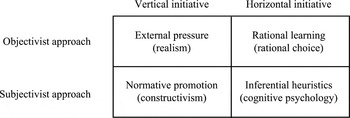
Analysts of diffusion's causes propose various factors,Footnote 30 which align along two dimensions. First, innovations can spread via contagion among autonomous units, or powerful units can promote innovations and push them on weaker units. Thus, diffusion can proceed via horizontal emulation or vertical influence. Second, some approaches stress the causal force of objective factors whereas others claim that “hard reality” is mediated by subjective factors, such as perceptions, communication, ideas, or norms.
Accordingly, external impulses for regime contention can arise from four causes, namely external pressure, normative promotion, rational learning, and cognitive inferences. External pressure and normative promotion embody vertical influence, whereas rational learning and cognitive inferences operate horizontally. While external pressure and rational learning transmit incentives and constraints from objective reality, normative promotion and cognitive inferences stress subjective mediations. Other factors invoked by diffusion scholars, such as economic competition, are crucial in political economy, but irrelevant for the wave of regime contention in 1848.
Causal mechanisms in the diffusion of political contention

Classification schemes necessarily simplify the theoretical landscape. “Splitters” prefer finer distinctions with softer boundaries. But space constraints make some “lumping” unavoidable. My coarser-grained distinctions intend to clarify the exposition, not set up a gladiator fight that only one theory, however bloodied, can survive. In the complexity of the real world, various causal mechanisms come into play, at different steps of diffusion.
The external pressure argument claims that powerful international actors seek to determine the political regimes of weaker countries. Their means of vertical leverage range from military intervention to economic aid conditioned on having an “acceptable” institutional framework.Footnote 31 Such external pressure can overwhelm domestic veto players or push them to change political arrangements against their will. In an unequal world, hard power carries the day according to this objectivist view. External pressure can be exerted by individual great powers or coalitions, such as the Concert of Europe after the Napoleonic wars. Instances of vertical influence date back to Athenian “imperialism,” chronicled by Thucydides 2,500 years ago. While often claiming noble goals, great powers apply coercive means, including military force. Accordingly, the stronger a hegemon is, the more it can trigger a wave of regime changes among countries that have yet to follow its example.Footnote 32
The normative promotion argument also stresses inequality in the world system but highlights moral advance versus backwardness, not brute power. In this constructivist view, waves of regime change result from new norms, principles, and ideas that spread through moral suasion from “core” countries to the periphery.Footnote 33 Important domestic actors in “underdeveloped” nations seek to enhance their legitimacy; therefore, they eagerly comply with new international norms and change their behavior accordingly. As modern values spread in international society, old elites may face new challenges to their rule, or they themselves absorb the novel norms and start regime transitions out of their own initiative. The promoters of new values thus use “soft power,” reshaping the malleable preferences of subordinate actors. Rather than pushing change on the unwilling, they make them willing to enact change on their own.Footnote 34
Whereas external pressure and normative promotion are vertical, top-down mechanisms, rational learning and cognitive inference arguments depict diffusion more as a horizontal process: actors in recipient countries observe foreign events, assess them in light of their own, largely given interests, and draw lessons to resolve problems and attain benefits. The initiative lies with the emulators, who exert an authentic choice, rather than submitting to external influence or conformity pressures. Contending political forces have a clear notion of their underlying goals and pursue them consistently. Instrumental preferences—the means for pursuing goals—can shift with contextual parameters, but basic goals are unaffected by these calculations.
The predominant variant of this interest-based approach is rational choice, which postulates that actors maximize their utility by pursuing their goals in the best possible fashion despite facing environmental uncertainty and imperfect information. Actors derive decisions from fairly systematic, unbiased cost-benefit calculations, for which they search for the relevant information. While unimportant choices may not justify much costly information gathering so that “rational ignorance” prevails, high-stakes decisions stimulate considerable reconnaissance.Footnote 35 Since participation in regime contention risks injury, even death, potential activists are likely to acquire a reasonable grasp of the objective situation with all its uncertainties and dangers. Although common citizens may lack the information access, time, experience, and computational capacity to conduct such assessments on their own, they take cues from the opinion leaders who do. The careful calculations of a minority that grasps the situation thus guide the mass of citizens, allowing common people's “low-information rationality” to approximate the conclusions that more sophisticated calculations would yield.Footnote 36
Moreover, individual deviations from rational assessments tend to cancel out in the aggregate.Footnote 37 According to the law of large numbers, mistakes compensate for each other; the average position therefore falls close to the optimal point. For both reasons, the mass public, which plays a decisive role in regime contention, manages to approximate rational choices although most individuals are incapable of performing well-informed rational calculations. Despite individual frailties, the opportunities and limitations of the real world thus tend to shape actors' choices in the aggregate.Footnote 38
Diffusion occurs in this fairly objectivist view because regime contention is plagued by tremendous uncertainty and highly imperfect information.Footnote 39 Political domination is a bargaining gameFootnote 40 in which the dominant side bluffs to intimidate subordinate groups; the subjects in turn avoid revealing their desire for regime change to avert repression. Precisely for those reasons, a protest that suddenly reveals a ruler's weakness and subjects' widespread, intense dislike for the established regime and willingness to challenge it can serve as a crucial signal for other discontented sectors, which now see a chance for overthrowing the existing order. Thus, rational learning from an outburst can quickly trigger spiraling contestation.Footnote 41
Such a rebellion also provides useful information to potential leaders of oppressed sectors in other nations with similar political regimes, inducing them to assess whether their ruler is equally weak and whether important domestic sectors share their antiregime preferences and willingness to act. In this way, rational learning from the experiences of one country can trigger recalculations of the benefits and costs of obedience versus contestation in other nations, which—if the situation is ripe—can set in motion waves of regime change.Footnote 42 Since a miscalculation can inspire a premature challenge that carries serious risk, rational actors are expected to proceed with prudence, however; when in doubt, they prefer continued submission. Opposition leaders are careful in assessing opportunities and threats, and common people follow their cues. As excessive boldness and paralyzing fear cancel out, proper caution prevails in the aggregate. Therefore, contagion will be fairly selective; it will take hold only where the “political opportunity structure”Footnote 43 is propitious.
By contrast to the objectivist tendencies of rational choice, cognitive psychology finds that people systematically deviate from rational assessments and have a more problematic grasp on reality. Confounded by pervasive uncertainty and overwhelmed by a flood of complex information, humans commonly rely on inferential shortcuts to cope with the demands of decision making, yet at the risk of distortions and mistakes. Given high search costs and time pressures, people do not thoroughly look for the relevant facts but use information that happens to become available to them, due to its vividness and psychological impact rather than its inherent significance. Instead of carrying out systematic, balanced cost-benefit analyses, they draw inferences haphazardly, disregarding essential information, such as statistical base rates, and relying instead on superficial similarities and stereotypical affinities.Footnote 44
According to cognitive psychology, people do not only confront imperfect (yet unbiased) information, as rational choice highlights, but rely on selective perceptions and process the skewed information they consider in nonlogical ways. The automatic usage of cognitive shortcuts can create important distortions and divergences between objective circumstances and people's subjective assessments. Whereas rational choice invokes cues to sustain its claim that even people with low information and limited computational capacity can make reasoned choices that approximate objective reality,Footnote 45 cognitive psychology stresses that inferential heuristics cause common deviations from rational information processing and decision making.Footnote 46
The unthinking application of cognitive heuristics and the resulting biases weaken the arguments advanced by rational choice to support its objectivist position in spite of individuals' difficulties to perform rational calculations. If deviations from rationality are systematic, they fail to cancel out in the aggregate and the law of large numbers cannot distill rationality out of a welter of accidental mistakes.Footnote 47 If these systematic deviations also affect the opinion leaders from whom common citizens take cues, then large numbers of people may march off in the wrong direction. Even if opinion leaders are less susceptible to cognitive biases, psychological factors keep the cues for the mass public from operating as reliably as rational choice tends to claim.Footnote 48
Cognitive psychologists highlight two shortcuts, the heuristics of availability and representativeness.Footnote 49 The availability heuristic shapes attention and memory recall, which are affected disproportionately by drastic, striking, vivid, directly witnessed events; equally relevant information that is less stunning is neglected. Car drivers, for instance, commonly slow down when seeing a car crash—although a single accident should not alter their cost-benefit calculations about the risks of speeding. But the shocking view overpowers systematic, rational considerations. The representativeness heuristic also causes deviations from rational judgments by basing inferences on apparent similarities while disregarding relevant information, such as statistical base rates. For instance, people draw improperly firm conclusions from limited data, assuming that patterns found in small samples are representative of population trends. Accordingly, an early success can imbue an innovation with the aura of inherent quality and trigger an upsurge of imitation.Footnote 50
Due to these heuristics, recent events in neighboring countries that make a striking, vivid impression have a disproportionate impact and grab people's attention; and facile judgments of similarity fuel much stronger contagion than cautious rational learning justifies. The bounded-rationality approach thus predicts waves of diffusion that sweep beyond the limited range of similar political-institutional settings. In fact, cognitive shortcuts inspire fairly rash challenges of established regimes; therefore, aborted efforts and failures should be frequent. Cognitive psychology's observable implications thus differ from rational choice.
In recent years, psychology has complemented its earlier cognitive turn by paying increasing attention to emotions and their neurophysiological basis in human brain structure, moving even farther away from the concept of calculating rationality that originated in economics.Footnote 51 Although these novel findings have not yet crystallized into a coherent theory, they reinforce the predictions of excessive boldness and sweeping diffusion suggested by cognitive heuristics. Drastic, vivid, particularly “available” events can unleash waves of emotions, such as euphoria, indignation, or anger; and apparent success highlighted by representativeness can stimulate hope and enthusiasm. Experiments demonstrate that several of these emotions, such as enthusiasm and anger, turn people risk-acceptant,Footnote 52 boosting their willingness to challenge unjust regimes. The emotions unleashed by other countries' experiences thus reinforce people's tendency to deviate from rational demands of prudence and engage in dangerous protests, propelling regime contention farther than careful cost-benefit calculations advise.
Yet while cognitive psychology diverges significantly from rational choice, the boundary between these approaches is fluid: The bounds of rationality can be more or less tight, and the distortions created by cognitive heuristics vary in severity, depending, for instance, on collective decision-making procedures and the diversity of participants.
In sum, four causal mechanisms—external pressure, normative promotion, rational learning, and cognitive heuristics (cum emotions)—can drive the spread of political contention. How did these factors operate in the revolutionary wave of 1848? The following sections assess their impact in turn.
External Pressures in the 1848 Revolutions
Did pressure by a powerful foreign actor set in motion the 1848 wave? The “age of revolutions” after 1789 indeed saw many externally propelled regime changes. Revolutionary France quickly started to export its new constitutional principles and institutions. Military victories allowed Napoleon to install satellite regimes in conquered territories, such as the Kingdom of Westphalia in Northwestern Germany.Footnote 53 Napoleon also shaped the constitutional design of nominally independent states in France's sphere of influence. These efforts had lasting effects by spreading liberal, republican, and democratic ideas, values, and sentiments in the regions closest to France, such as the German territories along the Rhine.Footnote 54 In more distant regions, however, they triggered fierce resistance, such as the Spanish guerrilla war immortalized in Francisco Goya's disturbing prints. Moreover, they fell with Napoleon's defeat in 1813–15.
The Concert of Europe sought to suppress precisely these principles and ideas imported from France and guarantee monarchical, if not absolutist rule. Thus, the counter-revolution also resorted to external pressure, coordinated by Austrian éminence grise Metternich. The pentarchy of Austria, Britain, France, Prussia, and Russia enforced political stagnation during three stifling decades.Footnote 55 But these external pressures were not always successful. While the smaller German states had little room to maneuver, great powers were less vulnerable, as the ouster of France's “legitimate” king and the installation of a constitutional monarchy in 1830 showed.
Although external pressures were common in the early nineteenth century, they played virtually no role during the 1848 revolution. The spark of rebellion spread through demonstration and contagion, not the exercise of power. Discontented sectors all over Europe and parts of Latin America took inspiration from the surprisingly easy overthrow of the French king. The wave of uprisings it triggered resulted from spontaneous domestic initiatives, not French arms. The provisional government in Paris did not foment revolution in other countries.Footnote 56 Remembering the 1790s, contemporaries expected France again to export its revolution via a major war—but this conflagration never materialized. France's second republic did not even intervene in areas where revolutionary principles coincided with geopolitical interests, such as the regions of northern Italy that sought independence from France's old rival Austria. The fear that international war would cause domestic radicalization, as during the run-up to Jacobin terror in 1792–93, induced the new government in Paris to refrain from military adventuresFootnote 57 and forestalled the forceful promotion of revolution.
Similarly, there were no French agents or advisors who stimulated uprisings in other countries, contrary to reactionary charges.Footnote 58 The only direct link between events in Paris and other contentious episodes were liberal or democratic exiles from Central or Eastern Europe who had fled from domestic repression to France and then, when revolution erupted, went home to help spread the gospel there.Footnote 59 But even this return of exiles had a significant impact only in a few cases, such as the principalities of Moldavia and Wallachia and the republic of Chile.Footnote 60 In the two most important sites to which revolution spread in 1848, the great powers of Austria and Prussia, this return migration played virtually no role. Instead, autonomous domestic uprisings, which the news of Louis Philippe's fall triggered spontaneously, shook the established monarchs and forced concessions, such as political liberalization and the appointment of reformist ministers.
Rather than furthering the spread of regime contention, external force was used in the final defeat of revolutionary efforts in 1849. After established dynasties had managed to take back many of the initial concessions, reassert autocratic rule, and suppress mass politics in Prussia, large parts of the Habsburg Empire, and most small states in Germany, Italy, and Eastern Europe, the Roman Republic in the Papal States, and radical reformers in Hungary continued to hold out against the wave of counter-revolution. French forces sent by conservative new president Louis-Napoleon Bonaparte to help the embattled Pope and Russian army units requested by the Austrian Emperor squashed these remaining islands of contentious fervor. But these military interventions reflected reactionary solidarity; solicited by the formal authorities, they did not arise from external initiatives.
In sum, external pressure, which has played a role throughout history, especially since the French Revolution of 1789, was not the moving cause for the wave of regime contention in 1848. It did not trigger the revolutionary tsunami in Europe, not to speak of the ripples that lapped the distant shores of Latin America.
The Spread of Ideas, Norms, and Principles
Did normative promotion propel the rapid diffusion of regime contention in 1848? According to sociological institutionalists and constructivists, novel ideas, values, and principles developed in the center of the international system can raise the standards of appropriateness and quickly win adherents. In this way, new moral concerns and commitments set in motion a norm cascade.Footnote 61
This causal mechanism created the preconditions for the 1848 wave but did not directly propel it. Regime contention spread much more explosively than a norm cascade. Conversion to new ideas and values may be quick but cannot be instantaneous. It did not trigger the dramatic contagion in March 1848, when masses of people, immediately upon hearing about the monarchy's overthrow in Paris, poured into the streets and challenged their repressive governments all over Europe.Footnote 62 New ideas and values are not embraced that fast. Instead, due to a gradual norm cascade during earlier decades, important sectors of the urban population already held liberal or democratic values but had refrained for years from expressing them in public to avoid governmental sanctions. When Louis Philippe's downfall made other regimes suddenly look weak, citizens finally felt confident to act on these values. While “preference falsification”Footnote 63 evaporated instantaneously, the underlying preferences had spread more gradually, propelled by the French Revolution of 1789 and diffusing throughout the pre-1848 decades.Footnote 64
In fact, the 1848 revolution did not significantly change the content of the ideas and values held in Central and Eastern Europe. Analyses of the prevailing political discourse demonstrate that political movements, associations, and leaders voiced the viewpoints they had held before the uprisings and expressed in small circles;Footnote 65 few new values emerged. There was no substantial normative shift right before and during the rash of uprisings; the revolutionary wave was not unleashed by new ideas.
Moreover, 1848 did not see the same values diffuse from a source of normative innovation to a range of emulators, as constructivists claim. Political movements in Central and Eastern Europe pressed different demands and adhered to different values than the French revolutionaries who inspired their actions.Footnote 66 Whereas Parisians overthrew the monarchy and installed a republic, the majority of revolutionaries in the rest of Europe had more moderate goals, namely to transform absolutism into constitutional monarchy.Footnote 67 They wanted to enhance citizen participation, make princes more responsive and accountable, and limit their latitude through constitutions. But they did not push for radical popular sovereignty and the installation of republics; instead, many of them wanted to retain hereditary monarchy. Thus, most emulators of the Paris revolution wanted to institute precisely the regime type that the French had just toppled!Footnote 68
This moderation resulted less from a prudent, realistic assessment of prevailing opportunities and constraints, especially the continued power of established dynasties. Instead, it reflected principled reasoning, namely the fear that a democratic republic would degenerate into mob rule and terror, as in France from 1792–94. While the French Revolution of 1789 had inspired a rejection of absolutist rule, its radicalization served as a deterrent in most of Europe and induced a widespread preference for moderate political liberalism.Footnote 69 This goal differed greatly from the democratic radicalism that surfaced again with the proclamation of a republic in Paris in February 1848.Footnote 70
The protagonists did not see these liberal values as a transitional stage in the long march toward democracy but as an alternative designed to pre-empt full democracy. In their view, democratic republicans merely wanted to transfer unrestrained, undivided sovereignty from absolutist kings to “the people.” But this simple transmission threatened to replace monarchical despotism with the tyranny of the majority. To prevent this risk, political liberals sought to tame royal authority through a constitution that guaranteed basic rights and a separation of powers. Mid-nineteenth-century liberalism saw itself as fundamentally different from both absolutism and democracy, not as a transitional compromise.Footnote 71 Thus, the goals inspiring the majority of European revolutionaries did not reproduce the ideas and values driving their forerunners in Paris. Constructivist arguments about the diffusion of the same norms do not apply in this case. As regards constitutional principles and institutional forms, Britain, Belgium, and the United States served more as an inspiration for European liberals than the new French republic. For these reasons, the 1848 wave of revolutions did not result from a norm cascade unleashed by the installation of a democratic republic in Paris.
Certainly, however, the gradual spread of antiabsolutist, liberal values during the pre-March decades, which was inspired dialectically by the French Revolution of 1789, prepared the ground for this striking surge of regime contention. As more and more people regarded undivided monarchical rule as illegitimate, advocated a constitution guaranteeing the separation of powers, and yearned for freedom of speech and association, the preference for challenging established dynasties spread—in case the opportunity arose. When Louis Philippe's fall seemed to signal such an opening, this accumulated value shift burst into the public sphere. Thus, while a norm cascade did not produce the wildfire of 1848, it constituted a crucial underlying cause that made such a drastic wave possible. It provided the tinder that the spark from Paris set on fire.
Tinder, however, does not combust on its own. The repressive Metternich system was designed to forestall this outcome and had successfully done so for decades. Thus, the outbreak of revolution and its wavelike spread were not foreordained by gradual value change. Contrary to culturalism,Footnote 72 political power plays a crucial role in regime contention and its results. Louis Philippe's overthrow suggested that seemingly powerful monarchies were surprisingly weak and could be challenged at limited risk. Rather than inspiring new ideas and norms, the French monarchy's fall offered instrumental information about the chances of regime contention.
Rational Learning in the 1848 Revolution
Given the importance of the February events in Paris as a signal, did the revolutionary wave result from the transmission of new information that reshaped the calculation of opportunities and risks by hidden opponents of absolutist regimes? Rational learning predicts that the unexpected ease of Louis Philippe's ouster led potential revolutionaries in other countries to update their assessments of the chances of forcing change. It demonstrated the striking fragility of an established regime, the extensiveness of discontent, and the willingness of many people to act on this dissatisfaction through collective protest. While censorship and repression can make opposition invisible and create a false sense of governments' strengths, the sudden fall of a typical government rectifies this misinformation, reveals governments' weaknesses, and induces the opposition to overcome “preference falsification”Footnote 73 and join forces to remove existing regimes.
This explanation has two observable implications, however, that do not seem to apply fully in 1848. First, given the dangers inherent in challenging a repressive regime, opponents—especially opinion leaders with reasonable access to information, but also mass actors displaying “low-information rationality”—should be fairly cautious. Obvious collective action dilemmas, which are especially severe where the opposition lacks disciplined, broad-based organizations, should inspire further prudence. Therefore, people should be careful before spearheading or joining an uprising.
The spread of revolution in 1848, however, was not based on careful assessments of opportunities and constraints. Rather than gathering a reasonable amount of information and weighing their options in a balanced fashion, oppositionists jumped to conclusions at the first news received from Paris. In fact, rumors ran wild, and people often acted on them, rather than on minimally solid information.Footnote 74 For instance, the worst and decisive outbreak of violence occurred in Berlin as a result of two accidental gunshots, which protesters saw—mistakenly, it seems—as the deliberate start of a crackdown.Footnote 75 All eyewitnesses and historians stress that the prevailing mood among elites and common citizens was not one of careful, prudent calculation,Footnote 76 but of exalted hopes, revolutionary excitement, and enthusiasm.Footnote 77 During this “springtime of the peoples,” notables, opposition leaders, intellectuals, students, artisans, shopkeepers, and workers started to act before receiving reliable news about the triggering events. They did not assess in any depth whether foreign lessons were applicable to their own countries: Was their government equally weak and were their fellow opponents equally strong and committed to contention as in the world capital of revolution? Extant reports show that this crucial question did not receive systematic consideration. Instead, Louis Philippe's fall swept up people in the logically problematic belief that what was possible in Paris would be possible in their capital. This rash inference, which affected opinion leaders and mass publics, diverges from rational learning.
Second, given the risks of challenging repressive governments prematurely, rational learning predicts that revolution spreads selectively, reaching only a few countries with similar “political opportunity structures” as the frontrunner. But in 1848, regime contention diffused very far, even to settings that differed greatly from revolution-happy France, such as the stolid Austrian Empire and the Danubian backwaters of Wallachia and Moldavia. These political systems boasted highly diverse levels of economic development, urbanization, education, societal pluralism, associational depth, and political institutionalization, ranging from more liberal, constitutional regimes in the West to backward, repressive, staunchly absolutist autocracies toward the East.Footnote 78
Why did protest leaders and their followers in these different settings all take inspiration from the same event and engage in similar types of contention? In most of East-Central and Eastern Europe, people had traditionally submitted to hierarchical authority and remained quiet in the previous wave of European revolutions in 1830.Footnote 79 But now, many long-quiescent “subjects” suddenly believed they could defy their powerful governments. Rational cost-benefit calculations cannot easily account for this striking switch to courage, which had at most fleeting success. The spread of the 1848 revolution in varied power constellations, under the threat of repression, went beyond the predictions of rational learning arguments. Many leaders and citizens discounted the caution that balanced cost-benefit calculations attuned to the prevailing political opportunity structure would have counseled.
Prudence did set some limits to the diffusion of regime contention, however. The thoroughly repressive tsarist regime, which had brutally squashed the Polish uprising in 1830–31 and had not allowed an independent civil society to emerge in Russia, forestalled serious challenges in 1848. Despite some feeble stirrings, the Paris revolution failed to spark imitation in this totally unpropitious setting. Similarly, dictator Juan Manuel Rosas prevented the 1848 revolution from exerting any impact in Argentina, whereas it affected less repressive countries in Latin America.Footnote 80 Thus, where the chances of success approached zero—yet only there—the established order avoided disruption. Truly hard constraints shone through the subjective layers examined in the next section.
Moreover, immediate concessions and credible commitment to reforms, such as the creation or strengthening of constitutional limitations on monarchs, managed to avert violent uprisings in several countries infected by contagion from Paris in early 1848, such as Belgium, the Netherlands, Scandinavia, and Brazil.Footnote 81 Where governments pre-empted popular rebellion by quickly initiating change, discontent eased and tranquility returned. Thus, regime contention did not spread to states where it seemed unnecessary, or where it was obviously infeasible. Prevailing opportunities and constraints set some limits.
Inside these broad boundaries, however, diffusion was less selective than rational choice predicts. Many people risked protesting in settings that reasoned judgments would find unpromising. Rational learning cannot easily account for the swiftness and breadth of the revolutionary wave of 1848 (although it correctly highlights diffusion's limits). Regime contention spread faster and farther than careful cost-benefit calculations justified.
Cognitive Heuristics in the Spread of the 1848 Revolution
Can goal-oriented behavior that deviates from low-information rationality by relying on simplifying and distortionary strategies of inference account better for the striking diffusion of regime contention in 1848? Cognitive psychology shows that humans do not tend to process the relevant information systematically, as rational choice assumes. People apply heuristics that facilitate information processing and decision making, yet at the risk of biases and mistakes.Footnote 82 These commonly used shortcuts introduce a thicker subjective layer between actors and the objective environment. Social scientists have demonstrated that these strategies of inference can shape political decision making.Footnote 83
Cognitive heuristics hold special sway in situations of high uncertainty when novel opportunities suddenly open up and players' actions and reactions are impossible to foresee. Such uncertainty prevails in revolutions and regime transitions, which constitute unusual interruptions of political normality.Footnote 84 As previously quiescent actors burst onto the scene, marshal their unused power capabilities, and test the unclear limits of political possibilities, outcomes seem to be “up in the air.” The dearth of reliable, trustworthy information in the mid-nineteenth century, in the absence of telephones and mass media, exacerbated this uncertainty. In 1848, wild rumors swept across cities and countries; people often acted on shaky information.Footnote 85 Situations of tremendous fluidity impede systematic information processing and interest calculation so that rational choice assumptions may not fully apply;Footnote 86 rationality may be particularly bounded.
However, neither does chaos prevail; political contenders do not act in purely arbitrary, idiosyncratic ways. Instead, cognitive psychology shows that people automatically resort to inferential shortcuts to process a flood of uncertain information and make sense of fast-moving events. These heuristics focus attention on certain phenomena and filter out many others, and they produce quick albeit logically problematic conclusions. This simplification of complexity helps people avoid informational overload and decisional paralysis, but it comes at a risk, namely the potentially limited quality of decisions.
Specifically, the availability heuristic focuses attention and memory recall, guiding and limiting information intake. It highlights striking, dramatic pieces of information, regardless of their inherent importance and actual relevance. This filtering mechanism applies logically problematic criteria, namely the vivid, memorable nature of information; for instance, it makes people fear plane crashes although air travel is in fact very safe. Stunning, directly available information impresses itself on observers' mind. They do not proactively search for it but react to its appearance; it grabs their attention.
This cognitive shortcut seems to have played a central role in the spread of revolution in 1848. Dramatic events captured the attention of a wide range of people, both established governments and discontented citizens. Above all, the sudden ouster of Louis Philippe “electrified the Viennese”Footnote 87 and many other people all over Europe. In Berlin, this regime collapse triggered a rush on newspapers; whoever obtained a new issue had to read aloud because others could not wait to hear the news.Footnote 88 Since directly available information grabs people's attention, the February revolution immediately impressed itself on people's mind. They did not proactively search; this stunning information burst onto their radar screen. The instantaneous repercussions of the July monarchy's fall show the availability heuristic at work.
Typically, this stream of vivid, novel information first grabbed the attention of those sectors that, due to educational background and professional position, were particularly attuned to news, namely journalists, professors, and students. Both in Berlin and Vienna, students were among the first to respond to the French monarchy's collapse, raise demands for reform, and move to contentious action, such as besieging representative bodies and engaging in protest.Footnote 89 City burghers, especially liberal professionals, shopkeepers, and artisans, soon followed suit. Their unrest, expressed in semi-public mass meetings of growing size that (in the absence of a guiding organization) debated the best course of action, then reinforced the impact of the Parisian news on the lower classes living on cities' peripheries. In that way, this highly “available” news spread downward in the social pyramid.
As cognitive psychology claims, attention was channeled by logically problematic criteria. People were disproportionately impressed by some events while neglecting many others, regardless of their substantive importance. While immediately drawn to the Paris events, governments, opinion leaders, and citizens had paid little attention to the revolutionary wave that swept across Italy at the beginning of 1848,Footnote 90 although the absolutist Italian states were politically more similar to the rest of Europe than France's liberal, constitutional monarchy. Whereas by rational standards, regime contention in Italy held special significance for Central and Eastern Europe, people there downplayed it as “baby revolutions” (“Revolutiönchen”).Footnote 91 Italy lay at the periphery of Europe; news reports were sparse and personal connections few and far between. The Italian rebellions were not particularly available to most Europeans—not to speak of Latin Americans.
The Italian sequence of revolutions therefore remained geographically confined. As is typical of diffusion processes, neighborhood effects were strong, given that geographic proximity makes information available. News travels easily among adjacent states, which often have historical and personal ties. This holds especially true where commonality or similarity of language prevails, as inside Italy. Therefore, the Sicilian rebellion and its contagion effects were directly available on the peninsula, setting in motion a fall of political dominoes in early 1848. But other countries that should have rationally learned from these experiences remained unaffected.
By contrast to the limited Italian wave, Louis Philippe's overthrow unleashed a tsunami. Its exceptional availability reflected the unique position of France, which had, since 1789, been the global epicenter of revolution. From Bastille Day onward, fearful governments and eager rebels saw France as the volcano from which revolution would erupt. The status of Paris as “the capital of Europe”Footnote 92 and the legacy of having been the “mother of revolutions”Footnote 93 drew widespread attention to any new outbreak of regime contention. The July monarchy's downfall immediately grabbed the attention of governments and citizens throughout Europe and in the Americas. These dramatic events forcefully impressed themselves on everybody's mind. As innumerable eyewitness reports about the tremendous impact of the Paris events suggest,Footnote 94 the availability heuristic was at work.
From a rational perspective, the disproportionate attention paid to Paris is puzzling. Louis Philippe's liberal, constitutional regime differed significantly from the illiberal, absolutist monarchies that the imitators of the Paris events challenged; and ironically, the majority of Central and Eastern European rebels sought to institute not a republic as in France, but the type of liberal, constitutional monarchy that had just been overthrown in France! Why did these moderate revolutionaries take inspiration from France, rather than the Italian revolutions that were more similar in their goals?
Similarly, why did the French Revolution of 1848 have greater repercussions in Latin America than the democratization achieved under President Andrew Jackson in the United States?Footnote 95 This differential effect is surprising because the Spanish-speaking countries already had republican constitutions; the main accomplishment of the Paris events was irrelevant. The Jacksonian effort to transform a republic from an oligarchy into an effective democracy was much more pertinent. Contrary to these rational considerations, Latin Americans paid attention primarily to the dramatic events in the world capital of revolution, rather than to the changes in the politically more similar republic to the North, which lay at the periphery of the civilized world.Footnote 96 The violent collapse of Louis Philippe's reign was more vivid and stunning than the sequence of democratic reforms enacted under President Jackson. Typically, the availability heuristic made Latin Americans pay disproportionate attention to the bloody revolution in France, rather than the peaceful transformation in the United States. Although the Jacksonian reforms had more lasting effects, the striking, dramatic events in Paris grabbed Latin Americans' attention.
In sum, Paris's central position in the revolutionary universe accounts for the high availability of the February events, which instantaneously made a strong impression on a variety of people. The contagion emanating from France had the typical geographic clustering created by the availability heuristic. Due to these neighborhood effects, regime contention first spread to areas adjacent to France, especially the Rhine valley. From there, it moved eastward like a wave, traveling with the news, which took days to spread. After stirring up Baden at the end of February, it reached Munich in early March, Vienna in mid-month, and shortly thereafter Berlin. Thus, diffusion's characteristic geographic pattern is clearly visible in the 1848 revolutions.
As the dominoes fell, pressure for a further spread of regime contention increased. The rising tide of revolution exacerbated the challenge for the more repressive governments toward the East. Thus, there were secondary diffusion effects; for instance, the Viennese revolution of March 13 affected both the protesters and the authorities in Berlin, contributing to the outburst of violence on March 18 and the governmental capitulation the next day.Footnote 97 Moreover, the main demands advanced in Baden—press freedom, trial by jury, citizen militia, and a national parliament—turned into a model for rebels in other German-speaking states, who pushed for the same concessions.Footnote 98 Thus, nested within the storm triggered by the Paris events, diffusion also occurred among some of the imitators. As events in neighboring states were particularly available, revolution spread in concentric waves.Footnote 99
Louis Philippe's overthrow also triggered the representativeness heuristic, which bases judgments on similarities—even if they are logically arbitrary and irrelevant—and draws excessively firm conclusions from limited data. Disregarding statistical base rates, people overestimate the significance of trends that appear in small samples, for instance; thus, they fail to consider chance factors.
Accordingly, observers all over Europe were impressed by the surprising ease with which the French monarchy crumbled.Footnote 100 Based on this single event, they immediately altered their political calculations. Repressive governments of diverse stripes suddenly looked like giants on feet of clay, and opposition forces came to believe in their strength. Viewing similarities across very different settings,Footnote 101 many people jumped to the conclusion that what was feasible in Paris could be repeated in their states.Footnote 102 The French regime collapse was seen as representative of large swaths of a continent. The resulting sense of empowerment helped unleash the enthusiasm and exalted hopes that swept across Europe during this “springtime of the peoples.”
The instantaneous spread of revolutionary fervor and contentious action did not emerge from rational calculations, which would have counseled greater caution, given the high stakes of challenging repressive governments. Instead of performing careful, systematic cost-benefit calculations, many citizens left prudence behind because they followed the representativeness heuristic and drew a rash inference: if the French had managed to overthrow the monarchy, they could force a similar transformation. Student Paul Boerner believed, “Now we will be free as well!”Footnote 103 Austrian revolutionaries proclaimed that “the people ‘must drive the Louis Philippes of the Austrian state out of the ministries.’”Footnote 104 Extrapolating from the surprisingly easy regime change in France, many people assumed they could bring about a similar feat.Footnote 105 Thus, they overestimated the evidentiary value of a single occurrence and exaggerated the similarities of their domestic political opportunity structure with prerevolutionary France.
The perception of an unusual window of opportunity suggested by the availability and representativeness heuristics also unleashed people's emotions. It prompted an outburst of enthusiasm; opinion leaders and common citizens held enormous hopes for the future. Moreover, anger exploded against established governments, which had so long stifled these hopes. Popular indignation and fury were further fueled by disproportionate governmental suppression of initially peaceful reform demands in cities such as Berlin and Vienna.Footnote 106 All these emotions reinforced people's willingness to risk violent protest—contrary to the commands of reason and prudence—and thus contributed to the escalation of conflict. In line with psychological experiments,Footnote 107 both enthusiasm and anger emboldened opinion leaders and common people and reinforced goal-oriented demands for reform, especially an end to absolutism with its arbitrariness and brutality. Thus, emotions came into play when cognitive inferences opened the door to their expression, and they strengthened the behavioral tendencies suggested by the representativeness heuristic.
Interestingly, the logically problematic belief in the likely success of protest and rebellion did not result from wishful thinking. Incumbent governments applied the representativeness heuristic as well and drew similar conclusions from the Paris revolution. In many palaces, Louis Philippe's downfall caused perplexity, consternation, and the fear of suffering the same fate.Footnote 108 A Prussian aristocrat commented immediately after the July Monarchy's collapse: “Believe me, this will repeat itself here!”Footnote 109 Metternich wrote an Austrian diplomat on March 1, “Europe is facing the year 1793 again…. We are headed toward horrible events!”Footnote 110
Yet whereas discontented citizens had the Parisian success to imitate and therefore protested and built barricades,Footnote 111 the authorities did not know how to prevent replications of Louis Philippe's failure to retain power: Should they make hasty concessions or respond with repression? Whereas more liberal-minded governments in Belgium, the Netherlands, and Scandinavia went the conciliatory route and thus averted revolutions, most absolutist princes in Central and Eastern Europe instinctively dug in their heels.Footnote 112 But there were disagreements among court factions on how harsh the response to protests should be. The representativeness heuristic led different government sectors to advocate somewhat different tactics, depending on their interests and power capabilities. Interacting with contextual circumstances, the same causal mechanism played out differently, as the literature on causal mechanisms postulates.Footnote 113 Since external inputs combine with the domestic constellation of political forces, they are “localized” and give rise to contending “coalitions.”Footnote 114
The authorities therefore wavered on how to respond to the gathering storm.Footnote 115 In Berlin, the king's brother, Prince Wilhelm, pressed for a hard line. This position—also held by Metternich in Vienna—saw Louis Philippe's downfall as the logical result of the July Monarchy's birth defect: the departure from “legitimate” dynastic rule and the liberal base of the Citizen King's regime.Footnote 116 In this view, the Parisian collapse suggested the need to refuse concessions to the liberal opposition, which sought to institute the type of rule just overthrown by the French. Wilhelm's faction insisted on royal absolutism and, through direct command over military units, tried to suppress protest brutally.Footnote 117
While reactionaries stressed the similarities in liberal principles underlying the July Monarchy and the rebels' demands, moderate factions equally followed the representativeness heuristic yet highlighted the more acute and salient political similarities between the rapidly growing mass protest in Paris and in their state; therefore, they saw their regime endangered by collapse as well.Footnote 118 Both factions thus applied the representativeness heuristic and perceived crucial similarities to the Parisian events but interpreted them differently based on their political and ideological backgrounds.
This division kept governments from pursuing a coherent response and increased the uncertainty among contentious citizens and their informal leaders. The authorities' vacillations reinforced the impression of similarity with the collapsing July Monarchy, while the incidents of brutality unleashed indignation and anger, which strengthened protesters' willingness to take risks.Footnote 119 As capital cities therefore rose in mass insurgency, governments lost their nerve and abruptly switched to concessions to save their tottering rule and avoid Louis Philippe's fate. After considerable bloodshed, Prussia's Friedrich Wilhelm IV, for instance, decided to give in to popular demands, withdrew the undefeated military, and sent his tough brother into exile.Footnote 120
As princes appointed liberal ministers and promised civil rights, a constitution, broader parliamentary representation, and the arming of the citizenry, the revolutionary fervor quickly ebbed. Believing they had reached their goals as quickly as their models in Paris, the protesters did not overthrow the monarchy itself. As a result, the forces of repression—while removed from the capital cities—remained intact, and the new citizen militias did not form a serious counterweight.Footnote 121 Misled by the relative ease of victory, contentious citizens and their leaders misjudged the new power constellation and failed to cement their political gains.Footnote 122 The representativeness heuristic made them overestimate the similarity of their accomplishments with the regime change in France.
Within months, however, the March revolutionaries were disabused of their illusions by princes who gradually regained their strength and skillfully took advantage of political and ethnic divisions among the revolutionaries, which were most pronounced in the Austrian Empire and allowed the Habsburgs to rein in rebellious hotspot Hungary.Footnote 123 Slowly but surely, the reigning dynasties rescinded concession after concession, tightened the chokehold of coercion, and encircled remaining foci of unrest militarily, in Hungary and the Papal States with armed help from allied reactionary powers.Footnote 124 Almost as quickly as the revolutions seemed to succeed in the “springtime of the peoples” did the chilly winds of repression blow away many of their accomplishments,Footnote 125 ushering in the stagnant 1850s. The illusion of easy victory, derived via the representativeness heuristic from the example of France, came to haunt the rebels of 1848.
Conclusion
What drives the waves of revolutionary protest and regime contention that the modern world has seen? Given the long predominance of structuralist approaches to the study of revolutions, this question has received insufficient attention.Footnote 126 This article helps fill this gap by studying the 1848 wildfire, which, in its dramatic spread, allows for an especially clear analysis of the causal mechanisms driving diffusion. The examination of the patterns of contagion and the perceptions and thoughts of numerous eyewitnesses considers various “moving causes,” namely external pressure, normative promotion, rational learning, and cognitive heuristics.
The evidence suggests that forceful pressures by a great power did not propel this diffusion of regime contention. Contrary to its first revolutionary period, France refrained from exporting its new bout of revolution. A norm cascade from advanced to backward countries did not directly trigger the revolutionary wave either. Instead, liberal and democratic ideas had been implanted decades before in West-Central Europe and had gradually spread eastward. This slow value change prepared the ground for the explosion of regime contention, as constructivism correctly stresses (see below). But it did not set in motion the revolutionary upsurge in early 1848. Indeed, the February events in Paris did not inspire new norms but suggested the feasibility of attaining norms that had already spread before. In fact, the French rebels pursued a different goal—a republic—than the revolutionaries in Central and Eastern Europe, who sought to institute the kind of liberal, constitutional monarchy the French had just overthrown.
Instead of being pushed by great powers or acting on new, externally promoted norms, the revolutionaries of 1848 pursued their own goals. Louis Philippe's ouster made them reassess the opportunities and risks of pursuing these aims by challenging their repressive governments. But deviating from rational learning, neither opinion leaders nor the cues-taking mass public conducted this reassessment in a very systematic and balanced way. Instead, many actors displayed surprising boldness and abandoned the caution that rational calculations would have counseled, given the risk of repression. Considering their goals and interests, the protesters did not seem to make reasoned choices that reflected the opportunities and constraints of the real world.
Instead, the contentious public deviated from the standards of full rationality and applied bounded rationality. Reliance on inferential shortcuts allowed people to cope with uncertain information in highly fluid and unclear situations, but at the risk of drawing hasty and faulty conclusions. Both the revolutionaries and the established authorities applied the availability heuristic and paid disproportionate attention to particularly vivid, dramatic, and memorable events, namely the violent rebellion in the world capital of revolution, Paris. By contrast, they neglected other, arguably more relevant information: they took little notice of the revolutions in Italy, despite the greater similarity in the setting and the revolutionaries' goals. Similarly, progressives in Latin America were more impressed by the overthrow of the French monarchy than the Jacksonian reforms in the United States, although they already lived under republican constitutions and sought to democratize their effective regimes, as the United States had just done.
Moreover, the 1848 revolutionaries overestimated the ease of reaching their goals. Applying the representativeness heuristic, they drew excessively confident inferences from the single case of Louis Philippe's overthrow and believed they could replicate this success in their states, disregarding the differences in the setting. Yet because princes drew similar inferences, they quickly abandoned their initial recourse to repression and made concessions. They promised many policy and institutional changes—but retained command over the forces of coercion, which remained intact. Misled by princes' seeming weakness and the ease of their early triumph, the revolutionaries failed to understand the true constellation of power, which allowed the established authorities to take back one concession after another. Contrary to the initial excitement and hope, the “springtime of the peoples” therefore brought little lasting success; the 1848 revolutions are widely viewed as failures. The striking wave propelled by cognitive heuristics soon dissipated on the hard rocks of reality.
This article thus shows that cognitive-psychological insights help elucidate the spread of revolutions. The heuristics of availability and representativeness seem to be crucial causal mechanisms driving the diffusion of regime contention in 1848.
As stressed throughout the analysis, however, other factors also made important contributions. The gradual spread of liberal and democratic ideas and values from France and England toward Central and Eastern Europe created the preconditions for the sudden explosion of challenges to entrenched autocratic governments. This slow norm cascade in turn had received an important impulse from the forceful export of liberal principles and institutions by French revolutionary armies in the 1790s and early 1800s. Thus, external pressure and the promotion of new norms helped produce the fuel that the spark of Louis Philippe's fall set aflame across Europe.
Moreover, the constraints of hard reality set some limits to this dramatic diffusion. Where brutal regimes suppressed civil society, as in tsarist Russia and dictatorial Argentina, autocrats managed to maintain firm control and forestall contagion. Under those clear-cut conditions, cost-benefit calculations that called for caution carried the day, taming the allures of availability and representativeness. Though significantly bounded, rationality did play a role. In sum, while demonstrating the causal significance of cognitive heuristics, this article also clarifies the preconditions that allow them to exert their effect and the obstacles that can hinder their operation. Given the tremendous complexity of political life, various causal factors play a role.
By demonstrating the impact of inferential shortcuts, this article goes beyond the structuralist arguments that predominated in the “third generation of revolutionary theory” and contributes to the analysis of agency-oriented and ideational factors that characterizes the “fourth generation.”Footnote 127 Yet it diverges from the approach to political agency that has advanced in the social sciences, namely rational choice. Instead, it draws on empirical findings from cognitive psychology that document the bounds of rationality. So far, such arguments have not found many adherents in the social sciences, especially the study of revolutions.Footnote 128 But they promise to elucidate a wide range of diffusion processes, including later waves of regime change—both democratization and authoritarian reversal—as well as the clustered spread of various policy innovations, ranging from trade liberalization to social security privatization.
Interestingly, revolution and regime contention did not spread as dramatically in the twentieth century as in 1848. For instance, the Bolshevist Revolution of 1917, the transitions of the “third wave of democratization,” and the recent “color revolutions” displayed more limited contagion effects; dominoes fell more slowly and selectively than during the “springtime of the peoples.” My larger project hypothesizes that higher levels of political organization gave experienced leaders a greater role in these later waves and limited the space for spontaneous mass action. Therefore, the bounds of rationality were less tight, cognitive heuristics did not reign as freely, caution asserted itself more, and abortive challenges—while still common—were less frequent than in 1848 (and 1830). Further research will examine this variation in the operation and effect of inferential shortcuts and the differential constraints they impose on rational choice.
In an even broader perspective, cognitive heuristics help explain the frequently haphazard advance of social and political development. Rather than being guided in an orderly fashion by fully rational calculation, reasoned deliberation, moral suasion, or cognitive evolution, decision makers, citizens, and even experts pay selective attention to their environment, process information in unbalanced ways, and thus risk arriving at rash, distorted conclusions. Instead of responding proportionately to problems and challenges, they long postpone action but then fall for a novel solution that happens to appear on their radar screen and that they eagerly embrace without thoroughly assessing its costs and benefits. As empirical studies show, mechanisms of bounded rationality underlie the striking twists and turns of political decision making and historical change.Footnote 129