INTRODUCTION
Lentils (Lens culinaris Medik.) have high-nutritional value and are grown on a global scale, mainly for human consumption (Muehlbauer et al. Reference Muehlbauer, Kaiser, Clement and Summerfield1995). The crop has benefits in crop rotation due to its symbiotic N-fixation, and it increases diversification of the cropping system in arable land. Reasonable sequential cropping and crop diversity are relevant and desirable in organic and conventional rotations, especially with regard to the future framework of the European Common Agricultural Policy. On a global scale, lentil production was c. 3·6 million metric tonnes in 2009 (FAO 2010), produced mainly by Canada, India, the United States and Turkey.
In Europe, lentils are considered one of the important leguminous food crops, following pea and Phaseolus bean (Horneburg Reference Horneburg2006). As a minor crop, both cultivation and scientific research on lentils have been neglected in Germany and Central Europe in general for several decades, thus lentils have almost vanished from this region over the past 50 years, although they remain a well-known and popular food. Most of the lentils consumed in Central Europe are imported from South Europe and North America.
Recently, farmers have begun to realize the value of lentils and more and more consumers seem to like lentils, especially if they are locally produced, which has helped to re-introduce this crop into organic and conventional farming in Central Europe to meet the increased demand. The standard cropping system of lentils in Central Europe is mixed cropping with cereals, such as oat (Avena sativa L.), barley (Hordeum vulgare L.) and rye (Secale cereale L.), to avoid lodging of the crop. However, there are limited research results concerning lentil cultivation under temperate climates. One of the main challenges for lentil cultivation is increasing its yield, which in Germany currently ranges from 0·5 to 0·8 t/ha under farmers’ practices. This is much lower than the 1–2 t/ha in, for example, Turkey, Canada and Australia (Tepe et al. Reference Tepe, Erman, Yazlik, Levent and Ipek2005; McDonald et al. Reference Mcdonald, Hollaway and Mcmurray2007; Baird et al. Reference Baird, Shirtliffe and Walley2009).
Currently, lentils are sown in April/May in the Swabian Alb mountains in southwest Germany, a traditional lentil growing area. This allows enough time for stale-seedbed techniques (several passes to stimulate germination of weed populations and then control of weeds before or as the crop is seeded) to reduce weed pressure, as lentils have low competitive ability against weeds (Muehlbauer et al. Reference Muehlbauer, Short, Summerfield, Morrison and Swan1981). However, the comparatively late sowing date shortens the growing season and may result in low yields. Early sowing (earlier than April/May) can provide more time for crop growth to increase dry matter accumulation, especially under short-day conditions in spring, resulting in potentially higher yields; stale-seedbed techniques would not then be possible or indeed necessary due to the limited time if sowing was earlier. As some lentils are reported to show frost-tolerance to a certain extent, Murray et al. (Reference Murray, Eser, Gusta, Eteve and Summerfield1988) ranked lentils as similar to faba beans (Vicia faba) and better than peas with respect to winter hardiness in Turkey. Winter hardiness was also described for lentils by Fruwirth (Reference Fruwirth1936), Kusmenoglu & Aydin (Reference Kusmenoglu, Aydin, Keatinge and Kusmenoglu1995) and Hamdi et al. (Reference Hamdi, Küsmenoğlu and Erskine1996); therefore an early sowing date might be possible. Thus, it is necessary to explore the potential growth period for lentils to better adapt the cropping system to the temperate climate of Europe.
The present study focused on a standard lentil–barley mixture cropping, which has been very common in southwest Germany in recent years. The objective was to identify the optimum sowing time for mixtures of several lentil varieties with barley that increase crop yield and reduce weed infestation under temperate climatic conditions.
MATERIALS AND METHODS
Experimental sites
A field experiment was carried out at two sites: the organic research station Kleinhohenheim (KH, 48°42′N, 9°12′E and 435 m asl), and the conventional research station Oberer Lindenhof (OLI, 48°30′N, 9°18′E, 700 m asl, in the centre of the Swabian Alb mountains) of the University of Hohenheim, southwest Germany, in 2009 and 2010.
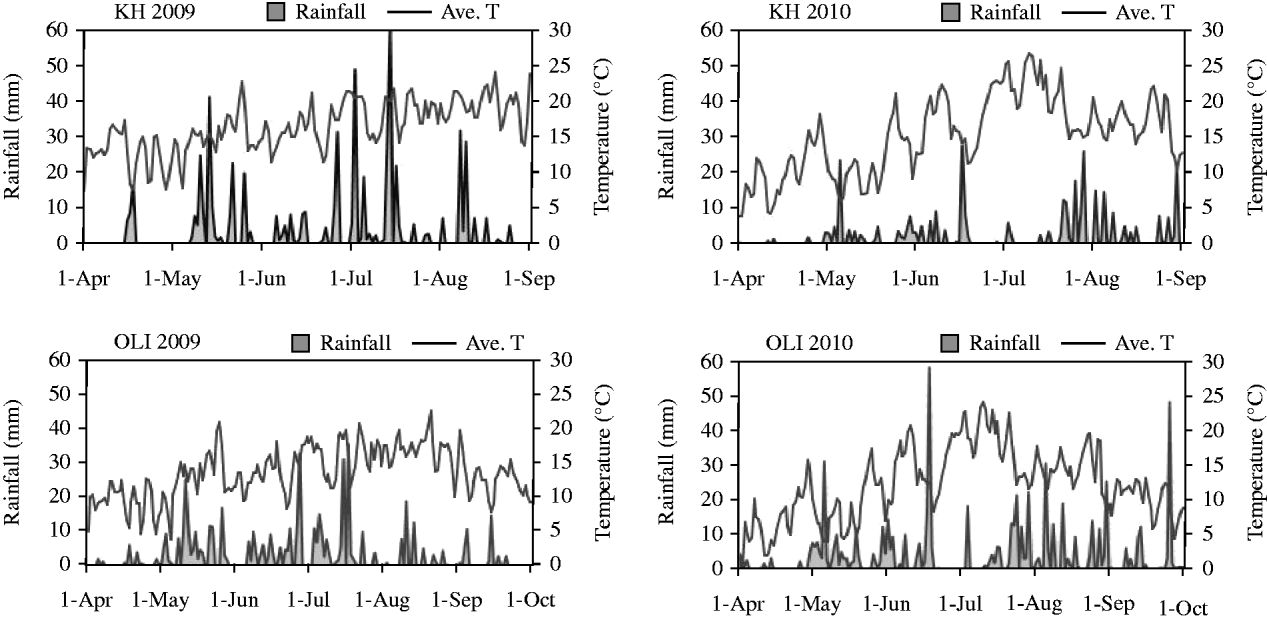
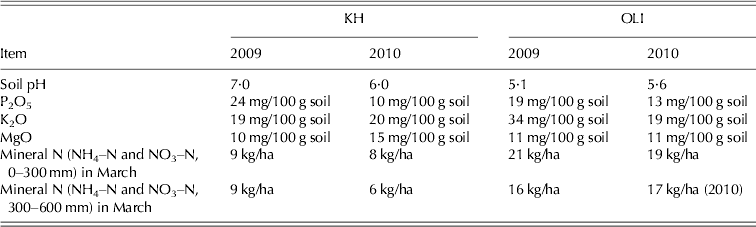
Location KH is characterized by a long-term (1961–2010) annual average rainfall of 710 mm and an average air temperature of 9·2 °C. The mean minimum spring temperatures in the last 6 years (2005–10) were −8·8, −8·0 and −1·1 °C (February, March and April, respectively). Total rainfall and mean temperature during the lentil growing season from April to August were 601 mm and 16·3 °C in 2009, 362 mm and 15·4 °C in 2010 (Fig. 1). The dominant soil types are Luvisols and Cambisols, with loess to sandy loamy clay textures, which means the soils have a high water holding capacity and are well suitable for agricultural use. More details on the topsoil (0–200 mm) characteristics and the soil mineral nitrogen (nitrate and ammonium fractions) are shown in Table 1. The research station has been managed according to the organic standards of Bioland and Naturland since the year 1993, and has an 8-year crop rotation of grass/clover (2 years), winter wheat (Triticum aestivum L.), oat (A. sativa), faba bean (V. faba L.), spelt (T. aestivum ssp. spelta), maize (Zea mays L.)/potatoes (Solanum tuberosum L.) and triticale (Triticosecale). The current experiment with lentils was integrated into the faba bean field, thus the preceding crop was oat.
Total rainfall (mm) and mean temperature (°C) during the lentil growth period in the locations KH (from April to August) and OLI (from April to September) in 2009 and 2010.

Topsoil characteristics and mineral nitrogen content of the experimental sites KH and OLI
Location OLI is characterized by an average long-term (1970–2010) annual rainfall of 942 mm and an average air temperature of 6·9 °C. The mean minimum spring temperatures in the last 6 years (2005–10) were −14·4, −11·3 and −5·6 °C (February, March and April, respectively). The total rainfall and mean temperature during the growing season of lentils from April to September were 486 mm and 13·1 °C in 2009, 732 mm and 12·5 °C in 2010 (Fig. 1). The geological formation of this region is White Jurassic Delta, and the soil is considered to be argillaceous silt rich in humus. The preceding crops were grassland for pasture in 2009, and wheat in 2010.
The soil pH was determined potentiometrically in a soil suspension of 3 m KCl. Available P and K were extracted by the CAL method (Schüller Reference Schüller1969). Magnesium was determined by the flame atomic absorption spectrometric method (Spectr AA 220FS; Varian Deutschland, Darmstadt, Germany). Soil mineral N was determined using the FIA star 5012 flow injection analysis system (Foss Tecator AB, Höganäs, Sweden).
Experimental design and data collection
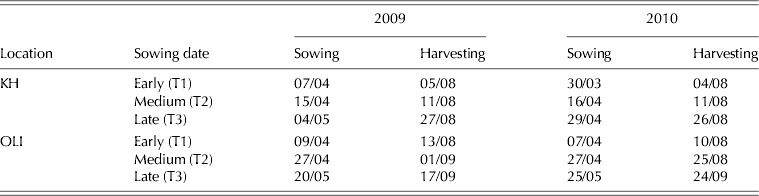
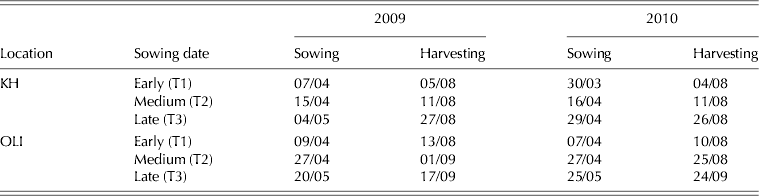
Three sowing dates: early, medium and late, were tested in both locations (Table 2). These sowing dates referred to the phenological events of flowering of coltsfoot (Tussilago farfara L.; T1), dandelion (Taraxacum officinale Weber ex F.H. Wigg; T2) and lilac (Syringa vulgaris L; T3). Four genotypes of lentil: Anicia (green marbled, TGW 31 g), Schwarze Linse (black, TGW 20 g), Hellerlinse (brown, TGW 62 g) and Berglinse (brown coat with red inside, TGW 32 g) were mixed-cropped with spring naked-barley (cvar Hora) at each sowing date. The trial was a split-plot design with four replications, with a total number of 48 plots at each location. At KH, individual plots consisted of 16 rows with a row spacing of 150 mm and a length of 4·2 m, while individual plots were 6 rows with 190 mm row spacing and 4·2 m (2009) or 4·0 m (2010) length at OLI. The fixed total target seeding density was 240 seeds/m2 with a cropping ratio of lentil:barley = 3:1 in both locations. Crops were sown using a plot drill at a uniform sowing depth of 30 mm and were harvested by hand when the majority of lentil pods had turned to brown and tended to open (Table 2). Weed density and species were investigated during lentil flowering to early pod formation stage at each sowing date in the location KH (2009 and 2010) and OLI (only 2010), with a randomly chosen sample area of 3 × 0·25 m2 per plot. No further crop management (such as mechanical weed control, fertilization or fungal crop protection) was done, in order to mimic the situation of most organic lentil farmers who do not perform direct mechanical weed control, mainly because of the susceptibility of lentils to mechanical damage.
Sowing dates (Early ‘T1’, Medium ‘T2’ and Late ‘T3’) and corresponding harvest date for a standard lentil–barley mixed cropping system at KH and OLI in 2009 and 2010
The sample area per plot for harvesting was 2 × 0·5 m2 at KH and 2 × 0·25 m2 at OLI. Crops and weeds were removed by hand in the sampling area, and then separated into crop species and weeds. The roots of all crops and weeds were cut manually and discarded so that total above-ground biomass remained for further analysis. Air-dried samples of each plot were threshed using a threshing machine at 550 rpm for lentils and 850 rpm for barley. For dry weight determination, all the samples were oven-dried for 3 days at 80 °C to constant weight.
Statistical analysis
Analysis of variance was performed using the ‘proc mixed’ procedure of the SAS statistical software Version 9.2 (SAS Institute 2009). The sowing date was regarded as the main-plot factor and lentil genotype as the sub-plot factor. Replication was considered as a random effect, whereas sowing date, lentil genotype, experimental year and location were taken as fixed effects. Data were square root transformed to get a normal distribution and homogeneity (Levene's test) of variance if necessary.
RESULTS
Crop grain yield, biomass and yield components
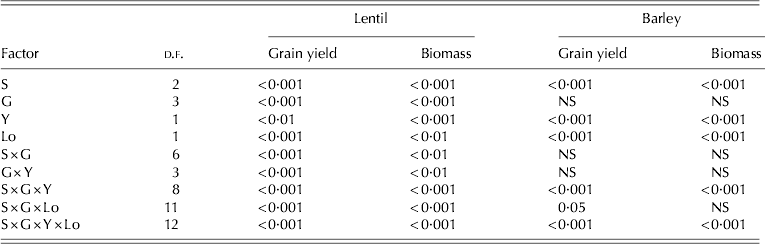
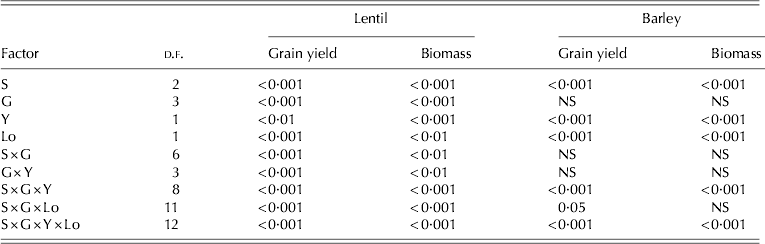
Sowing date, lentil genotype, experimental year, location and their interactions had highly significant effects on grain yield and above-ground total biomass of lentils (Table 3). Most of the variables and their interactions were also significant for barley grain yield and biomass. In the lentil–barley mixture, lentil genotype had different effects on barley yield at different levels of sowing date, experimental year and location.
Analysis of variance (Pr > F) for the effect of sowing date (S), lentil genotype (G), experimental year (Y), location (Lo) and their interactions on grain yield and above-ground total biomass in a standard lentil–barley mixed cropping system with different lentil genotypes in 2009 and 2010
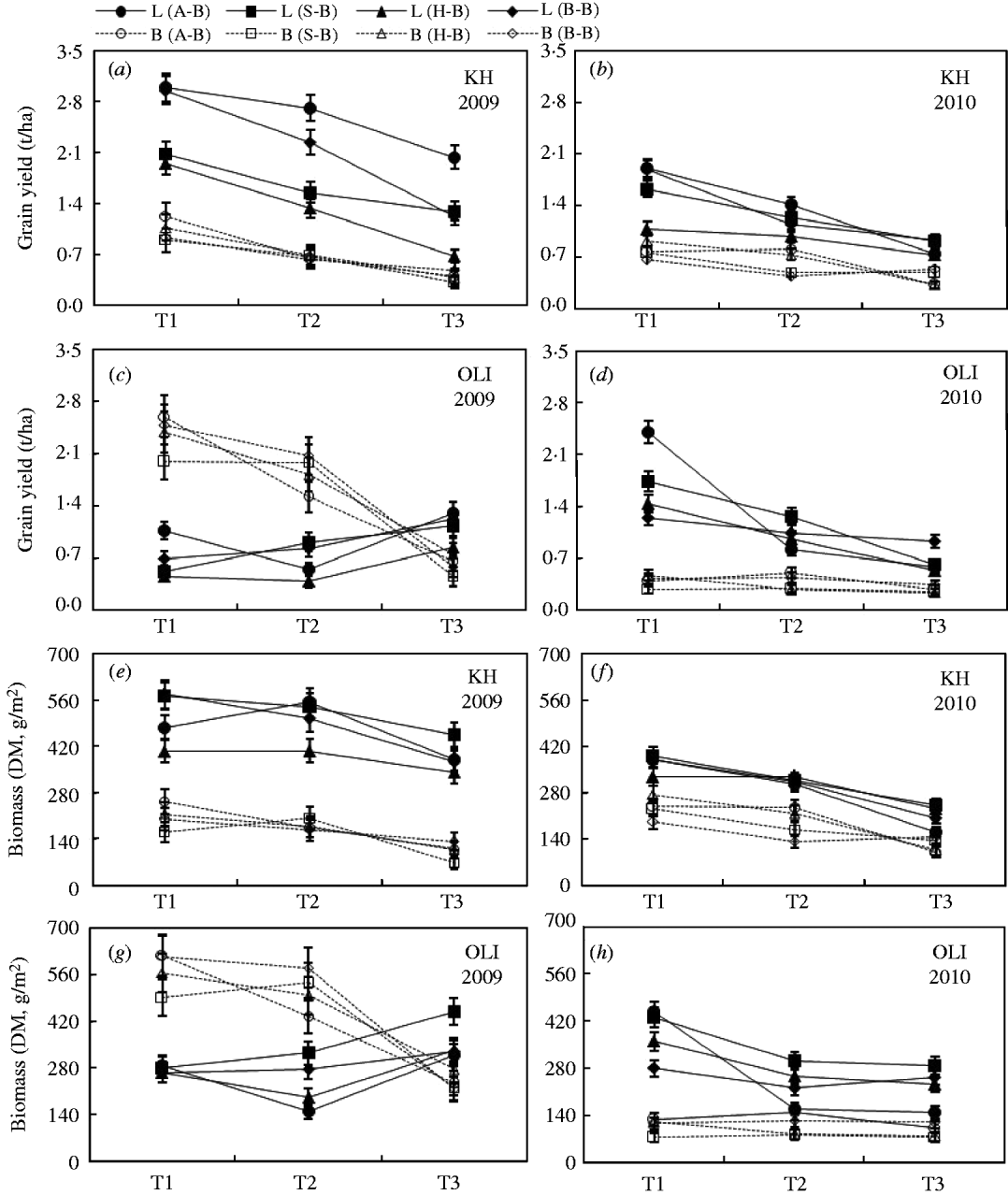
None of the varieties appeared to suffer from early sowing, for instance due to cool temperature. Lentil grain yield and above-ground total biomass decreased with delayed sowing dates in both years and locations, except for OLI 2009 (Fig. 2). Early sowing of lentils resulted in the highest grain yield among the three sowing dates for all genotypes. The genotype Anicia had the highest grain yield in both years and both locations, accounting for c. 3·0 t/ha (2009) and 1·9 t/ha (2010) at KH, and 1·1 t/ha (2009) and 2·4 t/ha (2010) at OLI. The yield of Berglinse was very close to that of Anicia in KH in both years, but this comparison was not observed at OLI. Schwarze Linse yielded less than Anicia, with a range of 1·6–2·1 t/ha at KH and 0·5–1·7 t/ha at OLI. Hellerlinse produced the lowest grain yield in both years and both locations. Late sowing caused grain yield losses at KH of 18–55% compared to the early sowing date, depending on genotype and year. Similarly, grain yield losses at OLI accounted for 17–75% for sowing dates later than the earliest date.
Lentil (L) and barley (B) grain yields (a–d) and above-ground total biomass (e–h) in a standard lentil–barley mixed cropping system at three sowing dates (Early ‘T1’, Medium ‘T2’ and Late ‘T3’) in the location KH and OLI (2009–2010). A-B, Anicia-barley; S-B, Schwarze Linse-barley; H-B, Hellerlinse-barley; B-B, Berglinse-barley. All values are means (n = 4)±s.e. (bars).
Similar to the yield and biomass trends of lentils, the grain yield and above-ground total biomass of barley were reduced when sowing was delayed (Fig. 2). The yield of barley was highest at early sowing with a mean of c. 1·0 t/ha (2009), 0·8 t/ha (2010) at KH and 2·4 t/ha (2009), 0·4 t/ha (2010) at OLI. On average, barley grain yield declined by 28 and 54% (KH), and 13 and 52% (OLI) if early sowing was postponed to medium and late sowing, respectively.
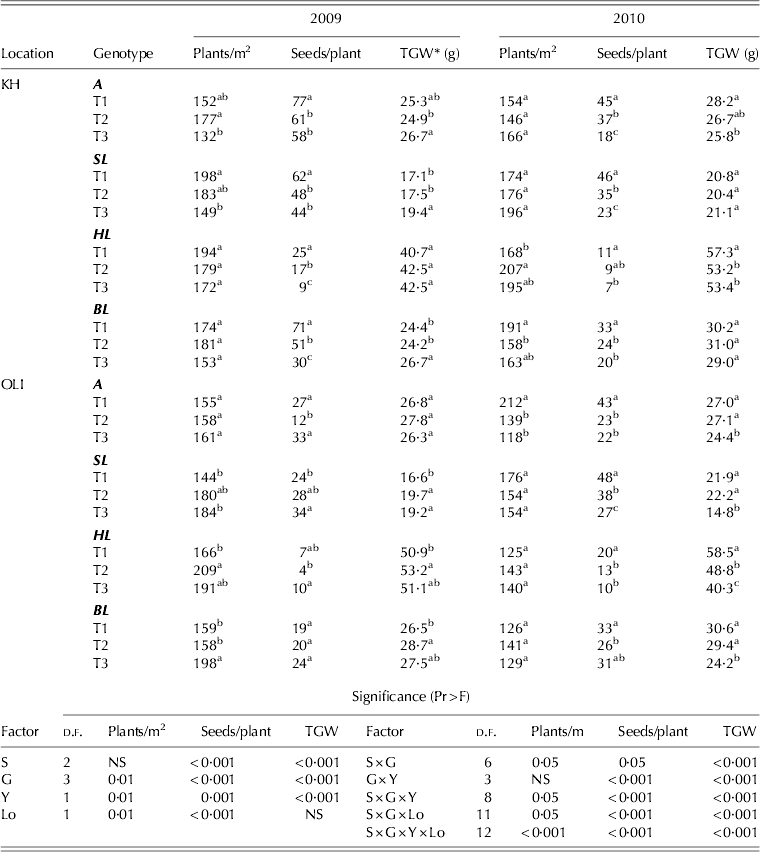
There were variations in the plant density of lentils depending on location, year and genotype (Table 4). Sowing date had different effects on lentil crop density at different levels of genotype, year and location. A significant interaction (sowing date × genotype × year × location) was also observed for lentil seed number per plant and TGW, which indicated that lentil yield component parameters varied at different levels of sowing date, genotype, year and location. For instance, at location KH, the number of seeds per individual lentil plant declined by 19–50%, depending on the genotype, if sowing was delayed beyond T1.
Yield components of four lentil genotypes at three sowing dates (Early ‘T1’, Medium ‘T2’ and Late ‘T3’) in the location KH and OLI in 2009 and 2010. Genotypes: A (Anicia), SL (Schwarze Linse), HL (Hellerlinse), BL (Berglinse)
* TGW, thousand grain weight; S, sowing date; G, genotype; Y, year; Lo, location. Non-significant differences P > 0·05 are identified by the same letters in a column within the same lentil genotype at one location and year.
Weed infestation
The most dominant weed species at KH were Veronica persica L., Cerastium holosteoides Fries, Polygonum convolvulus L., Galium aparine L., Stellaria media L., Chenopodium album L. and Alopecurus myosuroides L., with changing proportions in both experimental years. The weed population at OLI was different from that at KH, with Poa spp., V. persica L., Lamium purpureum L. and Capsella bursa-pastoris L. being the most abundant species. Some weed species appeared only at the sowing dates T2 and T3, such as Sonchus asper (L.) Hill, Trifolium repens L. and Matricaria chamomilla L. at OLI.
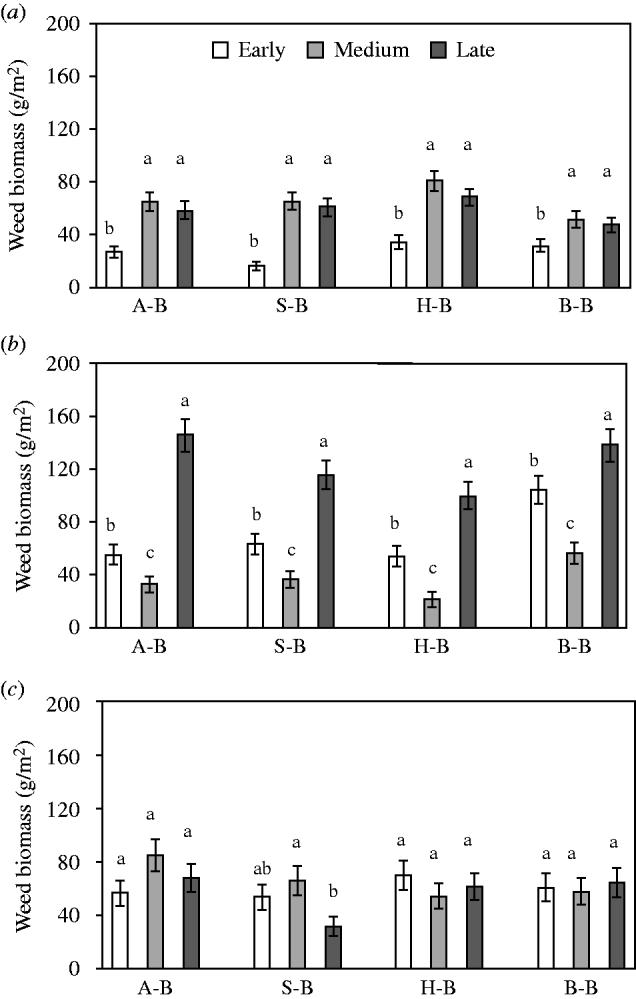
The weed biomass in the crop clearly varied between both years and ranged from 16 to 81 g DM/m2 (2009), 19 to 145 g DM/m2 (2010) at KH and 31 to 85 g DM/m2 (2010) at OLI (Fig. 3). In general, the weed biomass was significantly lower if lentils were sown at T1 (early) compared to the later sowing dates. This effect was visible for all lentil genotypes. Additionally, there was a negative correlation between weed dry biomass and lentil grain yield in KH (r = − 0·435, P < 0·001, data not shown). No clear effect of the sowing date on weed biomass was found at location OLI, except for the genotype Schwarze Linse (data not shown).
Weed biomass (DM, g/m2) in a standard lentil–barley mixed cropping system with four lentil genotypes at three sowing dates in the location KH in (a) 2009 and (b) 2010, and the location OLI in (c) 2010. A-B, Anicia-barley; S-B, Schwarze Linse-barley; H-B, Hellerlinse-barley; B-B, Berglinse-barley. No significant differences for values with the same letters within the same genotype mixture at one location and year, P < 0·05. All values are means (n = 4)±s.e. (bars).
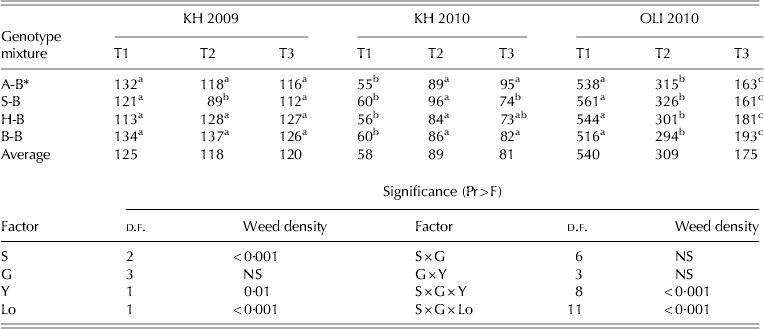
The density of weeds (plants/m2) also varied significantly with sowing date, and additionally varied significantly year and location (Table 5). Location OLI had a generally higher weed density than location KH. In contrast to weed biomass, the number of weed plants was lower when sowing was delayed at OLI; however, this effect was not observed at KH. Different lentil genotypes and sowing date interacted significantly in the sowing date × genotype × year and sowing date × genotype × location interactions. The mean weed density at KH (2009) in four lentil genotypes in the mixed cropping system with barley at T1, T2 and T3 was 125, 118, and 120 plants/m2. A different situation was found for the year 2010 with the early sowing date (T1) resulting in the lowest number of 58 weed plants/m2, compared to 89 and 81 plants/m2 for T2 and T3 respectively. At OLI, the weed density also decreased if the crop was sown later in the year, accounting for 540 (T1), 309 (T2) and 175 (T3) plants/m2.
Weed density (plants/m2) in a standard lentil–barley mixed cropping system at three sowing dates (Early ‘T1’, Medium ‘T2’ and Late ‘T3’) at the locations KH (2009 and 2010) and OLI (2010)
* A-B, Anicia-barley; S-B, Schwarze Linse-barley; H-B, Hellerlinse-barley; B-B, Berglinse-barley; S, sowing date; G, genotype mixture; Y, year; Lo, location. Non-significant differences (P > 0·05) are identified by the same letter in a row within the same genotype mixture at one location and year.
DISCUSSION
The lentil grain yield of the present study was higher than that reported from practical farming in southwest Germany (<1 t/ha, W. Mammel, personal communication), which could be caused partly by the method of harvesting. Hand-harvesting by uprooting the total plants, as performed in the present study, may have resulted in lower grain losses than mechanical harvesting. The total yield from lodging plants may therefore be over-estimated in the present study compared with practical farming in temperate climates. However, the yield of lentils in this experiment was similar to yields obtained under semi-arid conditions; for instance, 0·6–1·4 t/ha in organic farming in Greece (Vlachostergios et al. Reference Vlachostergios, Lithourgidis and Roupakias2010), 1·0–2·5 t/ha in conventional farming in south-western Australia (Siddique et al. Reference Siddique, Loss, Pritchard, Regan, Tennant, Jettner and Wilkinson1998), c. 1·2 t/ha in conventional farming under dryland conditions in Turkey (Yagmur & Kaydan Reference Yagmur and Kaydan2006) and c. 1·5 t/ha of 10-year average lentil yield in Saskatchewan in Canada (McVicar et al. Reference Mcvicar, Mccall, Brenzil, Hartley, Panchuk, Mooleki, Vandenberg and Banniza2010). Taking into account that the cropping system in the current experiment was mixed cropping, compared to sole cropping in most of the studies from semi-arid conditions, the yields are quite promising and show that the yield potential of lentil has not yet been achieved by German farmers.
Grain yield of lentils was generally reduced by delaying sowing time. Sowing at the end of March or at the beginning of April allowed a longer period for crop vegetative and reproductive growth and thus more accumulation of dry matter compared to late sowing. The present results were in line with the studies of Silim et al. (Reference Silim, Saxena and Erskine1991) and Siddique et al. (Reference Siddique, Loss, Pritchard, Regan, Tennant, Jettner and Wilkinson1998) who both indicated that lentil seed yields declined with delayed sowing in dryland Mediterranean-type environments of south-western Australia and in northern Syria. As lentils are usually quantitative long-day plants (though some cultivars tend to be day-neutral), they have a quantitative response to photoperiod and flower more quickly during longer days compared to shorter days (Summerfield & Roberts Reference Summerfield, Roberts and Summerfield1988). Large parts of Europe, with temperate climates, are located at latitudes that experience large annual differences in daylength. Thus, early sowing and young growth of the plants under comparatively short-day conditions can increase the growing season, slow down plant development, and increase dry matter and yield production of both lentils and barley which is also sensitive to photoperiod (Guitard Reference Guitard1960; Takahashi & Yasuda Reference Takahashi and Yasuda1960).
Early sowing of lentils could be considered as a method to indirectly control weeds. However, this method may not be a universal control measure and the unmanaged weeds varied among years (seasons) or locations. Except for the grass weed and volunteer infestation in 2009 at OLI, the early sown lentil/barley mixture seemed to suppress emerging weeds efficiently, probably because of higher total biomass production of the crops and increased tillering of the barley, resulting in higher competitiveness of the total mixture.
As an indicator to assess the competition of the weed infestation, weed biomass provided a better fit than ‘weed density’ in the current study. Early sowing of lentil was found to be a good strategy for better weed control and seemed to be superior to the ‘stale-seedbed’ technique followed by farmers. It had a similar effect to the strategy of increasing lentil competitiveness by higher sowing density (Ball et al. Reference Ball, Ogg and Chevalier1997; Paolini et al. Reference Paolini, Colla, Saccardo and Campiglia2003; Baird et al. Reference Baird, Shirtliffe and Walley2009): robust and big plants resulted from early sowing, which could better compete with emerging weeds. It is not clear, however, whether this effect was caused by the lentil crop, or by the companion barley crop, or by both.
The level of lentil yield was similar in both locations (0·6–3·0 t/ha in KH and 0·4–2·4 t/ha in OLI; data not shown), which showed the ability of the lentil crop to respond to more favourable growth conditions and give higher yield under such conditions. A factor contributing to varying yields in both locations could have been the preceding crop that resulted in the weeds and volunteers observed in the following crop of lentils. This was especially true at OLI in 2009, because lentils followed grassland. The mean loss in yield of winter-sown lentils caused by weeds could be 60%, or even 100% at the highest density of weeds (Halila Reference Halila, Keatinge and Kusmenoglu1995). Additionally, the soil pH at OLI was below the optimum for lentils (c. 7·0; Oplinger et al. Reference Oplinger, Hardman, Kaminski, Kelling and Doll1990) and was close to the minimum pH that can be tolerated (Veseth Reference Veseth1987). In the current study, the nutrients (P2O5, K2O and Mg) of the soil at two sites are both target (middle) levels (LTZ 2011), thus it could be considered that differences in soil nutrients had little effect on grain yield. Annual differences in lentil grain yield can occur as a result of differences in water supply and temperature during the critical period from flowering to the beginning of pod filling. Water deficit can reduce lentil flower production and seed number (Hamdi et al. Reference Hamdi, Erskine and Gates1992; Shrestha et al. Reference Shrestha, Turner, Siddique, Turner and Speijers2006). In the present study, the amount of rainfall during this critical period (from mid June to the beginning of August) in 2010 at KH was lower than that in 2009, which might be one reason why yield was lower in the second year than in the first.
All in all, sowing lentils as early as in the present study (first week of April) seems to be a feasible strategy for increasing yield and controlling weeds, if no other direct weed control such as hoeing and harrowing can be performed in the standing crop. The genotype Anicia, which is already widely used by growers in the study area, seems to be the most promising genotype in terms of yield and is better adapted to the local conditions, though other genotypes such as Berglinse performed equally well in the present study. The study revealed that ‘favourable’ sites are also suitable for lentil cultivation; therefore, an opportunity for wide expansion of more productive soils and high rainfall areas for lentils can be expected as the crop performed relatively well across sites. This means that several organic farmers could integrate lentils into their crop rotation and take advantage of the beneficial effects of crop diversification and N-fixation. Furthermore, the previous study by Wang et al. (Reference Wang, Gruber and Claupein2012) showed that it is better to choose a lentil–barley mixture rather than lentil sole cropping, because the mixture showed higher yield advantages and weed control, and relative profitability as lentil is the desired and high-value grain. Breeding for winter hardiness of lentils for temperate conditions to extend the growth period and further increase yield could be the next step in efforts for re-introducing lentils into German organic farming.
We sincerely thank Ilona Weikert, Oliver Hübner, Rainer Funk and Peter Weckherlin who supported the field work from sowing to harvesting, Christiane Klei and Florian Petrik for data collection in the field, and also Andrea Rückle for help with the laboratory work. Thanks to Martin Zahner and Dagmar Mezger for helping in analysing the soil samples. We gratefully thank Woldemar Mammel and the Öko-EZG ‘Albleisa’ for providing the seeds and for other advice and assistance. We also thank Jens Möhring for guiding on SAS statistic program, Kathleen Regan for providing language help.