INTRODUCTION
The southwestern region of the Japanese Islands that forms Okinawa Prefecture has made very important historical contributions to archeological studies in Japan. Human bones of the oldest type of modern Homo sapiens from several individuals were discovered in a limestone fissure in Gushichan-son, Minatogawa, Okinawa Island of the Ryukyu Islands and were dated around 22 ka cal BP (Kobayashi et al. Reference Kobayashi, Hirose, Sugino and Watanabe1974; Baba and Narasaki Reference Baba and Narasaki1991). Several archeological sites have been excavated and studied so far in the Ryukyu Islands, but the detailed history of the Holocene remains to be understood. In the medieval period, the area was called “Ryukyu,” and was an independent country that had some interactions with China and Japan, as recorded in Chinese historical documents. According to present historical knowledge, several powerful regional families known as aji appeared around the 12th century. At the same time, several regional powers were united by military force, and King Sho Hashi ultimately founded the Ryukyu Kingdom in 1429. After the establishment of the kingdom, the aji families continued as the second most powerful court rank, next to the royal family. The Ryukyu Kingdom was an independent country and lasted from 1429 to 1879. During that time, the kingdom developed a unique religious culture called the noro system to govern the island and control the people living there. The kingdom was prosperous due to its important position in the center of trade routes between south and east Asian countries, which was due to Japan’s national policy that excluded foreigners, as well as China’s (Ming and Qing Dynasties) policy that prohibited its people from freely traveling in the East China Sea and conducting overseas or local trade. The Ryukyu Kingdom was abolished when Okinawa Prefecture, Japan, was established in 1879.
The noro hereditary religious system was maintained in relation to the political power of the Ryukyu Kingdom. The senior noro priestesses were systematized into a female priesthood, and the court of the Kingdom officially appointed the wives or female relatives of highly ranked regional staff from the royal and aji families as noro priestesses for religious and political control of the local area. The costumes and accessories that were given to noro priestesses by the Ryukyuan king symbolized their religious power. The association of the noro religious system with political power persisted until the late 19th century, and even today, these priestesses join and lead many religious festivals on the Ryukyu Islands (Terada Reference Terada2014).
The cultural heritage of the Ryukyu Islands has been preserved to some extent, despite heavy destruction of military facilities as well as privately owned property during World War II. Research on historical clothing and accessories related to the cultural heritage of Okinawa has greatly benefited from the efforts of private citizens who have preserved Ryukyuan traditional silk costumes and fabric products other than costumes—for example, a cloth altar cover or a shawl—which they have generously offered to aid direct scientific investigations. At present, analysis on the production processes of ancient silk products is based on studies of techniques for dyeing and weaving as well as sewing and embroidery by hand (Terada Reference Terada2014). In addition, it is important to know whether historical silk products were produced domestically or imported from foreign countries such as China. Chronology plays an important role in such systematic studies.
Silkworms eat the leaves of mulberry trees and spin a cocoon after four weeks of growth. As mulberry is a deciduous tree, the carbon contained in a cocoon originates from a year’s worth of atmospheric CO2. Cotton is also harvested yearly. Therefore, we can expect that silk and cotton textiles used for producing costumes and fabric goods were prepared within the same period of several years, which is nearly consistent with the possible margin of error in 14C dating, although several years’ worth of silk textiles may be required to produce one complete embroidered silk product.
Radiocarbon (14C) dating of silk requires appropriate treatment. Burleigh and Baynes-Cope (Reference Burleigh and Baynes-Cope1983) mentioned the difficulties in successfully treating silk samples prior to 14C measurements. Recently, Boudin et al. (Reference Boudin, Boeckx, Vandenabeele, Mitscheke and Van Strydonck2011, Reference Boudin, Boeckx, Vandenabeele and Van Strydonck2014, Reference Boudin, Bonafini, Vanden Berghe and Maquoi2016, Reference Boudin, Bonafini, van den Brande and Vanden Berghe2017) systematically investigated a preparation procedure for archeological wool and silk materials to eliminate contaminating materials for high-accuracy 14C dating. Kim et al. (Reference Kim, Southon, Imamura and Sparks2008) also studied preparation procedures of silk samples, and used silk textiles separated from modern neckties thought to be produced in the 1970s and measured 14C contents of untreated silk samples including dyes and three silk protein fractions of different molecular weight ranges that were separated from decomposed silk fibroin using ultrafiltration concentrators. 14C contents of such elaborately extracted silk protein fractions had different but only slightly smaller values than the 14C content numerically calculated for silk protein and that of the bulk silk sample. This means that special pretreatment is not always necessary if special high accuracy in 14C dating of silk samples is not a requirement. In addition, these special pretreatment procedures damage long-preserved silk samples, resulting in a large loss of silk material. Thus, we used a typical procedure for 14C dating, treating our samples, which had disintegrated badly during long preservation periods in imperfect storage conditions, with diluted acid-alkali-acid sequence, paying particular attention not to lose any sample materials due to over-treatment.
SAMPLE MATERIALS
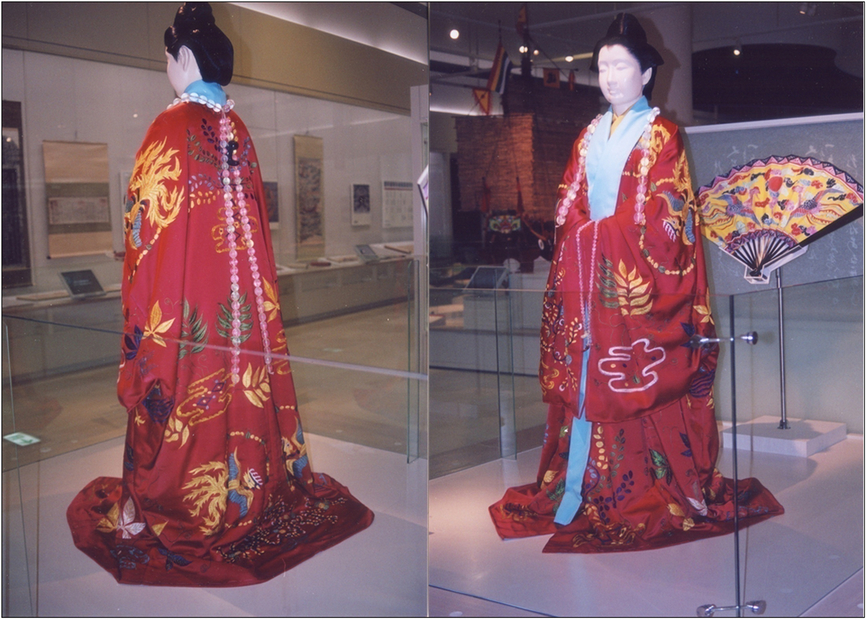
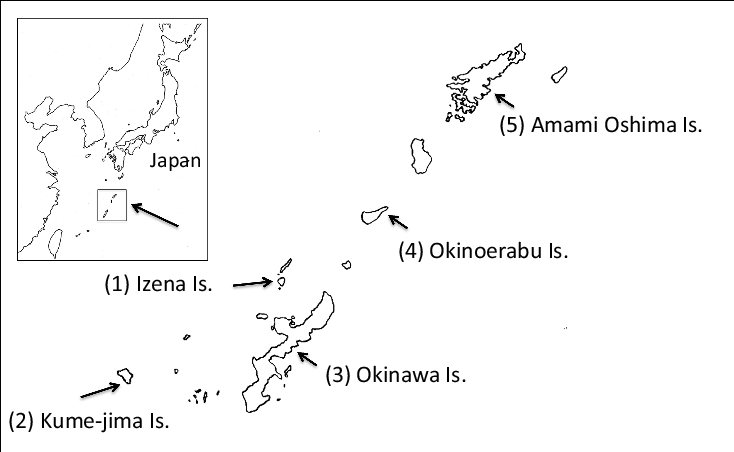
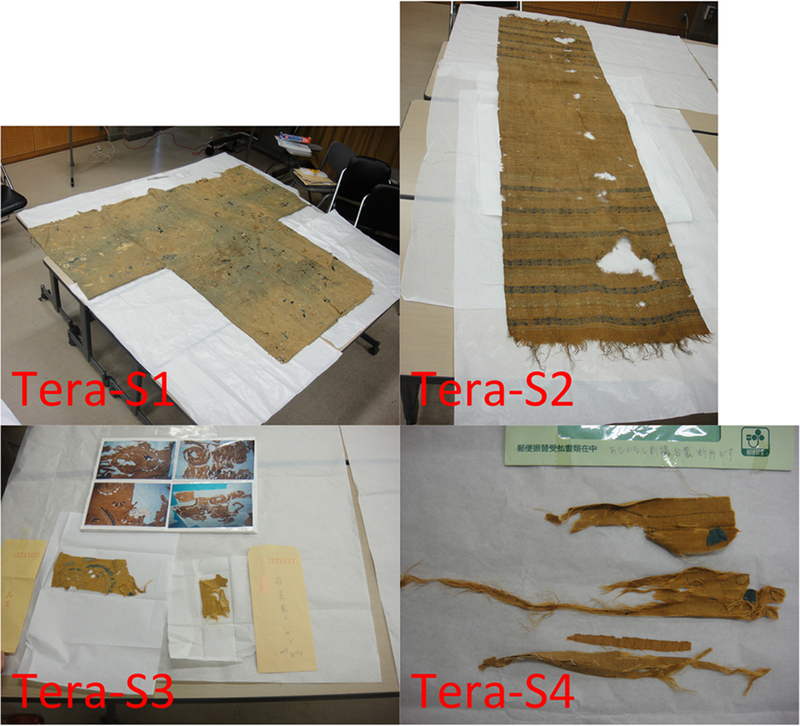
We collected 15 samples (13 silk and 2 cotton) separated into embroidered silk costumes and non-costume products for 14C dating with accelerator mass spectrometry (AMS) as shown in Table 1. These samples consisted of cloth fragments and fibers from various positions (not documented), on embroidered costumes (seven samples: nos. 1, 3–4, 11–13, and 15 in Table 1) and associated textiles from non-costume products (seven samples: nos. 2, 5–10), of noro priestesses (Figure 1), and of men and women from high-status families, such as the royal and aji families of the Ryukyu Kingdom. Among them, two samples (nos. 4 and 11), were related to noro priestesses. Five samples (nos. 5–9) were collected from the same block of a fabric product with embroidery (ca. 100 cm × 50 cm). Sample no. 14 was from a silk shawl imported from overseas, and will be explained in more detail later. The costumes and textile products listed in Table 1 were kept as family treasures and passed from generation to generation, and as such were preserved in well-manufactured wooden boxes. One sample was from (1) Izena Island, one from (2) Kume-Jima Island, eight from (3) Okinawa Island, one from (4) Okinoerabu Island, and four from (5) Amami Oshima Island (Figure 2). Types of costume, color, sample material, possible original and present owners, and obtained analytical data are summarized in Table 1, and sample photos are shown in Figure 3. Though the fabric products were carefully stored, there was still some time-related damage, and holes from worm damage were observed in some of them (Figure 3).
Description of fabric product, color, sample material, possible original and present owners, and obtained analytical data by 14C dating.

Reconstruction of the 15th century senior noro costume, the embroidered Osode-i (大袖衣), exhibited at Okinawa Prefectural Museum & Art Museum, Japan.

Sampling locations: Location of (1) Izena Island, (2) Kume-jima Island, (3) Okinawa Island, (4) Okinoerabu Island, and (5) Amami Oshima Island.

Photos of textiles, costumes, and some costume fragments used for 14C dating. Details are described in Table 1.

METHODS
All cloth samples were first treated in an ultrasonic cleaner with solvent (acetone) to eliminate possible contamination by lipids and dyes on the sample surface. During the treatment, the solvent color changed to light blue for sample nos. 1 and 2, light brown for nos. 3 and 4, red for nos. 5 and 8, and green for no. 11, suggesting that some portion of the dye was released into the solvent. However, for other samples, there was no clear color change in the solvent, and it was not easy to remove the dye completely by solvent treatment. The samples were then gently rinsed with diluted HCl (0.2 M) for 12 hr, with NaOH (0.3 M) for 3 hr, and again with diluted HCl (0.3 M) for 12 hr, with rinsing in between with distilled water, without damaging the silk threads. The cotton threads were treated in a routine manner used for 14C dating of plants, wood, and charcoal, with NaOH and HCl solutions of 1.2 M concentration for one day. Pretreated samples were combusted to CO2 and the produced CO2 was converted to graphite using a routine method (Kitagawa et al. Reference Kitagawa, Masuzawa, Nakamura and Matsumoto1993). The carbon isotope ratios of 14C/12C and 13C/12C were measured for graphite materials prepared from silk and cotton samples as well as for those from NBS oxalic acid standards (NIST SRM 4990c) and 14C blank materials (dead oxalic acid No. 57952, Kishida Chemical Co., Ltd., Japan) prepared in a similar routine procedure, with a 3.0 MV Tandetron AMS system (Model 4130-AMS, HVE, the Netherlands) at Nagoya University (Nakamura et al. Reference Nakamura, Niu, Oda, Ikeda, Minami, Ohta and Oda2004; Reference Nakamura, Nishida, Takada, Okuno, Minami and Oda2007). The 14C/12C ratios of the sample and standards were corrected first for 14C background level, and then for carbon isotopic mass fractionation with their respective δ13C values measured with AMS. The conventional 14C ages thus evaluated were calibrated to calendar ages using IntCal13 (Reimer et al. Reference Reimer, Bard, Bayliss, Beck, Blackwell, Bronk Ramsey, Buck, Cheng, Edwards, Friedrich, Grootes, Guilderson, Haflidason, Hajdas, Hatté, Heaton, Hoffmann, Hogg, Hughen, Kaiser, Kromer, Manning, Niu, Reimer, Richards, Scott, Southon, Staff, Turney and van der Plicht2013) and the OxCal ver. 4.2.4 calibration program (Bronk Ramsey Reference Bronk Ramsey2009).
RESULTS AND DISCUSSION
Obtained 14C ages and calibrated calendar ages are summarized in Table 1 and Figure 4. The resulting calendar age ranges are summarized as follows. Eleven samples (nos. 1 to 11) are cloth and string fragments of costumes and non-costume fabric products from locations (1)–(4) and are most likely from the middle to late 15th century, except for sample nos. 5 and 8. These two samples are younger than the other three (nos. 6, 7, and 9) that were collected from the same block of an embroidered fabric product. There is some possibility that sample nos. 2 and 7 belong to the late 16th to early 17th century in addition to the 15th century. The age of sample no. 7 will be discussed in the next paragraph. Four samples (nos. 12–15) are cloth from costumes and a silk shawl from location (5), and are all younger (AD 1660–1950). Lastly, the oldest sample (no. 4) among the seven historical costumes dates back to the mid-15th century. Except for sample no. 14, all other samples are from fabric products related to the noro priestesses or official systems of the Ryukyu Kingdom, and the obtained ages are consistent with the lifetime of the kingdom, from around the 14th century to AD 1829.
Calibrated age ranges using OxCal v4.2.4 for 14C ages measured for silk and cotton samples. Probabilities in curve and possible calibrated age ranges with two-sigma error in horizontal bars are shown.

We selected the five sample nos. 5–9 (UEKI-1, UEKI-2, UEKI-3-1, UEKI-3-2, and UEKI-3-3) from the same fabric block to examine differences in age among parts of the same block. Sample no. 5 is a textile from the red cotton lining of silk fabric ground (no. 6) with Kaichi pattern embroidery (no. 7) and was found to be in the age range of AD 1646–1950. However, the sample of green silk fabric (no. 6) belonged to the mid-15th century, and the sample of brown silk textile (no. 7) from the Kaichi pattern embroidery was found to be in the younger age ranges of AD 1446–1522 (68.9%) and AD 1574–1626 (26.5%). The brown patchwork sample (no. 9) showed the age range of AD 1436–1489 (94.2%), and the red cotton string sample (no. 8) that sewed the patchwork (no. 9) onto the green fabric base (no. 6) had age ranges of AD 1516–1596 (65.0%) and AD 1617–1654 (30.4%). Thus, the 14C ages of green fabric ground no.6, brown broidery no. 7 and brown patchwork no. 9 that were forming the same fabric block were consistent within two-sigma error. To obtain a more specific age of the fabric block containing the samples UEKI-1, UEKI-2, and UEKI-3 (nos. 5–9), we calibrated the weighted mean 14C age of 411±13 BP for sample nos. 6, 7 and 9 that was calculated by using the R_Combine function of OxCal, which yielded AD 1441–1481 (95.4%). This analysis suggests that the fabric block is most likely from the mid- to late 15th century, and that it is very similar in age compared with the silk fabric products (nos. 1, 3–4, and 10–11). However, the red cotton lining (no. 5; age range of AD 1646–1950) and the red cotton thread (no. 8; AD 1516–1654) are clearly newer than the fabric block. The age difference suggests that the cotton lining and the cotton thread were used at a later date to repair the fabric block product. The cotton thread might have been used to sew the patchwork firmly onto the body cloth later.
Sample no. 4 (Tera-S4 in Figure 3) from location (1), with especially beautiful and colorful embroidery, has an evident historical record. The costume was a holy dress of great significance for a noro priestess and has been preserved by the Naka family of Izena Island. Legend says that the costume was a present from Shoen, the king of the Ryukyu Islands from AD 1470 to 1476, gifted to his older sister who lived on Izena Island. The costume was dated to be from AD 1426–1474 by 14C analysis, which is consistent with the historical record.
The three samples nos. 12–13 and 15 were silk textiles from traditional costumes of high-ranking person from Amami Oshima Island, Kagoshima Prefecture (location (5) in Figure 2), offered by local public organizations (local museums and a board of education). Since the samples were relatively well preserved, we expected that these samples would be newer. This is consistent with the calendar ages of these traditional costumes as from AD 1660 and more recently.
Sample no. 14 (Ueki-8), an embroidered silk shawl inherited by the Nishi family on Amami-Oshima Island, is considered an example of a Manila shawl. A public record indicates that the Nishi family resided at Ikomo, on the southern end of Amami Oshima Island, and made a living through trade with the Ryukyu government in the latter half of the 18th century. Historically, Manila shawls were produced in Guangdong, China, most of which were then gathered in Manila, the Philippines, before transport to Spain by galleons, a practice that continued from 1565 to 1815. The most probable age range of the silk shawl sample is AD 1726–1784 (44.2%), which is consistent with the trade history of Manila shawls. This product has been used as a part of decoration of the Nishi family.
Where did the original silk textiles to produce traditional costumes for noro and high-ranking officials come from? It is well known that silk production originated in China around 3000 BC. Techniques for handling and feeding silkworms were established no later than the Earlier Han Dynasty (206 BC–AD 8), after which many silk textiles were produced, as is the case in the present. The famous Silk Road connecting East Asia and Europe was established at that time. Silk production techniques came to Japan in the Yayoi period (9th century BC–3rd century AD); however, the quality and quantity of silk textile production was not very high in Japan, and until the 1700s, the highest quality silk textiles were imported from China. No specific scientific study has yet revealed the origin of the silk textiles used for traditional costumes in the Ryukyu Islands, but it is thought that silk strings and silk textiles were not produced there before the 18th century and that these materials were imported from China. Where the embroidering and sewing of noro and royal costumes were performed has similarly not yet been established. However, it is believed that the formal costumes of Ryukyuan kings and high-ranking officials as well as those of noro priestesses were produced by special tailors or dressmakers who belonged to the Ryukyu Kingdom.
CONCLUSION
We measured 14C ages with AMS of 13 silk and two cotton samples that were collected from historical cloth products preserved in the Ryukyu Islands, Japan. Two samples were from the formal costumes of noro priestesses, five were from the costumes of high-ranking officials of the Ryukyu Kingdom, seven were from non-costume fabric products, and one was a silk shawl produced in a foreign country. The calendar ages obtained for all 15 samples were consistent with their expected historical ages. These calendar ages ranged from the mid-15th century to the present and were consistent with the time period in which Ryukyu Kingdom existed (AD 1429–1879). Our experiment suggests that acetone and AAA treatments are adequate for 14C dating of silk and cotton samples that were produced in the late Middle Ages and later and that were reasonably well preserved in a separate and clean location, such as the family treasures stored in wooden boxes in the present experiment. To answer the question of whether the silk costumes in the Ryukyu Islands were produced domestically or transported from China after the mid-15th century, it is necessary to date more silk costumes in collaboration with researchers on historical clothing and accessories.
ACKNOWLEDGMENTS
We thank Toshimasa Nakamura and Eiwa Naka from Okinawa Prefecture; Akira Mori from Kagoshima Prefecture; the staff of Kumejima Museum, Amami Museum, Setouchi Library, and Folk Museum of Oshima Island; and the Board of Education at Uken of Oshima Island for permitting us to perform 14C dating of their ancient fabric products. We also thank Chika Mori of the Museum of Materia Medica, University of Toyama, for her help in translating the name of materials, clothing, and accessories from Japanese into English, as well as Tomoko Ohta and Masami Nishida for their support in sample preparation of CO2 purification and graphite target production.