INTRODUCTION
It is widely documented that Chinese managers (hereafter ‘managers’) are preoccupied with developing and maintaining two distinct types of guanxi relationships across organizational boundaries: business-to-business (B2B) ties and business-to-government (B2G) ties (Li, Zhou, & Shao, Reference Li, Zhou and Shao2009; Luo, Huang, & Wang, Reference Luo, Huang and Wang2012). The importance of and preoccupation with these particularistic interpersonal connections (Chen & Chen, Reference Chen and Chen2004) derives from the fact that they are essential for navigating, managing, and succeeding within the Chinese economic and institutional landscape, as revealed in a recent meta-analysis by Luo et al. (Reference Luo, Huang and Wang2012). B2B ties, which are connections between managers at different firms, and B2G ties, which are connections between business managers and government officials or administrators, provide managers with a wide variety of needed resources, knowledge, and influence (Luo et al., Reference Luo, Huang and Wang2012).
Recent research has greatly enhanced our understanding of Chinese firms’ B2B and B2G ties, especially with respect to their distinct contribution to firm performance (e.g., Peng & Luo, Reference Peng and Luo2000) and their distinct roles as substitutes for institutions (e.g., Park & Luo, Reference Park and Luo2001). However, these emprirical studies have focused primarily on the contrast between B2B and B2G ties at the organizational level. Despite the fact that interpersonal relationships rest at the core of these ties, the social exchange dynamics and content characteristics of these interpersonal relationships have only been inferred. At a theoretical level, we still understand little about how members of these two tie types engage in a variety of practices aimed at initiating, building, and utilizing guanxi, and the resultant nature of the bond formed between the tie members. At a practical level, this lack of focus on the interpersonal relationship dynamics of B2B and B2G ties has left managers who wish to develop such ties with very little empirically validated guidance and understanding. This is a serious oversight given the necessity of these ties for career and firm success in the Chinese market.
The purpose of this study, therefore, is to further our understanding in this area of research by developing and empirically testing hypotheses that predict the guanxi practice and quality differences between B2B and B2G ties at the interpersonal level in the Chinese context. More specifically, by using data obtained through structured interviews with 108 midlevel and senior mainland Chinese managers and applying Chen and Chen's (Reference Chen and Chen2004) process model of guanxi development, we identify and empirically test differences in guanxi initiation, building, utilization, and quality between B2B and B2G ties. In doing so, we focus on the key practices that characterize each stage of the guanxi process and build upon the process model by highlighting the role of gift giving practices. We also explicate and measure guanxi quality as a separate concept from guanxi process and verify that guanxi quality is a multidimensional concept that includes affective attachment and felt obligation, both of which vary across B2B and B2G ties. The study's results also appear to indicate that different guanxi practices contribute to guanxi quality in different ways.
By conducting a fine-grained examination of the guanxi practice and quality differences between B2B and B2G ties, this study responds to Chen, Chen, and Huang's (Reference Chen, Chen and Huang2013) call for further clarification and empirical testing of guanxi constructs. These scholars note in their comprehensive review of the guanxi literature that while the recent proliferation of guanxi studies has resulted in a large number of guanxi constructs, some of those constructs are not conceptually distinctive nor have they been empirically tested. These researchers assert that to advance our understanding of guanxi, clear specification and empirical testing of guanxi constructs is needed. By moving beyond guanxi as an umbrella construct and examining the specific components of guanxi practice and quality, this study further contributes to the understanding of guanxi development and maintenance as a multistage process (Chen & Chen, Reference Chen and Chen2004). This study also responds to Chen et al.'s (Reference Chen, Chen and Huang2013) call for research that explicates and measures guanxi quality, which they noted is scarce. The investigation of the underlying dynamics of both B2B and B2G ties at the interpersonal level also contributes to a research area that has been neglected (Bedford, Reference Bedford2011). Furthermore, this research responds to Gu, Hung, and Tse's (Reference Gu, Hung and Tse2008) call for a closer examination of B2G ties and advances the work of those that have focused on the investigation of guanxi relationships that span organizational borders (e.g., Luo et al., Reference Luo, Huang and Wang2012). Our study also contributes to the discussions of how recent economic and institutional changes in China affect guanxi practices. The findings have both important theoretical significance and practical value for managers and their firms in China given the importance of guanxi ties in the Chinese context.
THEORETICAL BACKGROUND AND HYPOTHESES
The Distinctiveness of B2B and B2G Ties
Managers must develop and maintain both B2B and B2G ties, because the two tie types serve quite different purposes. Within China's rapidly developing economy, a firm needs to transact and collaborate with other firms to conduct its routine business, such as finding suppliers (Millington, Eberhardt, & Wilkinson, Reference Millington, Eberhardt and Wilkinson2006), ensuring timely payments (Peng & Luo, Reference Peng and Luo2000), and acquiring technical knowledge and market intelligence (Poppo & Zenger, Reference Poppo and Zenger2002). A firm also needs to stay in touch with other firms to identify and seize new investment opportunities (Poppo & Zenger, Reference Poppo and Zenger2002), share risks and reduce transaction costs (Park & Luo, Reference Park and Luo2001), and acquire network legitimacy (Dacin, Oliver, & Roy, Reference Dacin, Oliver and Roy2007). To achieve these ends, managers (referred to as ‘egos’) have a strong desire to cultivate mutually beneficial B2B ties with managers at other firms (referred to as ‘B2B alters’).
Managers also must negotiate and renegotiate a complex set of arrangements with a multitude of government bureaus and agencies, including, among many others, the taxation bureau for tax exemptions, industrial bureau for product standards, and local planning commission for land use (Park & Luo, Reference Park and Luo2001). They must strive to gain advantageous access to government-controlled resources, such as land and business licenses (Sun, Wright, & Mellahi, Reference Sun, Wright and Mellahi2010), knowledge about rules and policies (Child & Tse, Reference Child and Tse2001), a meditator for reconciling conflicts with other firms (Luo, Reference Luo2000), and expedient and special treatment (Li et al., Reference Li, Zhou and Shao2009). Despite the rapid marketization of the Chinese economy (Naughton, Reference Naughton2007), the infrastructure and institutions governing these bureaus and agencies in China remains inadequate (Zhou & Poppo, Reference Zhou and Poppo2010). Most government rules and regulations are ambiguous, subject to the personal interpretation of government officials, and enforced at the discretion of those officials (Krug & Hendrischke, Reference Krug and Hendrischke2008). As a result, government officials and administrators in China yield substantial power. Managers have a strong need to cultivate influential B2G ties with government officials and administrators (referred to as ‘B2G alters’).
In addition to the different purposes for these ties, the dynamics of B2B and B2G ties also differ substantially. Market forces, which have developed from the rapid marketization of the Chinese economy, have led Chinese firms to introduce and improve control systems that better ensure their managers’ dealings with external stakeholders make economic sense for the firm. While instances of managers behaving in a self-serving manner at their firm's expense (e.g., purchasing a supplier's substandard goods as a means of repaying a personal favor) still occur in China (Warren, Dunfee, & Li, Reference Warren, Dunfee and Li2004), the control systems have lessened the prevalence of such practices (Zhang & Keh, Reference Zhang and Keh2010). This has led to greater transparency in managers’ B2B tie dealings. In contrast, due to the absence of an independent and impartial judiciary and news media in China, B2G tie exchanges are poorly monitored. Some government officials continue to use their position to engage in exchanges of an opaque and ethically questionable nature for personal gain (Fan, Reference Fan2002).
Guanxi Practice Differences between B2B and B2G Ties
B2B tie members, which represent two different companies, have fairly comparable negotiating power, whereas B2G tie members hold very different power positions, with the government official yielding enormous authority over the manager. Furthermore, B2B tie transactions are generally routine and transparent in nature, whereas B2G tie transactions are generally sensitive and opaque in nature. These differences in guanxi nature can be expected to lead to substantail differences in guanxi practice between the two tie types. In this study, we develop hypotheses that predict how guanxi practice differs between B2B and B2G ties, using the process model of guanxi development (Chen & Chen, Reference Chen and Chen2004), which involves three distinct stages: guanxi initiation, guanxi building, and guanxi utilization.
Guanxi initiation. The goal during this initial stage is to identify and create bases for developing guanxi. Traditionally, in China, potential guanxi tie members were identified and sourced from one's pre-existing kith or kin (qinyou) associations (e.g., relatives, school, or local village connections) (Bian, Reference Bian1997). More recently, some scholars have observed that China's free market pursuits have reduced the salience of these associations and increased the emphasis placed on relationships with work colleagues and business contacts as guanxi tie sources (e.g., Millington et al., Reference Millington, Eberhardt and Wilkinson2006). This may be increasingly true for B2B ties given that fierce competition requires firms to connect with customers, suppliers, investors, and partners beyond their managers’ pre-existing kith and kin social circles. On the other hand, these Chinese firms typically still operate within a clear local administrative territory with respect to taxation, land leasing, industry bureaus, and banking. This local orientation in their interaction with the government enhances the likelihood that B2G ties are established with individuals within a manager's pre-existing kith and kin social circles. Chinese government officials, yielding substantial power, the exercise of which remains poorly monitored, at times bypass, bend, or violate official government policies and regulations in their exchanges with business managers. Given that these illicit dealings are viewed with disdain by Chinese society, B2G tie members have a need to conduct their exchanges with those whom loyalty and discretion can be assured. Pre-existing kith or kin associations are more likely to provide tie members with the needed loyalty and discretion (Yan, Reference Yan1996). Therefore, we predict:
Hypothesis 1: Chinese managers will more likely use pre-existing kith or kin associations to initiate B2G ties than B2B ties.
Guanxi building. Following the initiation of the guanxi tie, members personally interact to build guanxi (Chen, Chen, & Xin, Reference Chen, Chen and Xin2004; Yang, Reference Yang1994). The goal of these interactions, known as the expressive and instrumental types, is to move the guanxi parties closer to one another. Expressive interactions, which are of a more socioemotional nature, are especially effective at developing trust in a relationship. A common practice during these interactions is the discussion of personal matters (Yang, Reference Yang1994). Scholars have noted that the Chinese have a high level of particularistic trust with kith and kin, but a low level of general trust in the broader society (Chen & Chen, Reference Chen and Chen2004). Thus, given that B2G ties tend to be initiated with kith or kin, B2G tie members likely have little need to discuss personal matters as a means to move closer to one another. B2B tie members, on the other hand, lacking a pre-existing kith or kin association, likely have a need to build particularistic trust, and thus are likely to confide in each other on personal matters as a means to build guanxi. Therefore, we predict:
Hypothesis 2a: Chinese managers will discuss personal matters less frequently with their B2G alters than with their B2B alters.
Instrumental interactions involve pragmatic transactions and exchanges that include confidential (i.e., restricted) work-related information. There is no doubt that B2B tie members exchange a wide variety of work-related information, such as information with suppliers to facilitate knowledge transfer and exploitation (Ragatz, Handfield, & Petersen, Reference Ragatz, Handfield and Petersen2002), with customers to enhance their understanding of consumer preferences (Li, Reference Li2005), and with competitors to improve human resource management practices (Luo, Reference Luo2007). However, while this information is critical in facilitating work activities, it is not confidential, but rather functional, routine, and relatively transparent. B2G tie members, on the other hand, have little need to discuss information of this type given the retreat of the Chinese government from the daily business operations of firms. Instead, managers turn to politicians and bureaucrats to obtain land lease or license approval advantages, settle disputes with another firm, and gain insight on forthcoming regulatory changes. This requires B2G alters to share restricted policy information and managers to share sensitive corporate information with one another. Therefore, we predict:
Hypothesis 2b: Chinese managers will exchange confidential work-related information more frequently with their B2G alters than with their B2B alters.
The B2B and B2G ties also differ in the extent to, and venue at, which their members interact. The instrumental interactions of B2B tie members encompass a wide variety of functional and routine activities, necessitated by significant task interdependency across firms. Furthermore, the expressive interactions of B2B tie members would span and escalate across multiple encounters to enable the tie members to grow more comfortable and forthcoming with one another. Such requirements would certainly necessitate frequent interaction of the B2B tie members, whereas the instrumental interactions of B2G tie members encompass intermittent issues (e.g., land lease or license approval) and atypical events (e.g., regulatory changes). These focused, isolated, and issue-specific activities require a limited number of transactions. Therefore, we predict:
Hypothesis 3a: Chinese managers will interact less frequently with their B2G alters than with their B2B alters.
While there are a wide variety of interaction venues available to guanxi tie members, the venues fall within three categories: workplace settings, public settings, and private settings. The extent to which tie members interact in these settings is very likely dictated by their interaction content and frequency. Workplace settings provide a convenient, familiar, task-related, and open venue for tie members to interact. Given the interaction regularity, the need to expediently resolve interdependent task-related issues, and the nonconfidential nature of the information exchanged between B2B tie members, it is likely that B2B tie members interact in a workplace setting. Workplace settings, however, are awkward interaction venues for exchanges that are of a delicate nature, require tact, or violate official government policies or organizational procedures. Thus, given the confidential and potentially sensitive nature of the work-related information exchanged between B2G tie members, it is likely that these tie members avoid interacting in a workplace setting. Therefore, we predict:
Hypothesis 3b: Chinese managers will be less likely to interact in a workplace with their B2G alters than with their B2B alters.
Chinese guanxi tie members are known to interact extensively outside of the workplace (Yang, Reference Yang1994). This is not surprising given the need for managers to develop particularistic trust through the discussion of personal matters, especially with B2B alters, and to exchange confidential work-related information, especially with B2G alters. A key difference between the public and private settings beyond the workplace is the extent to which the settings provide discretion and subtlety, with private settings providing substantially more of both qualities. With less need for discretion and subtlety, B2B tie members are likely to interact in public settings, whereas B2G tie members, having a notable need for discretion and subtlety, are likely to interact in private settings. Therefore, we predict:
Hypothesis 3c: Chinese managers will be less likely to interact in public settings beyond the workplace with their B2G alters than with their B2B alters.
Hypothesis 3d: Chinese managers will be more likely to interact in private settings beyond the workplace with their B2G alters than with their B2B alters.
Guanxi utilization. The third stage of the guanxi development process encompasses the utilization of existing guanxi. Managers use guanxi ties when encountering nonroutine problems and difficulties that cannot be easily resolved through normal channels. Using guanxi ties not only serves to solve problems, but it is also a means of re-evaluating the quality of the relationship and a sign of faith and trust in the parties being asked. Doing one's best to perform a favor for a guanxi tie when prevailed upon to do so is the very essence of Chinese relationship norms (Chang & Holt, Reference Chang and Holt1994). So, too, is the need for guanxi ties to maintain long-term equity in the relationship (Chen & Chen, Reference Chen and Chen2004). The Chinese are socialized to possess a keen sense of proportionality and reciprocity, which results in the prudent weighing of favor exchanges in relationships (Della Rocca, Reference Della Rocca1992). The balances owed between people create indebtedness, which is remembered in minute detail. Over time, those who fail to repay or to make a concerted effort to repay feel a sense of shame (Chen & Chen, Reference Chen and Chen2004). To protect guanxi quality from deteriorating and to prove one's desire of continuing the relationship, a guanxi tie member that has received a special favor will feel a need and strive to provide a favor to the favor provider. However, not all managers are able to reciprocate an alter's favor with a favor and must utilize some other means of maintaining equity and restoring balance in a relationship. One such popular means of doing so in China is gift giving. The provision of a gift by an indebted manager to a favor-granting alter may not only serve to restore an equity imbalance, but it may also signal that the relationship is valued and that the favor provider is respected, appreciated, and honored. Lavish gifts also demonstrate a giver's success and generosity and, hence, their worthiness to be a guanxi tie member (Yang, Reference Yang1994).
The power differentials that exist between B2B and B2G ties suggest that members of the two tie types have differing imbalance restoration needs and practices. B2G alters, by virtue of holding or having access to powerful positions in government, are able to provide favors that are valuable and difficult for a person to reciprocate in kind (Seligman, Reference Seligman1999). As a result, managers are likely to provide their B2G alters with gifts as a means of restoring the balance owed for a valuable favor. B2B alters, on the other hand, possessing similar power as the ego, engage in mutually beneficial work task exchanges (Chen, Reference Chen2001). As a result, there is less need to provide B2B alters with gifts to compensate for any reciprocation value shortfalls. This does not imply that managers do not receive gifts from their B2G alters nor exchange gifts with their B2B alters. Gifts, given their importance in guanxi cultivation, are certainly exchanged in both types of ties. However, powerful B2G alters provide valuable favors and are not inclined to use gift giving as a way to ease a feeling of indebtedness. Therefore, we predict:
Hypothesis 4a: Chinese managers will be more likely to give gifts to their B2G alters than to their B2B alters.
Hypothesis 4b: Chinese managers will be less likely to receive gifts from their B2G alters than their B2B alters.
Hypothesis 4c: Chinese managers will be less likely to reciprocate favors from their B2G alters than from their B2B alters.
Guanxi Quality Differences between B2B and B2G Ties
One of the ultimate objectives of guanxi tie members is to develop a close and lasting relationship. A high-quality guanxi relationship is enduring and functional. Earlier conceptualizations of guanxi quality are based on the categories of particularistic ties (Chen et al., Reference Chen, Chen and Huang2013). Tsui and Farh (Reference Tsui and Farh1997) propose three types of relationship quality based on Yang's (Reference Yang, Yang and Yu1993) three categories of particularistic ties: familial ties, familiar ties, and stranger ties. Familial ties are social affective and most stable, stranger ties are instrumental and least stable, and familiar ties are both instrumental and social affective and of medium stability. Other scholars have defined or measured guanxi quality in terms of affective attachment (e.g., Chen, Friedman, Yu, Fang, & Lu, Reference Chen, Friedman, Yu, Fang and Lu2009; Yen, Barnes & Wang, Reference Yen, Barnes and Wang2011); felt obligation (Yen et al., Reference Yen, Barnes and Wang2011), intimacy, and trust (Bian, Reference Bian1997; Luo, Reference Luo2011; Yen et al., Reference Yen, Barnes and Wang2011); and personal-life inclusion or interaction outside of work (e.g., Chen & Peng, Reference Chen and Peng2008; Chen et al., Reference Chen, Friedman, Yu, Fang and Lu2009). Chen and Chen (Reference Chen and Chen2004) define guanxi quality as consisting of two broad dimensions: trust and feeling. Trust is dissected into trust with respect to ability and trust with respect to sincerity. Feeling is dissected into affection and obligation. Chen et al. (Reference Chen, Chen and Huang2013) also decouple guanxi quality from guanxi categories and suggest a dimensional approach to the conceptualization and measurement of guanxi quality.
In this study, we focus on affective attachment and felt obligation as two dimensions of guanxi quality (Chen & Chen, Reference Chen, Friedman, Yu, Fang and Lu2014). Affective attachment is defined as a sense of emotional connection, a desire to spend time together, and a willingness to support each other (Chen et al., Reference Chen, Friedman, Yu, Fang and Lu2009). Felt obligation is defined as a sense of duty to repay (bao) human emotional indebtedness (renqing) (Chang & Holt, Reference Chang and Holt1994). Felt obligation has been recognized as the most critical sentiment that binds a guanxi tie (Chang & Holt, Reference Chang and Holt1994). Chinese social norms dictate that mutual obligation is unconditional in familial ties (Chang & Holt, Reference Chang and Holt1994). Outside of the familial sphere, the degree of obligation felt by guanxi tie members is influenced by the norm of reciprocity and, therefore, is conditional based on the favors exchanged between them (Chang & Holt, Reference Chang and Holt1994). Therefore, guanxi quality, if measured solely by felt obligation, would map perfectly onto the earlier categorical conceptualization of guanxi quality, where guanxi ties within the family are the most stable and wane as they move further away from the familial sphere. Recent work suggests that it is too static and simplistic to define guanxi quality solely based on felt obligation. It has been shown that familiar ties in China can be closer than familial ties in certain situations (Luo, Reference Luo2011), and the positive sentiment resulting from frequent and positive interactions between Chinese coworkers may draw them closer (Chen & Peng, Reference Chen and Peng2008). In other words, guanxi ties who feel strong obligation to each other may or may not have a strong emotional connection with each other. Therefore, affective attachment and felt obligation independently contribute to the closeness and durability of guanxi ties and are both important in defining guanxi quality.
We suggest that B2B and B2G guanxi differ in the extent of affective attachment and felt obligation. Research has demonstrated that individuals are more likely to develop affective attachment to others perceived to be similar (Tsui & Farh, Reference Tsui and Farh1997) and with whom personal matters are discussed (Nicholson, Compeau, & Sethi, Reference Nicholson, Compeau and Sethi2001). B2G tie members, being in a hierarchical relationship in which the alter likely possesses greater power, may perceive each other as dissimilar. In addition, infrequent discussion of personal matters in B2G relationships reinforces perceptions of dissimilarity. B2B tie members, on the other hand, possessing similar power, are likely to perceive one another as similar. Therefore, we predict:
Hypothesis 5a: Chinese managers will perceive less affective attachment to their B2G alters than to their B2B alters.
The likelihood of B2G alters providing valuable favors that cannot be reciprocated suggests that relationship equity imbalances are likely to arise between B2G tie members. Gifts given to B2G alters as substitutes for reciprocated favors typically do not completely eliminate an equity shortfall. Furthermore, B2G ties are more likely than B2B ties to involve a kith or kin association. With the obligatory qualities mandated in such associations by Chinese society, managers are more likely to feel a stronger sense of obligation to their B2G alters than to their B2B alters. Therefore, we predict:
Hypothesis 5b: Chinese managers will feel greater obligation to their B2G alters than to their B2B alters.
METHOD
Sample
Structured personal interviews were conducted with 108 senior and midlevel Chinese managers recruited from the personal networks of the researchers and their research assistants. These managers were from 73 firms in China located in the coastal cities of Beijing, Tianjin, Shanghai, Qingdao, Guangzhou, Shenzhen, Shunde, and Foshan. Among them, 31 (42.5%) were foreign-invested enterprises (FIEs), 28 (38.4%) were state-owned enterprises (SOEs), and 14 (19.2%) were domestic private enterprises (DPEs). The managers were, on average, 37.6 years of age, and 69 (63.9%) were male. The respondents included 94 (87.0%) midlevel managers, which collectively represented a wide array of functional areas, and 14 (13.0%) senior managers (including presidents and senior vice-presidents). The respondents’ average company tenure was 6.8 years, and 73 (67.6%) had a postsecondary education. No significant differences were found on the above dimensions between the sexes at the 0.10 level using ÷2 and t tests. There was, however, significant difference in age between the sexes (t = 1.70, p < 0.10), with the average age of male respondents being 38.8 years and that of female respondents being 35.5 years.
Procedure
A standard interview protocol was employed during each of the 108 interviews, which were conducted in Mandarin or Cantonese depending on the respondent's preference. In all cases, managers were encouraged to elaborate if they found it difficult to fit their responses into the provided categories or scales. The interviews lasted approximately one hour and were not taped given the sensitive nature of the subject matter. The interviews began by focusing on collecting general information about the respondents (egos), including their sex, age, education, job position, tenure with their current employer, etc. This was followed by questions regarding the egos’ work-related guanxi ties.
The procedure used to collect information regarding the respondents’ work-related guanxi ties was the egocentric network nomination method adapted from the General Social Survey (GSS) Protocol (Burt, Reference Burt1984; Marsden, Reference Marsden1987). Instead of asking about the people with whom the respondents discussed personal matters, as was the case in the GSS study, we focused on those whom the respondents considered important to their job and career. Specifically, the following instructions were given to the respondents: ‘We know that managers will seek help from others when they have problems. I would like you to please think of six key individuals that have provided the most critical help to your job/business success. You do not necessarily like them or think of them as good friends. As long as you think their help was important to your job/business success. . ..’ Given that content-specific networks are composed, on average, of four or five ties (Podolny & Baron, Reference Podolny and Baron1997), and fewer than 6% of the GSS respondents identified six or more ties (Marsden, Reference Marsden1987), a maximum of six ties were discussed during the interviews.
Measures
After identifying the ties, the egos answered a series of questions about each of their tie alters and their relationship with those alters. To test our hypotheses, we focused only on the ties that pertain to the ego's job responsibilities or business success rather than personal career.
Tie type. We used the alter's position/occupation and employer, the primary reason why the alter was useful to the ego, and how the alter had helped the ego in the past to form this dichotomous variable. The two researchers and their research assistant independently determined the type of each tie based on the responses to these questions, and any disagreements among the three judges were discussed until consensus was reached. We focused exclusively on ties with alters outside of the respondents’ (egos’) firm. A total of 243 external ties were identified by the 108 respondents. Of these, 90 were excluded because they were unrelated to the egos’ organizational responsibilities. These include ties with alters that offer career advice (‘he [who was employed by a competitor] coaches me on how to enhance my career’) or socioemotional support (‘[a former classmate employed by an unrelated firm] gives me constant encouragement’). The remaining 153 ties consisted of 101 (66.0%) B2B and 52 (34.0%) B2G ties. An example of a B2B alter is ‘she represents one of our suppliers’, and an example of a B2G alter is ‘he is in charge of our product's sanitation approval in the government’.
Pre-existing kith or kin association. Respondents described how they initially met each of their alters. The responses fell into two broad categories: (a) a pre-existing kith or kin association, such as being from the same hometown, university, or having served in the military together (coded 1), and (b) in the course of working at their current jobs (coded 0).
Personal matters discussion. The respondents were asked to estimate the extent to which their communication involved the discussion of personal matters and that constituted at least 25% of their total communication. The variable was coded ‘1’ if the response was affirmative, and ‘0’ otherwise. The 25% threshold point was determined through informal pilot interviews with Chinese managers not included in the study sample. The pilot test revealed that a threshold point of 25% (compared to 50% and 75%) was the most realistic.
Confidential information exchange. Respondents were asked to estimate the extent to which their communication involving the exchange of confidential work-related information constituted at least 25% of their total communication. The variable was coded ‘1’ if the response was affirmative, and ‘0’ otherwise.
Interaction frequency. Respondents estimated how frequently they interacted with each of their alters. The variable was coded ‘1’ if interactions occurred monthly, and coded ‘0’ otherwise.
Workplace interaction. Respondents were asked whether they interacted with each of their alters at either of their workplaces. This variable was coded ‘1’ if interactions took place at either the ego's or alter's workplace, and ‘0’ otherwise.
Public settings interaction beyond the workplace. A variety of recreational event and dining/drinking venues were presented to the respondents. They were asked to indicate whether they interacted with their alter at each of the venues. From these data, two variables were constructed to measure public settings interaction beyond the workplace: Recreational event interaction and dining/drinking establishment interaction. The recreational event interaction variable was coded ‘1’ if the tie members had participated in recreational events together (e.g., going to movies, playing golf, attending karaoke, etc.), and ‘0’ otherwise. The dining/drinking establishment interaction variable was coded ‘1’ if the tie members had meals or beverages together at restaurants, tea houses, or pubs, and ‘0’ otherwise.
Private settings interaction beyond the workplace. Respondents were asked to indicate whether they interacted with their alter at their home and at their alter's home. The two resulting variables (i.e., ego's home interaction and alter's home interaction) were coded ‘1’ if the tie members had interacted at the corresponding venues, and ‘0’ otherwise.
Egos giving of gifts and egos receiving of gifts. Respondents indicated whether they had given gifts to, and received gifts from, their alters, and were coded ‘1’ if the corresponding acts had taken place, and ‘0’ otherwise.
Ego's reciprocation of favors. Respondents indicated whether they had provided help to their alter, and the responses were coded ‘1’ if respondents indicated that they had helped their alters, and ‘0’ otherwise. The helping act is one of reciprocation given that in this study the respondents identified only those alters that had previously helped them.
Ego's affective attachment. A four-item Likert scale (1 = strongly disagree, and 5 = strongly agree) was used to measure the ego's affective attachment to each of their alters. The four items were (1) ‘My relationship with the person is mutually gratifying’, (2) ‘My relationship with the person is important to me’, (3) ‘I want the relationship with the person to last’, and (4) ‘I trust this person’. The scale has a Cronbach's alpha of 0.86.
Ego's felt obligation. This variable was measured using a five-point Likert item (1 = strongly disagree, and 5 = strongly agree) stating ‘I feel indebted to the person’.
Analyses
Binary logistic regression analyses were used to test Hypotheses 1 through 4c. For each logistic regression, the ownership category of the ego's employer, ego's sex, ego's age, ego's education (with or without postsecondary education), ego's tenure (with current employer), alter's sex, and alter's age were entered as control variables in the first step of the analysis. Given that the sex composition of the ego-alter dyads has been shown to significantly affect guanxi practice (Bu & Roy, Reference Bu and Roy2005; Reference Bu and Roy2008), we also controlled for this potential confounding effect by entering the interaction term between ego's and alter's sex at the second step of the regression. The independent variable tie type was entered into the logistic regressions at the final step. Ordinary-least-squares (OLS) regression analyses were used to test Hypotheses 5a and 5b. For each of the OLS regressions, the ownership category of the ego's employer, ego's sex, ego's age, ego's education, ego's tenure, alter's sex, and alter's age were entered first, followed by the interaction term between ego's and alter's sex, with tie type entered at the final step.
RESULTS
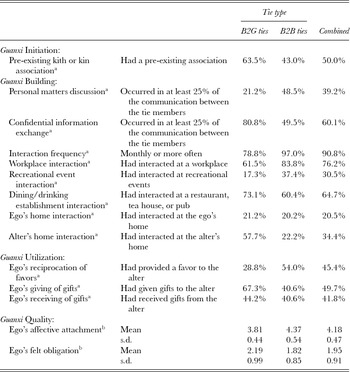
Table 1 reports the frequencies of all dichotomous dependent variables and the means and standard deviations of all continuous dependent variables, broken down by tie type.
Descriptive statistics of dependent variables by tie type

Notes: N = 152–153 due to missing values.
a Numbers shown in the row are the percentage of responses in the stated category of the dichotomous variable.
b Numbers shown in the row are the means and standard deviations of the continuous variable.
Guanxi Initiation
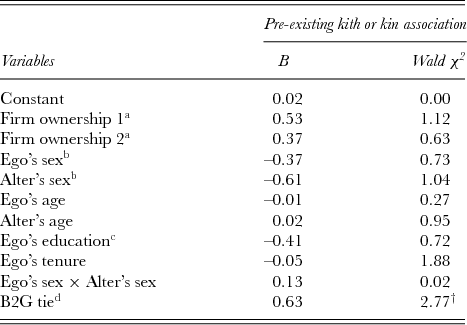
The descriptive statistics presented in Table 1 indicate that 63.5% of managers’ B2G ties and 43.0% of their B2B ties were initiated from pre-existing kith or kin associations. While this clearly illustrates the importance of pre-existing kith or kin associations as a tie alter source for developing both tie types in China, the results of the logistic regression (Table 2) confirm that managers are more likely to use pre-existing kith or kin associations to initiate B2G ties than B2B ties (B = 0.63, p < 0.10). Therefore, Hypothesis 1 is supported.
Binary logistic regression: Impact of tie type on guanxi initiation (Hypothesis 1)

Notes: N = 152; numbers shown are unstandardized logistic regression coefficients (B) and Wald ÷2 statistics obtained at the final step of the analysis.
Significance levels shown are the results of ÷2 tests.
†p < 0.10.
aDummy variables (for SOEs, firm ownership 1 = 0, firm ownership 2 = 0; for DPEs, firm ownership 1 = 1, firm ownership 2 = 0; for FIEs, firm ownership 1 = 0, firm ownership 2 = 1).
bDummy variable (male = 0; female = 1).
cDummy variable (without postsecondary education = 0; with postsecondary education = 1).
dDummy variable (B2B tie = 0; B2G tie = 1).
Guanxi Building
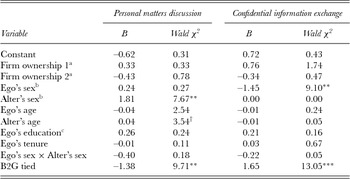
The descriptive statistics (Table 1) concerning the content of the interactions during the guanxi building stage indicate that nearly half (48.5%) of the B2B tie members and approximately one-fifth (21.2%) of the B2G tie members discussed personal matters in at least 25% of their communications. More than 80% of B2G tie members and approximately 50% of B2B tie members exchanged confidential work-related information. The results of the logistic regression analyses used to test the hypotheses concerning the content of the interactions during the guanxi building stage (Hypotheses 2a and 2b) are presented in Table 3. These results provide support for Hypotheses 2a and 2b, which predicted that managers discuss personal matters less frequently (B = –1.38, p < 0.01) and exchange confidential work-related information more frequently (B = 1.65, p < 0.001) with B2G alters than with B2B alters.
Binary logistic regressions: Impact of tie type on interaction content during guanxi building (Hypotheses 2a and 2b)

Notes: N = 151–153; numbers shown are unstandardized logistic regression coefficients (B) and Wald χ2 statistics obtained at the final step of the analysis; significance levels shown are the results of χ2 tests.
† p < 0.10, ** p < 0.01, and *** p < 0.001.
a Dummy variables (for SOEs, firm ownership 1 = 0, firm ownership 2 = 0; for DPEs, firm ownership 1 = 1, firm ownership 2 = 0; for FIEs, firm ownership 1 = 0, firm ownership 2 = 1).
b Dummy variable (male = 0; female = 1).
c Dummy variable (without post-secondary education = 0; with post-secondary education = 1).
d Dummy variable (B2B tie = 0; B2G tie = 1).
The descriptive statistics (Table 1) concerning interaction frequency and venues during the guanxi building stage indicate that members of both types of guanxi ties interacted very frequently, with 78.8% of B2G tie and 97.0% of B2B tie members having interacted at least once a month. Beyond meeting frequently at a workplace (61.5% of B2G ties and 83.8% of B2B ties), guanxi tie members also met regularly beyond the workplace. By far the most popular interaction setting beyond the workplace was a dining or drinking establishment, at which nearly two-thirds (64.7%) of both B2B and B2G tie members interacted. In comparison, 37.4% of B2B ties and 17.3% of B2G ties interacted at recreational events. Egos visited the home of B2G alters in 57.7% of the cases and the home of B2B alters in 20.0% of the cases, whereas B2G and B2B alters visited the ego's home in approximately 20.0% of the cases.
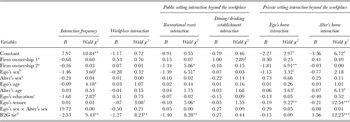
The results of the logistic regressions concerning interaction frequency and venues during the guanxi building stage (Hypotheses 3a, 3b, 3c, and 3d) are summarized in Table 4. The results provide support for Hypotheses 3a and 3b, which predicted that managers interact less frequently (B = –2.53, p < 0.01) and are less likely to interact in a workplace setting (B = –1.27, p < 0.01) with B2G alters than with B2B alters. Hypothesis 3c, which predicted that managers are less likely to interact in public settings beyond the workplace with B2G alters than with B2B alters, is partially supported. While managers were less likely to interact at recreational events with B2G alters than with B2B alters (B = –1.40, p < 0.01), they interacted equally as often with B2G and B2B alters at dining and drinking establishments (B = 0.27, p > 0.10). Hypothesis 3d, which predicts that managers are more likely to interact in private settings beyond the workplace with B2G alters than with B2B alters, is also only partially supported. While managers were more likely to visit their B2G alter's home than their B2B alter's home (B = 1.56, p < 0.001), they met equally as often at their home with their B2B and B2G alters (B = –0.15, p > 0.10).
Binary logistic regressions: Impact of tie type on interaction frequency and venues during guanxi building (Hypotheses 3a, 3b, 3c, and 3d)

Notes: N = 151–153; numbers shown are unstandardized logistic regression coefficients (B) and Wald χ2 statistics obtained at the final step of the analysis; significance levels shown are the results of χ2 tests.
† p < 0.10, * p < 0.05, ** p < 0.01, and *** p < 0.001.
a Dummy variables (for SOEs, firm ownership 1 = 0, firm ownership 2 = 0; for DPEs, firm ownership 1 = 1, firm ownership 2 = 0; for FIEs, firm ownership 1 = 0, firm ownership 2 = 1).
b Dummy variable (male = 0; female = 1).
c Dummy variable (without postsecondary education = 0; with postsecondary education = 1).
d Dummy variable (B2B tie = 0; B2G tie = 1).
Guanxi Utilization
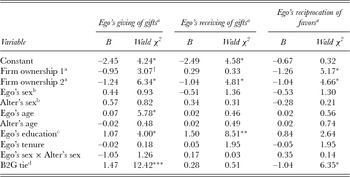
The descriptive statistics (Table 1) concerning guanxi utilization show that in B2G ties, managers gave gifts to the alters in 67.3% of the cases and reciprocated the alters’ favors in 28.8% of the cases. In B2B ties, on the other hand, managers gave gifts to the alters in 40.6% of the cases and reciprocated the alters’ favors in 54.0% of the cases. These results support Hypotheses 4a and 4c, which predicted that managers are more likely to give gifts to (B = 1.47, p < 0.001) and less likely to reciprocate favors from (B = –1.04, p < 0.05) B2G alters than B2B alters. However, managers received gifts from an equal number (41.8%) of B2B and B2G alters (B = 0.28, p > 0.10). This is inconsistent with Hypothesis 4b, which predicts that managers are less likely to receive gifts from B2G alters than B2B alters. Hypothesis 4b is rejected.
Guanxi Quality
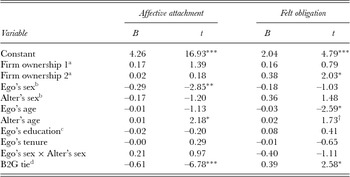
The results in Table 6 indicate that managers express less affective attachment (B = –0.61, p < 0.001) and feel greater obligation (B = 0.39, p < 0.05) to B2G alters than B2B alters. Both Hypotheses 5a and 5b are supported.
Binary logistic regressions: Impact of tie type on guanxi utilization (Hypotheses 4a, 4b, and 4c)

Notes: N = 152–153; numbers shown are unstandardized logistic regression coefficients (B) and Wald χ2 statistics obtained at the final step of the analysis; significance levels shown are the results of χ2 tests.
† p < 0.10, * p < 0.05, ** p < 0.01, and *** p < 0.001.
a Dummy variables (for SOEs, firm ownership 1 = 0, firm ownership 2 = 0; for DPEs, firm ownership 1 = 1, firm ownership 2 = 0; for FIEs, firm ownership 1 = 0, firm ownership 2 = 1).
b Dummy variable (male = 0; female = 1).
c Dummy variable (without postsecondary education = 0; with postsecondary education = 1).
d Dummy variable (B2B tie = 0; B2G tie = 1).
OLS regressions: Impact of tie type on guanxi quality (Hypotheses 5a and 5b)

Notes: N = 151–152; numbers shown are unstandardized regression coefficients (B) and t-statistics obtained at the final step of the analysis; significance levels shown are t-test results.
† p < 0.10, * p < 0.05, ** p < 0.01, and *** p < 0.001; two-tailed tests.
a Dummy variables (for SOEs, firm ownership 1 = 0, firm ownership 2 = 0; for DPEs, firm ownership 1 = 1, firm ownership 2 = 0; for FIEs, firm ownership 1 = 0, firm ownership 2 = 1).
b Dummy variable (male = 0; female = 1).
c Dummy variable (without post-secondary education = 0; with post-secondary education = 1).
d Dummy variable (B2B tie = 0; B2G tie = 1).
DISCUSSION
Theoretical Implications
By illustrating how guanxi practice and quality differ between B2B and B2G ties, this study contributes to the literature in numerous ways. The fine-grained empirical examination of the various elements of the guanxi development process enhances our understanding of the guanxi initiation, building, and utilization practices in B2B and B2G relationships. Managers are more likely to use pre-existing kith or kin associations to initiate B2G ties than B2B ties. The finding that B2G tie members exchange confidential work-related information more often than B2B tie members highlights differing needs for trust, loyalty, and discretion between the two tie types. The need to exchange restricted, sensitive, and valuable work-related information suggests a greater need for a more trustworthy partner in B2G ties than in B2B ties, who tend to exchange functional, routine, and relatively transparent information. This is corroborated by the fact that B2G ties, compared to B2B ties, are more likely to involve pre-existing or kin associations.
The finding that managers spend more time discussing personal matters and less time sharing confidential work-related information with B2B than with B2G tie members is important and interesting. It is possible that the B2B ties in our sample might be less instrumental and more expressive in nature than the B2G ties. To rule out this possibility, we compared the extent to which the members in the two tie types shared routine, nonconfidential work-related information. This additional analysis shows that members of both types of ties were equally likely (in 83.0% of the cases) to share nonconfidential work-related information. This indicates that B2B ties are as instrumental in purpose as B2G ties. These findings confirm our initial assertion that the differences in guanxi practices between B2B and B2G ties lie in their difference in relationship-building needs and in information and power access.
Differences between B2B and B2G ties extend beyond the content of the exchanges to include extensive differences in interaction frequency and the venues of their interactions. B2G tie members interact with one another less frequently than do B2B tie members, reflecting the intermittent issues and atypical events that periodically arise in B2G tie dealings. This confidential information exchange may also explain interaction venue differences between B2B and B2G ties. An interesting observation is that B2G tie members were much more likely to interact at the alter's (i.e., government official's) home rather than the ego's (i.e., business manager's) home. This reflects the power differential in this tie type. The Chinese believe that visiting someone at home is an act of great respect; therefore, it is more socially appropriate for a lower status individual to visit a higher status individual's home rather than the reverse. Actually, the formal term for ‘paying a visit’ in the Chinese language is baifang (
 ), which consists of two words, bai (
 ), meaning kowtow, and fang (
 ), meaning visit. It is also interesting to note that despite the B2G tie members’ greater need for privacy and discretion, they did not interact less frequently at dining and drinking establishments than B2B tie members. While we did not expect this result, in retrospect, treating dining and drinking establishments as public interaction settings is problematic. In practice, restaurants and pubs can provide privacy in the form of private rooms and hosting invitation-only meetings.
This study also reveals that B2B and B2G tie differences also exist during the guanxi utilization stage. While relationship equity maintenance and imbalance restoration are important for all guanxi ties, managers are less likely to reciprocate favors received from B2G alters than B2B alters. This is not to say that managers are not interested in reciprocating the favors of B2G alters. The weak governance infrastructure in China, which is ambiguous and riddled with loopholes, continues to bestow upon government officials great liberty in interpreting and arbitrating policies and regulations. This establishes a notable power differential between B2G tie members, with the alter (i.e., government official) possessing significantly greater power than the ego (i.e., business manager). This differential does not exist in B2B ties, whose members are typically of relatively equal power. As a result, managers are less capable of reciprocating favors received from B2G alters than those received from B2B alters.
This study also contributes to the guanxi literature by refining the process model of guanxi development (Chen & Chen, Reference Chen and Chen2004) through the inclusion and examination of gift giving practices in the guanxi utilization stage. This study demonstrates that when managers are unable to reciprocate their B2G alters’ favor in kind, they adopt the alternative tool of gift giving to maintain and restore equity in their relationship. This gift giving practice, coupled with the fact that managers are more likely to visit the home of a B2G alter than a B2B alter, suggests that efforts are made by managers to ‘correct’ any perceived debt imbalances. This is consistent with the guanxi principles of ‘long-term equity’ proposed by Chen and Chen (2004: 310). Despite any short-term debt imbalances, balance is strived for in the long run.
There is no doubt that managers aim to develop high-quality guanxi through their guanxi initiating, building, and utilizing practices in both their B2B and B2G relationships. This study defines guanxi quality as a multidimensional concept that includes two independent dimensions of affective attachment and felt obligation, each of which varies across B2B and B2G ties. More specifically, this study reveals that managers are less affectively attached but feel greater obligation to their B2G alters than to their B2B alters. Managers initiate their B2B tie with those perceived to be equal (similar), build their guanxi through frequent interaction that involves the discussion of personal matters within and beyond the workplace, and reciprocate their B2B alter's favors when utilizing their guanxi. These practices may explain why managers are more affectively attached to their B2B alter than their B2G alter. Managers tend to initiate their B2G ties with kith or kin associates, build their guanxi through relatively infrequent interaction that involves the discussion of confidential work-related information, and receive valuable favors that are difficult to reciprocate, and thus compensate through gift giving. These practices may explain why managers feel more obligated to their B2G alters than their B2B alters.
By responding to calls for research that moves beyond the examination of the objectives of guanxi ties (Bedford, Reference Bedford2011; Yang, Reference Yang1994) and for research that closely examines B2G ties (Gu et al., Reference Gu, Hung and Tse2008), this study advances the work of those that have focused on the investigation of guanxi relationships that span organizational boundaries (e.g., Luo et al., Reference Luo, Huang and Wang2012; Peng & Luo, Reference Peng and Luo2000). The findings also reveal a number of guanxi development social process norms across the two tie types. First, pre-existing kith or kin associations continue to serve as an important base for the initiation of guanxi relationships for both B2B and B2G ties. Second, guanxi tie members interact very frequently. Third, gifts were frequently given by members of both types of ties. This indicates that gift giving continues to be an important practice in the guanxi development process. Last, both B2B and B2G ties are bound more by affective attachment than felt obligation. This is noteworthy given that the literature on interorganizational guanxi has emphasized the role of favor and gift exchange in the creation of indebtedness and obligation, while to some extent treating the nurturing of affective attachment as secondary.
Limitations
The study has several limitations. First, this study is susceptible to retrospective bias (Fischoff & Beyth, Reference Fischoff and Beyth1975). However, research suggests that people's recollections regarding stable patterns in long-term relationships are remarkably accurate (Freeman, Romney, & Freeman, Reference Freeman, Romney and Freeman1987). A second limitation is its reliance on ego-centered data. While this data collection method has been widely used in network and guanxi research (e.g., Podolny & Baron, Reference Podolny and Baron1997; Xiao & Tsui, Reference Xiao and Tsui2007), the data obtained were susceptible to the egos’ self-report bias and the validity of the responses was not verified by another source (e.g., the alters). This is particularly important in the case of B2G ties given the power asymmetry between the egos and alters. Gaining the perspective of B2G alters (e.g., government officials) would have been very useful. Third, while the structured interview method enabled us to collect rich and comprehensive information, the time and resource intensity of this method resulted in a relatively small sample size. A larger sample would improve statistical power and external validity. It would also allow testing the potential interconnections among some variables. Last, this study's cross-sectional design limits its ability to test the process model of guanxi development, which includes multiple stages. However, the study's hypotheses focus on cross-sectional comparisons of each of the guanxi variables in the process model rather than casual inferences across multiple guanxi variables at various stages. Thus, the adopted approach was deemed adequate.
Managerial Implications
To succeed in China's complex institutional environment characterized by a fairly open, market-dominated economy, but an ambiguous, opaque and, at times, arbitrary governance infrastructure, managers must distinguish between B2B and B2G ties. Managers need to be cognizant of and engage in those practices that are most fitting for the particular tie type. Given that China has become a magnet for foreign firms and is among the top two countries in the world for expatriate assignments (Brookfield Global Relocation Services, 2012), expats and their firms would also benefit by being aware of the general and differentiated guanxi practices. China is a particularly challenging environment for expatriates (Brookfield Global Relocation Services, 2012), and guanxi is especially difficult for them to develop (Gomez Arias, Reference Gomez Arias1998). It would be useful for expats to know the different approaches in building guanxi ties with a business counterpart vis-à-vis a government official. Given that B2B and B2G ties require substantial cost, time, and effort to develop and maintain, those that best understand the guanxi practices of these ties may have a competitive advantage in the Chinese business landscape.
This study, taking an ego-pragmatic approach in describing and comparing managers’ guanxi practices across B2B and B2G ties, does not directly address the morality of guanxi and guanxi practices from a community-ethical perspective (Chen et al., Reference Chen, Chen and Huang2013). Some guanxi practices may be deemed immoral based on universal ethical principles (Nguyen & Cragg, Reference Nguyen and Cragg2012) or the moral judgments of the Chinese business community (Warren et al., Reference Warren, Dunfee and Li2004). Managers should be aware that guanxi practices may be scrutinized on moral grounds, and such assessments may negatively affect their firm's performance or their own career success.
Future Research
Although China has developed unified laws nationwide, legal enforcement varies widely across regions because of local government intervention and the varying interpretations of laws by different enforcement authorities (Zhou & Poppo, Reference Zhou and Poppo2010). A useful avenue for future research would be the study of how the guanxi practices of B2B and B2G tie members vary across the different regions within China. The most obvious comparison would be between the coastal and inland regions. Future research could also examine how these practices differ among Chinese in locations outside of mainland China, such as Hong Kong, Taiwan, and Singapore, all of which have a large population of ethnic Chinese but with distinct legal and governance infrastructures. Analyzing this in non-Chinese societies would also reveal the impact of cultural tradition, in addition to governance infrastructure, on the guanxilike practices of managers. Another potentially intriguing area of future research would be to compare the perceived morality of guanxi practices in relation to B2B and B2G ties. While the morality of guanxi practices within both tie types has been questioned, the practices of B2G tie members generate the most controversy (Chen & Chen, Reference Chen, Chen, Huang and Bond2012). Government officials involved in B2G ties almost inevitably use public resources in exchange for personal gain (Nguyen & Cragg, Reference Nguyen and Cragg2012). Thus, even though B2G ties may generate substantial firm benefits, the negative externalities of B2G ties for society are enormous (Fan, Reference Fan2002). Future studies also might investigate the influence of B2B and B2G ties on a company's environmental, social, and economic performance. Future research could assess the moral judgments of managers involved in guanxi ties, as well as those of the broad Chinese business community, with respect to the guanxi practices within B2B and B2G relationships. Last, but not least, future research should examine the usefulness of these practices for business success. Luo et al.'s (2012) meta-analysis found diminishing returns of government ties. In-depth study of when and why government ties are more or less important would contribute to both the theory and practice of instrumentally motivated social relationships in China.
CONCLUSION
For all the depth and scope of the guanxi literature, researchers have just begun to explore guanxi practice and quality. By being cognizant of the guanxi practice and quality differences between B2B and B2G ties, scholars and practitioners alike can better understand the psychological, behavioral, market, and institutional factors that affect the development and maintenance of these ties. Given the unrelenting growth of the Chinese economy and the importance of B2B and B2G ties in China, underestimating the importance of such knowledge, which promotes and preserves the relational investments required for business success in China, would be a serious oversight.