Introduction
Taro (Colocasia esculenta (L.) Schott) is a tropical tuber species of the Araceae family, and is widely consumed in Asia, Africa and South America.Reference Pereira, Puiatti and Miranda 1 This tuber is rich in starch and has several phytochemical compounds, such as polyphenols, tannins, flavonoids, alkaloids and saponins.Reference Pereira, Puiatti and Miranda 1 , Reference Chan, Hsu, Wang and Su 2
This tuber is commonly used in China as a drug because of it’s antioxidant and anti-inflammatory capacity and is widely used as therapeutic relief.Reference Depypere and Comhaire 3 In the literature, it was already reported the benefit that taro brings to women, especially with regard to postmenopausal health improvement, attenuating the symptoms relative to this stage, since it is a precursor in estrogen synthesis.Reference Depypere and Comhaire 3 , Reference Wu, Liu, Chung, Jou and Wang 4 In a study by Chiang et al.Reference Chiang, Chang and Pan 5 it was given a substrate of Dioscorea (red mold dioscorea) to ovariectomized rats with postmenopausal osteoporosis and the results were a decrease in estrogen-induced bone loss. Wu et al.Reference Wu, Liu, Chung, Jou and Wang 4 observed that postmenopausal women, who received 390 g of yam (Dioscorea alata) for 30 days, had a higher increase of estrone, sex hormone-biding globulin and estradiol, decreased cholesterol and increased time of lipoprotein oxidation, thus decreasing the risk of cancer and cardiovascular diseases.
This performance is related to the androgenic action of these compounds present in taro. Saponin including diosgenin, has been investigated for its role in steroid production, this is because it binds to the receptors of these hormones or the enzymes that metabolize them.Reference Chiang, Chang and Pan 5 – Reference Gauthaman and Ganesan 7 The alkaloids bind to the nervous system and modulate neurotransmitters in the gonadal tissue, there are still the hypothesis that polyphenols also have the ability to modulate neurotransmitters.Reference Schaffer and Halliwell 8 It has also been found that flavonoids are capable of raising these hormone levels by serotonergic action or by preventing their metabolic degradation.Reference Jianfeng, PengYing and ChengWei 6
Despite these reports, it has not yet been seen the performance of Colocasia esculenta in the hormonal levels of males and in the seminiferous tubules where this hormone is produced. So the goal of this study is to evaluate the effects of diet containing 25% of taro flour on hormone levels, seminiferous tubule morphology and number of Sertoli cells from Wistar rats at 90 days of age.
Materials and methods
The project was approved by the Ethics Commission on Animal Use (Ethics Committee on the Use of Animals – of the Pro-Rectory of Research, Graduate and Innovation of the Federal Fluminense University (UFF) with registration number: 669/2015.
In the present study, rats Wistar, three months old, from the colonies of the Experimental Nutrition of Laboratory (LABNE) of the UFF were used. They were kept under temperature control (22±1°C), humidity (60±10%) in an environment with artificial light–dark cycle (12–12 h).
Six nulliparous rats were used, ~3 months old. After mating, each female was relocated to individual cage with access to water ad libitum and commercial diet. After the pups birth litter were adjusted with six males per dams. At 21 days of lactation, the pups were weaned and randomly divided into two groups with 12 each until the 90 days of age. These two groups were divided as follows: the control group (CG), received control diet, and the experimental group, received diet containing 25% taro flour, according to Pessôa et al.Reference Pessôa, Rêgo and Asht 9 Formulated according to the American Institute of Nutrition AIN-93G recommendations for rodent diets.Reference Reeves 10 The diet control is composed (g/100 g): 20 g casein, 52.9 g maize starch, 10 g sucrose, 7 g soy oil, 5 g fiber, 3.5 g mix mineral, 1 g mix vitamin, 0.25 g choline bitartrate, 0.3 g l-cystine, 0.0014 g tert-butylhydroquinone, 58 g carbohydrate, 7 g lipid, 17 g protein, 362 kcal energy. Diet experimental is added in 25 g taro flour (carbohydrate: 80 g/100 g; lipid: 0.4 g/100 g; protein: 7 g/100 g) and diverge in 28 g maize starch, 55 g carbohydrate, 7.4 g lipid, 17 g protein, 355 kcal energy, the other ingredients have the same amount as the control diet. The diets are similar with respect to the macronutrient content, however experimental diet content bioactive compounds present in taro.
The taros were bought at local market in Rio de Janeiro. They were washed and peeled, then cut into slices 1–3-cm thick called slats ‘chips’.Reference Chan, Hsu and Wang 11 The chips were then immersed in water at 100°C and held for about 1 min in that water.Reference Hashimoto, Noda and Kim 12 Thereafter, they will be frozen, and then dehydrated in a freeze dryer at 60°C until they acquire a constant weight.Reference Chan, Hsu, Wang and Su 2 After this process, the taros were made into a flour through an industrial mixer to be milled and then passed through a 35 mesh (0.5 mm mesh) sieve, where the ready meal was stored at −20°C until used.
Food intake was performed twice a week after weaning of the animals, controlling a supply of feed and rest ingestion. Body mass and length were measured at 90 days. The rats at 90 days of age will be fasted for ~8 h, then anesthetized by intraperitoneal injection of Thiopentax® at 5% (0.1 mg/100 g of body mass) being diluted with 50 ml of distilled water for each 1 g of anesthetic. After that, blood was collected by cardiac puncture. Samples were centrifuged, and serum was stored at −80°C for later analysis of testosterone (ng/dl) by radioimmunoassay method, through the Double Antibody RIA testosterone kit (MP Biomedicals, USA).
The testis were collected, weighed (g) and cleaved horizontally at about 1 cm. All material was processed following the standard laboratory protocol and then included in paraffin. The cuts were made with a thickness of 5-μm thick and then stained with hematoxylin and eosin. The images to perform the analyses were obtained under an Olympus BX-51 microscope, coupled to an Olympus video camera, the image being transferred to a LG monitor. In total, 30 photographs of two cuts of each animal were taken with a 20× and 40× fold objective of the rounded tubules, which were found in the spermatic cycle of 8–10.Reference Leblond and Clermont 13 After the photos were taken, the seminiferous tubules were analyzed, with total diameter (μm), seminiferous epithelium height (μm), luminal height (μm), luminal (μm) and total (μm) area. These analyses were performed with ImageJ program with performed anti-vimentin immunohistochemistry technique to identify vimentin in Sertoli cells. All Sertoli cells were counted and, after that, divided by the number of tubules, expressed per unit.
Statistical analyses were performed using the statistical package Graph Pad Prism version 5.0, 2007 (San Diego, CA, USA). Data were analyzed by the Student’s t-test method. All results were expressed as mean± s.e.m., considering the level of significance of P<0.05.
Results
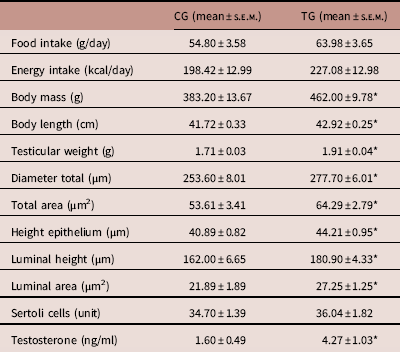
During the experiment, food intake and caloric intake were similar between groups. However, body mass and length and testicles mass were significantly higher (P<0.05) in taro group (TG).
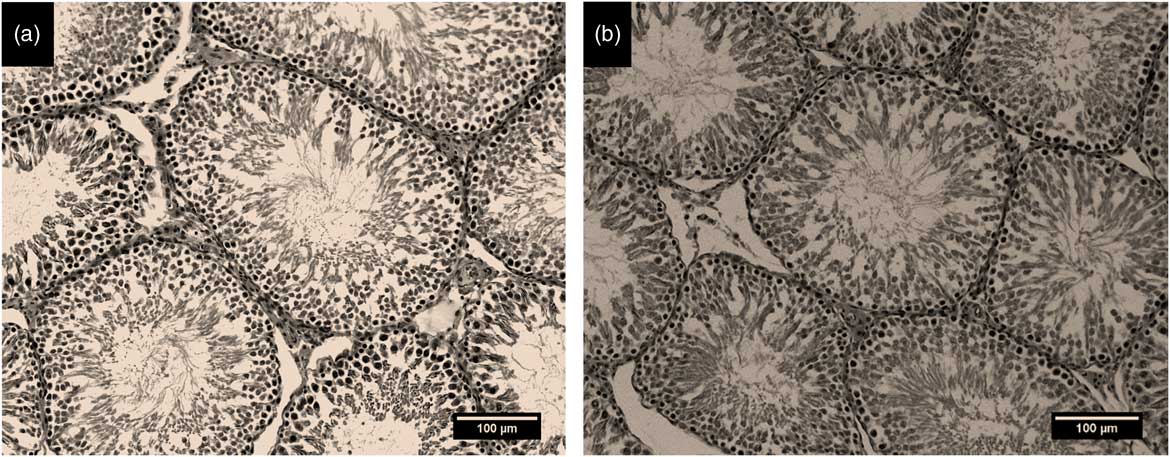
The interior of the testicles presented normal structure and well preserved. The organized germinative epithelium, with cells distributed in concentric layers from the base to the tubular lumen, and with well-defined tubular lumen (Fig. 1). Regarding at seminiferous tubules histomorphometric data, the total diameter, total area, seminiferous epithelium height, luminal height and luminal area showed a significant increase (P<0.05) in TG (Fig. 1). The amount of Sertoli cells had no statistical differences between groups (Table 1). The levels of testosterone were significantly higher (P<0.05) in TG.
Photomicrography of the seminiferous tubules of Wistar rats (original magnification 20×), hematoxylin–eosin staining. (a) Group treated with a diet containing 250 g/1000 g cocoyam flour for 90 days. (b) Group treated with control diet.

Food intake, body mass, length, histomorphometric analyses, testosterone levels and Sertoli cells

Control group (CG), fed with casein diet, Taro group (TG) diet containing 25 g/100 g taro flour for 90 days.
*The values are averages (Student’s t-tests, P<0.05).
Discussion
The taro is a food with high nutritional value and with great antioxidant capacity, to the 90 days, it was observed that the taro had influenced the development of the seminiferous tubules. At the end of the experimental period, it was seen that food and caloric intake did not present significant differences. Body mass and length of the animals were significantly higher in the group fed with taro flour. These data differ from Chan et al. (2006), who found no differences in these criteria, after administration of yam flour (Dioscorea alata) for 90 days.Reference Chan, Hsu and Wang 11 This increase in body development may be associated with elevated hormone levels, since testosterone assists muscle and bone development.Reference Gauthaman and Ganesan 7
Significant alterations in the testicular mass and seminiferous tubules morphology were observed in TG. About 85% of this organ is composed of the seminiferous tubules, testis weight is associated with sperm production.Reference Sinha-Hikin, Amador and Klemcke 14 The tubule diameter is positively associated to spermatogenic activity and is in agreement with the value found for most amniotes (they are animals whose embryos are surrounded by an amniotic membrane) varying from 180 to 300 μm,Reference Sinha-Hikin, Amador and Klemcke 14 , Reference Takashiba, Segatelli and Moraes 15 whereas the height of the seminiferous epithelium is related to the tubule functionality. These data were similar to those of Goel et al.Reference Goel, Samanta and Kannan 16 which demonstrated that an extract of a plant (Hippophae rhamnoides) rich in flavonoids, polyphenols and tannins, resulted in increase in testicular mass, even if not significant and provided a significant increase in seminiferous tubule total diameter by 104% compared with the CG. This was also the case with an alcoloidal solution in which it promoted a significant increase in testicle weight, seminiferous tubule diameter and epithelial height. It was seen that flavonoids, polyphenols, tannins and alkaloids are capable of acting on testicular parameters exposed.Reference Rafiee, Nejati and Heidari 17 , Reference Vyas and Raval 18
The number of Sertoli cells did not show statistical differences between the groups, however the TG had increase of 4%. The number of Sertoli cells correlates positively with testicular weight and with sperm production, moreover Wu et al.Reference Wu, Dong and Zhao 19 observed that cultures of Sertoli cells treated with diosgenin obtained a significant increase, this increase, although not significant may be due to the presence of saponin.
In this study, Colocasia esculenta helped increase the serum levels of testosterone and favored the seminiferous tubules morphological alteration. Possibly, this hormonal increase may be related to gonadal performance in the pituitary stimulation of follicle stimulating hormone and luteinizing hormone, which was also suggested by Jianfeng et al. (2012). This author observed that in the extract of Arctium lappa L. rich in fitoquimicos, in the concentrations of 600 mg/kg and 1200 mg/kg promoted increase of more than 220% in testosterone concentrations and stimulated the sexual behavior of animals.Reference Jianfeng, PengYing and ChengWei 6 In addition, Vyas and Raval (2016) observed that extract of a Hygrophil aspinosa plant, rich in alkaloids and saponin, in the concentration of 1000 μg/ml promoted an increase in the levels of testosterone secreted by Leydig cells (in vitro) by more than 300%.Reference Vyas and Raval 18 Monet-Kuntz et al.Reference Monet-Kuntz, Hochereau-de Reviers and Terqui 20 mentioned that elevations of testosterone levels lead to greater measures in testicular weights and seminiferous tubules dimensions, suggesting that testosterone exerts positive feedback on its own receptors acting as local action. It has already been seen that these actions may be due to the presence of polyphenols, flavonoids, alkaloids and saponins present in the taro.
Conclusion
Although the present study emphasizes that the consumption of taro flour, along with its compounds, are associated with higher testicular and hormonal parameters, later studies necessary to assess fertility in adult.
Acknowledgments
The authors are thankful for the College of Nutrition of the UFF.
Financial Support
This research received no specific grant from any funding agency, commercial or not-for-profit sectors.
Conflict of Interest
None.
Ethical Standards
The protocol used to deal with experimental animals was approved by Ethics Committee on Animal Research of UFF, Niteroi-RJ, Brazil (protocol 669/2015). All procedures are in accordance with the provisions of Brazilian Society of Science and Laboratory’s Animals and the Guide for the Care and Use of Laboratory Animals.