INTRODUCTION
Marine gastropods of the families Conidae and Conilithidae are among the most diverse in the world (Tucker & Tenorio, Reference Tucker and Tenorio2009). With the total estimated diversity of 27 genera and 214 species in the western Atlantic alone (Petuch, Reference Petuch2013), these molluscs form an important part of shallow coral reef ecosystems. Despite their diversity and importance to reef ecosystems in the western Atlantic, there is a notorious lack of studies on ecology and habitats of these families. Habitat information provided in taxonomic descriptions is often inaccurate, incomplete, or even erroneous.
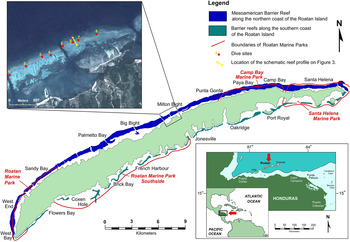
Coral reef ecosystems in the western Atlantic are currently experiencing a high rate of reef deterioration and draw attention of the international scientific community as the area of special concern (Ginsburg, Reference Ginsburg1994; Hughes, Reference Hughes1994; Aronson et al., Reference Aronson, Precht, MacIntyre and Murdoch2000, Reference Aronson, MacIntyre, Precht, Murdoch and Wapnick2002; MacIntyre et al., Reference MacIntyre, Glynn and Toscano2007). One of the largest reef habitats in the western Atlantic is the Mesoamerican Barrier Reef System (MBRS). MBRS is the second longest reef system in the world, and the largest reef system in the western hemisphere extending over 1000 km from Yucatan, Mexico, to the Bay Islands in Honduras. The present paper is the first study dedicated to the description of habitats of Conidae and Conilithidae within the MBRS off the northern-central portion of the Roatan Island, Honduras (Figure 1).
Map of the study area (photograph of the studied reef section is taken from Google Earth).

Roatan Island is the largest of the Bay Islands of Honduras located off the northern coast of Honduras in the western Caribbean. It is a volcanic island surrounded by deep waters and located 50–80 km offshore (Figure 1). The island is fringed by extensive reefs on both sides. The reefs off the northern coast of Roatan are part of the southernmost extension of the MBRS. As a measure to protect coral reefs around Roatan Island, a series of marine reserves were established starting in the late 1990s through to the mid-2000s (Figure 1). Diversity and ecology of reef Conidae and Conilithidae in this area remains largely unaccounted for. Evaluation of benthic habitats and diversity of these two reef families can assist the preservation efforts and be a landmark study for future benthic surveys within the MBRS.
MATERIALS AND METHODS
The survey of benthic habitats was carried out in August 2013 by five SCUBA divers at 8 localities, during day and night at depths from 4 to 20 m, along the 2.4 km stretch of the MBRS, off Milton Bight—Turquoise Bay area, 16o24′23.77″N 86o24′37.24″W, northern coast of Roatan Island (Figure 1). A total of 6 day and 18 night dives were conducted in the area. Reef morphology and depth observations were carried out during day dives. Because gastropods of both families are nocturnal, live animals were observed and photographed only during night dives. The typical night survey at each dive sight consisted of a zigzag pattern upward path starting on the sand flat at the base of the reef in approximately 20 m depth and following the reef slope and wall up to the top at approximately 4 m. This pattern allowed for a satisfactory vertical and spatial coverage of the reef surface within each locality. Each sighting of live species in situ was accompanied by record of depth, specimen size and notes on habitat/substrate type. Photographs of live specimens were taken when possible. Water temperature during night dives ranged from 25.5 to 27.2oC.
Abbreviations used: United States Museum of Natural History, Smithsonian Institution (USNM); Museum d'Histoire Naturelle, Geneva (MNHG); Los Angeles County Museum of Natural History (LACM); Linnaean Collection, Linnaean Society, London (LSL); Florida Atlantic University, Boca Raton, Florida (FAU).
RESULTS
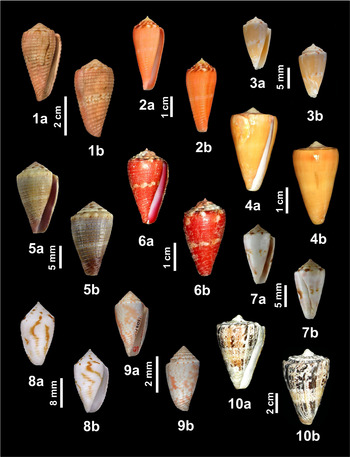
A total of 184 sightings of adult and sub-adult specimens belonging to 5 genera and 8 species of Conidae and Conilithidae (Figure 2) were made during night dives on the section of the MBRS off the northern-central part of Roatan Island. Based on the precise location of each specimen on the reef, within each dive site, and its unique shell characteristics, all sighted specimens were believed to be different individuals. In vast majority of sightings, molluscs were actively crawling on various parts of the reef. Whereas majority of observed activity was most probably related to the search of suitable prey; some other movements like emerging from and burrowing into the carbonate sand, getting in and out of reef cavities, were also recorded.
Shells of the gastropod families Conidae and Conilithidae inhabiting a coral reef off northern Roatan Island: (1a, b) Atlanticonus granulatus (Linnaeus, 1858), lectotype, LSL 261, Jamaica, 41 × 21 mm; (2a, b) USNM 1190434, Pompano Beach, Florida, smoother red variety, similar to those found off Roatan Island; (3a, b) Dauciconus kalafuti (daMotta, 1987), holotype MHNG 987/111, Roatan Island, 15 × 8 mm; (4a, b) Dauciconus daucus (Hwass in Bruguière, 1792), FAU 131031, Pompano Beach, Florida; (5a, b) Purpuriconus kulkulcan (Petuch, Reference Petuch1980), holotype USNM 784487, north side Roatan Island, 21.3 × 12.2 mm; (6a, b) fresh dead specimen from northern Roatan. A more commonly encountered red variety; (7a, b) Purpuriconus magnottei (Petuch, Reference Petuch1987), holotype USNM 859887, Roatan Island, Honduras, 14 × 7 mm; (8a, b) Jaspidiconus roatanensis Petuch & Sargent, Reference Petuch and Sargent2011, holotype LACM 3147, off Coxon's Hole, Roatan Island, 13.9 × 7.7 mm; (9a, b) Jaspidiconus mindanus (Hwass in Bruguière, 1792), holotype MHNG 1107/16, South Lake Worth, Florida, 31.5 × 17 mm; (10a, b) Stephanoconus regius (Gmelin, 1791), FAU 135672, off Pompano Beach, Florida.

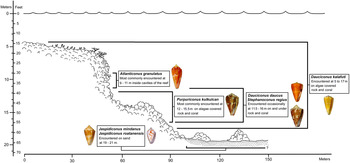
The general reef profile is shown in Figure 3. The same general reef profile was consistent for all diving localities. All surveyed areas within the region consisted of carbonate sand flat at 18 to 20 m deep, a 20 to 40o slope from 18 to 12 m, a nearly vertical wall from 12 to 6 m, and a flat to 3–4o sloping area from 6 to 4 m marking the reef platform. The main framework of the reef consists of Acropora palmata, which is typical for the western Atlantic coral reefs (MacIntyre, Reference MacIntyre1988). Live Acropora palmata is common in depths of 6 to 8 m at crest of the reef (Figure 3). Other common hard coral species include Montastrea cavernosa, Montastrea franksi, Montastrea faveolata, Siderastrea siderea, Meandrina meandrites, Diploria spp. and other species, also common in the Caribbean. Besides hard corals, the slopes and even vertical walls host a diverse and healthy population of zooxanthellate octocorals—Pseudopterogorgia spp., Plexaurella spp, Muricea spp. and Briareum spp., with Gorgonia spp. being notoriously more common on the reef crest and platform. Dead corals covered with algae and attached to the reef were considered to be a part of the reef structure and not the ‘reef rubble’. Reef rubble, often cited in many publications (Rosenberg, Reference Rosenberg2009; Petuch, Reference Petuch2013) as molluck habitat, are considered herein as loose or poorly cemented fragments of dead corals at the base of the reef and/or in the hollows of the reef platform.
Reef profile off northern Roatan with the outline of Conidae and Conilithidae habitats.

The reef framework is covered with a variety of algae. Among the most common algae were burgundy crust algae (Peyssonnelia sp.), encrusting fan-leaf alga (Lobophora vareigata), green algae Dictyota sp. and calcareous algae Halimeda copiosa. Flat sand patches at the base of the reef are typically composed of medium to coarse-grained carbonate sand with occasional coral rubble piles near the base of the reef. Portions of sand patches are covered with the bacterial and algal mats of various thicknesses.
The following Conidae and Conilithidae species habitats were observed and documented from the reef off northern Roatan; generic and higher classification of Conidae follows that of Tucker & Tenorio (Reference Tucker and Tenorio2009) and the update by Petuch & Sargent (Reference Petuch and Sargent2011).
Superfamily CONOIDEA Fleming, 1822
Family CONIDAE Fleming, 1822
Subfamily PUNCTICULIINAE Tucker & Tenorio, Reference Tucker and Tenorio2009
Genus Atlanticonus Petuch & Sargent, Reference Petuch and Sargent2011
Atlanticonus granulatus (Linnaeus, 1758)
A widely distributed western Atlantic and Caribbean species; ranges from eastern Florida to Venezuela, 26°N to 9.4°N; 92°W to 59.6°W (Rosenberg, Reference Rosenberg2009). The species is reported from a variety of habitats throughout its biogeographical range.
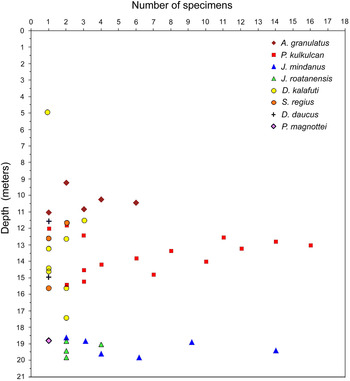
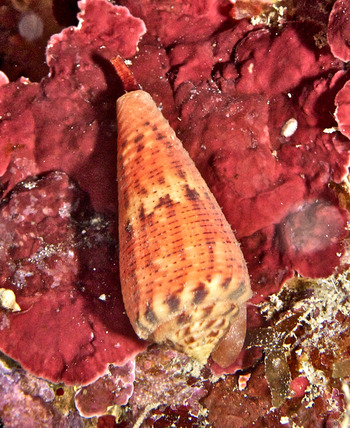
Sixteen specimens (8.7% of all sightings) of adult and sub-adult A. granulatus, ranging in size from 27 to 48 mm in length, were encountered off the northern coast of Roatan. Live specimens were encountered exclusively on the vertical portion of the reef from 9.3 to 11 m (Figure 4) with majority of specimens found between 10 and 10.5 m (Figure 3). Vertical walls consisting mostly of dead A. palmata at that depth are highly cavernous and heavily incrusted by the burgundy crust algae Peyssonnelia sp. Atlanticonus granulatus was found in deep caverns of the vertical portion of the reef, where it finds refuge during daytime, or areas immediately nearby (Figures 3 & 5).
Plot of distribution of Conidae and Conilithidae species on the reef off northern Roatan, by depth.

Atlanticonus granulatus in situ on burgundy crust algae Peysonnelia sp., vertical portion of the reef, 10.5 m deep (photograph by D. Holzinger).

Genus Dauciconus Cotton, 1945
Dauciconus daucus (Hwass in Bruguière, 1792)
Dauciconus daucus is a widely distributed western Atlantic species ranging from Central Florida to Venezuela and Colombia, 35°N to 20°S; 83.3°W to 32.5°W. The type locality is off Guadeloupe (Rosenberg, Reference Rosenberg2009). The species is known from variety of habitats within its range. Only 2 live specimens (1% of total sightings) of sub-adult D. daucus ranging from 17 to 24 mm in length were observed within the study area, which precludes making any reliable conclusions on their preferred habitat off the northern side of Roatan Island. The species were found within the depth range of 11.3 to 15 m on and under algae-covered rocks (dead A. palmata fragments), within the sloped portion of the reef (Figures 3 & 4)
Dauciconus kalafuti (da Motta, Reference Da Motta1987)
The type locality of D. kalafuti (da Motta, Reference Da Motta1987) is Roatan Island, but it has also been recorded in the past few years from southern Belize, Nicaragua and Honduras (Petuch, Reference Petuch2013). Fourteen specimens of adult and sub-adult D. kalafuti (7.6% of all sightings), ranging in size from 8 to 13.5 mm in length, were documented from the study area. The original description states that the species occur in 30–40 ft (9–12 m) (da Motta, Reference Da Motta1987). Species off northern Roatan were recorded at depths from 4 to 17.5 m with fairly even spread throughout the depth-range (Figure 4). Dauciconus kalafuti was most frequently encountered on rocks and dead corals covered with various red and green algae. This is the only species whose habitat ranges throughout the entire reef from the top platform to the base. Two live specimens were sighted on the reef rubble piles at 17.5 m. It is only absent from sand patches and sand flats at the base of the reef (Figure 2).
Genus Purpuriconus DaMotta, 1991
Purpuriconus kulkulcan (Petuch, Reference Petuch1980)
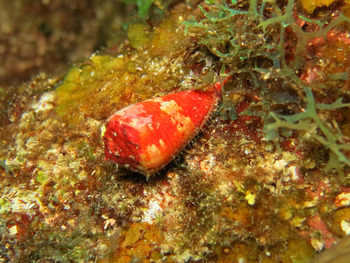
The species is apparently endemic to Roatan Island (Petuch, Reference Petuch1980, Reference Petuch2013), although its relationship to a more widely occurring P. cardinalis (Hwass in Bruguière, 1792) needs further investigation. Although the shell of the holotype of P. kulkulcan is brown in colour (Figures 2, 5a-b), the majority of specimens observed off northern Roatan had red shells (Figure 2, 6a-b). Animal colour was red in both cases. Sightings of brown and greenish-coloured individuals were notoriously less common than those of red ones. Out of 102 observed specimens (55.4% of all sightings) of juvenile, adult and sub-adult P. kulkulcan, ranging in length from 12.8 to 34.7 mm, only 14 (13.7% of all P. kulkulcan sightings) had brown and greenish-brown shells. The type locality of P. kulkulcan is given as ‘2 m depth on North side of Roatan Island’ (Petuch, Reference Petuch1980). Later, Petuch (Reference Petuch2013) suggested that the species is found ‘deeply within coral rubble’. All P. kulkulcan were observed from 11.9 to 15.5 m on top of algae-covered rocks and coral (Figure 7), within the sloped portion of the reef (Figure 3), with most sightings made from 12.5 to 14 m deep (Figure 4). Majority of P. kulkulcan specimens were observed crawling among the encrusting leaf alga Lobophora vareigata, calcareous algae Halimeda copiosa, or green algae Dictyota sp. (Figure 7). Specimens of P. kulkulcan must be hiding under rocks during the daytime when no live specimens were observed on the reef.
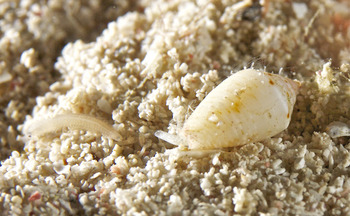
Jaspidiconus mindanus in situ hunting a polychaete worm, probably of the family Amphinomidae, on sand flat, 19 m deep (photograph by D. Holzinger).

Purpuriconus kulkulcan in situ on the algae-covered slope (photograph by A. Oleinik).

Purpuriconus magnottei (Petuch, Reference Petuch1987)
Designated as endemic to Roatan Island (Petuch, Reference Petuch1987, Reference Petuch2013); the habitat cited in the original description is ‘2 m depth, under rocks, North Coast of Roatan Island’ (Petuch, Reference Petuch1987). Although only one adult specimen (0.5% of all sightings), 14.7 mm in length was encountered, which cannot be a reliable indicator of the overall species habitat, the occurrence is worth mentioning for future references. The single specimen was found on algae-covered coral rubble at 18.8 m at the base of the reef (Figure 4).
Genus Stephanoconus Mörch, 1852
Stephanoconus regius (Gmelin, 1791)
Widely distributed western Atlantic species with the range from Palm Beach, Florida to Brazil (Abbott, Reference Abbott1974; Rosenberg, Reference Rosenberg2009; Petuch, Reference Petuch2013); three sub-adult specimens (1.6% of all sightings), ranging in length from 28.7 to 41.2 mm of S. regius were observed within the depth-range of 11.2 to 15.7 m (Figure 3). All specimens were encountered on or under the algae-covered rock and coral (Figure 4). Scarcity of occurrence of this otherwise common western Atlantic species within the surveyed portion of the MBRS precludes any reliable conclusions about its preferred habitat within the area, other than it is definitely present on the reefs off northern Roatan.
Family CONILITHIDAE Tucker & Tenorio, Reference Tucker and Tenorio2009
Subfamily CONILITHINAE Tucker & Tenorio, Reference Tucker and Tenorio2009
Genus Jaspidiconus Petuch, 2003
Jaspidiconus mindanus (Hwass in Bruguière, 1792)
Widely distributed western Atlantic and Caribbean species; recorded from Bermuda to Brazil (Rosenberg, Reference Rosenberg2009; Petuch, Reference Petuch2013). Majority of occurrences of J. mindanus throughout its range are on sand, sandy gravel, or broken coral. Thirty-eight (20.6% of all sightings) adult, sub-adult and juvenile specimens of J. mindanus, ranging in length from 9 to 28.4 mm, were observed within the area. The species is very common and found exclusively on sand patches at depths of 18.5 to 20 m at the base of the reef (Figures 3 & 4). No preferences between clean sand and sand covered with bacterial/algal films were detected. None were found on or inside rubble piles at the base of the reef. Jaspidiconus mindanus was the only species photographed while hunting. Figure 6 shows a specimen approaching the polychaete worm of the family Amphinomidae.
Jaspidiconus roatanensis Petuch & Sargent, Reference Petuch and Sargent2011
This endemic species is confined in its present known distribution to Roatan Island (Petuch & Sargent, Reference Petuch and Sargent2011; Petuch, Reference Petuch2013). The type locality is indicated as ‘On sand bottom, 10 m depth, off Coxon's Hole, Roatan Island’ (Petuch & Sargent, Reference Petuch and Sargent2011). We encountered 8 specimens of J. roatanensis (4.3% of all sightings) varying in length from 11.3 to 15.9 mm. All specimens observed were on same sandy patches and within the same depth-range (18.5 to 20 m) as J. mindanus (Figures 3 & 4).
DISCUSSION
The studied portion of the MBRS along the northern coast of Roatan Island is located within the Nicaraguan Subprovince of the Caribbean Molluscan Province (Petuch, Reference Petuch2013). The ratio of widespread Caribbean–western Atlantic species—A. granulatus, J. mindanus, D. daucus and S. regius to the endemic species—P. kulkulcan, D. kalafuti, P. magnottei and J. roatanensis is 50 to 50%. High percentage of endemic species confirms the biogeographical status of the Nicaraguan subprovince and may be even suggestive of a separate biogeographical status for the Honduras Bay Islands. Additional data on occurrences of other mollusc families are needed for a more definitive answer about the exact biogeographical status of Roatan Island. A section of the MBRS off northern Roatan provides habitats for 6 species of Conidae and 2 species of Conilithidae. The two most common species within the surveyed portion of the reef are P. kulkulcan and J. mindanus, accounting together for 76% of all sightings, with P. kulkulcan being the most commonly encountered species (55.4% of all sightings). Two species of the genus Jaspidiconus (J. mindanus and J. roatanensis) share the same habitat. Both species of Jaspidiconus are confined to the sand flats at the base of the reef (Figures 3 & 4). Similar habitats for the genus Jaspidiconus were observed by the author of this paper in the Bahamas, Florida and Lesser Antilles. It suggests that the genus Jaspidiconus is a sand dwelling cone throughout the western Atlantic. The observations of this study show that Jaspidiconus, A. granulatus and P. kulkulcan, have very distinct, non-overlapping depth ranges and habitats within the studied portion of the reef. Whereas species of Jaspidiconus are confined exclusively to sand flats, A. granulatus occupies cavernous algae-covered vertical walls from 9 to 11 m deep, and P. kulkulcan is found on the slope portion of the reef from 12 to 16 m (Figures 3 & 4). Genus Purpuriconus was also recorded from the reefs in the Bahamas but within different local profiles and from different depths. Based on our observations, the statement about habitats of A. granulatus made by Petuch (Reference Petuch2013, p. 106), as occurring ‘deeply within coral rubble......together with Purpuriconus kulkulcan’ appears to be incorrect. Atlanticonus granulatus was repeatedly reported from rubble piles at 18 to 25 m deep off south-eastern Florida, which is a drastically different habitat from the one off Roatan Island. It also appears that the type locality and habitat of P. kulkulcan, cited by Petuch (Reference Petuch1980, p.117), as ‘2 m depth’ is in error. Fourteen sightings of D. kalafuti indicate that the species is not significantly restricted by depth and, apart from the vertical walls and sand patches, present in all other areas of the reef. The recorded occurrences of D. daucus, S. regius and P. magnottei are not sufficient enough to make reliable conclusions about their habitats in the area. The most densely populated habitat within the reef is the slope area from 11.5 to 16 m deep. That is where the majority of different species were observed. The most restricted habitat is the vertical portion of the reef from 6 to 11 m with A. granulatus being the only species found there (Figures 3 & 4). The distinct reef partitioning by A. granulatus, P. kulkulcan and two species of the genus Jaspidiconus is potentially related to their preferred prey distribution. Given the fact that most of conoidean gastropods are vermivorous (Kantor & Taylor, Reference Kantor and Taylor2000), it is possible that all species of Conidae and Conilithidae observed on the reef off northern Roatan are highly specialized hunters, with each of them targeting a particular species of polychaete worm as a prey. A study of gut contents, details of radular morphologies, and distribution and diversity of polychaete worms on the reef would be helpful in testing the hypothesis.
ACKNOWLEDGEMENTS
I thank Randy Allamand of Sebring, David Holzinger and Linda Zylman of Palm City, and Caitlin Hanley of Boca Raton, Florida for assistance with underwater observations. Special thanks to David Holzinger for photographing live specimens under water. I also thank the staff of Subway Watersports, Roatan Island, for their assistance with diving operations off the northern coast of Roatan. Special thanks to John Tucker and Edward Petuch for very helpful reviews and comments.