

Introduction
Democracy promotion is about interaction, and this interaction is at least partially about justice. These are the two major claims the present paper makes. In general terms, no one would deny that the international promotion of democracy involves interaction between those promoting democracy from the outside (the ‘donors’) and those at the receiving end (the ‘recipients’). Yet, instead of conceiving of interaction in democracy promotion as being limited to the implementation of a given ‘formula’ (i.e., democracy), we argue that interaction has a crucial normative dimension to it: it involves contestation of the appropriate conception of the set of political norms that is to be implemented in a given country and promoted from the outside. But why should external actors have a legitimate say in the shaping of an appropriate normative order for a given society? Here, the concept of justice enters the equation (Pangle Reference Pangle2009). In normative terms, the international practice of democracy promotion is based on the notion that there is a universal value of and, in fact, commitment to democracy (Sen Reference Sen1999; Schraeder Reference Schraeder2003: 25–6). Bringing democracy to people living under non- or not sufficiently democratic conditions aims, thus, at correcting ‘a perceived discrepancy between entitlements and benefits’ (Welch Reference Welch1993: 19) – it is a question of justice.Footnote 1 Yet, as soon as interaction in democracy promotion involves contestation of the proper set of political norms, it is no longer clear which specific entitlements are to be met by means of which precise rules and institutions. Even more basically, the very intent by external actors to help construct a just political order implies meddling in the internal affairs of other states. Democracy promotion can therefore, itself, be viewed as violating the (collective) entitlement to sovereignty and self-determination (cf Hurrell Reference Hurrell2007: 163; Ikenberry Reference Ikenberry2011: 287–90; Sørensen Reference Sørensen2011: 42; Tully Reference Tully2005; Whitehead Reference Whitehead2010). In this sense, external democracy promotion is both based on and challenged by claims to perceived entitlements. In this paper, we propose analysing such collisions of competing claims to entitlements as justice conflicts.
It is broadly acknowledged that the 1990s boom in both the practice of and the discourse on democracy promotion has given way to a period of increasing challenges or outright backlash.Footnote 2 In this context, a normative debate about the universal applicability and appropriateness of ‘western-derived analytical frameworks and models of democracy’ (Burnell Reference Burnell, Burnell and Youngs2010: 5; cf Hobson and Kurki Reference Hobson and Kurki2012; T. Smith Reference Smith2007) has resurfaced as has ‘attention to the question of norms concerning democracy assistance’ (Carothers Reference Carothers, Burnell and Youngs2010: 67).Footnote 3 Carothers specifically emphasizes legal norms – concerning, for instance, the contested right of democracy aid providers ‘to carry out their work in other countries’ (Carothers Reference Carothers, Burnell and Youngs2010: 67). Indeed, the tension between the alleged universality of democracy and the perceived illegitimacy of external interferences in internal affairs refers to competing rights in a narrow, legal sense (individual human rights vs collective state rights). Yet, what is at stake here are not ‘only’ laws. Emphasizing the universal commitment to democracy or defending collective self-determination implies referring to more basic, morally based claims that are not dependent on a specific legal order. This type of claims is precisely what David Welch has conceptualized as justice claims, that is, claims to perceived entitlements (Welch Reference Welch1993). The focus on ‘justice’ – on claims to entitlements (justice claims) and on conflicts shaped by contested perceived entitlements (justice conflicts) – therefore provides an analytical perspective on the above-mentioned normative debate that specifies the kind of contested normative claims without overly restricting the analysis to a narrow look at legal issues only. To put it differently: entitlements, not laws or norms, constitute the lowest common denominator in the normative debate on democracy promotion.
In this sense, it appears promising to look systematically at justice conflicts in democracy promotion.Footnote 4 Analytically, we distinguish between three areas of contestation constituting three types of justice conflicts in democracy promotion: when external and domestic actors argue over each other’s particular conceptions of a ‘just political order’ (contestation of the just model of political order); when they dispute the very legitimacy of international efforts at promoting democracy (contestation of the extent and means of just external interference); and when they disagree about whom to recognize as justice claimants, that is, as participants in the negotiation about political change and democracy promotion (contestation of recognition). The research programme conceptually outlined in this paper would enable scholars to analyse how democracy promoters deal with such normative contestation and how conflicts over justice are negotiated between donors and recipients. This promises important insights into the normative premises and the political mechanisms behind the formulation and implementation of democracy promotion policies.
The present paper starts with defining core concepts. Then, we discuss mainstream views on democracy promotion. Arguing that the bulk of existing research, even when apparently looking at interaction, treats the ‘formula’ that is to be promoted (i.e. democracy) as a non-negotiable given, we make a case for a perspective that takes democracy promotion as interaction seriously. The third section looks at debates in normative theory where democracy promotion has been explicitly dealt with as a justice-related issue. This section reveals the underlying normative tensions inherent in the overall endeavour to externally promote democratic self-determination. Fourth, the paper integrates these discussions in a typology of justice conflicts, which conceptually grasps the inherent normative challenges that confront democracy promotion as interaction. It concludes by highlighting the political significance of the proposed research agenda: how democracy promoters deal with justice conflicts, and whether donors and recipients are able to peacefully negotiate contentious justice claims is relevant for the effectiveness, legitimacy and conflict-proneness of democracy promotion as well as for the future of world order at large.
Core concepts: Democracy promotion, justice claims and justice conflicts
In this paper, democracy promotion is broadly understood as comprising all activities by external actors ‘aimed at establishing, strengthening, or defending democracy in a given country’ (Azpuru et al. 2008: 151). Such activities range from development aid (democracy assistance) and diplomatic appeals (democracy diplomacy) to material incentives and sanctions (democratic conditionality) as well as military intervention (coercive democratization). Democracy, as the aim that guides such activities, is not defined a priori. Given our focus on normative contestation of democracy promotion, it is an empirical question what different actors (‘donors’ and ‘recipients’) understand by democracy – and, more broadly, a just political order.
The analytical focus on justice claims and justice conflicts follows the pioneering work on the role of justice in international politics by David Welch (Reference Welch1993).Footnote 5 Drawing on the psychological perspective put forward by Melvin Lerner, Welch defines the justice motive as ‘the drive to correct a perceived discrepancy between entitlements and benefits’ (Welch Reference Welch1993: 19; emphasis in the original). Justice claims, thus, are not characterized by a specific content, but only by the specific ‘formal structure of a justice speech act’: the claimant puts forward a demand for something she/he maintains belongs to her/him (Müller Reference Müller2010: 9). The definition of justice (claims) is, in this sense, deliberately ‘formal and subjective’ (Welch Reference Welch1993: 42). In order to qualify as an issue of justice, what matters is not a particular content as defined by a substantial or procedural notion of justice, but merely the question of whether actors perceive and present something they demand (for themselves or others) as something they are entitled to (Welch Reference Welch1993: 19):
Justice reigns if actors have got what rightfully belongs to them; of course, what this might be is highly controversial within and across cultures. But this does not matter: As long as a speech act in politics has the structure of a claim for an entitlement, it satisfies the formal structure of a justice claim, independently of how it is substantiated. (Müller Reference Müller2010: 9)Footnote 6
In the case of democracy promotion, we are faced with an ‘other-referential’ perception of injustice – ‘an injustice suffered by someone else’ (Welch Reference Welch1993: 42; emphasis in the original) – which an external actor then is trying to help correct. On the recipient side, however, such external attempts to bring justice may be regarded as violating an entitlement to collective self-determination or sovereignty, giving rise to a (self-referential) perception of injustice. The result is an example for what we call a justice conflict in democracy promotion: Competing claims to perceived entitlements collide (cf Daase and Humrich Reference Daase and Humrich2011: 8–9).
As we argue in this paper, the formal definition of justice allows for an analytical perspective that facilitates taking an empirical look at the normative problematique of democracy promotion contestation. In contrast to the debate in (international) political theory discussed below (section ‘Just and unjust democracy promotion’), this perspective does not aim at solving the inherent normative tensions in democracy promotion that become manifest in justice conflicts. Instead, the prospective aim is to analyse how contentious justice claims are processed by democracy promoters and negotiated between democracy promoters and recipients.
But why focus on competing claims to entitlements and justice conflicts – instead of on references to (contested) rights or norms? As already explained in the introduction, legal rights are only one, if important, subset of entitlements that are contested in the field of democracy promotion. Furthermore, whether and to what extent an entitlement is codified by a legal framework is itself part and parcel of norm contestation in international relations (cf Abbott et al. Reference Abbott, Keohane, Moravcsik, Slaughter and Snidal2000; Brunnée and Toope Reference Brunnée and Toope2011).Footnote 7 As Welch (1993: 197) explains, to speak about an entitlement ‘presupposes the existence of an institutional substructure to give it meaning and moral authority’; but such an institutional context does not only consist of legal norms in a narrow sense. At the same time, any claim to an entitlement, by implying a collective expectation about appropriate behaviour in a given institutional context, constitutes a normative claim.Footnote 8 Not every claim that refers to norms, however, is also a justice claim. Justice claims relate to norms in two specific regards. On the one hand, they refer to what Antje Wiener (2008: 66–7) has called ‘fundamental norms’: norms with high degrees of generalization, moral and ethical scope.Footnote 9 On the other, they refer to norms that have a specific function: ‘to apportion rights, benefits, and obligations in a given area or on a given issue’ (Welch Reference Welch1993: 198). The analytical focus on justice conflicts in democracy promotion, therefore, allows us to zoom in on contestation of fundamental norms that establish entitlements.
Having said this, the analytical perspective adopted in this paper is generally informed by the constructivist research tradition in International Relations (IR). While taking norms, ideas and language seriously, the proposed research programme on justice conflicts in democracy promotion is, however, not theoretically embedded in any one of the diverse constructivist or post-positivist approaches (cf Adler Reference Adler, Carlsnaes, Risse and Simmons2002). Our focus on justice claims obviously draws on speech-act theory and is based on the assumption that speech acts are ‘important mechanisms that generate social reality’ (Pouliot Reference Pouliot2004: 327), and our proposal to analyse the negotiation of justice conflicts in democracy promotion is clearly related to broader IR research on norm contestation (cf Acharya Reference Acharya2004; Wiener Reference Wiener2008; Zimmermann Reference Zimmermann2012). But this does neither imply that speech acts are all that constitutes and maintains social facts, nor does it suggest that ideational factors have ontological or causal primacy over material ones (cf Sil and Katzenstein Reference Sil and Katzenstein2010).
From the state-of-the-art to a new perspective: The normative challenge of interaction
There is broad consensus that democracy is not just a ‘good’ that can be exported from one country to another (Bermeo Reference Bermeo, Barany and Moser2009: 242; Fukuyama and McFaul Reference Fukuyama and McFaul2007: 5). Democracy is a deeply contested concept, and there exists a variety of very different models of democracy, both in theory and in the real world (cf Held Reference Held1995: Chapter 1; Hurrell Reference Hurrell2007: 157–8; Kurki Reference Kurki2010). At the same time, most practitioners and scholars of democracy promotion agree that external actors can, at best, support the emergence, stabilization and improvement of a democratic regime that has to grow from within, has to be endorsed by both domestic elites and the general population, and, therefore, has to correspond to local norms and values. For example, Larry Diamond (2008: 316), one of the leading scholars in the field, emphasizes ‘the need for local ownership’ as the ‘first and foremost’ key principle for democracy assistance:
Assistance efforts must be grounded in the interests and needs of societal stakeholders, most of all the general public. For democracy assistance to be legitimate, effective, and sustainable, it must respond to local priorities and initiatives rather than impose preconceived formulas from the outside.’ (Diamond Reference Diamond2008: 316)Footnote 10
Even former US President George W Bush paid lip-service to this consensus view:
Freedom, by its nature, must be chosen, and defended by citizens, and sustained by the rule of law and the protection of minorities. And when the soul of a nation finally speaks, the institutions that arise may reflect customs and traditions very different from our own. America will not impose our own style of government on the unwilling. Our goal instead is to help others find their own voice, attain their own freedom, and make their own way. (Bush Reference Bush2005)Footnote 11
This acknowledgment, however, has crucial implications for democracy promotion – implications both scholars and politicians have yet to seriously engage with (see Kurki Reference Kurki2010). If every society has to develop its own set of norms, institutions and styles of democratic government, then countries that are trying to introduce or improve democracy have to actively construct something new out of the broad and heterogeneous set of norms that is generally associated with democracy. Such ‘appropriation’ or ‘localization’ involves adapting ideas, norms and institutions to ‘local beliefs and practices’ (Acharya Reference Acharya2004: 245; Zimmermann Reference Zimmermann2012).Footnote 12 As a consequence, democracy promoters cannot simply stick to their particular concept of democracy but have to reconsider what is to be promoted in a given situation: If a variety of models of democracy exists, and if the shape and content of democracy is processed by local actors based on local beliefs and practices, then it is not enough to design context-sensitive democracy promotion strategies and programmes, but the normative premises and conceptual underpinnings of democracy promotion themselves have to be adapted in the light of local conditions. Of course, the processes of adaption (on the part of the donor) and appropriation (on the part of the recipient) have to be closely related. While local appropriation of norms can happen without any active external interference, adapting democracy promotion to local conditions can only result from interaction.
There is no need to emphasize that external democracy promotion, by definition, involves some kind of interaction between donor and recipient. Yet, interaction as it is meant here is different from the kind of interaction that is usually acknowledged in the literature on and the practice of democracy promotion. The latter corresponds to a very asymmetric understanding of interaction, resembling social engineering, in that an external actor helps implementing a given set of norms in the recipient country by applying a series of strategies (ranging from persuasion, material support and incentives to sanctions, threats, and military force). As is well known from its application in general development aid, the ownership concept then is transformed from denoting substantial control by the recipients to implying local commitment to an externally predetermined reform agenda (Whitfield Reference Whitfield2009). Taking ownership seriously leads to an alternative perspective on interaction in democracy promotion. If democracy is ‘also about contestation and co-operative argumentation over the meaning and substance of democratic self-governance’ and if ‘consistent democracy promotion must itself comply with the principle of free, mutual agreement’ (Patomäki Reference Patomäki2012: 87),Footnote 13 then democracy promoters cannot but accept the need to put their own normative premises up for discussion with those that are at the receiving end (cf Kurki Reference Kurki2010: 376–9; Teivainen Reference Teivainen2009). In this sense, interaction requires meaningful agency on both sides and, therefore, substantial negotiation about the set of norms that is to be promoted.Footnote 14 This alternative perspective on democracy promotion as interaction, thus, differs from mainstream scholarship with regard to one important assumption: the ‘formula’ that is to be promoted cannot be taken for granted. Normatively, it is, for any recipient country, an open question which democratic norms in which shape and combination are appropriate. Empirically, the central question is which model of democracy is promoted in a given case and to what extent this model relates to, and is shaped by, political beliefs and practices in the recipient country.Footnote 15
In the 1990s, the conceptual contestability of democracy (Kurki Reference Kurki2010) was largely seen as of theoretical relevance at best. The end of the Cold War and the ‘third wave of democratization’ (Huntington Reference Huntington1991) did not only create new opportunities and demands for democracy promotion, but, in the 1990s, ‘democracy enjoyed an unrivalled position as an ideology for humankind’ (Burnell Reference Burnell2000b: 39). The related notions of a universal value of democracy (Sen Reference Sen1999), an international right to democracy (Franck Reference Franck1992; cf Fox and Roth, Reference Fox2000) and an international norm of democracy promotion (McFaul Reference McFaul2004; Schraeder Reference Schraeder2003: 40) became increasingly popular (cf Hurrell Reference Hurrell2007: Chapter 6). In the North-Western discourse, democracy was more and more seen as a global entitlement that binds all nation states in both moral and legal terms (cf Fox Reference Fox2000; Franck Reference Franck1992; McFaul Reference McFaul2004). Consequently, state sovereignty and the right to non-interference were seen as conditioned by ‘a growing array of standards pertaining first and foremost to human rights, but more recently also to democracy’ (Brock Reference Brock, Brzoska and Krohn2009: 224; cf McFaul Reference McFaul2004: 83–5; Reisman Reference Reisman2000). In this context, democracy promotion as an international practice became regarded as not only both legitimate and legal,Footnote 16 but even as an international norm that shifts ‘the normative burden … to those not interested in advocating democracy promotion’ (McFaul Reference McFaul2004: 158). The normative challenge to democracy promotion outlined above could, thus, be largely ignored at the time, given the allegedly corroborated normative premise that liberal democracy constitutes the universally valid model of a just political order.Footnote 17
This premise has also shaped the mainstream scholarship on democracy promotion. Most empirical studies that are interested in analysing the strategies, logics of influence and consequences of democracy promotion accept that such policies are based on a certain model of liberal democracy and do not regard the question of conceptual adaption or contextualization as a relevant issue. This is obviously the case for quantitative studies on the impact of democracy promotion (cf Finkel et al. Reference Finkel, Pérez-Liñán and Seligson2007; Scott and Steele Reference Scott and Steele2011), but the qualitative literature that draws on the concept of international socialization (cf Cowles et al. Reference Cowles, Caporaso and Risse2001; Schimmelfennig et al. Reference Schimmelfennig, Engert and Knobel2006) likewise accepts the given set of (democratic) norms as the benchmark against which success and failure of norm takeover is to be measured. The same holds true for most qualitative studies that explicitly deal with democracy promotion (Kurki Reference Kurki2010: 365–70). An edited volume on Democracy Assistance (Burnell (ed) 2000), for instance, starts out from the twofold assumption that, empirically, ‘the notions of democracy that lie at the centre of much democracy assistance, while not all being identical, occupy a limited range’ whereas, normatively, ‘to promote something other than elements of the standard western experience would be reprehensible if it meant exporting untried models of democracy that are judged too risky to entertain at home’ (Burnell Reference Burnell2000a: 4). A recent volume that compares US and European democracy promotion policies (Magen et al. Reference Magen, Risse and McFaul2009), in the introductory chapter, notes the ‘triumph of democracy as an ideal and system of government’; observes a common ‘normative commitment to democracy and the objective of its promotion outside’ by the US and Europe; and then focuses on the analysis of the differences and commonalities in terms of strategies of promoting democracy (Magen and McFaul 2009: 5, 11). Another comparative study (Schraeder (ed) 2002) does look at differences in ‘the nature of the democracy promotion policies’ in terms of more specific targets or dimensions (Schraeder Reference Schraeder2002: 228). Yet, this volume focuses on general differences between donors (namely the US, Germany, Japan and the Nordic countries) and not on processes of adaption to local conditions; consequently, the variance is explained by divergent foreign policy interests with the recipients playing no role at all (Schraeder Reference Schraeder2002: 228–30).
More policy-oriented authors equally avoid the question of whether it could be useful to consider contestation of democracy as a relevant subject for either scholars or practitioners.Footnote 18 Even scholars who look critically at one-size-fits-all approaches to democracy promotion (cf Carothers Reference Carothers2007; Grävingholt et al. Reference Grävingholt, Leininger and Schlumberger2009; Hill 2010) understand context-sensitivity or case-specificity largely in terms of a strategic adaptation to local capacities and framework conditions, not in terms of contested norms. If ideological challenges to liberal democracy are discussed, the focus is mostly on non-democratic alternatives and not on (perhaps non-liberal) challenges within democracy (cf Burnell Reference Burnell, Burnell and Youngs2010: 9–10; McFaul Reference McFaul2010: 37–41; NED 2006: 8–9; Ottaway Reference Ottaway2010). Likewise, among practitioners, the recent ‘backlash’ against democracy has not led to ‘any substantial reconsideration or reformulation of their work’ (Carothers Reference Carothers, Burnell and Youngs2010: 66).Footnote 19 As Milja Kurki (2010: 363) concludes with a view to both scholarship and practice, ‘a broad consensus continues to exist on the belief that democracy promotion entails liberal democracy promotion, that is, the promotion of certain key liberal democratic procedures’ (emphasis in the original; cf Ayers Reference Ayers2009: 7–10; Burnell Reference Burnell, Burnell and Youngs2010: 2; Carothers Reference Carothers1999: 85–8).
These liberal assumptions have always been contested,Footnote 20 but events and trends since the turn of the century have led to a revival of critical analyses of the normative premises und conceptual underpinnings of ‘North-Western’ democracy promotion.Footnote 21 The evolving new context is characterized by the legacy of the George W Bush administration and, in particular, the 2003 invasion of Iraq; by ambivalent and non-linear trends in the evolution of national political orders that have led to an increasingly plural picture of diverse types of (semi-)authoritarian and hybrid as well as a range of most differently democratic regimes; a changing international correlation of power characterized by the rise (and rising assertiveness) of non- or semi-democratic states like China, Russia or Venezuela; and, associated with the three former features, increasing resistance by recipient governments to external support for democratic reforms and civil-society groups.Footnote 22 These trends are captured by catchwords like the ‘backlash against democracy promotion’ (Carothers Reference Carothers, Burnell and Youngs2010) and the ‘democratic recession’ (Diamond Reference Diamond2008: 56–87), ‘autocracy promotion’ (Burnell Reference Burnell2011a: Chapter 11) and ‘authoritarian capitalism’ (Bermeo Reference Bermeo, Barany and Moser2009: 251), the ‘changing global distribution of power’ (cf Young et al., Reference Young, Druckett and Graham2010) and the ‘normative divide in international society’ (Bundegaard Reference Bundegaard2010).Footnote 23
All these supposed trends are, of course, debatable. Still, there is ample evidence suggesting that democracy promotion is confronted with normative contestation that cannot simply be dismissed as a neglectable expression of the narrow interests of some outdated dictators:
The mood now is that democracy promoters must expect to have to argue their case and tread carefully – a moral that is somewhat at odds with the hubris of the 1990s … . (Burnell Reference Burnell2011b: 7)
It seems highly unlikely that any single ideology or world view will provide an overarching framework or meta-narrative for values and ethics in the twenty-first century. … To the extent that such convergence around a single world view does emerge, it will only be viable in so far as it comes from persuasion and un-coerced acceptance rather than imposition and imperialism – both for moral reasons, but also because imperial or hegemonic ordering, including liberal imperialism, is unlikely to prove stable, effective, or legitimate. (Hurrell Reference Hurrell2007: 314–15; cf Sørensen Reference Sørensen2011)
At the moment, therefore, the optimism has largely vanished and the critics of democracy promotion have gained strength both in the political and the academic arena. This directly concerns the normative assumption of democracy’s universality. Whether in China or Russia, the Middle East or South America, the claim to self-determined political development that may involve not only a different path and pace of democratization but also an alternative end point (i.e., a different conception of democracy) is pitted against the alleged universal entitlement to liberal democracy as conceived of in the global ‘North-West’.Footnote 24 ‘Competing ideologies’ of various kinds are, again, treated as a significant challenge for the endeavour to globally spread democracy as understood in the global North-West (Burnell Reference Burnell, Burnell and Youngs2010: 9–10). Even if it is contested to what extent a ‘full-fledged’ ideological challenge to liberal democracy exists (cf Ottaway Reference Ottaway2010), there is not much doubt that the ideological uncontestedness – or taken-for-grantedness – of liberal democracy is gone. Hence scholars have noted the (re-)increasing questioning of ‘western-derived analytical frameworks and models of democracy’ (Burnell Reference Burnell, Burnell and Youngs2010: 5) and the rising ‘attention to the question of norms concerning democracy assistance’ (Carothers Reference Carothers, Burnell and Youngs2010: 67; cf Mahbubani Reference Mahbubani2009).
We draw on this incipient debate about the normative premises and conceptual underpinnings of democracy promotion, but intend to take it one step further: from highlighting and criticizing problematic assumptions to offering an approach for assessing, empirically, the role and the fate of these normative assumptions in the interaction between donors and recipients. In order to analytically approach this normative dimension of interaction, we propose a focus on justice conflicts as the underlying problematique democracy promoters are confronted with.
Just and unjust democracy promotion: The debate in normative theory
The academic literature that explicitly deals with democracy promotion rarely refers to justice as a relevant concept.Footnote 25 Yet, at the very basic level, the liberal perspective on international relations that is at the heart of the democracy promotion enterprise is based on the distinction between ‘[d]omestically just republics, which rest on consent’ (i.e., liberal democracies), and ‘nonliberal states’, which ‘do not rest on free consent’ and are, therefore, ‘not just’ (Doyle Reference Doyle1986: 1161). Democracy promotion, in this sense, is embedded in what Hurrell (2007: 296) calls the ‘particular justice agenda of liberal solidarism’. Accordingly, it is not by chance that important normative debates crucial for democracy promotion do regularly address questions of justice. The philosophical debate about the universality of democracy and human rights is, to an important extent, a debate about the principles of global justice. Consequently, in contributions that deal with the legitimacy and legality of coerced democratization by military means (and the broader debate about the military enforcement of human rights), references to theories of justice and, in particular, the concept of ‘just war’ abound.Footnote 26
It is in international political theory and philosophy that questions of democracy promotion have been dealt with as explicitly justice-related issues:Footnote 27 Are states entitled – or perhaps even obligated – to promote democracy in other states? To what extent, and under which conditions, can democracy promotion be regarded a just or unjust intervention? While focusing mainly on the question if and when military interventions can be regarded as just, this debate nevertheless offers important insights into the justice conflicts that confront also the kinds of democracy promotion that are limited to non-coercive means. The overall issue at stake in this debate is, indeed, ‘a conflict between competing demands of justice’: The aim to intervene into the internal affairs of a given country in order to correct intolerable injustice clashes with the problem that any intervention – ‘whether military or nonmilitary’ – ‘violates the right to self-determination of the citizens of the state that is the target of the intervention’ (McMahan Reference McMahan1996: 2). Or, as Michael Doyle (2009: 350) puts it, ‘the cosmopolitan, humanitarian commitment to assistance’ collides with the ‘respect for the significance of communitarian, national self-determination’. Dispute about precise criteria notwithstanding, most scholars agree that this justice conflict largely dissolves when a given state massively violates basic human rights in a way that renders any notion of collective self-determination ‘cynical and irrelevant’ (Walzer Reference Walzer2006: 90).Footnote 28 Yet, with a view to democracy promotion, this leaves two issues unresolved: What about non-coercive means? And what about political aims that go well beyond a (however narrowly defined) set of basic human rights?
On the question of means, most scholars agree that established democracies ‘can never rightly use force to create a democratic regime in someone else’s country’ (Walzer Reference Walzer2008: 351; cf W. Merkel Reference Merkel2008: 498).Footnote 29 In this, they can refer to both Immanuel Kant’s Perpetual Peace and John Stuart Mill’s A Few Words on Non-Intervention (Doyle Reference Doyle2009: 352; Jahn Reference Jahn2005: 188–9).Footnote 30 Yet, the demands of justice, according to liberal philosophers and theoreticians, are less clear when it comes to non-military means, or intervention in a broader sense.Footnote 31 John Rawls’ Law of Peoples, for example, restricts just interventions in a way that leaves almost no room for any kind of activities directly aiming at democracy promotion. Liberal democracies, according to Rawls, have to tolerate non-democratic regimes as long as these respect some basic human rights and international rules and thereby qualify as ‘nonliberal but decent’ (Rawls Reference Rawls1999: 3). Toleration means ‘to recognize these nonliberal societies as equal participating members’ (Rawls Reference Rawls1999: 59), which requires refraining from any activities that would deny this status as equal partners, including ‘the granting of subsidies to other peoples as incentives to become more liberal’ (Rawls Reference Rawls1999: 85). Liberal-democratic states, in the Rawlsian perspective, should even refrain from ‘official criticisms with respect to these societies’ (Macedo Reference Macedo2004: 1732) This far-reaching toleration, by allowing a recognition ‘of these societies as bona fide members of the Society of Peoples’, is seen as the best means to indirectly promote democracy, because ‘withholding respect from decent peoples’ would stifle their ability ‘to reform themselves in their own way’ (Rawls Reference Rawls1999: 61).
Michael Walzer goes a bit further in the direction of active democracy promotion by arguing that states can ‘encourage democratization without using military force – through diplomacy, say, or ideological argument’ (Walzer Reference Walzer2008: 351). While this allows for the kind of official criticism Rawls rejects, Walzer still seems to limit democracy promotion to the defence of ‘human rights by advocacy and example’ (Walzer Reference Walzer2008: 352).Footnote 32 This corresponds to the classical liberal perspective, according to which ‘example and persuasion’ constitute ‘the sole path open to fostering liberal democracy abroad’ (Fabry Reference Fabry2009: 727; cf Nussbaum Reference Nussbaum2006: 80). Thomas Nagel, without being precise about appropriate means, adds that external assistance can be considered just once internal developments already point in the right direction:
People engaged in a legitimate collective enterprise deserve respect and noninterference, especially if it is an obligatory enterprise like the provision of security, law, and social peace. … But there seems nothing wrong with being particularly supportive of transformations in a liberal direction. (Nagel Reference Nagel2005: 135)
Briefly discussing the spectrum of ‘non-belligerent tactics’ to spread liberal democracy, Thomas Pangle concludes that ‘ideological’ measures – ‘including inter-governmental dialogue, exhortation, propaganda, cultural exchange, and educational efforts of all kinds’ – can be considered ‘to be almost always legitimate, and indeed obligatory – as an expression of the highest defining goals of liberal republicanism and its self-expression and self-affirmation’ (Pangle Reference Pangle2009: 33). When turning to ‘the pressure of peaceful, but costly, sanctions of all sorts’, ‘greater moral caution’ is required because of ‘the respect that is due to nonliberal regimes that are relatively unwarlike and unoppressive’ (Pangle Reference Pangle2009: 33). The most intrusive policies that are still non-violent concern ‘material and educational support for indigenous nongovernmental or semi-governmental democratic organizations and movements within nonliberal nations’; these, accordingly, demand ‘still greater moral circumspection’ (Pangle Reference Pangle2009: 33). Cosmopolitan liberals – following up on John Stuart Mill’s plea for ‘benign colonialism’ (Doyle Reference Doyle2009: 363; cf Jahn Reference Jahn2005) – consider much more intrusive forms of intervention as potentially just. Charles Beitz, for example, acknowledges that, when dealing with a target state that ‘is just, or is likely to become just if left free from external interference’, the prohibition of nonintervention would hold and include ‘subversion, payoffs to government officials, conditional aid, and similar techniques of influence’ (Beitz Reference Beitz1999: 91–2). Yet, if these conditions are not met, promoting ‘justice’ from the outside by a wide range of measures can be perfectly just (Beitz Reference Beitz1999: 92) and can even include ‘some form of imposed trusteeship or protectorate or shadow government’ (Beitz Reference Beitz2009: 345; cf Jahn Reference Jahn2005: 185).Footnote 33
On the question of aims, Rawls, again, represents the most restrictive end of the spectrum. According to Rawls, as seen, once ‘nonliberal states’ meet ‘a minimal condition of decency’, the foreign policy of liberal states should not aim to move these further ‘toward liberalism’ (Nagel Reference Nagel2005: 134; cf Rawls Reference Rawls1999: 118). Drawing on Rawls, Stephen Macedo (2004: 1738) adds that ‘[d]ue respect for the project of collective self-governance requires that just societies resist the impulse simply to universalize principles arrived at within the horizons of one people’s institutions, history, and culture.’ Walzer, while arguing in favour of using diplomatic protest as a means to promote democracy, in terms of aims advises the established democracies to be ‘minimalists abroad’, which implicates a focus on (basic) human rights:
Steady pressure on behalf of political decency and a sustained critique of brutality and repression are what we should expect from democratic states, and, except in humanitarian emergencies, not much more. (Walzer Reference Walzer2008: 352)
Andrew Hurrell also argues ‘that a core list of human rights should form the basis for international action rather than the aim of promoting democracy’:
If external involvement is extended beyond this into the detailed ways in which policies are chosen and implemented, the central liberal principals [sic] of representation, of accountability, of pluralism and the respect for diversity will be undermined. (Hurrell Reference Hurrell2007: 163)
Indeed, if we take the basic assumption that Rawls and Walzer – following Kant and Mill – make seriously, any attempt to shape the path of political development of other societies is deeply problematic. Just as Kant ‘made a strong case for respecting the right of nonintervention because it afforded a polity the necessary territorial space and political independence in which free and equal citizens could work out what their own way of life would be’ and Mill added that intervention, even if well-meant, would actually undermine ‘the authenticity of domestic struggles for liberty’ (Doyle Reference Doyle2009: 352),Footnote 34 Rawls argues that ‘[d]ecent societies should have the opportunity to decide their future for themselves’ (Rawls Reference Rawls1999: 85). Walzer adds that democracy ‘has to be reached through a political process that, in its nature, can also produce different results’; as long as these results do not ‘threaten life and liberty’, ‘the different political formations that emerge must be given room to develop (and change)’ (Walzer Reference Walzer2004: 184).
Most liberal scholars certainly see much less problems in advocating the explicit (if non-violent) promotion of specific liberal-democratic principles and institutions. Early on, for example, Michael Doyle has argued in favour of ‘economic means – sanctions or restricted interaction with nonliberal states, and extended aid and trade with liberal or transitional states – to promote liberal principles abroad’ (Jahn Reference Jahn2005: 182; cf Doyle Reference Doyle1983: 344–7). In general, there is a wide range of scholars who do not seem to see any injustice in the attempt to promote the spread of liberal democracy, even if it cannot count on explicit consensus in the target countries (cf Jahn Reference Jahn2005: 185–6). Yet, to date, international political theorists have not comprehensively dealt with the question of which kinds of non-coercive democracy promotion activities are justified (or not) under which circumstances (cf Gädeke Reference Gädeke2010).Footnote 35
In order to facilitate systematic theoretical reasoning, most scholars in this debate assume a relatively simple differentiation between democratic and non-democratic countries.Footnote 36 They, therefore, can avoid more complex questions about to what extent external actors are entitled to promote a rather specific set of (liberal-democratic) institutions conceived, by them, to be universally just. When we turn to democracy promotion in countries that are, in terms of their basic political structures, already democratic, a second justice conflict adds to the overall one between the claims to self-determination and human rights/democracy: What if just (democratic) procedures lead to decisions – ‘actual enactments of the democratic people’ – that violate a given ‘interpretation’ of ‘universal human rights’ (Benhabib Reference Benhabib, Rosenthal and Barry2009: 191)?Footnote 37
This brief review of debates in normative theory shows that, even from a liberal perspective, it is heavily contested which kinds of democracy promotion are to be regarded as just or unjust. Even peaceful democracy promotion ‘can quickly come into conflict with a liberal respect for the self-determination of other nations – and with a liberal tolerance for the diversity of civic cultures’ (Pangle Reference Pangle2009: 31). At the same time, to refrain from actively promoting democracy would be not much better in terms of complying with liberal principles of justice. Quite clearly, democracy promotion is confronted with contradictory justice claims, which refer to competing entitlements and result in justice conflicts that can, arguably, not be resolved on the abstract level of philosophical reasoning. If global justice, as Hurrell (2007: 308) states (see also Welch Reference Welch1993: 200), cannot ‘be deduced from abstract rational principles’, but has to be thought of as ‘a negotiated product of dialogue and deliberation’, then an alternative to the attempt to theoretically dissolve the normative tensions of democracy promotion is to empirically study the ways in which these tensions actually play out and are handled in the interaction between democracy promoters and recipients. This is the path for future research this paper suggests.
Justice conflicts in democracy promotion: A conceptual proposal
Up to this point, the present paper has made the case for two arguments: democracy promotion has to be conceived of as a process of interaction that includes contestation and negotiation and the normative problematique implied by this perspective results from underlying normative tensions inherent in the overall endeavour to externally promote democratic self-determination. As seen, the common denominator of these tensions is that they render problematic basic claims to entitlements associated with democracy promotion. The result is a series of justice conflicts that shape both the devising and adapting of democracy promotion strategies on the part of the donor (the processing of justice conflicts) and the interaction between external actors and recipients (the negotiation of justice conflicts). At the heart of this problematique is what Nancy Fraser (2009: Chapter 4) has called a context of ‘abnormal justice’: a situation in which ‘the grammar of justice itself is up for grabs’ (Fraser Reference Fraser2009: 50). Normative contestation of democracy promotion is not ‘only’ about substantive questions concerning, e.g., the appropriate model of a just political order. It also includes basic disagreement about the kind of actors which are entitled to make justice claims (individuals, states, external actors?) as well as about the proper arena in which such claims should be dealt with (nation state, inter- or transnational relations?).Footnote 38
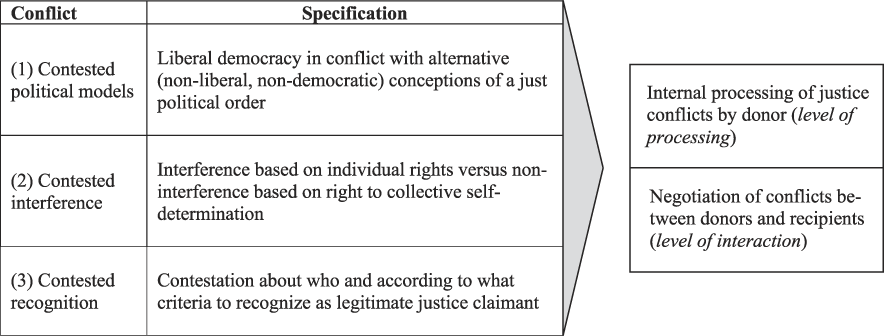
Systematically, we can distinguish between three types of justice conflicts in democracy promotion: contestation of the just model of political order; contestation of the extent and means of just external interference; and contestation of the question whom to recognize as participants in the negotiation about political change and democracy promotion. With a view to each of these substantial topics which may be contested in democracy promotion, justice conflicts can theoretically come in two different shapes: In an application conflict, competing justice claims are derived from the same or from generally shared principles of justice; in a conflict of principles, by contrast, such basic principles are themselves contested (Daase and Humrich Reference Daase and Humrich2011: 8–9).Footnote 39
Justice conflicts in democracy promotion, at the same time, can play out at different levels. Justice conflicts may be something internal to the democracy promoter. Here, a particular context or specific events in the recipient country give rise to conflicting objectives, which involve justice-related aims, on the part of the external actor; such conflicts are conflicts between competing aims and beliefs a specific actor holds. Justice conflicts can also emerge between democracy promoters and recipients. Here, the conflict situation is constituted by competing claims of external and local actors; it is a conflict between actors that make competing claims. There is, of course, an additional level – internal justice conflicts in recipient countries – and, given the fact that democratization is first and foremost an internal process, it is arguably the most important one. Yet, to include domestic justice conflicts as an additional object of research would require an analysis of the diverse and complex political dynamics in recipient countries with a view to the shaping of political order and social conflict. While this is certainly an important research agenda situated at the level of domestic politics, in research focusing on international democracy promotion it is reasonable to look at this level only to the extent that it gives rise either to conflicting objectives on the part of the democracy promoters or to conflicting local claims directed against external actors. The focus of this paper is, therefore, on the processing of justice conflicts on the part of the democracy promoters and the negotiation of justice conflicts in the interaction between donors and recipients.
Figure 1 maps the typology of justice conflicts we propose. In the first instance, the democracy promoters’ claim that liberal-democratic standards constitute universal features of any just political order collides with alternative democratic or non-democratic conceptions of a just political order that may exist in a given recipient country (Conflict 1). Thus, the nature and shape of a just political order is contested, taking either the form of a conflict of application or a conflict of principle. Between external and local actors such contestation may either arise if shared democratic principles are interpreted, applied and/or prioritized in different ways, or when there is fundamental disagreement about basic principles of political rule. With a view to the former, these application conflicts may concern differences, e.g., between presidential and parliamentary systems, mechanisms of majority rule and power sharing, representative and direct democracy. With a view to the latter, the individualist conception of justice, which is at the heart of liberal democracy, may collide with conceptions of justice which give priority to collective and/or communitarian rights (conflict of principles). Clashing understandings of a just political order, at the internal level of the democracy promoter, render problematic the justice-related norms that guide democracy promotion: How is the principle of ‘country ownership’ to be applied under circumstances of contestation (conflict of application)?Footnote 40 How is the conflict between the individual entitlement to democracy and the collective right to self-determination to be resolved (conflict of principle)?Footnote 41
Justice conflicts in democracy promotion

This problem of ownership/self-determination already points to the second justice conflict, in which contestation is about whether or not external actors have the right to interfere in another country’s internal affairs (Conflict 2). Whereas external military intervention may be the most extreme case of interference, it can be argued that any kind of involvement in another state’s affairs constitutes an illegitimate act (see section ‘Just and unjust democracy promotion’). When it comes to the interaction between external and local actors, democracy promoters invoke the universal right to democracy that applies to each individual and thus claim to intervene on behalf of those who have been denied their basic rights. External interference, however, runs into conflict with two other valued international principles, namely the right to self-determination of peoples and the national sovereignty of each state (Ikenberry Reference Ikenberry2011: 287–90). Internally, democracy promoters have to come to terms with this conflict as well, as promoting democracy, in principle, is based on individual political and civil rights as well as on the notion of collective self-determination. While these principles may be starkly pitted against each other (conflict of principles), the more likely case is that actors argue about the manner and degree to which they should be applied in a given situation (conflict of application). Local actors may welcome a certain degree of external support but may resent too much pressure or the imposition of sanctions. External actors may also debate internally how to balance their commitments against each other: How much ‘Liberalism of Imposition’, how much ‘Liberalism of Restraint’ is appropriate (Sørensen Reference Sørensen2011)?Footnote 42
At the most fundamental level – and in the most extreme cases – external and local actors can refuse to recognize each other as legitimate justice claimants (Conflict 3). Here, an actor’s status as a legitimate justice claimant, i.e. as having the legitimacy to make justice claims at all, is disputed. Such conflicts of recognition emerge between external actors and recipients either when a local actor demands such recognition but is seen by democracy promoters as illegitimate in this respect – or when the external democracy promoter is regarded illegitimate by one or several local actors. For example, in the contemporary ‘backlash’ against democracy promotion, some ‘non-Western’ governments reject external advice and pressure on domestic political issues by claiming that outsiders do not have any legitimate say in the internal affairs of sovereign states, whereas, conversely, some liberal analysts and politicians reject these demands by ‘autocratic leaders’ as they deny them the status of legitimate justice claimants (cf Carothers Reference Carothers, Burnell and Youngs2010; Gershman and Allen Reference Gershman and Allen2006; NED 2006). At the internal level of the democracy promoter, such conflicts of recognition raise crucial questions about the appropriate rules and criteria of recognition: In deciding with whom to cooperate and whose voices to hear, should such recognition be based on formal authority (government as official representative of a state and a people), empirical legitimacy (political forces that receive broad support in the population) or on the nature of behaviour and claims (political forces whose behaviour and claims are deemed just by the external actors)?Footnote 43
In the real world of democracy promotion, these three types of justice conflicts will regularly be intimately connected, mutually reinforcing or mitigating each other. Analytically, however, it is useful to differentiate between them as they refer to distinct problems which can, at least theoretically, exist independently of each other. For instance, even if there is no conceptual disagreement about democratic standards of just political rule and no problem of denied recognition, a given recipient government might still reject any kind of active involvement by democracy promoters. In the same vein, there might be no contestation, in principle, of the legitimacy of promoting democracy from the outside but still disagreement about the kind of democracy that democracy promotion should aim at.
In principle, democracy promoters have vowed to do justice to these competing norms: While the promotion of democracy is supposed to endow all human beings with their inalienable rights, local conceptions of justice are to be respected and accounted for. Yet, as seen, this harmonious idea is regularly contradicted by justice conflicts that characterize the political dynamics in a pluralist world (cf Hurrell Reference Hurrell2007: 158–63; Müller Reference Müller2010; Sørensen Reference Sørensen2011: Chapter 2). The dilemma at hand is that principles such as ownership and self-determination suggest the need to put the appropriate norms that are to guide democracy promotion in any specific case up for discussion with the respective recipients. Yet, promoting democracy, by its very essence, means supporting a specific political regime (democracy), which may be defined more or less narrowly but, in any case, implicates normative limits to local adaptation. What is more, democracy promotion derives from the very identity of the established democracies in the ‘North-West’ and is, thus, systematically informed by the specific (liberal-democratic) norms established in these societies. This raises the empirical question of how such justice conflicts are processed by democracy promoters and negotiated between donors and recipients.Footnote 44 The perspective on democracy promotion as interaction and the typology of justice conflicts developed in this paper present a framework for tackling this question.
Concluding remarks
Democracy promotion has to be considered as a process of interaction which requires a departure from unidirectional notions of ‘export’ or ‘socialization’. Scholars and practitioners in the field have to acknowledge that interaction in democracy promotion involves meaningful agency also on the part of the recipients, including with regard to the very norms that are to guide democracy promotion. This paper aimed at, theoretically, establishing this need and outlining a conceptual framework that enables us to analyse, empirically, how democracy promoters deal with, and how donors and recipients negotiate about, the ensuing normative challenges or justice conflicts.
The problem at hand is, however, not ‘only’ an abstract normative issue as well as an object for empirical research that has so far received little academic attention. It is also relevant for the practice of democracy promotion itself. Research should, therefore, go beyond empirically analysing the processing and negotiation of justice conflicts in democracy promotion and also aim at identifying constructive ways of handling contestation in this policy field. Procedurally, such ways can refer either to internal operating procedures on the part of the donor that enable a reflexive processing of justice conflicts,Footnote 45 or to ways of institutionalizing the interaction between donor(s) and recipient(s) that favour arguing over bargaining.Footnote 46 In terms of substance, the question is whether justice conflicts can be resolved (or, at least, mitigated) by way of an agreement about basic principles for both a just political order for the recipient side and just forms of external interference by the donor.Footnote 47 Answers to these questions are arguably of crucial importance for the future of democracy promotion in the twenty-first century. As will be argued in these concluding remarks, finding constructive ways of handling justice conflicts is not only immediately relevant for making democracy promotion more effective, more legitimate and less conflict-prone but also for the shape of world order in the twenty-first century.
As we have shown, there is, on a general level, a broad consensus that democracy can only work in a given country if it is ‘locally owned’ and correspondingly adapted to the particular socio-politico-cultural context. If taken seriously, this requires democracy promoters to be reflexive in the sense of adjusting their (universalist) conceptions of the good political order to local demands and circumstances. In the terminology adopted in this paper, this would require that democracy promoters take up justice claims and deal with justice conflicts arising from within the recipient countries in a serious manner. This is a question of effectiveness, but also impacts directly on the legitimacy of external interventions (which, on its part, is generally assumed to contribute to effectiveness). The criticism as to the quasi-imperialist nature of democracy promotionFootnote 48 may often be overdrawn, given that most really-existing democracy promotion policies are much less coercive, dogmatic and coherent than these critics would have it (cf Burnell Reference Burnell2011: Chapter 4; Carothers Reference Carothers2009a: 12–18; Wolff Reference Wolff2012; Youngs Reference Youngs2012). Still, even relatively sympathetic observers note that democracy promoters are regularly not very sensitive to local contexts and demands (cf Burnell Reference Burnell2011b: 9–10; Carothers Reference Carothers2009b; Grävingholt et al. Reference Grävingholt, Leininger and Schlumberger2009; Hill Reference Hill2010). There can, thus, be no doubt that the empirical legitimacy of democracy promotion in the eyes of the recipients would increase – and, hence, also its potential effectiveness – if external actors demonstrated that they were not engaged in exporting a certain model but in supporting the search for locally adjusted paths to locally adjusted democracy.
Furthermore, dealing constructively with justice conflicts in democracy promotion is also of immediate relevance for preventing conflict, both inside recipient countries and between donors and recipients. With a view to the intra-recipient dimension, the research on the specific risk of political violence associated with democratization does not generally discard the possibility that democracy and democratization may contribute to establishing and/or securing intra-state peace. Scholars rather point to the need to adjust processes of political change to the particular situation in a given country (Bermeo Reference Bermeo, Barany and Moser2009: 244–5).Footnote 49 As has been argued in this article, such adjustments would have to take into account the – potentially diverging – local claims as to how a just political order in the country should look like. With a view to the international dimension, democracy promotion can become a major source of conflict between donor and recipient governments if justice conflicts between the two are not dealt with in a cooperative way. That democracy promoters, for example, listen to the ‘plurality of views on democracy’ existing in a given country is, therefore, not only ‘normatively desirable but also practically desirable in allowing productive engagement to emerge between critical (or even hostile) target publics and democracy promoters’ (Kurki Reference Kurki2010: 378).
From a broader perspective, the challenges to democracy promotion are also relevant to the future of world order in the twenty-first century. The question of the extent to which peaceful global governance can or should be based on liberal-democratic norms is at the heart of the current debate about possible normative foundations of order in an increasingly pluralist world (Cox 2002; Hurrell Reference Hurrell2007; Ikenberry Reference Ikenberry2011; Sørensen Reference Sørensen2011). Correspondingly, contestation of democracy and democracy promotion is part and parcel of the broader dynamics of norm contestation in international politics (Acharya Reference Acharya2004; Müller Reference Müller2010; Wiener Reference Wiener2008). While this academic scholarship focuses on norm dynamics in multilateral arenas, it is, in fact, the form of political order at the level of the nation state that will constitute the basis of any multi-layered structure of global governance for the foreseeable future. In this sense, analysing the dynamics of contestation in regard to foreign and development policies that aim at promoting democracy also promises crucial contributions to the contemporary study of international politics.
Acknowledgements
Previous versions of this paper were presented at the 2011 IPSA-ECPR Joint Conference in São Paulo, at the 2012 BISA-ISA Joint Conference in Edinburgh, and published in the PRIF Working Paper series. The authors would like to thank Iris Wurm for contributions to a first version of the paper as well as Evgeniya Bakalova, Dorothea Gädeke, Harald Müller, Hans-Jürgen Puhle, Philippe C. Schmitter, Lisbeth Zimmermann, the members of the German Research Network ‘External Democratization Policy’, and two anonymous reviewers for helpful comments.