INTRODUCTION
One of the main focus areas of modern ecological parasitology is to elucidate factors responsible for spatial variation in parasite community composition. Parasites ultimately depend on their hosts not only as sources of food but also as habitats in which they live and mate and as means of dispersal. It is thus not surprising that species composition of parasite communities is often shaped by host characteristics such as social structure (e.g. Bordes et al. Reference Bordes, Blumstein and Morand2007), age (Timi et al. Reference Timi, Luque and Poulin2010) or gender (Bordes et al. Reference Bordes, Nicolas Ponlet, Goüy de Bellocq, Ribas, Krasnov and Morand2012). The off-host environment is another important factor affecting community composition in both ecto- (Krasnov et al. Reference Krasnov, Shenbrot, Medvedev, Khokhlova and Vashchenok1998) and endoparasites (Bush et al. Reference Bush, Aho and Kennedy1990; Marcogliese and Cone, Reference Marcogliese and Cone1991; Palmeirim et al. Reference Palmeirim, Bordes, Chaisiri, Siribat, Ribas and Morand2014). In other words, both host-associated and environment-associated factors are the reasons behind spatial variation in parasite community composition. While the reasons for environment-related variation in ectoparasite species composition are often clear (direct effects of abiotic factors; e.g. Krasnov et al. Reference Krasnov, Khokhlova, Fielden and Burdelova2002), these reasons are less obvious for endoparasites such as gastrointestinal helminths. Nevertheless, whatever the ultimate factors affecting endoparasite community composition are, their actions likely result in at least two proximate (not mutually exclusive) causes shaping these communities. First, an absence or a presence of a given parasite in a community may be associated with the absence or presence of a suitable intermediate host in a given locality (Simkova et al. Reference Simkova, Sitko, Okulewicz and Morand2003). Second, environmental conditions may influence survival of free-living stages of some helminths (Hudson et al. Reference Hudson, Cattadori, Boag and Dobson2006). Consequently, hosts living under different environmental conditions may differ in species composition of their parasite assemblages.
Spatial variation in parasite community composition has been repeatedly studied among and within host species (e.g. Bush, Reference Bush, Esch, Bush and Aho1990; Carney and Dick, Reference Carney and Dick2000; Poulin, Reference Poulin2001, Reference Poulin2003; Timi and Poulin, Reference Timi and Poulin2003; Karvonen et al. Reference Karvonen, Cheng and Valtonen2005; Krasnov et al. Reference Krasnov, Shenbrot, Mouillot, Khokhlova and Poulin2005; Karvonen and Valtonen, Reference Karvonen and Valtonen2009; Froeschke et al. Reference Froeschke, Harf, Sommer and Matthee2010). These studies revealed a plethora of factors underlying this variation with different factors acting in different host-parasite systems (e.g. host diet, local climatic conditions or historical connections). This suggests the necessity of further studies to distinguish between general and system-specific factors responsible for spatial variation in parasite community composition (Karvonen and Valtonen, Reference Karvonen and Valtonen2009).
Among the reasons behind our still limited ability to understand general rules of spatial variation in species composition of parasite communities, the most striking are as follows. First, the majority of studies considered parasite assemblages in aquatic hosts, whereas parasites (especially, endoparasites) of terrestrial hosts have received less attention (but see Calvete et al. Reference Calvete, Blanco-Aguiar, Virgós, Cabezas-Díaz and Villafuerte2004; Froeschke et al. Reference Froeschke, Harf, Sommer and Matthee2010; Palmeirim et al. Reference Palmeirim, Bordes, Chaisiri, Siribat, Ribas and Morand2014). Second, studies that compared patterns of spatial variation in parasite community composition among different hosts usually involved distantly-related host species (e.g. Poulin, Reference Poulin2003) that differ in multiple traits. As a result, it is often more difficult to reveal the most important host-associated factor(s) affecting spatial variation of parasite assemblages than when comparing closely-related species. On the other hand, comparison of spatial variation of parasite communities in closely-related allopatric species may allow a better understanding of the effect of environment on this variation because these species are likely similar in their morphological, physiological and immunological traits, but inhabit different environments.
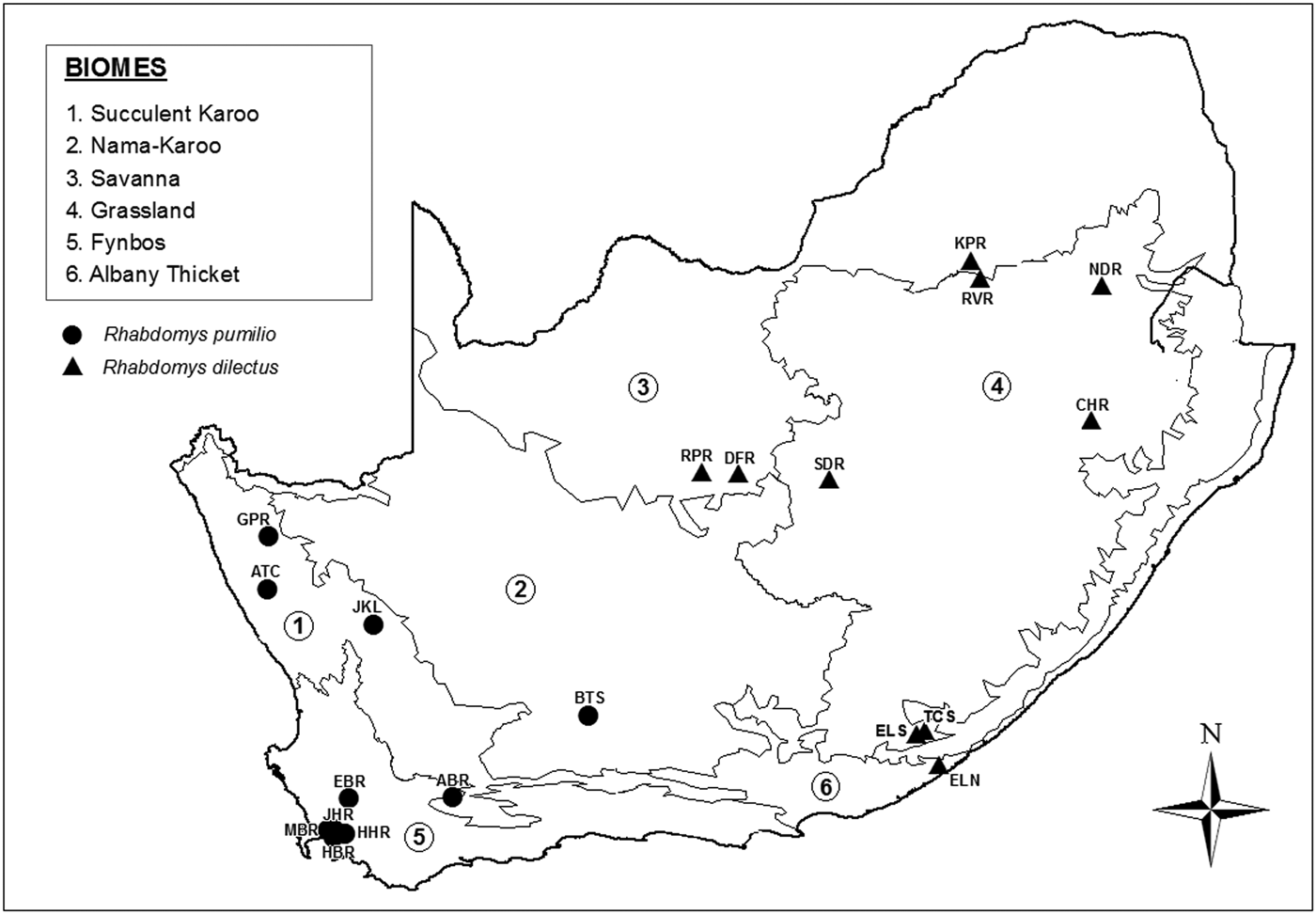
Here, we studied patterns of spatial variation in species composition of the communities of gastrointestinal helminths harboured by two rodent hosts from South Africa, Rhabdomys pumilio and Rhabdomys dilectus. These two species are very closely related (du Toit et al. Reference du Toit, Jansen van Vuuren, Matthee and Matthee2012) and until recently have even been thought to belong to the same species (e.g. Schradin, Reference Schradin2005). Despite their close relatedness, R. pumilio and R. dilectus differ sharply in their social and spatial behaviour. Rhabdomys pumilio is social and lives in groups comprising 8–30 adult individuals (Schradin and Pillay, Reference Schradin and Pillay2005a). This species inhabits the mostly xeric western region of South Africa (Fig. 1), with average rainfall varying from the more xeric central and northern parts (<250 mm per annum; the greater Karoo region) to the less dry southern part (250–600 mm per annum; the Fynbos) (Mucina and Rutherford, Reference Mucina and Rutherford2006). In contrast, R. dilectus is solitary and occurs in the mostly mesic eastern regions of South Africa in predominantly grassland habitats (Fig. 1). Furthermore, R. pumilio is characterized by high population densities (up to 171 individuals per hectare; Schradin and Pillay, Reference Schradin and Pillay2005b) and, consequently, small home ranges (ca. ± 250 m2; Schradin, Reference Schradin2005). In contrast, R. dilectus demonstrates low population densities (from 10 to 40 individuals per hectare; Perrin et al. Reference Perrin, Ercoli and Dempster2001), follows a roaming strategy and therefore has much larger home ranges of approximately 2000 m2 (Ostfeld, Reference Ostfeld1990; Schradin and Pillay, Reference Schradin and Pillay2004, Reference Schradin and Pillay2005b; Schradin et al. Reference Schradin, Schmohl, Rödel, Schoepf, Treffler, Brenner, Bleeker, Schubert, König and Pillay2010). Rhabdomys pumilio is marginally larger (males 214–216 mm and females 202–225 mm) than R. dilectus (males 170–200 mm and females 171–196 mm) (Skinner and Chimimba, Reference Skinner and Chimimba2005).
Biome regions of South Africa, according to Mucina and Rutherford (Reference Mucina and Rutherford2006) with sampling localities. Locality names and abbreviations are: Carolina (NDR); Pretoria site 1 (KPR); Pretoria site 2 (RVR); Springbok (GPR); Kimberley site 1 (DFR); Kimberley site 2 (RPR); Bloemfontein (SDR); Newcastle (CHR); Matjiesfontein (ABR); Stellenbosch site 3 (MBR); Stutterheim site 1 (ELS); Stutterheim site 2 (TCS); Beaufort West (BTS); Loeriesfontein (JKL); Garies (ATC); Somerset West (HBR); Stellenbosch site 2 (JHR); Stellenbosch site 1 (HHR); Wellington (EBR); East London (ELN).

In this study, we focused on patterns of similarity in helminth species composition between and within these two host species because investigation of these patterns is one of the ways to understand the mechanisms behind spatial variation of parasite communities. We considered helminth assemblages of the two hosts at two hierarchical scales, namely infracommunities (assemblages of helminths in individual hosts) and component communities (assemblages of helminths in host populations; i.e. localities). First, we asked whether the two hosts harbour similar helminth assemblages and whether these assemblages are more dissimilar between than within hosts. Secondly, we asked whether host social or spatial behaviour affects similarity in helminth species composition of infracommunities within localities and how this compares with the pattern found among localities. Higher within-locality than among-localities similarities presumably result from a higher probability of helminth transmission among individual rodents. Consequently, we predicted that the effect of social behaviour will be manifested in the difference between within- and among-localities similarities in the infracommunity species composition being greater in social R. pumilio than in solitary R. dilectus. Alternatively, the effect of spatial behaviour will be manifested in this difference being higher in more mobile R. dilectus than in less mobile R. pumilio. Moreover, the difference between within- and among-localities similarities in helminth species composition could be associated with environmental conditions rather than with host traits. In particular, a more mesic environment may present favourable conditions for increased survival and transmission rates of free-living helminth stages, as well as for higher diversity and abundance of arthropods that serve as intermediate hosts for many helminths (e.g. Hudson et al. Reference Hudson, Cattadori, Boag and Dobson2006; Dybing et al. Reference Dybing, Fleming and Adams2013). If this effect of environment is strong, then the difference between within- and among-localities similarities is expected to be greater in the predominantly xeric R. pumilio than in the predominantly mesic R. dilectus. We further examined the effect of environmental conditions on patterns of similarity of helminth communities within R. pumilio. As mentioned above, the geographic range of this rodent in South Africa includes both the relatively more xeric greater Karoo region and the relatively less xeric Fynbos. If the environment incurs substantial effect on the pattern of similarity, then helminth infracommunities will be less similar between biomes than both among and within localities.
Finally, we asked whether similarity in species composition of helminth component communities decreases with an increase of geographic distance between host localities and, if yes, whether host spatial behaviour affects the rate of this decrease (Poulin, Reference Poulin2003). A pattern of distance decay of similarity in species composition (a decrease of similarity between a pair of communities with an increase of geographic distance between them; Nekola and White, Reference Nekola and White1999) has been repeatedly reported for both ecto- (Krasnov et al. Reference Krasnov, Shenbrot, Mouillot, Khokhlova and Poulin2005) and endoparasites (e.g. Poulin, Reference Poulin2003). We predicted that the rate of distance decay of similarity will be higher in more territorially conservative R. pumilio than more mobile R. dilectus. Recently, Froeschke et al. (Reference Froeschke, Harf, Sommer and Matthee2010) reported the pattern of distance decay of similarity in species composition of helminth communities in R. pumilio. However, they evaluated pairwise similarity using the qualitative Jaccard index, whereas here we used the Bray–Curtis similarity index (Bray and Curtis, Reference Bray and Curtis1957) that takes relative abundances of helminth species into account.
MATERIALS AND METHODS
Host sampling and helminth collection
Rodents were trapped at 20 localities across South Africa during 2004–2014 (Fig. 1) using Sherman-type live traps, baited with a peanut butter – oats mixture. Traps were set out in 3–5 lines (50–100 m length) with 10 m distance between traps, checked twice daily and closed during the heat of the day (11:00–15:00) in summer, and the cold nights (17:00–08:00) in winter. Adult animals (R. pumilio or R. dilectus) were placed in plastic bags and immediately euthanized by intraperitoneal injection with Sodium Pentobarbitone (200 mg kg−1). Carcasses were either frozen in the field and remained frozen until parasite removal at the laboratory or gastrointestinal tracts (GIT) were removed immediately and stored in 70% alcohol for later dissection. All helminths were recovered from the GIT and stored in 70% alcohol. Identifications were based on relevant keys and descriptions of multiple authors. Abundance data were also recorded for each helminth species per host individual.
Data analyses
To compare similarity in helminth species composition between the two host species, among localities within host species and between biomes for R. pumilio, we carried out analyses of similarities (ANOSIMs) (Clarke and Green, Reference Clarke and Green1988; Clarke and Warwick, Reference Clarke and Warwick2001). ANOSIM operates on a matrix of similarities between samples. Consequently, prior to these analyses, the matrices of the Bray–Curtis similarities (Bray and Curtis, Reference Bray and Curtis1957) in helminth species composition between each pair of samples (i.e. individual hosts or localities) were constructed. The null hypothesis in ANOSIM is that there are no assemblage differences between groups of samples, i.e. among host individuals within a locality or among localities. The ANOSIM test statistic, R, usually varies between 0 and 1 (although theoretically it may vary from −1 to 1), where R = 1 indicates that all replicates within a group (i.e. host species or host population in a given locality) are more similar to each other than any replicates from different groups, whereas R ≈ 0 suggests that similarities between and within groups on average are the same. Each analysis was based on 999 permutations and carried out using the routine ANOSIM implemented in the program Primer-7 (Clarke and Gorley, Reference Clarke and Gorley2015). Prior to analyses, the data entries (number of helminths of a given species in each host individual or mean abundance of a given helminth species in each locality) were log + 1-transformed and standardized within a sample (i.e. a host individual or a locality) by total abundance. To visualize dissimilarity in species composition of helminth infracommunities, we applied multidimensional non-parametric scaling with a matrix of pairwise between-localities Bray–Curtis similarities in helminth species composition as input data. Then, we identified those helminth species that primarily accounted for differences between helminth infracommunities of the two hosts, each pair of localities for each host separately or between helminth assemblages of the Fynbos vs the greater Karoo region for R. pumilio (Clarke and Gorley, Reference Clarke and Gorley2015). This was carried out by decomposition of the Bray–Curtis similarity into contribution of each species using the routine SIMPER implemented in the program Primer-7 (Clarke and Gorley, Reference Clarke and Gorley2015).
We analysed the effect of geographic distance between sampling localities on the similarity of helminth component communities separately for each of the two hosts using multiple regressions on distance matrices (MRM; see Manly, Reference Manly1986; Legendre and Legendre, Reference Legendre and Legendre1998; Lichstein, Reference Lichstein2007 for details). MRM is an extension of the partial Mantel analysis. It investigates relationships between a multivariate response distance matrix (here Bray–Curtis pairwise similarity in species composition of helminth infracommunities) and an explanatory distance matrix (pairwise geographic distances). Geographic distances between data points were measured in kilometres using the measure tool in ArcGIS 10·2·2 (ESRI) software. The significance of the model and regression coefficients was tested by permuting a response matrix while the explanatory matrices are held constant. The rows and corresponding columns in the response matrices are permuted simultaneously and the coefficient of determination of the model and regression coefficients are calculated for each permutation to generate a null distribution (Legendre and Legendre, Reference Legendre and Legendre1998; Lichstein, Reference Lichstein2007). All probabilities were based on 10000 permutations. Analyses were performed using the package ‘ecodist’ (Goslee and Urban, Reference Goslee and Urban2007) implemented in the R statistical environment (R Core Team, 2016).
RESULTS
A total of 778 rodents were captured (486 R. pumilio and 292 R. dilectus) from which 168433 individual helminths belonging to 25 nematode and 9 cestode species were collected. Rhabdomys pumilio harboured 11 nematode and 5 cestode species and R. dilectus was host to 19 nematode and 7 cestode species. Information on prevalence and abundance of individual helminth species is provided in more detail in Spickett et al. (Reference Spickett, Junker, Krasnov, Haukisalmi and Matthee2017).
Analyses of similarity between host species
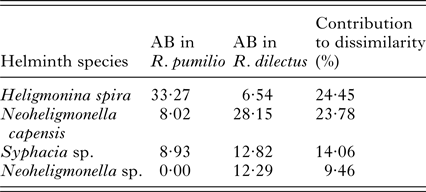
Analysis of similarity of species composition of helminth infracommunities between the two host species resulted in R = 0·08 (P < 0·001). Significance of the test statistics for the analysis based on infracommunity composition suggests that the two hosts, in general, do not harbour identical helminth assemblages. Nevertheless, the low value of R indicates a broad overlap in species composition between helminth infracommunities of R. pumilio and R. dilectus. Furthermore, this overlap was broader than the overlap in helminth species composition among R. pumilio or R. dilectus from different localities (see below). Four helminth species contributed most to the dissimilarity between host species (cumulative contribution = 71·75%) due to either a difference in abundance between the two hosts or complete absence from one of the host species (e.g. Neoheligmonella sp. was recorded in R. dilectus but not R. pumilio) (Table 1). Between-host analysis of similarity based on component community composition resulted in R = 0·08 (P = 0·06), suggesting that species composition of helminth component communities between hosts was, on average, as similar as that among populations of conspecific hosts.
Helminth species that contributed most to dissimilarity in species composition of helminth infracommunities between Rhabdomys pumilio and Rhabdomys dilectus

AB, average abundance (after transformation and standardizing; see text for explanation).
Analyses of similarity within host species
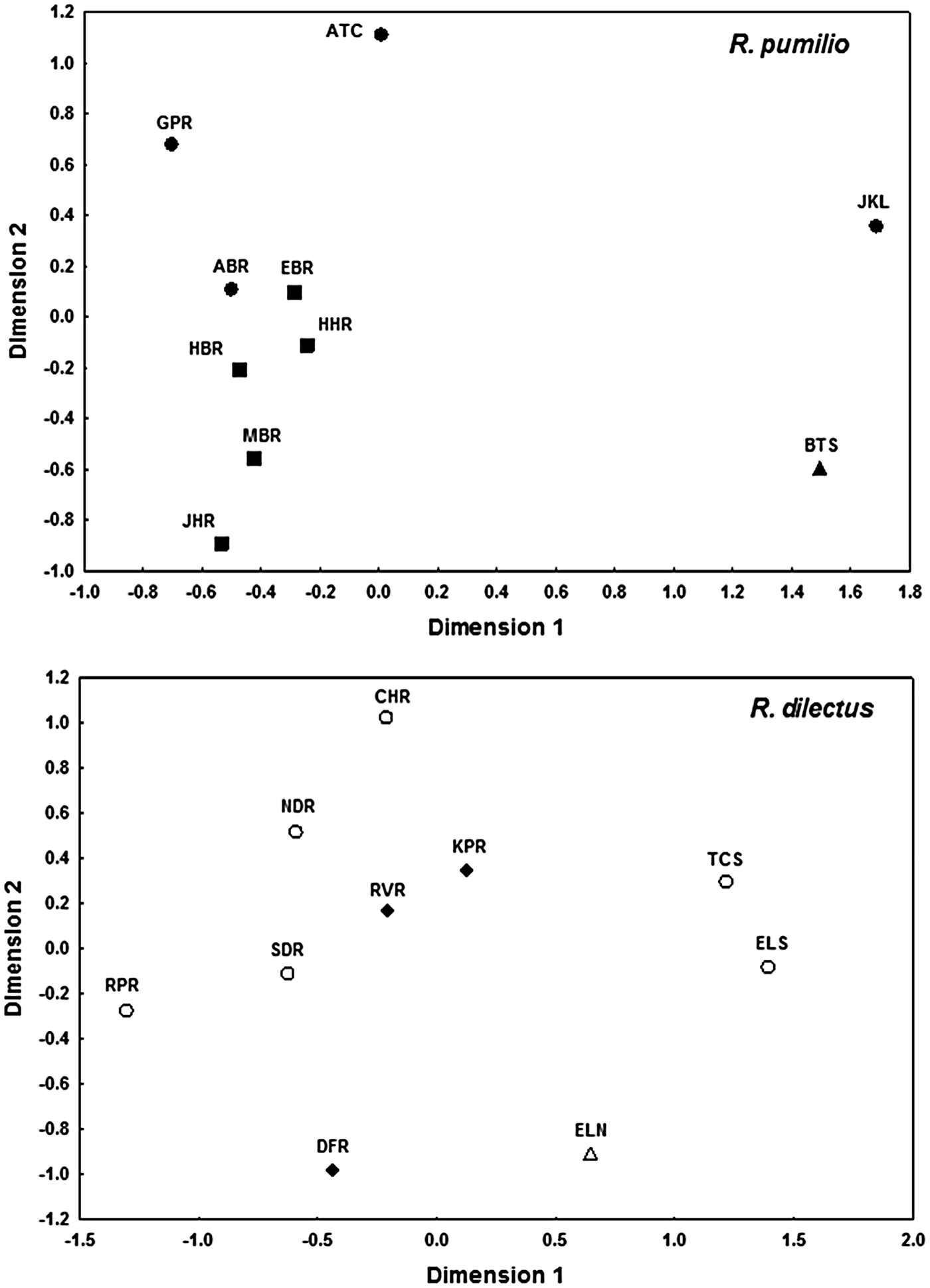
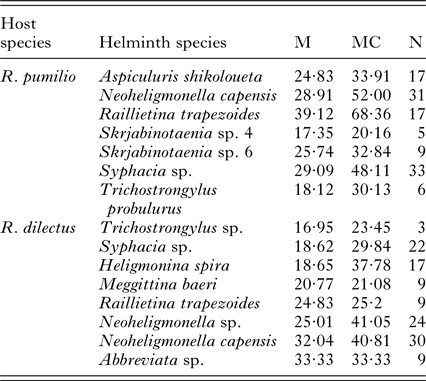
Global values of the test statistics R for among-localities and between-biomes similarity in helminth species composition of individual R. pumilio were 0·25 and 0·28, respectively, both being larger than any of 999 permuted values (P < 0·0001 for both). In other words, similarity in species composition of helminth assemblages was significantly lower among localities and between biomes than among host individuals within a locality. However, the degree of dissimilarity among localities was almost the same as that between biomes. In other words, communities differed more among localities and between biomes than within localities or biomes, respectively. Likewise, helminth infracommunities were more dissimilar among R. dilectus from different localities than among individuals from the same locality (R = 0·64, P < 0·001). Note that the value of the test statistics R is much greater in R. dilectus than R. pumilio (see above). Helminth species that contributed most in pairwise dissimilarity between localities are presented in Table 2. The distribution of sampling localities in the ordination space constructed using non-parametric multidimensional scaling (MDS) is presented in Fig. 2. In R. pumilio, species composition of helminth infracommunities of populations inhabiting the Nama Karoo and the Succulent Karoo differed sharply (along both the first and the second dimensions) from that of the populations in the Fynbos. In R. dilectus, species composition of helminth infracommunities differed the most between southern and northern populations.
Multidimensional scaling distribution of localities based on Bray–Curtis similarity in species composition of helminth infracommunities of Rhabdomys pumilio and Rhabdomys dilectus. See Fig. 1 for abbreviations of the locality names. Closed circle – Succulent Karoo, closed triangle –Nama-Karoo, closed square – Fynbos, diamond – Savanna, open circle – Grassland, open triangle – Albany Thicket.

Helminth species that contributed most (maximum contribution >20%) to the pairwise between-locality dissimilarity in species composition of infracommunities in Rhabdomys pumilio and Rhabdomys dilectus

M, mean (across pairs of localities) percentage contribution to dissimilarity; MC, maximum contribution; N, number of locality pairs in which a given species contributed to dissimilarity.
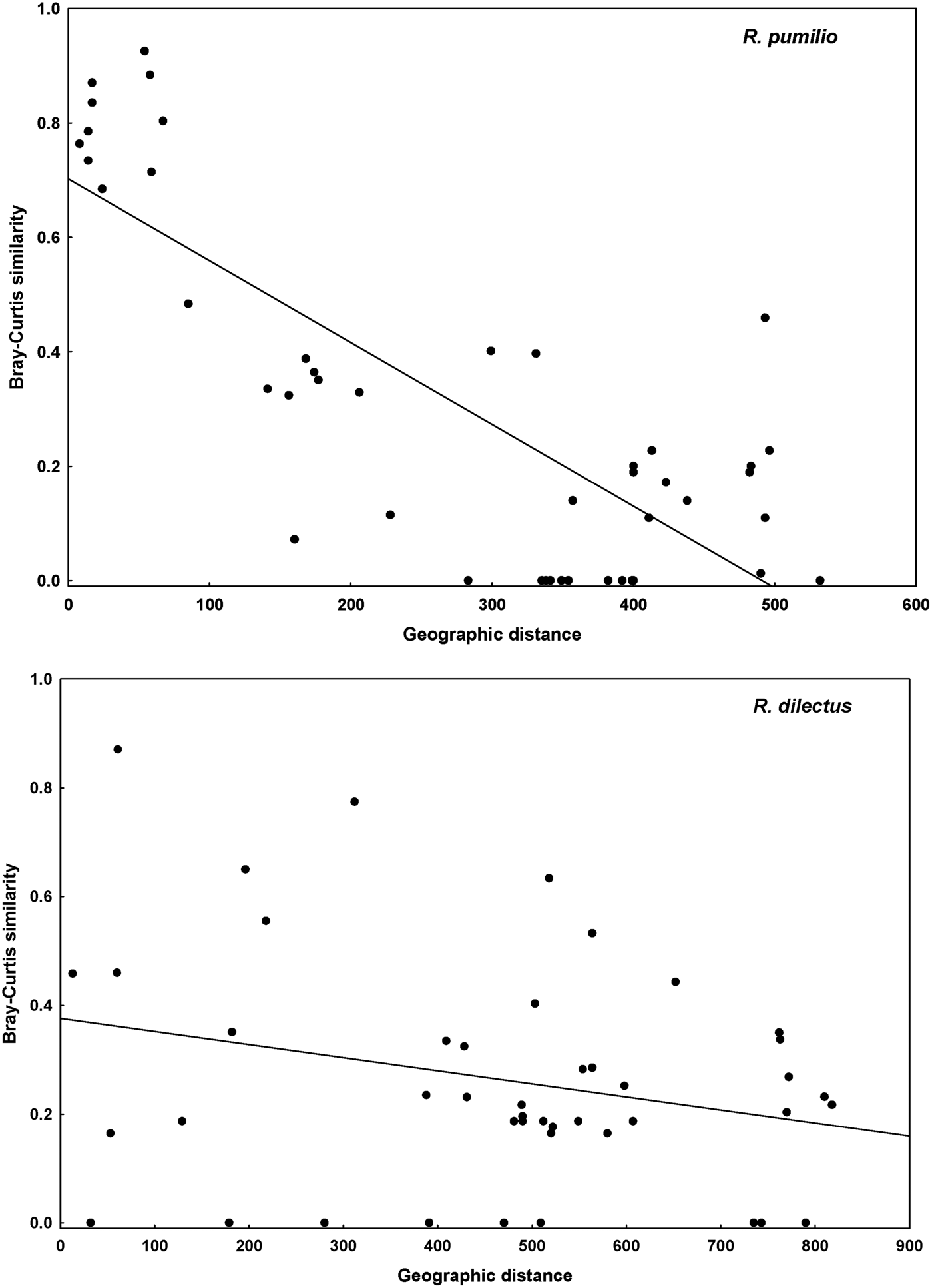
MRM analysis demonstrated that similarity in helminth species composition among localities correlated significantly and negatively with geographic distance between localities (r 2 = 0·64, F = 77·32, P = 0·0004; coefficient = 0·001 for R. pumilio and r 2 = 0·07, F = 3·27, P = 0·04; coefficient = 0·0002 for R. dilectus). The farther two localities were from one another, the less similar their helminth assemblages were. Moreover, the rate of the decrease of similarity of helminth assemblages between a pair of localities with an increase in geographic distance between these localities was higher in R. pumilio than in R. dilectus (Fig. 3).
Relationship between pairwise compositional dissimilarity of helminth component communities and pairwise geographic distance between sampling localities in Rhabdomys pumilio and Rhabdomys dilectus.

DISCUSSION
Our results suggest that spatial variation in helminth species composition in R. pumilio and R. dilectus is driven by factors associated with both host behaviour and environment. However, these factors differ in their relative importance.
Host behaviour
The sharpest contrast between the two hosts found in this study was that difference in dissimilarity of helminth infracommunities among rodents from different localities as compared with dissimilarity among individuals from the same locality was much greater in R. dilectus than in R. pumilio. This indicates that spatial variation in helminth composition was promoted mainly by the pattern of space used by the hosts rather than by their social behaviour. The reason behind this could be the greater extent of parasite exchange between host individuals within a given locality in R. dilectus than in R. pumilio. On the one hand, highly mobile R. dilectus that have large home ranges (Schradin and Pillay, Reference Schradin and Pillay2005a) likely encounter highly diverse vegetation types, microclimatic conditions, arthropod intermediate hosts and many other con- and heterospecific helminth hosts, being thus exposed to numerous and varied infective stages of helminth parasites. On the other hand, spatial distribution of R. pumilio within a locality is fragmented. Social groups within a locality are characterized by broad within-group overlap of home ranges and extremely weak or no home range overlap among groups (Schradin and Pillay, Reference Schradin and Pillay2005a). Consequently, although the rate of between-individual contacts within a group is presumably high, it is likely extremely low (if at all) among groups. In other words, individual R. pumilio are territorially conservative and move short distances only, thus, environmental conditions (including biotic interactions shaping species composition of their helminth assemblages) could be relatively stable for each given social group but vary among groups in the same locality. Furthermore, although home ranges of individual R. pumilio belonging to the same social group broadly overlap, individuals from different groups exhibit a high level of aggression towards each other (Schradin and Pillay, Reference Schradin and Pillay2004), so that individual movements take place mainly within a group but not between groups. One of the results of this pattern could be a net high dissimilarity in helminth species composition of individual R. pumilio within a locality.
We found a significant decrease of similarity in species composition of helminth component communities with an increase of geographic distance between host populations. This is not especially surprising because distance decay of similarity has been documented for a variety of animal communities, including parasites (Poulin, Reference Poulin2003; Bordes et al. Reference Bordes, Guégan and Morand2011; Poulin et al. Reference Poulin, Krasnov and Mouillot2011) and at a variety of spatial scales (Rohde, Reference Rohde1992; Krasnov et al. Reference Krasnov, Shenbrot, Mouillot, Khokhlova and Poulin2005; Van der Mescht et al. Reference Van der Mescht, Krasnov, Matthee and Matthee2016). The decrease of similarity in biological communities with distance can be explained by various mechanisms. One of these is a decrease in environmental similarity with increasing distance (Nekola and White, Reference Nekola and White1999). Consequently, environmental similarity, including similarity in abiotic factors influencing egg and larval survival, infection opportunity and suitability for transmission results in similarity of helminth communities. Although distance decay of similarity in parasite communities is a rather general phenomenon, it is not universal. For example, Vinarski et al. (Reference Vinarski, Korallo, Krasnov, Shenbrot and Poulin2007) established that the similarity in species composition of component communities of gamasid mites parasitic on small mammals across the Palearctic was generally unaffected by geographic distance between regions.
Observation of distance decay of similarity in species composition of helminth communities was not especially surprising. However, the difference in the rate of this decay between the two hosts (higher in R. pumilio than in R. dilectus), despite their close relatedness, was unexpected. To the best of our knowledge, this is the first time that evidence is presented that the rate of distance decay of similarity in species composition of essentially similar helminth communities depends on the identity of the host species. In other words, the change in helminth species composition and/or their relative abundances per unit of distance in R. pumilio was greater than that in R. dilectus. This difference can be explained by at least two reasons. First, it may be associated with between-host differences in vagility. The vagility of the host species is one of the key determinants of the range expansion or exchanges of parasites among host populations because of the limited dispersal abilities of the parasites themselves (Poulin, Reference Poulin2003). Consequently, long distance movements of a host may lead to higher homogeneity of parasite communities. However, movements in both hosts are mainly limited to individual home ranges either within a social group (R. pumilio) or as solitary individuals (R. dilectus) (Schradin and Pillay, Reference Schradin and Pillay2003, Reference Schradin and Pillay2004, Reference Schradin and Pillay2005a, Reference Schradin and Pillay2006; Schradin, Reference Schradin2005). Despite that the dispersal ability of R. dilectus is approximately 10-fold that of R. pumilio, inter-locality dispersal is highly unlikely for both species. Any vagility-associated explanation of the difference in the rate of distance decay of similarity between two species would thus appear inadequate. Second, difference in the rate of distance decay of similarity between hosts might be linked to differences in the range of environmental variation across their geographic ranges. Environmental variation across the geographic range of a host may either promote or hamper dissimilarity of its parasite assemblages within this range. Habitat diversity across the geographic range of R. pumilio is more pronounced than that of R. dilectus. Indeed, the region inhabited by R. pumilio encompasses 23 vegetation zones, whereas that of R. dilectus covers 11 vegetation zones only (Mucina and Rutherford, Reference Mucina and Rutherford2006). In addition, in the eastern, mesic parts of the country, suitable habitats for R. dilectus are more interconnected than those of R. pumilio in the western xeric regions, especially in the arid Karoo, so that populations of the latter species would be separated from each other by uninhabitable areas. Such habitat patchiness (Milton and Dean, Reference Milton, Dean, Dean and Milton1999) might accentuate differences in the helminth composition between different localities, as differences in helminth assemblages might evolve faster through chance events of parasite loss on the one hand, and parasite acquisition from other rodents sharing the same habitat on the other hand (Sarà and Morand, Reference Sarà and Morand2002; Bordes et al. Reference Bordes, Morand, Pilosof, Claude, Krasnov, Cosson, Chaval, Ribas, Chaisiri, Blasdell and Herbreteau2015).
Environmental effects
Helminth infracommunities of each of the two hosts differed among localities to a somewhat greater extent than they differed between the two host species. This higher dissimilarity in helminth assemblages among localities within a host than between hosts suggests some effect of local environmental factors on helminth infracommunities. For example, vegetation structure may affect nematodes with direct life cycles because they require suitable environments for egg survival and larval development (Hulbert and Boag, Reference Hulbert and Boag2001; Brouat et al. Reference Brouat, Kane, Diouf and Bâ2007). For example, poorer vegetation cover in xeric habitats of R. pumilio as compared with mesic habitats of R. dilectus may thus explain (at least, partly) the much higher abundance of Neoheligmonella capensis in the latter than in the former (Table 1). The same is likely the case for the presence of Neoheligmonella sp. in R. dilectus but not in R. pumilio.
Local environmental factors might affect helminth species composition of the same host among both different biomes and localities within the same biome. Moreover, these factors seem to be both climate- and vegetation-associated. Indeed, the degree of dissimilarity of helminth assemblages among localities was almost the same as that between biomes. Differential climate and vegetation could directly influence the free-living stages of parasitic helminths (Boomker et al. Reference Boomker, Horak, Watermeyer and Booyse2000; Turner and Getz, Reference Turner and Getz2010; Dybing et al. Reference Dybing, Fleming and Adams2013). In South Africa, the mesic eastern region presents favourable conditions for free-living stages of parasitic nematodes, where they have a tendency to ascend vegetation in a film of moisture in order to become available to hosts (Anderson, Reference Anderson2000). This would promote survival and transmission rates, whereas xeric conditions would cause desiccation of these stages. Arthropod diversity is influenced by environmental conditions, which may affect the presence of heteroxenous cestodes (Meggittina baeri, Skrjabinotaenia spp., Raillietina trapezoides) and some nematodes (Abbreviata sp.) that depend on arthropods as intermediate hosts for the completion of their life cycles (Anderson, Reference Anderson2000; Georgiev et al. Reference Georgiev, Bray, Littlewood, Morand, Krasnov and Poulin2006). Raillietina trapezoides occurred only in the Karoo biomes, suggesting that habitat conditions elsewhere were unfavourable for its intermediate hosts. In contrast, Syphacia sp. is monoxenous and utilises a transmission strategy associated with behavioural patterns of its host (Taffs, Reference Taffs1976; Anderson, Reference Anderson2000). In addition to accidentally being ingested during foraging, it can also be transmitted via auto- and allo-grooming as well as retrofection, reducing its dependency on local environmental conditions. As a result, this helminth is present at all localities in both hosts and does not contribute much to the dissimilarity between host species as well as sampled localities.
However, we did not find strong support regarding the direct effect of the level of xericity on spatial variation in helminth species composition. First, contrary to our expectation, the difference between within- and among-localities similarities was found to be greater in predominantly mesic R. dilectus than in predominantly xeric R. pumilio. Second, the differences between within-locality and among-localities or that of Fynbos and Succulent Karoo biomes in the helminth composition of R. pumilio were essentially the same. These results, however, do not refute the effect of environment on helminth assemblages (see above). Indeed, MDS (Fig. 2) demonstrated that helminth infracommunities in some localities differed substantially in species composition and/or their relative abundances from infracommunities in other localities. This was true for both host species. It seems that these differences might be driven by factors other than the level of aridity; however, these factors remain undetermined and require further investigation.
Helminth communities are similar in the two hosts
Despite the differences described above, R. pumilio and R. dilectus harboured similar, albeit not identical, helminth infracommunities. Moreover, similarities in species composition of component communities between and within hosts on average were the same, as indicated by the non-significant value of the test statistics R (P = 0·06; see Results) in the between-host analysis of similarity of component community composition. This suggests that both host species are equally susceptible to many helminth species. The most obvious reason behind this is close phylogenetic relatedness. The two species are phylogenetically young and diverged ca 4·30 and 3·09 MYA, likely in response to vegetation and rainfall changes (du Toit et al. Reference du Toit, Jansen van Vuuren, Matthee and Matthee2012). Morphological similarity of R. pumilio and R. dilectus is probably accompanied by similarity in physiological and immunological traits, although this has never been specifically studied.
Methodological aspects
The results of ANOSIM and tests for the distance decay of similarity seemed to be somewhat contradictory. For example, the ANOSIM results indicated higher among-locality heterogeneity in helminth communities of R. dilectus, whereas the rate of distance decay of similarity in species composition and/or relative abundance point to their higher homogeneity. The main reason behind this contradiction is that the two analyses captured different facets of spatial variation of helminth communities, so that the results of the two analyses are not directly comparable. Indeed, ANOSIM tests for the difference between within-locality and among-localities in the degree of similarity, whereas the test for distance decay of similarity compares communities among localities. Finally, ANOSIM dealt with infracommunities, whereas distance decay of similarity was applied to component communities. The structure of these two hierarchical units is governed by different mechanisms (Poulin, Reference Poulin2007). In particular, this is because the former are ephemeral and short-lived, whereas the latter may persist for a long time.
In conclusion, our results demonstrated that differences in spatial utilization between the two hosts and, to a lesser extent, environmental conditions rather than host social behaviour determine patterns of spatial variation in species composition of their helminth assemblages.
ACKNOWLEDGEMENTS
We thank two anonymous referees for their helpful comments on the earlier version of the manuscript. We thank private landowners and nature reserve authorities for permitting us to conduct fieldwork on their properties, under the following provincial permit numbers: Eastern Cape, CRO37/11CR; KwaZulu-Natal, OP4990/2010; Western Cape, 0035-AAA007-00423; Northern Cape, FAUNA 1076/2011, Free State, 01/8091; Gauteng, CPF 6-0153 and Mpumalanga, MPB. 5331. We thank G. Froeschke for the identification of helminths that were recovered from most of the Fynbos localities as well as N. Avenant, M.D. Chipana, J. Coetsee L. Cohen, N. du Toit, A. Engelbrecht, G. Froeschke, R.F. Masubelle, C.A. Matthee, L. Richards and L. van der Mescht for help with field and technical work and R. Williams for mapping and associated Geographic Information System (GIS) input. This is publication no. 925 of the Mitrani Department of Desert Ecology.
ETHICAL APPROVAL
All applicable institutional and/or national guidelines for the use of animals were adhered to. Reference numbers: 2006B01007 and SU-ACUM11-00004 (Stellenbosch University); AEC32·11 (Agricultural Research Institute – Onderstepoort Veterinary Institute).
FINANCIAL SUPPORT
The National Research Foundation (NRF), Agricultural Research Council – Onderstepoort Veterinary Institute and Stellenbosch University, provided financial support for the project. The Grant holder acknowledges that opinions, findings and conclusions or recommendations expressed in any publication generated by the NRF-supported research is those of the authors, and that the NRF accepts no liability whatsoever in this regard.