Introduction
The welfare state has long been regarded as playing a unique and critical role in supporting social solidarity within the countries of Europe (Taylor-Gooby, Reference Taylor-Gooby2005). However, in recent years, commitment to, and support for, the welfare state within and across European countries has come under increasing pressure. (Hemerijck, Reference Hemerijck2013). Yet, the idea that the welfare state is central to social cohesion in European societies remains a powerful and influential one. Institutional theories of social capital, in particular, highlight how social services and welfare provision contribute to the development of generalised trust between citizens (Freitag and Buhlmann, Reference Freitag and Buhlmann2009; Rothstein and Stolle, Reference Rothstein and Stolle2008), and European debates about social cohesion continue to emphasise that access to public services is a key policy aim (Vandenbroucke et al., Reference Vandenbroucke, Hemerijck and Palier2011). Although the global financial crisis, and its fallout, have arguably placed more pressure on the cohesiveness of European societies than at any time in the post-war period (European Commission, 2010), the welfare state is still thought to be serving as a crucial bulwark against the centrifugal tendencies of economic hardship (Marchal et al., Reference Marchal, Marx and van Mechelen2014). The relationship between the quality of the social services received by citizens and their perceptions of social cohesion within European countries is therefore a timely and pertinent subject for empirical investigation.
Social cohesion is a concept that is often mobilised by policy-makers to capture a kind of idealised togetherness within society, especially in response to perceived social crises (Bernard, Reference Bernard1999). Yet, despite its frequent politicisation, the concept of social cohesion has long been deployed by social scientists as a means for investigating the capacity of a community to reproduce itself in the long-run (e.g., Durkheim, Reference Durkheim1984; Tönnies, Reference Tönnies1955). The growing literature on the definition and measurement of social cohesion (e.g., Chan et al., Reference Chan, To and Chan2006; Dragolov et al., Reference Dragolov, Ignácz, Lorenz, Delhey and Boehnke2013) suggests there are two broad approaches to understanding social cohesion. The first emphasises the shared norms and values that bind communities together, while the second stresses the actual quality of social relationships (Delhey, Reference Delhey2007). In this paper, we adopt a relational approach to the issue as this emphasises the inter-group relations, which are the focus of current debates about the cohesiveness of European societies. In doing so, we concentrate on an aspect of social cohesion that has received only limited attention to date: the perceived degree of tension between different social groups.
As academic and policy debates about the future of the welfare state have grown in salience, so too has interest in what shapes Europeans’ perceptions of how well different social groups get along (e.g., Andrews et al., Reference Andrews, Jilke and Van de Walle2014; Green et al., Reference Green, Janmaat and Cheng2011; Whelan and Maître, Reference Whelan and Maître2005). Nevertheless, comparatively little is still known about the relationship between the performance of the welfare state and citizens’ perceptions of social cohesion. In particular, although the relationship between social services quality and social cohesion has been studied within single countries using measures of generalised trust (e.g., Kumlin and Rothstein, Reference Kumlin and Rothstein2005), to our knowledge there has been no research evaluating the connection between social services quality and inter-group relations either within or across countries. Evidence on this relationship and its boundary conditions can tell one much about the prospects for social cohesion in Europe.
Since one of the major rationales for the state-led provision of social services is their propensity for building social solidarity, it seems logical to suppose that citizens who receive better quality social services will also perceive group relations to be more harmonious. Nevertheless, it is still conceivable that this positive performance pay-off may be contingent upon the economic strain individuals are experiencing. Individuals experiencing economic hardship tend to make unfavourable comparisons between their own lot and that of outgroups (Elster, Reference Elster1983). This, in turn, may problematise the propensity of the welfare state to impart a sentiment of everyone ‘being in it together’ when times are tough. Are individuals receiving better quality social services more likely to perceive positive inter-group relations? Do individuals experiencing economic strain perceive social cohesion to be weaker? Does the experience of strain undermine the positive effect of high-quality social services on inter-group relations? To answer these questions, this study draws on the Eurobarometer 74.1 on poverty and social exclusion conducted in 2010, which was answered by respondents from 27 member countries of the EU (European Commission, 2010). Using multilevel modelling techniques, we explore the independent and combined effects of social services quality and economic strain on respondents’ perceptions of the relations between the major social groupings within their country.
The paper begins by discussing institutional theories of social capital and applying them to the case of inter-group relations. Next, hypotheses on the relationships between social services quality, economic strain and perceptions of social cohesion are developed. Thereafter, the data and methods for our analysis are described, before the results of our statistical modelling are presented. The paper concludes with a discussion of the theoretical and practical implications of the findings.
Theoretical framework and prior studies
Institutional theories of social capital suggest that the quality of public institutions leaves an indelible mark on individuals’ attitudes, beliefs and actions (Rothstein and Stolle, Reference Rothstein and Stolle2008). In particular, when public institutions are perceived to be functioning effectively as a ‘fair rule-setter or rule-imposer’ individuals may be more likely to trust others within society because the incentive for opportunistic behaviour is much weaker (and vice versa) (Cook et al., Reference Cook, Hardin and Levi2005). Street-level institutions play an especially critical role in building confidence in the political system, because they adhere to principles of impartiality, efficiency and fairness (Rothstein and Stolle, Reference Rothstein and Stolle2008). When these street-level institutions perform well, citizens are likely to believe institutions will be capable of resolving disagreements between different groups that would otherwise create difficult social tensions. Thus, the management and quality of public services potentially shapes individuals’ perceptions of social cohesion. The welfare state may be an especially important street-level institution in this respect, since the ‘street-level bureaucrats’ who deliver social services shape what it means to be a citizen through the role they play in dealing with clients (Blaxland, Reference Blaxland2013).
Because faith in street-level institutions induces trustworthy behaviour (Irwin, Reference Irwin, Thye and Lawler2009), it can also bolster citizens’ confidence that social and political tensions can be successfully resolved. As such, the quality of social services might be thought prima facie to be a critical influence on the propensity for citizens to trust one another and to believe that inter-group tensions are surmountable. However, there has been comparatively little research that has analysed the potential effects of social services quality on citizens’ attitudes towards each other and the state of social relations within their country. Numerous comparative studies have now examined the connections between different welfare state regimes and generalised trust, invariably concluding that Scandinavian countries are blessed with higher levels of trust and other aspects of social capital (e.g., Pichler and Wallace, Reference Pichler and Wallace2007; van Oorschot and Arts, Reference van Oorschot and Arts2005). Researchers have also evaluated the relationship between levels of welfare spending and social trust, uncovering a mixed pattern of associations depending on the measure of social capital (van Oorschot and Arts, Reference van Oorschot and Arts2005; Gelissen et al., Reference Gelissen, van Oorschot and Finsveen2012). One of the reasons for these inconclusive findings may be that it is not welfare expenditure that matters, but the ways in which that resource is utilised. Lee (Reference Lee2013), for example, finds that spending on active labour market policies contributes to social trust, whereas spending on social security transfers has a deleterious effect. At the same time, the ways in which the welfare state treats citizens may be important. Rothstein and Uslaner's (Reference Rothstein and Uslaner2005) cross-country research finds that universal welfare policies are associated with higher interpersonal trust than selective or needs-based ones; as do Kumlin and Rothstein (Reference Kumlin and Rothstein2005) in their study of local welfare institutions in Sweden. All of which suggests that the quality of the welfare services that citizens receive may influence levels of social capital and cohesion. But what do we mean when we talk about the quality of social services?
For the purposes of this study, we rely on citizen perceptions to evaluate service quality. Such measures can capture the actual experience of service users in a way that the artificial selection of ‘objective’ service outputs (e.g., average time waited for a case to be processed, number of hours of care provided) simply cannot. At the same time, perceptual data may be the only comparable information available on the quality of social services across multiple countries (Missinne et al., Reference Missinne, Meuleman and Bracke2013). For these reasons, citizens’ perceptions of the quality of the services provided by the welfare state offer a unique perspective on the contribution that social services can make to social cohesion. Nevertheless, evidence on that contribution has been slow to emerge.
Studies have analysed the connection between confidence in public institutions and interpersonal trust (e.g., Rothstein and Stolle, Reference Rothstein and Stolle2008), and there is work that has evaluated dissatisfaction with domestic public services and trust in the European Parliament (e.g., Kumlin, Reference Kumlin2009). However, to date, little research has investigated the connection between satisfaction with social services and the cohesiveness of European societies. Kumlin and Rothstein (Reference Kumlin and Rothstein2005) illustrate how individuals’ perceptions of the receipt of services to which they were entitled contributed to higher levels of interpersonal trust. Likewise, the urban studies literature suggests that high-quality public services can enhance residents’ satisfaction with the quality of life in their neighbourhood (see, for example, Parkes et al., Reference Parkes, Kearns and Atkinson2002). In a similar fashion, we anticipate prima facie that satisfaction with social services will be positively related to perceptions of social cohesion. Social service organisations play an especially important role in integrating excluded or marginalised groups within the policy process and social and economic life of a country (Marrow, Reference Marrow2009). Interactions with social services represent a structured ‘space of association’ through which group needs can be addressed and inter-group dialogue can take place (Amin, Reference Amin2002). Nonetheless, in spite of the potential for investment in the development of quality social services to result in a wider societal pay-off, it is also conceivable that the benefits of quality social services for social cohesion reach a point beyond which further marginal gains in inter-group harmony are no longer realised – or, put differently, that services become ‘good enough’ to underpin a cohesive society.
Van Ryzin and Charbonneau (Reference Van Ryzin and Charbonneau2010) illustrate how the use of public services can have an inverted u-shaped relationship with users’ actual satisfaction with those services, and it is possible that an analogous process occurs in the building of a cohesive society. Theories of customer expectation-disconfirmation suggest that as people's expectations of service quality expand so too does the likelihood that they will be less satisfied with the quality of the services (James, Reference James2009). From this perspective, it may be the case that the social pay-off from providing high-quality social services reaches an optimum point once a certain standard of service quality has been attained, beyond which no further gains in cohesion are realised. Or, in other words, once the expectations of people regarding the quality of social services are met, further quality improvements make no additional contribution to the cohesiveness of society. On the basis of all these arguments about the role that social services play in generating cohesive societies, we therefore anticipate that:
Hypothesis 1a: There is a positive relationship between social services quality and perceptions of social cohesion;
Hypothesis 1b: The positive relationship between social services quality and perceptions of social cohesion will exhibit diminishing marginal returns.
In addition to the potential benefits of high-quality social services for social cohesion, it is important to consider possible detrimental influences on the inter-group relations within European societies. The economic circumstances of individuals, in particular, seem especially likely to influence social cohesion. That said, the amount of income people earn may be less important than their perceived experience of economic strain. Reference group theory highlights how the perception of relative economic deprivation may be as detrimental to social solidarity as actual income inequality (Runciman, Reference Runcimann1966). Indeed, economic strain is not straightforwardly equivalent to a person's income. Instead, it is a concept that refers to how hard people are finding it to live on their current income (Whelan et al., 2001). In this respect, people's subjective assessment of their economic circumstances may not even correlate with their actual income or standard of living. One good example of this is the experience of the ‘squeezed middle’ in recent years who may feel, rightly or wrongly, that they are experiencing as much if not more economic pressure than their working class neighbours (Scott and Pressman, Reference Scott and Pressman2011).
According to reference group theory, individuals routinely compare their own social and economic circumstances with that of others. For people experiencing economic strain, this subjective comparison can create the same kinds of damaging psychological effects associated with the ‘objective’ fact of being poor (Runciman, Reference Runcimann1966). Mani and colleagues (Reference Mani, Mullainthan, Shafir and Zhao2013) highlight how people who are economically hard-pressed experience reduced cognitive capacity, which results in their believing that their difficulties prevent them from achieving a better standard of living. For Elster (Reference Elster1983), individuals experiencing strain may feel unable to attain the place within the social structure to which they aspire and become apt to feel ‘sour grapes’ when they see their compatriots doing better than themselves (see also Hedstrom, Reference Hedstrom2005). This can give rise to the perception that some individuals and groups are gaining at the expense of others, which will potentially spur hostility and resentment towards outgroups (Hoggett et al., Reference Hoggett, Wilkinson and Beedell2013).
By prompting outgroup hostility, the negative comparisons individuals make between their own circumstances and that of others, ultimately undermines the shared goals and values that underpin social cohesion (Merton, Reference Merton1957). In particular, where there is a mismatch between an individual's economic aspirations and their actual ability to make ends meet, feelings of resentment towards outgroups may be more likely to arise, because people's well-being is profoundly shaped by their place within the economic opportunity structure (Hagerty, Reference Hagerty1998). In addition to potentially suffering lower levels of life satisfaction and increased hostility towards outgroups, individuals experiencing economic strain, like those who live in poverty, may lack the willingness and capacity to actively participate in activities that can contribute to the cohesiveness of society. For example, economically stressed individuals may be less inclined to devote their time and energy to developing or maintaining the social networks that can subsume outgroup hostility or to contribute to the kinds of civil associations that build connections between diverse social groups (Dieckhoff and Gash, Reference Dieckhoff and Gash2015). Given the potential for sour grapes to give rise to outgroup hostility and for the experience of economic strain to constrain civic participation, our second hypothesis is:
Hypothesis 2: Economic strain is negatively related to perceptions of social cohesion.
In addition to having a direct negative connection with perceptions of social cohesion, economic strain is likely to influence the impact that other salient variables might have on people's perceptions of tensions between different social groups. In particular, when their life situation leads them to compare themselves unfavourably to other reference groups, individuals may value the public goods that are provided to them less. The wider societal benefits of high-quality welfare provision may therefore be adversely affected by the propensity for a person's failure to achieve the standard of living to which they aspire. This can result in their feeling alienated from society or hostile towards other social groups (Hedstrom, Reference Hedstrom2005). Individuals experiencing severe economic strain who are nonetheless satisfied with the social services that they receive, may still conceivably feel that the society in which they live has become one in which their own life aspirations and chances are not valued as highly as those of other social groups. For example, some, though not all, research on perceptions of welfare deservingness suggests that individuals in more difficult socio-economic circumstances or of lower socio-economic status apply more stringent criteria of conditionality to the distribution of welfare (Golding and Middleton, Reference Golding and Middleton1982; van Oorshot, Reference van Oorschot2000; though c.f. van Oorschot, Reference van Oorschot2006).
Although a positive experience of social citizenship might potentially buffer Europeans from some of the centrifugal effects of economic strain, it is possible that the potential for good social services to inspire a positive sense of common citizenship becomes damaged by the experience of economic inequality. Or, put differently, that the welfare state is simply unable to overcome the ‘sour grapes’ that individuals who are unable to attain the kind of life they desire feel when they look about them. Hence, our final hypothesis is that:
Hypothesis 3: Economic strain weakens the positive relationship between good social services and social cohesion.
Data and method
To analyse citizens’ perceptions of social services quality and social cohesion within their country, we draw upon Eurobarometer data. Eurobarometers are cross-national, large-N public opinion surveys that have been conducted twice a year on behalf of the European Commission since 1973. Respondents are selected following a multi-stage, random probability sampling procedure from the total population aged fifteen and above in each country, and then interviewed face-to-face in their homes. Eurobarometer questionnaires are carefully designed, translated and back-translated to check for consistency of meaning and interpretation (see GESIS, 2013). For this study, we used Eurobarometer 74.1 on poverty and social exclusion, which was fielded across the EU-27 member countries between August and September 2010 (European Commission 2010). On average, 1,000 respondents were interviewed in each country.
Dependent variable
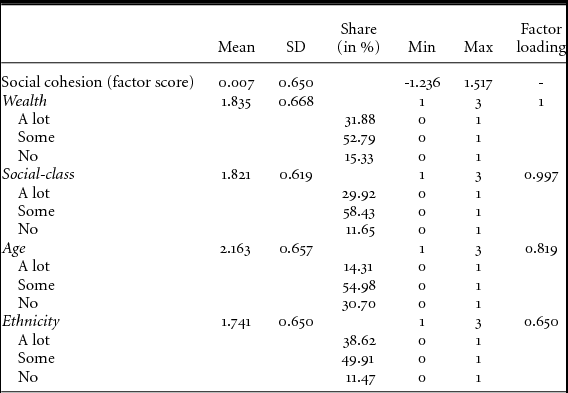
For the purposes of our analysis, we treated social cohesion as the (perception of) micro-level interactions between individuals and groups within their country. Such perceptions may be a better indicator of what shapes an individual's behaviours and actions than objective measures, such as crime levels or education. Thus, we operationalised social cohesion as a low degree of perceived social tensions among key socio-economic groups, including the poor and the rich (wealth), managers and workers (social class), old and young people (age), and different racial and ethnic groups (ethnicity). Respondents to the Eurobarometer were asked to indicate whether they perceive tensions between each of those social groups in their country. More precisely they were asked: ‘In all countries there sometimes exists tension between social groups. In your opinion, how much tension is there between each of the following groups in (YOUR COUNTRY)?’. Answer possibilities ranged between ‘A lot of tensions’ (1), ‘Some tensions’ (2), and ‘No tensions’ (3). We assume that, the lower the degree of tensions between indicated groups, the higher the perceived social cohesiveness of a given country.
Consistent with prior research, we regarded social cohesion as a latent concept (e.g., Andrews et al., Reference Andrews, Jilke and Van de Walle2014), and thus constructed a social cohesion index consisting of all four mentioned foci. For the construction of the latent variable, we used confirmatory factor analysis (for an overview see Kline, Reference Kline2010) using the statistical software Mplus (version 6.12; see also Muthén and Muthén, Reference Muthén and Muthén2012: 62). A robust weighted least squares estimator was employed to deal with the ordered categorical nature of our factor indicators (see Muthén Reference Muthén1984; Muthén et al., Reference Muthén, du Toit and Spisic1997; but see Kline, 2011: 180–181). In their simulation study, Flora and Curran (Reference Flora and Curran2004) point out the positive performance of the robust weighted least squares estimator when dealing with measurement models that come from ordinal factor indicators. Furthermore, a full information estimator was used to incorporate all items into the measurement model where there is at least one available data point for one of the four items (see also Little and Rubin, Reference Little and Rubin2002). Observations with missing data for all four items were deleted (148 respondents in total).
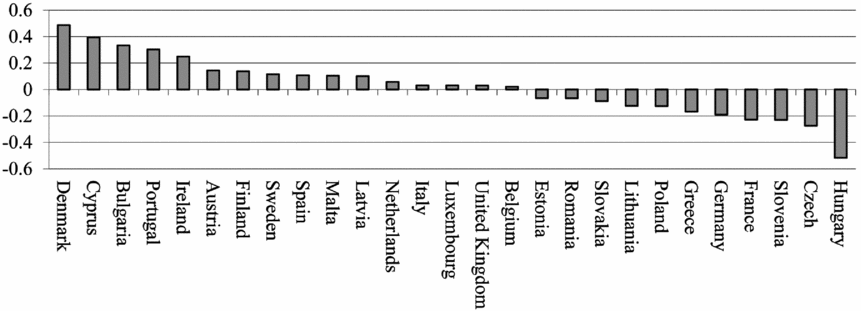
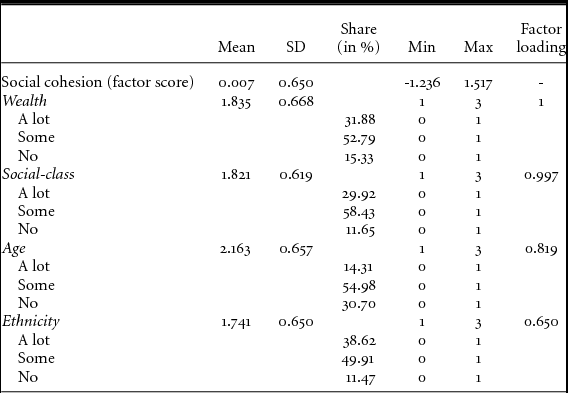
Table 1 indicates that each measure of inter-group tensions loads on to a single latent trait of social cohesion. A Cronbach's alpha of 0.70 confirms the internal scale reliability of this social cohesion index. Figure 1 provides an overview of perceptions of social cohesion across European countries. We can see that there are clear cross-national differences. For example, in Denmark, Cyprus, Bulgaria and Portugal we find high levels of perceived social cohesion, while in the Czech Republic and Hungary they are very low. These variations are comparable to those for the ‘acceptance of diversity’ indicator presented in Dragolov et al's (Reference Dragolov, Ignácz, Lorenz, Delhey and Boehnke2013) comprehensive international social cohesion rankings. Interestingly, like the ‘acceptance for diversity’ ranking, our ranking diverges from other measures of social cohesion, such as interpersonal trust, in some slightly unexpected ways with, for example, Bulgaria and Portugal scoring highly, while France and Germany don't do quite so well.
Citizens’ perceptions of social cohesion
Social cohesion in Europe (N = 26,487)

Independent variables
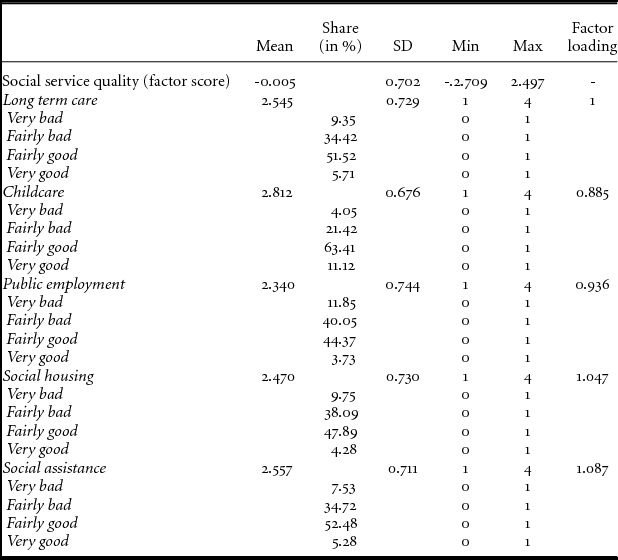
In order to assess citizens’ evaluations of social services, respondents were asked to indicate their perceptions of service quality for a variety of key services, including long-term care, child care, public employment, social housing, and social assistance. More precisely, respondents were asked ‘Thinking about the quality of . . . in (OUR COUNTRY), would you say that it is very good, fairly good, fairly bad, or very bad?’ This results in a four-point Likert scale measure of service quality for each service under consideration. We assume that the measures do not just reflect evaluations of specific services, but are more general evaluations about the quality of social services in a given country (see also Kumlin, Reference Kumlin2009 for a similar approach). Hence citizens' perceptions of social service quality are regarded as a latent concept. Indeed, all items are highly correlated with each other and a Cronbach's alpha of 0.85 exemplifies its high internal reliability. Thus, we used all five items to construct a measure of social service quality by extracting factor scores using factor analytical techniques by means of a weighted least squares estimator (the same method as for our dependent variable). To deal with item non-responses, a full information estimator was employed. Observations with missing data for all four items were deleted (2,124 respondents in total) prior to the analysis. Similar results were observed when the sample was restricted solely to respondents with no prior experience of using any of the services in question (available on request).
Given substantial cross-national disparities in income levels and the cost of living across Europe, it is important to utilise an indicator that represents the relative levels of experienced economic strain across the EU. As indicated by reference group theory, individuals generally judge their own economic situation by comparing their own conditions with that of relevant others (Runciman, Reference Runcimann1966). In this regard, respondents to the Eurobarometer 74.1 were asked to indicate on a six-point Likert scale how comfortable they felt taking into account their total household income. Specifically, they were asked: ‘A household may have different sources of income and more than one household member may contribute to it. Thinking of your household's total monthly income, is your household able to make ends meet. . .?’. Answer possibilities ranged from ‘Very easily’ to ‘With great difficulty’. We used this specific item on individuals’ self-perceived economic strain in our subsequent analysis. Measures of this type have been used in several prior studies (e.g., Andrews et al., Reference Andrews, Jilke and Van de Walle2014; Blekesaune, Reference Blekesaune2013).
Control variables
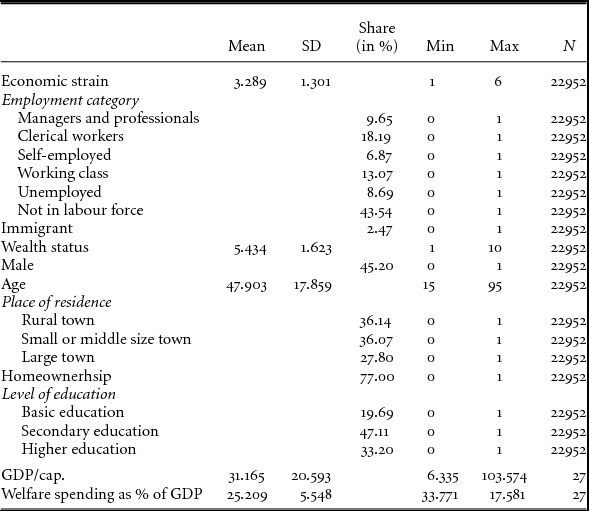
We controlled for a wide range of possible confounders that might have an influence on the relationships we studied (see Table 3). First, we controlled for respondents’ wealth to parse-out the effects of economic strain from those simply associated with lower household resources, which are also anticipated to have a negative relationship with social cohesion. In this regard, respondents’ wealth status was measured by asking them to indicate on a 10-point Likert scale, ranging from very poor to very wealthy, where they would situate the economic situation of their household. In addition, we controlled for peoples’ current employment status. Here, respondents were grouped into seven categories: managers and professionals, clerical workers, self-employed, working class, unemployed, and not in the labour force. Prior research highlights that the unemployed, especially, are less likely to feel part of society (e.g., Dieckhoff and Gash, Reference Dieckhoff and Gash2015) and therefore more apt to experience ‘sour grapes’.
Perceptions of social service quality
Descriptive statistics
Measures of age (continuous), gender and the type of community individuals live in (rural town, small or medium town, large town) were also included in the statistical models. Older people and men tended to feel more socially included (Dieckhoff and Gash, Reference Dieckhoff and Gash2015), while individuals residing in urban areas may be more accepting of social diversity than rural residents (Gorodzeisky and Semyonov, Reference Gorodzeisky and Semyonov2009). Controlling for educational status, we grouped respondents according to their age when they left full-time education. Those who indicated that they had no formal education or exited the educational system at the age of 15 or younger were regarded as having completed basic or no formal education. Those between 16 and 19 years were categorized as having finished secondary education and those older than 20 as having finished higher education. Respondents who were still studying were assigned to one of the three categories in correspondence with their age. Education is consistently associated with a range of positive social attitudes (e.g., Dieckhoff and Gash, Reference Dieckhoff and Gash2015). Finally, whenever a respondent had a different nationality from the country where he/she currently lived, we coded them as an immigrant. Theories of segmented assimilation suggest first-generation immigrants may have a particularly positive view of the society to which they have migrated (Zhou, Reference Zhou1997).
At the country level we controlled for economic factors that may impact respondents’ perceptions of social tensions by including a measure of GDP per capita in 2010. This enabled us to parse-out the net-effects of economic strain from those simply associated with a poor economic situation within the country as a whole. Furthermore, we accounted for the amount of welfare contributions by the state, which may influence levels of social capital (van Oorschot and Arts, Reference van Oorschot and Arts2005). Thus we included a measure of the total expenditure on social protection in 2010 as a percentage of a country's GDP. Descriptive statistics for all the variables included in the statistical modelling are shown in Table 3.
We estimated hierarchical linear regression models, with individuals (level 1) being nested in countries (level 2). This approach not only allowed us to take into account potential clustering effects between individuals from the same country, but also explicitly deals with unobserved heterogeneity between countries via random intercepts and random slopes (Steenbergen and Jones, Reference Steenbergen and Jones2002). Basically, we modelled variance at the individual- and country-level so that we get:
 $$\begin{equation}
Y_{ij} = \beta _{0j} + \beta _1 X_{1ij} + \varepsilon _{ij}\end{equation}$$
where
 $$\begin{equation}
\beta _{0j} = \beta _0 + \mu _{0j}\end{equation}$$
Here, Yij is the individual level dependent variable for individual i (= 1,. . .,N) nested in country j (= 1,. . .,J) – in our case that is citizens’ perceptions of social cohesion. X 1ij is an individual-level covariate (such as perceptions of the quality of social services, or economic strain), εij the individual-level residuals and μ0j the country-level disturbance term. Such random intercepts as in equation (2), can be introduced not only for the regression intercept, but also for individual covariates so that we have varying country intercepts and slopes within a single model.
Results
A series of two-level linear regression models were estimated to assess the independent and combined effects of social service quality and economic strain on citizens’ perceptions of social cohesion. First, the null model was estimated to evaluate how much variation in respondents’ perceived social cohesion was attributable to differences across countries, and whether multilevel modelling is actually needed (model 0). In the next model, we looked at the individual effects of our control variables on perceptions of social cohesion using a random intercept model (model 1). We then estimated the linear effects of social service quality on social cohesion including all control variables (model 2). Conforming with our theoretical expectations we then included a squared term of service quality (model 3). Furthermore, to account for unobserved heterogeneity in country differences that may affect the relationship between service quality and social cohesion, we included random slopes for our measures of social service quality. In model 4 we added a measure of economic strain to our model. In our final model (model 5) an interaction term between service quality and economic strain was added to investigate the combined effect of both predictors on social cohesion. All continuous variables were mean-centred before being entered into the models; estimations were executed using Stata 12.0 and its ‘xtmixed’ routine.
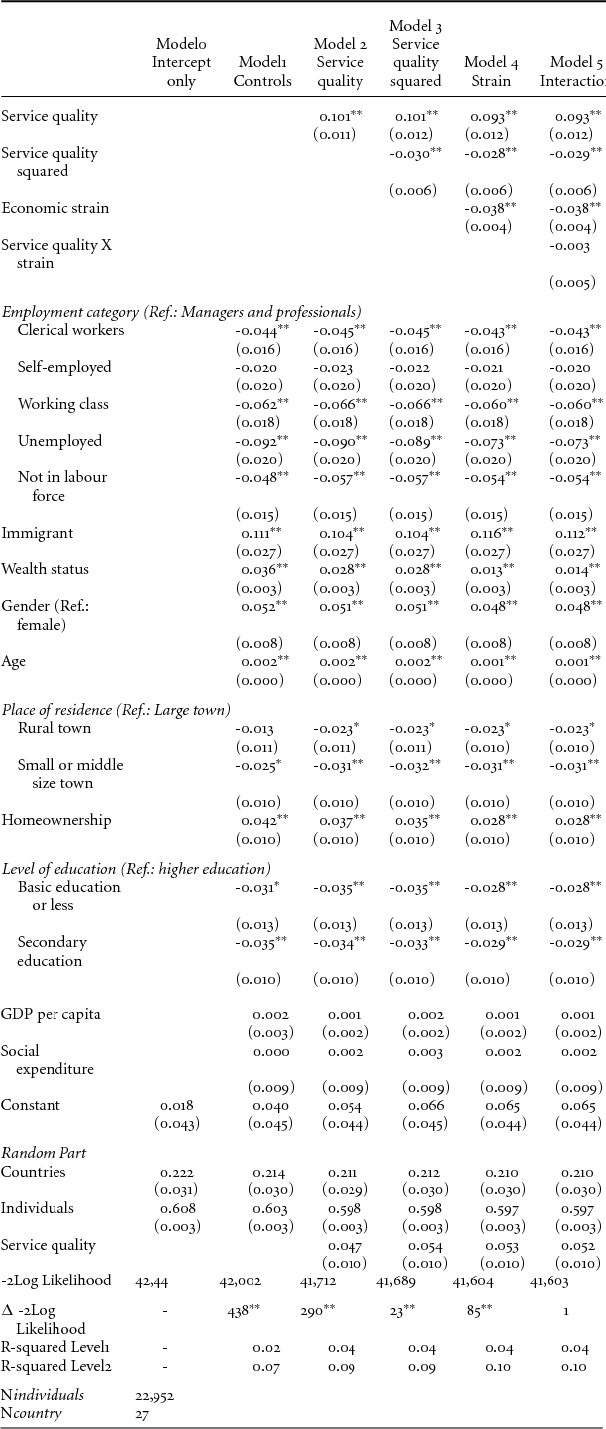
Table 4 provides an overview of our results. The intercept only model displays an intraclass correlation of 0.12, which means that 12 per cent of the total variation in peoples’ perceptions of social cohesion can be attributed to country differences. Moreover, comparing our null model with a non-hierarchical linear model reveals a significant improvement in model fit (-2Log likelihood difference of 2,718, statistically significant at a 99 per cent level). This indicates that respondents are, indeed, not independent from each other, and that multilevel modelling techniques are needed for this kind of nested data structure.
Two-level linear models of social cohesion
** p< 0.01, * p<0.05, + p<0.1.
Model 1 displays the effects of our control variables. As anticipated, we find that individuals who are unemployed or not part of the labour force have more negative perceptions of social cohesion than respondents who work as managers, or professionals. The same holds true for those people who are part of the working class and clerical workers: their views on social tensions are significantly more negative than the views of managers, or professionals – as previous research suggests is the case for attitudes towards immigration (Gorodzeisky and Semyonov, Reference Gorodzeisky and Semyonov2009). When considering immigrants, we can see that people who have not been born in their country of residence have significantly more positive perceptions of social cohesion, when compared to their native counterparts, which confirms the arguments made by theorists of segmented assimilation (Zhou, Reference Zhou1997). As for our other control variables, as expected, wealthier individuals perceived there to be fewer tensions between different social groups, as did older people, men and homeowners. Also, respondents living in large towns, compared to rural, or small- or middle-size towns, have significantly more positive views of social cohesion, as do people with higher levels of education – both findings that accord with our theoretical expectations. Although the coefficients for our two country level controls – GDP and welfare spending – point in the anticipated direction, neither are statistically significant. All of which suggests that micro-level determinants of social cohesion may be more important than macro-level determinants.
Overall, the model displays acceptable fit values, with an R-squared of 0.02 and 0.07 at the individual and country level respectively, as well as indicating an improvement in model fit over the null model in terms of the -2Log likelihood. In a next step, we added our linear measure of social service satisfaction to the equation, and allowed it to vary across country slopes (random slopes). It significantly improved our model fit compared to model 1. The model shows that citizen satisfaction with social services is positively related to perceptions of social cohesion. Following that, we included a squared term of social service satisfaction (model 3), which further improved the model fit. Moreover, model 3 confirms the hypothesised individual effects of service quality on social cohesion. When social services are regarded as of good quality, individuals have significantly more positive perceptions of social cohesion within their societies. However, the negative and statistically significant squared term indicates that there may be decreasing marginal effects of service quality on cohesion.
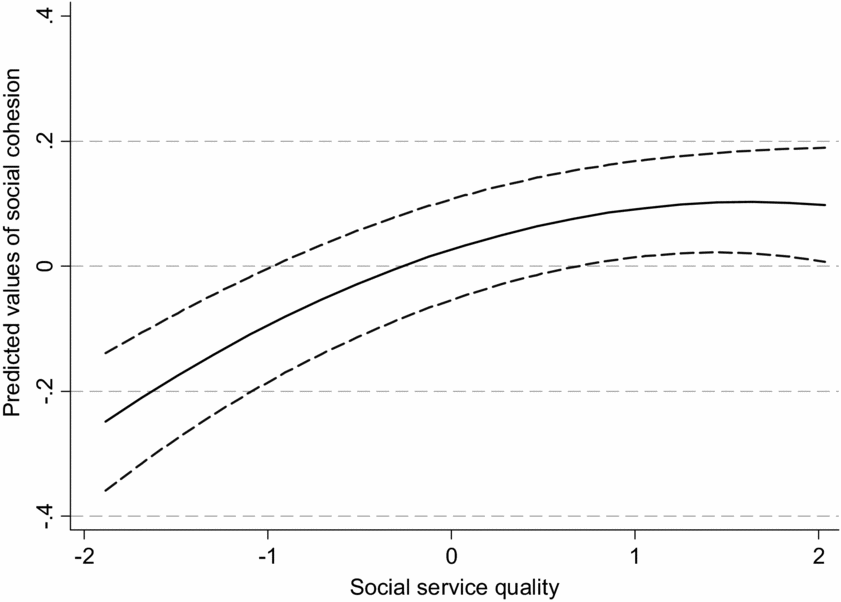
To examine the decreasing marginal effect of social service quality on social cohesion in more detail, it is useful to estimate those marginal effects. In this regard, Figure 2 displays the predicted values of social cohesion at different levels of service quality for all the countries, holding the model's covariates constant at their mean values. From the Figure we can see that, once service quality gets to be ‘good enough’, a one unit improvement in quality has no further effect on perceptions of social cohesion. Thus, after a certain point, the better service quality gets, the less salient its positive relationship with social cohesion eventually becomes. Importantly though, the tipping-point for diminishing marginal returns to emerge lies at 1.64 on the social service satisfaction factor score, and less than two per cent of our sample (344 individuals) expressed such high satisfaction levels. All of which suggests that the provision of high-quality social services may be a remarkably reliable means for building social cohesion.
Predicted values of social cohesion contingent on social service quality (95 per cent confidence intervals).
In model 4 we added economic strain to our equation. Including random slopes for strain did not yield a significant change in model fit, thus we proceeded without including them. However, the inclusion of strain as such improved the model fit, and resulted in a R-squared of 0.04 and 0.09 at the individual and country level respectively. Regarding the effects of economic strain, we can conclude that it matters to individuals’ perceptions of social cohesion. Experiencing economic hardship is negatively related with perceptions of social cohesion. The effect is statistically significant, and of a non-trivial magnitude. An individual who faces high levels of economic strain perceives there to be on average 8 per cent less social cohesion than someone who experiences no economic strain at all.
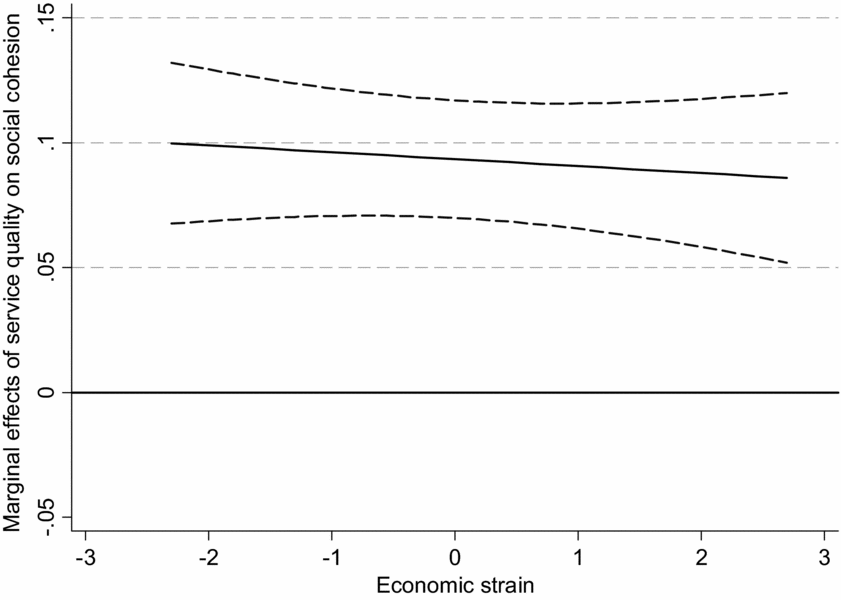
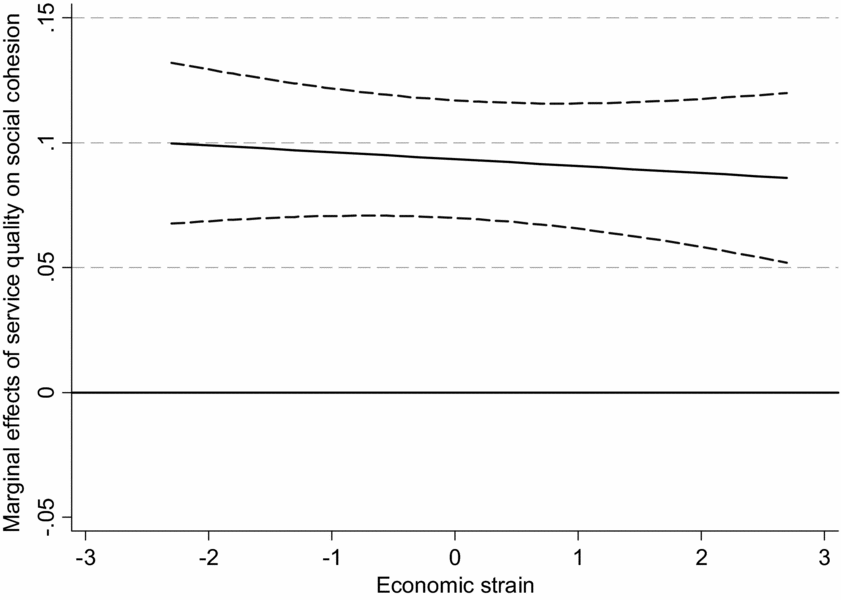
Turning to our final model (model 5), we examine the combined effects of economic strain and social service quality on social cohesion, investigating in particular whether strain weakens the positive association between social service quality and social cohesion. The inclusion of an interaction term between social service quality and economic strain did not lead to an improvement in model fit. Furthermore, the coefficient is only of weak magnitude and does not exhibit statistical significance, suggesting that the experience of economic strain does not influence the relationship between social services quality and social cohesion. These results can be further illustrated by figure 3, where we depict the marginal effects of service quality on social cohesion, contingent on different levels of economic strain, holding all other control variables constant at their mean values. The figure points in a similar direction: economic strain does not moderate the service quality-cohesion relationship. Thus we have to conclude that both predictors, perceptions of social services quality and economic strain, have substantive individual effects on perceptions of social cohesion, but not any combined effect. Or, put differently, that economic strain does not undermine the potential for social services quality to make a positive contribution to the cohesiveness of society.
Marginal effects of social service quality contingent on economic strain (95 per cent confidence intervals).
Discussion
The statistical results we present suggest that there is a positive relationship between social services quality and perceptions of social cohesion – though with some evidence of decreasing marginal effects at high quality levels. At the same time, perceptions of social cohesion are negatively associated with economic strain, even when controlling for other relevant personal characteristics and circumstances. Nevertheless, the largely positive effect of social service quality on social cohesion did not appear to be influenced by the experience of having difficulty making ends meet. For people satisfied with the social services that they received, economic strain made it no more or less likely that they would perceive tensions between different social groups within their country.
Our study builds on institutional theories of social capital providing a rare test of the connection between the quality of social services and inter-group tensions in European societies. Although prior studies have explored the importance of welfare expenditure and universal versus particularistic welfare policies for social cohesion, that research has tended to focus on interpersonal trust as a measure of cohesion (e.g., van Oorschot and Arts, Reference van Oorschot and Arts2005; Lee, Reference Lee2013), rather than the relations between different social groups. Our analysis of the Eurobarometer 74.1 data provides qualified support for previous work, draws inspiration from institutional theories of social capital and highlights that the quality of the welfare state can make an important positive contribution to societal cohesiveness within European countries – though this contribution may eventually exhibit diminishing marginal returns.
The statistical results indicate that perceived economic hardship is associated with worsening social relations, thereby affirming the insights of reference group theory regarding the role that social comparison plays in shaping societal outcomes. Not only is the actual income of individuals an important micro-level determinant of perceptions of social cohesion, but their relative experience of economic strain also shapes the way in which they perceive inter-group relations. That said, the findings do provide succour for supporters of social citizenship by illustrating that, although economic strain is associated with increased social tensions, this is not sufficient to disrupt the positive contribution that social services can make to the cohesiveness of European societies.
Although our study analyses a broad, nationally representative, sample of the adult population of 27 EU member countries, it has important limitations. First, we cannot confidently rule-out that there are other important respondent level factors that we may have omitted from our empirical analyses. Further analysis (available on request) revealed respondents’ life satisfaction and optimism towards life did not affect the results we present However, other personal attributes may be relevant, such as altruism (Kearns et al., Reference Kearns, Bailey, Gannon, Livingston and Leyland2014) and social dominance orientation (Pratto et al., Reference Pratto, Sidanius, Stallworth and Malle1994), which we cannot analyse on this occasion. Second, it could be argued that instead of social service quality and economic strain influencing perceptions of social cohesion, it could be the other way around. While we cannot test this alternative proposition with the data we have to hand, theoretically we can derive the direction of causality from two well-established bodies of literature: a) institutional theories of social capital, and b) reference group theory, which clearly suggest that our predictors of interest directly affect perceptions of social cohesion, and not the other way around. Nevertheless, future studies are advised to employ research designs such as time-series analytical techniques, or (quasi-)experimental designs, which can more effectively differentiate between cause and effect. In addition, subsequent research should seek to analyse multiple indicators of cohesion, distinguishing, in particular, between norms-based aspects of cohesiveness, such as community identification, and relational aspects, such as inter-group relations.
With these methodological caveats in mind, we believe our study has important policy implications. Efforts to improve the quality (or performance) of social services may have benefits beyond those immediately felt by recipients of the services themselves, making a vital contribution to social solidarity and the experience of citizenship within European societies. Interventions designed to drive service standards upwards within social care, child care, employment services, housing and welfare may therefore achieve more than just the improvement of organisational functioning. This wider societal gain is something that merits much more extended consideration, and it would be fascinating to investigate which types of policies, initiatives and reforms result in the greatest positive pay-off for inter-group relations. Interestingly, it may be the case that those interventions likely to result in improved responsiveness and ‘customer satisfaction’ are also the ones that have the greatest impact on social cohesion. In this respect, the ‘personalisation’ agenda and the development of a social investment state may, in the right circumstances, be an apt response to the crisis in European welfare states (Van Kersbergen and Hemerijk, Reference Van Kersbergen and Hemerijck2012; Taylor-Gooby, Reference Taylor-Gooby2011). At the same time, it is important to note that the benefits of social service quality for social cohesion may eventually evaporate, suggesting that it might also be possible to make some kind of judgement about the service standards (and hence investment) required to sustain a cohesive society. Further research that sought to identify the optimal levels of service and social investment would cast valuable light on this important issue.
Conclusion
This study has indicated that social services quality has an important role to play in enhancing perceptions of social cohesion amongst citizens across Europe. It also highlights that the relationship between social services quality and inter-group relations is not influenced by the experience of economic hardship. Ultimately, this implies that more should be done to understand and support the work that social service organisations can undertake to incorporate all social groups within the welfare state. Previous research suggests that, for the personalisation of social services, in particular, to work it requires that diverse local actors responsible for its implementation work very closely together (Power, Reference Power2014) and that street-level bureaucrats develop new skills and capabilities essential for improving the quality of their interactions with clients (Toerien et al., Reference Toerien, Sainsbury, Drew and Irvine2013). How, and in what ways these goals can be achieved against the backdrop of fiscal austerity in many countries remains a major challenge for policy-makers at all levels of government.