INTRODUCTION
Agricultural expansion caused by the high demand for food and biodiesel is the principal factor contributing to deforestation in tropical regions (Malhi et al. Reference MALHI, GARDNER, GOLDSMITH, SILMAN and ZELAZOWSKI2014, Tilman et al. Reference TILMAN, FARGIONE, WOLFF, ANTONIO, DOBSON, HOWARTH, SCHINDLER, SCHLESINGER, SIMBERLOFF and SWACKHAMER2001). In recent years, the cultivation of one crop, oil palm (Elaeis guineensis Jacq.), has been expanding at an annual rate of 9% worldwide, driven by the demand for low-cost vegetable oils for food-processing and biofuels (Fitzherbert et al. Reference FITZHERBERT, STRUEBIG, MOREL, DANIELSEN, BRÜHL, DONALD and PHALAN2008, Malhi et al. Reference MALHI, GARDNER, GOLDSMITH, SILMAN and ZELAZOWSKI2014). In Brazil, the production of palm oil is concentrated in the eastern Amazon basin, in particular in the state of Pará, where in 2014 an estimated total of 329000 ha was planted with E. guineensis (Villela et al. Reference VILLELA, JACCOUD, ROSA and FREITAS2014).
Most of the research into the effects of oil palm plantations on local biodiversity has been conducted in Asia, and shows major impacts on species richness and the structure of biological communities (Aratrakorn et al. Reference ARATRAKORN, THUNHIKORN and DONALD2006, Azhar et al. Reference AZHAR, LINDENMAYER, WOOD, FISCHER, MANNING, MCELHINNY and ZAKARIA2013, Fitzherbert et al. Reference FITZHERBERT, STRUEBIG, MOREL, DANIELSEN, BRÜHL, DONALD and PHALAN2008, Koh Reference KOH2008, Savilaakso et al. Reference SAVILAAKSO, GARCIA, GARCIA-ULLOA, GHAZOUL, GROOM, GUARIGUATA, LAUMONIER, NASI, PETROKOFSKY, SNADDON and ZRUST2014). Similarly, in the eastern Amazon, recent studies show that these plantations reduce the species richness and alter the composition of the assemblages of aquatic insects (Heteroptera) (Cunha et al. Reference CUNHA, MONTAG and JUEN2015), frogs (Correa et al. Reference CORREA, JUEN, RODRIGUES, SILVA-FILHO and SANTOS-COSTA2015) and birds (Lees et al. Reference LEES, MOURA, ALMEIDA and VIEIRA2015).
In Pará State, oil palm plantations are considered to be a low-impact land-use and may substitute native vegetation of riparian forests and legal reserves in smallholdings (Lees et al. Reference LEES, MOURA, ALMEIDA and VIEIRA2015). However, this crop cannot be considered low-impact and cannot substitute native forest vegetation for large property owners, because it affects communities as intensively as cattle pasture (Lees et al. Reference LEES, MOURA, ALMEIDA and VIEIRA2015). Oil palm plantations are homogeneous environments characterized by a less complex structure (Fitzherbert et al. Reference FITZHERBERT, STRUEBIG, MOREL, DANIELSEN, BRÜHL, DONALD and PHALAN2008), while natural forest is heterogeneous and capable of supporting a greater variety of niches, which support a more complex local biodiversity (Tews Reference TEWS, BROSE, GRIMM, TIELBÖRRGER, WICHMANN, SCHWAGER and JELTSCH2004).
Functional diversity is considered to be one of the most ecologically relevant measures of biodiversity (Tilman Reference TILMAN and Levin2001), due to the fundamental role of this parameter in the maintenance and functioning of community-level ecological processes (Díaz & Cabido Reference DÍAZ and CABIDO2001, Petchey & Gaston Reference PETCHEY and GASTON2006, Tilman Reference TILMAN and Levin2001). This measure estimates the differences among organisms directly, based on their functional characteristics, and incorporates the ecological similarities among the species that coexist in a given community (Petchey & Gaston Reference PETCHEY and GASTON2006, Tilman Reference TILMAN and Levin2001).
Understanding the implications of land-use change for functional diversity of birds is essential, given that these animals contribute a range of ecosystem services, including pollination (Bawa Reference BAWA1990, Luck et al. Reference LUCK, CARTER and SMALLBONE2013), seed dispersal (Pizo & Galetti Reference PIZO, GALETTI, Von Matter, Straube, Accordi, Piacentini and Cândido2010) and predation (Perfecto et al. Reference PERFECTO, VANDREMEER, BAUTISTA, NUÑEZ, GREENBERG, BICHIER and LANGRIDGE2004), as well as occupying a wide range of ecological niches (Şekercioğlu Reference ŞEKERCIOĞLU2012). Thus, the objective of the present study was to verify the functional structure of bird communities in forested habitats and in oil palm plantations in the eastern Brazilian Amazon region. Our hypothesis is that the bird communities in plantations are functionally more similar than expected by chance due to low niche variability in this habitat, while in forested areas bird communities are functionally more different than expected by chance. In addition, we test the hypothesis that the functional diversity of birds in areas of forest is higher than in plantations, given that forested habitats support bird assemblages with diverse functional characteristics.
METHODS
Study area
The study area was located within the Agropalma agro-industrial complex (02°36′18″S, 48°47′06″W; Figure 1), which consists of 64000 ha of legal reserve (fragments of rain forest) and 39000 ha of oil palm plantations. The company has Roundtable on Sustainable Palm Oil (RSPO) certification, which implies that the production process respects various environmental requirements. The forest fragments were between 5000 and 17000 ha, and were dominated by unflooded (terra firme) forests (Bolfe & Batistella Reference BOLFE and BATISTELLA2011, Portes et al. Reference PORTES, CARNEIRO, SCHUNCK, SILVA, ZIMMER, WHITTAKER, POLETTO, SILVEIRA and ALEIXO2011). The fragments can be considered well-preserved since they are protected and monitored by the company and no logging and hunting is allowed.
Map of Brazil showing the state of Pará (hatched), sampled sites in Agropalma agro-industrial complex (a) and survey experimental design (b). Squares represent sites in forest and triangles are those located in oil palm plantations.

The present study focused on 16 plots, eight of which were located in oil palm plantations, and eight in adjacent fragment of native forest. The plantation plots were established within the areas planted exclusively with Elaeis guineensis and all oil palm plots included at least one stream (Figure 1). The inclusion of watercourses in the study plots was based on the fact that riparian forest is a protected type of habitat under Brazilian legislation and provides potential corridors for dispersal between forest fragments (Develey & Pongiluppi Reference DEVELEY and PONGILUPPI2010, Hawes et al. Reference HAWES, BARLOW, GARDNER and PERES2008, Lees & Peres Reference LEES and PERES2008). The portion of each plot that included the stream margins comprises a buffer zone of natural vegetation, with a width of 10–30 m on each side of the stream. Outside this zone, the plot is composed entirely of oil palm plantation (10–15 y).
Sampling of the birds
The bird fauna was sampled using an adapted point count method (Blondel et al. Reference BLONDEL, FERRY and FROCHOT1970, Vielliard et al. Reference VIELLIARD, ALMEIDA, ANJOS, SILVA, Von Matter, Straube, Accordi, Piacentini and Cândido2010), in May and December 2012, with all the plots sampled during each campaign. At each plot a set of 10 sample points was established, separated by a distance of 200 m from one another, at which 10-min counts were conducted. In the plantation areas, eight point counts were conducted in oil palm plantations and two point counts next to each of the margins of the stream. In total, we sampled 32 points in riparian forest, 128 in oil palm plantations and 160 in forested habitats.
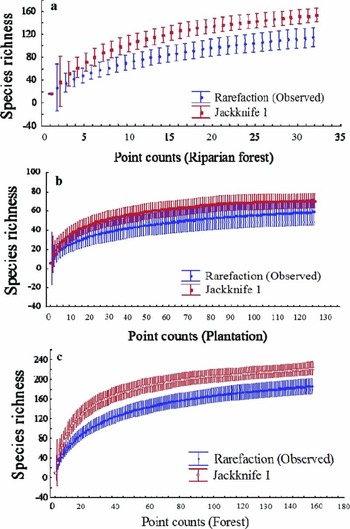
The number of individuals of each species observed and/or heard within a radius of 50 m of the observer was recorded between 05h00 and 10h30. Considering the narrow width of the riparian buffer and the risk of double counting, our experienced ornithologists (PVC and MPDS) recorded only the species within the limits of the riparian forest. Despite the difference in the number of point counts, the species accumulation curves indicated asymptotic tendency for the three treatments (Appendix 1).
Functional traits
To quantify functional diversity, 17 functional traits were used for each species, following Wilman et al. (Reference WILMAN, BELMAKER, SIMPSON, DE LA ROSA, RIVADENEIRA and JETZ2014). They were related to diet (1 – invertebrates; 2 – mammals, birds; 3 – reptiles, amphibians; 4 – fish; 5 – vertebrates – general or unknown (for species where it was not clear what kind of vertebrates were being eaten), 6 – scavenge, garbage, carcasses, carrion; 7 – fruit, drupes; 8 – nectar, pollen, plant exudates, gums; 9 – seed, maize, nuts, spores, grains; 10 – other plant material), foraging stratum (water, ground, understorey, mid to high levels, canopy, aerial) and body mass (geometric mean of average values provided for both sexes). Diet and foraging stratum were based on estimated percentage usage of each category as determined by the literature (Wilman et al. Reference WILMAN, BELMAKER, SIMPSON, DE LA ROSA, RIVADENEIRA and JETZ2014).
Additionally, four biometric parameters were established for each species (length, height, and width of the beak, and the length of the tarsus), given their relationship with the foraging strategies adopted by the species and the types of resource it exploits. These measurements were obtained from the ornithological collection of the Goeldi Museum in Belém, Pará, Brazil. Three male specimens of each species were measured using a digital caliper with a precision of 0.1 mm, and three readings of each measurement were taken from each specimen, with the mean of these three values being used for analysis. The specimens were selected based on the proximity of their collecting localities to the geographic location of the present study.
Data analysis
A matrix presenting the 21 functional characteristics of each species was constructed and converted into a similarity matrix using Gower's measure of distance (Pavoine et al. Reference PAVOINE, VALLET, DUFOUR, GACHET and DANIEL2009). Then a functional dendrogram was produced using the UPGMA clustering approach. Values of functional diversity (FD), which are the sum of the branches of the functional dendrogram, were calculated in the pd function of the FD package in the R environment (Laliberté & Legendre Reference LALIBERTÉ and LEGENDRE2010). To test whether oil palm plantations affect functional diversity of birds the FRic (functional richness) was also calculated, which quantifies the volume of functional space occupied by the community irrespective of the species richness (Cornwell et al. Reference CORNWELL, SCHWILK and ACKERLY2006, Mouchet et al. Reference MOUCHET, VILLÉGER, MASON and MOUILLOT2010, Villéger et al. Reference VILLÉGER, MASON and MOUILLOT2008).
Species richness, FD and FRic were compared among treatments (forest, riparian forest and plantation) using one-way ANOVA test with intervals followed by a Tukey post hoc test to check for significant pairwise differences.
FD is one of the best parameters for the detection of the rules of composition under different scenarios of simulation (Mouchet et al. Reference MOUCHET, VILLÉGER, MASON and MOUILLOT2010), and has been widely used for the evaluation of the structural patterns of bird assemblages (Devictor et al. Reference DEVICTOR, MOUILLOT, MEYNARD, JIGUET, THUILLER and MOUQUET2010). To evaluate whether the species that make up an assemblage are functionally more similar to one another than expected by chance the standardized effect size (SES) of FD was calculated. This model (SES.FD) is the difference between the observed value of FD and the mean value of randomized assemblages, divided by the respective standard deviation of the 999 randomized values (see Sobral & Cianciaruso Reference SOBRAL and CIANCIARUSO2015 for similar application). The analysis and the randomizations were run in the picante package of the R environment using ses.pd with the taxa.label argument for the null models (Kembel et al. Reference KEMBEL, COWAN, HELMUS, CORNWELL, MORLON, ACKERLY, BLOMBERG and WEBB2010).
To test whether the SES values calculated for the bird communities in the forests, riparian forest and plantation were higher (i.e. functional overdispersion) or lower (i.e. functional clustering) than expected by chance Fisher's P was used (Whitlock Reference WHITLOCK2005), through function combine.test in survcomp package (Schroeder et al. Reference SCHROEDER, CULHANE, QUACKENBUSH and HAIBE-KAINS2011). This analysis combines the probabilities (P-values) from several independent tests upon the same null hypothesis (Whitlock Reference WHITLOCK2005). Then, to verify the relationship between richness and functional diversity, a Pearson's correlation between SES values and species richness was conducted.
To identify which functional characteristics were most associated to forested and plantation sites a classification tree using the traits was constructed (Breiman et al. Reference BREIMAN, FRIEDMAN, OLSHEN and STONE1984). The species recorded in the forest but absent in the plantation (absences) and the species present at plantation (presences) were considered. Thus, we can verify the functional attributes more strongly affected by oil palm plantations. In this case, we did not consider species recorded in riparian forest. The classification of the guilds was based on Wilman et al. (Reference WILMAN, BELMAKER, SIMPSON, DE LA ROSA, RIVADENEIRA and JETZ2014), who classified species that prefer 50% or more of a particular item of diet or foraging stratum to be specialists. Species that used the foraging stratum or dietary items in proportions smaller than 50% were classified as generalists. For diet items, the species were grouped according to dietary preference: fruits-nectar, invertebrates, seeds-plants, vertebrates and omnivores. Considering the foraging stratum, the species were classified in ground, understorey, mid to high levels, canopy, aerial, water and generalist.
Classification tree models were performed in rpart package of the R environment. Gini's impurity function was used as a division criterion, thus terminal nodes have the maximum homogeneity among all the possible traits. Cross-validation (10-fold cross-validation) was used to decide how much of the tree model to retain, i.e. the optimal tree size. For plotting rpart tree we used the rpart.plot package.
Spatial autocorrelation of bird composition was evaluated using Mantel's statistic (permutations = 999), performed in ade4 R package (Dray & Dufour Reference DRAY and DUFOUR2007), and there was no significant spatial autocorrelation of bird assemblages within (r = 0.009, P = 0.35) or between sites (r = 0.02, P = 0.40).
RESULTS
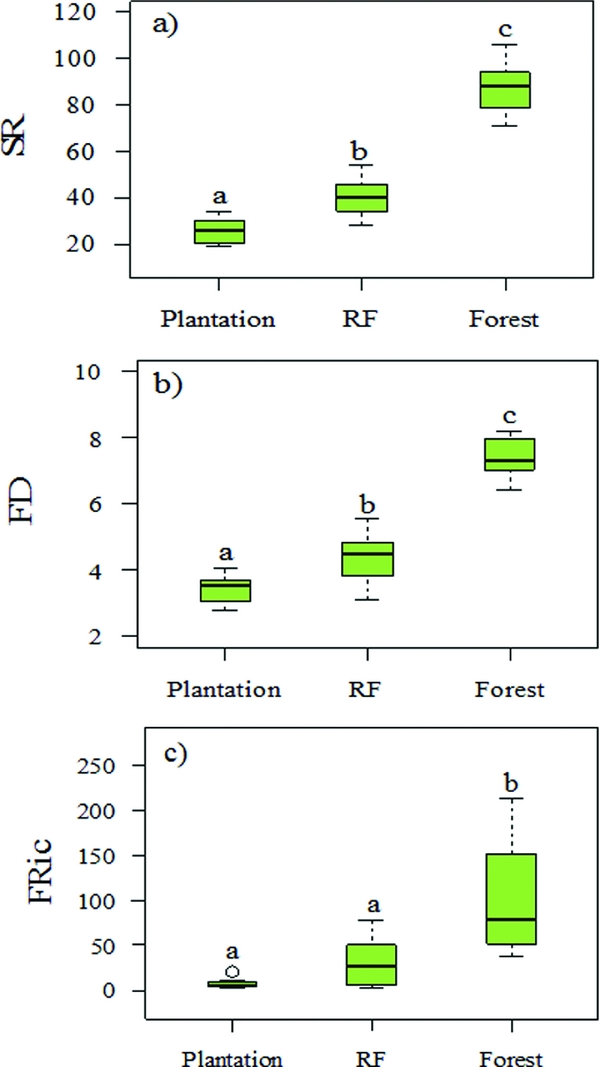
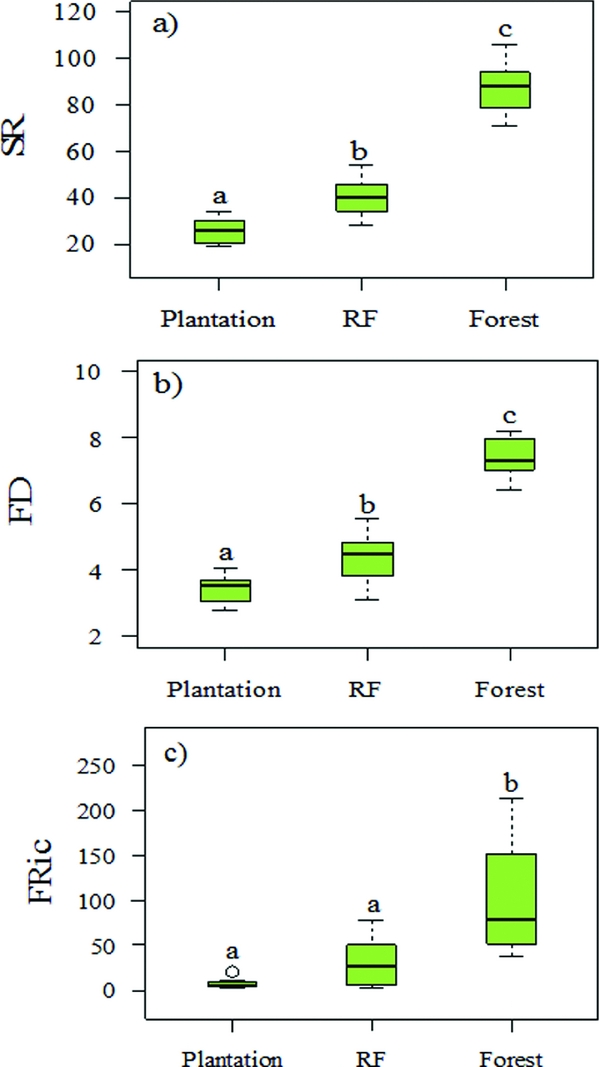
We recorded 248 bird species, including 185 species in the forested habitat, 116 in riparian forests and 58 in the oil palm plantations (for a full list see Appendix 2). The mean species richness was 87.2 ± 28 in the forest plots (N = 8, range = 71–106), 40.2 ± 8.7 in riparian forests (N = 8, range = 28–54), and 25.8 ± 5.7 in oil palm plantation (N = 8, range = 19–34), and these differences were significant between all treatments (F = 102, df = 21, P < 0.001; Figure 2a). The functional diversity (FD), in turn, was 2.1 and 1.7 times higher in the forest plots (mean = 7.41 ± 1.83, range = 6.43–8.18) in comparison with the plantation (mean = 3.43 ± 0.42, range = 2.78–4.05) and riparian forests (mean = 4.37 ± 0.78, range = 3.09–5.57), respectively. Furthermore, the FD was lower in the plantations when compared with riparian forest (F = 89.7, df = 21, P < 0.001; Figure 2b). The functional richness (FRic) was greater in forest plots (mean = 102 ± 56.2, range = 37.6–213) in comparison with the plantation (mean = 7.28 ± 5.71, range = 2.34–19.9) and riparian forest (mean = 30.7 ± 27.6, range = 2.74–78.1) (F = 11.9, df = 21, P = 0.01; Figure 2c). Nonetheless, FRic was not significantly different between plantation and riparian forest (P = 0.48).
Parameters of diversity recorded for the bird assemblages observed in forest habitats and oil palm plantations in eastern Amazon, state of Pará, Brazil: SR – Species richness (a), FD – Functional diversity (b), and FRic – Functional richness (c). The middle line represents median, lower and upper bounds of box plots represent 25th and 75th percentiles (first and third quartiles, respectively), whiskers shows minimum and maximum values. Values indicated with different letters are significantly different (according to a Tukey test 95%).
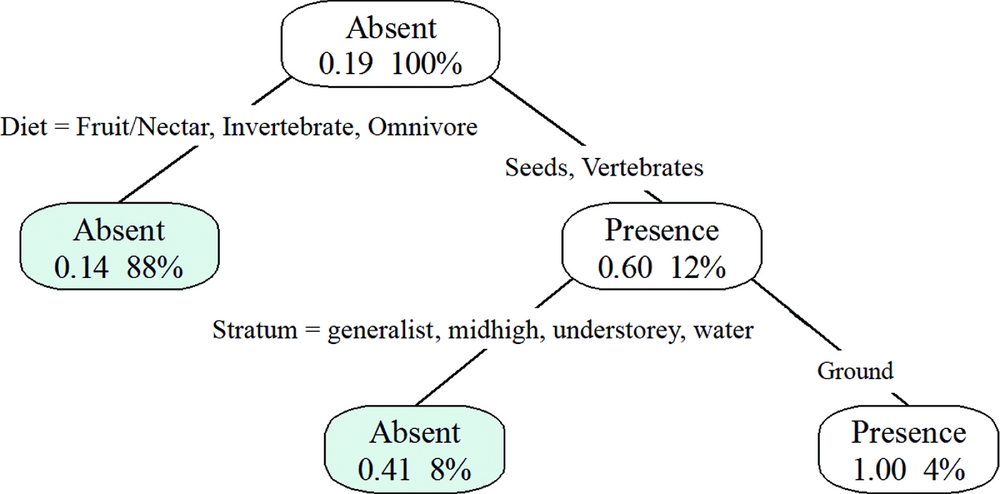
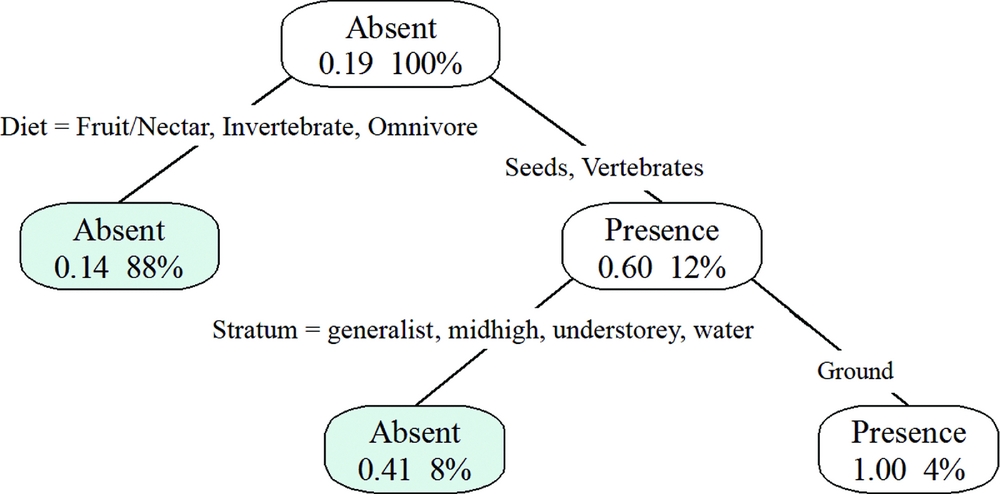
The most important variables associated with the presence or absence of forest birds in the palm plantation were diet (44%) and foraging stratum (19%). Therefore, these variables were used in the model. Other characteristics (body mass, length of tarsus, length of beak, height of beak and width of beak) contributed with 10%, 9%, 8%, 8% and 2%, respectively. According to this model, the species that feed on fruits, nectar, invertebrates or have a varied diet (omnivorous) had a 14% probability of being absent in the oil palm. On the other hand, those that eat seeds (granivorous), vertebrates and feed on the ground had a 100% probability of occurring in oil palm plantation. However, those with similar diet (seeds and vertebrates), but foraging in the understorey, in the water, in the middle and high stratum, or being a generalist for foraging strata had a 41% probability of being absent from oil palm (Figure 3).
Classification tree showing the functional characteristics most associated with the presence and absence of bird species in oil palm plantation in eastern Amazon, state of Pará, Brazil. The values in the terminal branches represent the proportion of species persisting or absent in plantation, considering the total number of species with the functional characteristics of the branch, and the percentage (%) of species that have the functional features of each of the terminal groups.
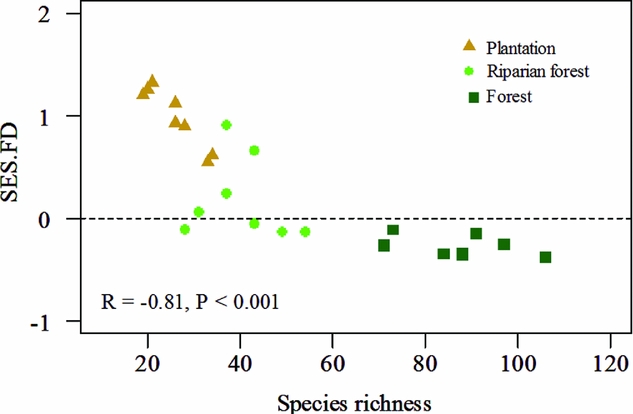
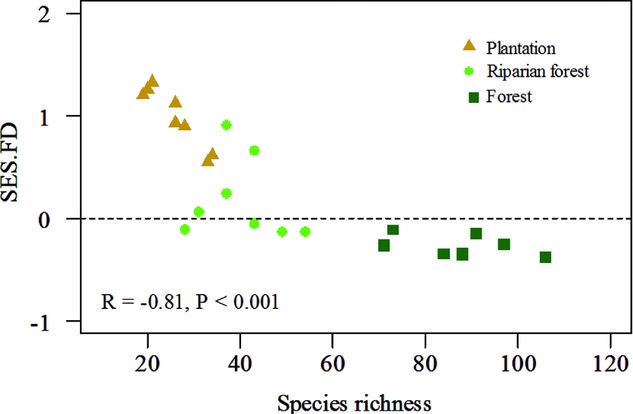
Bird communities in forest areas returned values of functional diversity equal to that expected by chance indicating random functional structure (Fisher's P = 0.24). Riparian forests, in turn, showed random structure to both clustering (Fisher's P = 0.45) and functional overdispersion (Fisher's P = 0.11). By contrast, the indices recorded for the plantation indicated functional overdispersion (Fisher's P < 0.001), that is, the species had functional characteristics more different than expected by chance. In general, bird communities with higher species richness (forested habitats) had a tendency to be functionally clustered, namely, the species were more similar to each other in relation to the set of traits (R = −0.81, P < 0.001, Figure 4).
Relationship between species richness of birds in forest, oil palm plantation and riparian forest and their respective standardized effect size of functional diversity (SES.FD) in eastern Amazon, state of Pará, Brazil. Values greater than zero indicate functional overdispersion while values lower than zero indicate functional clustering.
DISCUSSION
The Amazon rain forest in Brazil is highly threatened by illegal logging, mining and agriculture, including oil palm plantations (Lees et al. Reference LEES, MOURA, ALMEIDA and VIEIRA2015, Vieira et al. Reference VIEIRA, TOLEDO, SILVA and HIGUCHI2008, Villela et al. Reference VILLELA, JACCOUD, ROSA and FREITAS2014). Although it is known that in eastern Amazon these plantations retain impoverished avian communities (Lees et al. Reference LEES, MOURA, ALMEIDA and VIEIRA2015), the present study is the first assessment of how oil palm plantations affect functional diversity in the Brazilian Amazon. Here we found that oil palm plantations negatively affect the functional diversity of birds. This result is supported by similar studies in Australia, Borneo and the New World, which showed that agriculture is the land use that most reduces functional diversity in birds (Edwards et al. Reference EDWARDS, EDWARDS, HAMER and DAVIES2013, Reference EDWARDS, EDWARDS, LARSEN, HSU, BENEDICK, CHUNG, VUN KHEN, WILCOVE and HAMER2014; Flynn et al. Reference FLYNN, GOGOL-PROKURAT, NOGEIRE, MOLINARI, RICHERS, LIN, SIMPSON, MAYFIELD and DECLERCK2009, Luck et al. Reference LUCK, CARTER and SMALLBONE2013), dung beetles (Edwards et al. Reference EDWARDS, EDWARDS, LARSEN, HSU, BENEDICK, CHUNG, VUN KHEN, WILCOVE and HAMER2014) and mammals (Flynn et al. Reference FLYNN, GOGOL-PROKURAT, NOGEIRE, MOLINARI, RICHERS, LIN, SIMPSON, MAYFIELD and DECLERCK2009), while logging (Edwards et al. Reference EDWARDS, EDWARDS, HAMER and DAVIES2013) and wildfire (Hidasi-Neto et al. Reference HIDASI-NETO, BARLOW and CIANCIARUSO2012) did not cause significant declines.
We found that forest fragments and riparian forests had higher functional diversity (FD) and functional richness (FRic) than plantations. Similarly, in Colombia, FD and FRic were higher in remnant forests than in oil palm plantation and in pasture (Prescott et al. Reference PRESCOTT, GILROY, HAUGAASEN, URIBE, FOSTER and EDWARDS2016). These results indicate that conversion of forest to oil palm plantations represents a great loss of functional strategies (Azhar et al. Reference AZHAR, LINDENMAYER, WOOD, FISCHER, MANNING, MCELHINNY and ZAKARIA2013). This could be explained by the lower complex structure and lower niche variability in oil palm plantations (Fitzherbert et al. Reference FITZHERBERT, STRUEBIG, MOREL, DANIELSEN, BRÜHL, DONALD and PHALAN2008), thus accommodating bird assemblages with limited functional characteristics (Edwards et al. Reference EDWARDS, EDWARDS, HAMER and DAVIES2013, Hutchinson Reference HUTCHINSON1957).
The conversion of the forest into monocultures may result in a series of changes in the functional structure and interspecific interactions of a community (Şekercioğlu Reference ŞEKERCIOĞLU2012). In the present study, the functional traits most affected by oil palm were those related to diet and foraging stratum. Oil palm plantations did not support species that use different foraging stratum (for example, the understorey) while in forested habitats vertical stratification allowed the coexistence of many bird species (Lovejoy Reference LOVEJOY1974). Besides that, tropical forest birds exhibit a high degree of specialization (Rosenberg Reference ROSENBERG1990). For example, frugivorous and nectarivorous birds (e.g. Trogonidae, Psittacidae and Trochilidae) and understorey insectivorous birds (e.g. Thamnophilidae, Formicariidae) are more closely associated with the forested habitats and are highly sensitive to changes in the environment (Galetti & Aleixo Reference GALETTI and ALEIXO1998, Şekercioğlu Reference ŞEKERCIOĞLU2006, Zanette et al. Reference ZANETTE, DOYLE and TRÉMONT2000). Granivorous birds, in turn, are favoured in open areas where grasses proliferate, providing an important and accessible feeding resource (Wiens & Johnston Reference WIENS, JOHNSTON, Pinowski and Kendeigh1977). In natural habitats, omnivorous birds can contribute to ecosystem stability given their ability to vary feeding strategies, and their role as additional predators prevents the rapid population expansion of the prey (Fagan Reference FAGAN1997, Namba et al. Reference NAMBA, TANABE and MAEDA2008, Şekercioğlu et al. Reference ŞEKERCIOĞLU, DAILY and EHRLICH2004).
Although the functional richness did not differ between plantation and riparian forests, we found that these forested areas helped to maintain the functional diversity of Amazonian birds. By contrast, Edwards et al. (Reference EDWARDS, HODGSON, HAMER, MITCHELL, AHMAD, CORNELL and WILCOVE2010) studied taxonomic diversity of birds in fragments of logged forest (0.7–87 ha) surrounded by oil palm, contiguous logged forest, and oil palm plantations in Borneo, and they verified that fragments had a species composition more similar to that of oil palm than of contiguous forest. Furthermore, the spatial juxtaposition of fragments and oil palm in the landscape had little effect on the bird diversity (Edwards et al. Reference EDWARDS, HODGSON, HAMER, MITCHELL, AHMAD, CORNELL and WILCOVE2010).
Other studies showed that forest remnants found in the vicinity of oil palm plantations constitute an important refuge for some forest-dwelling birds in the oil palm matrix (Azhar et al. Reference AZHAR, LINDENMAYER, WOOD, FISCHER, MANNING, MCELHINNY and ZAKARIA2013, Koh Reference KOH2008, Prescott et al. Reference PRESCOTT, GILROY, HAUGAASEN, URIBE, FOSTER and EDWARDS2016). In this case, the connectivity between the riparian forests and adjacent forest fragments is essential for the maintenance of the ecosystem services in Amazonian forests, buffering the effects of the frequent changes in land use.
Here, we observed that the negative SES values indicated small functional distances between the species that coexist in the forest areas, though the functional structure of these communities was random (Fisher's P > 0.05). In addition, an increase in the number of species can promote functional clustering in Amazonian forest birds. This may be accounted by the greater environmental complexity of forested habitats and the consequent increase in the availability of resources allowing the coexistence of ecologically similar species (Cornwell et al. Reference CORNWELL, SCHWILK and ACKERLY2006, Tews et al. Reference TEWS, BROSE, GRIMM, TIELBÖRRGER, WICHMANN, SCHWAGER and JELTSCH2004). In this case, the random loss of some of the species found in these areas of forest may not necessarily result in any loss of functional diversity or alterations in ecosystem function (Edwards et al. Reference EDWARDS, EDWARDS, HAMER and DAVIES2013, Elmqvist et al. Reference ELMQVIST, FOLKE, NYSTROM, PETERSON, BENGSTON, WALKER and NORBERG2003, Luck et al. Reference LUCK, CARTER and SMALLBONE2013, Petchey et al. Reference PETCHEY, EVANS, FISHBURN and GASTON2007).
The tendency towards functional redundancy (high functional similarity) was also found for dung beetles within primary forest in Borneo (Edwards et al. Reference EDWARDS, EDWARDS, LARSEN, HSU, BENEDICK, CHUNG, VUN KHEN, WILCOVE and HAMER2014), as well as in Amazonian birds (Hidasi-Neto et al. Reference HIDASI-NETO, BARLOW and CIANCIARUSO2012) and forest bird assemblages in Brazilian savanna (Sobral & Cianciaruso Reference SOBRAL and CIANCIARUSO2015). Prescott et al. (Reference PRESCOTT, GILROY, HAUGAASEN, URIBE, FOSTER and EDWARDS2016) also found higher levels of functional redundancy of bird assemblages in forests than in oil palm. On the other hand, bird assemblages from forests disturbed by wildfires and of oil palm plantations have the tendency to be functionally overdispersed (Edwards et al. Reference EDWARDS, EDWARDS, HAMER and DAVIES2013, Hidasi-Neto et al. Reference HIDASI-NETO, BARLOW and CIANCIARUSO2012).
Nevertheless, in oil palm plantations bird assemblages were functionally overdispersed because the reduction of resources may have promoted the occurrence of more functionally unique species. Functional redundancy is low when many of the species found in the community are functionally unique (that is, their traits do not overlap) and, in the case of this study, the loss of species has major implications for the functioning of the ecosystem (Luck et al. Reference LUCK, CARTER and SMALLBONE2013).
It is important to consider that despite the knowledge that many bird species are dependent on riparian forest (Develey & Pongiluppi Reference DEVELEY and PONGILUPPI2010), the proximity between plantation and riparian forest may have enabled spillover of forest birds at the edge and these were recorded within the plantations. Land-use intensification has led to a landscape mosaic that juxtaposes human-managed and natural areas and the probability of spillover effect will only increase, especially in systems that differ in resource availability (e.g. oil palm plantation vs. riparian forest) (Blitzer et al. Reference BLITZER, DORMANN, HOLZSCHUH, KLEIN, RAND and TSCHARNTKE2012). In this context, Prescott et al. (Reference PRESCOTT, GILROY, HAUGAASEN, URIBE, FOSTER and EDWARDS2016) found that there was spillover of FD and FRic from forest fragments into oil palm and pasture. Thus, in a landscape that has no forest fragments near the plantations, we would expect to see lower functional diversity values (Prescott et al. Reference PRESCOTT, GILROY, HAUGAASEN, URIBE, FOSTER and EDWARDS2016).
We found that oil palm plantation causes great losses in FD and FRic and affects functional groups that are more sensitive to environmental perturbation. Thus, it would be better to produce oil palm in areas where there is no risk of forest conversion (e.g. abandoned cattle pasture) (Bastos et al. Reference BASTOS, MULLER, PACHECO, SAMPAIO, ASSAD and MARQUES2001). As a mitigation measure, we suggest the creation of forested buffer zones around the oil palm plantation and protection of the remnant forest patches in the landscape, because the tropical landscape needs to be designed in recognition of its biodiversity, economic and livelihood needs (Koh Reference KOH2008, Koh et al. Reference KOH, LEVANG and GHAZOUL2009).
Overall, the results of the present study indicate that the layout of oil palm plantations in the Amazon basin should include the maintenance of tracts of forest in areas adjacent to the plantations, as well as riparian forests within the plantation, as a means of connecting these tracts. In addition, future studies must consider the functional groups most affected when evaluating the response of communities to modifications in the environment, given that the potential for a more refined analysis will be lost when the species are considered to be equivalent to one another.
ACKNOWLEDGEMENTS
This study was supported financially by Conservation International, the Agropalma Group, the U.S. Agency for International Development (USAID) – Biodiversity and Socio-Economic Impacts of Palm Oil Bioenergy Development in the Brazilian Amazon, and the Fundação Amazônia Paraense de Amparo à Pesquisa (FAPESPA). We are grateful to CAPES (the Brazilian Higher Education Training Program) for providing a doctoral stipend to SMA, a master's stipend to MRC and LCS, and Propesp-UFPA for manuscript translation. The Brazilian National Research Council (CNPq) provided PVC with a graduate stipend, and LJ (process 303252/2013-8) with research fellowships.
Species rarefaction curves per point count considering avian assemblage in riparian forest (a), oil palm plantation (b) and forest habitats (c) in eastern Amazon, state of Pará, Brazil.

Systematic list (following Piacentini et al. Reference PIACENTINI, ALEIXO, AGNE, MAURÍCIO, PACHECO, BRAVO, BRITO, NAKA, OLMOS, POSSO, SILVEIRA, BETINI, CARRANO, FRANZ, LEES, LIMA, PIOLI, SCHUNCK, AMARAL, BENCKE, COHN-HAFT, FIGUEIREDO, STRAUBE and CESARI2015) of bird species recorded in the forest (For), riparian forests (RF) and oil palm plantation (Pla) in Agropalma agro-industrial complex, state of Pará, Brazil.