International comparisons of living standards are often conducted using data on labor productivity or GDP per capita, while national debates on living standards are frequently conducted in terms of real wages. Since real wages and labor productivity do not always yield the same picture, there is a need for a unified approach to the international comparison of living standards, which covers both real wages and labor productivity.
Recently, a broad consensus has been reached regarding the comparative performance of the British and German economies during the second half the nineteenth century and the first half of the twentieth century, taking labor productivity as the measure.Footnote 1 At the outset, Germany lagged behind in all three main economic sectors—agriculture, industry, and services—but its industrial labor productivity converged towards British levels at the turn of the century and hovered around British levels until World War II.Footnote 2 In agriculture and services, Germany lagged behind throughout the period. Consequently, economy-wide labor productivity was lower in Germany than in Britain.Footnote 3 Any remaining disagreements in this area are now relatively minor, and do not affect the qualitative conclusions.Footnote 4
In a perfectly competitive world, we would expect comparative real wages to reflect comparative labor productivity levels in each sector as well as at the aggregate level. In practice, however, there are good reasons to expect a wedge between real wages and real labor productivity, for at least three reasons.Footnote 5 First, if the economies are not fully competitive, differences in the markup between the countries and over time can induce varying deviations of wages from marginal productivity. Second, the bargaining power of firms versus workers can also vary between countries and over time. This affects the wage-productivity relation since the wage is a weighted average of the average product of labor and its opportunity costs, with the weight of the former being equal to the workers’ bargaining power.Footnote 6 Third, labor adjustment costs can also drive a wedge between the marginal product of labor and the wage, since the marginal costs then include the wage, the adjustment costs, and the future expected adjustment costs.
The historical literature suggests that these theoretical reasons indeed affected the relationship between wages and labor productivity in Britain and Germany. The impact of cartels on the economic development of Imperial Germany is an evergreen of economic history and these cartels might have led to a higher markup in Germany compared to Britain. Moreover, increased bargaining power and resulting changes in the labor share were a key element in the “Borchardt controversy” about the origins of high unemployment and weak investment in interwar Germany.Footnote 7
Beyond theoretical reasons, simple measurement differences might result in differences between comparative labor productivity and comparative real wages within sectors. First, real labor productivity is compared using purchasing power parities (PPPs) from the output side, whereas real wages are usually compared using expenditure side PPPs. If all goods and services were tradable without barriers, the two PPPs should be equal. However, if some goods or services are not freely tradable and if the degree of trade barriers is different for consumers compared to producers, the two PPPs can deviate from each other. Second, the time series of real wages are generated using consumer price indices, whereas the time series of real labor productivity are generated using wholesale price indices or volume indicators. For the same reasons as in the case of PPPs, wholesale and consumer price indices can deviate from each other.
Most of the recent work on comparative living standards in Britain and Germany during the nineteenth and twentieth centuries has been based on income per capita or output per employee, neglecting the functional distribution of income and therefore the comparative level of real wages. By contrast, the evolution of real wages and the functional distribution of income have played significant roles in national debates over the standard of living, as illustrated by a number of controversies. In the British literature, the controversy over the development of real wages during the Industrial Revolution shows little sign of quietening down, while the extent of poverty in the first half of the twentieth century continues to be hotly debated.Footnote 8 On the other hand, there is no such “standard of living controversy” in Germany and it is generally accepted that German real wages increased substantially during the late nineteenth and early twentieth centuries.Footnote 9 Moreover, most authors agree that Germany improved its international competitiveness as a low-wage country and benefited from technological innovation in a number of science-based industries.Footnote 10 In addition, there has been a major debate in Germany over the loss of competitiveness after World War I and over the extent to which real wages were too high compared to labor productivity.Footnote 11 A full understanding of comparative standards of living therefore requires an analysis of both real wages and labor productivity within a unified framework.
This article provides this unified perspective on comparative living standards by offering an overview of the development of both real wages and labor productivity in Britain and Germany over the period 1871–1938. More specifically, we first calculate benchmarks of the comparative real wages in the two countries by comparing nominal incomes using purchasing power parities from the expenditure side for 1905 and 1937. We then estimate the comparative real wage of the two countries for the period 1871–1938 using national time series of wages and consumer prices. For the economy as a whole, German real wages were around three quarters of the British level during the 1870s and remained at this level until the early 1890s, before then converging to around 83 percent of the British level by 1913. German real wages fell back to around three quarters of the British level during the first half of the 1920s, and although there was a recovery during the late 1920s, this was quickly followed by the Depression of the 1930s, which hit German workers much more severely than their British counterparts. During the Nazi period, the German real wage recovered to around 85 percent of the British level in 1937, the year of our second benchmark.
Throughout the period 1871–1938, then, the average British worker was substantially better off than the average German worker, but the scale of the British lead varied over time and across sectors. For the aggregate economy, the real wage gap was about the same as the labor productivity gap, but there were substantial differences across the main sectors. Compared to their productivity, German industrial workers were poorly paid, while German service sector workers were very well remunerated. This affected the competitiveness of the two countries in these sectors. In particular, the substantial rise of German industrial unit labor costs over the 1913–1925 period was heavily discussed during the Borchardt controversy.Footnote 12 Our results confirm Knut Borchardt's finding that comparative unit labor costs indeed increased substantially in Weimar Germany compared to the prewar period, particularly in industry. However, by considering levels as well as rates of change of both real wages and labor productivity on a comparative basis, we are able to show that German industrial workers were still poorly paid in an international perspective, given their relatively high productivity.
There were also differences in comparative real wages by skill level. Whilst most occupational groups were better paid in Britain, unskilled British industrial workers were as badly paid as their German counterparts before World War I, and this helps to explain the persistence of large pockets of poverty in Europe's highest wage economy at a time of full employment.Footnote 13 This changed with the improvement in the position of unskilled workers across World War I, although poverty remained a problem in interwar Britain because of a sharp increase in unemployment.Footnote 14
BENCHMARK ESTIMATES OF COMPARATIVE REAL WAGES IN 1905 AND 1937
Our benchmark estimates for comparative real wages in 1905 and 1937 combine data from several sources. The main sources for the 1905 benchmark are enquiries of the British Board of Trade about the incomes and expenditures of working-class households in Britain and Germany.Footnote 15 The basic procedure is to compare money wages in the two countries by converting them to a common currency using a purchasing power parity obtained by comparing the prices of goods and services in the two countries, weighted by their importance in consumer expenditure. This is necessary because the exchange rate cannot be assumed to be a perfect guide to differences in prices between two countries, particularly when there are non-traded goods and services.Footnote 16 The German expenditure shares are taken from a comprehensive survey of 852 households conducted in 1907 by Germany's Imperial Statistical Office and the British expenditure shares are taken from the later detailed study of Alan Prest.Footnote 17 Our 1937 benchmark relies on British price data and budget shares assembled by Richard Stone and D. A. Rowe.Footnote 18 The German data are taken from a 1937 household survey conducted by the Arbeitswissenschaftliches Institut der Deutschen Arbeitsfront.Footnote 19
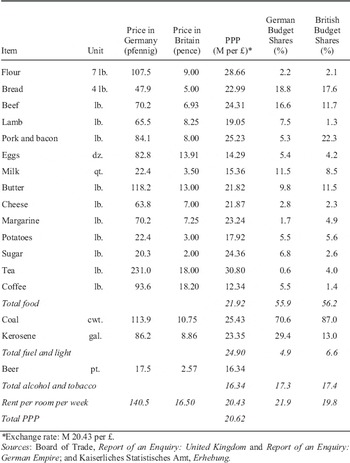
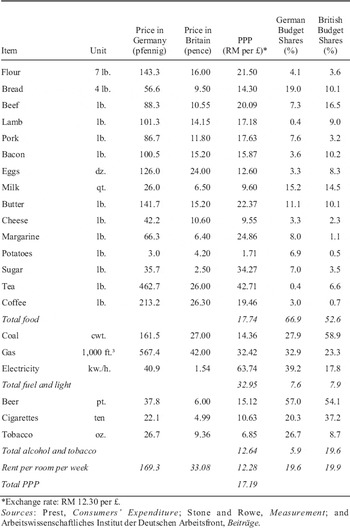
Tables 1 and 2 show the budget items included in our benchmark estimates of expenditure side PPPs, their prices in the two countries, and their shares. The rows showing the four main categories of food, fuel and light, alcohol and tobacco, and rent give the PPPs for the subcategories and the weights for each subcategory in total consumption.Footnote 20
EXPENDITURE SIDE PPP FOR 1905

*Exchange rate: M 20.43 per £.
Sources:
Board of Trade, Report of an Enquiry: United Kingdom and Report of an Enquiry: German Empire; and Kaiserliches Statistisches Amt, Erhebung.
EXPENDITURE SIDE PPP FOR 1937

*Exchange rate: RM 12.30 per £.
Sources:
Prest, Consumers’ Expenditure; Stone and Rowe, Measurement; and Arbeitswissenschaftliches Institut der Deutschen Arbeitsfront, Beiträge.
The PPP for 1905 is M 20.62 per £, only about 1 percent higher than the official exchange rate. For 1937, however, our expenditure side PPP is RM 17.19 per £, or nearly 40 percent higher than the official exchange rate of RM 12.30 per £. This is in line with the findings of Rainer Fremdling, Herman de Jong, and Marcel Timmer, who estimated a single deflated output side PPP of RM 18.40 per £ in 1935/36 for the manufacturing sector.Footnote 21 Jeffrey G. Williamson also found an expenditure side PPP of RM 18.08 per £ for 1927.Footnote 22 Moreover, it should be noted that Britain left the gold standard in 1931 and Germany introduced exchange controls at the same time.
We use the PPPs from Tables 1 and 2 to convert German money wages for 1905 and 1937 into £s and compare them with money wages in Britain. The German nominal income data are taken from Walther G. Hoffmann.Footnote 23 They are based on the income data collected by the compulsory accident insurance, and are provided here for the aggregate economy, the three major sectors, and a number of industrial and service subsectors. The British data for 1905 are taken from Charles Feinstein, who gives information about the average annual full employment earnings in 1911 for the major sectors and branches of the economy as well as employment in 1911 in those branches.Footnote 24 The benchmark estimate of money earnings in 1905 is obtained from Feinstein's 1911 benchmark, projected back to 1905 using Feinstein's wage index. The British data for 1937 are taken from Feinstein, drawing where necessary on Agatha Chapman for the sectoral breakdown.Footnote 25
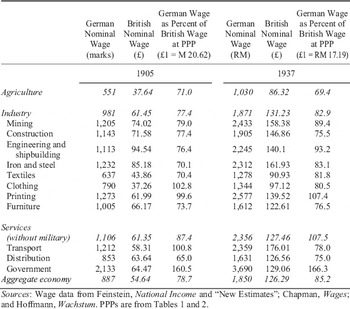
Table 3 shows the comparative wage income for Britain and Germany in the two benchmark years. For Germany, annual money wages for the aggregate economy were M 887 in 1905 and RM 1,850 in 1937. This compares to money wages in Britain of £54.64 and £126.29 in 1905 and 1937, respectively. Dividing the German money wages by the appropriate PPPs of M 20.62 per £ in 1905 and RM 17.19 per £ in 1937 and then by the British nominal incomes yields a comparative wage of 78.7 percent in 1905 and 85.2 percent in 1937 for a full-time equivalent employed worker in Germany.

Looking at the three sectors—agriculture, industry, and services—yields the results that German agricultural workers were comparatively poorly paid in 1905, whereas German service sector employees were comparatively well paid. Comparative wages in industry were about the same as comparative wages in the aggregate economy, although there was some variation across industrial branches, with German workers well remunerated relative to their British counterparts in clothing and printing. The high comparative wages in the German service sector partly reflected pay differentials for civil servants, with employees in the government sector receiving 160.5 percent of the income of British civil servants in 1905.Footnote 26 By 1937 German real wages had increased compared with their British counterparts in industry and especially in services, where real wages were now higher than in Britain. However, comparative Germany/U.K. real wages had fallen back slightly in agriculture.
TIME-SERIES PROJECTIONS OF COMPARATIVE REAL WAGES
In this section, we project the 1905 benchmark forwards and backwards using national real wage indices for the aggregate economy and the three major sectors of agriculture, industry, and services. The German nominal income data for the period 1871–1938 are taken from Hoffmann.Footnote 27 The British data for the period 1880–1913 are taken from Feinstein.Footnote 28 For the years 1871–1879 and 1913–1938 we use Feinstein's wage index, incorporating the minor adjustments presented in his later article.Footnote 29 The sectoral breakdown for the period 1920–1938 draws on Agatha L. Chapman as well as the nominal wage data in Feinstein.Footnote 30 To derive the German real wage index, we deflate the nominal earnings series from Hoffmann using Ashok Desai's consumer price index for the pre-1913 period and the official cost of living price index of the Statistisches Reichsamt for the period 1924–1938.Footnote 31 For Britain, the widely accepted consumer price index of Feinstein is used to deflate the nominal wage series.Footnote 32
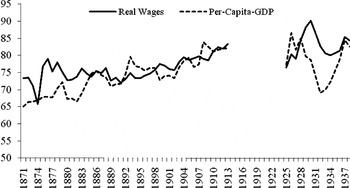
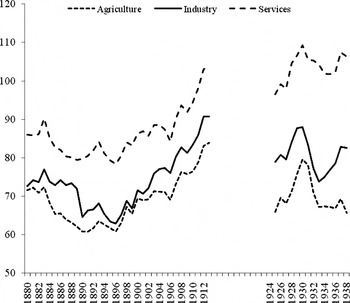
The results of the time-series projection of comparative Germany/U.K. real wages shown in Figure 1 are based on the 1905 benchmark. However, it should be noted that the results would not be substantially altered by projecting back from the 1937 benchmark, rather than projecting forward from the 1905 benchmark, since there is a high degree of consistency between the benchmarks and the time-series projections. Projecting forwards from the 1905 benchmark yields an estimate of the comparative Germany/U.K. real wage in 1937 of 83.3 percent, which is very close to the benchmark estimate of 85.2 percent, yielding a discrepancy of just 1.9 percentage points, well within the margins of error in this type of work.Footnote 33
COMPARATIVE GERMANY/U.K. REAL WAGE AND PER CAPITA INCOME (United Kingdom = 100)

It is helpful to consider the trends in comparative real wages for the aggregate economy in three main periods. First, between 1871 and 1891 there was no tendency for Germany to catch up on Britain in real wages, although there were significant cyclical fluctuations during this period. In particular, the Gründerkrise of the early 1870s had a sharp negative impact on the living standards of German workers. So also did the tariff on agricultural goods, which had a substantial impact on the cost of living. Between 1871 and 1891 money wages increased by 34 percent in Germany, but only by 19 percent in Britain. However, whereas the cost of living fell by 15 percent in Britain, it remained stable in Germany. It is difficult to avoid the conclusion that these divergent trends in the cost of living were related to the different reactions in Britain and Germany to the possibility of cheap grain imports from the United States.Footnote 34 For example, the price of bread remained constant in Germany from the early 1870s to World War I, whereas it declined by about one-third in Britain between the early 1870s and the early 1890s and remained constant thereafter.Footnote 35
Figure 1 graphs comparative GDP per capita. Over the period 1871–1938 as a whole, there is broad agreement between comparative living standards measured by both GDP per capita and the real wage. Nevertheless, there are some differences over shorter periods. In contrast to the stagnating comparative real wage between the early 1870s and the early 1890s, the trend in Germany/U.K. comparative GDP per capita was more clearly positive. This can be explained partly by the diverging trends of the price ratio of agricultural and industrial goods in Germany.Footnote 36 Between 1871 and 1891 the price index for German agricultural goods increased by about eight percent, whereas the price index for industrial goods decreased by about 26 percent. This led to downward pressure on real wages compared to real GDP per capita since agricultural goods had a higher weight in a consumer price index compared to the national product deflator. Moreover, diverging trends in labor force participation also played a part in explaining the gap between real wages and GDP per capita. Thus a high comparative real wage in Germany compared to Britain was consistent with a low comparative real per capita GDP so long as labor force participation was also lower in Germany. Labor force participation was in fact much higher in Britain than in Germany during the 1870s and 1880s, but both countries converged to similar levels over time. More specifically, British labor force participation decreased from 52.9 percent in 1871 to 48.6 percent in 1891, whereas German labor force participation increased from 42.3 percent in 1871 to 45.2 percent in 1891.Footnote 37 Therefore, the gap in labor force participation declined from 10.6 percentage points in 1871 to only 3.4 percentage points in 1891.
Between 1891 and 1913 there was a clear upward trend in the ratio of German to British real wages, from 72.1 percent to 83.3 percent of the British level. Although the cost of living rose more rapidly in Germany than in Britain during this period, money wages increased even more rapidly in Germany compared with Britain, confirming the hypothesis of a German catch-up to Britain during the Edwardian period.
There was a period of disorder between 1913 and 1925, during which German real wages suffered a major setback. By 1925 the comparative real income position of a German worker had fallen back to 76 percent of the British level versus 83.3 percent in 1913. Although Germany/U.K. comparative real wages recovered by 1928, the Great Depression hit Germany much more severely than Britain. The Germany/U.K. comparative real wage fell but staged a strong recovery during the Nazi period. In particular, the functional distribution of income changed substantially during the Great Depression and the Nazi recovery. From the late 1920s until the mid-1930s, comparative per capita income declined faster than comparative real wages, indicating a stronger impact of the Depression on profits than on wages. Thereafter, the picture reversed.
David Khoudour-Castéras has recently suggested that Bismarck's social legislation had an impact on German emigration before World War I, by providing “indirect wages” which need to be added to the “direct wages” considered so far.Footnote 38 The benchmark estimates of comparative real wages in Table 3 and the time-series projections in Figures 1 and 2 assume a similar ratio of taxes, social security benefits, unemployment, and working hours in the two countries. To what extent would the calculation of a “total wage,” including the indirect wage, change the picture?
In fact, the difference between direct wages and total wages including the net benefits of the social security system would be rather small, simply because workers paid contributions as well as receiving benefits. And to the extent that the costs of the social security system fell partly on firms as well as workers, they depended on distortionary taxation, the effects of which have to be set against any apparent excess of benefits over contributions experienced by workers. The first thing to note is that contributions and benefits were both tiny for the pre-1914 period, in Germany as well as in Britain. Khoudour-Castéras claims that the ratio of indirect to direct wages in Germany rose from just 2.55 percent in 1885 to 5.85 percent in 1913, but he only considered employees covered by the insurance scheme. Since most employees were not covered by the insurance scheme, indirect wages would be a much smaller percentage of the average wage for all workers. Indeed, the net transfer of income towards workers using the firms’ contributions and taxpayers’ money was less than 1 percent of wages until 1913.Footnote 39 During the interwar period, data published by the Statistisches Reichsamt show that net transfers were on average 3.2 percent of wages between 1925 and 1938.Footnote 40 Thus, redistribution schemes operated on a very small scale until World War II.
In 1913 average social security contributions in Germany were 3 and 4.8 percent for blue-collar and white-collar employees, respectively. In Britain before World War I, the shares of income taxes and national insurance contributions were somewhat lower than in Germany, with people earning less than £160 per year (around twice the average wage) paying no income tax in 1913.Footnote 41 Social security contributions were introduced in Britain only with the National Insurance Act of 1911, which applied to just 2.3 million largely skilled workers by 1914.Footnote 42 Furthermore, rates were low, working out at just 1.89 percent of income for someone on £150 per year.Footnote 43
For the interwar period, the social security system clearly became more important, but again our conclusion is that the net effect of benefits and contributions was small and within the margins of error of international comparative real wage data. In Germany, average social security contributions remained constant across World War I, with blue-collar and white-collar employees contributing 3 and 4.8 percent in 1924 as well as in 1913. Thereafter, social security contributions of both groups increased to about 8 percent in 1929, and finally to about 9 percent from 1933.Footnote 44 In addition, income taxes were substantially higher during the interwar period. Most employees paid no income taxes during the pre-1913 period, whereas the income tax rate for a married worker with two children and average income was about 4.5 percent in 1924 and 2–3 percent from 1925 until 1938. Thus, in Germany, taxes and social security contributions doubled from about 5 percent in 1913 to about 10 percent during the interwar period.Footnote 45 In Britain, those with incomes below £250 per year in 1937 (again around twice the average wage) paid 2.7 percent in all direct taxes, including income tax and national insurance contributions.Footnote 46
We also need to consider the impact of unemployment, since we are comparing full employment wages. In both countries, unemployment rates were very low during the pre-1914 period. Between 1900 and 1913 unemployment averaged about 4 percent in Germany and 4.4 percent in Britain.Footnote 47 For the interwar period, however, large differences emerged between the two countries. Between 1924 and 1938 the unemployment rate averaged 17.6 percent in Germany, fluctuating strongly.Footnote 48 In Britain, average unemployment was much higher than before the war, at 10.1 percent, but substantially lower than in Germany, particularly during the early 1930s.Footnote 49 German workers were therefore more strongly affected by unemployment than British workers during the interwar period. However, to the extent that the social security system provided insurance against unemployment, the comparative welfare effects of this would have been more limited than if the differential unemployment had occurred before World War I.
Turning to hours worked, Michael Huberman and Chris Minns suggest that Germans worked longer hours than Britons before World War I, but shorter hours between the wars.Footnote 50 In the United Kingdom, hours worked declined from 2,755 hours per year in 1870 to 2,656 hours in 1913, and further to 2,200 hours in 1938. The comparable figures for Germany are 3,284 hours in 1870, 2,723 hours in 1913, and 2,187 hours in 1938. German employees thus worked about 19 percent more than their British counterparts in 1870, about 2.2 percent more in 1913, but about 1 percent less in 1938. The 1913 and 1938 figures suggest that accounting for differences in hours worked would have little effect on comparative living standards, but the scale of the difference is more substantial in 1870. However, it should be noted that Huberman's study, on which these estimates for the earlier years are based, does not cover agriculture, which accounted for around half of all employment in Germany, compared with little more than 20 percent in Britain.Footnote 51 Furthermore, Huberman's study covers very few service occupations, with relatively well treated civil servants being a notable omission.
Taken together, the social security system, unemployment, and hours worked are not critical in an assessment of comparative living standards in Britain and Germany for the pre-1914 period. Although German workers did pay higher taxes and social security contributions and worked longer hours before 1914, they also received higher benefits. And more importantly, the magnitudes involved were relatively small. For the interwar period, although working hours became more similar in both countries, tax rates, social security contributions, and unemployment all became more significant in both countries and impacted more negatively on German workers than their British counterparts. Consequently, our calculations based on the gross earnings of full-time equivalent workers may overstate slightly the true welfare of German workers between the wars. However, it is important to bear in mind that it is the net effect of benefits and contributions which matters for the calculation of indirect wages.
REAL WAGES AND LABOR PRODUCTIVITY BY SECTOR
So far, we have used the annual time-series projections to provide annual estimates of comparative real wages for the economy as a whole. In fact, it is possible to do this at the level of the three main sectors. The sectoral data in Figure 2 show that German industrial workers received about the same proportion of the British real wage as the average across all sectors, while workers in German agriculture received less and German service sector workers received rather more. Indeed, by the outbreak of World War I, German service sector workers were better paid than their British counterparts, and this remained the case throughout the interwar period.
COMPARATIVE GERMANY/U.K. REAL WAGE BY SECTOR (United Kingdom = 100)

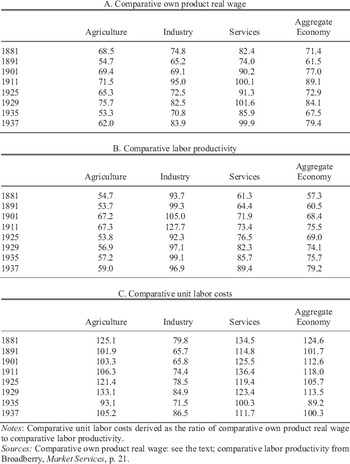
We now use the sectoral real wage data to analyze the relationship between comparative real wages and comparative labor productivity, deriving comparative unit labor costs in Table 4. This will enable us to address issues of the competitiveness of the German and British economies in the main sectors of the economy. To do this, however, it is necessary to compute comparative own product real wages for each sector, using producer prices rather than the consumer prices used in Table 3. Sectoral wholesale price indices are taken from Brian Mitchell for Britain and Statistisches Reichsamt for Germany.Footnote 52 For both countries, the wholesale price index for foodstuffs is used to deflate agricultural wages, the wholesale price index for materials is used to deflate industrial wages, while service sector and total wages are deflated by the overall wholesale price index. Comparative levels in 1905 are obtained using PPPs for industry from Broadberry and Burhop and for agriculture from Patrick O'Brien and Leandro Prados de la Escosura.Footnote 53 The PPP used for services and the aggregate economy is a weighted average of the PPPs for agriculture and industry, using the geometric means of the employment shares in Britain and Germany as weights.
GERMANY/U.K. COMPARATIVE UNIT LABOR COSTS

Notes:
Comparative unit labor costs derived as the ratio of comparative own product real wage to comparative labor productivity.
Sources:
Comparative own product real wage: see the text; comparative labor productivity from Broadberry, Market Services, p. 21.
The results are presented in the first panel of Table 4. Although there are some minor differences from the comparative real wages calculated using consumer prices, the broad pattern of comparative own product real wages is quite similar, with German service sector workers better remunerated than average, German agricultural workers less well remunerated than average, and German industrial workers receiving about the same proportion of the British real wage as the average across all sectors.
The second panel of Table 4 then sets out the data on Germany/U.K. comparative labor productivity for a number of years between 1881 and 1937, taken from Broadberry.Footnote 54 German labor productivity had converged to the British level in industry by the end of the nineteenth century, but Germany's overall labor productivity remained substantially lower because of a substantial productivity gap in agriculture and services. This sectoral pattern of comparative productivity performance persisted across World War I and throughout the interwar period. Combining this comparative productivity data with the information on comparative own product real wages yields the data on comparative unit labor costs in the third panel of Table 4. The ratio was around 100 for the aggregate economy in 1891, 1925, and 1937, indicating that over the long run, on average, German workers were remunerated broadly in line with their comparative productivity level.
It is interesting, however, to consider the ratio in the three main sectors. To the extent that comparative real wages were higher than comparative labor productivity, a sector was likely to have difficulty competing internationally. This seems to have been the case—with 1935 being the only exception—for German agriculture throughout the period, which is consistent with what we know about tariffs and high food prices in Germany. However, it was even more strongly the case for services, where we have already noted the comparatively high levels of remuneration in Germany. The economic effects of this were far reaching, since high service sector wages meant that Germany was internationally uncompetitive in private services, which remained a comparatively small part of the German economy.Footnote 55 Britain, by contrast, had a large, internationally competitive service sector throughout this period. In industry, however, the situation was exactly the opposite of that in services, with German workers poorly paid compared to their labor productivity. This resulted in difficulties for British industry, facing a strong competitive threat from German industry already during the “Made in Germany” scare of the 1890s.Footnote 56
Unit labor costs play a central role in the Borchardt controversy. Borchardt hypothesized that hourly industrial wages were higher in interwar Germany than in prewar Germany, whereas labor productivity was lower.Footnote 57 As a consequence of high unit labor costs, investment was low and unemployment high in Weimar Germany. Thus, high unit labor costs contributed to the downfall of Weimar Germany. Much of the early controversy remained tightly within the confines of Borchardt's framework, using alternative data to dispute the changes in labor productivity or real wages within Germany between 1913 and the 1920s.Footnote 58 Although a number of later contributions placed the debate within an international comparative framework, they continued to focus on rates of change of unit labor costs. Thus Theo Balderston claimed that the increase of unit labor costs compared to 1913 was lower in Germany than in Britain until 1927, and only became higher during 1928–1930, while Broadberry and Albrecht Ritschl argued that similar increases in unit labor costs in both Britain and Germany help to explain the failure of both countries to benefit from the catch-up possibilities opened up by rapid U.S. productivity growth.Footnote 59
A major innovation of this article is to provide for the first time data on comparative levels of unit labor costs, rather than indices of change. A further innovation is that we can distinguish between the three major sectors of the economy. These innovations allow us to confirm some aspects of Borchardt's view, but also to shed new light on the controversy. Thus our data confirm the view that unit labor costs in industry and agriculture grew faster in Germany than in Britain between 1911 and 1925 as well as between 1925 and 1929, but they also show that comparative unit labor costs declined in the service sector. Yet, it must be remembered that services was the least competitive sector during the prewar period and it was still uncompetitive during the interwar period, so that shifting labor from agriculture and industry into services contributed to the overall decline of German competitiveness. In addition, the industrial sector experienced only a modest increase of unit labor costs between 1911 and 1925. Furthermore, taking account of levels, it must be emphasized that German industrial unit labor costs were still substantially below British industrial unit labor costs in 1925 and 1929. Hence, although German industry did lose some of the advantage of cheap labor across World War I, it remained a low-wage industrial producer compared with Britain.
COMPARATIVE REAL WAGES BY OCCUPATION
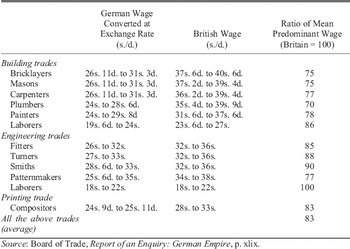
The Board of Trade conducted an enquiry into wages and the cost of living in Germany in 1905, and made a direct comparison between Britain and Germany in that year.Footnote 60Table 5 sets out the weekly money wages for a number of industrial trades. It is interesting to note that the ratio of German to British wages was higher amongst the unskilled than amongst the skilled occupations. Indeed, amongst unskilled engineering laborers, the weekly money wage was the same in the two countries.
PREDOMINANT WEEKLY MONEY WAGES IN BRITISH AND GERMAN INDUSTRY, 1905

Sources:
Board of Trade, Report of an Enquiry: German Empire, p. xlix.
The implication is that the skill premium was higher in Britain. What does this in turn imply for the existence of poverty in Britain, which became a major political issue in the early twentieth century, following the social surveys of Charles Booth and Seebohm Rowntree? Both investigators found around 30 percent of the working-class population living in either primary or secondary poverty at the beginning of the twentieth century.Footnote 61 Of course, it must be recognized that the extent of poverty depends on where the poverty line is drawn, but the high rejection rate for recruits during the Boer War suggests that the poor identified by social investigators in the early twentieth century were indeed poor in an absolute sense. Furthermore, Rowntree found low wages to be a major cause of poverty, explaining nearly half of all primary poverty.Footnote 62
Most work on the standard of living is not conducted within an international comparative framework, but once this approach is adopted, the existence of large pockets of absolute poverty in Britain, which was the highest wage economy in Europe at the time, becomes very surprising. If 30 percent of the British working class lived in such poverty around 1900 that they were unfit for military service, how much worse must the situation have been in Germany, let alone the less developed parts of Europe? Comparative studies on poverty are, however, in short supply.Footnote 63 The only available study investigates pauperism in Britain and Germany in 1885. It turns out that 6.6 percent of the British population was counted as paupers, whereas only 3.4 percent of the German population belonged to this category.Footnote 64 The main reason for being poor in Germany during the 1880s was illness or death of the breadwinner, whereas unemployment was comparatively unimportant: only 5 to 10 percent of poverty was related to unemployment, whereas illness accounted for about 45 percent of poverty cases.Footnote 65
The evidence on comparative wages by occupational groups helps us to reconcile Rowntree's and Booth's findings of high levels of poverty in Britain around 1900 with the fact that Britain was the highest wage economy in Europe at the time. For unskilled workers in Britain were not any better remunerated in absolute terms than their German counterparts at this time. Rowntree identified the causes of primary poverty in York in 1899 and again in 1936.Footnote 66 In 1899 nearly half of those living in primary poverty were in families where the chief wage earner was in full work but paid low wages.Footnote 67 Low wages were similarly implicated in the extent of primary poverty in other pre-World War I social surveys, including Northampton, Warrington, Reading, and Stanley and Bolton.Footnote 68 These were the unskilled industrial workers, who were paid no more than their German counterparts, while Maud F. Davies painted a similar picture amongst agricultural laborers in Corsley, Wiltshire.Footnote 69
Across World War I, there was a major compression of the skill differential in Britain, with unskilled wages increasing by more than skilled wages.Footnote 70 The factors behind this compression have been much debated amongst labor historians, but without reaching a consensus. Possible causes include the minimum wages introduced by the Trade Boards Act of 1909, the spread of the unemployment insurance system, the growing unionization of unskilled workers and the payment of flat rate increases to offset wartime inflation, as well as changes in technology affecting the demand for particular skills and access to education affecting the supply of skilled workers.Footnote 71 Whatever the reasons for the compression, the effect was to remove one of the main cause of primary poverty in the pre-World War I period. However, this did not have the effect of eliminating poverty in interwar Britain, because of the rise of mass unemployment.Footnote 72 Low wages was the chief cause of poverty in just 9.2 percent of cases of primary poverty in York in 1936, compared with unemployment of the chief wage earner in 44.5 percent of cases.Footnote 73 Unemployment was the main cause of primary poverty in many other interwar social surveys, including Northampton, Warrington, Reading, Stanley and Bolton, London, Merseyside, Southampton, Sheffield, and Bristol.Footnote 74
CONCLUSION
This article provides a comparative perspective on living standards in Britain and Germany over the period 1871–1938, using a unified approach covering both real wages and labor productivity. For the economy as a whole, German real wages were slightly less than three-quarters of the British level in the early 1870s. Between 1871 and 1891 real wages grew at a similar rate in both countries, so that there was no catching up. After 1891, however, real wages grew more rapidly in Germany, with German real wages converging to around 83 percent of the British level on the eve of World War I. Following the war and postwar hyperinflation, German real wages fell back to about three-quarters of the British level by 1924, and had recovered only to 83 percent of the British level on the eve of World War II. On average, then, British workers were better off than their German counterparts throughout the period.
For the aggregate economy, comparative real wages were about the same as comparative labor productivity, but there were significant differences across sectors and skill levels. Compared to their productivity, German industrial workers were poorly paid, whereas German workers in agriculture and services were well remunerated. As a result, Germany was highly competitive internationally in industry, but had a comparatively small service sector which was not internationally competitive. Germany's agricultural sector was kept artificially large only through substantial protection. By contrast, Britain's industrial sector had difficulty competing with Germany, but Britain had a very strong position in internationally tradable services. Britain was also reluctant to forego the benefits of free trade in agricultural goods.
There were also important differences in comparative real wages across skill levels. Most occupational groups were substantially better paid in Britain than in Germany, but this did not apply to unskilled workers. Since unskilled workers in Britain received real wages as low as their German counterparts in the pre-World War I period, it is easier to understand the persistence of large pockets of poverty in Europe's highest wage economy. Although unskilled wages rose relative to skilled wages in Britain after World War I, this did not eliminate poverty because of the emergence of the problem of mass unemployment.