Introduction
Bats, belonging to the order Chiroptera, have been historically implicated as reservoirs for emerging infectious diseases affecting both humans and livestock. As the second most diverse group of mammals, following rodents, bats are recognized for their role in harboring numerous emerging viruses, including Ebola viruses, SARS-CoV, SADS-CoV, and MERS-CoV (Chin. J. Prev. Vet. Med. Letko et al. Reference Letko, Seifert, Olival, Plowright and Munster2020). Their capacity for flight, along with the migratory behavior exhibited by certain species, enhances the dissemination of pathogens. Furthermore, the presence of many bat species in both urban and rural environments increases the likelihood of interactions with humans, thereby facilitating potential pathogen transmission. While wildlife parasites constitute a significant proportion of zoonotic pathogens that emerge in humans (Taylor et al. Reference Taylor, Latham and Woolhouse2001), they also pose substantial threats to livestock economies (Woolhouse et al. Reference Woolhouse, Dye, Cleaveland, Laurenson and Taylor2001). However, research focusing on the biodiversity and ecology of wildlife parasites has been largely overshadowed by the heightened interest in zoonotic viruses (Thompson et al. Reference Thompson, Lymbery and Smith2010).
Nematodes are considered to be among the most diverse and abundant metazoans, with estimates suggesting the existence of over one million species. They display a variety of dietary preferences, including the parasitism of both animals and plants. The prevalence of parasitic nematode infections is widespread among wild animal populations (Beveridge et al. Reference Beveridge, Nguyen, Nyein, Cheng, Koehler, Shuttleworth, Gasser and Jabbar2014; Li et al. Reference Li, Chen, Qi, Ren, Pan, Shen, Lu, Zhai, Wu, Zou, Xiao, Feng and Yuan2024; Seguel and Gottdenker Reference Seguel and Gottdenker2017) and can extend to humans and domesticated animals, significantly impacting the physiology, behavior, and reproductive success of their hosts (Cole and Viney Reference Cole and Viney2018). While these infections are rarely fatal, it is estimated that more than 2 billion individuals worldwide are affected by parasitic nematodes (Moser and Hallem Reference Moser and Hallem2024).
Morphology-based classification serves as the cornerstone of taxonomy. Traditional methods of nematode identification, which rely on morphological and anatomical differences analyzed through microscopic imaging, have proven inadequate for studying nematode diversity and identification. This inadequacy primarily arises from the limited morphological variation observed among closely related taxa (Bogale et al. Reference Bogale, Baniya and DiGennaro2020). Recent research indicates that mitochondrial genes in nematodes are particularly effective for identifying and differentiating new or cryptic species within closely related groups. This effectiveness is attributed to their relatively rapid evolutionary rates, maternal inheritance patterns, and absence of recombination (Gendron et al. Reference Gendron, Sevigny, Byiringiro, Thomas, Powers and Porazinska2023; Ma et al. Reference Ma, Li, He, Jiang, Hao and Bu2024). Additionally, internal transcribed spacers of nuclear ribosomal DNA (ITS) have been shown to serve as valuable genetic markers for the identification of closely related nematode species (Bu et al. Reference Bu, Niu and Zhang2013; Hung et al. Reference Hung, Chilton, Beveridge, Zhu, Lichtenfels and Gasser1999).
In the present study, we identified Durettenema sp. (Nematoda: Trichostrongyloidea) within the intestinal tracts of a great leaf-nosed bat (Hipposideros armiger) obtained from Shaoguan City, Guangdong Province, utilizing mitochondrial DNA genome and ITS1 sequence analysis. Additionally, we evaluated the prevalence of this nematode in H. armiger across southern China.
Materials and methods
Sample collection
In June 2023, a total of 26 great leaf-nosed bats were captured in an abandoned house in Shaoguan City, Guangdong Province, China. One individual was euthanized for the purpose of creating a specimen for the ‘Fauna of Guangdong Province’. From the small intestine of this bat, seven nematode specimens were collected. The parasites were thoroughly rinsed in phosphate-buffered saline, subsequently preserved in 70% ethanol, and stored at -80°C for future identification. Morphological examinations of the nematodes were conducted using a stereomicroscope (Leica, Germany). For the remaining 25 great leaf-nosed bats, anal swabs and fecal samples were obtained. Additionally, anal swabs of 31 bats (1 Rhinolophus thomasi, 4 Rhinolophus pusillus, 12 Myotis ricketti, 1 Myotis laniger, 1 Hipposideros pomona, 12 Hipposideros larvatus) were collected in a cave near this abandoned house (straight-line distance about 8.30 km). Fecal samples from 102 great leaf-nosed bats collected in 16 regions across Guangxi, Guangdong, Guizhou, Jiangxi, Sichuan Provinces and Chongqing Municipality were utilized to assess the prevalence of the nematode.
Epidemiological investigation
The genomic DNA from fecal samples was extracted and used for PCR amplification targeting mitochondrial cytochrome c oxidase subunit 1 (COX1) locus (605 bp) and ITS1 (906 bp). The PCR primers for COX1 were as follows: COX1, forward: 5’-TGGGTGCCCCAGATATGAGT-3’; reverse: 5’-TGCCCATACCACACAACCAA-3’. For ITS, the primers were as follows: NC5: 5’-GTATCTGTAGGTGAACCTGC-3’; NC2: 5’-TTAGTTTCTTTTCCTCCGCT-3’ (Zhu et al. Reference Zhu, D’Amelio, Paggi and Gasser2000).
NGS sequencing and data analyses
The genomic DNA was extracted from one specimen using a universal genomic DNA extraction kit (RaPure Universal DNA Kit, magentec, MD011) according to the manufacturer’s instructions. Total DNA was sequenced on a DNBSEQ-T7 sequencing platform. 6.1 Gbp of clean data (paired reads) were obtained and assembled for mitogenome using GetOrganelle and Megahit (Jin et al. Reference Jin, Yu, Yang, Song, dePamphilis, Yi and Li2020; Li et al. Reference Li, Luo, Liu, Leung, Ting, Sadakane, Yamashita and Lam2016). Open reading frames were predicted using Geneious (Kearse et al. Reference Kearse, Moir, Wilson, Stones-Havas, Cheung, Sturrock, Buxton, Cooper, Markowitz, Duran, Thierer, Ashton, Meintjes and Drummond2012), and gene boundaries were inferred by aligning the complete mitochondrial genome sequences of related species using MAFFT (Katoh et al. Reference Katoh, Misawa, Kuma and Miyata2002; Kearse et al. Reference Kearse, Moir, Wilson, Stones-Havas, Cheung, Sturrock, Buxton, Cooper, Markowitz, Duran, Thierer, Ashton, Meintjes and Drummond2012). tRNA genes were predicted with ARWEN (Laslett and Canback Reference Laslett and Canback2008). The mitochondrial genome structure was visualized in Geneious (Kearse et al. Reference Kearse, Moir, Wilson, Stones-Havas, Cheung, Sturrock, Buxton, Cooper, Markowitz, Duran, Thierer, Ashton, Meintjes and Drummond2012). The parasites were obtained from the bat specimen identified as bat888, and consequently, they have been classified as Durettenema sp. 888. The relative synonymous codon usage (RSCU) of 12 protein-coding genes (PCGs) in Durettenema sp. 888 were calculated using CAIcal (Puigbo et al. Reference Puigbo, Bravo and Garcia-Vallve2008).
Phylogenetic analysis
The ITS1 and mitochondrial genome sequences were subjected to BLAST searches. Based on the BLAST results, all available ITS1 sequences of Molineidae were retrieved from GenBank. These sequences were aligned using MAFFT (Katoh et al. Reference Katoh, Misawa, Kuma and Miyata2002; Kearse et al. Reference Kearse, Moir, Wilson, Stones-Havas, Cheung, Sturrock, Buxton, Cooper, Markowitz, Duran, Thierer, Ashton, Meintjes and Drummond2012), and a maximum likelihood (ML) phylogenetic tree was constructed using IQ-TREE (Katoh et al. Reference Katoh, Misawa, Kuma and Miyata2002; Nguyen et al. Reference Nguyen, Schmidt, von Haeseler and Minh2015). Haplotype network analysis was performed for all ITS1 sequences of the Durettenema genus. Haplotype data of ITS was generated using DnaSP and visualized with PopART (Rozas et al. Reference Rozas, Ferrer-Mata, Sanchez-DelBarrio, Guirao-Rico, Librado, Ramos-Onsins and Sanchez-Gracia2017).
To compare mitochondrial differences at the family level, reference mitochondrial genome sequences of the Trichostrongyloidea were collected based on BLAST results. The 12 PCGs were individually aligned using MAFFT, concatenated using Goalign, and used to construct a maximum likelihood tree with IQ-TREE (Katoh et al. Reference Katoh, Misawa, Kuma and Miyata2002; Lemoine and Gascuel Reference Lemoine and Gascuel2021; Nguyen et al. Reference Nguyen, Schmidt, von Haeseler and Minh2015). The Bayesian inference (BI) trees were generated using BEAST (Suchard et al. Reference Suchard, Lemey, Baele, Ayres, Drummond and Rambaut2018). All maximum likelihood trees were visualized with FigTree (http://tree.bio.ed.ac.uk/software/figtree/).
Results
Morphological description
The seven worms (three males and four females) were unexpectedly collected while preparing specimens for a great leaf-nosed bat in the wild. They were preserved in 70% ethanol at room temperature for approximately one week before being transported to the laboratory, where they were stored at -80°C until further analysis. The freezing process posed challenges in accurately observing the morphological characteristics of the specimens. Generally, these organisms are classified as small nematodes (Figure 1). The measurements of three male specimens indicate a length range of 11.45 to 12.26 mm (mean: 11.82 mm) and a maximum width of 0.20 to 0.30 mm (mean: 0.24 mm). In contrast, the measurements of four female specimens reveal a length range of 12.22 to 14.24mm (mean: 13.44 mm) and a maximum width of 0.21 to 0.31 mm (mean: 0.26 mm).
The morphological characteristics of the head and tail of nematodes obtained from a great leaf-nosed bat. Panel (a) presents a lateral view of the anterior region of the female, while panel (b) depicts a lateral view of the anterior region of the male. Additionally, panel (c) shows the dorsal view of the posterior end of the female, and panel (d) displays the dorsal view of the posterior end of the male.

Characteristics of the mitogenome
Utilizing next-generation sequencing (NGS) data, we successfully determined the circular mitochondrial genome sequence of the nematode, which measures 14,130 base pairs in length. The overall nucleotide composition of the mitochondrial genome is as follows: A = 28.2%, T = 47.6%, C = 6.2%, and G = 18.0%. The genome comprises two mitochondrial ribosomal RNA genes, specifically the small (rrnS) and large (rrnL) subunits, and notably lacks the ATP8 gene, resulting in a total of 12 protein-coding genes (Cox1-3, ND1-4, ND4L, ND5-6, ATP6, and Cytb), along with 21 transfer RNA (tRNA) genes (Figure 2A and Table 1). All identified genes are situated on the same strand and are transcribed in a unidirectional manner. The most extensive non-coding region, found between the ND5 and ND6 genes, spans 388 base pairs and exhibits an AT content of 84.6%, which is considerably higher than that observed in other regions of the mitochondrial genome.
The structure and characteristics of the mitochondrial genome of Durettenema sp. 888. (A) 12 PCGs are denoted in green, 2 rRNAs in bule, and 21 tRNAs in red. (B) The synonymous codon usage frequency of the 12 PCGs of the Durettenema sp. 888.

Length and GC content of 12 mitochondrial PCGs

The 12 protein-coding genes collectively encoded a total of 3,476 amino acids, with 24 preferred codons (RSCU > 1) identified (Figure 2B). The most frequently used codon was TTA, with an RSCU of 3.6, followed by CCT, and GCT, with RSCU values of 2.9 and 2.8, respectively. However, CTG exhibited the lowest usage frequencies, with RSCU values of 0.01.
Phylogenetic analysis
Phylogenetic analysis utilizing the twelve mitochondrial PCGs from representative species of lungworm indicated that the nematode forms a sister clade with Nematodirus spathiger and Nematodirus oiratianus, which are members of Molineidae, exhibiting a nucleotide identity of only 74.4%–74.8% (Figure 3A). Furthermore, all available ITS1 sequences of Molineidae were used to construct the maximum likelihood (ML) and Bayesian Inference (BI) trees (Figure 3B). It showed that the nematode clusters with the genus Durettenema (Figure 3B), with 98.6%–98.8% nucleotide identity with the Durettenema guangdongense. Consequently, this nematode has been designated as Durettenema sp. 888. It is noteworthy that the despite the description of three species within the genus Durettenema (D. guangdongense, D. rhinolophi, and D. scotophili) (Jian et al. Reference Jian, Xu, Zhang, Xu, Song, Chen and Ju2022; Ju et al. Reference Ju, Li and Zhang2017), the lack of available mitochondrial sequences has constrained our capacity to conduct further comparative analyses of these species.
Phylogenetic trees based on the mitochondrial genomes and nuclear ITS1 sequences, respectively. (A) ML tree of the Trichostrongyloidea based on the mitochondrial genomes. (B) ML tree of Molineidae based on ITS1 sequences. (C) BI tree of the Trichostrongyloidea based on the mitochondrial genomes. (D) BI tree of Molineidae based on ITS1 sequences. Caenorhabditis tropicalis was used as the outgroup for the mitochondrial genome trees. Macropostrongyloides baylisi was used as the outgroup for the ITS1 trees. Nodes with bootstrap support values (for ML trees) or posterior probabilities (for BI trees) of 80 or greater are indicated. The scale bar indicates the number of nucleotide substitutions per site.

Epidemiological investigation
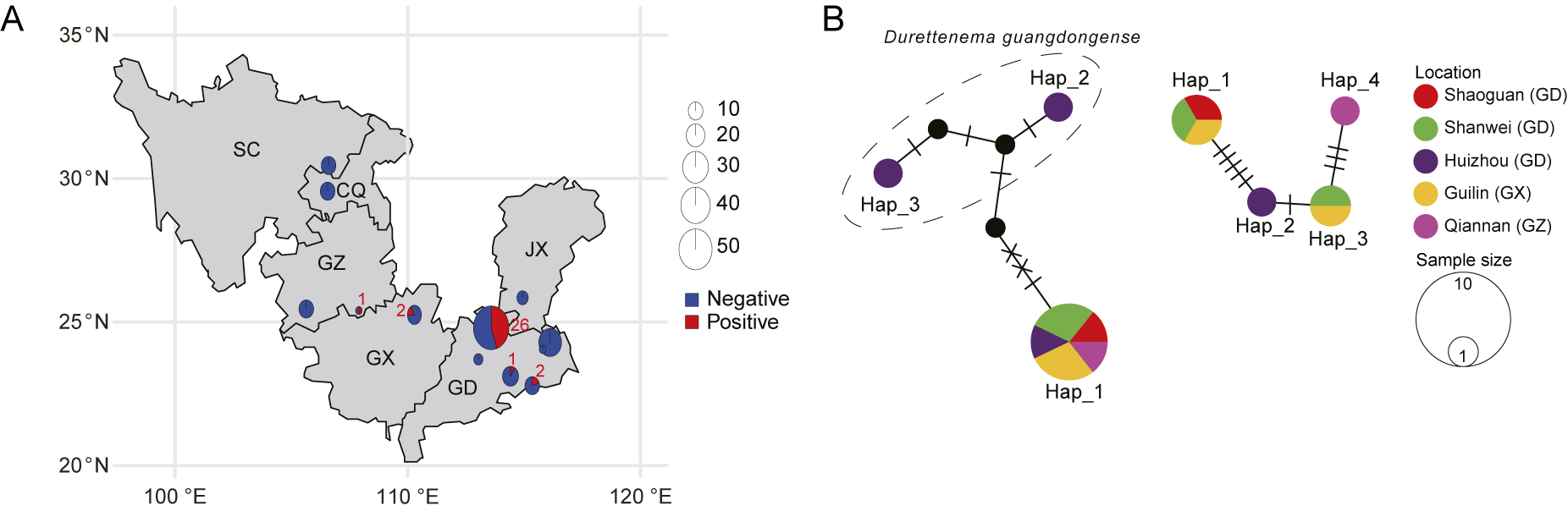
All 26 specimens of H. armiger collected from the same cave exhibited a 100% prevalence of the nematode. 31 bats (1 Rhinolophus thomasi, 4 Rhinolophus pusillus, 12 Myotis ricketti, 1 Myotis laniger, 1 Hipposideros pomona, 12 Hipposideros larvatus) collected in a cave near this abandoned house were all negative. Additionally, we analyzed fecal samples from 102 great leaf-nosed bats collected across 16 regions in Guangxi, Guangdong, Guizhou, Jiangxi, and Sichuan Provinces and Chongqing Municipality, of which six samples were positive (Figure 4A). The ITS1 of the positive samples in this study belong to the same haplotype (Figure 4B). There are four haplotypes for Cox1 gene of the nematode. Haplotype 1 is the most common haplotype, found across multiple regions including Shanwei (GD), Shaoguan (GD), and Guilin (GX). Haplotype 2 distributed in Huizhou, haplotype 3 distributed in Guilin (GX) and Shanwei (GD), while haplotype 4 in Qiannan (GZ).
Epidemiological investigation of the nematode in H. armiger in South China. (A) Sampling sites. (B) Left: Haplotype network of the ITS1 of Durettenema sp. 888. The network was constructed using ITS1 sequences obtained in this study from Shaoguan, Shanwei, and Huizhou in Guangdong Province, Qiannan in Guizhou Province, and Guilin in Guangxi Province, as well as sequences of Durettenema guangdongense retrieved from GenBank: KX856929 and KX856930 from Huizhou, Guangdong Province. Right: Haplotype network of the Cox1 of Durettenema sp. 888. Horizontal lines represent nucleotide differences, while crosses indicate nucleotide insertions. SC: Sichuan Province; CQ: Chongqing; GZ: Guizhou Province; GX: Guangxi province; GD: Guangdong Province; JX: Jiangxi Province.

Discussion
Bats represent a significant reservoir of parasitic biodiversity, particularly with respect to ectoparasites such as bat flies, which have been extensively researched (Lee et al. Reference Lee, Seo, Lee, Oem, Kim, Jeong, Kim, Jheong, Kwon and Kwak2021; Poon et al. Reference Poon, Chen, Tsang, Shek, Tsui, Zhao, Guénard and Sin2023). However, the implementation of wildlife protection significantly constrains the invasive sampling, thereby affecting the study of gastrointestinal parasites (Lord and Brooks Reference Lord, Brooks, Klimpel and Mehlhorn2014). During the taxidermy of a H. armiger specimen for the ‘Fauna of Guangdong Province’, seven specimens of gastrointestinal nematodes were inadvertently collected, providing a valuable opportunity to enhance our understanding of bat parasites.
Molecular identification techniques utilizing informative loci, such as the internal transcribed spacer (ITS) and mitochondrial DNA (mtDNA), are extensively employed for the identification of nematodes (Seesao et al. Reference Seesao, Gay, Merlin, Viscogliosi, Aliouat-Denis and Audebert2017). Phylogenetic assessments based on the 12 mitochondrial PCGs indicate that Durettenema sp. 888 cluster with members of Molineidae, exhibiting a nucleotide identity of only 74.4%–74.8% (Figure 3A). This finding supports the notion that the Durettenema genus is distinct from other genera within the subfamily Molineinae. However, their genome structures were similar. The nuclear ITS1 gene of the bat nematode (Durettenema sp. 888) exhibits 98.6%-–98.8% nucleotide identity with the D. guangdongense. Prior research has indicated that the sequence divergence of ITS among species ranges from 1.3% to 29% (Falcón-Ordaz et al. Reference Falcón-Ordaz, Iturbe-Morgado and Martínez-Salazar2024; Hung et al. Reference Hung, Chilton, Beveridge, Zhu, Lichtenfels and Gasser1999; Mejías-Alpízar et al. Reference Mejías-Alpízar, Porras-Silesky, Rodríguez, Quesada, Alfaro-Segura, Robleto-Quesada, Gutiérrez and Rojas2024). Consequently, this suggests a potential conspecificity of these two parasites. The male specimens of Durettenema sp. 888 exhibit a length ranging from 11.45 to 12.26 mm, with a mean measurement of 11.82 mm. This length is greater than that observed in D. guangdongense, which has a mean length of 11.2 mm (Ju et al. Reference Ju, Li and Zhang2017), and D. scotophili, which has a mean length of 11.5 mm (Jian et al. Reference Jian, Xu, Zhang, Xu, Song, Chen and Ju2022). Conversely, the female specimens of Durettenema sp. 888 measure between 12.22 and 14.24 mm, with a mean of 13.44 mm, which is shorter than the mean lengths of D. guangdongense (15.0 mm) (Ju et al. Reference Ju, Li and Zhang2017) and D. scotophili (15.2 mm) (Jian et al. Reference Jian, Xu, Zhang, Xu, Song, Chen and Ju2022). Several morphological distinctions among D. guangdongense, D. scotophili, and D. rhinolophi have been documented (Jian et al. Reference Jian, Xu, Zhang, Xu, Song, Chen and Ju2022; Ju et al. Reference Ju, Li and Zhang2017). However, the freezing process applied to the specimens of Durettenema sp. 888 has hindered our ability to examine the finer details of their morphological characteristics, thereby limiting our capacity to conduct further comparative analyses. Additionally, the lack of mitochondrial sequences for D. rhinolophi, D. scotophili, and D. guangdongense poses a significant limitation to comparative studies of these species. Consequently, further research is necessary to elucidate their taxonomic relationships.
All 26 specimens of H. armiger collected from the same cave exhibited a 100% prevalence of Durettenema sp. 888, indicating a high susceptibility of H. armiger to this particular parasite. Our epidemiological study demonstrates that this nematode can be detected across three provinces in South China. Certain nematode species exhibit a high degree of host specificity, thriving and reproducing exclusively within a single species or a closely related group of species. Conversely, other nematodes display lower specificity, with a greater propensity to transfer between suitable hosts during favorable periods in their life cycle (Brant and Gardner, 2000). For the three described species in genus Durettenema, D. guangdongense has been found in H. larvatus, whereas D. scotophili and D. rhinolophi have been identified in Scotophilus kuhlii. This suggests that parasites belonging to the genus Durettenema can infect multiple bat species. Nonetheless, our investigation did not detect any infections in 31 bat samples, which included 1 R. thomasi, 4 R. pusillus, 12 M. ricketti, 1 M. laniger, 1 H. pomona, 12 H. larvatus. All samples were collected in the same cave adjacent to the abandoned house where we identified the infections of Durettenema sp. 888 in all 26 specimens of H. armiger. Further research is warranted to elucidate the host range of this genus.
The transmission of pathogens associated with bats necessitates opportunities for contact between bats and other species. Species such as H. armiger, H. larvatus, and S. kuhlii exhibit a broad distribution across Asia (Smith et al. Reference Smith, Xie, Hoffmann, Lunde, MacKinnon, Wilson and Wozencraft2010). H. armiger typically roosts in caves; however, it also utilizes anthropogenic structures, including sheds and abandoned houses, as roosting sites. Conversely, S. kuhlii tends to favor roosts located in buildings and trees in proximity to human settlements. Furthermore, bat feces are frequently employed as organic fertilizer in rural regions, which may facilitate the transmission of bat-associated pathogens to humans and domestic animals. For instance, the Hendra virus and Nipah virus can infect equines and swine upon exposure to the urine, feces, or saliva of infected flying foxes, with human infections occurring through direct contact with these infected domestic animals (Mahalingam et al. Reference Mahalingam, Herrero, Playford, Spann, Herring, Rolph, Middleton, McCall, Field and Wang2012; Weatherman et al. Reference Weatherman, Feldmann and de Wit2018). Recent epidemiological studies indicate that rapid urbanization and increasing interactions between humans and wildlife may enable certain hookworm species originating from wildlife to emerge as significant zoonotic helminths (Hotez et al. Reference Hotez, Brooker, Bethony, Bottazzi, Loukas and Xiao2004). A comprehensive understanding of the diversity of gastrointestinal parasites and their transmission dynamics is essential to mitigate their potential impact on human and animal health. In addition to their zoonotic potential, parasites can adversely affect wildlife populations (Thompson Reference Thompson2013). Currently, over half of bat species are experiencing significant population declines, with bat populations in China decreasing by 50% within a mere two decades (Jiang et al. Reference Jiang, Zhao, He, Zhang, Luo, Liu, Sun, Yu, Wu and Feng2020). The potential influence of parasite prevalence on bat population numbers warrants further investigation and concern.
In conclusion, this research characterized a parasitic nematode obtained from the intestines of a great leaf-nosed bat by utilizing complete mitochondrial genome and ITS1 sequence analyses. The nuclear ITS1 gene exhibited 98.6%–98.8% nucleotide identity remarkably high nucleotide similarity with D. guangdongense, indicating a potential conspecific relationship of these two parasites. However, the absence of mitochondrial genomes for other parasites in genus Durettenema precludes definitive species identification. This study presents the first complete mitochondrial genome for the genus Durettenema, thereby enhancing the understanding of the genetic diversity within parasitic nematodes.
Data availability statement
High-throughput dataset generated in the current study was deposited into the NCBI SRA database under the BioProject accession no. PRJNA1191973. The Cox1 and ITS sequences of the Durettenema sp. identified in this study was deposited to NCBI (Accession number: PQ660740- PQ663761).
Authors’ contribution
Xuejuan Shen conceived and designed the study. Yuanjia Hu and Yongyi Shen collected the samples. Yuanjia Hu, Xuejuan Shen, Yingde Gan, and Yiting Chen performed the research. Hai Wang and Xinyuan Cui analyzed the data. Xuejuan Shen wrote the paper. Yongyi Shen critically revised the manuscript. All authors read and approved the final manuscript.
Acknowledgements
This work was supported by the Guangdong Provincial Key R&D Program (2022B1111040001), the Guangdong Major Project of Basic and Applied Basic Research (2020B0301030007), the 111 Center (D20008), specific university discipline construction project (2023B10564003), and the Department of Education of Guangdong Province (2019KCXTD001).
Competing interest
The authors declare no competing interests.
Ethical standard
Ethical review and approval of this study were not required because this is a case report describing a natural parasite infestation.
Consent to participate
Not applicable.
Consent for publication
All the authors have read and approved the final manuscript.