Introduction
The deep-sea includes the seafloor, water and biota beneath 200 m depth, covering over 70% of the total global surface (Levin & Dayton, Reference Levin and Dayton2009; Thurber et al., Reference Thurber, Jones and Schnabel2011; Tyler et al., Reference Tyler, Baker, Ramirez-Llodra, Clark, Consalvey and Rowden2016). Far from the original conception of a dark and cold space devoid of life, the deep-sea holds vast communities of specialist fauna that rank among the most biodiverse on the planet (Gage & Tyler, Reference Gage and Tyler1991; Ramirez-Llodra et al., Reference Ramirez-Llodra, Brandt, Danovaro, De Mol, Escobar, German, Levin, Martinez Arbizu, Menot, Buhl-Mortensen, Narayanaswamy, Smith, Tittensor, Tyler, Vanreusel and Vecchione2010; Rex & Etter, Reference Rex and Etter2010; Valentine & Jablonski, Reference Valentine and Jablonski2015). Considering both the already high number of new species awaiting proper taxonomic description and the current pace of their discovery, it is clear that there is a large gap of knowledge on the deep-sea biodiversity and ecology (Higgs & Attrill, Reference Higgs and Attrill2015; Costa et al., Reference Costa, Fanelli, Marini, Danovaro and Aguzzi2020). A great deal of that diversity is contributed by the benthic fauna, much of which need hard substrates to settle, feed and proliferate (Gage & Tyler, Reference Gage and Tyler1991; Ramirez-Llodra et al., Reference Ramirez-Llodra, Brandt, Danovaro, De Mol, Escobar, German, Levin, Martinez Arbizu, Menot, Buhl-Mortensen, Narayanaswamy, Smith, Tittensor, Tyler, Vanreusel and Vecchione2010). Since hard substrates are a limited resource in the deep-sea, the resulting strong competition for space is thought to have led to the remarkable diversity of epibiotic associations found in these habitats (Abelló et al., Reference Abelló, Villanueva and Gili1990; Wahl, Reference Wahl and Wahl2009). Here the term ‘epibiosis’ is defined as a close and long-lasting spatial association of an organism, called the epibiont, with another that acts as a substrate, the basibiont (Wahl & Mark, Reference Wahl and Mark1999; Harder, Reference Harder, Flemming, Murthy, Venkatesan and Cooksey2009; Wahl, Reference Wahl and Wahl2009).
The geology, topography and oceanographic features of the deep-sea South-western Atlantic are relatively well known, but its biological exploration and ecological knowledge is still in its infancy. In this area the bottoms are characterized by a broad shelf that narrows to the north, followed by a relatively steep continental slope that drops from 120 to 4000 m in depth in just a few tens of kilometres, connecting the continental shelf with the adjacent basin (Violante et al., Reference Violante, Paterlini, Costa, Hernández-Molina, Segovia, Cavallotto, Marcolini, Bozzano, Laprida, García Chapori, Bickert and Spie2010; Bozzano et al., Reference Bozzano, Cerredo, Remesal, Steinmann, Hanebuth, Schwenk, Baqués, Hebbeln, Spoltore, Silvestri, Acevedo, Spiess, Violante and Kasten2021). The slope is crossed by several transverse submarine canyons, through which strong downward currents flow, carrying sediment and debris to the deeper bottoms (Parker et al., Reference Parker, Paterlini, Violante and Boschi1997; Violante et al., Reference Violante, Paterlini, Costa, Hernández-Molina, Segovia, Cavallotto, Marcolini, Bozzano, Laprida, García Chapori, Bickert and Spie2010; Bozzano et al., Reference Bozzano, Martín, Spoltore and Violante2017).
During 2012 and 2013 the R/V ‘Puerto Deseado’ carried out three benthic surveys in the Mar del Plata Submarine Canyon and surrounding areas, resulting in the publication of several studies on the taxonomy, biogeography and life history traits of a wide variety of taxa through the following years (e.g. Farías et al., Reference Farías, Ocampo and Luppi2015; Pastorino & Sánchez, Reference Pastorino and Sánchez2016; Penchaszadeh et al., Reference Penchaszadeh, Atencio, Martinez and Pastorino2016, Reference Penchaszadeh, Pastorino, Martinez and Miloslavich2019; Sganga & Roccatagliata, Reference Sganga and Roccatagliata2016; Pereira & Doti, Reference Pereira and Doti2017; Flores et al., Reference Flores, Brogger and Penchaszadeh2019; Martinez et al., Reference Martinez, Solís-Marín and Penchaszadeh2019; Risaro et al., Reference Risaro, Williams, Pereyra and Lauretta2020; Rivadeneira et al., Reference Rivadeneira, Martinez, Penchaszadeh and Brogger2020). During one of these surveys, we regularly found the skeleton shrimp Caprella ungulina Mayer, Reference Mayer1903 attached to the Patagonian lobsterette Thymops birsteini (Zarenkov & Semenov, Reference Zarenkov and Semenov1972). The caprellid amphipod C. ungulina has a wide geographic distribution encompassing North and South America, Japan and South Africa, at depths ranging 50–1100 m (Griffiths, Reference Griffiths1977; Wicksten, Reference Wicksten1982; Takeuchi et al., Reference Takeuchi, Takeda and Takeshita1989; Baldinger, Reference Baldinger1992; Sittrop & Serejo, Reference Sittrop and Serejo2006; Medina et al., Reference Medina, Figueroa and Cañete2017). Its biology remains poorly known, but it is commonly reported as an epibiont of a variety of decapod crustaceans in deep waters (Takeuchi et al., Reference Takeuchi, Takeda and Takeshita1989). Particularly in the South-western Atlantic, C. ungulina was recorded in association with Paralomis formosa Henderson, 1888 and P. granulosa (Hombron & Jacquinot, 1846) (see Sittrop & Serejo, Reference Sittrop and Serejo2006 and Medina et al., Reference Medina, Figueroa and Cañete2017, respectively). The Patagonian lobsterette T. birsteini (Decapoda: Nephropidae) distributes on the circalittoral and bathyal zones of Uruguay, Argentina, southern Chile, reaching the Malvinas (Falklands) and Georgias del Sur (South Georgia) islands and the Scotia Sea (see Spivak et al., Reference Spivak, Farías, Ocampo, Lovrich and Luppi2019 and references therein), at depths ranging from 150–2500 m, in cold waters between 2–3.5 °C (Laptikhovsky & Reyes, Reference Laptikhovsky and Reyes2009). As other nephropid species generically known as ‘scampi’, T. birsteini is an edible lobster with potential for commercial exploitation (Wyngaard et al., Reference Wyngaard, Firpo, Iorio and Boschi2016; van der Reis et al., Reference van der Reis, Laroche, Jeffs and Lavery2018). Relatively little is known on the biology and ecology of this decapod, but it is likely that as their relatives do, they play an important role on continental slopes as food for many large fishes, as predators of a variety of invertebrates, and contribute to deep-sea nutrient cycling as active scavengers and bioturbators given their burrowing habits (Yau et al., Reference Yau, Collins, Bagley, Everson and Priede2002; Laptikhovsky & Reyes, Reference Laptikhovsky and Reyes2009; Wyngaard et al., Reference Wyngaard, Firpo, Iorio and Boschi2016; van der Reis et al., Reference van der Reis, Laroche, Jeffs and Lavery2018).
Here we report on the first record of the epibiotic association between the crustaceans C. ungulina and T. birsteini, adding some notes on its biology, taxonomy and distribution, and discuss their ecological interaction.
Materials and methods
The benthic biodiversity survey ‘Talud III’ was carried out during September 2013 with the aim of exploring the Mar del Plata Submarine Canyon, an incision of the continental slope that runs transversally to it and located off Mar del Plata city (~400 km; Figure 1). This canyon, one of the main in the South-western Atlantic Ocean, has a V-shaped transversal section between 1200–3700 m depth, connecting the continental shelf with the abyssal plains (Violante et al., Reference Violante, Paterlini, Costa, Hernández-Molina, Segovia, Cavallotto, Marcolini, Bozzano, Laprida, García Chapori, Bickert and Spie2010; Bozzano et al., Reference Bozzano, Cerredo, Remesal, Steinmann, Hanebuth, Schwenk, Baqués, Hebbeln, Spoltore, Silvestri, Acevedo, Spiess, Violante and Kasten2021).
Geographic localization and schematic representation of Mar del Plata Submarine Canyon (grey square).

Several sampling stations were performed at a seawater depth between ~200–3500 m, using a bottom otter trawl with 6-m headrope, 10-mm mesh size at the cod end. Once the net was on deck, specimens of Thymops birsteini were photographed, measured and preserved in 96% ethanol. The total length was measured from the tip of the rostrum to the posterior margin of telson; and, cephalothorax length from the tip of the rostrum to the posterior margin of cephalothorax. In the laboratory, each lobster was thoroughly checked for caprellid epibionts and these were carefully removed with tweezers, registering in which appendages or body part they were attached. Then, epibionts were counted, sexed and measured from the tip of the cephalothorax to the posterior margin of the abdomen using a graduated eyepiece (total length, mm). The taxonomic identification of T. birsteini and Caprella ungulina was corroborated using taxonomic works (Takeuchi et al., Reference Takeuchi, Takeda and Takeshita1989; Boschi et al., Reference Boschi, Fischbach and Iorío1992; Sittrop & Serejo, Reference Sittrop and Serejo2006; Spivak et al., Reference Spivak, Farías, Ocampo, Lovrich and Luppi2019) and nomenclature of organisms were adopted in accordance with the World Register of Marine Species (WoRMS, www.marinespecies.org). Epibiotic association between T. birsteini and C. ungulina were assessed by the following parameters: prevalence (total number of lobsters with caprellids/total number of lobsters collected), caprellid abundance (total number of caprellids/total number of lobsters collected) and intensity (total number of caprellids/total number of lobsters with caprellids), including in each case the 95% confidence intervals (CI) through Quantitative Parasitology v3.0 software (Reiczigel et al., Reference Reiczigel, Marozzi, Fábián and Rózsa2019).
The geographic distributions of C. ungulina, as well as all its known basibiont crustacean species (including T. birsteini) were compiled, using the data available from the literature and records presented in the Global Biodiversity Information Facility (GBIF, www.gbif.org) and in the Ocean Biodiversity Information System (OBIS, www.obis.org).
Results
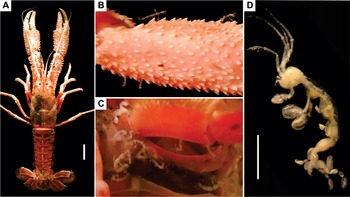
During the ‘Talud III’ survey, a total of 129 decapod specimens belonging to 15 taxa (including 13 nominal species) were registered (Table 1), with Chaceon notialis Manning & Holthuis, 1989, Munida spinosa Henderson, 1885, Nematocarcinus gracilis Spence Bate, 1888, Paralomis formosa, Thymops birsteini and Caridea spp. being the most abundant species (between ~10–17% each), while the rest of the decapods recorded the lowest percentages (~1–6% each). Thymops birsteini (Figure 2A) were collected in only nine stations from a total of 64 (Table 1). A total of 14 lobsters were found, their total lengths ranged between 149.69–303.08 mm, and the cephalothorax length between 70.34–138.89 mm.
(A) Dorsal view of adult male of Thymops birsteini (total body length: 246.67 mm); (B) Caprella ungulina on chelipeds of T. birsteini; (C) C. ungulina on mouthparts of T. birsteini; and (D) lateral view of juvenile specimen of C. ungulina (total length: 7.25 mm). Scale bars: (A) 30 mm; (D) 3 mm.

Breakdown of Decapoda collected during ‘Talud III’ survey sorted by species, with detail of number of specimens, depth range and number of stations at which each species was recorded

N, number; n/d, no data available.
Some sampling stations only show one depth value, corresponding to the bottom otter trawl release site.
Thymops birsteini was the only decapod in which Caprella ungulina as an epibiont was detected (Figure 2B–D), being present in 7 individuals collected between 1087–2212 m depth (Table 2), and recording a total of 205 caprellids. The epibiotic parameters (Table 3) showed that the prevalence of C. ungulina on T. birsteini was 50% (95% CI = 0.23–0.77); the mean abundance of caprellids per lobster was 14.64 (95% CI = 6.79–28.93), registering a maximum value of 60 caprellids per lobster; while, the intensity value was 29.29 (95% CI = 17.71–47.14). In addition, C. ungulina were recorded mainly on the mouthparts of T. birsteini (31.22%; Table 2), followed by chelipeds (18.05%), cephalothorax (4.88%) and pereiopods (0.98%). However, it should be noted that a high percentage of epibiont specimens were detached during the fixation and storage of the host (44.08%).
Collected specimens of Thymops birsteini indicating their sampling stations, geographic position (latitude and longitude) and depth range

Mo, mouthparts; Ce, cephalothorax; Ch chelipeds; Pe, pereiopods; D, detached.
In those lobsters where caprellids were found the number of epibionts picked up in each body region is detailed. Detached individuals correspond to loose organisms of C. ungulina found in the plastic containers as product of lobster fixation and storage.
Epibiosis between caprellid and decapod species

Population parameters (TDS, total decapods sampled; TDC, total decapods with caprellids; TC, total caprellid collected; caprellids population groups; M, males, F, females; J, juveniles). Epibiotic parameters (%P, prevalence; A, mean abundance; I, intensity).
All the individuals of C. ungulina sorted from T. birsteini showed the absence of eyes. A total of 181 specimens were classified as juveniles and 4 as males; another 20 individuals were not possible to classify due to poor preservation, and for that reason they were not measured either. The mean size of C. ungulina juveniles was 3.42 ± 1.45 mm, ranging between 1.56–8.63 mm; while the males registered a mean total length of 13.44 ± 3.69 mm, ranging between 10.77–18.88 mm (Figure 3).
Length frequency analysis of juveniles and males of Caprella ungulina.

Discussion
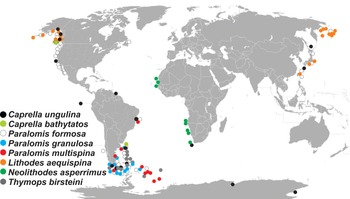
Most epibiotic amphipods are usually listed as host-specific (Vader & Tandberg, Reference Vader and Tandberg2015), except for the widely distributed Caprella ungulina and C. bathytatos Martin & Pettit, Reference Martin and Pettit1998, which are known to occur on a variety of king and spider crab species (see Table 4 and references therein). The validity of the distinction of these two species remains doubtful, given that in the original description of C. bathytatos morphological differences with C. ungulina are rather subtle and their depth ranges and geographic distribution overlap (Martin & Pettit, Reference Martin and Pettit1998), with their main difference being the decapod species upon which they have been recorded (see Figure 4, Table 4). Moreover, Takeuchi et al. (Reference Takeuchi, Takeda and Takeshita1989) reported that some diagnostic characters in C. ungulina present high morphological variation, therefore additional material from different localities should be compared to determine if such differences have taxonomic implications, or are due to ontogenic changes or phenotypic plasticity related to the wide geographic and bathymetric distribution of the hosts. Furthermore, Verdi & Celentano (Reference Verdi and Celentano2008) reported morphological differences among specimens of C. bathytatos from Uruguay when compared with those described by Martin & Pettit (Reference Martin and Pettit1998) from the Pacific coast of Canada, suggesting that these two populations could in fact be different morphs of C. ungulina.
Geographic distribution of C. ungulina and C. bathytatos and their decapod basibiont species (P. formosa, P. granulosa, P. multispina, L. aequispina, N. asperrimus and T. birsteini). For specific localization and references of epibiotic associations, see Table 4.

Epibiosis between caprellid and decapod species, indicating: epibiont species, basibiont species, country of collection, body region of epibiosis and depth

Ce, cephalothorax; Mo, mouthparts; An, antenna/antennules; Ch, chelipeds; Pe, pereiopods; Und, undetermined.
A remarkable feature of C. ungulina is the absence of eyes reported for some populations. In the original description of the species, Mayer (Reference Mayer1903) mentioned the presence of individuals with eyes, but later studies described deep-sea specimens as completely lacking ommatidia (Griffiths, Reference Griffiths1977; Takeuchi et al., Reference Takeuchi, Takeda and Takeshita1989). More recently Sittrop & Serejo (Reference Sittrop and Serejo2006) found individuals of different sizes and sex, with and without eyes co-existing in deep-sea samples, and proposed that eyelessness might result from development under deep-sea conditions of high pressure and darkness, as was described for other amphipod species (see Thurston & Bett, Reference Thurston and Bett1993). Accordingly, Medina et al. (Reference Medina, Figueroa and Cañete2017) found individuals of C. ungulina attached to Paralomis granulosa, a false king crab restricted to shallow waters, as all having eyes. Our finding is also consistent with the idea posed by Sittrop & Serejo (Reference Sittrop and Serejo2006), since all caprellids were collected at great depth (below 1087 m) and eyes were not observed in any of them. However, considering that some populations of C. ungulina have been studied from preserved material where eye pigments are affected, histological analysis would be necessary to better understand the changes in the presence or absence of eyes throughout the increase in depth, as Takeuchi et al. (Reference Takeuchi, Takeda and Takeshita1989) suggested. Taking all the above into account, we tend to think that C. ungulina and C. bathytatos could be synonymous species whose morphological differences reflect phenotypic plasticity in response to the different developmental conditions imposed by the specific habitat of their various basibionts. Additional taxonomic revisions and genetic analyses will be needed to conclude on this.
Caprellids are expected to have low dispersal rates associated with their sedentary lifestyle and direct development with no early life stages capable of active swimming (Takeuchi & Hirano, Reference Takeuchi and Hirano1991; Cook et al., Reference Cook, Willis and Lozano-Fernandez2007; Takeuchi et al., Reference Takeuchi, Tomikawa and Lindsay2016; Wei et al., Reference Wei, Zhang, Wu, Yao, Chen and Fang2016). Hence, cases of littoral caprellids with very wide or even global geographic distributions (e.g. C. dilatata Krøyer, 1843; C. equilibria Say, 1818; C. mutica Schurin, 1935; C. scaura Templeton, 1836; Deutella venenosa Mayer, 1890) are usually explained as the result of long-distance dispersal mediated by different vectors, either natural such as rafting on floating macroalgae or wood, or anthropogenic, via ballast water or hull fouling, which in the last case would favour the establishment in, and further dispersion from, ports and marinas (Thiel et al., Reference Thiel, Guerra-García, Lancellotti and Vásquez2003; Masunari & Takeuchi, Reference Masunari and Takeuchi2006; Martínez-Laiz et al., Reference Martínez-Laiz, Ulman, Ros and Marchini2019, Meloni et al., Reference Meloni, Correa, Pitombo, Chiesa, Doti, Elías, Genzano, Giachetti, Giménez, López-Gappa, Pastor, Wandeness, Ramírez, Roccatagliata, Schulze-Sylvester, Tatián, Zelaya and Sylvester2021). However, the wide horizontal, and especially the bathymetric distribution of C. ungulina (up to 2212 m; Table 4), cannot be adequately explained by these factors alone, but rather by its habit as an epibiont of highly mobile animals.
Symbiont species with none or restricted free-living stages such as C. ungulina often rely on the migratory capability of their hosts for successful dispersal. In this sense, large decapods become excellent basibionts, since they often undertake ontogenetic habitat shifts and reproductive migrations through long distances and depth ranges, besides having additional advantages over other living substrates such as: (1) having exoskeletons that offer hard and rough surfaces, often with multiple spines, notches and lobes that facilitate attachment; (2) being usually aggressive and strongly armed thus providing protection against predators; (3) being active consumers that crumble their food during intake, making small fragments available to their epibionts that may constitute good food (Abelló et al., Reference Abelló, Villanueva and Gili1990; Wahl, Reference Wahl and Wahl2009; Fernandez-Leborans, Reference Fernandez-Leborans2010; Vader & Tandberg, Reference Vader and Tandberg2015). Hence, the ample geographic distribution of C. ungulina is more likely explained as the result from their capability of living on a variety of highly mobile decapod species that partially overlap their distributions spanning very large areas. For example, Lithodes aequispina Benedict, 1895 could be one of the species that favoured the dispersion of C. ungulina between Japan and the Pacific coast of North America; Paralomis granulosa, P. multispina (Benedict, 1895), T. birsteini along South America; Neolithodes asperrimus Barnard, 1947 in South Africa; while P. formosa would be involved in the dispersion of C. ungulina in all the mentioned regions, except Africa (Figure 4; Table 4).
The benefits of the epibiotic relationship with decapods as basibionts has its downside in the host's discontinuous growth with periodic moulting, which forces the epibiont to recolonize its basibiont during the moulting process, or to been shed along with the exuvia, with the consequent loss of shelter and mobility provided by the living host. Thus, there is an interaction between the moulting period of the basibiont and the reproductive period of the epibiont that must be taken into account. According to several authors, epibiosis between decapods and other species is favoured in those species where basibionts have long intermoulting periods and epibionts have a short life cycle (Abelló et al., Reference Abelló, Villanueva and Gili1990; Dvoretsky & Dvoretsky, Reference Dvoretsky and Dvoretsky2010). Although the length of the intermoult period of T. birsteini is unknown, it is reasonable to assume that it is similar to that of the confamiliar Nephrops norvegicus (Linnaeus, 1758) (Karasawa et al., Reference Karasawa, Schweitzer and Feldmann2013), the commonly known ‘scampi’ from the North-east Atlantic Ocean and Mediterranean Sea, which because of its enormous commercial value has been studied in detail (Bell et al., Reference Bell, Redant, Tuck and Phillips2006). Nephrops norvegicus is ecologically equivalent to T. birsteini, and similar in several other aspects of its biology, such as general morphology, maximum size and burrowing habits (Collins et al., Reference Collins, Yau, Nolan, Bagley and Priede1999; Yau et al., Reference Yau, Collins, Bagley, Everson and Priede2002; Laptikhovsky & Reyes, Reference Laptikhovsky and Reyes2009). These two lobsters are long-lived animals, lifespans between 5 and 10 years, and there are reports of them living up to 15 years. Juvenile stages have very short intermoult periods that increase from one to four months as they develop until sexual maturity, at which point moult frequency is reduced to 1–2 moults per year in males and 0–1 moult per year in females (Bell et al., Reference Bell, Redant, Tuck and Phillips2006), with no evidence of terminal moult in either sex (Farmer, Reference Farmer1973). In the other basibiont decapods in which C. ungulina has been recorded, the intermoult period of adult individuals is even longer (González-Gurriarán et al., Reference González-Gurriarán, Freire, Farinã and Fernandez1998; Comeau & Savoie, Reference Comeau and Savoie2001; Kuzmin & Gudimova, Reference Kuzmin and Gudimova2002).
Regarding C. ungulina, its lifespan is also unknown, however, in several related caprellid species, growth rates from juvenile to reproductive mature adults were ~20–40 days, depending on several factors, such as food source and temperature (Takeuchi & Hirano, Reference Takeuchi and Hirano1991; Cook et al., Reference Cook, Willis and Lozano-Fernandez2007; Baeza-Rojano & Guerra-García, Reference Baeza-Rojano and Guerra-García2013; Wei et al., Reference Wei, Zhang, Wu, Yao, Chen and Fang2016). Therefore, the finding of specimens of C. ungulina with different sizes and stages of development (see Figure 3) on T. birsteini supports the idea that the Patagonian lobster has a long enough intermoult period to allow the development and reproduction of caprellids, although it is not excluded that they are also able to go through the moult of their host and recolonize it during the process that could take at least 20 minutes, as is known for its related lobster N. norvegicus (Bell et al., Reference Bell, Redant, Tuck and Phillips2006).
The low number of C. ungulina specimens collected in the different basibiont species and the lack of information on male, female and juvenile abundances in some studies (see Table 3), as well as the low number of males and the absence of females on T. birsteini specimens, make it difficult to speculate any traits in the life history of this caprellid. Our findings could be explained by a differential loss or shedding of adults caprellids during the recovery of the net along the water column; although evidently more basibiont samples could improve our biological understanding about the population parameters of this epibiont (e.g. a differential mobility or selection of host by adults according depth and/or temporality). On the other hand, the comparison of epibiotic parameters revealed that the number of basibiont specimens analysed were scarce (~1–14 decapod specimens for each species), except in Paralithodes camtschaticus (Tilesius, 1815) and P. granulosa, in which a total of 915 and 3072 individuals were studied, respectively (Table 3); this fact makes evident the need to increase the number of decapod specimens analysed to correctly compare the epibiotic parameters of C. ungulina and their basibionts. However, despite the low number of T. birsteini collected, a higher total caprellid density, prevalence, mean abundance and intensity values were recorded in comparison to P. camtschaticus and P. granulosa (Table 3), suggesting that in Mar del Plata Submarine Canyon a preference exists of C. ungulina for T. birsteini, with respect to other decapod species. Even in P. formosa, a lithodid collected in the study area and previously reported as basibiont of C. ungulina in northern Brazil (Sittrop & Serejo, Reference Sittrop and Serejo2006), no associated caprellids were observed.
Further evidence on the type and strength of the symbiotic relationship of C. ungulina and T. birsteini is provided by the differential distribution of caprellids on the body of their host. In agreement with our findings (31% of caprellids on mouthparts), previous works showed that C. ungulina attach mainly to mouthparts, antennas and antennules of their basibionts (see Table 4; Takeuchi et al., Reference Takeuchi, Takeda and Takeshita1989; Baldinger, Reference Baldinger1992; Medina et al., Reference Medina, Figueroa and Cañete2017). Cadien (Reference Cadien2015) proposed that the high abundance of C. ungulina on these appendages is the product of a kleptoparasitic relationship, in which the caprellid can steal food as it is consumed by the decapod species, producing a nutritional benefit to C. ungulina at the expense of the basibiont crustacean. Medina et al. (Reference Medina, Figueroa and Cañete2017) suggested a commensal interaction between species, related to the large size of the host (in this case the lithodid P. granulosa), the specific relationship between both species, the potential use of food residues from the basibiont, the cryptic habitat and the dispersion to other areas mediated by the host, and the physical shelter against environmental conditions. However, despite the presence of C. ungulina specimens close to the mouthparts, their specific feeding habits are unknown, and a true commensalism relationship has yet to be confirmed (see Vader & Tandberg, Reference Vader and Tandberg2015).
The knowledge of deep-sea amphipods recorded off the Argentina coast is limited, however, in a recent compilation of this fauna (Doti et al., Reference Doti, Chiesa, Roccatagliata and Hendrickx2020), the family Caprellidae was the most diverse (8 spp.). The finding of C. ungulina provides a new, and also the deepest, record for the Caprellidae from this area of the South-western Atlantic, and in turn extends the bathymetric distribution of the species to 2012 m depth. Moreover, it constitutes the first report on the association of this common epibiont with the basibiont, Patagonian lobsterette T. birsteini. Both the incidence and the location of C. ungulina in the body of a new host, in this case belonging to another crustacean infraorder and family (Astacidea and Nephropidae, respectively) not previously recorded as basibionts, confirm the symbiotic relationship of this caprellid as epibiont of decapods with some preference for lithodids, but not restricted to a particular basibiont taxa.
More detailed information about the symbiotic interactions in the deep-sea will require the implementation of non-destructive gear such as images taken by ROVs and towed camera platforms, as was recently published by Takeuchi et al. (Reference Takeuchi, Momoko and Ryosuke2021); these authors described a new species of Caprella filmed and collected from a gorgonian at 1497 m depth in a submarine canyon of central Japan. We expect that the present work will contribute with the basic knowledge on the biodiversity and ecology of deep-sea environments in the South-western Atlantic.
Acknowledgements
We thank the lead scientists for inviting two of us (I.L.C. and N.E.F.) to the ‘Talud III’ survey 2013, as well as the colleagues and crew of the RV ‘Puerto Deseado’ for their assistance during the expedition. We are also thankful to Brenda Doti for her constructive comments on an earlier draft of this manuscript. Two anonymous referees provided useful comments which contributed to improve the final version of the manuscript.
Financial support
The present work was partially supported by the Agencia Nacional de Promoción Científica y Tecnológica (grant number FONCyT PICT 2016-2631 to C.E.R.) and by CONICET (PIP17/19-0643 to I.L.C. and PIP 11220130100434CO).