Aby Warburg Encounters a Survival
[T]he Malinche insists [the old men] — at the diagonal — withdraw and she must hold on to the obstinate bull with a blue silk scarf — as near [as she can] to the weakened bull without timidity. Afterward the Old Men, to be included and because [Malinche] will dash incorrectly, continue to dart around with the scarf, heckling the bull and running around the spectators, until [Malinche] kills the bull; without timid gestures they, indeed she, are able to scan and turn but the bull hoofs her and flees until saddled for the Malinche; [the bull] will only shamble until ridden. (WIA III 1896:10)Footnote 1
German art historian Aby Warburg’s above journal entry describes a Matachines dance he attended on New Year’s Day in 1896 in Cubero, a mission and trading outpost in the New Mexico territory along the Santa Fe railroad, near the Ácoma village of Acomita. The Matachines dances relate to colonial encounters and the ways in which the violence and shock of those encounters are memorialized, marked, contested, and transformed through performance. They are highly varied and widely practiced by diverse cultures from Oaxaca through Colorado. Versions of the dance performed from the early years of Spanish colonialism until the present day merge characters from and narratives about the conquest of Mexico and the fate of the Aztec ruler Montezuma with European folk performances brought by Spanish conquistadors. Matachines dances depict battles between Christians and Moors along with other narratives, cultural traditions, and social and political concerns. Images, characters, and gestures move through variation after variation, and yet recognizable traces survive. They are, to use Diana Taylor’s phrase, “scenarios of discovery,” performances outside of or in addition to archival materials (Reference Taylor2003:28–33, 53–64; see also Cabranes‐Grant Reference Cabranes-Grant2016).
Matachines dances would also seem to be striking examples of one of Warburg’s key theoretical terms: Nachleben (usually translated into English as “afterlife” or “survival,” although the term can be translated in the plural as well). “Nachleben” refers to the movement of images, gestures, and pathos through time and across geography, and is often associated with Warburg’s primary scholarly concern with the survival of images from pagan antiquity into the Renaissance. But by applying the term to a Matachines dance that survives in archival notes and the marginalia of Warburg’s oeuvre, it becomes evident that as images, bodies, and cultures travel, survival inevitably multiplies and proliferates into survivals. By travel I mean here Warburg’s own, but also the paths of migration, conquest, and forcible displacement that have been etched onto maps of the southwestern US and across the globe through circuits of capitalism and colonialism. Framing Nachleben in the colonial context in which it was theorized prompts a focus on the relationship between the transmission of images through time and space and the embodied performances of these images; differentials in geography, temporality, and power among performing bodies imbues an image with a charged potentiality — both violent and transformative — as it passes among them.
The Matachines dances in the region of the Upper Rio Grande Valley where Warburg witnessed the New Year’s Day dance are performed by both Hispanic‐identified people descended from Spanish colonial settlers and people from various Indigenous American tribal nations in the region, commonly referred to by themselves and others using the Spanish‐derived term “Puebloan.” Although there are innumerable differences between iterations of the dance and its various performances over time, there are also similarities across the region. The music that accompanies the dance engages the tensions of cultural crossings. Spanish guitar and violin are played in both Hispanic and Puebloan traditions, sometimes accompanied or replaced by Puebloan drums (Romero Reference Romero and Gonzales2007:63–64). The folklorist Enrique Lamadrid describes the music as “European in its melodies and Native American in its use of insistent repetition” (Lamadrid n.d.). The choreography reflects a sense of oppositional interweaving. Two symmetrical rows of dancers face one another, and although the exact foot patterns vary from community to community, the movement emphasizes complex weaving and crossing patterns navigated with repetitive, rhythmic steps.
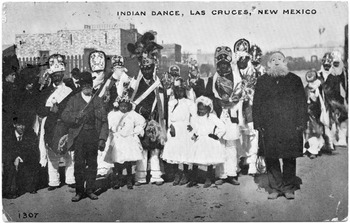
Matachines dancers, including several Malinches and an Abuelo. “Indian Dance, Las Cruces, New Mexico,” 1905? (Photo by Thomas K. Todsen; courtesy of New Mexico State University Library, Archives and Special Collections, Rio Grande Historical Collections)

In his journal, Warburg described the sound and movement patterns of the Monarcha, a figure modeled on the Aztec emperor Montezuma, and the rest of the dancers:
While until then there was only fiddling and hooting, a regular separation began now between the Monarcha and the rest of the Matachines at the festival; in rotations like Sir Roger de Coverley rows; he is at the end with the Matachin opposite across; while the remaining Matachines dance two and two against each other (alternating foot movements). (WIA III 1896:8)
The Roger de Coverley English folk dance that Warburg references does indeed bear a choreographic resemblance, being performed in two lines with frequent crossings and turns (Lowe [1860] 1992:97–98). But whereas the English dance enacts games of courtship across gender lines, the Matachines dance has a more martial quality with “a subtle undertone of violence” beneath its “festive air” (Rodríguez Reference Rodríguez and Stephenson2008:6). It is unclear where exactly Warburg encountered the English dance, although his Hamburg banking family conducted frequent business in London. In any case, this will not be the last time that Warburg identifies an affinity — purely resemblance in this case, but provocative nonetheless — between folk dance traditions in Europe and the US southwestern territories. From the first moments that Warburg recorded his impressions of the Matachines dance, he noted its tendency to cross borders.
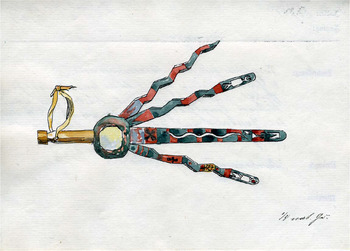
Hand‐drawn inventory card depicting a palma from a Matachines dance, performed by Hopi people, purchased by Warburg and donated to the Hamburg Museum of Ethnology. Director Georg Thilenius began the drawings in 1904 and completed them in 1907 with the assistance of two draftsmen, E. Bodstein and Elisabeth Weber. (© Museum am Rothenbaum [MARKK], Hamburg)

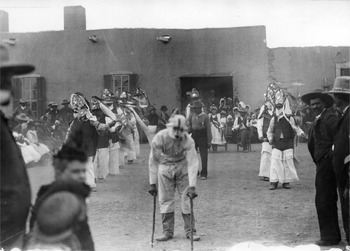
The performers in the Matachines dance each carry a guaje (rattle) in one hand and a palma (trident) in the other. The palmas are “three‐pronged lightning swords” that “invoke the Trinity and carve the wind in symmetrical arabesques” while the guajes accompany the dancers’ movements with rhythmic reinforcement (Lamadrid Reference Lamadrid and Stephenson2008:13). The dancers wear headdresses both reminiscent of a papal mitre (Rodríguez Reference Rodríguez and Stephenson2008:3) and “Moorish desert garb” (Romero Reference Romero and Gonzales2007:66), with rainbow ribbons streaming down and swinging with each crossing and reversal. “Bilateral opposition” patterns the symbolic structure of much of the dance (Rodríguez Reference Rodríguez and Stephenson2008:12). Other oppositional pairings include two clown figures, los Abuelos (the grandfathers), and the Monarcha and Malinche, who are Montezuma and either his daughter, his betrothed, or the betrothed of his son. The Malinche either converts the Monarcha to Christianity and/or marries him or his son during the dance. The Malinche is usually played by one or several little girls (although occasionally by a cross‐dressed man), sometimes wearing a white first communion dress and close in age (7 or 8) to when someone first receives the sacrament, although age and costume might vary (Romero Reference Romero and Gonzales2007:63, 71; Rodríguez Reference Rodríguez1996:4). The Monarcha and the Malinche engage in rhythmic interweavings and crossings of their own through the rows of dancers, and after an exchange of guaje and palma between them the performance reaches a tenuous reconciliation. An additional character appears in the Upper Rio Grande Valley Matachines, a character not present in the numerous other regional versions. El Toro, who might be “the totem bull of imperial Spain,” played by a man “with horns and canes for front legs,” appears “taunting the Malinche and weaving through the lines of dancers, as though lost in a labyrinth” with wild disregard for the tightly choreographed, rhythmic consistency of the movement (Lamadrid Reference Lamadrid and Stephenson2008:13). El Toro is eventually subdued by the Abuelos and either killed, castrated, or both, restoring order and bringing reconciliation. As the Malinche takes up the guaje and becomes the new leader of the dance in an exit march, the clown elders “pop their whips, make fun of the people, and ridicule the New World Order” from the sidelines (12).
A performer playing El Toro in a Matachines dance, Monticello, New Mexico, 1909. “Monticello Church Festival,” Henry A. Schmidt Pictorial Collection 000‐179‐0677. (Photo by Henry A. Schmidt; courtesy of the Special Collections and Center for Southwest Research, University of New Mexico Libraries)

Warburg watched this Matachines dance during a six‐month trip through the US southwestern territories from November 1895 to May 1896. In September 1895, Warburg had traveled to New York for his younger brother Paul’s marriage with Nina Loeb, a nuptial merger between two powerful banking families. Afterward, Warburg decided to stay in the US for several months and travel to the New Mexico and Arizona territories to study the cultural practices of the Indigenous people. He departed westward in November with letters of introduction and a recommendation procured prior to his departure through connections at the Smithsonian Institute and the investment firm of Kuhn, Loeb & Co. (with which he was now connected via his sister‐in‐law) that he be provided with a rail pass from the US government (Naber Reference Naber1988:62–63). He traveled west through Chicago, then Denver, before turning south and visiting the ruins of cliff dwellings at Mesa Verde, which he memorably called, in one of several geographical and temporal displacements, “Pompeii in New Mexico” (89, 91–92). Warburg then traveled in December 1895 and January 1896 through the New Mexico territory, staying mostly near Albuquerque and Santa Fe while taking shorter trips to visit nearby pueblos to observe traditional dances and other cultural practices (92). In February he traveled to California and briefly considered the idea of going on to Japan (Gombrich [1970] 1986:90). Ultimately, however, he decided to return eastward through the Arizona Territory, where in March and April he spent time with the Hopi nation (Naber Reference Naber1988:94 –95).
Warburg returned to Germany in May 1896, where, over the next year, he presented photographs and some preliminary observations from his travels in several lectures at the Hamburg Photographic Society, the American Club of Hamburg, and the Free Photographic Union of Berlin (Steinberg Reference Steinburg and Steinberg1995:90). After 1897, Warburg then seemed to put this research away, returning to his main field of expertise: classical images in Renaissance art. He did not return to public scholarly consideration of his travel through the southwestern US until decades later. Devastated by Germany’s defeat in World War I and increasingly plagued by paranoid delusions, Warburg suffered a mental breakdown in 1918, and his family had him committed and treated at several clinics in Hamburg and Jena before placing him at Ludwig Binswanger’s Kreuzlingen sanatorium in Switzerland from 1921 to 1924 (Chernow [Reference Chernow1993] 2016:192–196, 209–06; Didi‐Huberman Reference Didi-Huberman and Mendelsohn2016:241). In 1923, while institutionalized and struggling to recover, Warburg delivered a lecture at the sanatorium on his American trip in order to demonstrate to Binswanger that he was fit for release (Steinberg Reference Steinburg and Steinberg1995:76–78). A few months later, Binswanger allowed Warburg to return home. Although the first half of the lecture included much of the material from the photographic society lectures, the second half contained new material that focused on the Hopi Snake Dance, comparing it with images of snakes and dancing maenads of Greek antiquity. This decision was odd given that among the several performances that Warburg witnessed during his travels, he did not see the Hopi Snake Dance and had to rely on secondary sources. Meanwhile, a dance that he did see, the Matachines dance, remained unremarked.
How are we to understand the relationship between Warburg’s research on Indigenous cultures in the New Mexico and Arizona territories, and his dominant interest in the survival of classicism into modernity? This same question has intrigued, inspired, and confounded a great deal of subsequent scholarship on Warburg that has rehearsed and analyzed the travel narrative sketched in the paragraphs above (see Gombrich [1970] Reference Gombrich1986:88–92; Steinberg Reference Steinburg and Steinberg1995:97–109; Forster Reference Forster1996:6–7; Michaud Reference Michaud and Hawkes2004:171–228; Johnson Reference Johnson2012:29– 42; Didi‐Huberman Reference Didi-Huberman and Mendelsohn2016:232–39). In his notes while preparing his 1923 Kreuzlingen lecture, Warburg attempted to describe the reasons for his sojourn westward, beginning with a sense of aversion to “the emptiness of the civilization of eastern America” (Warburg [1923] 2004:301). This was coupled with his encounters in New York with the work of anthropologist Franz Boas and in Washington, DC, at the Smithsonian Institute with the work of other researchers on Native American culture, such as Cyrus Adler, Frank Hamilton Cushing, and James Mooney (301).Footnote 2 The disdain of the East Coast that pushed Warburg west also manifested as an attraction to the researchers in the US who “opened my eyes to the universal significance of prehistoric and ‘savage’ America. So much so that I resolved to visit Western America, both as a modern creation and in its Hispano‐Indian substrata” (301). For Warburg, the cultural expressions of Indigenous people who lived in the southwestern US produced temporal layers to study as a metaphorical archaeological dig, with sediments dating both before Western historical record and resolutely within the present tense of modernity: both historically positioned as altered by Spanish colonialism and autochthonous. This depth and dimensionality pulled Warburg from what he felt was the temporal shallowness of the East Coast.
Yet this layered culture also presented problems for Warburg. The Matachines dance that he witnessed most clearly introduced him to the complexities of images and stories across cultures, languages, and geographies, but Warburg seemed to have excised them from the story of his travels. Neither Matachines dances nor the fact that Warburg watched one has been substantially remarked upon in subsequent scholarship on Warburg or inserted into the well‐trod travel narrative sketched above. Yet survivals of the Matachines dance are threaded through citations and notes in both Warburg’s published and unpublished oeuvre, appearing over decades of his career, continually prodding his thinking from the edges. The temporal stability of ancient and modern along with the cultural and geographical certainty of Western and non‐Western that Warburg often deployed in his published writing and public lectures was directly challenged by the continued survival in his marginalia of the Matachines dance. The question becomes: why did both Warburg and his later readers retrospectively construct a travel itinerary that removes the Matachines dance? Moreover, in filling this lacuna, how might the terminologies Warburg developed to study the transmission of images across time and space change?
Remapping Survival
“Nachleben,” the term most closely associated with Warburg even though he used it infrequently, is difficult to define. Ernst Gombrich, Warburg’s first biographer and director of the Warburg Institute from 1959 to 1972, noted that “the special problem of Kulturwissenschaft [the science of culture] that Warburg had singled out as his principal concern was that of ‘das Nachleben der Antike,’ literally ‘the after‐life of classical antiquity’” (Gombrich [1970] Reference Gombrich1986:16). The difficulty, Gombrich points out, is that the nearest English equivalent might be “survival,” but that Warburg’s meaning might have been closer to “revival” (16). Georges Didi‐Huberman critiqued this definition as invalidating Nachleben’s dialectical and anachronistic structures (Reference Didi-Huberman and Mendelsohn2016:53). Didi‐Huberman argues that Nachleben cannot be understood as simplistically evolutionary or adhering to a 19th‐century notion of social Darwinism (36). Instead, Nachleben pushes against the certainties and teleological evaluations of periodization, which sets up a dialectical tension between the term and the Renaissance (which literally means rebirth), the focus of Warburg’s research. The European Renaissance was a rebirth and an afterlife, both a survival and a revival (39). This means that the Renaissance, the ostensible origin of modernity and rationality, is impure, but this impurity is the very source of its vitality (45). Nachleben anachronizes history, “eroding any chronological notion of duration” in both the present and the past: it anachronizes the present by contradicting the idea that artistic style is determined solely by its present tense context; and it anachronizes the past by calling classical antiquity’s status as “an absolute origin” into question, further suggesting that this “origin itself is an impure temporality characterized by hybridizations and sediments, by protensions and perversions” (49). This is why Didi‐Huberman rejects Gombrich’s proposal of “revival” as a term equivalent to Nachleben, accusing it of being an “exorcism” (51). For Didi‐Huberman, a revival insists on rigid periodization, negating the anachronistic tension of Nachleben in the Renaissance. It does not allow for the “displacement” or “foreignness” that gives images in their renewed lives their special intensity (26, 152–54, 160–61, 262, 265). The spatial metaphors for temporal movement that Didi‐Huberman uses at different points in his book might also prompt a critique of Gombrich’s tentative geographically and culturally situated assertion that “perhaps the best way of defining [Warburg’s] problem would be that he was concerned with the continued vitality of the classical heritage in Western civilization” (Gombrich [1970] 1986:16).
In actuality, one of the few times that the term “Nachleben” appears in Warburg’s writing is in a handwritten note accompanying the text of his Kreuzlingen lecture, where it becomes an adjective. After a passing mention of the Matachines dance, Warburg writes, “Moresca nachlebend?” [Surviving Moorish dance?] ([1923] 2018:101). Warburg’s question here opens a travel route for a survival that interweaves back and forth across the geocultural borders of “Western” like the choreography of Matachines dancers. One of the routes mapped for the origins of Matachines dances is through the Spanish Moros y Cristianos dance, a martial performance that documents centuries of conflict and intercultural contact between the Islamic and Christian kingdoms on the Iberian Peninsula (see Forrest Reference Forrest1999:397n4; Romero Reference Romero and Gonzales2007:66–67; Versényi Reference Versényi1993:1–2, 95). At the end of the Reconquista in 1492, the last Islamic kingdom on the Peninsula was defeated by Christian armies, marking new geographical, religious, and cultural boundaries for the Spanish kingdom months before those boundaries would again be transformed by Christopher Columbus’s expedition across the Atlantic. The Spanish term “Reconquista” suggests that this was not a new conquest but a retaking of what Christian Spaniards were already entitled to by way of an illusory originary conquest, attempting to clarify a likely ambiguous demarcation between Indigenous and foreign empires and people. Perhaps it is not surprising then that a performance that memorialized this demarcation made its way to the Americas by way of Spanish conquistadors and missionaries. Drawing and redrawing brackets around the categories of indigeneity and foreignness, conquest and reconquest were urgent matters in the Spanish colonies, both for those seeking to annex land, resources, and bodies and those seeking to protect them. Moreover, they continued to be so in the southwestern territories that Warburg visited. Like the Reconquista, the US doctrine of Manifest Destiny suggested that an expanse of the North American continent stretching from the Atlantic to Pacific Oceans already belonged to the United States. After the US annexation of the southwestern territories following the end of the 1848 Mexican‐American War, lines between native and invader were again redrawn to serve the interests of the powerful, but also as a tactic of resistance by the dispossessed. It is this history of displacement and foreignness — the tensions tentatively corralled in moments of crisis — that imbues Matachines dances with their liveliness and pathos.
If “Nachleben” is a concept that Warburg developed, contextualized by and inextricably tied to the spatiotemporal displacements and power differentials of globalizing colonialism and capitalism, then whether we translate it — and thus interpret it — as “survival” or “afterlife” is political. In theatre and performance studies ghosts, the spectral, hauntologies, and other deathly metaphors have provided rich material for scholarly critical engagement across a range of topics (see for example Carlson Reference Carlson2001; Sofer Reference Sofer2013; Luckhurst and Morin Reference Luckhurst and Morin2014; DuComb Reference DuComb2017). Metaphors for the dead, however, mean different things in different contexts; we must be cautious feeling at ease with their use (these are indeed matters of life and death). Sometimes it matters that performances not only remain, as Rebecca Schneider has argued so compellingly (Reference Schneider2011), but that they also survive because the lives of the human bodies doing the performing depend on it. Warburg’s Nachleben depends on the well‐worn stereotype of Indigenous cultures generally, but Indigenous American cultures specifically, as “vanishing,” “dying out,” “the last of their kind,” “on the verge of extinction.” Whether we emphasize the more ghostly, revived‐after‐death dimensions of Nachleben or the capacity of cultures, gestures, images, and bodies to survive — transferred and transformed but resistantly alive nonetheless — marks the political stakes.Footnote 3 Warburg himself at times embraced the trope. If Nachleben is intrinsically bound up in his trip to the US southwest, then the term suggests a prerequisite death for some in order to culturally enrich others. But at times the way Warburg analyzed and understood what he experienced shows how Indigenous communities were alive, insisting on their survival; how nothing and, more importantly, no one is obligated to die before being revived. This is why I translate “Nachleben” as “survivals,” both because of my own political orientation and as a means to reposition Warburg’s theories.
Displacing survivals from the categorically “Western” creates endless forks in their paths. One trail leads from Warburg’s question, “Morsesca nachlebend?” to conflict on the Iberian Peninsula. After 1491 as the Granada War ended, and as they were taking hold as Matachines dances in the Spanish colonies, “Moorish” dances and music migrated across the European continent and the British Isles. Morescas, Morris dances, and dances with several other related monikers all generally depict something ostensibly “Moorish,” but what that means and how that is interpreted varies considerably both historically and presently (like Matachines dances, Morescas survived to Warburg’s time and continue in our own). In Europe, Morris dances or Morescas were performed in streets, inns, and private households, but their cultural spread was facilitated by their popularity in royal courts across Europe in the 16th century (Forrest Reference Forrest1999:74). These loosely related dances were martial with vigorous movement emphasized by costumes covered in bells (87). Their “Moorishness” often became a catchall for an exoticized outsider identity in both popular and courtly iterations:
The actual use of Moors as characters in the dance is conspicuously rare, so that whatever Moorishness the titles moresque, morescha, maruscka, and so forth imply, the reference is somewhat indirect. But the characters are, in the main, representative of the non‐Christian world: Jews, pagans, barbarians, Turks. In a general sense, therefore, the dances may be said to be outlandish — symbolic of the remote and exotic worlds at the fringes of Europe. (Forrest Reference Forrest1999:89)
Like Matachines dances, Morescas in Europe were a means of drawing and redrawing geographical and cultural borders. Morescas, however, seem to tell less of a story about cultural difference and invasion, and more of one that endlessly reinvents the category of foreigner. On both sides of the Atlantic, the conflict of Moors and Christians — a staging of war, cultural difference, foreignness, empires, invasion, conquest, and reconquest — was repurposed over and over for centuries while power, alliances, geographies, and identity categories shifted and changed. These dances restage the ambivalence of cultural contact as both memorials to violence and potential sites of transformation. Loose and disreputable genealogies link all of these performances — more bastardization and miscegenation than pedigree, but trace them as kin nonetheless. Is the Matachines dance a surviving Moresca, or is it the other way around? Are they twin survivors of some unknown ancestor, dispersed across oceans, plains, and mountains by colonialism and capitalism? For Warburg to connect these two traditions that developed simultaneously in Europe and America suggests that not only are survivals unmoored from the stable harbors of “the Western,” but that they behave temporally in much less linear ways than a one‐way passage from antiquity to modernity.
“Antiquity,” for Warburg, is a charged source of pathos when it reemerges outside of its own time. The particular form that survivals often take in Warburg’s research is corporeal, in what he called Pathosformeln (pathos formulas, sometimes translated as emotive formulas). Pathos formulas suggest that temporally displaced images move through bodies, in both two‐ and three‐dimensional artistic renderings including embodied performance. Images from “pagan antiquity” have a particularly strong emotive force, an enlivening sense of movement for Warburg, which is evident throughout his career. Early on, in his 1893 dissertation on the Renaissance painter Sandro Botticelli, Warburg writes in a prefatory note:
It is possible to trace, step by step, how the artists and their advisers recognized “the antique” as a model that demanded an intensification of outward movement, and how they turned to antique sources whenever accessory forms — those of garments and of hair — were to be represented in motion. ([1893] 1999:89)
The flowing costumes and props that Warburg describes are indicative of the performative means through which pathos formulas survive through time. Later in the dissertation, Warburg suggests the influence of Poliziano’s 1479 opera, Orfeo, and its subsequent life in performance, on the “nymphlike costume of antique inspiration” in Boticelli’s paintings (125). As Warburg describes it, performance transmits pathos from the past to the present, a chain of inspiration from antiquity into the Renaissance:
Once we assume that the festive performances set the characters before the artist’s eyes as living, moving beings, the creative process becomes easier to follow. The program supplied by the humanist adviser loses its taint of pedantry: the inspirer is not imposing an object to be imitated, but simply facilitating its articulation. (125)
This articulation in painting by way of performance marks the Renaissance as strikingly contemporary and classical at the same moment; the pathos of the past moves not only through images but through the living bodies of performers.Footnote 4
The idea that the survival of antiquity awakens in corporeal form as pathos formulas is discordant with the ways in which some previous scholars — particularly in the German art historical tradition — had imagined and described the art of ancient Greece and Rome. In particular, Warburg contrasts pathos formulas with the 18th‐century art historian Johann Joachim Winckelmann’s repeated description of classical art as qualitatively possessing “noble simplicity and tranquil grandeur” ([1756] Reference Winckelmann and Nisbet1985:42– 45). In his 1905 essay on the northern Renaissance artist Albrecht Dürer and his renderings of the death of Orpheus, Warburg writes:
The narrow Neoclassical doctrine of the “tranquil grandeur” of antiquity has long tended to frustrate any adequate scrutiny of this material; it remains to be pointed out that by the latter half of the fifteenth century […] Italian artists had seized on the rediscovered antique treasury of forms just as much for its emotive force of gesture as for any tranquil, classical ideal. ([1905] 1999:553)
The pathos formula that Warburg traces in his Dürer essay through depictions of the death of Orpheus are imagistic, literary, and performative, bringing him again to Poliziano’s opera:
For the death of Orpheus was more than a studio motif of purely formal interest: it stood for the dark mystery play of Dionysian legend, passionately and knowingly experienced in the spirit and through the words of the ancients. Proof of this can be heard in the Ovidian strains of the first Italian drama, Poliziano’s Orfeo. (555)
The survival of Greek tragedy’s particular pathos emerges here in the opera’s “Ovidian strains,” the multisensory immediacy of an opera. Warburg calls this research “a record of some initial excavations along the route of the long migration that brought antique superlatives of gesture from Athens, by way of Rome, Mantu, and Florence, to Nuremberg and into the mind of Albrecht Dürer” (558). But there might be an unmapped detour to follow on this “long migration” of corporeal survivals and their pathos.
When Warburg references the Poliziano opera in his dissertation on Botticelli he includes a note that a satirical version of the death of Orpheus was performed in a 1571 intermedio as a “Morescha of Orpheus among the wild beasts (portrayed by ten dwarfs) and Orpheus slain” ([1893] 1999:417). Although Orpheus is a character from antiquity who survives in Renaissance performances, soon after Poliziano first decided to put him onstage, Orpheus began to wander from his antique provenance. Later opera adaptations of the Orpheus myth continue this tradition, including Monteverdi’s well‐known adaptation from 1607 that ends with a Moresca included in a nod to the ubiquity of the tradition (Johnson Reference Johnson2011:174 –75). So, in the pathos formulas that survive in the death of Orpheus, not only is the Renaissance temporally impure, it is geographically and culturally impure. What pathos does Orpheus acquire not by way of his antique pedigree, but by his more promiscuous journeys through religious warfare and colonialism, murdered not by antique nymphs, but by satirical Moors?
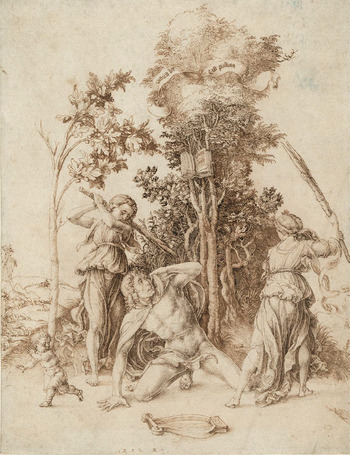
Albrecht Dürer, The Death of Orpheus, brown ink on paper, 1494. (Bpk Bildagentur/Hamburger Kunsthalle/Christoph Irrgang/Art Resource, NY)

The same year that Warburg wrote his essay on Dürer’s depictions of the death of Orpheus, he seems to have renewed his interest in the Matachines dance, perhaps prompted in part by Orpheus’s Moorish journeys. When Warburg watched a Matachines dance in 1896 he was not able to record his impressions on film, but only in his notebook. Warburg purchased a Kodak Bull’s‐Eye camera while on his American trip and his photographs of the region were clearly an important part of his travel, given that he presented the research first to photographic societies, venues he did not generally make use of to share his other research (see Jones Reference Jones, Guidi and Mann1998; Guidi Reference Guidi, Guidi and Mann1998; Michaud Reference Michaud and Hawkes2004:368n22). On the day that he watched the Matachines dance, however, Warburg did not have the camera with him. He specifically mentions in his journal that his “study time” companion for that day, Father Juillard, would have the Kodak brought for the following day when they visited Acomita, “the desert Indian Pueblo [that] has artful alleys and photographic parts and existing frames at their guest building” (WIA III 1896:11). But writing his essay on Dürer in 1905, Warburg sought to supplant the visual record of his trip. In correspondence that year from Emil Bibo of the Cubero Trading Company — who watched the Matachines dance with Warburg in 1896 — Bibo sent images and a film of Matachines dances to Warburg, requesting that they be returned if Warburg no longer had use for them (WIA GC 1905). It is unclear how long Warburg kept these materials although they do not seem to have been preserved in his archives. Whether or not they were still in his possession after he was admitted to Kreuzlingen, he recalled them then. In the same note in his 1923 lecture where he asks about Matachines/Moresca survivals, he makes note of Bibo’s photos, seemingly as a reminder to himself.
But for nearly a decade after Warburg returned to Germany from his trip, he had only his memories and notes to recall the Matachines dance. As he studied Dürer’s images of the death of Orpheus in 1905 — tracing the pathos elicited by an arm raised futilely in defense against a pack of nymphs with flowing scarves and vengeful intentions, finding correspondence in the resemblance of props and gesture as they survive with an emotive charge intact — a survival of the Matachines dance pulled at him from the margins. To return to Warburg’s recollection of the Malinche who “must hold on to the obstinate bull with a blue silk scarf — as near [as she can] to the weakened bull without timidity,” might there have been something that resonated with his research on Dürer? Perhaps at the moment of his death, El Toro shielded himself in a gesture reminiscent of the pathos formulas of Dürer’s Death of Orpheus. Perhaps the Malinche’s blue silk scarf waved in the wind, reminiscent of a Renaissance nymph whose flowing garments capture a dynamic moving emotive force of antiquity. It is not possible to know what exactly Warburg was looking for in Bibo’s images or whether or not he found it there, and the timing could be coincidental. But the fact that a survival of the Moresca and Matachines dances continues to exist, intertwined, over two decades later when Warburg crafted the Kreuzlingen lecture in 1923 might suggest at the very least that the displacements of time and place that give antiquity its emotive charge as they erupt into new present forms are never disentangled from the displacements of colonialism that also culturally and financially fueled the Renaissance (see Mignolo Reference Mignolo1995). To return to Didi‐Huberman’s observation that survivals — along with their corporeal forms, their pathos formulas — acquire a charge through displacement and foreignness, how do the dynamics of power, subjugation, and resistance feed, reroute, and alter this charge? This question becomes particularly urgent when encountering embodied transmissions in colonial contexts, where vectors of transmission might pass, multidirectionally, through moments of violence and trauma. Additionally, in what ways are the material forms through which pathos formulas also pass transformed by the material conditions of their movements through networks of colonial/capitalist exchange and annexation?
Warburg sketched out the specific problem of how human bodies relate to lives and things outside of themselves in acts of performance while on his trip’s mid‐point from the New Mexico and Arizona territories to California from late February through the end of March 1896. Here, he recorded the first notes for an incomplete project he would work on for several years following his return to Europe: “Symbolism as a Determinant of Periphery” (Symbolismus als Umfangbestimmung). In this writing, Warburg attempted to sketch out a theory of the ways in which symbols mediate a transformative relationship between self and other (Warburg [1896] 2015). He describes a problem that pulls at him, “the loss of a personal sense of identity through inorganic spatial expansion,” or as he concisely summarizes in a single word jotted below this phrase, “appropriation” (299). The expansion of the self beyond the supposedly stable peripheries of flesh and subjectivity might be facilitated through actively engaged objects such as a “device, jewelry, costume,” which Warburg calls “painless body parts,” or “property (owned or donated)” (300). These objects are scriptive things (Bernstein Reference Bernstein2011:69–91) that allow for performers to connect with narratives, characters, and histories beyond their own immediate surroundings, producing an expansion of the body through the prosthetic addition of “painless body parts.” The fact that Warburg, the heir to a banking fortune, also identifies these prosthetic objects as private property — owned, donated, or, perhaps, appropriated — suggests that this bodily expansion might happen through the processes of colonialist/capitalist accumulation in and of itself. Survivals expand the body of the performer through the practices of appropriation and misappropriation, possession and dispossession, as props, costumes, and musical instruments move from performer to performer, across generational histories of both inheritance and theft. Perhaps it is not surprising then that one of the ways in which Warburg brought the Matachines dance back to Germany was through the purchase of two palmas, props from the dances, which he donated to the Museum of Ethnology in Hamburg along with a collection of other Indigenous art objects he had purchased or otherwise acquired during his travel through the southwestern territories (see Flecken Reference Flecken2018).
The Survivals of New Mexico and the Pathos Formulas of the Matachines Dance
Cultural impositions, borrowings, and interactions in the contexts of empire, migration, colonialism, and war had been playing out in the landscape of the southwestern territories for centuries when Warburg arrived. But whereas Warburg viewed the survival of antiquity in the Renaissance as enlivening, set into motion, and charged with affect, he struggled at times to see the layered survivals of the southwestern territories in the same way:
The material is contaminated: it has been layered over twice. From the end of the sixteenth century, the Native American foundation was overlaid by a stratum of Spanish Catholic Church education, which suffered a violent setback at the end of the seventeenth century, to return thereafter but never officially to reinstate itself in the Moki villages. And then came the third stratum: North American education. ([1923] 1995:2–3)Footnote 5
Contamination — the word implies disease and toxicity — also presupposes an originary purity, a primitive authenticity that might be glimpsed through some kind of decontamination‐filtered lens. Spanish colonialism, forced religious conversion, the Pueblo Revolt of 1680, and US imperialism do not seem to lend a charged pathos to cultural survivals in the same way that antiquity does for Warburg; rather they corrupt it. Instead, tracing what survives leads to what is prior to, without, or despite colonialism. This “originality” remains or is revivified in Indigenous performances and visual art. But as I have suggested above, survivals, particularly in their embodied forms, always occur within contexts of power. Moreover, this fantasy of a pure and eternal time before colonialism is constantly challenged in Warburg’s own notes and citations by his continued references to the Matachines dance.
Because of the complex and rich history of their transmission, through which traces of images, gestures, structures, and narratives survive in their varied performance revivals, Matachines dances would seem to be exceptionally well‐suited case studies for Warburg to analyze. Like Warburg’s depiction of pagan antiquity reemerging as survivals in the Renaissance, this transmission history does not result in the motifs of Matachines dances becoming stultified or static homages to the past, but instead continuously reenlivens the dances through the very act of their displacement. Claire Sponsler characterizes Matachines dances as “refracted histories” performed as “conquest dramas” that “present a contested view of the past, in which the nature and meanings of the conquest are fought over by its various inheritors” (Reference Sponsler2004:17). Through this process of historical refraction, images from the colonial encounter are refracted like light hitting a cracked mirror, rather than reflected in a straight line from a smooth surface. But it is precisely through this indirect mode that these survivals gain a pathos.
These refracted histories and presents, however, can also be a source of disorientation. For example, Warburg seems to have been uncertain as to who, exactly, he saw performing the Matachines dance. In a letter written to his parents soon after he saw the performance, he characterized it as “Indian” (WIA GC 1896). But decades later in the Kreuzlingen lecture, Warburg mentions that he attended a “Mexican Matachina dance” with Juillard ([1923] Reference Warburg and Steinberg1995:11). The ambiguity of the dances’ cultural provenance (whether it is “Indian” or “Mexican”) is, in practice, deeply a part of the Matachines dances. In many ways, this is also indicative of the far more permeable cultural borders that cross the region.
Even the name of the territory that Warburg saw the dance performed in marks the region as a site of contested histories and hybrid cultural forms. The toponym “Nuevo México,” or in its later translation, “New Mexico,” has been used for centuries to denote a geographic region in multiple iterations and with fluctuating borders and power structures. New Mexico has existed as both a real series of overlapping places and an imaginary location particularly suffused with the survivals of images, myths, and performances generated both within its sandy terrain, and from outside via the multiple cultures that intersected there at different epochs. New Mexico as an imagined place has served as a palimpsest through which images and myths have passed, ceaselessly moving over and under one another. New Mexico was and continues to be a site of territorial contestation and struggle.
The consistent practice of carving the “New World” into various chunks, sketched onto maps as “new” versions of kingdoms, cities, and towns in Europe, makes the initial naming of land in the Upper Rio Grande Valley as “New Mexico” during the Spanish conquest of 1598 strikingly peculiar. Jill Lane argues that the conquest and creation of New Mexico was an act of both repetition and forgetting, happening over a century after Columbus’s ships first sailed when “the acts of conquest themselves have become increasingly codified, and have developed a taxonomy of repeatable behaviors” (Reference Lane, Phelan and Lane1998:57). So colonial claims of novelty transform, in the decadent years of empire, into nostalgia. But as Danna Levin Rojo has argued, it was not only imported Spanish conquest scenarios, doubled over, that influenced the attempts to conquer the lands north of New Spain, but also Indigenous Nahua narratives about an ancestral Mexica migration from the north (Reference Rojo2014:173). While a reanimation of decomposing Spanish conquest images from the past may have informed the 1598 expeditions, there is also a return to the origins of the Aztec people and a rebirth of a “New” Mexico nearly a century after Mexico‐Tenochtitlan was conquered and renamed “New Spain.” New Mexico, in its invention and naming, is filled with the tensions of survivals and seems to remain so in its subsequent life as the New Mexico territory, and later the state of New Mexico.
The New Mexico territory that Warburg encountered continued to be a site of displacements and reiterations, where images that migrated from distant times and places appear in altered forms. In the early years after the Mexican‐American War when it was acquired by the US in the treaty of Guadalupe Hidalgo in 1848, and throughout the US Civil War, travel to the New Mexico territory was difficult, with narratives of poverty and lawlessness persisting in popular depictions (Sandweiss Reference Sandweiss and Melzer2010:65–66). This depiction was in some ways merited by the precarious situation many of the region’s residents found themselves in after successive dispossessing waves of colonialism and war, but it was also often exaggerated and sensationalized. The introduction of a railway created a new impetus for commercial interests to alter this image. In 1872, the Atchison, Topeka & Santa Fe Railway reached the New Mexico border, and by 1883 track had been extended through the territory to meet the Southern Pacific Railway in California (Weigle Reference Weigle1989:116). In order to promote tourism as well as commerce along the new railway, the Santa Fe Railway Company along with another major investor in the region, Fred Harvey, who founded the first US chain restaurants in train stations along the line and a number of luxury hotels, created a sense of cultural accessibility. Harvey created a network of “living museums” or small‐scale “world’s fairs” near railway stations, where Indigenous people from the region performed their cultures for tourists. These performances displayed Indigenous people as ancient and authentic, somehow untouched by modernity despite centuries of colonialism (Weigle Reference Weigle1989:121, 125). The rebranding of New Mexico as a destination for culturally enriching travel relied on clear cultural differentiation and institutionalization. For example, in an ambitious, multiday event — named (with dubious historical accuracy) the Santa Fe Tertio‐Millennial Celebration and Exposition — staged in Santa Fe in 1883 by the governing authorities of the New Mexico Territory, performances were clearly delineated as being “Spanish,” “Indian,” or “Anglo” and were presented as entirely self‐contained and unmixed (Herrera Reference Herrera, Noriega and Santana2018:90; Sandweiss Reference Sandweiss and Melzer2010:65–71). Part of stripping New Mexico of its lawless reputation involved erasing cultural hybridity and managing the borders of cultural identity. The Santa Fe Exposition was widely publicized at the time, and Warburg acquired a copy of the brochure when he traveled through the region five years later (WIA GC n.d.).
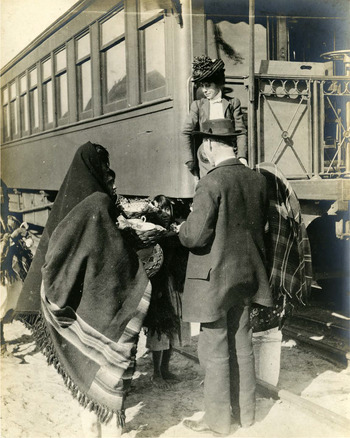
Indigenous people selling pottery to riders of the train line through the southwestern territories, 1900? “Native American Women Selling Pots,” Nancy Tucker Pictorial Collection of Southwest Materials, 000‐885(8)‐0011. (Photo by Nancy Tucker; courtesy of the Special Collections and Center for Southwest Research, University of New Mexico Libraries)

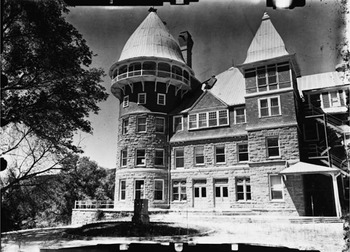
Conversely, at the same time as the Harvey Company was engaged in this practice of cultural quarantining, it also promoted a rebranded image of the region and the various people who lived there through a series of dislocations that, while reinforcing a sense of ancient authenticity, also utilized intentionally blurry cultural borders as a marketing ploy. As Marta Weigle details, this new image of New Mexico promised tourists a glimpse of the “ancient villages of Ancient Egypt and Nubia, Ninevah, and Babylon” in the villages of the Puebloan peoples of the region, or sights of “American Pyramids” in the Taos Pueblo. This made travel there “symbolically equivalent” to romanticized imagery of edifying and culturally elevating travel to classical or biblical lands by upper‐class Europeans, replete with all of the, by this time, well‐worn tropes of the grand tour (Weigle Reference Weigle1989:117). These geographically displaced survivals of images of romantic travel to the ancient world left intact the sense of temporal displacement inherent in the notion of travel to particular places granting access to the “ancient.” Additionally, they were supplanted by material whose provenance was geographically nearer and culturally more directly linked. The figure of Montezuma became a popular marketing ploy; a prominent example was Fred Harvey’s name for his luxury hotel at the Las Vegas, New Mexico, hot springs: The Montezuma (120). Montezuma seems to appear as a survival of New Mexico’s perceived Aztec origins, as though after having the Aztec empire annexed and renamed New Spain, the legendary ruler returned in highly varied guises to the originary place of his people, now a “New” Mexico. Montezuma’s name lent the hotel an imperial majesty by way of the Aztec empire, but, in a displaced and conflated geographic and temporal gesture, visually it was another empire that was evoked. Built in Queen Anne revival style, the Montezuma hotel was simultaneously stylistically out of place in the southwestern landscape, but was also integrated as a part of it because it was built out of local red sandstone, its towers evoking the surrounding mountains (Ivers Reference Ivers1974:209–11). The Montezuma character for whom Fred Harvey named his hotel, which was imperial by way of British empire nostalgia, conformed to other preexisting scenarios from European traditions, where Montezuma appeared as a “‘stately’ ruler of a ‘civilized’ but vanquished Aztec Empire” (Weigle Reference Weigle1989:117). But Montezuma characters also appear throughout the region in Matachines dances in more complicated and contested guises.
“Montezuma Hotel, Gallinas Canyon, Las Vegas, San Miguel County, NM,” documentation compiled after 1933. (Photo by Koogle & Pouls, Engineering; Historic American Buildings Survey, Library of Congress)

The varied depictions of Montezuma in Matachines dances in the region and the political stakes in those differences returns to Warburg’s uncertainty about whether or not the dance he witnessed was “Indian” or “Mexican.” As noted earlier, Matachines dances are performed throughout a large geographic area with substantial local variation. Variants of the dance in the Upper Rio Grande Valley, where Warburg saw it, are performed by both Hispanic and Puebloan communities, and share seemingly similar choreography, dramatic structures, props, characters, music, and costuming, distinct from versions of the dance performed elsewhere (Rodríguez Reference Rodríguez1996:2). The visual and structural coherence between performances by both Hispanic and Puebloan communities, however, does not account for the significant differences in how these two groups perceive the meaning of the dance. As Rodríguez notes:
Both agree it is Christian rather than pagan or aboriginal, but most Pueblos claim the dance was brought to them from Mexico by Montezuma […] Hispanic villagers, on the other hand, attribute its introduction to colonizer don Juan de Oñate, reconquest leader don Diego de Vargas, or Cortés himself, because the drama portrays the advent of Christianity among the Indians by referring to the expulsion or conversion of the Moors, a paradigm the Spanish colonizers instantly projected onto their conquest of the New World. The dance thus has historical but differential meaning for Indian and Hispaño groups because the advent of Christianity in the region does not have the same meaning for those who brought it as for those it subjugated. (2)
Rodríguez argues that this difference in the origin story of the dance is tied to a difference in the religious and political interpretations both groups have of the performance, which can be seen especially in the character Montezuma.
For both Hispanic and Puebloan communities, Montezuma’s significance in the dance is trans‐temporal. For Hispanic communities who perform the dance in the region, Montezuma is a figure of religious conversion and his depiction celebrates the triumph of Christianity over paganism (Harris Reference Harris2000:239). Montezuma’s conversion is memorialized as a renewal in the present of the promises of Christian salvation in the future. In a distinctly different register, for Puebloan communities who perform the dance, Montezuma, who is both the progenitor of the dance and one of its main characters, the dance becomes “symbolic resistance to European conquest and forced conversion to Christianity” (Sponsler Reference Sponsler2004:20). Some Puebloan people refer to the Matachines dance as “Montezuma’s dance” suggesting that it was “brought to them in a way that both signified and yet helped to mitigate the catastrophic advent of European penetration” (Rodríguez Reference Rodríguez1996:144). In other words, Montezuma brings them the dance as a memorial for the catastrophe of colonialism and a tool for a resistant rebuilding. At the same time, according to Harris, Montezuma also takes on a “messianic” quality in Puebloan interpretations of the dance, suggesting that his reappearance there might also mark acts of resistance to come and an ultimate overthrow of the colonial order that will unfold in the future (Reference Harris2000:238–39). This is echoed in the characterization of the Malinche, who appears in both the Hispanic and Puebloan interpretations of the Matachines dance, unencumbered by the negative and destructive connotations that she often does in iterations of the dance in other regions (Romero Reference Romero and Gonzales2007:68–69). Nor is she primarily understood in the Upper Rio Grande Valley to be the translator and mistress of the conquistador Cortés, but is instead generally characterized as the wife or daughter of Montezuma (Harris Reference Harris2000:238). In the Hispanic interpretation, the Malinche plays an important role in facilitating Montezuma’s conversion; while in the Puebloan tradition she takes on a mythic role as the daughter of an old monarch/Montezuma, and the future legitimating wife of a new monarch/Montezuma (238). In this context the Malinche becomes a genetic and temporal carrier of resistance to colonialism, which survives through her body in the guise of a literal promised rebirth.
The multiple temporal registers that Montezuma and the Malinche perform in both cases echoes a shared sense of geographical displacement:
[I]nterpretations of the dance from both sides revisit local history obliquely, through a restaging of the earlier conquest of the Aztecs that, while obviously connected to the fate of the Pueblos, is nonetheless slightly displaced from it. The result is a performance that engages with local history from one or more removes rather than confronting it head on. (Sponsler Reference Sponsler2004:29)
The Matachines dance does not travel head on toward its ancestors, and could be characterized by what Joseph Roach calls the “performance of origin,” which he defines as “the reenactment of foundation myths along two general axes of possibility: the diasporic, which features migration, and the autochthonous, which claims indigenous roots deeper than memory itself” (Reference Roach1996:42). Diasporic and autochthonous performances of origin need not appear separately in a given performance tradition, but might appear together in contested forms that disrupt an even temporal flow:
As evocations of the past, both myths of origin — the diasporic and the autochthonous — also suggest alternatives for the future. These alternatives inevitably raise the question of surrogation: diaspora tends to put pressure on autochthony, threatening its imputed purity, both antecedent and successive, because it appears to make available a human superabundance for mutual assimilation. At this promising yet dangerous juncture, catastrophe may reemerge from memory in the shape of a wish. (42)
As paths of diasporic migration transport bodies, images, and narratives, they threaten notions of autochthonous purity and might instead enter into the more jumbled family lines of surrogation. These moments of catastrophe refract through time, becoming stages upon which possible histories and futures get played. This is a moment filled with pathos, heightened by the dislocation of foreign into local, pasts into futures.
When Warburg attended the Matachines dance in Cubero, the temporal, geographical, and cultural borders that purportedly partitioned off the “Indian” and “Mexican” must have inevitably revealed a diasporic porosity. In Warburg’s notes where he recounts watching the dance, Spanish words slip into German, pointing to the impossibility of quarantining cultures in contact as Warburg describes the choreography and action. For example, he alternates between calling the improvisational pair of old men Abuelos (“grandfathers” in Spanish) and der Alten or der wilden Männer (“the old men” or “the wild men” in German) (WIA III 1896:13). In one moment, he recounts the high point of the action, the moment of the bull’s sacrifice:
The bull’s blood is siphoned with the help of the wild men and the Malinche puts it on her blue silk scarf and looks at it — prompted by all the old men she smells the blood of the dead bull, fine clavos and canela within (her father has sacrificed and prayed well). (WIA III Reference Warburg, Pfisterer and Hönes1896:13)
The bull, played by a human performer, is sacrificed, but his stage blood falls scented with warm, sweet spices (cloves and cinnamon). Warburg evokes these scents with Spanish words, perhaps recreating the Malinche’s line as she smells her blood‐soaked blue silk scarf. Her father, Montezuma, has invoked the linguistically and olfactorily transformed blood with his prayers.
In Warburg’s Kreuzlingen lecture, a second note about the Matachines dance (after the first question about Matachines/Moresca survivals) appears in the margins, this time in relation to a discussion of what he terms a “Darwinism of mythical elective affinity” ([1923] 1995:19). The German word Warburg uses here, Wahlverwandtschaft, usually translated as “elective affinity” or “kindred by choice,” is a chemistry term used to describe that certain chemicals prefer one another, which was translated into a model of human romantic relationships in Goethe’s 1809 novel of the same name pluralized (Adler Reference Adler, Cunningham and Jardine1990:263–79).Footnote 6 The word is both quasiscientific and romanticist, genetic and agentive, where the attachments of kin are no longer foretold but elective. When Warburg evokes this “Darwinism of mythical elective affinity” in his lecture, he has just finished discussing the Antelope Dance he watched at San Ildefonso Pueblo, in which the dancers mimic the movements of the animals they hunt. From this, Warburg describes what he sees as the pagan worldview:
These Indian pagans, like pagans all over the world, form an attachment out of reverential awe — what is known as totemism — to the animal world, by believing animals of all kinds as the mythical ancestors of their tribes. Their explanation of the world as inorganically coherent is not so far removed from Darwinism; for whereas we impute natural law to the autonomous process of evolution in nature, the pagans attempt to explain it through arbitrary identification with the animal world. It is, one might say, a Darwinism of mythical elective affinity which determines the lives of these so‐called primitive people. ([1923] 1995:19–20)
Warburg here reverses the view of modernity as a time supposedly typified by human mastery of nature. For so‐called modern people who see evolution as an autonomous process, natural and detached from culture, the descriptions they create for it appear as equally natural, and are thus both infallible and nonnegotiable. Modernity forecloses the capacity to make kin across species, to creatively crisscross genetic lines of descent based purely on choice and desire. It is only by being outside of time (primitive) and outside of Abrahamic religions (pagan) that Darwinism can become imbued with both mythology and choice.
But in a citation here that suggests another possible route this mythical elective affinity might take, Warburg adds at the bottom of the slide: “Note: The dance performance in Cubero, also clearly a medieval Morris dance. The son of Montezuma only dances when the girl (Malinche) hands him the head of the bull, and remarks that: ‘The bull’s blood smells good’” ([1923] 2018:100). This is the second time that the Matachines dance has found its way into the margins of Warburg’s Kreuzlingen lecture. The movements, characters, and actions from a common ancestor might survive in performances of a Morris dance or Matachines dance, but what has been transformed, added, and erased might reflect the affinities felt as they reappeared. The Malinche hands the head of the bull to the son of Montezuma, prompting a dance and a survival of a reborn Emperor through the reproductive capacity of her body. The Malinche, through the transformed blood of the bull, seems able to carry the blood of Montezuma and her people into the future in order to survive through the repetition and transformation of performance. What this Montezuma or his descendant will be — a stately ruler of a hotel chain, a figure of the renewal of Christian redemption, or a memorial of resistance in the past and resistance to come — lies within the realm of the elective affinities of survivals. Even so, Warburg makes a change here from his original travel notes, a misplaced or forgotten kinship perhaps, in describing the Malinche as simply saying that the blood smells “good” rather than the descriptive Spanish words for the specific scent of the blood. Clavos and canela fade from the sensory present along with the permeability, the linguistic messiness, of culture as it transforms through displacements and points of contact.
After Warburg was released from Kreuzlingen following his lecture, and in the few years that remained for him prior to his death in 1929, he traveled again, this time to Rome accompanied by his long‐time assistant Gertrud Bing. Surprisingly, it is here that the Matachines dance emerges to live again in a citation. Warburg explored a number of archeological sites during this trip, but was particularly interested in researching the cult of Mithras, a god worshiped throughout the Mediterranean in antiquity, most often depicted as killing a bull. One of Warburg’s last projects, the Mnemosyne Atlas — which involved an experimental mode of research presentation in the form of image assemblages based on symbols and motifs of antiquity — preserved some of this research in panel eight (Warburg [1924 –1929] 2013–2016). Warburg visited several sites, most underground, that preserved vestiges of the Mithras cult, and in his notes describing descending a ladder into one, the Matachines dance returned to him. Warburg writes: “As in the kiva at Oraibi Reference Warburg, Pfisterer and Hönes1896, G.B. climbed down the ladder into the chamber room. ‘The bull’s blood smells good’ Malicieva [sic] said in San Ildefonso” (in Johnson Reference Johnson2012:212). Warburg has mixed up some details here, owing to the obfuscations of time and distance. He most certainly did not see a Matachines dance performed inside a kiva in the Hopi village of Oraibi or in any of the other Pueblos, as kivas are normally reserved for religious practices; nor did he see the Matachines dance performed at San Ildefonso Pueblo (although it is interesting to see the survival of the earlier context of the “elective affinity” citation here); nor does he spell the Malinche’s name correctly. Nonetheless, Warburg has found a charged pathos formula in this survival.
Christopher Johnson, to whom I owe the discovery of this citation, describes it as “a dizzying bit of syncretism” (Johnson Reference Johnson2012:212). Following this, I want to pause for a moment inside of this affect called dizziness. The linkage of two things that are not supposed to go together sets off an affective moment when the rules of time, transmission, and symbolism are suspended and an untethered spinning where the geographies of east, west, north, south spin around and around. The linear temporal partitions and the power structures that rely on them break apart and buzz with uncertainty. To be syncretic rather than evolutionary, historical, or material sends a vibration through the tiny bones in our inner ears, and our bodies can no longer find the ground. Syncretism risks considerable loss in oversimplification and hegemony. As survivals are displaced, they gain charges through the differences in their sites of transfer, including power differentials. Syncretic survivals, more than perhaps any others, have the capacity to be fueled with the pathos of genocidal erasure. Bodies should not be flung into them lightly. Even so, sometimes when the dizziness abates, after you wait it out, you find yourself pointed in an unexpected direction on the map. In this case, it turns out that Warburg’s comparison of the Upper Rio Grande Valley Matachines dance and the Mithras cult was not entirely syncretic.
Matachines dances in their tremendous variety and capacity for transformation and creativity in the face of violence trace many lines of descent, but given Spain’s historical geographical position in the Mediterranean, one of them might be the Mithras cult. Since domesticated cattle arrived in the Americas postconquest, and the closest visually similar species previously would have been a buffalo, the bull is likely borrowed from an originally non‐Indigenous source (Romero Reference Romero and Gonzales2007:68). This is not evident, however, in most iterations of the Matachines dance. It is only in the Upper Rio Grande Valley that the Matachines dance features the ritual slaying of a bull, a detail added or subtracted at some point in the dance’s long and messy transmission trajectories, but that might be a survival of a pagan ritual performed on the Iberian Peninsula (Romero Reference Romero and Gonzales2007:68). Although Warburg clearly saw the emergence of antiquity in the Renaissance as imbuing artwork with pathos and movement, he struggled to describe this same resonance when found in the history of colonialism in the Puebloan cultures he interacted with as anything other than a corruption of purity. Even so, in this late‐life moment of syncretism, Warburg came close to glimpsing a possible shared survival between Renaissance painters and Matachines dancers in Cubero that disrupts the divisions of time invented by colonialism that too neatly demarcates the classical, the modern, and the primitive. Pagan Greek antiquity comes unmoored from its supposed ancestral tethering to European culture, and becomes instead refracted on waves of exchange, displacement, dispossession, migration — a survival shared, charged with pathos by the differences between its sites of transfer on both sides of the Atlantic.
In the anachronistic ebbs and flows of the survivals of pathos formulas — as they are geographically displaced, shifted between material and immaterial forms recurring in the shared liveness of performance and image — the very differences between the forms in which they survive and are renascent seems to give them their charge. This charged gesture is ambivalent, neither inherently subversive nor hegemonic. Survivals accrue force through the tensions of difference, and in their embodied forms, pathos formulas do so through the tensions of difference between bodies. When terminologies enter into scholarly vernacular, they can continue to carry survivals of the contexts in which they were first theorized. This is especially so when considering terms and analytic approaches that might have historically developed bracketed (or in some cases financed) by colonialism, enslavement, and other forms of violence and dispossession. These histories can continue living inside concepts and terms that masquerade as neutrally detached from these concerns, but no one has ever developed a theoretical approach in a vacuum unimpeded by power dynamics. The question for those of us engaged with scholarship is: What we will do with these survivals? What charged pathos, generative or destructive, emerges when we displace a terminology from another scholar into our own writing, and is it one that we truly want to work with? Understanding the Warburgian notion of survival as threaded through a Matachines dance displaces “antiquity” as the source of a charged embodied affect threaded through time, and instead repositions the movement of images through bodies on the currents of colonial dispossession, displacement, and struggle as the prototypical source of this pathos. This is never a dead pathos, however, nor is it required to die in order to reemerge in some elsewhere otherwise afterlife, but rather a survivor, insistently and resiliently alive, and still capable of transformation in the bodies of those from whom it is reborn.