




No CrossRef data available.
Article contents
The role of social factors in the dynamics of sound change: A case study of a Russian dialect
Published online by Cambridge University Press: 05 January 2006
Abstract
This article presents results of a sociolinguistic study of a Northern Russian dialect as spoken in a small rural community of Pokcha in the Western Urals, Russia. Because of a number of social influences, the dialect has been undergoing a rapid shift towards Standard Russian. The study examines two sound changes in progress: (1) a merger of unstressed mid back vowels and (2) a split of a post-alveolar fricative into two phonemes. The focus of the study is on the role of social factors—age, mobility, education, and sex—in determining the dynamics of the two rather different phonological processes.I am grateful to Jack Chambers for his encouragement and advice throughout this project. I thank Joseph Schallert, Keren Rice, and an anonymous reviewer for many helpful comments and suggestions on the article. I also thank Dr. Tatyana Permyakova and Dr. Irina Rusinova of Perm' University for their help in the organization of my field trip to Cherdyn' region, Russia. All errors are my own. This research was partly supported by a travel grant from the University of Toronto School of Graduate Studies.Some of the results of this study have been previously reported in: Kochetov, Alexei. (2000). Sound change in progress: An effect of standardization on a Northern Russian dialect. Toronto Working Papers in Linguistics 18:62–79.
Information
- Type
- Research Article
- Information
- Copyright
- © 2006 Cambridge University Press
While a substantial body of work has been done on identifying linguistic factors in sound change—phonological structural considerations (Martinet, 1955), the speaker's articulatory effort (Lindblom et al., 1995), or the listener's auditory misperceptions (Ohala, 1981)—the role of social factors in initiation and actuation of sound change has been largely beyond the scope of formal phonology or historical linguists until relatively recently. The sociolinguistic work produced in the last few decades (starting with Labov, 1963; see Labov, 1994, 2001; Chambers, 2003) has convincingly demonstrated that almost any phonological or phonetic sound change (or any linguistic change) can be initiated and continuously influenced by a range of social factors, such age, sex, and social class of speakers.
This article is a contribution to the continual investigation of the role of social factors in sound change. It presents results of a sociolinguistic study of a Russian dialect spoken in a small town community of Pokcha in the Western Urals. As a result of the increasing social pressure of urbanization, the dialect has been undergoing a rapid shift towards Standard Russian. The focus of the study is on two standardizing sound changes: (a) the unrounding of the unstressed vowel /o/ ([o] → [a]) and (b) the split of a retroflex post-alveolar fricative

into two phonemes,

. As I will show, social factors of age, home background (raised in town or out of town), and, partially, education play a crucial role in both changes. Reference to these social factors, combined with an examination of the phonetic characteristics of the sounds involved, also explains the strikingly different dynamics of the two changes.
BACKGROUND
Pokcha: The social background
Pokcha is a small town in the Western Urals, Russia. It is a predominantly rural community about 480 km north of the province's capital city Perm' (formerly Molotov). Administratively, it belongs to the Cherdyn' region (raion) of the Perm' province (oblast'). The region, like other parts of the Western Urals, used to be sparsely populated by the indigenous Uralic-speaking Komi (Permyaks). Russians began to settle in the area along the Upper Kama and Kolva rivers starting in the 15th and 16th centuries as a part of the general eastward expansion (Chagin, 1988:9–16; Poliakova, 1998). Most new settlers were peasants from the Russian Northwest, driven by over-population, poverty, and religious tensions. The region, with Fort Pokcha and then Cherdyn' as administrative centers, became a Russian strategic outpost on the way to Siberia and the Southern Urals (Chagin, 1988:131–132; cf. Pallot, 2002:1060). With further waves of migration to the west and south, the region, with few natural resources and diminished military and commercial importance, fell into a relative economic decline.
The socioeconomic stagnation of the region was broken in the 20th century. The Bolshevik revolution in 1917 was followed by a land reform that took property from the big local land owners and turned it over to peasants. In the early 1930s, the “collectivization” campaign was initiated on a countrywide scale, establishing collective farms and cracking down on “excessive” private land-owning. The campaign led to the elimination of the middle class and leveling of social distinctions in the region (Ivanova, 1998). Thus, the family of one of my speakers, Marija P., lost all property and was evicted from Pokcha in 1932, not to return until eight years later.
At the same time, the “cultural revolution” campaign aimed to eliminate illiteracy, as well as “religious superstitions.” New schools and libraries were set up in towns and in rural areas of the region; churches were closed and turned into clubs or warehouses, or simply destroyed. This happened to the Blagoveščensky cathedral in Pokcha (built in 1785; Chagin, 1988:137), which, according to my informants, served as a collective farm warehouse in the 1930s and was later partly demolished.
Because of its remoteness, the region became a convenient location for a number of labor camps, Gulags, where political and civil prisoners from all over the country were used as a free workforce at logging sites (Pallot, 2002; Suslov & Gasheva, 1998; Varese, 2001). In the late 1930s to the early 1950s, the timber-rich Cherdyn' region had the highest concentration of labor camps in the Perm' province, with the latter having the highest number of such facilities in the USSR (Varese, 2001:124–125).1
The Cherdyn' district still hosts a range of correctional facilities, including “special regime” and “general regime” prison camps, and “penal villages” (Pallot, 2002:1078; cf. Varese, 2001:124–125).
In 1941, almost all able-bodied men of the region were drafted and sent to the World War II eastern front. Out of necessity, women became involved in the economic life of the region at all levels. Prior to that, it was hardly possible for a woman to occupy the position of collective farm manager or director of a trade cooperative, as did for example, Vera D. in my survey sample. The overall inefficiency of collective farming prompted the Communist government to declare the countrywide amalgamation of these farms and elimination of small villages in the 1950–1960s (Poliakova, 1998:28). According to my informants, almost all of over 20 villages of the Pokcha county turned into “ghost towns,” with their population flooding into the administrative center. Many old and middle-aged speakers in my sample were raised in those smaller villages and subsequently moved to Pokcha. Whether a person was raised in Pokcha or outside it became a social factor stratifying the otherwise relatively socially homogeneous population of the town.
The collapse of the Soviet Union and the fall of the Communist rule in 1992 brought political and economic changes. These changes, however, were not enough to stabilize the crippled economy of the region. The abrupt introduction of the “free market” pushed collective farming, forestry, and many other state-owned businesses to the brink of collapse, while the conditions for the new type of market were not yet established (Pallot, 2002:1077–1079). This resulted in a further decline in the standard of living, with mass unemployment and chronic wage debts in the region, giving an impetus to migration. Now, most younger mobile people from Pokcha are moving to larger urban centres that have relatively more opportunities for employment and private enterprise. For young residents of Pokcha, life in a city has become associated with success and prosperity, contributing to the already strong social pressure towards urbanization.
Pokcha: The linguistic background
The local dialect, a variety of the Northern Russian dialect, formed in the 16th and 17th centuries, existed in a relatively stable state for several centuries (Poliakova, 1998). The major changes of the 20th century, particularly starting in the 1930s, could not leave the Pokcha dialect intact. The speech of the region started to undergo a gradual shift towards the standard usage. This shift was accompanied by a significant degree of variation, which is the focus of this study.
The following discussion of the variables is based on the author's fieldwork. Although the rural dialects of Perm' Province has been a focus of a number of linguistic studies (Shtern & Erofeeva, 1998; Skitova, 1961; Smoliakova, 1961), none of these works specifically investigated the dialect of Pokcha, or nearby areas. In addition, most studies were primarily concerned with lexicography rather than the phonology or phonetics of these dialects (cf. Ignatkina, 1987:132). The authors, however, mention the significant interspeaker variation and differences between generations in speech patterns, leading to a “collapse of dialect phonetic systems … under the destructive impact of the literary language” (Shtern & Erofeeva, 1998:70).
The vowel variable
Standard Russian and the Pokcha dialect have the same stressed vowel inventory, consisting of five vowels /i e a o u/ (Bolla, 1981; Bondarko, 1981; Timberlake, 2004; for Standard Russian). (Phonetically, Standard Russian vowels are

. In the Pokcha dialect, as in other rural dialects of Perm' Province (Ignatkina, 1987:132; Shtern & Erofeeva, 1998), the back mid vowel /o/ can be realized as mid-high [o] rather than mid-low

, as mentioned later.) One of the main differences between the two varieties is found in the quality of some unstressed vowels. In Standard Russian both /a/ and /o/ are neutralized in unstressed environments to a reduced [a], which is phonetically unrounded mid-low back

. In the Pokcha dialect, the contrast between the unstressed allophones of /a/ and /o/ is maintained: They are realized as slightly reduced [a] (

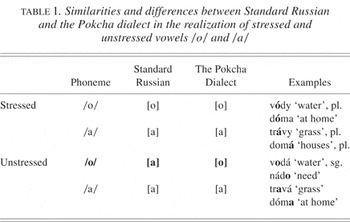
) and [o], respectively. Examples in Table 1 illustrate the differences between the standard and the dialect in the choice of variants for the stressed/unstressed vowels /o/ and /a/.
Similarities and differences between Standard Russian and the Pokcha dialect in the realization of stressed and unstressed vowels /o/ and /a/

Based on my acoustic analysis of the unstressed vowels in the Pokcha dialect, the two variants of the unstressed /o/ (phonetically

) differ mainly in the values of the first and second formants (F1 and F2; roughly corresponding to tongue height and tongue backness: Ladefoged & Maddieson, 1996). The difference in F1 is about 250 Hz and the difference in F2 is about 350 Hz for older speakers (cf. Erofeeva, 1997 on the Perm' variety of Standard Russian).
The pattern of the Pokcha dialect is typical of Northern Russian dialects and is referred to in the literature as okan'e, or ‘using [o]’, as opposed to the standard akan'e, ‘using [a]’ as the allophone of the unstressed /o/ (Avanesov & Orlova, 1965). The pattern of okan'e is more conservative, reflecting an earlier historical stage, while akan'e represents an innovation.
The inventory and realizations of vowels in the Pokcha dialect (as shown in Table 1) represent the older variety of the dialect, or the old regional standard. It is still characteristic of the speech of the oldest and predominantly rural speakers of the region. As a result of increased social pressure, the phonological patterns of the dialect have been changing to conform to those of the standard. The focus of this study is not on the differences between these two varieties, but rather on the sound change in the Pokcha dialect from the nonstandard [o] to the standard [a] in all positions where the unstressed /o/ is found. Overall, the sound change leads to a phonological simplification that results in a positional neutralization of a contrast. The variable is quite frequent in speech, given the high occurrence of the unstressed /o/ in Russian (Bondarko, 1981:144–149).
Note that the vowel change appears to be phonetically gradual, involving intermediate stages (more specifically,

; cf. Shtern & Erofeeva, 1998). In the current study I will not distinguish between the rounded variants

, focusing on the change as “unrounding.” The status of the mid-low rounded variant

, however, is sociolinguistically important (as discussed later). It can be regarded as a “fudge” (Chambers & Trudgill, 1998:110), an intermediate variant that shares rounding with [o] and height with

.
The consonant variable
Another difference between the dialects is in the presence or absence of a phonemic contrast in voiceless post-alveolar fricatives. Standard Russian has two such fricatives: a retroflex (apical) post-alveolar

and a laminal post-alveolar

, with the latter being phonetically long

(Timberlake, 2004:54–55, 65–67). The

of Standard Russian correspond to the short and long variants,

, of the phoneme

in the Pokcha dialect, the correspondence typical of many Northern Russian dialects (cf. Avanesov & Orlova, 1965:88–90). In these dialects, the original

(developed from the cluster

) has lost its laminal articulation and merged with the apical

. The merger, however, can be considered incomplete, since the phonetic length of the former

is still preserved (as

) in stressed prevocalic contexts.
2This leaves a possibility of considering

in stressed prevocalic contexts as a separate phoneme

. Such analysis is complicated by the fact that the dialect also has

as a realization of the heteromorphemic sequences

, for example, s-šit'

‘to sew’, perfective (cf. Avanesov & Orlova, 1965:89).

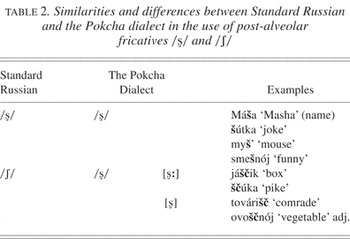
, whereas in other lexical items, Standard Russian has

, while the Pokcha dialect has

(or

).
Similarities and differences between Standard Russian and the Pokcha dialect in the use of post-alveolar fricatives

The production of the two consonants involves conflicting articulatory gestures: tongue tip raising for

and tongue tip lowering (and tongue front raising) for

, acoustically manifested in lower spectral noise and lower second formant (F2) vowel transitions for

compared to

(Bolla, 1981; confirmed by the author's acoustic analysis).
The change examined in the current study involves a split of the

into

(which is in fact a reversal of the original, albeit incomplete, merger of

into

). The focus here will be on the change in the quality of the fricative, rather than on its duration. This sound change adds to the complexity of the grammar and lexicon, because it introduces a new phoneme to the inventory and restructures corresponding lexical representations. It is relatively infrequent in speech, given the relative paucity of

in Russian, at least compared to the unstressed /o/ (Bondarko, 1981:144–149).
THE STUDY SET-UP
Sample and method
The data for the study was collected during my fieldtrip to the Cherdyn' region. The speech sample for this study includes recorded spontaneous speech from 32 informants, all residents of Pokcha, with a total duration of about eleven hours. The subjects were asked to talk about themselves—their youth, school, work, and life in town.
Factors
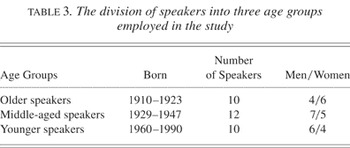
The factors examined in the study include speakers' age, sex, education, and the place where he/she was raised. The sample comprises speakers born in the period from 1910 to 1990 (see Appendix). Speakers were divided with respect to their age into three age groups, roughly corresponding to three generations (Table 3). There are substantial time gaps between these groups: six years between the oldest speaker in the first group and the youngest speaker in the second group; and thirteen years between the oldest speaker of the second group and the youngest speaker of the third group. All the groups include from ten to twelve speakers. There are seventeen men and fifteen women in the sample, fairly evenly distributed across the age groups.
The division of speakers into three age groups employed in the study

In our examination of the two sound changes and estimation of their relative timing, the age group variable will be very important. It is assumed here that the speakers retain their speech patterns acquired in their teens (the “third formative period”: Chambers, 2003:170–171); thus, these patterns give us a rough impression of the degree of variation in the corresponding decades.
All the speakers in the study were born and raised in the north of Perm' Province, mostly in Pokcha, or in smaller villages within 50 km. Speakers raised in Pokcha will be contrasted with those from the outside; this variable will be referred to as the “home background.” In terms of education, the speakers are divided into two groups based on the number of years of schooling: education 1 (Grade 1–7) and education 2 (Grade 8–10 or more). The factors of occupation and class were not treated as independent variables and thus were not coded for. The sample was to a large degree homogeneous with respect to these factors. Many speakers in the sample had (or used to have) jobs as farmers, forestry workers, drivers, cleaning persons, and so forth. A few subjects that at some stage in their life occupied white-collar positions (e.g., a librarian or a director of a trade co-op) are sometimes singled out on an individual basis as the results warrant. The population in the region is, for the most part, rooted in the region. Most of my subjects have never lived outside the region (or in some cases, even never traveled outside it). Men in general, however, are more mobile than women. Many men have spent a few years in the military outside the region. The demographics of the speakers, indicating their year of birth, sex, educational level, and home background, are given in the Appendix.
Analysis
The vowel variable, the unstressed /o/ phoneme, occurred very frequently in the speech of all 32 informants (on average, about 15 tokens per minute of speech). Each instance of the unstressed /o/, corresponding to the orthographic “o”, was classified as belonging to one of the two variants, [o] or [a]. This was done based on auditory judgments; selected tokens were verified by an acoustic analysis of vowel formants (using Praat). The study involved a total of 3,592 vowel tokens (i.e., about 110 tokens per speaker). The consonant variable occurred much less frequently in the recorded sample (on average, less than 1 token per minute). Three speakers did not have a single item with it, leaving us with 29 other speakers in the sample. Altogether the sample included 585 tokens (about 20 tokens per speaker) for this variable. Each instance of the consonant variable, corresponding to the orthographic “šč”

, was classified as belonging to one of the two variants,

, based on auditory judgments.
Based on the collected tokens, mean percentages of nonstandard vowel and consonant variants were calculated for each speaker. These were analyzed statistically by running a multivariate ANOVA with the following between-speaker factors: age group (older, middle-aged, and younger), sex (men and women), home (raised in Pokcha and raised outside), and education (education 1 and 2).3
In the initial analysis of the data, each token was coded for linguistic variables (e.g., preceding or following segments, stress placement, and frequency), in addition to the social variables. The data were analyzed using the sociolinguistic statistical program goldvarb, the Macintosh version of varbrul (Rand & Sankoff, 1991). Because the results did not show significant effects of linguistic variables (see Kochetov, 2000, for the vowel variable), the current article focuses on the social variables, which are reanalyzed using spss 13.0.
RESULTS
The results are presented and discussed separately for the vowel and consonant variables, with each discussion focusing on the effects of the factors age group, home, education, and sex.
The vowel variable
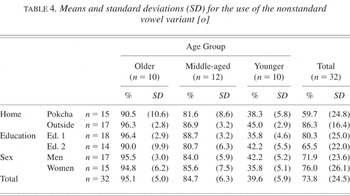
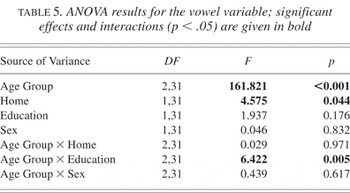
The results for the vowel variable—mean percentages and standard deviations of the nonstandard variant [o]—are summarized in Table 4. They are organized by different social factors separately for each age group. Numbers of speakers for each factor level are also provided. Table 5 presents the analysis of variance (ANOVA) results for the vowel variable—main effects and interactions. Significant effects and interactions (p < .05) are given in bold. Only two-way interactions with age group are given in the table, because none of the other two- or three-way interactions turned out to be significant. Each of the factors and relevant interactions are discussed next.
Means and standard deviations (SD) for the use of the nonstandard vowel variant [o]

ANOVA results for the vowel variable; significant effects and interactions (p < .05) are given in bold

Age
The results show that the factor age group is highly significant (F(2, 31) = 161.821, p < .001). The first age group, older speakers, uses the nonstandard variant [o] almost without exception (on average, 97% of the time; see Table 4). For the second age group, middle-aged speakers, the nonstandard variant [o] is still common (81%), yet on the decrease. For the third group, younger speakers, the use of the nonstandard variant [o] drops substantially (39%), becoming less frequent than the standard variant [a]. A Bonferroni post-hoc test reveals that all three age groups—older, middle-aged, and younger—are significantly different from each other (p < .001–.01).
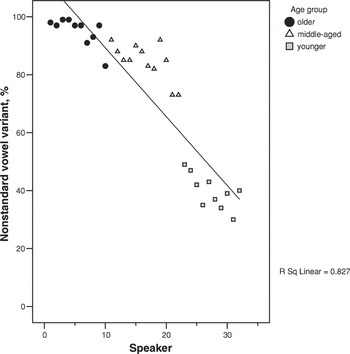
Mean values of the nonstandard vowel variant [o] for each speaker are plotted in Figure 1. Speakers are arranged according to their date of birth, from the oldest speaker on the left (Speaker 1, Iraida M.) to the youngest one on the right (Speaker 32, Aleksej P.) (see the Appendix). The nonstandard variant values are marked for age group—older (born in 1910–1923), middle-aged (born in 1929–1947), and younger (born in 1960–1990).

The use of the nonstandard vowel variant [o]; values represent means for each speaker and are labeled for age group.
We can observe that there is a strong correlation between the percentage of the use of the nonstandard variant [o] and the age group (R2 = 0.827). Note also that speakers within each age group are not homogeneous with respect to the variable; those relatively younger tend to show lower values than those relatively older within the same group. This is not surprising, given large time spans within age groups. Overall, the difference in the use of the variant in the population is considerable: one of the older speakers in the sample, Ekaterina K. (born in 1914) uses the nonstandard variant 99% of the time, while one of the younger speaker in the sample, Olga P. (born in 1985) uses it in only 34% of all instances. The difference between these speakers, thus, is 64%, reflecting a change in progress: from the rounded variant [o] to the unrounded variant [a].
The home background
Whether a person was raised in Pokcha or in a neighboring village is an important factor in the distribution of the vowel variable (F(1, 31) = 4.575, p < .05). Regardless of age or sex, outsiders use the nonstandard variant [o] 26% more frequently than town people (see Table 4). This number, however, is somewhat skewed by the greater representation of older and middle-aged out-of-town subjects in the sample. Eight out of ten older speakers, and seven out of twelve middle-aged speakers were raised outside of Pokcha; the number of outsiders among the younger age group is only two out of ten. Within each group, the home background differences are rather modest: 5–7%.
Education
Recall that for purposes of the analysis, we divided speakers into two groups: speakers who had received no more than 7 years of school (education 1) and speakers who had received 10 years of school with, in some cases, vocational training (education 2). The analysis of the data shows that the factor of education is not significant (F(2, 31) = 1.937, p > .05). However, there is a significant interaction of education with age group (F(2, 31) = 6.422, p < .01), pointing to significant differences in the educational background among middle-age speakers (p < .05). In this age group, more educated speakers used the nonstandard variable 8% less frequently than less educated speakers (see Table 3). Similar, yet nonsignificant difference is observed for older speakers. It should be noted that there are only two education 2 speakers in this group. There is also considerable variation among the education 1 speakers: half of them had no more than four years of school, whereas the other half had up to seven years of school. For younger speakers, the distinction between the two educational groups is less meaningful, as four out of ten speakers were still in school at the time of the study.
In sum, the results suggest that education played some role in facilitating the spread (and possibly enforcing) the standard variant. This is not surprising, because local school teachers usually receive some higher education in a city and thus are exposed to the more standard variety to a greater extent. The attitudes that exist towards the village speech in cities, as well as the general focus of education on the standard, stigmatize the use of the rural dialect in school. For example, in the 1980s, the Education Ministry distributed the brochure “Dialects of Perm' Province: Methodological recommendations for future primary school teachers” (Gruzberg, 1984:4), to provide a set of guidelines on how to “overcome local features in the speech of students” and how to “correct the dialect mistakes” (my translation).
Sex
Many previous sociolinguistic studies have shown that women are generally more linguistically adaptive than men and tend to use the nonstandard variant to a lesser degree (see Chambers, 2003:121–138; Labov, 1972, 2001; Trudgill, 1983). The current results, however, do not reveal significant differences between men and women in the use of the nonstandard vowel variant (F(1, 31) = .046, p > .05). Nor, is there a significant correlation between Sex and Age Group. As we can see in Table 4, older and middle-aged men and women show about the same usage of the nonstandard vowel variant (96% vs. 97% and 82% vs. 80%). This lack of the difference between the two groups likely reflects the status of women in the early and mid decades of the century. Women at that time were more dependent, less educated, and more house-bound, while men tended to be more mobile and exposed to more speech varieties, for example, through military service and work for labor camps. The overall social changes that took place in the 1920s–1950s have influenced the social status of women and may have contributed to the apparent change in their sociolinguistic behavior. Younger women show a (nonsignificant) tendency to use the nonstandard variant less frequently than younger men (by 8%).
The consonant variable
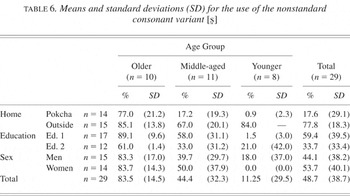
Now we turn to the consonant variable. The results, mean percentages, and standard deviations of the nonstandard variant

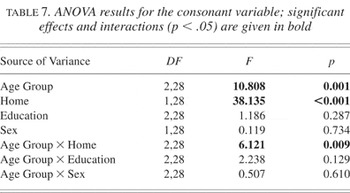
are summarized in Table 6. As for the results for the vowel variable, they are organized by the social factors of sex, home background, and education separately for each age group. Table 7 presents the ANOVA results for the consonant variable—main effects and interactions. Significant effects and interactions are given in bold. These are discussed in the following sections.
Means and standard deviations (SD) for the use of the nonstandard consonant variant

ANOVA results for the consonant variable; significant effects and interactions (p < .05) are given in bold

Age
The results show that the factor age group is significant (F(2, 28) = 10.808, p < .01). A Bonferroni post-hoc test reveals that all three age groups are significantly different from each other (p < .001–.01). The use of the nonstandard variant is 84% for the older group, 44% for the middle-aged group, and 11% for the younger group (see Table 6).
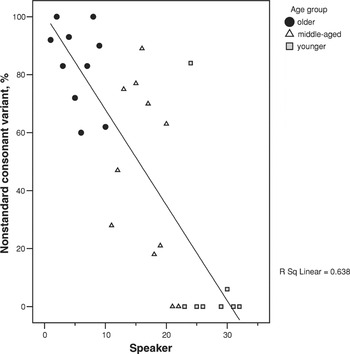
Figure 2 plots mean values of the nonstandard vowel variant

for each of 29 speakers. The nonstandard variant values are marked for age group.

The use of the nonstandard consonant variant ; values represent means for each speaker and are labeled for age group.
The figure shows some correlation between the percentage of the use of the nonstandard variant

and the age group (R2 = .638). This is similar to what we saw for the vowel variable. However, there are some important differences. First, the overall range of variation here is greater than for the vowel variable. There are speakers who use the nonstandard variant

only (some older speakers), and there are speakers who use the standard variant

only (some middle-aged speakers and almost all younger speakers). Second, interspeaker variability within each age group is considerably higher for the consonant variable, as seen in Figure 2 and reflected in the lower R2 and higher standard deviations (Table 6), particularly for middle-aged and younger speakers. It should be noted that greater variability for the consonant variable is at least in part attributable to the relatively lower number of tokens per speaker in the sample (as discussed in the Summary section).
The home background
The factor home is highly significant (F(1, 28) = 38.135, p < .001). Speakers raised outside of Pokcha have more of the nonstandard variant

by 49% than the people raised in town (80% vs. 31%), averaged for age group, sex, and education. There is, however, a significant age group × home interaction (F(2, 28) = 6.121, p < .01). Further analysis determined that home is not significant for older speakers (F(1, 7) = .001, p > .05). Recall that there are only two Pokcha-raised speakers in this group. One of them, Iraida M. (born in 1910), uses the nonstandard variant 92% of times, while the other one, Vera D. (born in 1923), uses the nonstandard variant 62% of times. Certain out-of-town speakers, such as Ivan š., are quite advanced with respect to the variable: he uses the nonstandard variant 60% of times. However, some of these individuals appear to present special cases, and will be discussed in later.
The home background is significant for middle-aged and younger speakers (F(1, 18) = 42.493, p < .001). The difference between middle-aged speakers raised in and outside of Pokcha is as high as 50% (see Table 6). The difference between younger speakers raised in and outside of Pokcha is even higher, 60%. However, the latter difference is a result of the gap between the single outsider, Vladimir T. (84%) and the rest of the group who grew up in Pokcha (less than 1%).
Education
Overall, speakers with less education (education 1) used the nonstandard variable 26% more often than speakers with more education (education 2). This difference, however, is not significant (F(2, 28) = .507, p > .05). The results for the age group × education interaction are not significant either (F(2, 28) = .365, p > .05), despite the mean differences between the educational groups within each age group (89% vs. 61% for older speakers, 58% vs. 33% for younger speakers; 2% vs. 21% for younger speakers). Again, the lack of significant results can be explained by considerable interspeaker variation, as well as by uneven numbers of subjects who belong to different educational groups within each age group. Recall that there are only two education 2 speakers among the older subjects, Vera D. and Ivan š. The unexpected (nonsignificant) difference found for younger speakers—the higher use of the nonstandard variant by those with more education—is a result of the same “anomalous” speaker, Vladimir T., who received his schooling out of town.
Sex
As in the case of the vowel variable, the difference between men and women in the use of the nonstandard consonant variant (44% vs. 54%) is not significant (F(1, 28) = .119, p > .05). Nor are there any significant age group × sex interactions (F(2, 28) = .507, p > .05). Some apparent (nonsignificant) differences between middle-aged and younger men and women (40% vs. 50% and 18% vs. 0%, respectively) are largely a result of individual differences.
Interspeaker variation and outliers
As mentioned earlier, the use of the nonstandard consonant variant shows considerable interspeaker variation. Some speakers appear to be “anomalous,” either less or more conservative than other speakers in their age group. Recall that two older speakers, Vera D. and Ivan š. used

only 60–62% of the time, whereas the average for the rest of the group is 89%. On the other hand, Vladimir T. shows exactly the opposite pattern in the younger age group: He uses

84% of the time, whereas the average for the rest of the group is less than 1%. What makes these people different from other speakers in their corresponding groups and different from each other?
Vera D. was born and raised in Pokcha, received a complete secondary education, followed by further vocational training outside the region. Her education and her status as a town person gave her access to a prestigious job as director of the local trade cooperative, thus differentiating her from other speakers of her age group, who had less education and less status in town. Vera D. is thus an “insider,” a person deeply involved in the activities of a social group and being ahead of the group in her sociolinguistic behavior (Chambers, 2003:110–114). Ivan š. was born in a village 30 km from Pokcha, but moved to town at the age of eleven, when his family was assigned to join the newly founded collective farm. As Vera D., he completed more years of school than anybody else in their age group: eight years of school in Pokcha, followed by a vocational school in the provincial capital Perm'. During World War II, Ivan š. served in the Navy; after he returned to the region, he worked as a truck driver delivering supplies to neighboring labor camps. His education and mobility thus set him apart from other speakers in his group.
In contrast to these two speakers, Vladimir T. is the most conservative speaker in the younger age group. He was born and raised in a small village 25 km northwest of Pokcha. He worked as a low-skilled collective farmer and, later, as a road construction worker. His status, as well as his age (the oldest among the younger speakers), made him different from the other speakers of the group, most of whom were raised in Pokcha and had more extensive education (and sometimes more prestigious jobs). Vladimir T. is thus an “oddball,” an outsider whose social and linguistic behavior does not conform to the norms for his group (Chambers, 2003:93–110).
In sum, reference to the social background of these individuals explains their “anomalous” linguistic behavior, clarifying the general correlation between the age and the dynamics of the sound changes.
SUMMARY: TWO CHANGES
The analysis of the data for both variables,

, shows a gradual decrease in the use of the nonstandard variants

at the expense of the standard variants

. Both processes are, therefore, sound changes towards Standard Russian:

. The processes correlate strongly with speakers' age group and, to a lesser degree, with their home background (whether they were raised in town or in a neighboring village). The level of education is also important for the vowel variable, at least among middle-aged speakers. Neither of the variables appears to correlate with sex. Despite these similarities, the vowel and consonant changes are quite different in their overall dynamics and degree of variation. These differences are further discussed later.
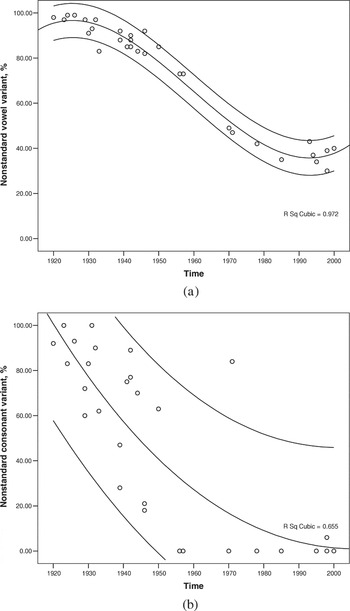
As mentioned earlier, the use of speech variants by speakers of a particular age group is likely to reflect the use of these variants during the period of their teens (Chambers, 2003). Thus, the speech of speakers in our sample who were born in the 1910s may represent, or be close to, the speech in Pokcha of the 1920s. This would allow us to estimate the dynamics of the vowel and consonant changes. Graphs (a) and (b) in Figure 3 present mean values of the nonstandard variants for each speaker, plotted against the years when these speakers reached their teens. (Note that not all decades are equally represented by the speakers in our sample.) In each graph, the trajectory of the change is plotted as a cubic fit line with 95% individual confidence intervals (using spss 13.0).

The trajectories of the vowel change (o → a) (a) and consonant change (b) as reflected in the percentage of nonstandard variants in the speech of 32 speakers. The years indicate the approximate time when the corresponding speakers developed their speech patterns.
We can see from the graphs that standardization of the Pokcha accent, as reflected in the two changes, started perhaps prior to the 1920s. In the early 1920s, the use of the nonstandard variables is still close to 100% (with more variation for the consonant variable). The vowel change (Figure 3a) approximates an S-curve. Almost stagnant in the 1920s, the change progresses steadily from the 1930s to the 1950s, approaching the 70% mark for the nonstandard variant. Recall that this is the time of the major social upheavals in the region: “collectivization” and “cultural revolution,” the advent of the Gulag, World War II, and the exodus of village populations into town. By the beginning of the 1970s, the use of the nonstandard variant drops to below 50%, and then seems to stabilize at around 35–40% in the 1980s and 1990s. The process is thus still a change in progress, possibly turning into a stable variability pattern (Chambers, 2003:121; Labov, 2001:74–75).
In contrast, the consonant change (Figure 3b) exhibits interspeaker variability already in the 1920s, increasing in the 1930s and 1940s. The use of the nonstandard variant

drops to 0% in the 1950s, thus de facto completing the change, at least for the speakers who grew up in Pokcha. In sum, the consonant change is more rapid and variable than the vowel change.
Undoubtedly, some of the interspeaker variability can be attributed to the relatively small number of tokens per person for the consonant variable (on average, 20 tokens per person), compared to the vowel variable (on average, 110 tokens per person). Yet, recall that some of the variability can be well accounted for by speakers' age, home background, and education. More importantly, the relatively small sample size does not explain the dramatic “all or nothing” differences between older and younger speakers in the use of the nonstandard variant.
The striking differences between the vowel and consonant changes in the pace can be possibly explained by different phonetic salience of the two nonstandard variants and degrees of social acceptability associated with them. In the speech of some-middle-aged and most younger speakers in our sample, the nonstandard variant is often realized as the less rounded “fudge” variant

, intermediate between the [o] of the older speakers and the standard [a] (not quantitatively examined in the current study). The use of the “fudge” variant was therefore likely to be more socially acceptable than the use of the traditional nonstandard [o]. Interestingly, the “fudge” variant is still not uncommon in the speech of the provincial capital, Perm' (Erofeeva, 1997; Ignatkina, 1987:135–136).
Unlike the vowel variable, the consonant variable did not develop a fudged variant, because the two consonants involve conflicting articulatory gestures (tongue tip raising for

and tongue tip lowering for

, acoustically manifested in vowel transitions and frication noise). Given this, the perceptually distinct

was increasingly associated with the nonstandard variety, possibly more than the unstressed vowel variant [o] (or

); at the same time,

came to be identified with the prestigious town speech, more so than the unstressed vowel variant [a] (more precisely

). While the nonstandard

still occurs in the speech of the provincial capital, Perm', it is relatively uncommon and widely regarded as a marker of “uneducated,” “village” register (Shtern & Erofeeva, 1998). Other factors, such as distinct representation of the phonemes

in the orthography (

) have likely contributed to the rapid conclusion of the consonant change. Thus, the brochure “Methodological recommendations for future primary school teachers” (Gruzberg, 1984:5) explicitly instructs teachers to “pay special attention to words with the letter

… to ensure that students pronounce the sound

correctly … and [to provide] students with as many examples as possible” (my translation).
One interesting property of the sound change

is that it presents an apparent reversal of the earlier merger of

into

in the Pokcha dialect.
4I am thankful to the anonymous reviewer for raising this question.

instead of

in words like šutka ‘joke’ and smešnoj ‘funny’; see Table 2) suggests that a full reversal of the merger has taken place in Pokcha, at least in the speech of most younger speakers.
5To my knowledge, no other Perm' dialect sources report on the

hypercorrection (Shtern & Erofeeva, 1998; Skitova, 1961; Smoliakova, 1961). However, a further investigation of the question is needed.

compared to

in Standard Russian,
6A count of the occurrences of the letters

in a sample of over 93,100 words (an electronic version of Suslov & Gasheva, 1998) revealed that

occurred 2.2 times less frequently than

.
CONCLUSION
In this article, I have analyzed the social factors affecting sound changes in progress in a small Northern Russian town of Pokcha. I focused on two processes: unrounding of the unstressed /o/ and the change of the post-alveolar

. Both changes proceeded in the direction of Standard Russian and involved significant variation. The sample involved the speech of thirty-two residents of Pokcha who belong to different age, sex, and educational groups, and who were raised either in town or outside the town. The statistical analysis of the results showed that each of the attested variations had clear-cut patterns: They were determined primarily by the social factor of age group, as well as by home background and education. The most conservative speakers were older, less educated subjects raised out of town, and the most progressive speakers were younger, better educated subjects raised in town. The results also showed that the relative dynamics of the two sound change processes was related to phonetic characteristics of the two non-standard sound variants. Overall, the study contributes to the body of work shedding light on the role of social factors in the mechanism of sound change (Labov, 1994, 2001; Chambers, 2003, among others).
APPENDIX
Speakers involved in the study: Their names, years of birth, sex, home background, and educational levels

References
REFERENCES
Avanesov, R. I., &
Orlova, V. G. (eds.).
(1965).
Russkaia dialektologiia
[Russian dialectology].
Moscow:
Nauka.
Bolla, K.
(1981).
A conspectus of Russian speech sounds.
Cologne:
Bölau.
Bondarko, L. V.
(1981).
Foneticheskoe opisanie iazyka i fonologicheskoe opisanie rechi
[A phonetic description of the language and a phonological
description of speech].
Moscow:
Nauka.
Chagin, G. N.
(1988).
Na drevnei permskoi zemle [On the ancient Perm'
land].
Moscow:
Iskusstvo.
Chambers, J. K.
(2003).
Sociolinguistic theory,
2nd edition.
Cambridge, MA:
Blackwell.
Chambers, J. K., &
Trudgill, Peter.
(1998).
Dialectology.
Cambridge:
Cambridge University Press.
Erofeeva, E. V.
(1997).
Eksperimental'noe issledovaniefonetiki regional'nogo
varianta literaturnogo iazuka [An experimental investigation of a
regional variant of the literary language].
Perm':
Perm' University.
Gruzberg, A. A.
(1984).
O govorakh Permskoi oblasti: Metodicheskie rekomendatsii v pomoshch
studentam fakul'teta nachal'nykh klassov [On the dialects
of Perm' province: Methodological recommendations for future
elementary school teachers].
Perm':
Perm' Pedagogical University.
Ignatkina, L. V.
(1987).
Permskie govory [Perm' dialects]. In
L. V. Bondarko &
L. A. Verbitskaia (eds.),
Interferentsia zvukovykh system [Interaction of sound
systems].
St. Petersburg:
Izdatel'stvo St. Peterburgskogo Universiteta.
132–150.
Ivanova, M.
(1998).
Kollektivizatsia v Prikamye: Nasilie bez granits.
[Collectivization in the Kama region: Terror without
borders.] In
A. Suslov &
N. Gasheva (eds.),
Gody terrora: Kniga pamiati zhertv politicheskikh repressii.
[Years of terror: A book commemorating victims of political
repression]. Part 1.
Perm':
Zdravstvui.
47–66.
Kochetov, Alexei.
(2000).
Sound change in progress: An effect of standardization on a Northern
Russian dialect.
Toronto Working Papers in Linguistics
18:62–79.Google Scholar
Labov, William.
(1972).
Sociolinguistic patterns.
Philadelphia:
University of Pennsylvania Press.
Labov, William.
(1994).
Principles of linguistic change: Internal factors.
Oxford:
Blackwell.
Labov, William.
(2001).
Principles of linguistic change: Social factors.
Oxford:
Blackwell.
Ladefoged, P., &
Maddieson, I.
(1996).
The sounds of the world's languages.
Cambridge, MA:
Blackwell.
Lindblom, B.,
Guion, S.,
Hura, S.,
Moon, S.-J., &
Willerman, R.
(1995).
Is sound change adaptive?
Revista di Linguistica
7:5–37.Google Scholar
Martinet, André.
(1955).
Economie de changements phonétiques.
Berne:
Éditions A. Francke AG Verlag.
Ohala, J. J.
(1981).
The listener as a source of sound change. In
C. S. Masek,
R. A. Hendrick, &
M. F. Miller (eds.),
Papers from Chicago Linguistic Society parasession on language
and behavior,
Chicago, IL:
Chicago Linguistic Society.
178–203.
Pallot, Judith.
(2002).
Forced labour for forestry: The twentieth century history of
colonization and settlement in the north of Perm'
Oblast'.
Europe-Asia Studies
54:1055–1083.Google Scholar
Poliakova, E. N.
(1998).
Formirovanie permskikh govorov [The formation of the
Perm' dialects]. In
Russkie govory permskogo regiona: Formirovanie i razvitie
[Russian dialects of the Perm' province: Formation and
development].
Perm:
Izdatel'stvo Permskogo Universiteta.
4–30.
Rand, D., &
Sankoff, D.
(1991).
GoldVarb: A variable rule application for Macintosh.
Montréal:
Centre de Recherches Mathématique, Universite de
Montréal.
Shtern, A. S., &
Erofeeva, E. V.
(1998).
Fonetika govorov i literaturnogo iazyka na territorii permskoi
oblasti [The phonetics of the dialects and the literary language of
the Perm'province]. In
L. A. Gruzberg &
F. L. Skitova (eds.),
Russkie govory permskogo regiona: Formirovanie i razvitie
[Russian dialects of the Perm' province: Formation and
development].
Perm:
Izdatel'stvo Permskogo Universiteta.
31–133.
Skitova, F. L.
(1961).
Verkhnevisherskie govory Permskoi oblasti na sovremennom etape
razvitiia [The Upper Vishera dialects of the Perm' province at
the current stage of development].
St. Petersburg University Candidate of Sciences
dissertation.
Smoliakova, L. P.
(1961).
Nekotorye foneticheskie osobennosti russkikh govorov srednego
Pokamia (iugo-zapadnye raiony Permskoi oblasti) [Some phonetic
characteristics of Russian dialects of the middle Kama region
(south-western regions of the Perm' province)].
Kazan' University Candidate of Sciences dissertation.
Suslov, A., &
Gasheva, N. (eds.)
(1998).
Gody terrora: Kniga pamiati zhertv politicheskikh repressii.
[Years of terror: A book commemorating victims of political
repression]. Part 1.
Perm':
Zdravstvui. [available at: http://www.memo.perm.ru/pub.htm]
Timberlake, Alan.
(2004).
A reference grammar of Russian.
Cambridge:
Cambridge University Press.
Trudgill, Peter.
(1983).
On dialect: Social and geographic factors.
Oxford:
Blackwell.
Varese, Federico.
(2001).
The Russian mafia: Private protection in a new market
economy.
Oxford:
Oxford University Press.
Similarities and differences between Standard Russian and the Pokcha dialect in the realization of stressed and unstressed vowels /o/ and /a/
Similarities and differences between Standard Russian and the Pokcha dialect in the use of post-alveolar fricatives
The division of speakers into three age groups employed in the study
Means and standard deviations (SD) for the use of the nonstandard vowel variant [o]
ANOVA results for the vowel variable; significant effects and interactions (p < .05) are given in bold
The use of the nonstandard vowel variant [o]; values represent means for each speaker and are labeled for age group.
Means and standard deviations (SD) for the use of the nonstandard consonant variant
ANOVA results for the consonant variable; significant effects and interactions (p < .05) are given in bold
The use of the nonstandard consonant variant ; values represent means for each speaker and are labeled for age group.
The trajectories of the vowel change (o → a) (a) and consonant change (b) as reflected in the percentage of nonstandard variants in the speech of 32 speakers. The years indicate the approximate time when the corresponding speakers developed their speech patterns.
 You have
Access
- 13
- Cited by