The results from a large body of research indicate that phonological awareness (PA) is strongly related to children's reading skills (e.g., Bus & van IJzendoorn, Reference Bus and van IJzendoorn1999). PA refers to the ability to detect or manipulate the sound structure of words independent of meaning (Wagner & Torgesen, Reference Wagner and Torgesen1987). This ability to access smaller and smaller units of sound within spoken words helps children make the connection between the sounds and the letters that represent them in print (i.e., the alphabetic code). Children who are better at detecting or manipulating the individual sounds in words acquire stronger abilities to decode print (i.e., read) earlier in life, even after controlling for intelligence, memory, vocabulary, and maternal education (Bryant, MacLean, Bradley, & Crossland, Reference Bryant, MacLean, Bradley and Crossland1990; Maclean, Bryant, & Bradley, Reference Maclean, Bryant and Bradley1987; Wagner, Torgesen, & Rashotte, Reference Wagner, Torgesen and Rashotte1994). Furthermore, evidence indicates that PA plays a causal role in learning to decode and comprehend words (e.g., Byrne & Fielding-Barnsley, Reference Byrne and Fielding-Barnsley1995), and there may be a bidirectional influence between PA development and learning to read in alphabetic languages (e.g., Muneaux & Ziegler, Reference Muneaux and Ziegler2004).
PA can be measured by a variety of tasks, such as blending (i.e., putting sounds together to form words or word segments), elision (i.e., removing sounds from words to form new words), segmentation (i.e., isolating the sounds of words or decomposing words into their constituent sounds), and rhyming, which require manipulation of sounds at different levels of linguistic complexity, such as the word, syllable, onset rime, or phoneme levels. The ability to complete PA tasks follows a developmental sequence (Anthony, Lonigan, Driscoll, Phillips, & Burgess, Reference Anthony, Lonigan, Driscoll, Phillips and Burgess2003; Lonigan, Burgess, Anthony, & Barker, Reference Lonigan, Burgess, Anthony and Barker1998). Children progress from initially being sensitive to large and concrete units of sound (i.e., words and syllables) to being sensitive to small and abstract units of sound (i.e., phonemes). Children are generally able to blend sounds together before they are able to segment words into their component sounds (Anthony et al., Reference Anthony, Lonigan, Driscoll, Phillips and Burgess2003). There is consistent evidence that PA tasks that require manipulation of phonemes and tasks that require manipulation of larger units of sound (e.g., syllables and onset rimes) are indicators of the same underlying ability (e.g., Anthony & Lonigan, Reference Anthony and Lonigan2004; Anthony et al., Reference Anthony, Lonigan, Driscoll, Phillips and Burgess2003; Lonigan, Burgess, & Anthony, Reference Lonigan, Burgess and Anthony2000). Consequently, PA is a single construct that remains stable across development from the preschool years through the early elementary school years that can be measured using age-appropriate tasks.
Despite a large body of research concerning how PA is related to the development of reading, little is known about the developmental origins of PA. One possibility is that PA development is partially dependent on changes in the way words are represented in the lexicon. According to the lexical restructuring model (LRM; Metsala & Walley, Reference Metsala, Walley, Metsala and Ehri1998; Walley, Metsala, & Garlock, Reference Walley, Metsala and Garlock2003), as children's vocabularies grow, their mental representations of words shift from a holistic form to an increasingly segmented form (i.e., representations of smaller units of sound, such as individual phonemes). This lexical restructuring occurs only for words that children know. As children learn new words, they inevitably encounter words that are phonologically similar to words already known. Although lexical restructuring ultimately culminates in the ability to detect interword differences at the level of the phoneme, the shift in children's representations of words, like the development of PA (e.g., Anthony et al., Reference Anthony, Lonigan, Driscoll, Phillips and Burgess2003), most likely follows a continuum (e.g., Fowler, Reference Fowler, Brady and Shankweiler1991). Children's representations of words should initially be holistic, and as children's vocabularies develop, these representations should gradually become more segmented. As these segmented representations develop, children should be able to detect differences between words at the suprasyllabic, syllabic, subsyllabic, and phonemic levels. This increasingly segmented lexicon allows children to access the sounds of words at the level required by PA tasks (e.g., syllable, onset rime, or phoneme). Therefore, the LRM should be applicable not only to tasks that assess PA at the level of the individual phoneme but also to tasks that assess PA at the supraphonemic level.
LEXICAL CHARACTERISTICS AND PHONOLOGICAL AWARENESS
According to LRM, lexical restructuring occurs as a function of various lexical characteristics of words, including age of acquisition (AoA), word frequency, and phonological neighborhood density. The current study examined how each of these lexical characteristics (as well as phonotactic probability) impact children's performance on a PA task. The majority of prior research has not simultaneously accounted for the effects of all of these variables. Simultaneous inclusion of these lexical characteristics allowed for the examination of how each variable uniquely affects children's performance on a PA task.
AoA refers to a subjective rating of the age at which a specific word is generally acquired. Words that are acquired earlier have a longer period of time to undergo lexical restructuring than do later acquired words. Therefore, it would be expected that PA performance would be better for words with earlier AoA than for words with later AoA. Very little research has evaluated the effects of the AoA of words used in PA measures on children's PA performance. Metsala (Reference Metsala1999) reported that the PA performance of 4- to 7-year-old children was stronger for early-acquired words than for late-acquired words.
Word frequency refers to how often a word occurs in speech or text. High-frequency words are more likely to be encountered and to overlap phonologically with other words than are low-frequency words (Landauer & Streeter, Reference Landauer and Streeter1973), and as a result, high-frequency words have more opportunities to undergo lexical restructuring than do low-frequency words. Therefore, it would be expected that PA performance would be better for high-frequency words than for low-frequency words. The results of studies that have evaluated the relation between word frequency and children's PA performance have produced mixed results. Some studies have demonstrated the expected relations between word frequency and PA performance (Hogan, Bowles, Catts, & Storkel, Reference Hogan, Bowles, Catts and Storkel2011; Roth, Troia, Worthington, & Handy, Reference Roth, Troia, Worthington and Handy2006). For example, Hogan et al. reported that second- and fourth-grade children's performance on a phoneme deletion task was greater for high-frequency words than it was for low-frequency words. Other studies have failed to demonstrate the expected relation or have demonstrated a pattern opposite what was expected (Garlock, Walley, & Metsala, Reference Garlock, Walley and Metsala2001; Roth et al., Reference Roth, Troia, Worthington and Handy2006). For example, Roth et al. reported that there was no relation between word frequency and preschool children's performance on a phoneme-level segmenting task, but they reported that children's performance on a rhyming task was better for low-frequency words than it was for high-frequency words.
Phonological neighborhood density refers to the number of words that differ from each other by only one phoneme. Words that come from more dense phonological neighborhoods are more likely to undergo lexical restructuring because they are similar to more words than are words that come from sparse neighborhoods. Therefore, it would be expected that PA performance would be better for words from dense phonological neighborhoods than for words from sparse phonological neighborhoods. The results of studies that have evaluated the impact of phonological neighborhood density on children's PA performance have produced mixed results. Some studies find the expected relation between phonological neighborhood density and PA performance (DeCara & Goswami, Reference De Cara and Goswami2003; Hogan et al., Reference Hogan, Bowles, Catts and Storkel2011; Metsala, Reference Metsala1999; Roth et al., Reference Roth, Troia, Worthington and Handy2006; Ventura, Kolinsky, Fernandes, Querido, & Morais, Reference Ventura, Kolinsky, Fernandes, Querido and Morais2007). For example, Hogan et al. reported that second- and fourth-grade children's performance on a phoneme deletion task was better for words from dense phonological neighborhoods than for words from sparse phonological neighborhoods. In contrast, other studies have failed to demonstrate the expected relation (e.g., Garlock et al., Reference Garlock, Walley and Metsala2001; Roth et al., Reference Roth, Troia, Worthington and Handy2006; Stadler, Watson, & Skahan, Reference Stadler, Watson and Skahan2007) or have demonstrated a pattern opposite what is expected (Foy & Mann, Reference Foy and Mann2009; Roth et al., Reference Roth, Troia, Worthington and Handy2006). For example, Foy and Mann reported that preschool children's reaction times on PA measures were slower for words from dense onset neighborhoods (i.e., words that share their initial phoneme with 50% or more of their neighbors) than they were for words from sparse onset neighborhoods.
Although evidence linking LRM with PA development is mixed, research examining the effects of lexical characteristics of words on children's spoken-word recognition provides strong support for the LRM. Walley and Metsala (Reference Walley and Metsala1990) divided words into early-, current-, and late-acquired words based on adults’ ratings of the AoA of the words. Early-acquired words were estimated to be acquired before preschool, current-acquired words were estimated to be acquired during preschool, and late-acquired words were estimated to be acquired after preschool. Analyses showed that 5- and 8-year-old children were as sensitive to spoken errors in early-acquired words as were adults but that only 8-year-old children were as sensitive to spoken errors in current words as were adults. Another study used a gating task in which small pieces of a word were pronounced at first and listeners were exposed to additional pieces of the word sequentially until they could identify it (Metsala, Reference Metsala1997). The results of this study indicated that performance was most similar between children (7, 9, and 11 years of age) and adults for words that had high frequency and high phonological neighborhood density. Garlock et al. (Reference Garlock, Walley and Metsala2001) examined the relations of AoA, word frequency, and phonological neighborhood density with performance on a gating task, with children from preschool through second grade and adults. The results indicated that spoken-word recognition was better for early-acquired words for younger children, older children, and adults. Words from sparse phonological neighborhoods were more easily recognized by older children and adults, but there was no effect of phonological neighborhood density on younger children's spoken-word recognition. The results showed minimal effects of word frequency. Taken together, these findings suggest that lexical restructuring does occur as children's vocabularies grow.
PHONOTACTIC PROBABILITY
Like phonological neighborhood density, phonotactic probability is a metric of the phonological similarity between words. Specifically, phonotactic probability refers to the frequency with which phonological segments, as well as sequences of phonological segments, occur in a language (Vitevitch & Luce, Reference Vitevitch and Luce2004). Words from dense phonological neighborhoods often have a high phonotactic probability, but these constructs are not identical. For instance, a particularly long word could have sequences of sounds that have a high probability of occurrence in English, but because of the length and complexity of the word, there could be few words that differ from this word by only one phoneme. Phonological neighborhood density is a characteristic of the whole word, whereas phonotactic probability is a characteristic of the individual sounds and sound segments that comprise words. In other words, phonological neighborhood density is a characteristic at the lexical level of the word, and phonotactic probability is a characteristic at the sublexical level of the word. Because PA tasks require manipulation of the individual sound components within words, a sublexical metric of phonological similarity between words may better indicate how phonological similarity between words places pressure on words to undergo lexical restructuring than does a metric at the lexical level.
Although no studies to date have examined the effect of phonotactic probability on children's PA performance, Garlock et al. (Reference Garlock, Walley and Metsala2001) argued that increased phonotactic probability facilitates performance on PA tasks. Extant research indicates that phonotactic probability has an effect on phonological memory and children's word learning. For example, Beckman and Edwards (Reference Beckman, Edwards, Broe and Pierrehumbert2000) demonstrated that children's repetition of common sound sequences was more accurate than was their repetition of rare sound sequences on a nonword-repetition task. In another study, Storkel (Reference Storkel2001) reported that children learn common sound sequences more quickly than rare sound sequences.
Phonotactic probability was included in the current study because it may better represent the contrasts between words that cause lexical restructuring than does phonological neighborhood density. For example, two words could have similar sequences of sounds but differ by more than one phoneme. These similarities would be reflected in phonotactic probability values, but the two words would not be considered phonological neighbors. Furthermore, the more frequently a given sound occurs, the more likely it is to overlap with other sounds, necessitating lexical restructuring so that the various combinations of sounds are kept distinct from each other in the lexicon.
CURRENT STUDY
Many studies that have examined the influence of these lexical characteristics of words on PA performance have methodological weaknesses that could contribute to the mixed results. For example, although AoA, word frequency, and phonological neighborhood density are represented on a continuum, all but one of the studies (i.e., Hogan et al., Reference Hogan, Bowles, Catts and Storkel2011) compared performance on words divided into two groups based on whether they were high or low on one of the lexical characteristics. Dichotomization of continuous variables can cause numerous analytic problems, such as underestimation of effect size, loss of power, and the detection of spurious main effects and interactions (MacCallum, Zhang, Preacher, & Rucker, Reference MacCallum, Zhang, Preacher and Rucker2002). Most of these studies also were conducted with relatively small samples. Only the studies by Hogan et al. (Reference Hogan, Bowles, Catts and Storkel2011) and Garlock et al. (Reference Garlock, Walley and Metsala2001) included more than 100 participants. Whereas small sample sizes cannot account for effects opposite the hypothesized direction, the absence of an effect in some studies (e.g., Stadler et al., Reference Stadler, Watson and Skahan2007) could be due to small sample sizes.
Because prior research has generated conflicting results and some previous studies had small samples (e.g., Foy & Mann, Reference Foy and Mann2009; Ventura et al., Reference Ventura, Kolinsky, Fernandes, Querido and Morais2007) or were methodologically weak (e.g., De Cara & Goswami, Reference De Cara and Goswami2003), more research is needed to determine the relations between lexical characteristics of words (i.e., AoA, word frequency, phonological neighborhood density, and phonotactic probability) and children's PA skills. Hogan et al. (Reference Hogan, Bowles, Catts and Storkel2011) is one of few exemplars of methodologically strong studies to examine how lexical characteristics of PA items impact children's likelihood of correctly answering those items. Although we sought to build on the solid framework laid out by Hogan et al., this study is not solely a replication study, and there are several key distinctions to be made between the current study and the study conducted by Hogan et al. First, whereas Hogan et al. tested PA skills among second- and fourth-grade children, the current study examined PA development during early childhood, when PA first begins to emerge. Second, Hogan et al. only examined the effects of word frequency and neighborhood density on children's PA skills, and it is likely that other lexical characteristics impact lexical restructuring as well. For example, AoA may have a particularly large effect on lexical restructuring in young children, becase AoA is directly related to the likelihood of acquiring a word. Third, prior studies (including Hogan et al.) have primarily examined how lexical characteristics affect lexical restructuring at the level of the individual phoneme. This study used a measure of PA that involved manipulation of words at the phonemic and supraphonemic levels, which may help elucidate how children's lexicons move gradually from holistic representations of words to fully phonemically segmented representations of words.
In this study, we examined the unique effects of lexical characteristics of words on children's PA skills while controlling for other important child- and item-level predictors (e.g., IQ and oral language skills). Furthermore, we replicated analyses across two large, independent samples of preschool children, and this allowed us to control for variables not measured in one sample (i.e., nonverbal cognitive ability) and replicate results across two different measures of oral language skills.
Consistent with the LRM, we hypothesized that the probability of preschool children's correct responses to PA items would be higher for items that used words with lower AoA, higher word frequency, and more dense phonological neighborhoods or higher phonotactic probability. According to the LRM, lexical restructuring is a function of children's vocabulary growth. Greater overall vocabulary knowledge should lead to exposure to words that vary in their level of AoA, frequency, phonological neighborhood density, and phonotactic probability. Therefore, we expected that each of the lexical characteristics of words would interact with children's ages and overall vocabulary knowledge.
AoA and frequency both influence the amount of time to which children have been exposed to words, which in turn influences the opportunity for those words to undergo lexical restructuring. Because older children have had a greater degree of exposure to words with later AoA and to low-frequency words than have younger children, words with later AoA or lower frequencies would be more likely to move toward segmental representation for older children but not for younger children. Therefore, it was expected that differences in children's PA performance on words with later versus earlier AoA and words with lower versus higher frequencies would be more pronounced for younger children than for older children. Similarly, it was expected that variation in children's PA performance that could be attributed to the AoA and frequency of words would be greater for children with less vocabulary knowledge than it would for children with more vocabulary knowledge. This prediction is consistent with findings reported by Metsala (Reference Metsala1999). In contrast to AoA and frequency, which largely impact lexical restructuring through mere exposure to words, the influence of phonotactic probability and phonological neighborhood density on lexical restructuring should primarily stem from the phonological similarity between words. Therefore, children must know phonologically similar words for phonotactic probability or neighborhood density to impact lexical restructuring. It was expected that these variables would have a stronger effect for older children and children with more vocabulary knowledge, because more vocabulary knowledge should lead to a higher likelihood of knowledge of words that are phonologically similar to each other. We expected that these moderation effects would be specific to age and language ability and, therefore, would be found even when controlling for children's nonverbal cognitive ability.
METHOD
Participants
Two independent samples of preschool children participated in this study. Both samples came from preschools serving primarily children from low-income families. Consequently, the majority of children in the samples had higher than average risk for later academic difficulties. Sample 1 included 392 children from Florida who ranged in age from 35 to 64 months (M = 52.17, SD = 5.95). One child (0.3%) was under 36 months of age, 20.9% of the sample was between 36 and 47 months of age, 70.2% of the sample was between 48 and 59 months of age, and the remainder of the sample was 60 months of age or older. Males comprised 58.1% of the sample, and the majority of children in the sample (56.8%) were African American/Black, 33.3% were White, and the remainder of the sample were of other ethnicities. Sample 2 included 814 children from Los Angeles and Florida who ranged in age from 33 to 70 months (M = 49.83, SD = 6.22). Two children (0.2%) were under 36 months of age, 37.5% of the sample was between 36 and 47 months of age, 58.2% of the sample was between 48 and 59 months of age, and the remainder of the sample was 60 months of age or older. Males comprised 52.7% of the sample, and the majority of the children in the sample were African American/Black (84.2%), 7.9% were White, 6.9% were Latino, and the remainder of the sample were of other ethnicities.
Measures
PA
Children completed the blending and elision subtests from the Preschool Comprehensive Test of Phonological and Print Processing (Lonigan, Wagner, Torgesen, & Rashotte, Reference Lonigan, Wagner, Torgesen and Rashotte2002). The blending subtest contained 21 items that require children to blend two components of words together to create a new word. Items included blending two words to form a compound word (e.g., blending “star-” and “-fish” to create “starfish”), blending syllables to form a word (e.g., blending “doc-” and “-tor” to create “doctor”), or blending individual phonemes to form a word (e.g., blending /f/ and “-ox” to create “fox”). The blending subtest contained 6 items that required blending two words to form a compound word, 6 items that required blending syllables to form a word, and 9 items that required blending individual phonemes to form a word. The elision subtest contained 18 items that required children to eliminate parts of a word to form new words. Items included removing one word from a compound word (e.g., removing “snow” from “snowshoe” to create “shoe”), removing a syllable from a word (e.g., removing “-ture” from “fixture” to create “fix”), and removing a phoneme from a word (e.g., removing /d/ from “raid” to create “ray”). The elision subtest contained 7 items that required removal of one word from a compound word, 5 items that required removal of a syllable from a word, and 6 items that required removal of a phoneme from a word. Both the blending and the elision subtests contained multiple-choice and free-response items (for blending: 9 multiple-choice and 12 free-response items; for elision: 9 multiple-choice and 9 free-response items). On the multiple-choice items, children were required to point to a picture of (or say) the word that was formed by either blending sounds together or removing sounds from a word. On the free-response items, children were required to say the word that was formed by either blending sounds together or removing sounds from a word. Internal consistency reliability for each of these subscales was moderately high (α = 0.87 for blending, α = 0.86 for elision).
Oral language skills
Children in Sample 1 completed the Peabody Picture Vocabulary Test, Fourth Edition (PPVT-4; Dunn & Dunn, Reference Dunn and Dunn2007). The PPVT-4 is a measure of receptive vocabulary in which children are asked to point to one of four displayed pictures. Internal consistency reliability for the PPVT-4 ranges from 0.94 to 0.95 for the two forms. Children in Sample 2 completed the Preschool Language Scales, Fourth Edition (PLS-4; Zimmerman, Steiner, & Pond, Reference Zimmerman, Steiner and Pond2002). The PLS-4 evaluates children's receptive and expressive language skills. Although the PLS represents a somewhat more complex measure of children's oral language skills than does the PPVT, items administered to preschool-age children primarily involve vocabulary (e.g., the ability to name objects and describe their features) and morphological knowledge (e.g., past tense, suffixes, etc.). Internal consistency reliability for the PLS-4 ranges from moderate to high for children ages 3–5. (α = 0.87–0.94 for receptive language, α = 0.92–0.95 for expressive language, and α = 0.94–0.97 for the total score). Standard scores for both the PPVT-4 and the PLS-4 were used in analyses.
Cognitive ability
Children in Sample 2 completed three subtests from the Stanford–Binet Intelligence Scale, Fourth Edition (SB-IV; Thorndike, Hagen, & Sattler, Reference Thorndike, Hagen and Sattler1986): pattern analysis, copying, and bead memory. This measure was used to account for nonverbal cognitive ability when evaluating the impact of lexical characteristics of items and vocabulary knowledge on PA skills. Internal consistency reliabilities for the pattern analysis, copying, and bead memory subtests are moderately high (α = 0.85–0.90 for pattern analysis, α = 0.88 for copying, and α = 0.87–0.89 for bead memory). Standard scores for the SB-IV were used in analyses.
Procedure
Informed consent was obtained from parents/guardians of participants prior to inclusion in the study, and assent was obtained from children prior to testing. Children in these samples were part of larger curriculum evaluation studies. The data used were from children's initial assessments from the start of the preschool year and occurred before exposure to substantially different preschool experiences as a result of the different curriculum conditions in the studies (i.e., treatment vs. control conditions). Children were administered assessments by trained examiners in quiet areas of their preschool. Assessments were completed over multiple sessions without a fixed order.
Coding lexical characteristics
Each unique word on the blending and elision subtests was coded for AoA, word frequency, phonological neighborhood density, and phonotactic probability. AoA norm values were obtained from a database of 3,000 monosyllabic words (Cortese & Khanna, Reference Cortese and Khanna2008), from Gilhooly and Logie (Reference Gilhooly and Logie1980) norms in the MRC Psycholinguistic Database (Coltheart, Reference Coltheart1981), and from lexical development norms (Dale & Fenson, Reference Dale and Fenson1996). AoA norms for two of these databases were constructed by having adults rate the age at which they or their children acquired certain words. Norms from Dale and Fenson (Reference Dale and Fenson1996) were computed based on the comprehension and production of 1,789 children who ranged in age from 8 to 30 months. Because these databases contained AoA values on different scales, z scores were computed. When AoA values for compound words were unavailable, these values were computed by averaging the AoA values of the individual words within the compound word. AoA values for two bisyllabic words on the blending subscale of the Preschool Comprehensive Test of Phonological and Print Processing were unavailable, and AoA values were unavailable for three of the elision words.
Word frequency values were obtained using the Irvine Phonotactic Online Dictionary, version 2.0 (Vaden, Halpin, & Hickok, Reference Vaden, Halpin and Hickok2009). This database gives the SUBTLEXus word frequency value, which is based on the number of times the word occurred in a corpus of 51 million words from subtitles of American films. These values were then z scored.
Phonological neighborhood density and phonotactic probability values were calculated using the Child Mental Lexicon Calculator (Storkel & Hoover, Reference Storkel and Hoover2010). This calculator used a corpus of 4,832 words from two databases of words spoken by kindergarten and first-grade children to compute values for phonological neighborhood density and phonotactic probability. Phonological neighborhood density represented the number of words in the corpus that differed from a target word by only one phoneme. The Child Mental Lexicon Calculator computed values for each phoneme as well as each biphone segment within each word in the corpus. In addition, the sum of the values of each phoneme and the sum of the values of the biphoneme segments were computed, and an average phoneme and biphone value was obtained by dividing these sums by the number of phonemes or biphones in the word. These averages were chosen for use in this study because they represent the words’ phonotactic probability values rather than the value of the individual phonemic and biphonemic components of the words. Because both phonotactic probability and phonological neighborhood density are often correlated with word length, z scores were computed for both variables. Phonological neighborhood density and phonotactic probability means and standard deviations for words with the same number of phonemes generated by Storkel (Reference Storkel2004) from the Hoosier Mental Lexicon (Nusbaum, Pisoni, & Davis, Reference Nusbaum, Pisoni and Davis1984) were used to compute z scores that were independent of word length.
Data analysis
Data analysis for both samples employed a cross-classified generalized linear model. In these analyses, items were crossed with participants, such that every participant received every PA item. Item- (AoA, word frequency, phonological neighborhood density, and phonotactic probability) and child-level (age and oral language skills) variables were used to predict the likelihood of correct responses to PA items. In the cross-classified models, the PA outcome was at Level 1 and the item- and child-level predictor variables were at Level 2. Because HLM 6 (Raudenbush, Bryk, & Congdon, Reference Raudenbush, Bryk and Congdon2004) only allows for missing data at the first level of a cross-classified model, items that had no AoA values were dropped from analyses that included AoA as a predictor variable. In both samples, the effects of item type (i.e., blending or elision) and unit of manipulation (i.e., syllabic, subsyllabic, or phonemic) were also examined. In Sample 2, the effects of the item-level variables were tested in the context of children's nonverbal cognitive ability, as assessed by the SB-IV. To examine the effects of child-level variables (i.e., age and oral language skills) on the relation between these lexical characteristics and PA skills, Child Level × Item Level interaction terms were added to the models.
The results for generalized linear models are given in terms of odds ratios (OR). An OR of 1.0 corresponds to a regression coefficient of 0, ORs greater than 1 correspond to positive effects, and ORs between 0 and 1 correspond to negative effects. For example, an OR of 2.0 indicates that with every 1 unit increase in the predictor variable, it is twice as likely that the item is answered correctly. In contrast, an OR of 0.50 indicates that with every 1 unit increase in the predictor variable, it is half as likely that the item is answered correctly.
Model descriptions
For both samples, analyses involved five model steps, each representing a more conservative test of the effects of the item- and child-level predictors than the previous model. Model 1 represents each of the separate first-order models that tested the univariate effects of each of the child- and item-level variables. The results reported for Model 1 do not represent a single model but rather separate univariate models (e.g., one model in which only AoA predicted PA skills and one model in which only frequency predicted PA skills). Model 2 tested the multivariate effects of the item-level variables. Specifically, AoA, frequency, neighborhood density, individual phoneme probability, and biphone probability were included together as predictors of PA skills in Model 2. Model 3 tested the main effect of item type (i.e., blending or elision) as well as the interactions between item type and the lexical characteristic predictor variables that were significant predictors in Model 2. Model 4 tested the main effects of the child-level variables. Sample 1 included child age as well as the PPVT-4 in Model 4, and Sample 2 included child age, the PLS-4, and a composite for the SB-IV subtests in Model 4. Model 5 tested the interactions between child- and item-level variables that were significant predictors of PA skills in prior models. For all significant interactions, the simple effects of the item-level variables were examined at high and low levels of the child-level moderator variable.
Phonological neighborhood density, individual phoneme probability, and biphone probability were all significantly correlated with each other (for phonological neighborhood density and individual phoneme probability, r = .47, p < .01; for phonological neighborhood density and biphone probability, r = .82, p < .001; and for individual phoneme and biphone probabilities, r = .70, p < .001). To avoid effects of multicolinearity, Model 2 was fit hierarchically. The initial step included phonological neighborhood density; individual phoneme and biphone probabilities were added in the second and third steps, respectively. Because of an effect of multicolinearity in both samples, as evidenced by the originally significant effect of individual phoneme probability becoming nonsignificant when biphone probability was included in the models, all subsequent models excluded biphone probability. Biphone probability never significantly predicted PA skills. Because biphone probability was excluded from the models, individual phoneme probability is referred to as “phonotactic probability” below.
RESULTS
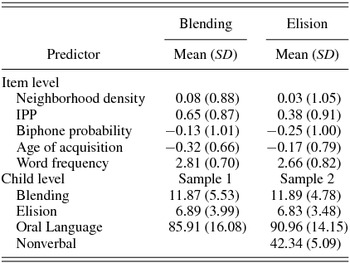
Prior to hypothesis testing, the data were examined for normality. In both samples, data for both the blending and the elision tasks were univariate normal. To determine whether there were significant floor effects on the PA tasks for the youngest children in the samples, children's ages and PA skills were evaluated for bivariate normality. In all cases, the data were bivariate normal. Descriptive statistics for item-level variables are reported in Table 1. For child-level variables, children from both samples scored below the mean on the oral language assessments.
Descriptive statistics for item- and child-level variables

Note: IPP, Individual phoneme probability; Nonverbal, nonverbal cognitive ability.
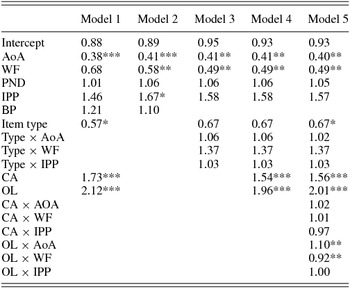
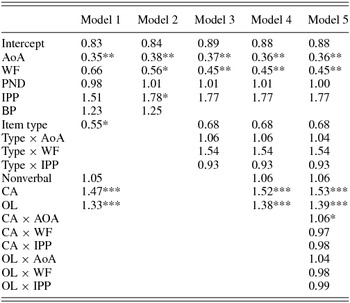
Tables 2 and 3 provide the results for Samples 1 and 2, respectively.Footnote 1 The results of Models 1 through 4 were replicated across samples. In Model 1, each item- and child-level variable predicted PA outcomes with no other variables in the model. AoA and item type were significant, negative predictors of PA skills, such that children were more likely to respond correctly to early-acquired words and to blending items. Child age and oral language skills positively predicted PA skills, such that older children and children with stronger oral language skills were more likely to correctly respond to PA items. The effect of unit of manipulation required by the PA item (i.e., word, syllable, or phoneme) was not a significant predictor of correct responses and did not interact with item-level variables.
Odds ratios of child- and item-level predictors for Sample 1 (N = 392)

Note: AoA, Age of acquisition; WF, word frequency; PND, phonological neighborhood density; IPP, individual phoneme probability; BP, biphone probability; CA, chronological age; OL, oral language.
*p < .05. **p < .01. ***p < .001.
Odds ratios of child- and item-level predictors for Sample 2 (N = 814)

Note: AoA, Age of acquisition; WF, word frequency; PND, phonological neighborhood density; IPP, individual phoneme probability; BP, biphone probability; CA, chronological age; OL, oral language.
*p < .05. **p < .01. ***p < .001.
When all lexical characteristic variables were examined together in Model 2, AoA, word frequency, and phonotactic probability uniquely predicted PA skills. Word frequency negatively predicted PA skills such that children were more likely to respond correctly to PA items consisting of low-frequency words than to PA items consisting of high-frequency words. Phonotactic probability positively predicted PA skills, such that children were more likely to respond correctly to PA items with high phonotactic probability than to PA items with low phonotactic probability. When the main and interactive effects of item type were added in Model 3, AoA and word frequency continued to predict PA skills; however, phonotactic probability did not. Neither item type nor the interactions between item type and item-level variables predicted PA skills. In Model 4, the main effects of child age and oral language uniquely predicted PA skills.
The results for Samples 1 and 2 diverged concerning the interactions between item- and child-level predictors in Model 5. In Sample 1, when all main and interaction effects were examined in Model 5, AoA, word frequency, item type, child age, and oral language uniquely predicted PA skills; in addition, there were significant interactions between children's oral language skills and both AoA and word frequency. Follow-up analyses of the significant interactions revealed that the relation between AoA and PA skills was significant at both high and low levels of oral language skills (for high oral language, OR = 0.40, p < .01; for low oral language, OR = 0.34, p < .001); however, the effect of AoA was larger for children with lower oral language skills than it was for children with higher oral language skills. In contrast, the relation between word frequency and PA skills was significant for children with high oral language skills but not for children with low oral language skills (for high oral language, OR = 0.62, p < .05; for low oral language, OR = 0.74, p = .19).
In Sample 2, when all main and interaction effects were examined in Model 5, AoA, word frequency, child age, and oral language uniquely predicted PA skills; in addition, there was a significant interaction between AoA and child age. Follow-up analyses revealed that the relation between AoA and PA skills was significant at both high and low levels of child age (for higher child age, OR = 0.37, p < .01; for lower child age, OR = 0.33, p < .001). The negative effect of AoA on correct responses was larger for younger children than for older children.
DISCUSSION
Although LRM is not a theory about the development of PA, lexical restructuring may set the stage for the development of PA. The increasingly segmental representation of words posited by LRM allows children to access smaller components of words to complete PA tasks and ultimately to map the letters in words to the sounds in words they represent. LRM hypothesizes that lexical restructuring is a gradual process. That is, not all words in a child's lexicon move from holistic to segmented form at the same rate. LRM does not make claims about the nature of the restructuring process for individual words; however, it seems unlikely that the representation of words is binary (i.e., holistically represented vs. fully segmentally represented at the phoneme level). Given that children's abilities to perform PA tasks at different levels of linguistic complexity (e.g., words, syllables, and phonemes) follows an orderly developmental sequence (Anthony et al., Reference Anthony, Lonigan, Driscoll, Phillips and Burgess2003), it seems likely that lexical restructuring of individual words follows a similar developmental sequence (Fowler, Reference Fowler, Brady and Shankweiler1991) to the extent that lexical restructuring underlies the development of PA. Therefore, the word characteristics that drive lexical restructuring should also be associated with performance on PA tasks.
To our knowledge, this is the first study to demonstrate that lexical characteristics of words impact children's performance on PA tasks requiring supraphonemic manipulation of words, indicating that lexical restructuring begins to occur in early childhood and is partially responsible for the development of PA. In two different samples, preschool children were more likely to respond correctly to PA items consisting of words that were acquired earlier and words that had higher phonotactic probabilities, consistent with predictions derived from the LRM. In contrast to these predicted effects, children were less likely to respond correctly to PA items consisting of higher frequency words than they were to PA items consisting of lower frequency words, and there was no effect of phonological neighborhood density. As expected, children who were older and children who had better language skills were more likely to respond correctly to PA items. In addition, these child factors moderated the effects of some lexical characteristics in some analyses. Consistent with predictions derived from the LRM, the relation between AoA and children's responses to PA items was greater for younger children and children with lower oral language skills; however, the direction of the interaction between oral language and word frequency was not consistent with our predictions.
AoA
Consistent with predictions and findings of previous research (e.g., Metsala, Reference Metsala1999), performance was better on PA items that contained earlier acquired words than on PA items that contained later acquired words. Words to which children have been exposed for a longer period of time have had more opportunity to undergo lexical restructuring than have words children recently acquired or have not yet acquired. In contrast, it may be that children are simply more familiar with early-acquired words. However, because AoA and frequency are related constructs, the contradictory findings for AoA and frequency make it seem unlikely that effects of AoA simply represent children's familiarity with words. For example, if the effect of AoA on PA skills was due entirely to word familiarity, it would have been expected that children's PA performance would have been stronger for high- than for low-frequency words, because word frequency should also reflect familiarity. However, this was not the pattern of results obtained.
Word frequency
The effect of word frequency on children's PA performance was opposite the predicted direction. Children were less likely to respond correctly to PA items with high-frequency words than they were to PA items with low-frequency words. Prior studies have reported mixed findings concerning the influence of word frequency on children's PA skills, some reporting that children's PA skills were stronger for high-frequency words (e.g., Hogan et al., Reference Hogan, Bowles, Catts and Storkel2011) and some reporting that frequency did not impact children's PA skills (e.g., Garlock et al., Reference Garlock, Walley and Metsala2001). Examination of the characteristics of these studies (e.g., age of participants, source of word frequency values, and type of PA task) did not suggest a clear pattern to explain the mixed results. For instance, different studies have used different methods for estimating word frequencies. To determine if this variation could have influenced the results of this study, analyses also were conducted using the word frequency estimates provided by Kucera and Francis (Reference Kucera and Francis1967). The correlation between the two sets of word frequency estimates was high (r = .80). Across both samples, results obtained when using Kucera and Francis word frequency values indicated that word frequency was negatively related to children's PA skills, consistent with the original results. Consequently, the word frequency estimation method does not explain differences across studies. Although the majority of studies use the Kucera and Francis (Reference Kucera and Francis1967) word frequency estimates, SUBTLEXus values were chosen for use in this study because comparisons of word frequency corpuses have demonstrated that SUBTLEXus is a stronger metric of frequency based on a much larger corpus of words than are the Kucera and Francis norms (Brysbaert & New, Reference Brysbaert and New2009) and other frequency norms.
Hogan et al. (Reference Hogan, Bowles, Catts and Storkel2011) reported that children were more likely to respond correctly to PA items with high-frequency words than to PA items with low-frequency words. Their study was similar to this study in that it involved an elision measure, used items from an existing measure of PA, and used hierarchical logistic models to estimate the influence of lexical characteristics of words on PA task performance. The primary difference between this study and the study by Hogan et al. was the age of participants (i.e., preschool vs. second- and fourth-grade children).
There seem to be two possible explanations for the negative effect of word frequency. There may be an interference effect of word frequency that occurs for young children. Although higher frequency words should undergo more lexical restructuring, young children also are more likely to acquire higher frequency words. Therefore, high-frequency words are novel words in younger children's lexicons. Perhaps the novelty of hearing a word that a child has just acquired leads that child to simply say the word rather than perform the PA task. Similarly, Garlock et al. (Reference Garlock, Walley and Metsala2001) argued that unstable representations of high-frequency words that were newly acquired may hamper children's ability to manipulate the sounds of those words. This prediction is consistent with the notion that increased exposure to words increases the likelihood that the words will be segmentally represented in the lexicon. Other researchers have theorized that words children do not know may draw their attention toward the task (Gierut & Dale, Reference Gierut and Dale2007). Children may be more patient when they encounter a PA item for a word that they do not know and attempt to utilize their knowledge about the individual sound components of words to complete the PA task as instructed. This hypothesis was partially supported based on anecdotal evidence. One common incorrect answer on many of the PA items for children who have low PA ability is to repeat the stimulus word. It is possible that the effect of word frequency shifts from a negative to a positive effect as children get older and their language skills increase. Future longitudinal research should investigate how the effect of word frequency changes as children get older and develop stronger language and PA skills. In contrast, the frequencies to which preschool children are exposed to words could differ from the frequencies to which older children and adults are exposed to words; although it does not appear that this is the case, because estimates of word frequency from child speech (Baath, Reference Baath2010) and print to which children are exposed (Masterson, Stuart, Dixon, & Lovejoy, Reference Masterson, Stuart, Dixon and Lovejoy2010) are significantly correlated with the SUBTLEXus word frequency values (for child speech, r = .65, p < .001; for print, r = .55, p < .001). Although these metrics of frequency may seem appropriate for use in a study of early PA development, issues related to characteristics of the word corpuses (e.g., corpus size) led us to use the SUBTLEXus word frequency values. Further, the corpus derived from print to which children are exposed was obtained from reading materials commonly used by 5- to 9-year-old children in the United Kingdom, which leaves open the question of better match of the word frequency estimates to the population used in this study.
Phonological neighborhood density
Phonological neighborhood density was not related to children's responses to PA items. According to LRM, children should be more likely to respond correctly to PA items consisting of words that come from dense phonological neighborhoods than to PA items consisting of words that come from sparse phonological neighborhoods. Words that are phonologically similar to other words need to be kept distinct from each other in the lexicon, necessitating lexical restructuring. Previous studies have shown inconsistent results for neighborhood density on children's PA performance. Some studies have found a positive effect of neighborhood density (e.g., Hogan et al., Reference Hogan, Bowles, Catts and Storkel2011), whereas others have found a negative (e.g., Foy & Mann, Reference Foy and Mann2009) or no (e.g., Garlock et al., Reference Garlock, Walley and Metsala2001) effect of neighborhood density.
The absence of an effect of phonological neighborhood density on children's PA skills in this study could be an artifact of the words used on PA tasks. Of the 39 PA items, 12 items had no neighbor words that differed by only one phoneme. Phonological neighborhood density is often negatively correlated with word length (Storkel, Reference Storkel2004). Because nearly one-third of the items were at the floor of phonological neighborhood density, analyses also were conducted without these items to determine if they were the cause of the nonsignificant effect of phonological neighborhood density. These analyses did not reveal a significant effect of phonological neighborhood density, indicating that the specific words on the PA task did not explain the absence of an effect of phonological neighborhood density.
Because the PA assessment was not developed specifically for this study, it was not possible to manipulate items based on phonological neighborhood density. It is possible that a PA measure on which items were selected based on their phonological neighborhood density values would provide a better estimate of the impact of phonological neighborhood density because the measure could be constructed to encompass words with varying levels of phonological neighborhood density. However, prior research with PA measures for which words were chosen to reflect specific phonological neighborhood densities also has demonstrated mixed results, and the predicted effect of phonological neighborhood density has been reported in studies in which existing PA measures were used (e.g., Hogan et al., Reference Hogan, Bowles, Catts and Storkel2011).
Another potential explanation for conflicting findings concerning the effect of phonological neighborhood density on PA items could be the unit of analysis at which the PA task is performed. In this study, the PA tasks primarily required children to manipulate supraphonemic components of words (e.g., syllables and individual words within compound words). Four prior studies used at least one measure of PA that required children to manipulate sounds at the level of the individual phoneme (Foy & Mann, Reference Foy and Mann2009; Garlock et al., Reference Garlock, Walley and Metsala2001; Hogan et al., Reference Hogan, Bowles, Catts and Storkel2011; Roth et al., Reference Roth, Troia, Worthington and Handy2006). All of these studies, with the exception of Roth et al. (Reference Roth, Troia, Worthington and Handy2006), reported significant effects of phonological neighborhood density. Because phonological neighborhood density reflects the number of words that differ from the index word by only one phoneme, PA tasks that require the manipulation of phonemes may provide a better metric of how phonological neighborhood density influences children's performance than do PA tasks that require supraphonemic manipulation. Similarly, because development of PA culminates in phonemic awareness, phonological neighborhood density may be a more appropriate metric of similarity between words for older children who are capable of manipulation at the phonemic level.
Phonotactic probability
The results indicated that phonotactic probability may be a better metric than phonological neighborhood density of how the phonological similarity between words necessitates lexical restructuring. This finding is perhaps because phonological neighborhood density is a lexical-level metric of phonological similarity between words whereas phonotactic probability is a sublexical-level metric of phonological similarity between words. PA tasks require manipulation of words at the sublexical level. Prior research on adults has indicated that phonotactic probability impacts picture-naming speed even when other lexical characteristics like phonological neighborhood density are controlled (Vitevitch, Armbruster, & Chu, Reference Vitevitch, Armbruster and Chu2004). Furthermore, no effect of neighborhood density was detected when both neighborhood density and phonotactic probability were experimentally manipulated. The authors argued that for tasks that require attention to words at the sublexical level (such as PA tasks), effects of phonotactic probability will emerge, whereas for tasks that require attention to words at the lexical level, effects of phonological neighborhood density will emerge. Consistent with this theory, results of our study demonstrated an effect of phonotactic probability but no effect of phonological neighborhood density.
Words with high phonotactic probability should necessitate lexical restructuring more than words with low phonotactic probability. This is because words with high phonotactic probability have sounds and sequences of sounds that commonly occur in English. Therefore, other words should contain similar sequences of sounds, and children need to keep these words distinct from one another in their lexicon. Phonological neighborhood density simply reflects how many words differ from a given word by only one phoneme, and younger children have significant difficulty performing PA tasks at the level of the individual phoneme. In contrast, phonotactic probability values can reflect the average probabilities of occurrence of either individual phonemes or clusters of phonemes in a word. For younger children, lexical restructuring may not have occurred at the level of the individual phoneme yet; however, lexical restructuring could still have occurred at larger units of sound for these children. For example, some words could be represented as being composed of numerous biphone segments, whereas others could be represented as being composed of syllables. Furthermore, the more frequently a given sound occurs, the more frequently it will overlap with other phonemes. This necessitates lexical restructuring because children need to keep frequently occurring sounds distinct from the sounds with which they frequently co-occur.
Child characteristics
Increases in children's vocabulary knowledge result in lexical restructuring (Walley et al., Reference Walley, Metsala and Garlock2003). Because increases in child age are generally associated with increases in vocabulary knowledge, it was expected that increases in child age also would result in lexical restructuring. As was predicted, there were positive effects of vocabulary knowledge and age on children's PA performance. The relation between vocabulary knowledge and PA performance did not appear to be due to children's overall intelligence, because the measure of nonverbal cognitive abilities did not predict PA skills in this study.
It was hypothesized that the four lexical characteristic variables examined in this study would interact with children's ages and vocabulary knowledge. It was expected that AoA and word frequency would have a greater impact on the PA skills of younger children and children with less vocabulary knowledge (Metsala, Reference Metsala1999) but that phonological neighborhood density and phonotactic probability would have a greater impact on the PA skills of older children and children with more vocabulary knowledge. Results consistent with these predictions were obtained for AoA but only partially for word frequency; however, results for neighborhood density and phonotactic probability were not consistent with these predictions.
AoA interacted with children's oral language skills and ages in Samples 1 and 2, respectively. The use of different measures of oral language skills across samples may explain why the interaction between children's oral language skills and the AoA of PA items did not replicate across samples. Children in Sample 1 completed the PPVT-4, a measure of receptive vocabulary, and children in Sample 2 completed the PLS-4, a measure of oral language skills beyond vocabulary. Because lexical restructuring is dependent on vocabulary knowledge (Walley et al., Reference Walley, Metsala and Garlock2003), a simple receptive vocabulary measure may be a better indicator of vocabulary when examining the utility of lexical restructuring in the explanation of the development of PA than is a measure that assesses oral language skills in addition to vocabulary. However, correlational and discriminant validity evidence suggests that when used in samples consisting primarily of low-income children, the PPVT and the PLS are measuring the same underlying language constructs (Qi, Kaiser, Milan, Yzquierdo, & Hancock, Reference Qi, Kaiser, Milan, Yzquierdo and Hancock2003).
Child characteristics did not consistently moderate the effect of word frequency on children's responses to PA items. Word frequency interacted with children's oral language skills for children in Sample 1; however, this interaction operated opposite the predicted direction. Perhaps there is limited variance in the frequency of words known by children with weak oral language skills. Therefore, frequency would not be likely to affect PA performance because the frequency of words would not place more pressure on the restructuring of some words relative to other words. In contrast, children with strong oral language skills may know both frequent and infrequent words, with certain words being more saliently represented in the lexicon than others, necessitating lexical restructuring.
Limitations and future research
Despite some of this study's strengths, such as the large sample sizes and replication across two independent samples, this study had several limitations. First, the primary goal of the study was to explore the developmental origins of PA; however, the cross-sectional nature of this study limits our ability to make claims about the development of PA. A longitudinal study is needed to understand fully how PA develops, how lexical restructuring occurs, and how lexical characteristics of words affect lexical restructuring. Second, the PA assessment completed by children was not one in which items were selected based on their lexical characteristics. Specifically, this was an issue for neighborhood density and AoA, because many of the PA items had no neighbor words that differed by only one phoneme and AoA estimates were not available for several words. An assessment in which items were selected based on these variables would ensure that these issues did not arise. Future research should use carefully designed measures of PA that experimentally manipulate the lexical characteristics of items to confirm the findings of this study. Third, the generalizability of the results may be limited because of the demographics of the two samples. Children were recruited from Head Start centers and consequently represented a low-income sample of children. Furthermore, African American children were overrepresented in both of the samples.
Summary and conclusions
The results of this study help advance knowledge about how the PA skills of preschool children develop and the characteristics of words that impact the development of children's PA skills. Better performance on PA tasks was found for children with larger vocabularies, for words with lower AoA, and for words with higher phonotactic probability. Contrary to our expectation, higher word frequency was associated with worse performance on PA tasks, which may have been due to an interference effect. The results indicated that each of these lexical characteristics influence the development of PA. Although lexical restructuring may not fully explain the development of PA, it is clear that various lexical characteristics of words impact whether a word is segmentally represented in the lexicon. AoA and frequency do so indirectly via the likelihood of exposure to those words (providing opportunities for segmentation), whereas phonotactic probability directly necessitates lexical restructuring (i.e., phonologically similar words need to be kept distinct from one another in the lexicon).
The findings of this study have broad implications for the assessment and instruction of PA skills. Certain characteristics of words used on a PA task may impact children's performance on that task. Specifically, it is important that items on PA tasks come from a broad range of each of these lexical characteristics (e.g., AoA, frequency, and phonotactic probability) to ensure that assessment scores are accurate. For example, a PA task in which all items have low phonotactic probability may underestimate children's true PA skills. As indicated by prior research, the lexical characteristics of words impact children's likelihood to acquire those words (e.g., Storkel, Reference Storkel2001). If certain characteristics of words lead to lexical restructuring, it is possible that informed vocabulary instruction could enhance children's PA abilities. For example, teaching children words that are phonologically similar to one another and to words children know may cause those words to undergo restructuring so that they are kept distinct from each other in the lexicon. Targeted vocabulary instruction may heighten children's sensitivity to the individual sound components that comprise words.
ACKNOWLEDGMENTS
This study was supported by grants from the Institute of Education Sciences, US Department of Education (R305B090021, R305J030093), the Eunice Kennedy Shriver National Institute of Child Health and Human Development (HD060292), and the National Science Foundation (REC-0128970). The views expressed herein are those of the authors and have not been reviewed or approved by the granting agencies.