Over 10 years ago, the transition from primary school to secondary school was acknowledged as particularly difficult for those Indigenous young people who had to temporarily leave their community to complete their secondary education at a school away from home (Ministerial Council for Education, Employment, Training and Youth Affairs [MCEETYA], 2001). Specifically, that ‘not knowing what to expect, homesickness, distance from family and community support, lack of local support, poor literacy levels and shame at not succeeding [at school] lead many young Indigenous people to drop out’ (MCEETYA, 2001, p. 11). A review of Indigenous education concluded that the transition from primary school to secondary school was particularly difficult for Indigenous males who had to relocate from their local community and family to attend a secondary school (Mellor & Corrigan, Reference Mellor and Corrigan2004). The review identified how this transition often coincided with increased participation in important rites of passage ceremonies for Indigenous males, activities traditionally seen as crucial to the healthy formation of identity and a sense of self as they transitioned into manhood (Mellor & Corrigan, Reference Mellor and Corrigan2004).
Aboriginal Children and Boarding Schools in Western Australia
The enrolment of Aboriginal children boarding at a school away from home and family is not a new social phenomenon, but rather one that is deeply entwined with the colonisation of Western Australia (WA). The Perth Natives’ School, established in September 1840 (Hetherington, Reference Hetherington2002), was accompanied by a set of school rules and regulations that were published in The Perth Gazette and Western Australian Journal on August 14, 1841 (Shenton, Reference Shenton1841). Rule number 2 emphasised that Aboriginal children who attended the school were required to ‘sleep at Mr. Armstrong’s, the Native Teacher's House, as they have been placed under his care by their parents’ (Shenton, Reference Shenton1841, p. 3). Separate boarding apartments were provided for Aboriginal boys and girls and students receiving two hours of instruction per day (Shenton, Reference Shenton1841). Boarding Aboriginal children at the school addressed several issues from the perspective of the colonists, each of which had a tenuous connection with the provision of education. The physical separation of Aboriginal children from their parents, combined with exposure to a Christian ethos, was argued to civilise Aboriginal children and save them from being primitive savages of little ‘value’, to become functional servants who could fulfil domestic and labour roles for colonial society (Hetherington, Reference Hetherington2002).
By the mid-1900s it was commonplace for station managers on remote farms across the Kimberley region of WA to forcibly send the children of Aboriginal workers to board at mission schools (Human Rights and Equality Opportunity Commission [HREOC], 1997). Just after World War II, the role of mission schools was rapidly expanded by the state government to include a network of residential institutions, such as children's hostels, cottage homes and more formalised boarding schools (Haebich, Reference Haebich2008). By 1958, it was estimated that 25% of Aboriginal children from the Kimberley (HREOC, 1997), and by 1964, 25% of Aboriginal children from the South West, were schooling away from home and family (Haebich, Reference Haebich2008). In 2010, approximately 4,165 Indigenous secondary school students nationally, of which 793 were in WA, accessed the Aboriginal and Torres Strait Islander means-tested Student Assistance Scheme (ABSTUDY) — School Fees Allowance (Boarding) Supplement, and were schooling away from home (A. Davila, personal communication, October 11, 2010).
Recent government and non-government funding initiatives designed to support Indigenous families to send their children to boarding school have been described as assimilation, a ‘band-aid’ solution, and as ‘cherry-picking’ only the very best Indigenous students, while failing to attend to the educational needs of the majority in regional and remote communities, whereas others have argued that boarding schools offer an important and necessary educational pathway that overcomes social disadvantage, inequitable access and standards of secondary education in regional and remote communities, and enables Indigenous students to experience hope for a better future (Pearson, Reference Pearson2009). However, it is evident from the literature that few dialogic spaces existed for Aboriginal young people to speak back to a predominantly adult-centric discourse and share their knowledge about schooling away from home at a boarding school. Hence, a need exists to shift away from viewing Aboriginal young people as the ‘topic of discussion’, to instead position them at the centre of understanding about this social phenomenon.
Purpose of the Study
The aim of this study was to explore how male Aboriginal students from regional and remote towns and communities across WA constructed meaning and understanding around the transition experience to a metropolitan boarding school.
Method
This cross-sectional qualitative research used a phenomenological ontology, social constructionist epistemology and narrative methodology to explore how participants constructed meaning and understanding about the transition to boarding school. Congruent with recommendations by the National Health and Medical Research Council (NHMRC, 2003), the design and conduct of this research was undertaken in collaboration with an independent Aboriginal advisory group.
Participants
After obtaining university ethics approval, the subjective accounts of 32 male Aboriginal secondary school students at five boarding schools located in Perth, WA were investigated. Purposive sampling was used as it provided a powerful non-random sampling approach to identify and recruit information-rich cases (Patton, Reference Patton1990). Participants were recruited from Grades 7 to 12 and ranged in age from 12 to 17 years. Participants were drawn from 23 different regional and remote towns and communities in WA, and included one participant from the Northern Territory.
Procedure
Participation was first canvassed with parents via an information package posted home by schools. The contact details of the Aboriginal advisory group were also provided so that parents could contact them to evaluate the merits of the study (NHMRC, 2003). Contact was only made with a potential participant when a parent provided active consent. Despite this step, inherent power differentials exist between researchers and participants, particularly when participants are children and the researcher is an adult. To address this issue, the language and research jargon used in the students’ information letter was adjusted for a younger audience. Six key questions were used to construct the student information letter: (1) What is the research about? (2) Why do I need your help? (3) What am I asking? (4) What will happen? (5) What happens with the information you give me? (6) What else do you need to know or do, if you want to participate in this research? For students identified with low reading literacy, the information letter was read aloud by the Head of Boarding, Aboriginal Liaison Officer or Indigenous Program Coordinator and then discussed. The researcher only made contact with those students who expressed an interest in participating in the research. If a student was willing to proceed, informed written consent was gained. Individual interviews took place at the school of each respective participant on a date and time of their choice, and in a location nominated by a participant. The Head of Boarding was always informed of these arrangements. Interviews ranged in length from between 25 to 90 minutes.
Given the overarching aim of this study, a narrative interviewing approach was deemed as the most appropriate methodology (Vicary, Tennant, Garvie, & Adupa, Reference Vicary, Tennant, Garvie and Adupa2006). Evidence shows that social inquiry structured around predetermined checklists, forced-choice responses or closed-ended questioning only receive apprehensive and superficial responses from Aboriginal young people (Kearins, Reference Kearins, Dudgeon, Garvey and Pickett2000). Narrative inquiry has been described as exploring social phenomena in terms of the stories of individuals (Mankowski & Rappaport, Reference Mankowski and Rappaport2000). Personal narratives and storytelling hold meaning for individuals and help them to make sense of human experiences. They also hold linkages with valued communication and social conventions for Aboriginal people, such as ‘yarning’ (Westerman, Reference Westerman2004). Yarning has been described as an informal, relaxed, open-ended and reflective way of exchanging knowledge through conversation (Bessarab & Ng’andu, Reference Bessarab and Ng’andu2010). Moreover, yarning plays an important role in promoting rapport and building trust with Aboriginal young people (Westerman, Reference Westerman2010).
Data Analysis
Transcription was done immediately after an interview was conducted. Interviews were transcribed verbatim and systematically de-identified. Thematic analysis was used to analyse the data collected. Thematic analysis is commonly used in conjunction with narrative inquiry (Riessman, Reference Riessman2008) and has been described as a general but widely used strategy to identify, order and analyse patterns of meaning within qualitative datasets (Braun & Clarke, Reference Braun and Clarke2006). The researcher systematically generated a list of possible major themes and subthemes. Each emergent theme was reiteratively compared and contrasted across all transcripts and discussed with members of the Aboriginal advisory group to ensure accurate interpretation of data (NHMRC, 2003). A description of each theme was generated and then exemplars from participant transcripts were selected to convey the essence in the present study.
Results and Findings
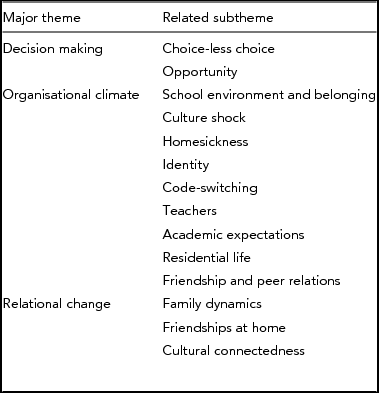
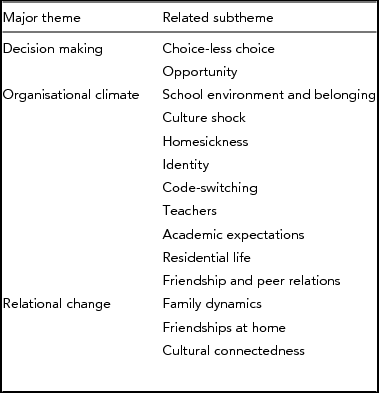
Three major themes consistently emerged from the data collected: (a) decision making, (b) organisational climate, and (c) relational change (see Table 1). In the following section, a description of each major theme is provided, along with evidence for each related subtheme.
Major Themes and Related Subthemes for Participants
Decision Making
Decision making refers to the period preceding attending boarding school for participants. In varying degrees, all but six participants reported actively contributing to the decision-making process prior to attending boarding school. These participants revealed highly valuing the opportunity to exercise influence and a sense of control over their secondary education pathway. For the six participants who did not partake in the decision-making process, discovering they were going to be schooling away from home made them feel angry, uneasy, hesitant and powerless. One reported that this not only caused friction in his relationship with his father, but it also clashed with his own personal perception of local schooling in his community. He recounted:
Oh my Dad . . . he sees that there is nothing left for me back home, that there's not much opportunity for change . . . but I disagreed with him. I didn't want to come and we had arguments. It was very hard to talk it out. (Participant 25)
Choice-less Choice
Notwithstanding participants’ level of involvement in the initial decision-making process, the majority described how they believed their local school did not have adequate facilities and resources such as classrooms, computers, desks and chairs, sporting ovals and equipment, and that they did not provide access to desired course options in Grades 11 and 12. It was perceived that to experience success at the secondary school level, they had to deliberately circumvent their local school and instead explore other options such as boarding school. One explained, ‘It was a hard call because I sort of didn't have a choice, if I wanted to have more opportunities and go to a better school . . . I just had to get used to it’ (Participant 4). For several, the prospect of contending with problematic social issues that they perceived pervaded their local secondary school context — such as alcoholism, drug use, family feuding and gang membership — was more daunting than studying away from home. One recalled, ‘It was like a bit of a dodgy kind of school, like kids getting into fighting and drugs and stuff, so I didn't really like it that much’ (Participant 19). Several believed that contact with such issues was a matter of course in their home community rather than as subject to their own control. A troubling feature of this perception was that it was particularly pronounced in the younger participants; as one revealed: ‘I’d probably be in jail or something if I still stayed in community . . . I feel lucky to come down here and staying away from that’ (Participant 6).
Opportunity
Participants often described how they viewed the decision to go to boarding school as a ‘fork in the road moment’, and that it was presented as an opportunity to realise an alternative educational pathway compared with the known experience offered by local schooling. As one explained, ‘there was this opportunity to come down here [boarding school] . . . they don't have Year 11 and Year 12 subjects up there [local school], they don't have any TEE [Tertiary Entrance Examination], just really basic stuff, not very hard’ (Participant 10). Although many participants constructed the decision to go to boarding school as an opportunity, several revealed struggling with pursuing self-advancement at the expense of being away from home and family. Several ameliorated this conflict by linking boarding school with being part of a broader grand plan in their life, such as boosting their prospects of gaining an apprenticeship or gaining entrance to university; indeed, that boarding school would enable even longer-term goals that extended beyond just accessing a post-school destination. For example, one revealed how an important longer-term goal behind his motivation to attend boarding school was to use the benefits of education to gain entry to university and in turn build a better future for vulnerable members in his home community. He explained:
You want to go back home and make a difference you know, like with people who don't have jobs, it's sort of on your mind you know, that you could make a difference. That's one of the reasons why I wanted to come down here, so I could make a difference with my people . . . and show them strategies to, like empower our people. (Participant 15)
Organisational Climate
Organisational climate refers to the social customs, nuances and routines that shape life as a boarding student at a boarding school. Participants were confronted by the necessity to manage multiple academic, lifestyle, personal and interpersonal, and social changes when they first arrived at boarding school. These included, but were not limited to, the challenge of negotiating a new and larger school campus, learning boarding house routines and rules, adjusting to academic and study expectations, and building new social networks and friendships.
School Environment and Belonging
Most participants had transitioned from a smaller day school environment where Aboriginal students comprised a much larger proportion of the overall student population. The sharp contrast of their new boarding school with their previous school triggered for some a sense of uncertainty about ‘fitting into the environment’ (Participant 9). Such initial impressions prompted some to question whether they belonged at their new school. One recalled, ‘the vibe I sort of had was that I don't belong’ (Participant 15). For several participants it perpetuated reflection on wider societal issues such as social disadvantage and inequality, and their own sense of belonging within what they perceived as a privileged educational and learning context. For example, one participant reported how initially adjusting to new uniforms and uniform expectations caused him to probe his decision to school away from home. He explained, ‘in [name of community] where I come from you don't really have much stuff, don't really wear uniforms, I just ahhh . . . didn't feel like I ought to be here’ (Participant 12).
Culture Shock
Cultural shock has been described as the experience of entering another cultural domain and discovering that familiar cultural cues and ways of being, knowing and doing are different from what one is used to (Trudgen, Reference Trudgen2000). Culture shock is triggered by encountering for the first time new attitudes, expectations, routines, customs and social norms, and it can be a bewildering experience that may severely impact on one's day-to-day functioning (Sonn, Bishop, & Humphries, Reference Sonn, Bishop and Humphries2000). When describing this sense of shock, participants would often explain: ‘When you come down here you get like a shock’ (Participant 4) and ‘It's just a huge change, I mean everything's different here, culturally different, like I had to sort of adapt’ (Participant 18). For example, one recalled his initial astonishment at the menu and dietary regime at his boarding school, ‘Like normally we eat fresh meat. As for down here, we eat frozen meat. We eat kangaroo, turkey, goanna, things like that up home. We catch it and cook it ourselves’ (Participant 7). A range of factors not limited to the boarding school context were also implicated with triggering this sense of shock by participants, including adjusting to a change in typical weather conditions, increased amounts of noise, and population density.
Homesickness
In spite of participants utilising a variety of contemporary technologies such as Skype, mobile phones and email to keep in touch with family, the onset of homesickness was almost immediate for many, and for several it remained a constant feeling that stayed with them for the duration they were away from home. The experience of homesickness was described as hard times, wanting to leave school, thinking about family and feeling isolated, lonely, depressed and sad. One even described the experience of homesickness as painful (Participant 17). For a few, homesickness was not only associated with being at boarding school, rather, it was a feeling equally experienced at home. One described how for him homesickness was linked with yearning while at home for lost opportunities to participate in valued cultural, family and social activities. He explained:
I don't feel homesick while I’m here [at School B] but when I get back around home, being with family, that's when I start feeling like, homesick. So for me it's harder to come back. It's like butterflies in my stomach, I think about what I’ve missed out on. And just the everyday things I do back home that I can't do down here, I can't take those lost chances back, like going fishing and hanging out with my friends, and going hunting. (Participant 25)
Participants identified a cluster of similar strategies as helping with feelings of homesickness. Foremost, don't plan too far ahead, keep busy, take every day as it comes, try not to think too far ahead, get out and mix with people, talk with friends, talk with family, don't be ashamed, and to think about better times. However, a particularly valued source of support asserted as alleviating the fully impact of homesickness was having another student from their home community at their boarding school.
Identity
The transition to boarding school caused many participants to reflect on core aspects of their sense of self and cultural identity. Several believed they had to change, relinquish or set to one side aspects of their cultural identity and true sense of self while at boarding school. One recalled how encountering differences in language conventions and social etiquette regarding family triggered him to not only reappraise his way of knowing and being but also his cultural identity in terms of core family and cultural values that informed his sense of self as an individual. He explained:
There is this one thing back home that was bred into me; you always respect your Elders. Then you come down here and everybody is just saying all this stuff about teachers and parents and stuff like that. And even though it's like offhand jokes, it's still . . . I didn't know how to handle it, like it took me a while to work it out. (Participant 18)
Until Aboriginal students consider a school environment as safe and secure, they will not feel confident and comfortable expressing their identity and worldviews at school (Kickett-Tucker, Reference Kickett-Tucker2009). Participants explained that an important aspect of attending boarding school was that they had to learn how to negotiate two distinct but co-existing lived realities that constructed their identity as a young person. Several participants believed this circumstance forced them to figuratively walk in two different worlds. One revealed:
Well I sort of walk in two different worlds actually, because it's like back home I’m a man you know . . . when you come here you get like treated like a little kid again, you have to sign out and go to bed at a certain time and get lectures on all the rules and everything and it's hard to, you know, switching between the two. (Participant 12)
A sense of self for Aboriginal people is connected with ancestry, traditional lands and Dreaming (Garvey, Reference Garvey2007). Kinship, language and participation in customary practices are important aspects of affirming cultural identity (Juluwarlu Aboriginal Corporation, 2008). When Aboriginal young people are not supported as they negotiate differences between home and school, the tension of this experience has been shown to impede both functioning and healthy identity development within one or both contexts (Purdie, Tripcony, Boulton-Lewis, Fanshawe, & Gunstone, Reference Purdie, Tripcony, Boulton-Lewis, Fanshawe and Gunstone2000).
Code Switching
The concept of code switching has been described as when bilingual people switch between the codes of different forms of language to communicate with others (Department of Education, [DoE], 2002). Participants reported the need to code switch between Aboriginal English and the use of Standard Australian English while at boarding school. One reported, ‘I talk, let's say, with all these big words down here, but when I’m back home, I like change my style and say heaps of Aboriginal words’ (Participant 8). The most varied versions of Aboriginal English have been shown to occur in remote Australia (DoE, 2002), and it has been found to sustain identity (Sharifian, Reference Sharifian2005). For many participants, the premise of code switching extended beyond modifying their approach to communication. Rather, it emerged that code switching was conceived as being able to move between different cultural customs, social scripts and value systems. It was common for participants to describe how this extension of code switching prefigured the majority of social interactions at boarding school. One labelled this as ‘Acting Black, Acting White’ and explained:
Like back home I’m like my Aboriginal self, around here I just change, like some of the other boys said it before too, it's like being someone that you’re not. It's just like trying to please another person. It's like acting, acting like your different.. . . Like thinking Black, being Black like when you’re around family and stuff, but when you’re in White society you switch to the White side of things, so . . . yeah, acting Black, acting White. (Participant 1)
Other research has identified that ‘many Aboriginal children feel they have to sacrifice or compromise their own culture in order to survive or be successful in Western education’ (Zubrick et al., Reference Zubrick, Silburn, Maio, Shepherd, Griffin, Dalby and Cox2006, p. xxxiv). Participants similarly believed they had to suppress a genuine sense of self and cultural identity and instead switch between ways of knowing and doing at home in preference for a newly constructed way of being based on socio-cultural norms acceptable and familiar to others while at boarding school.
Teachers
Participants were initially apprehensive about how they would establish a relationship with their new teachers. Several even recalled contemplating questions such as, ‘Would the teachers hate me?’ (Participant 24). However, all reported having established at least one valued relationship with one or more teachers at their respective boarding school. Participants valued teachers that had a sense of humour, who were easy to get along with but had control of the class and who explained things properly while being perceived as accessible, respectful, supportive, and trustworthy. In the classroom setting, this translated into being ‘really interested in what you have to say’ (Participant 18) and as demonstrating a personal interest in learning about where participants were from, their culture, family and community. In the boarding house setting it involved spending time talking during dinner and participating in organised social and sporting activities. Three participants reported encountering what they perceived as prejudice or racism from teachers and boarding school staff. For example, one relayed his disbelief at a teacher who belittled his cultural status as an Aboriginal man while pointing out gaps in his academic knowledge, ‘Like with some, they say you’re a man, you should be able to do this stuff, I can't believe you can't do it’ (Participant 12).
Academic Expectations
Few participants reported coping well with the schoolwork and homework regime at boarding school. Many described the standard of work as well as the frequency and quantity of schoolwork and homework as confusing, hard, very hard, and really stressful. Several believed that their previous schooling had not adequately prepared them with the knowledge and skills to meet the academic and study expectations at boarding school. A large proportion indicated that they constantly grappled with curriculum content and struggled to complete set homework in the allotted time, an experience that caused some to experience a sense of academic alienation and internalise a negative self-concept as a learner, which led to disillusionment, loss of motivation and disconnection with schooling. One revealed:
Oh I was like, what am I doing here, you know, and all these other kids are doing it all really easy, you know. You feel like dumb, being in this sort of class and you feel shame and I didn't want to be there. You just feel like you want to put your head down and be really quiet. You don't want people talking to you. (Participant 28)
Residential Life
Aboriginal parents view autonomy and self-reliance as key developmental skills that nurture a sense of mastery of the world and as central to growing well-adjusted children (Enembaru, Reference Enembaru, Dudgeon, Garvey and Pickett2000; Kearins, Reference Kearins, Dudgeon, Garvey and Pickett2000); moreover, that these skills heighten the likelihood children will successfully transition into adulthood (Penman, Reference Penman2006). While some participants found ‘it really easy to fit into boarding life’ (Participant 24), several reported not realising the degree to which their freedom and privacy would be regulated and controlled at boarding school, and others thought that boarding house rules ensured fairness and created an even playing field for all boarding students. However, issues with the level of freedom and privacy were clearly perceived as less important to how boarding house rules were implemented by boarding school staff. Indeed, consistency and clarity by staff in communicating routines and rules was perceived as central to the harmony of the overall boarding house and to participants’ overall sense of wellbeing while at boarding school. For example, one shared how for him boarding house rules became bereft of meaning and instead were personalised intrusions when rules were perceived as being inconsistently and unjustly applied. He explained:
There are a couple of them [boarding house supervisors], it's like they need to have that control over you, over everything. Like, we’ve already got enough rules to deal with but they want to control you further, they give you absolutely no freedom whatsoever . . . [they] feel the need to have to control every single thing you do. (Participant 17)
Friendships and Peer Relations
The formation of new friendship circles was reported as crucial to successfully transitioning to boarding school. Several recounted initially worrying about how they would establish new friendships, but then being surprised by how approachable and welcoming other boarding students were during the first few days. One recalled, ‘people were real friendly, coming over to get to know me and asking my name and if they could be my friend and all that’ (Participant 22). All emphasised that participation in activities organised by boarding house staff such as barbeques, sporting carnivals and movie nights significantly helped them to establish new friendships and social networks. As these consolidated, particularly within the boarding house setting, several participants divulged how they appreciated the breadth of friendships that they were able to establish. That said, many revealed that they initially felt more comfortable building friendships with other Aboriginal students. One explained, ‘We [Aboriginal boarding students] can relate to them [other Aboriginal boarding students] easier than other people, and they can understand us when we talk’ (Participant 7).
An important benefit perceived by participants of initially building friendships with other Aboriginal boarding students was that other Aboriginal students would actively seek to open doorways to new friendships and social networks for new Aboriginal students. One recalled how ‘all the boys [Aboriginal boarding students] come up to you and say “oh you’re from up north, come meet my friends and you go have a kick [Australian Rules Football] with them and get to know them”’ (Participant 27). This served to alleviate anxieties, fears and insecurities for many participants. Moreover, the reciprocity of such friendships meant that participants were able to first observe how older Aboriginal boarding students negotiated the expectations and processes that comprised student life in their new boarding school. Indeed, an awareness of the significance of this support to new and younger Aboriginal boarding students was highly evident in older participants. One explained:
Well I had [name of student] here when I first arrived. He was a big help you know . . . like he told me about the school. We used to just sit down and he was easy to talk to and he’d tell me what I needed to know. So he helped me out a lot. Like, most of the new boys [new Aboriginal boarding students] come into my room now and we all sit down and talk. (Participant 12)
Despite the positive and supportive role undertaken by older Aboriginal students, several participants indicated they encountered racism during their early interactions with some non-Aboriginal boarding students. These experiences presented in both overt and covert forms, but tended to occur more often within the boarding house context, rather than in the day school setting. Incidents of racism angered and unsettled participants and caused some to re-evaluate their decision to study away from home. In negotiating such experiences, participants had to draw on significant personal restraint and tolerance in the face of highly offensive attitudes, behaviour and remarks. One explained:
I can't remember how it started but he [another boarding student] wouldn't show me something, and I asked why? He said oh it's because you’re an inferior race. There's always a little bit of racism in the boarding house. Like people call you stuff but you can't really go and punch them. That's not really me. I’ve just learnt to block it out and go back and tell [Indigenous Student Support Teacher]. (Participant 31)
Relational Change
Participants described how being away from home and family for extended periods of time over consecutive years and as they got older brought with it change to pre-boarding school relationships with both parents and siblings, as well as with friends. While lamenting the loss or fracturing of some pre-boarding school friendships, several rationalised this outcome as an unavoidable reality of going to boarding school and being separated from home, family and friends by long periods of time and large geographical distances.
Family Dynamics
While at boarding school all participants maintained a high level of interest in the functioning and wellbeing of family life at home. Many yearned to be involved in the ordinary and daily interactions that occurred in the home setting and, in particular, the opportunity to receive support and encouragement from their family at the end of each school day. Indeed, several divulged how dislocation from family was perceived as underpinning maturation and positive growth in their relationship with siblings. One explained:
At home I used to fight with my younger brothers a lot more, since being at boarding school I’ve noticed we’ve become a lot closer. We don't argue that much anymore . . . it sort of shed light on the fact you only have a certain amount of time with them, so you need to use it well. (Participant 31)
Friendships at Home
Participants often perceived they had two sets of friendship circles, one at home and another at boarding school. In varying degrees, some initially experienced feelings of anguish, insecurity and self-doubt about how schooling away from home would influence the sustainability and quality of relationships they had with friends at home. Several reported that their friends at home were supportive of their decision to attend boarding school. However, a number also revealed how although they had explained that boarding school was an opportunity, this did not necessarily protect them from criticism for schooling away. One recounted, ‘My friends say when I come back, you talk different, you’ve changed, like you’re a White bloke now, you’re a city bloke’ (Participant 15). Remarks such as these caused some to question if what they were doing at boarding school was relevant to life at home, and was seen as directly challenging their commitment to community, culture and people. Hence, when returning during school holidays, several recounted how they purposefully tried to draw less attention to themselves in an effort to discourage exposure to criticism by peers. To achieve this they often modified the language they used and also sought to play down or conceal at home the full extent of what they had learnt at boarding school.
Despite such endeavours to sustain friendships, several indicated that some relationships with friends at home gradually changed and in a number of instances ended. These participants explained that it was difficult to maintain some friendships simply because they were physically less able to participate in social activities at home. For others, in making the decision to attend boarding school, they had also begun to reappraise the type of friendships they wanted in their lives. One participant relayed, ‘Like, back home they’re like, let's get into trouble, before I was like, yeah ok, and would go along with it, but now I’m like, you guys can go and do that but I’m not, so I stay away’ (Participant 8). Accordingly, for many, the transition to boarding school involved negotiating the confusing reality of reconciling the fracturing or cessation of some previously valued friendships at home.
Cultural Connectedness
Participants lamented their dislocation from traditional activities while at boarding school. Indeed, this was particularly apparent with older participants as they reported regretting the loss of opportunities to learn and progress their cultural knowledge through spending time with Elders, but also through participation in everyday activities with significant others in their family. By having to spend extended periods of time away from home, several older participants reported continually reflecting on their relationship with ancestry, culture, traditional lands and spirituality. A critical aspect of forming a healthy sense of self and cultural identity for Aboriginal young people is building a sense of belonging and connection through upholding and performing cultural customs, spiritual obligations and responsibilities (Juluwarlu Aboriginal Corporation, 2008). To account for less time spent at home, they revealed feeling a growing sense of responsibility and obligation to make up for time spent away at boarding school. Moreover, they divulged placing pressure on themselves during school holidays to try and make up for gaps that they felt existed within their cultural knowledge. One explained:
I miss mostly the cultural side. Like, back home we can go out with our brothers and stuff, and they can teach you stuff which we can't do down here. Like spearing, hunting all that kind of food. And when they call you up [telephone] to tell you they caught this and that, you think oh why couldn't I be there? And like, when the Elders take all the young boys out and teach them a lot of stuff . . . when you’re down here, you don't get taught that. So when you get back there you’re behind in time. So you’ve got to catch up, and yeah, it's hard. In the holidays, they tell you to do this and I haven't been taught that you know. So yeah, that's sort of the down side to being down here [boarding school]. (Participant 26)
For several participants, missing out on an opportunity to advance their cultural knowledge and language base caused them to experience a sense of ambivalence about boarding school. For example, one participant revealed feeling frustrated at being already initiated as a man within his culture but not being able to participate in seasonal customary rites of passage ceremonies and support younger uninitiated males with their transition into adulthood. He revealed, ‘Up home they’re kind of like starting Law business up there right now, so I want to do it, but I’ve kind of missed out on this year's one, but I’ll be there for next year's one’ (Participant 6). For Aboriginal males committed to carrying the Law, it is important to return each season to perform ceremonies and to ensure the wellbeing of ancestors, land, spirits, and all things connected with their respective Dreaming (Juluwarlu Aboriginal Corporation & Rijavec, 2004).
Discussion: Implications for Policy and Practice
The Melbourne Declaration launched by the Ministerial Council for Education, Early Childhood Development and Youth Affairs (MCEECDYA) is the key document used to guide the educational goals of Australia for the next decade (MCEECDYA, 2008). Accompanying the declaration is the Aboriginal and Torres Strait Islander Education Action Plan for the 2010 to 2014 period (MCEECDYA, 2011). It states, ‘The Australian Government and education providers will work together to develop options to assist Aboriginal and Torres Strait Islander students in regional and remote areas to access high quality secondary schooling while retaining links with their communities’ (p. 14). However, it was highly evident in this study that participants did not perceive the standard and quality of secondary education available in regional and remote areas of WA as equivalent to options available in metropolitan Perth. The data revealed that boarding schools were not only seen as a means to overcome formidable distances and geographical remoteness, but they were constructed as an opportunity to pursue an optimal education and long-term goals. Problematic social issues present in their home community and at their local school further reinforced to participants the benefits of completing their secondary education at a boarding school.
Government bureaucrats and policymakers would do well to recognise that attending boarding school has implications that extend well beyond the economics of boarding school fees. Rather, a central finding of this research has been the importance of maintaining connectedness with people and place, language and land, kinship and family, ancestry and spirituality, to the overall wellbeing of Aboriginal boarding students. Similarly, it has outlined the positive benefits of creating meaningful opportunities for Aboriginal young people to exert control, power and influence during decision-making processes related to their education. The Aboriginal and Torres Strait Islander Education Action Plan emphasises that to improve Aboriginal students’ attendance, ‘Schools need to embrace diversity and explicitly value Aboriginal and Torres Strait Islander languages and cultures to enable students to feel culturally safe at school’ (MCEECDYA, 2011, p. 16). Those teachers who had a sense of humour and took the opportunity to learn from participants about their culture and where they were from were perceived as accessible, supportive and easy to get along with. However, the data also revealed that contending with prejudice and overt and covert racism at boarding school made an already difficult transition even harder.
Negative connotations of Aboriginality in school contexts strongly influence how Aboriginal young people construct themselves as learners (Purdie et al., Reference Purdie, Tripcony, Boulton-Lewis, Fanshawe and Gunstone2000). Moreover, negative attributions made by a teacher adversely influence the educational trajectory, aspirations and dreams of Aboriginal students’ (Craven et al., Reference Craven, Tucker, Munns, Hinkley, Marsh and Simpson2005; Godfey, Partington, Harslett, & Richer, Reference Godfrey, Partington, Harslett and Richer2001). If boarding schools are to be places in which Aboriginal students feel safe and confident to express a sense of self and cultural identity, then an imperative for boarding schools is to actively seek to redress unacceptable attitudes and behaviours exhibited by staff and students. Similarly, to promote school practices that positively embrace the complexity and diversity of socio-cultural realities that construct and give meaning to Aboriginal students’ life-worlds is imperative. Hence, professional development assisting staff at boarding schools to empathise with the significance of culture to Aboriginal boarding students represents a key area of need.
Male Aboriginal adolescents are least likely of all young people to seek help with problems (Commissioner for Children and Young People Western Australia, 2011). For several participants, the transition experience placed strain on their sense of self and cultural identity, with some indicating they had to code-switch between the parameters of what they perceived as two distinct worlds. Moreover, a number relayed feeling a sense of responsibility and obligation to catch up during school holidays on what they perceived as lost opportunities to advance their cultural knowledge. Hence, both parents and boarding schools need to carefully consider how they can work together to collaboratively support the cultural needs of Aboriginal boarding students during adolescence.
Understanding the link between culture shock and homesickness seems particularly pertinent for boarding schools. Students undertaking significant cultural and environmental shifts are more inclined to experience homesickness (Thurber, Reference Thurber2006). Homesickness has been described as a strong desire for contact with familiar people and places and is an indicator of wellbeing, positive mood and attitude associated with an environment (Harrison & Brower, Reference Harrison and Brower2011). It has been linked with culture shock (Poyrazli & Lopez, Reference Poyrazli and Lopez2007) and has been distinguished from depression, separation anxiety disorder and nostalgia (Thurber, Reference Thurber1995, Reference Thurber1999; Verschuur, Eurelings-Bontekoe, & Spinhoven, Reference Verschuur, Eurelings-Bontekoe and Spinhoven2001). Symptoms of homesickness are similar to those of depression and may include apathy, loss of appetite, feelings of insecurity and fatigue, lack of interest in the environment, withdrawal and sleeping disorders (Baier & Welch, Reference Baier and Welch1992; Fisher, Reference Fisher1989). Other physical symptoms may include headaches, dizziness and abdominal pain (Thurber, Reference Thurber1995). However, participants reported the presence of other Aboriginal students at their boarding school as a positive attribute, and moreover, that older Aboriginal boarding students helped alleviate concerns about fitting in, establishing new social and friendship networks, and negotiating a new school campus. Hence, they could play a formal function, not only as role models and supportive mentors, but also in the promotion of positive wellbeing during the initial stages of the transitioning to boarding school life for new students.
While a number of issues have been touched upon in this article, there is a need to further investigate the transition experience to boarding school for Aboriginal students in relation to academic attainment and post-school destinations, gender, social, emotional and cultural wellbeing, mental health, with parents and community also in mind, and on a longitudinal and national scale.
About the Authors
David Mander is a Psychologist and Early Career Researcher based at the Telethon Institute of Child Health Research, University of Western Australia. David is currently the Director of ‘A randomised controlled trial of a universal and targeted intervention to reduce mental health problems from bullying among school students’, funded by the National Health and Medical Research Council of Australia. Prior to this he was a school psychologist while also completing his PhD in psychology.
Lynne Cohen has a background in school teaching where she was head of the Biology and Mathematics departments. She is an Australian Learning and Teaching Council Fellow with an interest in developing leadership in undergraduate students. She has received numerous Awards for Learning and Teaching. Currently, she is the Executive Dean of the Faculty of Education and Arts and Professor of Psychology at Edith Cowan University. Lynne is a community psychologist and brings many years of experience in resiliency research with children and university students. She has successfully developed transition programs that empower students and positively impacts on their experience and outcomes. She has led a number of interdisciplinary research teams and is committed to a collaborative model involving community organisations. She also has extensive experience in working with children with learning difficulties. Lynne developed and implemented a literacy program for children with learning difficulties and has trained a team of teachers to provide a service for students with learning difficulties. Together with colleagues, she was instrumental in establishing the Lifespan Resilience Research Group at Edith Cowan University.
Julie Ann Pooley is the Associate Dean of Learning and Teaching in the Faculty of Health, Engineering and Science, and an Associate Professor of Psychology in the School of Psychology and Social Science at Edith Cowan University. Associate Professor Pooley is an accomplished lecturer in Psychology and has published extensively in the areas of resilience, post-traumatic growth, adolescence and children.