




No CrossRef data available.
Historical context and intercultural communication: Interactions between Japanese and American factory workers in the American South
Published online by Cambridge University Press: 26 April 2005
Abstract
This article underscores the importance of examining interlocutors' history in studies of intercultural communication. Five historical factors and four contextual factors are proposed and illustrated with interview and videotaped data, showing how each factor predetermines the interactants' power dynamics, thus shaping and influencing the process and outcome of interaction. Analyzing videotaped interactions between Japanese technical supporters and American workers on the production floor also demonstrates the interlocutors' creative utilization of available communicative resources and co-construction of meaning as interactions unfold. This co-construction of meaning occurs despite the severely limited knowledge of the other group's language and sociolinguistic norms.I thank all the study participants at Japan Die Company, who spent their precious time for my research. I am indebted to Miyako Inoue, Elizabeth Keating, Keith Walters, and Tony Woodbury for providing me with useful comments, insights, and encouragement, and Ellen Nakamura for proofreading the text. Thanks also to the School of Asian Studies at the University of Auckland, New Zealand, for supporting my writing of this article. Earlier versions of this project were presented at Stanford University, Nagoya University, and Ritsumeikan Asia Pacific University, and I appreciate the audiences' valuable feedback.
Keywords
Information
- Type
- Research Article
- Information
- Copyright
- © 2005 Cambridge University Press
INTRODUCTION
“It's really really important its' gotta be straight right from the start and … you can't make a mistake with them [dies and panels], and it's something other people in other departments are depending on, it's gotta be communicated really good.” (Ben, a worker at the Japan Die Company)1
All the individual and organization names appearing in this article are pseudonyms.
According to the Gumperzian model (Gumperz 1982, 1992a, 1992b; Gumperz & Roberts 1991), miscommunication occurs as a result of different contextualization cues that interlocutors from two different ethnic or national backgrounds bring (often unconsciously) when conversing with each other. The researchers using this model also astutely point out that the often frustrating and unsuccessful outcomes of such “crosstalk” can easily be a basis for discrimination against speakers who belong to the minority in a given society (e.g. Roberts et al. 1992). Thanks to these studies, we now know a great deal about what can and often does happen when a relatively fluent nonnative speaker, who often occupies a vulnerable social and/or professional position, communicates with a native speaker.
A number of researchers have conducted studies to widen the scope of this traditional framework by addressing other aspects, such as the majority's presupposed negative attitude toward a certain ethnic group (which overrides the minority's (in)ability to use appropriate contextualization cues; Meewis 1994), the effect of the majority's individual motivation to accommodate or not (Smith et al. 1991), the dilemma shared by those who are exposed to more than one set of communicative styles (Scollon & Scollon 1995), the minority's capability to articulate their communicative strategies (Shi-xu 1994) and their resistance to ethnification in interaction (Day 1994). Clyne's (1994) work is a valuable precedent in studying multiethnic communication in factory settings. In specifically referring to Japanese-American interactions in a corporate setting, Miller's (1994, 1995) works illustrate how we can (and should) deconstruct stereotypes reinforced as a result of dichotomizing “national characteristics.”
To add to the development of studies in intercultural communication, I propose in this article that we must examine the historical context that participants bring to their intercultural interactions, and how it affects their negotiation and co-creation of meaning in a situated context. As Lukács 1971 points out, we cannot understand the real nature of an event unless we understand it in “the historical totality” (p. 12).
Furthermore, two other points, which have not been investigated in previous studies, must be addressed. First, the mismatch of contextualization cues is often observed in encounters between strangers. What would happen after the initial “culture shock” or a discriminatory feeling if the interlocutors did not have the option of walking away but instead had to work together over time? Second, by focusing on contextualization cues, we have assumed that pragmatic concerns are the real and important ones, and that concerns at other levels (e.g. understanding of content) are not. Consequently, nonnative speakers have been placed in a “lose-lose” situation where, if they are fluent, they are still trapped in their native communicative norms, and if they are not fluent, they are not even considered in the framework.
Commonly, in the previous literature, the nature of interactions has been greatly asymmetrical: The native-speaker interlocutor possesses not only linguistic capital but also institutional power. In contrast, the nonnative-speaker interlocutor lacks both of these. Consequently, when their interactions result in negative outcomes, the burden and resultant sanctions are on the latter. The task to “understand,” to comprehend the other's intention and (re)act accordingly, is much more heavily and seriously assigned to the nonnative speaker.
Although such interactions are commonplace and deserve investigation, as revealed by the previous literature, a different type of interaction in an intercultural setting needs as much attention: the context in which the distribution of interlocutors' interactional power differs that in from most previous research. The present study analyzes just such a situation: communication between Japanese technical support members and American workers in a Japanese-owned factory in the American South.
The other important issue to consider is the meaning of “understanding.” The following statement by Wenger fits well with the setting in question: “Understanding in practice is the art of choosing what to know and what to ignore in order to proceed with our lives” (1998:41). Another useful notion, given in Bremer et al. 1996, is that understanding is a continuum. In my data, the participants start with an attempt to clarify what is being said or what needs to be done. At the end of the interaction, they mostly manage to obtain necessary and crucial information, however minimal it might be, so that they can go on to the job waiting for them. Understanding is not “all or nothing.” Rather, it is a continuum on which the interactants negotiate its degree and focus in each interaction based on their necessity and, in this case, the extent and limit of their linguistic capabilities. For this reason, my focus is on the process of how they reach some necessary level of understanding, or in this case, task completion. Instead of dichotomizing “successful” cases and “failures,” I will analyze how and why the interlocutors manage to have the outcome they achieve.
FIELDWORK SETTING AND DATA
The fieldwork for the present study took place in a facility of the Japan Die Company (hereafter JDC), a wholly owned Japanese manufacturing company operated in the United States. Its headquarters (hereafter, the north plant) is located in a northern state and had been operating for over a decade at the time of the fieldwork in 1997. The south plant, the main location of the fieldwork, is in the Deep South (the southeasternmost states) and was preparing for its first mass production when I stayed there. Its parent company is located in Japan, where it manufactures dies to stamp car panels. In the two U.S. plants, workers stamp panels using the dies and ship them to a number of automobile assembly plants. All the key employees, including managers, engineers, and technical support members (specialists in modifying dies; hereafter “supporters”) are sent from Japan to the U.S. plants, where their main jobs are to set up and run the plants and train local workers inexperienced in die modification and panel production. The American workers and managers at the time of the study were high school graduates or had vocational training. As for the Japanese, except for a few top managers and engineers, they also had high school education. Some of the expatriates were on long-term assignments, staying in the U.S. for three to four years with their families. The others were on short-term assignments for a period of one to several months.
Similar to making origami (Japanese folding paper) into a perfect three-dimensional shape, as one supporter put it, manufacturing car panels from flat metal sheets is a complex process, in which custom-made dies need to be modified numerous times based on trial outcomes. Many of the necessary skills cannot be written down in a manual, thus the need for experienced supporters, who are able to detect a dent as small as 0.1 mm simply by touching the surface.
I was hired as a liaison officer for four months at the south plant in the middle of its start-up period. In exchange for working for them, I was allowed to conduct fieldwork in my spare time. Prior to this fieldwork, I had also made a two-day visit to the north plant to learn about their production process and interview a number of workers and managers. The data are drawn from three sources: videotaped interactions between the Japanese and American workers on the production floor, interviews, and observation. A summary of the interviewees' profiles is in Appendix 1. Note that the total number of interviewees in this fieldwork was 27; however, owing to space limitations, only the ones whose input appears in this article (10 of them) are included in the table. Notice that not all interviews were tape-recorded because I did not wish to impair their effectiveness.2
The workers at JDC had long hours. In addition, in pilot interviews, it turned out that sitting at a table with a tape recorder was too artificial and formal for them to talk spontaneously. Thus, with a number of workers, I joined their 10-minute break, when many of them smoked a cigarette outside the plant. Casually asking questions and taking notes worked well.
The plant was generally divided into two parts: the production floor and the office area. The production floor had a few different areas, each of which was in charge of a different stage of production. The two major areas of fieldwork were Die and Maintenance (hereafter Die) area and the Press area. In the former, Japanese supporters and their American coworkers worked on fixing dies. In the latter, the modified dies were used to stamp panels. Videotaping took place in these two areas. Several workers, both American and Japanese, agreed to carry a portable microphone, and I followed them on the floor with a video camera while the microphone picked up their voices as well as those of their interactants.
PARTICIPANTS' COMMUNICATIVE STRATEGIES
Interactants as historical agents
A tendency in the previous literature on intercultural communication is to focus on the interlocutor's (personal) informedness about the other “culture” and his or her willingness to engage in interaction. In other words, a number of studies overtly or covertly send a message saying, “If only we knew better about the other group's communicative styles, misunderstanding could be avoided.” We cannot negate such a possibility, but the reality entails more complexity. In addition, intercultural communication is as much about how much one gets to be heard as about how much one can talk appropriately. That is, we would be missing a significant point not only if I treated encounters between Japanese and Americans as those of neutral agents, but also if I neglected my awareness as an individual and as a researcher about the often unjust distribution of the entitlement to be heard.
Interactants are manifestations of their life histories, both at a macro level (e.g. nationality) and at a local level (e.g., in the present case, their position in the company). They are historical agents in the sense that complex aspects of the lives they have led so far inevitably influence the process and outcome of their intercultural interaction. In Bourdieu's words, “Different agents' linguistic strategies are strictly dependent on their positions in the structure of the distribution of linguistic capital” (1991:64). And one's linguistic capital is a historical product based on the makeup of his or her life at all levels, from macro levels such as national background to micro levels such as one's occupation.
Added to these ingredients is the pragmatic nature of humans in (particularly intercultural) communication. In other words, when an interlocutor is “willing” to communicate, the reasons for that often do not come from pure humanity or conscience (although such qualities would be a nice addition to aid the interaction). I believe that interactants typically weigh the necessity and the potential benefits of engaging in interaction with interlocutors who come from another (often national) culture. Because of the perceived challenge presented by the linguistic and cultural differences between the two parties, a mental calculation (often done unconsciously) of the expected “return” (the benefit of succeeding in the communication) becomes important. In case the interactants decide to engage in such interactions, they do so through making the most of the available communicative resources. Exactly how they do so is shown in the examples below.
I propose that the nine items in Table 1 are of particular relevance as influencing factors in this study's interactions between Japanese and Americans. Each of the nine factors will be described below with examples from interviews. My claim is that the interlocutors reached the outcomes of the interactions as a result of their negotiations between their immediate interactional goals (i.e., what needs to happen as a result of a particular interaction) in a given context in combination with these nine factors.
Factors contributing to the interaction between American and Japanese workers on the production floor at JDC

The following insight offered by Bourdieu applies in analyzing intercultural interactions:
The position of a given agent in the social space can … be defined by the position he occupies in the different fields, that is, in the distribution of the powers that are active in each of them. These are, principally, economic capital (in its different kinds), cultural capital and social capital, as well as symbolic capital, commonly called prestige, reputation, fame, etc., which is the form assumed by these different kinds of capital when they are perceived and recognized as legitimate. (1991:230)
In light of this observation, in the present setting there are five interrelated factors at the macro level to be considered as playing crucial roles in determining the interlocutors' interactional power vis-à-vis each other, even before they utter a word. I call these five historical factors. The first is their capital deriving from their nationalities (hereafter Nationality). In other words, the economic and political status of both Japan and the United States and their subsequent power relations need to be taken into account. For a Japanese company, setting up a plant in the United States thus means something quite different from the same company's setting up a plant in Southeast Asia.
The second factor, deeply related to the first, is the current global hierarchy of languages: the different degrees of ethnolinguistic vitality that English and Japanese possess in the current global linguistic market (hereafter Vitality). Quite aside from the purely linguistic legitimacy and thus equality of all languages in the world, native speakers of English enjoy the most privileges, as is easily seen anywhere, from international business to second/foreign language teaching (see Phillipson 1992, 2000 and Tsuda 2002 on “linguistic imperialism”). Thus, an encounter between a native speaker of English and a nonnative speaker exhibits a different kind of capital distribution from one between a native speaker of another language and a nonnative speaker (especially if the nonnative speaker is also a native speaker of English). Kasuya 2000 states that under the unquestionable, increasing dominance of English, nonnative speakers are led to feel that they are somehow deficient if they cannot handle English (at least in the Japanese situation he examines). This leads to their “voluntary learning” of the language, which in turn accelerates its dominance.
In the present setting, English dominance manifested in situations where the Japanese expatriates, despite their superior status in the company, had to speak English no matter how poor their ability was.3
In contrast, a number of supporters told me that when they had gone on assignments in Asia, they found locals eagerly learning Japanese, which placed them in an advantageous position in the company, freeing them from learning the local languages.
The third factor is the different social positions the Japanese and American participants occupied in their respective societies of origin (hereafter Social Positions), and this is linked with the first two factors as well. In the case of the Japanese, some supporters and managers on the one hand, and engineers and top managers on the other, were equipped with different cultural capital: The former were high-school educated, with limited exposure to English, whereas the latter were university graduates with more solid background in English (in Japan, educational level is a reliable indicator of one's degree of exposure to English4
Although more exposure does not automatically guarantee higher competence, coupled with their tendency to be inclined to academic achievement, university graduates would normally have at least better grammatical knowledge of English. This was definitely the case among Japanese employees at JDC.
Fourth, the corporate hierarchy within JDC (hereafter Hierarchy) played an important role in participants' everyday interactions. Ultimately, this factor includes the fact that the company is Japanese-owned, which implies that certain of its corporate practices are of Japanese origin. All Japanese, regardless of their positions, were assigned a supervisory role over the local American workers, and no American was a line manager of a Japanese worker in JDC. Last, the fifth form of vital capital in this context was employees' skills to do the job right, especially being able to troubleshoot and fix a problem on a die, a machine, and so on (hereafter Skills). The fact that the Japanese, regardless of their official positions, had more experience in JDC's various tasks granted them more interactional power in the context. These last two factors are closely related, and the following remark by Miyata, a senior manager in the north plant, succinctly expresses their effects: ‘In the morning meetings, Kishi [another manager] and I speak. Our grammar is no good, but you know what? They listen very hard.’ Tomita, a supporter in the Die area, could afford to learn only minimal English (mostly noun phrases for names of tools and troubleshooting activities, as well as praise-giving such as good job and OK), as he himself admitted. This was so because he was in an advantageous position relative to his American colleagues in terms of Skills.
While Nationality and Vitality obviously placed the Americans in an advantageous position, Hierarchy and Skills gave the Japanese more interactional power, and the two sides' relatively similar Social Positions provided commonalities, an aid to better understanding. In the Japanese and American workers' communication, these Historical Factors tended to function as backgrounds or as underlying facts rather than direct reasons for particular interactional outcomes. These factors mostly focus on interlocutors' power dynamics; that is, the factors place the two parties vertically, based on differential power. Although the Japanese and Americans were not necessarily aware of all five factors, as Bourdieu reminds us, the participants could never escape from them.
At a different, more local level, another group of factors, which derived directly from the participants' situated contexts, also contributed to the outcome of their communication, which was generally persistent, patient, and collaborative in nature. I call these Contextual Factors. Unlike the Historical Factors, the Contextual Factors focus on collaboration and sharing and are related to how much interlocutors are able to and want to accommodate each other. In other words, the more factors that are present, the more they bring the two sides closer.
First, the Japanese and American workers shared similar work knowledge and content (hereafter Knowledge; cf. Hatch 1983). Although their knowledge levels and skills differed, they nonetheless worked together on the same die issues and problems every day. Second, they were in a highly goal- and task-oriented environment, sharing goals and priorities at work (hereafter Goals). They were continually pressed by deadlines and emergency situations, which needed to be taken care of immediately for production to continue.
Third, the time spent in dealing with workers from the other group in general (the Americans dealing with the Japanese and vice versa) helped them improve their communication with each other (hereafter Time Together). The plant had started operation eight months prior to the fieldwork. It can be said that the Japanese and American workers' communicative competence with each other was proportionate to Knowledge, Goals, and Time Together. Thus, among the participants of this study, the three American workers in the Die area (Rob, Keith, and Rick), who had most frequent contacts with Japanese supporters, were among the most experienced local communicators in the south plant.
In response to my question whether his supporter Wakamiya's English has improved, Alex in Equipment stated, Well, maybe over time. I've become better at understanding or Wakamiya's English has improved, or probably a little bit of both. The same thing happened though when I moved down here [from the Midwest], with the people and language in [name of the state], different slang words and stuff. And over time, it got better. Obviously, what Alex described most likely implied different levels of issues, and linguistic and cultural differences definitely complicated the Americans' and Japanese's communication with each other.5
See Sunaoshi 1999 for more detailed discussion of complications and challenges that the workers faced.
A few American mid-level managers6
The north plant had a history of 12 years, long enough to train some American workers well enough to be supporters. Some of them regularly came to the south plant for assistance.
The other factor that contributed to the Americans' patience is the Japanese's low level of English proficiency (hereafter Low English). It seems that the lower the nonnative speaker's competence level, the more tolerant a native-English-speaker interlocutor can be with the nonnative speaker's mistakes. The informants on the floor ranged from low to intermediate levels of English, roughly speaking, so their American interlocutors could be more tolerant toward their nonstandard, inaccurate, or inappropriate use of English. This, in turn, might have helped the Japanese to avoid following the Americans' communicative rules. Of course, the Japanese's lack of English linguistic competence was a challenge, but the same disadvantage worked to the Japanese's advantage so that they could concentrate on their work and goals, instead of using energy in trying to speak appropriately.7
This observation is partly based on my own experience in the U.S. That is, when I was less fluent, conveying my intent was sufficient and acceptable to my local interlocutors. However, as my English improved, I had to pay more attention to being pragmatically appropriate.
Besides these Historical and Contextual factors, an important aspect of the workers' stories was that their view of differences came directly from their experiences in specific jobs instead of from abstract, intellectualized Japanese/American or East/West oppositions. Such intellectualized notions of Japaneseness and Americanness often come from anthropological, cultural, and business texts, which are usually accessed more by those of high educational background in related fields. In the present case, both American and Japanese workers came from similar socioeconomic backgrounds, where they were more likely to be “deprived” of that type of cultural capital. Ironically and interestingly, this very lack of capital made them rely almost solely on their direct experience when forming opinions of each other. Therefore, though Japanese and Americans are stereotypically depicted in dichotomies such as “hierarchical/egalitarian,” “reserved/outgoing,” and “indirect/direct,” the interviewees' remarks often and spontaneously contradicted such assumed notions. In fact, some remarks were counterintuitive to what (we) “intellectuals” tend to assume about cultural differences and communication.
To list a few examples, Miyata, reviewing what he thinks about American workers from a manager's perspective, said Bei-jin wa jouge kankei ga hakkiri shiteru kara ‘Americans are hierarchy-conscious [lit. clear about vertical relationship] more so than us Japanese’. He was referring to the fact that to Americans, what their direct boss says is an absolute order, whereas the Japanese workers would not be so rigid. Jack, with eight years' experience in the north plant, pointed out, referring to occasional karaoke nights he had with his Japanese colleagues: I just watch…. they [Japanese] don't have to feel shy in front of people, unlike Americans, who are not confident. Inui compared Japanese and American attitudes toward work, and said that Americans work hard during the hours they are supposed to, whereas sometimes Japanese end up smoking cigarettes all day. When there is one more hour left, Japanese would say ma, iiya ‘oh well, this is enough’, whereas Americans would say Let's do it! Alex, even though he could not necessarily talk much with the supporters, remarked: They have a good sense of humor. I think humor is the biggest common ground (see Sunaoshi 2004 on this point).
Some elements of the traditionally discussed “Japanese indirectness” were noticed, and practically and pragmatically handled by these American workers. Stu mentioned Fujimi, an engineer of assembly machines. He uses maybe a lot; however, over time Stu learned that Fujimi seemed confident, and his work was good, so he could tell that Fujimi was confident even when he said maybe. This is an example where Fujimi's expertise (Skills) overrode his linguistic limitations and brought more patience on the part of Stu as the two shared Knowledge, Goals, and Time Together. Bill, in the north plant, said that he was never completely sure if the Japanese had understood when they said yeah. In that case, either he would go with his instinct, or if it was followed by an immediate action and if what they were doing was not right, he would come up and tell them. Owing to Goals, Bill could not afford to leave misunderstanding or nonunderstanding uncorrected.
In contrast to proactive Americans, a typical response the Japanese gave me regarding communication issues on the floor was how much their American interlocutors were accommodating to them, rather than what kind of communicative strategies they themselves would use to improve the situation, as this comment from an engineer from a vendor, Tsuchida, indicates:
When I talk I translate from Japanese into English [in my head], but people here [in the Press area of the south plant] kindly understand me if I try very hard. A hotel of a certain level is still OK, but when I go to a place like Wal-Mart, they speak with the assumption that I understand, so I (shrugs).
To express his confusion comically, he mimics an American gesture of shrugging at the end of the excerpt. The reason Tsuchida and others were thankful to those who spoke in an intelligible manner can be explained by Nationality and Vitality; that is, English is the “natural” code choice at JDC. At the same time, owing to the Japanese's higher corporate positions and/or more advanced skills in car panel production (Hierarchy and Skills), they could afford to be rather passive in communication. The “kind” Americans Tsuchida mentions tended to be experienced ones with regard to Knowledge, Goals, and Time Together. Further, although Low English worked negatively outside the plant, as in Wal-Mart, it evidently did not with the “kind” interlocutors at JDC.
An interview with Miyata reveals that good or bad, the company's policy on the language issue was expressed as jissen arunomi ‘just do it’, a common Japanese idiomatic expression.8
This motto seems to prevail in the JDC workers' overall attitudes, beyond just English-language issues.
This section has introduced nine Historical and Contextual factors that conditioned the ways in which the Japanese and American workers would interact with each other, accompanied by examples drawn from the interview data. The following section illustrates exactly how interaction on the production floor unfolds and how it is linked with the factors outlined above.
Utilizing available communicative resources
First, three segments are analyzed that illustrate the range of communicative strategies the participants used. The common underlying assumption in studies of communicative strategies (see Dörnyei & Scott 1997 for a review) is that interactions involving nonnative speakers create a limitation, and interlocutors come up with various strategies to compensate for it. The strategies tend to be presented as a form of taxonomy based on extraction of isolated linguistic strategies. Here, however, the focus is the process of their creative co-construction, where we can see the dynamic use of the most available, appropriate, and efficient communicative resources as each interaction progresses with respect to a particular issue or incident.
Each transcript is given with a brief overview of its flow, followed by a detailed analysis. The first segment is an example in which the interlocutors utilize a combination of available communicative resources in a complex manner: linguistic and paralinguistic elements, gaze, gesture, body positioning, and an object. Restricted linguistic resources are compensated for by creative use of the other resources. The interlocutors' eagerness and perseverance in making the interaction work is illustrated in the detailed analysis. The second segment illuminates how Time Together and Knowledge can make an interaction possible without many verbal cues. Finally, the third segment demonstrates how what I call “mediators” work to facilitate an outcome of interaction in case it stagnates.
Last, two short instances are examined as examples of cross-usage of contextualization cues. Stubbornly appearing contextualization cues in the use of a foreign (majority) language can be detrimental to minority nonnative speakers, as Gumperz and others have convincingly revealed. However, in the present situation, it was observed that American workers adapted some Japanese contextualization cues when speaking in English.
Interplay of gaze, gesture, positioning and object
Excerpt (1) is the beginning of an interaction between Hashida, a long-term supporter, and Rob, a worker in the Die area. Rob brings up the topic of ordering grind wheels because there is only one left and they urgently need more. Rob reports to Hashida that Glen in the Tools department said it would take one month for them to arrive. Rob also knows that Okano, the team leader of the Die area, has perhaps ordered more as well. Since one month is obviously unacceptable, they decide to ask Okano to order them directly from the vendor, who can ship them more quickly. The excerpt continues up to the point where Hashida finds out that it will take one month and shares his disbelief with Rob:


Hashida asks “two hundred?” while Rob holds up a grind wheel (Example 1, line 4)
Analysis of (1). Rob and Hashida had been talking about moving a die, then there was a brief pause right before the beginning of line 1. Up to this point, they positioned themselves side by side, looking ahead toward the die in question. Then, during the pause, Rob shifts his body so that it is facing Hashida. Rob lifts his right hand, which is holding a grind wheel (hereafter GW), to his belly height. His shift of body alignment and lifting up of what will be the key object indicates that the topic is about to change and the object has to do with the main topic. Throughout the excerpt, as shown below, this grind wheel works as a pivot, or a reference point – a physical manifestation of the core theme of the interaction. As discussed in Sunaoshi 2000, 2002, it is crucial for participants to secure and keep track of the main topic of conversation because of their linguistic limitations and the serious consequences of misunderstanding.
Line 1 functions as the initiator Rob's presentation of the new topic and his obtaining Hashida's attention to it. Rob's utterance grind wheels works as a main topic presentation and a summons, with the “storytelling and more to come” final intonation. As Rob says grind, his gaze goes to the GW in his hand; then, as he says wheels, his gaze shifts to Hashida. Line 2 is Hashida's response to Rob's summons, recognizing the newly presented topic and indicating his readiness to be engaged. Hashida recognizes and stabilizes his gaze onto the GW, then utters yeh. His intonation and pitch have gone lower and his pronunciation more clipped compared to previous turns, which employed intonation typical of demonstration and explanation in discussing moving a die. As he utters yeh, his body moves slightly closer (10 cm or so), drawn to the GW, thereby indicating that his attention is now directed toward the upcoming new topic.
In line 3, Rob begins by presenting three pieces of important information regarding grind wheels: The ordering took place, Glen ordered them, and the quantity was two hundred. While he says Glen, Rob's gaze is on the GW (the object of the sentence), then it moves to Hashida as he says ordered. In the brief pause after that, Hashida's gaze comes to Rob; up to this point it was on the GW. After gaining Hashida's gaze, Rob finishes by saying two hundred. Notice that his gaze goes back and forth between Hashida and the GW, securing both the interlocutor's attention and the main theme. Likewise, Hashida's gaze shifts between the GW and Rob.
Hashida picks up the quantity to confirm (line 4) with a questioning, rising intonation. He accompanies this with an iconic gesture, pointing his index and middle fingers upward, palm facing himself, holding his hand upright, at the same height as the GW that Rob is holding (see Fig. 2). The pointing fingers are spatially aligned with the object, bringing the quantity into the “spotlight.” Hashida's use of the iconic gesture here is hardly redundant (cf. Goodwin 2000); rather, his synchronized indication of ‘two hundred’ both verbally and physically underscores the importance of accurately understanding the quantity, thereby successfully moving along in the interaction.

Hashida steps back from the ‘core’ (grind wheel) as he utters ‘one month’ (Example 1, line 14)
As soon as Hashida's two open fingers reach the height of GW, Rob gives a nod, and meanwhile says yesterday along with the downward part of the nod, followed by another brief nod (line 5). Here Rob is (i) giving confirmation and (ii) presenting an additional piece of information: when the grind wheels were ordered. Hashida's aa in line 6 is uttered with high pitch, and as he says it, he rotates his body 45° or so, with the GW as the pivot, all the while keeping his two fingers up. He says yesterday louder and with rising intonation. This combination of his most prominent vocal quality and the shift of body orientation shows that he is questioning in surprise (i.e., ‘just yesterday when we only have one left?’). This tilted positioning by Hashida continues while Rob talks in line 7.
In line 7, after confirming the date and ending this sequence, in the brief pause, Rob's gaze quickly goes to the GW and then back to Hashida. At today, Hashida's gaze goes to the GW. Rob's gaze-shift successfully guides Hashida's gaze back to the reference point, the GW. In saying today, Rob's voice is louder again, with a flat intonation, both of which indicate initiation of a new (sub)topic, as if saying “new information is now coming.” Here, as Rob says today, he flips the GW 90°, then flaps it once. With Okano ordered, he flaps the GW a few more times. While the GW always stays in the “core” of the conversation, Rob's rotation of it brings a renewed attention to the “core”. By flapping it several times along with his speech, he makes the physicality of GW function as supplementary to speech; that is, Rob does not have to say a full sentence such as “Maybe Okano ordered some grind wheels also.”
Still with the tilted positioning, as Hashida utters four (line 8), he adds his ring and little fingers to the first two to mean ‘four hundred’, and slightly lifts and extends the fingers close to the GW, thereby indicating the referring object. As Rob says Okano-san, he loosely flaps the GW with the intonation meaning “more to come.” In line 11, as Rob finishes saying ordered with the intonation of ending and closure, Hashida's gaze goes to the GW. In line 12, at the micro pause after uh haa haa, Hashida's index finger points to the GW, and as he says from Japan, he points again at the GW by lifting and lowering his index finger back to it. Here, again, the GW works as a (pro)noun as well as the secured main theme.
In line 13, as Rob says maybe, he rotates the GW 90° again, signaling the next piece of information to come. Here, right after maybe, Hashida reacts by saying ah (line 14) in a voice of surprise as he opens his arms wide. This gesture could be Hashida's indication of the distance between Japan and the United States, or it could also be his comically dramatic reaction. As Rob says one month (line 13), with the GW in his right hand, he moves it across his belly, pointing quickly twice in the direction of Glen's office. Here, Rob's combined use of the hand movement and GW invites attention simultaneously to the object in question and to nonverbal deixis (the subject of the sentence, he = Glen).
In line 14, one month is uttered emphatically by Hashida with a definite tone of surprise, accompanied by a surprised expression, and at the end of it he breaks into laughter. As he laughs, he lets his opened arms back down and takes a few steps back, distancing himself from the “core” (the GW), thereby effectively demonstrating his disbelief and detachment (as if to say ‘I can't believe it, I don't want to deal with the issue’) (see Fig. 3). The last bit of the utterance by Hashida is latched with Rob's one mo/ (line 15), which ends with a brief burst of laughter, at which point Rob drops his hand with the GW slightly. As Hashida laughs, for about 2.5 seconds, Rob goes with it by nodding and smiling. Together with his laughter and smile, Rob's dropping of the GW indicates a momentary release of tension/attention from the theme.

Keith points at the area of concern and looks up to secure Ishige's gaze, who is looking at something over Keith's head (Example 2, (3)-iii&iv)
Continuing on in line 15, before the onset of I said, Rob lifts the GW back to the original position, indicating ‘we are back to business’. Also recovering from the shock and tension release, Hashida momentarily starts walking back toward Rob and the GW. As Rob says eh, his gaze goes to the GW, then he once more rotates the GW, signaling another piece of information to come. Hashida, as he says yeah (line 16), gazes at the GW as well.
Let us now examine how this interaction can be related to the Historical and Contextual factors. First, the code choice, English, is due to Nationality and Vitality. In this interaction, Rob is in the position of reporting to Hashida on ordering grind wheels and its possible delay. In other words, because of Skills, Hashida is in the position of being reported to. As a result, the burden of making himself clear is more on Rob. The current example clearly demonstrates the two interlocutors' complex utilization of multiple available resources in communication. The flow of interaction is smooth, considering their linguistic limitations. This relative ease can be attributed to their Time Together, as well as Knowledge and Goals.
If we look at certain parts of the excerpt, we can make a few more observations. First of all, we can see that they both share a great deal of “common sense” regarding grind wheels: Two hundred is a reasonable number to order at once (lines 3–4), there are two people who can order them (lines 3–11), they can be shipped from Japan (but this is obviously not the fastest choice) (lines 12–13), and they just cannot wait for one month when only one is left (lines 13–17). These pieces of common sense have been learned and shared over the past eight months in Time Together, and have turned into Knowledge. Because of this shared knowledge, they did not have to question or explain the validity of these matters.
Rob's use of the Japanese title -san (equivalent to ‘Mr.’, but it can be used for both genders) in line 9 must be a result of Hierarchy and Skills, and possibly the fact that the plant is located in the South. At JDC, it was not uncommon to hear American workers, especially those in the Die and Press areas, use -san when referring to or addressing Japanese, especially those who were senior or in managerial positions. The Americans must have picked it up by hearing the Japanese addressing and referring to each other. Some Americans told me that they did not think it was strange, as they thought it was similar to their use of sir.
In lines 14 and 15, Hashida gave a dramatic and even slightly humorous reaction to the information one month, and Rob can immediately chime in by expressing a cynical, joking attitude. Again, this is possible owing to Knowledge and Goals.
Overall, it can be said that Rob's and Hashida's speech, especially the former's, is simplified syntactically and lexically, yet elaborate in other aspects to make sure they reach sufficient understanding. By “elaborate,” I mean their creatively combining various resources at hand as the interaction unfolds. Of the various kinds of communicative resources, what is most noteworthy is the multiple and crucial functions Rob and Hashida assign to the grind wheel Rob holds. They co-create these functions by positioning or moving it in various ways and placing it in the core position, as well as timing these movements together with other linguistic and paralinguistic elements. In fact, because the interlocutors skilfully combine multiple elements, their interaction becomes nonlinear and thus more efficient in some ways than communication that relies more heavily on verbal elements.
Getting attention and troubleshooting in nonverbal interaction
In (2) below, Ishige, a long-term supporter, and Keith, a young worker, interact in the Die area in essentially a nonverbal manner. As the verbal part of their interaction is brief, a description of the interlocutors' nonverbal movements is included in the example itself. In this setting, Keith is polishing a part. Ishige is by Keith, watching and supervising. As Keith polishes the part, he seeks checking from Ishige, nonverbally. Ishige immediately responds, then they both start examining the part. Everything is all right. Keith resumes his polishing work.


Both Ishige and Keith touch the area of concern on the part (Example 2 (4))
As soon as Keith utters OK in line 4, Ishige detaches his right hand from the area and slightly straightens his back and quickly nods. Immediately following Ishige's affirmation, Keith resumes polishing at a somewhat slower pace. After a brief nod, Ishige says OK (line 5), which is immediately followed by Keith's fast-paced polishing. In the next 30 seconds or so, Keith's polishing continued and the recording was completed.
Analysis of (2). Many supporters attested that touching is of paramount importance in repairing die parts. Touching by a skilled hand reveals tiny faults that even the latest machines cannot detect. Thus, teaching and learning how to touch dies is essential. In this example, too, touching appears as the method of troubleshooting. In addition to this practice of a nonverbal nature, Keith successfully gains Ishige's attention and Ishige quickly and accurately attends to the concern Keith has. Meanwhile, they do not utter a single word. In particular, from the moment Keith straightens up his head until the moment Ishige crouches down (at (iii)(c) and (d)), the sequence is very smooth, without a pause or hesitation.
How was such communication possible? In the present case, it can be partly explained as a result of Time Together (backed up by Knowledge and Goals). Furthermore, owing to Skills, Ishige is the one to teach and supervise Keith. In addition, the nature of the skill required for the job in hand – detecting faults by touching – is mostly nonverbal and to be learned largely through experience anyway. Consequently, the interlocutors' use of verbal means was kept to a minimum, employed only for Keith's confirmation of the exact location of his concern about the part (line 1), Ishige's identification of Keith's concern, and Keith's confirmation (lines 2 and 3), and verification from both sides that nothing was wrong and Keith could proceed with his work (lines 4 and 5).
This example undoubtedly demonstrates an interaction between two people who know each other well in the working context. This is the overwhelming impression that came to the fore when I witnessed and then analyzed the interaction. Whether the limited use of verbal means of communication came from their Time Together and Knowledge, or from their linguistic limitations, or both, is no longer clear. It is in this kind of situation where we can observe the multiplicity of influencing factors in human communication, and it certainly reminds us that differences in nationality (or ethnicity, gender, etc.) cannot be singled out as the sole dominant variable influencing a particular “intercultural” interaction.
Interactional mediators
Besides utilizing various linguistic and nonlinguistic communicative resources, which was mostly a joint effort by the interlocutors in a particular interaction, there was sometimes one person in an interaction whom the workers perceived to be the best spokesperson (see Goldstein 1996 on a somewhat similar role, “language broker”). In JDC, everyone I observed in the Die and Press areas was capable of participating in American-Japanese interactions, if it was necessary. And in those mostly one-to-one interactions, they usually managed to function and reach sufficient understanding without seeking help from someone else (e.g. the researcher). However, when the issue being discussed involved more than two speakers, I commonly observed that one of the Americans and the Japanese, or both of a pair, chose one person to take a role to enhance communication.
In this section, I discuss what those chosen ones did in interactions. I call them the “mediators” here, considering the kind of role they played in interactions. I said the workers “chose” a mediator, but this is by no means an overt assignment of the role to a person. In fact, the mediator was partially predetermined, but such a role simultaneously emerged as a particular interaction unfolded. In other words, the role of mediator was constructed and reinforced in the process of interaction in order to make it more effective. The main criteria for a Japanese mediator seemed to be English fluency and technical skills, and for an American mediator, experience in interacting with the Japanese and sufficient technical knowledge to understand the interaction. These criteria were applied to the participants in a particular interaction, and the one(s) most suitable became the mediator. Rob, who undertook this informal duty several times during my observation, was aware of his role, and once after a problem (not shown here) occurred and he was called, he confessed to me that this was when he felt stretched in both directions.
An interaction that exhibits a striking example of mediators is (3), “Discussing die finishing time.” The interlocutors in this interaction are a supporter, Ishige, a short-term supporter, Hiki, Rob, Ken (plant manager), and Dick (Press area manager). The interaction occurred in the Die area, and the drawing in Fig. 5 indicates the interlocutors' approximate locations in relation to one another. In this interaction, Rob plays a mediator role between the supporters and the two American managers. Simultaneously, Ishige plays a mediator's role between Hiki and the two managers.

Positioning of interlocutors in the interaction “Discussing die finishing time”
A brief summary of the incident is as follows. The managers on the production side (Dick and Ken) come to confirm with the supporters (Ishige and Hiki) when a particular set of dies9
Five pairs of dies (where each pair consists of upper and lower dies) are necessary to stamp one part, e.g. a right rear door.
Hiki has the least experience with the work among the Japanese supporters and has been in charge of the set of dies in question. Ishige is in a superior position in terms of skills and overall responsibility on dies. Throughout the interaction, in the middle of the managers and the supporters is Rob from the Die area (but he is not directly involved in this problem). He places himself in between the two sides, not only physically but also in terms of communication.

Analysis of (3). This example starts after the managers have come to understand that one pair of dies will not be ready for a few days, but being still unsatisfied, they will not let go of the topic. There is a 7-second pause. Then, in an attempt to convey one more time that they are simply following the schedule and thus are not behind, in line 58, Ishige draws a big rectangle in the air with both hands, supposedly a shape of their schedule (see Fig. 6). He makes typographic “bullets” by placing several “dots” in the air with his right index finger. Note that this is the third time Ishige has attempted to tell Dick and Ken that everything is normal. However, from these gestures and Ishige's utterance, schedule, Dick does not understand what Ishige is trying to say.

Ishige draws a rectangle with both hands in the air (a sheet of schedule) as he utters “schedule” (Example 3, Line 58; Note that Ken is temporarily out of the frame)
In line 59, Dick looks at Ishige first with a “don't get it” expression, then immediately looks at Rob, who stands in between Dick and Ishige and has been carefully observing their exchange. He has been silently paying attention so far (see Fig. 6) but now comes in to help Dick understand Ishige's intent. Rob understands what Ishige is trying to say, though he himself is not familiar with the content or status of the schedule. He starts explaining in line 60, Evidently it's on the sche/ some kinda..., all the while looking alternately at Dick and Ishige (line 61). This shift of gaze shows his simultaneous attention to both sides. Rob's attempted paraphrasing of Ishige's utterance here indicates Rob's accurate assessment of Ishige's Low English. Also, what makes Rob intervene and help right here in this manner is Knowledge and Time Together. He then turns to Ken, who he believes is familiar with the schedule, and asks Is it on schedule of running that tomorrow? Ken, who has also been more or less a bystander up to now, replies no and, in line 63, finally gives the reason why they have been so eager to have the dies for production: Euro Car doesn't have parts for Wednesday.
Euro Car is the user to whom they shipped their panels. As a supplier, JDC's priority was to satisfy the user, and this was shared and understood by everyone in the plant (Knowledge and Goals). Ken is facing Dick while uttering line 63, to which Rob pays attention by looking at Ken. However, Ishige is looking away and Hiki looking down. Rob immediately turns to Ishige and repeats Ken's statement with a few modifications in line 64. Ken's utterance sounded “normal” – that is, without any notable adjustments for Ishige, which led to Rob's utterance. He untruncates the auxiliary negative doesn't to does not, accompanies visual information by pointing to the die, and produces the entire utterance with clearer pronunciation and clearer pausing between words. However, Ishige responds inappropriately in line 65; he first stares at Rob, then says I don't know, which shows his misunderstanding. Rob first quietly nods along with Ishige, then immediately simplifies his utterance. His calm reaction and subsequent swift accommodation by paraphrasing suggests that he is used to this type of initial failure in comprehension, after which he is instantaneously ready to try again (Low English and Time Together). He says, Ken says don't/ no parts Euro Car. On top of simplifying, he topicalizes no parts. He uses his pointing gesture to clarify the source of the utterance, Ken, and then self-repairs and changes the utterance to the simple no parts Euro Car, as he shakes his head, which doubly conveys the meaning of negation.
Interestingly, plant manager Ken was one of the most competent Americans in terms of comprehending the Japanese limited English and using similar utterances with them. Nevertheless, in this interaction, he leaves the talking to Dick and the mediator job entirely to Rob, and he does not take responsibility for clarifying for Ishige and Hiki. As this was a matter between the Die and Press areas, it was probably the case that Ken left most of the interaction up to Dick, who is in charge of the Press area.
Right after Rob's modified utterance in line 66, Ishige looks down and thinks for 7 seconds. Interestingly, without getting verbal confirmation or acknowledgment from Ishige, Rob seems to know that Ishige understands it this time. Rob attempts no more clarification and waits. Finally, Ishige turns to Hiki and with a “still wondering” expression, asks him ashita no yakin ka ‘how about tomorrow's night shift’, suggesting a possible change to tomorrow's (Tuesday's) night shift (line 67). This utterance confirms Ishige's understanding of Rob's utterance in line 66. In the entire interaction Hiki never talks directly with anyone except Ishige, and Ishige translates and negotiates on his behalf. Note, however, that Hiki responds kanaa ‘maybe so’ in line 68 without asking the content of Ken and Rob's utterance. This suggests that Hiki is capable of understanding what Rob (or even Ken) has said; yet he allows Ishige to be the go-between during the entire interaction. This is understandable considering that Ishige's English is better overall, and he has more decision-making authority in die modification than Hiki has.
In line 69, after confirming the revised plan with Hiki by saying aa ‘yeah’, Ishige tells Dick and Ken that they can do it during tomorrow's second (night) shift, saying tomorrow second shift while his pointing at Hiki indicates the action's subject. In response, both Ken (line 70) and Dick (line 71) sound hopeful and await confirmation. Ishige quickly rethinks in line 73, saying to Hiki that they can probably do the job tomorrow morning. Once he realizes that the source of the problem is the user, he quickly reacts and modifies the die modification schedule, which indicates all the members' shared Goals. Hiki agrees with the change, without arguing, in line 74. In line 75, Ishige looks at both Dick and Ken and says the dies will be fixed by tomorrow noon. His utterance is truncated but sufficiently conveys necessary information. First he secures his interlocutors, Dick and Ken, with his gaze, and then he utters the newly proposed time: tomorrow lunch/ lunch time, the crucial piece of information for this incident to settle. Ishige's utterance finished is accompanied by an iconic gesture, where he quickly moves and stops his downward-facing right palm. This fast turn of the direction of the conversation quickly solves both sides' frustration and needs. Of course, what kind of schedule change would be possible, preferred, and necessary in a case of emergency has been shared by all parties present (Knowledge and Goals) as background information or common sense.
In response to Ishige's confirmation that the die will be finished by tomorrow noon, Ken immediately gives positive feedback in line 76 – OK, that would work – and then in 78, tomorrow, that's good. Dick nods in line 79, thereby indicating that this long negotiation of the die finishing time has finally reached a satisfactory result. Ishige nods simultaneously with Dick in line 80, followed by a pause. After that, there is silence for 4 seconds, during which time Ishige walks away a few steps. The pause and stepping away function as pre-pre-closing. Then Rob, who has been listening, asks Ken and Dick Is it all right? to make sure that they are satisfied now. This pre-closing by Rob, the mediator, leads to the closing in lines 83 and 84, Ken and Dick's positive acknowledgment and expression of gratitude, and all leave to go back to their work areas immediately after that (see the next section for more analysis).
As seen, the two mediators, Ishige and Rob, played important roles for effective communication in this interaction. That is, perhaps the communication would have survived without them, but the mediators definitely contributed to the more efficient outcome of the interaction. In the case of Ishige, he constantly played the role of a spokesperson for Hiki, as Ishige excelled Hiki both linguistically and technically. Rob's job, on the other hand, was not to interpret. Instead, when a misunderstanding occurred or the interactional flow was impeded, he came in and helped reestablish communication. Toward the end of the interaction, he helped the other participants reach closing by checking if the managers were satisfied, as well as offering a pre-closing. In essence, the mediators were able to fill the linguistic, pragmatic, and technical gaps between the Japanese and American sides in a given interaction.
In the light of the nine factors, I observe that the mediator is a manifestation of the two sides' willingness and determination to come closer for effective communication. That is, the participants were principally motivated by Contextual Factors, where the background power dynamics have been predetermined by Historical Factors; that is, the language to use is English, and production depends on the supporters' work.
Negotiating contextualization cues: Topic shift and request for clarification
In the Gumperzian mismatch model, it is assumed that native speakers can never get away from their original contextualization cues, no matter how fluent they are (or maybe such adaptations have not been a focus of research). This assumption underestimates the agent's ability to learn and change over time (see Shea 1994 on mediated contextualization cues in the presence of cooperative native speakers). Despite the very different communicative norms they originally brought in, instances were observed where some of the American workers in the Die and Press areas adopted some of the Japanese contextualization cues when necessary: when giving a cue for a topic shift, and when requesting clarification.
According to Yamada 1992, 1997, Japanese and Americans typically use different strategies when ending the topic under discussion and/or wanting to shift to another. Based on her tape-recorded data of business meetings among Japanese and among Americans, she found that the Americans used explicit verbal closures such as That's all, That's it in order to mark a topic ending or shifting. In contrast, the Japanese used long pauses in order to signal their topic shifts. Further, the pause was shared by all the participants, the co-creators of the flow of the conversation. An example follows (the dialogue was originally in Japanese, and below is Yamada's English translation):

Here, Tanaka''s phrase This talk is completely different but can also be regarded a topic shift. However, my understanding is that Yamada only paid attention to closures of the previous topic (the first of the two topics involved) as topic shift markers.
In interactions among the Japanese at JDC, similar long pauses were observed. The following example demonstrates how Rob participated in co-constructing pauses as a signal to shift topics. It is shown in lines 78–85 at the end of (3). Not only did he mediate the content of the two sides' claims, but he also mediated different contextualization cues at the end of the interaction. When Ken gives positive evaluation (line 78) and Dick nods (line 79), Ishige's synchronized nods with these turns are a closing signal at least for Ishige; after attempting (most likely) to supply additional information on the newly proposed schedule (line 77), he has not added information or responded to Ken and Dick's positive reactions. Rather, he simply nodded and now stays silent; in addition, he steps away from the interactional circle. All of these actions indicate that he is ready to end this topic. After a pause of 4 seconds, in line 81, Rob, who has been looking at Ishige and Hiki, turns to Ken and Dick and asks Is it all right? as an explicit query to check if the topic is ready to be closed. Dick and Ken immediately respond by thanking Ishige and Hiki in lines 83 and 84, which closes the whole interaction. Ishige and Hiki give no more verbal responses, but they are likewise satisfied. They all start walking to where they work.
This final sequence points to the fact that Rob appropriately interpreted and participated in the 4-second pause as a signal of topic shift from the supporters' side. Given his frequent contacts with the Japanese in the Die area and his regular role as a mediator, it is understandable he had acquired this knowledge (though it might not be conscious). Nevertheless, it is an interesting phenomenon because, although the language they used was English, not only did the Japanese continue to use their contextualization cue of topic shift pauses, but also Rob adapted to the Japanese way of using pauses when necessary. When he was placed in the middle as a mediator, he contributed to the smooth ending by accommodating to both sides. That is, he was able to recognize the silence as a closing signal from the Japanese participants' point of view, and he translated it for the American managers and initiated a pre-closing, which explicitly asked the managers to give an assessment of the outcome of the negotiation.
The second contextualization cue to be examined is a common way for the Japanese to seek clarification. The Japanese participants frequently used the gesture of putting their ear (the one closer to the interlocutor) forward together with an “I don't get it” expression, either without any verbal cue or with a minimal utterance such as a? or e? An example is shown below.

The interactants are Tsuchida, the vendor of press machines, and Max, a worker in Press area. In line 22, Max's original message is conveyed: this job is hard to get running, referring to the trouble press machines are having these days. Tsuchida does not respond verbally or nonverbally, and simply keeps paying attention to Max (line 23), which signals Tsuchida's noncomprehension. In line 24, Max paraphrases his original message by repeating the subject this job, omitting the copula is, and emphasizing the utterance by speaking more loudly. To this second attempt by Max, Tsuchida responds by moving his left ear towards Max, indicating his nonunderstanding and requesting clarification. This reaction by Tsuchida shown in line 25 is an instance of the “ear-forward” gesture as a clarification request in Japanese. As predicted by Gumperz, Tsuchida used this familiar contextualization cue even in an interaction in English.
From my native intuition, I can say that this is one of the most common ways for Japanese speakers to ask for clarification. On the other hand, giving an explicit verbal cue such as Pardon? or What's that? is a common way of asking for clarification in American English. Occasionally, however, Americans – especially those who had regular contacts with the Japanese – used the gesture of putting an ear forward. An example is shown in an earlier segment from E-4) “Discussing die finishing time.” The excerpt is shown in (5) below, where Dick tries to understand what Ishige is talking about.
Prior to line 32, Dick asked the supporters Ishige and Hiki if the dies would be ready for tomorrow's (Tuesday's) production. Ishige then relayed Hiki's negative response. In line 32, Hiki confirms with Ishige in Japanese that the dies in question are scheduled to be fixed on Thursday. On this Ishige agrees in Japanese in line 33. He then immediately turns to Dick, switches to English, and attempts to convey the message by “spelling out”: he says, Tuesday, Wednesday. This spelling out by Ishige must be partly due to his awareness that at this point Dick does not seem to understand the current schedule of die modification. However, Dick does not understand what Ishige is trying to convey, so in line 34, without any verbal cue, he moves his right ear (and his whole body) toward Ishige. In response to this, using the same spell-out strategy but more thoroughly by starting from today (Monday) up to the scheduled day (Thursday), Ishige clarifies his previous utterance. Although the interaction took place in English, Dick, who had regular contact with supporters, used a Japanese cue for nonunderstanding and clarification request.

The two instances of Americans' use of Japanese contextualization cues in English can be seen as a manifestation of several Historical and Contextual factors. The background condition was determined through competing factors: Nationality and Vitality on the one hand, and Hierarchy and Skills on the other. The former pair grants American workers more interactional power, and the latter pair grants Japanese workers more. Contextual Factors contribute to the two sides' collaborative attitude. The end result is, as shown, that the dominant language is still English, but some leakage (adaptation) of contextualization cues from the minority language to the majority language took place.
CONCLUSION
This article first called attention to the necessity of examining the historical context of participants in order to make sense of their interaction in the intercultural context. I proposed five Historical Factors and four Contextual Factors that shaped the blueprint of communication between the American and Japanese workers. Next, I examined exactly how communication was managed on the production floor by focusing on five examples, each of which elucidated different aspects of communicative strategies the interlocutors employed. In sum, the interlocutors in the first segment demonstrated nonlinear, dynamic utilization of available communicative resources, especially a physical object, gaze, and body positions. Analysis of the second segment revealed how “mostly relying on nonverbal resources” becomes possible, and determining what made it possible can be elusive. I believe, however, that it was mainly a function of both Time Together and the linguistic limitation. Use of interactional mediators was ultimately about relying on sociolinguistically and technically more skillful participants, and about efficiently utilizing abilities for the common good. Finally, Americans' adaptation of some of Japanese contextualization cues reveals that even the supposedly obstinate element of one's sociolinguistic competence is a potential communicative resource to enhance intercultural communication. These American participants showed in action that they indeed understood the importance and significance of the correct use of such communicative norms.
It is tempting to automatically focus on our “national characteristics” when examining “intercultural” communication. However, ultimately we should not forget that “intercultural” communication is another instance of human interaction, in which all relevant influencing factors as well as the interaction itself must be carefully examined. The participants in this study have taught us that it may be we, the researchers, who tend to be trapped in intellectualized notions of how “We” and “They” speak. Through everyday workplace interaction, the participants dynamically demonstrated to us that speakers are not innocent victims of sociolinguistic and cultural conditioning. Rather, given sufficient motivation and appropriate context, participants are capable of continuously co-creating and assigning new meanings to available communicative resources in and around them (cf. Goodwin et al. 2002).
Finally, I end this article with a word of caution. Although I focused on the collaborative side of the American and Japanese workers in this article, the use of English itself – as is always the case for a minority – was a more complex issue for the Japanese than for the Americans. For the Americans, it was mostly a matter of increasing their tolerance, motivated by practical necessity, power dynamics, and goodwill. For the Japanese, however, more had to be considered. First, using English meant acquiring (however little it might be) a typologically very different language from their mother tongue, especially when most of the supporters were not academically inclined. What this implies is that a significant level of investment was required in acquiring the language in addition to performing their demanding work. Second, in the U.S. context, their communicative proficiency did not determine but definitely influenced their performance and outcome. Proficiency also possibly helped their authority-building. Third, each supporter had to determine how much value he would place on the cultural capital called English. Some were geared toward their local living and working environment back in Japan, where English simply did not add much convenience or prestige to their social position. Others, by being exposed to the forefront of globalization, gained a consciousness that English is a valuable international currency. In short, interlocutors constantly learn and change in the complex process of meaning-making and recurring interactions with each other.
Through this article, I hope to have contributed to lessening a negative byproduct of intercultural communication research: inadvertently reinforcing stereotypes, which leads to further separation. Instead, the diversity and the uniqueness of human interaction, be it “intercultural” or not (though ultimately every interaction is), is to be celebrated and respected as an opportunity for us to come closer to one another.
APPENDIX 1: INTERVIEWEES AND THEIR DESCRIPTIONS

APPENDIX 2: CONTENTS OF THE SETTINGS USED IN THIS ANALYSIS

APPENDIX 3: TRANSCRIPTION CONVENTIONS

References
REFERENCES
Bourdieu, Pierre.
(1991).
Language and symbolic power.
Cambridge, MA:
Harvard University Press.
Bremer, Katharina;
Roberts, Celia;
Vasseur, Marie-Thérèse;
Simonot, Margaret; &
Broader, Peter
(1996).
Achieving understanding: Discourse in intercultural
encounters.
London:
Longman.
Clyne, Michael G.
(1994).
Inter-cultural communication at work: Cultural values in
discourse.
Cambridge:
Cambridge University Press.
Day, Dennis
(1994).
Tang's dilemma and other problems: Ethnification processes at
some multicultural workplaces.
Pragmatics
4:315–36.Google Scholar
Dörnyei, Zoltán, &
Scott, Mary Lee
(1997).
Communication strategies in a second language: Definitions and
taxonomies.
Language Learning
47:173–210.Google Scholar
Goldstein, Tara
(1996).
Two languages at work: Bilingual life on the production
floor.
Berlin:
Mouton de Gruyter.
Goodwin, Charles
(2000).
Action and embodiment within situated human interaction.
Journal of Pragmatics
32:1489–1522.Google Scholar
Goodwin, Charles;
Goodwin, Marjorie H.; &
Olsher, David
(2002).
Producing sense with nonsense syllables: Turn and sequence in
conversations with a man with severe aphasia. In
Cecilia E. Ford
et al. (eds.),
The language of turn and sequence,
56–80.
New York:
Oxford University Press.
Gumperz, John
(1982).
Discourse strategies.
Cambridge:
Cambridge University Press.
Gumperz, John
(1992a).
Contextualization and understanding. In
Alessandro Duranti &
Charles Goodwin (eds.),
Rethinking context: Language as an interactive phenomenon,
229–52.
Cambridge:
Cambridge University Press.
Gumperz, John
(1992b).
Interviewing in intercultural situations. In
Paul Drew &
John Heritage (eds.),
Talk at work: Interaction in institutional settings,
302–27.
Cambridge:
Cambridge University Press.
Gumperz, John, &
Roberts, Celia
(1991).
Understanding in intercultural encounters. In
Jef Verschueren &
Jan Blommaert (eds.),
The pragmatics of intercultural and international communication:
Selected papers of the International Pragmatics Conference, Antwerp,
August 17-22, 1987 (Volume 3), and the Ghent Symposium on intercultural
communication,
1–12.
Amsterdam:
John Benjamins.
Hatch, Evelyn M.
(1983).
Psycholinguistics: A second language perspective.
Rowley:
Newbury Press.
Kasuya, Keisuke
(2000).
Gengo hegemonii: “jihatsu teki doui” o soshiki suru
kenryoku [Linguistic hegemony: Power that sets up “voluntary
agreement”]. In
Nobutaka Miura &
Keisuke Kasuya (eds.),
Gengo teikoku shugi towa nanika [What is linguistic
imperialism?],
275–92.
Tokyo:
Fujiwara Shoten.
Lukács, Georg
(1971).
History and class consciousness.
Merlin Press.
Meewis, M.
(1994).
Leniency and testiness in intercultural communication: Remarks on
ideology and context in intercultural sociolinguistics.
Pragmatics
4:391–408.Google Scholar
Miller, Laura
(1994).
Japanese and American indirectness.
Journal of Asian Pacific Communication
5:37–55.Google Scholar
Miller, Laura
(1995).
Two aspects of Japanese and American co-worker interaction: Giving
instructions and creating rapport.
Journal of Applied Behavioral Sciences
31:141–61.Google Scholar
Phillipson, Robert
(1992).
Linguistic imperialism.
Oxford:
Oxford University Press.
Phillipson, Robert
(2000).
English linguistic imperialism, past and present. In
Nobutaka Miura &
Keisuke Kasuya (eds.),
Gengo teikoku shugi towa nanika [What is linguistic
imperialism?],
95–110.
Tokyo:
Fujiwara Shoten.
Roberts, Celia;
Davies, Evelyn; &
Jupp, Tom
(1992).
Language and discrimination: A study of communication in multiethnic
workplaces.
London:
Longman.
Scollon, Ronald, &
Scollon, Suzanne W.
(1995).
Intercultural communication.
Cambridge:
Blackwell.
Shea, David P.
(1994).
Perspective and production: Structuring conversational participation
across cultural borders.
Pragmatics
4:357–89.Google Scholar
Shi-xu
(1994).
Discourse attributions and cross-cultural communication.
Pragmatics
4:
337–55.Google Scholar
Smith, S. W.;
Scholnick, N.;
Crutcher, A.;
Simeone, M.; &
Smith, W. R.
(1991).
Foreigner talk revisited: Limits on accommodation to nonfluent
speakers. In
Jef Verschueren &
Jan Blommaert (eds.),
The pragmatics of intercultural and international
communication,
1–12.
Amsterdam:
John Benjamins.
Sunaoshi, Yukako
(1999).
Collaboration on reaching understanding: Interactions and
negotiations in Japanese manufacturing plants in the US.
Dissertation,
University of Texas at Austin.
Sunaoshi, Yukako
(2000).
Gesture as a situated communicative strategy at a Japanese
manufacturing plant in the US.
Ninchi Kagaku [Cognitive Science] March:
78–85.Google Scholar
Sunaoshi, Yukako
(2002).
Ibunkakan komyunikeeshon ni jesuchaa ga hatasu yakuwari: aru nikkee
koojoo ni okeru nichibee juugyoo-in kan deno ishisotsuu no jiree
[Roles of gesture in cross-cultural communication: A case study of
interactions between Japanese and American workers in a Japanese-owned
plant]. In
Hirofumi Saito &
Sotaro Kita (eds.),
Jesuchaa, kooi, imi [Gesture, action, and meaning],
160–82.
Tokyo:
Kyoritsu.
Sunaoshi, Yukako
(2004).
“This is what we have in common”: Use of humor between
Japanese and American factory workers. In
Wai Fong Chiang
et al. (eds.),
Proceedings of SALSA XI (the 11th Symposium About Language and
Society—Austin).
〈http://studentorgs.utexas.
edu/salsa/salsaproceedings/salsa11/salsa11contents.htm〉
Accessed 20 September, 2004.
Tsuda, Yukio
(2002).
“Eigo = Kokusai kyoutsuugo” e no gimon: Eigo shihai no
mondaiten to kotoba no ecorogii [Question on “English =
international common language”: Problems of English domination and
language ecology]. In
Yukio Tsuda &
Hisao Sekine (eds.),
Guroobaru komyunikeeshon ron: Tairitsu kara taiwa e [Global
communication theory: from conflict to dialogue],
45–60.
Kyoto:
Nakanishiya Shuppan.
Wenger, Etienne
(1998).
Communities of practice: Learning, meaning, and identity.
Cambridge:
Cambridge University Press.
Yamada, Haru
(1992).
American and Japanese business discourse: A comparison of
interactional styles.
Norwood:
Ablex.
Yamada, Haru
(1997).
Different games, different rules: Why Americans and Japanese
misunderstand each other.
New York:
Oxford University Press.

Factors contributing to the interaction between American and Japanese workers on the production floor at JDC

Hashida asks “two hundred?” while Rob holds up a grind wheel (Example 1, line 4)
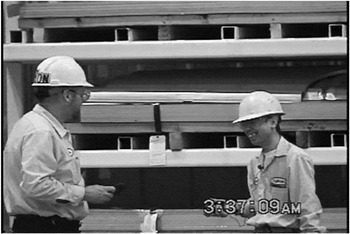
Hashida steps back from the ‘core’ (grind wheel) as he utters ‘one month’ (Example 1, line 14)
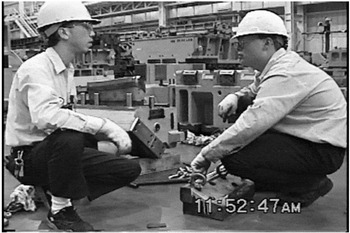
Keith points at the area of concern and looks up to secure Ishige's gaze, who is looking at something over Keith's head (Example 2, (3)-iii&iv)
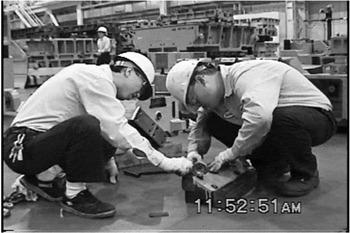
Both Ishige and Keith touch the area of concern on the part (Example 2 (4))
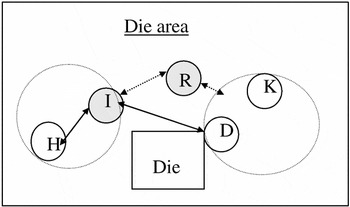
Positioning of interlocutors in the interaction “Discussing die finishing time”
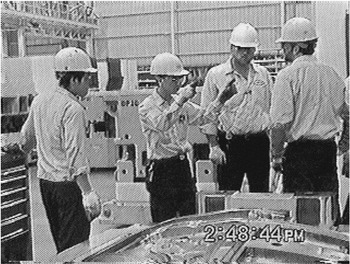
Ishige draws a rectangle with both hands in the air (a sheet of schedule) as he utters “schedule” (Example 3, Line 58; Note that Ken is temporarily out of the frame)
 You have
Access
- 26
- Cited by