Introduction
Verbs that subcategorize for more than one complement can differ in how likely they are to be followed by each complement (Connine, Ferreira, Jones, Clifton & Frazier, Reference Connine, Ferreira, Jones, Clifton and Frazier1984; Garnsey, Pearlmutter, Myers & Lotocky, Reference Garnsey, Pearlmutter, Myers and Lotocky1997b). An example is understand. In ‘The man did not understand the message on the answering machine’, understand is followed by a noun phrase functioning as its direct object, and in ‘The man did not understand the message meant a late start to the trip,’ it is followed by a sentential complement. Although understand can be followed by both types of complements, statistically it is most often followed by a direct object complement (Garnsey et al., Reference Garnsey, Pearlmutter, Myers and Lotocky1997b). Verbal complements, in turn, differ in their semantic fit. So the message in the examples above is a plausible direct object for understand, but the snow in ‘The man did not understand the snow meant a late start to the trip’, is an implausible direct object. Past psycholinguistic studies examining native language processing have asked whether a verb's preferred subcategorization frame (referred to in literature as ‘verb bias’) and the plausibility of verb-noun word combinations are employed by readers to constrain the developing interpretation of incoming words during syntactic processing. One reason to assume that they do is that verbs encode combinatorial information about argument structure and thematic roles (Jackendoff, Reference Jackendoff1990) that could be employed to facilitate comprehension. Recent studies have asked a similar question regarding sentence processing in a second language (L2). The framing question underlying this research has been focused on the sources of information that L2 readers use at specific points during sentence comprehension. By and large, there is agreement in the L2 literature that semantic and lexically-encoded probabilistic information has rapid effects on L2 syntactic processing (for reviews, see Clahsen & Felser, Reference Clahsen and Felser2006a; Kroll & Dussias, Reference Kroll, Dussias, Bhatia and Ritchie2004). However, no study to date has investigated the interplay of plausibility and verbal information during syntactic parsing in an L2. Although recent accounts of syntactic processing in L2 speakers agree that both types of information influence processing (see, for example, Lee, Lu & Garnsey, Reference Lee, Lu and Garnsey2013; Qian, Lee, Lu & Garnsey, Reference Qian, Lee, Lu, Garnsey, Scott and Waughtal2016), it is not known whether plausibility information is prioritized and drives structural choices, or whether its role is secondary (e.g., during reanalysis of initially mis-parsed structures). In this article, we use event-related potentials to explore the contribution of verb bias and plausibility while Spanish–English speakers process temporarily ambiguous noun phrases like the message and the snow in the examples above.
Verb bias and plausibility in the native language
Many psycholinguistic studies examining native language processing have been devoted to answering the question of what sources of information readers use at specific points during sentence comprehension. The evidence has come primarily from studies involving the resolution of direct object (DO)/sentential complement (SC) ambiguity because the absence of the complementizer that preceding sentential complements in English creates a propitious environment to test competing hypotheses (Hare, Elman, Tabaczynski & McRae, Reference Hare, Elman, Tabaczynski and McRae2009). The logic in these studies has been to embed verbs that can appear in a number of structural configurations – but that vary in how often they occur with each – in sentence frames that are congruent with only one syntactic reading, as shown below:
(1) The scuba diver discovered (that) the wreck was caused by a collision.
(2) The job applicant believed (that) the interviewer was dishonest with her.
In these examples, discover and believe are followed by sentential complements. When the complementizer that is omitted, the noun phrases the wreck and the interviewer become syntactically ambiguous: they can function either as a direct object or as the subject of the embedded clause. If the parser immediately takes into account verb-specific knowledge accumulated through experience with language (MacDonald, Reference MacDonald1994; Seidenberg & MacDonald, Reference Seidenberg and MacDonald1999) – such as knowledge that discover is most often followed by a direct object and believe is most often followed by a sentential complement – (1) but not (2) should cause parsing difficulties. Because discover is a direct object-bias verb (e.g., Garnsey et al., Reference Garnsey, Pearlmutter, Myers and Lotocky1997b), readers should initially adopt a direct object analysis of the post-verbal noun phrase the wreck and should be “garden-pathed” upon encountering the embedded verb was caused. However, in (2), the post-verbal noun phrase should be assigned the role of sentential subject, presumably because believe is a sentential complement-bias verb. In this instance, misanalysis is not expected to occur.
Although early work suggested that verb bias did not have any special significance during initial syntactic processing (Ferreira & Henderson, Reference Ferreira and Henderson1990; Fodor & Frazier, Reference Fodor and Frazier1980), recent research on reading comprehension suggests that verb bias information can ease the difficulty encountered during the processing of particular types of syntactic constructions. The evidence comes from studies in which participants experience a processing advantage when presented with sentences in which a verbal complement is congruent with the verb's preferred continuation, relative to cases where the complement is incongruent (e.g., Clifton, Frazier & Connine, Reference Clifton, Frazier and Connine1984). Past work has also investigated the role that semantic fit plays during syntactic ambiguity resolution, with findings generally demonstrating that plausibility influences how fast reanalysis, when necessary, will happen (e.g., Tanenhaus, Boland, Garnsey & Carlson, Reference Tanenhaus, Boland, Garnsey and Carlson1989). Other studies have examined the joint contribution of verb bias and plausibility on sentence comprehension, with results suggesting that verb bias information is prioritized over plausibility. The clearest demonstration of this comes from a classic study conducted by Garnsey et al. (Reference Garnsey, Pearlmutter, Myers and Lotocky1997b). Readers were presented with stimuli containing DO-bias verbs like discover, SC-bias verbs like believe, and equi-bias verbs (e.g., know). All verbs appeared in structures that were ultimately resolved in favor of a sentential complement analysis (as illustrated in (1) and (2) above). Critically, the semantic fit of the post-verbal noun phrase as a direct object was also manipulated. One question of interest was how verb bias information influenced ambiguity resolution in cases where the verb in the main clause was DO-bias, SC-bias or equi-bias. They also asked how plausibility information might modulate the effects of verb bias. The results of two experiments showed that sentences with DO-bias verbs caused processing difficulty at the disambiguating region in the embedded clause relative to control sentences (i.e., sentences with the complementizer that), but SC-bias sentences did not. Their manipulation of plausibility showed that when verbs were strongly biased toward one of the two possible structures, plausibility had little to no influence on the initial syntactic analysis. That is, the post-verbal noun phrase was interpreted as a direct object after DO-bias verbs, and as a grammatical subject after SC-bias verbs regardless of the plausibility. With equi-bias verbs, plausibility information guided the initial interpretation: a noun phrase that was “semantically good” as a direct object was mapped onto that role but a noun phrase that was not “semantically good” received a subject interpretation.
These illustrative studies converge on the notion that a verb's subcategorization frequency influences reading speed and processing difficulty during sentence comprehension, and provide evidence that speakers are able to exploit probabilistic information from their linguistic input and use it to generate expectations about upcoming information during reading (e.g., MacDonald, Reference MacDonald2013).
Verb bias and plausibility in the second language
Numerous studies have investigated whether L2 speakers select among different candidate structures in the L2 by relying on the same types of information that influence sentence processing during native language reading. A source of information that has been extensively investigated is the role of semantic information. The results are generally consistent with the interpretation that proficient L2 speakers are guided by semantic information during sentence processing. To illustrate, Frenck-Mestre and Pynte (Reference Frenck-Mestre and Pynte1997) reported that L2 speakers of French were more likely to attach a syntactically ambiguous prepositional phrase to a verb phrase if it was a plausible verbal argument, and to a noun phrase when it was a plausible noun phrase modifier. Felser and Roberts (Reference Felser and Roberts2007) found that Greek learners of English were strongly influenced by plausibility and had difficulty recovering from misanalysis when deciding if a post-verbal noun phrase functioned as a direct object or as an embedded subject (see also Roberts & Felser, Reference Roberts and Felser2011 for additional evidence demonstrating L2 speakers’ stronger commitment to semantic fit during sentence processing than native speaker controls). In general terms, the finding that L2 speakers employ semantic information during L2 processing is so robust that it was taken as a major source of evidence in support of the proposal that the L2 parser was solely guided by lexical-semantic, thematic role and plausibility information (e.g., Clahsen & Felser, Reference Clahsen and Felser2006a).
Another source of information that has attracted some attention is verb bias because it can differ cross-linguistically. For example, in English, ‘warn’ is twice as likely to be followed by a direct object than by a sentential complement (Garnsey, Lotocky, Pearlmutter & Myers, Reference Garnsey, Lotocky, Pearlmutter and Myers1997a), but the Spanish equivalent ‘advertir’ is normally followed by a sentential complement (Dussias, Marful, Gerfen & Bajo, Reference Dussias, Marful, Gerfen and Bajo2010). Given this, past studies examining the role of verb bias during sentence processing in a second language have asked whether L2 readers use verbal information from the first language to resolve syntactic ambiguity in the second language, or whether they employ specific information from the L2. Studies with proficient learners of different L1 backgrounds have demonstrated sensitivity to L2-specific verb information, even when the lexical constraints of the verbs conflict in the two languages (e.g., Dussias & Cramer Scaltz, Reference Dussias and Cramer Scaltz2008; Frenck-Mestre & Pynte, Reference Frenck-Mestre and Pynte1997). There is also evidence that when the L1 does not encourage the use of lexically-encoded verbal information to anticipate an upcoming verbal complement (e.g., in verb-final languages like Korean), if proficiency in the L2 is high enough, speakers access verbal information specific to the L2 to generate predictions about an upcoming sentence structure (Lee et al., Reference Lee, Lu and Garnsey2013). Finally, when verb bias and plausibility have been jointly examined in behavioral studies, L2 speakers have been shown to use verb bias information to guide structure building, and, much like native English speakers, L2 participants do not prioritize plausibility information during this process (Qian et al., Reference Qian, Lee, Lu, Garnsey, Scott and Waughtal2016).
Monitoring brain activity while processing DO/SC syntactic ambiguity
The majority of studies examining the contribution of verb bias and plausibility in a native and a second language have employed behavioral methods (e.g., Ferreira & Henderson, Reference Ferreira and Henderson1990; Garnsey et al., Reference Garnsey, Pearlmutter, Myers and Lotocky1997b; Kennison, Reference Kennison2001; but see Osterhout, Holcomb & Swinney, Reference Osterhout, Holcomb and Swinney1994). Behavioral techniques, including eye-movement recordings and reaction time methods, despite providing important insights about the temporal flow of information (e.g., Meseguer, Carreiras & Clifton, Reference Meseguer, Carreiras and Clifton2002), can leave questions unanswered about the relationship between the dependent measures and the cognitive processes underlying syntactic and semantic processing (e.g., Boland, Reference Boland, Carreiras and Clifton2004). That is, slower reading in reaction-time studies or longer fixation durations in eye-tracking studies do not unambiguously provide information about the time course of particular component processes (Carreiras & Clifton, Reference Carreiras, Clifton, Carreiras and Clifton2004). An added complication is that longer eye fixations and increased regressive eye movements have been shown to occur in the vicinity of syntactic or semantic anomaly (e.g., Rayner, Sereno, Morris, Schmauder & Clifton, Reference Rayner, Sereno, Morris, Schmauder and Clifton1989), making it challenging to differentiate whether a particular response is due to the detection of a syntactic or a semantic irregularity. Event-related potentials (ERPs) are useful in this respect because the brain's electrophysiological responses have been found to be sensitive to language-related events and also to the linguistic levels (i.e., semantic vs. syntactic) of anomaly of these events (e.g., Kutas & Hillyard, Reference Kutas and Hillyard1980a, 1980b; Osterhout et al., Reference Osterhout, Holcomb and Swinney1994). Because ERP responses correlate with particular types of processes during sentence comprehension, they allow researchers to disentangle behavioral effects due to semantic (e.g., plausibility) and syntactic (e.g., verb bias) information (Kaan, Reference Kaan2007).
Past studies have shown that neurophysiological responses related to the processing of semantic information, including plausibility information, elicit a negative-going waveform peaking at around 400 ms after the onset of the target word (e.g., Kutas & Hillyard, Reference Kutas and Hillyard1980a; Kutas & Van Petten, Reference Kutas, Van Petten and Gernsbacher1994) – the so-called N400. The N400 is part of the typical electrical brain activity that arises when semantic expectancy is violated, such as when readers encounter a stimulus that is semantically anomalous (Kutas & Hillyard, Reference Kutas and Hillyard1980a, 1980b) or that is semantically congruent but has a low cloze probability. Critical for our purposes, a greater N400 has been reported when readers encounter words that do not fit the semantic context of a sentence (for a review, see Kutas & Federmeier, Reference Kutas and Federmeier2011), as would be expected, for example, when a direct object bias verb is followed by an implausible direct object. Grammatical and syntactic violations, on the other hand, sometimes give rise to a positive deflection that peaks at around 600 ms post-stimulus onset, and that is evident over the midline and posterior regions of the scalp (P600; Osterhout & Holcomb, Reference Osterhout and Holcomb1992). In cases where a syntactic ambiguity results from the application of verb-specific knowledge during parsing, a P600 arises at the disambiguating region in sentences with a dispreferred continuation relative to sentences with a preferred continuation (Frisch, Schlesewsky, Saddy & Alpermann, Reference Frisch, Schlesewsky, Saddy and Alpermann2002). For example, Osterhout et al. (Reference Osterhout, Holcomb and Swinney1994) observed that temporarily ambiguous sentences that included transitively biased verbs (similar to the DO-bias verbs in Garnsey et al., Reference Garnsey, Pearlmutter, Myers and Lotocky1997b) followed by a clausal complement, as in ‘The professor knew his lecture was unprepared,’ elicited a P600 at the disambiguating verb (i.e., ‘was’) compared to those following what the authors termed “intransitively biased” verbs (i.e., the SC-bias and equi-bias verbs in Garnsey et al., Reference Garnsey, Pearlmutter, Myers and Lotocky1997b; ‘The professor believed his lecture was unprepared’). The authors explained that the presence of a P600 effect for the transitively biased conditions represented the participants’ attempt to revise the role assigned to the syntactically ambiguous noun phrase (‘his lecture’ in the example above) from the initially assigned direct object role to a sentential subject analysis. Importantly, Osterhout et al. (Reference Osterhout, Holcomb and Swinney1994) did not observe N400 differences in the noun phrase in their intransitive and intransitively biased conditions compared to the transitive and transitively biased ones, suggesting that verb subcategorization information comes in very quickly in the parsing process to guide initial interpretation.
The present study
We employ the N400 and P600 ERP components to examine the integration of syntactic and semantic information in L2 speakers while they read temporarily ambiguous sentences in which DO-bias and SC-bias verbs are systematically followed by syntactically ambiguous noun phrases that can either be plausible or implausible direct objects. To our knowledge, this study is the first to examine the neural correlates of verb bias and plausibility in a group of L2 speakers. Most past monolingual and L2 speaker studies on DO/SC ambiguity share a design in which comparisons between DO- and SC-bias verbs involve entirely different stimuli, requiring separate analyses for each verb type (e.g., the classic study by Garnsey et al., Reference Garnsey, Pearlmutter, Myers and Lotocky1997b). In many past studies, comparisons have involved different words, beginning at the syntactically ambiguous post-verbal noun phrase and continuing through the end of the sentence (e.g., The talented photographer accepted the money could not be spent yet has been compared to The talented photographer accepted the fire could not have been prevented). These past designs have allowed for the creation of materials that have spanned a wide range of possible combinations, allowing researchers to evaluate nuanced predictions on the joint contribution of each type of information. The obvious disadvantage is that word properties – like frequency and length – are not perfectly controlled at the critical post-verbal noun phrase and at the disambiguation region. As will be shown below, we overcome this limitation by creating stimuli that are identical in every respect, with the exception of the verb in the main clause; this allows, for the first time, a direct examination of how verb bias and plausibility interact during online syntactic ambiguity resolution.
Experiment 1
Methods
Participants
Twenty-five highly proficient Spanish–English L2 speakers (15 females; mean age = 24.26, SD = 5.13) participated in the study. A group of 24 native speakers of English (11 females; mean age = 20.63 SD = 1.65) who were functionally monolingual was also recruited. All participants were recruited at a large US institution and received monetary compensation for their participation. Both groups of participants completed a series of language proficiency assessment tasks (see Supplementary Materials). The results, which are summarized in Table 1, converged on the conclusion that the L2 group was highly proficient in English.
Results from the objective measures of language proficiency.

Span = Spanish; Eng = English; N-N Eng = Non-native speakers of English; N Eng = native speakers of English; Acc. prop = proportion accuracy; RT = reaction time in milliseconds; d' = d prime discrimination index. *indicates contrasts at p < .05, **p ≤ .01.
Materials
The design was similar to Garnsey et al. (Reference Garnsey, Pearlmutter, Myers and Lotocky1997b). Following a Latin-square design, 140 quartets (equaling 560 experimental sentences) were constructed by crossing two factors: verb bias (DO-bias or SC-bias verbs) and plausibility (plausible or implausible post-verbal noun phrases, in italics in (3) below). The sentences were identical in all respects except for the verb in the main clause (underlined in (3) below), and were constructed in such a way that the syntactic ambiguity could only be resolved when readers encountered the text following the post-verbal noun phrase (e.g., ‘had’ below). This region is emboldened in Conditions 1 through 4 and will be referred to as the disambiguating region:
(3)
-
Condition 1. DO-bias verb + plausible direct object:
The weary traveler found his suitcase had been opened for inspection.
-
Condition 2. DO-bias verb + Implausible direct object
The weary traveler explained his suitcase had been opened for inspection.
-
Condition 3. SC- bias verb + plausible direct object:
The weary traveler claimed his suitcase had been opened for inspection.
-
Condition 4. SC-bias verb + implausible direct object:
The weary traveler believed his suitcase had been opened for inspection.
-
Sixteen verbs were selected from Garnsey et al.'s (1997b) verb norming study. Eight verbs were DO-bias (confirm, discover, emphasize, explain, find, hear, learn, and maintain) and eight were SC-bias (admit, argue, believe, claim, conclude, prove, suggest, worry). We selected DO-bias verbs that had been classified in the norming study as having been used at least twice as often with a direct object as with an embedded sentential complement (mean proportion of DO-verbs followed by a direct object =.75, SD =.08; mean proportion of DO-verbs followed by a sentential complement =.19, SD = .06). Similarly, only SC-bias verbs that had been used at least twice as often with an embedded sentential complement as with direct objects were included (mean proportion of SC-verbs followed by a sentential complement =.55, SD =.14; mean proportion of SC-verbs followed by a direct object =.11, SD = 1.07). DO- and SC-biased verbs were matched on frequency (frequency per million: SC mean = 21.52, SD = 31.32; DO mean = 120.45, SD = 185.63Footnote 1; p = 1.16; SUBTLEX-US, Brysbaert & New, Reference Brysbaert and New2009) and orthographic length (SC mean = 7.50; DO mean = 7.71; p = .82; phonological length: SC mean = 6.25; DO mean = 5.85; p = .69). Published verb norms in Spanish (Dussias, Marful, Gerfen & Bajo, Reference Dussias, Marful, Gerfen and Bajo2010) were used to match the verb bias of the English verbs and that of their Spanish translations equivalents. This was done to avoid potential pitfalls due to differences across languages (see discussion in Felser & Roberts, Reference Felser and Roberts2004). T-test analyses showed that neither DO- nor SC-bias verbs were different between languages (DO: t = 1.01, p = .33; SC: t = .48, p = .63). All verbs appeared in structures that were ultimately resolved in favor of a sentential complement analysis (as shown in (3) above). Participants saw each verb an average of 8.75 times during the experimental session (SD = 0.93; including the fillers) preceding plausible and implausible nouns.
In addition to the experimental items, 140 syntactically ambiguous filler sentences were also constructed using the same 16 DO- and SC- bias verbs, but this time the sentences were resolved in favor of a direct object analysis (e.g., ‘The venturous hang glider discovered the hidden beach on a perfect day’ and ‘The reckless driver admitted his blunder to the jury’ for DO- and SC-bias verbs, respectively). This was done to prevent participants from anticipating a sentential complement construction each time they encountered one of the 16 verbs (Osterhout et al., Reference Osterhout, Holcomb and Swinney1994). In the fillers, the post-verbal noun phrase was plausible as a direct object for the verb. Each presentation of a particular verb contained a different subject and post-verbal noun.
Plausibility of the syntactically ambiguous post-verbal noun phrase in the experimental sentences (in italics in the examples above) was assessed via a norming study. Thirty-eight participants from Amazon's Mechanical Turk (www.Mturk.com) who did not take part in the experiment (10 females; mean age = 32.96, SD = 8.22) evaluated the experimental sentences for plausibility. The 560 experimental sentences were truncated at the direct object site (e.g., the item ‘The treasure hunter discovered the diamonds had been found on the cave’ was presented as ‘The treasure hunter discovered the diamonds.’). Participants were asked to rate on a 7-point Likert scale how confident they were that each sentence “made sense” (i.e., were plausible). To illustrate, the sentence ‘The treasure hunter discovered the diamonds’ was expected to receive a high plausibility rating; conversely, ‘The treasure hunter believed the diamonds’ was expected to receive a low plausibility rating. In addition to the experimental sentences, participants also rated the 140 filler sentences with different structures and verb types. An ANOVA on the log-transformed mean ratings was conducted that included verb bias and plausibility as factors. Only the main effect of plausibility was significant, F(1, 37) = 110.38, MSe = 0.09, p < .001, showing that sentences that were intended to be implausible were indeed rated as less plausible than sentences designed to be plausible. Neither the main effect of verb bias F(1, 37) = 0.481, MSe = 0.04, p > .05 nor the verb bias x plausibility interaction F(1, 37) = 0.31, MSe = 0.03, p > .05 were significant. The results indicate that semantic fit of the noun phrase as a plausible or implausible direct object in our materials was successfully manipulated for sentences with DO-bias and SC-bias verbs.
Four pseudo-randomized counterbalanced lists were created, each containing 140 experimental sentences, 140 filler sentences and four practice items. Each list was divided into 35 blocks, and each block included one experimental item belonging to each of the four conditions, along with four filler items. Participants saw all conditions but only read one sentence from each of the 140 quartets. Presentation of lists was rotated across participants and each list was presented a balanced number of times. A yes/no comprehension question followed 25% of experimental and filler sentences (e.g., for ‘The reckless driver admitted his blunder to the jury,’ the question was ‘Did the reckless driver confess his mistake?’) to ensure that participants were engaged in the task.
Based on past ERP findings, we expect a P600 at the disambiguating auxiliary verb in DO-bias sentences (Conditions 1 and 2), which should result from a revision of the initial, but erroneous, DO interpretation. This effect is expected to be smaller in Condition 2 compared to Condition 1, consistent with results from past behavioral studies demonstrating that readers recover faster from a garden path effect in the presence of semantically implausible alternatives (e.g., Traxler & Pickering, Reference Traxler and Pickering1996). In addition, in Condition 2, we expect an N400 effect at the syntactically ambiguous noun phrase (his suitcase), caused by the presence of an implausible noun phrase following DO-bias verbs. If non-native readers are more sensitive to semantic information than native readers, they may show a greater N400 in comparison to the native group, similar to previous behavioral results. Finally, the integration of cues is expected to result in facilitation (reduced N400 and reduced P600) when they point to the same interpretation (i.e., Conditions 3 and 4).
Procedure
Sentences were displayed on a computer monitor one word at a time using the rapid serial visual presentation format (Gordon, Camblin & Swaab, Reference Gordon, Camblin, Swaab, Carreiras and Clifton2004). Every sentence was preceded by a fixation cross that remained on the screen for 1000 ms until the first word appeared. Every word remained on the screen for 450 ms with an ISI of 250 ms, a procedure customarily used in studies examining non-native processing (e.g., Steinhauer, Reference Steinhauer2014). Participants were asked to read each word silently and to respond when a comprehension question appeared, by pressing “c” (yes) or “m” (no) on a keyboard. The task included four breaks to rest and it had a duration of approximately one hour.
Apparatus, electrophysiological recording and analysis
We recorded the electroencephalogram from 31 electrode channels mounted in an elastic cap and placed according to the International 10-20 system. Four more electrodes measured eye-related movements, two on the outer canthi of the eyes to register horizontal movements, and the other two below and above the left eye. Finally, two electrodes were placed on the left and right mastoids. The online reference to all channels was the right mastoid, and the signal was re-referenced off-line to the average of both mastoids. We kept electrode impedance below 5 kΩ. The electrophysiological signal was amplified with a 0.05 Hz high-pass filter and a 100 Hz low-pass filter, and was digitized at a sampling rate of 500 Hz using NeuroScan equipment (Synamps amplifiers, NeuroScan, Herndon, VA, USA). Sections with eye-related artifacts (i.e., blinks) were corrected using a spatial filter transform based on Berg and Scherg (Reference Berg and Scherg1991) and implemented in Scan 4.0 (NeuroScan Labs, Sterling, USA). Sections with other artifacts were rejected after visual inspection of continuous data. A band-pass filter of 0.1-30 Hz was used off-line. We epoched data between −200 ms before and 2800 ms relative to the onset of the noun located in the subject position of the sentential complement; we included the auxiliary verb in the segment (e.g., The treasure hunter discovered the diamonds had been found in a cave). The 200 ms before the noun onset constituted the baseline.
For the analyses, two-time windows in the epoch were selected based on visual inspection and on previous research studying the critical components N400 and P600 (e.g., Hagoort, Reference Hagoort2003). Anchored 300 to 500 ms after the appearance of the noun, the N400 time-window was employed to explore the plausibility effect of the post-verbal noun phrase as a direct object for a given verb. As mentioned in the Introduction, the auxiliary verb is the critical region because it disambiguates the syntactic structure in favor of a sentential complement analysis. Therefore, we examined the P600 time window, which included the mean amplitude between 550 and 850 ms after the auxiliary verb in the sentential complement clause (that is, 1250 and 1550 after the beginning of the epoch, locked to the noun phrase). In addition, although we did not predict an effect in any other time window, after visual inspection we incorporated an earlier area including the amplitude between 300 and 500 ms after the auxiliary verb (e.g., had in the example above; 1000-1200 after the ambiguous noun phrase).
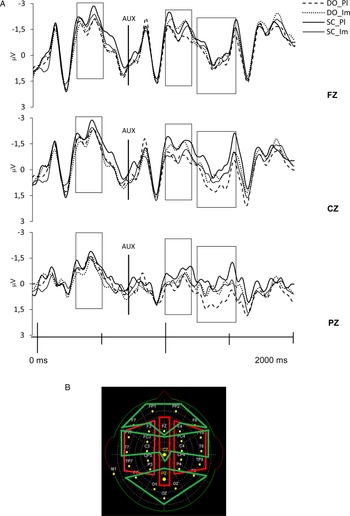
To explore the topographical distribution of the two components, we included laterality and anterior/posterior factors (Hahne & Friederici, Reference Hahne and Friederici2002). Both factors comprised three levels, left hemisphere (F7, F3, FC3, FT7, C3, TP7, CP3, P3), midline (Fp1, Fp2, FZ, CZ, PZ) and right hemisphere (F8, F4, C4, FC4, FT8, P4, CP4, TP8) for laterality and anterior (F7, Fp1, Fp2, F3, F4, FZ, F8), central (FT7, FC3, C3, CZ, C4, FC4, FT8) and posterior (TP7, CP3, P3, PZ, P4, CP4, TP8) regions for the anterior/posterior factor. We calculated an omnibus mixed-ANOVA for every time window on mean voltage amplitudes with group (monolingual vs. L2 speakers) as a between-participants factor, and with verb bias (DO vs SC), plausibility (plausible vs implausible), laterality (left, midline, right) and anterior/posterior factor (anterior, central, posterior) as within-participants factors (Figure 1). Because some theories predict qualitative differences in how L2 speakers and monolinguals comprehend (e.g., the Shallow Structure Hypothesis, Clahsen & Felser, Reference Clahsen and Felser2006a, Reference Clahsen and Felser2006b; the Declarative/Procedural Model, Ullman, Reference Ullman2001), we further explored separate group patterns with ANOVAs per language group whenever there was either an effect of group or a significant interaction concerning the group variable. All contrasts that involved at least three levels were corrected using the Greenhouse/Geisser correction (results show corrected probabilities). The effects of lateralization and the anterior/posterior factor are only reported in interaction with our main variables of interest.
A) Grand averages of ERPs time-locked to the temporary ambiguous noun and including the disambiguating auxiliary verb (AUX). Dashed lines represent waveforms to nouns that are plausible as DO for the preceding DO verb and dotted lines, the implausible ones. Solid lines represent the condition preceded by SC biased verbs (in bold, plausible noun phrases). Boxes represent target time-windows. B) Electrodes grouped in regions included in the analyses.

Results
Behavioral results
Behavioral responses to comprehension questions were examined to ensure that the participants were reading and understanding the stimuli. The mean accuracy was 85.79% (SD = 8.88); the native group was more accurate than the non-native group (M native = 88%, SD = 9.34; M non-native = 83%, SD = 7.44; p = .02). Similar accuracy results have been reported in other past studies (e.g., Qian et al., Reference Qian, Lee, Lu, Garnsey, Scott and Waughtal2016).
Electrophysiological results: Time Window 1 (300-500 ms after the post-verbal noun phrase – N400)
English monolinguals and Spanish–English L2 speakers presented similar mean amplitudes between 300-500 ms after the noun (group effect, F > 1). There was neither an effect of verb bias (F[1,41] = 1.39, Mse = 23.10, p = .25), nor an effect of plausibility (F[1,41] = 0.004, Mse = 16.54, p = .95). None of the interactions reached significance (all ps > .1).Footnote 2
Electrophysiological results: Time Window 2 (300-500 ms after the disambiguating auxiliary verb)
Of theoretical interest were ERPs to auxiliary verbs, because the auxiliary functioned as the syntactically disambiguating region in the sentences with direct object biased verbs. The presence of an auxiliary verb in these sentences would provide confirmation that the preceding noun phrase is the grammatical subject of the embedded clause and not the direct object of the main verb. Analyses conducted in the early time window (300-500 ms) after the auxiliary verb in the embedded clause revealed no significant main effects. Nevertheless, the interaction of Group x Verb bias x Plausibility was statistically significant (F[1, 41] = 4.08, Mse = 9.12, p = .05), as were the interactions of Verb bias x Plausibility x Anterior/Posterior factor (F[2, 82] = 4.45, MSe = 2.68, p = .04), Group x Verb bias x Plausibility x Anterior/Posterior factor (F[2, 82] = 5.36, Mse = 2.68, p = .02), Group x Verb bias x Laterality (F[2, 82] = 4.57, MSe = 1.79, p = .03), and Group x Plausibility x Anterior/Posterior x Laterality (F[1, 164] = 3.30, MSe = 0.31, p = .04). Separate ANOVAs per group served to qualify these interactions. The analysis for the monolingual speakers revealed a significant interaction of verb bias and plausibility (F[1, 21] = 4.90, MSe = 11.35, p= .03) that we further examined per anterior/posterior region, as this is the factor involved in the Verb bias x Plausibility interaction in the omnibus ANOVA described above. There were no differences between either DO-plausible and SC-plausible or DO-implausible and SC-implausible sentences in any region (all ps > .1). An effect of plausibility emerged when comparing DO-plausible with DO-implausible sentences in the anterior region such that DO-implausible sentences were more negative than DO-plausible ones (F = 4.48, p = .05; M pl = −0.28 μV, M imp = −1.34 μV; central, F = 3.21, p = .09; posterior, F = .43, p = .52; see Figure 2). SC-plausible vs SC-implausible paired comparisons did not reveal any significant effect (all regions’ ps > .1). In the non-native group, the Verb bias x Plausibility x Anterior/posterior factor interaction was significant (F[2, 40] = 5.88, MSe = 4.31, p = .006). When DO-plausible vs SC-plausible sentences were compared, no differences arose at any region (ps ≥ .1 for anterior, central and posterior areas), and the same was observed for the contrasts between DO-implausible vs SC-implausible conditions (all ps > .1). Planned comparisons involving DO-plausible vs DO-implausible sentences revealed a reversed pattern from that of the native speakers, such that DO-plausible sentences displayed an increased negativity relative to DO-implausible sentences in electrodes at anterior sites (F = 10.22, p = .005; M pl = −1.78 μV, M imp = −0.80 μV; central and posterior regions, ps > .1). When the verb in the main clause was SC bias, no fluctuations associated with plausibility appeared in this time window (all ps > .1). We take up the interpretation of the findings reported here in the General Discussion.
A) Native speakers of English. ERPs locked to the temporary ambiguous noun and including the disambiguating auxiliary verb (AUX). Left: DO biased sentences containing a plausible noun (dashed line) compared to SC biased sentences containing a plausible noun (solid line). Right: comparison of DO biased sentences containing a plausible noun (dashed line) with DO biased sentences containing an implausible noun (solid line). Shadowed areas depict target time-windows. Framed shadowed areas indicate statistically significant differences. B) Non-native speakers of English. ERPs locked to the temporary ambiguous noun and including the disambiguating auxiliary verb (AUX). Left: DO biased sentences containing a plausible noun (dashed line) compared to SC biased sentences containing a plausible noun (solid line). Right: comparison of DO biased sentences containing a plausible noun (dashed line) with DO biased sentences containing an implausible noun (solid line). Framed areas depict target time-windows. Framed shadowed areas indicate statistically significant differences.

Electrophysiological results: Time Window 3 (550-850 ms after the disambiguating auxiliary verb – P600)
Finally, we analyzed the mean amplitudes corresponding to the P600. The findings, depicted in Figure 2, showed that monolinguals and L2 speakers behaved similarly, as reflected in the absence of main effects or interactions involving the group factor. There was an effect of Verb bias x Plausibility (F[1, 41] = 5.35, Mse = 7.75, p = .03), Verb bias x Plausibility x Anterior/posterior factor (F[2, 82] = 5.31, Mse = 3.25, p = .02), and Verb bias x Plausibility x Anterior/posterior x Laterality (F[4, 164] = 3.15, MSe = .29, p = .03). To explore the topographical distribution of the effect, we examined the Verb bias x Plausibility interaction for each region by comparing DO-plausible vs. SC-plausible sentences, DO-implausible vs. SC-implausible sentences, DO-plausible vs. DO-implausible sentences, and the SC-plausible vs SC-implausible ones. At the disambiguating region (i.e., the auxiliary verb in the sentential complement clause), a P600 emerged in the posterior region after plausible nouns in DO-bias sentences compared to SC-bias sentences (F = 11.58, Mse = 6.40, p = .002), but not after implausible nouns (F = 0.72, Mse = 6.27, p = .400). The posterior P600 effect observed was significant in all left (F = 7.11, p = .01), midline (F = 11. 72, p = .001) and right (F = 12.90, p < .001) electrodes. The pattern was similar, although attenuated, in the central electrodes; that is, we observed a greater P600 after plausible nouns in DO-bias sentences compared to SC-bias sentences (Condition 1 vs Condition 3 in (3); F = 7.19, Mse = 5.30, p = .01), but not after implausible nouns (Condition 2 vs Condition 4 in (3); F = 4.72, Mse = 4.72, p = .931). The effect appeared in the midline (F = 7.68, p = .008) and right (F = 7.94, p = .007; left, p > .1) electrodes. There were no differences in the electrodes in the anterior regions (all Fs < 1).
Also, we examined the role of plausibility within the same verb bias condition. The contrast between DO-plausible and DO-implausible conditions reached significance at posterior regions (Condition 1 vs Condition 2 in (3); F = 9.40, p = .004; central, F = 3.69, p = .062; anterior, F = .11, p = .74). An analysis of the posterior effect for the DO-plausible vs DO-implausible comparison across laterality levels showed that differences were significant in all regions (left, F = 9.32, p = .004; midline, F = 9.34, p = 004; right, F = 6.85, p = .01). For the sentences including a SC-biased verb, none of the contrasts were significant at any region (all ps > .1). Despite the absence of a group interaction, further ANOVAs per group were conducted given that previous research has revealed differences between native and non-native processing (Clahsen & Felser, Reference Clahsen and Felser2006a). The analyses replicated the observed pattern: in native readers, there was a significant effect of Verb bias x Plausibility (F = 4.20, p = .05), and of Verb bias x Plausibility x Anterior/Posterior factor x Laterality, (F = 3.09, p = .02); the non-native readers presented a significant interaction of Verb bias x Plausibility x Anterior/Posterior factor (F = 3.30, p = .04).
Interim discussion
Our predictions were largely borne out: both groups showed a larger P600 at the disambiguating verb in the DO-biased condition in which the post-verbal noun was a plausible direct object. As we will further discuss in the general discussion, this supports the view that both our L1 and L2 English speakers can use verb bias information immediately. One unexpected result in Experiment 1 was that the plausibility manipulation did not elicit an N400 effect with DO-bias verbs. We predicted a greater N400 at the syntactically ambiguous post-verbal noun phrase when implausible noun phrases preceded DO-bias verbs (The weary traveler explained his suitcase…) relative to plausible ones (The weary traveler found his suitcase…), but this is not what we found. Instead, by and large the characteristics of the neurophysiological response seem to suggest that plausibility was used by L2 speakers and monolingual speakers alike during the revision process, when participants were required to assign the role of sentential subject to a noun that had previously been analyzed as a direct object. One possibility to account for this finding is that the nature of our materials were such that the plausibility difference across conditions was not strong enough to elicit differences in the N400 when the direct object interpretation was forced. To investigate this possibility further, we conducted a follow-up ERP experiment with a new group of monolingual English speakers. The experiment was an exact replication of Experiment 1 with one critical difference: we truncated the experimental sentences after the syntactically ambiguous noun phrase and added a period after the noun (e.g., The weary traveler found/explained/claimed/believed his suitcase.) to unambiguously indicate that the correct syntactic role for the post-verbal noun phrase is that of direct object. By means of this, we could directly test whether in the DO-sentences in Experiment 1, the plausibility manipulation was not effective, or whether the lack of the N400 effect was related to the differential weight assigned to verb bias and plausibility.
Experiment 2
Methods
Participants
Twenty functionally-monolingual speakers of English from a large US institution participated in the study for payment (13 females, mean age = 21; SD = 3.14). Participants reported minimal to no knowledge of a second language in a language history questionnaire (LEAP-Q, Marian, Blumenfeld & Kaushanskaya, Reference Marian, Blumenfeld and Kaushanskaya2007).
Materials and procedure
The sentences were identical to those used in Experiment 1, including the filler items, with the exception that the material appearing immediately following the syntactically ambiguous noun phrase was truncated, and a period was added to signal the end of the sentence. To illustrate this in (4) below, we provide the truncated version of (3) above from Experiment 1:
(4)
-
Condition 1. DO-bias verb + plausible direct object:
The weary traveler found his suitcase.
-
Condition 2. DO-bias verb + Implausible direct object
The weary traveler explained his suitcase.
-
Condition 3. SC- bias verb + plausible direct object:
The weary traveler claimed his suitcase.
-
Condition 4. SC-bias verb + implausible direct object:
The weary traveler believed his suitcase.
-
Results
To process the electrophysiological signal, we used the same procedure implemented in Experiment 1. In Experiment 2, the epochs started –200 ms before the noun and ended 800 ms after it. For the analyses, two time windows anchored to the noun phrase targeted verb bias and plausibility effects. One started 300 ms after the noun and ended 500 ms after it to explore the N400; a second one, from 500 to 700 ms, was intended to capture the P600 effect, which was expected as a result of a syntactic anomaly perceived upon encountering a direct object after a verb that is more frequently followed by a sentential complement (SC bias verbs; Conditions 3 and 4 in (4) above).
We ran separate ANOVAs for the mean amplitudes corresponding to the 300-500 ms and 500-700 ms post-verbal noun with verb bias (DO vs SC), plausibility (plausible vs implausible) and the two topographic factors – laterality and anterior/posterior factor – as independent variables. Grand averages from representative electrodes appear in Figure 3.
Grand averages of ERPs time-locked to the noun functioning as DO in sentences from Experiment 2. Dashed lines represent waveforms to nouns that are plausible as DO for the preceding verb and dotted lines, the implausible ones. Solid lines represent the condition preceded by SC biased verbs; in bold, followed by plausible nouns.

Time Window 1 (300-500 ms after the syntactically unambiguous noun – N400)Footnote 3
There was a significant effect of verb bias, F(1, 19) = 4.78, MSe = 17.75, p = .042 that reflected a greater N400 to noun phrases preceded by DO verbs (Conditions 1 and 2) when compared to those following a SC verb (Conditions 3 and 4). The Verb bias x Plausibility x Laterality effect was significant, F(2, 38) = 4.22, MSe = 0.42, p = .027. Figure 3 shows that the N400 plausibility effect is numerically largest for the DO biased verbs over the left hemisphere, and for SC biased verbs over right and midline regions. ANOVAs per region, however, did not reveal any significant effect in the left electrodes (main effects and interaction ps > .1); for the middle line and right region only the main effect of verb bias was observed (right: F = 4.57, p = .05; middle: F = 6.53, p = .02). There were no other significant interactions involving the variables of interest and the location factors (all ps > .09).
Because we were interested in differences at this time window between Experiment 1 and Experiment 2, a mixed ANOVA was conducted on the data from the monolingual participants in Experiment 1 and the participants in Experiment 2. We included experiment as a between-participant factor and verb bias, plausibility, anterior/posterior and laterality as within-participant variables. The Experiment x Anterior/Posterior x Laterality interaction (F[4, 164] = 2.85, p = .05) and the Experiment x Plausibility x Anterior/Posterior x Laterality (F[4, 164] = 2.76, p = .05) interactions reached significance. To qualify the four-way interaction we calculated a post-hoc Tukey HSD for unequal sample sizes analysis. None of the plausible vs implausible comparisons were significant for Experiment 1. In Experiment 2, differences across plausible and implausible conditions emerged in the posterior left (M pl = 0.32, M imp = −0.11, p = .045) and posterior midline (M pl = −0.06, M imp = −0.74, p < .001) regions.
Time Window 2 (500-700 ms after the syntactically unambiguous noun phrase – P600)
The ANOVA including the second time window did not reveal any differences that were significant across conditions when verb bias or plausibility were considered (all ps > .05).
Interim discussion
To explain the unexpected lack of an N400 effect in the DO-implausible sentences vs. the DO- plausible ones in Experiment 1, we suggested that our plausibility manipulation was perhaps not sufficient enough to elicit N400 differences. Although the sentences used in Experiment 1 were normed for plausibility, previous work has shown that implausible nouns are typically rated as less anomalous when they follow DO-bias verbs relative to SC-bias verbs (Garnsey et al., Reference Garnsey, Pearlmutter, Myers and Lotocky1997b; Qian et al., Reference Qian, Lee, Lu, Garnsey, Scott and Waughtal2016). If the DO-implausible sentences were regarded as more plausible than reflected by the off-line rating, this could explain why the N400 is as small in DO-implausible sentences as DO-plausible ones. However, the results of Experiment 2 cast doubt on this account. Experiment 2 used the same verb-noun phrase combinations as in Experiment 1, but the ERPs looked very different. In Experiment 2 we did observe an N400 effect in that the implausible condition elicited a posterior negativity compared to the plausible condition. Although the effect was statistically weak, the four-way interaction between experiment, plausibility and the two location factors supports our view that the verb-noun combinations that were intended to be implausible were indeed processed as implausible at the noun in Experiment 2 but not in Experiment 1. The critical difference in the two experiments is that, in Experiment 1, the verb-noun phrases were embedded in sentential complement continuations, whereas in Experiment 2 there is an unambiguous marker (the presence of a period) that signaled to the reader that the direct object reading of the ambiguous NP was the only possible interpretation (see Chafe, Reference Chafe1988; Steinhauer, Reference Steinhauer2003; and Mitchell & Holmes, Reference Mitchell and Holmes1985 for evidence that punctuation can act as a visual trigger for covert prosodic phrasing). Experiment 2 showed plausibility effects; the lack of an N400 effect at the noun in Experiment 1 can therefore not be due to the particular verb-noun combinations used.
General discussion
To our knowledge, this is the first study to provide electrophysiological evidence of the processing of DO/SC ambiguities in L2 speakers. It is also the first study in the monolingual or L2 speaker literature to examine the effect of verb bias and plausibility in the resolution of DO/SC ambiguities in which DO-bias and SC-bias verbs appear in identical sentence frames. This represents an important departure from past studies, where comparisons across verb types have involved different stimuli, making it necessary to conduct separate analyses for each verb type. The goal of Experiment 1 was to examine how non-native readers use probabilistic information about verb subcategorization (verb bias) and semantic information (plausibility) to select between syntactic alternatives while reading in their second language. Assuming that both L1 and L2 readers rely on verb bias information, we predicted, first, a P600 at the disambiguating auxiliary verb in the DO-bias versus SC-bias condition (e.g., Osterhout et al., Reference Osterhout, Holcomb and Swinney1994). If readers initially pursue a DO interpretation in the DO-bias condition, they need to revise this interpretation when they encounter the disambiguating verb, which will lead to a larger P600. Second, we expected a modulation of this P600 by plausibility in the DO-bias condition, since recovery from a garden path effect may be harder if an initially plausible semantic interpretation needs to be undone, as in the DO-plausible condition (e.g., Traxler & Pickering, Reference Traxler and Pickering1996). Third, we predicted an N400 for implausible versus plausible noun phrases following the DO-biased verb. This is because the noun would be interpreted as a direct object of the preceding DO-biased verb, leading to a larger N400 effect when the noun is not semantically suitable as a direct object. Finally, if non-native readers are more sensitive to semantic information than native readers, we expected them to show a greater N400 in comparison to the native group, possibly also in the SC-conditions.
Our predictions regarding the P600 were borne out. For both native and non-native speakers of English, a P600 effect emerged at the disambiguating verb for DO-plausible structures relative to DO-implausible and SC-biased conditions, indexing syntactic revision of the initial DO interpretation, but only when the noun was semantically a good direct object of a DO-biased verb. However, our predictions regarding the N400 were not borne out: the semantic fit of the post-verbal noun phrase as a plausible direct object did not affect the N400 at the noun phrase following either DO-biased or SC-biased verbs. The same materials did elicit plausibility effects when the sentences were truncated at the noun phrase (Experiment 2), suggesting that the lack of effects at the noun in Experiment 1 was not due to the particular verb-noun phrase combinations used. Finally, we did not find differences in the N400 between the groups at the post-verbal noun. Instead, slight group differences were found at the disambiguating verb in the time window preceding the P600: ERPs in the L1 English group showed a larger positivity at frontal sites for the DO-plausible relative to the DO-implausible conditions, whereas the L2 readers showed a larger negativity at frontal sites for DO-plausible relative to the DO-implausible condition.
Below we will give two possible accounts of the patterns observed at the verb in the absence of N400 effect at the noun. The first account assumes that aspects of processing can be delayed in some situations; the second account assumes that semantic information can steer the syntactic interpretation in the absence of strong syntactic biases.
According to the first account both native and non-native speakers used verb bias information immediately upon encountering the syntactically-ambiguous NP. For SC-biased verbs, readers immediately built the SC construction; plausibility of the following noun did not play a role, since it was always compatible with a SC interpretation. For the DO-bias verbs, readers also immediately considered a DO construction, which was confirmed by semantics in the DO-plausible condition. As a consequence, they had to revise the structure at the disambiguating auxiliary, giving rise to a (larger) P600 in the DO-plausible condition. However, in the DO-implausible condition, there are two conflicting cues at the noun phrase: the strong verb bias towards a DO-structure, and a semantic cue that is at odds with this interpretation. Prior research has suggested that, in such cases of uncertainty, commitment to a certain interpretation or structure can be briefly delayed until more information comes in (e.g., Frazier & Rayner, Reference Frazier and Rayner1990; Stanford & Sturt, Reference Stanford and Sturt2002; Stowe, Reference Stowe1991). In Experiment 2, the noun phrase had an end-of-the-sentence period, which enforced a DO interpretation; in Experiment 1 the following auxiliary enforced an SC structure.
An alternative account is that both verb bias and plausibility information are taken into account immediately, but their effect depends on their relative strengths (Garnsey et al., Reference Garnsey, Pearlmutter, Myers and Lotocky1997b). In the SC-biased condition the verb bias for an SC construction is strong. The plausibility of the NP following the verb, therefore, does not affect much the expectation of a SC continuation. As a result, no effects of semantic implausibility arise at the NP or the disambiguating auxiliary. To account for the results for the DO-biased conditions, we need to assume that the experimental context has made the DO-bias of the verbs weaker than reflected by the verb-bias norms from Garnsey et al. (Reference Garnsey, Lotocky, Pearlmutter and Myers1997a). This may be due to the prominence of SC constructions in Experiment 1: in fact, also DO-biased verbs are used in SC constructions in half of the sentences. As a result, the verbs that we considered to be DO-biased may have become more equi-biased, and semantic information may have had a stronger effect on the expectation of a DO or SC construction in our DO-biased conditions than in Garnsey et al. (Reference Garnsey, Pearlmutter, Myers and Lotocky1997b). At the verb itself, readers may not have had a strong expectation for either a DO or SC continuation. A following implausible direct object of the preceding DO biased verb therefore biased the reader towards an SC continuation. This may also have been encouraged by the fact that all items in Experiment 1 that contained an implausible verb-noun phrase combination were resolved towards a SC-construction. Therefore, there was no plausibility effect at the noun-phrase, or revision at the disambiguating auxiliary in the DO-implausible condition. This interpretation is supported by the observation that the ERPs at the disambiguating auxiliary in the DO-implausible conditions were similar to those in the SC-conditions. On the other hand, the noun phrase in the DO-plausible condition could be interpreted as a plausible object. In this case, plausibility information biased towards a DO construction. The DO-bias plausible condition was therefore the only condition in which a DO structure was pursued or preferred. This led to revision at the disambiguating auxiliary, resulting in a P600 for both native and L2 speakers.
Regardless of whether the absence of the plausibility effect is accounted for by delayed processing or weak DO verb biases, the earlier, frontal effect at the auxiliary for the native speakers can be interpreted as a positivity for the plausible condition, rather than a negativity for the implausible condition. Frontal positivities preceding a posterior P600 have been interpreted as reflecting ambiguity resolution and syntactic complexity effects (Friederici, Hahne & Saddy, Reference Friederici, Hahne and Saddy2002a; Kaan & Swaab, Reference Kaan and Swaab2003). For the non-natives, the result at 300-500 ms time window at the auxiliary showed a reversed effect (i.e., ERPs to DO-plausible sentences were more negative than DO-implausible sentences). This can be interpreted as a (left) anterior negativity effect (LAN) or an N400 for the DO-plausible condition; in the latter case, the frontal distribution can be the result of component overlap with the following P600. Under this interpretation, the L1 speakers showed early effects of syntactic revision at the auxiliary for the DO-plausible condition, whereas the L2 speakers showed a biphasic LAN/N400-P600 response for this condition. Bi-phasic responses have been reported at the group-level in previous L2 studies (see McLaughlin, Tanner, Pitkänen, Frenck-Mestre, Inoue, Valentine & Osterhout, Reference McLaughlin, Tanner, Pitkänen, Frenck-Mestre, Inoue, Valentine and Osterhout2010, for a review) to morphosyntactic violations (for example, subject-verb number agreement), and native speakers (e.g., Osterhout, Reference Osterhout1997; Tanner & Van Hell, Reference Tanner and Van Hell2014). Bi-phasic effects at the group level often are driven by individual-level differences in N400 or P600 responses to syntactic violations or garden paths, which may be related to individual differences in sensitivity to semantic and syntactic cues (e.g., Tanner, Mclaughlin, Herschensohn & Osterhout, Reference Tanner, Mclaughlin, Herschensohn and Osterhout2013). Our results suggest that more of our L2 than native speakers were sensitive to semantic information when encountering or revising the garden path, which elicited a negativity in the ERP for the DO-plausible condition. Further research, including different proficiency levels and individual differences measures, will be needed to clarify this point.
We should point out that prior studies using similar verbs and sentence constructions have reported effects of plausibility at the post-verbal noun phrase (Garnsey et al., Reference Garnsey, Pearlmutter, Myers and Lotocky1997b). We therefore need to account for why this is different in our study. A potential explanation is that the readers in our study have adapted to the local experimental context, either resulting in a delay (first account), or a weakening of the DO-bias of the verbs (second account). To investigate whether our participants changed their processing over the course of the study (e.g., Jaeger & Snider, Reference Jaeger and kSnider2013; Kaan & Chun, Reference Kaan, Chun, Federmeier and Watson2018), we compared ERPs between the first and second half of the study (the analysis is reported in the Supplementary Materials). Unfortunately the results are inconclusive as to the presence of adaptation effects. Future studies using item-based analyses are needed to investigate to what extent readers adapt.
The findings for our L2 group are consistent with those of other past studies showing that L2 syntactic processing can approximate L1 processing (e.g., Foucart & Frenck-Mestre, Reference Foucart and Frenck-Mestre2011; Friederici, Steinhauer & Pfeifer, Reference Friederici, Steinhauer and Pfeifer2002b; Gillon-Dowens, Vergara, Barber & Carreiras, Reference Gillon-Dowens, Vergara, Barber and Carreiras2009; Steinhauer, White & Drury, Reference Steinhauer, White and Drury2009). The most compelling type of evidence in support for this claim comes from studies that have used ERPs while L2 speakers are exposed to sentences that vary systematically with respect to particular linguistic characteristics. To illustrate, Kotz, Holcomb, and Osterhout (Reference Kotz, Holcomb and Osterhout2008) investigated the neural correlates of language-specific syntactic ambiguity by examining how verb subcategorization information affected the resolution of temporary ambiguity. Native Spanish speakers with near-native proficiency in their L2 English judged the grammatical status of sentences that were temporarily ambiguous in English, but that if translated into Spanish resulted in an ungrammatical sentence (hence, the label language-specific ambiguity resolution). Spanish–English bilinguals showed a P600 in the syntactically ambiguous condition comparable to that of the native readers of English, leading the authors to conclude that L1 speakers and adult L2 acquirers can demonstrate comparable sensitivity towards temporal syntactic ambiguity during online processing.
In conclusion, the present study aimed to explore the non-native processing of temporarily ambiguous sentences in English. We manipulated verb bias and plausibility in a context where a noun-phrase could be interpreted as either DO of a preceding verb or the subject of a sentential clause to explore the preference of natives and non-natives in their use of combinatorial and semantic cues. The neurophysiological results suggest that both monolingual and bilingual readers initially rely more on verb bias to assign the role to the noun-phrase when the sentence could continue after the noun, and the semantic fit affects an ulterior re-analysis in DO-biased sentences, in agreement with behavioral data using DO/SC ambiguities (Garnsey et al., Reference Garnsey, Pearlmutter, Myers and Lotocky1997b; Lee et al., Reference Lee, Lu and Garnsey2013; Qian et al., Reference Qian, Lee, Lu, Garnsey, Scott and Waughtal2016). Unlike former views on non-native comprehension, our data indicate that highly proficient bilinguals immersed in their L2 develop processing strategies in their non-native language that are very similar to natives’.
Acknowledgements
The writing of this paper was supported in part by NSF grants BCS-1535124 and NSF grant OISE-1545900, and NIH Grant HD082796 and NIH Grant HD071758 to Paola E. Dussias. We thank the anonymous reviewers for helpful comments.
Supplementary Material
For supplementary material accompanying this paper, visit https://doi.org/10.1017/S1366728921000924.
Online Supplement 1 contains objective measures used to assess language proficiency and Online Supplement 2 contains block analysis from Experiment 1.
Competing interest
The authors declare that there is no conflict of interest.