INTRODUCTION
Nitrogen (N) nutrition (NH4+-N and NO3−-N) is a key factor for vegetable growth and yield. Often excessive amounts of N are applied to crops as it is considered a reasonable insurance against low yield and its economic consequences. Thus, crops and particularly vegetables may contain high concentrations of nitrate related to increased use of synthetic N fertilizers and livestock manure in intensive agriculture (Santamaria, Reference Santamaria2006). Moreover, application of excessive amount of N causes imbalance of nutrients in the soil which influences further the nitrate content of plants as nitrate accumulation in vegetables often depends on the amount and kind of nutrients present in the soil.
High nitrate levels in vegetables may be toxic to humans following reduction to nitrite and the subsequent conversion to nitrosamines and nitrosamides (Speijers, Reference Speijers1996). The nitrite and the N-nitroso compounds formed are toxic and carcinogenic. They can lead to severe pathologies in more than 40 animal species, including mammals, birds, reptiles, fish and humans (Hill, Reference Hill1999). It is therefore vital to lower the levels of nitrates in vegetables in order to avoid intake of vegetables with nitrate contents higher than the acceptable daily intake. This can best be done through improving N use efficiency that will, additionally, minimize losses of nitrate to the environment and costs to farmers (Santamaria, Reference Santamaria2006).
In Tanzania, strong effects of N fertilization on vegetable yields have long been recognized (Maerere et al., Reference Maerere, Kimbi and Nonga2001). The researchers established that farmers in Tanzania have increased N fertilizer input in their lands for years without considering the response of different vegetables to various N fertilizer rates. As a result, there is a potential to accumulate nitrate in vegetables and soils to levels that are hazardous to consumers and the environment. To gain insight into the potential for accumulating nitrates in vegetables, we designed this study. We investigated: 1) soil fertility management practices by farmers and their impact on vegetable yield and quality; 2) the effect of N source and rates on nitrate levels in Chinese cabbage and amaranthus (the two important and commonly grown vegetable crops in Tanzania) under field trial; 3) the patterns of mineral N in soils under field trial; and 4) the relationship between mineral N in soils and nitrate accumulation in Chinese cabbage and amaranthus.
MATERIAL AND METHODS
The study area
The study was conducted in Morogoro municipality, Morogoro region, Tanzania. Morogoro municipality is located between 37° and 39°E and 6° and 5°S at an altitude of 500–600m asl. Its temperature ranges between 27.0 °C and 33.7 °C in the dry/warm season and 14.2 °C and 21.7 °C in the cold/wet season. The climate is sub-humid tropical with a bimodal rainfall pattern; a dry season separates the short rains (October–December) and long rains (March–May). Mean annual rainfall is about 870 mm, and there are about five months of dryness, the peak being September.
Survey of vegetable farming systems
To investigate the effect of soil fertility management practices on nitrate concentration in vegetables a survey was conducted. Participatory rural appraisal tools were used to characterize the vegetable farming systems in a two-stage process (Chambers, Reference Chambers1994). In the first stage, study communities were selected with participation from the municipality, ward and division governments. Initial meetings together with ward and division officials were used to introduce the aim of the study and obtain information such as population, rainfall data and land use. Based on this information, minimum size of the field considered in this survey was 0.1 ha. Among 140 farmers who apply manure (Morogoro Municipality Commissioner's Office, personal communication) only 47 farmers had at least 0.1 ha of vegetable fields, and they were selected for interview. During the second stage, interviews were conducted with the individual farmers in their homes and/or fields to gain information on their experience and management of vegetable cultivation.
Monitoring of vegetable management in farmers’ fields
The survey results showed that Chinese cabbage (CC) and amaranthus (AM) are the most commonly grown and consumed vegetables. Thus, these vegetable crops were used in this experiment. Owing to their dominance, 9 and 16 fields of CC and AM, respectively, which were fertilized with manure only (without inorganic fertilizer) were selected to examine vegetable management more closely. All management decisions on the selected fields were entirely up to the farmers. Manures to be applied were weighed and sampled for total N determination. At harvesting time, three CC plants and AM plants from an area of 0.5 m × 0.5 m were uprooted from three locations in each field to make a composite sample; the roots were separated from the aboveground parts. Each sample being composed of the aboveground parts of the plants was put into a marked plastic bag and then placed in a refrigerating box for transport. In the laboratory, samples were cleaned with a wet towel. All sample material per field was cut and homogenized into one composite sample and weighed to obtain fresh yield. Samples were sealed in plastic bags and kept in the refrigerator at 4 °C until analysis for nitrate which was carried out one day after sampling.
Nitrate determination in plants
Each sample was placed into a mortar, mashed and homogenized using a pestle. Five gram fresh plant mush was mixed with 100 ml of cold distilled water. The mixture was shaken on a reciprocating shaker for 30 min at 150 rotations min−1 and filtered through a Whatman filter paper No. 41. Nitrate-N was measured in the filtrate using a steam distillation method (Bremner and Keeney, Reference Bremner and Keeney1965). The values obtained were multiplied by a conversion factor of 4.43 to express values in mg NO3− kg−1 fresh matter.
Field trials
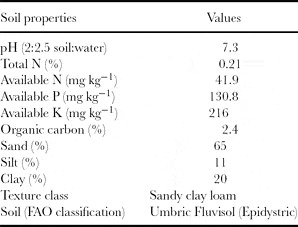
The experiment was conducted on vegetable field at the horticultural unit of Sokoine University of Agriculture. The soil was sandy clay loam, classified as Umbric Fluvisol (Epidystric) (WRB, 2006) (Table 1).
Mean values of some physical and chemical characteristics of the field trial soil.

Particle size analysis was determined by the Bouyoucos hydrometer method (Gee and Bauder, Reference Gee, Bauder and Klute1978). Soil pH was measured using a glass electrode pH meter in a ratio of 1:2.5 soil to water (McLean, Reference McLean and Page1982). Organic carbon content was determined by the wet oxidation method following the procedure of Walkley and Black (Reference Walkley and Black1934). Total N was by micro Kjeldahl procedure (Bremner and Mulvaney, Reference Bremner, Mulvaney, Page, Miller and Keeney1982). Available N (NH4+-N and NO3−-N) was extracted by 2M KCl and measured in the filtrate using a steam distillation method (Bremner and Keeney, Reference Bremner and Keeney1965). Soil available P was determined according to Olsen et al. (Reference Olsen, Cole, Watanabe and Dean1954). Exchangeable K was determined by the atomic absorption spectrophotometer following the procedures outlined by Wilde et al. (Reference Wilde, Corey and Iyer1979).
Materials and growing conditions. The experimental design was a randomized complete block design with three replicates. Chicken manure (CHM) and cattle manure (CAM) were chosen as the source of N because the survey showed that they were readily available and most used by farmers. Chicken manure was collected from a farm near Sokoine University of Agriculture (SUA) and CAM was collected from SUA cattle farm, where it was heaped outside the kraal for not less than three weeks. Manures were applied to CC plots immediately after collection while manures for AM were applied to the respective plots three days later after collection.
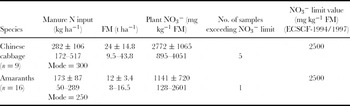
The amount of manure N used by farmers per cultivation season for CC ranged from 172 to 517 kg N ha−1, while for AM, N fertilization ranged from 50 to 289 kg N ha−1 (Table 3). The majority of farmers were using about 300 and 250 kg N ha−1 for CC and AM, respectively. In this study, based on the above data two treatments of manure N levels with a control (no application of manure) were adopted per vegetable: 0, 200, 300 kg N ha−1 and 0, 170, 250 kg N ha−1 for CC and AM, respectively, where the higher doses represent the most common fertilizer application rates. Plot size for each treatment was 4 m2, separated by 0.7 m within blocks and 0.9 m between blocks. Manure was incorporated into the soil one day before sowing. In CC plots five seeds were sown per point on 1 July 2008 during the dry season. Two weeks after sowing, plants were thinned, and one plant was left per point resulting in a plant density of 6 plants m−2. Plant-to-plant distance within rows and between rows was 30 cm and 50 cm, respectively. In order to have a uniform stand, AM seeds were mixed with sand at a ratio of 1 g seed to 100 g sand and broadcasted at the rate of 1 g seed m−2 on 18 July 2008 (dry season). Irrigation was practiced once a day (5 L m−2) to maintain an adequate soil moisture. The CC plants were sprayed with a synthetic pyrethroid pesticide, Mo-Karatep 5 Ec containing Lambda-cyhalothrin 5g L−1 (Agchem Access LTD, Norwich, UK) when attacking pests had been observed in plots. No pesticides were applied to AM.
Plant and soil sampling. In CC plots destructive samplings were done 30 and 44 days after sowing (DAS), while in AM plots this was done 28 and 38 DAS. Sampling was carried out between 08:00 and 10:00 hours. Three CC plants were uprooted from each plot, while AM plants were uprooted from three locations (0.3 m × 0.3 m per location) of each plot; the root lengths were measured and afterwards separated from the aboveground parts. Sample preparation and nitrate analysis was as described above.
Along with plant sampling, three soil samples per plot were taken from the 0–15, 15–30 and 30–45 cm depths and composite samples per depth were placed in plastic bags as one sample for each depth. Samples were kept in a refrigerating box until arrival in the laboratory and then in a freezer in the laboratory. Two days after sampling soil samples were analysed for NH4+-N and NO3−-N contents.
Determination of mineral N in soils. Mineral N (NO3−-N and NH4+-N) was measured in 2M KCl extracted at a ratio of 1:10 (w/v). The soil suspension was shaken for 1 h on a reciprocating shaker and filtered through Whatman filter papers No. 41. Inorganic N was measured in the filtrate using a steam distillation method (Bremner and Keeney, Reference Bremner and Keeney1965). Soil water content was determined by drying a sub-sample to constant weight at 105 °C for 24 h allowing to calculate soil inorganic N on a dry weight basis.
Statistical analysis
Frequencies and percentages for the information collected by interviews were processed using Statistical Package for Social Sciences (SPSS) software. Experimental data were statistically analysed with multifactor analysis of variance (ANOVA) for a randomized complete block design using the MSTAT-C package. To determine the statistical significance of differences in means between treatments, we carried out the least significant difference (l.s.d.) tests based on Duncan's multiple range tests. A probability level of p ≤ 0.05 was considered significant. Regression analysis was used to determine the relationships between vegetable nitrate and soil mineral N contents.
RESULTS
Survey results
In total 57% of the surveyed area (55 fields out of 144) was fertilized with manures at least during the past five years: 19% received manure and inorganic fertilizers, 13% received inorganic fertilizer only and 11% received no fertilizer. There was a considerable number of vegetable species in the studied area with 20 species being recorded. These included leafy vegetables, fleshy fruits such as tomato and eggplant, and root vegetables. Chinese cabbage and AM species were identified as the main vegetable crops, accounting for 46% of the total area surveyed and 63% of the area fertilized with manure.
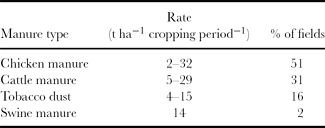
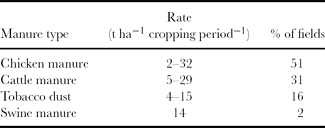
The details of the types and amount of manure applied were investigated and the results are presented in Table 2. The main sources of farm yard manure in the study area were identified as chicken and cattle. Chicken manure was used in 51% of the fields, followed by CAM (31%), tobacco dust (16%) and swine manure (2%).
Manure utilization in vegetable fields from the survey conducted in Morogoro municipality (% of fields refers to % of fields where only manure is used: Σ = 100%).
The average amount of manure N applied to CC and AM are presented in Table 3. In CC fields, five seeds were sown per point. Two weeks after sowing, plants were thinned, and one plant was left per point. Transplanting was practiced only by two farmers out of nine. Amaranthus seeds were broadcasted on beds and no thinning was done. The reaping and regrowth system of harvesting was practised for CC. This method leads to higher total yields than whole plant harvest. A larger plant size at the beginning of harvest results in higher total yield related to more reserves of carbohydrate being present in the remaining part of the plant to stimulate regeneration of new leaves (Fu, Reference Fu2008). It is therefore important to assess how these harvest practices can affect yield, N uptake and nitrate concentration of the respective plants. Farmers who seed direct in the fields started reaping 4–6 weeks after sowing depending on the demand, while those who practice transplanting started reaping five weeks after transplant.
Survey results for manure N input, fresh matter and nitrate concentrations of Chinese cabbage and amaranthus species in Morogoro municipality (values are means and range, and ± values are standard deviations).

FM: fresh matter.
Amaranthus are grown by sowing, and harvesting is done by uprooting the whole plant 4–5 weeks after sowing. However, for some varieties harvesting was done even as early as three weeks after sowing. A wide range of fresh matter yields and nitrate concentrations was observed (Table 3). Nitrate accumulation was quite different between the two vegetables species and within each vegetable, ranging from 895 to 4051 mg kg−1 fresh matter (FM) for CC and from 128 to 2601 mg kg−1 FM for AM. A regression was performed to determine the dependence of nitrate concentration in vegetables on N levels. There was a positive relationship which was significant at p = 0.01 with AM (R 2 = 0.59) but not significant with CC (R 2 = 0.33).
Field trials
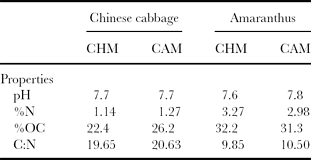
Effect of N sources and rates on vegetables’ marketable yield. The mean values of some properties of the manures used in this experiment are presented in Table 4. The variation in N and C contents of manure applied to CC and AM could be related to differences in nutrients losses during manure handling and related to non-homogenized manure heaps during manure collection, since manures for CC were collected on 30 June 2008 and manures for AM on 14 July 2008.
Properties of the manures used in the field trial.
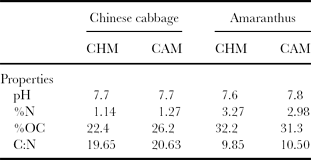
CHM: chicken manure; CAM: cattle manure.
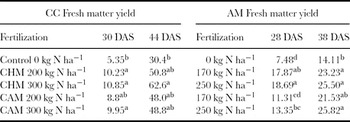
The highest marketable fresh yield of CC was obtained by the application of CHM (Table 5); however, the difference between CHM and CAM treatments was not statistically significant (p = 0.05). All fertilized treatments except 200 kg CAM N ha−1, resulted in significantly higher (p < 0.05) CC marketable fresh yields at 30 DAS compared to control. At 44 DAS only CHM applied at 300 kg N ha−1 resulted in significantly (p < 0.05) higher yields than controls. The differences between 200 and 300 kg N ha−1 with respect to N source were not statistically significant.
Chinese cabbage (CC) and amaranthus (AM) fresh matter yield (t ha−1) as influenced by different manure N levels.

Means with the same letter in columns are not significant different by Duncan's multiple range test comparison at p = 0.05.
DAS: days after sowing; CHM: chicken manure; CAM: cattle manure.
Chicken manure yielded more marketable fresh yield of AM than CAM and the difference was significant at 28 DAS (p < 0.05), while at 38 DAS the effect of CHM was not significantly different from that of CAM (Table 5). All treatments with organic manures had significant higher marketable yield of AM (p < 0.05) than control at both 28 and 38 DAS, except fertilization with 170 kg CAM N ha−1. As in the CC experiment, there was no significant difference in marketable fresh matter yield between the application of 170 and 250 kg N ha−1 with respect to N source.
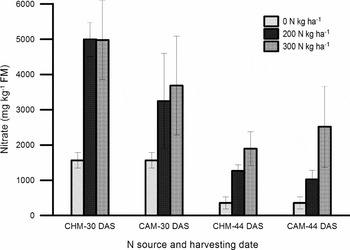
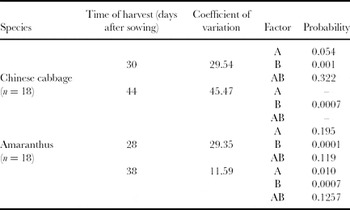
Effect of N sources, N rates and harvesting date on vegetable nitrate content. A strong increase of nitrate accumulation in CC and AM was observed in fertilized treatments over control regardless of the N source and sampling time, and the difference was significant at p < 0.05. At the first and second harvest, there was no difference in nitrate content of CC treated with CHM and that treated with CAM (Figure 1 and Table 6). At the second harvest, the nitrate content in CC supplied with 300 kg N of CAM ha−1 was 146% (i.e. significantly) higher than that supplied with 200 kg N ha−1. For the same N source and N rate, higher nitrate concentrations in CC were observed at 30 DAS than at 44 DAS (Figure 1). The difference was significant (p < 0.05) except with the application of 300 kg CAM N ha−1.
Nitrate concentrations in Chinese cabbage 30 and 44 DAS (days after sowing); CHM: chicken manure, CAM: cattle manure (± error bars represent the standard deviations).

ANOVA table for nitrate concentrations in Chinese cabbage and amaranthus.

A: type of manure; B: N levels.
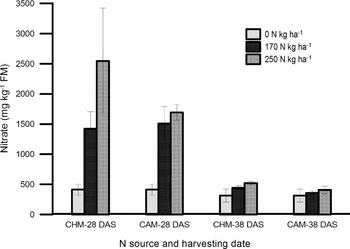
The nitrate contents in AM 28 DAS at 170 kg N ha−1 were still within acceptable levels, whereas at the high N rate (250 kg N ha−1) NO3− levels exceeded the acceptable level (2500 mg kg−1 FM). At 38 DAS the nitrate content of AM treated with CHM was higher than that treated with CAM and the difference was significant at p = 0.01 (Figure 2 and Table 6). There was no significant difference between nitrate content of AM harvested at 28 DAS and that harvested at 38 DAS in control plots (Figure 2). However, the differences between 28 and 38 DAS in fertilized AM were significant at p < 0.05 for both CHM and CAM.
Nitrate concentrations in amaranthus 28 and 38 DAS (days after sowing); CHM: chicken manure, CAM: cattle manure (± error bars represent the standard deviations).

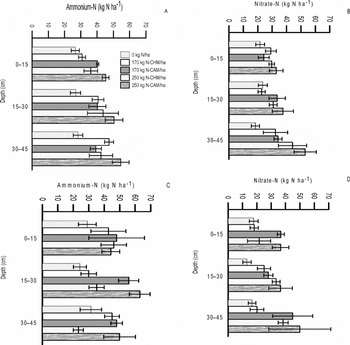
Effect of N source and rate on mineral N in the soil. The amount of mineral N (NH4+-N + NO3−-N) in the soil after two harvests did not differ significantly (p = 0.05) between the two types of manure applied to CC plots (Figure 3A–3D). However, at 28 DAS NH4+-N was significantly higher at 0–15 cm depth and significantly lower (p < 0.05) at 30–45 cm depth in AM plots treated with 170 kg N of CAM ha−1 than that treated with 170 kg N of CHM. At 38 DAS NH4+-N was significantly higher at 0–15 cm and 15–45 cm depth in AM plots treated with 170 kg N and 250 kg N of CAM ha−1, respectively, than that treated with the same N rates of CHM (Figure 4A–4D).
Changes in soil mineral N content (0–45cm) in Chinese cabbage plots: A) ammonium-N 30 days after sowing, B) nitrate-N 30 days after sowing, C) ammonium-N 44 days after sowing and D) nitrate-N 44 days after sowing; CHM: chicken manure, CAM: cattle manure (± error bars represent the standard deviations).

Changes in soil mineral N content (0–45cm) in amaranthus plots: A) ammonium-N 28 days after sowing, B) nitrate-N 28 days after sowing, C) ammonium-N 38 days after sowing and D) nitrate-N 38 days after sowing; CHM = chicken manure, CAM = cattle manure (± error bars represent the standard deviations).

Moreover, at first harvest of CC, higher NO3−-N at 0–30 cm and 30–45 cm depths was observed related to application of 300 kg N of CHM and 300 kg N of CAM, respectively, than by application of 200 kg N. The effect of N source was observed at 30 and 44 DAS CC where the application of 300 kg N of CAM led to higher NO3−-N at 30–45 cm depth than that of CHM.
Application of 250 kg N from CHM to AM plots resulted in the highest NO3−-N at 15–30 cm and 30–45 cm at 28 and 38 DAS, respectively. A similar trend was observed at 38 DAS at 30–45 cm depth with application of 250 kg N of CAM. Furthermore, higher NO3−-N was observed at 15–30 cm depth at the first sampling of AM, 0–15 and 30–45 cm depths at the second sampling of AM related to the application of 170 kg N of CAM ha−1 than that of CHM. The difference was significant at p < 0.05 (Figure 4A–4D). The amount of NO3−-N in 0–45 cm depth of unamended soils was lower than amended soils (significantly different at p < 0.01). The interaction of manures and N rates was only significant (p < 0.05) in AM plots where the highest amount of mineral N was observed with application of 250 kg N of CAM ha−1. It was observed that NO3−-N content in the amended soils increased slightly with soil depth.
Figure 3 shows that 30 DAS in CC plots, NH4+-N was higher than NO3−-N in the 0–45 cm layer. Fourteen days later the former had increased and the NO3− -N had decreased. The same trend was observed in AM plots, but not to the same extent. Surprisingly, ammonium concentrations also increased by 34% and 4% in CC and AM soils (0–45cm), respectively, between the two sampling times in the control soils.
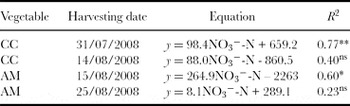
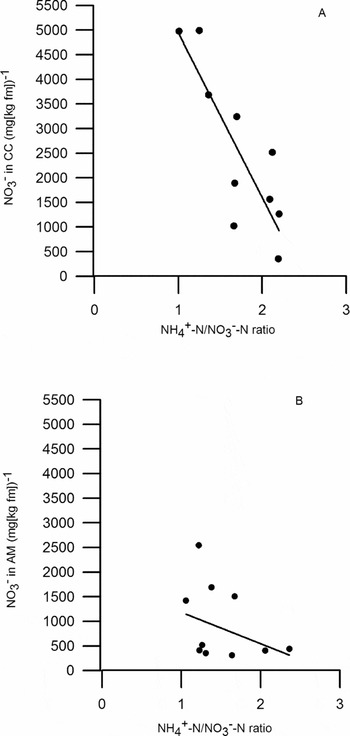
Nitrate accumulation as affected by NO3− -N and NH4+-N in the soil profile. To explore the dependence of NO3− in vegetables on NO3−-N and (NH4+-N)/(NO3−-N) ratio in the rooting depth (0–15cm) a regression was performed. Data in Table 7 showed that there was a positive relationship with soil nitrates which was significant at first harvest of both CC and AM. At second harvest the regression observed between NO3− concentration in AM and NO3−-N in the soil was weaker. The regressions showed that there was a strong negative relationship between (NH4+-N)/(NO3−-N) ratio in the soil and CC nitrate content (Figure 5) (R 2 = 0.74; significant at p = 0.001). With AM, the negative relationship was weak (R 2 = 0.11; not significant at p ≤ 0.05).
Relationship between mean vegetable NO3− content (y-value) and NO3−-N in the soil profile (0–15cm).

CC: Chinese cabbage; AM: amaranthus.
y = nitrate concentration in CC and AM (mg NO3− kg−1 FM).
** = significant at p = 0.025; * = significant at p = 0.05; ns: not significant at p ≤ 0.05.
Relationship between (NH4+-N)/(NO3−-N) ratio in the soil (0–15cm) and nitrate content of: A) Chinese cabbage and B) amaranthus.

DISCUSSION
The rates of manure applied by farmers ranged from 2 to 32 tonnes ha−1. Surprisingly, none of the respondents had an idea about the amount of nutrients they apply to their fields. During the discussions with farmers, it was found that no recommendations or guidelines are available with regard to the use and management of manure in relation to vegetable production. There was no proportional relationship between the amount of N applied and the yields, as farmers applying more or less the same amount of manure N harvested different amounts of vegetables. This could be due to the differences in management from one farmer to another. In this case, contributions of other factors such as cropping cycle period and type of manure, etc. should be taken into consideration for determination of effects of N levels on vegetable yields. A true relationship could only be determined through field experimental research. Compared to the safety standard of nitrate for vegetables (2500 mg kg−1 FM) set for leafy vegetables by the European Communities Scientific Committee for Food (ECSCF) (Commission Regulation (EC) 1994/97), the mean concentrations of NO3− in CC was higher while that of AM was lower. Generally there was an increase of nitrate concentration in both CC and AM with increasing manure N levels.
The high yield observed with application of CHM in the field experiment could be related to its rapid release of nutrients in soil compared to CAM. These results are in agreement with those by Abou El-Magd et al. (Reference Abou El-Magd, El-Bassiony and Fawzy2006) who reported higher yield of vegetables with CHM as compared to CAM. Lack of significant difference between high and low N levels to marketable fresh yields of both CC and AM implies that the high N levels applied (300 and 250 kg N ha−1, respectively) are not profitable to farmers. Thus, fertilization levels can be reduced to 200 and 170 kg N ha−1 without significantly affecting the yield.
The observation that CHM led to more accumulation of nitrate in CC and AM than CAM at the first sampling could be explained by the slower release of N from CAM compared to CHM, as was observed in previous mineralization experiments under laboratory conditions (Baitilwake et al., Reference Baitilwake, De Bolle, Salomez, Mrema and De Neve2010). Indeed, the current results affirm further that N sources affect accumulation of nitrate in CC and AM plants at first sampling.
We have observed a strong increase in nitrate accumulation in CC and AM following fertilization. This observation confirms the results from the survey, suggesting that intensive addition of organic manure in vegetable growing soils has a strong influence on the NO3− concentration in plants. The nitrate concentrations in both vegetables were higher at first sampling than second sampling, in agreement with earlier studies by Amr and Hadidi (Reference Amr and Hadidi2001), who reported a lower nitrate accumulation in cabbage at a later harvesting stage. The nitrate amounts observed in the current study for CC at first sampling (ranging from 3243 to 4993 mg kg−1 FM, Figure 1) were more than the maximum limit (2500 mg kg−1 FM). The nitrate concentrations in CC at the second sampling however, were below the EC standards except at high N rate where it was 2518 mg kg−1 FM.
From an environmental point of view, the mineral N was determined at harvest, because this N will be susceptible to leaching. The observed amount of mineral N (NH4+-N + NO3−-N) in the soil after two harvests may indicate leaching of NO3−-N from the top soil into the deeper soil layers. Although there was an increase in both NH4+-N and NO3−-N between sampling times, the increase in the latter was not as much as in NH4+-N. In addition, because of the shallow rooting depth of CC and AM, this NO3−-N will be prone to further leaching. On the other side, there was an increase in ammonium concentrations between the two sampling times in the control soils. This could be related to significant N-mineralization arising from the regular manure applications in the past (Kucke and Kleeberg, Reference Kucke and Kleeberg1997) as practiced in the study area. Regular manure application increases soil organic N, and in the longer term this increases N mineralization rate (Sleutel et al., Reference Sleutel, De Neve, Prat Roibás and Hofman2005). In addition, the difference between control soils of two vegetable plots could also be related to ammonium-N released from the biomass killed by the pesticide sprayed on the CC a few days before the first sampling to suppress an identified disease. Nitrifying organisms are vulnerable to fumigation which leads NH4+-N to remain in unoxidized form for a prolonged period of time (De Neve et al., Reference De Neve, Csitári, Salomez and Hofman2004). Moreover, this increase in ammonium N may be related to the stimulating effect of plant roots on N mineralization. The effects of roots on soil include uptake of nutrients and water, movement of soil caused by root penetration and release of exudates (Priha et al., Reference Priha, Lehto and Smolander1999). This complicates the prediction of the fertilizer value of the manure and may also influence the release of manure-derived N in the years after application. Ammonium N is much less mobile in the soil than NO3− thus reducing loss of N through leaching. However, in the absence of a crop its conversion to NO3− by nitrification can also contribute to the leaching of N from the soils at a later stage.
Since the nutritional factors play an important role in the accumulation of nitrate, the variations in vegetable nitrate concentration between two sampling times was not a surprise. The degree of nitrate accumulation is assumed to be related primarily to the amount of nitrate in the growing medium. However, NH4+ content has been reported to also influence NO3− accumulation in crops. Takebe et al. (Reference Takebe, Ishihara, Ishii and Yoneyama1995) reported that nitrate contents in spinach decreased with increasing (NH4+-N)/(NO3−-N) ratio. Therefore, the low nitrate concentrations in vegetables observed during the second harvest could be related to the relatively increased soil NH4+-N observed at second harvest of CC and AM (Figure 3 and 4) as compared to the first one. The negative relationship between (NH4+-N)/(NO3−-N) ratio in 0–15 cm soil depth and the nitrates in vegetables is in agreement with the findings of Takebe et al. (Reference Takebe, Ishihara, Ishii and Yoneyama1995).
CONCLUSION
This study revealed that nitrate accumulation in vegetables depends on the amount and sources of N present in the soil. Therefore, an adequate fertilization programme and selection among the available N sources that accumulate less nitrate may limit nitrate accumulation in vegetables. This is important to ensure an adequate supply of nutrients for optimum yield and minimize the nitrate in vegetables and N losses to the environment. Since nitrate was strongly accumulated at early growing stages, the extent of nitrate intake by humans through CC and AM may be reduced by harvesting the crop during the maturity stage under the same growing conditions. Harvesting at maturity will not only lower nitrate in vegetables but also will improve marketable yield.