Introduction
Neuroendocrine studies have emphasized the dual contributions of sympathetic hyper-activation and diminished hypothalamic-pituitary-adrenal (HPA) axis function in the failure to achieve posttraumatic physiological homeostasis and to develop posttraumatic stress disorder (PTSD).Reference Yehuda1-Reference Galatzer-Levy, Ma, Statnikov, Yehuda and Shalev3 Specifically, the modulation of the normal stress response initiated by cortisol (through negative feedback inhibition) helps restore stress-related reactions to baseline after the termination of the acute stressor.Reference Yehuda and LeDoux4
Several animal and clinical studies have reported lower cortisol levels in the first few hours after trauma as a potential predictor of PTSD symptoms.Reference McFarlane, Barton, Yehuda and Wittert2, Reference Delahanty, Raimonde and Spoonster5-Reference Cohen, Zohar and Gidron8 Decreased cortisol levels at the time of a traumatic event could prolong the availability of norepinephrine to synapses in both the periphery and the brain,Reference Jeong, Jacobson, Pacak, Widmaier, Goldstein and Majzoub9, Reference Pacak, Palkovits, Kopin and Goldstein10 which, in turn, might lead to pathological consolidation of the traumatic incident’s memory.Reference Cahill, Prins, Weber and McGaugh11 These findings suggest that a disruption (hypo-reactivity) in the initial adaptive endogenous response of the HPA axis may unfavorably alter the trajectory of trauma exposure. Accordingly, animal studies were set to examine the effect of a single corticosterone intervention immediately after stressor exposure.Reference Cohen, Zohar and Gidron8, Reference Cohen, Matar, Buskila, Kaplan and Zohar12 In a controlled prospective animal study conducted by our group, a single administration of hydrocortisone was correlated with a significant reduction in the incidence of the PTSD-like phenotype and improved resilience to subsequent trauma.Reference Cohen, Matar, Buskila, Kaplan and Zohar12 In addition, in a pilot clinical study, previously reported by our group,Reference Zohar, Yahalom and Kozlovsky13 hydrocortisone treatment (100-140 mg) given within the first 6 hours after a traumatic experience was associated with a significantly reduced prevalence of PTSD at 1 and 3 months post trauma. These results imply that a single administration of hydrocortisone in the time frame when the consolidation of the traumatic memory takes place (up to 6 hours) following exposure to the traumatic event is worth further investigation as a potential secondary prevention intervention for PTSD.Reference Zohar, Yahalom and Kozlovsky13-Reference Vermetten, Zhohar and Krugers15
The unique feature of PTSD, the potential ability to pinpoint its time of onset (the traumatic event) along with the (long) time for PTSD to be fully expressed has opened the opportunity for secondary prevention studies. These studies focused on the “window of opportunity”—a time frame in which an intervention may significantly alter the trajectory of PTSD (the “golden hours” concept).Reference Carmi, Fostick, Burshtein, Cwikel-Hamzany and Zohar14, Reference Pitman and Delahanty16
This randomized, prospective, double-blind, placebo-controlled trial study replicated and extended our pilot study.Reference Zohar, Yahalom and Kozlovsky13 We hypothesized that a single injection of hydrocortisone within 6 hours after exposure to a traumatic event would favorably alter the trajectory of PTSD compared with the placebo group, not only at 1 and 3 months (as in the pilot study), but also at 8 and 13 months after exposure.
Methods
The study was conducted at the Chaim Sheba Medical Center in Tel-HaShomer and was approved by its institutional review board (IRB) committee (“the Committee of Human Research”). The study was performed in accordance with the ethical standards as laid down in the 1964 Declaration of Helsinki and its later amendments or comparable ethical standards (ClinicalTrials.gov Identifier: NCT00855270).
Participants
A total of 158 persons arriving to the emergency department (ED) within 6 hours of experiencing a trauma were evaluated for eligibility. In order to recruit people who are at the highest risk of PTSD, we enrolled only those who reported marked anxiety, emotional distress, and/or dissociation related to the recent trauma exposure (enrich sample).Reference Zohar, Fostick and Juven-Wetzler17, Reference Schultebraucks, Shalev and Michopoulos18 Thus, specific inclusion criteria were employed to assess either acute stress response (ASR) or a subthreshold ASR using Diagnostic and Statistical Manual of Mental Disorders (DSM-IV) criteria with the following designations: exposure to traumatic events (ie, A1), ≥2 (of 5) dissociative symptoms (B), anxiety/arousal (E), and significant distress (F). Exclusion criteria included serious physical injury (a score of ≥3 on the Abbreviated Injury Scale), any indication of brain trauma, current substance abuse disorders, cardiac pacemaker implant, a history of epilepsy, neurosurgery, hypersensitivity to hydrocortisone, pregnancy, and treatment for asthma. In addition, any either medical or psychiatric conditions that may represent contraindications for hydrocortisone administration (ie, diabetes, endocrinological alterations, psychosis, or bipolar disorder) were excluded.
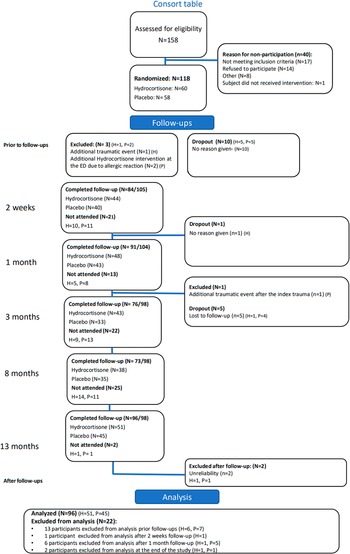
Of the 158 persons screened, 118 met the inclusion/exclusion criteria and consented to participate (Figure 1).
Consort flowchart of Hydrocortisone for posttraumatic stress disorder in a placebo-controlled randomized trial. H: Hydrocortisone; P: Placebo.

Procedure
The initial screen for eligibility was conducted by a research assistant with the help of the ED staff. When potential participants were identified, senior psychiatrists (J.Z. and E.J.) interviewed and examined the candidate, determined the diagnostic and medical eligibility, and completed informed consent procedures. The participants were randomized by a computerized program and entered into a prospective, placebo-controlled, randomized, double-blind design.
Patients received hydrocortisone (or placebo) intravenously in a single bolus within 6 hours following the exposure to traumatic event. Based on previous study conducted by our group,Reference Zohar, Yahalom and Kozlovsky13 the doses ranged from 100 to 140 mg based on body weight (100 mg for the weights of 60-69 kg, 120 mg for the weights of 70-89 kg, and 140 mg for the weights of 90-99 kg). Blood samples were taken before hydrocortisone administration. Ratings of PTSD and depressive symptoms were completed at 5 time points following the ED visit—at 2 weeks, 1 month (as the time point of diagnosis for PTSD), 3 months (as the time point of diagnosis for chronic PTSD according to DSM-IV), 8 months (as a time point of diagnosis for delayed PTSD), and 13 months (accomplishing 1 year of follow-up while avoiding the anniversary effect). All assessments were performed by expert investigators who were blind to the treatment condition and in person. All raters were trained via video and live interviews prior to the study to achieve intra-rater reliability, and weekly staff meetings were conducted to maintain it.
Hormones determination
Blood for plasma cortisol was drawn at the ED just prior to drug administration. Plasma cortisol concentrations were determined by ELISA kits (IBL-America, Minneapolis, NH, USA), according to the instructions of the manufacturer, by a technician blind to the drug treatment condition. All samples were measured in duplicate. The intra-assay and inter-assay coefficients of variation were 5.3% and 9.8%, respectively.
Questionnaires
-
• Demographics and background questionnaire: The questionnaire included age, marital status, date and place of birth, education, place of residence, and the type of trauma that led them to the ED.
-
• Visual analog scales for anxiety (VAS-A), visual analog scales for emotional distress (VAS-ED), and visual analog scales for dissociation (VAS-D) ranged from 0 to 10 cm.
-
• The Peritraumatic Dissociative Experience Questionnaire was assessed at the ED.
-
• A Hebrew version of the Clinician Administered PTSD Scale (CAPS)Reference Blake, Weathers and Nagy19 at 2 weeks, 1, 3, 8, and 13 months. PTSD diagnosis throughout the study was assigned to participants with a CAPS total score of ≥50.Reference Weathers, Keane and Davidson20
-
• The Montgomery-Åsberg Depression Rating Scale (MADRS) was assessed during the 3rd and 6th meetings.
Statistical methods
To test whether a single timely intervention with hydrocortisone, compared with the placebo, will reduce the risk of developing PTSD, CAPS total score changes were examined with 5 different analyses.
-
• Chi-square analyses were used to compare categorical data.
-
• Mixed model analysis, including the CAPS total score as the dependent variable, the study groups (hydrocortisone and placebo), and successive measurements (2 weeks, 2, 3, 8, and 13 months) as fixed factors.
-
• An analysis of covariance (ANCOVA) of change from visit 2 (the first visit when the CAPS was administered) to visit 6 (final study visit) controlling for visit 2 total score. This was conducted using both the last observation carried forward (LOCF) and the next observation carried backward (NOCB).
-
• Comparison of means of CAPS at each visit between the groups (hydrocortisone and placebo).
-
• Comparison of meeting the PTSD threshold (Yes/No) at each visit between the groups (hydrocortisone and placebo).
Secondary analysis
Time of trauma occurrence
Given the known diurnal variation in glucocorticoid regulation, we examined whether the timing of the trauma would impact the treatment. For this purpose, a dichotomous variable was created of day (6:01-18:00) and night (18:01-06:00), and mixed model of repeated measure (MMRM) analysis that included time of trauma by treatment interaction was performed. The possible clinical significance of the treatment was computed by calculating the number needed to treat (NNT). NNT was computed as the reciprocal of the risk difference, and the 95% confidence interval was the inverted risk difference confidence interval.
Results
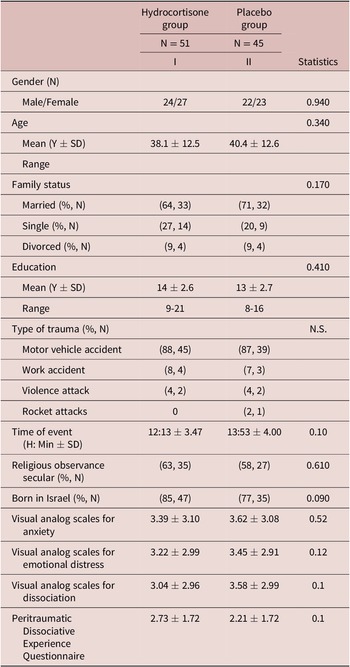
A total of 118 consented participants were randomized to hydrocortisone (n = 60) or placebo treatment (n = 58). Twenty-two participants were excluded or dropped from the study (see the Consort figure—Figure 1), and their data were not included in the analyses described in this report. Accordingly, the analysis included 96 participants (Figure 1). The great majority of traumas were traffic accidents (n = 102), with the remainder reporting accidents at work (n = 7), interpersonal violence (n = 8), and rocket attacks (n = 2). Neither age, sex, marital status, education level, trauma type, prior trauma, current comorbidities, nor baseline VAS scores were significantly different between the Hydrocortisone and Placebo groups (Table 1).
Hydrocortisone and Placebo Groups—Participant’s Demographic Data and Clinical Characteristics at Baseline

Notes: The demographic and clinical characteristics of participants from the hydrocortisone and placebo groups. Results are expressed as mean and standard deviation.
Safety
Overall, as Hydrocortisone is a safe and common treatment, and was given only once in this study (at the ED), there were no reported side effects of either hydrocortisone or placebo (SDs were assessed during the following assessment [ie, week 2]).
Primary longitudinal analysis
PTSD Symptoms and prevalence
Hydrocortisone intervention was not superior on Placebo intervention, in CAPS total score nor in incidence of PTSD at 13-month assessment. Specifically, CAPS scores at all time points (2 weeks, 1, 3, 8, and 13 months) and study groups (hydrocortisone and placebo) showed a nonsignificant group by time interaction (MMRM, P = .31; ANCOVA, LOCF, P = .44; NOCB, P = .49; Supplementary Table S1). In addition, at all-time points, hydrocortisone and placebo groups had a similar prevalence of PTSD diagnosis, without significant differences (Supplementary Table S2).
Circulating cortisol
Plasma cortisol taken at the ED before hydrocortisone/placebo administration did not differ between participants who developed and did not develop PTSD at 13 months: not at baseline (ie, in the ED; no PTSD at 13 months (n = 84): 12.11 ± 9.19; PTSD at 13 months (n = 7): 7.69 ± 4.19; F(1,88) = 1.55, P = .216, controlling for time of blood draw) nor at 13-month assessment (no PTSD (n = 60): 13.64 ± 10.07; PTSD (n = 4): 10.08 ± 3.53; F(1,62) = 0.49, P = .486).
VAS measurements and MADRS
VAS-A, VAS-D, MADRS scores, prior trauma, or current comorbidities were not significantly different between the hydrocortisone and placebo groups in all assessments points (Supplementary Tables S3-S5).
Post hoc analysis—Time of trauma occurrence
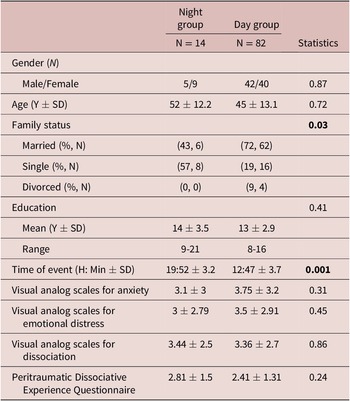
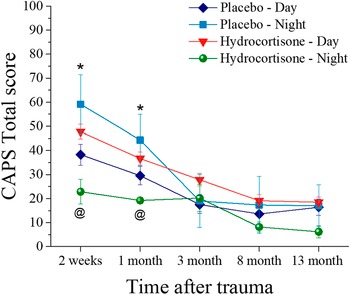
Glucocorticoid diurnal variation suggests that cortisol injection would be more effective if administered when cortisol levels are low (at night). To test this hypothesis, we divided the participants into two groups based on the time of trauma: Daytime (6:01-18:00) and Night (18:01-06:00). No statistical differences were found between the night and day groups in ASR responses or VAS questionnaires (Table 2). A significant interaction of time of trauma (day vs night), group (hydrocortisone vs placebo), and CAPS total score at all time points (2 weeks, 1, 3, 8, and 13 months) was found (F(1,196) = 2.5, P < .045). Bonferroni post hoc test confirmed that within the hydrocortisone group, the CAPS total score at 2-week and 1-month follow-ups was lower in the night group (22.86 ± 5.13 and 19.2 ± 0.487, respectively) than in the day group (47.76 ± 3.05 and 36.67 ± 2.67, respectively; P < .04 and P < .05). For the placebo group, the results were the opposite; CAPS scores at 2-week and 1-month follow-ups during the day (06:01-18:00) were lower (38.27 ± 4.38 and 29.54 ± 3.8, respectively) than CAPS scores during the night (18:01-06:00; 59.14 ± 12.24 and 44.33 ± 15.66, respectively; P < .02 and P < .03, respectively; Figure 2). Scores of VAS-A, VAS-D, MADRS, prior trauma, or current comorbidities were not significantly different between the night and day groups.
Night and Day Groups—Participant’s Demographic Data and Clinical Characteristics at Baseline

Notes: The demographic and clinical characteristics of participants from the night and day groups. Results are expressed as mean and standard deviation. p < 0.05
Effects of hydrocortisone/placebo treatment administered immediately after trauma on the total Clinician Administered PTSD Scale (CAPS) score.
The 2-week, 1, 3, 8, and 13-month CAPS total scores for the hydrocortisone-treated and placebo groups according to time of trauma. *Placebo night vs placebo day: 2 weeks: P < .04 and 2 month: P < .05. @Hydrocortisone night vs hydrocortisone day: 2 weeks: P < .02 and 2 months: P < .03.

Cortisol diurnal variation, acute stress Disorder, and PTSD
ASD and PTSD prevalence within the placebo group (day vs night)
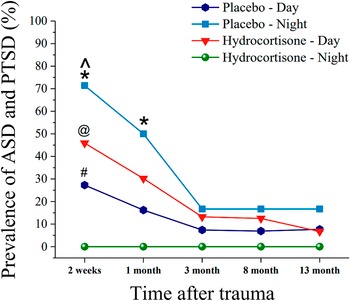
At 2-week assessment, acute stress disorder (ASD) incidence in the day placebo group was significantly lower than incidence in the night placebo group (27.3% [n = 9/33] and 71.4% [n = 5/7], respectively, χ2 = 4.95, P < .03). At 1-month assessment, the incidence of ASD was nearly significantly lower in the day placebo group than in the night placebo group (16.2% [n = 6/37] and 50.0% [n = 3/6], respectively, χ2 = 3.56, P = .059). At 3, 8, and 13 months, the prevalence of PTSD in the day group remained lower than the prevalence of PTSD in the night group (3 months: 7.4% (2/27) and 16.7% (1/6); 8 months: 6.9% (2/29) and 16.7% (1/6); and 13 months: 7.7% (3/39) and 16.7% (1/6), respectively), yet these differences did not reach statistical significance (Figure 3).
Effects of hydrocortisone/placebo treatment administered immediately after trauma on acute stress disorder (ASD) and posttraumatic stress disorder (PTSD) prevalence.
The ASD (2 weeks) and PTSD (1, 3, 8, and 13 months) prevalence within the placebo group (day vs night) and hydrocortisone (day vs night). *Placebo day vs placebo night: 2 weeks: χ2 = 4.95, P < .03; 1 month: χ2 = 3.56, P = .059. ^Placebo night vs hydrocortisone night: 2 weeks: Fisher exact, P < .015. @Hydrocortisone day vs hydrocortisone night: 2 weeks: Fisher exact, P < .025. #Placebo day vs hydrocortisone day: 2 weeks: Fisher exact, P < .025. The results are displayed as percentages.

ASD and PTSD prevalence within the hydrocortisone group (day vs night)
At 2 weeks, the prevalence of ASD in the hydrocortisone-night group was significantly lower than the prevalence of ASD in the hydrocortisone-day group, 0% (n = 0/7) and 45.9% (n = 17/37), respectively (Fisher exact, P < .025). Although the hydrocortisone-day group (N = 45) improved over time, at 13 months, 6.7% (N = 3/45) still met the criteria for PTSD in comparison to none in the hydrocortisone night group (N = 0/6; Figure 3).
ASD and PTSD prevalence during the night (hydrocortisone vs placebo)
The prevalence of ASD (2 weeks) and PTSD (1, 3, 8, and 13 months) in the placebo-night group was higher than the prevalence of ASD and PTSD in the hydrocortisone-night group (2 weeks: 71.4% [n = 5/7] and 0% [n = 0/7], respectively, Fisher exact P < .015; 1 month: 50% [n = 3/6] and 0% [n = 0/5]; 3 months: 16.7% [n = 1/6] and 0% [n = 0/5]; 8 months: 16.7% (n = 1/6) and 0% [n = 0/6]; and 13 months: 16.7% [n = 1/6] and 0% [n = 0/6], effect size of 0.41; Figure 3).
ASD and PTSD prevalence during the day (hydrocortisone vs placebo)
The prevalence of ASD (2 weeks) and PTSD (1, 3, 8, and 13 months) in the placebo-day group was lower than the prevalence of ASD and PTSD in the hydrocortisone-day group (2 weeks: 27.3% [n = 9/33] and 45.9% [n = 17/37], respectively, Fisher’s exact P < .025; 1 month: 16.2% [n = 6/37] and 30.2% [n = 13/43]; 3 months: 7.4% [n = 2/27] and 13.2% [n = 5/38]; 8 months: 6.9% [n = 2/29] and 12.5% [n = 4/32]; and 13 months: 7.7% [n = 3/39] and 6.7% [n = 3/45]; Figure 3).
The number needed to treat
NNT was calculated from the observed response rates. The NNT values at the 1-month follow-up were 2.3 for the hydrocortisone-night group and 8 for the hydrocortisone-day group. At the 13-month follow-up, the hydrocortisone-night group had the NNT value of 7, whereas the hydrocortisone-day group had the NNT value of 39.
Discussion
This study examined the effect of a single administration of hydrocortisone in the ED within the first 6 hours after the traumatic event (ie, “golden hours”). Overall, participants who received hydrocortisone during the “golden hours” did not differ significantly on measures of symptoms or prevalence of PTSD, nor for the secondary outcomes of anxiety and depression from those who received placebo. Both groups improved over time, and at the 13-month follow-up, only 7% to 8% met the criteria for PTSD.
The lack of response in the general hydrocortisone group is inconsistent with our pilot study of injured/traumatized participants in which the same dose of hydrocortisone given 6 hours after the trauma reduced PTSD symptoms (identical protocol)Reference Zohar, Yahalom and Kozlovsky13 and in a recent meta-analysis investigating hydrocortisone administration for reducing PTSD symptoms.Reference Kothgassner, Pellegrini and Goreis21 However, the difference might be explained by the fact that most of the patients in the pilot study were recruited during the night (and accordingly, they were exposed to trauma during the night). Taking into account the cortisol diurnal variation and preclinical findings that highlighted the difference between day and night at which the trauma occurred,Reference Cohen, Vainer and Matar22 we further analyzed the data. We thought that the endogenous diurnal variations in the basal activity of the HPA axis may influence the response to the trauma and, thereby, the susceptibility to or the severity of stress-related disorders, such as PTSD. Analyzing the data by dividing it by day (6.01 a.m. to 18.00 p.m.) vs night (18.01 p.m. to 6.00 a.m.) revealed a higher prevalence of ASD and PTSD in the placebo group among participants exposed to trauma during the night: 71.4% at the 2-week follow-up and 50% at the 1-month follow-up, compared with 27.3% and 16.2%, respectively, in participants exposed during the daytime. These results confirm the evidence indicating the zeitgeber time at which rats were exposed to stress influenced on the behavioral response of the rats.Reference Cohen, Vainer and Matar22 We reported that rats appeared to be more vulnerable to stress applied at the onset of the inactive phase and, conversely, more resilient to stress applied at the onset of the active phase.Reference Cohen, Vainer and Matar22
Moreover, significant preventive effects of hydrocortisone were found only when hydrocortisone was administered to participants exposed to trauma only during the night (effect size of 0.41) compared with the placebo group (effect size of 0.02). In fact, none of those who have been exposed to trauma during the night and received hydrocortisone developed PTSD (in line with our pilot study). The NNT supports the observation regarding the importance of the timing of the intervention, as only hydrocortisone night administration has yielded effective results. These findings suggest that hydrocortisone is effective at night (when the endogenous cortisol levels are relatively low, due to diurnal variation). Moreover, the favorable outcome of hydrocortisone administration during the night is in line with the hypothesis that a low cortisol level would be associated with an increased risk for PTSD. In contrast to these findings, we found that those who have been exposed to trauma during the day and treated with hydrocortisone fared worse than placebo. One may speculate that high dose hydrocortisone given after traumatic exposure during the day to those who already present relative high cortisol levels (as compared to the night cortisol levels) may disrupt the negative cortisol feedback system endogenously required for the production of cortisol. This leaves these participants with inadequate cortisol concentration as depicted by abnormal traumatic responses/symptoms.Reference Cohen, Vainer and Matar22
Major limitations to be considered when interpreting our data are related to the small number of patients who developed PTSD, and further and wider studies are in need and currently in process in our group. Due to the small N, some of our results, although yielded positive trends, have not reached statistical significance. Accordingly, we may discuss observations rather than statistical findings. Furthermore, the generalizability of our results is low due to the homogeneity of the trauma types (mainly motor vehicle accident) compared to other traumas, such as rape, physical assault, and so forth. In addition, childhood adversity measures could not be analyzed, as a large number of participants did not answer the relevant questionnaire. Furthermore, treatment strategies (pharmacological and/or psychotherapeutic) potentially adopted by patients to manage symptoms over the mid- and long-term as well as social and/or familial support to face traumatic events were not always available to the researchers. These factors, although equally distributed between groups, may have an impact on the results.
Conclusion
The primary outcome measure of this study was not found—participants who received hydrocortisone did not differ significantly in measures of symptoms or prevalence of PTSD, nor for anxiety and depression from those who received placebo. However, at post hoc analysis, in which the diurnal variation in cortisol was introduced as a variance, a favorable significant effect of a single administration of hydrocortisone, given within 6 hours after exposure to traumatic event (the “golden hours”), emerged.
The diurnal variation in HPA activity significantly impacted the value of the study data. The significant differences in clinical effectiveness of the treatment protocol according to the time of trauma exposure are worthy of further study. Should these be reconfirmed in future studies, they might impact on treatment protocol in the field (ie, prehospital acute trauma care).
Financial Support
This work was supported by the National Institutes of Health (NIH; Grant No. RO1 NCT00855270). The NIH had no further role in study design; in the collection, analysis, and interpretation of data; in the writing of the report; and in the decision to submit the paper for publication.
Author contributions
J.Z. and Y.R. designed the study and wrote the protocol. A.J.-W and T.W. managed the clinical evaluations. L.C. and L.B. managed the literature searches and analyses. H.C. undertook the statistical analysis. L.C. wrote the first draft of the manuscript. All authors contributed to and have approved the final manuscript.
Disclosures
The authors have no relevant financial or nonfinancial interests to disclose. The authors have no conflicts of interest to declare that are relevant to the content of this article. The authors certify that they have no affiliations with or involvement in any organization or entity with any financial interest or non-financial interest in the subject matter or materials discussed in this manuscript. The authors have no financial or proprietary interests in any material discussed in this article.
Supplementary Materials
To view supplementary material for this article, please visit http://doi.org/10.1017/S1092852922000852.