Why does the United States support Israel so strongly when that support appears to violate American national interests? In their recent book, The Israel Lobby and U.S. Foreign Policy, John Mearsheimer and Stephen Walt argue that Israel is of little strategic value to American interests and that the moral case for supporting Israel is weak at best. They then argue that this apparent distortion in American foreign policy is due to the extraordinary influence of pro-Israel groups and individuals—a collection of actors they dub the “Israel lobby”—in American domestic politics.Footnote 1 Not surprisingly, this book and the article that preceded it have provoked a great deal of criticism, as well as a fair amount of praise, focused largely on the merits of the book's foreign-policy argument.Footnote 2 Much less attention has been paid, however, to their core argument, which consists of a set of causal claims about American politics and policymaking. In this article I examine this argument and conclude that the case for an “Israel lobby” as the primary cause of American support for Israel, although it points to a number of interesting questions about the mechanisms of power in American politics, is weak at best.
I treat Mearsheimer and Walt's work as an exercise in the study of American politics, in which they attempt to mount an argument about the reasons for a particular set of American policy choices and the possible influence of an interest group in guiding those choices in the context of American policymaking institutions. My focus is exclusively on this part of their argument, and not on their assessment of American foreign policy toward Israel and the Middle East. I ask three sets of questions about their argument. First, what, exactly, are their causal claims? By what mechanisms do they suggest that pro-Israel individuals and organizations influence policy outcomes? What are their hypotheses about the forces that shape American policy toward the Middle East? Second, what does political science have to say about these mechanisms? Many of the political processes that Mearsheimer and Walt discuss have, of course, been the subject of extensive research by scholars of American politics. What guidance can the discipline's state-of-the-art knowledge about policymaking in the American political system give us in evaluating their argument? And finally, what kind of evidence would be necessary to substantiate their hypotheses? Do Mearsheimer and Walt provide such evidence? What might systematic empirical tests of their claims look like?
How does their argument hold up when subjected to this kind of critical scrutiny? Not well. Their causal claims about American politics are often illogical or impossibly vague, are almost never supported by dispositive evidence, and frequently contradict well-established research findings in American politics. I begin by describing their argument in some detail in order to expose the argument's theoretical underpinnings and discern the causal hypotheses that they explore. I then zero in on these causal claims and examine Mearsheimer and Walt's treatment of them—the logic by which they submit these hypotheses to critical tests, the evidence they use to test them, and alternative approaches that might illuminate the problems they address. My primary purpose is to unpack and evaluate Mearsheimer and Walt's claims about influence on American policymaking and not to propose and test a fully-fledged alternative argument about the links between the activities of pro-Israel individuals and organizations and American foreign policy. To the extent that there are conventional standards for making causal inferences from empirical observations about influence in American politics, Mearsheimer and Walt generally fail to meet them. I note, however, that their argument involves claims not only about the lobby's direct influence on policy outcomes but also about its ability to shape the policy agenda through the stifling of open debate and discourse in the United States about Israel and American policy toward Israel. These more subtle mechanisms of power are considerably harder to observe and there is no consensus among scholars of American politics about how to demonstrate their effects. Nevertheless, they offer a provocative and suggestive account of political influence that merits careful attention.
Mearsheimer and Walt's Argument
Mearsheimer and Walt's central argument is that the activities of the Israel lobby are the primary cause of American foreign policy in the Middle East. They make this argument by tracing the lobby's multiple pathways of influence on the American policymaking process: Congress, the president and the executive branch, the media, think tanks and the issue networks of professional policy analysis, universities, and broader public discourse. Following this theoretical exposition, they present several brief case studies of recent American policymaking that supposedly display the lobby's influence.
The success of the causal argument about the reasons for American Middle East policymaking and the power of the Israel lobby will depend primarily on the principle of variation. In order to show a casual relationship between a cause and an effect, we must be able to observe that when the cause is present the effect is present but that when the cause is absent the effect is absent or, alternatively, that when there is more of the cause there is more of the effect. Empirically, then, substantiating a causal relationship between the activity of the lobby and policy outcomes would seem, as a general matter, to require showing that relatively higher levels of pro-Israel lobbying activity are associated with more pro-Israel outcomes, and showing this would require that the observed level of both lobbying activity and policy outcomes vary.Footnote 3
This general principle of causal explanation suggests that a fruitful way of evaluating Mearsheimer and Walt's argument would be to probe their argument for propositions that can be expressed as causal hypotheses and then to examine whether it presents evidence to substantiate these hypotheses. In this section, I derive several distinct causal hypotheses from the book, and in the following section I evaluate whether or not Mearsheimer and Walt's evidence provides sufficient reason to accept these hypotheses, and consequently their overall argument, as true. The short answer is that it does not. In some cases, is fairly easy to demonstrate decisively that their causal claims—particularly those concerning the lobby's direct influence over policy decisions—are simply wrong. In other cases the evidence is either absent or ambiguous, making it impossible either to accept or reject their claims without further examination, particularly where their claims concern the lobby's more subtle and indirect agenda-setting influence over the boundaries of legitimate debate and discussion of Israel and the Middle East in American policymaking.
The Existence and Influence of the “Israel Lobby”
The Israel lobby, Mearsheimer and Walt contend, is a “loose coalition of individuals and organizations that actively works to move U.S. foreign policy in a pro-Israel direction” (5). The lobby is composed primarily of American Jews for whom this is an important political issue, but it also includes others, particularly evangelical Christians, for whom Israel holds an important place in a set of eschatological beliefs (115, 132–34).Footnote 4 Finally, the lobbyalso encompasses Israeli government officials, with whom many Americans active in public affairs have close ties and routinely consult. The lobby is bound together not only by a common interest in supporting Israel but also by strong shared norms against public criticism of Israeli policy (121–22). Mearsheimer and Walt do not claim in direct terms that the lobby is an organized entity, although they emphasize a single organization, the American Israel Public Affairs Committee (AIPAC), whose reputation for lobbying influence and effectiveness they note (117–18).
The individuals and groups that make up the “lobby,” Mearsheimer and Walt suggest, engage in a number of activities intended to influence American foreign policy in the direction of support for Israel (112–13). First, they vote for pro-Israel candidates. Second, they engage in other activities intended to convey their policy preferences to their elected representatives and other policymakers, including writing letters, contributing money to candidates for public office, and “supporting pro-Israel organizations,” which presumably includes donating money, joining membership organizations, volunteering, attending meetings, and so forth (115). In other words, they engage in political participation in a democratic system; this list of activities corresponds almost precisely with the classic definition of political participation that has long formed the backbone of the study of mass political behavior in the United States and other democratic countries.Footnote 5
In principle, therefore, Mearsheimer and Walt's major contention, that the activity of the Israel lobby is the primary cause of American policy toward Israel, is amenable to the construction of empirically testable hypotheses that connect pro-Israeli political participation in the United States to pro-Israel policy outcomes. If, as they contend, the strength of the lobby and its activities translate into policy outcomes, then we ought to be able to observe its effects in a variety of ways.
The political participation of pro-Israel actors, they suggest quite reasonably, is not undifferentiated. Rather, they argue that it exploits the particular fragmented institutional structure of the American political system, which provides “a multiplicity of points of access” and veto points for actors who wish to influence policymaking.Footnote 6 Mearsheimer and Walt's assertion that the lobby's members “exert significant influence on the policy-making process in Washington” (151), then, rests on a set of more precise causal claims about the lobby's influence in specific institutional venues, particularly Congress and the executive branch, and their dominance of public and policy discourse through think tanks, the media, and the academy.
The “Lobby” and Congress
The brief section of the book on the lobby's apparent influence in Congress contains a number of causal claims and testable propositions about the means by which pro-Israel forces in American society might plausibly affect policy. Mearsheimer and Walt make several explicit testable claims. One is that the presence of members of Congress who are either “Christian Zionists” or Jews can be expected to increase the likelihood of pro-Israel policy outcomes. “One reason for the lobby's success with Congress,” they write, “is that some key members have been Christian Zionists, such as former House Speaker [sic] Richard Armey…. There are also Jewish senators and representatives who work to make U.S. foreign policy support Israel's interests” (152–53).Footnote 7 The implication of this statement is that the power of either “Christian Zionist” or Jewish members of Congress translates into pro-Israel policy outcomes, and that the more powerful these members are, the greater the likelihood of pro-Israel outcomes. This is so presumably because these members of Congress have pro-Israel policy preferences that derive from either their religious convictions or ethnic attachments independently of any lobbying activity (although it might also be the case that these members represent districts or states whose voters have pro-Israel preferences that are reflected in their choice of representative). If the presence and power of “Christian Zionist” and Jewish members of Congress increase the chance of pro-Israel policy outcomes, this ought to be discernible in one of two ways. One is that variations in the power of these members will be associated with variations in pro-Israel outcomes; when these members are either more numerous or wield more influence in congressional policymaking, the results should tilt more toward the preferences of pro-Israel actors. Alternatively, we should be able to observe and describe the processes by which these particular members wield such influence. Elsewhere, Mearsheimer and Walt rightly caution against equating American Jews with pro-Israel policy preferences or political behavior. They cite a survey finding that “36 percent of Jewish-Americans were either ‘not very’ or ‘not at all’ emotionally attached to Israel” (115), so that the presumption of pro-Israel preferences should not attach automatically to all Jewish members of Congress. This caution should temper our willingness to attribute pro-Israel influence to Jewish members. For the moment, I leave deliberately vague the question of how congressional “power” is constituted or measured (as Mearsheimer and Walt leave it vague). I return to it later.
Members of Congress themselves are not the only source of influence over congressional policy. Congressional staff members play an important role in the formulation of policy on behalf of the members and committees whom they serve. Staff members with pro-Israel policy preferences, then, constitute another potential causal factor in policymaking, again independent of lobbying by nongovernmental actors. Mearsheimer and Walt slide quickly from this broader claim about the policy preferences of Congressional staff members to a quotation (from a former executive director of AIPAC) about the presence of Jewish staffers “who are willing … to look at certain issues in terms of their Jewishness” (153). Again, it is not clear how closely the “Jewishness” of staff members maps onto pro-Israel policy preferences, nor is it clear exactly by what mechanism these staff members are supposed to wield power—sheer numbers, occupancy of particular positions on the staffs of pivotal members or influential committees—but the suggested hypothesis, connecting the presence and power of Jewish congressional staff members with pro-Israel policy outcomes, is clear enough. Evidently “Christian Zionist” congressional staffers are of less consequence; they receive no mention.
At the center of Mearsheimer and Walt's congressional influence story, however, are AIPAC and its capacity to funnel campaign contributions to congressional candidates who are perceived as friendly to the group's preferences and to withhold contributions from candidates whose policy positions or commitments are different:
AIPAC's success is due in large part to its ability to reward legislators and congressional candidates who support its agenda, and to punish those who do not, based mainly on its capacity to influence campaign contributions. Money is critical to U.S. elections … and AIPAC makes sure that its friends get financial support so long as they do not stray from AIPAC's line (154).
This proposition gives rise quite straightforwardly to a hypothesis connecting this electoral activity to policy outcomes: greater levels of campaign activity, whether measured in contributions or other kinds of electoral support, should be associated with higher levels of support for pro-Israel policies. This hypothesis has two empirical variants, depending on the level of analysis—collective or individual—at which campaign activity and outcomes are being measured. At the collective level, an association should appear between aggregate levels of campaign activity by groups such as AIPAC and overall policy outcomes. At the individual level, the association might work in one of two ways. On the one hand, contributions and campaign support might be retrospective, a means of rewarding or punishing past behavior; if this is the case, candidates whose records or policy statements indicate support for Israel should receive higher levels of pro-Israel campaign support than those whose records indicate lower levels of support. On the other hand, they might also be prospective, a means of inducing future behavior; in this case, candidates who receive higher levels of pro-Israel electoral support should subsequently be more supportive of pro-Israel policy than those who receive less support. While these two mechanisms are conceptually distinct, empirical research on campaign contributions and other electoral activity has found them fiendishly hard to distinguish empirically, as I will elaborate below. In principle, these relationships between campaign activity and policymaking behavior ought to be empirically observable in terms of both correlations (between campaign contributions and legislative behavior, for example) and of process (evidence, perhaps, of the interactions between candidates and groups).
A suggested final mechanism for the lobby's influence on Congress is AIPAC's role as a source of information, background work, and tactical advice for members of Congress and their staffs. They quote a former legislative director of AIPAC who says that members of Congress often “turn to” AIPAC before other sources for information, and that AIPAC “is often called upon” for other assistance (161). This quotation appears to suggest that members of Congress voluntarily seek out AIPAC for these interactions. This is, moreover, a common mode of interaction between legislators and interest groups that does not clearly distinguish AIPAC from other organizations.Footnote 8
Thus it is not clear what the causal mechanism at work here or why we evidence of this form of contact leads to an inference of influence. Is the information that AIPAC provides biased or inaccurate in a way that might influence policy decision-making? Does AIPAC's information crowd out information from other sources? Does AIPAC derive some advantage from being, on occasion, the first source of information, such as the ability to frame policy issues for members of Congress in an advantageous way? Mearsheimer and Walt say no more about the causal argument here.
The “Lobby” and the Executive Branch
The second key point of influence for the Israel lobby that Mearsheimer and Walt explore is the executive branch, particularly the president and his close foreign- and defense-policy advisors, especially (but not exclusively) those with Middle East portfolios. The principal causal mechanism they propose here is, quite reasonably, electoral. The lobby's “leverage over the Executive branch,” they write, “derives in part from the impact Jewish voters have on presidential elections” (163). First, they suggest that Jewish-Americans are particularly important as donors to presidential campaigns: “Despite their small numbers in the population (less than 3 percent), American Jews make large campaign donations to candidates from both parties…. Indeed, the Washington Post once estimated that Democratic presidential candidates ‘depend on Jewish supporters to supply as much as 60 percent of the money raised from private sources’” (163). This claim suggests that presidential candidates who receive more financing from Jewish donors (or, one might add, from other pro-Israel sources) ought to be more likely to espouse pro-Israel policies (and to pursue them if they are elected) than candidates who receive less, and that candidates with more pro-Israel financing ought to be more likely to win presidential elections. Of course, as with congressional candidates, the causality might work the other way: pro-Israel candidates raise more money from pro-Israel donors.
The second part of the electoral argument concerns the apparently pivotal position of Jewish voters in presidential elections: “Furthermore, Jewish voters have high turnout rates and are concentrated in key states like California, Florida, Illinois, New Jersey, New York, and Pennsylvania, which increases their weight in determining who becomes president.” (163). Here the contention is that Jewish voters are decisive in presidential election—that the outcome of the election hangs, at least in part, on their vote choices and, presumably, that these vote choices depend on the stances or records of the candidates toward Israel. If, in fact, Jewish (or pro-Israel) voters ever cast the decisive votes in presidential elections, then it might be reasonable to expect more pro-Israel policies from the ensuing administrations than from administrations in which Jewish voters were not decisive—assuming, that is, that it is reasonable to equate “Jewish” and “pro-Israel” votes. Once again, the argument slides from a broader claim about the Israel lobby to more particular claims about Jewish voters; they do not discuss the potential electoral influence of evangelical “Christian Zionists” as a factor in pro-Israel electoral pressure, although such voters have received a great deal of attention in recent years as a powerful and decisive force in American politics.Footnote 9 They also seem, once again, to ignore their own precaution against assuming that pro-Israel policies are of high importance to all American Jews.
A second suggested avenue of influence on the executive branch is appointments. The lobby, Mearsheimer and Walt suggest, acts as a gatekeeper for senior executive appointments in foreign and defense policy as high as the cabinet level. Pro-Israel organizations, they argue, exercise veto power over prospective appointees who they view as insufficiently supportive of pro-Israel policy and can snuff out policy avenues of which they disapprove (166–67). Moreover, they suggest, the lobby often enjoys close ties to executive-branch officials, to the point that people affiliated with the lobby have often themselves occupied key Middle East policymaking positions (165–66). Although the assertion of influence is clear enough, it is not clear what empirically testable proposition is being offered about the lobby's influence on executive personnel. It is hard to discern a hypothesis here that is neither a truism nor a tautology, on the order of “pro-Israel officials make pro-Israel policy.” How are we to know empirically when the presence of pro-Israel officials in an administration is the consequence of interest-group pressure that runs contrary to the president's own foreign-policy preferences rather than merely reflecting those preferences? Is, for example, Jimmy Carter's failure to appoint George Ball secretary of state—one of the very small number of anecdotal instances of apparent influence over a presidential appointment that Mearsheimer and Walt discuss—part of a larger pattern of such influence (167)? Is it an instance of a recurring norm (as in labor policy, where labor unions and business organizations routinely propose and vet presidential nominees to the National Labor Relations Board), or is this influence of a more extraordinary sort?Footnote 10 Were the pro-Israel officials who, they note, populated the national security establishment in the first term of the Bush fils administration there because they were foisted upon the president against his wishes or because they shared his (and the vice president's) policy beliefs, whether about Israel or other foreign- and defense-policy matters? Mearsheimer and Walt offer little guidance on these questions.
The Lobby and Policy Discourse
Alongside their argument about the Israel lobby's direct influence on the processes and outcomes of American foreign policymaking, they make a separate but related argument about the lobby's influence on the discourse surrounding Middle East policy in the United States. Here their central claim is that pro-Israel actors manage on the whole to stifle open debate about American policy toward Israel in order to maintain favorable public opinion toward Israel and American support for Israel. This influence, they suggest, operates through a number of mechanisms. One is the media, which, they argue, is susceptible to pressure such as “letter-writing campaigns, demonstrations, and boycotts against news outlets whose content [the lobby] considers anti-Israel” (172). A second is the arena of professional policy analysis, particularly the dense world of think tanks and other policy research institutions concerned with Middle East policy, which they portray as dominated by pro-Israel analysts (175–78). A third domain, in which Mearsheimer and Walt acknowledge that the lobby has been rather less successful in its attempts to regulate discussion of Middle East policy on college and university campuses. Nevertheless, they describe some attempts by pro-Israel actors to monitor teaching and research by university faculty and note the recent increase in the number of Israel studies programs in American universities (178–85). Finally, they describe what they see as one of the lobby's key tactics in shaping discourse on the Middle East in the United States: the accusation that criticism of Israel or of pro-Israel policy is tantamount to anti-Semitism (188–96). These claims, while hard to substantiate and exquisitely difficult to theorize, nevertheless seem, as I will show, to describe something closer to reality than the arguments about the lobby's direct impact on American policymaking. I return to this point in the conclusion.
Assessing the Argument
How well do Mearsheimer and Walt's arguments about the causes of American policy toward Israel stand up to careful examination? Are they logically consistent? Do they allow for clear and systematic empirical tests that would allow us to observe whether or not American policy does, in fact, respond to the sources of pressure that Mearsheimer and Walt deem so important? If so, do they provide the evidence to conduct such tests? Are these arguments consistent with what we already know about how American politics and policymaking work? Now that I have unpacked the logic of their argument and identified the particular causal claims that seem to be embedded in it, I return to those claims and examine whether the book makes a reasonable empirical case for them.
The General Argument
In its most encompassing form, Mearsheimer and Walt's argument describes an overall relationship between pro-Israel political activity and American foreign policy. As a general matter, testing such a hypothesis requires establishing an observable connection between the two parts of this general proposition: the level and kind of political activity aimed at affecting American Middle East policy on the one hand and the results—policy outcomes—on the other. An examination of the methods and evidence by which Mearsheimer and Walt test these propositions reveals several serious problems with the book's empirical argument and the general logic behind it.
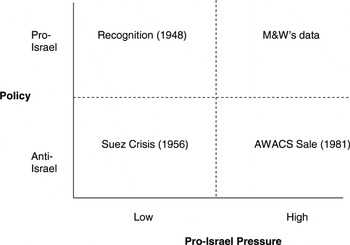
The first of these issues is the matter of variation. There are a number of conceivable ways that Mearsheimer and Walt might find and explain variation in both their independent and dependent variables. They might, for example, examine variation over time. The state of Israel and, hence, the question of American policy toward Israel have existed for more than sixty years, and was a matter of public debate for some decades before that. Surely the lobby's power, as Mearsheimer and Walt would measure it, has not been constant over that period. So they might have found a systematic way of observing both the level of pro-Israel lobbying activity of various kinds and the level of “pro-Israelness” of American foreign policy. If their main argument is right, then, we should expect to find that at times of greater pro-Israel lobbying activity, American policy is more pro-Israel. They might also have considered variation across policy areas. If the lobby has paid more attention to some aspects of policy than to others, we might expect to find that policy in those policy areas that receive the lobby's direct attention is more pro-Israel than policy in other areas. It might, in fact, be the case that there has been little variation in American policy toward Israel, in which case an explanatory strategy based on exploring the covariation of cause and effect would not work. If this were the case—if American Middle East policy were constant—it would be necessary to show that Mearsheimer and Walt's favored explanatory factor, the activities of the Israel lobby, was also constant while other possible explanatory factors varied.
But the book, in general, presents very little variation on any of these dimensions. The level of lobbying always seems to be high, and the outcomes always seem to be pro-Israel, regardless of the circumstances. Nor do they systematically canvass alternative explanations of American Middle East policy that might help bolster their case for the lobby's causal importance. The examples of the lobby's apparent influence in the book are taken from a relatively broad time period, although most of them—and all of the cases in the book's empirical section—are drawn from the George W. Bush administration (which seems to be the most one-sidedly pro-Israel administration in recent memory).Footnote 11 This time period seems to align with the era in which AIPAC in particular has been recognized as a highly skilled actor in national politics. But what about major events in U.S.-Israel policy before this period, and before AIPAC wielded such influence? What about President Harry Truman's rather controversial decision to recognize Israel after its declaration of independence in 1948, in which pro-Israel lobbying certainly played a role but without the densely institutionalized lobby that Mearsheimer and Walt describe in a later period?Footnote 12 What about President Dwight Eisenhower's response to the Suez Crisis of 1956, presumably also before the emergence of a powerful Israel lobby (AIPAC had been founded only three years earlier)? The Suez example might, in fact, help Mearsheimer and Walt's case, as an example of American diplomacy deployed against Israeli military gains (although the real targets of American pressure were Britain and France) in the absence of a powerful lobby. What about the sale of Airborne Warning and Control System (AWACS) aircraft to Saudi Arabia in 1981, which was concluded by President Ronald Reagan with the approval of the Senate over the strenuous objections of both Israel and its American supporters?
Each of these episodes receives brief mention in the book, to be sure, but they are not deployed as comparative cases that might provide a test of the book's overall hypothesis. In the AWACs case, Mearsheimer and Walt acknowledge that the outcome “was mostly due to a set of unusually unfavorable conditions,” a combination of international and domestic factors (p. 144). This is a pregnant claim, which implies—correctly—that policymaking is the result of a complex and ever-changing set of variables and that the efficacy of lobbying might vary depending on these contextual conditions. Sadly, this insight does not inform the rest of the analysis. There is, in general, no systematic attempt to find or exploit the variation, either in pressure or in outcomes, that would help to establish a causal connection between the two. Rather, the evidence that they offer—both the illustrative examples in the presentation of their argument and the cases that make up their empirical demonstration of the lobby's supposed effects—seems to be selected precisely because it follows the pattern they expect: high pressure and pro-Israel outcomes. But this appearance of selection bias, which I will discuss in more detail, severely undermines the validity of their argument.
A second general source of confusion about Mearsheimer and Walt's argument concerns the relationship among the various causal arguments that they present. These hypotheses run the gamut of American politics, encompassing campaigns and elections, voting behavior, interest group behavior, Congressional and executive politics, and the media. It is not clear how these different mechanisms interact with each other in Mearsheimer and Walt's causal scheme. Are they complementary? Do they compete with one another? Do they all exert influence on policy outcomes independently, or are they connected in a more complex causal chain, in which one effect is itself a cause of yet another effect, and so on, with policymaking at the end of the chain? For example, some of the causal arguments they offer are not about policymaking per se, but rather about media coverage of Israel and the Middle East, the content and volume of which are presumably somehow related to the policymaking process, although this relationship is not clearly specified. This distinction—between direct influence on policy decisions and more indirect influence through the shaping of discourse surrounding policymaking—will turn out to be an important one in evaluating the success of Mearsheimer and Walt's argument, but it is one that they do not make. In general, their failure to specify a model of the American policymaking process with any clarity produces an argument with some rather loose ends.
Finally, a question arises frequently in the book about the boundaries of the lobby and its distinctness from the government over which it seems to wield such influence. Mearsheimer and Walt seem to veer between two different portraits of the lobby. On the one hand, they suggest the lobby (as this name implies) is a non-governmental entity (or set of actors), whose purpose is to exert influence or power over actions of the government. On the other hand, some of their claims suggest that the lobby is a ruling elite that includes both government officials and people outside of the government who are connected to one another by shared social background, economic status, or network ties.Footnote 13 If the lobby is defined in the first of these ways, such that it consists of actors outside of the government, then its influence is, in principle, empirically testable; many of the hypotheses elaborated above take just such a form, connecting a discrete and observable set of actions on the part of one set of people with a set of policy outcomes that they prefer. If, on the other hand, the lobby consists not only of pro-Israel voters, campaign contributors, organizations, and the like but also elected and appointed government officials and their staffs, then the proposition that the lobby exerts disproportionate influence on policymaking begins to verge on the unfalsifiable, for at every turn of the policymaking process there seems to be another “member” of the lobby closer to the center of power to whom some decision can be attributed.Footnote 14
One might respond to this general critique of their argument that they are engaged in a different kind of explanatory enterprise than the one I have contemplated thus far, based on tracing processes of influence to find causal mechanisms rather than simply measuring the extent of covariation between lobbying activity and policy outcomes. As its name implies, process-tracing is intended not simply to discover the extent to which hypothesized causes and effects covary—that is, whether effects tend to appear when causes are present across a large number of independent cases—but to examine closely the processes by which causes generate effects within each case.Footnote 15 This is certainly a plausible way of framing their argument and might allow them to relax somewhat the need for a large sample of cases of policymaking in order to substantiate their claims about the lobby's influence. If, instead, they can document recurrent sequences of cause and effect connecting pro-Israel political activity and pro-Israel policy outcomes, they will be able to stake a strong claim to having established a more general causal relationship. But following a process-tracing approach does not exempt them from the need to specify and test theories of policymaking and hypotheses about the particular causal connections they suspect to be behind American policy. Even in this kind of analysis, as Peter Hall has argued, “the causal theories to be tested are interrogated for the predictions they contain about how events will unfold.”Footnote 16 Whether these hypotheses are expressed in terms of covariation or process, the fundamental nature of the empirical tests to which they are to be subjected remains the same: have they assembled evidence that would reveal if they were wrong, and does that evidence, in the end, fit their expectations about both processes and outcomes? As I proceed to examine whether Mearsheimer and Walt's data support their hypotheses, I will try to examine their evidence in terms of process as well as outcome.
In order to assess more precisely the general claim about the lobby's influence, we need to explore the evidence for the more specific propositions that I have outlined that highlight particular mechanisms by which the Mearsheimer and Walt hypothesize that pro-Israel political activity is the primary cause of policy outcomes. I emphasize again that my purpose is not to test these hypotheses fully or to develop a comprehensive explanation of American foreign policy toward Israel. My intent, rather, is to explore Mearsheimer and Walt's arguments and to suggest (and, in some cases, briefly demonstrate) how one might systematically deploy theory and evidence to test them. In examining their treatment of each claim, I assess the evidence about three things: the relevant pro-Israel activity, the outcomes in question, and the processes that connect the two. Where possible, I also evaluate their claims against the relevant theory and research findings about these topics that might inform their discussion. I am not suggesting that any finding that contradicts what other political scientists have said is necessarily invalid, but if they are going to do so they ought to be prepared to show where current theory goes wrong and how their evidence supports their model of influence over a currently prevalent alternative. There is no such analysis in the book, however—no discussion of the relationship of the argument with other theories and no systematic testing of Mearsheimer and Walt's models of American politics and policymaking against alternatives. There are also frequent misstatements about basic elements of American politics. More generally, the specific empirical tests in the book display the basic general flaws of the argument over and over—lack of variation, selection bias, conceptual confusion, and lack of clarity about the boundaries distinguishing cause, effect, and process.
Congress
Mearsheimer and Walt's discussion of the lobby's influence in Congress begins with a statement that displays something of a misunderstanding of Congress and how it operates. Israel, they contend, is “virtually immune from criticism” in Congress. “This situation is remarkable,” they write, “because Congress frequently deals with contentious issues” (152). Maybe so, but Congress habitually shies away from contentious issues; avoiding unnecessary controversy is inherent in Congress's very nature and structure, beginning with the reelection imperative that forms the basis of modern congressional studies. The things that individual members of Congress do revolve around the fundamental electoral incentive, which dictates that they should avoid doing anything that might alienate too many voters. The activities in which they do tend to engage—famously characterized by David Mayhew as advertising, credit claiming, and position taking—are fundamentally conflict-avoidant.Footnote 17 Individual members' electoral interests in conflict-avoidance among other things, moreover, dictate the way Congress as a whole is organized to act collectively and the way congressional policymaking occurs. Consequently, Congress collectively is very good at doing things that are relatively unlikely to cause substantial controversy, such as distributing discrete, identifiable benefits to particular places or groups that do not impose visible or traceable costs on others. Congress generally finds it difficult, however, to address highly controversial issues or to adopt policies that will impose substantial visible costs on voters.Footnote 18
Thus, Mearsheimer and Walt's basic premise here—that the lack of Congressional debate and division on Middle East policy reflects the stifling of Congress's natural urge to address controversial issues—is fundamentally flawed. If anything, the burden is on Mearsheimer and Walt to show that congressional action on the Middle East is out of synch with the central tendency of national opinion; this presumption lies behind their argument (both here and in general), but they do not establish that it is so. In fact, data on long-term trends in American public opinion show that Americans have long consistently expressed substantial support for Israel. Levels of sympathy for Israel have been sensitive to short-term events, though fluctuating around a baseline of support approaching or exceeding a majority, a picture consistent with their observation of Congress's general pro-Israel stance but not consistent with their premise.Footnote 19
Nevertheless, Mearsheimer and Walt hint at some specific causal claims about the lobby and its influence on Congress, particularly relating to the presence of Jewish and evangelical members of Congress and Jewish staff members and to the impact of campaign contributions and other campaign activity on the part of AIPAC and other pro-Israel organizations. Their first argument suggests that it is the presence of Jewish and evangelical Christian members of Congress (and Jewish staff members) that drives congressional policy toward Israel. But they offer little evidence connecting either of these groups within Congress to actual policy outcomes, beyond a single pro-Israel quotation from former House Majority Leader Dick Armey (who left the Congress in 2003 and thus was not a member during most of the events Mearsheimer and Walt discuss) and the bland assertion that some Jewish members of Congress “work to make U.S. foreign policy support Israel's interests” (152–53). How many such members of Congress are there? How do they influence American foreign policy? What actions do they take to shape policy? What positions within Congress do they hold that give them privileged access to the levers of foreign policymaking? Mearsheimer and Walt do not say.
There are a number of ways that a discrete and like-minded group of members of Congress might influence congressional policymaking. One is through sheer numerical power. To explore this proposition, a useful starting point is the size of the group. There were several dozen Jewish members of the 109th Congress (which was the sitting Congress when Mearsheimer and Walt's original article appeared): eleven senators (out of 100) and twenty-six House members (out of 435, less than six percent) according to one count.Footnote 20 These numbers have been relatively stable over the recent past. It is somewhat harder to count precisely the number of “Christian Zionist” members of Congress because they are not generally so identified in compilations of member data (in the Congressional Directory, for example, members are generally identified either by generic denomination—“Baptist,” or “Catholic,” for example—when they are identified by religion at all). So we have little idea how much weight “Christian Zionist” members carry in Congress, although given the recent growth of the Christian right as an important force in American politics, it is a reasonable suspicion that the “Christian Zionist” presence has grown in recent decades.
Given these relatively small numbers, it is also far from clear how Mearsheimer and Walt suppose that these members wield such influence over congressional policymaking. Certainly the Jewish members of Congress do not carry enough voting weight to make a substantial difference by themselves in policy decisions, which must be made by majorities (and often by supermajorities in the Senate, due to the filibuster rule), without substantial support from others. In the House, for example, a bloc of twenty-odd members could not succeed in passing legislation without the support of nearly 200 other members. By the same token, eleven senators could not generally legislate without the support of forty-nine others, due to the three-fifths requirement under Senate rules (amounting to sixty votes) to close debate and end a filibuster (which would likely either occur or be threatened on such a closely divided and potentially controversial subject).Footnote 21
But numbers alone do not tell the whole story in Congress, and there are other mechanisms by which members of Congress with distinctive policy views might sway congressional deliberations. There are a number of theoretical approaches to congressional policymaking in which strategic considerations, rather than sheer numbers, are decisive in determining policy outcomes. Three such approaches deserve special consideration. One is the theory of pivotal politics developed by Keith Krehbiel.Footnote 22 In this approach, members of Congress are assumed to have policy preferences that can be represented as points on a single dimension—say, from pro- to anti-Israel. In typical majoritarian institutions, we would expect the median voter—the individual right at the center of the preference distribution—to control policy outcomes, because his or her preferred policy would defeat any other proposed policy.Footnote 23 But the American policymaking system includes several key nonmajoritarian elements—particularly the filibuster in the Senate, the presidential veto, and the two-thirds requirement for a congressional veto override—which require a modification of the median-voter approach. Krehbiel's pivotal politics approach thus identifies the preferences of several key actors, or pivots, as crucial to explaining policymaking outcomes: the median member of the House, the sixtieth senator, the president, and the representative and senator representing a two-thirds division of each House in case of a presidential veto.Footnote 24 In this picture, policymaking influence might derive from occupying these key pivotal positions in one or more of these institutions. Establishing that this is what is driving the lobby's influence in congressional policymaking would, therefore, require a more textured examination of the role of Jewish or “Christian Zionist” members.
A second model of congressional policymaking focuses on parties as key agents of congressional policymaking. In this approach, parties represent aggregations of members with common policy preferences who unite to exercise majority control over the procedures and, especially, the agenda of the House and Senate. By exercising agenda control, parties can shape policy outcomes, at least by preventing their least preferred policy options from being considered.Footnote 25 In one especially influential version of this approach, known as “conditional party government,” the power of the majority party in each house to set the agenda and direct policymaking comes about particularly when the parties in Congress are highly unified and ideologically homogeneous, as has increasingly been the case in recent decades. In this scenario, unified parties consent to delegate agenda control and other powers to their leaders in order to maximize the achievement of their own policy and electoral goals. Under this approach, the key observations to chronicle policy influence in Congress would be the extent to which the parties, and especially the majority party in each chamber, are unified in their policy views, and hence we might want to know something about the weight of pro-Israel members not in the chambers as a whole but in the majority party. Based on this approach, the possibility that Jewish members, at least, exercise decisive influence on congressional policymaking through their centrality to partisan majorities seems exceedingly remote. In the 109th Congress, the last Congress before the Democratic takeover in the 2006 elections, there were only three Jewish Republicans in Congress, two in the Senate and one in the House, hardly a recipe for tremendous influence in establishing the majority party's policy direction. Again, it seems much more likely that it would be “Christian Zionists” playing this role under the Republican congressional majorities of the last twelve years, although this proposition is subject to the same measurement problem mentioned earlier.
A final perspective on congressional policymaking concerns the internal organization of the Congress, particularly the role of committees, which are Congress's primary internal shapers and gatekeepers of substantive legislation. There are two schools of thought about the role committees play in the legislative process. One holds that committees tend to be composed of members who have particularly strong and distinctive preferences regarding the policy areas under their committee's jurisdiction.Footnote 26 For example, we might expect the agriculture committees to be composed of members from farm states who have a strong interest in protecting policies such as agricultural subsidies that confer highly concentrated benefits on their constituents while imposing highly dispersed costs on everybody else. In this picture, such “preference outlier” committees manage to engineer the passage of legislation highly favorable to their own members through log-rolling with other committees, so that distinctive interests in Congress are each able to protect their most cherished policies.
This “distributive” approach to committee power is actually potentially consistent with Mearsheimer and Walt's account of the lobby's influence in that it provides an institutional logic for policy outcomes in specific policy areas that follow the preferences of a narrow group whose interests diverge from the central tendency of Congress's overall preferences. But they offer little evidence to show that it is disproportionate representation on the relevant committees that constitutes the critical ingredient of the “lobby's” influence. In the 109th Congress Jewish members occupied eight of twenty-three Democratic seats on what was then called the House International Relations Committee, including the top three ranked minority members and the top six of nine. One of these members was also the ranking minority member of the Subcommittee on the Middle East and Central Asia, which presumably plays an important role in developing congressional Middle East policy. (As Mearsheimer and Walt note, this committee and subcommittee—renamed the Committee on Foreign Affairs and the Subcommittee on the Middle East and South Asia after the 2006 elections—are now chaired by Jewish members under the new Democratic majority. But they misrepresent the process by which committee and subcommittee chairs are selected, implying that there was some kind of Israel litmus test rather than a system based largely, although not exclusively, on seniority (153).)Footnote 27 But on the Senate's counterpart committee (Foreign Relations), Jewish members accounted, in the 109th Congress, for only two of eight Democratic seats and one of ten on the Republican side. (The Armed Services committees were equally bereft of Jewish members—two of eleven Senate Democrats, including the ranking minority member (now the chair), and two of twenty-eight House Democrats.) Again, disproportionate representation on the minority side of a single committee hardly seems a formula for outsized influence.
An alternative approach to committee power in Congress holds that committees exist principally to provide information about specialized policy areas to members through the division of labor.Footnote 28 This approach begins with the recognition that although members of Congress have preferences about policy outcomes, they are typically generalists and do not have enough knowledge of specific policy areas to know which policies are most likely to achieve their preferred outcomes. Committees, then, divide up the range of policies into substantive areas and allow committee members to gain specialized knowledge and convey that information to the entire chamber so that the house as a whole can make more informed policy decisions. In this picture, committees serve the interests of the median (or pivotal) tendency of overall congressional preferences rather than the more specialized interests of their own members. The implications of this “informational view,” then, are similar to the pivotal view of policymaking under separated powers—it is hard for specialized groups to induce policy outcomes that deviate from these pivotal tendencies.
Clearly these approaches to the congressional policymaking suggest different pathways of potential influence and each implies a different empirical test. Some, moreover, are incompatible with one another. Examining Mearsheimer and Walt's propositions about congressional influence in a convincing way would seem to require a careful, systematic examination of pivots, committees, and parties in Congress, which their analysis does not provide. On its face, moreover, the validity of the proposition that a small band of ideologically pro-Israel members of Congress has hijacked American foreign policy seems dubious, and this cursory examination of some evidence about these members does not bear out this causal connection.
A second set of hypotheses about congressional influence centers not on the composition and structure of congress but on the bases of electoral support for members of Congress, particularly financial and other campaign support from AIPAC and other pro-Israel organizations.Footnote 29 What pro-Israel campaign donors are Mearsheimer and Walt describing? How much money have they contributed, to how many candidates, over what period of time? How does AIPAC orchestrate these contributions? Do these contributions systematically and significantly affect the likelihood that AIPAC's favored candidates will win their elections (or that those on AIPAC's hit list will lose)?
Mearsheimer and Walt do substantiate, in its broadest outlines, their claim that pro-Israel donors, both individuals and political action committees (PACs) donate a lot of money to candidates for federal office. They cite data from the Center for Responsive Politics (CRP), a nonpartisan nonprofit organization that tracks money in politics, that show that pro-Israel PACs contributed more than $3 million to congressional candidates in the 2006 elections (117, 156). In fact, pro-Israel individuals and organizations contributed an average of approximately $7.3 million to candidates for Congress and the presidency in each two-year election cycle between 1990 and 2006.Footnote 30 But is this overall level of contributions sufficient to indicate influence? These aggregate figures conceal some important factors that ought to give one pause before drawing that conclusion. First, between two-thirds and three-fourths of the total is donated to Democratic candidates, and although the Democratic share did decline after the Republican takeover of Congress in 1994 (73.6 percent during the 1990–94 cycles; 63.7 percent during 1996–2006), Democrats still received most pro-Israel contributions, even when they were in the minority. Second, the total amount of pro-Israel donations has remained relatively flat while the overall level of campaign contributions has increased dramatically, meaning that pro-Israel contributions constitute an ever-smaller share of total campaign spending. According to the CRP's rankings, pro-Israel contributions amounted to the twelfth-highest total of any industry or issue-oriented group in 1990, but that ranking steadily declined over the 1990s and early 2000s; in 2004, pro-Israel contributions ranked only fifty-second, recovering to thirty-fourth in 2006.
Finally, it is far from clear that even these large-sounding amounts of money are enough to be decisive in increasingly expensive congressional elections, especially for Senate seats. For one thing, the candidates who received the largest shares of pro-Israel contributions were hardly guaranteed victory. In 2004, for example, the congressional candidate receiving the most money from pro-Israel donors, Senate Minority Leader Tom Daschle, lost his reelection bid despite receiving nearly $250,000 from pro-Israel sources.Footnote 31 In 2002, three of the top ten pro-Israel recipients lost; in 2000, two of the top ten (including the largest single recipient, Senator Charles Robb); and in 1998, two of ten again. Moreover, even these extravagant-seeming amounts of money constitute a relatively small portion of the total cost of running an expensive election campaign; even Senator Joseph Lieberman's record $1.2 million in pro-Israel contributions for his highly publicized 2006 reelection campaign (in which he was elected as an independent after losing the Democratic primary) constituted only 6 percent of his total fundraising for the campaign. (Lieberman also spent approximately $1.2 million less than he raised in that campaign and still won decisively, suggesting that his pro-Israel contributions were essentially superfluous). Mearsheimer and Walt provide a handful of examples of campaigns in which pro-Israel contributions lined up against a candidate who turned out to be unsuccessful, but these anecdotes hardly demonstrate that pro-Israel campaign contributions are causally decisive in hard-fought, high-stakes electoral contests (157–59).
More problematic, however, than this lack of empirical investigation is Mearsheimer and Walt's apparent but erroneous presumption that campaign contributions effectively “buy” influence—that is, that contributions will induce members of Congress to behave in ways they would not otherwise do, or that large campaign contributions can cause congressional policymaking to deviate from directions it might otherwise take were it governed by more “sound” considerations. There is, to be sure, some evidence that organized campaign contributors behave as if they are, in essence, making “investments” in candidates that they expect to pay off in policy terms, and there is also evidence that overall levels of candidate spending are an important factor in determining the outcomes of congressional elections.Footnote 32 But these findings do not necessarily imply that groups, even highly coordinated and well-financed ones, can influence either election outcomes or legislative behavior on a large scale. Most candidates rely much more heavily on a broad array of individual contributions than on PAC contributions or on particular bundles of substantively focused contributions. Moreover, the extensive literature on the connection between campaign contributions and policymaking has found very little support for the link in either direction—that is, contributions neither have a strong effect on legislative behavior nor are they affected strongly by it, suggesting that no hypothesis connecting pro-Israel campaign contributions to congressional policymaking behavior would be likely to receive empirical support. As some of the leading analysts of this question recently put it,
the evidence that campaign contributions lead to a substantial influence on votes is rather thin. Legislators' votes depend almost entirely on their own beliefs and the preferences of their voters and their party. Contributions explain a minuscule fraction of the variation in voting behavior in the U.S. Congress. Members of Congress care foremost about winning re-election. They must attend to the constituency that elects them, voters in a district or state, and the constituency that nominates them, the party.Footnote 33
Thus, Mearsheimer and Walt's confident assertion that “there is little doubt about the potency of these tactics” (156) in fact contradicts the main thrust of recent research findings on this question, suggesting that it might be imprudent to accept their conclusions in the absence of any theoretical or empirical basis for their claim of influence through campaign finance or other campaign activity.
The Executive Branch
The second pillar of Mearsheimer and Walt's argument is the executive branch. Here the key causal mechanism they posit is again electoral, centering principally on the pivotal position of Jewish voters in presidential elections. They base this argument, first, on the apparent predominance of campaign funds for major presidential candidates that come from Jewish donors. This claim stems primarily from a 1977 White House memo from advisor Hamilton Jordan to President Jimmy Carter stating that “wherever there is major political fundraising in this country, you will find American Jews playing a significant role” (163). Neither Jordan nor Mearsheimer and Walt offer any hard evidence to back this claim, and Mearsheimer and Walt, like Jordan, fail to heed their own injunction against equating “Jewish” with “Israel-centric.” In fact, identifiably pro-Israel contributions have, in the last four presidential elections, amounted to an infinitesimal share of total contributions to presidential campaigns. Again relying on the Center for Responsive Politics's data, the total of all pro-Israel contributions to all presidential candidates in 2004 was slightly more than $300,000 out of more than $528 million received by all candidates during the campaign, amounting to a little bit more than five one-hundredths of one percent.Footnote 34 These contributions, moreover, have not always gone to the winning candidates. While George W. Bush has received the largest share of pro-Israel contributions by far in his two runs for the presidency (totaling nearly $400,000), Bill Clinton received only $7,000 from pro-Israel sources in his 1996 reelection campaign, considerably less than Senator Bob Dole's $80,500 or former Tennessee Governor Lamar Alexander's $21,425. Regardless of these rankings, however, these are minuscule amounts given the scale of modern presidential campaigns.Footnote 35 Once again, the available evidence contradicts the claim of influence.
The second element of Mearsheimer and Walt's claim about the lobby's influence on the executive branch stems from the assertion that Jews are pivotal voters in presidential elections, due to their high turnout and their concentration in “key states like California, Florida, Illinois, New Jersey, New York, and Pennsylvania” (163). This claim is subject to a number of empirical tests. First, we might examine demographic and voting data to examine whether, given the margin of victory and their weight in the voting population, it is plausible that Jewish voters were decisive. Second, we might look at the campaign process itself to see if American policy toward Israel played an important role in candidate strategies and messages, especially in states where Jewish voters might have held the balance of electoral power. This claim, too, softens when confronted with actual data. American Jewish voting behavior has, in recent years, been extraordinarily predictable: Jews have supported the Democratic nominee at rates of approximately seventy-five percent or more in every presidential election since 1992, and more than sixty percent in every election but one dating back to 1928.Footnote 36 This behavioral consistency rather limits the potential for Jewish votes to be decisive. Of the states Mearsheimer and Walt mention, moreover, three—California, Illinois, and New York—can hardly said to be “key” to recent presidential elections; these states have not, in recent years, been competitive, and the Democratic candidate has won each of these states by a very large margin in each of the last five presidential elections. In fact, most states were decided in 2004 by a margin substantially larger than the entire Jewish population of the state regardless of voting eligibility, suggesting that Jewish votes were essentially extraneous to these states' electoral competition.Footnote 37 In some states, however, the Jewish population may have been large enough to tip the election one way or another. Some of these states—New York, New Jersey, Florida, Nevada, and Pennsylvania—are states with relatively high Jewish population percentages. Others—Ohio, New Hampshire, New Mexico, and Wisconsin—are states with very small Jewish populations that also had very thin election margins in 2004. Either way, these states bear closer examination.
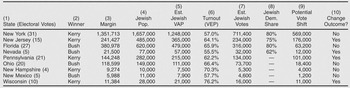
These nine states are the ones in which it is numerically possible that the votes of Jewish citizens were decisive, in the sense that if those who voted for the eventual winner of the state's plurality had voted for the other major-party candidate, the results might have changed, placing the state's electoral votes in the other column.Footnote 38 Simulating this possibility requires several assumptions and calculations, which are presented in table 1. (Table 1 lists states in descending order of Jewish population percentage.) First, it is necessary to estimate the voting-age share of the Jewish population (those 18 and over). Each states' voting-age Jewish population was estimated by assuming that the percentage of population 18 year of age or over was the same for the state's Jewish population as for the state's total population as reported in the 2000 Census. These estimates are shown in column 5 of table 1.
Estimate/simulation of Jewish pivotal voting, 2004 presidential election

Not all of a state's voting-age residents actually vote, however, so we must estimate the proportion of each state's Jewish residents who actually voted. To estimate this figure, I assume that Jewish voting-age residents of a state turned out at the same rate as the state's overall voting-eligible population, which filters out those voting-age residents who are ineligible to vote because of citizenship, felon status, or another reason.Footnote 39 I use voting-eligible turnout rather than voting-age turnout for several reasons. Jewish voting-age residents are very likely to be eligible to vote because they are very likely to be citizens. Jewish-Americans are probably more likely than average to turn out to vote on the basis of generally above-average education and income, so using the higher turnout rates calculated using voting-eligible rather than voting-age population probably more accurately reflects Jewish voting behavior. This approach, then, runs less risk than the alternative of systematically underestimating Jewish voting strength and thus falsely finding that Jewish voters were not decisive in any given state. This produces an estimate of the total number of Jewish voters in the state, reported in column 7 of table 1.
The next step in the simulation is an estimate of how those Jewish voters voted, and how many additional votes they would have produced for the losing candidate in the state if all of them had voted for that candidate. For this estimate, I use the estimated Democratic vote of Jewish voters in the state as reported from election-day exit polls, reported in column 8 of table 1. (For some states, there were too few Jewish voters in the survey to produce a statistically reliable estimate of Jewish vote choice at the state level, indicated by a dash in column 8; in these cases, I assume that the state's Jewish voters voted the same way as those in the national exit-poll sample, 75 percent for Senator John Kerry, the Democratic nominee.) Column 9 reports the estimate of the votes that would have been transferred to the loser if every Jewish voter in the state had voted for him. In states won by Kerry, this is calculated by multiplying the total Jewish vote by the Jewish Democratic vote share. In states won by Bush, the calculation is the reverse: total Jewish vote multiplied by the Jewish Republican vote share (assumed to be 1—[Democratic vote share]). Finally, column 10 indicates whether or not, if this had happened, the outcome in the state would have been reversed. If the additional votes for the loser equal more than half of the state's total margin, reported in column 3, the conclusion is that the outcome would have been reversed (because these votes represent votes taken away from the winner as well as added to the loser). These results reveal that in four of the nine states the result would have been reversed if every single Jewish voter in the state had voted for the losing candidate: New Jersey, Nevada, Pennsylvania, and Wisconsin. In the other states—importantly including New York, Florida, and Ohio—Jewish voters could not have affected the state's outcome.
The first critical conclusion to draw from this exercise is that it is simply mathematically impossible for Jewish voters to have been decisive in the 2004 presidential election. If every Jewish American who voted had voted for Kerry (as almost all of them did), Bush would still have won. Of the states that President Bush won in 2004, only Nevada was in play based on the disposition of Jewish voters. Nevada's five electoral votes, however, were well within the cushion of Bush's Electoral College majority. Had he lost those electoral votes because Jewish voters in Nevada deserted him, he would still have won the presidency. Senator Kerry, by contrast, had much more to lose from alienating Jewish voters, although perhaps less than Mearsheimer and Walt imply; he stood to lose 46 electoral votes (15 from New Jersey, 21 from Pennsylvania, and 10 from Wisconsin) if Jewish voters had defected en masse from their traditional partisan loyalty. Although this outcome would have deprived Kerry of any hope of winning the election, it would still not have changed the election's overall outcome.
At the same time, however, these results do seem to confirm, arithmetically at least, Mearsheimer and Walt's supposition that Jewish voters might, under the right circumstances, be decisive in presidential elections, and that this pivotal position might have policy consequences.Footnote 40 We can imagine a presidential election that was even closer than the 2004 election, in which the national outcome hung on the vote count in a state where the margin was small enough and the Jewish population large enough that a plausible swing of Jewish votes could have changed the outcome. (In fact, we have lately experienced just such an election; a careful analysis of the results in Florida in 2000 have shown that in the heavily Jewish counties of South Florida enough votes meant for Al Gore were miscast for Pat Buchanan because of the “butterfly ballot” to have altered the result. In such freakishly close elections, however, all bets are off; any random perturbation might change the results, as it evidently did).Footnote 41 But it also suggests that Democratic presidential candidates have a great deal more than Republicans to lose by alienating Jewish voters, although history suggests that it is hard for them to do so. Accordingly, the simulation suggests that the incentive to protect Jewish votes was severely imbalanced between the candidates in 2004. Moreover, even the possibility of such a reversal is predicated on the expectation that Jewish voters would deviate substantially from long-held, stable electoral loyalty to the Democratic Party. Democratic presidential candidates, then, do have a nontrivial incentive to avoid crossing Jewish voters, although it is not clear how precisely pro-Israel rhetoric and policy map onto this goal.Footnote 42 For Republican candidates, however, this electoral incentive appears rather weaker. Given these results, it might be interesting to look more closely at the candidates' campaign strategies in the few battleground states that this analysis suggests were legitimately in play to see if Bush or, more pertinently, Kerry sought to target an Israel-based appeal at Jewish voters and if commitments made in this context affected subsequent policymaking. But in the end, George W. Bush's victory (in 2004, at least) did not depend on Jewish votes, making it hard to explain his pro-Israel policy stance as a function of electoral pandering to Jewish voters. At the very least, these observations are not promising for the hypothesized causal connection between pivotal Jewish votes and policy influence (although a fuller test would, of course, examine this question over many elections).
Public Discourse: The Media, Think Tanks, and the Academy
One of the central preoccupations of pro-Israel actors, in Mearsheimer and Walt's rendering, seems to be the shaping of public discourse about Israel and the Middle East in a number of venues, particularly the media, the world of professional public policy research, and college and university campuses. The general themes of these sections of the book are similar: the lobby tries to stifle free and open debate about Israel and the Middle East in each of these venues, and it generally succeeds either because its members dominate the relevant institutions or because it uses pressure tactics to discipline, blackmail, or otherwise lean on others who have the temerity to criticize Israeli policy or behavior or American support for Israel. These sections of the argument display the same general lack of systematic data and lapses of logic as those on Congress and the executive branch, as well as highlighting some other important limitations. At the same time, however, they also point to a more subtle—and more promising—approach to understanding the potential policy influence of pro-Israel actors that depends more on the capacity to shape the terms of policy discourse rather than direct power over policy decisions.
First, these sections are full of apparent selection bias in the presentation of evidence. The discussion of the media, for example, mentions a number of nationally prominent publications that display a pro-Israel editorial bias: the New York Times, the Washington Post, the Wall Street Journal, the Los Angeles Times, the Chicago Sun-Times, the Washington Times, Commentary (which is published by the American Jewish Committee), the New Republic, and the Weekly Standard (170–72). A similar accounting of pro-Israel think tanks appears several pages later (175–77). These lists may indeed indicate that there are some serious journalists and foreign-policy scholars and analysts with pro-Israel preferences, but this fact by itself indicates neither “bias” nor influence. Without some account of how these lists were arrived at and whether they are somehow representative of a larger phenomenon that cuts across the entire population of media outlets, think tanks, or other relevant venues, we should hesitate before taking these data as anything more than suggestive. Moreover, it is not clear whether these organizations and the individuals who inhabit them are themselves part of the lobby or merely subject to its influence, rendering the causal significance of this evidence somewhat murky. In the case of news coverage, there is some evidence of the kind of activity in which pro-Israel actors engage to try to influence Middle East coverage, such as letter-writing and e-mail campaigns and boycotts directed against news outlets whose reporting is deemed anti-Israel (172–73), and there is similar evidence that some university professors have, in some instances, been identified for similar treatment (179–80). But the evidence presented does not demonstrate at all systematically that these activities had an observable effect on the content or valence of the Middle East reporting or on teaching and research in universities. Did the individual news outlets, reporters, or faculty members who were targeted by these activities change their behavior in response? Was the aggregate balance of reporting or teaching affected? These questions remain unanswered.
A second limitation of these sections is a lack of clarity about the ultimate impact of these activities. Even assuming, for the sake of argument, that public discourse is different than it might otherwise be due to the behavior of pro-Israel actors, it is not clear what effect this fact is likely to have on the policymaking process. Underlying this section of Mearsheimer and Walt's argument is a presumption that if news coverage, policy research, and academic discourse on the Middle East were “unbiased,” policy would somehow come out differently. But this is far from self-evident. In his landmark study of American policymaking, John Kingdon found that academics, researchers, and the media, while important, are clearly of rather limited independent importance in shaping the national agenda and determining the direction of policy.Footnote 43 More focused studies of the media's impact on policymaking have found that media coverage does not affect what people think about public issues as much as it frames public discussion of issues; by presenting the news in a certain way, media coverage can activate beliefs or understandings that people already hold and affect the importance they attach to a particular issue, but it will generally not induce them to change their minds altogether about an issue on which they already have relatively settled views.Footnote 44 Finally, recent research on think tanks and their effect on policymaking has found that think tanks with clearly ideological or one-sided missions tend to have a smaller impact precisely because the policy research they produce comes with a known ideological predisposition, which allows policymakers to dismiss it more readily if the predisposition does not fit their own.Footnote 45 Think tanks, consequently, often preach to the converted. In sum, the claims about the lobby's influence on American policy discourse do not seem to be supported systematically by Mearsheimer and Walt's evidence, but neither can they be clearly refuted. In fact, these factors point to the most plausible and suggestive account of the lobby's influence on American politics and policymaking, through the shaping of public discourse that frames policy debates regarding Israel and the Middle East, a point to which I return in the conclusion.
Anti-Semitism
The final causal mechanism that Mearsheimer and Walt posit, and the lobby's ultimate weapon in the battle for the hearts and minds of American policymakers, is the tendency to equate anti-Israel sentiments with anti-Semitism, which, if true, would understandably create a chilling effect for many potential entrants into this debate. “Anyone who criticizes Israeli actions or says that pro-Israel groups have significant influence over U.S. Middle East policy stands a good chance of being labeled an anti-Semite,” they write (188), although their discussion of this subject contains only a handful of specific examples of this phenomenon involving such public figures as former President Jimmy Carter and Francis Fukuyama (193–94). (To be fair, as they point out (193–94), Mearsheimer and Walt themselves were the victims of this unfortunate tactic after the publication of their London Review of Books article in 2006.Footnote 46) In most of these high-profile cases, as they also point out, the tactic was singularly unsuccessful as a means of silencing its intended targets (195–96). More to the point, however, they offer very little in the way of systematic empirical analysis that shows a causal connection between this threat and the behavior of would-be critics of Israel or American policy toward Israel.
Much of this section is devoted to a discussion not of this phenomenon in the United States but rather of anti-Semitism in Europe (188–90). The purpose of this discussion seems to be to establish that European societies are more tolerant of anti-Israel discourse not because they are, as some suppose, more tolerant of anti-Semitism but because European political elites are not in thrall to an Israel lobby equivalent to the American one. They point, for example, to the decline in anti-Semitic violence in France between 2004 and 2005 (188), although they neglect to mention that 2004 saw the largest number of anti-Semitic incidents recorded in recent memory and that the 48 percent reduction in incidents between 2004 (974 incidents) and 2005 (504 incidents) still meant that anti-Semitic “actions and threats” were at a historically high level in 2005.Footnote 47 Between 1995 and 1999, France averaged 98 recorded incidents of anti-Semitism per year, with no more than 118 in any single year (1996); between 2000 and 2005, the annual average was 663 incidents. Since 2000, more French Jews than French immigrants have been injured as a result of such violent incidents.Footnote 48 This is hardly a picture of a society in which anti-Semitism is an insignificant matter; the French government, after all, feels compelled to report regularly on anti-Semitism in France and to take punitive action against its effects.Footnote 49 Moreover, recent research has found a strong and robust association between anti-Semitism and anti-Israel sentiment in ten western European countries (including France).Footnote 50
In any event, this discussion has little bearing on either the tendency of pro-Israel actors in the United States to play the anti-Semitism card or the question of whether this tactic has the effect that they suggest, to stifle criticism of Israel or of American policy that would otherwise find a hearing and, as a consequence, to affect policy. This ambiguity once again raises the possibility that the lobby's influence takes a “softer,” more indirect form, through the shaping of the boundaries of policy discourse rather than the control of policy actors and the direction of policy decisions.
The Empirical Argument
The final major section of the book is devoted to an empirical demonstration of these effects at work in a series of American policy decisions. Mearsheimer and Walt examine six cases of policymaking: 1) the Bush administration's decision to back off from its stance of pressure against Israeli policy in the occupied territories between 2001 and 2003; 2) the decision to invade Iraq in 2003; 3) the abandonment of the policy of “dual containment” of Iran and Iraq and the move toward a more aggressive assault on nondemocratic regimes in the Middle East, particularly 4) Syria, 5) Iran, and 6) Lebanon. Each of the elements of the theoretical argument outlined in the book's previous section is on display in these case studies, in which Mearsheimer and Walt attempt to show how they cumulate to direct overall American Middle East policy in a decisively pro-Israel direction. In this section, Mearsheimer and Walt purport to offer concrete evidence of the Israel lobby in action and, in particular, evidence that on these issues “the lobby successfully pressured Bush to change course and to adopt its policy preferences instead” of alternative policies preferred by much of the foreign-policy, defense, and intelligence establishment (202). In each case they examine briefly the course of events leading to a policy decision, and in each case they conclude that pressure applied by the lobby was the decisive factor in shaping policy. On the issue of President Bush's shifting rhetoric toward Israeli policy in the occupied territories, they write that “the lobby's influence was one of the central reasons for this shift” (204), and suggest that “[Israeli Prime Minister Ariel] Sharon and the lobby [took] on the president of the United States and triumphed…. But it was the pro-Israel forces in the United States, not Sharon or Israel, that played the key role in thwarting Bush's efforts to promote a more evenhanded policy” toward the Palestinians (211). On Iraq, they write that “the war was motivated at least in good part by a desire to make Israel more secure” (231). The broader transformation of Middle East policy following the invasion of Iraq, they suggest, came about because “Israeli leaders, neoconservatives, and the Bush Administration all saw war with Iraq as the first step in an ambitious campaign to remake the Middle East” (259). They attribute the passage of the 2003 Syria Accountability Act, which imposes sanctions against Syria to counter its sponsorship of terrorism and its effective occupation of Lebanon, to the lobby. “The story here,” they write, “is a simple one: without the lobby's influence, there would have been no Syria Accountability Act and U.S. policy toward Damascus would have been more in line with the American national interest” (279). They argue, also, that the lobby is responsible for escalating American saber-rattling against Iran: “Israel and the lobby … are the central forces today behind all the talk in the Bush administration and on Capitol Hill about using military force to destroy Iran's nuclear facilities…. Were it not for the lobby, the United States would almost certainly have a different and more effective Iran policy” (282). And finally, they argue that “the lobby played the critical role in keeping the United States firmly aligned with Israel” during the latter's military conflict with Lebanon during the summer of 2006 (334). These case studies do, indeed, seem to show a consistent pro-Israel stance in American foreign and defense policy over the last four years or so. But for many of the reasons I have already catalogued, they do not amount to a convincing causal argument about the effects of the Israel lobby.
The principal flaw in Mearsheimer and Walt's empirical argument stems from the lack of variation in the evidence with which they attempt to show the lobby's influence. In order to substantiate their causal claims about the sources of American Middle East policy, Mearsheimer and Walt would need to present evidence that clearly represents the full range of actually existing combinations of pro-Israel pressure activity and pro-Israel outcomes at various levels. Schematically, one could imagine that it might be possible to measure any instance of policymaking according to the level of pro-Israel pressure it entailed and classify it as either low or high. One could classify any policy according to its level of favorability toward Israel. Thus each policymaking instance could be classified on each of two dimensions, as represented graphically as in figure 1; each episode can be assigned a single location on the diagram corresponding to its level of pressure (on the horizontal axis) and the “pro-Israelness” of its outcome (on the vertical axis). Mearsheimer and Walt's basic hypothesis—that greater pressure leads to more pro-Israel outcomes—is represented by the diagonal line in figure 1; if they are right, then were we to plot the location of all instances of Middle East policymaking (or a representative sample of them) on the figure according to these two measurements, the preponderance of the cases should fall more or less along this diagonal. That is, there should be a lot of high-pressure/pro-Israel cases and low-pressure/anti-Israel cases, and relatively fewer high-pressure/anti-Israel or low-pressure/pro-Israel cases.
The “Israel Lobby” argument

But in order to show convincingly that this is, in fact, the case, Mearsheimer and Walt would have to present a sample of evidence that is reasonably certain to include cases from every one of these combinations, if they exist. In order to have faith in their conclusions, we need to be confident that in collecting and presenting their data, they have allowed for the possibility that episodes in the “wrong” quadrants—high/anti and low/pro—would show up. If they allow for this possibility and these cases don't show up in large numbers compared with cases on the diagonal, then we might confidently conclude that pressure and outcomes are related as they hypothesize. In order to instill this confidence, they would have to explain how and why they selected the evidence that they choose to present—both the anecdotes they use to illustrate their theoretical points and the slightly more extensive case (though hardly very detailed) case studies of policymaking that constitute their empirical argument. This they do not do. Moreover, when we plot the evidence they do offer on the diagram represented in figure 1, nearly all of it falls in the upper right, high-pressure/pro-Israel. No causal inferences are possible from these data because we simply have no way of knowing what happens when levels of pressure vary or whether all instances of high pressure result in pro-Israel outcomes. To the extent, moreover, that there is any contrary evidence in the book, it tends to suggest that there are times when pro-Israel pressure does not, in fact, always produce ostensibly pro-Israel outcomes—the failure (thus far) to induce Congress to place speech-based restrictions on Middle East research funding to universities (181), for example, or the suggestion that the lobby has not had much effect on American policy toward Iran (281–82). There is nothing in the book that allows us to assess what happens when pro-Israel pressure occurs at lower levels. Finally, it is not hard to find major policymaking episodes that seem to occupy the other three quadrants of the diagram. Take, for example, the cases I mentioned in passing earlier: the recognition of Israel in 1948, the Suez crisis of 1956, and the AWACS sale to Saudi Arabia in 1981. The first, recognition, would seem to be a low-pressure/pro-Israel case; the second, Suez, a low-pressure/anti-Israel case; and the third, AWACS, a high-pressure/anti-Israel case, as represented in figure 2. Given the apparent existence of ample historical variation on both key dimensions of their argument, the appearance of selection bias in their evidence rather severely hampers their ability to make causal inferences connecting the lobby with policy outcomes and casts severe doubt on central claims of Mearsheimer and Walt's argument for the lobby's direct power.Footnote 51
Variation in pressure and policy

Conclusions
It is quite clear that the book's argument does not support Mearsheimer and Walt's central contention, that the existence and activities of an Israel lobby are the primary causes of American policy in the Middle East. The claim is supported neither by logic nor evidence nor even a rudimentary understanding of how the American policymaking system works. Several questions remain, however. If the unified Israel lobby of Mearsheimer and Walt's analysis is not the prime mover in shaping American foreign policy toward the Middle East, what alternative explanations might account for these policy outcomes?
Mearsheimer and Walt have already implicitly considered and rejected the standard realist account of foreign policymaking, which posits that states (or at least powerful states) will generally act in the international arena on the basis of their material security interests as shaped by the international system. It is the apparent deviation from this theoretical expectation, in fact, that motivates the book's core analysis. But given the discovery that domestic politics has intruded on policymaking, several alternative approaches that might be profitably considered alongside Mearsheimer and Walt's blunt interest-group approach suggest themselves.
There is a somewhat simpler version of the interest-group-centered explanation of Middle East policy outcomes, to which Mearsheimer and Walt allude, that might, at first blush, work better. “In a democracy,” they write, “even relatively small groups can exercise considerable influence if they are strongly committed to a particular issue and the rest of the population is largely indifferent” (140). All public policies, of course, confer benefits on some actors and impose costs on others, and the nature of policymaking in different policy domains often depends on how widely or narrowly distributed those costs and benefits are.Footnote 52 In this case, Mearsheimer and Walt are undoubtedly right that the benefits of pro-Israel policy are particularly concentrated among those American voters whose intense policy preferences for pro-Israel policy are thereby satisfied, while the costs of that policy are widely dispersed across the population, most of whom are consequently indifferent to policy outcomes. This scenario does typically produce strong and intense interest organization on the part of the policy's proponents and little organized opposition. But note that in this schematic understanding of the policymaking world, the organization of interests is understood to be a consequence rather than a cause of the characteristics of the policy realm in which it operates.Footnote 53 This theoretical perspective might predict outcomes similar to those Mearsheimer and Walt highlight—consistently pro-Israel policy, subdued public discussion, and displacement of conflicts over policy from the material dimension to the moral or ethical (that is, attempts to debate policy might easily devolve into name-calling precisely because the material stakes for most people are so low that they cannot be mobilized into active opposition on the basis of the policy's active harm to them).Footnote 54
But policymaking in such situations is often dominated not by the highly public and often acrimonious debates that seem to characterize Middle East policymaking (at least in Mearsheimer and Walt's telling) but by quiet and generally harmonious networks of relationships among interest groups and policymakers who share goals that few others care about, as well as repeated logrolls among a number of such groups, who agree to support each others' favored policies at little net cost to themselves. In such policy subsystems, moreover, the goals of interest groups and policymakers are generally closely aligned and it is often not clear who is serving whom—whether policymakers are doing the bidding of interest groups or vice versa. As a result, this perspective by itself does not generate clear theoretical predictions about the causal mechanisms that might connect group activity to policy outcomes.
To what other factors might we attribute the pattern of American policymaking toward Israel? One plausible alternative approach might be based on public opinion and its role in shaping policymaking. Correspondence between the policy preferences of the mass public and the policymaking behavior of elected representatives is notoriously weak in the United States, a finding that is generally attributed to low levels of information and sophistication on the part of American voters.Footnote 55 But more recent research has shown that in the aggregate, American public opinion about major policy issues is reasonably stable and that policy generally corresponds to the broad outlines of national opinion and that when opinion changes significantly, policy changes usually follow.Footnote 56 This perspective would at least provide a set of competing hypotheses about the relationship between public opinion and policy that would challenge the Israel lobby account.
A second alternative might focus more comprehensively than Mearsheimer and Walt do on the institutional structure of the American political system and the particular discipline that this structure imposes on policymaking, including foreign policymaking. Such an account might consider some of the institutional patterns discussed above, considering for example the organizational structure of Congress or the relations between Congress and the presidency. Institutional accounts might emphasize the veto points inherent in American policymaking, the many opportunities that advocates of alternative policies have to shape the policymaking process and its outcomes. This complexity inherent in the separation of powers tends to bias American policymaking away from dramatic change and toward incrementalism and the status quo. Major policy change is relatively rare (precisely because it is hard), but it generally endures and enjoys wide legitimacy because, as David Mayhew has put it, the enactment process is “so strenuous, dramatic, and crystallizing.”Footnote 57 Moreover, recent research has shown that policy is often path-dependent, that once a policy direction is established it becomes harder to dislodge and that early incremental choices can become increasingly significant over time.Footnote 58 In this view, we might expect that early patterns of policy toward Israel and the Middle East would set the template for later policy directions and that dramatic changes in policy would occur only under unusual conditions (or at least we would have to specify a causal mechanism for policy change).Footnote 59 In this picture, for example, foreign-policy decisions taken during the Cold War—when Mearsheimer and Walt acknowledge that there was a sound strategic logic behind support for Israel as a check against Soviet expansionist designs in the Middle East (51–58)—might have established a pattern of policy that became increasingly difficult to adjust over time, even when the Cold War ended.Footnote 60 At any rate, assessing this approach would require a careful examination of policy over time.
Mearsheimer and Walt's own evidence suggests yet another alternative approach, focusing on a more careful delineation of the meaning of power, that deserves particular attention. Most of Mearsheimer and Walt's argument presumes that power means the ability of one set of actors, in this case the Israel lobby, to impose its preferences on other actors, policymakers, who do not share those preferences.Footnote 61 But the parts of the argument that draw on this understanding of power are, for the most part, demonstrably false. The Israel lobby does not appear to wield extraordinary influence on the visible mechanics of American policymaking through any of the pathways that Mearsheimer and Walt examine, particularly Congress and the executive branch. Critics have argued, however, that power has multiple faces. In addition to this first, overt, face, power can be exerted in more hidden ways, by controlling the agenda of matters that are available for debate and decision (the “second face of power”) and by so shaping the ideological environment that certain ideas or proposals are considered outside the legitimate or taken-for-granted bounds of discussion (the “third face”).Footnote 62
These understandings of power suggest an alternative approach to conceptualizing the lobby's influence on American policy toward Israel and the Middle East. Despite the lobby's limited direct power over American policy choices, it seems more plausible to observe that American Middle East policy is made in a context that discourages robust debate about the costs and benefits of support for Israel compared against other policy options. Given Mearsheimer and Walt's provocative but ultimately inconclusive arguments about the lobby's potential influence over public discourse about American Middle East policy, it would be reasonable to hypothesize that pro-Israel actors, both inside and outside of government, make it very hard—or at least very costly—for public officials to be openly critical of Israel or of pro-Israel policy choices, with the consequence that policy debate in the United States is limited and stilted, as Mearsheimer and Walt justly lament. There might, of course, be numerous reasons for this state of affairs: public opinion; the cumulative, historical effect of past policy; or the continuing and active vigilance of pro-Israel actors in much the way Mearsheimer and Walt chronicle. These subtle and interesting possibilities deserve considerably more attention than they have received. Investigating such pathways of power is a notoriously difficult enterprise because it requires careful and nuanced attention not only to decisions but also to non-decisions, actions either contemplated but not taken or not contemplated at all, as well as to the ways in which those boundaries of legitimate discourse are constructed over time.Footnote 63
I offer these alternatives not to propose a comprehensive account of American policy toward Israel but merely to suggest the range of possible explanations that might plausibly enjoy theoretical grounding and empirical support and to suggest several directions that seem, on their face, to be more promising explanatory avenues than the crude interest-group theory that Mearsheimer and Walt offer. Recent research on American foreign policymaking, in fact, suggests that side-by-side assessment of multiple potential explanations—encompassing interest groups, public opinion, and expertise, among other factors—can provide more subtle and convincing accounts of foreign policy outcomes than single-cause explanations, which are susceptible to bias and distortion.Footnote 64 Mearsheimer and Walt do not seem, at any rate, to have considered alternative explanations and they do not deploy their evidence in ways that show convincingly that their explanation provides a better account for some range of outcomes than one of these alternatives (or any other alternative).
Mearsheimer and Walt pose a set of deep and provocative questions about who wields power in American politics and policymaking. Although their own answer is unconvincing, they challenge the discipline to take up (and take seriously) these questions—both about the particulars of American foreign policy toward Israel and the Middle East and more generally about the pathways of power in American politics, a venerable topic that is happily now receiving renewed interest in political science.Footnote 65 If their enterprise—and the reaction it has occasioned—start a more robust and substantive conversation about either or both of these things, and thereby open up new directions of scholarly inquiry and public debate on these terribly important issues, it will have been a worthwhile enterprise.