The East Asian authoritarian developmental state, in which aggressive policy intervention is a key feature, has been central to our understanding of successful industrialisation in several East Asian economies. It is believed that these states, born out of East Asian ruling elites' desire for political survival, cannot last, as the effectiveness of the state in engineering rapid growth may inevitably be undermined by the rise of social forces in the development process (Castells, Reference Castells, Appelbaum and Henderson1992).Footnote 1 Numerous studies have supported this proposition by drawing on the examples of South Korea and Taiwan. For these two newly industrialised economies, the state's capability to direct economic development has been undermined by the rise of various social actors (mainly large business owners and organised labour) during the processes of economic liberalisation and democratic transformation.
The Korean developmental state had already exhibited signs of decline in the early 1980s as the state became increasingly incapable of managing policy pressure from large businesses (Moon, Reference Moon and Macintyre1994; Kim, Reference Kim1997). A rapid decline of the developmental state occurred in the early 1990s when both chaebol and organised labour became assertive over the state's economic decision-making, a change which many analysts held responsible for the country's economic disaster in 1997 (Kim, Reference Kim1999; Minns, Reference Minns2001; Clark and Jung, Reference Clark and Jung2002; Heo and Tan, Reference Heo and Tan2003). In the post-crisis period, despite a temporary revival, the state could no longer operate on the principle of developmentalism as it had done in the past (Kim, Reference Kim2005; Cherry, Reference Cherry2006; Hundt, Reference Hundt2014). In Taiwan, the Taiwanese state largely retained its dominant position vis-à-vis business elites and organised labour. Its superiority was demonstrated in the country's satisfactory economic performance during the Asian financial crisis (Tan, Reference Tan, Horowitz and Heo2001; Clark and Jung, Reference Clark and Jung2002; Heo and Tan, Reference Heo and Tan2003). A major transformation of the developmental state occurred in the post-2000 period during which the state lost most of its capability to direct economic development and could no longer insulate its economic policy-making from major societal interests (Wu, Reference Wu2007; Tan, Reference Tan, Paolino and Meernik2008, Reference Tan2009; Chu, Reference Chu2011).
While these institutional changes have been well-documented, little attention has been paid to the actual transformation process of the developmental state. One study by Heo and Tan (Reference Heo and Tan2003) has explored the developmental state's transformation process. They argue that East Asian ruling elites' economic policy choices shape the industrial structure of a country, which in turn affects the capabilities of business and labour actors to challenge the state's economic decisions. In particular, they identify two distinct types of industrial structure: concentrated industrial structure and dispersed industrial structure. While a concentrated industrial structure shaped by the Korean military regime's policy preference led to the emergence of concentrated business and labour interests that were more capable to challenge the state, the dispersed industrial structure shaped by the Taiwanese elites' policy preference gave rise to dispersed economic interests that produced limited political influence to reshape the state in Taiwan.
This paper extends Heo and Tan (Reference Heo and Tan2003)'s efforts to understand the developmental state's transformation process. I argue that the emergence of either concentrated or dispersed economic interest groups shaped by a country's industrial structure constitutes only half the story of the state's transformation process. To offer a full explanation to the state's transformation process, we need to understand a specific political process – the democratic transition of a countryFootnote 2 as initiated by ruling elites. This process includes two consecutive strategic choices made by East Asian ruling elites. The first elite choice concerns political choices to end an authoritarian rule in response to the democratic mobilisation of the middle class (with or with the working class as an ally). The second elite choice concerns the decision to introduce democratic elections in response to the emergence of an electoral threat from opposition elites. A democratic transition of a country motivated by the strategic calculations of ruling elites contributes to the transformation of the developmental state by altering the political foundation of the state.
This understanding contributes to current studies on the transformation of the East Asian developmental state. Most studies have focused on the emergence of business elites and organised labour to explain the decline of the state in economic development. I will highlight the crucial role played by another type of social actor – the middle class – in transforming the developmental state. Compared to business elites and organised labour who directly challenge the state's policy-making, the middle class indirectly contributes to the transformation of the developmental state by forcing East Asian ruling elites to democratise the political system of a country.
The paper is organised as follows. In the next section, I introduce a theory of the transformation of the developmental state. Particularly, I elaborate my elite-choices hypotheses to explain the democratic transition in a developmental state. Using case material from South Korea and Taiwan, I then test these hypotheses to show how elite-led democratic transition is an important part of the developmental state's transformation process.
1. A theory of the transformation of the developmental state
1.1 The rise of the developmental state and the formation of the industrial structure of a country
It is argued that the rapid development process promoted by the state through aggressive government policy intervention is a typical strategy of East Asian ruling elites to achieve performance-based legitimacy through a combination of political control and economic promotion (Castells, Reference Castells, Appelbaum and Henderson1992; Doner et al., Reference Doner, Ritchie and Slater2005). The adoption of the survival strategy requires the ruling elites to build an authoritarian system to impose political control and to create a core policy-making of the state to spearhead the development process (Castells, Reference Castells, Appelbaum and Henderson1992). The creation of the two types of political institutions ensures the state's autonomy in formulating growth-first policies; while a core policy-making agency ensures the formulation of optimal policies, an authoritarian political system insulates the state's economic agendas from societal interests (Johnson, Reference Johnson1982, Reference Johnson and Deyo1987; Amsden, Reference Amsden1989; Wade, Reference Wade1990). In East Asia, the autonomous state converts its strength and autonomy into coordinating capacity by entering a state-led cooperative relationship with the private sector to ensure the effectiveness of the state's policy intervention (Evans, Reference Evans1995; Weiss, Reference Weiss1995; Chibber, Reference Chibber2003).
The need for political legitimacy motivated East Asian ruling elites to construct institutional arrangements for promoting economic growth; but how do they make their economic policy choices within a state-led development? As I have noted, ruling elites' creation of an institutional arrangement for effective market intervention was a typical strategy to generate performance legitimacy and achieve regime survival in the post-war period (Castells, Reference Castells, Appelbaum and Henderson1992; Doner et al., Reference Doner, Ritchie and Slater2005). Economic policies formulated under this arrangement are thus consistent with ruling elites' logic of achieving political survival shaped by specific historical and domestic situations (Chu, Reference Chu and Pempel1999b; Tan, Reference Tan, Horowitz and Heo2001; Heo and Tan, Reference Heo and Tan2003).
An unintended consequence of the state's industrial policies generated within the state's institutional arrangement is the formation of the industrial structure of a country. Through the allocation of financial resources, state policies can shape the percentage of domestic private capital concentration (DPCC) and state-owned enterprises (SOEs) in an economy (Fields, Reference Fields1995).Footnote 3 While the concentration of financial resources on a small number of private firms leads to a high percentage of DPCC, the restriction of the provision of financial resource to the private sector results in a low percentage of DPCC coupled with a relatively high percentage of SOEs.
1.2 Economic growth, the rise of political interest groups and democratic transition
The developmental state, born out of the ruling elite's strategy to generate performance-based legitimacy, cannot last forever. A major part of the transformation of the state is triggered by ruling elites' decision to initiate democratic transition to transform their old legitimacy formula. I call this process ‘transforming the political foundation of the developmental state’. This process involves two major elite decisions: (1) ruling elites' decision to end an authoritarian rule; and (2) ruling elites' willingness to introduce democratic elections.
The source of the first elite decision is the emergence of democratisation pressure in the development process. While Lipset (Reference Lipset1959) argues that economic development associated with increases in wealth, industrialisation, urbanisation and education cultivates a sizable urban middle class who are more independent from state interference and generally more pro-democratic, Rueschemeyer et al. (Reference Rueschemeyer, Stephens and Stephens1992) argue that capitalist development can also give rise to a politically active working class by supplying them with favourable conditions for organising labour movement.Footnote 4 Clearly, a rapid development process promoted by the state helps to create two pro-democratic social actors that are willing to challenge an authoritarian government.Footnote 5 But the question is, how will the middle and working classes push for the democratic transition? Studies argue that another type of political elite, opposition elites, can mobilise the two types of social classes to push for democratic transition. Collier (Reference Collier1999) notes that liberal opposition elites can mobilise the middle class to push for democratic transition, as the establishment of a liberal democratic political system can allow their class inclusion. The work of Luebbert (Reference Luebbert1991) shows that, attracted by the idea of liberalism, both the middle class and the working class can be mobilised by liberal opposition elites to collectively push for democratic transition to achieve their respective class inclusion.
With these insights in mind, we can now explain the emergence of democratisation pressure in developmental Asia. The emergence of pro-democratic middle and working classes provides East Asian opposition elites with an opportunity to challenge old authoritarian regimes. Adopting a liberal democratic agenda, they can successfully mobilise the two social classes to push for a democratic transition. Given the above discussion, we can conclude that a state-led development can lead to the democratic mobilisation of the middle class with or without the working class as an ally. There are two possibilities for this outcome. First, when both the middle class and the working class are mobilised, a cross-class alliance can be formed against an authoritarian state. Second, when the mobilisation of the working class is hindered by structural factors which cause the dispersion of domestic labour forces (as we will see in the case of Taiwan), only the middle class is mobilised to push for democratic transition.
To explain why ruling elites initiate the democratic transition, we need to understand their specific strategic calculation in response to the democratisation pressure emerging from a state-led development. According to Olson (Reference Olson1993), authoritarian rulers would allow democratic transition when they can no longer retain political control in a country. To Olson, initiating democratic transition can allow authoritarian rulers to prolong their political presence through power sharing. For East Asian ruling elites, the democratic mobilisation of the sizeable and political significant middle class for democratic transition (with or without the working class as an ally) creates a situation in which they can no longer retain political dominance. Their old legitimacy formula that is based on political control and economic promotion clearly can no longer function to ensure political survival. Therefore, ruling elites' decision to initiate a democratic transition to end the authoritarian rule becomes a strategic choice for them to form a new legitimacy formula that is based on the principles of democracy. After imitating a transition to a democratic political system, old East Asian authoritarian rulers can at least remain in the politics of a country to continue to compete for political power in a democratic context. Based on this discussion, I hypothesise that:
H1:
A democratisation movement pushed by the middle class (with or without the working class as an ally) can force ruling elites to initiate the democratic transition.
I now turn to the process of democratic transition following the ruling elites' decision to transform their legitimacy formula in response to the democratic mobilisation of the middle class. A major component of democratic transition is the formation of agreements among political elites (O'Donnell et al., Reference O'Donnell, Schmitter and Whitehead1986; Huntington, Reference Huntington1991). Thus, ruling elites' willingness to reach agreements with opposition elites matters in a democratic transition process. Boix (Reference Boix1999) argues that a key factor, electoral threat, plays an important role in incentivising a dominant ruling party to introduce democratic electoral rules. He argues that the introduction of democratic rules would allow ruling elites to ensure maximum political representation in the new electoral arena. The level of an electoral threat, according to Boix, is a function of two main conditions: the strength of the new parties and the capacity of the old ruling parties to coordinate among themselves to block the growth of new parties.
Boix's work offers historical guidance to explain the pace of democratic transition in developmental Asia. During the elite-negotiation process, East Asian ruling elites are likely to face a certain degree of electoral threat from opposition elites. This is due to two reasons: First, emerging as credible political parties in an authoritarian period, new opposition parties that are generally more liberal and progressive are capable of mobilising pro-democratic middle-class voters. Second, in the past, authoritarian institutions ensured the political dominance of the ruling elite. With the decision to end an authoritarian rule, the ruling elites certainly do not possess any effective tools to contain the growth of opposition parties. East Asian dominant parties are highly adaptable to new political situations associated with their electoral decline (Friedman and Wong, Reference Friedman, Wong, Friedman and Wong2008). It is therefore highly desirable for Asian ruling elites to adopt some forms of adaptions in response to the possibility of losing elections. Competitive democratic elections as a form of most basic democratic electoral rules would allow Asian ruling elites to ensure their maximum political representation in the democratic politics of a country. This discussion leads to my third hypothesis:
H2:
During a democratic transition, the higher an electoral threat posed by opposition parties, the greater willingness for ruling elites to introduce democratic elections.
1.3 Trade-driven growth, industrial structure and the emergence of economic interest groups
A concurrent political process behind the transformation of the developmental state is the emergence of business and labour interests. In developmental Asia, the growth of business and labour interests is an inevitable consequence of the export-oriented industrialisation engineered by the state. With the export expansion, both businesses and labourers become assertive over the state's economic decisions to defend their economic interests (Rogowski, Reference Rogowski1989). The rise of business and labour interests are capable of shaping the state's policy-making. While the capability of business elites to shape the state's economic decision-making comes from the importance of businesses to the economic performance of a country, the power of organised labour to shape state policies lies in the industrial actions of organised labour which can disrupt any economic performance of the state (Gourevitch, Reference Gourevitch1986).
The industrial structure of the country can shape the capabilities of economic interest groups to influence the state's economic policy-making. According to studies, the higher the degree of DPCC, the greater the capabilities of business elites and organised labour to challenge the state's economic decisions. The logic to explain this correlation works as follows. The concentration of domestic private capital facilitates the emergence of concentrated business and labour interest groups. Concentrated business interest groups are giant business actors who have greater power to influence the state because of their importance to a country's economy. Concentrated labour interest groups consist of large labour unions. Given their great mobilisation strength to launch industrial actions resulting from the concentration of industrial workers, concentrated labour interest groups also have a large bargaining power to influence the state's policy direction. In contrast, an industrial structure characterised by a low percentage of DPCC and a high percentage of SOEs creates the condition for the emergence of dispersed economic interest groups. Dispersed business interest groups predominantly consist of small business entities and a number of relatively large business groups who clearly lack the capability to demand state policy changes. Dispersed labour interest groups have limited strength to influence the economic decision-making of the state due to their limited mobilisation strength resulting from the dispersion of industrial workers in the private sector (Horowitz and Heo, Reference Horowitz, Heo, Horowitz and Heo2001; Tan, Reference Tan, Horowitz and Heo2001, Reference Tan, Paolino and Meernik2008, Reference Tan2009).
1.4 The emergence of state policy constraints and the transformation of the developmental state
My above theoretical discussion involves two sets of actors: political elites and social actors. Political elites include ruling elites and opposition elites. Ruling elites seek to achieve political monopoly through a combination of political control and economic promotion. Opposition elites can challenge the power monopoly of ruling elites by mobilising a democratisation movement. Social actors include economic and political interest groups. Business elites and organised labour are economic interest groups whose capabilities to influence the state's policies are shaped by the industrial structure of a country. The middle class and the working class are political interest groups who have desires for pushing the political system of a country towards a democratic direction to achieve their respective class interests: the middle class are concerned about protecting their socioeconomic benefits, while the working class are concerned about economic redistribution.
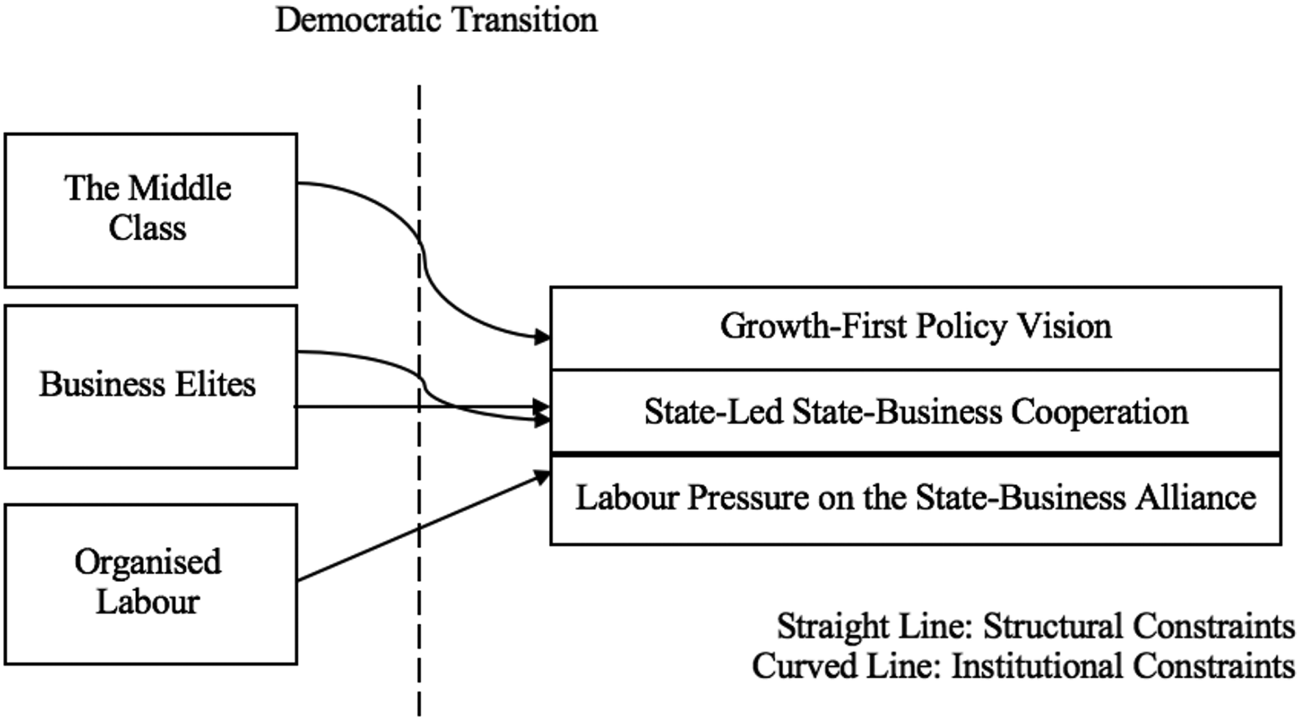
The political actions of these actors led to two political processes: (1) the emergence of economic interest groups affected by the industrial structure of a country; (2) a democratic transition initiated by ruling elites in response to the democratic mobilisation of the middle class. Figure 1 illustrates my argument. These two political processes can lead to the transformation of the developmental state by producing two types of state policy constraints: (1) structural constrains from business elites and organised labour; (2) institutional constraints from the middle class and business elites (see Fig. 2).
The transformation of the developmental state.

Economic Interests, Democratic Transition and State Policy Constraints.

Institutional constraints emerge as the democratic transition process initiated by ruling elites changes the context in which the state's policy-making occurs. In a democratic context, the power consolidation of the ruling elites requires the support of the two types of social actors: the middle class who offer political support (often in the form of voting) and business elites who offer political funding. The reliance of the ruling elites on business elites for political funding undermines state-led state-business cooperation (Lim, Reference Lim2009). The need of ruling elites to achieve electoral legitimacy also diverts the state from its growth-first economic visions.
The emergence of structural constraints occurs when the interests of business elites and organised labour can shape the state's decision-making. Given that the state's policy-making is insulated by the authoritarian political system in a developmental-state context, the democratic transition can facilitate the entry of business and labour interests into the state's decision-making process. Democratic transition not only intensifies business interests for lobbying, but also empowers the role of business interests in the state's more open decision-making (Kim, 1993; Tan, Reference Tan, Paolino and Meernik2008). The end of authoritarian rule also allows industrial workers to defend their economic interests through organisation of independent labour unions.
2. The rise of the developmental states, industrial structure, economic interests
2.1 How elites' economic policy shaped the industrial structure of the countries
In the post-war period, we saw the rise of the two developmental states in South Korea and Taiwan. In South Korea, the need for regime survival emerged after a military coup led by Park Chung-hee in 1961. In Taiwan, a similar kind of regime survival commenced after the Kuomintang (KMT)'s relocation to Taiwan. In both countries, we witnessed the ruling elites' adoption of a survival strategy based on a combination of political control and economic promotion. In Taiwan, the KMT's political control began with a party reform which led to the creation of an authoritarian structure in the early 1950s (Gold, Reference Gold1986; Chu, Reference Chu and MacIntyre1994; Dickson, Reference Dickson1997; Myers and Lin, Reference Myers and Lin2007). In South Korea, the initial mechanism for political control was created with the Korean Central Intelligence Agency (KCIA) as its core in the 1960s and was upgraded in the early 1970s with the ratification of the Yushin Constitution (Clifford, Reference Clifford1994; Oh, Reference Oh1999; Heo and Roehrig, Reference Heo and Roehrig2010; Han, Reference Han, B-K and EF2011; Kim, Reference Kim, Kim and Vogel2011). To promote economic growth, the state's economic policy-making were put into place in both countries. In South Korea, the Economic Planning Board (EPB) was established by the coup leaders in 1961 to direct industrialisation (Johnson, Reference Johnson and Deyo1987; Woo, Reference Woo1991; Oh, Reference Oh1999). In Taiwan, a series of state policy-making agencies were created to direct Taiwan's economic development at different stages (Gold, Reference Gold1986; Wade, Reference Wade1990; Cheng et al., Reference Cheng, Haggard and Kang1998; Wu, Reference Wu2005).Footnote 6
When launching their respective economic transformation projects, the two states emerged out of regime survival as the ruling elites pursued entirely different economic policy preferences: promotion of DPCC in South Korea and prevention of DPCC in Taiwan. In the following paragraphs, I will demonstrate how ruling elites' need for political survival played important roles in shaping the states' policy choices during two very crucial economic processes in South Korea and Taiwan: the two countries' initial push for labour-intensive export promotion and their industrial upgrading at a later stage of economic development.
Ruling elites' policy preferences diverged in the beginning of the two countries' industrialisation period. In South Korea, the elites' preference for promoting private capital concentration was shaped by the regime's decision to promote chaebol. To quickly kick off the development process in the early 1960s, the promotion of chaebol proved an inevitable policy choice of the military regime; the chaebol, created in the Japanese colonial period, was in possession of most essential economic resources including economic expertise, personnel and facilities (Kim, Reference Kim1976, Reference Kim1988; Fields, Reference Fields1995; Kim and Park, Reference Kim, Park, Kim and Vogel2011). In Taiwan, the émigré nature of the KMT regime shaped the state's preference in two sets of state policies in 1950. The first was a massive land and reform and the second was the state's promotion of SOEs. Both sets of state policies facilitated the political survival of the émigré regime; while the former aimed at boosting the popularity of the regime among the Taiwanese and eliminating all large indigenous businesses that could potentially challenge the KMT (Gold, Reference Gold1986; Ho, Reference Ho1987; Dickson, Reference Dickson1993; Wong, Reference Wong2003), the latter aimed to provide employment for their mainland support base (Fields, Reference Fields1995, Reference Fields and Gomez2002; Minns, Reference Minns2006: 206).
Specific political objectives of the ruling elites to achieve regime survival continued to shape the two states' policy choices in the 1970s, as both countries embarked on industrial upgrading processes. In South Korea, the promotion of chaebol became even more irreversible in the new stage of economic growth for the apparent reason that only chaebol could facilitate the state's ambition to embark on a heavy-chemical industry (HCI) drive, which was crucial for the regime to generate badly-needed performance legitimacy (Jung, Reference Jung1988; Kim, Reference Kim1988; Fields, Reference Fields1995; Kim and Park, Reference Kim, Park, Kim and Vogel2011). In Taiwan, the émigré regime's political goal was similarly not compromised in the 1970s. During this period, the political survival of the KMT became closely linked with a sector that had been neglected by the state in the 1950s and 1960s – the SME sector.Footnote 7 An SME strategy could not only drive economic growth, but it could also help the KMT generate political support among SME owners who were mainly native Taiwanese (Wu, Reference Wu2005). Consequently, while strengthening SOEs in heavy industries, the state launched a ‘joint project’ with the SMEs to promote high-tech industries (Gold, Reference Gold1986; Clark, Reference Clark1989).
In sum, the state's policy choice in the development process is closely linked with ruling elites' specific logic of political survival in the post-war period. In South Korea, the military regime's reliance on the country's major economic players, the chaebol, to generate economic growth made the state's preference for large businesses inevitable in the 1960s and the 1970s. In Taiwan, the KMT's need to generate popularity as an émigré regime pushed the Taiwanese state to adopt an entirely different developmental strategy. This was seen in the state's two policies (the land reform and SOE creation) in the 1950s and the state's projects to cultivate SMEs while promoting SOEs in the 1970s.
The state's initial push for export-led growth in the 1960s and industrial upgrading in 1970s shaped the industrial structure of the two countries. In South Korea, a concentrated industrial structure emerged by the end of the 1970s. In 1980, the top 50 chaebols contributed 49% of Korea's gross domestic product (GDP), more than half of Korea's total exports, and 18% of employment in the manufacturing sector (Haggard and Moon, Reference Haggard and Moon1990: 218). In contrast, a dispersed industrial structure had formed in Taiwan by the early 1980s. In the early 1980s, SMEs, the majority (nearly 98%) of Taiwanese enterprises, produced 65% of Taiwan's manufactured exports (Chou, Reference Chou1992). The private business groups only represented just over 10% of the total GNP (Fields, Reference Fields1995: 7).
2.2 The emergence of economic interests
An important process driving the transformation of the developmental state is the emergence of business and labour interests. In South Korea, the highly concentrated industrial structure gave rise to concentrated business and labour interests. In Taiwan, the industrial structure initially led to the emergence of dispersed business and labour interest groups, although privatisation would later lead to the emergence of more concentrated business interest groups and further marginalise labour interests in the private sector.
2.2.1 Concentrated and dispersed business interest groups
In South Korea, with a high percentage of DPCC, the state-led development process gave rise to concentrated business interest groups – the chaebol owners. Given their weight in the economy, the chaebol owners' strong capability to shape the state's policies was already demonstrated before the country's democratic transition. The Chun Doo-hwan regime's policy to reduce the concentration of the chaebols was unsuccessful because of the chaebol's open defiance of the state through the acquisition of new firms. Furthermore, the chaebol even reversed the government's specific industrial policy to promote Daewoo during the reorganisation of the HCI. The chaebol also successfully achieved financial independence during the process of financial reform (Kim, 1993, Reference Kim1997; Moon, Reference Moon and Macintyre1994; Zeile, Reference Zeile and Hamilton1996; Lee et al., Reference Lee, Lee and Lee2002).
Korean business interests remained highly concentrated in democratic Korea. In 2017, sales revenue earned by the top 10 chaebols accounted for 67.8% of the country's GDP; their assets equalled nearly 110% of GDP, with Samsung's assets alone accounting for 42% (Premack, Reference Premack2017:4). The chaebol's significant bargaining power was indisputable in the 2010s, when scholars raised the question of ‘whether top chaebol leaders are too big to indict, regardless of their behaviour’ (Haggard and Rhee, Reference Haggard and Rhee2017).Footnote 8
In Taiwan, the country's low percentage of DPCC in the 1990s gave rise to dispersed business interest groups that lacked the capability to challenge the state. The majority of Taiwanese business actors, mainly SME owners, moved their business abroad and became even more distant from the state policy process given their limited political influence to obtain favourable policies in an increasingly democratic Taiwan (Chu, Reference Chu and MacIntyre1994; Lam and Clark, Reference Lam and Clark1994; McBeath, Reference McBeath1998; Clark and Tan, Reference Clark and Tan2012). Within the Taiwanese economy, there were no business elites that could be considered as important as their counterparts in Korea. Their inability to contribute to state policy-making had already been evident in the 1980s, during which Taiwanese business elites had to rely on powerful SOEs to influence the state's economic agendas (Wang, Reference Wang1996; Wu, Reference Wu2005).
While the high level of DPCC remained unchanged in South Korea, the initial Taiwanese industrial structure shaped by the state's policies was transformed in the 2000s. A number of financial conglomerates, controlled by family-owned business groups, formed during the privatisation of state-controlled financial institutions (Clark and Tan, Reference Clark, Tan and Lee2010; Wang, Reference Wang2012). As a result of the emergence of these powerful financial conglomerates, a level of private capital concentration that was comparable to that of South Korea's chaebol had appeared in Taiwan by the late 2000s: the financial assets owned by the most prominent three family-owned business groups accounted for 65% of Taiwan's GDP (Tao and Chang, Reference Tao, Chang, Wang, Li and Kung2008: 231).
2.2.2 Concentrated and dispersed labour interest groups
In South Korea, the concentrated industrial structure resulted in concentrated labour interests and the emergence of a few strong chaebol-based labour unions. Following the country's democratic transition in 1987, the emergence of chaebol unions fundamentally transformed labour relations (Koo, Reference Koo and Koo1993, 2001; Chang, Reference Chang2009). These unions remained highly organised during Korea's structural reform in the post-crisis period. With powerful mobilisation resulting from their large membership base, organised chaebol workers successfully secured their job security and became ‘labour aristocrats’ in the process of neoliberal reform (Kim, Reference Kim2013).Footnote 9
In sharp contrast with the Korean case, private-sector labour interests are largely disorganised in Taiwan. The initial industrial structure, characterised by a low percentage of DPCC and a high percentage of SOEs, produced dispersed labour interest groups in the private sector. Given the dispersion of SME workers, Taiwanese labour activists faced enormous obstacles to organise labour unions in the private sector following the country's transition to democracy (Yu, Reference Yu1993; Minns and Tierney, Reference Minns and Tierrney2003; Ho, Reference Ho2006a). Taiwanese organised labour was dominated by SOE-sector labour unions that became increasingly organised in response to the threat from the country's privatisation process initiated in the late 1980s (Chiu, Reference Chiu2011; Ho, Reference Ho2012). Consequently, private-sector labour interests were further marginalised as SOE interests dominated the policy agenda of organised labour (Ho, Reference Ho, Wang, Li and Kung2008).Footnote 10
3. The transformation of the political foundation of the state
While the developmental state is affected by the emergence of economic interest groups which affect the state's economic policy-making, the state also changes as a result of the transformation of its political foundation. My hypotheses suggest that the transformation of the political system of a country involves two decisions by the ruling elites: (1) the decision to end authoritarian rule in response to the democratic mobilisation of the middle class; and (2) the willingness to introduce democratic elections in accordance with the level of electoral threat from opposition elites.
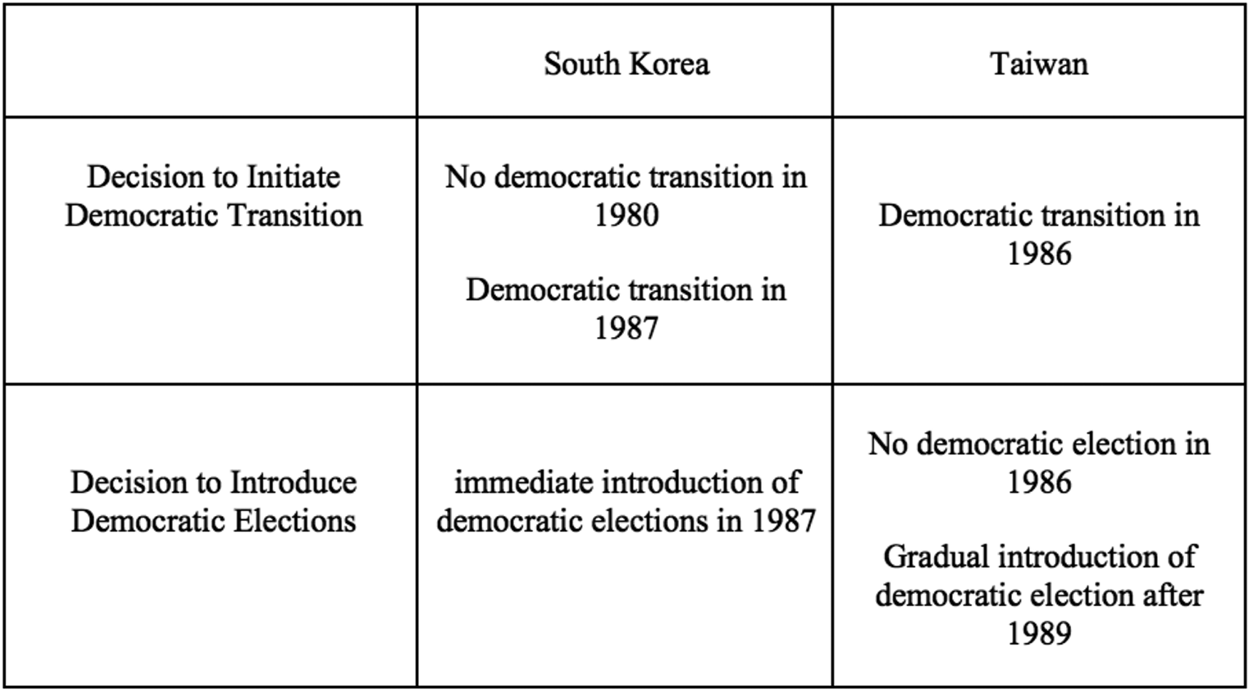
In this section, I will assess my elite choice hypotheses, using empirical cases from South Korea and Taiwan. Figure 3 provides a summary of these strategic choices made by ruling elites in South Korea and Taiwan.
Ruling elites' democratisation decisions in South Korea and Taiwan.

3.1 Rival explanations
This section first considers the rival explanations for ruling elites' decision to democratise the political system of a country. It is often argued that external geopolitical factors such as pressure from the 1988 Olympics and public pressure from the US government forced South Korea ruling elites to carry out democratic reform (see Fowler, Reference Fowler1999). Domestic social cleavage (i.e., regional cleavages) is also believed to have contributed to the ruling elites' strategic decision to democratise the political system of the country in South Korea (Kwon, Reference Kwon2004).
The internal variation within South Korea eliminates social cleavage as a variable to account for elites' decision to initiate the democratic transition. Regionalism was a constant factor in South Korea, yet ruling elites made divergent choices in 1980 and 1987. An argument can also be made that a divergence in external factors such as pressure from 1988 Olympics and public pressure from the US government between 1980 and 1987 resulted in divergent strategic choices in South Korea. However, the case of China, the largest developmental state in Asia, indicates that external geopolitical factors do not necessarily correlate with East Asian elites' decision to initiate democratic transition. In the next section, through empirical analysis, I will show that the democratic mobilisation of the middle class is the variable that determines elites' decision to end authoritarian rule.
Alternative explanations for elites' decision to introduce democratic elections include both external and internal factors. These explanations seem effective in explaining the variation in ruling elites' decision to introduce democratic elections between South Korea and Taiwan. Specifically, it seems possible that the US military presence in South Korea put the Korean ruling elites under greater pressure to introduce democratic elections.Footnote 11 It could also be argued that the scheduled 1988 Olympics produced more constraints for Korean ruling elites to delay the introduction of democratic elections. Furthermore, the variation can also be explained by domestic regional cleavages which incentivised the Korean ruling elites to push forward with the country's democratisation process. The main problem with these alternative factors is that none of them can explain Taiwan's internal variation. In the following section, I will demonstrate how Taiwanese ruling elites' interest to introduce democratic elections corresponds with the levels of electoral threats facing ruling elites.
3.2 Elite decision 1: ending an authoritarian rule
Three historical episodes will test my first hypothesis concerning ruling elites' decision to end authoritarian rules. The case of South Korea in 1980 represents a negative case in which ruling elites had no intention to initiate a democratic transition in the absence of the democratic mobilisation of the middle class. The cases of South Korea in 1987 and Taiwan in 1986 will serve to confirm the plausibility of my contention that the democratic mobilisation of the middle class forces ruling elites to transform their legitimacy formula through initiating democratic transition with or without the working class as an ally.
3.2.1 Reproduction of a dictatorship in South Korea
With rapid development engineered by the state, the emergence of a democratisation pressure challenged the authoritarian rulers in South Korea in 1980. In South Korea, opposition elites' attempt to link the country's democratic transition to the issue of economic injustice led to a national democratisation movement – the Minjung Movement (Choi, Reference Choi and Koo1993; Koo, Reference Koo and Koo1993). However, the power consolidation of ruling elites subsequently followed the old method of imposing political control. To explain the Korean rulers' lack of interest in initiating a democratic transition, we must explore the absence of the middle class from the democratisation movement.
The support of the middle class could not be obtained in the late 1970s due to division within the opposition community. Ideological differences and historical factors (regional politics) intensified by the death of Park in 1979 were behind the elite division, particularly between the two major leaders – Kim Young-sam and Kim Dae-jung (Cotton, Reference Cotton1989; Nam, Reference Nam1989). Without a strong liberal community, the working class adopted a radical approach to pursue their own class agenda. Sohn (Reference Sohn1989) notes that the establishment of a radical interpretation of social phenomena especially among the students-turned workers occurred in October 1979 when a massive uprising broke out in Pusan and Masan. The radicalisation of the working class consequently deterred the desire of the middle class for a regime transition. Han and Chung (Reference Han, Chung, Morley and Bernstein1993: 206) write on the hesitation of the middle class following the radicalisation of the labour,
‘Even though riots broke out in certain cities such as Kwangju when martial law was extended throughout the nation in May 1980, citizens began to show as much concern about the social instability and disorder accompanying the democratisation process as about its delay. Such concern became more poignant as student demonstrations intensified and after large-scale riots by miners and steel mill workers broke out in April’.
Without the participation of the middle class, the strategic response of the de facto authoritarian ruler of South Korea in 1980, General Chun Doo Hwan, to a democratisation movement followed the old methods of authoritarian repression. His repressive measures included the arrest of student leaders and opposition leaders, the imposition of full martial law, and the issuance of new Martial Law Decree No. 10 which led to an instant restriction on all political activities by closing universities, banning all political gatherings and imposing prior censorship over all publications and broadcasts (Lee, Reference Lee1981; Nam, Reference Nam1989). Army paratroopers trained for combat against North Korean troops were deployed in the southern city of Kwangju, where his repression strategy was challenged. Chun's repression strategy was apparently sufficient to deal with the situation in 1980; within a half month, social and political order was restored in South Korea.
The case of South Korea in 1980 has clearly indicated that a democratisation movement pushed by the working class without the participation of the middle class could not motivate the ruling elites to transform the legitimacy formula through a democratic transition. In the next few paragraphs, I will turn to the cases of South Korea in 1987 and Taiwan in 1986 to show that when the middle class offers their support for democratisation movement, democratic transition becomes a strategic choice of ruling elites to transform their old legitimacy formula.
3.2.2 The end of South Korea and Taiwan's authoritarian periods
As I noted before, in South Korea, a cross-class alliance could not be formed in the 1970s due to a divided liberal community. This was no longer the case in South Korea by the mid-1980s when both two major opposition elites, Kim Young-Sam and Kim Dae-Jung, announced their abandonment of personal ambitions to collectively challenge the power monopoly of the ruling elite (see Lee, Reference Lee1990: 25). In the subsequent ‘6.10 struggle’ which lasted for 20 days, the formation of a cross-class alliance greatly challenged the authoritarian regime, as millions of citizens came forward all over the country to demand the country's transition to democracy (Han, Reference Han1988; Nam, Reference Nam1989: 308–309; Oh, Reference Oh1999: 91–93). The positive effect of the democratic mobilisation of the middle class on the strategic calculations of the Korean rulers to transform their legitimacy formula was consequently witnessed in June 1987, when Chun Doo-hwan's chosen successor, Roh Tae-woo, refrained from using political repression and pursued a strategy of democratic transition, announcing his democratic declaration in June 1987.
The Taiwanese case identifies an even stronger and consistent linkage between the middle class mobilisation and elites' decision to initiate a democratic transition. Unlike the Korean case, Taiwan's rapid socioeconomic development engineered by the state did not lead to the rise of the working class. The absence of the working class as a potential democratic partner was largely due to the country's decentralised economic development that had deterred the growth of a working class consciousness (Yu, Reference Yu1993; Chu, Reference Chu1996; Minns and Tierrney, Reference Minns and Tierrney2003). Mobilised by liberal elites on the issue of national identity, the democratic mobilisation of the middle class spurred a national democratisation movement – the Tangwai movement (Tien, Reference Tien1989; Rigger, Reference Rigger and Rodan1996, 1999; Hsiao and Koo, Reference Hsiao, Koo, Diamond, Plattner, Chu and Tien1997; Myers and Chao, Reference Myers and Chao1998).
With consistent pressure from the middle class, the ruling elite began to contemplate the formation of a new legitimacy formula much earlier in Taiwan. The first sign of the elites' adaption came as early as 1983 when the KMT leader Chiang Ching-kuo assembled a team to put together a blueprint and strategy for democratic reform (Myers and Chao, Reference Myers and Chao1998). The Taiwanese ruling elites' decision to end an authoritarian rule eventually occurred after the formation of an opposition party – the Democratic Progressive Party (DPP) in 1986. The formation of the DPP in defiance of the martial law clearly signified that the Tangwai movement reached a new level (Myers and Chao, Reference Myers and Chao1998). The intensified democratic mobilisation of the middle class made the elites' decision to transform legitimacy formula as an inevitable choice in 1986. The necessity for the KMT's decision was pointed out by Dickson (Reference Dickson1997: 213) who writes, ‘The KMT would be better off allowing an organised opposition to participate within the political arena than risking continued chaos outside it’. To transform their legitimacy formula, the KMT leader refrained from resorting to political repression and announced major political liberalisation measures, including the acceptance of the DPP and the lifting of martial law restrictions (Tien, Reference Tien1989; Chu, Reference Chu1992; Myers and Chao, Reference Myers and Chao1998).
In short, the democratic mobilisation of the middle class plays an important role in shaping the ruling elites' strategic calculation to transform their legitimacy formula in South Korea and Taiwan. These two strategic elite decisions consequently kicked off the transformation of the political systems of the two countries towards a democratic direction.
3.3 Elite decision 2: elites' willingness to introduce democratic elections
This section covers the core component of a democratic transition – the introduction of democratic elections. This process involves the negotiations between ruling elites and opposition elites. My hypothesis attributes the ruling elites' willingness to introduce democratic elections to the level of electoral threat from opposition elites. South Korea and Taiwan are two distinctive cases to illustrate this contention.
3.3.1 South Korea's speedy introduction of the democratic election
In South Korea, a full democratic presidential election was held in the same year that Roh made his democratic declaration. Democratic election to the other branch of the government, the National Assembly election, was held in early 1988. Electoral threat proves helpful in explaining South Korea's speedy democratic transition.
In South Korea, the ruling elites faced a strong electoral threat in the 1980s. In 1985, the February National Assembly election showed an impressive voter support of 29.26% for the opposition New Democratic Party of Korea (NKDP) while the DJP's share of the popular vote declined from 35.6% in 1981 to 35.3% and it lost the three seats it had won in 1981 (Nam, Reference Nam1989: 301). Lee (Reference Lee1990: 21) notes that a 1985 secret survey conducted by the pro-government Kyunghyang Daily suggested that nearly 53% of the respondents did not support the Chun regime. The electoral threat heightened in March 1987 when an even stronger and unified opposition party emerged as the two Kims broke away from the NKDP and formed the hard-line opposition party, the Reunification Democratic Party (RDP), taking with them 66 of the 90 NKDP lawmakers.
With such a level of electoral threat, the Korean authoritarian rulers had no reason to delay the introduction of democratic elections. Facilitating a speedy transition was an optimal choice for the ruling elites – implementing full democratic elections for both the state's decision-making bodies would allow the ruling party to hold maximum power in the event of an electoral setback. This choice became even more attractive when they realised that allowing full democratic elections would bring another benefit – enhancing the possibility for the rulers to defeat their democratic opponents by renewing conflicts between two major opposition leaders (Saxer, Reference Saxer2003; Heo and Roehrig, Reference Heo and Roehrig2010).
Consequently, we witnessed the ruling elites' great willingness to push forward a thorough constitutional reform process to transform the political system of the country towards a democratic transition after the June declaration. A special commission was formed in the National Assembly. By October, the National Assembly had adopted sweeping revisions to the constitution. All democratic institutional changes to transform the authoritarian system were finalised in the 1987 amendments. These changes to South Korea's political system include the removal of authoritarian institutions that restricted various civil and political rights including freedom of the press, campus autonomy, the banning of arrests without a warrant and the lifting of restraints on artistic creativity. The removal of authoritarian institutions was accompanied by the installation of democratic electoral institutions including the first direct presidential election and the National Assembly election (Henderson, Reference Henderson, Kim and Kihl1988; Bedeski, Reference Bedeski1994; Oh, Reference Oh1999).
3.3.2 Taiwan's slow introduction of democratic elections
In contrast with the South Korean case, the removal of authoritarian institutions was not accompanied by the introduction of both legislative and executive elections in Taiwan. Democratic elections for the National Assembly election was not held until 1991 and the Legislative Yuan until 1992, and the presidency until 1996.
The factor that proves most helpful in explaining the Taiwanese ruling elites' lack of incentive to introduce democratic elections in 1986 is the low level of an electoral threat from opposition elites. Taiwan's first two-party contest in 1986 suggested the KMT's electoral dominance just before Chiang's decision to initiate democratic transition (Chao and Myers, Reference Myers and Chao1998; Rigger, Reference Rigger1999). Scholars note that for the KMT, two strategic manoeuvres were key to the party's political dominance in the 1980s. The first manoeuvre was the ruling party's Taiwanisation programme. In a major departure from its mainland image, the KMT blocked the growth of the opposition party by undercutting their ability to mobilise the middle class along ethnic identity at elections (Tien, Reference Tien1975; Winckler, Reference Winckler1984; Tien and Cheng, Reference Tien and Cheng1997). Another strategic move, the expansion of the elections at the central level of the government, also contributed to the KMT's strong electoral viability. In the early 1980s, the gradual liberalisation of the central level elections succeeded in exploiting the growing fissures within the Tangwai opposition, which ensured that the KMT's hegemonic position was not threatened electorally (Winckler, Reference Winckler1984).
In short, the lack of an electoral threat explains the first stage of Taiwan's democratic transition – the removal of authoritarian institutions in the late 1980s. There was certainly no need for the KMT to pursue strategic adaption as they could simply dominate Taiwan's democratic politics. Therefore, for the better part of the late 1980s, the KMT ruling elites lacked the willingness to introduce democratic elections, which explains the period of ‘liberalisation without democratisation’ (Jacobs, Reference Jacobs2012: 67).
The case of Taiwan in 1986 clarifies that the level of an electoral threat from opposition elites proves helpful in explaining ruling elites' willingness to introduce democratic elections. This conclusion is corroborated by an internal variation within the Taiwanese case. The end of the 1980s saw the Taiwanese ruling elites' increased desire for introducing democratic elections. The growth of the KMT's new-born desire coincided with the growth of an electoral threat at the end of the 1980s. The background of the KMT's electoral decline was the internal split within the ruling KMT elites. The 1989 election was widely considered a watershed event which marked the beginning of the electoral decline of the KMT. The KMT began to face even a greater electoral threat in 1991 when the factional dispute within the DPP ‘took a turn for better’. The KMT's ability to coordinate votes to contain the opposition had been already undermined by internal strife between Taiwanese soft-liners and more conservative hard-liners in the 1992 election. The ruling party's electoral viability was further weakened by a party split in 1993. By the mid-1990s, each party had carved out a fairly stable share of the electorate (Rigger, Reference Rigger and Rodan1996; Tien and Cheng, Reference Tien and Cheng1997; Chao and Myers, 1998; Chu, Reference Chu, Giliomee and Simkins1999a; Clark and Tan, Reference Clark and Tan2012).
The growing electoral threat from the opposition party led to the Taiwanese elites' strategic actions to push for the introduction of democratic elections in the early 1990s. The ruling elites' effort began with a National Affairs Conference (NAC) in 1990 when political elites agreed on a blueprint for moving Taiwan's democratic reform forward. Although the issue of direct presidential elections was not resolved during the NAC, new electoral rules were established for competitive elections to the two central parliamentary organs – the National Assembly and the Legislative Yuan. Finally, with an alliance between the KMT mainstream and the DPP moderate, the National Assembly finally reached a consensus on the institutionalisation of the direct presidential election during several rounds of constitutional amendments in 1992 and 1994 (Tien and Cheng, Reference Tien and Cheng1997; Chao and Myers, Reference Myers and Chao1998; Jacobs, Reference Jacobs2012).
Overall, the empirical evidence suggests a strong correlation between two sets of variables: the level of an electoral threat from opposition elites and ruing elites' willingness to introduce democratic elections. While the Korean elites' willingness for a full democratic transition occurred in the context of a high level of an electoral threat in 1987, the ruling elites' lack of incentives to introduce democratic elections in Taiwan was the result of an absence of an electoral threat in 1986. What provides even more compelling evidence to my hypothesis is the internal variation offered by the Taiwanese case, namely that the growth in the Taiwanese ruling elites' willingness to introduce democratic elections after the 1989 election coincided with the KMT's declining electoral viability in the early 1990s.
4. Explaining the transformation of the states in South Korea and Taiwan
As argued earlier, the result of the above two political processes (i.e., the emergence of economic interests and the transformation of the political foundation of the state) is the emergence of structural and institutional constraints. The last section will show how the emergence of these two types of state policy constraints led to the transformation of the two states: a rapid transformation process in South Korea and a two-phase transformation process in Taiwan.
4.1 The rapid transformation of the developmental state in South Korea
A rapid transformation of the developmental state occurred in South Korea immediately after the country's transition to democracy. With the rise of institutional constraints emanating from the middle class, the state could no longer retain its strategic visions: The Sixth Five Year Economic and Social Development Plan formulated by the Roh government (1988–1993) was not a growth-first economic plan but a populist vision to generate political popularity (Oh, Reference Oh1999; Kong, Reference Kong2000). The Kim Young-sam government (1993–1998)'s economic drive under the name of segyehwa (Globalisation) contains contradictory goals of economic growth and chaebol reform (Gills, Reference Gills1996). In the same period, a combination of strong structural constraints and institutional constraints emanating from business elites significantly undermined the state's leadership role vis-à-vis business elites. Consequently, the financial liberalisation process was shaped by business elites' interests in expanding their financial power, which paved the way for the 1997 financial crisis (Chang, Reference Chang and Jomo1998; Chang et al., Reference Chang, Park and Yoo1998; Kalinowski and Cho, Reference Kalinowski and Cho2009; Wang, Reference Wang2012). At the same time, the concentrated labour interest groups also exerted strong structural constraints upon the state-business alliance. As a result, the 1996 labour market reform bill achieved ‘too little to deal effectively with the structural flaws of Korea's fragmented system of company unionism, but too much for both capital and labour to remain politically unruffled’ (Kim, Reference Kim, Haggard, Lim and Kim2003: 72).
The levels of both structural and institutional constraints decreased in the period immediately following the 1997 crisis. As ruling elites prioritised the task of economic restructuring, a temporary renewal of the state's strategic role was witnessed in all three aspects of the state's policy mechanism. First, the Kim Dae-jung (1998–2003) administration's single-mindedly pushed for the execution of the structural reform plan externally imposed by the International Monetary Fund (IMF) as an essential condition for post-crisis recovery (Kong, Reference Kong2000; Ha and Lee, Reference Ha and Lee2007; Mo, Reference Mo, Maclntyre, Pempel and Ravenhill2008). Second, the state successfully pushed the chaebol to trim down their excessive capacity and increase their competitiveness by the end of December 1999 (see Mo and Moon, Reference Mo, Moon, Haggard, Lim and Kim2003; Cherry, Reference Cherry2006; Pirie, Reference Pirie2008). Third, the organised labour became a partner of the state-business alliance for economic recovery, which created the essential condition for the state to carry out labour market reforms (Kong, Reference Kong2000).
The rapid transformation of the developmental state resumed in the late 1990s. With the return of strong structural constraints generated by business elites, President Roh Moo-hyun (2003–2008)'s vision of structural reform which was ‘on a collision course’ with the chaebols (Shim, Reference Shim2003). The return of structural constraints emanating from organised labour was also clear when the Korean government risked harming the relationship with businesses by making several concessions to avoid the escalation of labour strikes (Kong, Reference Kong2000; Han et al., Reference Han, Jang and Kim2010). Recent evidence also suggested the presence of strong policy constraints emanating from both business elites and organised labour: Neither of the two of the state's economic visions to boost economic growth (the ‘Green Growth’ launched by the Lee Myung-bak government (2008–2013) and the ‘creative economy plan’ formulated by the Park Geun-hye administration (2013–2017)) were free from strong policy constraints imposed by business elites (Kalinowski and Cho, Reference Kalinowski and Cho2009; Mundy, Reference Mundy2015). The strong structural constraints imposed by the organised labour on the operation of the state-business alliance led to the trapped labour market in the post-crisis period (Han et al., Reference Han, Jang and Kim2010).
4.2 The two-phase transformation of the developmental state in Taiwan
Taiwan's two-phase transformation process is shaped by divergences occurring in two aspects of the transformation of the state's policy mechanism. The first concerns state-led state-business cooperation. In the 1990s, not only did the business elites lack structural constraints, but they also failed to produce institutional constraints due to the KMT's financial independence achieved through the creation of profit-generating Party-Owned Enterprises (POEs) (Chu, Reference Chu and MacIntyre1994, Reference Chu, Giliomee and Simkins1999a, Reference Chu and Pempel1999b). With the continuation of the state's domination over the private sector, the state insulated the driver of Taiwan's economy, the SME sector, from business interests (Cheng and Chu, Reference Cheng, Chu and L1999; Chu, Reference Chu and Pempel1999b). In the 2000s, the emergence of both structural and institutional constraints generated by business elites led to a rapid decline of state-led state-business cooperation.Footnote 12 The result was the end of the state's strategic actions to promote the SME sectors by the late 2000s: despite the government's intention to promote SMEs through innovation-oriented industrial policy, SME owners simply could not compete with large business interests for essential economic resources provided by the government for industrial upgrading (Clark and Tan, Reference Clark and Tan2012).
A difference in the formulation of the state's strategic visions was also observed between the 1990s and the post-2000 period.Footnote 13 Similar to the Korean situation, as ruling elites became electoral-minded, the government's plan to develop Taiwan into an Asian-Pacific Regional Operations Centre (APROC) for the mainland market was largely a symbolic vision to strengthen the political profile of the KMT in the 1990s (McBeath, Reference McBeath1998).Footnote 14 The erosion of the state's strategic visions worsened after 2000.Footnote 15 Between 2000 and 2008, the Cheng Shui-bian administration's economic policies in regards to cross-strait economic relations reflected the DPP leader's desire to retain short-term political support in the context of strong partisan competition from the KMT (Lin, Reference Lin2016).Footnote 16 The partisan visions associated with the political identities of the major parties emerged after 2008 were similarly not viable. While Ma Ying-jeou administration (2008–2016)'s plan revitalise Taiwan's economy through promoting cross-strait economic integration caused major security concerns in the country (Gold, Reference Gold1986; Lin, Reference Lin2016), the economic projects proposed under Tsai Ing-wen administration's ‘New Southward Policy’ aimed at reducing Taiwan's dependency on China is expected to ‘face an uphill battle’(Huang, Reference Huang2017).
The policy constraints emanating from organised labour remained relatively low due to the dispersed labour interests, which also contributed to the two-phase transformation of the developmental state in Taiwan. Certainly, the labour's success in preventing a downward revision of labour laws and forcing the state to revise the proposed adjustment during the reform of the National Health Insurance System in the 1990s show that labour constraints did emerge (Ho, Reference Ho, Fell, Kloter and Chang2006b). However, the level of policy constraints imposed by the organised labour on the state-business alliance is clearly limited for two reasons. First, the labour's interest advancement is contingent on the availability of political channels. For example, the organised labour had to cooperate with the opposition party to shape the regulation of working hours in 2000. Second, they had to make concessions with the state-business alliance in exchange for new labour gains, which was the case during the revisions of the Labour Standard Law in 1996 and the Economic Development Advisory Conference in 2001 (Ho, Reference Ho, Fell, Kloter and Chang2006b, Reference Ho, Wang, Li and Kung2008; Wang, Reference Wang2010).
5. Conclusion
This paper has offered a theory to account for the transformation processes of the two East Asian developmental states. The theory includes three components: (1) ruling elites' policy choices and the emergence of economic interest groups (dispersed or concentrated economic interests), (2) the democratic mobilisation of the middle class and democratic transition initiated by ruling elites, (3) the emergence of structural and institutional constraints. My empirical analysis shows how this political mechanism operated to produce the different outcomes of the states' transformation processes in South Korea and Taiwan. My theory suggests that the transformation of the developmental state has been taking place in a ‘path-dependent’ fashionFootnote 17: the outcomes of the states' transformation processes that we observe today were consequences of the strategic choices made by East Asian ruling elites concerning political consolidation.
The paper focuses on the two known cases of the transformation of the East Asian developmental state; it should not imply that the decline of the state's effectiveness in formulating policies is inevitable. The other typical case of the developmental state – the Singaporean case – shows that the emergence of economic and political interest groups does not necessarily lead to the emergence of state policy constraints. An explanation to the non-transformation of the developmental state requires the development of new theoretical hypotheses to account for the absence of both constraining economic interest groups and a lack of democratic transition in rapidly industrialising East Asia.