


Rarely has a philosophical theory fallen so thoroughly out of favour as has the cluster theory of proper namesFootnote 1 in the aftermath of the criticisms raised against it by Kripke in Naming and Necessity.Footnote 2 Kripke’s modal arguments are widely thought to have shown the cluster theory (and descriptivism, more broadly) to be inadequate as an account of the meanings of names. And his Gödel/Schmidt counter-example, among others, is generally thought to have shown it to be inadequate as a theory of referring. The upshot has been a trend away from the cluster theory which “has become almost a stampede.”Footnote 3
Nevertheless, underlying the cluster theory is a core idea that is quite compelling. In a nutshell, the thought is that speakers/thinkers stand in numerous cognitive relations to things in the world, and it is in virtue of being so related to thinking subjects that things in the world become the objects of thought and talk. Of course, it is a further step to suppose that such “clusters of cognitive relations” play any essential role in a theory of meaning or referring for proper names (or any category of referring expressions for that matter). What I want to argue is that that they find a home in an account of the meanings of expressions in epistemic sentence frames, and in a more general theory of the reference of proper names.
The argument of this paper will proceed as follows. First, I will motivate and develop a Fregean account of meanings of ascriptions of belief to individual subjects. Second, I will present a problem that arises for the Fregean account of ascriptions to groups if the meanings of expressions in ascription complements are taken to be single cognitive relations. Third, I will show how this problem can be avoided if the meanings of such expressions are taken to be clusters or “teams” of cognitive relations rather than single relations. And finally, I will take up a number of issues concerning the reference rather than the meaning of names.
1. Fregeanism and Ascriptions to Individuals
At the core of the picture I wish to develop here is the notion of a cognitive relation. A cognitive relation is a relation in which a cognitive agent stands to the potential objects of thought and talk, in virtue of which she or he is capable of thinking or speaking about them. Cognitive relations include the following: (i) experiential relations — seeing, hearing, etc., objects; (ii) conceptual relations — thinking about objects via the deployment of concepts; (iii) reputational relations — hearing, reading, or otherwise indirectly learning about objects; and (iv) memory relations, in which one or more of the others normally serve as intermediaries. Typically, cognitive relations have both causal and conceptual elements. The former consist of causal chains, initiated by events involving the object, which ultimately produce changes in the psychological state of the subject mediated by perceptual uptake.Footnote 4 The latter can range from a fully articulated concept with a unique denotationFootnote 5 — although this is a lot rarer than the literature often has it — to a dim ineffable feeling that a subject might have. As noted above, a cognitive agent can stand in numerous distinct cognitive relations to a single object.Footnote 6
Cognitive relations play the following roles in a Fregean account of ascriptions of belief to individuals: they serve as the meanings of expressions in ascription complement clauses, and they determine the referents of those same expressions. An ascription of the form,
(1) S believes that A is F
gets analyzed, on the Fregean picture, as follows:
(2) Believes (S, <RSA, RSF-NESS >),
where the relation RSA denotes a cognitive relation between the subject, S, and the object, A, and RSF-NESS denotes a cognitive relation between S and the property F-ness.Footnote 7, Footnote 8 So, for example, the ascription,
(3) Nixon believed that Deep Throat was a danger to his presidency
gets analyzed as
(4) Believed (Nixon, <RNDEEP THROAT-1, RNBEING-A-DANGER-TO-NIXON’S-PRESIDENCY>).
Note: My concern here is an account of the “assertive content” (or more generally the “illocutionary content”) of belief sentences; that is, “what is said” by means of their utterance. Insofar as the assertive content of belief sentences is distinct from their semantic content (what is literally expressed by them), my concern is with only the former.Footnote 9
In my view, a Fregean account of belief sentences is preferable to a Millian account according to which the contents of expressions in ascription complements are their (extensional) referents.Footnote 10 Not only does the former provide a more plausible explanation of failures of substitutivity in epistemic sentence frames than does the alternative; it also is more commensurable with the role that belief sentences play in explanatory inferences.Footnote 11 Consider the following example. Suppose that as the Watergate scandal was unfolding, Nixon sent some thugs to break into the offices of Woodward and Bernstein. Nixon’s (hypothetical) behaviour might be explained as follows:
(i) Nixon desired to protect his presidency
(ii) Nixon believed that Deep Throat was a danger to his presidency
(iii) Nixon believed that in order to protect his presidency from people dangerous to it, he needed to discern their identities
(iv) Nixon believed that the identity of Deep Throat could be discerned by breaking into the offices of Woodward and Bernstein.
What is important to note is that if (ii) [or (3) above] is replaced by
(5) Nixon believed that Mark Felt was a danger to his presidency,
we no longer have an explanation of Nixon’s behaviour. After all, if Nixon had believed Felt to be a danger to his presidency, he would have ousted him from his position as Associate FBI Director, or had him assassinated, rather than breaking into the offices of a couple of Washington Post reporters.Footnote 12
According to the Millian theory, both (ii) and (5) get analyzed as
(6) Believes (Nixon, <Deep Throat [=Felt], Being-a-danger-to-Nixon’s-presidency>).Footnote 13
This entails, however, that the explanation with (5) substituted for (ii) is the same explanation as the original which, as we have seen, is erroneous. On the Fregean account, in contrast, (5) receives a different analysis than does (ii):
(7) Believed (Nixon, <RNDEEP THROAT-2, RNBEING-A-DANGER-TO-NIXON’S-PRESIDENCY>).
As a result, the Fregean account does not entail that the two explanations are equivalent. Moreover, the difference between these two explanations is manifest on the Fregean view: the occurrence of “Deep Throat” in (ii) denotes a cognitive relation between Nixon and Felt distinct from that denoted by the occurrence of “Mark Felt” in (5). Further, the way we are cognitively related to the objects of our interest, and not merely what objects we are related to, plays an essential role in how we behave vis-à-vis these objects.
One final note: On the Fregean picture, the referent of the occurrence of an expression in a belief context — and the object of the subject’s attributed thought — is the objectual relatum of the cognitive relation that serves as the content of that expression in that context. So, for example, because the content of “Deep Throat” in (3) is a cognitive relation Nixon stands in to Mark Felt, Felt is the referent of the occurrence in question of this name.
2. The “Fregecide” Argument
Any attempt to extend this basic Fregean picture to ascriptions of belief to groups, however, runs into insuperable difficulties. Although there are in the literature a number of distinct arguments that make this point,Footnote 14 the most serious challenge to the Fregean is posed by the “Fregecide” argument.Footnote 15 The Fregecide argument focuses on ascriptions in different contexts to pairs of believers whose beliefs about the identities of the objects under discussion differ. Suppose that Fred is a both philosopher and a professional tennis player. And suppose that while Anne Evans realizes this, her sister Mary thinks that the philosopher and tennis player are distinct people, albeit both named “Fred.” Finally, suppose that (i) while attending one of Fred’s tennis matches, both Anne and Mary assent to the sentence “Fred is athletic,” and (ii) while attending a philosophical presentation by Fred, Anne again assents, but Mary, convinced as she is that all philosophers are clumsy, dissents. Intuitively, their dual assent suffices for the truth of both
(8) Anne believes that Fred is athletic
and
(9) Mary believes that Fred is athletic
in context (i), and Anne’s continued assent and Mary’s dissent suffice for the truth of (8) but the falsity of (9) in context (ii).Footnote 16 This distribution of truth-values can be tabulated as follows:
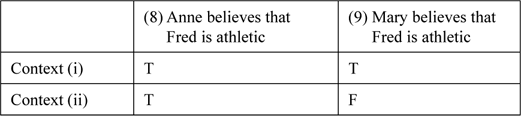
In order to explain the difference in the truth-value of (9) in contexts (i) and (ii), the Fregean would argue that the occurrences of “Fred” in (9) differ in content as between these two contexts. That is, the cognitive relation that serves as the meaning of “Fred” in (9) when it occurs in (i) differs from the cognitive relation that serves as its content in (9) when it occurs in (ii).Footnote 17 Now, if “Fred” has the same content in ascriptions to Anne as it does in ascriptions to Mary,Footnote 18 this implies that the occurrences of “Fred” in (8) differ in content as between (i) and (ii). And this despite the facts that the truth-value of (8) is the same in both contexts and that Anne is unconfused about the identity of Fred. Given that this phenomenon continually reoccurs,Footnote 19 the Fregean needs to claim that the contents of expressions in ascription-complements must differ in ascriptions to different subjects, or face the unpalatable consequence of having occurrences of “Fred” in (8) differ in content in every context in which it is uttered.
But consider now the group ascription
(10) The Evans sisters believe that Fred is athletic.
If uttered in context (i), this ascription would intuitively appear to be true. And the natural suggestion is that this is (in part) due to the fact that the content of “Fred” in (10) is the same as its content in the context (i) occurrences of (8) and (9). But what the Fregecide argument shows is that “Fred” has no shared content in those latter two utterances to serve as its content in (10). More to the point: if as we have been assuming, the content of an expression in the complement of an individual ascription is a cognitive relation, then, presumably, so is the content of an expression in the complement of a group ascription. But if the cognitive relations that serve as the contents of “Fred” in the context (i) occurrences of (8) and (9) differ — and groups do not stand in cognitive relations in their own rights — then there are no non-arbitrary grounds to take either of these cognitive relations, or any other cognitive relation in which one of the Evans sisters stands to Fred, to be the content of “Fred.”
Before developing my own cluster-theoretical solution to the Fregecide puzzle, it is worth pausing for a moment to dispense with a couple of tempting alternatives. The first alternative involves subjecting group ascriptions to a conjunctive analysis: on this view, an ascription of belief to a group is equivalent to a conjunction of individual ascriptions to the members of the group. So, for example, (10) would be analyzed as
(11) Anne believes that Fred is athletic and Mary believes that Fred is athletic.
Although perhaps adequate in some cases, the conjunctive analysis will not do as a general account of group ascriptions for a number of reasons. First, some groups, such as hockey teams, have their members only contingently. Ascriptions of belief to such groups and their putative conjunctive analyses will inevitably differ in their modal profiles: there will be possible circumstances in which they differ in truth-value.Footnote 20 As a result, they cannot be equivalent. Second, Gilbert has provided the following counter-example to the conjunctive analysis:
Suppose an anthropologist were to write “The Zuni tribe believes that the north is the region of force and destruction.” Now suppose that the writer went on to give his grounds for this statement as follows:
Each member of the Zuni tribe believes that the north is the region of force and destruction, but each one is afraid to tell anyone else that he believes this; he is afraid that the others will mock him, believing that they certainly will not believe it.
Such an explanation might well, I think, be taken to throw doubt on the original statement.Footnote 21
The lesson of this example is that the truth of the conjunction of individual ascriptions to the members of certain groups is not sufficient for the truth of the corresponding group ascription, because the truth of the group ascription requires that the beliefs be in some sense jointly held by the membership.Footnote 22
The second tempting alternative would be to suppose that the contents of expressions in the complements of group ascriptions are the (extensional) referents of those expressions. So, for example, the content of “Fred” in (10) would simply be Fred, as opposed to any cognitive relation to him. The trouble with this suggestion is that, as with the Millian analysis of individual ascriptions, it runs afoul of the explanatory role that group ascriptions play vis-à-vis group behaviour. For example, the ascription
(12) The Nixon Administration believed that Deep Throat was a danger to Nixon’s presidency
might well explain a broad swath of behaviour — designed to discover the identity of Deep Throat — engaged in by members of said administration. But if Millianism were true, (12) would be equivalent to
(13) The Nixon Administration believed that Mark Felt was a danger to Nixon’s presidency.
The trouble is, however, that if (13) were true, members of the administration would presumably have engaged in a rather different pattern of behaviour — one aimed at silencing Felt rather than discovering who Woodward and Bernstein’s source was.Footnote 23
3. Cognitive Relations and Communication
The challenge that faces us is to produce an account of the contents of group ascriptions that can be reconciled with the fact that the contents of expressions in the complements of individual ascriptions must vary with the subject to whom belief is ascribed. There is, however, a parallel problem that arises for accounts of communication: How are individuals who stand in distinct complex cognitive relations to objects in the world nevertheless able to communicate with one another about those objects? And what I want to suggest is that a solution to the former problem falls out of a solution to the latter.
The first thing to note is that the various cognitive relations in which thinkers/speakers stand to objects in the world are divided up into collections. Each collection corresponds to one of the subject’s notional objects; that is, it consists of cognitive relations that the subject judges to share a relatum (or which function in her cognitive architecture as if they share a relatum). Rather than being thought of as sets, these collections of cognitive relations are better understood on a team model. Henceforward, I will refer to them as “C-teams.” Like the Calgary Flames, for example, C-teams can survive diachronic change in membership. The 2004 Stanley Cup finalists are the same team as the 1989 Stanley Cup champions, despite having no players in common. Similarly, as a subject has new experiences, many of the cognitive relations she thereby forges to objects in the world will become members of pre-existing C-teams; and as a result of failures of memory, or of the discernment of mistaken identity-judgments, C-teams can lose members. Moreover, membership in a team, even time-indexed membership, is contingent. There are possible circumstances in which Jarome Iginla was not a member of the 2004 Calgary Flames; and for any given member of any given C-team (at any given time), there are possible circumstances in which the C-team exists but lacks that member (at that time). If C-teams — or hockey teams, for that matter — have essential features at all, such features are probably bound up in their origins.
Now consider two participants in a conversation, Anne and Mary, about some object, Fred. This requires that Anne and Mary each have C-teams of cognitive relations to Fred consisting of distinct members:


In order to get the conversation off the ground, Anne and Mary will have to come to the shared judgement that some of their distinct cognitive relations share a relatum. In effect, they will have to generate an inter-subjective C-team consisting of cognitive relations to Fred in which each of Anne and Mary individually stand. It is worth noting that, in general, conversationally generated inter-subjective C-teams do not consist of simply the unions of intra-subjective C-teams from the various conversational participants; although Anne may judge that one of Mary’s cognitive relations shares a relatum with one of her own, she may disagree with — or be unsure about — certain shared-relatum judgments Mary makes about her own cognitive relations. Instead intra-subjective C-teams are made up of a collection of sub-teams of the intra-subjective C-teams associated with the various participants in the conversation.
Inter-subjective C-teams get constructed roughly as follows. A speaker initiates a conversation using a referring expression which she takes to denote the shared relatum of one of her C-teams. So, for example, Anne might say, “Dr. Campbell is lecturing today on belief sentences” while taking “Dr. Campbell” to denote the shared relatum of CTANNE. Now, when a speaker utters a conversation-initiating sentence of this sort, some members of the C-team at question are salient; the salient cognitive relations underlying her or his utterance are those by means of which he or she is thinking about the object about which he or she is trying to get a conversation started. Let us suppose that, in the case at hand, the salient members of CTANNE are RAFRED-1 and RAFRED-2. In order for the conversation to get going, the listener has to determine who the speaker is talking about; this involves making a judgment to the effect that the referring expression used denotes (what he or she takes to be) the shared relatum of one of his or her C-teams. (This may or may not require eliciting further information from the speaker). So, for example, Mary might judge that the referent of Anne’s utterance of “Dr. Campbell” is the shared relatum of CTMARY. When a listener makes an identity-judgment of this sort, some members of the C-team she or he identifies will be salient; again, the salient cognitive relations are those by means of which she or he thinks of the object she or he judges the speaker to be talking about. Let us suppose that that the salient members of C-teamMARY are RMFRED-1 and RMFRED-2. At this point an inter-subjective C-team has been generated whose members are members are the speaker’s and the listener’s salient cognitive relations. In our example, Anne and Mary have generated the following C-team:

It is worth noting that inter-subjective C-teams can undergo changes in membership as a result of conversational moves made subsequent to their generations. Cognitive relations get added to an inter-subjective C-team when the following conditions are met: (i) one of the participants in the conversation asserts a sentence containing a referring expression she or he takes to denote the object of conversation; (ii) the other participants in the conversation accept the speaker’s assertion; and (iii) the salient cognitive relations underlying the speaker’s utterance are not currently members of the inter-subjective C-team. Suppose, for example, Mary were to say, in response to Anne’s original assertion, “His lecture last Tuesday was really boring,” where the salient cognitive relation underlying Mary’s utterance was (her memory of) her experience of Fred on the previous Tuesday. If Anne accepted Mary’s utterance and this cognitive relation was not already a member of CTA&M, it would then become a member.
Cognitive relations also can be subtracted from inter-subjective C-teams. Normally this occurs when a previously accepted assertion is subsequently rejected. Suppose, for example, that later in her conversation with Anne, Mary were to say, “Dr. Campbell couldn’t have given a lecture last Tuesday because he was home sick.” And suppose that Anne accepted this claim. Under such circumstances, the cognitive relations underlying Anne’s prior utterance would be subtracted from CTA&M. Note: If such statements are not accepted by all participants in the conversation, the cognitive relations at issue are not added to/subtracted from the inter-subjective C-team. Instead, they remain in a kind of inactive limbo. To push the analogy with hockey teams beyond all utility, they become like hockey players on injured reserve.
4. C-teams and Ascriptive Content
Before developing an account of the contents of group ascriptions that invokes inter-subjective C-teams, it may prove instructive to consider the role intra-subjective C-teams might play in an account of individual ascriptions. The account of individual ascriptions I have in mind is exactly like the basic Fregean picture sketched above except that instead of taking the contents of expressions in ascription-complements to be individual cognitive relations, it takes them to be teams of the subject’s cognitive relations. So, an ascription of the form
(1) S believes that A is F
gets analyzed, on this picture, as
(14) Believes (S, <CTSA, CTSF-NESS>),
where “CTSA” denotes one of S’s teams of cognitive relations to an individual and “CTSF-NESS” denotes one of S’s teams of cognitive relations to a property,Footnote 25
rather than as
(2) Believes (S, <RSA, RSF-NESS>).
Note: The issue of exactly which of a subject’s C-teams serve as the contents of expressions in the complements of ascriptions to her will be addressed in section V below.
This basic picture provides a simple intuitive explanation of the difference in truth-value between the occurrences of
(9) Mary believes that Fred is athletic
in contexts (i) and (ii). In context (i), (9) gets analyzed as
(15) Believes (Mary, <CTMFRED-1, CTMBEING ATHLETIC>)
where CTMFRED-1 (presumably) includes Mary’s experiential relations to Fred during the tennis match. And in context (ii), (9) gets analyzed as
(16) Believes (Mary, <CTMFRED-2, CTMBEING ATHLETIC>)
where CTMFRED-2 is distinct from CTMFRED-1 and includes Mary’s experiential relations to Fred at his philosophy presentation. These two C-teams correspond to distinct objects in Mary’s notional world; that is, the world as Mary believes it to be. (9) is true in context (i) because the content of “Fred” in this context is one of Mary’s notion objects that she believes to athletic. And (9) is false in context (ii) because the content of “Fred” in this context is one of her notional objects that she believes not to be athletic.
The “New Cluster Theory” (henceforward NCT) account of group ascriptions I wish to defend is just like the account of individual ascriptions sketched above except that the contents of expressions in ascription-complements are inter-subjective C-teams whose members includes cognitive relations of the members of the group to which belief is ascribed. For present purposes I am going to focus on ascriptions to groups whose members have engaged in conversation about the object of ascription, thereby generating inter-subjective C-teams. A more general account will have to invoke other sorts of processes whereby inter-subjective collections of cognitive relations are generated.
Consider again Mary’s and Anne’s utterances regarding Fred while attending his tennis match [context (i)] and during his philosophy presentation [context (ii)]. Let us suppose that in each case these utterances occur as part of a conversation between them. So in context (i), Mary initiates a conversation with her assertion of “Fred is athletic” and Anne responds with an utterance of “Yes, he is.” At this point in the conversation, Anne and Mary have a generated an inter-subjective C-team — call it CTA&MFRED-(i) — consisting of the salient cognitive relations underlying each of their utterances — presumably their experiential relations to Fred during the tennis match. And in context (ii), Anne initiates a conversation with “Fred is athletic” and Mary replies with “No, he’s not,” thereby generating an inter-subjective C-team — CTA&MFRED-(ii) — consisting of their (salient) experiential relations to Fred during his philosophy presentation. And these inter-subjective C-teams are candidates to serve as the meaning of “Fred” in utterances of ascriptions such as
(10) The Evans sisters believe that Fred is athletic.
An occurrence of (10) in context (i) would be analyzed as
(17) Believes (Mary, <CTA&MFRED-(i), CTA&MBEING ATHLETIC>),
and its occurrence in (ii) would get rendered as
(18) Believes (Mary, <CTA&MFRED-(ii), CTA&MBEING ATHLETIC >).
On this picture, the occurrence of (10) in context (i) is true because CTA&MFRED-(i) corresponds to one of the Evans sisters’ shared notional objects which they jointly believe to be athletic. And the occurrence of (10) in (ii) is false because CTA&MFRED-(ii) corresponds to one of their shared notional objects which they do not jointly believe to be athletic.
It is worth emphasizing that the NCT account of group ascriptions yields a promising solution to the Fregecide puzzle presented above.Footnote 26 The content of “Fred” in the context (i) occurrences of (8) differs from its content in the context (i) occurrence of (9): in the former its content is one of Anne’s intra-subjective C-teams; in the latter, its content is one of Mary’s intra-subjective C-teams. Nevertheless, the content of “Fred” in the context (i) occurrence of (10) is also a C-team, albeit an inter-subjective team. And it stands in a non-arbitrary relation to the C-teams that constitute the content of “Fred” in the corresponding individual ascriptions: its membership wholly includes members of these intra-subjective C-teams.
5. Modal Objections
In effect, what I have done here is given a cluster theoretical account of the meanings (or, as I would have it, the illocutionary contents) of names, at least when they occur in epistemic sentence frames. Kripke’s modal arguments, however, are thought undermine views of this sort. As a result, it would be prudent to dispel any worry one might have that similar arguments undermine the view on the table. Kripke’s modal arguments were in large part directed against Searle’s endorsement of an implication of his version of the cluster theory to the effect that “it is a necessary fact that Aristotle has the logical sum, inclusive disjunction, or properties commonly attributed to him; any individual not having at least some of the properties could not be Aristotle.”Footnote 27 Kripke’s response was simply to deny this implication, on the basis of shared modal intuitions: “[It] would seem that it’s a contingent fact that Aristotle ever did any of the things commonly attributed to him today, any of these great achievements that we so much admire.”Footnote 28
Kripke’s argument can be fruitfully reconstructed as follows. Consider a sentence of the form
(19) N is F1, or N is F2, or …. , or N is FN,
where F1, …, FN are the properties commonly associated with N (or, perhaps better, with the name “N”). Now, intuitively, sentences of this form are contingent: there are possible circumstances in which N exists but lacks all of F1, …, FN.Footnote 29 But according to the cluster theory, (19) entails
(20) ɿx(F1x or F2x or … or FNx) is F1, or ɿx(F1x or F2x or … or FNx) is F2, or …, or ɿx(F1x or F2x or … or FNx) is FN.
And although (20) is not strictly necessary, unlike (19) it is true in all possible circumstances in which at least one of F1, …, FN is uniquely satisfied. Nevertheless, since the cluster theoretical analysis of (19) is true in possible circumstances in which (19) is not, this analysis must be erroneous.
It is important to note that this modal argument cannot be applied straightaway to the NCT analysis because the latter applies only to occurrences of referring expressions within epistemic frames. (I am, of course, rejecting semantic innocence here; that is, the thesis that the contents of expressions do not vary with the sentential frames within which they occur.) Nevertheless, it is not difficult to adapt the modal argument so that it applies to (occurrences of) belief sentences. All that needs to be done is to establish that there are possible circumstances in which the proposition asserted by means of an utterance of a belief sentence differs in truth-value from the NCT analysis of the content of that utterance.
Consider an utterance of an ascription of the form
(1) S believes that A is F,
which, let us suppose, is in fact true. According to the NCT, this ascription should be analyzed as
(14) Believes (S, <CTSA, CTSF-NESS>).
For present purposes, I will remain neutral as to whether the subject, S, is an individual or a group and, hence, whether the C-teams in question are intra- or inter-subjective. Let us suppose that the (actual) members of CTSA are RSA-1, … , RSA-n. Moreover, let’s suppose that (1) is uttered as part of an explanation of S’s behaviour and that one member of CTSA, RSA-i, is irrelevant to this explanation. For example, although S judges A, whom she or he is currently experiencing, to be the person she or he remembers meeting at a party two years ago, this judgment plays no role in her behaviour of fleeing the vicinity; her flight is wholly explained by her belief that the person she is currently experiencing is a danger to her. Now consider possible circumstances in which S does not stand in RSA-i to A. Perhaps S did not attend the party in question, or forgot about her encounter with A during it, or failed to judge that the person she encountered at the party was the person she is currently experiencing. Intuitively, the proposition asserted by the utterance of (1) would remain true in such circumstances. But, it might be argued, since S does not stand in RSA-i in such circumstances, CTSA does not exist, rendering (14) false or meaningless.
The trouble with this argument is that it relies on the assumption that C-teams have all of their members essentially. Now, if the collections of cognitive relations invoked by the NCT were sets, this assumption would be well-founded. But since these collections are teams — and membership in a team is a contingent matter — the assumption is erroneous. Moreover, the team model is not merely an ad hoc device designed to avoid such worries; there are independent grounds for it stemming from the fluidity of identity judgments. As a result, there is no reason to think that CTSA fails to exist in the circumstances at issue, and, hence, there is no reason to think (14) is false is these circumstances.
My interlocutor might rejoin, however, that the proposition asserted by the utterance of (1) could be true even if S stood in none of RSA-1, … , RSA-n, and that although CTSA could exist while lacking one of its members, it could not exist while lacking all of them. Now, one response would be to insist that C-teams can exist in possible circumstances in which they lack all of their actual members. But although I do think this is right-headed, in the absence of a developed account of trans-world identity for C-teams it is not altogether satisfactory.Footnote 30 A more promising strategy would be to undercut the certainty that the proposition asserted by (1) could be true in such circumstances. One reason someone might have for thinking (1) could be true is because the proposition asserted by
(21) S believes of A that it is F
could intuitively be true in the circumstances at issue. After all, the truth of (21) presumably requires only that the subject stand in some cognitive relation or other to the object of belief, and not in any particular cognitive relation. But the truth of the proposition asserted by (1) cannot be inferred from the truth of the proposition asserted by (21). Recall: the proposition asserted by (1) explains S’s behaviour vis-à-vis A. This behaviour is in part due to how S is cognitively related to A; if, for example, S had not stood in an experiential relation to A that revealed what he or she took to be a danger, he or she would not have fled. As a result, the proposition asserted by (1) must be sensitive to how S is cognitively related to A, which is exactly what (21) is not sensitive to. Moreover, to the extent that intuitions about the truth values in counterfactual circumstances of propositions designed to serve specific explanatory purposes are reliable at all — and they are probably quite unreliable — they count against the truth of the proposition asserted by (1) in the counterfactual circumstances at issue. Intuitively, a proposition whose truth is sensitive to S’s cognitive relations to A is unlikely to be true in circumstances in which those relations do not obtain.
6. Referring
What remains to be done is to provide a theory of referring for the NCT. There are, however, two separate issues that need to be addressed under this heading. The first concerns exactly which C-team serves as the content of an expression in an ascription complement on an occasion of use. The second concerns what the referent (or, more generally, the extension) — as opposed to the content — of an expression in an ascription complement is. I will address each of these questions in turn.
For present purposes, I am going to focus on cases in which the ascriber is a participant in the conversation in which the subject(s) of the ascription makes an assertion which motivates (or perhaps even justifies) the ascription. Consider, for example, the following conversation during one of Fred’s tennis matches [context # (i)]:
Mary: Fred is athletic.
Anne: Yes, he is.
Tom: Mary believes that Fred is athletic. [ = (9)]
Bill: The Evans sisters believe that Fred is athletic. [ = (10)]
Let us assume that the basis for Tom’s assertion is Mary’s utterance and that the grounds for Bill’s assertion are Mary’s utterance and Anne’s utterance. As above, the content of “Fred” in Tom’s utterance of (9) is one of Mary’s intra-subjective C-teams, and its content in Bill’s utterance of (10) is a conversationally generated inter-subjective C-team whose members include cognitive relations of Mary’s and cognitive relations of Anne’s C-teams.
Before addressing which C-teams serve as the contents of expressions in ascription-complements, a distinction needs to be drawn between referential and deferential uses of expressions.Footnote 31 When an expression is used deferentially, the speaker intends it to refer to whatever the reference was of some prior occurrence of a referring expression. And when an expression is used referentially, the speaker intends it to refer to some object that he or she “has in mind.” On the picture I am developing, the object a speaker has in mind is the relatum of the salient (non-reputational) cognitive relation underlying her utterance.
Consider, first, deferential uses of expressions in ascription complements. Typically, underlying a referring expression to which reference is deferred is a salient cognitive relation (or a number of salient cognitive relations) in virtue of which the subject of ascription is able to talk about the referent. And, again typically, this cognitive relation will be a member of one of the subject’s intra-subjective C-teams, as well as an inter-subjective C-team generated by the conversation in which she was participating when she made her utterance. The content of a deferentially used expression in the complement clause of an individual ascription is the intra-subjective C-team of which the salient cognitive relation underlying the expression to which reference is deferred is a member. And the content of a deferentially used expression in the complement clause of a group ascription is the inter-subjective C-team of which the salient cognitive relations underlying the various expressions to which reference is deferred are members.
Suppose, for example, that Tom’s and Bill’s utterances of “Fred” were deferential. That is, suppose that Tom is using “Fred” to refer to whomever Mary used “Fred” to refer to, and Bill is using “Fred” to refer to whomever Mary referred to using “Fred” and Anne referred to using “he”. And let us suppose that the salient cognitive relations underlying May’s and Anne’s utterances are their respective experiential relations to Fred during the tennis match. In such circumstances, the content of “Fred” in Tom’s individual ascription to Mary is the intra-subjective C-team of which Mary’s experiential relation to Fred during the tennis match is a member. Furthermore, the content of “Fred” in Bill’s group ascription to the Evans sisters is the inter-subjective C-team generated by Mary and Anne’s conversation during Fred’s tennis match which includes their respective experiential relations to Fred, again, during the match.
Consider now referential uses of expressions in ascription complements. As with the deferential case, underlying the subject’s prompting utterance — the utterance that prompts the subsequent ascription — is a salient cognitive relation that is a member of one of her intra-subjective C-teams and an inter-subjective C-team generated by the conversation in which she was participating. And underlying the ascription is a salient cognitive relation belonging to the ascriber. When an ascriber’s use of an expression in an ascription is referential, she is in effect judging that the salient cognitive relation underlying her utterance as well as that underlying the prompting utterance share a relatum, thereby adding the former cognitive relation to the C-team(s) to which the latter belongs. The content of a referentially used expression in the complement clause of an individual ascription is a newly generated inter-subjective C-team whose members include (i) the members of the intra-subjective C-team to which the salient cognitive relation underlying the prompting utterance belongs and (ii) the salient cognitive relation underlying the ascriber’s utterance. And the content of a referentially used expression in the complement clause of a group ascription is an inter-subjective C-team whose members include (i) the members of the inter-subjective C-team to which the salient cognitive relation underlying prompting utterances belong and (ii) the salient cognitive relation underlying the ascriber’s utterance.
Suppose that Tom’s and Bill’s utterances of “Fred” were referential and that the salient cognitive relations underlying them were Tom’s and Bill’s respective experiential relations to Fred during the tennis match. And again let us suppose that the salient cognitive relations underlying Mary’s and Anne’s prompting utterances are their respective experiential relations to Fred as well. In such circumstances, the content of “Fred” in Tom’s individual ascription to Mary is an inter-subjective C-team consisting of (1) the members of the intra-subjective C-team of which Mary’s experiential relation to Fred during the tennis match is a member and (2) Tom’s experiential relation to Fred. And the content of “Fred” in Bill’s group ascription to the Evans sisters is an inter-subjective C-team consisting of (1) the members of the inter-subjective C-team generated by Mary and Anne’s conversation during Fred’s tennis match — which includes their respective experiential relations to Fred during the match —and (2) Bill’s experiential relation to Fred.
It is worth noting that the difference between deferential and referential uses of expressions in ascription complements is not nearly as large as the previous discussion might lead one to believe. The only difference is that the C-teams that are the contents of referential uses include ascribers’ cognitive relations among their members. Moreover, in order to use expressions deferentially, ascribers need to stand in reputational cognitive relations to the objects of ascription. As a result, a uniform theory of referring can be achieved by adding these relations to the C-teams that are the contents of deferentially used expressions. Doing so has the added advantage of ensuring that expressions in ascription complements remain contentful even when the ascriptions themselves are defective in various ways:Footnote 32 minimally, C-teams whose memberships consist only of ascribers’ cognitive relations will serve as their contents.
According to the most well-known version of the cluster theory, the referent of a name is the object that satisfies a “sufficient but unspecified number” of the descriptions associated with the name.Footnote 33 A natural suggestion then for the NCT would be to take the referent of an expression in an ascription complement to be the shared relatum of a sufficient but unspecified number of the member cognitive relations of the C-team that serves as the expression’s content. However natural it might be, this suggestion is no more compelling than its predecessor: reference may not always be entirely determinate, but it is more determinate than this. A better alternative is the following. If there is a single salient cognitive relation underlying the ascriber’s utterance, the referent is the object of this relation. And if there are a number of equally salient cognitive relations underlying the utterance, the referent is the shared relatum of these relations. If the salient cognitive relation lacks a unique object — or if the collection of salient cognitive relations lack a shared object — then we have a case of reference failure.Footnote 34
It may prove useful to work through one final illustration of the NCT. When I was a graduate student, a classmate, Mary MacLeod, and I had an ongoing conversation about “our mutual friend” Mark, a guitar player. Despite having regular talks about “Mark,” neither one of us realized for several years that we were talking about different people. How embarrassing. Consider the following conversation:
Mary MacLeod: Mark plays guitar.
Peter Alward: Yes, he does.
Rebecca: Mary believes that Mark plays guitar.
Jane: They both believe that Mark plays guitar.
Let us suppose that the salient cognitive relation underlying Mary’s utterance is (her memory of) her experiential relation to a long-haired fellow named “Mark” busking outside of the Seahorse Tavern in Halifax, and that the salient cognitive relation underlying my utterance is (my memory of) my experiential relation to a short-haired friend of mine named “Mark” playing guitar in his apartment on Edward Street, again in Halifax. Moreover, let us suppose that Rebecca’s and Jane’s utterances of “Mark” are deferential: Rebecca is using “Mark” to refer to whomever Mary used “Mark” to refer to; and Jane is using “Mark” to refer to whomever Mary and I were talking about.
Now, the referent (and the content) of Mary’s use of “Mark” was the long-haired busker she experienced outside of the Seahorse, and the referent of my use of “he” was my short-haired friend. In effect, we spent years talking past one another. The content of Rebecca’s use of “Mark” was that C-team of Mary’s to which her remembered experiential relation to a long-haired busker belonged, and its referent was the long-haired busker himself. And the content of Jane’s use of “Mark” was the conversationally generated inter-subjective C-team whose members include Mary’s remembered experiential relation to a long-haired busker and my remembered experiential relation to a short-haired friend. But because it is prompted both by my and Mary’s utterances (let’s say equally), Jane’s use of “Mark”, though contentful, lacks a referent.
7. The Cluster Theory?
The “New Cluster Theory,” as I have been calling it, does seem able to avoid many of the difficulties that arose for its predecessor. The question, however, is whether it is aptly named; that is, whether it is a version of the cluster theory at all. There are at least three central departures from the earlier theory that might incline one to answer in the negative. First, included in the NCT clusters (or teams) are not only conceptual cognitive relations — my analogue of associated descriptions — but also experiential, reputational, and memory relations. And, on my view, conceptual relations are rarely purely denotational; like the alternatives, they normally include a causal element. Nevertheless, this may not suffice to deny the NCT its status as a version of the cluster theory if the causal relations to the objects of thought and talk count as “intentional causation” of the sort embraced by the later Searle.Footnote 35 Second, according to the NCT, teams of cognitive relations count as the contents of expressions only when they occur in epistemic sentence frames. Its predecessors, in contrast, took clusters of associated descriptions to be the contents of names more generally. And third, the original cluster theory took the referent of an expression to be determined by a context-independent function of the cluster of descriptions associated with an expression — the object that satisfies a “sufficient but unspecified number” or a “weighted most” of the descriptions. The NCT, in contrast, takes the referent of an expression to be contextually dependent — determined by the salient cognitive relation underlying the ascriber’s utterance. Whether or not the cumulative effect of these differences moves the NCT beyond the boundaries of what might reasonably be counted as a version of the cluster theory is not obvious. In my view, NCT does retain the core idea that made the cluster theory compelling in the first place. But this question may not prove to be very important; at the end of the day, the NCT will stand or fall on its own merits.


