The closing decades of the twentieth century were devastating for working classes around the globe. As markets were freed from state controls and capital mobility increased, work was increasingly organized around flexible and informal employment relations that led to an increase in insecure and low-paying jobs.Footnote 1 Guy Standing captures this shift by pointing to the post-1970s rise of the “precariat,” a new “class-in-the-making” that is defined by a combination of labor-related insecurities.Footnote 2 For Standing the precariat is central to contemporary global capitalism, but it lacks the basic protections that underpinned labor in the mid–twentieth-century global economy.
Standing argues that the expansion of the precariat undermines working class solidarity, as it fuels anxiety, alienation, anger, and anomie. The result is opportunism, competition, and susceptibility to right-wing demagogues who fan the flames of division, most importantly through anti-migrant politics. These patterns, he suggests, may be found to varying degrees in most countries. Yet his analysis focuses primarily on the well-developed countries of Europe, North America, and Japan, as well as standout cases such as South Korea, China, and India.
While delivering important insights, this analysis is limited in two important ways. First, it downplays crucial cross-national variation and, in particular, the experiences of the Global South. Emphasizing the “Great Convergence” of capital, wages, and living standards between advanced and emerging economies, Standing suggests that the expansion of the precariat is a relatively uniform process across countries and regions.Footnote 3 This downplays the fact that labor has always been precarious in the Global South and, further, that the vast majority of precarious workers live in the Global South.Footnote 4 It also ignores the fact that surplus labor-power is significantly more prevalent in the Global South, giving rise to an informal sector that is built through survivalist activity from below, rather than cost-cutting strategies from above.Footnote 5
Second, Standing underestimates the capacity of precariously situated workers to develop collective agency. He argues that the precariat “lack self-esteem and social worth in their work,” and thus do not have the same positive work-based identity that “engendered a robust pride and dignity that helped make [the industrial working class] a political force with a class agenda.” He laments that the precariat “does not feel part of a solidaristic labor community.”Footnote 6 Yet there is a growing literature that illuminates the collective struggles of flexible, informal, and low-wage workers.Footnote 7 Contrary to Standing, this suggests that precarious layers of the working class are capable of waging significant collective struggles.
This article begins to address the gaps in Standing's analysis through a comparative study of precarious class formation at opposite ends of the globe: California, United States and Gauteng, South Africa. Precarious class formation refers to the process by which insecurely employed and unemployed, low-income, and nonunionized individuals constitute themselves as collective actors. The analysis proceeds in two parts. Drawing on secondary sources and statistical analysis of survey data, the first part traces the historical expansion of the precariat from the 1970s to the present. Although the expansion of the precariat coincided with processes of racial inclusion and mass migration in each place, the resulting forms of precariousness are far from uniform. Whereas in California the precariat is more politically vulnerable due to noncitizenship, in Gauteng the precariat is more detached from the formal economy and prone to long-term unemployment.
The second part of the analysis turns to two case studies of prominent collective struggles by precarious layers of the working class. Drawing on four years of ethnographic fieldwork between 2010 and 2014, as well as 130 interviews with activists and community members, I examine May Day protests around migrant rights in California and community protests around public service delivery in Gauteng. Both sets of struggles are rooted in precarious working and living conditions, but they exhibit very different politics. Whereas issues of work are central in California they are a background feature in Gauteng. Likewise, the Gauteng struggles revolve around demands for state resources while such demands are noticeably absent in California. To orient the analysis I begin with a brief discussion on class formation.
The Precariat and Class Formation
One of the most controversial aspects of Standing's analysis is the claim that the precariat is a new class in the making.Footnote 8 Arguing that the precariat is not new or a class on its own, critics underscore that precarity has long been a key feature of the working-class condition. As Allen and Ainley posit, “our real relations with our kind do not include a new class of the precariat. Rather it is the same old class of the proletariat being remade once again as more and more sink into it.”Footnote 9 Responding to critics in his recent volume, A Precariat Charter, Standing reasserts that the precariat share a common set of objective characteristics—their position within production, their sources of income, their relation to the state—but that they still lack unity at the subjective level.Footnote 10 This analysis poses the question, to what extent and through what means will precarious layers of the working class be able to develop a collective identity and forge common struggles?
Scholars of “class formation” have long been concerned with the way in which class positions relate to collective identities and struggles.Footnote 11 Drawing from Katznelson, we may understand class formation as the “process of connection” between four different levels of class: the social structure, such as the organization of the capitalist economy; ways of life, including lived experiences both inside and outside of work; dispositions, referring to worldviews and values; and collective action, meaning the ways in which individuals organize and forge acts of resistance.Footnote 12 In classical Marxist approaches a direct causal relation is assumed to link the first two levels (“class in itself”) and the latter two levels (“class for itself”). But the emergence and contours of collective action are never predetermined. It is more appropriate to understand the first three levels as setting limits, within which various forms of collective action may emerge.
Class formation is thus highly contingent, dependent on how individuals collectively interpret and react to particular conditions. In this formulation, “class” is a dependent rather than an independent variable: “Classes are not prior to political and ideological practice … [they] are organized and disorganized as outcomes of continuous struggles … the ideological struggle is a struggle about class before it is a struggle among classes.”Footnote 13 If class formation is a contingent outcome, struggles about class may become entangled with various axes of identity such as race, nation, sex, or geographic community. How these variables interact will depend on the particular historical context.
Rather than debate whether or not the precariat is a class, the following analysis is rooted in the problematic of precarious class formation. It is primarily concerned with understanding the diverse ways in which individuals who work and live under insecure conditions forge collective struggles. I begin with the crucial shifts of the late twentieth century.
Precarious Transformations
For Standing, the precariat is a product of neoliberal globalization, which he dates to 1975 and associates with global market integration and deepening commodification.Footnote 14 But precarity was not created from scratch. In both California and Gauteng, embryonic traces of the contemporary precariat—marginalized segments of the workforce with similar sociopolitical characteristics—may be found well before 1975. To understand the divergent processes of precarious class formation in the two places, we must trace the expansion of the precariat from this earlier period.
In both places the rise of the precariat was shaped and, to some extent, propelled by transformations with respect to race, migration, and citizenship. As Winant has shown, the United States and South Africa were prototypes of a global shift toward racial inclusion, marked by the elimination of overt and state-sanctioned racial exclusion.Footnote 15 While the timing of the shift varied across contexts—the United States toward the beginning, South Africa at the end—formal legal equality for all racial groups became the popular norm across the globe. Not only did the more tolerant racial order facilitate marketization, as it “freed” labor markets from “external” constraints, but it ushered in mass migration. In the late twentieth century, California and Gauteng each became primary migrant destinations.
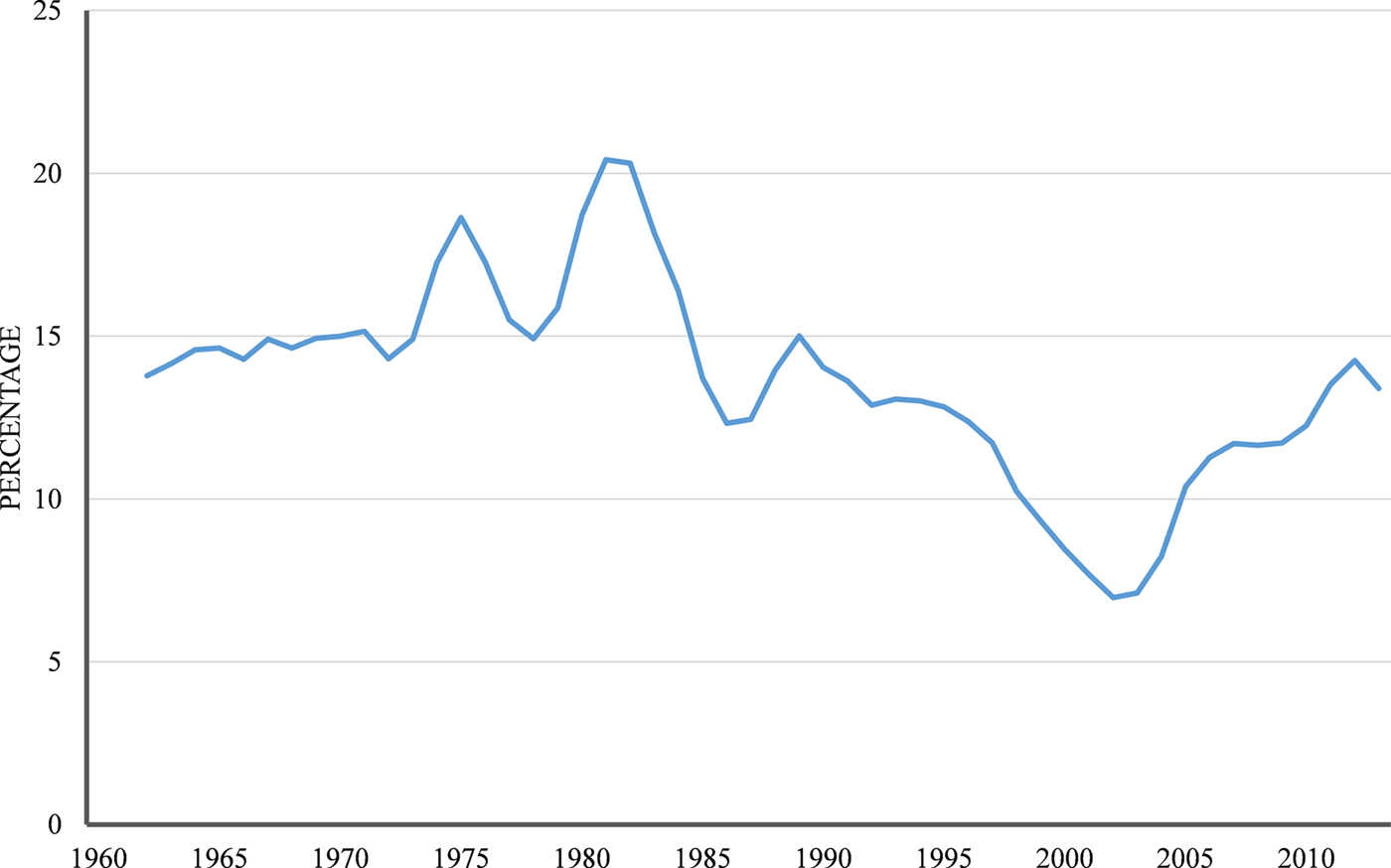
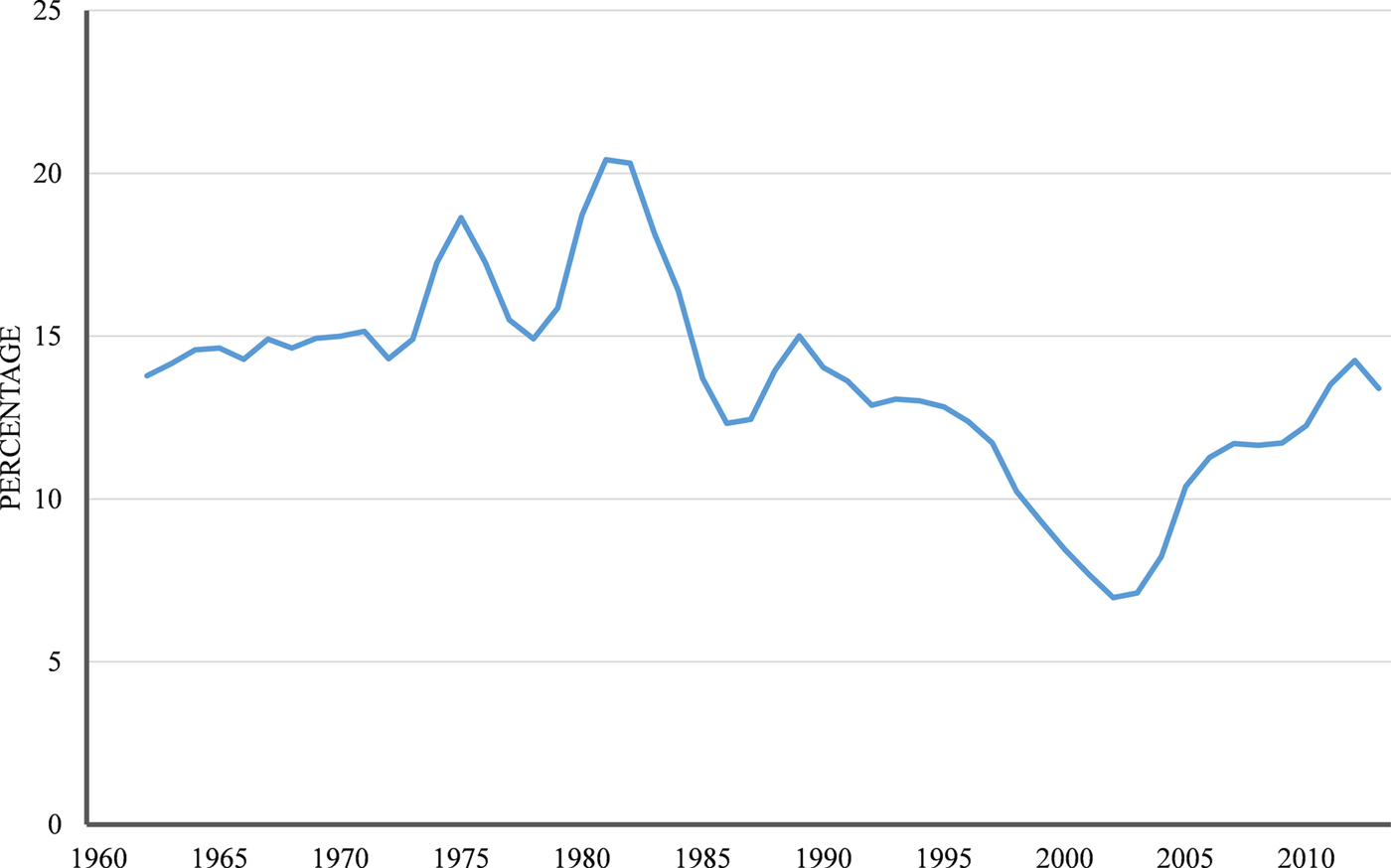
These parallel transformations, however, interacted with crucial North/South variation. One difference pertains to the character of migration. The majority of the world's international migrants—roughly sixty percent—live in the North. International migrants also comprise ten to twelve percent of the total population in the North, compared to only one to two percent in the South.Footnote 16 In contrast, “internal” rural-to-urban migration has been greater in the South. Between 1975 and 2009, for example, the urban population of the South more than tripled (in Africa it quadrupled), compared to only a twenty-nine percent increase in the North.Footnote 17 The United States and South Africa epitomize these trends, with high international migration in the former and high “internal” migration and urbanization in the latter. A second difference pertains to income. Despite the spatial relocation of manufacturing industries, per capita incomes in countries of the South remain substantially below those of countries in the North.Footnote 18 Reflecting this divide, since 1960 South Africa's per capita income has consistently remained below fifteen percent that of the United States, with the exception of two brief upticks between 1974 and 1984 (see Figure 1).
Printed with permission. Gross national income per capita, South Africa as percentage of United States, 1962–2013
(Data source: World Bank, http://data.worldbank.org/indicator/NY.GNP.ATLS.CD?display=default). Courtesy of Marcel Paret.
These differences have important consequences for working-class composition. On the one hand, a larger proportion of migrants in Gauteng are citizens from rural areas of South Africa, whereas a larger proportion of migrants in California are noncitizens from other countries. On the other hand, due to the wealth differential, the California economy is much better placed to absorb migrant labor. I begin by tracing the historical transformation of the working class in each place, and then turn to a comparative analysis of their contemporary workforces.
California
The immediate postwar period was a relatively prosperous time for many Californians, with the manufacturing sector becoming a key driver of economic growth and employment. Between 1940 and 1960 the manufacturing labor force more than tripled, accounting for one-quarter of all employment.Footnote 19 Manufacturing growth fueled a surge in union density, which surpassed forty percent in the early 1950s, facilitating a modest redistribution of profits.Footnote 20 Native-born white workers dominated the California workforce, with smaller numbers of European migrants and native-born black and Latino workers. Foreign-born workers from Latin America and Asia were a tiny proportion of the overall workforce, particularly in the urban areas.Footnote 21
Representing an important exception to these patterns, the agricultural sector was organized around the state-sponsored Bracero program, which brought Mexican farm workers to California on temporary work contracts. Through this program, Mexican workers came to dominate the agricultural workforce. In contrast to the more stable employment of urban manufacturing, the Bracero program tied workers to coercive contracts and treated them as disposable labor. They had few rights, were excluded from unions, and were highly exploited.Footnote 22 Agriculture, however, accounted for only five percent of the workforce in 1960.Footnote 23 The late twentieth century expansion of the precariat entailed the growth and diffusion of this low-wage migrant workforce.
The growth of precarious work lay at the root of this transformation. Between 1970 and 2000 the California economy continued to produce jobs at a rapid pace, including 5.5 million new jobs between 1975 and 1990. But employment expansion was polarized between high- and low-paying jobs.Footnote 24 The economy was increasingly organized around low-wage and often unstable work, whether in sweatshop factories, janitorial services, restaurants and hotels, or domestic household work. Precarious work went hand-in-hand with union decline. By 2000 union density had dropped to sixteen percent, and eleven percent in the private sector.Footnote 25 These trends underpinned declining wages, especially at the bottom. Between 1969 and 1997, real male wages decreased by more than twenty percent at the median, and by roughly forty percent at the tenth and twenty-fifth percentiles.Footnote 26
This precarious transformation coincided with major changes to US immigration law. The Bracero program was discontinued in 1964, partially because “unfree” labor was viewed as racist, and thus inconsistent with the emerging civil rights consensus.Footnote 27 At the same time the Hart-Cellar Act of 1965 installed a new immigration system based on quotas. The new system created legal pathways for non-Europeans that were not attached to the agricultural sector. The Immigration Reform and Control Act (IRCA) of 1986 reinforced this process by creating two amnesty programs, which led to the legalization of roughly three million undocumented migrants.Footnote 28 At the same time, however, the new system placed numerical limits on legal migration, thus ensuring that many newcomers would enter without legal authorization.Footnote 29
After 1970 the influx of immigrants from Latin America and Asia—both documented and undocumented—expanded dramatically. The growing demand for flexible and low-wage labor was increasingly met by foreign-born workers.Footnote 30 Low-wage employers came to prefer migrant workers, partially because they were understood to be more disciplined and hard-working.Footnote 31 This partially reflected workers’ precarious legal status, as the majority of migrant workers are noncitizens, and many live and work in the country illegally. It follows that migrant workers are especially vulnerable to employer abuse, the violation of basic labor laws, and low pay.Footnote 32
Gauteng
Located in the northern part of South Africa, Gauteng (formerly the “PWV” region) is the country's smallest, wealthiest, and most populous province. Similar to California, Gauteng's postwar economy was propelled by a booming manufacturing sector. Along with rural decline, the boom fueled massive black urbanization. The apartheid state organized the labor market around a strict system of racial classification and domination. Essentially constituted as noncitizens, black workers were excluded from voting, denied basic labor protections and the right to assembly, restricted from skilled and supervisory positions, and subjected to pass laws that strictly regulated where they could live and work.Footnote 33 In contrast to California, noncitizens comprised an overwhelming proportion of the mid-century workforce, concentrated at the bottom end. In 1965, for example, at the national level black workers comprised seventy-one percent of menial service jobs, eighty-six percent of unskilled manual jobs, and seventy percent of semiskilled manual jobs.Footnote 34
Apartheid laws also created an important division within the black population, between those with and without permanent urban residence rights.Footnote 35 Under Section 10 of the 1952 Urban Areas Act, permanent residence rights were extended to large numbers of current urban residents in the early 1950s.Footnote 36 Not only was their urban residence relatively secure, but residents with Section 10 rights also received preferential access to urban employment. Conversely, those without Section 10 rights had to either obtain a temporary work contract, giving them access to the urban areas for the duration of employment, or live and work in the urban areas illegally. Politically tied to the rural areas, these so-called “migrant” workers were especially vulnerable to removal from the urban areas. They were also subject to “the toughest and most grueling work, at the lowest pay, and under harsh treatment.”Footnote 37
Dramatic changes in South Africa's political economy—many, but not all, of which may be traced to the democratic transition—led to a significant reconfiguration of Gauteng's working class. The dismantling of apartheid may be traced at least as far back as 1979, when the state decided to officially recognize the newly emergent black unions, accelerating their already rapid expansion. While the US trade union movement was experiencing sharp decline, South African unions grew quickly, expanding in membership from roughly 750,000 in 1979 to more than three million by 1996.Footnote 38 Equally as important was the elimination in 1986 of “influx control” restrictions on movement, which further accelerated processes of urbanization. As the country's wealthiest and most urban province, Gauteng became a primary migrant destination. While the collapse of apartheid did facilitate international migration to Gauteng, such movement paled in comparison to the large “internal” migration.Footnote 39
Mirroring similar processes taking place across the Global SouthFootnote 40 , urban newcomers confronted a shrinking pool of formal employment opportunities. Unemployment began to expand in the late 1960s and 1970s.Footnote 41 Semiskilled positions were primarily extended to workers with Section 10 rights, while migrant workers faced fewer jobs, declining wages, and high rates of unemployment.Footnote 42 The democratic transition exacerbated these effects. Between 1980 and 2010, employment expansion was concentrated in high-paying professional and managerial jobs, which increased by more than two hundred percent, compared to only thirty-six percent and sixty-six percent growth, respectively, in semiskilled and unskilled jobs.Footnote 43 Meanwhile unemployment continued to increase. By 2000 the official unemployment rate, which excludes discouraged work seekers, stood at twenty-six percent.Footnote 44
These conditions fueled informalization from both above and below. From above, employers sought to exploit the labor surplus by hollowing out the core of stable workers, replacing them with more flexible and low-cost workers through casualization and subcontracting.Footnote 45 Whereas in California the flexible turn was enabled by the growing weakness of organized labor, in Gauteng it is perhaps better understood as employers’ response to organized labor's growing strength. From below, poor communities have been forced to rely on informal income-generating activities, which range from small street-trading operations to providing small services for cash, to forms of nonwage labor and casual servitude.Footnote 46 Precarious employment and livelihood are also increasingly managed at the household level,Footnote 47 where extended social networks provide support and facilitate the pooling of resources from temporary jobs, informal activities, and state transfers.
Compositional Divergence
These two different trajectories of working class reconfiguration in the period between 1970 and 2010 are rooted in two key divergences. The first divergence pertains to unskilled employment. Whereas in California the demand for unskilled labor increased steadily, in Gauteng it saw a sharp decline. The second divergence pertains to citizenship status. In California the influx of international migrants meant that a growing proportion of the workforce, particularly at the bottom, was foreign-born and noncitizen. In contrast, not only did the dismantling of apartheid essentially turn all black South Africans into citizens, but the vast majority of migrants to Gauteng are citizens from other provinces of South Africa. Taken together, these two divergences mean that low-wage noncitizen workers are more prevalent in California, while unemployed and underemployed citizens are more prevalent in Gauteng.
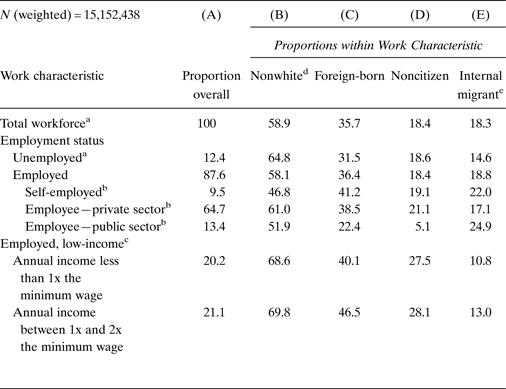
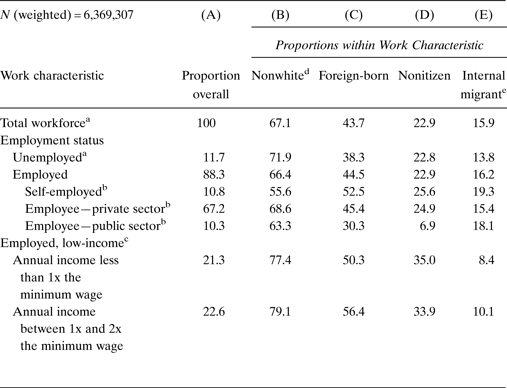
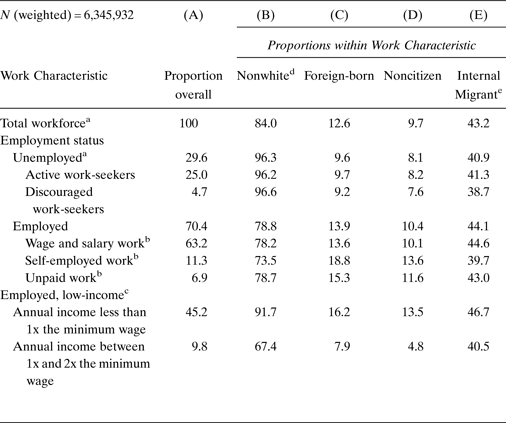
This contrast is captured in Tables 1–3, which present basic characteristics of the workforce—including those aged 16–64 who are either working or eligible for work—in California, Los Angeles, and Gauteng.Footnote 48 The previous analysis focused on California, which parallels Gauteng as a subnational political unit. But the Los Angeles metropolitan area, located in southern California, parallels Gauteng as a central “city region” of the global economy. It is also more comparable in size, with a workforce of roughly 6.3 million. I thus present results for both California and Los Angeles. Because the California patterns noted above are especially salient in Los Angeles, the narrower focus makes the contrast with Gauteng more pronounced.
Characteristics of the California Workforce, 2011.

Source: American Community Survey, 2011. Authors’ own calculations.
a Does not include discouraged work seekers.
b These categories are mutually exclusive and thus sum to the total proportion of employed individuals.
c These categories are based on the estimated annual income for an individual who worked 40 hours per week for 52 weeks at the federal minimum wage, which in 2011 was $7.25 per hour. This calculation produces an annual, minimum-wage–based income of $15,080.
d Nonwhite includes anybody who self-identified with at least one race other than white or who self-identified as Hispanic.
e Includes individuals who were born in the United States, but not in the state of California.
Characteristics of the Los Angeles Metropolitan Area Workforce, 2011.

Source: American Community Survey, 2011. Authors’ own calculations.
a Does not include discouraged work seekers.
b These categories are mutually exclusive and thus sum to the total proportion of employed individuals.
c These categories are based on the estimated annual income for an individual who worked 40 hours per week for 52 weeks at the federal minimum wage, which in 2011 was $7.25 per hour. This calculation produces an annual, minimum wage-based income of $15,080.
d Nonwhite includes anybody who self-identified with at least one race other than white, or who self-identified as Hispanic.
e Includes individuals who were born in the United States, but not in the state of California.
Characteristics of the Gauteng Workforce, 2011.

Source: South African Census, 2011. Authors’ own calculations.
a Includes discouraged work seekers.
b These categories are not mutually exclusive and thus sum to more than the total proportion of employed individuals. They are based on three different questions, asking whether the individual did each of the different forms of work.
c These categories are constructed to parallel the cutoffs used in Tables 1 and 2 (see note c). Each cutoff was converted to South African Rands using the Purchasing Power Parity conversion of the World Bank-led 2011 International Comparison Program. In 2011 the conversion was 4.769. The South African equivalent of the US minimum wage-based annual income is R71,916.52.
d Includes individuals who self-identified as black African, colored, Indian or Asian, or other.
e Includes individuals who were born in South Africa but not in Gauteng province.
Focusing on column A, the results suggest that from an economic standpoint, the Gauteng workforce is more precarious than the California workforce. Most striking is the difference in the unemployment rate, which is thirty percent in Gauteng but only twelve percent in California and Los Angeles. Further evidence from labor force surveys suggests that unemployment is also more chronic in Gauteng than it is in California. Nearly half of the unemployed in Gauteng (forty-six percent), for example, have been without work for three years or more. In contrast, more than sixty percent of the unemployed in California and Los Angeles have only been searching for work for less than one year, and none have been searching for more than three years.Footnote 49
A further contrast pertains to the proportion of those who are employed but earn considerably low income. The bottom rows of Tables 1–3 identify employed workers who earned less than one or two times the equivalent annual income for a full-time job that pays at the US federal minimum wage (see note c of each table). The Gauteng figures adjust for differences in purchasing power. The results show that Gauteng has a substantially higher proportion of working poor, with forty-five percent living on less than the US minimum wage, compared to only twenty percent in California and twenty-one percent in Los Angeles. The results are somewhat more comparable if we consider individuals earning less than two times the US minimum wage, but still show a higher proportion of working poor in Gauteng (fifty-five percent) than in California (forty-one percent) and Los Angeles (forty-four percent).
Column B shows that in both places, the majority of the entire workforce is nonwhite, and nonwhite workers are also disproportionately represented within the most precarious layers. In California and Los Angeles, for example, sixty-nine percent and seventy-seven percent of those who are employed and make less than minimum wage are nonwhite, compared to fifty-nine percent and sixty-seven percent of the workforces overall. In Gauteng, eighty-four percent of the entire workforce, ninety-two percent of those working for less than minimum wage, and ninety-six percent of the unemployed are nonwhite. Yet there are important differences with respect to country of origin. As shown in column C, just over one-third of the workforce in California (thirty-six percent), and forty-four percent of the workforce in Los Angeles, is foreign-born. Conversely, only thirteen percent of the workforce in Gauteng is foreign-born. The contrast is even starker among workers with income less than the US minimum wage: forty and fifty percent are foreign-born in California and Los Angeles, respectively, compared to only sixteen percent in Gauteng.
It follows from these contrasts that noncitizens (column D) are more prevalent in California and Los Angeles, comprising eighteen percent and twenty-three percent of the workforce, respectively, compared to only ten percent in Gauteng. Among those who are employed but earn less than the US minimum wage, noncitizens comprise twenty-eight percent in California and thirty-five percent in Los Angeles, compared to only fourteen percent in Gauteng. Conversely, internal migrants (column E) are much more prevalent in Gauteng, comprising a whopping forty-three percent of the workforce. Internal migrants are only eighteen percent and sixteen percent of the workforce in California and Los Angeles, respectively, and even less prevalent among those with low income. In sum, foreign-born migrants and noncitizens are more prevalent in California, while internal migrants and citizens are more prevalent in Gauteng.
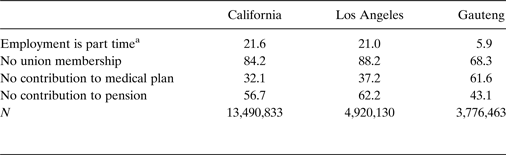
Among the employed, there are also important differences in the forms of insecurity, as shown in Table 4. Part-time employment is more prevalent in California and Los Angeles, affecting roughly one in five workers, compared to only six percent of workers in Gauteng. Workers in California (eighty-four percent) and Los Angeles (eighty-eight percent) are also especially likely to be nonunionized, though two-thirds of workers in Gauteng are also without a union (note that these unionization estimates exclude self-employed and own-account workers). Conversely, sixty-two percent of workers in Gauteng do not have employer-subsidized health insurance, compared to only thirty-two percent in California and thirty-seven percent in Los Angeles. Employment-based pensions are becoming rare in both contexts, though lack of a pension is slightly more common in California (fifty-seven percent) and Los Angeles (sixty-two percent) than it is in Gauteng (forty-three percent).
Proportion of Employed Workers Aged 16–64 with Selected Features of Precarious Employment, California, Los Angeles, and Gauteng, 2011.

Source: Current Population Survey, March 2011 (California, Los Angeles); Quarterly Labor Force Survey, Third Quarter (Gauteng). Authors’ own calculations. Includes all employees doing paid or unpaid work. Does not include the self-employed, own-account workers, or the unemployed.
a Includes individuals who worked fewer than 35 hours per week.
Struggles against Insecurity
The divergent working class composition in California and Gauteng lays the foundation for different collective struggles. The following analysis illustrates the divergence by examining May Day protests in California and community protests in Gauteng. I focus on these particular cases for two reasons. First, they were highly visible struggles that involved significant numbers of people and were sustained over a period of at least a decade. Each represents a significant example where precarious layers of the working class engaged in public, collective action. Second, they highlight the contrast between the two cases, precisely because they pertain to segments of the working class that are distinctly prominent: in California, low-wage noncitizen workers; in Gauteng, underemployed citizens. In comparative perspective, each set of struggles appears unique. There are currently no sustained protests by the foreign-born in Gauteng that parallel the size of May Day protests in California, and there are currently no sustained protests by poor citizens in California that parallel the proliferation of community protests in Gauteng.
One could reasonably argue that May Day protests and community protests are among, if not the, most significant collective struggles by precarious layers of the working class in California and Gauteng. But they are by no means representative of all such struggles. It would certainly be possible to find two examples that are more similar in terms of the groups involved and the demands they make. The case studies are thus better understood as an illustration of the diversity of precarious class formation. I begin by providing an overview of each example, and then turn to their divergent politics.Footnote 50
May Day Protests (California)
Though celebrated worldwide as an international day of worker solidarity, May Day was historically supplanted in the United States by the celebration of Labor Day in September. In California this began to change in the early 2000s. The impetus was a growing surge of struggles by low-wage migrant workers, many of whom began to organize with the assistance of nonprofit organizations known as “worker centers.”Footnote 51 Through these struggles, workers in a variety of industries dominated by precarious work—domestic workers, garment workers, restaurant workers, grocery store workers, day laborers—began to collaborate and support each other. One outgrowth of this collaboration was the formation of the Multi-Ethnic Immigrant Workers’ Organizing Network (MIWON) in Los Angeles, which brought together low-wage and noncitizen migrant workers from various origin countries.Footnote 52
One of MIWON's central aims was to extend work-related struggles into the broader arena of migrant rights. May Day protests exemplified this extension. The idea emerged out of a successful picket against an abusive employer, prompting worker center organizers to devise a plan, for the following year, to “reclaim May 1st and make it an migrant workers’ day, make it about immigration.”Footnote 53 Between 2000 and 2005 the May Day protest march became an annual event, bringing together low-wage migrant workers and the broader migrant community from across Los Angeles. Regularly drawing upwards of four thousand participants, the event reached as many as fifteen thousand in 2002, in the wake of the 9/11 attacks and the subsequent anti-migrant backlash.Footnote 54
Between February and May 2006 a wave of migrant protests spread across the country, including roughly five million participants. The resistance was national in scope, but California accounted for one-quarter of the largest protests. The 2006 protests extended well beyond MIWON's reach, even in Los Angeles, but they climaxed on May Day—thirty thousand protesters in San Francisco, one hundred thousand in San Jose, and a monstrous six hundred fifty thousand in Los AngelesFootnote 55 —thus reinforcing the tradition that MIWON had invigorated. After 2006 the tradition of May Day protests spread to cities throughout California. In 2010, for example, there were protests in at least eleven different cities. For many, May Day has become an important ritual and space of resistance for migrant communities. As one migrant and long-time MIWON activist put it: “It's just become a tradition … and we feel that that's definitely the space to talk about whatever it is that's going on … that's when everybody comes together. It's like the family reunion.”Footnote 56
Community Protests (Gauteng)
Community protests in the urban areas of South Africa have been prevalent since at least the 1980s, when antiapartheid struggles frequently took the form of township uprisings. After a brief period of demobilization following the democratic transition in 1994, popular urban struggles re-emerged forcefully in the late 1990s and 2000s. This resurgence fueled the formation of a host of new social movements, many of which were highly critical of the new ruling party and party of national liberation, the African National Congress (ANC).Footnote 57 These new social movements did not last long, however, with most beginning to dissipate by the middle of the 2000s. But they laid an important foundation for a new wave of struggle, which is defined by the proliferation of more loosely organized community-based protests around issues of public service delivery.Footnote 58
The new wave of community protests began to take shape after 2004, but they accelerated rapidly beginning in 2009. The protests have taken place across the country, but they have been especially prevalent in Gauteng province. According to mainstream media sources, there were 433 community protests in Gauteng between 2005 and 2012—an average of more than 50 per year—accounting for roughly one-quarter of the total nationwide.Footnote 59 Due, at least partially, to their loose organization, the protests have remained highly localized and isolated from each other. Yet they also demonstrate a remarkable similarity in terms of demands (discussed below) and tactics. With respect to the latter, protesters often hold marches to local government offices or to the homes of local political officials and have frequently turned to disruptive tactics such as burning tires and barricading roads in order to get the attention of the state.Footnote 60
Community protests have taken place almost exclusively in townships and informal shack settlements. Reflecting the history of racialized spatial planning under apartheid, these areas are predominantly black and defined by high levels of poverty. Evidence shows that protest-affected areas experience high levels of material deprivation. It also suggests that community protests have been propelled by an emergent generation of unemployed youth activists, though protests commonly draw support from a wide swath of the community, including older generations as well as those in various forms of insecure employment.Footnote 61 The protests have largely been driven by native-born citizens, and in a growing number of cases they have devolved into episodes of xenophobic antagonism directed at foreign residents, and shop owners in particular.Footnote 62
Divergent Politics
May Day protests in California and community protests in Gauteng are both rooted in precarious working and living conditions. But their politics differ in two important ways. First, community protests revolve around demands for state-provided resources, while such demands are noticeably absent in May Day protests. Second, whereas work-related issues and identities are central to May Day protests, they are a background feature of community protests. I take each in turn.
Demands
Both sets of struggles were oriented toward the state, which makes sense in the context of precarious employment. For those who are unemployed, do not have a regular employer, or are particularly vulnerable to dismissal, organizing against employers is risky, difficult, or entirely impossible. Indeed, the power, mobility, and general elusiveness of capital are defining characteristics of the contemporary period, underpinning the growth of economic insecurity. In contrast, the state is less mobile and more dependent on the well-being of ordinary people for maintaining its legitimacy. Yet the primary actors in the two sets of struggles had very different relationships to the state, which in turn had a profound impact on their demands.
Community protesters in Gauteng had a relatively privileged relationship to the state. Not only were they citizens, but their citizenship had special meaning in the racialized postapartheid context. The ruling ANC came to power on the back of the liberation struggle, and its legitimacy is heavily dependent on the perception that it is improving the conditions of the previously excluded black majority. In this context it is not surprising that poor black citizens would hold the state accountable for providing basic needs and lifting them out of poverty. Community protests are popularly referred to as “service delivery” protests precisely because they often demand that the state deliver resources. The most common demands are for housing, water, and electricity, but others include paved roads, street lights, refuse removal, and quality toilets. In many instances protesters demand better “service delivery” or “development” in general. These demands are frequently directed towards local state officials, who are the state actors in nearest reach.
These dynamics are illustrated by a memorandum that was presented by the residents of Elias Motsoaledi informal settlement to their local ward councilor, in association with a protest in July 2009. The memorandum begins by contrasting their situation with expectations of post-1994 improvement: “We the poor and continuously disadvantaged people of Elias Motsoaledi Squatter camp at Soweto … [are] living in the standard afar beneath human level. [This is despite] the black government which gave [the] impression ‘it will improve the lives of the black and poor majority.’” It continues by noting how “living without electricity is devastating our lives,” and that “unemployment is at an alarming rate.” Perhaps most importantly, the memorandum expresses frustration with the fact that the community has been ignored by political officials:
The first democratic government in 1994 promised to bring development … the officials from local government came with landscape maps. Proving that ‘the development is coming and no-one will be relocated’ they said repeatedly … Prior [to the recent] elections the ward councilor promised the development was coming in April this year. Now [it] is July nothing has happened. It has been the same story from predecessors to successor … This [is] making the lives of people at Elias Motsoaledi Squatter Camp to [be] “meaningless.”
As the conclusion underscores, the protest demanded that political officials recognize the existence of the community and in turn attend to its development needs. At the forefront of these needs, listed at the end of the memorandum, were electricity inside of the shacks, upgrading of the shacks to proper houses, and free transportation for children going to school. Five years later, in 2014, after a number of subsequent protests, one of which included the burning of a local KFC restaurant and the toppling of a traffic light, the state began to build concrete houses in the area.
These dynamics contrast sharply with the politics of May Day protests in California, where the protesters had a much more tenuous relationship with the state. Though the protests drew support from other sections of society, they were animated and driven by migrants from Latin America and Asia, most of whom were not citizens and many of whom were undocumented. Following from this political vulnerability, the primary demand of the protests was for the legalization of undocumented migrants. This was highlighted by a prominent MIWON activist in Los Angeles: “[May Day] was a common space where people could actually stand together in support of legalization … you were seeing immigrants coming together, coming out of the shadows … saying this is who we are, and we demand our rights, and we believe that we're contributing to this country and that we're here.”Footnote 63
Similar to community protests in Gauteng, May Day protests in California were thus rooted in demands for recognition and directed toward the state. But rather than calling on the state to provide material resources such as housing and electricity, they called on the state to treat migrants as legal residents with the same formal rights as native-born residents. Demands for legalization went hand in hand with opposition to the criminalization of migrants, both documented and undocumented, and in particular to the tearing apart of families and communities through deportation. The latter issue gained increasing prominence after 2001, as Immigration and Customs Enforcement ramped up spending on enforcement and increasingly enlisted the support of local police agencies, thus leading to growing numbers of deportations. As a poster advertising a 2012 May Day protest in Los Angeles demanded: ”Full Legalization Now! Stop ICE/Police Repression!”
May Day protests took many by surprise, partially because they were led by noncitizens who lacked basic political rights and could be removed from the country at the whim of the state. For example, they fly in the face of prominent theories regarding political mobilization and social movements, which assume citizens to be the central protagonists.Footnote 64 If their lack of citizenship did not prevent migrants from taking to the streets, however, it did influence the types of demands that they made. In particular, it discouraged the types of claims for state-provided resources that were prevalent in Gauteng. One migrant worker and prominent activist explained, “Our people, nobody wants to ask for help from other people or the government. So it gets complicated.”Footnote 65 Reinforcing the idea that the protests are about basic legal rights, not government provisions, another migrant activist who is prominent within MIWON put it plainly: “It's not that we're asking for handouts. I think we've suffered enough … we're here now, we want to contribute to this society. But then we also want to be respected and be part of it as such.”Footnote 66
Contrasting with the sense of entitlement that stemmed from the postapartheid transition in Gauteng, protests in California were underpinned by a sense of antientitlement. As one migrant and longtime May Day organizer in northern California explained,
You don't feel that you qualify to demand, [or] claim for your rights because you are nothing … The message of who I am, is so strong, that here [in the US] it's like, do I really deserve? … It's not my country, and how do I dare? … We are in a system and we feel that we are like begging … yeah, we want education for all, we want health for all, those are important. But for immigrants, the main, you need to be legal.”Footnote 67
In short, legalization is the central target. This does not mean that economic resources are unimportant for noncitizen migrants. It only means that obtaining those resources from the state is not the primary object of collective struggle.
Work and Resistance
Another crucial difference between the two sets of struggles is their relationship to work. As illustrated above, underemployment is substantially more prevalent in Gauteng than it is in California, where there is a relatively greater demand for low-wage labor. Further, May Day protests were largely propelled by low-wage workers, whereas community protests were largely propelled by the underemployed. It follows that work-related identities were more central in the California case.
From the beginning there was always a close connection between May Day protests and issues surrounding low-wage work. MIWON itself grew out of work-related struggles that had emerged over the course of the 1990s, and its founding platform included a demand for “greater protection and enforcement of US labor laws, which will guarantee at least a minimum wage and security from blacklisting, harassment and intimidation of any kind.”Footnote 68 The annual May Day march consistently highlighted worker issues. In 2004, for example, the protest included a caravan that visited various abusive employers around Los Angeles, combining demands for migrant rights with demands for the fair treatment of migrant workers.
Further demonstrating the organic connection between migrants and worker issues, May Day protests commonly demanded that undocumented workers have access to drivers’ licenses. Such access had been denied beginning in 1993, making it difficult for undocumented workers to get to work. As one migrant domestic worker explained,
I was scared to drive without [a] license. But one day I say to myself, ‘Hey, come on. You need to drive. You need to take your son to school, and you have to go to work.’ And taking [the] bus to the school, and then going to my work, I didn't make it.Footnote 69
The fusion of migrant rights and worker rights was especially apparent on May Day 2006, which featured a boycott of work, school, and business. The boycott was designed to highlight the economic contributions of migrants, particularly as workers, thus justifying their demand for inclusion as legal residents. The contrast was captured by the prominent slogan, “We are workers, not criminals.” A previously undocumented migrant worker and long-time activist in San Francisco explained just how central the “worker” identity is to collective struggle:
That's not even a message that people want to say. That's more of the nature of who we are. They say, “we are workers, not criminals.” That's our common slogan. “We are here to work. We came to work. We are good decent people who come to work. The only thing we want to do is to work.” So it's ingrained.Footnote 70
In addition to issues of work-based identity, the struggle for legal status was also connected to gaining fair treatment at work. This was captured by a previously undocumented day laborer who had become a prominent activist in Los Angeles:
Respondent They [undocumented workers] are losing their lives, they are losing their salaries, they are losing their families, they are losing everything. But they need to survive … So I tell them we have to stop this mess. How is this mess going to be stopped? Legalizing all the workers.
Interviewer So its sounds like for you, the legalization struggles and worker struggles are—
Respondent —are the same. Are the same because it's the struggle for good salaries. First for the right to work.Footnote 71
As this exchange illustrates, for many migrant workers the struggle for better pay and working conditions is rooted in a struggle for legal status, and especially the right to work legally.
Worker identities are less central to community protests in Gauteng, which are more about the absence of employment than its degradation. The realities of underemployment are a constant pressure, giving rise to both poverty and frustration, which in turn undergird protest. This sense of frustration was captured by two young activists from Bekkersdal, located to the west of Johannesburg, who explained why protests had been so prevalent in their township:
People are so angry. The sewage everywhere, unemployment. Even parents are fed up with the unemployment rate. Having to feed four or five adults in the house is just too much … Most of us here we are qualified to do the job, we have qualifications. But then we do not get the job, especially in the municipality. People got angry, and still are, because nothing has been done.Footnote 72
We do not have opportunities here. So that is why we start to protest …We go everyday to look for jobs, but none of us get … Some people got internships and they graduated from different institutions, but still they are not able to get jobs. That is when they say, let us protest.Footnote 73
While some protesters have hope that local development will translate into employment opportunities, as noted above the most common demands are not work-related, but rather revolve around the provision of goods and services such as housing and electricity. Community protests, therefore, are best understood as collective claims for a basic livelihood in the face of a disintegrating labor market. This need for protection was captured by a community leader of an informal shack settlement in Tsakane, a township to the east of Johannesburg:
Unemployed people get angry because it is hard to look for a job here, and they do not fulfill our needs. When we march it ends up getting out of control because of that. At least if they can meet our needs, if a person knows that their shacks wont flood because sometimes the water comes in … You go job hunting and it rains, when you come back your shack is wet and there is no food. So if they can put electricity at least you can sell [have a small vending operation], you know, because jobs are scarce.Footnote 74
The “they” here is the state, and the local state in particular, which is called upon to meet the basic needs of the people in the face of limited employment opportunities.
May Day protests in California and community protests in Gauteng thus had a very different relationship to work. The former were rooted in strong worker identities and sought to improve working conditions through legal inclusion. In contrast, the latter were rooted in identities around unemployment and sought to improve basic living conditions by securing basic provisions.
Conclusion
This study of precarious class formation in California and Gauteng sheds important light on Standing's analysis of the precariat, affirming some aspects while raising questions about others. Perhaps most importantly, it affirms the claim that precarious layers of the working class are becoming prominent. In both places the proportion of people confronting low-income and insecure employment expanded between 1970 and 2010. In this sense, it is reasonable to refer to the growth of the precariat in both California and Gauteng.
The central goal of the analysis, however, was to examine variation. Here it is important to add nuance to Standing's analysis, which implies that the growth of the precariat is a relatively uniform process across the globe. In contrast, the study of California and Gauteng illustrates crucial variation, particularly with respect to issues of labor market integration and citizenship. In California the precarious layers of the working class are well integrated into the low-wage labor market, but many lack formal citizenship due to the prevalence of international migration. Conversely, in Gauteng most workers have formal citizenship status, but they are more detached from the labor market and suffer more from underemployment.
It is worth re-iterating the historically specific character of this divergence. In both California and Gauteng, the working class was dramatically reorganized in the last quarter of the twentieth century. As I have shown elsewhere, for example, the contemporary labor market in California shares important similarities with the Gauteng labor market of the apartheid era.Footnote 75 Similar to many migrant workers in California today, during the 1950s and 1960s black workers in Gauteng were denied basic citizenship rights. Many black workers also confronted a very similar possibility of deportation or removal from their area of residence, due to the pass law system. The precarity of contemporary California thus mirrors the precarity of apartheid Gauteng, illustrating both historical variation and a recycling of political economic organization.
Another crucial modification of Standing's analysis is that precarious layers of the working class are capable of developing agency and forging collective struggles. Though Standing does not rule out this possibility altogether—indeed, his optimism about the future depends on the collective formation of a precariat identity—his analysis of the present emphasizes disorganization and a lack of agency. One reason for this pessimistic assessment is that he focuses on the organization of the precariat as the precariat. This need not be the case. Different groups may express agency, and challenge insecurity, in different ways.
The two sets of struggles examined here each reflect their particular context and focus on issues other than precarious employment: May Day protests reflect the prominence of low-wage noncitizen workers in California and focus on formal legal inclusion; community protests reflect the prominence of underemployed citizens living under slum conditions in Gauteng, and focus on state provision of basic livelihood needs. Both examples, therefore, illustrate resistance to precarity but not in the name of the precariat per se. This does not, however, mean that issues of employment were irrelevant. Whereas in California the worker identity was central to May Day protests, in Gauteng the prevalence of unemployment underpinned community protests.
These differences may partially reflect broader global variation, particularly regarding the greater wealth and relative significance of international migration in the North. But the generalization should not be exaggerated. It would be dubious to suggest that California and Gauteng accurately represent the entire North and the entire South. The analysis here does illustrate important variation in processes of precarious class formation. But further research is needed to establish if and where these processes are replicated, and whether it makes sense to refer to distinctive Northern and Southern processes of precarious class formation.