Introduction
Ruthenium (Ru) is an important element used widely in modern technologies, predominantly for wear-resistant electrical contacts and thick-film resistors and, to a lesser degree, as a chemistry catalyst and for extreme ultraviolet photomasks (Greenwood and Earnshaw, Reference Greenwood and Earnshaw1997). Ruthenium also has potential for anticancer therapy (Clarke, Reference Clarke2003). Ruthenium is produced as a by-product of extraction of Pt and other platinum-group elements (PGEs).
Ruthenium, similarly to other PGEs is very rare. Its average crustal abundance is 7.1 ppb (Lorand and Laguet, Reference Lorand and Luguet2016). Ophiolite-associated chromitites are characterised by a relatively higher Ru content in comparison with chondrite (O’Driscoll and González-Jiménez, Reference O’Driscoll and J.M2016 and reference therein). Native metals of the Ir–Os–Ru system and sulfides of the laurite–erlichmanite series are the one of the main mineral forms of Ru in chromitites and ophiolitic ultramafic rocks (O’Driscoll and González-Jiménez, Reference O’Driscoll and J.M2016). Ruthenium-dominated minerals are very few among PGMs and rare with this being only the seventh Ru-dominant PGM (including native Ru).
The average crustal abundance of Se is 5×10⁻⁶ wt.% (∼50 ppb (Ovchinnikov, Reference Ovchinnikov1990). The Se content of mantle peridotites varies from <1 ng/g–1 (ppb) to 130 ppb (Lorand and Laguet, Reference Lorand and Luguet2016). Selenium predominantly accumulates in a sulfide melt in comparison to a silicate melt (the ratio of Se content in sulfide melt/silicate melt is 3×10², Patten et al., Reference Patten, Barnes, Mathez and Jenner2013 and references therein). Accordingly, because of selenium’s affinity with sulfur or postmagmatic fluid alteration any Se in igneous ultramafic rocks is associated with sulfides of base metals, which crystallised due to liquation of a sulfide melt from silicate and oxide melt (Lorand and Laguet, Reference Lorand and Luguet2016). Due to different geochemical behaviours, Ru and Se have rarely encountered each other throughout geological history.
In general, the PGE selenides are sparse compared to sulfides and tellurides. No selenides are mentioned in the well-known review of petrogenesis of the platinum-group minerals by O’Driscoll and González-Jiménez (Reference O’Driscoll and J.M2016) in contrast to abundant data on tellurides, bismuthides and germanides. The Se content of more common platinum group minerals (PGMs) is also not discussed. No special attention for selenides has been paid in recent reviews about placers (Cabri et al., Reference Cabri, Oberthür and Keays2022 and reference therein) and chromitite from different types of ultramafic rocks (Zaccarini et al., Reference Zaccarini, Garuti, Pushkarev and Thalhammer2018, Reference Zaccarini, Economou-Eliopoulos, Kiseleva, Garuti, Tsikouras, Pushkarev and Idrus2022; Stepanov et al., Reference Stepanov, Palamarchuk, Antonov, Kozlov, Varlamov, Khanin and Zolotarev2020). Seventeen PGE selenides, however, are currently known from various localities worldwide (e.g. Johan et al., Reference Johan, Picot and Pierrot1970; Davis et al., Reference Davis, Clark and Criddle1977; Jebwab et al., Reference Jebwab, Cervelle, Gouet, Hubaut and Piret1992; Cook et al., Reference Cook, Wood, Gebert, Bernhardt and Medenbach1994; Polekhovskiy et al., Reference Polekhovskiy, Tarasova, Nesterov, Pakhomovskiy and Bakhchisaraitsev1997; Paar et al., Reference Paar, Roberts, Criddle and Topa1998; Roberts et al., Reference Roberts, Paar, Cooper, Topa, Criddle and Jedwab2002; Vymazalová et al., Reference Vymazalová, Laufek, Drábek, Cabral, Haloda, Sidorinová, Lehmann, Galbiatti and Drahokoupil2012; Zaykov et al., Reference Zaykov, Yu, Zaykova, Kotlyarov and Kraynev2017; Barkov et al., Reference Barkov, Nikiforov, Tolstykh, Shvedov and Korolyuk2017, Reference Barkov, Nikulin, Nikiforov, Lobastov, Silyanov and Martin2021; Krivovichev, Reference Krivovichev2021; Belogub et al., Reference Belogub, Britvin, Shilovskikh, Pautov, Kotlyarov and Zaykova2023). Selenium has been reported as a trace element in the outer rim of platinum–palladium grains from Corrego Bom Sucesso, Brazil, where the authors attribute Se contamination to biofilms (Reith et al., Reference Reith, Zammit, Shar, Etschmann, Bottrill, Southam, Ta, Kilburn, Oberthür and Ball2016).
A Ru selenide, which is similar to selenolaurite in composition, has been described in a gold-bearing placer of the Kundus River (Tyva Republic, Russia) (Zaykov et al., Reference Zaykov, Zaykova, Blinov, Oydup and Mongush2014). This selenide forms inclusions in native osmium up to 40 µm in size. An Se content of up to 5.93 wt.% was detected in minerals of the laurite–erlichmanite series from the inclusions in isoferroplatinum grains of the Kazan placer (Chelyabinsk district, Russia) (Belogub et al., Reference Belogub, Zaykova, Kotlyarov, Shilovskikh, Britvin and Pautov2019; Zaykova et al., Reference Zaykova, Blinov and Kotlyarov2020). An Ru selenide in an assemblage with native osmium and clinochlore as joint inclusions in magnesiochromite has also been described from the lode chromitites of the Pados-Tundra complex, Kola Peninsula, Russia (Barkov et al., Reference Barkov, Nikiforov, Tolstykh, Shvedov and Korolyuk2017).
This article describes the new mineral selenolaurite (symbol Slrt), which was approved by the Commission on New Minerals, Nomenclature and Classification of the International Mineralogical Association (IMA2020-027, Belogub et al., Reference Belogub, Britvin, Shilovskikh, Pautov, Kotlyarov, Krzhizhanovskaya, Novoselov, Zaykova and Blinov2020), and discuses its condition of formation. Selenolaurite was discovered during a routine mineralogical study of a heavy concentrate from the Ingul placer carried out by Viktor Zaykov (1938–2017). The holotype specimen of selenolaurite is deposited in the Natural Museum of the Ilmeny State Reserve (registration no. 920/geo840, Miass, Chelyabinsk district, 456317, Russia). Recently, we also found Se-dominant laurite as an inclusion in an isoferroplatinum grain from the Kazan gold placer. Selenolaurite is named as the Se-dominant analogue of laurite.
Material and methods
Heavy concentrates enriched in Pt were given to V.V. Zaykov by N.P. Zemlyanskiy (Ingul Cooperative). The sample was collected in an open pit of the Ingul gold placer in 2016. An additional three samples from this placer were provided by N.P. Zemlyanskiy in 2021 for the refinement of mineral compositions from the placer.
The chemical composition of selenolaurite was determined using a REMMA 2M scanning electron microscope (SEM) equipped with an Oxford Link energy-dispersive spectrometer (EDS) at an accelerating voltage of 20 kV, a beam current of 6 nA, and a beam diameter of 2 μm. The reference materials included metallic Rh, Pt, Os, Ir, Ru, Pd, Au and Ag for corresponding metals, chalcopyrite (S, Fe, Cu), CdSe and Bi2Se3 (Se) (a set of standards from NERMA.GEOL.25.10.74, Kyiv, 2005). Selenolaurite was also analysed on a Tescan Vega 3 SBU SEM equipped with an Oxford Instruments, X-act energy-dispersive spectrometer (EDS) at an accelerating voltage of 20 kV and a beam current of 200–300 pA in spot mode. The energy-dispersive spectra were acquired, processed and quantified using the Inca 5.02 software. The detection limit was reported to be no worse than 0.3 wt.%. The EDS was calibrated following the quant optimisation procedure on pure Co before and after analysis and the beam current drift was <1%. Metallic Os, Rh, Pt, Ir, Ru, Pd for respective metals, pyrite (S, Fe), CoSe and Bi2Se3 (Se) and PbTe (Te), Se), set of standards from NERMA. Kyiv, 2005, were used as reference materials (South Urals Federal Research Center of Mineralogy and Geoecology). The chemical composition of the selenolaurite was also analysed using electron microprobe JEOL JCXA-733 with a wave dispersive spectrometer (WDS, Fersman Mineralogical Museum); using an acceleration voltage = 20 kV; beam current = 20 nA; beam diameter = 2 μm, and the reference materials metallic Rh, Pt, Ir, Ru, Pd for respective metals, pyrite (S, Fe), Bi2Se3 (Se) and HgTe (Te). The formulas were recalculated to three atoms for the laurite–selenolaurite series and moncheite and one atom for the Os–Ir–Ru alloys.
Element-distribution maps and additional data on chemical composition were obtained on a Hitachi S-3400N SEM equipped with an Oxford Instruments X-Max 20 EDS at an accelerating voltage of 10 kV and a beam current of 1 nA to increase the beam size for the ED analysis at the GEOMODEL Resource Center (Saint Petersburg State University (SPbU), St Petersburg, Russia). The spectrometer was calibrated against pure Os, Rh, Pt, Ir, Ru, Pd, Se, Te and pyrite (for S) (Micro-Analysis Consultants Ltd (MAC) standards).
The electron back-scattered diffraction (EBSD) maps were obtained using an Oxford Instruments HKL NordlysNano detector mounted on the abovementioned SEM (GEOMODEL Resource Center, Scientific Park, SPbU). The acquisition conditions were as follows: 30 kV and 1.5 nA, exposure time of 0.5 s per pattern, average of 3–5 images (when mapping) or 20 images (to obtain individual high quality patterns). All the images were subsequently processed using AzTec and Channel5 software packages from Oxford Instruments. The structural data on a laurite crystal (Sutarno et al., Reference Sutarno and Reid1967) were used for the comparison and those of native osmium (Levi and Picot, Reference Levy and Picot1961, AMCSD 0016737) and shuangfengite (ICSD 33934) were used as references for EBSD mapping. Shuangfengite IrTe2 has the same trigonal structure as moncheite PtTe2 (space group Pm1). The lattice parameters a and c of shuangfengite and moncheite differ by 3 and 2%, respectively, therefore, given the sensitivity of EBSD for unit cell values of not better than 10%, structural data on shuangfengite were used as a reference for moncheite mapping. The orientation of individual selenolaurite crystals is shown in Euler colour schemes, pole figures and orientation distribution density heatmaps, as proposed in Mason and Schuh (Reference Mason, Schuh, Schwartz, Kumar, Adams and Field2009). To obtain a mechanically undistorted surface, a sample for the EBSD analysis was treated with a direct beam of Ar plasma on an Oxford Instruments Ionfab300 etcher with an exposure time of 10 min, an angle of 45°, an accelerating voltage of 500 V, a current of 200 mA and a beam diameter of 10 cm (Nanophotonics Resource Center, Scientific Park, SPbU).
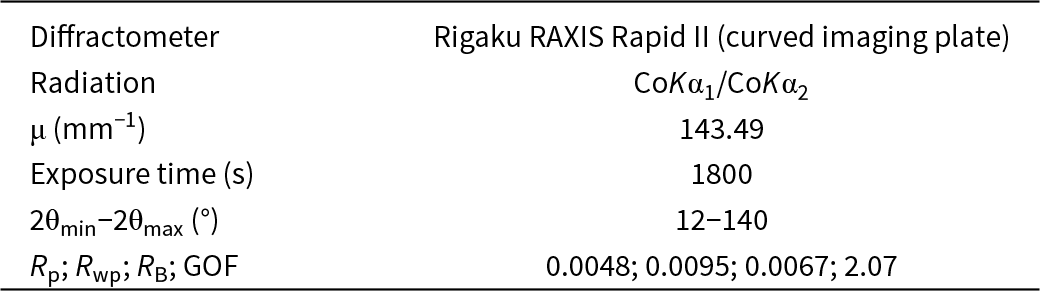
Powder X-ray diffraction data were collected for material extracted from the polished section which was analysed using WDS on a Rigaku RAXIS Rapid II diffractometer (curved (cylindrical) imaging plate, r = 127.4 mm) using CoKα-radiation (λ = 1.79021 Å), a rotating anode (40 kV, 15 mA) with microfocus optics, Debye-Scherrer geometry, and an exposure time of 30 min. The calculated d-spacings and intensities were obtained from the Stoe WinXPOW v. 1.28 program based on the unit-cell parameters and atomic coordinates refined by the Rietveld method. The Rietveld refinement of the crystal structure was carried out in Bruker TOPAS v. 5.0 software with R B = 0.0067. No single-crystal X-ray studies were performed because of a lack of sufficient material.
Reflectance data for selenolaurite were obtained on a LOMO MSP-R microscope–spectrophotometer equipped with a PEI ‘R928’ spectrophotometric device (Hamamatsu, Japan) at the South Urals Federal Research Center of Mineralogy and Geoecology, Miass, Russia. The reflectance spectra for a 420–700 nm range were measured in air using an objective of ×40 with a numerical aperture of 0.65, a photometric diaphragm of 0.3 mm, a size of an analysing area of 0.007 mm, diffraction grating of 600 grooves/mm, a spectral interval of 6 nm, a voltage for PEI of 450 V and elemental silicon as a standard.
Geological background
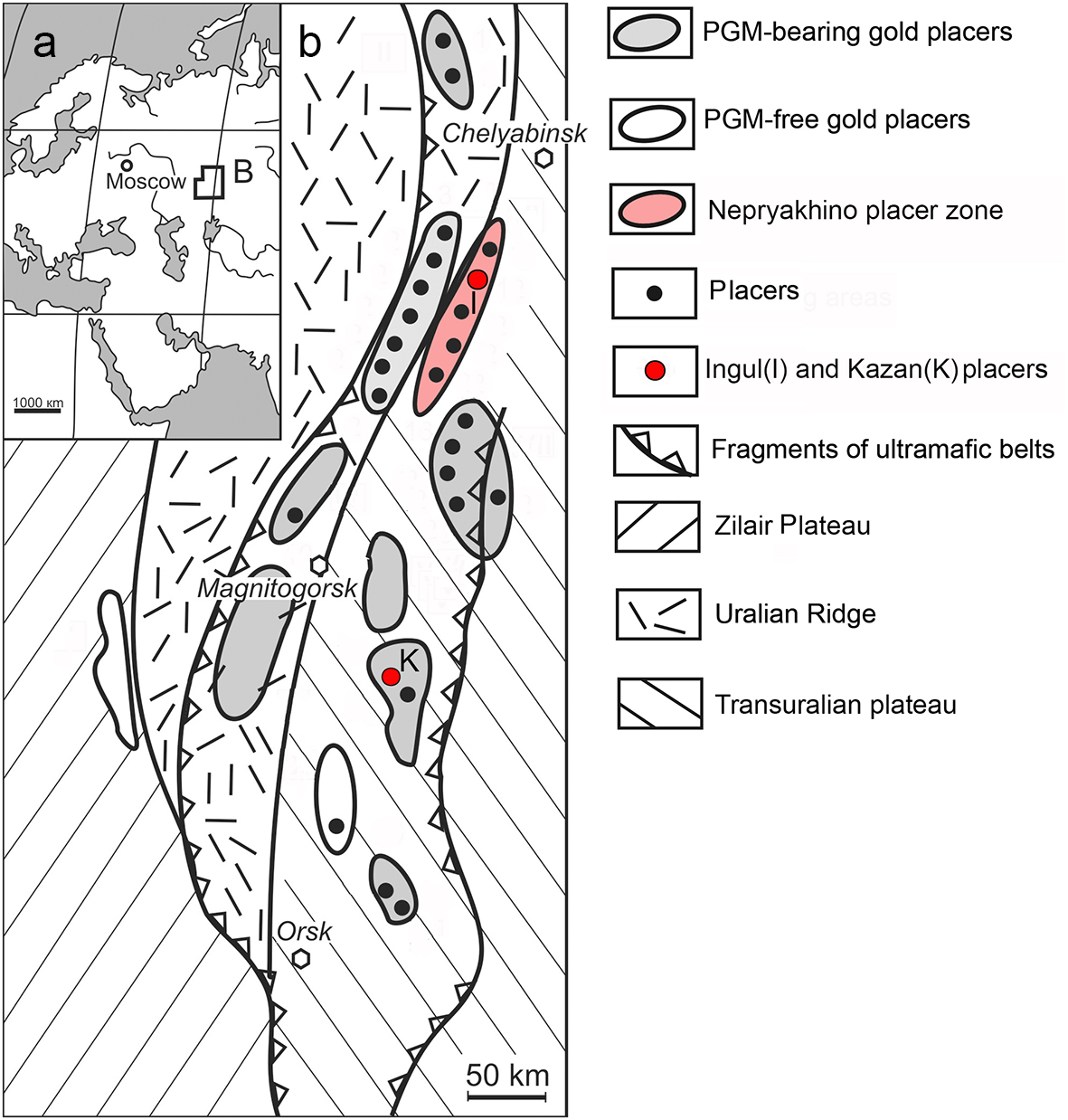
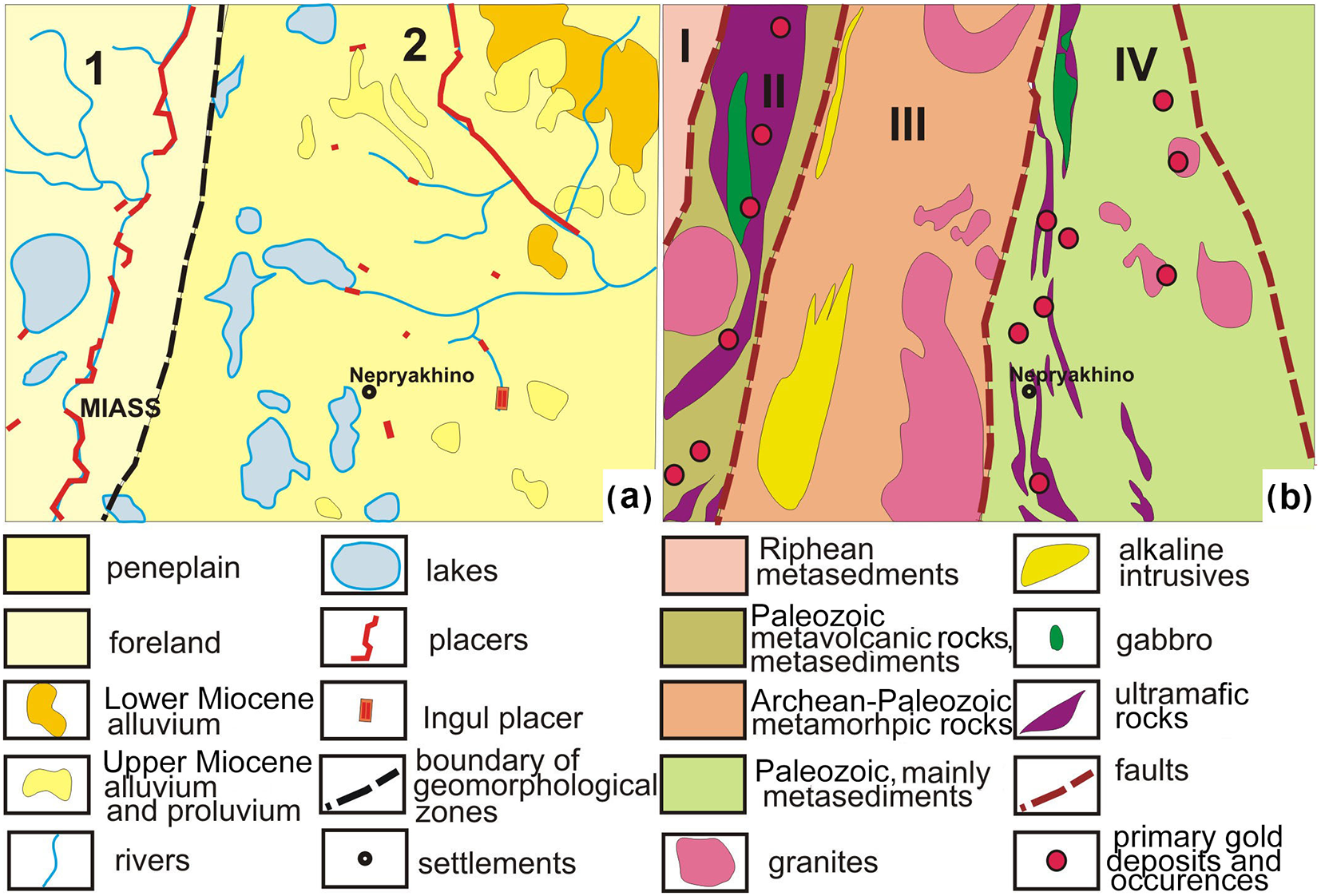
Selenolaurite was first found in a heavy concentrate from the Ingul gold placer. The Ingul placer (55°04ʹ49ʹʹN, 60°34ʹ11ʹʹE) belongs to the Nepryakhino gold placer zone and is situated ∼75 km SW of Chelyabinsk (Fig. 1) and 8 km ENE of the Nepryakhino village in Chelyabinsk district (Fig. 2a). The Nepryakhino gold placer zone is longitudinally extended concordant with a general strike of the Uralian fold structure. The placer zone includes proluvial and alluvial placers (unpublished report of geological survey of the company ‘UralNedra’). The current topography of the territory is a plain. The Nepryakhino placer zone is separated from the zone of the Main Ural Fault with most gold placers of Miass River by metasediments of the Ilmeno-Vishnegorsk zone (Fig. 1), forming positive relief forms. The Upper Miocene to Pleistocene placer is localised in the valley of the Ingul River, a right tributary of the Miass River (Zaykov et al., Reference Zaykov, Yu, Zaykova, Kotlyarov and Kraynev2017). The length of the placer reaches 6.5 km at a width of 20–40 m. The thickness of the peat and sand layers is 3.5 and 0.5–1.2 m, respectively. The placer has been exploited intermittently since 1900. The Au content varied from 0.3 to 1.2 g/m3 (unpublished report of the geological survey of the company ‘UralNedra’). There is no information on the PGE content of the placer but the findings of PGMs are generally known.
Geographic setting of the South Urals (a) and location of main placer zones and placers with data on placer mineral assemblages (b), simplified after (Zaykov et al., Reference Zaykov, Yu, Zaykova, Kotlyarov and Kraynev2017).

Position of the Ingul placer in the Nepryakhino placer zone in the geomorphological sketch (a) and geological map of the pre-Cenozoic basement (b), simplified after unpublished materials of the company ‘UralNedra’. Morphological structures: 1 – Miass foreland; 2 – Bayramgulovo uplifted peneplain. Metallogenic zones: I – West Uralian; II – Main Urals Fault; III – Ilmeno-Vishnevogorsk; IV – East Uralian.

A few small primary gold deposits and occurrences have been explored in the Nepryakhino gold placer zone, but similar objects are unknown near the Ingul placer (Fig. 1b). The deposits mainly include gold-bearing quartz veins and rare disseminated quartz–sulfide zones.
Some small unnamed fully serpentinised gabbro–dunite–harzburgite massifs of the Ordovician Chebarkul–Katsbakh complex are situated to the west of the Ingul placer. All of them are covered by Quaternary sediments. No data on the PGE content or the presence of the PGMs are available for these massifs.
We also found selenolaurite in a Pt–Fe alloy with isoferroplatinum composition during re-examination of the heavy concentrate of the Kazan gold placer (South Urals), which is localised in the Bredy erosion-structural depression of the Cenomanian – Upper Pleistocene age. It is located at the confluence of the Karagayly-Ayat and Kamyshly-Ayat rivers, but there are no permanent watercourses in close proximity to the placer. The raft is represented by karstic Lower Carboniferous limestone. More detailed geological and geomorphological explanation of the Kazan placer has been clarified previously (Belogub et al., Reference Belogub, Britvin, Shilovskikh, Pautov, Kotlyarov and Zaykova2022).
Results
Assemblage and morphology of selenolaurite
Ingul placer
The heavy concentrate of the Ingul gold placer includes Os–Ru–Ir alloys, Se-bearing moncheite, chromite, thorite, tantalite, magnetite, ilmenite and native gold (Zaykov et al., Reference Zaykov, Yu, Zaykova, Kotlyarov and Kraynev2017; Rassomakhin and Zaykov, Reference Rassomakhin and Zaykov2017), as well as Fe and Mn oxyhydroxides, amphibole, hematite, almandine, pyrite (including that with inclusions of Ag and Bi tellurides), limonite pseudomorphs after pyrite, arsenopyrite, rutile, molybdenite, zircon, tourmaline, baryte, monazite and kyanite (our data). Quartz, albite, orthoclase, microcline, talc, muscovite, kaolinite and minerals of the serpentine group are the gangue minerals of the alluvium.
Native gold is the principal noble metal mineral. It is slightly rounded, however locally the native gold grains are euhedral and have the remnant footprints of other minerals, which is evidence for the proximity of a primary source. The fineness of native gold varies from ∼850 to 950‰.
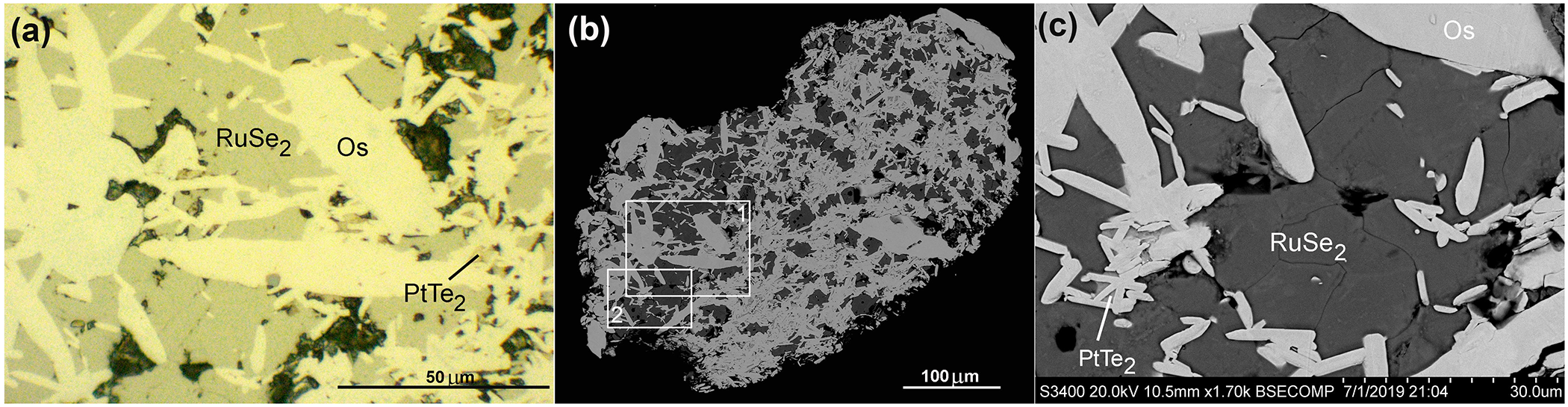
The size of the PGMs grains studied was typically up to 0.5 mm, locally, reaching 1–2 mm. Analysis of 139 PGM grains has shown the presence of Ru in the compositions of Os–Ru–Ir alloys (Rassomakhin and Zaykov, Reference Rassomakhin and Zaykov2017). No native Pt minerals were found in the Ingul placer. Selenolaurite forms anhedral interstitial grains between the aggregates of platy native osmium crystals up to 0.3 mm in size. The maximal size of sections of selenolaurite is 0.05–0.1 mm. Selenolaurite is closely intergrown with Se-bearing Pd- and Bi-free moncheite (Fig. 3). The chemical composition of the Os–Ir–Ru alloy and moncheite are shown in Tables 1 and 2, respectively. According to the EBSD patterns fitting and mapping data, the structure of the moncheite phase is similar to shuangfengite IrTe2 with a mean angle deviation (MAD) of <1° (0.48° for a selected high-resolution EBSD patterns) on the basis of 12 bands detection.
Interstitial holotype selenolaurite (RuSe2) and Se-bearing moncheite between the aggregates of native osmium crystals (Os), Ingul placer: (a) reflected light (oil immersion); (b) BSE image of the grain with the aggregate of platy native osmium crystals with square (1) marking (a) the area of the reflected light image and square (2) the location (c) of the detailed BSE image. (c) BSE image of anhedral selenolaurite aggregate between native osmium crystals. Holotype specimen (registration no. 920/geo840).

Chemical composition of Os–Ir–Ru alloy crystals with interstitial selenolaurite (wt.%)

Note: ‘–’ is below detection limit. EDS, REMMA 2M.
Chemical composition of moncheite associated with selenolaurite (wt.%)

Note: EDS, REMMA-2M.
Kazan placer
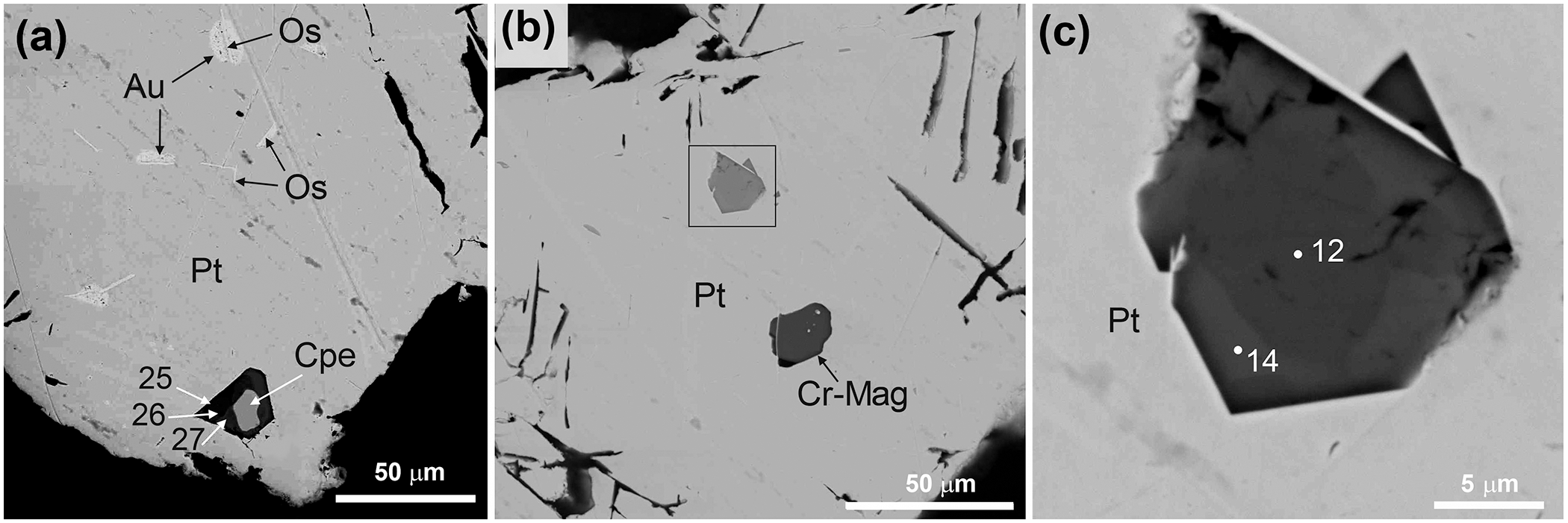
Selenolaurite and Se-bearing laurite from the Kazan placer form inclusions up to 20 µm in size in Pt3Fe grains. The Pd- and Cu-bearing native gold, native osmium and Cr-enriched magnetite also occur as inclusions in coarser Pt3Fe grains (Fig. 4). The euhedral Se-bearing laurite forms intergrowths with cooperite (Fig. 4a).
Inclusions of Se-bearing laurite (a, points 25, 26, 27) and selenolaurite (b, c, points 12, 14) in Pt3Fe, the Kazan placer. The square in (b) indicates the location of (c). Cpe = cooperite; Cr-Mag = Cr-enriched magnetite; Au = native gold; Os = native osmium; Pt = Pt3Fe.

Chemical composition of selenolaurite
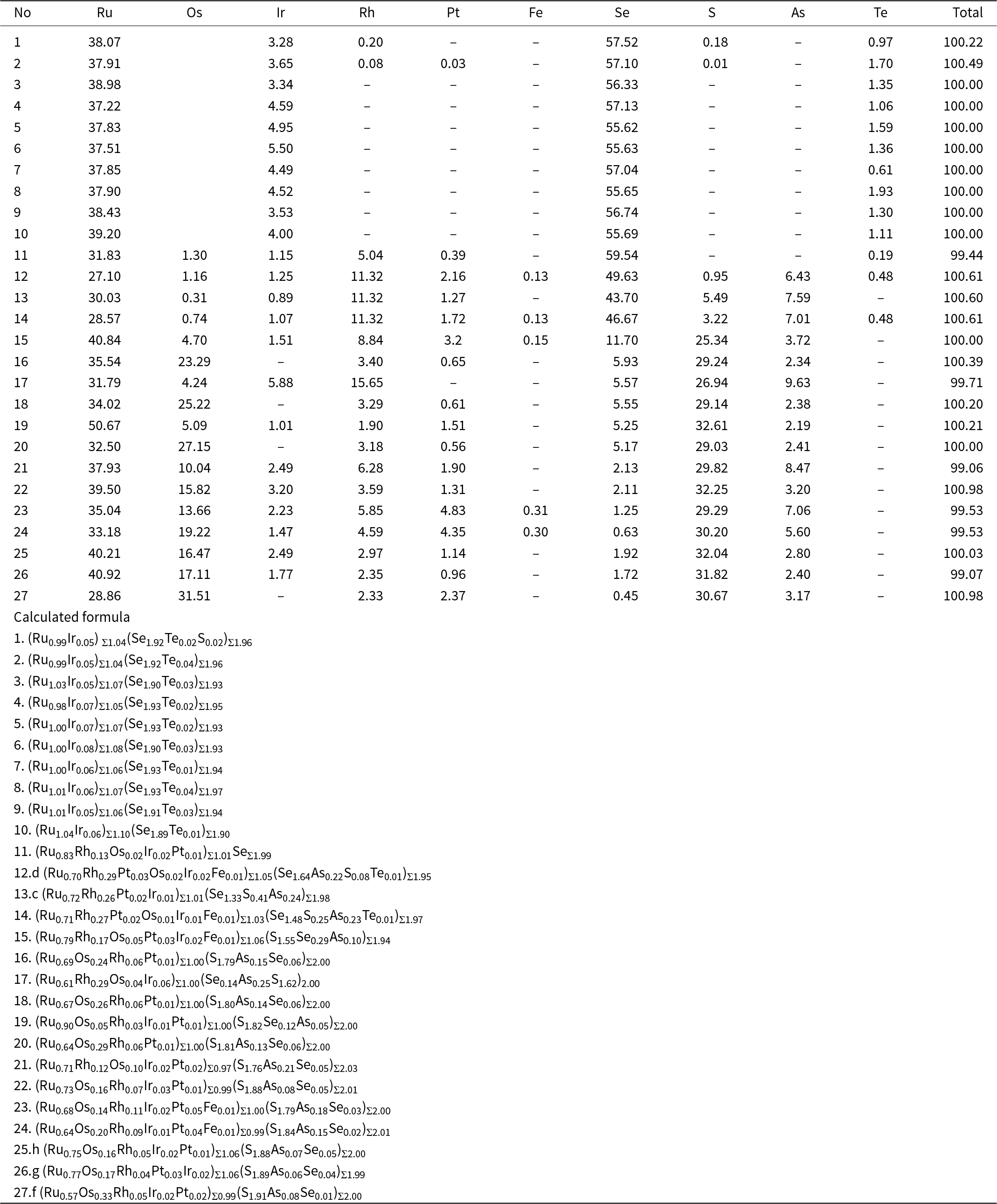
The chemical composition of selenolaurite is shown in Table 3. The average empirical formula of the holotype calculated on the basis of three atoms per formula unit is (Ru0.99Ir0.05)Σ1.04(Se1.92Te0.03S0.01)Σ1.96. The simplified formula is RuSe2. The ideal formula RuSe2 requires (wt.%) 39.05 Ru and 60.95 Se. Selenolaurite from the Ingul placer contains some Ir (3.28–5.50 wt.%), Te (0.61–1.93 wt.%) and S (<LOD-0.18 wt.%). In contrast, selenolaurite and Se-bearing laurite of the Kazan placer is characterised by the presence of Os (0.71–27.50 wt.%), Ir (nil–5.88 wt.%), Rh (5.04–15.65 wt.%), Pt (0.39–4.83 wt.%) and As (nil–9.63 wt.%) and the absence of Te (Table 3).
Chemical composition of selenolaurite and Se-bearing laurite (wt.%)

Notes: 1–10 – Ingul placer, 11–26 Kazan placer, analysis nos. 1, 2, WDS, JEOL JCXA–733; analysis Nos 3–10 EDS REMMA-2M, analysis Nos. 11–26 – EDS VEGA 3 TESCAN). ‘–’ is below detection limit.
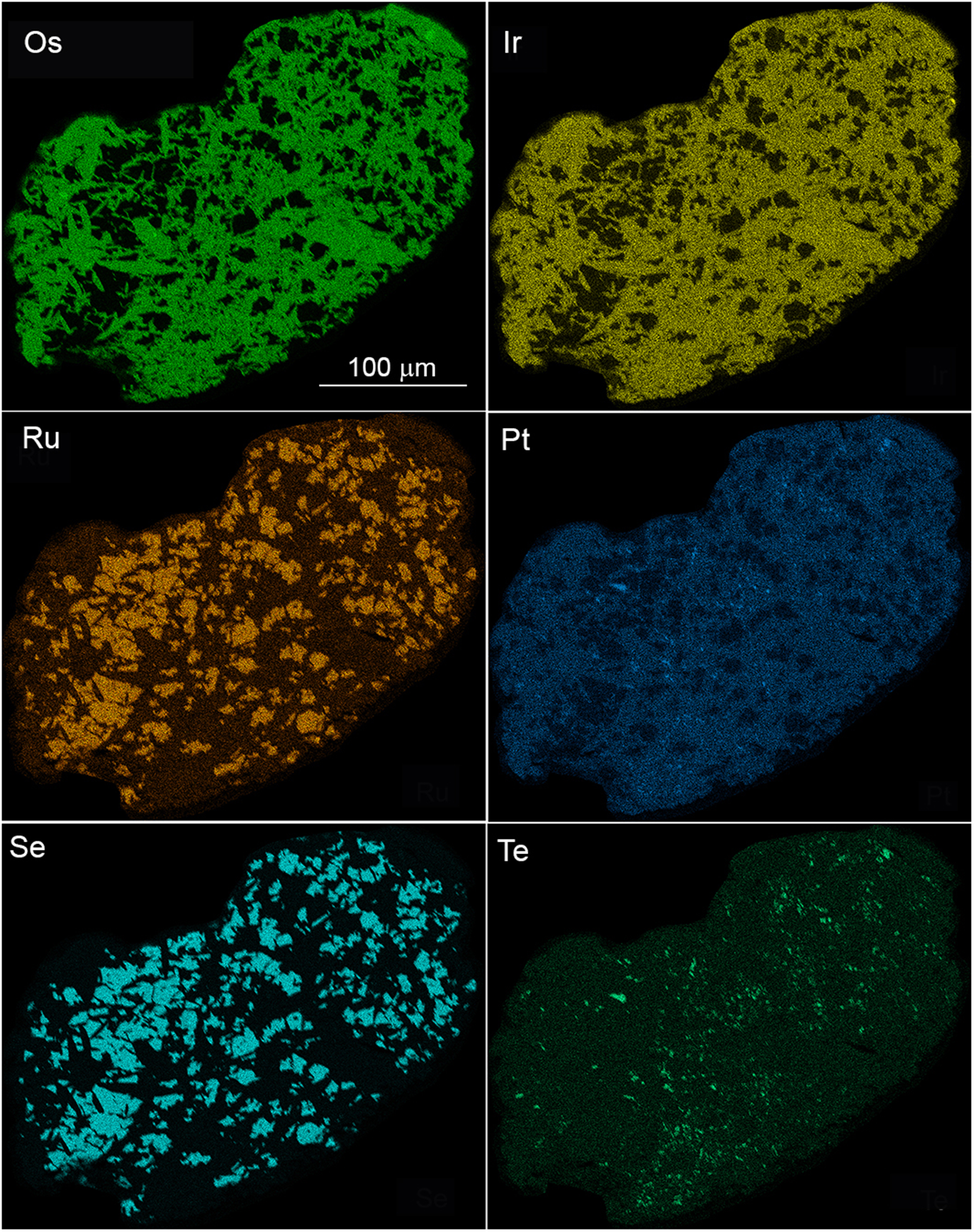
According to microgeochemical mapping, selenolaurite from the Ingul placer is the main concentrator of Ru and Se in the aggregate studied (Fig. 5). In contrast, the composition of selenolaurite from the Kazan placer varies even within individual grains (Fig. 4, Table 3 analyses nos. 12–13 and 25–27).
Element distributions in the aggregate studied of native osmium, holotype selenolaurite (registration no. 920/geo840) and Se-bearing moncheite.

Physical properties of selenolaurite
Selenolaurite is opaque with a metallic lustre. It is non-magnetic. The steak is black. The Mohs hardness is lower than that of native osmium (6–7) and higher than that of moncheite (2–3). Micro-indentation (Vickers hardness) could not reliably be measured due to intimate intergrowths with native osmium and moncheite. Selenolaurite is brittle; no cleavage and parting are observed. The density calculated on the basis of empirical formula and unit-cell parameters refined by the Rietveld method is 8.415 g·cm–3. Selenolaurite is insoluble in cool concentrated HCl.
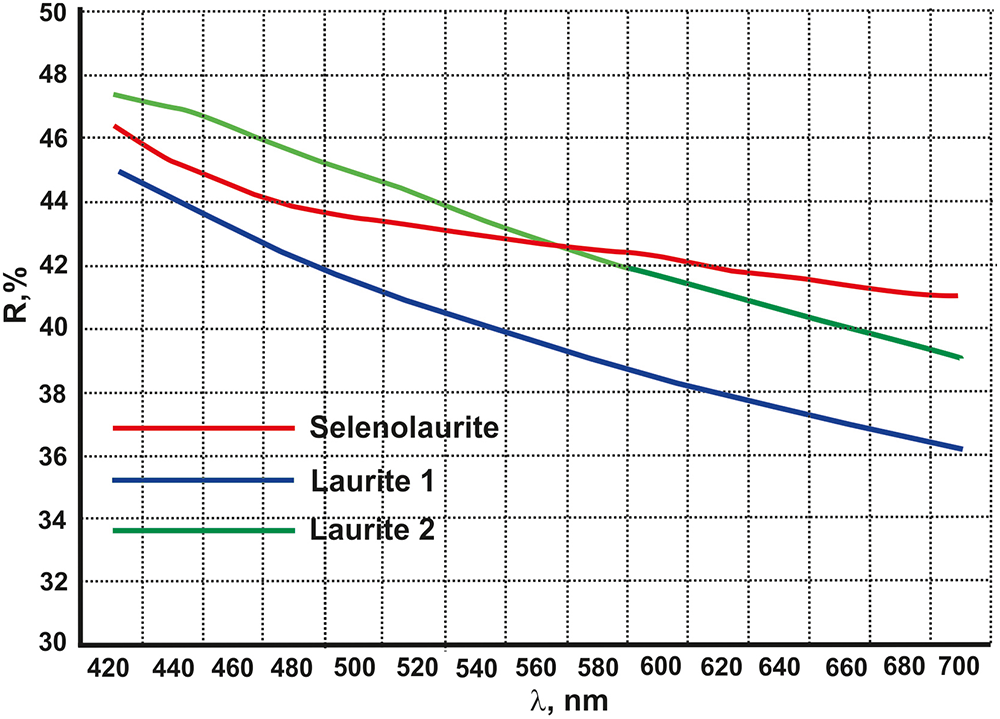
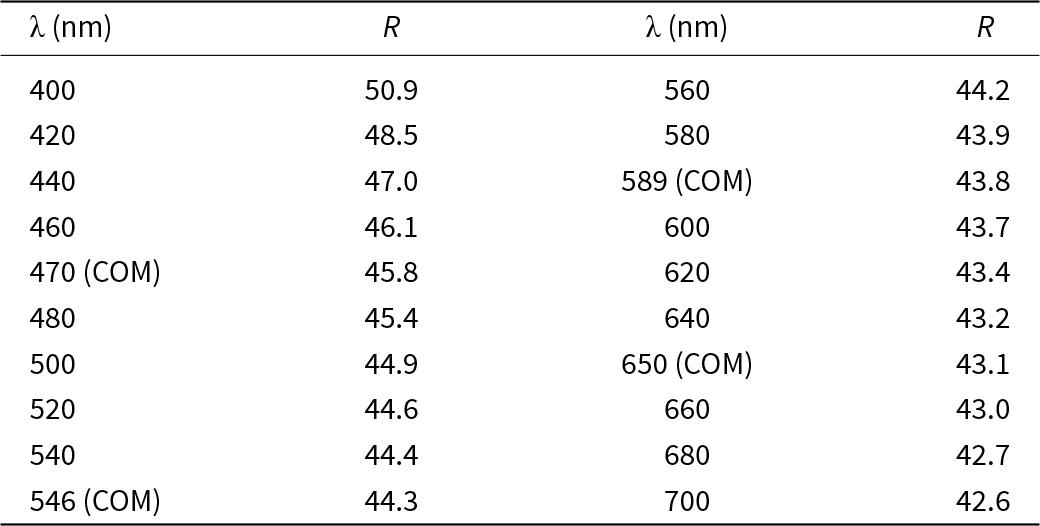
Selenolaurite is grey in reflected light. It has no bireflection, pleochroism, anisotropy and internal reflections. The reflectance values were measured for the selenolaurite holotype. The mean value of 4 measurements on different sites is shown in Table 4. The reflectance level of selenolaurite is similar to that of laurite (Fig. 6). The reflectance spectrum is characterised by normal dispersion and a steep slope in the blue area with flattening in the yellow–red area in contrast to the spectrum of laurite, which has a more uniform slope. The reflectance and the spectrum shape of laurite varies depending on its chemical composition (Leonard and Desborough, Reference Leonard and Desborough1969), therefore, the difference in the shape of the spectrum of selenolaurite from laurite is quite understandable.
Reflection spectra of selenolaurite in comparison with laurite: laurite 1 – data from Roberts et al. (Reference Roberts, Campbell and Rapp1990); laurite 2 – data of M. Tarkian and H.-J. Bernhardt (1985) in Criddle and Stanley (Reference Criddle and Stanley1986).

Mean reflectance values of selenolaurite

Note: COM are the values required by the Committee on Ore Microscopy.
Structure of selenolaurite
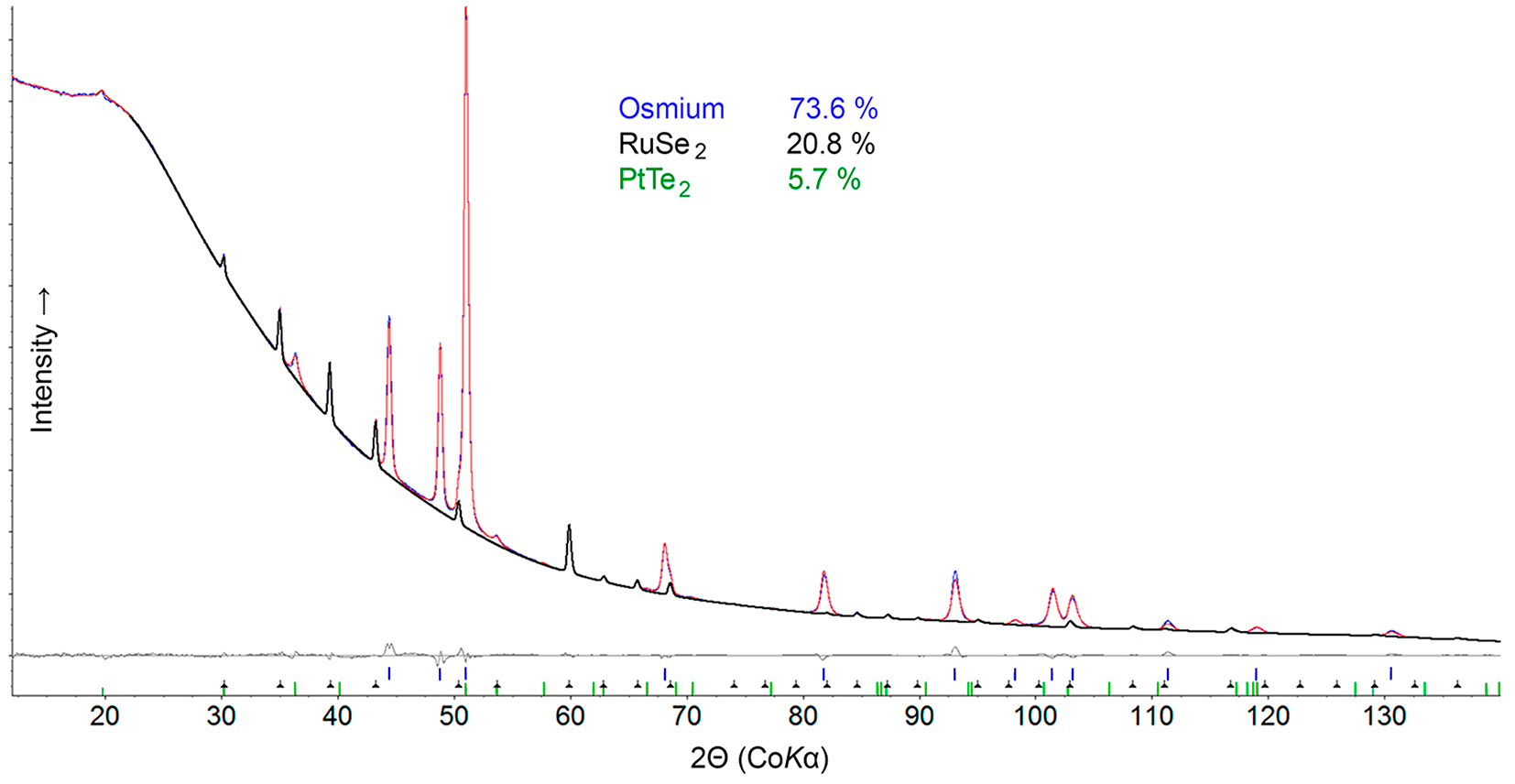
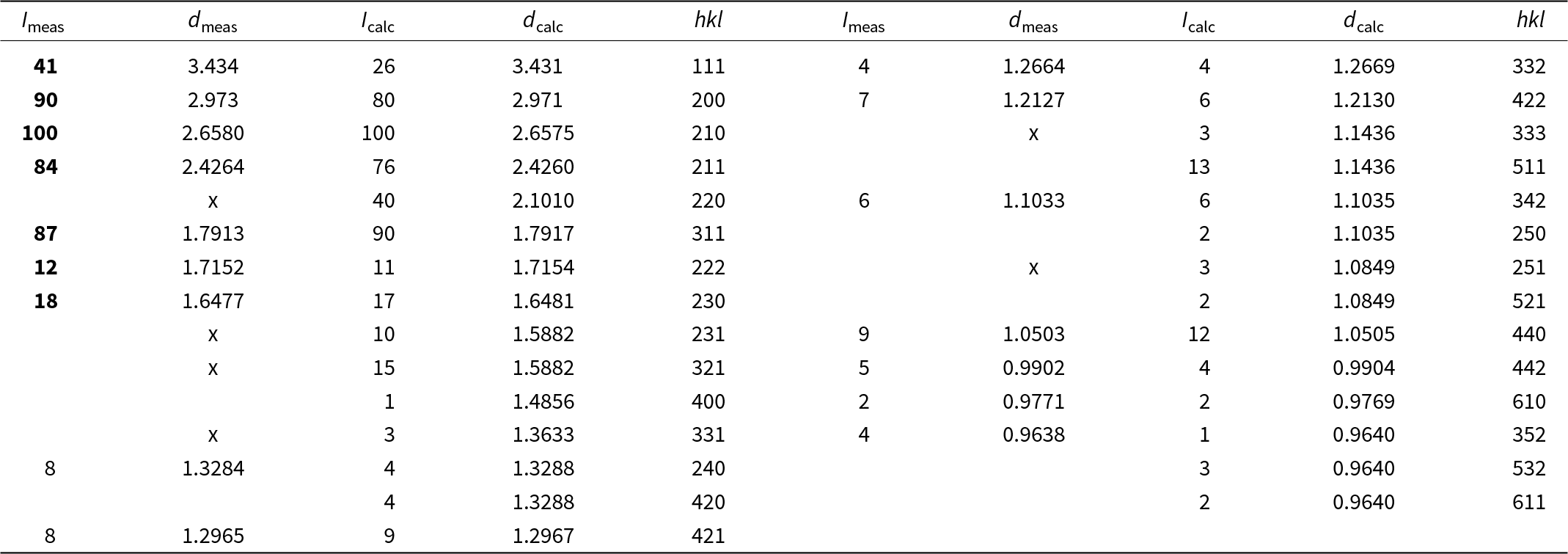
The crystal structure of selenolaurite was refined by the Rietveld method using starting parameters of synthetic RuSe2 (Lutz et al., Reference Lutz, Müller, Schmidt and Stingl1990). The powder sample was found to consist of 21 wt.% selenolaurite, 73 wt.% native osmium, and 6 wt.% moncheite (Fig. 7), therefore, several lines for selenolaurite are overlapped with the lines for metallic osmium (Table 5). The refined results are given in Table 6. Fractional atomic coordinates are provided in Table 7. The crystallographic information file has been deposited with the Principal Editor of Mineralogical Magazine and is available as Supplementary material (see below).
Rietveld refinement plot of a powder sample composed of selenolaurite, native osmium and moncheite. The black line highlights the calculated profile of selenolaurite

Powder X-ray diffraction data (d in Å) for selenolaurite

Note: x denotes the lines overlapped with reflections of metallic osmium; the strongest lines are given in bold.
Rietveld refinement details for selenolaurite

Fractional atomic coordinates and isotropic displacement parameters (B iso, Å2) for selenolaurite

Selenolaurite has a pyrite-type structure. It crystallises in a cubic system, space group Pa3̅ (#205). The unit-cell parameters refined from powder X-ray diffraction data are as follows: a = 5.9424(2) Å, V = 209.84(2) Å3, and Z = 4 (Table 6). The atomic coordinates are shown in Table 7.
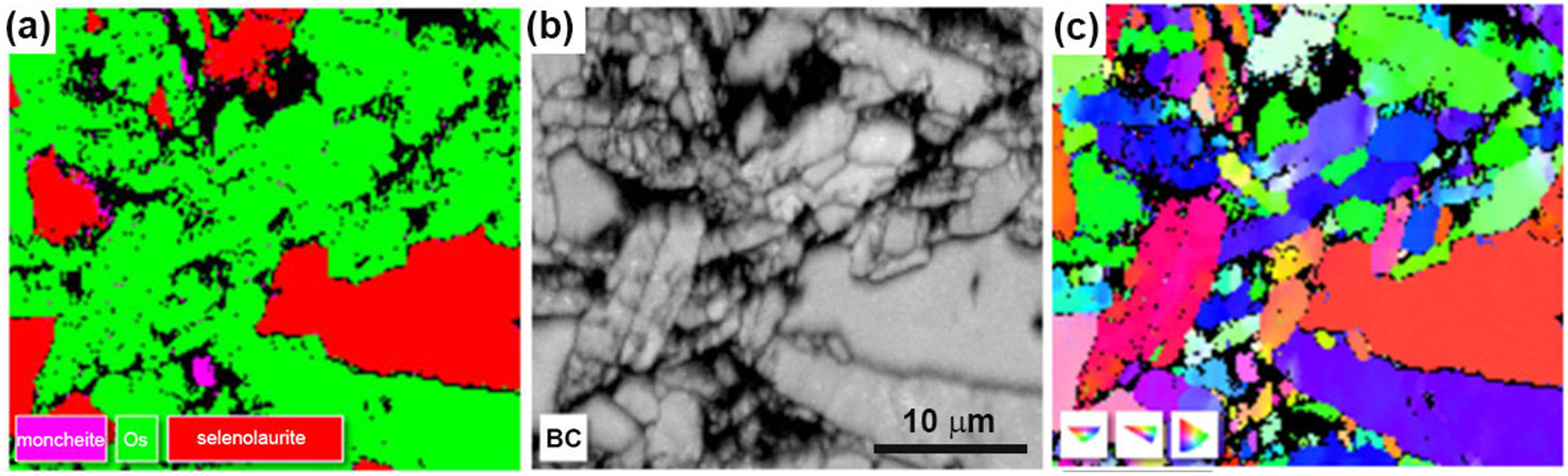
The EBSD map of the native osmium, selenolaurite and moncheite aggregate from the Ingul placer shows that all selenolaurite grains have the same anhedral morphology (Fig. 8a). The Kikuchi band contrast confirms the high degree of crystallinity of selenolaurite even better than for the Os–Ir alloy (Fig. 8b), all the detached grains are single crystals with no twinning or modularity, as it is visible from the Euler colour pattern (Fig. 8c).
EBSD phase map (a), Kikuchi band contrast (b) and orientation of grains in Euler colour (c) of a fragment of the native osmium, selenolaurite and Se-bearing moncheite aggregate.

Discussion
Structure of selenolaurite
Selenolaurite is a Se-dominant analogue of laurite, RuS2 (Wöhler, Reference Wöhler1866). Its lattice parameters are close to synthetic RuSe2 (Table 8). The dimension of the lattice of selenolaurite being larger than that of laurite is a result of the larger ion size of Se in comparison with S and larger distance Se–Se in comparison with S–S (Lutz et al., Reference Lutz, Müller, Schmidt and Stingl1990).
Comparative crystallographic data for selenolaurite, laurite and synthetic RuSe2

According to Zhaо et al. (Reference Zhao, Schils and Raub1985), RuSe2 is the only stable phase in the Ru–Se system similar to that found for RuS2 for the Ru–S system (Juza and Meyer, Reference Juza and Meyer1933).
Chemical composition of selenolaurite
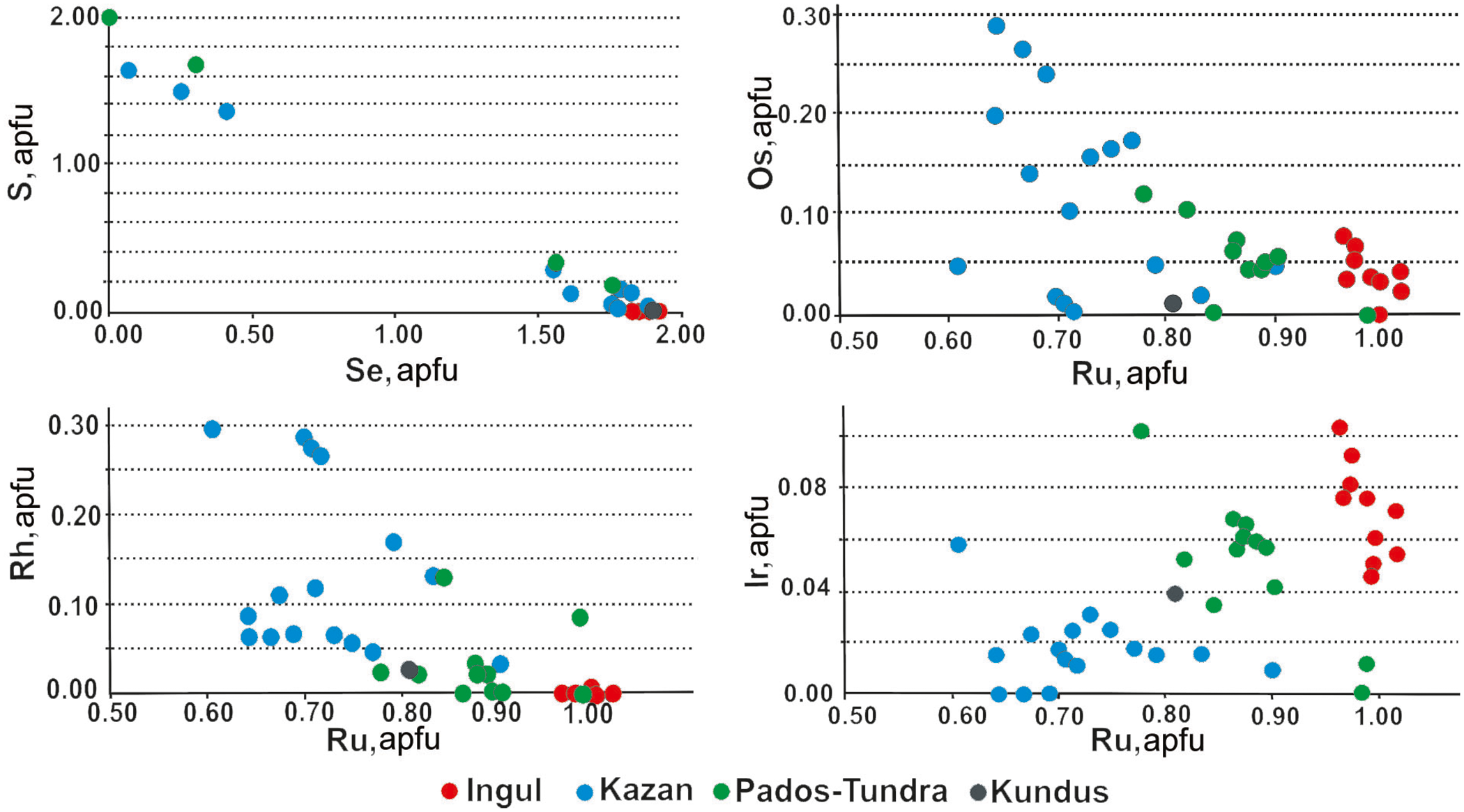
The limited data available on the composition of selenolaurite and Se-bearing laurite from four known localities indicate the presence of a miscibility gap between laurite and selenolaurite (Fig. 7). This can probably be explained by different ionic radii of Se and S and their ability to form joint S–Se anion dumbbells.
An insignificant Te and Pt content of selenolaurite is due to the presence of moncheite with corresponding elements in the same assemblage. In addition, RuSe2 and PtSe2 do not form a continuous isomorphic series, as PtSe2 (mineral sudovikovite) has a trigonal layered structure, which differs from the pyrite-like structure of selenolaurite.
There is a negative correlation between Ru and Os, similar to the full isomorphic miscibility in the laurite–erlichmanite series (Bowles et al., Reference Bowles, Atkin, Lambert, Deans and Phillips1983). A similar trend also exists for Ru and Rh, although sulfides with the same Rh:S ratio are unknown. The Ir and Ru contents tend to be positively correlated for grains from the same placer, but there is no correlation for all grains from placers for which analytical data are available.
Note that, based on the ratio of Ru and other PGEs, the composition of Se-bearing laurite and selenolaurite from various placers form slightly overlapping individual fields and, possibly, characterise specific signatures of individual placers (Fig. 9).
Binary plots characterising the composition of selenolaurite and Se-bearing laurite.

Source and formation conditions of noble metals minerals in placers
Judging from the present-day topography, native gold in the Ingul placer could be sourced from small gold-bearing silicified zones with quartz veins, which are localised in weakly metamorphosed clay–carbonaceous sedimentary rocks intercalated with Palaeozoic volcanic and volcaniclastic rocks of in the East Uralian metallogenic zone. The Kazan placer occurs in the same geological situation, where small uneconomic gold occurrences of various genetic types are supposed to be the sources of native gold (Belogub et al., Reference Belogub, Britvin, Shilovskikh, Pautov, Kotlyarov, Krzhizhanovskaya, Novoselov, Zaykova and Blinov2020).
The source of the PGMs in the Ingul placer could be related to small bodies of serpentinised ultramafic rocks of the East Uralian belt of ultramafic and ultramafic–mafic intrusions, which divides the Ilmeny–Vishnevogorsk Terrane and the East Uralian Zone. Selenolaurite and associated moncheite of the Ingul placer form interstitial aggregates between the native osmium crystals and thus are the latest PGMs crystalised after the osmium.
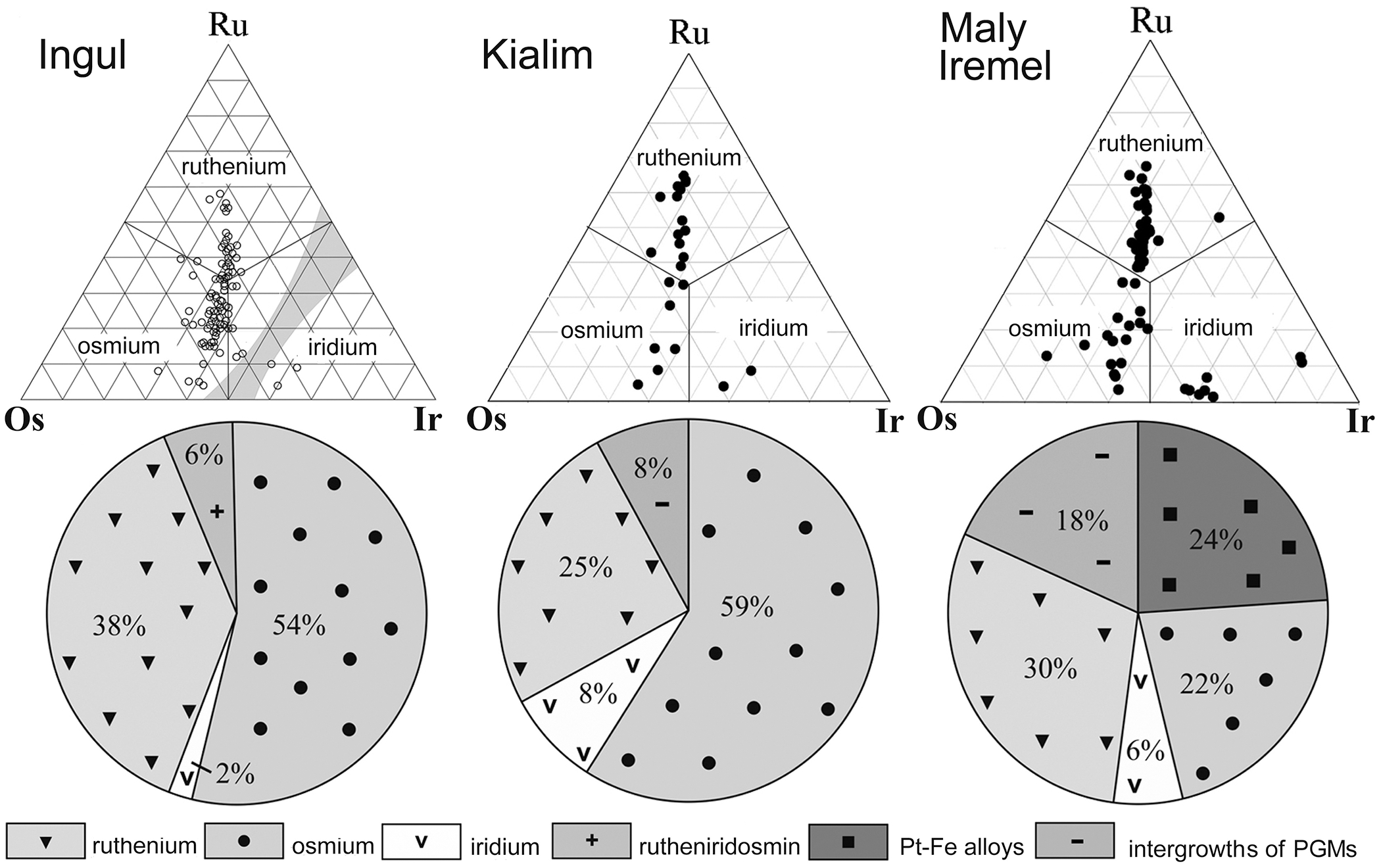
The better studied Nurali ultramafic massif compared to the Main Urals Fault (MUF) (Zaccarini et al., Reference Zaccarini, Pushkarev, Fershtater and Garuti2004) cannot be considered as a source of PGM for the Ingul placer, as the topography contradicts this. The set PGMs in the Maly Iremel placer which is located in close proximity to the Nurali massif differs from the mineral composition of PGMs of the Ingul placer by a significant amount of Pt–Fe alloys (Fig. 10). Minerals in the Pt–Fe system, which is typical for PGM of the Ural-Alaskan type massifs (Zaccarini et al., Reference Zaccarini, Garuti, Pushkarev and Thalhammer2018; Stepanov et al. Reference Stepanov, Palamarchuk, Antonov, Kozlov, Varlamov, Khanin and Zolotarev2020 and references therein) were not recorded in the Ingul placer or the Kialim placer related with the Karabash massif (Rassomakhin and Zaykov, Reference Rassomakhin and Zaykov2017). Os–Ir–Ru alloys of the Ingul placer are characterised by a distinct ruthenium trend (Fig. 10), which is more typical for PGM from chromitites of the lower part of the ophiolite section. No Pt–Fe minerals are found in the Ingul placer. In several grains of Os–Ir–Ru alloys of the Ingul placer, rounded inclusions of high-chromium chromite were found, the composition of which is calculated by the formulas Mg0.668–0.293Fe0.668–0.311Mn0.045–0)(Cr1.707–1.488Al0.508–0.296Fe3+0.036–0) (Zaykov et al., Reference Zaykov, Saveliev and Zaykova2018). Chromites of this composition are found both in ultramafites of the mantle part of the ophiolite section and in zonal massifs of the Ural–Alaska type. Unfortunately, ultramafites as potential sources for PGMs of the Ingul placer have not been characterised at the present time.
Composition of the Os–Ir–Ru alloys and set of PGMs of the Ingul, Kialim and Maly Iremel placers (Rassomakhin and Zaykov, Reference Rassomakhin and Zaykov2017).

In a gold-bearing placer of the Kundus River, East Tyva, Russia, selenolaurite was identified as inclusions in native osmium grains. Isoferroplatinum, ferrous and cuprous platinum and its arsenides and tellurides, palladodymite, and minerals of the laurite–erlichmanite series were also described as inclusions in Os–Ir–Ru minerals grains. The ophiolitic serpentinised harzburgites were suggested to be a source of the PGMs for this placer (Oydup et al., Reference Oydup, Mongush and Khuragan2012).
Two unnamed Se-bearing chalcogenides of Ir and Os occupy a similar position in Os–Ir–Ru grains from placers of the Eastern Russia. An unnamed selenide of Ir and Os with a small admixture of Ru replaces Os–Ir–Ru at the placer of the Aunik River, Buryatia, Russia. This selenide, separately or together with secondary osmium, fills the microcavity inside the iridium grains (Airiyants et al., Reference Airiyants, Belyanin, Zhmodik, Agafonov and Romashkin2020). An unnamed selenoarsenide of Ir and Os from the placer of the Kitoy river, West Sayan Ridge, Russia replaced osmium during late hydrothermal alteration (Airiyants et al., Reference Airiyants, Kiseleva, Zhmodik, Belyanin and Ochirov2022). The sources of PGMs for both mentioned placers are ophiolitic ultramafic rocks (Airiyants et al., Reference Airiyants, Belyanin, Zhmodik, Agafonov and Romashkin2020, Reference Airiyants, Kiseleva, Zhmodik, Belyanin and Ochirov2022). Selenium-enriched sperrylite has been described in the Zolotaya placer, located in the Kartushibinsky ophiolitic belt in Tuva (Tolstykh et al., Reference Tolstykh, Krivenko and Pospelova1997).
As noted by O’Driscoll and González-Jimenéz (Reference O’Driscoll and J.M2016), approximately 80% of PGMs in placers associated with ophiolites are the Os–Ir–Ru alloys. The general enrichment in refractory PGE and the predominance of Ru members of the laurite–erlichmanite series are characteristic of chromitites of the lower part of the ophiolite section (O’Driscoll and González-Jimenéz, Reference O’Driscoll and J.M2016 and reference therein). There is thus a reason to assume that the aggregates of native osmium crystals with selenolaurite in the Ingul placer derived from chromitites from the lower part of an ophiolite section. Thus, Se-bearing PGMs are more likely to be in association with ophiolites.
In contrast, Se-bearing laurite and selenolaurite of the Kazan placer form euhedral inclusions in isoferroplatinum grains and are associated with cooperite (Fig. 4). The Gogino zoned gabbro–pyroxenite–dunite massif or Varshavka and Mogutovsky serpentinised dunite–harzburgite massifs have been suggested to be a source of the PGMs of the Kazan placer. The genetic type of these massifs is still under discussion. The specific feature of the Kazan placer is related to the predominance of isoferroplatinum among the PGMs (Zaykov et al., Reference Zaykov, Yu, Zaykova, Kotlyarov and Kraynev2017) and Rh enrichment (Zaykova et al., Reference Zaykova, Blinov and Kotlyarov2020; Belogub et al., Reference Belogub, Britvin, Shilovskikh, Pautov, Kotlyarov, Krzhizhanovskaya, Novoselov, Zaykova and Blinov2020). The Pt-rich character of the PGE spectrum is characteristic of the late stage of the formation of the zoned mafic–ultramafic complexes (O’Driscoll and González-Jiménez, Reference O’Driscoll and J.M2016). Platinum and Rh enrichment relative to chondrite has been demonstrated previously for magmatic Ni–(± Cu–± PGE)–sulfide deposits in non-komatiitic rocks (Naldrett, Reference Naldrett2004), but sulfides and arsenides are the main PGE mineral forms of mentioned deposits. Moreover, selenium minerals including Se-bearing PMGs were not found in zoned massifs of the Uralian–Alaskian type during a recent study using modern local methods (Stepanov et al., Reference Stepanov, Palamarchuk, Antonov, Kozlov, Varlamov, Khanin and Zolotarev2020, Reference Stepanov, Palamarchuk, Kozlov, Khanin, Varlamov and Kiseleva2019).
The Se-enriched laurite and an unnamed Se-analogue of laurite from the Pados-Tundra ultramafic complex occur in chromite–magnesiochromite grains in dunite and are associated with chlorite and an Os-dominant alloy (Barkov et al., Reference Barkov, Nikiforov, Tolstykh, Shvedov and Korolyuk2017). These authors believed that the Se-bearing PGMs formed during autometasomatic alteration of the Pados-Tundra zoned dunite–harzburgite–orthopyroxenite complex.
The ophiolitic and zoned mafic–ultramafic complexes can thus be potential sources of Se-enriched laurite and selenolaurite. In all mentioned cases, these minerals could form at highly S-deficient conditions at a low S fugacity. The coexistence of a low-Os variety of laurite with Os-dominant alloys at the Pados-Tundra complex took place probably below the Os–OsS2 buffer (Barkov et al., Reference Barkov, Nikiforov, Tolstykh, Shvedov and Korolyuk2017). These conditions could occur at the late stage of the formation of mafic–ultramafic complexes. It is likely that the low S fugacity and a sufficient Se amount led to the formation of the described rare Ru selenide.
Conclusion
A new ruthenium selenide named selenolaurite, ideally RuSe2, is described in a matrix of an aggregate of the Os–Ir–Ru alloy together with moncheite PtTe2 in a heavy concentrate of the Ingul gold placer, South Urals, Russia. The structural features of selenolaurite indicate its later formation compared to the Os–Ir–Ru alloy.
Selenolaurite is a selenium analogue of laurite with a pyrite crystal structure. According to available empirical data, there is a miscibility gap of the laurite–selenolaurite series because of geometrical differences between S22– and Se22–.
The surface topography and the characteristics of rocks drained by the Ingul River support the assumption that the ultramafic rocks exposed by the Chebarkul–Katsbakh deep fault in the eastern frame of the Ilmeny–Vishnevogorsk magmatic–metamorphic complex are the source of PGM for the Ingul placer.
To date, four findings of the ruthenium selenide are described, including three in PGM-bearing gold placers and one in lode chromitites from a zonal mafic–ultramafic intrusion. In the Ingul and Kundus placers, selenolaurite was found in an assemblage with Os–Ir–Ru alloys, the composition of which is statistically characterised by elevated Ru concentrations. No Pt–Fe alloys were found in these placers and Pt occurs as chalcogenides only. These features are typical of the PGM assemblages from chromitites associated with the mantle part of ophiolite sections.
In the Kazan placer, selenolaurite is found as euhedral inclusions in Pt3Fe. In primary chromitites of the Pados–Tundra zonal complex, selenolaurite forms euhedral inclusions associated with Os and a RhTe compound in chromite. By analogy with widespread euhedral inclusions of laurite in chromite and isoferroplatinum, the origin of selenolaurite in these cases can be interpreted as late magmatic also.
It is thus supposed that selenolaurite forms during the late magmatic stage in different types of ultramafic rocks at highly S-deficient conditions, low S fugacity and high Se fugacity. The reason of the Se enrichment of some ophiolite-related placers remains still unclear.
Supplementary material
The supplementary material for this article can be found at https://doi.org/10.1180/mgm.2024.89.
Acknowledgements
The authors are grateful to N.P. Zemlyanskiy (Ingul Cooperative) and A.Yu. Ivanov and B.Ya. Hismatullin (Miass Priisk Company) for heavy concentrates from the Ingul and Kazan placers, respectively, and M. Lozhkin (Nanophotonics Resource Center, SPSU) for the preparation of the sample surface for EBSD mapping. This work was supported by state contract no. 122031600292-6. The authors acknowledge Saint-Petersburg State University Research Project no. 124032000029-9 supporting the EBSD study. The authors are thankful to the reviewers Anna Vymazalová and Federica Zaccarini whose comments helped improve the article.
Competing interests
The authors declare none.