Introduction
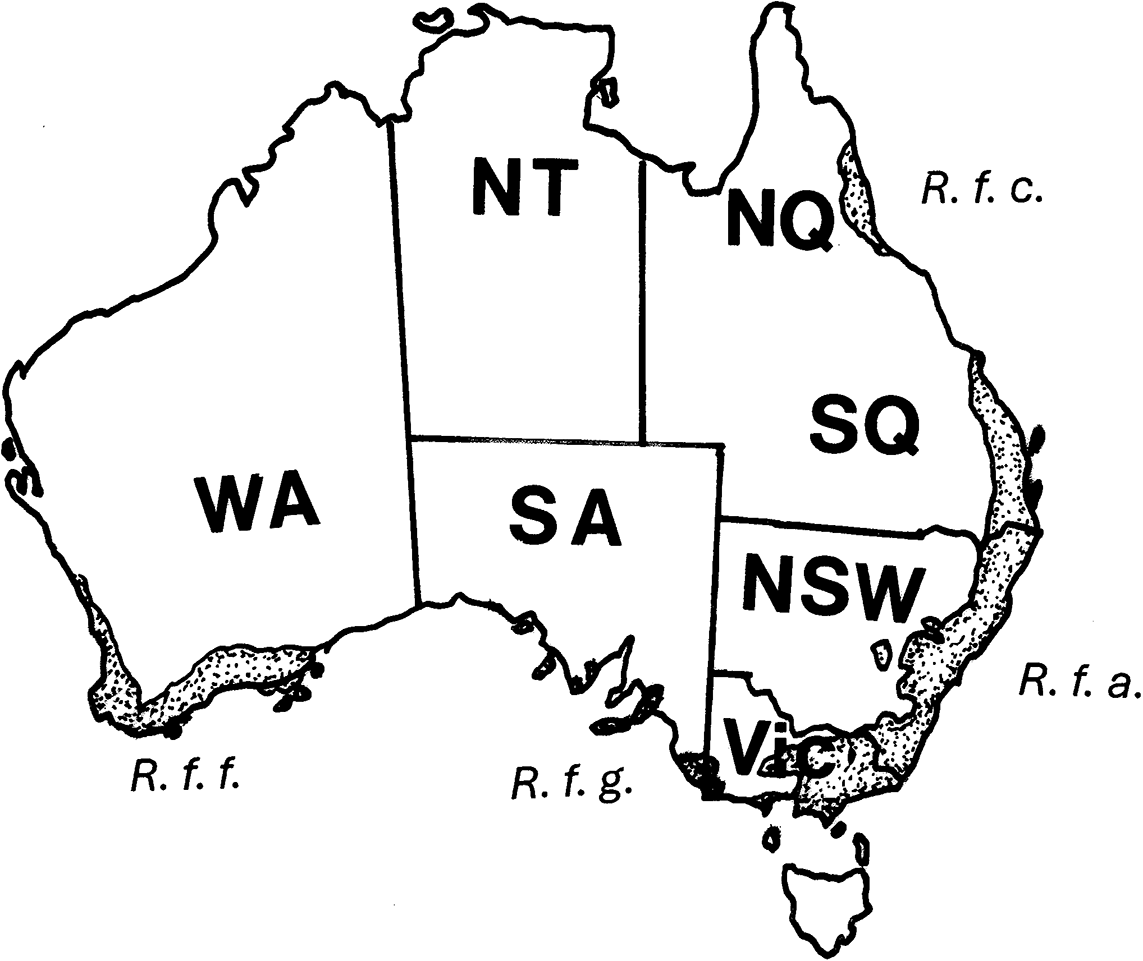
Rattus fuscipes (Waterhouse) (Rodentia: Muridae), the bush rat, is widespread and common in the subalpine woodland, coastal scrub, eucalypt, and rain forests of the East, South, and Southwestern coasts of Australia (Lunney and Banks Reference Lunney, Banks, Baker and Gynther2023). Four subspecies are recognised: Rattus fuscipes coracius Thomas is distributed along the East Coast of Queensland (Qld) from Cooktown in the north to Townsville, North Queensland (NQ); R. f. assimilis (Gould) is found from Rockhampton to South Queensland (SQ), through New South Wales (NSW) to Western Victoria (Vic) in coastal and subcoastal habitats; R. f. greyii (Gray) inhabits coastal and adjacent island habitats from Portland, Victoria to the Eyre Peninsula of South Australia (SA); R. f. fuscipes (Waterhouse) is found in coastal Southwestern Western Australia (WA) (Figure 1) (Lunney and Banks Reference Lunney, Banks, Baker and Gynther2023). The diet of R. fuscipes is varied, including insects, fruits, seeds, and fungi (Lunney and Banks Reference Lunney, Banks, Baker and Gynther2023). The ancestors of R. fuscipes (Murinae: Rattini) arrived from Southeast Asia via Indonesia and New Guinea, in the second wave of murine colonisation of Australia, about one million years ago (MYA), bringing a suite of helminth parasites with them (Breed et al. Reference Breed, Aplin, Rowe, Baker and Gynther2023).
Map of Australia showing the distribution of Rattus fuscipes. Abbreviations: R. f. a = Rattus fuscipes assimilis, R. f. c = Rattus fuscipes coracius, R. f. g = Rattus fuscipes greyii. NSW = New South Wales, NQ = North Queensland, SA = South Australia, SQ = South Queensland, Vic = Victoria.

A review of the helminth parasites of Australian rodents was prepared by Smales (Reference Smales1997) which included a history of rodent helminth parasites from the time of European settlement. Since that paper was published, our understanding of the origins of Australian rodents has improved, the taxonomy of R. fuscipes has been refined, and additional information about its parasite fauna has been generated.
The aims of this project were: to describe the community of nematodes infecting R. fuscipes; to provide an updated list of the nematode parasites of each of the subspecies of R. fuscipes, including information relating to biogeographic distribution; to compare the component communities of the geographic populations and subspecies of R. fuscipes.
Materials and methods
The data bases recording the nematodes collected from R. fuscipes between 1913 and 2019 held in the following institutions were interrogated: the Australian Museum, Sydney (AM), the Queensland Museum, Brisbane (QM), the South Australian Museum, Adelaide (SAM) the Western Australian Museum Perth (WAM), the CSIRO National Wildlife Collection, Canberra (W/L), and the Natural History Museum, London (NHM). The number of animals infected with nematodes was estimated, from field numbers and other collection information available on the databases, as 1108 individuals of R. fuscipes. The number of animals in each subspecies are as follows: 108 individuals of R. f. coracius were collected in 24 localities from north Queensland (NQ); 955 individuals from R. f. assimilis comprising 112 individuals from 13 localities in south Queensland (SQ), 722 from 35 localities, including the Australian Capital Territory (ACT), in New South Wales (NSW), and 121 from 27 localities in Victoria (Vic); 24 individuals of R. f. greyii were collected from 14 localities in South Australia (SA). Only 4 individuals of R. f. fuscipes were collected from 2 localities in Western Australia (WA). There were also records from an additional 14 individuals collected from Queensland (Qld) and 3 from Australia, which could not be placed in any subfamily of R. fuscipes and have been excluded from the calculations. Collection localities and host numbers are given in Table 1. Rattus fuscipes lives neither in Tasmania, Northern Western Australia, nor in the Northern Territory (Lunney and Banks Reference Lunney, Banks, Baker and Gynther2023).
Localities collected from and numbers of infected Rattus fuscipes (Waterhouse, 1839) registered in helminth collections between 1913 and 2019. Data from the Australian, Queensland, South Australian and Western Australian Museums, the CSIRO National Wildlife Collection, the Natural History Museum, London, and this study

Abbreviations: NQ = North Queensland, NSW = New South Wales, Qld = Queensland, SA = South Australia, SQ = South Queensland, Vic = Victoria.
Material listed in the collection databases of the AM, QM, and SAM and not identified to species, as well as material that was registered in the SAM as part of this study, was examined microscopically. These specimens, stored in museum-grade 70% ethanol, were processed by clearing in lactophenol and prepared as temporary wet mounts for examination, using an Olympus BH2 microscope with differential interference optics (Tokyo, Japan). Measurements were taken with the aid of an eyepiece micrometre and figures were drawn with the aid of a drawing tube. Species identifications were confirmed by comparison with published diagnoses and descriptions. Specimens recorded on the CSIRO W/L database and not identified to species could not be studied because the collection is currently mothballed, awaiting rehousing. Nematode classification follows Hodda (Reference Hodda2022) and host identification follows Jackson and Groves (Reference Jackson and Groves2015). Ecological terminology follows Bush et al. (Reference Bush, Lafferty, Lotz and Shostak1997).
Presence/absence of each nematode species was determined for each subspecies and biogeographic population of R. fuscipes. There was no available information as to the number of uninfected hosts that had been surveyed, and consequently the prevalence of infection of each nematode species could be calculated only as prevalence in infected hosts. These prevalences enabled comparisons of species composition within the nematode component community of each infected population. Sorensen’s index of similarity (Magurran Reference Magurran1988) was used to compare the similarity of the nematode communities of the biogeographic populations as well as the subspecies of R. fuscipes. Following the broad criteria of Hanski (Reference Hanski1982), Bush and Holmes (Reference Bush and Holmes1986), and Stock and Holmes (Reference Stock and Holmes1987), prevalence data were used to determine core and satellite species within the nematode assemblage. Because of the relatively small number of R. f. greyii sampled (24), a bootstrap estimate (Poulin Reference Poulin1998) was applied to estimate the species richness of its nematode community. The small number of hosts examined (4) precluded the inclusion of any data from R. f. fuscipes from WA in the analyses.
All data generated for or analysed during this study are included in this article.
Results
Records and specimens of nematodes from an estimated 1108 bush rats, R. fuscipes, were examined and representatives of 19 families, including 36 genera and 44 species, were recovered (Table 2). In some instances, material could be identified only to family or genus, either because the worms were immature, or in poor condition, or there were no males in the sample. Males are needed for species assignment in the genera Trichuris, Strongyloides, Hepatojarakus, Heterakis, and Syphacia. Capillariidae which could not be identified to genus with confidence are listed as Capillaria sensu latum. This material, possibly comprising more than one genus and or species, was recovered from 3 of the 5 host populations (Table 2). There were 756 records of Helgmosominae (Trichostrongylidae) in the CSIRO W/L collection that had not been identified and accordingly were not included in any analysis. Neither were the records of unidentified ascaridid, heligmosomid, spirurid, and trichostrongylid larvae nor unidentified ascaridid, spirurid, and nematode adults listed in Table 2 included. The 4 bush rats, R. f. fuscipes, collected from 2 localities in WA were infected with Mastophorus muris (3 hosts) and heligmosomes (Trichostrongylidae) (1 host). The relatively small number of individuals of R. f. greyii (24) examined from SA harboured only 8 identified species compared with 18 species from 108 individuals of R. f. coracius and 40 species from 954 individuals of R. f. assimilis (Table 3).
Nematode parasites of the Australian bush rat Rattus fuscipes

Abbreviations: NSW = New South Wales, NQ = North Queensland, SA =South Australia, SQ = South Queensland, Vic = Victoria. Data from the helminth databases of the AM, CSIRO, QM, SAM, WAM, and NHML and from Mackerras (Reference Mackerras1958); Mawson (Reference Mawson1961, Reference Mawson1971a, Reference Mawson1971b, Reference Mawson1973); Bhaibulaya (Reference Bhaibulaya1968); Sprent (Reference Sprent1957, Reference Sprent1963, Reference Sprent1970); Obendorf (Reference Obendorf1979); Spratt (Reference Spratt1982a, Reference Sprattb,Reference Spratt1985a, Reference Spratt1985b, Reference Spratt2002, Reference Spratt2006, Reference Spratt2023); Spratt and Haycock (Reference Spratt and Haycock1988); Spratt et al. (Reference Spratt, Haycock and Walter2001); Beveridge and Durette-Desset (Reference Beveridge and Durette-Desset1992, Reference Beveridge and Durette-Desset1993); Stokes et al. (Reference Stokes, Spratt, Banks, Pech and Willians2007); Smales (Reference Smales1996, Reference Smales1997, Reference Smales2018); Warren (Reference Warren1970); and this study. Classification follows Hodda Reference Hodda2022
* are records from Queensland without a specific locality
Prevalence %, calculated using data from infected animals, of nematodes identified to species comprising the communities of three of the four subspecies of Rattus fuscipes

As shown in Table 3, the component community of nematodes infecting each population of R. fuscipes was unique. Despite the disparity in number of hosts examined both the population of R. f. assimilis from NSW and that of R. f. assimilis from SQ harboured the same number of nematode species, 27. Of the 48 identified taxa (44 species and 4 genera), only the trichostrongylids Nippostrongylus magnus and Odilia emanuelae and the physalopterid, Physaloptera troughtoni, were common to all 3 of the host subspecies and 5 biogeographical populations (Table 3). Three species, the angiostrongylid Angiostrongylus mackerrasae, the capillariid Eucoleus gastricus, and the heterakid Heterakis spumosa occurred in 4 of the 5 populations. The highest prevalences were 42.9% for N. magnus in Vic hosts and 41.7% for Ph. troughtoni in SA hosts. Nematodes with prevalences of infection between 20% and 30% were E. gastricus, E. plumosus, H. spumosa, O. emanuelae, and Ph. troughtoni from Vic; Eq. polyrhabdote (19.8%), N. typicus, and Ophidascaris robertsi larvae from SQ; N. magnus, Pterygodermatites pearsoni, and Subulura andersoni from SA. Overall, the Trichostrongylidae was the dominant taxon in the nematode assemblage, comprising 16 of the 40 species identified from R. f. assimilis, 7 of the 18 species from R. f. coracius, and 3 of the 8 species from R. f. greyii (Table 3). Using a bootstrap analysis, the estimated number of species in the R. f. greyii community was calculated as 8.76 indicating that 91.3% of expected species had been found.
A core/satellite species analysis revealed that R. fuscipes supported a diverse, complex nematode community which, having neither core nor secondary components, did not fit an interactive community model. None of the geographic populations of R. fuscipes hosted a community with a core species component (prevalences greater than 66%) (Table 3). Three, those of R. f. coracius from NQ and R. f. assimilis from NSW and SQ, had communities comprised of 18, 27, and 27 satellite species (prevalences less than 33%), respectively. The Vic population of R. f. assimilis had 1 secondary species, N. magnus (42.9% prevalence), and 18 satellite species. The SA population of R. f. greyi also had a secondary species, Ph. troughtoni (41.7% prevalence) together with 7 satellite species (Table 3). Overall, the R. fuscipes nematode community comprised only satellite species.
Comparisons of the nematode component communities, of the subspecies of R. fuscipes, using Sorensen’s index of similarity (Table 4), showed that R. f. assimilis and R. f. coracius shared about half their species (54.8%), while R. f. assimilis and R. f. greyii shared only about a quarter (26.4%). The most similar communities were those of R. f. coracius (NQ) and the SQ population of R. f. assimilis (77.7% species shared). The least similar populations were those of R. f. assimilis from NSW and R. f. greyii (SA) (22.9% species shared). Comparisons within R. f. assimilis showed that the most similar populations, NSW and SQ, had only half their species (52%) in common.
Comparisons of the species composition of the nematode component communities found in Rattus fuscipes assimilis, R. f. coracius, and R. f. greyii using Sorensen’s index of similarity

Abbreviations: NQ = North Queensland, NSW = New South Wales, SA = South Australia, SQ = South Queensland, Vic = Victoria.
Taxonomic summary
Heterakidae Raillet and Henry, 1912
Heterakis Dujardin, 1945
Heterakis spumosa Schneider, 1863 ex Rattus fuscipes assimilis; Rattus fuscipes greyii
Locality: Victoria, South Australia.
Material examined: From R. f. assimilis vouchers 94 males, 170 females, SAM AHC 4656, 4658, 4659, 5501, 5512, 5535, 10032, 10215, 10220, 10248, 10254,10327, 10549, 10467, 23647, collected from Bemm River, Blackwood, Bonang, Camberville, Dartmouth, Gladysdale, Kalorama, Gippsland, Lake Mountain, Marysville, Mount Hotham, Victoria.
From R. f. greyii vouchers 4 males, 30 females, SAM AHC 5542, 7980, 8378, 8380, 8382, 8383, 8414, collected from Carey’s Gully Mount Lofty, Mount Magnificent, Mount Robinson, Willow Creek, South Australia.
Remarks
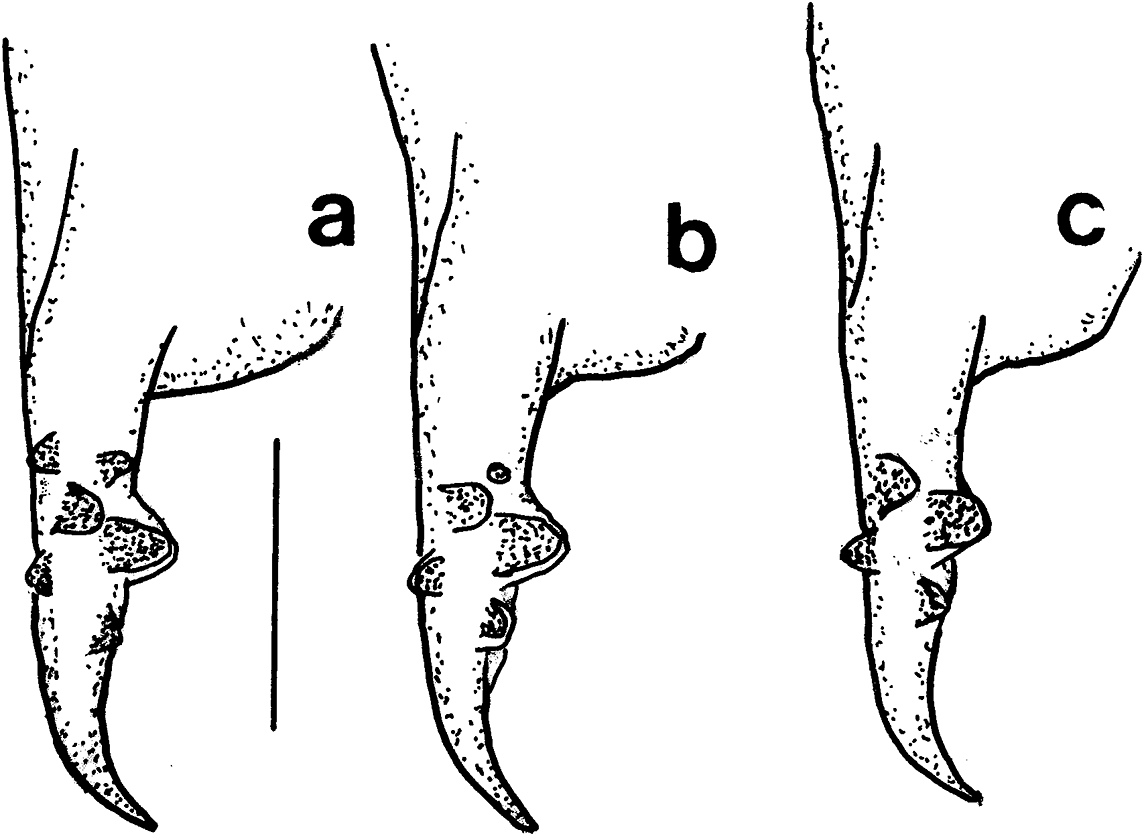
In his review of the superfamily Heterakoidea, Inglis (Reference Inglis1967) wrote that the structure and relative lengths of the spicules, used in conjunction with the number of caudal papillae, the relative size and position of the precloacal sucker, and the relative length of the male tail were the most useful characters for determining species of Heterakis. There was no combination of characters by which females alone could be identified. A suite of measurements comparing the above male characters from Heterakis spp. reported in Australia or Papua New Guinea, all from murid or bandicoot (Peramelidae) hosts and including the cosmopolitan species Heterakis spumosa is given in Table 5. Some morphometric differences between the species are apparent: for example, sucker diameter. Importantly, H. spumosa is characterised by having 3 pairs of papillae on the terminal spike of the tail and H. fielding, H. oweni, and H. sirawii have only 2 (Table 5) (Ribas et al. Reference Ribas, Gouy de Bellocq, Ros, Ndiaye and Miquel2013; Robles et al. Reference Robles, Navone and Gomez Villafane2008; Smales Reference Smales1996, Reference Smales2016, Reference Smales2023). All the males previously identified as H. spumosa collected in South Australia or Victoria and examined for this study had either 3 pairs of papillae, the third pair very small and difficult to see, or only 2 (Figure 2). Further study, including molecular analysis, is needed to determine the significance of the number of caudal papillae in this genus and hence confirm the identity of the specimens from SA and Vic.
Comparative measurements of characters, in μm unless otherwise stated, used for species delimitation of Heterakis spp. males infecting bandicoots and rodents from Australia, Papua New Guinea, Malaysia, and South America.

Heterakis spumosa male tail lateral view. (a) with 3 pairs of papillae, (b) with 3 pairs of papillae, 1 pair very small, and (c) with 2 pairs of papillae. Scale bar: 28 μm.

Taxonomic summary
Family Physalopteridae (Railliet, 1893 subfamily) Leiper, 1908
Physaloptera Rudolphi, 1819
Physaloptera banfieldi Johnston and Mawson, Reference Johnston and Mawson1941 ex Melomys cervinipes
Physaloptera troughtoni Johnston and Mawson, Reference Johnston and Mawson1941 ex Melomys burtoni, Melomys cervinipes, Rattus fuscipes
Locality: New South Wales, Northern Territory, Queensland, Victoria, South Australia.
Material examined: Physaloptera banfieldi
From Melomys cervinipes Types 1 male, 3 females, 2 pieces female AM W3237, collected from Dunk Island, Queensland.
Physaloptera troughtoni
From Melomys burtoni vouchers 5 females, SAM AHC 5559, collected from Miallo, Queensland.
From Melomys cervinipes voucher 1 male, SAM AHC 7434, collected from Innisfail, Queensland.
From Rattus fuscipes coracius vouchers 3 females, SAM AHC 7985, 8321, collected from Kuranda, Ravenshoe, north Queensland.
From Rattus fuscipes assimilis vouchers 1 male, SAM AHC 7449, collected from Kin Kin, South Queensland; 48 males, 121 females, SAM AHC 5511, 5513, 5813, 5816, 5570, 5571,10021, 10031, 10035, 10037, collected from Apollo Bay, Bonang, Childer’s Forest, Dartmouth, Eildon, Gladysdale, Healesville, Marysville, Olsen’s Bridge, Wye River, Victoria.
From Rattus fuscipes greyii paratypes 1 male, 1 piece female SAM AHC 1670 collected from Kangaroo Island; vouchers 23 males, 40 females SAM AHC 1664, 4848, 5025, 6675, 8379, 8381, 8390, 8422, 13951, collected from Carey’s Gully, Horsnell Gully, Mt Lofty, Mt Robinson, Pearson Island, Uraidla, South Australia.
Remarks
Physaloptera banfieldi infecting M. cervinipes, reported as M. banfieldi, from Dunk Island, Qld, and Ph. troughtoni infecting R. fuscipes greyii from Kangaroo Island, SA, were described in the same paper by Johnston and Mawson (Reference Johnston and Mawson1941). Since that first collection, Ph. banfieldi has been recovered neither from M. cervinipes nor M. burtoni nor R. fuscipes (see Smales et al. Reference Smales, Heinrich and McKillup2004). Physaloptera troughtoni, however, has since been recovered from R. fuscipes from NSW, NQ, SA, Vic, and SQ; from M. burtoni from the NT, NSW, and Qld (CSIRO W/L catalogue numbers N2734–N2737, N2739, N2742–N2749, N3260 (Smales Reference Smales2005; Smales et al. Reference Smales, Heinrich and McKillup2004; this study); and M. cervinipes from Innisfail (this study). In reviewing the helminth community of M. burtoni, Smales (Reference Smales2005) noted that the morphometric measurements of the large number of specimens identified as Ph. troughtoni formed a continuum which overlapped with the published measurements of Ph. burtoni and further stated that any differences in morphological characters could be accounted for as fixation artefacts. Accordingly, she placed Ph. troughtoni as a junior synonym of Ph. banfieldi (see Smales Reference Smales2005). In this, however, she failed to take full account of the significant morphological differences in the length of the male, the shape of the male tail, and the number of caudal papillae on the males of the two species. Although variability in number and placement of caudal papillae is not uncommon in species of Physaloptera (Norman and Beveridge Reference Norman and Beveridge1999), all the males from M. burtoni, M. cervinipes, and R. fuscipes examined in this study had 4 pairs of peri cloacal pedunculated papillae and 3 pairs of ventral papillae on the tail, as described for Ph. troughtoni. The description of Ph. banfieldi clearly states and is illustrated in the figures that males have 6 pairs of pedunculated papillae and two pairs of ventral papillae on the tail (Johnston and Mawson Reference Johnston and Mawson1941). Examination of the type male of Ph. burtoni confirmed the description by Johnston and Mawson (Reference Johnston and Mawson1941). Both species, therefore, are now considered valid and the decision of Smales (Reference Smales2005) is in error. Physaloptera banfieldi is reinstated here for the Physaloptera sp. occurring in M. cervinipes from Dunk Island, Queensland.
Taxonomic summary
Family Rictularidae Railliet, 1916
Pterygodermatites Wedl, 1861; Rictularia Froelich, 1802
Pterygodermatites pearsoni ex Rattus fuscipes greyii
Locality: South Australia.
Material examined: From R. f. greyii types 3 anterior ends, allotype 1 female, paratypes 10 females, SAM AHC 5012, 22996, 42870; vouchers 1 male, 57 females SAM AHC 1707, 5005, 5261, 5291, 5548, collected from Pearson Island, South Australia.
Rictularia mackerrasae ex Rattus fuscipes coracius
Locality: Queensland.
Material examined: From R. f. coracius holotype female, paratypes 33 females SAM AHC 5028, 5029, 23828, 41267; vouchers 26 females SAM AHC 12240 collected from Innisfail, Mossman, Palmerston, north Queensland.
Remarks
The classification of the Rictulariidae was reviewed by Quentin (Reference Quentin1969) and the diagnoses of the genera Pterygodermatites and Rictularia were revised to include within Pterygodermatites species with 3 oesophageal teeth and 29–56 pairs of prevulvar ventrolateral spines and within Rictularia species with a single oesophageal tooth and 34 pairs of prevulvar ventrolateral spines. Therefore, as discussed in Smales (Reference Smales2018), the specimens from South Australia originally described as R. pearsoni are now considered as Pterygodermatites pearsoni while those from North Queensland are retained in the genus Rictularia as R. mackerrasae.
Discussion
This review is based on the historical collections of many workers, carried out over a long period of time, to build up a significant record of the nematode community of R. fuscipes from data collected from 1108 infected hosts. This record also includes a large amount of information about the nematode component communities of 2 of the 4 subspecies of R. fuscipes, namely R. f. assimilis (955 hosts) and R. f. coracius (108 hosts), as well as less comprehensive data for the third subspecies, R. f. greyii (24 hosts). Only 4 hosts of the fourth subspecies, R. f. fuscipes, from WA were listed in the SAM and CSIRO W/L databases, 3 records of Mastophorus muris infections, and 1 of heligmosomes being recorded. Sufficient data has been obtained to examine biogeographic effects on the nematode component communities of the populations of R. fuscipes from Eastern Australia. Analyses of those communities have been constrained by the small number of individuals in the population of R. f. greyii (24) and the relatively small number of individuals in the population of R. f. coracius (107) compared with the large number of individuals of R. f. assimilis (955) from three populations. Moreover, the prevalence data of the Heligmosominae for R. f. assimilis has been skewed because 747 lots collected from 721 NSW hosts were not identified. Despite that 27 species were recorded from each of the NSW and SQ populations of R. f. assimilis although fewer species (19) were recovered from the Vic population (Table 3). A comprehensive statistical analysis of the host populations (subspecies and biogeographic populations) and their associated nematode communities was not attempted because the total number of animals examined, including uninfected animals, could not be established. Records from four individuals of R. f. fuscipes suggest that the most prevalent species in the WA nematode community may be the same as those of the East Coast populations of R. fuscipes. More sampling is needed before an analysis of the nematode community of R. f. fuscipes can be attempted.
Given the very large number of R. fuscipes examined and the comprehensive dissection of all the possible infection sites in the hosts, including various glands, the lungs, liver, muscle tissue, mesenteries and subdermal tissue, it is most likely that the taxa included in the 19 families listed in Table 2 represent the complete nematode community of R. fuscipes from its eastern and southeastern Australian populations. This community included 16 species of the Trichostrongylidae, the dominant taxon. Nippostrongylus magnus and Odilia emanuelae were the only species to occur across all 5 host populations and N. magnus, with prevalences up to 42.9%, was the dominant species both within the Trichostrongylidae and overall. This dominance of the heligmosomes in the NSW population of R. f. assimilis is under-estimated because the data on the unidentified heligmosomes could not be included. Trichostrongylid dominance of the nematode assemblages of Australian Rattus spp. is well documented, having been reported in R. colletti (Thomas), R. leucopus (Gray), and R. sordidus (Gould) (see Mulder and Smales Reference Mulder and Smales2009; Smales Reference Smales1992; Smales and Spratt Reference Smales and Spratt2004).
The species composition of the Trichostrongylidae recovered from the nematode community of R. fuscipes suggests a scenario of coevolution, host switching, and more recently acquired infections. All native Australian murines are derived from New Guinean murines which arrived in Southeast Asia in two colonisation events, the first about 6–7 mya. Descendents of that colonisation migrated across to Australia about 6–8 times and diversified across the continent. Later, about 1 mya, in the second wave of colonisation, the genus Rattus arrived in New Guinea and subsequently Australia (Breed et al. Reference Breed, Aplin, Rowe, Baker and Gynther2023; Godthelp Reference Godthelp, Metcalfe, Smith, Morward and Davison2001). Ancestral representatives of the genus Odilia are thought to have arrived in Australia with the first wave of colonising murines and subsequently diversified. These ancestors are now represented in Rattus spp. by 5 species of Odilia, 2 species of Chisholmia, a species of Equilophos, and a species of Parasabanema (see Durette-Desset and Digiani Reference Durette-Desset and Digiani2015). The species of Odilia, Chisholmia, and Equilophos that were found in R. fuscipes likely represent host switching events followed by speciation after the genus Rattus arrived in Australia with the second wave of murine colonisation. By contrast, the genus Nippostrongylus is a cosmopolitan taxon which likely arrived in Australia twice. Firstly, with the second wave of colonising murines, Rattus spp., and diversifying to N. typicus and N. magnus. Secondly, N. brasiliensis, a cosmopolitan species, travelled to Australia with ship rats, Rattus rattus Linneaus, following European colonisation of Australia. Nippostrongylus brasiliensis was reported in NSW and Qld as early as 1909 (Johnston Reference Johnston1918).
Heligmosomoides bakeri, a cosmopolitan parasite of wild and laboratory strains of Mus musculus Linneaus, was previously reported from M. musculus in Australia (Behnke and Harris Reference Behnke and Harris2010). The specimens of H. bakeri and the Heligmosomoides sp., possibly H. bakeri, found in this study from NSW and SQ are likely occasional parasites of R. f. assimilis. Two Hepatojarakus spp. are known from Australia and a third species from Malaysia, suggesting that the genus has southeast Asian origins. Paraustrostrongylus is an Australian genus, P. ratti being known only from R. fuscipes. Parauastrostrongylus trichosuri, usually infecting brush-tailed possums (Phalangeridae), was recovered as an occasional parasite of bush rats in this study. The two species can be easily distinguished by spicule length; 380–450 μm for P. trichosuri compared with 640–700 μm for P. ratti (Mawson Reference Mawson1973; Obendorf Reference Obendorf1979). Similarly, Peramelistrongylus skedastos, a parasite of bandicoots (Peramelidae), and Tetrabothriostronglyus mackerrasae, a parasite of the yellow-footed antechinus, Antechinus flavipes (Waterhouse) (Dasyuridae), were both recovered as occasional parasites of R. fuscipes.
Also prevalent across the community of R. fuscipes were the indigenous species Eu. gastricus, A. mackerrasae, and Ph. troughtoni, as well as the cosmopolitan H. spumosa and S. andersoni (Table 3). These species have life cycles which utilise insects, earthworms, gastropods, or cannibalism for intermediate hosts and all these are known dietary items of R. fuscipes, the definitive host (Anderson Reference Anderson2000).
Capillariid parasites are difficult to recover and process for identification, being fragile threadlike organisms, easily broken during dissection. Those known to infect R. fuscipes were described and listed by Spratt (Reference Spratt2006). The material recorded here as Capillaria s. l. (Table 1) may include undescribed species. An investigation into mitochondrial DNA from specimens of Capillaria s. l. recovered from several Australian hosts indicated a wide range of genetic variability (Zhu et al. Reference Zhu, Spratt, Beveridge, Haycock and Gasser2000). The primary hosts of C. hepaticum are the introduced murids Rattus norvegicus (Berkenhout) and R. rattus Linneaus (see Singleton et al. Reference Singleton, Spratt, Barker and Hodgson1991). Definitive hosts can be infected by cannibalism, that is, by eating the infected livers of other mice (Spratt and Singleton Reference Spratt and Singleton1986). The occasional infections of C. hepaticum found in this study could possibly be the result of R. fuscipes accidentally ingesting larvae from the infected livers of introduced mice (Mus musculus).
The limited geographical distribution of species such as the capillariid Aonchotheca praeputialis and the trichosomoidids, Anatrichosoma haycocki and Trichosomoides nasalis, may be because, in choosing preputial glands, nasal cavities, or paracloacal glands as infection sites, they were overlooked. Reported as early as 1966, A. praeputialis is found exclusively in R. fuscipes (Spratt Reference Spratt2006). Anatrichosoma is a cosmopolitan genus and A. haycocki, an indigenous species first described from Antechinus spp. (Dasyuridae), has since been reported as an occasional infection of R. fuscipes (see Obendorf Reference Obendorf1979). Similarly, Trichosomoides is a cosmopolitan genus nasalis, widely distributed in murid hosts throughout the world (Spratt Reference Spratt1985b), and T. spratti, the indigenous species (Diagne et al. Reference Diagne, Diouf, Lochouarn and Bain2000). By comparison, Cercopithifilaria johnstoni, an onchocercid, was not overlooked. It was detected in all the populations of R. f. assimilis even though subcutaneous tissue is the infection site.
Nothing is known about the life cycles of Dioctowittus spp., which have reptiles, snakes, and lizards as definitive hosts (Mulder and Smales Reference Mulder and Smales2006). Nor is there any information as to the life cycle stage of the specimens from NSW. Given that R. f. assimilis is a prey item of snakes and large lizards, it may be an intermediate host in that life cycle. Similarly, R. f. assimilis may be an intermediate host for the specimens of Raillietina varani collected from SQ, whose definitive hosts in Australia are Varanus spp., and whose life cycle is also unknown (Sprent Reference Sprent1985).
The identity of some of the material listed cannot be confirmed because of a lack of males. In particular, the Trichuris sp. may be either the cosmopolitan T. muris, introduced on the recent invasion of its hosts Rattus rattus and R. norvegicus, or a distinct Southeast Asian species of Trichuris as suggested by Ribas et al. (Reference Ribas, Wells, Morand, Chaisiri, Agatsuma, Lakim, Yuh Tuh and Saijuntha2020). The Strongyloides sp. may be either of the cosmopolitan species S. ratti or S. venezuelensis, which can be differentiated by features of the ovaries, or an as yet to be recovered indigenous species. A Strongyloides sp. was reported from R. fuscipes by Mackerras (Reference Mackerras1958) and not identified to species. Specimens of the trichostrongylid, Hepatojarakus sp., all females, could be either H. fasciatus or H. pycnofasciatus, both species that are here reported from R. fuscipes. Any Heterakis sp. females are likely H. spumosa because both males and females were recovered from some hosts. Syphacia sp. females could not be designated S. muris with certainty because S. darwini was also recovered. The finding of S. darwini in R. f. assimilis, however, is likely an occasional event, as Melomys cervinipes (Gould) is the usual host (see Hugot and Quentin Reference Hugot and Quentin1985).
Angiostrongylus cantonensis is a cosmopolitan species of lungworm which presumably travelled to Australia with invading cosmopolitan rats, R. norvegicus and R. rattus. Angiostrongylus mackerrasae is an indigenous species which infects the native murine R. fuscipes (Stokes et al. Reference Stokes, Spratt, Banks, Pech and Willians2007). The life cycles of Angiostrongylus spp. include gastropods as intermediate hosts and there is a risk of humans becoming infected with meningoencephalitis if the larvae of A. cantonensis are ingested with contaminated food (Prociv Reference Prociv1999; Spratt Reference Spratt2005). Usually there is geographical separation between R. rattus and R. fuscipes and consequently between A. cantonensis and A. mackerrasae (Stokes et al. Reference Stokes, Spratt, Banks, Pech and Willians2007) but there is potential concern given the reports of infection with A. cantonensis in R. fuscipes (this study). The genus Gallegostrongylus occurs as a satellite taxon throughout the world, living in subpleural nodules of the lungs (Spratt et al. Reference Spratt, Haycock and Walter2001). Gallegostrongylus australis has been recovered as an indigenous species taking a similar role in R. fuscipes in Australia. As with other species whose sites of infection are beyond the intestinal tract, G. australis may be present in other populations of R. fuscipes although not recovered in any surveys carried out thus far.
As alluded to above, the specimens of Dioctowittus sp. and the material identified as metastrongyloids, heligmosomes, oxyurids, and Rictularia sp. from NSW were not available for identification.
Rattus fuscipes, as potential prey, can be an intermediate host in life cycles of ascaridid species which include reptiles as definitive hosts or a definitive host in life cycles that include insects as intermediate hosts. Ophidascaris robertsi and O. moreliae are indigenous species that use pythons as definitive hosts (Sprent Reference Sprent1963, Reference Sprent1970) and Raillietascaris sp., probably R. varani (Baylis and Daubney, 1922), a regional species using Varanus spp., monitor lizards, as definitive hosts. As predators and scavengers, all these reptiles eat small mammals such as R. fuscipes (see Sprent Reference Sprent1985; Wikipedia 2025). By contrast, R. fuscipes, which commonly consumes insects, is a definitive host in life cycle of the ascaridid, Toxocara mackerrasae, an indigenous species. The definitive or intermediate hosts for these ascaridids are pythons and varanid lizards, reptiles that are not found in southern Australia, which explains why they were not collected in the SA and Vic populations.
Finding Contracaecum sp. in R. fuscipes, an anisakid which usually has fish as intermediate hosts and piscivorous birds or mammals as definitive hosts (Anderson Reference Anderson2000), is likely an occasional infection. Rattus fuscipes also becomes an occasional intermediate host in the life cycle of the physalopterid, Abbreviata sp. The capsules of Abbreviata larvae that are commonly found in the gastric tissue of smaller reptiles could have been acquired by eating bush rats. Since the smaller reptiles can become the prey of larger ones, the life cycle of Abbreviata spp. can be completed (Anderson Reference Anderson2000).
Antechinella suffodiax, an acuariid, usually a parasite of dasyurid marsupials, is an occasional parasite of R. fuscipes, as is the spirurid Spirura aurangabadensis (see Obendorf Reference Obendorf1979; Spratt Reference Spratt1985b).
The physalopterid, Physaloptera troughtoni, the rictulariids Pt. pearsoni and R. mackerrasae, and the gongylonematids G. beveridgei and G. agularense, all Australian species, as well as the spirocercid, Mastophorus muris, and subulurid, Subulura andersoni, cosmopolitan species, use insects as intermediate hosts (Anderson Reference Anderson2000). As indicated above, insects are common food choices of R. fuscipes (Lunney and Banks Reference Lunney, Banks, Baker and Gynther2023). Both pairs of gongylonematid and the rictulariid species were distributed with one in more northern and the other in more southern geographic zones (Table 2).
Bootstrap analysis confirmed that enough hosts had been collected to discover 91% of common species of nematode in the R. f. greyii community, although only 24 animals had been examined. The actual species richness of R. f. greyii is likely higher, given that 40 nematode species were recovered from the 955 individuals comprising the 3 populations of R. f. assimilis. Rare, uncommon, and species that infect sites beyond the gut were not recovered from R. f. greyii. Comparison of the nematode component communities of 121 animals in the Vic population of R. f. asimilis and 24 individuals of R. f. greyii showed that the Vic component community comprised 19 species and that of SA only 8. Potential members of the R. f. greyii community such as the capillariids may have been overlooked because they are difficult to recover during dissection.
A core-satellite species analysis revealed no core species, neither in the R. fuscipes nematode community nor in any of the component communities. Notwithstanding, it was apparent that the nematode community of R. fuscipes is speciose, including a designated interactive component of trichostrongylids, since trichostrongylids utilise niches along the length of the host gut (Bush and Holmes Reference Bush and Holmes1986). Excepting 2 secondary species, N. magnus in the Vic population and Ph. troughtoni in the SA population, the R. fuscipes community was made up of satellite species, that is, species present at less than 33% prevalence. This suggests that the R. fuscipes community is largely noninteractive including many species that select infection sites outside the gut (Bush and Holmes Reference Bush and Holmes1986; Stock and Holmes Reference Stock and Holmes1987).
Examination of the Sorrensen’s indices (Table 4), calculated to reveal similarities of the nematode component communities of the subspecies of R. fuscipes, showed that they were dissimilar. The closest were the R. f. coracius and R. f. assimilis communities with 55% similarity. Analysis of the geographic populations of R. fuscipes, however, indicated that the 2 Qld populations had the most similar (77 %) communities. In all other comparisons the R. fuscipes component communities (subspecies and populations) were dissimilar; no higher than 52% similarity for the SQ and NSW populations of R. f. assimilis and as low as 23–29% similarity for the NSW and SA and the SQ and SA component communities (Table 4). Comparisons between the component communities of the subspecies and populations of R. fuscipes were influenced by the number of individual hosts sampled and hence the number of nematode species recovered from each. Where the number of hosts sampled, as in NQ (107), SQ (112), and Vic (121), were comparable, then the indices calculated were probably more reliable.
The geographic distribution of R. fuscipes encompasses four climate zones. 1. A tropical, hot, humid summer zone (R. f. coracius) in the north. 2. A subtropical, warm humid summer in southern Queensland and the northern coast of New South Wales (R. f. assimilis). 3. A warm summer, cold winter zone along the east and south coasts from New South Wales through Victoria (R. f. assimilis) into South Australia (R. f. greyii). 4. A montane, mild summer, cold winter zone through New South Wales and Victoria (R. f. assimilis) (Bureau of Meteorology 2025; Figure 1). These climate zones support a wide range of habitats from tropical rain forest to eucalypt forest to open woodland and subalpine woodland, providing diverse habitats with diverse food items available for R. fuscipes (Lunney and Banks Reference Lunney, Banks, Baker and Gynther2023). This diversity is likely an environmental determinant of the species composition of the nematode community of R. fuscipes.
The component communities of the geographic populations of R. fuscipes were more similar than those of the subspecies populations; the NQ and SQ populations (subspecies assimilis and coracius), 77% similar, were more similar than the NSW and Vic populations (both R. f. assimilis), 48%. The diverse climate and habitat zones inhabited by the populations of R. fuscipes and its subspecies all appear to influence the composition of the component communities. Comparisons of the component communities of the Vic and SQ populations of R. f. assimilis as well as of the NQ population of R. f. coracius and the Vic population of R. f. assimilis were both 39% similar. The least similar populations were those of NSW and SA (23%) and these findings were congruent with subspecies community comparisons of assimilis and greyii (26%). This adds weight to the argument that subfamily relationships and environmental factors, acting together with nematode biology, determine the composition of the component communities that make up the nematode community of R. fuscipes (Table 4).
There is no simple explanation for the patchy distribution of some nematode species. Neither the Gongylonema spp. nor Heterakis spumosa and Subulura andersoni were collected from New South Wales (Table 3), although they were recorded from Qld and Vic and/or SA. The large number of animals recorded from NSW makes it unlikely that these species were present but missed during the collection or dissection of individual hosts.
The large number of R. fuscipes examined in this review, including the large number of animals collected in NSW, and the careful examination of sites of infection outwith the intestinal tract, has revealed a large complex nematode community of more than 46 species. By comparison 180 individuals of R. colletti (Thomas) collected from a single location in the Northern Territory harboured only 3 nematode species, 86 individuals of Rattus sordidus (Gould), collected from the Central Queensland cane fields, supported 7 nematode species, and 28 individuals of Rattus leucopus (Gray) collected from North Queensland and Papua New Guinea hosted 22 nematode species (Mulder and Smales Reference Mulder and Smales2009; Smales Reference Smales1992; Smales and Spratt Reference Smales and Spratt2004). Although the geographic distribution of R. leucopus spanned from NQ across the Torres Strait to Papua New Guinea, the habitats utilised can be considered as equivalent rainforest environments in contrast to the four climatic zones utilised by R. fuscipes. The number of species in the nematode community of R. leucopus (22) resembles the number of species in the Queensland or Victorian populations of R. fuscipes (18, 27, or 19, respectively). The NQ populations of R. fuscipes and R. leucopus live in similar environments. Nevertheless, their communities have different species compositions and therefore any further analyses and comparisons of their communities may not be informative.
The nematode community of R. fuscipes comprises cosmopolitan taxa parasitising cosmopolitan regional and Australian murine hosts, for example, Heterakis spumosa, Mastophorus muris, Nippostrongylus brasiliensis, and Syphacia muris; regional taxa using Australian murines, for example, Angiostrongylus cantonensis and Subulura andersoni; Australian taxa using Australian murines, for example, Angiostrongylus mackerrasae, Odilia polyrhabdote, Hepatojarakus pycnofasciatus, Cercopithifilaria johntsoni, and Toxocara mackerrasae; taxa shared with other Australian Rattus spp., for example, Eucoleus gastricus and Rictularia mackerrasae; taxa reported only from R. fuscipes, for example, Baruscapillaria conspecta, Paraustrongylus ratti, Physaloptera troughtoni, and Gongylonema beveridgei; and occasional infections by taxa whose usual hosts are not murines, for example, Paraustrostrongylus trichosuri and Antechiniella suffodiax (see Mulder and Smales Reference Mulder and Smales2009; Smales Reference Smales1992; Smales and Spratt Reference Smales and Spratt2004; Smales et al. Reference Smales, Heinrich and McKillup2004; this study). The determinants of the species composition of the nematode community of R. fuscipes include immigration to Australia and subsequent adaptive radiation of the genus Rattus to diversity of habitat and dietary choices which are congruent with nematode life cycle patterns.
Acknowledgements
Thanks are due to the staff of the Museums and CSIRO Wildlife for access to specimens and databases, particularly Claire Rowe for access to the Australian Museum collection and Leslie Chisholm and Jo Wood to the Australian Helminthological Collection.
Financial support
This research received no specific grant from any funding agency, commercial or not-for-profit sector.
Competing interests
None.
Ethical standard
All the specimens examined were taken from and returned to museum collections.