Reuterin (3-hydroxypropionaldehyde, 3-HPA) is a broad-spectrum antimicrobial compound produced by certain lactic acid bacteria (LAB) during glycerol metabolism (Vollenweider and Lacroix, Reference Vollenweider and Lacroix2004). Its antimicrobial activity against Gram-positive and Gram-negative bacteria, yeasts and moulds has generated interest in food preservation, particularly in dairy products (Gómez-torres et al., Reference Gómez-torres, Ávila, Delgado and Garde2016; Ortiz-rivera et al., Reference Ortiz-Rivera, Sánchez-Vega, Gutiérrez-Méndez, León-Félix, Acosta-Muñiz and Sepulveda2017). The two primary reuterin-producing species are Limosilactobacillus reuteri and Loigolactobacillus coryniformis, both of which have been isolated from various fermented foods (Chung et al., Reference Chung, Axelsson, Lindgren and Dobrogosz1989; Martín et al., Reference Martín, Olivares, Marín, Xaus, Fernández and Rodríguez2005).
Historically, reuterin production has been characterised as strictly anaerobic, with optimal production occurring at 37°C for L. reuteri (Chung et al., Reference Chung, Axelsson, Lindgren and Dobrogosz1989; Lüthi-peng et al., Reference Lüthi-peng, Schärer and Puhan2002) and 25°C for L. coryniformis (Nakanishi et al., Reference Nakanishi, Tokuda, Ando, Yajima, Nakajima, Tanaka and Ohmono2002). This anaerobic requirement increases production costs because it necessitates anaerobic fermentation equipment. Thus, strains capable of aerobic reuterin production would be highly valuable for dairy fermentation, where ripening of cheeses such as Camembert and Gouda occurs at 10–20°C under aerobic surface conditions. In such environments, an adjunct starter producing reuterin aerobically could extend shelf life by suppressing spoilage moulds and undesirable bacteria without requiring specialised anaerobic equipment.
In a previous study, L. coryniformis WBB05 was assayed for reuterin production at 15°C, 20°C, 25°C, 30°C and 37°C under both aerobic and anaerobic conditions, with time-course sampling at 20°C (Tsuda, Reference Tsuda2023). Reuterin production reached 120 mM from 200 mM glycerol at 20°C, and no statistically significant difference between aerobic and anaerobic conditions was detected at any temperature tested; maximum production was reached within 6 h and remained constant up to 24 h at 20°C, again without a significant difference between aerobic and anaerobic conditions. This low-temperature productivity is compatible with the ripening conditions of cheeses such as Camembert and Gouda, suggesting that L. coryniformis WBB05 is a promising adjunct starter for fermented dairy products. L. coryniformis WBB05 was originally isolated from Japanese pickles, a traditional fermented food with a history of safe consumption; however, its genomic safety profile had not been evaluated. For industrial utilisation of LAB strains in dairy applications, demonstration of safety is essential, as required by regulatory bodies including the European Food Safety Authority (EFSA).
Whole-genome sequencing (WGS) has revolutionised microbial safety assessment by enabling comprehensive detection of virulence factors, antimicrobial resistance (AMR) genes, biogenic amine biosynthetic pathways and mobile genetic elements that may pose food safety risks (Morovic et al., Reference Morovic, Roper, Smith, Mukerji, Stahl, Rae and Ouwehand2017; Chaichana et al., Reference Chaichana, Suwannasin, Boonsan, Yaikhan, Klaysubun, Singkhamanan, Wonglapsuwan, Pomwised, Konglue, Chema, Saivaew and Surachat2025). The safety assessment of LAB for food applications has traditionally relied on phenotypic characterisation, which may not reveal all potential safety concerns. The EFSA now recommends WGS-based safety evaluation for novel food cultures (EFSA, 2025).
The objectives of this study were (1) to conduct a WGS-based safety assessment of L. coryniformis WBB05 for food applications, and (2) to identify candidate genetic determinants for aerobic reuterin production through comparative genomic analysis with L. reuteri.
Materials and methods
Genome sequencing and assembly
L. coryniformis WBB05 was maintained in de Man, Rogosa and Sharpe (MRS) broth (De Man et al., Reference De Man, Rogosa and Sharpe1960) at 30°C under static aerobic conditions. The total DNA of L. coryniformis WBB05 was extracted using the method described by de Los Reyes-gavilán et al. (Reference de Los Reyes-gavilán, Limsowtin, Tailliez, Séchaud and Accolas1992). WGS was performed on an Illumina NovaSeq X Plus platform (Novogene, Seoul, Republic of Korea). Paired-end libraries (2 × 150 bp) were prepared and sequenced, generating approximately 1 Gb of raw data per sample, achieving a sequence coverage of 500–700×. Raw reads were processed, and de novo assemblies were generated on a Windows 11 workstation using Ubuntu (WSL2). Raw reads were quality-filtered using fastp (v0.26.0) with automatic adapter detection and quality trimming with parameters -q 20, -u 30 and -l 50 (Chen et al., Reference Chen, Zhou, Chen and Gu2018). De novo assembly was performed using SPAdes (v3.15.5) with the --isolate option (Bankevich et al., Reference Bankevich, Nurk, Antipov, Gurevich, Dvorkin, Kulikov, Lesin, Nikolenko, Pham, Prjibelski, Pyshkin, Sirotkin, Vyahhi, Tesler, Alekseyev and Pevzner2012). Assembly quality was assessed using QUAST (v5.2.0) (Gurevich et al., Reference Gurevich, Saveliev, Vyahhi and Tesler2013). Contigs shorter than 200 bp were removed using seqtk (v1.3) prior to downstream analyses. The genome sequence data are available in DDBJ/EMBL/GenBank under BioProject accession no. PRJNA1377693, BioSample accession no. SAMN53798339, genome accession no. JBSVDG000000000 and SRA accession no. SRR37317779.
Genome annotation
Genome annotation was conducted using the NCBI Prokaryotic Genome Annotation Pipeline (PGAP, version 2025-05-06) (Tatusova et al., Reference Tatusova, DiCuccio, Badretdin, Chetvernin, Nawrocki, Zaslavsky, Lomsadze, Pruitt, Borodovsky and Ostell2016). The organism was designated under its former name ‘Lactobacillus coryniformis’ to ensure database compatibility.
Virulence factor and AMR screening
Virulence factors were screened using ABRicate (v1.0.1) (Seemann, Reference Seemann2020) against the locally installed Virulence Factor Database (VFDB) (Liu et al., Reference Liu, Zheng, Zhou, Chen and Yang2022) with thresholds of ≥80% nucleotide identity and ≥80% coverage. AMR genes were identified using AMRFinderPlus v3.11.2 (Feldgarden et al., Reference Feldgarden, Brover, Haft, Prasad, Slotta, Tolstoy, Tyson, Zhao, Hsu, McDermott, Tadesse, Morales, Simmons, Tillman, Wasilenko, Folster and Klimke2021) with database version 2023-11-15.1, applying the same ≥80% identity and ≥80% coverage thresholds. Plasmid sequences were detected using ABRicate against the PlasmidFinder database with thresholds of ≥80% identity and ≥60% coverage.
CRISPR–Cas system analysis
CRISPR arrays and CRISPR-associated (Cas) genes were identified by PGAP using CRISPRCasFinder version 4.3.2. Orphan CRISPR arrays lacking adjacent Cas genes were assigned to their respective systems based on repeat sequence identity. CRISPR–Cas system types were classified according to Makarova et al. (Reference Makarova, Wolf, Iranzo, Shmakov, Alkhnbashi, Brouns, Charpentier, Cheng, Haft, Horvath, Moineau, Mojica, Scott, Shah, Siksnys, Terns, Venclovas, White, Yakunin, Yan, Zhang, Garrett, Backofen, Van der Oost, Barrangou and Koonin2020).
Prophage detection
Prophage regions were identified using the PHASTER web server (Arndt et al., Reference Arndt, Grant, Marcu, Sajed, Pon, Liang and Wishart2016). Prophages were classified as intact (score >90), questionable (score 70–90) or incomplete (score <70) based on the presence of phage structural genes and att sites.
Secondary metabolite biosynthetic gene clusters
Secondary metabolite biosynthetic gene clusters were predicted using the antiSMASH web server version 7.0 (Blin et al., Reference Blin, Shaw, Augustijn, Reitz, Biermann, Alanjary, Fetter, Terlouw, Metcalf, Helfrich, Van Wezel, Medema and Weber2023) with relaxed detection strictness.
Biogenic amine biosynthetic gene analysis
Genes encoding amino acid decarboxylases, which are potentially involved in biogenic amine production, were identified in the PGAP genome annotation. All annotated decarboxylase genes were manually curated to distinguish between primary metabolic enzymes and those responsible for biogenic amine biosynthesis (histidine decarboxylase, tyrosine decarboxylase, ornithine decarboxylase, lysine decarboxylase and glutamate decarboxylase).
Haemolytic activity
Overnight culture of L. coryniformis WBB05 was streaked on a sheep blood agar plate (Shimadzu Corporation, Kyoto, Japan) and incubated at 30°C for 48 h under aerobic conditions. Then, the haemolytic patterns were observed and classified as follows: α-haemolysis, partial haemolysis, indicated by a grey and greenish discolouration around the colonies; β-haemolysis, complete haemolysis, shown by a clear zone around the colonies; γ-haemolysis, no haemolysis, with no visible zone around the colonies. Staphylococcus strain was used as the positive control for β-haemolytic activity, and a Lactococcus strain was used as the negative control.
Minimum inhibitory concentrations of antibiotics
Minimum inhibitory concentrations (MICs) against L. coryniformis WBB05 were determined using twofold serial dilutions. Antibiotics used in this study included ampicillin, gentamicin, kanamycin, streptomycin, erythromycin, tetracycline and chloramphenicol. Briefly, 50 μL of twofold serial dilutions of antibiotic solution was added to 5.0 mL of MRS broth, yielding initial concentrations in the test medium of 2, 16, 256, 64, 1, 8 and 4 mg/L for ampicillin, gentamicin, kanamycin, streptomycin, erythromycin, tetracycline and chloramphenicol, respectively. Subsequently, 50 μL of the subcultured L. coryniformis WBB05 was inoculated into each medium, yielding a final concentration of approximately 106 CFU/mL in the test medium, and incubated at 30°C under static aerobic conditions. Growth inhibition was determined by measuring the optical density at 660 nm (OD660). The MIC was defined as the lowest concentration of antibiotic that inhibited microbial growth (OD660 < 0.2) after 48 h of incubation. In accordance with EFSA’s FEEDAP guidance for facultatively heterofermentative lactobacilli (EFSA, 2012), the strain is classified as resistant when its MIC exceeds the microbiological cut–off value defined for the respective antibiotic.
Comparative genomic analysis
Since reuterin is produced from glycerol, glycerol metabolism-related genes were first identified in the PGAP genome annotation by keyword searches for ‘glycerol’ and ‘propanediol’, and the functional annotation of each candidate was confirmed. To identify candidate genes for aerobic reuterin production, glycerol metabolism genes in L. coryniformis WBB05 were compared with those in L. reuteri, which produces reuterin only under anaerobic conditions, and other L. coryniformis strains. Glycerol metabolism genes, particularly those encoding glycerol kinase (GlpK), glycerol-3-phosphate oxidase (GlpO) and propanediol utilisation (pdu) genes, were identified through BLASTp searches (E-value threshold <0.01, per cent identity ≥70%) and manual curation. To assess GlpO distribution among Lactobacillales and to determine whether GlpO homologues could be detected in publicly available L. reuteri genomes, multilayered BLASTp searches were performed using both WBB05 GlpO sequences and phylogenetically diverse reference GlpO sequences (and the structurally related GlpD) from Escherichia coli, Streptococcus pneumoniae, Lactococcus lactis and Enterococcus casseliflavus as follows: (1) L. coryniformis WBB05 GlpO sequences (Type 1, 610 aa; Type 2, 554 aa) were queried against the NCBI RefSeq Protein database (taxid: 186826, Lactobacillales) to determine distribution patterns among LAB; (2) these representative sequences from phylogenetically diverse organisms – E. coli K-12 glycerol-3-phosphate dehydrogenase (UniProt P13035), S. pneumoniae GlpO (P35596), Lc. lactis GlpO (Q9CG65) and E. casseliflavus GlpO (O86963) – were queried against L. reuteri proteins (taxid: 1598) to detect any divergent GlpO family members; and (3) the L. reuteri DSM 20016T genome annotation (GCF_000009645.1) was directly examined using NCBI Protein Database searches to determine whether any GlpO homologue was annotated.
Results
Genome characteristics and general features
The draft genome of L. coryniformis WBB05 comprised 2.83 Mb distributed across 179 contigs with an N50 of 38.5 kb and a GC content of 42.84% (Table 1). These characteristics are consistent with those of other sequenced L. coryniformis genomes (genome size range: 2.71–2.78 Mb; GC content: 42.9%) (Zheng et al., Reference Zheng, Wittouck, Salvetti, Franz, Harris, Mattarelli, O'toole, Pot, Vandamme, Walter, Watanabe, Wuyts, Felis, Gänzle and Lebeer2020), indicating no gross genomic anomalies. Annotation identified 2,801 coding sequences (CDS), including 2,726 protein-coding genes, 6 rRNA genes and 57 tRNA genes.
Genome characteristics of L. coryniformis WBB05

Table 1 Long description
Genome characteristics are listed for the WBB05 assembly, including size, contiguity metrics, gene counts, RNA genes, and sequencing coverage. The genome size is 2.83 megabases. The number of contigs, greater than or equal to 500 base pairs, is 179. N50 is 38.5 kilobases, L50 is 23, and the largest contig is 109.9 kilobases. GC content is 42.84 percent. Total CDS is 2,801, with 2,726 protein coding genes. rRNA genes total 6, consisting of 5S times 3, 16S times 1, and 23S times 2, and tRNA genes total 57. Sequencing coverage is 500 to 700 times.
Safety assessment
Virulence factors and AMR
Screening against the VFDB detected no known virulence factors at stringent thresholds (≥80% identity, ≥80% coverage), supporting the non-pathogenic nature of L. coryniformis WBB05. Similarly, AMRFinderPlus analysis detected no AMR genes or resistance-conferring mutations. Plasmid screening detected one putative plasmid contig (NODE_59, 16.8 kb) encoding replication and maintenance functions; however, no AMR genes or virulence factors were detected on this contig or elsewhere in the genome. Although an investigation of MIC values against seven antibiotics revealed that this strain exhibited an MIC higher than the cut-off value for kanamycin (Table 2), no AMR genes were detected in the genome.
Minimum inhibitory concentrations of antibiotics against L. coryniformis WBB05

Table 2 Long description
Minimum inhibitory concentrations in mg/L are listed for seven antibiotics, alongside cut off values in mg/L marked with an asterisk. Ampicillin has an MIC of 0.5 and a cut off value of 4. Gentamicin has an MIC of 8 and a cut off value of 16. Kanamycin has an MIC of 128 and a cut off value of 64. Streptomycin has an MIC of 16 and a cut off value of 64. Erythromycin has an MIC of 0.25 and a cut off value of 1. Tetracycline has an MIC of 4 and a cut off value of 8. Chloramphenicol has an MIC of 2 and a cut off value of 4.
a Microbiological cut-off values for facultatively heterofermentative lactobacilli, according to EFSA’s FEEDAP guidance (2012).
CRISPR–Cas systems
L. coryniformis WBB05 harboured four CRISPR–Cas systems: two Type I-C systems (on NODE_1 and NODE_77) and two Type II-A systems (on NODE_25 and NODE_90). These systems comprised 10 CRISPR arrays with 212 spacers in total (Table 3). Four of these arrays (on NODE_76, NODE_135, NODE_180 and NODE_215) were orphan CRISPR arrays that lacked associated Cas genes and were assigned to their respective systems based on repeat sequence identity.
CRISPR–Cas systems and arrays in L. coryniformis WBB05

Table 3 Long description
Columns list type, location, Cas genes, CRISPR array location, CRISPR arrays, and spacers for CRISPR-Cas systems. Type I-C appears at locations, NODE_1 and NODE_77, with Cas genes, cas4, cas1c, cas2, cas3, cas5c, cas8c, and cas7c. Its CRISPR array locations are, NODE_1, NODE_77 with 2 arrays, and NODE_135 with an asterisk, for 4 arrays and 148 spacers. Type II-A appears twice: at location, NODE_25, with Cas genes, cas9, cas1, cas2, and csn2, and CRISPR array location, NODE_25, for 1 array and 15 spacers; and at location, NODE_90, with Cas genes, cas9, cas1, and cas2, and CRISPR array locations, NODE_76 with an asterisk, NODE_90 with 2 arrays, NODE_180 with an asterisk, and NODE_215 with an asterisk, for 5 arrays and 49 spacers. The total row lists 10 CRISPR arrays and 212 spacers.
a Orphan CRISPR arrays. Four orphan CRISPR arrays (NODE_76, NODE_135, NODE_180 and NODE_215; 50 spacers total) lacking their own Cas genes were assigned to the nearest complete system based on repeat sequence identity. All arrays are included in the totals shown above.
Prophage analysis
PHASTER analysis identified only one small incomplete prophage region (6.8 kb, score 20) on NODE_57, lacking attachment sites and essential structural genes needed for viable phage assembly. The GC content of this region was 43.12%.
Biogenic amine biosynthetic capacity
A keyword search for ‘decarboxylase’ in the genome annotation returned 16 CDS hits. Of these, 5 were considered false-positive hits (e.g., proteins with decarboxylase-related domains in unrelated metabolic contexts), and 2 CDS encoded the α- and β-subunits of a single oxaloacetate decarboxylase, resulting in 10 distinct decarboxylase enzymes (Table 4). All 10 enzymes were involved in primary metabolic pathways unrelated to biogenic amine production. No genes encoding biogenic amine-producing enzymes (histidine decarboxylase, tyrosine decarboxylase, ornithine decarboxylase, lysine decarboxylase or glutamate decarboxylase) were detected.
Decarboxylase genes annotated in the L. coryniformis WBB05 genome

Table 4 Long description
Columns are Gene, Product, Metabolic function, and BA risk. Ten rows list decarboxylase genes or decarboxylase family proteins with their products and metabolic functions. Gene, cobD is threonine phosphate decarboxylase for cobalamin vitamin B 12 biosynthesis, with BA risk, None. Gene is blank for oxaloacetate decarboxylase alpha and beta subunits for energy metabolism, with BA risk, None. Gene, pyrF is orotidine 5 prime phosphate decarboxylase for pyrimidine biosynthesis, with BA risk, None. Gene, coaBC is phosphopantothenoylcysteine decarboxylase for coenzyme A biosynthesis, with BA risk, None. Gene, lysA is diaminopimelate decarboxylase for lysine biosynthesis, and gene, mvaD is diphosphomevalonate decarboxylase for the mevalonate pathway, both with BA risk, None. Three additional rows have a blank Gene field: carboxymuconolactone decarboxylase family protein for aromatic compound catabolism, acetoacetate decarboxylase family protein for ketone body metabolism, and phenolic acid decarboxylase for plant phenolic acid degradation, each with BA risk, None. Gene, budA is acetolactate decarboxylase for acetoin and diacetyl biosynthesis, with BA risk, None.
Secondary metabolite biosynthetic gene clusters
AntiSMASH analysis identified two biosynthetic gene clusters (Supplemental data Table 1): a RiPP-like (ribosomally synthesised and post-translationally modified peptide) cluster (13.6 kb) showing medium similarity to coagulin and a terpene precursor cluster (20.9 kb).
Haemolytic activity
L. coryniformis WBB05 showed α-haemolytic activity (partial haemolysis) on sheep blood agar (Figure 1), whereas the Staphylococcus strain demonstrated β-haemolytic activity. No β-haemolytic activity was observed for L. coryniformis WBB05.
Haemolytic activity of L. coryniformis WBB05 on sheep blood agar. (A) WBB05, (B) Lactococcus (negative control) and (C) Staphylococcus (positive control).

Comparative genomic analysis: identification of pdu gene cluster and GlpO as a candidate genetic determinant
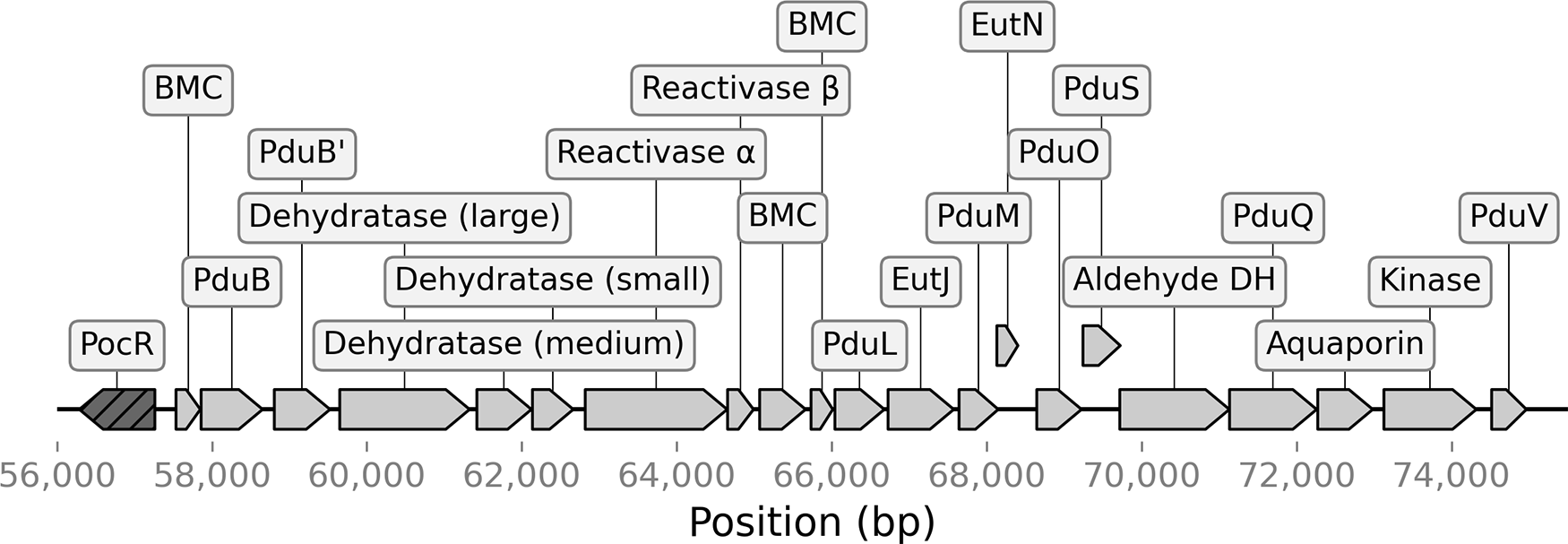
Genomic analysis revealed a complete pdu (propanediol utilisation) gene cluster on NODE_1 (56–75 kb) (Figure 2, Supplemental data Table 2). The cluster encodes the bacterial microcompartment (BMC) shell proteins and the B12-dependent glycerol dehydratase complex with large, medium and small subunits (PduC, PduD and PduE) together with its reactivase with α- and β-subunits (PduG and PduH), alongside PduL (phosphate propanoyltransferase) and PduQ (1-propanol dehydrogenase). The cluster also harbours an aquaporin-like gene adjacent to pdu genes, suggesting facilitated glycerol uptake coordinated with the pdu-encoded metabolism. Imported glycerol is converted to reuterin (3-HPA) by the B12-dependent glycerol dehydratase complex (PduCDE) together with its dedicated reactivase (PduGH), likely within the pdu-encoded BMC (Vollenweider and Lacroix, Reference Vollenweider and Lacroix2004; Martín et al., Reference Martín, Olivares, Marín, Xaus, Fernández and Rodríguez2005).
Organisation of the propanediol utilisation (pdu) gene cluster in L. coryniformis WBB05.

Figure 2 Long description
The organization of the propanediol utilization gene cluster spans positions 56,000 to 74,000 base pairs. It includes labeled genes such as PocR, PduB, Dehydratase (large, medium, small), Reactivase alpha and beta, BMC, EutJ, PduL, PduM, EutN, PduS, PduO, PduQ, Aldehyde DH, Aquaporin, Kinase and PduV. Each gene is represented by an arrow indicating its position and direction on the genome. The position scale is marked at intervals of 2,000 base pairs, starting from 56,000 to 74,000 base pairs.
L. coryniformis WBB05 harboured two putative copies of GlpO: Type 1 on NODE_102 (610 aa) and Type 2 on NODE_49 (554 aa). In addition, the genome encodes a glycerol-3-phosphate dehydrogenase on NODE_3 (337 aa). Interestingly, BLASTp analyses detected no GlpO homologues in publicly available L. reuteri genomes. Initial searches using WBB05 type 1 and type 2 GlpO sequences as queries against all publicly available L. reuteri genomes revealed no homologues for either enzyme. To exclude the possibility that highly divergent GlpO homologues might exist in L. reuteri, additional searches were performed using phylogenetically diverse reference sequences (GlpO and the related GlpD): E. coli K-12 glycerol-3-phosphate dehydrogenase, S. pneumoniae GlpO, Lc. lactis GlpO and E. casseliflavus GlpO. None of these queries produced alignments to L. reuteri proteins (E < 0.01), indicating that even distantly related GlpO family members were not detected. Furthermore, a direct examination of the L. reuteri DSM 20016T genome annotation (GCF_000009645.1; 2,076 protein-coding genes) using NCBI Protein Database searches yielded no genes annotated as GlpO.
To further characterise GlpO distribution patterns, BLASTp searches were conducted against all Lactobacillales genomes using WBB05 Type 1 and Type 2 GlpO sequences as queries. Among hits showing ≥70% amino acid sequence identity, Type 1 GlpO was detected in L. coryniformis (10 hits, 97.54–100% identity), Loigolactobacillus jiayinensis (1 hit, 84.59%), Loigolactobacillus iwatensis (1 hit, 73.56%), Loigolactobacillus backii (1 hit, 73.40%), Lactiplantibacillus pentosus (13 hits, 70.35–70.84%), Lactiplantibacillus plantarum (8 hits, 69.85–70.02%) and Lactiplantibacillus paraplantarum (4 hits, 70.51–70.68%). In contrast, Type 2 GlpO was detected only in L. coryniformis (2 hits, 99.82–100% identity) and L. jiayinensis (1 hit, 79.49%). The distribution patterns of Type 1 and Type 2 GlpO are as follows: Type 1 is present across multiple genera (Loigolactobacillus and Lactiplantibacillus), whilst Type 2 is restricted to the genus Loigolactobacillus.
Discussion
The present study provides a WGS-based safety assessment of L. coryniformis WBB05 and identifies GlpO as a candidate genetic determinant of aerobic reuterin production. Genomic screening revealed no known virulence factors, no AMR genes, no intact prophages and no biogenic amine biosynthetic genes, and phenotypic analysis confirmed the absence of β-haemolytic activity, supporting the potential of L. coryniformis WBB05 for food applications. The MIC for kanamycin (128 mg/L) exceeded the EFSA cut-off value of 64 mg/L; however, no AMR genes were detected in the genome, and the high MIC might be consistent with intrinsic low susceptibility of this species rather than horizontally acquired resistance. Susceptibility was assessed by comparison with the species-specific microbiological cut-off values recommended by the EFSA (2012), and the inclusion of reference control strains would have further strengthened the analysis.
L. coryniformis WBB05 harboured four complete CRISPR–Cas systems: two Type I-C systems and two Type II-A systems, the latter carrying the Cas9 endonuclease that confers phage resistance in dairy LAB (Barrangou et al., Reference Barrangou, Fremaux, Deveau, Richards, Boyaval, Moineau, Romero and Horvath2007; Makarova et al., Reference Makarova, Wolf, Iranzo, Shmakov, Alkhnbashi, Brouns, Charpentier, Cheng, Haft, Horvath, Moineau, Mojica, Scott, Shah, Siksnys, Terns, Venclovas, White, Yakunin, Yan, Zhang, Garrett, Backofen, Van der Oost, Barrangou and Koonin2020). The presence of two distinct CRISPR–Cas types suggests multilayered phage defence capacity. However, since phage resistance assays were not performed in the present study, the actual level of phage resistance conferred by these systems remains to be validated.
Biogenic amines such as histamine and tyramine can accumulate in fermented foods through microbial decarboxylation of amino acids, posing health risks including allergic reactions and hypertensive crises (Linares et al., Reference Linares, Martín, Ladero, Alvarez and Fernández2011), making genomic screening for the responsible biosynthetic genes an essential component of safety assessment for food-grade LAB. No genes encoding biogenic amine-producing enzymes were detected in the WBB05 genome, eliminating concerns regarding the accumulation of biogenic amines during fermentation.
AntiSMASH analysis identified a coagulin-like bacteriocin gene cluster, originally characterised in Bacillus coagulans (Hyronimus et al., Reference Hyronimus, Le Marrec and Urdaci1998). As B. coagulans is covered by the EFSA’s QPS framework with no safety concerns reported (EFSA, 2022), this gene cluster is unlikely to pose a risk; rather, the associated antimicrobial activity may enhance biopreservation potential.
In this study, L. coryniformis WBB05 exhibited no β-haemolytic activity. β-Haemolytic activity is a recognised virulence factor involved in the pathogenic invasion of the host, and the FAO/WHO Guidelines for the Evaluation of Probiotics in Food list the determination of haemolytic activity as a safety requirement for strains intended for food use (FAO/WHO, 2006). The absence of β-haemolytic activity in L. coryniformis WBB05 supports its suitability for food applications.
In addition to the safety assessment, a key objective of this study was to identify candidate genetic determinants for the aerobic reuterin production observed in L. coryniformis WBB05. Comparative genomic analysis revealed that L. coryniformis WBB05 harbours two putative copies of GlpO: a Type 1 GlpO (610 aa) and a Type 2 GlpO (554 aa). In contrast, no GlpO homologues were detected in publicly available L. reuteri genomes when WBB05 GlpO sequences were used as queries. Because GlpO is widely distributed among bacteria, it remained possible that L. reuteri harbours divergent GlpO family members. To exclude this possibility, additional searches were performed using reference GlpO and GlpD sequences from E. coli, S. pneumoniae, Lc. lactis and E. casseliflavus, none of which were detected in L. reuteri genomes. This finding suggests that the capacity for aerobic glycerol catabolism via GlpO is a distinctive feature of L. coryniformis WBB05 that has not been detected in the publicly available genomes of the well-characterised anaerobic reuterin producer L. reuteri.
GlpO catalyses the oxidation of glycerol-3-phosphate to dihydroxyacetone phosphate (DHAP) coupled with molecular oxygen reduction to hydrogen peroxide:
 \begin{align*}
&\mathrm{Glycerol\text{-}3\text{-}phosphate + O_2}\\
&\qquad\mathrm{\rightarrow Dihydroxyacetone\ phosphate + H_2O_2}
\end{align*}
This reaction provides an aerobic alternative to glycerol-3-phosphate dehydrogenase-mediated DHAP formation under anaerobic conditions (Li et al., Reference Li, Qiao, Cai, Nakanishi and Gao2015). DHAP subsequently enters glycolysis via triose phosphate isomerase, generating pyruvate and adenosine triphosphate (ATP) for downstream metabolism. Beyond yielding DHAP, this reaction consumes molecular oxygen and produces hydrogen peroxide. Under a redox-based hypothesis, oxygen consumption by GlpO may lower the local oxygen tension and shift the intracellular redox balance toward more reducing conditions, provided that the hydrogen peroxide generated is efficiently removed by cellular catalase/peroxidase systems.
Two separate branches of glycerol metabolism should be distinguished here: reuterin is produced directly from free glycerol by the B₁₂-dependent glycerol/diol dehydratase encoded by the pdu cluster (PduCDE), whereas GlpO acts on glycerol-3-phosphate to yield DHAP. GlpO is therefore not directly involved in reuterin biosynthesis; rather, by lowering the local oxygen tension it may favour the oxygen-sensitive dehydratase. On this basis, GlpO is regarded as a redox-linked candidate correlate of aerobic reuterin production rather than a direct cause.
L. coryniformis WBB05 possesses both GlpO and glycerol-3-phosphate dehydrogenase and produces reuterin not only under anaerobic but also under aerobic conditions (Tsuda, Reference Tsuda2023). In contrast, L. reuteri lacks GlpO and relies on glycerol-3-phosphate dehydrogenase for DHAP formation from glycerol-3-phosphate. Unlike GlpO, this dehydrogenase does not use molecular oxygen as an electron acceptor and does not consume oxygen. Accordingly, it would not be expected to contribute to the redox-modulating activity attributed to GlpO. Consistent with this, reuterin production in L. reuteri occurs only under anaerobic conditions (Chung et al., Reference Chung, Axelsson, Lindgren and Dobrogosz1989; Lüthi-peng et al., Reference Lüthi-peng, Schärer and Puhan2002). Although the molecular basis of this difference awaits experimental validation, the presence of GlpO in L. coryniformis WBB05 may represent the most apparent genomic distinction between the two species.
Several limitations of this study should be acknowledged. This study is based on draft genome sequence data with moderate contig fragmentation (N50 = 38.5 kb), which may have obscured some genomic features such as large-scale structural rearrangements or precise operon organisation; complete genome sequencing using long-read sequencing technologies would improve resolution. More importantly, functional validation of the proposed GlpO-dependent model through targeted ΔglpO knockout has not yet been achieved and represents an essential next step. Additionally, transcriptomic analysis comparing aerobic and anaerobic conditions would clarify why L. reuteri cannot produce reuterin aerobically, and would help elucidate the regulatory role of GlpO in L. coryniformis WBB05. A further limitation is that the comparison with L. reuteri was restricted to the genomes currently available in public databases. Accordingly, the absence of GlpO homologues applies to these publicly available genomes and cannot be extended to every strain of the species. In addition, because detection depended on the query sequences used in this study, the possibility that a more divergent GlpO homologue escaped detection cannot be excluded.
In conclusion, this study demonstrates that L. coryniformis WBB05 possesses a favourable safety profile for dairy food applications and identifies GlpO as a candidate genetic determinant for aerobic reuterin production. These findings provide a foundation for the future development of L. coryniformis WBB05 as a biopreservative culture for fermented dairy products.
Supplementary material
The supplementary material for this article can be found at https://doi.org/10.1017/S0022029926102659.
Acknowledgements
I gratefully acknowledge financial support from the Japanese Dairy Science Association Foundation. I also wish to thank Tenchi Kikuchi for supporting the MIC assays.
Author contributions
The author conceived and designed the study, performed the experiments, analysed the data, and wrote the manuscript.
Declaration of interest
The author declares none.
Ethics and approvals
Ethics approval was not required because this study did not involve human participants or animal experiments.