Introduction
Enricofrancoite is a new mineral found in rare litidionite-bearing samples of the Somma–Vesuvius volcano, southern Italy (40°49’17"N, 14°25'35"E). The specimen of enricofrancoite in this study was collected, together with other samples of the same type, in the Royal Mineralogical Museum of Naples (henceforth RMMN, nowadays part of ‘Centro Musei delle Scienze Naturali e Fisiche’) of the University Federico II (Italy) in 1873. In June of that year, a mineral collector found small lapilli covered by deep-blue crusts with a peculiar glassy to enamelled-like appearance, related to the 1872 AD eruption, at the Vesuvius crater and brought them to Arcangelo Scacchi, director of the Museum at that time.
Enricofrancoite is named in honour of Enrico Franco (1927–2009), professor of Mineralogy at the University of Naples Federico II, Italy. Prof. Franco was the author of many papers regarding mineralogy and made a significant contribution to the field of mineralogy of Somma–Vesuvius volcano, where he also discovered panunzite (the natural counterpart of tetrakalsilite) and chabazite-K (de Gennaro and Franco, Reference de Gennaro and Franco1974; Merlino et al., Reference Merlino, Franco, Mattia, Pasero and De Gennaro1985; Franco and de Gennaro, Reference Franco and de Gennaro1988).
The new mineral and its name (symbol Enf) were approved by the Commission of New Minerals, Nomenclature and Classification of the International Mineralogical Association (IMA2023–002, Balassone et al., Reference Balassone, Panikorovskii, Pellino, Bazai, Bocharov, Goychuk, Avdontseva, Yakovenchuk, Krivovichev, Petti, Cappelletti, Mondillo, Moliterni and Altomare2023). The holotype specimen is deposited in the systematic collection of the Vesuvian Collection of the RMMN, with the catalogue number 17926 E6457.
Occurrence
The specimen with the new mineral (Fig. 1) belongs to a set of samples from Vesuvius volcano (40°49’17"N, 14°25'35"E), which contains the rare litidionite-bearing assemblage (Pozas et al., Reference Pozas, Rossi and Tazzoli1975; Balassone et al., Reference Balassone, Petti, Mondillo, Panikorovskii, de Gennaro, Cappelletti, Altomare, Corriero, Cangiano and D'Orazio2019, Reference Balassone, Panikorovskii, Pellino, Bazai, Bocharov, Krivovichev, Petti, Cappelletti and Mondillo2022). The new mineral occurs in a complex paragenesis composed of litidionite, tridymite, wollastonite and Al- and Fe-bearing diopside, kamenevite, perovskite, rutile, Ti-rich magnetite, and an amorphous phase, in deep blue to white crusts covering metamorphosed lapilli related to the 1872 eruption. Various trace non-silicates are also recorded, and further minor to trace phases will very likely be identified in this mineral assemblage from Vesuvius in our ongoing research on new sample sets.
The enricofrancoite-bearing sample (holotype #17926 E6457) from the Royal Mineralogical Museum of Naples University Federico II (modified after Balassone et al., Reference Balassone, Panikorovskii, Pellino, Bazai, Bocharov, Krivovichev, Petti, Cappelletti and Mondillo2022). The length of the Museum label is 7 cm.

Titanium- and Pb-bearing litidionite are also reported (Balassone et al., Reference Balassone, Panikorovskii, Pellino, Bazai, Bocharov, Krivovichev, Petti, Cappelletti and Mondillo2022); moreover, in the white crust, the Ca–Na–K-bearing silicate was initially identified as calcinaksite by the above authors. This mineral association is typical of high-temperature alteration processes at the rock–fumaroles interface (Pozas et al., Reference Pozas, Rossi and Tazzoli1975; Balassone et al., Reference Balassone, Petti, Mondillo, Panikorovskii, de Gennaro, Cappelletti, Altomare, Corriero, Cangiano and D'Orazio2019, Reference Balassone, Panikorovskii, Pellino, Bazai, Bocharov, Krivovichev, Petti, Cappelletti and Mondillo2022) as a product of very localised high-temperature (exhalation-related) alteration processes of hosting silicates and the introduction of other chemical components by fluids (e.g. Cu2+). This peculiar assemblage, like that observed for the Eifel region calcinaksite-bearing rocks (Aksenov et al., Reference Aksenov, Rastsvetaeva, Chukanov and Kolitsch2014; Chukanov et al., Reference Chukanov, Aksenov, Rastsvetaeva, Blass, Varlamov, Pekov, Belakovskiy and Gurzhiy2015), probably occurs at a temperature of >600°C. Further chemical investigations predominantly on the white assemblage revealed a significant mineral component corresponding to an anhydrous analogue of calcinaksite, which was then named enricofrancoite. In the observed mineral assemblage, there are four different types of litidionite-group minerals which crystallise in the following order: euhedral and platy crystals of litidionite or Ca-bearing litidionite up to enricofrancoite → altered zones around diopside crystals consisting of litidionite or fine-grained litidionite → coarse-grained enricofrancoite crystals in the litidionite matrix → marginal zones of lapilli represented by Ti-bearing non-stoichiometric litidionite (Balassone et al., Reference Balassone, Panikorovskii, Pellino, Bazai, Bocharov, Krivovichev, Petti, Cappelletti and Mondillo2022). Based on our new evidence, most of the calcinaksite indicated previously should be in fact enricofrancoite.
Physical and optical properties
The morphology of the minerals was studied using a Jeol JSM5310 scanning electron microscope with an Oxford EDS equipped with an INCA X-stream pulse processor and the 4.08 version Inca software (Department of Earth Science, Environment and Resources, DiSTAR, University of Naples Federico II Italy). Enricofrancoite forms platy crystals in fine-grained aggregations (Fig. 2), rarely to 1 mm in length. It forms colourless, translucent, non-fluorescent individual crystals, with a white streak and vitreous lustre. The mineral is brittle, with a stepped fracture, a good {001} cleavage. The calculated density is 2.63 g/cm3, from single-crystal X-ray diffraction (SCXRD) data, as the measured density by flotation in Clerici solution, i.e. 2.63(3) g/cm3. The compatibility index is –0.049, good based on empirical formula and measured density (Mandarino, Reference Mandarino2007). Mohs hardness is assumed to be 5.5. The new mineral is transparent and optically biaxial (−), the refractive indices were measured in white light: α = 1.542(5), β = 1.567(5) and γ = 1.575(5). The 2V(meas) = 60(2)° and 2Vcalc = 58°. The 2V was measured using the formula sinV = KD/ β, where D is the distance in conoscopy between the vertices of the hyperbola branches at their maximum divergence (measured with an eyepiece equipped with a micrometre ruler); β is the refractive index; K is a coefficient depending on the optical system of the microscope, which was calculated using a standard with a known value of 2V (phlogopite – 16°). The dispersion is weak (r < v), and it is non-pleochroic. The optical orientation is X ≈ b, Y^c = 49° and Z^a ≈ 90°.
Scanning electron micrograph of (a) enricofrancoite (Enf) in aggregations of platy crystals (holotype #17926 E6457) and (b) back-scattered electron mode image of enricofrancoite with kamenevite (Kne) in polished thin section.

Chemical composition
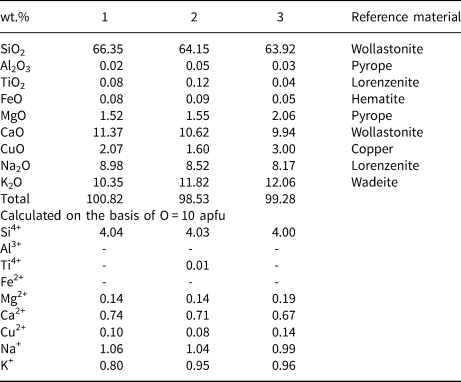
The chemical composition was determined with a Cameca MS–46 electron microprobe operating in a wavelength-dispersive mode (WDS) at 20 kV and 20–30 nA and a spot size of 10 μm at the Geological Institute of the Kola Science Center, Apatity. The following standards were used: lorenzenite (Na, Ti); pyrope (Mg, Al); diopside (Si, Ca); wadeite (K); hematite (Fe); metallic niobium (Nb); metallic copper (Cu); wulfenite (Pb); and atacamite (Cl). The mean analytical results of three selected crystals (five spots for each crystal, with a total of 15 analyses) are given in Table 1. Cation contents were calculated with the MINAL program of D. Dolivo-Dobrovolsky (Dolivo-Dobrovolsky, Reference Dolivo-Dobrovolsky2016). H2O was not analysed because of the absence of bands corresponding to the О–Н vibrations in the Raman and Fourier-transform infrared spectroscopy (FTIR) spectra.
Chemical data (in wt. %) for enricofrancoite.

The empirical formula calculated on the basis of O = 10 atoms per formula unit (apfu) is K0.90Na1.03(Ca0.71Mg0.16Cu0.10)Σ0.97Si4.02O10. The analyses of enricofrancoite crystals reveal a substitution between Ca2+, Mg2+ and Cu2+ nearly equal to 0.1 apfu. It seems that the Cu–Ca substitution forms a continuous series between litidionite and enricofrancoite. The amount of Mg is also variable and it is possible that the Mg-analogue of enricofrancoite is also present in the same mineral association. According to our previous data, the Ti4+ (analysis No 2 in Table 1) is also incorporated into the M site together with the Mg, Cu and Fe. This substitution may also include K/vacancy variations in the composition (Balassone et al., Reference Balassone, Panikorovskii, Pellino, Bazai, Bocharov, Krivovichev, Petti, Cappelletti and Mondillo2022). The simplified formula is KNa(Ca,Mg,Cu)Si4O10.The ideal formula is KNaCaSi4O10, which requires K2O 12.58%, CaO 14.97%, Na2O 8.28%, SiO2 64.18%.
Crystal structure solution and refinement
The grain selected for optical study was also used for single-crystal X-ray diffraction. The crystal studied was mounted on an Oxford Diffraction Xcalibur Eos diffractometer equipped with a CCD area detector using MoKα radiation (0.71073 Å) at the X-ray Diffraction Resource Centre of St. Petersburg State University. More than a half sphere of the diffraction sphere was collected (scanning step 1°, exposure time 75 s). The data were integrated and corrected by means of the CrysAlisPro program package, which was also used to apply an empirical absorption correction using spherical harmonics, as implemented in the SCALE3 ABSPACK scaling algorithm (Agilent Technologies, 2014). The crystal structure was drawn using the VESTA 3 program (Momma and Izumi, Reference Momma and Izumi2011). The distortion indexes for polyhedra were calculated according to the formula proposed by Baur, (Reference Baur1974).
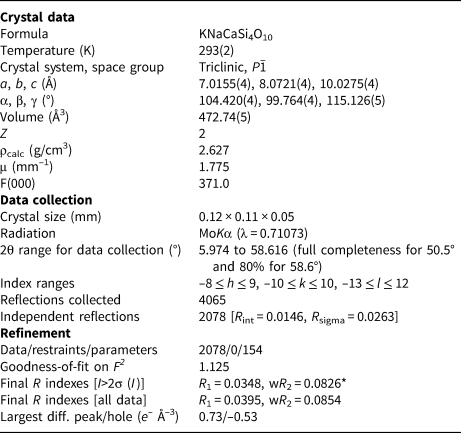
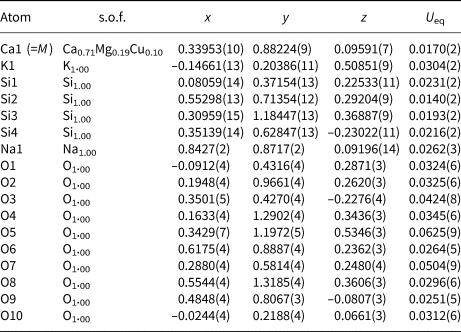
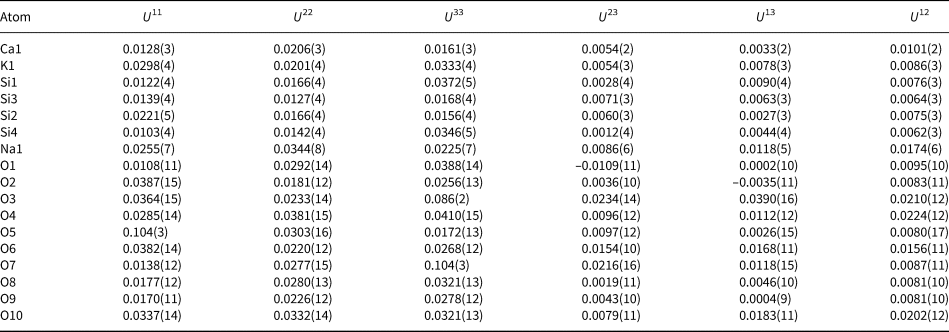
As the calcinaksite and enricofrancoite are chemically very close, the structure of enricofrancoite was refined using the initial calcinaksite model (Chukanov et al., Reference Chukanov, Aksenov, Rastsvetaeva, Blass, Varlamov, Pekov, Belakovskiy and Gurzhiy2015) without O11 (Ow) site to R 1 = 0.035 for 2078 independent reflections with F o > 4σ(F o) using Olex2 (Dolomanov et al., Reference Dolomanov, Bourhis, Gildea, Howard and Puschmann2009) with SHELXL (Sheldrick, Reference Sheldrick2015). Initially the M site refined with full occupancy by Ca atoms only, but the Bond-valence analysis demonstrated an overestimated sum (2.45 valence units), which was probably connected to admixtures of Mg and Cu with smaller ionic radii than Ca. According to the EMPA data the composition of the M site should be (Ca0.71Mg0.16Cu0.10)0.97. At the final stage of refinement, the M1 site occupancy were fixed with (Ca0.71Mg0.19Cu0.10)1.00. The R 1 factor slightly improved from 0.0353 in a model with Ca1.00 occupancy to 0.0348 for the last data with mixed occupancy. The SCXRD data are deposited in the CCDC under the entry No. 2292985 [Cambridge Crystallographic Data Centre, https://www.ccdc.cam.ac.uk/] and crystallographic information files are available as Supplementary material here (see below). Crystal data, data collection information and structure refinement details are given in Table 2. Atom coordinates, anisotropic atomic displacement parameters, and selected interatomic distances are presented in Tables 3, 4 and 5, respectively.
Crystal data, data collection information and structure refinement details for enricofrancoite.

*Weighting scheme: a = 0.0299 and b = 1.0128
Fractional atom coordinates, site occupancy factors (s.o.f.) and equivalent isotropic atomic displacement parameters U eq (Å2) for enricofrancoite.

Anisotropic atomic displacement parameters (Å2) for enricofrancoite.

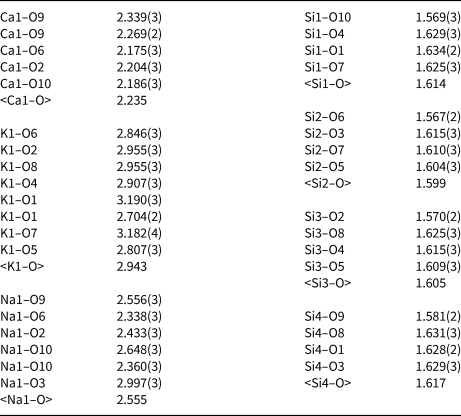
Selected interatomic distances (Å) for the crystal structure of enricofrancoite.

Note: Ca1 = M site
Powder X-ray diffraction
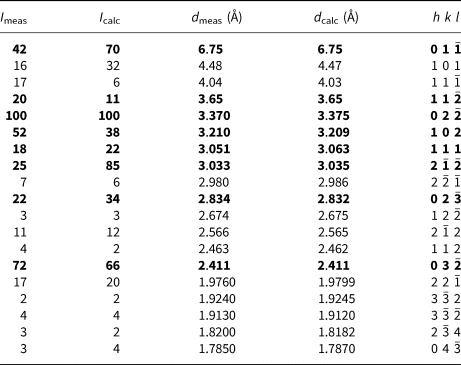
Powder X-ray diffraction (PXRD) data were collected using a Seifert-GE diffractometer ID 3003; the intensity profiles were collected in the 2θ range of 3–80°, using Ni-filtered CuKα radiation at 40 kV and 30 mA, with a step size 0.02°, at a scanning time of 10 s/step. The diffraction patterns were processed using the RayfleX software package. Measurements on the mineral assemblages were also carried out by an automated Rigaku RINT2500 rotating anode laboratory diffractometer (50 kV and 200 mA) equipped with the silicon strip Rigaku D/teX Ultra detector, and an asymmetric Johansson Ge (111) crystal (to select the monochromatic CuKα1 radiation with λ = 1.54056 Å) and using a glass capillary (0.5 mm diameter). The intensity values I calc for enricofrancoite were calculated using the VESTA 3 program from single-crystal X-ray data. They are given in Table 6 with the corresponding intensities I meas measured from the PXRD data using the software Analyze RayfleX (ver. 2.3.3.7, GE Inspection Technologies, USA–Germany), in addition to the calculated (d calc) and measured (dmeas) interplanar distance values and Miller indices (hkl). The unit-cell parameters were calculated using UNITCELL software (Holland and Redfern, Reference Holland and Redfern1997). The unit-cell parameters refined from the PXRD data are as follows: a = 7.071(2) Å, b = 8.089(2) Å, c = 9.933(2) Å, α = 104.35(2)°, β = 99.51(2)°, γ = 115.28(1)°, V = 473.3(1) Å3, space group P $\bar{1}$ (#2) and Z = 2, which are in good agreement with the single-crystal X-ray diffraction data (Table 2).
PXRD data for enricofrancoite.*

* The intensities, measured I meas (from PXRD data) and calculated I calc (from single-crystal X-ray data), are given with the corresponding interplanar distance values (d meas and d calc) and Miller indices (hkl). The eight strongest lines are highlighted in bold.
Structure description
The crystal structure of enricofrancoite is chemically close to that of litidionite and consists of complex heteropolyhedral framework (Fig. 3a). The main feature of litidionite-related crystal structures is one-dimensional infinite anionic tubes [Si8O20]8−∞ running along [100] (Fig. 3b). Enricofrancoite should be classified as loop-branched dreier double chain {lB, 21∞} [3Si8O20] in accordance with the Liebau classification (Liebau, Reference Liebau1985) or 3T 8 silicate tube-containing mineral according to the structure hierarchy for silicate minerals (Day and Hawthorne, Reference Day and Hawthorne2020). Tubes with the same topology are also observed in the agrellite structure, although they have differences. There is also a 3T 8 ribbon in the titanosilicate narsarsukite, which has a different structure and crystal system. Each tube consists of four symmetrically independent Si tetrahedra with Si−O bond distances in the range 1.567–1.634 Å. The mean bond lengths for the <Si1−O>, <Si2−O>, <Si3−O> and <Si4−O> tetrahedra are 1.614, 1.599, 1.605 and 1.617 Å, respectively, in agreement with the full occupancy of all tetrahedral sites by Si atoms.
Crystal structure of enricofrancoite: (a) general view; (b) silicate tubes; (c) silicate layers; and (d) local coordination of Ca1 site (= M) site.

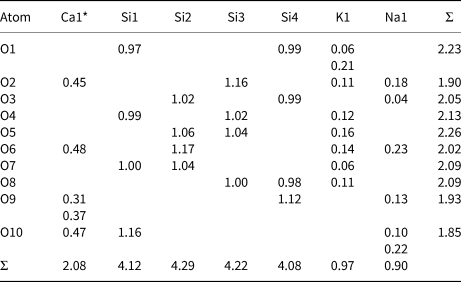
Silicate tubes are connected to each other through the [Ca2O8]12− dimers, which form layers along the ab plane (Fig. 3c) and build a three-dimensional framework (Fig. 3d) (Golovachev et al., Reference Golovachev, Drozdov, Kuz'min and Belov1970; Kornev et al., Reference Kornev, Maksimov, Lider, Ilyukhin and Belov1972; Pozas et al., Reference Pozas, Rossi and Tazzoli1975). The square-pyramidal sites form [Ca2O8] dimers (Fig. 3d) with the Ca–Ca distance of 3.469 Å. In contrast to calcinaksite where Ca atoms are 6-coordinated, in the investigated sample the Ca atoms are 5-coordinated. The 5-coordinated Ca is exceptionally rare in inorganic compounds (Katz et al., Reference Katz, Glusker, Beebe and Bock1996). The Ca atom occupies the centre of a distorted square pyramid with five bonds in the range 2.175–2.339 Å (Fig. 3d). In contrast to litidionite or Ti-bearing litidionite with a Cu2+ cation at the M site, in enricofrancoite there is no strong Jahn–Teller distortion observed. There are two relatively short bonds for Ca–O of 2.187 and 2.175 Å and three bonds with more appropriate distances of 2.204, 2.269 and 2.339 Å. The mean bond distance is 2.235 Å. The refined occupancy of the M site (Ca0.71Mg0.19Cu0.10)1.00 agrees well with its bond valence sum (BVS) of 2.08 vu (Table 7).
Bond-valence analysis (in valence units, v.u.) in the crystal structure of enricofrancoite calculated using bond valence parameters from Brese and O'Keeffe (Reference Brese and O'Keefe1991).

*The BVS for the M site calculated based on the occupancy [Ca0.71Mg0.19Cu0.10]1.00.
The heteropolyhedral framework of enricofrancoite is characterised by a two-dimensional system of crossing channels running along the [110] and near parallel to [010] directions of the triclinic cell. For non-isometric channels with an elliptical cross-section, according to International Union of Pure and Applied Chemistry (IUPAC) nomenclature, the lengths of the major and minor axes subtracting the ionic radii of O2‒ of 2.7 Å are used (McCusker et al., Reference McCusker, Liebau and Engelhardt2003). Channel I (Fig. 4a), running along [010], is characterised by an octagonal cross-section and an effective diameter equal to 4.31 Å × 1.26 Å.
Projections of the channels in the crystal structure of enricofrancoite: (a) along the [010] direction; (b) and (c) two channels along the [110] direction.

Channel II (Fig. 4b) parallel to the [110] direction also has an octagonal cross-section with an effective diameter of 2.88 Å × 1.87 Å. Channels I and II overlap and form a two-dimensional system of cavities populated by K+ cations. The K atom is 8-coordinated with the mean <K−O> distance of 2.943 Å.
Сhannel III is composed of four SiO4 tetrahedra and two CaO5 pyramids. Channel III runs along the [110] direction and has a hexagonal cross-section and an effective diameter of 1.61 Å × 1.16 Å. This type of channel is filled by Na+ cations. The Na1 site in the enricofrancoite structure is 6-coordinated with a mean <Na–O> distance of 2.555 Å. Note the weak character of the Na–O3 bond with a distance of 2.997 Å, which gives only (0.04 vu) according to the BVS data. Also according to the BVS data (Table 7), all O sites are fully populated by O2‒.
The formula refined from SCXRD data can be written as KNa(Ca0.71Mg0.19Cu0.10)1.00(Si4O10).
Raman and FTIR
The Raman spectra of enricofrancoite were recorded with a Horiba Jobin-Yvon LabRAM HR800 spectrometer equipped with an Olympus BX-41 microscope in back-scattering geometry via a CCD detector. For the measurements uncoated polished sections from the same grain used for EPMA were used. Raman spectra were recorded by a 514 nm Ar laser with power of 2 mW under the 50× objective with a numerical aperture equal to 0.75. The spectra were obtained in the range of 40–4000 cm–1 at a resolution of 2 cm–1 at room temperature with a 150 μm aperture diameter and 240 s acquisition time. To improve the signal-to-noise ratio, the number of acquisitions was set to 6. For the control of damage to the sample, photos of the sample surface before and after analysis were made. The spectra were processed using Labspec (Horiba Jobin Yvon) and Origin (OriginLab Corporation) software. The attribution of observed bands was made according to other minerals of the litidionite group (Balassone et al., Reference Balassone, Panikorovskii, Pellino, Bazai, Bocharov, Krivovichev, Petti, Cappelletti and Mondillo2022).
Fourier-transform infrared spectroscopy, performed on a powered sample in Attenuated Total Reflectance mode (ATR–FTIR), was used in the spectral range 4000–400 cm–1 with resolution 2 cm–1 (Bruker Alpha; Opus 7.2 software–Bruker Optik GmbH, Leipzig, Germany).
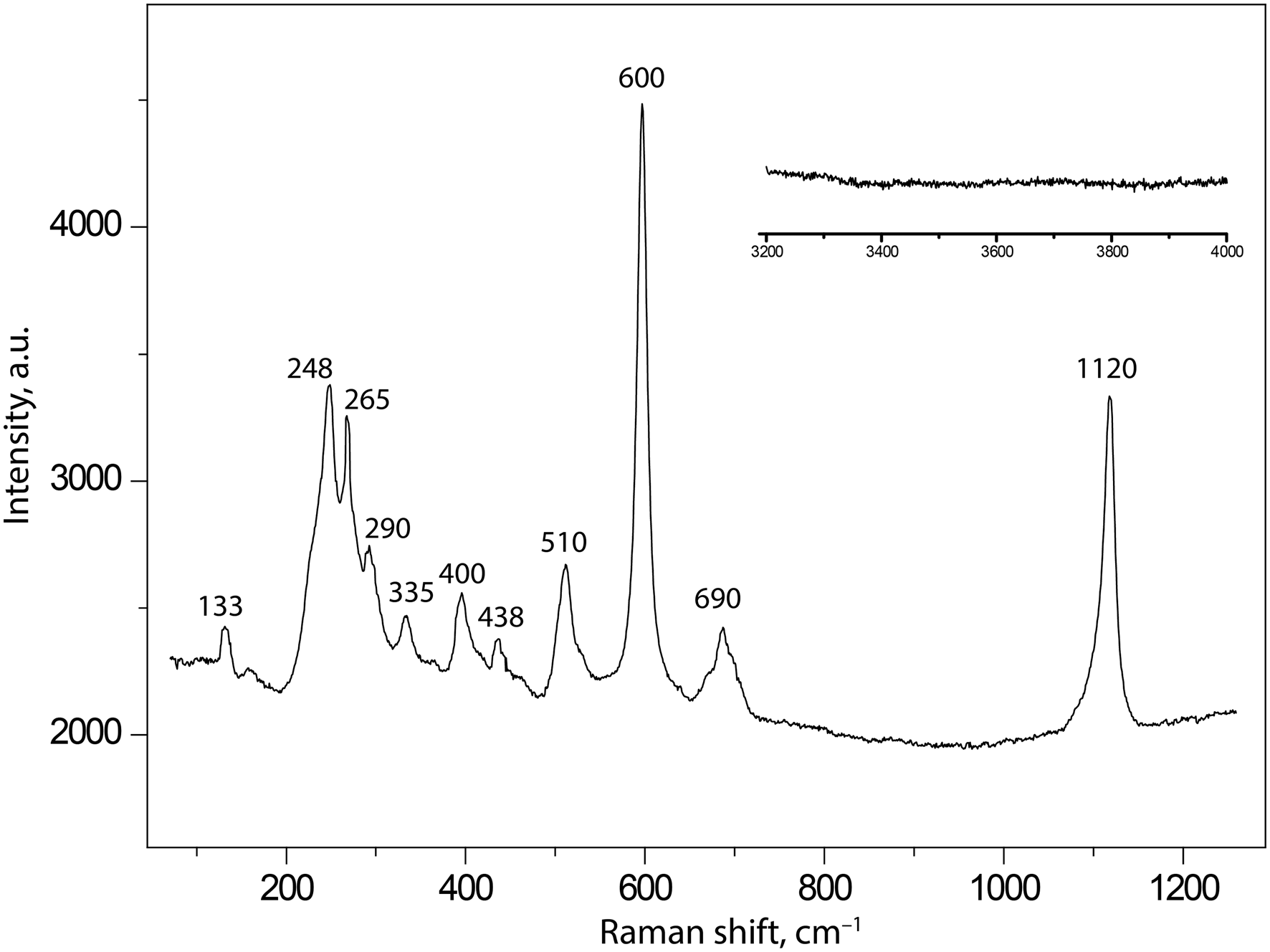
The Raman spectrum of enricofrancoite (Fig. 5) is similar to both Vesuvius litidionite sample R130088 of the RRUFF project (Lafuente et al., Reference Lafuente, Downs, Yang, Stone, Armbruster and Danisi2015) and Ti-bearing litidionite (Balassone et al., Reference Balassone, Panikorovskii, Pellino, Bazai, Bocharov, Krivovichev, Petti, Cappelletti and Mondillo2022), but has some differences. The spectrum band (s = strong band, w = weak band, sh = shoulder) at 1120 (s), can be assigned to the symmetric stretching vibrations of the Si–O bands in the [Si8O20]8− groups (Yakovenchuk et al., Reference Yakovenchuk, Pakhomovsky, Panikorovskii, Zolotarev, Mikhailova, Bocharov, Krivovichev and Ivanyuk2019; Balassone et al., Reference Balassone, Panikorovskii, Pellino, Bazai, Bocharov, Krivovichev, Petti, Cappelletti and Mondillo2022). Bands at 690 and 600 (s) cm‒1 related to asymmetric bending vibrations of Si–O–Si and O–Si–O bonds. The bands centred at 510, 438 (w), 400 and 335 (w) cm‒1 are attributed to different modes of bending vibrations in SiO4 tetrahedra (Pakhomovsky et al., Reference Pakhomovsky, Panikorovskii, Yakovenchuk, Ivanyuk, Mikhailova, Krivovichev, Bocharov and Kalashnikov2018). Bands at 248, 265 and 290 cm‒1 can be assigned to symmetric vibrations of Ca‒O bonds (Galuskin et al., Reference Galuskin, Lazic, Armbruster, Galuskina, Pertsev, Gazeev, Wlodyka, Dulski, Dzierzanowski, Zadov and Dubrovinsky2012). The band at 133 (w) cm‒1 corresponds to the lattice mode vibrations. The absence of bands in the ranges of 1550 to 1650 and 3000–3700 cm−1, respectively corresponding to the bending H‒O‒H and stretching vibrations of bonds in water molecules and OH-groups, is in accordance with undetectable H2O content in the enricofrancoite composition.
Raman spectrum of enricofrancoite.

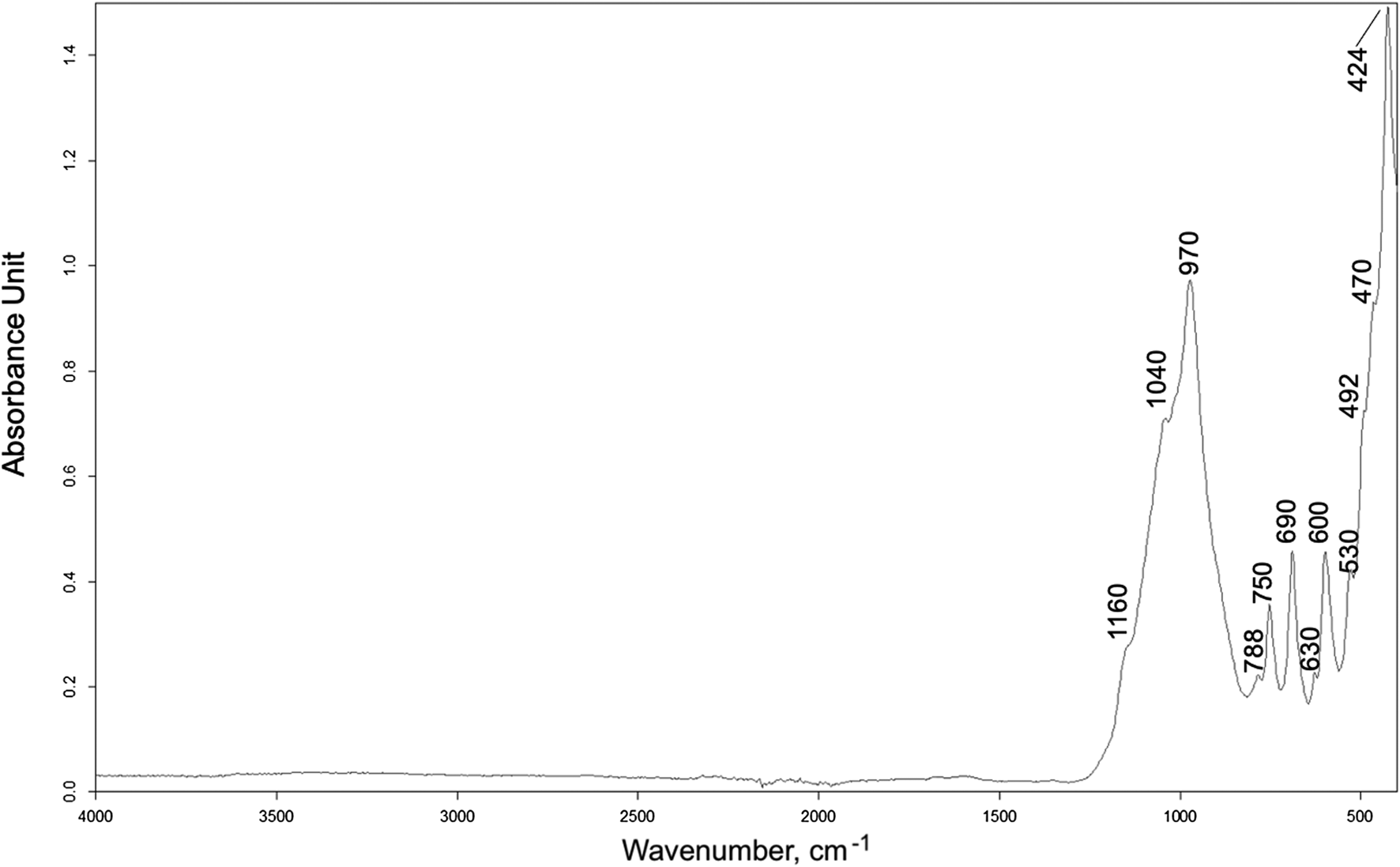
The IR spectrum of enricofrancoite is given in Fig. 6. In general, the spectrum is somewhat similar to those of the structurally related calcinaksite, fenaksite and manaksite (Chukanov et al., Reference Chukanov, Aksenov, Rastsvetaeva, Blass, Varlamov, Pekov, Belakovskiy and Gurzhiy2015). Wavenumbers of absorption bands can be assigned with Si–O–Si bending and stretching vibrations combined with vibrations of Ca–O bonds in CaO5 polyhedra 424 (s), 470 (sh) and 492 (sh) cm‒1. The bands at 530, 600, 630 (w), 690, 750 and 788 (w) cm‒1 can be attributed to the bending vibrations of Si–O bonds in the tubular silicate [Si8O20]8− anionic radical. The bands at 970 (s), 1040 (w), 1160 (sh) correspond to the Si–O stretching vibrations. Bending and stretching vibrations of H2O molecules have not been observed in contrast to the calcinaksite, which contains certain bands at 1654, 3170, 3340 and 3540 cm‒1 (Chukanov et al., Reference Chukanov, Aksenov, Rastsvetaeva, Blass, Varlamov, Pekov, Belakovskiy and Gurzhiy2015).
FTIR spectrum of enricofrancoite.

Discussion
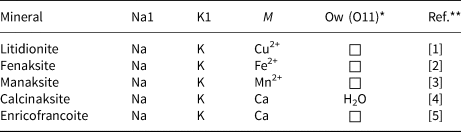
Silicates with tubular fragments, natural and synthetic, are quite rare. In addition to the litidionite family with hexagonal tubes, minerals with octagonal (frankamenite, canasite and miserite) and quadrangular (narsarsukite) tubes, heterogeneous (charoite) and heteropolyhedral tubular fragments (yuksporite) and such compounds often have pronounced magnetic, luminescent and ion-exchange properties (Rainho et al., Reference Rainho, Carlos and Rocha2000; Brandão et al., Reference Brandão, Rocha, Reis, dos Santos and Jin2009; Day and Hawthorne, Reference Day and Hawthorne2020). Enricofrancoite is the H2O-free analogue of calcinaksite with 5-coordinated Ca2+ at the M site (also indicated as Ca1). The dominant components in different litidionite-group minerals are listed in Table 8. The most variable site in the litidionite-type structure is the M position, its coordination number can vary from 4+1 (for Cu) and 5 (for Mn2+, Fe2+, Ti and Ca) to 5+1 (Ca) (Fig. 7a) (Rozhdestvenskaya et al., Reference Rozhdestvenskaya, Bannova, Nikishova and Soboleva2004; Karimova and Burns, Reference Karimova and Burns2008; Brandão et al., Reference Brandão, Rocha, Reis, dos Santos and Jin2009; Aksenov et al., Reference Aksenov, Rastsvetaeva, Chukanov and Kolitsch2014; Balassone et al., Reference Balassone, Panikorovskii, Pellino, Bazai, Bocharov, Krivovichev, Petti, Cappelletti and Mondillo2022). A similar diversity for a basically 5-coordinated site is observed for another silicate from Vesuvius, formed in a similar temperature range (500–800°C): vesuvianite (Balassone et al., Reference Balassone, Talla, Beran, Mormone, Altomare, Moliterni, Mondillo, Saviano and Petti2011). The five-coordinated site in vesuvianite Y1 can be occupied predominately by Fe2+, Fe3+, Mn2+, Mn3+ Cu, Mg and Al (Groat et al., Reference Groat, Hawthorne and Ercit1992; Ohkawa et al., Reference Ohkawa, Yoshiasa and Takeno1992; Armbruster et al., Reference Armbruster, Gnos, Dixon, Gutzmer, Hejny, Döbelin and Medenbach2002; Panikorovskii et al., Reference Panikorovskii, Chukanov, Aksenov, Mazur, Avdontseva, Shilovskikh and Krivovichev2017a, Reference Panikorovskii, Chukanov, Rusakov, Shilovskikh, Mazur, Balassone, Ivanyuk and Krivovichev2017b, Reference Panikorovskii, Shilovskikh, Avdontseva, Zolotarev, Karpenko, Mazur, Yakovenchuk, Bazai, Krivovichev and Pekov2017c; Reference Panikorovskii, Shilovskikh, Avdontseva, Zolotarev, Pekov, Britvin, Hålenius and Krivovichev2017d). The unit-cell volume of the litidionite-group minerals depends on the coordination number of the M site (Fig. 7b). The unit-cell volume increases together with the coordination number of the M site. Such variability is the key for the new litidionite-group mineral searches and for the synthesis of new compounds with the litidionite structure, Co and Ni analogues having already been synthetised (Durand et al., Reference Durand, Vilminot, Richard-Plouet, Derory, Lambour and Drillon1997).
Dominant components at the crystallographic sites for selected litidionite-group minerals.

*The Ow (O11) coordinates are at the Ca1 (=M) site and are only observed in the crystal structure of calcinaksite in which Ca is in octahedral coordination (5+1).
**References: [1] Pozas et al. (Reference Pozas, Rossi and Tazzoli1975); [2] Golovachev et al. (Reference Golovachev, Drozdov, Kuz'min and Belov1970); [3] Khomyakov et al. (Reference Khomyakov, Kurova and Nechelyustov1992); [4] Chukanov et al. (Reference Chukanov, Aksenov, Rastsvetaeva, Blass, Varlamov, Pekov, Belakovskiy and Gurzhiy2015); and [5] this work.
(a) Coordination polyhedra in the minerals of litidionite group based on the data of Rozhdestvenskaya et al. (Reference Rozhdestvenskaya, Bannova, Nikishova and Soboleva2004), Karimova and Burns (Reference Karimova and Burns2008), Brandão et al. (Reference Brandão, Rocha, Reis, dos Santos and Jin2009), Chukanov et al., Reference Chukanov, Aksenov, Rastsvetaeva, Blass, Varlamov, Pekov, Belakovskiy and Gurzhiy2015) and Balassone et al. (Reference Balassone, Panikorovskii, Pellino, Bazai, Bocharov, Krivovichev, Petti, Cappelletti and Mondillo2022); (b) graph of the dependence of unit cell volume on coordination number for litidionite-group minerals.

The litidionite-crystal-structure type is unique because it may contain Ca with a coordination of both number 5 and 6, which is extremely rare for inorganic compounds. It seems that the Ca coordination depends on the formation conditions.
During the voting on the new mineral proposal, one comment was related to the possible formation of enricofrancoite through the dehydration of calcinaksite, because the sample has been stored in a museum collection for a long time. In favour of this assertion is a small contraction of the volume between enricofrancoite 472.74 and calcinaksite 495.94 Å3.
The most unstable water-free minerals in fumarolic environments at normal temperatures are typically associated with halides. For example, sanguite, KCuCl3 in humid air alters to eriochalcite CuCl2 × 2H2O and sylvite KCl after several weeks (Pekov et al., Reference Pekov, Zubkova, Belakovskiy, Lykova, Yapaskurt, Vigasina, Sidorov and Pushcharovsky2015). Another example is saranchinaite, Na2Cu(SO4)2, which transforms into kröhnkite, Na2Cu(SO4)2 × 2H2O, after one week if exposed at ambient conditions (87% humidity and 25°C) (Siidra et al., Reference Siidra, Lukina, Nazarchuk, Depmeier, Bubnova, Agakhanov, Avdontseva, Filatov and Kovrugin2018). At the same time, the dehydration process is also possible; for example, kröhnkite is replaced by saranchinaite if heated to a temperature above 200°C (Hawthorne and Ferguson, Reference Hawthorne and Ferguson1975). Silicate minerals are more stable and do not usually change in chemical composition, for example analcime, cancrinite, chabazite-K, gonnardite, phillipsite-K, thomsonite-Ca, scolecite from Somma–Vesuvius Complex are not known to lose water during storage in a museum.
Theoretically, enricofrancoite can be transformed into calcinaksite by a reaction: KNaCaSi4O10 + H2O → KNaCaSi4O10 × H2O. Figures 8a,b show the local coordination of the M position within Na-containing channels along the [110] direction in calcinaksite and enricofrancoite, respectively. The presence of an additional H2O molecule in calcinaksite leads to an increase in channel size, for example, the O4–O4 distance increases from 4.31 in enricofrancoite to 5.15 Å in calcinaksite. The change of the coordination number for the M site significantly distorts the framework and affects the geometry of the Si8O20 tubes. The large diagonal (Fig. 8c,d) decreases from 5.69 to 5.16 Å and the small diagonal increases from 3.27 to 3.41 Å in enricofrancoite compared with calcinaksite. Thus, the hydration reaction entails global changes in the mineral structure, which requires significant energy and this is unlikely at room conditions. At the very least, such a reaction will be connected with crystallinity loss. Thus, we believe that a spontaneous transition from enricofrancoite to calcinaksite is unlikely, and such a rearrangement of the structure is likely to entail a loss of crystallinity.
(a) Local coordination of Na-contained channel along the [110] direction in the crystal structure of calcinaksite and (b) enricofrancoite; and (c) geometry of the [Si8O20]8‒ tubes in the crystal structure of calcinaksite and (d) enricofrancoite.

Conclusions
Enricofrancoite with litidionite associations of Somma–Vesuvius are typically found in deep blue glassy crusts and characterise very unusual thermally modified pyroclastic fragments related to the old fumarolic activity of the 1872 eruption (Scacchi, Reference Scacchi1880; Pozas et al., Reference Pozas, Rossi and Tazzoli1975). Whereas calcinaksite is a product of contact metamorphism formed during the relatively high-temperature hydrothermal stage (estimated temperature of crystallisation is 300°C), the enricofrancoite can be formed in the temperature range 600–800°C (hydrogen-free), as a result of direct deposition from the gas phase (as volcanic sublimates) or gas–rock interactions. The occurrence of coexisting litidionite-group minerals (earlier litidionite and later ‘Ti-litidionite’), which do not contain OH and H2O in their composition, corroborates this observation. The formation of enricofrancoite as a product of dehydration of calcinaksite is possible, but requires significant structural changes and probably leads to loss of crystallinity.
Acknowledgements
The authors are grateful to Principal Editor Stuart Mills and referees Prof. Peter Leverett and two anonymous reviewers for the constructive comments that significantly improved the quality of the paper. This research was funded by the Russian Science Foundation, project no. 21-77-10103 (TLP) and by the State Assignment of the Russian Academy of Sciences, theme #FMEZ-2022-0022 (OFG). Funding from University of Naples Federico II (Ric. Dip. 2018-2020) granted to G.B. are also acknowledged. Thanks are due to Prof. M. Mercurio (Università del Sannio, Benevento, Italy), for allowing the use of the FTIR instrumentation at the Department of Science and Technology.
Supplementary material
The supplementary material for this article can be found at https://doi.org/10.1180/mgm.2024.9.
Competing interests
The authors declare none.