

INTRODUCTION
The mobility of materials, ideas and technological knowledge has recently attracted the attention of historical and archaeological research. Contrary to the cultural–historical approach to archaeology, where ‘cultural’ entities are assumed to correspond to particular groups of people (Trigger Reference Trigger1989), recent studies of identity trace the movement of material and humans in order to offer interpretations of the scale and nature of such interactions (Zakrzewski Reference Zakrzewski, Agarwal and Glenross2011). Powerful tools, such as biodistance studies, combined with biomolecular and chemical analyses, can provide new insights into the behaviour of past populations (e.g. Gilbert et al. Reference Gilbert, Bandelt, Hofreite and Barnes2005; Brown and Brown Reference Brown and Brown2011; Pinhasi and Stock Reference Pinhasi and Stock2011; Shapiro and Hofreiter Reference Shapiro and Hofreiter2012). Skeletal morphology is, in part, genetically determined and it is well established that analyses of metric and non-metric traits can be used to explore the biological/genetic relationship between populations (e.g. Betti et al. Reference Betti, Balloux, Hanihara and Manica2010; Irish Reference Irish2006; Coppa et al. Reference Coppa, Cucina, Lucci, Mancinelli and Vargiu2007; Nikita, Mattingly and Lahr Reference Nikita, Mattingly and Lahr2012; Ricaut et al. Reference Ricaut, Auriol, Von Cramon-Taubadel, Keyser, Murail, Ludes and Crubézy2010). Strontium isotopes detected from dental and skeletal tissues can provide valuable information regarding the movement of people during the course of a person's lifetime (e.g. Bentley Reference Bentley2006; Montgomery and Evans Reference Montgomery, Evans, Gowland and Knüsel2003; Bentley et al. Reference Bentley, Bickle, Fibiger, Nowell, Dale, Hedgers, Hamilton, Wahl, Francken, Grupe, Lenneis, Teschler-Nicola, Arbogast, Hofman and Whittle2012; Giblin et al. Reference Giblin, Knudson, Bereczki, Pálfi and Pap2013). This paper presents the results of a pilot project where such methods were applied, for the first time, to human skeletal remains of the third and early second millennia bc from Crete; the aim is to distinguish the scale and the character of gene flow in the study area. It should be noted that the term ‘gene flow’ refers to the movement of people across the landscape and the resulting interbreeding between members of different groups (Stojanowski Reference Stojanowski2005; Relethford Reference Relethford and Larsen2010; Weiss and Buchanan Reference Weiss, Buchanan and Larsen2010). In this paper, gene flow is deduced by assessing the biological distance among the population samples under study, and mobility patterns are revealed through analysis of strontium isotopes within Crete.
EARLY BRONZE AGE CRETE: REGIONAL DIVERSITY AND CYCLADICA
It is widely recognised that, during the third millennium bc, Crete was characterised by distinct cultural diversity. This has cast serious doubts upon the traditional assumption ‘that the island was inhabited by a single population with a more or less homogeneous culture’ (see discussion and relevant bibliography in Legarra Herrero Reference Legarra Herrero2009, 29, 49). In contrast, significant variations in ceramic production (e.g. Wilson and Day Reference Wilson and Day1994; Day, Wilson and Kiriatzi Reference Day, Wilson, Kiriatzi, Laffineur and Betancourt1997; Whitelaw et al. Reference Whitelaw, Day, Kiriatzi, Kilikoglou, Wilson, Laffineur and Betancourt1997), stylistic traits, values of consumption, circulation of materials and finished artefacts (e.g. Carter Reference Carter and Branigan1998; Bevan Reference Bevan, Barrett and Halstead2004; Doonan, Day and Dimopoulou-Rethemiotaki Reference Doonan, Day, Dimopoulou-Rethemiotaki, Day and Doonan2007; Sbonias Reference Sbonias, Schoep, Tomkins and Driessen2012), and the funerary record (especially tomb architecture, quantity and quality of the associated grave goods and the manipulation of the deceased within the island: e.g. Soles Reference Soles1992; Vavouranakis Reference Vavouranakis2007; Papadatos and Sofianou Reference Papadatos, Sofianou, Andrianakis, Varthalitou and Tzachili2012; Legarra Herrero Reference Legarra Herrero2009; Reference Legarra Herrero2014; Papadatos and Sofianou in press) reinforce the idea that communities in Prepalatial Crete, located sometimes in close proximity, developed different socio-economic and ideological trajectories.
Special emphasis has been placed, to date, upon relationships with other parts of the southern Aegean and in particular with the Cyclades. During the early and mid third millennium bc, places in a large area of the southern Aegean, including Crete (e.g. Hagia Photia Siteias: Davaras and Betancourt Reference Davaras and Betancourt2004; Reference Davaras and Betancourt2012; Gournes Pediados: Galanaki Reference Galanaki2006); Attica (e.g. Agios Kosmas: Mylonas Reference Mylonas1959; Tsepi: Pantelidou-Gofa Reference Pantelidou-Gofa2005), Euboea (e.g. Manika: Sampson Reference Sampson1988) and to a lesser degree the Anatolian coast (e.g. Iasos cemetery: Levi Reference Levi1961–2; Reference Levi1965–6; Pecorella Reference Pecorella1984), exhibit close cultural affinity: this is demonstrated in terms both of material culture (e.g. portable artefacts and grave forms) and of ideas and technological knowledge (Renfrew Reference Renfrew1972; Broodbank Reference Broodbank2000; Papadatos Reference Papadatos2005; Brodie et al. Reference Brodie, Doole, Gavalas and Renfrew2008; Wilson, Day and Dimopoulou-Rethemiotaki Reference Wilson, Day, Dimopoulou-Rethemiotaki, Brodie, Doole, Gavalas and Renfrew2008; Cherry Reference Cherry, Parkinson and Galaty2009; Papadatos and Tomkins Reference Papadatos and Tomkins2013). The impact of the Early Bronze Age Cycladic tradition in this area is materially expressed through marble figurines with folded arms (Branigan Reference Branigan1971; Getz-Preziosi Reference Getz-Preziosi1987; Papadatos Reference Papadatos1999), metal objects (especially daggers with raised mid-rib made of Cycladic raw materials: Branigan Reference Branigan1974; Stos-Gale Reference Stos-Gale, Scarre and Healey1993; Doonan and Day Reference Doonan, Day, Day and Doonan2007), a specific type of pottery known as the ‘Kampos Group’ style (Day, Wilson and Kiriatzi Reference Day, Wilson, Kiriatzi and Branigan1998; Wilson, Day and Dimopoulou Reference Wilson, Day, Dimopoulou, Cadogan, Hatzaki and Vasilakis2004; Day et al. Reference Day, Hein, Joyner, Kilikoglou, Kiriatzi, Tsolakidou, Wilson, Davaras and Betancourt2012; Davaras and Betancourt Reference Davaras and Betancourt2012; Nodarou 2012; Tsipopoulou Reference Tsipopoulou, Mantzourani and Betancourt2012b), the so-called ‘frying pans’ with symbolic cosmological and marine representations (Betancourt Reference Betancourt, Mantzourani and Betancourt2012), long blades of Melian obsidian (Carter Reference Carter and Branigan1998) and other artefacts.
The manner in which Cycladic-related items (hereafter Cycladica), ideas and practices were transferred from the core islands of the Archipelago has provoked considerable debate. The main topics of interest include the mode of transmission of objects, people and ideas around the southern Aegean during the third millennium bc, and the character and quantity of Cycladica, particularly since these objects frequently accompany funerary assemblages. There are two opposing interpretations of this phenomenon: Cycladic colonists settled outside their core area and transferred pottery, technical equipment, ideas, practices and technological knowledge from their original home area to their new settlements (Sakellarakis Reference Sakellarakis and Thimme1977a; Reference Sakellarakis1977b; Doumas Reference Doumas1979; Sapouna-Sakellaraki Reference Sapouna-Sakellaraki1987); alternatively, individuals and local populations adopted Cycladic imports or artefacts of Cycladic character in order to shape and probably project different identities for themselves and their local communities (see recent discussion in Papadatos Reference Papadatos, Antoniadou and Pace2007). Current approaches support the idea that a combination of the two processes took place: locals adopted Cycladic objects and traditions while Cycladic groups moved to Crete, in the context of trading networks and intermarriage, particularly during the mid-third millennium bc (Broodbank Reference Broodbank2000).
In order for the above issues to be addressed effectively, there is a need for research into cultural interchange between Prepalatial Crete and the Cyclades in the light of human mobility patterns and interbreeding practices. It is possible that analysis of the nature and scale of such patterns and practices may offer new perspectives on the role that the local populations played in cultural, material and technological interaction among the different regions of Prepalatial Crete.
THE CASE STUDY FUNERARY ASSEMBLAGES
The evidence of funerary assemblages demonstrates the integration of Crete with the wider southern Aegean. In contrast to the majority of studies to date, which have focused upon items of material culture, the current paper will focus on the people who lived in eastern Crete during the third and early second millennia bc. The wider region of eastern Crete was selected as a case study area on the basis of recently excavated and partly, or completely, studied mortuary assemblages with human skeletal remains. This material demonstrates: (a) temporal proximity, (b) cultural similarities that may suggest participation in common networks of interaction, and (c) cultural differences that may imply biological differences between the corresponding population groups.
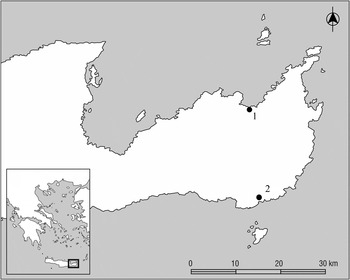
Crete, particularly the north coast, exhibits a relatively large series of mortuary contexts manifesting Cycladic-related materials: among the most recently excavated assemblages (Fig. 1) are the rockshelter at Kephala Petras, near Siteia (Tsipopoulou Reference Tsipopoulou, Andrianakis, Varthalitou and Tzachili2010; Reference Tsipopoulou, Mantzourani and Betancourt2012b; Reference Tsipopoulou and Tsipopoulou2012c) and the tholos tomb and rockshelter at Livari-Skiadi in south-east Crete (Papadatos and Sofianou Reference Papadatos, Sofianou, Andrianakis, Varthalitou and Tzachili2012; in press). The Kephala Petras cemetery lies on the flat plateau area of a high hill, less than 1 km east of the modern town of Siteia, overlooking Siteia bay. On the west slope of the cemetery there is a burial rockshelter which faces the Protopalatial palace and the surrounding Minoan town; its use extends from Early Minoan IB to Middle Minoan IB, c.2900–1875/1850 bc (Tsipopoulou Reference Tsipopoulou, Andrianakis, Varthalitou and Tzachili2010; Reference Tsipopoulou and Tsipopoulou2012c; for absolute chronology see Manning Reference Manning and Cline2010, table 2.2). Moreover, systematic excavation since 2004 has recovered 11 house tombs with multiple rooms, special open areas and platforms for ritual activities in memory of the deceased. The use of the house tombs extends from the mid-third millennium bc to the early second millennium bc, c.2400–1850 bc (Early Minoan IIB – Middle Minoan IIA) (Manning Reference Manning1995, fig. 2; 2010, table 2.2), with peak use in the early Protopalatial period (Middle Minoan IB–IIA) (Tsipopoulou Reference Tsipopoulou, Andrianakis, Varthalitou and Tzachili2012a; Reference Tsipopoulou and Tsipopoulou2012c). The current analysis focuses on House Tomb 2, the only fully excavated mortuary complex of the cemetery, which spans the period from Early Minoan III to Middle Minoan IB/IIA, c.2200–1875/1850. There is, therefore, an overlapping period of approximately 350 years when the burial rockshelter and House Tomb 2 were in contemporary use. The Livari-Skiadi tholos tomb and rockshelter are situated on a small coastal plain opposite the islet of Kouphonisi, about 50 m from the seashore. The plain is cut by deep gorges which run from the inland Ziros plateau, while a rocky promontory protrudes into the sea, forming a small bay in front of the cemetery (Papadatos and Sofianou Reference Papadatos, Sofianou, Andrianakis, Varthalitou and Tzachili2012; in press). The tholos tomb was in contemporary use with the rockshelter from Early Minoan IB to Early Minoan IIB (Papadatos and Sofianou in press), c.2900–2200 bc (Manning Reference Manning1995, fig. 2; 2010, table 2.2), while the rockshelter seems to have been in continual use until Early Minoan III, c.2200–2100/2050 bc, that is, almost one or two centuries after the last use of the tholos tomb.
Map indicating the location of the study areas (drawn by N. Valasiadis). Key: 1 = Kephala Petras, 2 = Livari-Skiadi.

Funerary assemblages from both the Kephala Petras rockshelter and the Livari-Skiadi tholos tomb and rockshelter include various types of artefacts which follow well-known local and non-local traditions from other regions across the island: the pottery may be paralleled with material from the Mesara-Asterousia area (Papadatos and Sofianou in press), and there are obsidian blades (Carter in press) and metal objects which ‘seem to be Cretan in origin’ (Ferrence, Muhly and Betancourt. Reference Ferrence, Muhly, Betancourt and Tsipopoulou2012, 140); significantly, however, they include also a number of Cycladica. The latter consist of various pottery artefacts which are classified as part of the so-called ‘Kampos Group’ (Nodarou 2012; in press, 85; Papadatos and Sofianou Reference Papadatos, Sofianou, Andrianakis, Varthalitou and Tzachili2012, 51; Tsipopoulou Reference Tsipopoulou, Andrianakis, Varthalitou and Tzachili2012a; Reference Tsipopoulou, Mantzourani and Betancourt2012b), mid-rib copper daggers (Papadatos and Sofianou in press) and four fragments of marble figurines with folded arms (Tsipopoulou Reference Tsipopoulou, Andrianakis, Varthalitou and Tzachili2012a; Reference Tsipopoulou, Mantzourani and Betancourt2012b). It is interesting to note that the recent petrographic analysis of 45 samples belonging to the ‘Kampos Group’ pottery from the Kephala Petras rockshelter identified a highly calcite-tempered fabric (Nodarou 2012, 85), which is a common Cycladic manufacturing tradition found also at sites on the north coast of Crete which offer similarly strong evidence for off-island contacts with the Aegean; these sites include Hagia Photia, Gournes and Poros-Katsambas (Hagia Photia: Day, Wilson and Kiriatzi Reference Day, Wilson, Kiriatzi and Branigan1998; Day et al. Reference Day, Wilson, Kyriatzi and Joyner2000; Gournes: Galanaki Reference Galanaki2006; Poros-Katsambas: Dimopoulou-Rethemiotaki, Wilson and Day Reference Dimopoulou-Rethemiotaki, Wilson, Day, Day and Doonan2007).
To sum up, in three (Kephala Petras rockshelter, Livari-Skiadi tholos tomb and rockshelter) out of the four (Kephala Petras rockshelter and House Tomb 2, Livari-Skiadi tholos tomb and rockshelter) mortuary assemblages investigated in this study, there is significant evidence for off-island relations with the Cyclades. These coincide with the critical time span of Early Minoan IB–IIA (c.2900–2450/2400 based on Manning Reference Manning and Cline2010, table 2.2), that is, the peak time of interregional cultural contacts in the southern Aegean, described in the literature by Renfrew (Reference Renfrew1972) as the ‘international spirit’ phenomenon. Meanwhile, all case study sites seem to have been engaged in diverse cultural networks within Crete. Moreover, regarding temporal proximity, in the Kephala Petras and Livari rockshelters as well as in the Livari tholos tomb, there is an overlapping period of approximately 700 years of use which extends from Early Minoan IB to Early Minoan IIB, c.2900–2200 bc. In contrast, Kephala Petras House Tomb 2 is of a slightly later date, c.2200–1850 bc, partially overlapping with the later period of use of the Kephala Petras rockshelter, and has provided no evidence of Cycladica. It will be of interest therefore to explore the biological connections among these assemblages and to assess the degree to which the observed cultural similarities or diversities can be explained by means of population relocations and exogamy.
THE PEOPLE REPRESENTED: RESULTS OF THE MACROSCOPIC STUDY
The macroscopic analysis of the skeletal populations disposed of in the Kephala Petras rockshelter and House Tomb 2 (HT 2), as well as in the Livari-Skiadi tholos tomb and rockshelter (Table 1), has offered valuable evidence with regard to the manipulation of the deceased and the demographic composition of each assemblage. Disarticulated skeletal remains and major anatomical units are consistent with the deposition of secondary burials of either skeletonised or fresh bone in both rockshelters, which appear to represent one-off episodes of systematic redeposition of burials placed initially in a different disposal area (e.g. Triantaphyllou Reference Triantaphyllou2009; Reference Triantaphyllou and Tsipopoulou2012; in press; Triantaphyllou, Tsipopoulou and Betancourt in press). The manipulation of the deceased in the Kephala Petras House Tomb 2 differs slightly since, along with the secondary skeletal remains, there are a number of burials which appear to lie in their initial disposal area but manifest clear evidence of the removal of body parts shortly after death (for a synthetic discussion on secondary removal of body parts during the Pre- and Protopalatial periods, see Triantaphyllou in press; Triantaphyllou, Tsipopoulou and Betancourt in press). Finally, in the Livari-Skiadi tholos tomb bone alterations due to burning (e.g. severe cracking and warping) suggest a lengthy and systematic exposure of the body parts to high temperature as part of the secondary treatment of the deceased (Triantaphyllou in press).
Sample size of the populations under study.

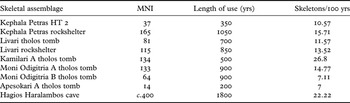
Assessment of the population groups deposited inside the communal tombs has occupied archaeologists working on Early Bronze Age Crete since the earliest stage of research (e.g. Branigan Reference Branigan, Kastrinaki, Orfanou and Giannadakis1987b; Reference Branigan1993, 84–95; Papadatos Reference Papadatos1999, 59–63; Vasilakis and Branigan Reference Vasilakis and Branigan2010, 262 and more recently Triantaphyllou in press). Analysis has been based upon (a) survey work and the association of the tombs with nearby settlements (Bintliff Reference Bintliff1977; Blackman and Branigan Reference Blackman and Branigan1977; Branigan Reference Branigan1993; Vasilakis and Branigan Reference Vasilakis and Branigan2010; Whitelaw Reference Whitelaw, Schoep, Tomkins and Driessen2012), (b) the internal social organisation of the fully excavated Early Minoan settlement at Myrtos Fournou Korifi based on the spatial distribution of artefacts across the site and the functional interpretation of rooms, built facilities and finds (Whitelaw Reference Whitelaw, Krzyszkowska and Nixon1983 vs Warren Reference Warren1972 and more recently Whitelaw Reference Whitelaw, Westgate, Fisher and Whitley2007), (c) the number of the skulls recognised during excavation (particularly with regard to the house tombs: Soles Reference Soles1992, 252), and (d) the study of artefacts and their distribution within the tombs (Whitelaw Reference Whitelaw, Krzyszkowska and Nixon1983, fig.71). Recent analysis of skeletal remains has shed some new light on issues concerning the group size and composition of the people deposited in Prepalatial and early Protopalatial funerary assemblages (Table 2). Table 2 demonstrates that the low estimates of skeletal remains deposited per 100 years do not approach the hundreds of individuals commonly assumed (cf. e.g. Branigan Reference Branigan, Kastrinaki, Orfanou and Giannadakis1987b). In contrast, assuming that a household of about five to seven individuals contributes approximately 20 corpses per century – a figure based on ethnographic observations of agricultural communities but also on historical studies of census data from rural communities (for specific references see Chamberlain Reference Chamberlain2006, 52; for an application of population estimates in prehistoric Aegean contexts, see Bintliff Reference Bintliff1977, 83) – Table 2 suggests that the nuclear family was perhaps the basic population unit in Early Bronze Age communities on Crete, as has been convincingly demonstrated by Whitelaw (Reference Whitelaw, Krzyszkowska and Nixon1983; Reference Whitelaw, Westgate, Fisher and Whitley2007). Analysis of household models from small rural communities in Early Bronze Age Crete would sustain the idea of independent households represented by nuclear families which appear to have been bound together with close ties (Whitelaw Reference Whitelaw, Westgate, Fisher and Whitley2007, 73). In a recent study Whitelaw considered new data derived from archaeological surveys in the Mirabello area; combining this with his early work at Myrtos Fournou Korifi, he proposed a notional model of Early Minoan II site distributions and local demographic networks (Whitelaw Reference Whitelaw, Macdonald, Hatzaki and Andreou2015, fig. 4). The results of this study suggested that small hamlets located particularly in a very dry landscape of thin soils would ‘have to have maintained a wide network of connections with comparable communities to be demographically viable’ (Whitelaw Reference Whitelaw, Macdonald, Hatzaki and Andreou2015, 2).
Estimation of skeletons deposited per 100 years from recently examined skeletal assemblages on Crete (key: HT = House Tomb, MNI = minimum number of individuals).

Both sexes and all age groups were equally represented in the skeletal assemblages (Table 3). The Livari-Skiadi tholos tomb, however, deviates from this pattern; the demographic composition of this skeletal assemblage suggests a significant under-representation of the sub-adult age categories since only six sub-adult, as against seventy-five adult individuals, were identified (Triantaphyllou in press; forthcoming). It is evident, therefore, that the manipulation of the deceased in the third and early second millennia bc in eastern Crete is dominated by the communal character of deposition, but with significant deviations with regard to the disposal area, the treatment of the deceased and perhaps segregation according to age groups. It is equally important to point out here that, given population estimates from recently studied skeletal assemblages (Table 2) and systematic work conducted by Whitelaw (Reference Whitelaw, Westgate, Fisher and Whitley2007; Reference Whitelaw, Macdonald, Hatzaki and Andreou2015), further investigation of kinship connections and of the scale of exogamous networks between the small and fragmented Prepalatial communities of eastern Crete will be of great value to the recognition of social and developing political entities in the third millennium bc.
Distribution of age groups in the case study skeletal assemblages (key: HT = House Tomb).

MATERIALS AND METHODS
In order to explore the character of gene flow in the study area and mobility patterns within Crete and the southern Aegean, this pilot project combined strontium isotope analysis of limited scale and biological distance calculation by means of dental non-metric traits. It is essential to clarify that these two methods provide evidence for different and independent phenomena. Dental non-metric traits can offer information on the biological affinity of the study populations, while strontium isotope analysis has the potential to distinguish whether individuals have moved between different geographic regions in terms of their geological and environmental settings; these methods can therefore complement each other in the context of the current research project. It should also be noted that analysis of ancient DNA was applied on a limited number of teeth from the Kephala Petras and the Livari-Skiadi rockshelters by the Palaeogenetics Group at the Institute of Anthropology at Mainz, Germany, but the samples were too collagen-depleted to extract sufficient usable DNA.
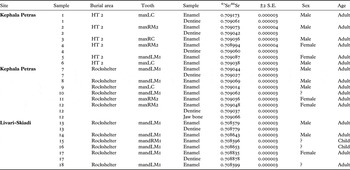
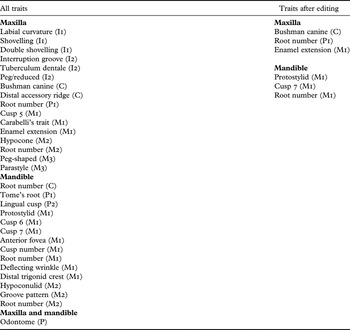
Owing to the limited budget for analytical work, only 18 teeth (Table 4) were selected from the Kephala Petras rockshelter, the Kephala Petras House Tomb 2 and the Livari-Skiadi rockshelter for strontium isotope analysis, while 31 dental non-metric traits were recorded for 475 teeth from the Kephala Petras rockshelter, 73 teeth from the Kephala Petras House Tomb 2, 127 teeth from the Livari-Skiadi tholos tomb, and 355 teeth from the Livari-Skiadi rockshelter, using the Arizona State University Dental Anthropology System (ASUDAS: Turner, Nichol and Scott Reference Turner, Nichol, Scott, Kelley and Larsen1991) (Table 5). The Livari-Skiadi tholos tomb was not sampled for strontium isotope analysis since all skeletal elements were severely affected by firing conditions due to their lengthy exposure to high temperatures.
Strontium isotope ratio (87Sr/86Sr) values for the case study populations (key: C = canine, HT = House Tomb, L = left, mand = mandibular, max = maxillary, M1 = first molar, M2 = second molar, R = right).

Non-metric dental traits under study (key: C = canine, I = incisor, M = molar, P = premolar).

Before proceeding to the presentation of the results, it is important to clarify the limitations of the sampling carried out for the strontium isotope analysis: the small sample of data produced means that our conclusions are tentative. Moreover, the commingled nature of the skeletal assemblages makes it impossible to know for certain whether or not first-generation immigrants were among those sampled from sites which demonstrated direct or indirect relations with the Cyclades (that is, the Kephala Petras and Livari rockshelters and the Livari tholos tomb). This problem is accentuated particularly due to the broad temporal span of use of the mortuary assemblages, which ranges from 400 to 1000 years. Moreover, given the very limited budget of the current project, it was impossible to perform large-scale sampling and/or direct dating of all samples analysed for strontium isotopes. Assuming that immigration was not a one-off event but rather a continuing process of new individuals drifting from the Cyclades and regularly establishing themselves in Crete through exogamy or other processes, the sampling approach adopted for the strontium isotope analysis, which incorporated bone and tooth samples from different layers of the skeletal depositions, aimed to capture such relocation events. However, a large-scale sampling programme would be more appropriate in future work.
Given the fact that evolutionary change in humans is very slow and happens across many generations (Fuentes Reference Fuentes2011, 96), temporal distance within and between assemblages is not large enough to have had a substantial impact upon the expression of non-metric traits and the calculated biological/genetic relationships based on them. Among the primary factors that generate changes in the frequency of specific alleles and subsequent changes in the morphological characters under study – in our case the dental non-metric traits – is gene flow (Fuentes Reference Fuentes2011, 97). Biological diversity within populations increases with gene flow because of the introduction of new alleles from an external source. The strength of this diversity depends on the migration rate and amount of gene flow over time, but also on the population size of the living community (Stojanowski Reference Stojanowski2005, 78). Therefore, in the small Early Bronze Age populations of Crete, even minimal gene flow should result in substantial biological diversity within and between populations, even though the rate and time span of biological isolation or interbreeding of the study communities is also important.
STRONTIUM ISOTOPE ANALYSIS: GEOLOGICAL SETTING AND METHODS
Isotope work in the Aegean, with a particular focus on human mobility, was introduced recently by Nafplioti (Nafplioti Reference Nafplioti2007; Reference Nafplioti2008; Reference Nafplioti2009a; Reference Nafplioti2009b; Reference Nafplioti, Sampson, Kaczanowska and Kozlowski2010; Reference Nafplioti2011) and Vika (Vika Reference Vika2009) and was combined in one case with the study of cranial non-metric traits (Nafplioti Reference Nafplioti2007). Moreover, Nafplioti has created a preliminary map of the 87Sr/86Sr values in different geological and geographic settings in the Aegean as measured not only from archaeological human and animal dental enamel and bone material, but also from modern snail shells (Nafplioti Reference Nafplioti2011); however, the sample sizes upon which this map was created were very limited, so further work is required in this direction.
Geologically a major part of the island of Crete belongs to the Gavrovo isopic zone, while certain areas in the central and central-western part of the island fall within the Ionian zone (Higgins and Higgins Reference Higgins and Higgins1996, fig. 2.2). The Gavrovo zone, which includes a narrow strip of Albania and central Greece, widens out in the Peloponnese. This isopic zone was a continental fragment for the early part of its history (Higgins and Higgins Reference Higgins and Higgins1996, 19). The two study areas, Petras and Livari, are situated on the north and south coast, respectively, of the eastern part of Crete which belongs to the Gavrovo zone (Higgins and Higgins Reference Higgins and Higgins1996, fig. 2.2). However, these two areas are located in different geological formations. Petras is situated on a combination of Miocene marine sediments and exposures of older (Permian–Triassic) phyllites (Papastamatiou et al. Reference Papastamatiou, Vetoulis, Bornovas, Christodoulou and Tataris1959b). Livari-Skiadi is at the junction of two geological units which consist, to the north-north-east, of Jurassic to Eocene thick-bedded to massive grey limestones and dolomites (Gavrovo-Tripolitza series) and the sandstone conglomerate of the Tripolis flysch, whereas the area to the south-south-west consists of Miocene continental sediments (Papastamatiou et al. Reference Papastamatiou, Vetoulis, Bornovas, Christodoulou and Katsikatsos1959a; Creutzburg, Drooger and Meulenkamp Reference Creutzburg, Drooger and Meulenkamp1977).
Owing both to the disarticulated state of the remains from the two rockshelters and to budgetary limitation, sampling for strontium isotope analysis could not include postcranial bone and teeth from the same individuals; this would have allowed more accurate assessment of diagenetic contamination and of the local range of isotopic values. The sampling strategy for strontium isotope analysis is based on the assumption that migrant individuals who moved between different geologic regions will demonstrate different 87Sr/86Sr signatures between the teeth and bones; this is a reasonable assumption given that adult tooth enamel will capture the 87Sr/86Sr values of their youth, whereas bones, which remodel throughout life, will represent the 87Sr/86Sr values of the environment where the person spent his or her last years (Sealy, Armstrong and Schrire Reference Sealy, Armstrong and Schrire1995; Bentley Reference Bentley2006; see, however, the comments on diagenetic alteration below). In addition to the 18 tooth enamel samples extracted from the study skeletal assemblages, seven samples of dentine and one of maxillary bone were also analysed (Table 4). Analysis on the same individual was avoided by selecting teeth of the same type and side. Analysis of the strontium isotope ratios was conducted at the Bristol Isotope Group (BIG) Laboratory, School of Earth Sciences, University of Bristol.Footnote 1 The strontium isotope ratio (87Sr/86Sr) in human tooth enamel, after the development of permanent dentition, reflects dietary strontium derived from soils and ground water via the food chain and undergoes relatively little change after it has mineralised in childhood and early adolescence (Hillson Reference Hillson1996; Bentley Reference Bentley2006, 169–74; Haak et al. Reference Haak, Brandt, Jong, Meyer, Ganslmeier, Heyd, Hawkesworth, Pike, Meller and Alt2008, 18229). Moreover, it is considered highly resistant to post-mortem diagenesis (Hillson Reference Hillson1996; Budd et al. Reference Budd, Montgomery, Barreiro and Thomas2000, 688). In contrast, the strontium ratios in other skeletal tissues, such as bone and dentine, are known to be subject to diagenetic change after burial. Consequently, it is likely that the 87Sr/86Sr ratio in these tissues will be heavily but variably modified by post-depositional strontium uptake and therefore give a closer indication of the local burial environment rather than the place of origin of the individual (Budd et al. Reference Budd, Montgomery, Barreiro and Thomas2000, 688; Haak et al. Reference Haak, Brandt, Jong, Meyer, Ganslmeier, Heyd, Hawkesworth, Pike, Meller and Alt2008, 18229). However, this is only an indication, depending on the extent to which the strontium originally in these tissues has been equilibriated with the local environment. Therefore, the measurements of strontium in dentine and bone cannot be taken as direct evidence for the values of the burial environment and may be different from the bioavailable strontium in the wider area (Budd et al. Reference Budd, Montgomery, Barreiro and Thomas2000). Nonetheless, in the absence of other biological samples (see below) it was felt that the measurement of some dentine and jaw bone samples would at least provide an indication/approximation of the 87Sr/86Sr ratio of the burial environment. However, ideally, analysis of human bone and teeth should be applied in parallel to analysis of biosphere samples (waters, soils, modern plants), animal teeth, bones and archaeobotanical material in order to map more accurately the local range of isotopic values in a particular area (Bentley Reference Bentley2006, 136; Evans et al. Reference Evans, Montgomery, Wildman and Boulton2010; Frei and Price Reference Frei and Price2012).
DENTAL NON-METRIC TRAITS
The biological affinity among the study population samples was assessed by means of dental non-metric traits. Non-metric traits are minor variants of skeletal and dental anatomy which are not metrically measurable and are not a sign of disease (Tyrrell Reference Tyrell, Cox and Mays2000). Many twin and family studies (e.g. Scott Reference Scott1973; Berry Reference Berry, Butler and Joysey1978; Nichol Reference Nichol1990; Townsend et al. Reference Townsend, Richards, Brown, Burgess, Travan, Rogers, Smith and Tchernov1992; Scott and Turner Reference Scott and Turner1997; Schnutenhaus and Rösing Reference Schnutenhaus, Rösing, Alt, Rösing and Teschler-Nicola1998) suggest that non-metric dental variants are inherited polygenically, while the natural environment in which growth takes place also affects trait expression. It should, however, be noted that while environmental factors influence trait expression to some extent, they have not been shown to significantly affect population trait frequencies (Scott and Turner Reference Scott and Turner1997). Accordingly, non-metric traits have been used extensively in reconstructing patterns of intra- and inter-population affiliations spanning wide geographical areas and long periods of time (e.g. Corruccini and Shimada Reference Corruccini and Shimada2002; Tomczak and Powell Reference Tomczak and Powell2003; Irish Reference Irish2006; Coppa et al. Reference Coppa, Cucina, Lucci, Mancinelli and Vargiu2007; Hanihara Reference Hanihara2010; Nikita, Mattingly and Lahr Reference Nikita, Mattingly and Lahr2012).
Each non-metric trait was scored on one tooth within a class (Nichol Reference Nichol1990). The general practice is to score both the right and left side and use the highest degree of expression of a variant for population comparisons (Turner, Nichol and Scott Reference Turner, Nichol, Scott, Kelley and Larsen1991). Given that the sample under study consisted of loose and commingled teeth, in order to avoid biases we recorded non-metric traits on the maxillary and mandibular teeth that belonged only to the right side, even though this may not have been the side with the greatest degree of trait expression.
The fact that most of the material was preserved as loose teeth, disassociated from any cranial or postcranial elements, should not have any impact on the obtained results given that the mean measure of divergence (MMD), the distance measure employed in the present study (see below for details), is calculated on the overall frequency of each trait in the sample. In respect to levels of sexual dimorphism in trait expression and the potential bias of pooling sexes in the current analyses, sex differences in dental non-metric traits have been found to be low, and pooling data on males and females constitutes standard procedure (Turner, Nichol and Scott Reference Turner, Nichol, Scott, Kelley and Larsen1991; Scott and Turner Reference Scott and Turner1997).
The ordinal scores for each trait were transformed into dichotomised presence/absence values based on each trait's morphological threshold as determined by Turner (Reference Turner1987) and Irish (Reference Irish2006). Traits that exhibited very low frequency (at least one sample of <2 cases) were removed from the dataset, as were traits that did not exhibit at least one statistically significant difference between sample pairs (Harris and Sjøvold Reference Harris and Sjøvold2004). Moreover, significantly intercorrelated traits were also dropped from the dataset (Sjøvold Reference Sjøvold1977). The non-discriminatory and intercorrelated traits were identified by means of Chi-square and Fisher's exact tests. Table 5 shows the original dataset and the traits that remained after editing.
Smith's MMD was calculated using the remaining traits and the Freeman–Tukey angular transformation was employed in order to correct for small sample sizes (Freeman and Tukey Reference Freeman and Tukey1950; Sjøvold Reference Sjøvold1973; Reference Sjøvold1977). Although the MMD has occasionally been criticised, it has been found to perform very well and to offer results that are in accordance with the generalised Mahalanobis D2 distance for non-metric traits (Irish Reference Irish2010). The p-values for each MMD were estimated using a method that is based on the fact that the MMD values follow the normal distribution (Sjøvold Reference Sjøvold1973; Green, Suchey and Gokhale Reference Green, Suchey and Gokhale1979).
RESULTS
Strontium isotope analysis
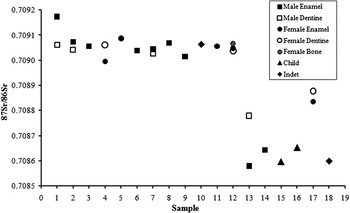
The results of the strontium isotope analysis applied to tooth enamel and selectively to one bone and seven dentine samples are given in Table 4 and Fig. 2. Utilising the dentine and bone samples as a very rough indicator of the isotopic range within the local burial environment, the range for the two Petras sites could be defined as between 0.7089 and 0.7091 and all the samples from these sites fall within this range, though the particularly small sample sizes make this observation tentative. The expected local range for Livari-Skiadi is, however, more difficult to define as there is no easy correlation between the majority of the enamel and the dentine samples (see below).
Scatterplot of enamel and dentine isotope values per population, age and sex. Samples 1–6: Petras House Tomb 2, 7–12: Petras rockshelter, 13–18: Livari rockshelter.

The mean 87Sr/86Sr ratios from tooth enamel are 0.70907 for the Kephala Petras House Tomb 2, 0.70905 for the Kephala Petras rockshelter and 0.70865 for the Livari-Skiadi rockshelter. Intra-group variation is highest in the Livari-Skiadi rockshelter (SD = 0.00009), followed by the Kephala Petras House Tomb 2 values (SD = 0.00006), while the Kephala Petras rockshelter (SD = 0.00002) shows the lowest intra-group variation, suggesting a tightly clustered population. Equally, the ratios from enamel, compared with those measured on dentine and jaw bone, correlate well with those from the Kephala Petras House Tomb 2 and the rockshelter, both individually and across the two populations (Fig. 2). The correlation between dentine and enamel values is especially strong at the rockshelter, where the average ratios for dentine (0.70904) and enamel (0.709048) are almost identical. It should be noted that the ratio of sample 1 at the Kephala Petras House Tomb 2 (0.70917) is slightly higher than all the others from the site but still within the expected local range. The broader range in strontium ratios from Livari-Skiadi compared with those from Kephala Petras is largely due to one sample (sample 17 = 0.70884), representing the only female sampled at the Livari rockshelter. When this sample is excluded, the results cluster quite tightly around the average of 0.70861. Sample 13 highlights the divergence in strontium ratios between enamel and dentine, while there appears to be good agreement between the enamel from this sample and the enamel values from all other individuals at the Livari rockshelter, except sample 17.
Interestingly, with the exception of the female (sample 17), all the dentine strontium ratios from the Livari rockshelter samples are more radiogenic than those on enamel. Perhaps the most likely explanation is that the dentine has become enriched in more radiogenic strontium through post-depositional diagenetic changes from sea spray, as the Livari rockshelter is located only a very short distance from the shore; the 87Sr/86Sr ratio for sea water ≈ 0.7092 (Elderfield Reference Elderfield1986). The difference in strontium ratios on the enamel of sample 17 compared with the other Livari samples could reflect a difference in diet, from a very early age onwards. For example the 87Sr/86Sr ratio in the female could have been elevated through a diet higher in marine resources or sourced from a slightly more radiogenic area of the island than that of the other five individuals. Alternatively, as Livari-Skiadi is located at the junction of two geological units (see above) it is also possible that the differences in ratios between these samples stem from the different underlying geological units. Consequently, all the individuals buried at the Livari-Skiadi rockshelter could be interpreted as local to south-eastern Crete but their Sr isotope ratios reflect two distinct geological areas. This could only be tested conclusively through more extensive sampling of biological material from throughout the island in order to arrive at a better understanding of the relationship between the bioavailable strontium ratios and the local geology.
The difference in the 87Sr/86Sr ratios from tooth enamel between the three assemblages was tested statistically. Given that the values for the sample from Livari-Skiadi deviated from normality (p = 0.024 < 0.05), both ANOVA as well as Kruskal-Wallis tests were employed. Both the parametric and the non-parametric statistical tests gave the same results. Specifically, there is an overall statistically significant difference among the three samples (p = 0.000 < 0.001 and p = 0.003 < 0.01 for the ANOVA and Kruskal-Wallis tests, respectively). When the pairwise comparisons were examined by means of post hoc tests and pairwise Mann-Whitney tests (in which the obtained p-values were corrected for multiple comparisons using the Holm-Bonferroni method), the difference between the two Kephala Petras assemblages did not appear to be significant (p = 0.841 and p = 0.485 > 0.05, respectively), whereas the Livari-Skiadi rockshelter was significantly differentiated from both Kephala Petras assemblages (Kephala Petras House Tomb 2 – Livari-Skiadi rockshelter: p = 0.000 and p = 0.006 < 0.05, Kephala Petras rockshelter – Livari-Skiadi rockshelter: p = 0.000 and p = 0.006 < 0.05).
The lack of other data on the local biologically available 87Sr/86Sr in eastern Crete limits considerably the interpretation of our results, particularly in terms of assessing geographical sources for the identified strontium ratios. Some comparative analysis is made possible on the basis of Nafplioti's (Reference Nafplioti2011) preliminary strontium isotope determinations in other parts of Crete, though the following comparisons are based on very small sample sizes and so should be treated as tentative, given that no statistical analysis can be performed on them. The strontium ratios from both the Kephala Petras skeletal assemblages (House Tomb 2 average = 0.70907, rockshelter average = 0.70905) correspond reasonably well to the average signatures from central Crete (Knossos and Ano Asites: 0.7089) and even better to those from Kastelos (0.709054) and Chania (0.709075) in the west as well as Margarites (0.709080) in the north-central part of the island. More broadly the ratios are also comparable to those from south-eastern Attica (0.7089) and the western Cyclades (0.7090) in the Attic–Cycladic metamorphic belt (Nafplioti Reference Nafplioti2011, 1567). In contrast to this, the ratios from the Livari-Skiadi rockshelter (average = 0.70865) are below the average for any of the other sampled sites on Crete. The ratio from sample 17 at Livari-Skiadi would broadly fit alongside the average strontium ratio from Myrtos Pyrgos (0.7088), located c.60 km to the west of Livari along the south coast (Nafplioti Reference Nafplioti2011, 1565). However, the other ratios from Livari-Skiadi match more closely to those measured outside Crete, such as those from the Parnassos and Pindos zones of mainland Greece (e.g. Corinthia average: 0.70866; Nafplioti Reference Nafplioti2011, 1567). Importantly, they appear to be distinct from the strontium ratios from the Central (average = 0.70948) and Western (average = 0.70901) Cyclades (Nafplioti Reference Nafplioti2011, 1568).
In summary, considering these results (which admittedly are based on a limited dataset), the most probable interpretation is that the sampled individuals from both sites at Petras are indeed local to Crete. While on the balance of probability the Livari-Skiadi samples may be local too, this cannot be stated with the same degree of certainty. Five of the six enamel samples from this site have strontium ratios of 0.7086 and below, making them some of the lowest 87Sr/86Sr values measured from Crete to date (Nafplioti Reference Nafplioti2008, 2313). This highlights the need for generating additional strontium isotope data, in particular from eastern Crete. In the absence of more samples indicating bioavailable strontium ratios from this part of Crete we can only say that the contrast between sample 17 and the other five samples, and the difference between enamel and dentine ratios, are extremely interesting and warrant further investigation.
Dental non-metric traits
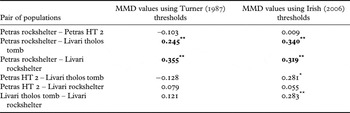
Table 5 shows the traits that remained in the dataset after the editing process. We observe that the final dataset on which population biodistances were calculated included six variables. Table 6 presents the MMD values for all pairwise inter-population comparisons using the edited dataset. It can be seen that a statistically significant biological distance is traced between the assemblages from the Kephala Petras rockshelter and the Livari-Skiadi rockshelter, as well as between the Kephala Petras rockshelter and the Livari-Skiadi tholos tomb. Moreover, it is interesting that the distance between the Kephala Petras House Tomb 2 and the Kephala Petras rockshelter is minimal (note that negative MMD values are interpreted as 0 divergence among samples). Given that the material from the House Tomb 2 temporally coincides with the later phases of use of the rockshelter, this result implies either that both Petras groups are local, despite the evidence of Cycladica at the rockshelter, or that any Cycladic immigrants were few and interbred so extensively with the locals that their genome – or at least the part of it responsible for the expression of non-metric traits – was homogenised. The latter scenario is also made feasible by the fact that the ‘Kampos Group’ pottery would suggest that the most likely time for any actual immigration was early (in the Early Minoan IB), which allows plenty of time for assimilation between the potential immigrants and the local populations.
Mean measure of divergence values for inter-population comparisons (key: HT = House Tomb, MMD = mean measure of divergence).

*MMD values are statistically significant at p < 0.05.
**MMD values are statistically significant at p < 0.001.
The biological distance between the Livari-Skiadi tholos tomb and the Kephala Petras House Tomb 2 also appears to be particularly small; however, when we change the thresholds slightly and follow the ones used by Irish (Reference Irish2006), whereas most MMD values and their significance only alter slightly, the values for the Livari tholos tomb and the Kephala Petras House Tomb 2 increase and become statistically significant. This may be attributed to the small sample size for the Kephala Petras House Tomb 2. In addition, it is striking that the biodistance between the Livari-Skiadi tholos tomb and the Livari-Skiadi rockshelter also becomes statistically significant when the Irish (Reference Irish2006) thresholds are used.
Given the impact that shifting thresholds has on our results, it is important to clarify that there is currently no consensus on the most valid threshold for each trait. Many authors follow Turner (Reference Turner1987) but, as Irish (Reference Irish2005, 525) has noted: ‘Although functional, the downside to this practice is that the full range of data is not presented, which precludes others from dichotomizing them differently.’ Accordingly, other researchers establish their own thresholds for presence/absence. Among the six traits used in the calculation of the MMD here, the only ones that exhibited a difference between Turner (Reference Turner1987) and Irish (Reference Irish2006) were the enamel extensions and the seventh cusp, and this difference was of one single grade (Turner places the threshold for presence at grade 2 for the enamel extensions whereas Irish places the same threshold at grade 1, while the opposite is true for cusp 7). Despite this small difference in the thresholds per se, the biodistance results, particularly between the two Livari assemblages, are markedly different. It is not possible to determine which threshold gives more valid results, but the statistically significant difference between the two Livari groups has been confirmed in a recent study where more Cretan assemblages were incorporated in the analyses, even when the Turner (Reference Turner1987) threshold was employed (Nikita, Triantaphyllou and Papadatos Reference Nikita, Triantaphyllou, Papadatos and Tsipopoulou2014); thus it appears to be factual and not an artefact of the diverse methods.
Before closing the presentation of the results based on non-metric traits, it should be made clear that since non-metric traits constitute part of the phenotype through which we indirectly access the genes that define them, there is no method available for quantifying the scale of interbreeding between each pair of groups under examination. Such questions could potentially be addressed using ancient DNA data and bioinformatics, though in the case of the assemblages under study, no DNA could be extracted, as mentioned above. Nevertheless, in an attempt to explore the overall degree of interbreeding among the small communities of Prepalatial eastern Crete, the fixation index (Fst) was calculated based on the MMD values (Irish Reference Irish2010). The fixation index is a measure of genetic differentiation between populations and its values may range from 0 to 1, where 0 suggests extensive interbreeding among samples, and 1 is indicative of no interbreeding at all (Nei and Chesser Reference Nei and Chesser1983). The calculated Fst values for the four assemblages under study were 0.003 and 0.007 using the Turner (Reference Turner1987) and Irish (Reference Irish2006) thresholds, respectively. It therefore appears that, despite the above-mentioned statistically significant pairwise biological distances, the overall degree of interbreeding in Prepalatial eastern Crete was high. This finding can at least in part be attributed to the small biodistance and subsequent extensive gene flow between the two Kephala Petras assemblages, but it is also accentuated by the small size of the communities under study.
DISCUSSION
The combined application of biodistance analysis and strontium isotope analysis is a valuable tool in the examination of gene flow and mobility patterns. The present project is the first attempt to apply this methodology in eastern Crete in order to approach not only outstanding questions concerning the processes underlying the extensive networks of cultural contact that characterise the southern Aegean during the Early Bronze Age, but also the exploration of regional diversities in relation to biological affinities and mobility patterns. The results presented above provide some interesting points for discussion and demonstrate the need for further studies of this kind in order to develop a comparative framework at a regional and interregional level. Issues of biological relatedness in Prepalatial Crete were investigated previously by Nafplioti, who applied metric and non-metric analyses of the cranial morphology from a very small sample of Early Bronze Age populations from the Moni Odigitria tholos tombs in the Asterousia mountains and two ossuaries from Roussolakos and the Patema enclosure in the wider area of Palaikastro in eastern Crete (Nafplioti Reference Nafplioti2007). That study found minimal biological distance between the two populations from central and eastern Crete based on cranial non-metric traits, which was interpreted by the author as suggestive of a common ancestor (parent population) (Nafplioti Reference Nafplioti2007, 201–2). This result was corroborated by the statistical analysis of cranial dimensions from the same groups, which showed a similarity in cranial shape between them (Nafplioti Reference Nafplioti2007, 226). It should be pointed out that the results based on cranial metric data in Nafplioti Reference Nafplioti2007 are rather tentative given that they actually encompass both the shape and the size of the crania under study and it has been shown that size is not a good indicator of biological distance between groups (see Betti et al. Reference Betti, Balloux, Hanihara and Manica2010 for a review). However, in combination with the non-metric data, they do suggest small genetic divergence between the sample populations from the Asterousia and Palaikastro. Moreover, a recent genetic analysis on Y-chromosome haplogroups of skeletal populations from Crete would support an influx of off-island genetic material from western and north-western Anatolia and Syro-Palestine around c.3100 bc (King et al. Reference King, Özcan, Carter, Kalfoğlu, Atasoy, Triantaphyllidis, Kouvatsi, Lin, Chow, Zhivotovsky, Michalodimitrakis and Underhill2008).
The results of the current paper support an overall statistically significant differentiation of the skeletal assemblages from Kephala Petras and Livari-Skiadi based on strontium isotope analysis. This may be due to the different geological settings of the two sites. Biodistance analyses confirmed the statistically significant differentiation of the Kephala Petras rockshelter material and the Livari-Skiadi rockshelter and tholos tomb remains, though the Kephala Petras House Tomb 2 sample size is too small to allow for any positive comparisons. The Kephala Petras rockshelter and House Tomb 2 samples exhibit close biological affinities. In combination with the overall similar 87Sr/86Sr values and the suggested origin of the sampled populations from within Crete, this undermines the likelihood of any dramatic effect from outside population influx. It is important to point out that, as stated earlier, the strontium isotope results may be misleading if migrants of the first generation have not been included in the samples analysed, particularly if population movement was a one-off episode and involved small groups of individuals. However, the combined use of the two methods clearly points to the Kephala Petras rockshelter population not being genetically differentiated from the Kephala Petras House Tomb 2, despite the evidence of Cycladic-type pottery, namely the so-called ‘Kampos Group’, deposited together with pottery of local tradition inside the rockshelter burial area. These combined results suggest that the two Kephala Petras groups were of Cretan origin and they also point to the fact that no large-scale immigration took place throughout the third and early second millennia bc in this area. This scenario lends further support to recent theoretical approaches according to which the association of ‘foreign’ elements, traditions and perhaps technologies with the deceased during the third millennium bc does not necessarily reflect different ethnic groups but most probably an intentional manipulation by local groups or individuals to shape new identities and project special roles (see review in Papadatos Reference Papadatos, Antoniadou and Pace2007, 434–5).
In contrast, the population sampled from the Livari-Skiadi tholos tomb does not appear to be close to that from the Livari-Skiadi rockshelter in terms of biological relatedness as determined using dental non-metric traits, although the two assemblages are broadly chronologically contemporary from Early Minoan IB to IIB, c.2900–2200 bc. This result may imply the occurrence of gene flow during the last couple of centuries of the use of the rockshelter, after the tholos tomb had been abandoned, but given the commingled nature of the assemblage it is not possible to distinguish the later from the earlier material and analyse them separately. Nevertheless, the mortuary practices that characterise these assemblages point to another interesting explanation. In particular, the Livari-Skiadi tholos tomb diverges significantly from the typical rules for disposal of the deceased in eastern Crete with regard to its architectural type, the manipulation of the deceased and the demographic composition of the interred population. Tholos tombs are typical architectural forms which dominate in south-central Crete (Branigan Reference Branigan1993; Goodison and Guarita Reference Goodison and Guarita2005; Legarra Herrero Reference Legarra Herrero2009; Reference Legarra Herrero, Schoep, Tomkins and Driessen2012; Reference Legarra Herrero2014). There are a few examples of tholos tombs outside the core area, e.g. Krasi, Pediados (Marinatos Reference Marinatos1929; Galli Reference Galli2014), tholos Epsilon and Gamma at Archanes (Panagiotopoulos Reference Panagiotopoulos2002; Papadatos Reference Papadatos2005), etc., and the more recently discovered Mesorachi, Skopis and Livari-Skiadi, which have raised questions with regard to the identity of the people who were disposed of in these tomb types (Papadatos and Sofianou Reference Papadatos, Sofianou, Andrianakis, Varthalitou and Tzachili2012). A major question concerns the origin of these people and their possible movement away from the core area of the Mesara plain and the Asterousia mountains in south-central Crete. A recent study (Nikita, Triantaphyllou and Papadatos Reference Nikita, Triantaphyllou, Papadatos and Tsipopoulou2014) on the biodistance of Prepalatial populations from central and eastern Crete has demonstrated a striking biological proximity between the Livari tholos material and the individuals buried in Moni Odigitria tholos B, suggesting a potential origin for part of the Livari-Skiadi population in the Mesara or Asterousia, although alternative explanations cannot be overlooked. Unfortunately, there is currently no available strontium isotope data from these areas that would allow us to explore this issue further.
Similarly, the manipulation of the deceased in the Livari-Skiadi tholos tomb, which included the systematic and lengthy exposure of human remains to high temperature, differs significantly from the common burial practices that took place in eastern Crete during the Prepalatial period (Triantaphyllou in press), though such a practice has not been traced to date anywhere in prehistoric Crete, so its point of origin cannot be identified. Evidence of burning on very few human skeletal remains in the Mesara tholoi would suggest their only short-term exposure to firing conditions and not their systematic cremation in the controlled conditions of a pyre, as is probably the case in the Livari-Skiadi tholos (Branigan Reference Branigan and Laffineur1987a; Triantaphyllou in press). Besides, the demographic profile of the Livari-Skiadi tholos assemblage does not provide typical mortality patterns; subadults are significantly under-represented. In contrast, while only very few communal skeletal assemblages in Prepalatial Crete have been thoroughly analysed, they are usually represented by all age groups and both sexes with very few exceptions (Triantaphyllou in press; forthcoming).
On the other hand, the Livari-Skiadi rockshelter constitutes a typical Prepalatial disposal context for this part of the island, where human remains were transferred at a secondary stage after their complete or partial decomposition at another location – which in the case of Livari-Skiadi remains unknown (Triantaphyllou in press). Considering all the above, it is possible that the Livari-Skiadi tholos tomb assemblage may represent a different subgroup which may have originated from somewhere else. Due to the effect of fire on tooth enamel and bone material from the Livari-Skiadi tholos, as already pointed out in the methodology section, sampling for strontium isotope analysis could not be conducted on this skeletal assemblage. Despite the various non-standard elements observed with regard to the manipulation of the deceased, it is interesting to note that material culture does not provide evidence of affinities with the Mesara plain alone, but also with sites on the north coast and the Cyclades. This phenomenon suggests that an extensive network of maritime and terrestrial interconnections was present in this rather remote part of the southern coastline (Papadatos and Sofianou Reference Papadatos, Sofianou, Andrianakis, Varthalitou and Tzachili2012; in press).
Therefore, our results do not appear to support substantial gene flow in Prepalatial eastern Crete from outside the island. Instead, interbreeding within Cretan communities may have varied in scale and character, as interesting biodistance patterns emerge when pairwise comparisons are performed. One aspect of special interest is the apparent population homogeneity of the Kephala Petras cemeteries, which comes in contrast to the heterogeneity of the Livari-Skiadi population assemblages based primarily on the results of the biodistance analysis. At this point, it is important to take into account that the Kephala Petras settlement was acting as a gateway community already in the Late Final Neolithic and early Early Minoan I (see recent discussion by Papadatos and Tomkins Reference Papadatos and Tomkins2013) while, in close proximity to the early site, a Protopalatial palace was established in Middle Minoan IIA (e.g. Tsipopoulou Reference Tsipopoulou, Driessen, Schoep and Laffineur2002; Reference Tsipopoulou, Betancourt, Nelson and Williams2007; Reference Tsipopoulou2011; Reference Tsipopoulou and Tsipopoulou2012c; Tsipopoulou and Hallager Reference Tsipopoulou and Hallager2010; Tsipopoulou and South Reference Tsipopoulou, South, Cadogan, Iacovou, Kopaka and Whitley2012), suggesting a continuous persistence of interest in the area operating as a nodal site at a regional level on the north-east coast of Crete. It may be plausible, therefore, to assume that the agricultural setting of the wider area of Kephala Petras favoured some self-sufficiency in demographic terms which can be translated into minimal outside population influx and exogamy with distant communities: Whitelaw (Reference Whitelaw, Macdonald, Hatzaki and Andreou2015) suggests ‘a minimum breeding group of 500 individuals for a stable local population based on anthropological studies (Wobst Reference Wobst1975)’. In contrast, the remote Livari-Skiadi community, located in a marginal and perhaps fragile environmental setting, would have required extensive interactions with a large range of outside communities, some of which appear to have been derived from considerably distant regions such as the Mesara plain and the Asterousia mountains in central Crete. It should be noted that cultural connections along the south coast of Crete have been documented by ceramics from the Mesara and Asterousia regions imported, on a limited scale, to EMIIA Myrtos Fournou Korifi (Whitelaw Reference Whitelaw, Macdonald, Hatzaki and Andreou2015).
CONCLUSIONS
The study of dental non-metric traits and strontium isotope analysis alongside the evidence of material culture and the manipulation of the deceased in eastern Crete has the potential to shed new light on the scale and character of mobility patterns and biological affinities developed among the human populations who lived in this area of the southern Aegean, and indicates the potential for more extensive studies of this kind. Given the biological distance between the two chronologically contemporary Livari populations, small-scale mobility of human groups could possibly be suggested, particularly for the remote site of Livari-Skiadi in south-eastern Crete. The results from the Kephala Petras assemblages show at a preliminary level the local origin of these individuals and highlight the fact that the manifestation of Cycladica in this area is not directly associated with islanders from the Cyclades. However, large-scale sampling, in order to identify outliers within populations with associated assemblages bearing strong evidence of Cycladic influence (such as at Hagia Photeia Siteias), should be considered in the future to more conclusively address this question. The manipulation of cultural elements locally invented or transferred from elsewhere and of ideas related to the treatment of the deceased, along with the study of the biological relations between populations, can offer a great deal of information regarding the formation of regional identities by communities in eastern Crete during the third millennium bc.
ACKNOWLEDGEMENTS
This pilot project was financed by the Research Committee of the Aristotle University of Thessaloniki (Code No. 88097). We would like to express our gratitude to the Greek Authorities for granting a permit to Sevi Triantaphyllou (ST) to sample the human skeletal populations. ST would like to thank especially Dr Metaxia Tsipopoulou, Dr Yiannis Papadatos and Ms Chryssa Sofianou for facilitating the study of the material. Special thanks also go to Professors Alex Bentley and Tim Elliott and the personnel of the Bristol Isotope Group for their collaboration, Drs Evangelia Kiriatzi and Eleni Nodarou for providing invaluable information and bibliographical references on the geological setting of the study areas, Professor Phil Betancourt for his comments on a preliminary draft, and Dr Tom Brogan, Director of the Institute for Aegean Prehistory in Eastern Crete, for the general support in practical matters. Finally, special thanks should go to Professor Todd Whitelaw, who critically reviewed this paper and kindly provided unpublished material motivating the authors to improve significantly their interpretation of the results.