Introduction
Fruit flies (Diptera:Tephritidae) are a major threat to the horticultural industry worldwide (White and Elson-Harris, Reference White and Elson-Harris1992; De Meyer et al., Reference De Meyer, Delatte, Mwatawala, Quilici, Vayssières and Virgilio2015; Ekesi et al., Reference Ekesi, De Meyer, Mohamed, Virgilio and Borgemeister2016). Some are polyphagous with a wide host range, while others remain oligophagous. Horticultural products vulnerable to these pests in tropical Africa include mangoes, citrus, guava, pawpaw, and watermelon (Ekesi et al., Reference Ekesi, De Meyer, Mohamed, Virgilio and Borgemeister2016). Tephritid fruit flies are a major constraint to the cultivation and export of mangoes due to reduced fruit quality. Their presence in exported fruits results in the interception, confiscation of such pest-ridden fruits, and embargoes on pest-ridden fruits during export on the exporting countries and companies (Ekesi and Billah, Reference Ekesi and Billah2007; Ekesi et al., Reference Ekesi, De Meyer, Mohamed, Virgilio and Borgemeister2016).
Mango is the preferred host of the Oriental fruit fly (Bactrocera dorsalis) (Ekesi et al., Reference Ekesi, De Meyer, Mohamed, Virgilio and Borgemeister2016). Bactrocera dorsalis can coexist with, and dominate the native mango fruit fly (Ceratitis cosyra) and other frugivorous fruit fly species (Vayssières et al., Reference Vayssières, Sinzogan, Adandonon, Rey, Dieng, Camara, Sangaré, Ouedraogo, Sidibé, Keita, Gogovor, Korie, Coulibaly, Kikissagbé, Tossou, Billah, Biney, Nobime, Diatta, N'Dépo, Noussourou, Traoré, Saizonou and Tamo2014; Ekesi et al., Reference Ekesi, De Meyer, Mohamed, Virgilio and Borgemeister2016). Prior to the detection of B. dorsalis in East Africa, the mango/marula fly (C. cosyra) was for decades the major fruit fly pest on mango (Lux et al., Reference Lux, Copeland, White, Manrakhan and Billah2003b). Subsequently, research revealed that a complex of fruit fly species apart from B. dorsalis and C. cosyra, attack mango and cause economic losses in Africa (Vayssières et al., Reference Vayssières, Sinzogan and Adandonos2009; Ekesi et al., Reference Ekesi, De Meyer, Mohamed, Virgilio and Borgemeister2016). About 30–50% of the two million tonnes of mango harvested yearly on the African continent are destroyed by tephritid flies (Georgen et al., Reference Georgen, Vayssières, Gnanvossou and Tindo2011). In the absence of control measures direct losses to mango fruits have been reported to range between from 30 to 100% (Vayssières et al., Reference Vayssières, Sinzogan and Adandonos2009; Ekesi et al., Reference Ekesi, De Meyer, Mohamed, Virgilio and Borgemeister2016). Several fruit fly species have been observed to infest mangoes in Ghana (Billah et al., Reference Billah, Owusu, Biney, Biney, Agboka and Edmund2010). Nboyine et al. (Reference Nboyine, Billah and Afreh-Nuamah2012) reported the presence of B. dorsalis, C. capitata, C. cosyra, Zeugodacus cucurbitae and C. ditissima from mango orchards in parts of the Guinea Savanna, Coastal Savanna, and Forest-Savanna Transition zones of Ghana, while Badii et al. (Reference Badii, Billah, Afreh-Nuamah and Obeng-Ofori2015) recovered C. cosyra, B. dorsalis, C. capitata and C. rosa from incubated mango fruits in Northern Ghana.
Ghana is the second-highest exporter of mango in the West African sub-region after Burkina Faso (Grumiller et al., Reference Grumiller, Christoph Arndt, Grohs, Raza, Staritz and Tröster2018). The variety ‘Keitt’ is widely cultivated and accounts for about 85% of mangoes produced in Ghana due to its versatile nature, and preference for it in the export market (Wih, Reference Wih2008; Komayire, Reference Komayire2017). The other varieties like Kent, Palmer, Haden, Tommy Atkins, Julie, Erwin, Zill, Jaffna and a range of local varieties make up the remaining 15% of the mango market in Ghana (Wih, Reference Wih2008).
Ghana has experienced a down turn in mango exports over the last two decades due largely to tephritid fruit fly infestations, primarily from Bactrocera dorsalis. The presence of B. dorsalis in Ghana resulted in an increase in fruit fly infestation levels with subsequent rejection of mangoes worth millions of Euros meant for export (ECOWAS-TEN Newsletter, 2012; ACP-EU Newsletter, 2013). This development led to the placement of a ban on Ghana's mangoes to the EU markets in January 2015, which was subsequently lifted in December 2017 (Billah, pers. Comm.; Billah and Cudjoe, Reference Billah and Cudjoe2020).
The Forest-Savanna Transition zone of Ghana is a hub for mango cultivation for both the local and international markets. Unfortunately, not much has been done in the zone in terms of fruit fly monitoring to determine species composition and new arrivals. A survey by Nboyine et al. (Reference Nboyine, Billah and Afreh-Nuamah2012) on fruit fly species in the Forest-Savanna Transition zone was limited to two study areas (Ejura and Wenchi) and therefore limiting the possible range of the fruit fly species present in the zone. The rational for conducting the study in different locations over a period with different pheromones is to have a representative data for the zone and also to identify other species that could be of economic importance to the horticultural industry in Ghana, but were missed during previous studies due to the lack of their respective attractants. The improvised traps employed in this study have been proven in other studies to be effective and user friendly in terms of their trapping efficiency, low cost of production and accessibility of raw materials (Nboyine et al., Reference Nboyine, Billah and Afreh-Nuamah2012). The aim of this study, therefore, was to update the existing data on fruit flies in the zone. Specifically, the study sought to; (i) collect and identify the species of fruit flies associated with mango in the Forest-Savanna Transition zone of Ghana, (ii) determine their diversity (iii) measure the fluctuations of their populations over time and, (iv) determine their percentage fruit infestation in the field.
Materials and methods
Study area
The study was conducted in eight selected mango orchards in the Forest-Savanna Transition zone of Ghana from November 2017 to October 2019. Details of the study location are shown in table 1. The purposive selection of the study orchards was based on the following criteria:
1. the farm should be at least two hectares in size.
2. the orchards should be planted with one or more exportable mango varieties and should have borne fruits before.
3. the farmers should be active and willing to allow their farms used for at least two years for the study.
Global Positioning System (GPS) Co-ordinates of Study Sites

Fruit fly monitoring
Traps made from 750 ml transparent water bottles with two cm2 holes (windows) on two opposite upper parts of the bottle were used (fig. 1). Tiny holes were bored in the bottom of the bottles to ensure drainage after rainfall but small enough to retain captured fruit flies. The traps were hanged on the branches of the selected trees with nylon threads strung on the corks of the bottles. Solid grease was then applied from the point of attachment to the middle of the nylon thread to prevent ants from entering the bottles to eat or steal the trapped flies.
Water Bottle Trap.

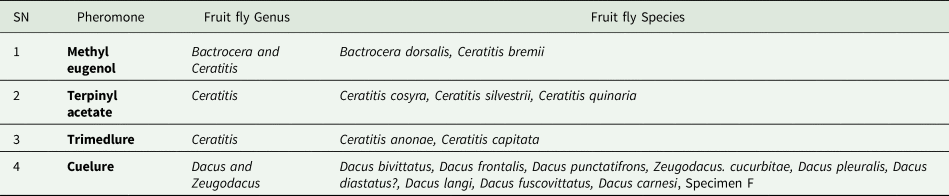
Four para-pheromone attractants sourced from Scentry Biologicals Inc. (Billings Montana, USA) were used. Methyl Eugenol (ME) for targeting Bactrocera species, Terpinyl Acetate (TA) and Trimedlure (TML) for Ceratitis species, and Cuelure (CUE) for Dacus species. Dimethyl 2, 2-DichloroVinyl Phosphate (DDVP) strips (2 × 1 cm) were placed in the traps as killing agent. Eight traps (2 of each attractant) were purposively deployed in each mango farm at a distance of 50 m apart and a height of 1.5 to 4.0 m above ground following the recommendation of (Ekesi and Billah, Reference Ekesi and Billah2009). Traps were checked weekly for collections, while servicing and recharging were carried out every eight weeks. The traps were rotated monthly to prevent trap location from interfering with performance.
Collection and identification of trap catches
Trap contents were preserved in vials containing 70% ethanol and labeled appropriately with the collection information. The samples were then transferred to the laboratory for sorting, counting, and identification using a Carl Zeiss stereomicroscope (Stemi 415500-1800-00). The identification was based on morphological features using taxonomic keys developed by Billah et al., (Reference Billah, Mansell, De Meyer, Goergen, Ekesi and Billah2007), the African Fruit Fly Initiative (AFFI) (Ekesi and Billah, Reference Ekesi and Billah2009) and the online Set of Multi-Entry identification Keys to African Frugivorous Flies (Diptera, Tephritidae) by Virgilio et al. (Reference Virgilio, White and De Meyer2014). The identification of the rare Dacus species (first record in Ghana) was also done using identification keys and literature by Billah et al. (Reference Billah, Mansell, De Meyer, Goergen, Ekesi and Billah2007) and De Meyer et al. (Reference De Meyer, White and Goodger2013), and confirmed in the Royal Museum for Central Africa, Tervuren, Belgium by Dr M. De Meyer.
Data analysis
To determine the relative densities of flies in the different localities, trap catches were expressed as indices by dividing the total number of flies collected (F) by the number of traps (T) and by the exposure period of traps (in Days) (F/T/D) (IAEA, 2003). Percentage trap catches per species were also determined. The number of trap-captured fruit flies were log transformed (log (x + 1)) to normalize the variance before subjecting the data to analysis of variance. Fly catches from the orchards were subjected to Analysis of Variance (ANOVA) using PROC GLM. Number of fly catches over the sampling period was used for treatment comparison (Epsky et al., Reference Epsky, Hendrichs, Katsoyannos, Vasquez, Ros, Zümreoglu, Pereira, Bakri, Seewooruthun and Heath1999) and means separated with Tukey's HSD test at P = 0.05, using GENSTAT® 12th edition. Non-target catches were recorded and grouped into their respective orders to assess the effect of the trapping on beneficial and neutral organisms. Field infestation rate was expressed as the ratio of the number of infested fruits per total number of fruits collected, multiplied by 100. The diversity of fruit fly species in the eight orchards was determined with the Simpson's diversity index. The Shannon-Weiner index was used to assess the total diversity index for the zone. Species richness was computed as the number of species encountered in the zone.
Results
Species composition and frugivorous fruit fly diversity
A total of 213,538 and 174,126 fruit flies were collected in 2018 and 2019, respectively with an average population size of 22, 803 per orchard. Seventeen fruit fly species belonging to four genera; Bactrocera (1) Ceratitis (6) Dacus (8), Zeugodacus (1), were collected during the two-year monitoring period (table 2). Two individuals of a non-frugivorous tephritid genus (Xanthaciura) (Supplementary fig. 2) were trapped at the end of the second season in 2019. Non-target athropods encountered include lacewings, red ants (Oecophylla species), other non-tephritid flies, leaf hoppers and spiders (table 3). The percentage of fruit lies captured per lure is shown in fig. 2.
Species of fruit flies attracted by different pheromone (lures)

Number of non-target organisms captured by different pheromone lures.

Percentage of tephritid fruit flies captured by the different pheromones.

Relative fruit fly densities
The highest relative fly density of 15.61 was recorded at Mampong, followed by Tanoso (12.59), Forikrom (11.31), Hansua (7.95), Bonsu (7.17) and Akumsa Domase (6.67). The Ejura orchards recorded the least fly densities of 2.84 and 2.23 respectively. The differences in species composition between the mango orchards were not significant, but differences between the mean populations of the species encountered in the eight orchards, were P ≥ 0.019. Bactrocera dorsalis formed 90% of total collections, with relative density values of 33.04 and 29.72 flies/trap/day for the 2018 and 2019 seasons, respectively. table 4 shows the mean relative fly densities of B. dorsalis and all the others fruit fly species. Percentage field infestation of mangoes ranged from 40–80% (table 5). Tanoso-Asutia recorded the highest percentage damage by the fruit fly infestation in both 2018 and 2019.
Means and relative fly densities of fruit fly species in the Forest-Savanna Transition zone of Ghana; (Nov. 2017–Oct. 2019)

Tukey's at 95 % confident interval.
Percentage field infestation of fruit fly species in Keitt mango.

Fruit fly diversity
Shannon diversity index for the frugivorous species in the zone was 0.41 with an Evenness value of 0.14. The zone recorded a species Richness (number of species) of 17. Tanoso-Asutia, Hansua and Forikrom recorded the highest species richness of 15 whilst the second orchard at Ejura (Ejura 2) recorded the least species richness of 13. The species diversity of each orchard is shown in table 6. Table 7 shows the numbers and proportions of the species present in the study zone.
Shannon Weiner's Diversity index for the composition of fruit flies in eight mango orchards

Numbers and proportions of fruit flies captured in pheromone-baited traps in eight mango orchards in the Forest-Savanna Transition zone of Ghana.

Seasonal fluctuations
Varying temporal fluctuations were observed for all the species throughout the duration of the study. Figure 3 illustrates the dynamics of B. dorsalis for both 2018 and 2019. The seasonal fluctuations of Ceratitis and Dacus species in the mango orchards in 2018 and 2019 are also shown in fig. 4.
Population fluctuations of B. dorsalis in the Forest-Savanna Transition zone of Ghana.

Population fluctuations of (A) Ceratitis species and (B) Dacus species in the Forest-Savanna Transition zone of Ghana.

Discussion
The results showed a complex of fruit fly species in all the study orchards. The monitoring survey conducted in the eight orchards in the Forest-Savanna Transition zone of Ghana resulted in the identification of 17 different species from four economically-important frugivorous fruit fly genera (Bactrocera, Ceratitis, Dacus and Zeugodacus,) and two non-frugivorous tephritids from the genus Xanthaciura. A similar trapping exercise carried out about a decade ago during the 2009 and 2010 mango season resulted in the collection of four fruit fly species (B. dorsalis, C. cosyra, C. ditissima, and C. capitata) from two farms (Ejura and Boasu-Wenchi) in the Forest-Savanna Transition zone (Nboyine et al., Reference Nboyine, Billah and Afreh-Nuamah2012). There was no record of the non-frugivorous Xanthaciura sp. and the frugivorous Dacus species. Nboyine et al. (Reference Nboyine, Billah and Afreh-Nuamah2012) employed the use of three different lures (ME, TA and TML) that targeted only Ceratitis and Bactrocera species and not Dacus species, which may explain their inability to detect Dacus spp. during their study.
The larvae of Xanthaciura species are known to feed on flowers of the Compositae, while species from the other four tephritid genera encountered in this study damage fruits and vegetables (White and Elson-Harris, Reference White and Elson-Harris1992). Xanthaciura insecta and its sister species X. biotellata (Thomson) and X. chysura (Thomson) are associated with the Asteraceae plant family (Benjamin, Reference Benjamin1934; Savaris et al., Reference Savaris, Lampert, Lorini, Pereira and Marinoni2015). These three Xanthaciura species have been recorded in Brazil, Florida, Mexico, and the West Indies, but none has been so far reported from Africa. The Xanthaciura species were encountered towards the tail end of this study in the month of October 2019. Since researchers are mostly interested in tephritid species of economic importance, any of the hitherto unreported Xanthaciura species found in any earlier study would have been mentioned and tagged for detailed study on its biology and bionomics. As there is no such record it is believed this is the first report of its presence in Ghana.
The current results show a marked increase in the number of species in the Forest Savanna Transition zone since the previous study, almost a decade ago. The increase in the number of fruit fly species could be attributed primarily to the use of more lures that are specific to the different fruit fly genera, and also due to anthropogenic activities and/or the increase in the area covered in this current study. However, the arrival of new species cannot be ruled out in explaining the increasing number of fruit fly species in the zone. Human activity, particularly in local mango trade, can result in the spread of the fruit-borne stages of the fruit flies. Changing environmental conditions due to human interference can impact insect populations both adversely and positively. Recent increase in the degradation of forests in Ghana may be blamed for creating the conducive environment for colonization and establishment of the hitherto unseen Dacus species in the zone.
The composition of the species in the Forest-Savanna Transition zone differs extensively from that of the Guinea savanna, Coastal savanna, and the Sudan savanna. Wih and Billah (Reference Wih and Billah2012) reported on nine fruit fly species (C. cosyra, C. capitata, C. ditissima, C, rosa, C. bremii C. anonae B. dorsalis, D. bivittatus, and D. vertebrata) from their survey of the Upper-West region. Nboyine et al. (Reference Nboyine, Billah and Afreh-Nuamah2012) reported only three species (B. dorsalis, C. cosyra, and C. capitata) from a trapping survey of the Guinea savanna zone and four species from the genera Bactrocera and Ceratitis in the Forest-Savanna Transition zone. The last two cited works were limited in the sense that they did not include the Cuelure (pheromone) to explore the range of Dacus species present at the time. The two previous studies together with this current study have established that currently in Ghana, three species of fruit flies (C. cosyra, C. capitata and B. dorsalis) are common in all the mango producing agro-ecological zones and also associated with mango orchards. Bactrocera dorsalis and Ceratitis cosyra are known to be of economic importance on mango (Ekesi et al., Reference Ekesi, De Meyer, Mohamed, Virgilio and Borgemeister2016). Therefore, periodic monitoring with specific attractants targeting both key and potential tephritid pests is important in the detection of existing cryptic pest species and introduced pests for early detection and necessary action.
Population trends of fruit flies of economic importance
Ten species of fruit flies of economic importance to mango were encountered in this study. These include Bactrocera dorsalis, C. anonae, C. bremii, C. capitata C. cosyra, C. quinaria,
C. silvestrii, Dacus bivittatus, D. punctatifrons and Zeugodacus cucurbitae. Out of these, only C. cosyra and B. dorsalis are known to cause significant economic losses to Mango in Ghana, with B. dorsalis being the most destructive. The other Ceratitis species collected from the traps are also known to attack mango in Mali and Uganda (Vayssières and Kalabone, Reference Vayssières and Kalabane2000; Vayssières et al., Reference Vayssières, Goergen, Lokossou, Dossa and Akponon2005). Ironically the mango fruit fly, C. cosyra, recorded relatively smaller numbers, with peaks in the months of April and May. Relative fly densities for the fruit fly species encountered were higher in 2018 than in 2019, except for C. silvestrii, C. quinaria, and D. punctatifrons. This shows that constant trapping all year round will aid in instituting management measures against the pest in time.
Bactrocera species
The invasive B. dorsalis, since its detection in Ghana in 2005, has dominated all fruit fly collections (Billah et al., Reference Billah, Wilson, Cobblah, Lux and Tumfo2006; Nboyine et al., Reference Nboyine, Billah and Afreh-Nuamah2012, Reference Nboyine, Abudulai, Nutsugah and Badii2013; Wih and Billah, Reference Wih and Billah2012; Billah and Wilson, Reference Billah, Wilson, Ekesi, Mohamed and De Meyer2016). Bactrocera dorsalis establishes easily because it is polyphagous, has high fecundity, and great dispersal traits (Ekesi et al., Reference Ekesi, Billah, Nderitu, Lux and Rwomushana2009). Its ability to compete well and its easy adaptation have led to its dominance and apparent displacement of the native mango fruit fly, C. cosyra, in several African countries (Ekesi et al., Reference Ekesi, Billah, Nderitu, Lux and Rwomushana2009). It occurs all year round with peak periods between April and June coinciding with fruit maturity periods. This study, together with other surveys carried out in Ghana, Burundi and other parts of Africa confirm that B. dorsalis is well established, is still a threat and responsible for the interception of mangoes from Ghana and parts of Africa (Nboyine et al., Reference Nboyine, Billah and Afreh-Nuamah2012; Gnanvossou et al., Reference Gnanvossou, Hanna, Goergen, Salifu, Tanga, Mohamed and Ekesi2017; Ndayizeye et al., Reference Ndayizeye, Nzigidahera and Theron2017; Billah and Cudjoe, Reference Billah and Cudjoe2020).
Zeugodacus species
Zeugodacus cucurbitae is known to primarily attack cucurbit plants, but has also been reported from an array of unrelated plant families (Mwatawala et al., Reference Mwatawala, Maerere, Makundi and De Meyer2010). It was first seen in Ghana in 2003 (Billah, Reference Billah2004) and also known to be associated with mango (Vayssières et al., Reference Vayssières, De Meyer, Ouagoussounon, Sinzogan, Adandonon, Korie, Wargui, Anato, Houngbo, Didier and De Bon2015; Gnanvossou et al., Reference Gnanvossou, Hanna, Goergen, Salifu, Tanga, Mohamed and Ekesi2017). This study has revealed that Z. cucurbitae occurs all year round in the Forest-Savanna Transition zone. Peaks occurred between February and March and again in September to October in 2018, while in 2019, peaks occurred between January and March, then August to November. These peaks coincided with flowering and fruit set during the first three months of the year, and during the vegetative flush periods. Adult Z. cucurbitae have been recovered from mango varieties including Keitt in Benin (Vayssières et al., Reference Vayssières, Rey and Traoré2007). Hence a potential threat to Ghana's mango industry because according to Wih (Reference Wih2008) about 85% of Ghanaian mango farmers prefer the Keitt variety to the other mango varieties available.
Ceratitis species
All the Ceratitis species encountered in this study are associated with the mango crop either in Ghana or other African countries. They account for 1.6% of the total trap collections. Ceratitis cosyra, the native mango fruit fly, accounted for 0.5% of the total trap collections. Ceratitis quinaria was found at Tanoso and Hansua, while C. silvestrii was found in all the other study orchards except Mampong. The other Ceratitis species were represented in all the eight study orchards. Small numbers of Ceratitis bremii was recorded in all the orchards. Hala et al. (Reference Hala, Quilici, Gnago, N'dépo, N'Da Adopo, Kouassi and Allou2006) reported that C. bremii made up 70.74% of total methyl eugenol trap catches from mango orchards in la Côte d'Ivoire. C. bremii was also reported from citrus orchards in Kade, Ghana (Foba et al., Reference Foba, Afreh-Nuamah and Billah2012), and also from mango orchards in Benin (Vayssières, et al., Reference Vayssières, De Meyer, Ouagoussounon, Sinzogan, Adandonon, Korie, Wargui, Anato, Houngbo, Didier and De Bon2015). A mass trapping exercise carried out in mango orchards in Western Burkina Faso also reported about 0.08% of total trap catches being C. bremii (Zida et al., Reference Zida, Nacro, Dabiré and Somda2020). Even though information on its host preference and ecological niche is quite scarce, this distribution trend of C. bremii in mango orchards is an indication that the species may be associated with mango.
This study recorded C. silvestrii and C. quinaria for the first time in the Forest-Savanna Transition zone of Ghana. A few individuals of C. quinaria and C. silvestrii, making up 0.01 and 0.05% of the total tap catches, were encountered during the study period. Ceratitis silvestrii was encountered in all orchards, except Mampong. Prior to this study C. quinaria and C. silvestrii were reported from yellow plum surrounding mango orchards in Northern Ghana (Oyinkah, Reference Oyinkah2012; Billah et al., Reference Billah, Oyinkah, Badii and Cobblah2023). However, no yellow plum was sited around the eight mango orchards used in this study. Although both species recorded relatively small numbers, their presence in the zone cannot be overlooked because of the evidence of their emergence from mango fruits in Benin, Burkina Faso, Mali, Niger, Nigeria, and Senegal (Vayssières et al., Reference Vayssières, Goergen, Lokossou, Dossa and Akponon2005, Reference Vayssières, De Meyer, Ouagoussounon, Sinzogan, Adandonon, Korie, Wargui, Anato, Houngbo, Didier and De Bon2015). According to Sawadogo et al. (Reference Sawadogo, Gnankine, Badolo, Ouedraogo, Dabiré and Sanon2013), C. silvestrii is a significant pest of mango in parts of West Africa, although it has also been reported to emerge from Shea fruits (Vitellaria paradoxa C.F Gaetn.). It accounted for 54.75% of the total number of fruit flies that emerged from the mango fruits in Western Burkina Faso (Zida et al., Reference Zida, Nacro, Dabiré and Somda2020).
The results from this study indicate that C. silvestrii is gradually expanding its geographical range in Ghana. C. quinaria on the other hand, had been recorded in Ghana with established populations confirmed all over West Africa and also found in Yemen (Vayssières et al., Reference Vayssières, Goergen, Lokossou, Dossa and Akponon2005, Reference Vayssières, Sinzogan and Adandonos2009; Oyinkah, Reference Oyinkah2012; Ekesi et al., Reference Ekesi, De Meyer, Mohamed, Virgilio and Borgemeister2016). Its host range is quite narrow but Mango happens to be one of its main hosts of economic importance (Manrakhan et al., Reference Manrakhan, Grout, Grove, Daneel, Stephen, Weldon, De Meyer, Carstens and Hattingh2020) In this study, it was recorded from only two orchards (Tanoso and Hansua). The peak periods for the two species were between February and March, confirming the report of Vayssières et al. (Reference Vayssières, Goergen, Lokossou, Dossa and Akponon2005) that C. quinaria and C. silvestrii coexist, are abundant in the dry seasons, and according to Zida et al. (Reference Zida, Nacro, Dabiré and Somda2020) are also quarantine pests.
An overview of the peak periods of Ceratitis species in the Forest-Savanna Transition zone, showed that C. cosyra populations started increasing during anthesis in January, peaked in February, and dropped in March when fruits were set. Then fluctuated till July while recording the highest peak at fruit maturity in May in 2018 during. The 2019 season saw smaller population levels of C. cosyra, with the highest peak occurring in April. Ceratitis capitata populations recorded low peaks in January and February at the flowering stage, and high peaks in October. C. bremii also recorded low peaks in March and relatively higher peaks in October for both seasons. The peak periods indicate that early maturing mango varieties like Jaffna and Palmer may be prone to Ceratitis species infestation. Late maturing varieties like Kent and Keitt may also be susceptible to attack either during the early stages of fruit development or in the absence of the dominant B. dorsalis. Ceratitis cosyra monitoring and control measures should start during the off-season from September to December; then intensified from January (flowering) to May (fruit setting to fruit development). Control for C. capitata should be from July to December where populations tend to shoot up showing distinct high peaks.
Dacus species in forest-savanna transition zone of Ghana
According to Ekesi and Billah (Reference Ekesi and Billah2007), the Cucurbitaceae plant family, especially cucurbit vegetables, are the primary hosts of Dacus species on which they inflict severe losses. Studies, more recent than the report of Ekesi and Billah (Reference Ekesi and Billah2007), have shown that Dacus species also infest mango (N'depo et al., Reference N'Depo, Hala, Adopo, Coulibaly, Kouassi, Vayssières and De Meyer2013; Ekesi et al., Reference Ekesi, De Meyer, Mohamed, Virgilio and Borgemeister2016). This study found eight species of Dacus from trap collections, occurring all year round with varying population trends. Dacus pleuralis and Dacus fuscovittatus were for the first time captured and identified in Ghana. Dacus (diastatus?), Dacus langi, and Dacus carnesi on the other hand have already been sighted in Ghana (De Meyer et al., Reference De Meyer, White and Goodger2013; Ofori et al., Reference Ofori, Osae, Kwapong and Abraham2023), but this is the first official record in the Forest-Savanna Transition Zone (see Supplementary fig. 1A–1E) and are hitherto not common. The confirmation of the identity of these species was done in the Royal Museum for Central Africa, Tervuren, Belgium by Dr M. De Meyer (Fruit Fly Taxonomist). The other species include D. bivittatus, D. frontalis and D. punctatifrons.
Common Dacus species in Ghana include D. bivittatus, D. vertebratus, D. ciliatus, and occasionally D. frontalis and D. lounsburyii (De Meyer et al., Reference De Meyer, White and Goodger2013). Dacus bivittatus and D. ciliatus have been reported to attack mango in parts of Africa (Hala et al., Reference Hala, Quilici, Gnago, N'dépo, N'Da Adopo, Kouassi and Allou2006; N'depo et al., Reference N'Depo, Hala, Adopo, Coulibaly, Kouassi, Vayssières and De Meyer2013; Fikru et al., Reference Fikru, Firdu and Yibrah2018). Ekesi et al. (Reference Ekesi, De Meyer, Mohamed, Virgilio and Borgemeister2016) did not report D. frontalis in Ghana. Nevertheless, D. frontalis was recorded in all study orchards, except Ejura 2. The presence D. bivittatus, D. punctatifrons and D. frontalis in mango orchards in the Forest-Savanna Transition zone of Ghana raises concern because of their ‘pest’ status elsewhere. Currently they can be considered potential pests, being subdued and outcompeted by the large populations of Bactrocera dorsalis.
The population of D. bivittatus was largest, followed by D. punctatifrons, A study in the Upper West region by Wih and Billah (Reference Wih and Billah2012) reported the presence of only two species of Dacus namely, Dacus bivittatus and Dacus vertebratus. Dacus fuscovittatus was recorded from all study orchards except Ejura 1 and Ejura 2, while Dacus (diastatus)? was recorded from only Ejura 1 and Ejura 2. Specimen F (Supplementary fig. 3) on the other hand, was recorded from three locations; Forikrom, Bonsu, and Akumsa-Domase. These study orchards were surrounded by other horticultural farmlands notably tomatoes and cashew.
The presence of the six tephritid species presently albeit rare, requires further research on their biology and geographical distribution in the country. The Paratype specimens of these species are deposited at the insectary of the Department of Crops and Soil Sciences, Kwame Nkrumah University of Science and Technology, Kumasi, Ghana.
Species diversity and proportions
The Shannon Weiner diversity analysis on the frugivorous species indicates a low diversity index for the zone despite the species richness of 17 recorded. This is due to the uneven distribution of the abundance of the individual species present. This is corroborated by the low evenness and effective number of species per orchard that resulted from the analysis. The dominance of Bactrocera dorsalis in the zone is the physical proof. An individual diversity assessment per orchard, resulted in only three out of the eight orchards recording a higher diversity index of approximately 1. The trapping exercise carried out in the Forest-Savanna Transition zone during the 2018 and 2019 mango seasons, saw B. dorsalis again dominating all trap collections in all the study orchards. It recorded the largest population in terms of trap catches, followed by Dacus bivittatus, Zeugodacus cucurbitae, and D. punctatifrons.
Field infestation assessment
In terms of percentage mango fruit infestation, Tanoso recorded the highest percentage fruit damage for the study duration. This can be attributed to the fact that orchard sanitation was very poor and none of the fruit fly management methods were employed. The other orchards that implemented some management practices like Male. Annihilation Technique (MAT), burying of dropped fruits and pruning recorded lower percentage infestation levels.
The role of different lures in population monitoring
The essence of the different lures employed in the study was to have a holistic view of all the different species of fruit flies in the zone. It was important to target all the fruit fly genera of economic importance because previous studies carried out in the zone didn't include Cuelure which is an attractant for Dacus species and Zeugodacus species. Ceratitis cosyra, C. quinaria, and C. silvestrii were collected from Terpinyl acetate baited traps, while C. anonae and C. capitata were captured in Trimedlure baited traps. Ceratitis bremii was the only Ceratitis species encountered together with B. dorsalis in Methyl eugenol-baited traps.
Non-target organisms
Methyl eugenol recorded the most diverse number of non-target arthropods belonging to seven insect orders and spider order (Araneae) from the class Arachnida. This was followed by Cuelure with Hymenopterans and Dipterans, recording the highest number of individuals. Terpinyl acetate and Trimedlure recorded one and three individual orthopterans, respectively, which could be attributed to accidental entries. Wih and Billah (Reference Wih and Billah2012), recorded non-target species from three insect orders and the order Araneae from a survey in the Upper West Region. Their work however did not include Cuelure para-pheromones. The methyl eugenol and Cuelure, even though are key for monitoring fruit flies, they can be detrimental against natural enemies like spiders, lacewings and wasps, as large numbers of them are trapped and killed.
Conclusions and implications for management
The influx of fruits and vegetables across regional and country borders due to trade, warrants constant monitoring and surveillance to aid early detection and potential new fruit fly incursions. Seventeen fruit flies, plus two non-frugivorous tephritid species were identified from mango orchards in the Forest-Savanna Transition zone of Ghana. Two species (B. dorsalis and C. cosyra) are known to cause economic losses in the Mango industry in Ghana. Seven other species (C. bremii, C. silvestrii, C. quinaria, C. capitata, C. anonae, Z. cucurbitae, and D. bivittatus) remain potential pests that must be watched. C. silvestrii and C. quinaria were recorded for the first time in the Forest-Savanna Transition zone. Bactrocera dorsalis remains the most destructive fruit fly of mango in Ghana.
Recommendations
Awareness of the species composition of a pest is key to the institution of appropriate management strategies or improving upon an existing management plan. A survey of the species composition of mango fruit flies should be repeated in other agro-ecological zones in Ghana since previous surveys are almost a decade old. This will update Ghana's fruit fly database, more so when research shows that most mango varieties in Ghana are susceptible to fruit attack (Ambele et al., Reference Ambele, Billah, Afreh-Nuamah and Obeng-Ofori2012). As a suppressive measure, intensive trapping of the flies with increased number of traps per unit area, is strongly recommended for mango farmers. Management practices like the male annihilation technique with para-pheromones, food baits, and orchard sanitation are also recommended. Stakeholders in the mango industry must recognize the presence of the other ‘potential’ mango infesting fruit fly species, to ensure a holistic approach when implementing management strategies. Further research on the ecology, biology and population dynamics of the newly encountered Dacus species is recommended. This will safeguard future outbreaks.
Supplementary material
The supplementary material for this article can be found at https://doi.org/10.1017/S0007485324000750
Acknowledgments
We are grateful for the partial funding from CORAF as part of the PhD training programme under the West African Fruit Fly control Project carried out in Ghana. This research was also supported by the Ghana GNPC Scholarship Fund.
Competing interests
The authors have no financial interests and neither do they have any propriety interests in the material discussed in this article.