INTRODUCTION
The deeper parts (the bathyal and abyssal) of the world oceans are usually regarded as rather homogeneous soft bottom habitats, with few intrinsic biogeographical barriers. It is therefore accepted that some deep-water species are found in widely separated parts of the North Atlantic. However, these abundant, wide-spread species occur for the most part only in the North Atlantic proper, that is south of the Iceland–Faroes–Scotland Ridge system. If the Nordic Seas are regarded as part of the North Atlantic, this is no longer a homogeneous environment, as the water masses in depths below ~500/800 m in the Nordic Seas have below-zero temperatures, and there is very limited deep water exchange with the Atlantic Ocean south of Iceland and the Faroes.
The mesogastropods from deep waters in the north-east Atlantic and adjacent ocean basins, were last revised by Bouchet & Warén (Reference Bouchet and Warén1993). Together with the companion volumes on other caenogastropods (Bouchet & Warén, Reference Bouchet and Warén1980, Reference Bouchet and Warén1985, Reference Bouchet and Warén1986) this revision has been used as a database for analysis of biodiversity patterns in the deep sea (e.g. Rex et al., Reference Rex, Stuart and Coyne2000, Reference Rex, McClain, Johnson, Etter, Allen, Bouchet and Warén2005a, Reference Rex, Crame, Stuart and Clarkeb; Witbaard et al., Reference Witbaard, Daan, Mulder and Lavaleye2005; Olabarria, Reference Olabarria2006). An essential part of their revision was to put into synonymy a number of species names introduced in various expedition reports during the 19th Century. The number of nominal species in the region was drastically reduced as a result of this revision. However, more material has recently become available allowing some of the synonymizations of Bouchet & Warén to be re-examined.
Cerithiella metula (Lovén, 1846) was described from moderate depths in a fjord near Bergen, Norway. Specimens of the ‘shallow water’ form of the species are not uncommon, although never abundant at depths of 50 to 350 m in fjords and along the coast of Norway, Sweden and Iceland (G.O. Sars, Reference Sars1878; Bouchet & Warén, Reference Bouchet and Warén1993), and are also reported as rare in the British Isles (e.g. Graham, Reference Graham1988). As this nominal form is also found on the shelf (including the Norwegian Trench) down to at least 400 m, it is called the shelf form in the following.
Bouchet & Warén (Reference Bouchet and Warén1993) observed that the shelf form of C. metula, is connected via intermediate specimens to several other recognizable geographical forms. One variety is represented by specimens from deep water (1000–1500 m) from north of the Wyville-Thomson Ridge, described as C. danielsseni and alternatively called the ‘deep water’ form in the following. C. procerum from the northern part of the Rockall Trough (south of the Wyville-Thomson Ridge, 2000–2500 m) is similar to this form, and it was long regarded as a senior synonym of C. danielsseni. Another recognizable form is found in north-western Iceland and off New England, in shallow water down to 500–1000 m, in New England known as C. whiteavesi. Finally, specimens similar to the shelf form are found sparingly in the depth-range 500–1500 m in the Bay of Biscay and southwards and also occasionally in the Mediterranean. Specimens with somewhat modified shell morphology are found in deeper water in the southern part of the North Atlantic. Based on these similarities and intergradations Bouchet & Warén (Reference Bouchet and Warén1993) concluded that these are all forms of the variable species C. metula:
C. metula (Lovén, 1846)—Bergen, Norway;
C. nitidum (Forbes, 1847)—Ling Bank, Shetland, 90 m;
C. danielsseni (Friele, Reference Friele1877)—‘Vøringen' Station 51 (65°53′N 07°18′W, 2127 m);
C. procera (Jeffreys, Reference Jeffreys1877)—‘Valorous' Station 12 (56°11′N 37°41′W, 2653 m);
C. whiteavesi (Verrill, 1880)—‘Fish Hawk' Station 891 (39°46′N 71°10′W, 915 m);
C. gracile (Jeffreys, Reference Jeffreys1885)–‘Porcupine' 1870, Station 3 (51°38′N 12°50′W, 677–1320 m);
C. bizonalis (Jeffreys, Reference Jeffreys1885)–‘Porcupine' 1870, Station 16 (39°55′N 09°56′W, 1809 m);
C. macrocephala (Dautzenberg & Fischer, 1897)—‘Monaco' Expedition Station 719 (39°11′N 29°06′W, 1600 m).
The inclusion of C. danielsseni is based on information in the figure legend to figure 1304 in Bouchet & Warén (Reference Bouchet and Warén1993). All the type localities except the ones for C. danielsseni, C. metula and C. nitidum are from deep water in the North Atlantic south of the Wyville-Thomson Ridge or south of Iceland.
Bouchet & Warén (Reference Bouchet and Warén1993) concluded that C. metula was distributed from the Barents Sea in the north to the Canaries and the Mediterranean (‘extremely rare’) in the south, and off the north-eastern coast of the United States, with a depth-range of 50–2500 m.
A study of the gastropod fauna of the continental slope west of Norway, based on material from some 60 samples collected during the 1980s (Høisæter, in preparation), revealed a distinct difference in species composition in samples from the shelf and from the slope below the thermocline. Many of the species only found on the slope were described by Friele (Reference Friele1877, Reference Friele1882, Reference Friele1886), and some of these were synonymized with shelf species by Bouchet & Warén (Reference Bouchet and Warén1993). This prompted me to look closer at the variation in shell morphology in the C. metula/C. danielsseni complex in the Nordic Seas.
MATERIALS AND METHODS
This review is based mainly on material from two sources: all specimens and shells of Cerithiella found in some 60 samples collected by Torleiv Brattegard and Jon-Arne Sneli during their 30 ‘Norwegian Sea’ cruises with RV ‘Håkon Mosby’ in the 1980s, and the 69 shells of Cerithiella in 36 samples from the Norwegian North Atlantic Expedition, 1876–1878 (NNAE). The ‘Håkon Mosby’ specimens were all sampled with a modified Rothlisberg and Pearcy (R-P) sledge (Brattegard & Fosså, Reference Brattegard and Fosså1991), designed for collecting hyperbenthic fauna, but well suited also for the smaller and less heavy epibenthos, while the material from the NNAE was caught with dredge or trawl with ‘swabs’. Two specimens were taken with a detritus sledge from two cruises with RV ‘Johan Ruud’ from Tromsø. Six specimens of the ‘shelf form’ from the Norwegian Trench (1988) and the coast of mid-Norway (1969) are also included.
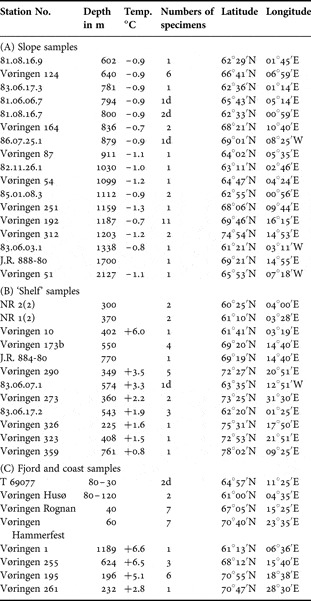
Details of the material are presented in Table 1, where also temperatures (if measured at the time of sampling) a few metres above the bottom are included. The material is split in three in the Table, slope samples (collected in below-zero temperature) at the top, sorted by depth; samples from the ‘shelf’ (including the Norwegian Trench and the Barents Sea) sorted by temperature; and finally fjord and coast samples. ‘Shelf’ is here defined as the off coast localities where the temperature never dips below zero. All the material marked ‘Vøringen’ is old dry museum material and it is not always possible to tell if live caught or not.
Material of Cerithiella studied. Empty shells are marked ‘d’ in the Table. Station numbers for the ‘Håkon Mosby’ cruises are of the form ‘yy. mm. dd. no’. The two J.R.-stations are from a cruise with RV ‘Johan Ruud’ in northern Norway in 1980. The two marked NR are from two samples from the Norwegian Trench in 1988 (Buhl-Mortensen & Høisæter, Reference Buhl-Mortensen and Høisæter1993), those marked ‘Vøringen’ are from the Norwegian North Atlantic Expedition in 1876–1878 and loaned from ZMB, while finally T 69077 is taken from a rich sample on the outer coast in mid-Norway collected by the author in 1969.

Temp., temperature.
For simplicity, specimens are identified below by the depth where taken, as this usually identifies the station unambiguously.
Most of the samples from the 1980s are from a restricted stretch of the slope, between 62°20′N and 63°N, just west of the ‘mouth’ of the Norwegian Trench. On this part of the slope a depth zone between ~500 and 700 m is affected by water masses fluctuating between positive and negative temperatures on a diurnal basis. In the following I refer to this depth zone as the thermocline. Further north this thermocline has its upper limit much deeper, around 69°N, at ~800 m (Mohn, Reference Mohn1887).
RESULTS
In this section, all Cerithiellas are referred to as either the shelf form, a modified shelf form, or the deep-water form.
All specimens of the shelf form (Figure 1A) are basically similar, whether they originate from the shelf, the coast or a fjord. The shell is a regular cone with a knobby apex, sculpture dominated by two strong, nodulated spiral cords, and a third less protruding nodulated cord just below the suture. A very thin transparent periostracum covers the glassy white shell of this form.
(A) Six specimens of Cerithiella metula, showing lack of variability in the shelf form of the taxon. Specimens to scale, the longest ~4.2 mm; (B) protoconchs of five of the specimens in A.

The protoconch (Figure 1B) has a smooth and glossy, bulbuous, more or less inflated, apical whorl. The second whorl is slightly compressed, diameter from 415–480 µm, and with numerous finely curved axial ribs starting at the beginning of the whorl. Starting at the beginning of the third whorl, two distinct spiral cords divide the whorl into three almost equally wide bands. The most variable part of the shell seems to be the size of the bulbous nucleus, the rest of the shell morphology is remarkably constant.
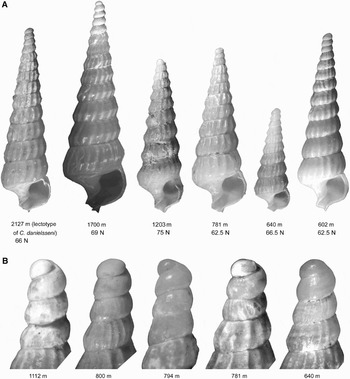
The shells of the deep-water form are also mostly similar to each other (Figure 2). The main differences from the shelf form are a rather heavy greenish-brown periostracum, and a completely different sculpture. The nodulated spiral cords are replaced by strong, gently curved axial ribs, sometimes with a bend slightly below the middle of the whorl giving the whorl a slightly angulated outline. The two extremes in the material studied (Figure 2A) are one from 1700 m (‘angulated’) and one from 602 m (‘evenly curved’) (see also Figure 4, and figures 1303 and 1305 in Bouchet & Warén (Reference Bouchet and Warén1993), showing two specimens from a sample from 1187 m).
(A) Six specimens of Cerithiella metula s.l., the deep-water form, from various depths in the Nordic Seas. Specimens to scale, the longest ~10.8 mm; (B) fairly well preserved protoconchs of five specimens from some of the same depth zones.

The protoconch is generally longer and more slender than the one in the ‘shelf form’, and with one extra whorl. The two first whorls are smooth and glossy with a diameter of 490–515 µm. There is no spiral sculpture and the axial sculpture in general appears first on the third whorl. The very fine axial ribs are generally weaker and denser than those on the second whorl in the shelf form. On the next whorl the ribs are stronger and further apart, but rather variable, as should be evident from Figure 2B.
A number of specimens originating either from the Barents Sea, north of ~72°N, or from the upper slope just above the upper boundary of the thermocline (modified shelf form; Figure 3), diverge from the shelf form by a reduction of, or complete elimination of the upper two nodulated cords. The lowermost of the cords tend to dominate the sculpture together with the axial ribs. Most of the shells have a yellowish periostracum. The protoconchs are for the most part similar to those of the shelf form. The shell sculpture is variable, as should be evident from Figure 3, but none of the specimens in any way approaches the morphology of the ones found in below-zero water on the slope.
(A) Six specimens of Cerithiella metula s.l., from various localities in the Norwegian Sea and Barents Sea with positive temperatures. Specimens to scale, the longest ~7.8 mm; (B) protoconchs of six specimens from the same depth zones.

To further illustrate the, in my opinion, fundamentally different shell sculpture in the deep-water form from the modified shelf forms, magnifications of part of the shell of four specimens are shown in Figure 4. While the main trend in the modified forms is that the upper two nodulated spiral cords are strongly reduced or totally lacking, while the lowermost cord just above the suture is maintained or strengthened, all the 36 shells found in below zero temperature have either completely smooth, gently curved axial ribs or a slight bend in the ribs around the middle of the whorl. The four shells from the ‘lower’ shelf (just above the thermocline, i.e. three from 543 m, and one from 770 m at 69°N) are indistinguishable from the ones from the Barents Sea.
Shell sculpture of four specimens of Cerithiella metula s.l. From left to right: outer coast, 65°N (shelf form); Barents Sea 72.5°N; Barents Sea 73.5°N (both modified shelf form); Norwegian Sea 66°N (deep-water form).

DISCUSSION
Bouchet & Warén (Reference Bouchet and Warén1993) maintain that all forms and varieties of Cerithiella in the North Atlantic (with the exception of C. amblytera, see below, and two rather distinct species from the southern part of the North Atlantic) are varieties of a single widespread and extremely variable species, C. metula. They divide the species into a ‘shallow water’ form and a ‘deep water’ form. Bouchet & Warén assert that in the Norwegian Sea in waters from 1000–1500 m the shallow water form ‘clines’ into a form which lacks the adapical cord and has a thick brown-greenish periostracum. This form has only two broad spiral cords and the axial ribs become very broad. The intersections of the axial- and spiral sculpture form indistinct nodules, more pronounced on the upper whorls.’
In the material I have seen, I find no evidence of a ‘cline’ or gradual change of the shell morphology with depth. Rather the investigated specimens from the continental slope (at ~62.5°N) and the Norwegian shelf belong to two distinct forms, with an abrupt change in morphology somewhere around 500–600 m. This depth corresponds more or less to the thermocline between the cold bottom water of the Norwegian Sea and the warmer water of North Atlantic origin.
The shells found above this thermocline fit the description of Cerithiella metula, while the ones below fit the description of C. danielsseni as described by Friele (Reference Friele1877). Specimens found below the thermocline, although variable, never approach the morphology of the shelf form. Neither can the variation observed be correlated with depth. Thus both the shell proportions and the degree of angulation of the whorls vary independently of depth. The specimen from the shallowest slope station (602 m) has smooth, evenly rounded axial ribs and only the barest indication of a ‘bend’ in the ribs (Figure 2). The specimens with most marked ‘angulation’ are the one from 1700 m and one from 640 m (Figure 2). That the depth in itself is not responsible for any morphological ‘clines’ is further evident from the specimen from 1189 m in Sognefjorden (‘Vøringen’ Station 1, temperature +6.6°C), which is only slightly different from the typical shelf form of the taxon. Even if there is no depth-related trend in the shell sculpture in this deep-water form, the variability is still high, which might be due to limited gene flow between populations in this taxon, in which the young hatch from an egg capsule as crawling larvae (Bouchet & Warén, Reference Bouchet and Warén1993). Further magnification of the shell sculpture of the specimens illustrated in Figure 2 reveals at least two types of microsculpture (not shown), indicating that the deep-water form might be a species complex.
Shells from the upper slope just above the thermocline at ~62.5°N, from the upper southern slope of the Iceland–Faroe Ridge, or from the Barents Sea north of ~72°N, all seem to be modifications of the shelf form (Figure 3). Figure 61A in Kantor & Sysoev (Reference Kantor and Sysoev2006), of a shell from the Barents Sea, 422 m, 73.5°N, is similar to the four shells I have illustrated from the Barents Sea in Figure 3A. All are from localities where the temperature at the time of sampling was anywhere from +3.5° to +0.8°C, while those from fjords, coast or shelf usually live in temperatures well above +5°C (Table 1). Thus rather than depth, water temperature might be a factor partly responsible for the different shell morphologies.
In my material the deep-water form is primarily an inhabitant of the lower slope, between 700 and 2000 m, and only occasionally occurring between 550 and 700 m. Among the 704 specimens of gastropods from nine samples between 576 and 708 m, only a single Cerithiella was found. This specimen (‘602 m’ in Figure 2A) was found in an extraordinary rich sample, with 297 specimens belonging to 27 species. On the other hand, in the depth interval between 770 and 1700 m, where only 291 gastropods were found, six live caught and five empty shells of Cerithiella turned up.
In this part of the Nordic Seas, depths between 550 and 650 m are exposed to large diurnal changes in temperature due to tidally induced internal waves. Study of the gastropod fauna on the slope around 62°–63°N (Høisæter, in preparation) has revealed that tens of species are found only in this depth zone. Species adapted to the permanent negative temperatures in depths below this zone may find it hard to penetrate the thermocline. If this is the case for Cerithiella, the probability that specimens of the two forms should meet is slight, and the gene flux across the thermocline barrier would be limited. This argues for a strong genetic component in the origin of the contrasting shell morphologies. The alternative is that temperature somehow is responsible for shaping the shells of genetically identical individuals. This is not inconceivable, but far more likely for the shells found along a temperature gradient from +5° to +0.5°C, than for those spanning the thermocline from positive to negative temperatures.
As the morphology of the populations found below the thermocline in my opinion is fundamentally different from the ones above, the most likely explanation is that the two forms represent either different species or subspecies. Whether two closely related taxa with adjoining distributions should be regarded as full species or subspecies is largely a subjective matter. Depending on personal preferences both designations are acceptable as long as each taxon maintains unique genetic cohesiveness throughout much of their ranges (Riginos & Cunningham, Reference Riginos and Cunningham2005). As trinomial nomenclature seems to be out of favour I would prefer to classify them as full species for the time being, not least in order to ensure that the junior name is not left out of future faunistic or biogeographical investigations. I am therefore inclined to classify the modified forms as varieties of C. metula, and to reintroduce the name C. danielsseni for the deep-water form.
Referring to the deep-water form Bouchet & Warén (Reference Bouchet and Warén1993) claim that ‘This is the form which has been described as C. danielsseni (figure 1301).’ For some reason the origin of this name is not mentioned in their exhaustive list of synonyms, nor in the text, and though the lectotype of C. danielsseni is illustrated (their figure 1304; still with no information on its author) they use as representative of this ‘cline’, another specimen taken from a station at 1484 m west of Iceland but, at 64°24′N, south of the Greenland–Iceland Ridge. According to recent hydrographical measurements, this locality should have bottom temperature of close to +4°C.
It is unwise to use a specimen from the North Atlantic proper (south of the Greenland–Iceland–Faroe Ridge) as basis for the description of any species from the deep, below-zero waters of the Nordic Seas. The description given and the specimen illustrated in Bouchet & Warén (Reference Bouchet and Warén1993) (their figure 1301) diverges in several ways also from the three specimens they illustrate (their figures 1303–1305) from the deep slope east of Iceland and the slope outside Norway. Especially the lectotype fails to satisfy the description offered for the ‘danielsseni’ form. See further the redescription of C. danielsseni below.
Of all described taxa in this species complex, Bouchet & Warén (Reference Bouchet and Warén1993) accept only C. amblytera (Watson, 1880) as a valid species in addition to C. metula. According to Bouchet & Warén (Reference Bouchet and Warén1993) this species (described from material from ‘Challenger’ Station 75, 38°38′N 28°29′W, 823 m) is distributed between 1000 and 4000 m in the Atlantic between 20°S and 40°N. However, they also indicate that there might be a cline towards some specimens from Iceland they have classified as C. metula, and also towards some specimens of the C. whiteavesi form from the north-western Atlantic. As they do not specify any morphological differences of diagnostic value for the C. amblytera/C. metula dichotomy, we are left with the photographs in Bouchet & Warén (Reference Bouchet and Warén1993). Based purely on the photographs, it is hard to figure out why the widely distributed and extremely variable C. metula s.l. should be specifically distinct from C. amblytera, which seems to nicely fit in as an intermediate between C. metula s.str. and C. danielsseni. If indeed C. amblytera is specifically distinct from C. metula, the modified forms in my material from the Barents Sea and from 770 m, at 69°N, should rather belong to C. amblytera than to C. metula.
ACKNOWLEDGEMENTS
This article would have been impossible without the meticulous work of Torleiv Brattegard and Jon-Arne Sneli in sampling the benthic fauna of the Norwegian Sea during the many cruises with RV ‘Håkon Mosby’ during the 1980s. I thank Jon Kongsrud at the Zoological Museum of the University of Bergen for placing at my disposal material from the Norwegian North Atlantic Expedition, Tom Alvestad at the Zoological Museum of the University of Bergen for his sorting of parts of the material from the ‘Håkon Mosby’ cruises, Christoffer Schander for reading and giving useful comments on the manuscript, and finally two anonymous referees whose helpful comments made me reformulate large parts of the manuscript.
APPENDIX
Redescription of Cerithiella danielsseni (Friele, Reference Friele1877)
Cerithium danielseni sp. nov. Friele, Reference Friele1877.
Cerithium procerum Jeffreys, Reference Jeffreys1877; Jeffreys, Reference Jeffreys1885 (in synonymy); Friele & Grieg, Reference Friele and Grieg1901.
Chasteria danielsseni (Friele) Warén, Reference Warén1980; Høisæter, Reference Høisæter1986.
Cerithiella metula (in part) Bouchet & Warén, Reference Bouchet and Warén1993 (indirectly as a synonym of C. procerum); Rex et al. (Reference Rex, McClain, Johnson, Etter, Allen, Bouchet and Warén2005a); Schiøtte in Sneli et al. (Reference Sneli, Schiøtte, Jensen, Wikander, Stokland and Sørensen2005); Høisæter Reference Høisæter2009.
TYPE MATERIAL
Lectotype: (designated by Warén, 1970 but first published in Bouchet & Warén, Reference Bouchet and Warén1993) ZMB 21693, 9.3×2.5 mm.
TYPE LOCALITY
‘Vøringen’ Station 51, 65°53′N 07° 18′W, 2127 m (–1.1°C).
Original description: ‘Form elongated pyramidal; 14–15 gradually increasing and only slightly convex whorls; suture distinct but shallow; mouth rhomboidical, nearly square, ending in a short, broadly abrupt to the left bent canal; columella curved; structure, coarse, prominent longitudinal ribs, there being 18 to 20 on the last whorl, terminating round the periphery in an edge; under side smooth, with fine lines of growth; the three top whorls are nearly smooth; apex rather swollen, and somewhat obliquely twisted’.
Size: L 9, B 2.2 mm
Hab: Cold area (Vøringen) St. 18, 400 f; 51, 1130 f; 54, 580 f; 87, 484 f. and ‘Lightning’ Expdn. St. 3, 550 f. (Dr Jeffreys).
In structure our species has much resemblance to Cerithiopsis costulata Møll. [= Eumetula arctica], but there is no trace of spiral lines' (Friele, Reference Friele1877:3–4; no illustration).
Very little needs to be added to this detailed description. The lectotype (figures 2 and figure 1304 in Bouchet & Warén, Reference Bouchet and Warén1993) has 13 1/2 whorls; its sculpture (Figure 4) is dominated by strong axial ribs of which there are 20 on the last whorl; these ribs are sligthly opisthocline, and evenly curved; the individual ribs are slightly convex in their lower part, changing to slightly concave just below the middle of the whorl and bending strongly into the channelled suture. Between the ribs, the upper part and lowermost part is dominated by four to six fine longitudinal striae while the slightly elevated band between the two have a number of microscopic horizontal incisions. The transition between the concave and convex part of the ribs in earlier whorls, at low magnification may seem like an incipient spiral cord. The first four whorls constitute the protoconch, which in the lectotype is abraded on top, thus giving the false impression of having a flat and compressed apex. The first two whorls are smooth, on the third very fine and dense finely curved riblets, getting gradually stronger and less dense on the following two whorls. No clear distinction between protoconch and teleoconch on the slightly eroded spire on the lectotype, but the protoconch riblets apparently disappears on the middle of the fourth whorl.
Cerithiella danielsseni has been mentioned only a few times in the literature, and mostly in synonymy. Jeffreys (Reference Jeffreys1885), apparently as the first, synonymized it with C. procera, which was also described in 1877. This synonymy was accepted by Friele (e.g. Friele & Grieg, Reference Friele and Grieg1901), and indirectly by Bouchet & Warén (Reference Bouchet and Warén1993). The long distance between the type localities should however lead to some caution regarding this synonymy. Even if the two should be conspecific, the name cannot be C. procera as this name is preoccupied at least twice (Bouchet & Warén, Reference Bouchet and Warén1993: 590).
The distribution of C. danielsseni, if only records from north of the Greenland–Iceland–Faroe Ridge are accepted, span from 60°40′N (in the Faroe–Shetland Channel) to 75°N (the slope west of Bjørnøya), and 11°32′W (slope north-east of Iceland) to 16°15′E (slope west of Senja in Norway). The species is mainly found on the middle and lower slope, from ~700 to ~2000 m. The depth of the type locality, 2127 m, is rather atypical, being by far the deepest recorded. These distribution limits are based on the material I have seen which is listed in Materialsand Methods, and on five records from the ‘Ingolf’ expedition (from Bouchet & Warén, Reference Bouchet and Warén1993) and four from the BIOFAR investigations (Sneli et al., Reference Sneli, Schiøtte, Jensen, Wikander, Stokland and Sørensen2005). In Witbaard et al. (Reference Witbaard, Daan, Mulder and Lavaleye2005) empty shells of C. metula are recorded only from the 400–500 m stratum in the Faroe–Shetland Channel, but they did not record negative temperatures in this stratum, and in all likelihood the shells belong to C. metula s.str. According to Schiøtte (in Sneli et al., Reference Sneli, Schiøtte, Jensen, Wikander, Stokland and Sørensen2005) C. metula is not particularly abundant in the cold water north and east of the Faroes. Of 29 records of C. metula deeper than 200 m in the BIOFAR investigation, only four were taken from negative or near negative temperatures. These literature records are uncertain as they (except for the ones recorded by Friele & Grieg, Reference Friele and Grieg1901) are listed as C. metula. Cerithiella was not mentioned from deeper than 2500 m in the Norwegian Sea by Bouchet & Warén (Reference Bouchet and Warén1979), neither has it been found in any of the 16 samples in the ‘Håkon Mosby’ material from depths below 2000 m seen by me. Apparently, it is everywhere an uncommon species, rarely more than a couple specimens in a single sledge sample.