


Set in the Holy Land during the First Crusade, Lully and Quinault's opera Armide (1686) relates the story of a beautiful Saracen sorceress, Armide, who loves and is ultimately abandoned by the Christian hero Renaud. Among the opera's most striking moments is Armide's transformation from enemy to lover in Act II scene 5. Renaud has provoked Armide, first by ignoring her charms, then by freeing her Christian captives. He now lies sleeping under the influence of a magic spell. Armide approaches the helpless knight with dagger in hand, eager to take her revenge. As she prepares to strike a fatal blow, her resolve suddenly weakens:
In the decades following its premiere in 1686, Armide's monologue ‘Enfin, il est en ma puissance’ came to be hailed as among the most affecting moments in French opera. Jean-Laurent Le Cerf de la Viéville prominently cited the scene in his well-known defence of French music, published 1704–6, where he recounted the almost hypnotic effect of the récitatif on audiences.Footnote 2 As Downing Thomas has shown, spectators responded with particular feeling to Armide's inner struggle at what should have been her most commanding moment. The unprecedented emphasis placed on Armide's ‘lapse into passion’ (in Thomas's words) practically insisted that audiences empathise with a woman totally dispossessed – a subversive and potentially terrifying proposition.Footnote 3
The scene owed its success in part to a radical reimagining of its source material. The opera's plot is drawn from Torquato Tasso's epic La Gerusalemme liberata, completed in 1575 and published in 1581.Footnote 4 The poem relates a fictionalised account of the Christian siege of Jerusalem in 1099. Much of the epic, however, concerns the romantic intrigue of Armida and Rinaldo (Armide and Renaud in most French translations and adaptations), who end the narrative reconciled and united in love. In the original version, Armida's encounter with the sleeping Rinaldo is related after the fact by the Wiseman of Ascalon to two Christian knights in search of their lost compatriot (canto 14). Here is Tasso's account:
She then binds Rinaldo in chains of flowers and conceals him in her secluded palace, from which he is rescued by the two Christian knights in canto 16. Striking is the near absence of the images or qualities that infuse so much drama into Lully and Quinault's version. Tasso's Armida, for instance, handles no weapon. Nor does she appear to struggle with conflicting passions. Indeed, the verse contains hardly any conflict at all. Apart from a brief moment of suspense, Armida moves smoothly from thoughts of vengeance to thoughts of love. What for Lully and Quinault will be a wrenching moment of uncontrolled passion is for Tasso an almost calm reflection on love's unexpected bloom.
Scholars generally credit Quinault with having first recognised the dramatic potential of Armida's encounter with Rinaldo. In one of the earliest modern studies of Quinault's life and work, Frido Lindemann claimed that ‘the conflict in Armide, her love for Renaud against her will, is the property of Quinault’.Footnote 7 Philippe Beaussant largely concurs in his study of Lully's career. Quinault is content to reproduce Tasso's narrative in the opening act of the opera, he writes, but begins to exceed his source material in the final scene of Act II: ‘Quinault's tragedy is less fine [than Tasso's], but it is more dramatic. For – and it is here that everything changes – it is a tragedy that begins at the very instant of Armide's reversal.’Footnote 8 Furthermore, because Quinault dramatically depicts rather than merely implies Armide's internal struggle, he produces a character of greater emotional complexity. As Raymond Abbrugiati argues in a recent article, ‘For the Armide of Lully [and Quinault], the passage from hate to love occurs in effect only at the end of a psychological crisis, which gives the character a new colour and richness.’Footnote 9 In modern discussions of the opera, the monologue has become the fulcrum on which pivots the entire work, the moment when Tasso's Armida becomes Quinault's Armide, a new character of greater psychological depth and, ultimately, tragedy.
Armide's monologue is a remarkable moment of drama, but Quinault did not create it ex nihilo. To view him as the sole force behind the development of a new Armide would be to overlook close to one hundred years of French engagement with Tasso's epic before the premiere of the opera. In musicology especially, the tendency has been to focus on the monologue's eventful afterlife, in particular its role in eighteenth-century debates over French musical aesthetics.Footnote 10 As a result, the scene's history in earlier artistic production has gone largely unexamined. Recent scholarship, however, has begun to uncover the historical origins of themes, tropes and plots found in French opera and Quinault's libretti. Sylvain Cornic, William Brooks and Buford Norman, for example, have done much in recent years to better contextualise Quinault's plays and libretti within French classicism.Footnote 11 Kathryn Anne Baillargeon and Emmanuelle Soupizet, meanwhile, have reviewed the reception of Ovid's Metamorphoses and Ariosto and Tasso's chivalric heroes, respectively, in French opera and the other fine arts.Footnote 12 In art history, Jeannine Guérin Dalle Mese has surveyed the evolving depiction of Armida and Rinaldo in early-modern painting.Footnote 13 These studies reveal the aesthetic and sometimes political preoccupations brought to bear by French adapters when refashioning earlier works for seventeenth-century audiences.
I adopt a similar approach to Armide's monologue from Act II scene 5 in this article. As Table 1 makes clear, Armida and Rinaldo's story enjoyed a rich reception history in France in the century between the first publication of La Gerusalemme liberata in Lyon and the appearance of Quinault and Lully's opera. While its popularity ebbed and flowed throughout the century, nearly every decade witnessed at least one new translation or adaptation of Tasso's epic. Some of these works are well known while others are less so, but each contributed to the development of a particular French understanding of the narrative. In what follows, I would like to survey the corpus and consider how select works portray Armida's encounter with the sleeping Rinaldo and other related moments from the narrative. As we will see, the Armide of Act II scene 5 represents not a decisive break with the past but rather one contribution to a much broader tradition of literary and musical experimentation. French authors continually remade Tasso's epic in pursuit of new dramatic goals, and the record of their fascination with this scene can tell us much of Quinault's own encounter with Tasso's poem in 1686 – and of the foundations upon which he and Lully built, in the words of the eighteenth-century biographer Évrard Titon du Tillet, ‘the greatest piece in all [French] opera’.Footnote 14
Armide and Renaud in French Literature, Ballet, Song and Opera, 1581–1686
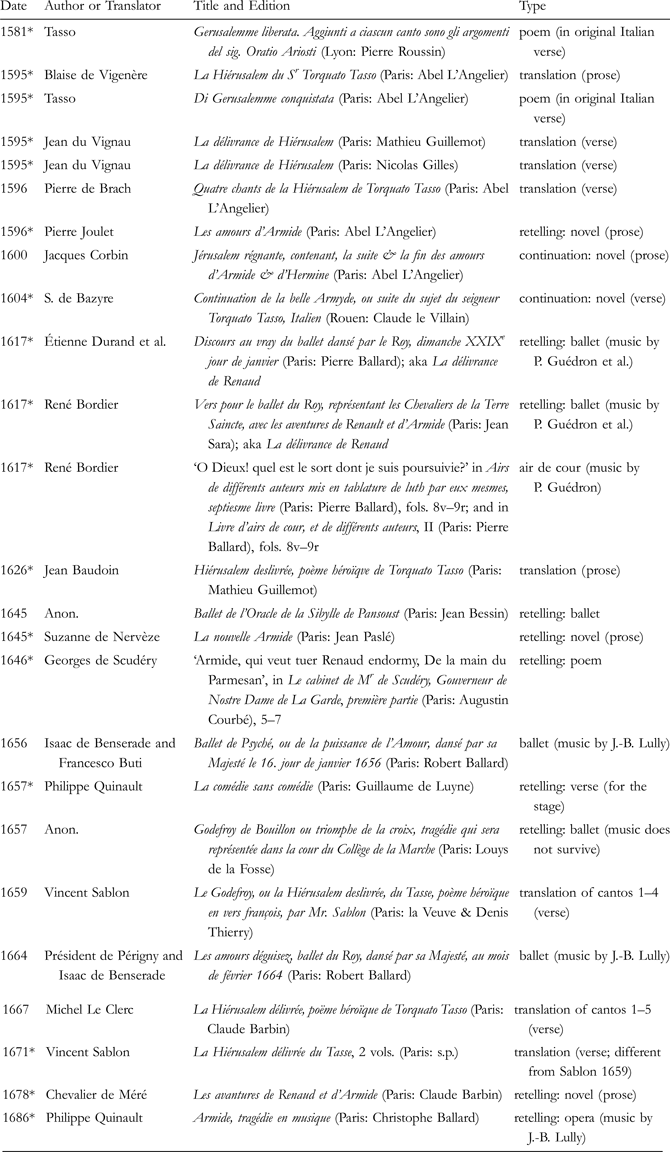
Asterisk signifies that the work recounts or depicts Armide's encounter with the sleeping Renaud.
Note: table lists earliest known edition; it does not account for subsequent reprintings or editions.
Before we turn to the sources, a word on my methodology. This article presumes that it is both possible and useful to trace the development of a narrative within a culture over time without establishing explicit chains of influence between authors. In historiography of the seventeenth century, it is often impossible to determine with any degree of precision the reading and viewing habits of individuals, especially some of the more obscure authors treated below. This does not mean that these authors did not influence one another, only that little or no evidence beyond what we locate in the work can be marshalled in support of such claims. In general, then, this article concentrates on the texts themselves without speculating about issues of influence, provenance or biography. A few exceptions are made, however, when allowed by circumstance and evidence. Finally, it should also be noted that this article's primary concern is with the text of Armide's monologue as opposed to its musical setting. It is possible that, as Le Cerf de la Viéville recorded, Lully would have revised the verse sent to him by Quinault before composing music for it.Footnote 15 However, this article follows the lead of previous scholarship and assumes that the libretto reflects the intention of its librettist.
The scene in early French translations
Tasso's poem was published in its entirety in 1581 in both Casalmaggiore and Parma. Later that year, the Parma edition was reprinted in Lyon by Pierre Roussin, whose edition is the poem's first appearance in France.Footnote 16 It was likely intended for the Italian-speaking population then residing in Lyon.Footnote 17 Compared to Tasso's pastoral play Aminta, which enjoyed broad popularity and influence in France almost immediately following its own publication in 1581, La Gerusalemme liberata was slower to make a mark on French literature during the author's lifetime.Footnote 18 Montaigne, Pierre de Brach, Jérôme d'Avost and Alphonse Delbene had read and cited the poem by the mid-1580s, but it was not until the middle of the next decade, when the Parisian publisher Abel L'Angelier oversaw an ambitious series of Tasso's work, that new editions of La Gerusalemme liberata appeared in France.Footnote 19 In 1595 L'Angelier published Blaise de Vigenère's prose translation La Hiérusalem du Sr Torquato Tasso, rendue françoise, both the first edition of the poem published in Paris and the first French translation. That year L'Angelier also published an edition of Tasso's late revision of the poem entitled La Gerusalemme conquistata, the manuscript of which, L'Angelier informs the reader, Tasso had recently sent him from Italy.Footnote 20 Finally, in 1596, L'Angelier brought out a partial translation of the poem by Pierre de Brach as well as Pierre Joulet's novel Les amours d'Armide.Footnote 21 In addition to L'Angelier's publications, the printers Mathieu Guillemot and Nicolas Gilles together published a verse translation of La Gerusalemme liberata by Jean du Vignau in 1595. In total, then, three Parisian publishers printed five editions or adaptations of Tasso's poem in two years.
In these early translations of La Gerusalemme liberata, Armide broadly resembles Tasso's original vision for the character, with neither Blaise de Vigenère nor Jean du Vignau straying far from their source material. Each recounts Armida's encounter with the sleeping Rinaldo more or less as it transpires in Tasso's poem, that is, without the added action and dramatic indecision of Quinault's libretto.Footnote 22 De Brach's version, completed c.1593 and published in 1596, is less predictable. He translates only four of the poem's twenty cantos: 16, 4, 12 and 2, in that order. Canto 16 relates the rescue of Renaud from Armide's pleasure-palace by two Christian knights, while canto 4 describes Armide's initial infiltration into the Christian camp outside Jerusalem. Cantos 12 and 2, meanwhile, narrate parts of the story of Tancredi and Clorinda. His decision to begin with Renaud's rescue betrays an early preference in France for this episode: in 1617 it would provide the plot to the ballet La délivrance de Renaud. Because De Brach omits canto 14, his publication does not include a rendering of Armide's encounter with Renaud. In the preface, De Brach offers the following explanation for his unusual ordering of the poem: ‘The cantos are out of order, but that is the way they hatched under my quill feather [plume]; and this does not matter so much since they are complete in what they treat and do not depend one upon the other.’Footnote 23 This remark articulates an important development in the reception of the poem in France. For him, it is possible to detach episodes from Tasso's narrative and experience them as self-contained dramatic units since, as he writes, they do not depend one upon the other. Indeed, so great is their independence that there is no need to adhere to Tasso's chronology of events: Renaud's deliverance from Armide's palace (canto 16) can precede the two characters’ initial encounter (canto 4). While no other author in France manipulated the chronology of Tasso's poem like De Brach, they did follow his lead by adapting discrete episodes and individual characters from La Gerusalemme liberata for the novels, ballets and plays that proliferated in the poem's wake.
The scene in the roman sentimental
La Gerusalemme liberata arrived in France at the same time as a new literary medium, the novel. The re-establishment of civil peace in the late 1590s and the growth of salon culture under Henri IV provided the necessary conditions for the genre's flourishing: while only two or three original novels were published in France between 1560 and 1590, thirty-two were published in the final decade of the century and 118 between 1600 and 1610.Footnote 24 An essential characteristic of these early novels is their emphasis on les sentiments and especially feelings of amorous love, which are often described in grave, dolorous and melancholic terms: ‘never do we see lovers quicker to shed tears’, writes Maurice Lever, than in these early seventeenth-century French novels.Footnote 25 The plots tend to revolve around two lovers, an obstacle separating them and, if the end is happy, a marriage.Footnote 26 In some novels, episodes of travel and combat punctuate the otherwise standard love story.Footnote 27 The roman sentimental seems to have been most popular among highborn women, courtiers and students.Footnote 28
La Gerusalemme liberata proved to be a tempting source of material for novelists. Beginning with Pierre Joulet's sentimental novel Les amours d'Armide, French authors shifted their attention away from strict verse or prose translations of Tasso's epic and towards more flexible adaptations based on its characters and scenarios. Indeed, following De Brach's partial translation in 1596, thirty years would pass before the next attempt to translate Tasso's entire poem into French: Jean Baudoin's 1626 Hiérusalem deslivrée. That novelists found inspiration in La Gerusalemme liberata is unsurprising, for it teems with the kind of sentimental love story eagerly consumed by readers of the French novel. Armida and Rinaldo in particular captured the French imagination. Jacques Corbin's Jérusalem régnante (1600) and Bazire d'Amblainville's Continuation de la belle Armyde (1604) are both so-called continuations of Armide's story, that is, they imagine events that transpire after the conclusion of Tasso's narrative, suggesting a growing sentimental interest in Armide's fate among a broad French readership.Footnote 29 Joulet's novel, first published in 1596, is more firmly rooted in Tasso's original poem. Joulet transplants Armide's narrative from La Gerusalemme liberata and adheres more or less to the story's outline. The narrative, however, is transformed by the florid language characteristic of the early novel in France. Here, for example, is Joulet's rendering of Armide's encounter with the sleeping Renaud:
[Renaud] having been immediately recognised by the beautiful Armide, who was on lookout nearby, she got up with the intention of running him through and taking his life … Having arrived five or six steps from Renaud she stopped firm before him, and despite all the impatience that her anger gave her to quickly tear out his heart and give it as prey to the vengeance that consumed her, she could not stop herself from regarding him beforehand, and in truth with a little more curiosity and leisure than would have seemed possible for an outraged woman. And after having stood in this way a while, she wanted to look at him closer still, and with a moderate step and filled with a fearful fury and audacious respect, she set herself next to him to contemplate him more exactly, and having cast her eyes over his face, whose beauty she grew enamoured of, and over his lips, which called more for kisses from her mouth than for the workings of her hands and sword, and after having admired his chestnut hair, curled by the hand of beautiful Venus, and after considering his body so well-proportioned in a way that had a je ne sçay quoy so agreeable that at first sight it forced the wills of those who saw to love it forever, she felt little by little extinguish in her breast the fires of importunate anger and alight the flames of a precious and dear love; erasing from her heart the pains of old, past injuries, with hope of the joys she promised herself from the possession of a beauty so lovable, in order to engrave more easily there in letters of fire and ember the image of this new Adonis, like a god to whom she already sacrificed not only her inner self and her hatreds, but also her freest passions, so much so that to this man who before this viewing was her mortal enemy she became in an instant his mistress so hopelessly in love and so lovingly hopeless that she proved, contrary to the maxims of philosophy, that it is possible to move from one extreme passion to the opposite extreme without descending by degrees from the summit of one to climb by other steps until the top of the other, since from a very strong hatred she went in one jump to the most violent love imaginable, pulling out with one yank her soul, which was numb and fastened to the ice of her old passion, to throw it into the sweet flames of her new affection.Footnote 30
The basic outline of the encounter remains as it is in the original poem. Indeed, Joulet emphasises even more than Tasso the suddenness of Armide's change: in an instant she becomes Renaud's lover, moving directly from one passionate extreme to the other without hesitation. But there are also important differences. First, Armide is armed with a sword. Joulet's version is the first in France, and perhaps the first anywhere, to place a weapon in her hand, and most subsequent depictions of this scene in France, barring the strict translations, will follow suit. Second, Joulet's long and fanciful elaboration lends the scene a weight otherwise missing in the original version. On the one hand, it is an opportunity to indulge in the flowery description typical of late sixteenth-century prose; on the other, it is an early attempt to reimagine the thoughts and feelings of Armide at a critical moment in her story. Joulet writes of her anger, the pains of past injuries, her frankly erotic attraction to Renaud, and the violence of sudden, hopeless love, a procession of feelings implied, perhaps, but never stated in Tasso's poem. Through Joulet's prose, in other words, Armide becomes the emotive, love-struck, sympathetic heroine typical of the roman sentimental. Still far removed from the drama of Quinault's Act II scene 5, Joulet's passage is nevertheless the first time in France an author substantially rewrites Tasso's scene in pursuit of new dramatic goals.
The scene in ballet
In addition to the roman sentimental, the arrival of La Gerusalemme liberata in France also coincided with the first ballets de cour.Footnote 31 These early ballets often borrowed their scenarios from sixteenth-century Italian literature, in particular the work of Ariosto and Tasso.Footnote 32 On 29 January 1617, the court of Louis XIII danced La délivrance de Renaud, among the most elaborate ballets of the seventeenth century and the only one produced before the second half of the century to feature Armide and Renaud in prominent roles. As the title suggests, the ballet's plot centres on a single episode from La Gerusalemme liberata: two knights infiltrate Armide's palace, battle monsters, remind Renaud of his Christian duty and spirit him away before Armide can stop them. Nobles of the court, including the king and his favourite gentleman, Charles de Luynes, danced in the ballet.Footnote 33 Its plot is usually read as allegorising the struggle of Luynes (who danced the role of Renaud) to wrest power away from the king's mother, Marie de’ Medici (represented by Armide), so that he can better serve Louis XIII (Godfrey of Bouillon, leader of the Christian forces) as he assumes personal rule of the kingdom.Footnote 34 Two sources, both published in 1617, preserve the ballet: Étienne Durand's Discours au vray du ballet dansé par le Roy, an elaborate volume containing the scenario, verse, set design, costumes and vocal music, and the smaller Vers pour le ballet du Roy, a booklet of the ballet's verse compiled by René Bordier, who composed much of the poetry.Footnote 35 Pierre Guédron, Gabriel Bataille, Antoine Boësset and Jacques Mauduit provided the ballet's music. The choreography, by Jacques de Belleville, does not survive.
Since the ballet's action takes place after Armide has imprisoned Renaud, it does not depict the moment of her transformation from enemy to lover. However, both sources of the ballet do contain a spoken monologue for Armide in which she describes her sudden ravishment before the sleeping Renaud. They differ on when in the narrative Armide delivers the verse: the Discours au vray concludes with the poem while the Vers pour le ballet opens with it.Footnote 36 Despite the long-enjoyed authority of Durand's publication, it is unlikely that the ballet concluded with the monologue. There is little sense in Armide relating her encounter with Renaud at this particular moment, and the livret itself suggests that the preceding piece, a grand ballet danced in celebration of Renaud's liberation, is the work's true finale. If the monologue was in fact performed at the ballet's premiere, it probably occurred early in the narrative, as it does in the Vers pour le ballet.Footnote 37 Here is the text:
The use of the first-person voice lends immediacy to the lyric. For the first time in France, Armide herself relates her conflicted feelings. This is an important development in the scene's theatric potential, although some might argue that it still lacks dramatic urgency. Armide only remembers her encounter with Renaud – she does not yet experience it before an audience. Nevertheless, by giving voice to Armide's joy and despair, the monologue helps to establish a more sympathetic, less one-sided character than she otherwise would be in the ballet.Footnote 40 Indeed, the confusion over the monologue's placement in the narrative may reflect an uneasiness on the part of the ballet's creators over whether Armide should be represented as sympathetic or purely antagonistic. If the ballet is meant to allegorise the end of Marie de’ Medici's regency and the beginning of Louis XIII's personal rule under the guidance of Luynes, too much sympathy for Armide might be read as undermining the young king's claim to power.Footnote 41
In the Discours au vray, Durand published the music for the ballet's sung verse but not for Armide's monologue. It could have been meant to be sung in performance, though, because Pierre Guédron published a musical setting of the monologue in 1617 alongside other songs from the ballet.Footnote 42 It is unclear why Durand failed to publish the music. Whatever the case, Guédron's song is the first musical setting related to Armide's encounter with Renaud produced in France. With it, a large community of amateur singers and lutenists had their first opportunity to inhabit Armide's character and re-experience through musical performance her love for Renaud. The music is typical of the early strophic air de cour, in particular its unbarred, free-flowing metre, a remnant of Jean-Antoine de Baïf's poetical experiments of the 1570s.Footnote 43 Alongside Lully's cantata Ah Rinaldo, e dove sei?, sung by Armida after her abandonment in the eighth entrée of the Ballet des amours déguisez (1664), it is the only song published in France before 1686 to refer to Armide or adopt her voice that I have been able to find, a surprising fact considering the popularity of Tasso's poem throughout the seventeenth century.Footnote 44
La délivrance de Renaud is also the century's only ballet to reference the events of canto 14. Armide appears in four other ballets produced before 1686: as a minor character in the second entrée of the obscure Ballet de l'Oracle de la Sibylle de Pansoust (1645), in which she briefly appears alongside two other female magicians; as a minor character in Ballet de Psyché, ou de la puissance de l'Amour (1665), a collaboration between Jean-Baptiste Lully, Isaac de Benserade and Francesco Buti, where in the eleventh entrée she is again viewed among a group of magicians, including Medée, Circé and Alcine; as a minor character in Godefroy de Bouillon ou triomphe de la croix (1657), a five-act ballet performed at the Jesuit Collège de La Marche, in which she tempts Renaud from his Christian duties; and as a character in the aforementioned Ballet des amours déguisez (1664), another collaboration between Lully and Benserade with additional text by Octave de Périgny. This long ballet's plot is drawn from several disparate sources; entrées seven, eight and nine feature Renaud and Armide. These entrées focus on Renaud's rescue from Armide's palace, after which Armide sings her lament Ah Rinaldo, e dove sei? Footnote 45 In sum, the character Armide serves one of two roles in these ballets: a figuration of sorcery and temptation (as in La délivrance de Renaud, Ballet de l'Oracle de la Sibylle de Pansoust, Ballet de Psyché, ou de la puissance de l'Amour and Godefroy de Bouillon ou triomphe de la croix) or an example of the abandoned woman (Ballet des amours déguisez). The inclusion of Ah Rinaldo, e dove sei? in the Ballet des amours déguisez anticipates the final act of Armide by concluding Armide's narrative with a sorrowful complaint rather than a celebration of Renaud's rescue and return to battle, as in the earlier La délivrance de Renaud, though the Italianate cantata is textually and musically quite unlike the later opera.Footnote 46
The scene in French literature: 1645–1655
The middle decade of the century was a period of experimentation for French authors working with Tasso's poem in a variety of genres. It is in their works that many of the narrative events later integrated into Armide's monologue of Lully and Quinault's opera first appear. In 1645 Suzanne de Nervèze published La nouvelle Armide, the fourth novel in France dedicated to the character. Like Pierre Joulet, Nervèze hews more or less to Tasso's plot, although her novel is roughly a sixth the length of the earlier work. It is also a more lighthearted treatment of the narrative. Nervèze de-emphasises the siege of Jerusalem and all other martial events. She also introduces a new character, the shepherdess Ismenie, whose troubled romantic life is the focus of the novel's middle section. Finally, although Renaud is again rescued from Armide's palace by two compatriots bearing a magic shield, the lovers’ parting is not the bitter, wrathful scene depicted by Tasso in canto 16 of the original poem. Instead, Renaud promises to marry Armide as soon as he can convince Godfrey of her worthiness. Godfrey quickly consents to the marriage, and the novel concludes with Armide's baptism and wedding.
Despite the general breeziness of her novel, Nervèze's depiction of Armide's encounter is more complex than earlier French adaptations. At first, it departs little from the original: Armide is quickly overcome by Renaud's beauty and renounces her plans for revenge. However, Nervèze elongates the scene by introducing an element of doubt. Her Armide trembles with confusion and begins to question her own feelings of love: ‘What, she says to herself, Armide, are you so cowardly as to be unable to resist the first danger [of love] you encounter, and without the excuse of a long courtship you give yourself over to the mercy of a man who perhaps has no intention of loving you? … Would it not have been better to choose one of those whom you have treated poorly [i.e., the other Christian knights] than to make yourself a slave to an enemy who has shown for you only contempt[?]’Footnote 47 In the end her love for Renaud proves too strong. Weeping, she admits what the reader already knows to be true: ‘Alas! … useless thoughts, what makes me think them, since it is not in me to follow any other counsel save that of my passion?’Footnote 48 Although Armide gives in to lust and makes Renaud her lover, her episode of doubt is an original contribution to the scene. Where Joulet had emphasised the rapidity of Armide's transformation, Nervèze instead lingers over her confusion and indecision. The result is a moment of pathos quite beyond that of earlier versions.
We encounter a very different Armide ten years later in the nineteen-year-old Quinault's La comédie sans comédie, the first spoken play produced in France to feature the scene. It was his fourth stage production, and the first to premiere in 1655 at a theatre other than the Théâtre de l'Hôtel de Bourgogne, the institution that had nurtured his early talent. The play's structure is unusual: Act I introduces Hauteroche and La Roque, two actors who wish to marry Silvanire and Aminte, the two daughters of La Fleur, a merchant. La Fleur takes a dim view of the young men's profession and refuses to consent to the marriages. To convince him of their worthiness, Hauteroche and La Roque propose to act out four brief scenarios, each of a different dramatic genre: a pastoral, burlesque, tragedy and tragi-comedy. The final four acts of La comédie sans comédie correspond to the four mini-plays performed for La Fleur, who watches the action from the side of the stage.
The final act, ‘Armide et Renaud, Tragicomédie en Machines’, centres on Armide's encounter with Renaud. In scene 5, two mythological creatures lull Renaud to sleep with singing. As Armide prepares to strike him dead with her dagger, Cupid appears suspended in air and commands her to stop (‘Arreste, arreste Armide!’). For the crime of despising love, he will punish her by transforming Renaud into her lover. Armide scoffs at the god's pretentions to power:
Cupid replies that she will soon learn the full extent of his ability. He fires an arrow into her breast and flies away. Armide is at first unconcerned (‘this blow is too light to protect Renaud from my anger’), but something holds her back as she moves to strike Renaud:
Armide concedes that Cupid has bested her; she now loves Renaud as much as she once hated him. But Cupid's vengeance is imperfect, for ‘He punishes me with a stroke that does not displease me at all.’Footnote 51 Cupid concludes the act by promising to serve as her guide through the world of love. The message of this final scenario is clear: a woman without a man to love is a dangerous thing. La Fleur is convinced, and the play ends with him congratulating Hauteroche and La Roque on the power of their craft and consenting to the marriages.
Because it employs stage machines and introduces sung verse, some scholars have viewed Act V of La comédie sans comédie as an early draft of the opera Armide.Footnote 52 Certainly Quinault's treatment of Armide in the play prefigures some of the events in Act II scene 5. He portrays Armide's transformation from avenger to lover as a contested, physically strenuous ordeal. She doubts, struggles, furiously yearns both to love and to slay Renaud. She also handles a dagger; and while Joulet was the first to introduce a weapon into the scene, Quinault's Armide seems eager to use it. The monologue from Act II scene 5 of the opera will retain and build upon these novel qualities, but there are also important differences. In La comédie sans comédie, only the timely appearance of Cupid prevents Armide from plunging her dagger into Renaud. What Quinault will later depict as an inner struggle fought by Armide against herself is here an outward struggle between Armide and a mischievous god.Footnote 53 Ultimately, then, her love for Renaud is not a feeling borne of admiration or physical attraction but rather the product of Cupid's arrow. The scene lacks the psychological realism of the later opera, for realism is not the point. Rather, Quinault's play is a kind of comedic morality tale, the story of a loveless virago's comeuppance at the hands of Cupid. Although he is the first playwright or librettist in France to recognise the dramatic potential of this encounter and to structure an entire dramatic act around it, his La comédie sans comédie pursues ends that are very different from those of Act II scene 5.
Nicolas Poussin's painting Rinaldo and Armida (c.1630) may have informed Quinault's handling of Armide and Renaud in La comédie sans comédie, for it also depicts Armide with dagger in hand held back by Cupid. We know that Quinault's friend and mentor Tristan l'Hermite hung a painting of Armida and Rinaldo in his room, where Quinault would have had opportunity to view it.Footnote 54 It is unknown whether or not Tristan's painting was by Poussin, although some have argued it was.Footnote 55 It is also possible, however, that Quinault drew inspiration from a heretofore overlooked publication. In 1646, Georges de Scudéry published Le cabinet de M de Scudéry, a collection of short pieces inspired by visual art. The second poem, ‘Armide, qui veut tuer Renaud endormy’, describes the encounter from the perspective of one attempting to dissuade Armide from killing Renaud.Footnote 56 In one possible reading, a Cupid (‘l'amour’) holds back her arm. The poem begins:
Note that Scudéry's first line, ‘Arreste, arreste belle Armide’, is nearly identical to Cupid's first line in Quinault's La comédie sans comédie, ‘Arreste, arreste Armide’. Furthermore, Scudéry introduces a moment of suspense in the eleventh stanza similar to Quinault's depiction of Armide's hand trembling with indecision:
Quinault was ten when Scudéry published the poem, but he might have encountered it later in the 1640s or 1650s. He must have known of Scudéry by 1655. Scudéry was one of the more prominent playwrights in Paris at the start of Quinault's career, and La comédie sans comédie is probably indebted to Scudéry's La comédie des comédiens, which premiered at the Théâtre de l'Hôtel de Bourgogne in 1634 and was published the following year.Footnote 59 Like Quinault's play, it too features a troupe of actors who perform a play (‘L'amour caché par l'amour’) within the framing narrative.Footnote 60 Whatever the nature of influence running through Poussin, Scudéry and Quinault, each of their works displays the same tendency to externalise Armide's struggle through the introduction of Cupid. The exception is Nervèze, whose Armide alone struggles with true self-doubt, but her novel appears to have been little read and quickly forgotten.Footnote 61
The Chevalier de Méré
The final work to consider as a precedent for the most famous scene in Quinault's Armide is by an author better known for non-fiction.Footnote 62 The Chevalier de Méré, whose given name was Antoine Gombaud, found a receptive audience for his essays on l'honnêteté, an expansive philosophy of morality, etiquette and social behaviour popular at court and the Parisian salons. In 1678 he published his lone work of fiction, the brief novel Les avantures de Renaud et d'Armide. The work is more faithful to Tasso's poem than Nervèze's novel, but Méré provides new dialogue for the title characters and, in general, de-emphasises the magical or supernatural elements present in the original narrative. He also alters two important scenes. The most obvious change occurs in Renaud's rescue from Amide's palace by the Christian knights. In the original, Armide faints from sorrow and Renaud, harried by his companions, leaves her half alive on the shore. Méré, apparently shocked by Renaud's conduct, felt compelled to invent an excuse to help explain his rapid desertion of the helpless Armide. In his novel, Renaud faints as well and is dragged away by the others before he can choose to desert his erstwhile lover.Footnote 63 In this change and the other discussed below, Méré’s intention appears to have been to render both title characters as sympathetic as possible and thus make their ultimate union at the end of the novel more pleasing to the reader.
Most importantly for our purposes, the other scene altered by Méré is that of Armide's encounter with the sleeping Renaud. Although the changes are subtler, they are nevertheless far-reaching:
Armide … walks toward the young, sleeping man with scimitar in hand. Her face and words showed that she was no less sensible to glory than to vengeance. ‘Finally … I hold [in my power] this valiant terror of Saracens, this Renaud who before Jerusalem neglected me with an intolerable indifference, and who since would not have been happy to have freed my prisoners if he had not also killed my guards.’ Having come to him, she stops, and considering him at leisure to prolong the sweetness of vengeance, she feels on his closed eyes, and on his face covered with powder, a secret power that holds back her arm and sets her in suspense: should she use violent blows to lessen his suffering, or lighter wounds to treat him with more gentleness? But by watching him she loses all her anger, her hate turns to tenderness, and she has pity for him for the danger he ran, inflicted by her; and accusing herself of cruelty, she excuses all that he has done against her.Footnote 64
Viewed in relation to both previous and subsequent attempts to reimagine this scene in France, Méré’s interpretation must be considered a breakthrough. In it, the disparate innovations of earlier versions coalesce into one unified moment of dramatic action. As in several earlier renderings, Armide is armed, here with a scimitar. Furthermore, her transformation from avenger to lover is again non-linear: with sword held precariously aloft, she responds to her new feelings with sincere confusion, and her vacillation between love, vengeance, violence and tenderness generates the scene's dramatic interest. Finally, and most importantly, her love for Renaud is not the result of external machinations, as it was in La comédie sans comédie. It is an immanent component of her psychology rather than the effect of Cupid's arrow. Where Quinault celebrated the subjugation of a woman under love's dominion, Méré, like Nervèze before him, portrays a woman compelled to act by her own conflicted feelings of love.
It is clear from his other published work that Méré made alterations to the scene with certain dramaturgical objectives in mind. In his essay on social grace, written around the same time as his novel, he argues that the greatest mark of social aptitude is the ability to move and win over a sensitive individual. The key to evoking true emotional response in such a person is to reject overwrought and artificial expression in favour of the natural and sincere. To demonstrate his point, Méré compares the effect of two moments in La Gerusalemme liberata. The first is Tancredi's long and brilliant monologue upon the death of his beloved Clorinda in canto 12. His speech can only disappoint, Méré claims, for its brilliance cheapens what should be a scene of emotional devastation. In contrast, the encounter between Armida and Rinaldo succeeds as drama because of its sincerity. As Méré writes:
But for the subtleties of the heart, [we must study] that beautiful princess … who seeks the bravest of her enemies in order to kill him; finds him sleeping alone, and as she approaches with the intention of doing away with him, she finds in him so much grace that she falls in love, and love holds back her arm; but not so soon being able to change her resolution she deliberates on whether she ought to use violent blows to lessen his suffering or lighter strikes to treat him less roughly. It is tenderness that gives rise to these various considerations, and they are pleasurable to think upon because they are natural.Footnote 65
Unlike Tancredi, Armide acts in a natural, recognisably human way. Her resolve weakened by Renaud's grace, she wavers between violence and tenderness. In other words, she responds to an extraordinary situation with believable feeling. Notice, however, that Méré does not describe the scene as it unfolds in the original poem – as we know, Tasso passes over Armide's internal struggle with little comment. Instead, Méré describes his own interpretation of the scene as published in his novel. He provides, in essence, a justification for rewriting Tasso: the scene is more credible, and thus more pleasurable to consider, as he renders it.
Although Lully and Quinault's opera premiered only eight years after the publication of Méré’s novel, it has rarely been examined in relation to the earlier work.Footnote 66 Whatever the reason for the novel's neglect, it nevertheless anticipates a number of qualities associated with the more famous opera's Act II scene 5. First, the novel and opera share common language. Both scenes begin with the word ‘enfin’ (finally). This may seem a superficial likeness, yet the word performs an important dramatic function: it establishes Armide's impatience for revenge and renders her subsequent struggle all the more fraught. Next, each version follows the word ‘enfin’ by describing Renaud's current relation to Armide. In Méré’s novel, Armide states that, ‘Finally, I hold [in my power] this brave terror of Saracens, this Renaud’, while Quinault's Armide recites something similar: ‘Finally, he is in my power, this fatal enemy, this superb vanquisher.’ The versions also share additional language immediately following Armide's transformation. Méré’s Armide accuses herself of cruelty for having wanted to kill Renaud, while Quinault's Armide levels a similar accusation: ‘Ah! What cruelty to take his life!’Footnote 67 In each version, the reproach indicates a new frame of mind and suggests the profundity of change. The most important quality shared by the novel and the opera, however, is their dramatic effect. They both present Armide's encounter with Renaud as a scene of pathos. She struggles with her emotions, and Méré and Quinault each structure the scene so as to emphasise the difficulty of her choice.
Did Quinault know Méré or his work? On the one hand, mid-century salon literature is known to have influenced Quinault. Patricia Howard has shown that themes and character types drawn directly from salon literature suffuse his plays and libretti, and contemporary critics were quick to note his affinity with the so-called Précieuses, the hyper-refined coterie of poets and novelists active in the 1650s and 1660s.Footnote 68 If Quinault did read Méré, a salon author par excéllence, it would have been in keeping with what is already known of his working practices. The accusations of plagiarism levelled against him by colleagues in Paris throughout his career would also suggest that Quinault drew from a largely French constellation of texts in his own work.Footnote 69 If he had wished to read a French adaptation of Tasso's poem before composing the libretto, Méré’s novel would have been an obvious choice. On the other hand, the similarity of their texts is far from conclusive proof of influence. It is not difficult to find combinations of similar words and phrases in other publications, including earlier works by Quinault himself.Footnote 70 Both Méré and Quinault drew upon a limited vocabulary in their work, which complicates the task of assigning influence in either direction. It must also be admitted that, aside from their depiction of Armide's love for Renaud, a number of narrative decisions distinguish the two works, such as Méré’s choice to relate Armide and Renaud's full story, including the events of canto 20 and its scene of reunion, and Quinault's choice to model his version of Renaud's desertion of Armide after Tasso's original rather than Méré’s revised account discussed above. Moreover, although they had mutual acquaintances, including the publisher Claude Barbin, who printed work for both men, there is no evidence that they ever met, corresponded, or referred to one another in writing.Footnote 71
Whether or not Quinault read Méré’s work, the fact remains that these two authors, working around the same time within the same social milieu, transformed a particular moment from Tasso's poem in similar ways. As the historical contextualisation undertaken in this article suggests, both authors’ versions of the monologue belong to an evolving tradition of translation and adaptation, one that can be summarised as follows: immediately following the appearance of the first translations of La Gerusalemme liberata in the 1590s, the French took a special interest in Armide. The sentimental novels from the turn of the century attest to the reading public's desire to know more of the character and her fate. Gradually, adapters began to focus specifically on the drama of her conversion from enemy to lover. Perhaps unsurprisingly, novelists instigated the change in emphasis, for their medium invited extended commentary on the inner workings of a character's mind. In his 1596 sentimental novel, Pierre Joulet lingered over the scene to a greater extent than those before him. He also raised the stakes of the encounter by arming Armide. Later in the next century, at a time when several adapters were inserting Cupid into their creations to dramatise Armide's struggle, Suzanne de Nervèze introduced true self-doubt into the narrative for the first time. Standing over Renaud's sleeping body, her Armide questions her new feelings of love and briefly despairs over the choice she must make. Finally, in the Chevalier de Méré’s rendition, the elements of earlier adaptations combine into a single dramatic scene for the sake of heightened emotional realism. Her struggle between love and hate becomes ‘natural’, according to Méré, and all the more affecting because of it. When viewed in relation to the scene's long history, Quinault's achievement in 1686 comes into clearer focus. Aside from the quality of the verse, there is nothing, strictly speaking, novel about the monologue from Act II scene 5. The passionate internal struggle often identified as its most powerful contribution to the narrative has, in fact, clear precedent.
But if the events of Act II scene 5 were nothing new by the 1680s, why did they affect contemporary audiences so deeply? Part of the answer surely lies with Lully's score, which heightens the scene's impact in ways available only to music. Indeed, Le Cerf de la Viéville wrote that audiences witnessed the encounter breathless, seized with fright until the final strains of the violin gave ‘permission to breathe again’, suggesting the primary role of music in guiding the listener's experience of the moment.Footnote 72 Another, less obvious characteristic of the opera, however, might also help to explain the monologue's power. While elements of the monologue resemble earlier depictions, Quinualt's decision to treat the scene as one piece of a tragic whole is nonetheless unique. It is easy to forget that, in Tasso's original poem, Armida's ultimate fate is a ‘happy’ one when, at the end of canto 20, she agrees to become Rinaldo's handmaiden. Since most adaptations of Armida's narrative include this ending or, in the case of La comédie sans comédie, a thematically similar one, none can be said to treat the character as a truly tragic figure. The only other adaptation to end with Armide's abandonment is the ballet La délivrance de Renaud, but, as its title suggests, Renaud's deliverance from the sorceress is presented as cause for celebration, not mourning. In the Ballet des amours déguisez, the eighth entrée does conclude with Renaud leaving Armide, but their story constitutes only a small portion of a much larger, heterogenous plot drawn from multiple sources. Quinault's opera marks the first time in France a complete narrative relates the story of Renaud and Armide and concludes in a tragic vein with her abandonment. And unlike the novels of Méré and Nervèze, both of which lessen the intensity of Armide's desertion, the final scenes of the opera starkly portray a woman devastated by her loss. Cast in this harsh new light, Armide's monologue must have taken on added urgency for the opera's original spectators. Although she wavers between love and hate in ways reminiscent of earlier adaptations, her ultimate choice means far more within the context of the story; it is her undoing.



