





Introduction
Sensitive and high-throughput testing for Neisseria gonorrhoeae (NG) is widely underpinned by commercial solutions which utilize large, automated instrumentation and nucleic acid amplification tests (NAATs). Established Conformité Européenne – in vitro Diagnostic (CE-IVD) solutions include Cobas 5800/6800/8800 CT/NG (Roche Molecular Systems, Inc., USA) [Reference Van Der Pol1] and Aptima Combo CT/NG (Hologic, San Diego, CA, USA) [Reference Hilmarsdóttir2], both of which simultaneously screen for NG and Chlamydia trachomatis (CT).
We have used Cobas CT/NG in our laboratory since 2017 for NG and CT primary screening of swabs (genital, anorectal, and oropharyngeal) and urine. We report on our experience of using this test at scale, in which we have tested over 360000 specimens within the last three years. Additionally, in our laboratory, Cobas NG-positive results from extragenital specimens undergo confirmatory testing with a second assay, in line with UK guidelines [3, Reference Fifer4] and wider judgement [Reference Whiley5–Reference Cuschieri8]. This is crucial as specificity problems with NG NAATs generally have long been recognized [Reference Whiley, Tapsall and Sloots9–Reference Tabrizi12]. This continues to be an ongoing challenge for NAAT testing due to the ability of NG and other Neisseria species to undergo genetic exchange through transformation [Reference Linz13] and the increasing use of NAATs to test extragenital sites, known to contain non-gonococcal Neisseria.
The CE-IVD NAAT Xpert CT/NG (Xpert NG) (Cepheid, Sunnyvale, CA, USA) [Reference Han14] has served as our confirmatory assay. Those samples that do not confirm by Xpert NG are reported as ‘indeterminate’. Such samples are highly problematic, as they fail to provide a definitive result for the patient, can impact patient management, require potentially unnecessary patient recall for repeat sampling, and are particularly contentious and unhelpful for paediatric samples and sexual assault samples.
We highlight the challenges faced concerning poor specificity for NG when testing oropharyngeal swabs and review NG confirmation using Xpert NG on a large sample set. Significantly, we also demonstrate that Cobas NG tests positive for an isolate of Neisseria lactamica that possesses NG DR-9, the highly conserved direct repeat region targeted by the assay.
Methods
Cobas NG and Xpert NG testing
Roche Cobas CT/NG (Cobas NG) was performed on the Roche Cobas 8800 system as per the manufacturer’s instructions. Cepheid Gene Xpert CT/NG (Xpert NG) was performed as per the manufacturer’s instructions, with the exception that samples were collected in Roche Cobas PCR media, which is not an approved media for Xpert NG. A total of 1 mL of sample was processed by Xpert NG. Cobas NG was used for primary testing. Xpert NG was used for the confirmatory testing of Cobas NG-positive samples. Samples that were negative by Xpert NG were reported as ‘indeterminate’.
Xpert NG confirmatory testing of different sample types
Following internal validation and implementation of Cobas NG and Xpert NG, for a three-month period (7 September 2017 to 7 December 2017), Cobas NG-positive results, irrespective of sample type or collection site, were confirmed by Xpert NG. This dataset comprised of 681 Cobas NG-positive samples (161 anorectal swabs, 281 oropharyngeal swabs, 133 urines, and 106 genital swabs). Xpert NG confirmation rate for each sample type was determined. Cobas NG cycle threshold (Ct) values were exported, reviewed, and arbitrarily grouped (e.g. 25 to <30) for analysis. Following review, all subsequent confirmatory testing was restricted to swabs from extragenital sites, except for genital swabs collected from paediatric patients or those submitted by the Sexual Assault Rehabilitation Centre (SARC).
Laboratory data for NG testing over a three-year period
Data for Cobas NG and Xpert NG testing were extracted from the laboratory information management system (LIMS). This pertained to testing performed between 8 September 2022 (date of implementation of current LIMS) and 15 September 2025. Data were analysed in MS Excel, with removal of not tested/insufficient results, internal quality assessment (IQA) samples, external quality assessment (EQA) samples, and environmental monitoring samples. The final dataset contained 360695 samples, consisting of 262992 swabs and 97703 urines.
NG DR-9 target sequence searches and alignments
Publicly available patents for Cobas 4800 CT/NG [15, 16] were reviewed to identify potential primer/probe target sequences and predicted Cobas NG amplicon sequences for NG DR-9 and NG DR-9VAR (Table 1). However, the exact combination of oligos used in Cobas NG was not explicitly known.
Consensus sequences for NG DR-9 and NG DR-9VAR

Table 1. Long description
The table consists of two columns: Target and Sequence.
* Row 1: Target is N G D R dash 9 super a. The sequence is a long string of nucleotides (A, C, G, T) starting with C A G C C G C A T C A T G A T G C C G C A C G T C A G G G C T T C G T C T T C C G A T A C C T T T G C G C C A G A C A A. It contains three underlined segments: C T C T C A A T G C C C A A T C A T A A A G C, then C G A G G T C G C C G A A T T T A A A T T G A T A G T T, and finally G T A T C C G C T T C G T C T G C T T T A T C. The sequence ends with T G C C G T C.
* Row 2: Target is N G D R dash 9 V A R super b. The sequence starts with C A G C C G C A T C A T G A T G C C G C A C G T C A G G G C T T C G T C T T C C G A T A C C T T T G C G C C C G A C A A. It contains three underlined segments: G T T T C G A C A G G C T T G C G A A, then T T C C C G C G C C T G C C T G A T T C C T A, and finally T C C T C T T T G T C G C A A A C A G G. The sequence ends with T G C C G T C.
Footnotes indicate that underlined sections represent target sites for specific primers and probes (N G 5 1 9, N G 5 1 4, N G 5 7 9, N G 5 5 2, and S E Q I D N O 1 8 or 4 2).
Sequences coloured red represent predicted ‘model’ amplicon sequences used in BLAST searches of the PubMLST Neisseria database (190 bases for NG DR-9 and 215 bases for NG DR9VAR). aSequences highlighted in bold and underlined represent the target site of primer NG519 (upstream as presented), probe SEQ ID NO: 18 (in between), and primer NG514 (downstream as presented) or complements thereof. b Sequences highlighted in bold and underlined represent the target site of primer NG579 (upstream as presented), probe SEQ ID NO: 42 (in between), and primer NG552 (downstream as presented) or complements thereof. Sequence sourced from patents EP 2050826A2 [15] and EP 1697541B1 [16].
The predicted ‘model’ amplicon sequences (Table 1) were used in BLAST searches of (i) Neisseria meningitidis (NM; n = 46340) and (ii) Non-NM/NG neisseria (‘commensal’, n = 1802) genomes on the PubMLST Neisseria database (https://pubmlst.org/organisms/neisseria-spp; accessed 15 September 2025). The constituent commensal species (according to PubMLST Neisseria database) and respective numbers are shown in Supplementary Table 1.
BLAST hits >100 bp were aligned with the respective predicted ‘model’ amplicon sequence using Sequencher (version 5.4.6; Gene Codes Corporation; Mi, USA) and BioEdit version 7.0.9.0 [Reference Hall17].
Cobas NG cross-reactivity testing of isolates
Cobas NG was used to test selected crude DNA preparations from locally archived isolates with full-length BLAST hits as follows: overnight cultures were grown at 37°C (± 2°C) on Columbia agar plus 5% horse blood agar in an atmosphere containing 5% CO2. Saline suspensions were prepared to McFarland standard 1 to 2 before heat killing at 90°C for 10 min. These then underwent snap chilling at −20°C for 3 min and centrifugation at 12000 x G for 5 min. A total of 10 μL of supernatant was added to a Cobas PCR media tube containing 4.3 mL of Cobas PCR media and tested by Cobas NG. A retest was performed, in which the supernatant was diluted 100-fold and 5 uL was added to 4.3 mL of Cobas PCR media and tested by Cobas NG.
Results
Xpert NG confirmation rates for different sample types
For a three-month period following implementation, we evaluated Xpert NG confirmation rates for anorectal swabs, oropharyngeal swabs, genital swabs, and urine samples, spanning a total of 681 Cobas NG-positive samples. The overall results stratified by Cobas NG Ct value and Xpert NG result are presented in Table 2. The proportion of oropharyngeal swabs that failed to confirm by Xpert NG was 39.2%. This was significantly higher than was observed for anorectal swabs, genital swabs, and urines at 11.2%, 3.8%, and 3.8%, respectively (chi-square p-value <0.05). Genital swabs and urine samples that were Cobas NG positive with Ct values within the range of 25 to <30 or 30 to <35 were all confirmed by Xpert NG. However, for oropharyngeal swabs with Cobas NG Ct values within these ranges, 7.7% and 39.5%, respectively, did not confirm by Xpert NG. For genital swabs and urine samples, 96.2% of samples confirmed by Xpert NG, in contrast to only 60.9% of oropharyngeal swab.
Cobas NG-positive samples stratified by sample type, Cobas NG Ct value, and Xpert NG confirmation result

Table 2. Long description
The table is organized by four sample types: Anorectal swab, Oropharyngeal swab, Urine, and Genital swab. For each type, it lists Xpert N G results (Positive, Negative, and Total) stratified by Cobas N G C t values in five ranges: 18 to less than 25, 25 to less than 30, 30 to less than 35, 35 to less than 40, and 40 to 45.
* Anorectal swab: 161 total samples. 143 were Xpert N G positive. The percentage unconfirmed by Xpert N G was 11.2 percent. Confirmation was 100 percent for C t values below 30, dropping to 71.4 percent in the 35 to less than 40 range and 0 percent in the 40 to 45 range.
* Oropharyngeal swab: 281 total samples. 171 were Xpert N G positive. The percentage unconfirmed was 39.2 percent. Confirmation rates decreased significantly as C t values increased: 100 percent (18 to less than 25), 92.3 percent (25 to less than 30), 60.5 percent (30 to less than 35), 41.5 percent (35 to less than 40), and 0 percent (40 to 45).
* Urine: 133 total samples. 128 were Xpert N G positive. The percentage unconfirmed was 3.8 percent. Confirmation remained 100 percent up to a C t of 35, then dropped to 50 percent (35 to less than 40) and 0 percent (40 to 45).
* Genital swab: 106 total samples. 102 were Xpert N G positive. The percentage unconfirmed was 3.8 percent. Confirmation was 100 percent up to a C t of 35, 83.3 percent (35 to less than 40), and 25 percent (40 to 45).
Cobas NG screening results and Xpert NG confirmation results over the three-year period
A total of 360695 Cobas NG tests were performed in the period. The overall interpretation of the results for these samples is summarized in Table 3. Oropharyngeal swabs and anorectal swabs represented the majority of swabs collected from non-genital sites. Of 82657 oropharyngeal swabs, 2.0% were reported as indeterminate. A total of 6271 oropharyngeal swabs were positive by Cobas NG; however, 25.8% of those (1618) failed to confirm by Xpert NG. A total of 3795 anorectal swabs were positive by Cobas NG, of which 7.6% (289) failed to confirm by Xpert NG. The overall results for oropharyngeal swabs, stratified by Cobas NG Ct value (where available) and Xpert NG result, are presented in Table 4.
Summary of NG final interpretation of results reported between 1 September 2022 and 15 September 2025

Table 3. Long description
The table contains seven columns: Sample type, Site, and five columns under the header Total number of N G final interpretation (percentage): Positive, Negative, Invalid, Indeterminate, and Total.
* Urine (All sites): 3100 Positive (3.2%), 94439 Negative (96.7%), 164 Invalid (0.2%), N A Indeterminate, 97703 Total.
* Swabs (All sites): 9789 Positive (3.7%), 244572 Negative (93.0%), 6715 Invalid (2.6%), 1916 Indeterminate (0.7%), 262992 Total.
* Swabs (Oropharyngeal): 4653 Positive (5.6%), 76319 Negative (92.3%), 67 Invalid (0.1%), 1618 Indeterminate (2.0%), 82657 Total.
* Swabs (Anorectal): 3506 Positive (6.8%), 45950 Negative (89.6%), 1526 Invalid (3.0%), 289 Indeterminate (0.6%), 51271 Total.
* Swabs (Eye): 36 Positive (2.2%), 1595 Negative (97.4%), 1 Invalid (0.1%), 6 Indeterminate (0.4%), 1638 Total.
* Swabs (Unspecified): 6 Positive (1.0%), 571 Negative (90.8%), 52 Invalid (8.3%), N A Indeterminate, 629 Total.
* Swabs (Urethra): 38 Positive (8.6%), 400 Negative (90.3%), 5 Invalid (1.1%), N A Indeterminate, 443 Total.
* Swabs (Urine swab): 0 Positive (0.0%), 41 Negative (93.2%), 3 Invalid (6.8%), N A Indeterminate, 44 Total.
* Swabs (Vaginal): 1550 Positive (1.2%), 119696 Negative (94.8%), 5061 Invalid (4.0%), 3 Indeterminate (0.0%), 126310 Total.
Footnote a: Indeterminate is stated as N A where confirmatory testing with Xpert N G was not performed. An indeterminate result refers to samples which were positive on Cobas N G but negative on Xpert N G.
a Indeterminate is stated as NA (not applicable) where confirmatory testing with Xpert NG was not performed. An indeterminate result refers to samples which were positive on Cobas NG but negative on Xpert NG.
Cobas NG-positive oropharyngeal swabs stratified by Cobas NG Ct value and Xpert NG confirmation result

Table 4. Long description
The table displays data for oropharyngeal swabs across five C t value ranges: 18 to less than 25, 25 to less than 30, 30 to less than 35, 35 to less than 40, and 40 to 45.
* For Xpert N G Positive results:
- 18 to less than 25: 730 (99.5 percent)
- 25 to less than 30: 1554 (95.0 percent)
- 30 to less than 35: 1394 (78.0 percent)
- 35 to less than 40: 876 (54.8 percent)
- 40 to 45: 92 (18.3 percent)
- Total: 4,646 (74.2 percent)
* For Xpert N G Negative results:
- 18 to less than 25: 4 (0.5 percent)
- 25 to less than 30: 81 (5.0 percent)
- 30 to less than 35: 393 (22.0 percent)
- 35 to less than 40: 724 (45.3 percent)
- 40 to 45: 411 (81.7 percent)
- Total: 1,613 (25.8 percent)
* Total samples per C t range:
- 18 to less than 25: 734
- 25 to less than 30: 1635
- 30 to less than 35: 1787
- 35 to less than 40: 1600
- 40 to 45: 503
- Grand Total: 6259
The final column indicates that 25.8 percent of the total samples were unconfirmed by Xpert N G.
Of the Cobas NG-positive oropharyngeal swabs with a Ct value within the range of 25 to <30 or 30 to <35, 5.0% and 22.0%, respectively, failed to confirm by Xpert NG. Of those samples with a Ct <25, 4 samples equating to 0.5% failed to confirm. For Cobas NG-positive samples, urine samples had the lowest mean Cobas NG Ct (24.88), followed by genital swabs (28.56), and then oropharyngeal swabs (30.42 for those that were confirmed by Xpert NG and 36.98 for those that were not confirmed by Xpert NG). This is summarized in Table 5.
Average Cobas NG Ct values for Cobas NG-positive oropharyngeal swabs that were confirmed or were not confirmed by Xpert NG

Table 5. Long description
The table is organized into six columns: Sample type, Xpert N G Result, and four sub-columns under Average Cobas N G C t (Minimum, Maximum, Mean, and Median).
* Oropharyngeal swabs with a Positive Xpert N G result: Minimum 19.92, Maximum 43.01, Mean 30.42, Median 30.11.
* Oropharyngeal swabs with a Negative Xpert N G result: Minimum 22.86, Maximum 46.85, Mean 36.98, Median 37.75.
* Genital swabs (Xpert N G result N A): Minimum 19.15, Maximum 46.97, Mean 28.56, Median 26.62.
* Urine (Xpert N G result N A): Minimum 18.77, Maximum 46.88, Mean 24.88, Median 23.00.
Cobas NG Ct values for genital swabs and urines are also stated for comparison.
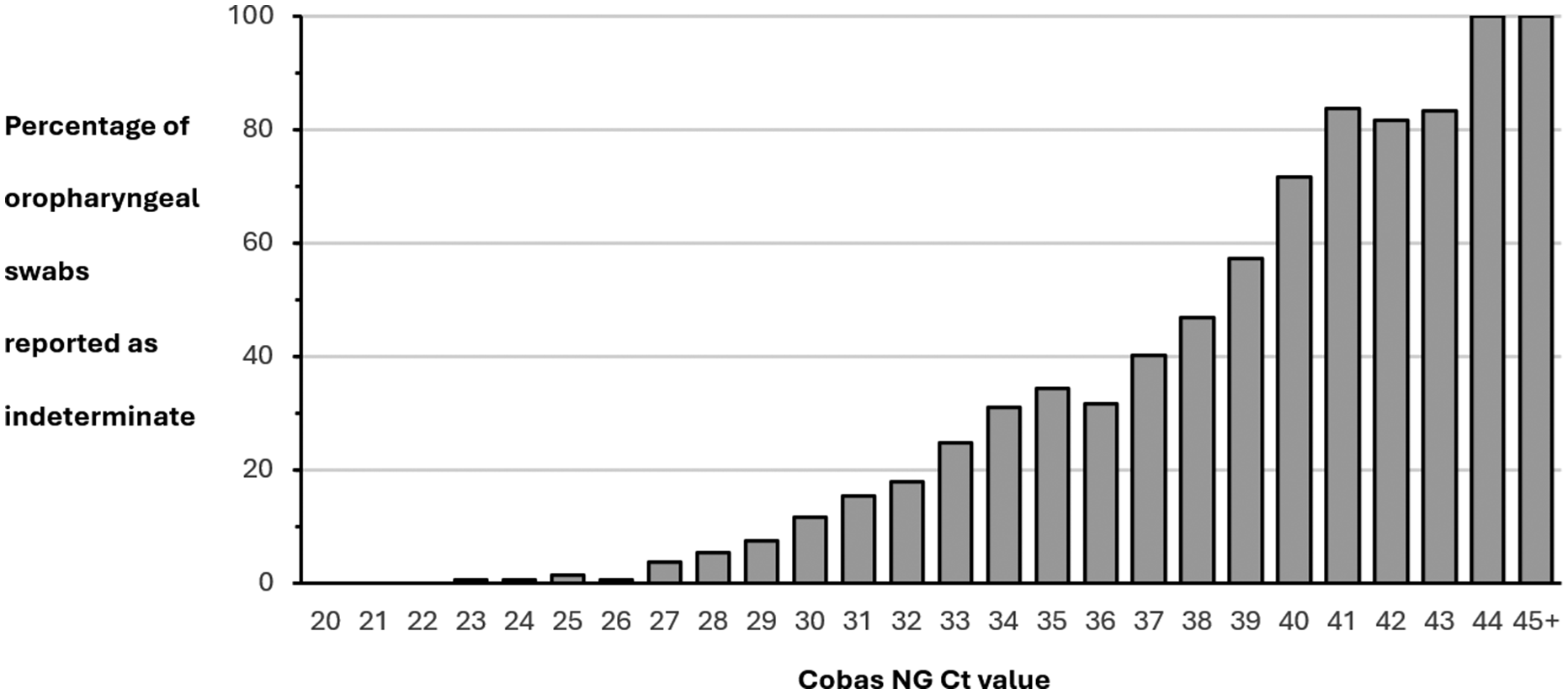
The proportion of oropharyngeal swabs reported as indeterminate increased as Cobas NG Ct increased, as shown in Figure 1.
Percentage of oropharyngeal swabs reported as indeterminate at each Cobas NG Ct point.

Cobas NG testing of non-NG Neisseria species selected based on genetic sequence
For the model NG DR-9 amplicon (190 bp), 5 meningococcal and 15 commensal genomes gave BLAST hits >100 bp. These included two meningococci (PubMLST IDs 47167 and 57907), a N. lactamica isolate (PubMLST ID 49718), and a N. cinerea isolate (PubMLST ID 171024) with full-length hits of 190 bp (96% to 100% identity). One of the meningococci with a full-length hit (PubMLST ID 47167) was flagged on PubMLST as being contaminated with gonococcal sequence and therefore disregarded. The remaining three meningococci with hits >100 bp included one with a 182 bp hit (PubMLST ID 30276; 95% identity) that lacked homology for eight bases at the 5′ end of primer NG519 and two with 157 bp (PubMLST ID 57909; 99% identity) and 126 bp (PubMLST ID 28959; 100% identity) hits, respectively, that were truncated at the end of their contigs within the respective draft genomes. The remaining 13 commensals gave BLAST hits of between 161 and 168 bp (88% to 96% identity) and had extensive mismatches versus primer NG519, as well as probes SEQ ID NO: 17 to SEQ ID NO: 20 (not shown). Among the six isolates with full-length hits or truncated hits with high percentage identity (Supplementary Figure 1), three locally available isolates (PubMLST IDs 28959, 30276, and 49718) were tested using the Cobas NG assay (Table 6). Only the N. lactamica isolate (PubMLST ID 49718) with a 190 bp hit with 96% identity tested positive.
Neisseria meningitidis and commensal Neisseria species tested by Cobas NG

Table 6. Long description
A table with five columns: Predicted target, PubMLST I D, Species, Cobas N G result Test 1, and Cobas N G result Test 2.
Under the Predicted target N G D R dash 9:
* PubMLST I D 28959, N. meningitidis: Test 1 and Test 2 are negative.
* PubMLST I D 30276, N. meningitidis: Test 1 and Test 2 are negative.
* PubMLST I D 49718, N. lactamica: Test 1 shows N G detected with C t 23.46; Test 2 shows N G detected with C t 31.32.
Under the Predicted target N G D R dash 9 V A R:
* PubMLST I D 20227, N. meningitidis: Test 1 and Test 2 are negative.
* PubMLST I D 35570, N. meningitidis: Test 1 and Test 2 are negative.
* PubMLST I D 35572, N. meningitidis: Test 1 and Test 2 are negative.
* PubMLST I D 35623, N. meningitidis: Test 1 and Test 2 are negative.
* PubMLST I D 38000, N. meningitidis: Test 1 and Test 2 are negative.
* PubMLST I D 43594, N. lactamica: Test 1 and Test 2 are negative.
* PubMLST I D 44384, N. lactamica: Test 1 and Test 2 are negative.
* PubMLST I D 49675, N. lactamica: Test 1 and Test 2 are negative.
* PubMLST I D 85623, N. meningitidis: Test 1 and Test 2 are negative.
Footnote a specifies that Test 1 used 10 microliters of neat extract in 4.3 milliliters of Cobas P C R media, while Test 2 used 5 microliters of a 100-fold dilution.
a In Test 1, 10 uL of neat extract was added to 4.3 mL of Cobas PCR media. For Test 2, 5 uL of a 100-fold dilution of extract was added to 4.3 mL of Cobas PCR media.
For the model NG DR-9VAR amplicon (215 bp), 1006 meningococci and 35 commensals gave BLAST hits >100 bp. Among the meningococci, 1003 meningococci gave hits of 213 bp (77% to 85% identity), and 3 gave hits of 134 to 156 bp (83% to 85% identity). Among the commensals, 30 gave hits of 203 to 213 bp (73% to 83% identity) and 5 gave hits of 164 to 171 bp (78% to 79% identity). All hits >100 bp were trimmed down to the concatenated sequences of primers NG579 and NG552, and possible probe sequences (SEQ ID NO: 42, 43, 44 and 45), or complements thereof, deduplicated to give 45 unique sequences with widespread mismatches to the corresponding model amplicon sequence (Supplementary Figure 2). Nine isolates (PubMLST IDs 20227, 35570, 35572, 35623, 38000, 43594, 44384, 49675, and 85623) representing a diverse subset of nine of these sequences (Supplementary Figure 3) were tested using the Cobas NG assay. All tested negative (Table 6).
Discussion
In our laboratory, Cobas NG-positive results from extragenital specimens have undergone confirmatory testing with a second assay, in line with UK guidelines [3, Reference Fifer4] and wider judgement [Reference Whiley5–Reference Cuschieri8]. Xpert NG has served as the confirmatory assay, which has two targets for NG. Those that do not confirm by Xpert NG are reported as ‘indeterminate’. An ‘indeterminate’ result fails to provide a definitive result for the patient, complicating patient management.
Our early implementation data comprising 681 samples comparing Xpert NG confirmation rates for different sample types showed that a disproportionate number of Cobas NG-positive oropharyngeal swabs (39.2%) and rectal swabs (11.2%) failed to confirm by Xpert NG, in comparison to genital swabs and urine samples (<4%). Our internal clinical evaluation data (unpublished) showed Cobas NG was more sensitive than Xpert NG. In agreement, studies reported that although both Cobas NG and Xpert NG are analytically very sensitive, Cobas NG was the more sensitive of the two tests, with an approximate seven-fold difference [Reference Pryce18, Reference Smith19]. This difference in sensitivity is likely the reason why low-level Cobas NG-positive samples can fail to confirm by Xpert NG. However, for oropharyngeal swabs with Cobas NG Ct values within the range of 25 to <30 or 30 to <35, 7.7% and 39.5%, respectively, failed to confirm by Xpert NG. Our more recent, larger dataset for the three-year period, however, showed that 25.8% of oropharyngeal swabs failed to confirm by Xpert NG. The datasets are from different time periods, and likely the larger dataset represents a more accurate and reliable measure of the proportion of oropharyngeal swabs that fail to confirm. These findings are hard to explain as a function of the difference in the sensitivity of Cobas NG and Xpert NG and are indirect evidence supporting a lack of specificity of Cobas NG when testing oropharyngeal swabs. Similarly, Pryce et al. [Reference Pryce20] reported that 22% of oropharyngeal swabs that were positive by Cobas 4800 NG failed to confirm by a second test.
Specificity problems with NG NAATs, generally, have long been recognized [Reference Whiley, Tapsall and Sloots9–Reference Tabrizi12]. This is complicated by the increasing use of NAATs to test extragenital sites, known to contain non-gonococcal Neisseria, which can undergo genetic exchange [Reference Linz13], potentially of assay gene targets. Notably, Cobas 6800/8800 NG, the latest iteration of Cobas NG, is CE-IVD licenced for the testing of oropharyngeal and anorectal swab samples.
Importantly, in 2012, Upton et al. [Reference Upton, Bromhead and Whiley7] demonstrated that a strain of Neisseria macacae, a commensal isolated from the oropharynx, generated a false-positive result when tested by Cobas 4800 NG. However, in 2022, the same isolate was found not to cross-react when tested by Cobas 6800 NG, despite this later iteration of the assay still targeting NG DR-9 [Reference Pryce, Bromhead and Whiley21]. More recently, however, Ayala et al. [Reference Ayala22] were the first to report that a non-gonococcal Neisseria isolate generated a false-positive result on Cobas 6800/8800 NG. Based on genetic analysis, the isolate was identified as a novel Neisseria species, most closely related to, but genomically distinct from Neisseria cinerea. It was isolated from the oropharynx of a patient initially suspected to have gonococcal treatment failure.
We demonstrated a strain of N. lactamica (PubMLST 49718, isolated from a meningococcal throat swab carriage study in 2015 [Reference Bratcher23]), carrying NG DR-9, also reproducibly generated a false-positive result when tested by Cobas NG. This represents only the second such non-gonococcal Neisseria isolate reported to date. Prior to testing, the isolate was identified as likely to cross-react in the assay by BLAST analysis of available Neisseria genomes looking for NG DR-9 and NG DR-9VAR. Of note, despite a review of >46000 Neisseria meningitidis and nearly 2000 commensal Neisseria whole genomes, only 3 contained full length NG DR-9. These included one NM (0.002%) and two commensals (0.11%), thereby highlighting the rarity of NG DR-9 among known NM and commensal Neisseria species represented on the most comprehensive Neisseria database, PubMLST. A BLAST search of the widely used Nucleotide Collection (nr/nt) database (accessed 12/03/2026) from the National Centre for Biotechnology Information at the National Library of Medicine using the model amplicons as search terms and excluding NG (taxid: 482) yielded no hits with >62% query coverage. The rarity of NG DR-9 may be corroborated by the laboratory data showing that out of 82657 oropharyngeal swabs testing either Cobas NG positive or negative, only 2% were reported as indeterminate. Alternatively, it may be possible a commensal containing NG DR-9 may be relatively prevalent in oropharyngeal swabs but present at levels lower than the sensitivity of the assays. The rarity of NG DR-9 in the commensal Neisseria genomes may suggest the existence of as-yet unknown strain(s) or species (Neisseria or otherwise), not currently represented on PubMLST Neisseria, that are testing positive.
Indeed, 11.5% (478) of all Cobas NG-positive oropharyngeal swabs with a Ct value of <35 (4,156) failed to confirm by Xpert NG. These are likely to represent true false-positive results caused by commensals in the oropharynx, as at these levels of positivity, Xpert NG may be expected to be positive if NG was present. Commensal Neisseria species may be present in the oropharynx at low bacterial loads, and so a proportion of oropharyngeal swabs that are weakly Cobas NG positive would also be expected to be falsely positive.
Xpert NG is not approved by the manufacturer for the testing of Cobas PCR media. However, from our experience of using Xpert NG for this purpose, we have not encountered compatibility issues. Xpert NG contains an endogenous human gene and a second internal control to monitor performance. Our data showed that among low-level positive oropharyngeal swabs identified by Cobas NG at a Ct value of 38, 53.3% were confirmed by Xpert NG. An analytical study using genome control also showed that Cobas PCR media did not inhibit Xpert NG [Reference Hopkins24]. Xpert NG was recently reported to give a false-negative result for an NG escape mutant found to lack both target sequences [Reference Jansen van Rensburg25]. Xpert NG has also been shown to cause a single target cross-reaction due to Neisseria commensals; however, these were still interpreted as negative [Reference Tabrizi26].
PivNG, an assay targeting the NG-specific pilin inversion (piv) gene, can be performed on the Cobas omni Utility Channel of the Cobas 6800/8800, which may serve as a convenient high-throughput supplementary test to confirm NG-positive results and reduce the number of ‘indeterminate’ reports [Reference Hopkins24]. PivNG was reported to be more analytically sensitive than Xpert NG [Reference Hopkins24]; however, this should be interpreted with caution, as 0.3 mL of sample was processed by Xpert NG in this study rather than 1 mL of sample as stipulated in the Xpert NG instructions for use. Of those oropharyngeal swabs found positive by both Cobas NG and PivNG, 14.9% (13/87) were found to negative by Xpert NG [Reference Hopkins24]. Although the sample size was limited, it demonstrated that PivNG can reduce the number of ‘indeterminate’ reports by resolving this subset of samples. However, of the Cobas NG-positive oropharyngeal swabs, 23.7% (27/114) were PivNG negative, and the authors recommended such samples still be reported as ‘indeterminate’ [Reference Hopkins24].
Our laboratory data showed that approximately one quarter of Cobas NG-positive oropharyngeal swabs failed to confirm by Xpert NG. Separately, we demonstrated that a historical PubMLST N. lactamica isolate generated a false-positive Cobas NG result. While this finding establishes biological plausibility for commensal cross-reactivity, the isolate was not derived from our study population and its contribution to the observed discordant results is unknown. As such, we reaffirm the need for NG confirmatory testing of oropharyngeal samples screened with Cobas NG.
NG DR-9 was rarely found in the whole genomes accessed; however, in conjunction with the high burden of ‘indeterminate’ oropharyngeal swabs observed in our laboratory, this may suggest that NG DR-9 may be present in other commensals in the oropharynx that are difficult to culture on conventional, typically NG selective media, and are therefore not represented in the whole genome databases accessed.
Caveats include that the actual primers/probes employed in the Cobas NG assay are not known and so possible combinations were inferred from the patent. As such, our BLAST screen may have missed other potential false positives.
Accurate determination of the presence or absence of NG in oropharyngeal swabs remains challenging. Multi-NAAT algorithms can reduce the number of ‘indeterminate’ reports generated, but may not negate them fully. A pragmatic approach to managing ‘indeterminate’ NG reports is required.
Supplementary material
The supplementary material for this article can be found at http://doi.org/10.1017/S0950268826102039.
Data availability statement
The data that support the findings of this article will be made readily available upon request to the corresponding author.
Acknowledgements
We acknowledge the numerous dedicated laboratory staff who have worked to deliver the molecular NG screening service within the Manchester Medical Microbiology Partnership (MMMP).
Author contribution
Conceptualization: A.M., J.L., T.W., R.B., P.T., N.M., M.G.; Data curation: A.M., J.L., T.W., R.B., P.T., N.M., M.G.; Formal analysis: A.M., J.L., T.W., R.B., P.T., N.M., M.G.; Investigation: A.M., J.L., T.W., R.B., P.T., N.M., M.G.; Methodology: A.M., J.L., T.W., R.B., P.T., N.M., M.G.; Validation: A.M., J.L., T.W., R.B., P.T., N.M., M.G.; Visualization: A.M., J.L., T.W., R.B., P.T., N.M., M.G.; Writing - original draft: A.M., J.L., T.W., R.B., P.T., N.M., M.G.; Writing - review & editing: A.M., J.L., T.W., R.B., P.T., N.M., M.G.
Competing interests
The authors declare no competing interests.





 Open access

