INTRODUCTION
Pelvic radiotherapy is an essential component of treatment for many genitourinary malignancies. During radiation therapy of tumours in pelvis, the intestine is an important normal tissue at risk. As in other organs, intestinal radiation toxicity is classified as acute (early) when it occurs during or within 3 months of radiation therapy, or delayed (chronic) when it occurs more than 3 months after radiation therapy.1
Approximately 80% of all patients treated with pelvic radiotherapy will notice a permanent chronic change in the way their bowels behave after radiotherapy.Reference Gami, Harrington and Blake2 This is unimportant unless that change in their bowels affects quality of life. Reports suggest that between 6% and 78% of long-term survivors have gastrointestinal symptoms affecting quality of life.Reference Potosky, Legler and Albertsen3
The development of late gastrointestinal symptoms following pelvic radiotherapy is not entirely dose related but depends on a complex interaction between physical, patient-related, treatment-related and genetic factors, which is not well understood.Reference Andreyev, Amin, Blake, Dearnaley, Tait and Vlavianos4
We are becoming increasingly good at knowing how to cure cancer. What we have still failed to address systematically is how best to care for the patient who is cured of his or her cancer but living with the physical consequences, specifically, delayed bowel toxicity.Reference Andreyev5
Effective therapy for chronic radiation proctitis has been limited. Medical therapies including topical sucralfate, 5-amino-salicylic acid enemas, short-chain fatty acids, vitamin E and topical application of formalin have been largely disappointing. Endoscopic therapy is currently the preferred modality including the most recent technique known as argon plasma coagulation (APC).Reference Zhou, Adler and Becker6
The aim of this study was to identify predictors and treatment outcome of late bowel toxicity after three-dimensional pelvic radiotherapy for genitourinary malignancies and also to describe our experience with APC in this toxicity.
PATIENTS AND METHODS
Between March 2004 and March 2010, all patients who had completed a course of pelvic radiotherapy for genitourinary malignancies at the department of radiotherapy, South Egypt Cancer Institute (SECI), Assiut University and fulfilled the following criteria were enrolled in this study. This study was reviewed and approved by the Ethics Committee of our University.
Eligibility criteria
Patients included in the study satisfied the following criteria: histopathologically proved cancer of the bladder, prostate or gynecological tract, aged ≥18 years, with Karnofsky scale ≥70 %, with no evidence of metastases, pre-radiotherapy serum electrolytes, renal and hepatic function tests within normal limits, and completed a radical course of pelvic radiotherapy at least 6 months previously.
Exclusion criteria
All patients who underwent radical pelvic surgery or received chemotherapy at any time of radiation. These patients were excluded due to the different toxicity profiles expected from these treatments. Also, patients having ≤6 months of follow-up were excluded (as the goal was to analyze late toxicity occurring at >3 months of follow-up).1 Patients known to have inflammatory bowel disease were also excluded.
Record review and data collection
The patients’ charts were reviewed by the research members for toxicity information. In each case, the maximum toxicity score charted in each category was the score assigned to the patient in that category. For each patient, the following data were collected: gender, age, site and pathology, the presenting symptoms of late gastrointestinal (GI) toxicity, the interval between radiotherapy and the onset of symptoms, the mode of diagnosis, treatment received. Presence of comorbid conditions predisposing to vascular disease (hypertension, ischaemic heart disease, cerebrovascular disease, diabetes mellitus and connective tissue disease) was also recorded.
Radiotherapy techniques
Patients had been treated using the three-dimensional conformal radiotherapy techniques chosen appropriately for their different tumour types. In general, all patients received pelvic irradiation to include pelvic lymph nodes at risk up to 45–50 Gy followed by boost dose to the primary tumour. All patients underwent computerized tomography (CT) scanning of the pelvis in the supine position. In phase 1, the planning target volume (PTV) extends in the cranial-caudal dimension from L5-S1 interspace to the lower pole of the obturator foramen (or according to lower tumour extension) and 0.5 to 1 cm beyond the pelvic bones laterally. The posterior border lies at the mid-rectum. All patients were treated by megavoltage X-rays (6 and/or 15 MV) emitted from linear accelerator. Booster treatment was then used. In bladder and prostate cancers, the target volume in phase 2 included the primary tumour and a margin of 2 cm using megavoltage X-rays to a total dose of 64–66 Gy. Radiotherapy was delivered by means of four-field box technique. All fields were equally weighted. All fields were treated simultaneously in daily fractionation of 2 Gy to the isocenter, 5 sessions per week.
In cervical and uterine cancers, patients were referred to a higher centre where booster dose was delivered using intracavitary high dose rate (HDR) brachytherapy to Point A in cervical cancer to a dose of 21–25 Gy or to a depth of 0.5 cm from the vaginal surface in uterine cancer to a total dose of 12 Gy in three fractions of HDR brachytherapy.
Assessment of toxicities
Toxicities due to radiotherapy were considered chronic when happened from 3 months following radiotherapy and thence after.
Lower gastrointestinal symptoms were scored according to the Common Terminology Criteria for Adverse Events (CTCAE) version 3.0 of the National Cancer Institute (NCI).1
Role of gastroenterologist
All patients with gastrointestinal symptoms were reviewed by the gastroenterologist, where detailed analysis of their complaints were done. Every patient with lower GI symptoms underwent at least flexible sigmoidoscopy or colonoscopy. All gastroenterological evaluations were performed in our hospital either as outpatient or inpatient setting according to the severity of the case. APC was used as a therapeutic tool in some cases. (ERBE VIO® APC2 Devise): The equipment consisted of an APC unit, an electrosurgical generator and APC instruments. In the ERBE VIO System, the APC2 and the VIO generator were optimally coordinated. A 2.3 mm diameter flexible probe (with axial beam) was inserted through the working channel of a standard Colonoscopy. The standard probes were 220 cm long. The type of gas: Argon 4.8 (99.998%), adjustable gas flow range (generally 0.8 L/min–1.0 L/min) of argon was selected, electrical power: 40–50 Watts. The operative distance between probe and tissue ranged from 2 to 8 mm, and the duration of the spark ranged from 0.5 to 2 seconds. According to the nature, number and size of the lesions, we did one APC session or several APC sessions in some patients to complete the healing of the lesions and to cure their symptoms.
Statistical methods
Data management and analysis were performed using Statistical Analysis Systems. Numerical data were summarized using means and standard deviations. Categorical data were summarized as percentages. Comparisons between groups with respect to numeric variables were done using the Mann–Whitney non-parametric test. Comparisons between categorical variables were done by the chi-square test. Factors important in the prediction of radiation-induced proctitis were examined using univariate analysis.
RESULTS
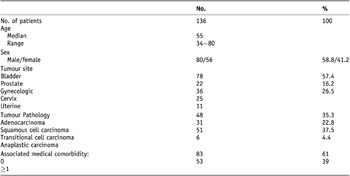
One hundred and thirty-six patients met all inclusion criteria. Follow-up period extended from 6 to 84 months (median: 37 months).
Table 1 lists the patients’ characteristics.
Patients’ characteristics

In 58 patients (42.65%), no data were available concerning the volume of rectum enclosed within the 95% isodose line of the radiation dose and the maximal rectal doses could not be determined. In the remaining 78 patients (57.35%), the data were traced from the sheets containing field setup and radiation dose distribution Table 2.
Percent volumes of rectum that received maximal doses

Chronic gastrointestinal morbidities (Table 3)
The most common presenting symptom was chronic diarrhoea. It is important to note that 13 patients had more than one symptom at presentation.
Radiotherapy induced chronic gastrointestinal morbidities

Chronic diarrhoea
Thirty-five patients (25.7%) developed chronic diarrhoea Grade 1 or 2. Onset ranged from the 3rd to 34th month (median time: 13 months). Offset ranged from the 4th to the 48th month (median time: 26 months).
Chronic proctitis
Seventeen patients (12.5%) developed chronic proctitis Grade 1 or 2. Six patients (4.4%) developed chronic proctitis Grade 3.
Onset ranged from the 3rd to 45th month (median time: 24 months). Offset ranged from the 4th to 62nd month (median time: 33 months).
Chronic bleeding per rectum
Sixteen patients (11.8%) developed chronic bleeding per rectum Grade1 or 2. Nine patients (6.6%) developed chronic bleeding per rectum Grade 3. Onset ranged from the 4th to the 60th month (median time: 31.5 months). Offset ranged from the 5th to the 62nd month (median time: 33.5 months).
Correlation between radiotherapy-related morbidities and potential risk factors
Running correlation analysis was done between radiotherapy-related gastrointestinal morbidities and potential risk factors. These include percent volume of rectum enclosed in the 95% isodose line and maximal dose received by the rectum, tumour site, sex, age at diagnosis and comorbidity ≥1.
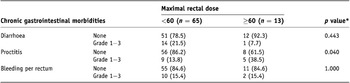
As regards percent volume of rectum enclosed in the 95% isodose line and maximal dose received by the rectum, the data were available for only 78 cases. When stratifying the patients according to the maximal dose received by the rectum into those received rectal dose ≥60 Gy (13 patients) and those whose maximal rectal doses were <60 Gy, it appears that; there is a statistically significant correlation between the maximum rectal dose and development of chronic proctitis (p = 0.040), while there is no significant correlation between the maximum rectal dose and other chronic gastrointestinal morbidities Table 4.
Maximal rectal dose in relation to radiotherapy induced chronic gastrointestinal morbidities

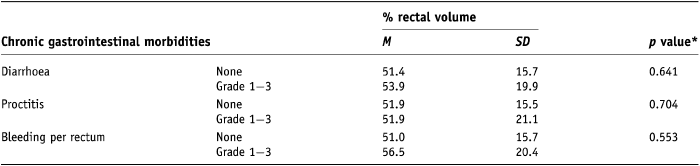
Also there is no statistically significant correlation between the volume of rectum enclosed in the 95% isodose line and chronic gastrointestinal morbidities Table 5.
Percent rectal volume in relation to radiotherapy induced chronic gastrointestinal morbidities
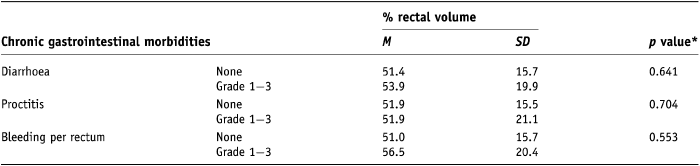
Regarding other factors, univariate analysis shows that only comorbidity ≥1 has significant correlation with late proctitis (p = 0.04) but not with chronic diarrhoea (p = 0.54) and bleeding per rectum (p = 0.068).
The majority of the patients with lower gastrointestinal tract (GIT) symptoms did not require blood transfusions (88.6%).Only, eight of nine cases presenting with bleeding per rectum, Grade 3 toxicity did require blood transfusion with average one or two units.
The endoscopic findings among study group with lower gastrointestinal symptoms
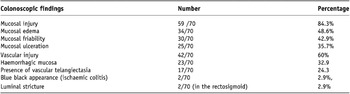
Endoscopic examinations showed that 59 cases (84.3%) had mucosal injury including just mild mucosal edema in 34 cases (48.6%); mucosal friability in 30 cases (42.9%) and/or ulceration in 25 (35.7%). Forty-two patients (60%) had vascular injury varied from haemorrhagic mucosa in 23 cases (32.9%); presence of vascular telangiectasia in 17 cases (24.3%) up to the presence of blue-black appearance (ischaemic colitis) in 2 cases (2.9%), Table 6. It is important to note that the total number of patients affected by different types of mucosal injury and vascular injury exceeds 70, as some patients had more than one type of mucosal injury and some patients had vascular injury in addition to mucosal injury.
Colonoscopic findings among the study cases with lower gastrointestinal tract (GIT) symptoms

Argon plasma coagulation (APC) for endoscopically diagnosed radiation colitis
APC was done for 17 cases with vascular telangiectasia with average number of setting 1–3. APC was successful in 14 cases (82.4%) and 3 cases need vasoligation through selective angiography. Also, APC was done for 25 cases with mucosal ulceration with average number of settingsReference Gami, Harrington and Blake(2–Reference Andreyev, Amin, Blake, Dearnaley, Tait and Vlavianos4) and it was successful in 11 cases (44%) while 14 cases needed another therapy including steroid enema. APC was done in 23 cases with haemorrhagic mucosa with average settingReference Gami, Harrington and Blakes(2–Reference Andreyev, Amin, Blake, Dearnaley, Tait and Vlavianos4) every 2 weeks and was successful in controlling patient symptoms in 16 cases (70%), while 7 cases needed another line of therapy after APC, including steroid enema for 2 to 3 weeks in 6 cases and surgical intervention in 1 case Table 7. Five cases (out of 70 cases) were presenting with severe radiation proctitis and needed surgical intervention (5.7%) including one case with extensive haemorrhagic mucosa; 2 cases with ischaemic colitis and 2 cases with luminal stricture at rectosigmoid.
Treatment outcome of radiation colitis through colonoscopy using Argon plasma coagulation (APC)

*Vasoligation through selective angiography was applied
**Steroid enemas were used for 2–3 weeks after APC.
***Steroid enemas in (6 cases) and surgical management in severe case (2 cases only).
DISCUSSION
Late onset bowel dysfunction post-pelvic radiotherapy is an increasingly common clinical scenario, which is related to improved oncological treatments and cancer survival.Reference Henson7 The median time to the appearance of symptoms from late intestinal injury in our study was 13 months (ranged from the 3rd to 34th month), which was in concordance with that reported by Wedlake et al.Reference Wedlake, Thomas, Lalji, Blake, Khoo, Tait and Andreyev8
The most commonly reported late gastrointestinal symptom in our study was chronic diarrhoea consistent with that reported in other published studies.Reference Haddock, Sloan and Bollinger9 Our results showed 25.7% Grade 1 and 2 chronic diarrhoea with no reported Grade 3 and 4 toxicities.
Rectal bleeding after radiotherapy has been reported to occur in 29%–51% of patients.Reference Williams, Vlavianos and Blake10 Rectal bleeding impairs patients’ daily activities and quality of life in 6% of all patients treated with radiotherapy.Reference Wong, Lim and Ho13 In our study, Grade 3 chronic bleeding per rectum was reported in 6.6% consistent with that reported in the literature. The lower figures of Grade 1 and 2 chronic bleeding per rectum (11.8%) reported in our study may be due to that some patients usually deny this symptom unless it affects their daily activities and quality of life.
Late radiation proctitis is initially manifested by rectal discomfort, but can progress to stool incontinence or even to life-threatening complications like perforation.1 In our study, 17 patients (12.5%) developed chronic proctitis Grade 1 or 2, 6 patients (4.4%) developed chronic proctitis Grade 3 and there was no Grade 4 toxicity. The overall incidence was 16.9%, which lies within the reported rates (5%–20%) in published studies.Reference Buchi11–Reference Wong, Lim and Ho13
Our results showed that there was no significant difference found between the mean rectal volumes among patients who developed chronic gastrointestinal morbidities and those who did not develop (p > 0.05). Lack of significant correlation between volume effect and radiotherapy induced morbidities in our study agrees with what was reported by Michalski et al.Reference Michalski, Gay, Jackson, Tucker and Deasy14 for doses ≤45 Gy. However, this was contrary to other studies, which reported that the volume of rectum receiving ≥60 Gy is consistently associated with the risk of Grade ≥2 rectal toxicity.Reference Michalski, Gay, Jackson, Tucker and Deasy14–Reference Fiorino, Sanguineti and Cozzarini16 The difference between our results and the results of the above-mentioned studies could be referred to the difference in dose levels used, the difference between the numbers of cases and unavailability of dose volume histograms for most of our patients.
As regards the correlation between radiation-induced toxicities and maximal rectal dose, we found that there was a significant difference between maximal rectal dose in those developed chronic proctitis and those did not develop (p = 0.040), but no significant difference in chronic diarrhoea (p = 0.443) and chronic bleeding per rectum (p = 1.000).
Lack of significant correlation between rectal dose and these morbidities in our study may be accounted to the dose used in our patients that was in most instances 66 Gy and the maximal rectal dose that was in median 56 Gy. This is accordant with what was reported by Fiorino et al.Reference Fiorino, Sanguineti and Cozzarini16 that the frequency of late rectal bleeding increases as the prescription dose rises above 70 Gy; however, our results are not accordant with what was reported by other investigators like Schultheiss et al.Reference Schultheiss, Lee and Hunt17 who found that radiation dose significantly correlated with late gastrointestinal morbidities.
Of patients variables, only comorbidity ≥1 has significant correlation with late proctitis (p = 0.04). This is in agreement with that reported by Lim et al.Reference Lim, Lau and Brasher18 who found diabetes to be significantly related to late ano-rectal toxicity. Contrary to that found by Skwarchuk et al.,Reference Skwarchuk, Jackson and Zelefsky19 age has no effect on the risk of late gastrointestinal morbidities in our study.
Sigmoidoscopy and/or colonoscopy was done in 70 cases with lower gastrointestinal tract (GIT) morbidity. Fifty nine cases (84.3% ) had mucosal injury. Forty-two patients had vascular injury (60%). Some patients had more than one type of mucosal injury and some patients had vascular injury in addition to mucosal injury. Five cases (out of 70 cases) were presenting with severe radiation proctitis and needed surgical intervention (5.7%), including one case with haemorrhagic mucosa, one case with ischaemic colitis and two cases with luminal stricture.
In post-radiation late bowel toxicity, it is postulated that recurrent bleeding occurs due to vascular telangiectasia and non-healing mucosal ulceration from underlying endarteritis obliterans.Reference Seow-Choen, Goh, Eu, Ho and Tay20 APC treatment has the distinct advantage of being able to reach to proximally affected parts of the rectum or colon as it is delivered using the colonoscope. Furthermore, APC only coagulates the superficial mucosal layer, causing minimal discomfort for the patient, and it can be safely performed in the endoscopy suite.Reference Wong, Lim and Ho13
APC was applied in 65 cases of our cases (17 cases with vascular telangiectasia, 25 cases with mucosal ulceration and 23 cases with haemorrhagic mucosa). In our study, APC was effective in controlling patients’ symptoms in 41 cases of them (63.1%) after 2 to 3 settings. In many case series, it was reported that the majority of patients achieved symptomatic improvement and complete remission after two to four treatment courses with APC.Reference Kaassis, Oberti, Burtin and Boyer21 Twenty-four cases needed another line of therapy after APC varied between vasoligation by angiography in three cases with vascular telangiectasia, surgical intervention in one case with haemorrhagic mucosa and steroid enema for 2 to 3 weeks in 20 cases (14 cases with mucosal ulceration and 6 cases with haemorrhagic mucosa).
Limitations of this study and recommendations: Our sample size was small and our results are unlikely to be generalizable to the populations of these patients. It needs confirmation by larger study with suitable sample size.
In conclusion, three-dimensional pelvic radiotherapy using a 2-phase technique is associated with a low level of Grade 3 late lower gastrointestinal toxicities. The most common presenting symptom is chronic diarrhoea. For all grades of late bowel toxicity, both maximum rectal dose and comorbidity ≥1 significantly predict the development of chronic proctitis. APC is an effective, safe and well-tolerated treatment for chronic radiation proctitis. It should be considered as a first-line therapy for radiation proctitis.