INTRODUCTION
Palliative care is “an approach that improves the quality of life of patients and their families facing the problems associated with a life-limiting illness”(World Health Organization, 2002). In Australia, general practitioners (GPs) and the primary healthcare team are central to the ongoing provision of care at the end of life. Many people with advanced cancer are cared for until their death by their GP, with support from specialist health providers (Mitchell, Reference Mitchell2002). Not all people with advanced cancer will require the intermittent or ongoing involvement of specialist palliative care (SPC) services (Currow & Nightingale, Reference Currow and Nightingale2003) however, it is suggested that up to 90% will need referral to a SPC service for a more detailed assessment, with 70% requiring some ongoing contact and 30% requiring direct care in conjunction with their GP (Palliative Care Australia, 2005). Late or non-referral of some people to SPC services may affect quality of life (QOL) for some patients and their carers. Ideally, when some aspects of patients' or families' needs are complex and are unable to be met within their current care framework, patients will be referred to a SPC service (Currow & Nightingale, Reference Currow and Nightingale2003). Decisions to refer need to consider severity of the problems of the patient and family, their personal and community support mechanisms, the ability of the GP to manage those problems, and the availability of other health professional and support services (Palliative Care Australia, 2005).
Apart from hospitals, GPs have been identified as the primary source of information about SPC (Campbell Research & Consulting, 2006). Consequently GPs' attitudes to, and perceptions of, SPC services are pivotal when discussing equity of access for people with advanced cancer (Ajzen, Reference Ajzen1988). Some doctors may not be well informed about palliative care or are not proactive in providing information regarding access to SPC services (Ogle et al., Reference Ogle, Mavis and Wyatt2002; Quantum Market Research, 2003; Brickner et al., Reference Brickner, Scannell and Marquet2004). It is, therefore, important to understand how GPs throughout Australia view palliative care and SPC, and what is the effect of these perceptions on referral practices.
This study describes GPs': (1) current referral practices to SPC services; (2) perceptions of, and attitudes to palliative care; (3) triggers that initiated SPC referrals; and (4) reasons for not referring people with advanced cancer; with comparisons made between GPs practicing in metropolitan (M GPs) versus non-metropolitan (NM GPs) areas across Australia.
METHODS
Procedure
A self-report questionnaire was mailed to a sample of GPs identified from the national Australian Medical Publishing Company database of medical practitioners (AMPCo Direct, 2002). Non-responders were sent a reminder after 12 weeks and followed up by telephone 6 weeks later. Participation implied consent.
Ethics approval was granted by the University of Newcastle HREC, approval number: H-624-0703.
Sample
From ~21,000 GPs in Australia (Commonwealth Department of Health and Aged Care, 2000), a stratified, random sample of 1680 GPs were invited to participate. This initial sample was calculated on the basis of an expected response rate of 50% and in the worst-case scenario of 50% prevalence of items of interest. Power calculations for this sample would allow assessment with up to 5.6% precision and a 95% level of significance, and allow comparison between M GPs and NM GPs with a detectable difference of up to 10% with 80% power. Only GPs employed for ≥35 hours per week were invited to participate, to capture a sample that cared for a reasonable number of people with advanced cancer. GPs were stratified according to location of practice (metropolitan versus non-metropolitan location according to Australia Post classification) (Australia Post, 2005) and by state or territory within Australia.
Instrument
The development and content of the instrument has been described in detail elsewhere (Johnson et al., Reference Johnson, Girgis and Paul2008). In brief, to develop the Palliative Care Referral Questionnaire, lists of potential barriers and triggers for referral to SPC and perceptual and attitudinal items were generated from the literature regarding palliative care referral and the findings of a preliminary exploratory study. An expert advisory group reviewed items for content and face validity and 20 medical practitioners pilot tested the survey for acceptability. The final survey included items on participant characteristics (9), perceptions of palliative care (25), service availability and satisfaction with services (6), and referral practices (2).
Analyses
Descriptive analyses were undertaken and between-group comparisons (M GPs versus NM GPs) were performed using Pearson's χ2 analysis and Student's t-test. Where appropriate, non-parametric analyses were undertaken. For attitudinal items, five-point Likert scales were collapsed into three categories of agree, neutral, and disagree. Backwards stepwise multiple logistic regression analyses were used to identify independent predictors of participants' referring >60% of eligible patients to SPC services in the past 12 months. For our study, referring > 60% of patients was defined as “higher referral” because it is the lower limit of the range that contains 70%, the proportion of patients with advanced cancer suggested by Palliative Care Australia as needing ongoing input from a SPC service (Currow & Nightingale, Reference Currow and Nightingale2003).
All analyses were undertaken using SAS for Windows Version 8 statistical analysis software (SAS Institute, 1999–2001).
RESULTS
Completed questionnaires were returned by 469 eligible participants. A further 177 were ineligible because of retirement, practicing overseas, or not working in a general practice, or they were unable to be contacted. The resultant 31% response rate allowed within group precision of up to 7% and a detectable difference between groups of 13% with 80% power and a 95% level of significance.
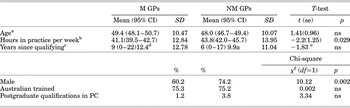
Distribution by state was similar to the national distribution of GPs, with South Australia being over-represented (χ2 = 8.57, df = 1, p = 0.003) and the Australian Capital Territory under-represented (χ2= 6.66, df = 1, p = 0.010). The study GPs were similar to the national sample in terms of age, gender, and proportion who were Australian-trained. Some differences were detected between M GPs and NM GPs (Table 1).
A Comparison of personal and demographic characteristics of M GPs and NM GPs.

aM GPs: n = 254, NM GPs: n = 213.
bM GPs: n = 250, NM GPs: n = 212.
cM GPs: n = 242, NM GPs: n = 206.
dMedian, (Inter-quartile range) mean.
eWilcoxon sum rank test.
Service Availability and Adequacy
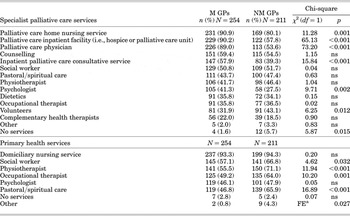
M GPs reported having greater access to a more comprehensive range of SPC services and health professionals (Table 2) including palliative care home nursing and inpatient facilities, as well as a palliative care physicians and psychologists. Conversely, NM GPs were more likely than M GPs to report the availability of allied health services at a primary health service level.
Palliative care services and health professionals reported to be available to M GPs compared to NM GPs.

aFisher exact test.
Advanced Cancer Work Load and Referral Rates
NM GPs reported having treated more people with advanced cancer in the previous 12 months (median = 5, IQ range = 3–10, mean = 7.4) than M GPs (median = 3, IQ range = 1–6, mean = 4.4) (Wilcoxon sum rank, z = 5.06, p < 0.001).
The majority of GPs (83% of M GPs and 85% of NM GPs) reported discussing referral to a SPC service with >60% of their patients, whereas >75% reported discussing referral with >60% of their patients' families (76% and 83%, respectively). Two-thirds (67%) of M GPs reported referring >60% of their advanced cancer patients to an SPC, compared to 50% of NM GPs (χ2 = 11.5, df = 1, p < 0.001). However, 61% of NM GPs referred >60% of the patients to generalist community services compared to only 48% of M GPs (χ2 = 6, df = 1, p = 0.014).
Attitudes to and Perceptions of SPC Service
Early Referral
The majority of GPs agreed that early referral was beneficial and that patients could benefit from SPC while still receiving disease-modifying treatment. M GPs however, were more likely than NM GPs to agree that all people with advanced cancer should be referred for SPC (62% vs 46%, χ2 = 14.65, df = 2, p < 0.001).
Training
Approximately half of NM GPs (52.2%) and 31.5% of M GPs perceived that they were well-trained to care for the symptoms of people with advanced cancer, with 28% and 31% being unsure (χ2 = 25.69, df = 2, p < 0.001).
Referral Outcomes
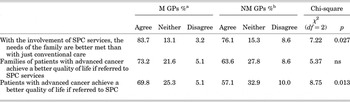
M GPs were more likely than NM GPs to be positive about the outcomes of SPC referrals for patients and their families (Table 3).
GPs' attitudes and perceptions about patients' needs, quality of life and SPC

aNumber of M GPs who participated in each question ranged from 249 to 255.
bNumber of NM GPs who participated in each question ranged from 202 to 211.
Note: Rows may not add up to 100% because of rounding.
SPC Focus
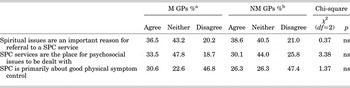
Whereas almost half of GPs disagreed that “SPC is primarily about good physical symptom control”, only about one-third of GPs perceived that SPC services played a role in psychosocial and spiritual issues (Table 4).
GPs' perceptions of the focus of SPC

aNumber of M GPs who participated in each question ranged from 249 to 255.
bNumber of NM GPs who participated in each question ranged from 202 to 211.
Note: Rows may not add up to 100% because of rounding.
Reasons for Referral and Non-referral to SPC
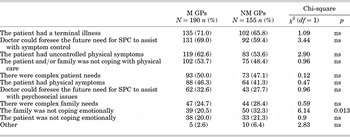
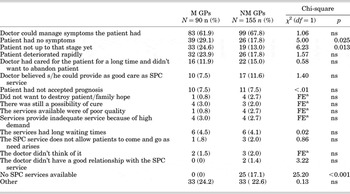
The most frequently cited reasons for referring and not referring people with advanced cancer for SPC in the previous 12 months are listed in Tables 5 and 6, with symptom-related reasons clearly dominating.
GPs' reasons for referral of patients with advanced cancer to a SPC service in the previous 12 months

Note: Participants were asked to identify all items that applied.
GPs' reasons for non-referral of patients with advanced cancer to a SPC service in the previous 12 months

aFisher Exact Test.
Note: Participants were asked to identify all items that applied.
Predictors of Higher Referral Rates
Univariate analyses were undertaken to test for association among 41 demographic, attitudinal, service, and location (i.e., metropolitan vs. non-metropolitan) variables and referral rates (higher >60% vs. lower <60%); and 25 significant associations were identified. The strongest predictors of higher referral rates were identified using a multiple logistic regression to control for confounders and interaction terms. Items were included in the model if they were significant at p < 0.25 on univariate analysis.
The frequency with which participants discussed palliative care with patients and the family, although highly associated with higher referral on univariate analysis, were excluded from the multivariate analysis because they were considered by the investigators to potentially have a dependent relationship on referral (i.e., referral was unlikely to take place without prior discussion with the patient and, in most instances, the family).
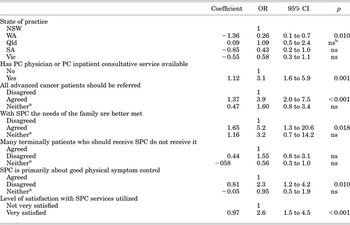
Six independent predictors of higher referral were identified (Table 7).
GP characteristics as predictors of higher referral rates (i.e., ≥ 60% of advanced cancer patients) (multivariate logistic regression)

aNeither agreed nor disagreed with the statement.
bNot significant at p < 0.05.
DISCUSSION
Our findings suggest that GPs have a positive attitude toward SPC and are satisfied with the services available to them. GPs perceived that SPC benefited patients, families and practitioners and resulted in needs being better met. Although NM GPs reported caring for more people with advanced cancer in the previous 12 months than had their metropolitan colleagues, they reported referring fewer patients to SPC services; only half, compared to two-thirds of M GPs, reported referring >60% of people with advanced cancer to SPC services.
The presence of a terminal illness and problems associated with the management of symptoms and physical care most frequently prompted referrals. Psychological, social, and emotional issues were least frequently identified as reasons for referral. GPs most frequently cited their ability to manage the patient's symptoms as the reason for not referring. Whereas the lack of patient symptoms, the patient “not being up to the stage of needing SPC”, and “rapid deterioration” were identified as important reasons for not referring, especially for M GPs, lack of service availability was reported only by NM GPs.
Although referral triggers were similar for all GPs in our study, the reported differences in service availability, training, and attitudes to palliative care between M GPs and NM GPs may account for referral rate differences and reasons for not referring. NM GPs reported less access to comprehensive SPC services and were less likely to be positive about the outcomes of SPC referrals. However, they reported a higher level of availability of some primary healthcare professionals. This is consistent with published research indicating that rural GPs are more likely to have access to local hospitals, making it easier for them to provide ongoing care for people with advanced cancer when inpatient care was required (Hays et al., Reference Hays, Veitch and Cheers1997; Strasser et al., Reference Strasser, Strasser and Hays2000).
NM GPs in our sample were also more likely to report being well trained to care for the symptoms of people with advanced cancer than were M GPs. Rural GPs have previously self-reported having a wider range of skills than their city counterparts, perhaps reflected in greater expertise having been sought to equip themselves for practice in areas with lower levels of support (Strasser et al., Reference Strasser, Strasser and Hays2000). It is evident that in non-metropolitan areas, the primary healthcare team is an important component of the network of care for people with advanced disease. Attitudes such as the belief by more M GPs than NM GPs that all patients with advanced cancer should be referred for SPC may also have contributed to the differing referral patterns.
Overall, in our study, the disease process and physical symptoms tended to dominate the reasons for referral. Psychosocial issues less frequently precipitated referrals, with “foreseeing the need for SPC to assist with psychosocial issues” being identified by less than one-third of all GPs as a reason for referral. This may reflect lower levels of recognition of psychological and social concerns by GPs (Newell et al., Reference Newell, Sanson Fisher and Girgis1998; Fallowfield et al., Reference Fallowfield, Ratcliffe and Jenkins2001), confidence that psychological and social concerns can be met within the primary healthcare framework, or uncertainty regarding the role of SPC services in providing psychosocial care. In our study, GPs expressed divergent views about the role of SPC services and psychosocial and spiritual problems, suggesting that more than half of GPs doubt the value of SPC services in these domains. These perceptions may reflect a view that SPC services are not as well-equipped to address spiritual and psychosocial concerns as specialist providers in those specific areas (e.g., psychological and pastoral services) are. This highlights a need for SPC services to be more focused in providing positive, measurable outcomes across all domains that contribute to the concept of QOL. Although physical care is crucial, the broader aspects of QOL, including psychological, social, and spiritual well-being, have been identified as particularly important to patients and families at the end of life, whereas doctors tend to focus on the physical aspects (Steinhauser et al., Reference Steinhauser, Christakis and Clipp2000).
The low levels of perceived competence by GPs in providing care for people with advanced disease suggests a need for undergraduate and general practice vocational training in palliative care to enable better care for people in the primary care setting. In the United States, it has been found that inadequate education in hospice and end-of-life issues contributed to non-referral (Friedman et al., Reference Friedman, Harwood and Shields2002).
When all potential predictors were included in a regression analysis, six attitudinal and SPC service delivery items were identified as independent predictors of higher referral rates. Higher referral was more likely if GPs agreed that all advanced cancer patients should be referred; that with SPC, the needs of the family are better met; and disagreed that SPC is primarily about good physical symptom control. Availability of a palliative care physician or palliative care inpatient consultative service and being very satisfied with the SPC services available were also predictive of higher referral rates. Interestingly, when included in the regression model, practicing in a metropolitan area compared to practicing outside of one was no longer a significant predictor of higher referral. NM GPs' lower reported level of SPC service availability and satisfaction, and being less likely to agree that all patients should be referred and that the needs of the family are better met with SPC, may help explain the reasons for lower referral rates by our sample of NM GPs.
This study has several limitations that may affect its generalizability. First, despite extensive follow-up, the response rate was lower than expected but similar to that in other research of GPs in Australia ( Mount Olivet Community Service, 2003; Australian Government Department of Health and Ageing, 2005). GPs have cited heavy work loads, lack of interest, and lack of financial incentives as reasons for non-involvement in research (McAvoy & Kaner, Reference McAvoy and Kaner1996). Therefore, the response rate may be close to the maximum achievable for such a national survey. Although generalizability may be less than optimal, the large sample provides sufficient power to demonstrate meaningful differences in practices between M GPs and NM GPs.
Although GPs in our study were similar to Australian norms, the lower response raises the possibility of bias. Participants and non-responders were similar for state and geographical location, but no other comparisons were possible. If participants were systematically biased toward palliative care, then the positive attitudes to palliative care found in our study may be overstated. The self-report design of the study may also potentially introduce bias, however, alternative sources of data collection on participants' perceptions of their own practice and attitudes are not easily accessed.
The need for a short survey to maximize response resulted in inclusion of only highly relevant items. Community, family and patient characteristics, size of practice, practitioner time, and financial considerations were not examined and may be associated with SPC referrals.
Despite these potential limitations, this study provides valuable insight into GPs' perceptions and attitudes to palliative care and the impact of these and institutional constraints on their SPC referral practices.
CONCLUSION
GPs are a pivotal part of the network of care for people with advanced disease and currently provide appropriate care for many people at the end of life. However, it is important that GPs are able to identify complex needs from all domains of care that may require the involvement of a larger team through referral to SPC services. Interventions are needed to raise the profile of SPC and increase knowledge among GPs about its role in providing support across the broad spectrum of care.
ACKNOWLEDGMENTS
This project was funded by the University of Newcastle Project Grant (G0183506), and undertaken by The Cancer Council New South Wales' Centre for Health Research and Psycho-oncology (CHeRP) with support from the Hunter Medical Research Institute. The views expressed are not necessarily those of The Cancer Council NSW. There are no known conflicts of interest.