Introduction
Knowledge about parasite biodiversity has increased in recent years; however, the real richness of most groups remains uncertain, but some studies have managed to estimate the high diversity of helminth parasites (Dobson et al., Reference Dobson, Lafferty, Kuris, Hechinger and Jetz2008; Luque & Poulin, Reference Luque and Poulin2008). A recent study using a mathematical model estimated a total of 103,078 species of helminths parasitizing vertebrates, most strongly represented by trematodes (44,262), followed by nematodes (28,844), cestodes (23,749) and acanthocephalans (6223) (Carlson et al., Reference Carlson, Dallas, Alexander, Phelan and Phillips2020), and birds and fish were the hosts that showed the greatest richness of these helminths. Even so, that study still reported a gap in the diversity of these organisms, where it would take 536 years to describe the global diversity of helminths and catalogue at least some host associations, and 745 years to add all species to a zoological collection.
In recent years, reports of new species, hosts and geographical distribution of helminths have increased, especially in regions with high fish diversity, such as South America (Luque et al., Reference Luque, Pereira, Alves, Oliva and Timi2017). This region is home to fish of virtually all taxonomic orders and can support a great diversity of parasites (Lafferty, Reference Lafferty1997). According to Poulin (Reference Poulin, Presswell and Jorge2020), for a given taxon, the more host species in an area, the more parasite species are expected. Thus, the author suggests that to maximize the discovery of species of these organisms, studies should be proportionately more directed to areas of higher host diversity. In this sense, verifying the relationship between the diversity, abundance and richness of parasites and hosts can be important, as host diversity begets parasite diversity (Wood et al., Reference Wood, Zgliczynski, Haupt, Guerra, Micheli and Sandin2018).
There are many regions in South America that can be considered a hotspot for parasite biodiversity (Azevedo et al., Reference Azevedo, Abdallah and Luque2016). Among the groups of helminth endoparasites most reported in this region are the Digenea, Nematoda, Acanthocephala and Cestoda. These endoparasites are found inside the bodies of their hosts (Sures et al., Reference Sures, Nachev, Selbach and Marcogliese2017) and their transmission can occur through a trophic web involving intermediate, paratenic and definitive hosts (Beevi & Radhakrishnan, Reference Beevi and Radhakrishnan2012). Thus, identifying the endoparasite fauna of fish can constitute contemporary evidence of biodiversity and allow monitoring the state of ecosystems, since their presence makes it possible to infer the richness of vertebrates and invertebrates in a particular habitat (Marcogliese, Reference Marcogliese2005).
In the case of the Amazon region, a high diversity of fish is found, from which it can be deduced that a rich fauna of endoparasites in this region, with a high degree of endemism, can be recorded, as reported in studies on the parasite fauna of fish in this region (Rengifo, Reference Rengifo2007; Hoshino et al., Reference Hoshino, Neves and Tavares-Dias2016; Hoshino & Tavares-Dias, Reference Hoshino and Tavares-Dias2019).
Currently for the Western Amazon, some studies have reported a high diversity of endoparasites, but a few host species from natural environments were analysed in these environments, such as Pimelodus blochii Valenciennes, 1840, Arapaima gigas Schinz, 1822, Cichla melaniae Kullander & Ferreira, 2006, Calophysus macropterus Lichtenstein, 1819, Phractocephalus hemioliopterus Bloch & Schneider, 1801 and Leporinus macrocephalus Garavello & Britski, 1988 (Cavalcante et al., Reference Cavalcante, Silva, Santos, Chagas-Moutinho and Santos2017; Baia et al., Reference Baia, Florentino, Silva and Tavares-Dias2018; Negreiros et al., Reference Negreiros, Pereira, Tavares-Dias and Tavares2018, Reference Negreiros, Florentino, Pereira and Tavares-Dias2019, Reference Negreiros, Neves and Tavares-Dias2021). Such studies revealed a high richness, mainly Nematoda and Digenea, where new species and geographical distributions of these endoparasites were reported.
For the Upper Juruá River region, recent studies on metazoan endoparasites have shown a great potential for diversity, where few studies carried out in these environments have already reported approximately 30 species of endoparasites (Lima et al., Reference Lima, Oliveira and Tavares-Dias2021; Pacheco et al., Reference Pacheco, Ceron, Akieda and Santana2021; Virgilio et al., Reference Virgilio, da Silva Lima, Massato Takemoto, Marcelo Aranha Camargo and Ulises de Oliveira Meneguetti2021). However, none of these studies carried out in the Western Amazon analysed more than 13 host fish, which makes the present study the first to report the endoparasite fauna of metazoans of more than 50 species of host fish. In this sense, the present study reported a strong relationship between different host fish and endoparasites in order to provide a database to assist in decision-making and conservation, monitoring and management actions.
Thus, the present study aimed to describe the endoparasite fauna of freshwater fish in the Upper Juruá region, Western Amazon. More specifically, the study aims to (1) relate the richness, number and diversity of fish species with the endoparasite fauna, and (2) report new host occurrences and geographical distribution of endoparasites.
Material and methods
Study area
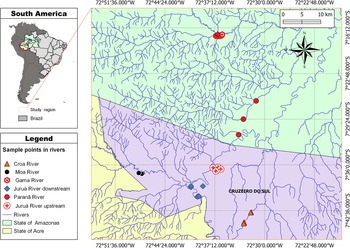
The study was carried out in the Upper Juruá River region in the Western Amazon around the municipalities of Cruzeiro do Sul, state of Acre, and Guajará, state of Amazonas, Brazil (07°37'52″S, 72°40'12″W). In this region, four sampling sites were selected in six sub-basins: Juruá River (7°40'34.1″S, 72°39'39.5″W); Crôa River (7°71'48.30″S, 72°53'34.98″W); Môa River (7°37'18″S, 72°47'47″W); Paranã River (7°17'13″S, 72°36'49″W); Gama River (7°37'13″S, 72°16'49″W); and Santa Rosa River (7°39'43.6″S, 72°48'44.4″W) (fig. 1). Fish were caught (SISBIO 59642-2/2019) from February 2019 to May 2021, so eight samplings were conducted in each sub-basin (8 samplings × 6 sub-basins = 48 samplings).
Sampling areas of fish parasites in the Juruá River Valley, Western Amazon.

Data collection
Passive fish collections were conducted using 12 gill nets with 80 m in length and 3.0 m in height, with mesh sizes of 1.5 cm, 2.5 cm, 3.5 cm and 5.5 cm between opposite knots, in areas of rivers, lakes and streams. Nets were set in the early afternoon, remaining exposed for 24 h. Inspections were carried out every 4 h, in which samples were obtained for the morning, afternoon and night periods. Active collections were performed with a trawl net of 25 m in length and 2.5 m in height, where nets were trawled along the banks of lakes, rivers and streams. A 12 m long and 1.8 m high cast net was also used for sampling in the environments, for 24 h; at every 4 h six casts were carried out on the bank, six in the flow and six in backwater areas. Fish captured were identified (according to Silvano, Reference Silvano2001, Reference Silvano2020; Torrente-Vilara et al., Reference Torrente-Vilara, Queiroz, Ohara, LJ, G, WM, THS, J and CRC2013), measured, weighed and necropsied. Some individuals, after biometry evaluation, were fixed in 10% formalin and taken to the laboratory, where they were deposited in the Fish Collection of the Federal University of Acre.
Collection and analysis of parasites
In total, 10,716 specimens of 216 fish species were necropsied and analysed. Fish were taken to the laboratory where they were anaesthetized with eugenol solution to evaluate the presence of haemoparasites; blood samples were drawn by cardiac puncture using a hypodermic syringe containing anticoagulant (5% ethylenediaminetetraacetic acid). Thus, blood smears were prepared per fish sample, stained with Quick Panoptic/LABORCLIN® and examined under optical microscopy at 400 and 1000× magnification at the Microscopy Laboratory of the Federal University of Acre (UFAC). To collect endoparasites, a longitudinal section was made, with the objective of exposing the entire contents of the visceral cavity. Internal organs were carefully removed and separated individually in Petri dishes containing 0.65% physiological saline. Parasites were placed in Petri dishes and washed with 0.85% physiological saline and observed under a stereoscopic microscope. Nematoda, Cestoda, Pentastomid and Acanthocephala found were fixed in 70% alcohol at 65°C; Digenea were fixed by slight pressing between the slide and the coverslip in heated 70% alcohol. Digenea, Cestoda and Acanthocephala were stained with Langeron's carmine, dehydrated by an increasing alcohol series (from 70% to 100% alcohol), cleared in phenol and beech creosote and mounted between a slide and coverslip with Canada balsam. Nematoda and Pentastomide were cleared and mounted on semi-permanent slides in Phenol and after being studied they were stored in vials with 70% alcohol.
Helminths were identified according to Travassos et al. (Reference Travassos, Freitas and Kohn1969), Yamaguti (Reference Yamaguti1970), Thatcher (Reference Thatcher1991), Moravec (Reference Moravec1998), Martins & Yoshitoshi (Reference Martins and Yoshitoshi2003), Jones et al. (Reference Jones, Jones, Bray and Gibson2005) and Miller & Cribb (Reference Miller, Cribb, Bray, Gibson and Jones2008). Samples of some morphotypes could not be identified to more specific taxonomic levels (morphospecies, genus or family) because they were damaged, and were named in the best possible way (e.g. Digenea-1).
Data analysis
The Shannon–Wiener diversity index, species richness and abundance of fish and endoparasite species were evaluated by sampling site. An analysis of variance (ANOVA) was used to test the differences in richness, diversity and total abundance of endoparasites and fish between sampling sites. The Cochran test was applied to check for homogeneity of variance.
Pearson correlation coefficient (r) was used to estimate the relationship between richness, diversity and abundance of host fish with those of endoparasites at each sampling site, the P-value was calculated for the r-value, in order to measure significance. Statistical analyses were run in the R 3.6.1 software (R Core Team, 2020).
Results
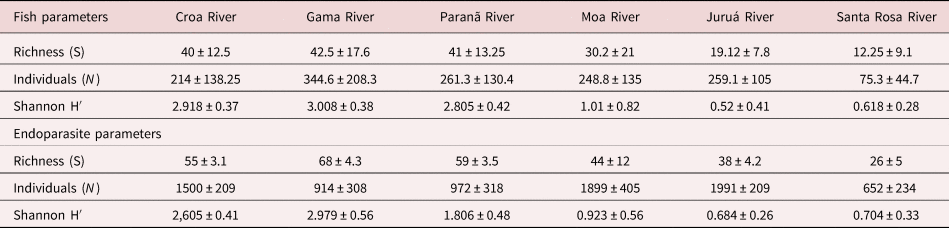
A total of 10,716 fish were collected, belonging to eight orders, 32 families and 216 species, with only 151 parasitized species. Species richness varied, on average, from 40 ± 12.5 to 12.5 ± 9.1 between environments (ANOVA – F = 4.23; P = 0.001), species diversity also presented variation (ANOVA – F = 2.23; P = 0.01), where the highest value was 3.008 ± 0.38 and the lowest was 0.52 ± 0.41. Fish abundance showed variation (ANOVA – F = 2.13; P = 0.02) with the highest mean value of 344.6 ± 208.3 and the lowest, 75.3 ± 44.7 (table 1).
Mean and standard deviation of values of Shannon–Wiener diversity, richness and diversity of host fish and endoparasites in sampling sites.

For endoparasites, a total of 27,581 individuals were found, with 65 species of Digenea (mean abundance = 1.614 ± 1.115), 40 Nematoda (mean abundance = 3.796 ± 3.615), 33 Cestoda (mean abundance = 504.2 ± 386), 21 Acanthocephala (mean abundance = 567 ± 405), five Pentastomids (mean abundance = 39 ± 33) and one Trypanosomatid (mean abundance = 1.200 ± 111). Where the richness (ANOVA – F = 1.73; P = 0.01), diversity (ANOVA – F = 3.35; P = 0.001) and abundance (ANOVA – F = 4.03; P = 0.0001) of endoparasite species varied between river environments (table 1).
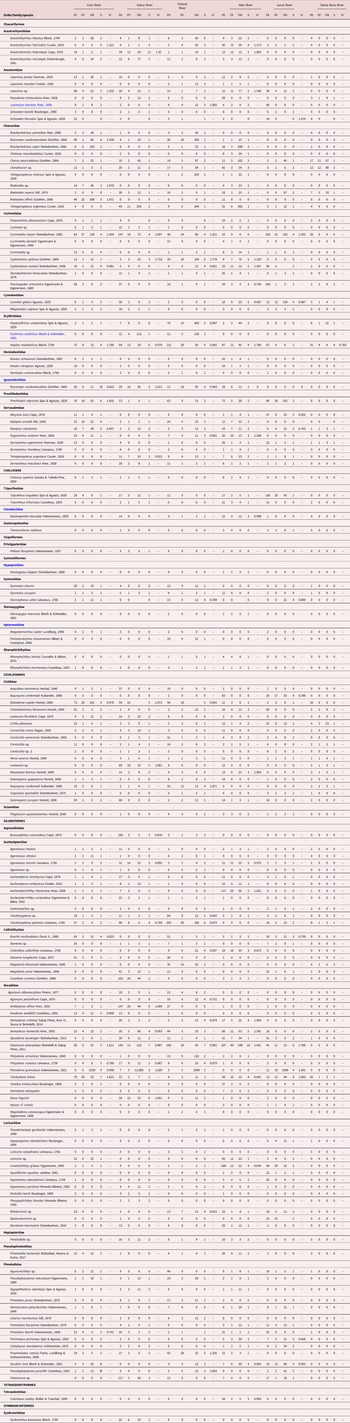
The most abundant species of Nematoda were Rondonia rondoni (n = 12.500) found in fish species of the family Doradidae, Procamallanus (S.) inopinatus (n = 540) and Cosmoxynemoide aguirei (n = 520). For Digenea, the species with the highest number of individuals were Pseudocladorchis romani (n = 3.478), Austrodiplostomum compactum (n = 580) and Ithyoclinostomum dimorphum (n = 139). The most abundant Cestoda was Proteocephalus sp. (n = 202) and Ageneiella brevifilis (n = 129), in Acanthocephala, Neoechinorhynchus curemai (n = 283) and Gorytocephalus elongorchis (n = 44) had the highest number of species, Sebekia sp. (n = 63) was the Pentastomida with the highest number of individuals (table 2).
Groups, host, infestation site, collection point, stage of development and total number of endoparasites collected (TNP) at the collection sites.

* Host with the first report of parasite fauna.
The endoparasite species predominating in several hosts were Prosthenhystera obesa (33 hosts), Clinostomum sp. (25 hosts) and Dadaytrema oxycephalum (23 hosts). For nematodes, Procamallanus (S.) inopinatus (66 hosts), Contracaecum sp. (62 hosts) and C. aguirrei (18 hosts). On the other hand, Cestoda Proteocephalus sp. (11 hosts) was the species with the highest number of hosts and for Acanthocephala, the species Neochinorhynchus sp. (six hosts) predominated (table 2).
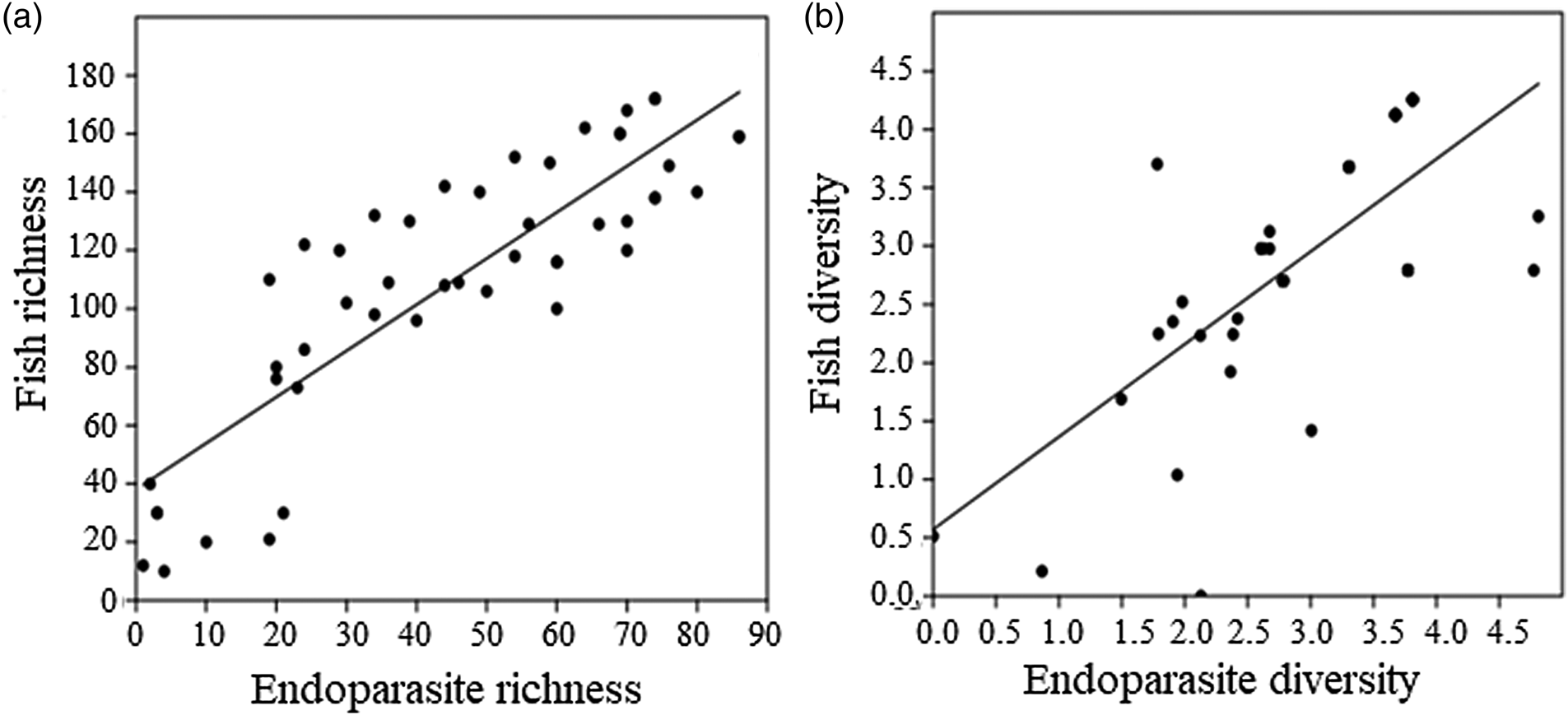
The present study showed that the increase in host richness and diversity influenced the increase in diversity and richness of endoparasites (richness: r = 0.93, p = 0.003; diversity: 0.86, p = 0.001) (fig. 2).
Pearson correlation between richness and diversity of hosts and richness and diversity of endoparasites. (a) Correlation between richness (S) of fish and richness of endoparasites (S). (b) Correlation between the diversity (H') of fish with the diversity (H') of endoparasites.

Ninety new hosts were reported for the first time, in addition to 95 new occurrences of endoparasites for the Western Amazon region, with 38 new reports of Digenea, 18 Nematoda, 14 Cestoda, 11 Acanthocephala and four Pentastomida. Some endoparasite species are new occurrence reports for the Brazilian Amazon, such as Digenea Crassicutis intermedius, Unisaccus prochilodorum, Genarchella isabellae, Goeldamphistomum peruanum, Microrchis oligovitellum, Iquitostrema papillatum, Travassosinia dilatata, Zonocotyle sp., Creptotrema lobata, Prosthenhystera oonastica and Phyllodistomum elongatum (see Supplementary Material), as well as Nematoda Raillietnema kritscheri, Dichelyne pimelodi, Travnema araujoi, Travnema travnema and Spinitectus asperus; and, also, Cestoda Valipora campylancristrota, Paramonticellia itaipuensis, Monticellia belavistensis, Proteocephalus fossatus, Proteocephalus jandia and Acanthocefala Palliolisentis quinqueungulis (table 2).
Fish species showing the highest richness and diversity of endoparasites were Acestrorhynchus heterolepis, Hoplias malabaricus, Bryconops caudomaculatus and Ossancora asterophysa (table 3). On the other hand, Pterodoras granulosus was the host that presented the highest abundance of parasites.
Abundance, richness and diversity of endoparasites in host fish at each sampling site.

EF, examined fish; PF, parasitized fish; PN, number of parasites; S, richness; H′, Shannon–Wiener diversity.
Discussion
The present study evidenced new occurrence records for endoparasites in the Brazilian Western Amazon region, and species such as U. prochilodorum found in Prochilodus nigricans was recorded only in Colombia, in Prochilodus reticulatus (Thatcher & Dossman, Reference Thatcher and Dossman1975). G. isabellae (Scholz & Salgado-Maldonado, Reference Scholz and Salgado-Maldonado1994) and C. lobata (Hernández-Mena et al., Reference Hernández-Mena, Lynggaard, Mendoza-Garfias and de León2016) were reported only in Central America, and the present study brings the first report of these species to South America infecting new hosts. Digenea G. isabellae is usually found in Cichliformes and Siluriformes fish (Scholz & Salgado-Maldonado, Reference Scholz and Salgado-Maldonado1994; Briosio-Aguilar et al., Reference Briosio-Aguilar, García-Varela, Hernández-Mena, Rubio-Godoy and De León2019) and in the present study, it was reported for the first time in Biotodoma cupido. Creptotrema lobata was recorded in Bryconops caudomaculatus, and, to date, in Characiformes fish, it had been reported in Brycon guatemalensis Regan, 1908 (Hernández-Mena et al., Reference Hernández-Mena, Lynggaard, Mendoza-Garfias and de León2016).
Phyllodistomum elongatum found in Crenicichla cincta was a reported species, so far, for example, in Asia and Europe (Urabe et al., Reference Urabe, Ishibashi and Uehara2015; Radujković & Šundić, Reference Radujković, Šundić, V, G and A2018; Mamontova et al., Reference Mamontova, Kuchko, Onishchenko and Pavlov2020) and the present study also brought this first report for South America. New geographical records of parasites in fish from the Amazon have been reported in several studies (Gonçalves et al., Reference Gonçalves, Oliveira, Neves and Tavares-Dias2016; Borges et al., Reference Borges, de Oliveira, Santos and Tavares-Dias2018; Chambrier et al., Reference Chambrier, Kuchta and Scholz2020; Reis et al., Reference Reis, Santos, Nunes and Mugnai2021), which may be associated with the high diversity of ecosystems and hosts found in this region – these results also indicate that studies in these areas can increase knowledge about the biodiversity of these organisms.
This study also indicated a strong correlation between host fish richness and endoparasite richness and diversity. The Amazon region is considered an important host diversity hotspot, and can sustain a variety of parasite species, as indicated in studies by Silva & Virgilio (Reference Silva and Virgilio2019) and Souza et al. (Reference Souza, Santos and Chagas2019). Many studies have reported a positive relationship between host and parasite richness in well-sampled habitats (Luque et al., Reference Luque, Pereira, Alves, Oliva and Timi2017). A meta-analysis confirmed that this relationship is very strong and universally observed in various host and parasite taxa (Luque & Poulin, Reference Luque and Poulin2007). In the midst of this high diversity of host fish, the Neotropical region may contain a high endemic fauna, corroborating studies on the parasite fauna of fish in this region (Rengifo, Reference Rengifo2007; Hoshino et al., Reference Hoshino, Hoshino and Tavares-Dias2014; Gonçalves et al., Reference Gonçalves, Oliveira, Neves and Tavares-Dias2016).
Endoparasites P. romani and R. rondoni were found in high abundance in Pterodoras granulosus, and both showed high parasite load in the same host. Pseudocladorchis romani has already been reported parasitizing Pterodoras granulosus, in addition to Brachyplatystoma vaillantii, Oxydoras niger in Peru and Megalodoras uranoscopus have been reported in the state of Pará (Pantoja et al., Reference Pantoja, Scholz, Luque and Jones2019), but the authors did not report this parasite load for this organism nor its interaction with specimens of R. rondoni. The parasite load of R. rondoni has already been observed in Pterodoras granulosus in the intestinal lumen (Dias et al., Reference Dias, Furuya, Pavanelli, Machado and Takemoto2004). This species of parasite is viviparous, and adults and larvae are observed in great intensity of parasitism in the intestine; however, fish are almost always asymptomatic (Takemoto et al., Reference Takemoto, Pavanelli, Lizama and Bellay2009). New hosts were reported for this species in the present study, such as Trachydoras brevis, Pterodoras granulosus, Bryconops caudomaculatus, Cyphocharax notatus, Amblydoras affinis and Dianema longibarbis – the infection of these parasites in these hosts may have occurred by ingestion of larvae or adults present in the water and that have been expelled in the faeces (Travassos, Reference Travassos1928).
The most abundant cestode endoparasites were Proteocephalus sp. and Ageneiella brevifilis, found in Ageneiosus inermis and in some species of the families Doradidae, Callichthyidae and Pimelodidae. Studies have revealed an extraordinary richness and abundance of proteocephalid worms in Amazon fish (Borges et al., Reference Borges, de Oliveira, Santos and Tavares-Dias2018; Chambrier et al., Reference Chambrier, Kuchta and Scholz2020). In Acanthocephala, N. curemai was the one with the highest number of individuals, and this endoparasite can be found in Prochilodus scrofa, Prochilodus lineatus Valenciennes, 1837 (Martins et al., Reference Martins, Fujimoto, Andrade and Tavares-Dias2020), Mugil curema Valenciennes, 1836 (Fortes et al., Reference Fortes, Mattos and Oliveira2000) and P. nigricans (Arévalo et al., Reference Arévalo, Morey and Malta2018; Virgilio et al., Reference Virgilio, da Silva Lima, Massato Takemoto, Marcelo Aranha Camargo and Ulises de Oliveira Meneguetti2021). And the present study expanded the number of reports of two more hosts for this species, such as Laemolyta taeniata and Roeboides sp. In the case of Sebekia sp., it was the most abundant Pentastomid, and in addition, the present study recorded, for the first time, new hosts for these organisms, such as Dianema longibarbis and Electrophorus voltai. Sebekidae species can infect Serrasalmidae, Erythrinidae and Pimelodidae species (Giesen et al., Reference Giesen, Takemoto, Calitz, Lizama and Junker2013), but for Gymnotiformes, only one species presented a report of Pentastomida (Ventura et al., Reference Ventura, Pádua, Ishikawa, Martins, Takemoto and Jeronimo2018), so the present result expands the record of these organisms to Gymnotiformes.
The most frequent endoparasite species in the environments and which colonized several host fish were Prosthenhystera obesa, Clinostomum sp. and Dadaytrema oxycephalum. These species of digeneans are considered generalists, and they are widely distributed in the Neotropical region in a wide variety of freshwater host families (Locke et al., Reference Locke, Caffara, Marcogliese and Fioravanti2015; Acosta et al., Reference Acosta, Smit and da Silva2020; Negreiros et al., Reference Negreiros, Pereira and Tavares-Dias2020). Clinostomum sp. and D. oxycephalum can occur in several organs, whereas P. obesa occurs in the gallbladder of their hosts (Bray, Reference Bray, Gibson, Jones and Bray2002; Gonçalves et al., Reference Gonçalves, Oliveira, Neves and Tavares-Dias2016). The present study reported, for the first time, the interaction of Clinostomum sp., P. obesa and D. oxycephalum in Ossancora asterophysa and presented the first record of occurrence of these endoparasites in Auchenipterichthys thoracatus, Nemadoras cristinae and Laetacara flavilabris, Clinostomum sp and P. obesa.
The present study showed that the nematodes Procamallanus (S.) inopinatus, Contracaecum sp. and C. aguirrei were predominant in almost all fish species. For the Western Amazon basin, 23 new hosts were found for P. (S) inopinatus, 27 for larvae of Contracaecum sp. and eight for C. aguirre. The predominance of these endoparasite species in the present study may be associated with the high diversity and abundance of hosts occurring in all periods in these lowland environments, in addition to the opportunistic generalist characteristics of these species, which allow them to infect several host species (Saad et al., Reference Saad, Vieira and Luque2012; Neves et al., Reference Neves, Silva, Florentino and Tavares-Dias2020; Virgilio et al., Reference Virgilio, da Silva Lima, Massato Takemoto, Marcelo Aranha Camargo and Ulises de Oliveira Meneguetti2021).
The present study evaluated parasite indices of 57 host species and, for the first time, the parasite characteristics of 36 host fish were reported, which, in addition to helping to increase information on the infracommunities of endoparasites in an environment, can also provide data for studies on evolution, distribution and ecology. Few studies collected more than ten hosts with field campaigns in a single region (Baia et al., Reference Baia, Florentino, Silva and Tavares-Dias2018; Negreiros et al., Reference Negreiros, Neves and Tavares-Dias2021) and some parasite fauna checklists were studies involving several collections and years of research (Lehun et al., Reference Lehun, Hasuike, Silva and Takemoto2020).
Among the analysed hosts, Ossancora asterophysa and Nemadoras humeralis of the family Doradidae were the species with the greatest richness of endoparasites. This can be explained by their feeding habits, as species of this family are considered omnivorous and benthic, feeding mainly on molluscs and arthropods (Barros et al., Reference Barros, Almeida, Figueiredo, Nunes and Carvalho Neta2021), which behave as intermediate hosts for several species of parasites (Pavanelli et al., Reference Pavanelli, Takemoto and Eiras2013).
The highest prevalence and mean intensities of endoparasites – that is, above 50% – were observed in fish species of the families Curimatidae, Erythrinidae, Cichlidae, Callichthyidae, Doradidae, Pimelodidae and Auchenipteridae, with higher mean intensity of infection and abundance found for nematodes. Species of these families in the present study presented omnivorous and carnivorous feeding habits. Previous studies on the fauna of metazoan parasites in fish of different trophic levels reported that both the prevalence and the mean intensity were higher in omnivorous and carnivorous hosts, indicating that the feeding habits of hosts was a determining factor in relation to the parasite fauna (Beevi & Radhakrishnan, Reference Beevi and Radhakrishnan2012).
In conclusion, this study demonstrated the high diversity of parasite–host associations, indicating new reports of hosts and geographical distributions, demonstrating information on the richness, abundance and distribution of parasites, and contributing with data that can be used as a useful tool for the conservation of biodiversity.
Supplementary material
To view supplementary material for this article, please visit https://doi.org/10.1017/S0022149X2200027X
Financial support
Not applicable.
Conflicts of interest
None.
Ethical standards
Not applicable.