In March 2013, a consortium of private foundations launched a global initiative for funding girls’ education with the release of the film Girl Rising. The film became an instant hit, screened in numerous venues all over the world, and particularly in the United States, where most of its foundation partners were based. Within a year, Girl Rising had raised more than $1.2 million for the Girl Rising Fund and was the subject of countless talk shows, blog posts, news articles, and discussion groups (see http://girlrising.com). In the past decade, virtually every major U.S. foundation has launched a program to support women and girls around the world, particularly in developing countries in Africa and Asia. Although U.S. private foundations provide significant and varied kinds of support for women and girls globally, we know little about the scope of foundation giving or its effects. In what ways, we ask, has foundation funding attempted to promote the empowerment of women and girls?
We begin by considering various feminist and feminist international relations perspectives that may shed light on the dynamics and potential impact of foundation funding. Although little research has looked specifically at the role of foundation funding for women, feminist scholarship has tackled this question in a number of ways. Keck and Sikkink (Reference Keck and Sikkink1998), who in their groundbreaking work were among the first scholars to consider the role of foundations in promoting gender equality, understood that role as largely positive and underscored the importance of foundations in facilitating international activism in the campaign against violence toward women. Other feminist scholars began to question this relatively positive assessment, however, pointing to the negative effect of donor behavior on women's activism and women's movements (Eyben Reference Eyben2010a, Hemment Reference Hemment2007; McMahon Reference McMahon2017) and the logic of the “good project,” which often diverts donors from supporting political organizing and activism (Krause Reference Krause2014). Moreover, as more recent scholarship on foundations has highlighted, at least some foundation funding has been influenced by “philanthrocapitalist” values and practices, which stress individual opportunity and choice over collective strategies for achieving enduring social change (Cornwall Reference Cornwall2016; Miller et al. Reference Miller, Arutyunova, Clark and Chu2013). In sum, whether the consequences of international (foundation) funding are understood as largely unintentional or not, an important critique has emerged that funding empowerment often undermines women's activism and movements.
We examine the empirical evidence for this critique. While we are unable to measure the impact of U.S. foundation funding directly, we are able to test the extent to which funding patterns exhibit the shortcomings described by this critique. We begin by demonstrating that foundations have become increasingly important actors in shaping the funding landscape in which gender equality activists move and work, underscoring the need to understand their funding discourse and practices. We focus on U.S. foundations as the largest overall private funders. Drawing on a recent survey data of international women's organizations, scholarly literature on women's movements, and interviews with foundation staff, we argue that scholars, practitioners, and foundation staff alike identify women's movements and political activism as essential elements of effecting meaningful and enduring change. It is therefore essential to understand whether and how funding practices support these goals. Building on the theoretical literature on social movements, we posit that women's movements must create capacity, find voice, and forge alliances to create effective political action, and we measure funding trends in these three areas. We are particularly interested in funding for organizations and activities that have an explicit political or advocacy mission on behalf of women's rights and empowerment, since these organizations are most central to the wider movement-building enterprise.
We argue that there are reasons for both optimism and concern when it comes to foundation funding for women's empowerment programs and initiatives. On the one hand, we find that the share of funding for organizations and issues that have a political advocacy component has held steady in the past decade, despite the concern that foundation funding, increasingly infused with philanthrocapitalist values, may be directed away from political activism. Moreover, the proportion of funding for organizations engaged with multiple issues and groups has increased dramatically, suggesting that funders are attuned to their stated goals of engaging in intersectional work. On the other hand, we find trends in the opposite direction in declining shares of funding for general operating costs, leadership training, and coalition building for groups engaged in political advocacy—trends that may weaken the ability of gender equality organizations to promote enduring change. The funding landscape in which activists and organizations move is critical, and feminist scholarship can help us map this terrain both theoretically and empirically. In the last part of the article, we suggest a research agenda to study the impact and power of philanthropy.
The research for this article is based on data from the Foundation Center's grants data set, which includes all grants of $10,000 or more awarded by a national sample of approximately 1,000 large private and community foundations. Our custom data set includes all funding coded for women's and girls’ empowerment programs and organizations from 1991 to 2013 (see the supplementary appendix online, Section 2, for a detailed discussion of the data set and coding rules). We supplement this data set with “gray material,” reports produced by and for foundations about women's empowerment programs and funding needs, including a recent survey by the Association for Women's Rights in Development (AWID) of 1,000 women's organizations about their sources of funding (Arutyunova and Clark Reference Arutyunova and Clark2013).Footnote 1 In addition, we conducted interviews with program staff and directors at three large foundations with a particular focus on women's empowerment programs to understand their perspectives and priorities when it comes to funding women's empowerment (see the online appendix, Section 1, for a detailed discussion of interview process and questions).Footnote 2
While the term “empowerment” is frequently used by foundation staff and in program descriptions, this term has been the subject of considerable debate and contestation among feminist scholars and even some foundation program directors, who point to its conceptual stretching and various, often depoliticized usages (Batliwala Reference Batliwala2007; Cornwall Reference Cornwall2016; Cornwall and Eade Reference Cornwall and Eade2011). For the purposes of this article, we use “women's empowerment” as a technical term, focusing on support for women's movements and political activism, which activists and scholars alike see as a necessary component of achieving enduring political change. While the term encapsulates a wide variety of programs and approaches, we use the operationalization of women's organizations and political activity presented in this article as the best way to translate the generalized term into a concrete category of funding (see the online appendix, Sections 2–7).
FEMINIST PERSPECTIVES ON FOUNDATION FUNDING
Few comparative and international relations scholars have considered the growth and impact of foundations in the international arena, and feminist scholars are no exception. Those who do usually fail to distinguish analytically among the various actors included in their discussions, such as international donors, international nongovernmental organizations (NGOs), and transnational advocacy networks. The absence of a distinct literature on foundations and international politics does not mean, however, that existing research has nothing to say about the potential impact of foundation funding on global women's empowerment.
Many refinements are possible, but we define a foundation as an NGO that primarily makes grants. This means that foundations use their own financial resources, are usually led by an independent board of trustees, and aim to address issues for the common good. Whether foundations are an explicit focus or not, a host of studies from various disciplines have contributed to what we know about the challenges of funding for enduring and transformational change. Although there is considerable overlap among them, the following section identifies five potentially demobilizing effects of funding for women's empowerment that are developed within these different bodies of literature: (1) the fracturing of women's movements through professionalization; (2) the directing of activists’ efforts toward service delivery rather than political advocacy; (3) the imposition of donor rather than local agendas; (4) the funding of discrete projects with limited, quantifiable outcomes in place of support for the messy business of politics; and (5) an emphasis on individual solutions rather than collective action approaches.
The first critique of donor practices has to do with the ways in which they weaken movements and activism through fractionalization. Numerous ethnographic studies from what we might call a civil society perspective have traced how organizations respond to donor practices and the many unintended consequences that these practices produce (Campbell and Teghtsoonian Reference Campbell and Teghtsoonian2010; Hemment Reference Hemment2007; Mendelson and Glenn Reference Mendelson and Glenn2002). These studies highlight the ways in which donor practices result in the professionalization of women's groups—what Sabine Lang first called “NGOization”—as they focus on grant requirements and the implementation of discrete, fundable projects and the heavy reporting requirements that sap the time and energies of activists in the chase for the next grant (Bagic Reference Bagic, Feree and Tripp2006; Lang Reference Lang, Scott, Kaplan and Keates1997). According to these studies, such assistance can cause a fracturing of civil society as groups compete with one another for funds. The upshot of such professionalization is the depoliticization of the discourses and practices of women's movements.
A second and related critique of funding practices has to do with various ways in which they direct activity toward service delivery and away from the political arena. A body of literature from a more state-centered approach develops a theory of foundation behavior that understands it as an appendage of the state, or what Jennifer Wolch (Reference Wolch1990) first called a “shadow state” and the economic elites who control it. The purpose of foundations is to preserve family wealth and to dissipate and co-opt social movements so that dissent does not threaten the social, economic, and political order (Roefels Reference Roefels2003). By creating and maintaining a “nonprofit industrial complex,” foundations preclude the emergence of liberatory social movements, directing women's organizations away from political activism toward project-based service delivery activities (Eyben and Napier-Moore Reference Eyben and Napier-Moore2009; Smith Reference Smith2007). Similarly, feminist development studies see foundations and other nonstate actors as embedded in a structure of neoliberal institutions in which the labor of caring is shifted from the state to the private sector, where women bear the brunt of the burden (Bernal and Grewal Reference Bernal and Grewal2014). The effect is to overburden women's organizations and activists, diverting them into service delivery instead of advocacy, ultimately reducing their capacity to act politically and causing NGOs to be directed by the state rather than holding the state accountable.
A third critique of donor practices is that rather than listening to the voices and needs of local activists, donors impose agendas devised from afar, often with little or no consultation with the women's organizations and activists they wish to assist (Nazneen and Sultan Reference Nazneen and Sultan2014). This critique has been advanced in postcolonial studies of development policies, which have, among other issues, drawn attention to the ways in which women's empowerment programs are used instrumentally to serve other goals (Batliwala Reference Batliwala2007; Nazneen and Sultan Reference Nazneen and Sultan2014). For example, they highlight the focus of Northern/Western aid agencies and actors on population control as a way of controlling the reproductive capacities of third-world women and limiting potential demographic “threats” from the global South (Antrobus Reference Antrobus2005). Foundations such as the Ford Foundation, which had large population programs in which reproductive health was often embedded, were directly implicated in this neocolonial critique (Dixon-Mueller Reference Dixon-Mueller1993). Feminist development studies affirm the importance of supporting local initiatives since these are more likely to succeed in making changes for other women (Cornwall Reference Cornwall2016).
A fourth critique of donor practices has to do with foundations’ increasing focus on clearly measurable outcomes and quantifiable indicators. This concern was first raised in numerous studies in the 1990s, as it became clear that government and private donors were driven by a need to show tangible results (Batliwala and Sen Reference Batliwala, Sen, Sen, Germain and Chen1994; Kabeer Reference Kabeer1999). More recent work on the sociology of international aid—what is often referred to as “Aidland”—has pointed to the logic of the “good project,” which may have as its goal gender empowerment but which is structured according the requirements of project design and evaluation with clearly quantifiable outcomes (Klugman Reference Klugman2011; Krause Reference Krause2014; Mosse Reference Mosse2005). This has resulted in a funding agenda that seeks easy projects and limited, technical solutions instead of supporting sustained activism for enduring change.
A final critique has to do with a set of ideas associated with the increasing influence of philanthrocapitalist values and practices, which stress individual opportunity and choice over collective strategies for achieving social change (McGoey Reference McGoey2015). “Philanthrocapitalism” is an umbrella term that covers a range of actors and approaches, but the hallmarks of this funding are “an entrepreneurial result-oriented framework” and the use of market mechanisms to achieve philanthropic ends (Edwards Reference Edwards, Kremer, van Lieshout and Went2009, 245. Critics from the body of work on philanthrocapitalism challenge the predominant philanthrocapitalist thinking that economic opportunity and money alone can empower women (Eyben Reference Eyben2010a, Reference Eyben2010b; Eyben and Turquet Reference Eyben and Turquet2013). Philanthrocapitalist ideas and practices have championed women as effective entrepreneurs and agents of change, even as they neglect the organizing and activism that have created new opportunities for them (Arutyunova and Clark Reference Arutyunova and Clark2013; Miller et al. Reference Miller, Arutyunova, Clark and Chu2013; McGoey Reference McGoey2015) According to this critique, instead of funding women's organizations to work for transformative change, philanthrocapitalist aid often serves to diminish and demobilize their work.
STRENGTHENING WOMEN'S MOVEMENTS AS A VEHICLE FOR CHANGE
These potentially movement-weakening outcomes of foundation funding are deeply problematic. Almost all scholarly work on the conditions necessary to bring about real and enduring change points to the central role that women's organizing and women's movement play. Indeed, if there is a consensus in the scholarly literature on gender equality, it is that women's movements are a necessary, though not sufficient, condition for progress toward gender equality (Beckwith Reference Beckwith2000; Htun and Weldon Reference Htun and Weldon2010; Waylen Reference Waylen2007). This focus on women's movements as a key aspect of gender equality is not limited to academia—both movement leadersFootnote 3 and foundation staff stress effective political movement building as a central goal of women's empowerment programs (Arutyunova and Clark Reference Arutyunova and Clark2013).Footnote 4 The argument that donor practices are having such a negative effect on women's movements and political activism is a serious cause for concern. Whether and how U.S. foundation practices reflect these potentially demobilizing funding practices and the kinds of remedies they have proposed are the focus of our empirical work.
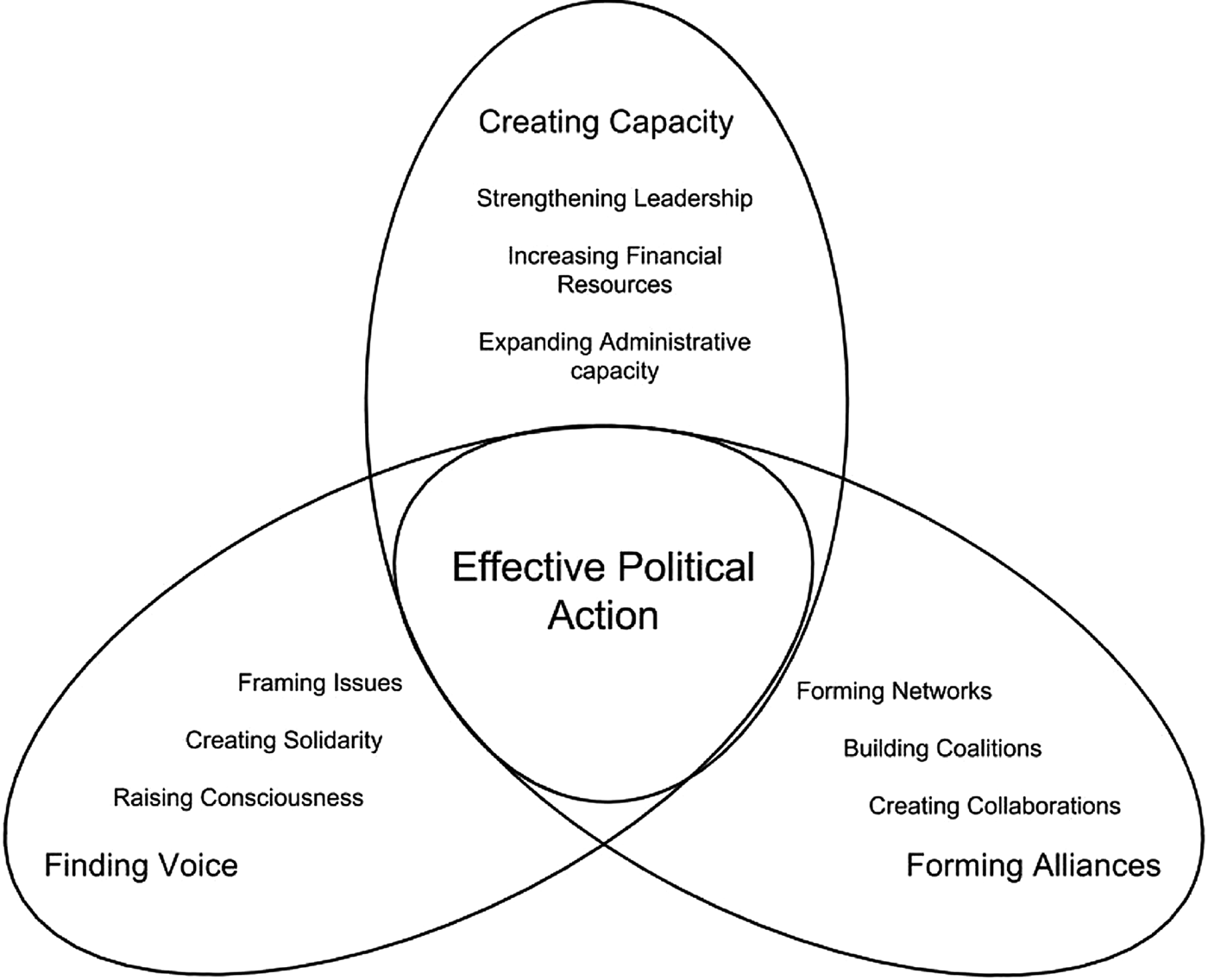
The extensive research on women's and other social movements can provide guideposts for evaluating the critiques described earlier as well as the most likely strategies for success in foundation funding of women's empowerment. Building on this work, we propose a framework for understanding what women's movements do and where resources should be directed. As we suggested earlier, three main approaches map the activities that are necessary for supporting effective women's movements. First, resource mobilization theory points to the process of creating capacity. In this area, feminist scholars and activists have identified general operational funding (Eyben Reference Eyben2011) and leadership training as particularly crucial for capacity building (Arutyunova and Clark Reference Arutyunova and Clark2013; Cornwall Reference Cornwall2016). Second, cultural theories of social movements stress identity formation and issue framing, creating a voice that resonates with participants and populace alike. For theorists of women's movements, consciousness raising and creating solidarity are thus essential elements of tackling cultural norms and practices that are internalized as forms of self-policing and addressing the various forms of privilege possessed by movement participants (Eyben Reference Eyben2010a; Hancock Reference Hancock2011). Third, political process theories emphasize the importance of political opportunity structures and the dynamics of coalitional politics. Feminist attention to intersectionality alerts us to the need for alliances not only across issues but also across groups based on such identities as race, class, ability, national belonging, and religion, to name a few—what Yuval-Davis (Reference Yuval-Davis1997) calls “transversal politics.” It also alerts us to the need to build alliances between women's organizations, women's policy agencies, and women representatives (Baldez Reference Baldez2003; Irvine Reference Irvine2007; Squires Reference Squires2007). Finally, all scholars of women's and social movements stress the need for collective action in the political arena to effect transformative political change.
Dimensions of movement building.

Using this framework to help us understand the range of activities that women's movements engage in, we examine U.S. foundation funding in the critical areas of building capacity, finding voice, and forming alliances, with an eye toward the potentially negative trends the foregoing critiques identify. Because funding is not directed at political behavior per se, we focus on capacity, voice, and alliances with the understanding that these are crucial components of any action and engagement in the political arena.
FOUNDATIONS AND GLOBAL FUNDING FOR WOMEN AND GIRLS
Much has been written about the so-called associational revolution of the 1980s, but at least for international and comparative scholars, this work has focused largely on the explosion of NGOs and other private nonstate actors rather than the numerical growth or economic wealth of private foundations (Witte Reference Witte2009). This is both surprising and unfortunate, because the growth of private foundations worldwide has been unprecedented, increasing more than threefold in just the second half of the 1990s (Anheier and Hammack Reference Anheier and Hammack2010). In 2014 in the United States alone, 86,726 foundations, worth well over $800 billion, funded a variety of causes and actors, including, increasingly, those promoting the empowerment of women and girls (http://data.foundationcenter.org/). This is demonstrated by the increase in the number and kind of programs focused on women's empowerment and gender equality.
Currently, there are four main types of private funds for women's empowerment and gender equality initiatives: private foundations, women's funds, international NGOs (which are often focused on humanitarian assistance but may support women's programs), and corporate funders (often separated into corporate foundations, which are not-for-profit entities, and corporate philanthropy, which is an arm of a company). In this article, we focus primarily on private (sometimes called family) foundation funding for women's empowerment programs, for several reasons. First, in terms of overall spending, they are the largest players, particularly with the formation of the Bill and Melinda Gates Foundation (Gates Foundation), the largest charitable foundation in the United States, with international spending exceeding the foreign aid budgets of many industrialized countries. Moreover, foundations such as the Ford Foundation have extensive and well-established national offices that form an important and enduring part of the funding landscape. Further, the role and dynamics of private foundations have been changing rapidly as this sector has grown in importance in international funding for women's empowerment programs.
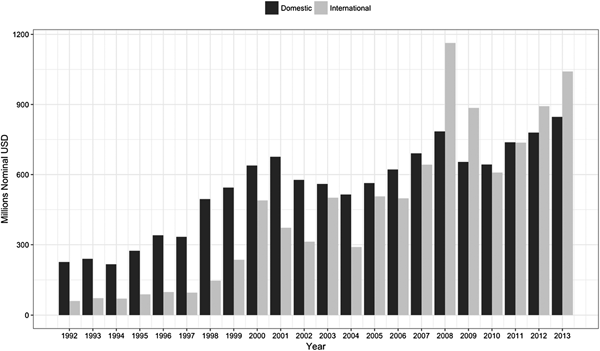
Two major trends have affected U.S. foundation funding for programs and initiatives aimed at empowering women and girls since 1992. As Figure 2 shows, since 1992, U.S. foundations have more than tripled the funding directed at women and girls, and this funding has increasingly been directed outside the United States. Some U.S. foundations such as the Ford Foundation have traditionally directed a substantial portion of their funding abroad, but taken in the aggregate, the lion's share of U.S. foundation funding was invested in programs and initiatives in the United States. By the beginning of the twenty-first century, however, the distribution of domestic and international funding of women's empowerment programs had shifted in favor of international funding. This shift can be attributed in large part to the impact of the Gates Foundation, which began to increase its international spending around this time.
All foundation spending on women's empowerment, domestic and international, 1992–2013.

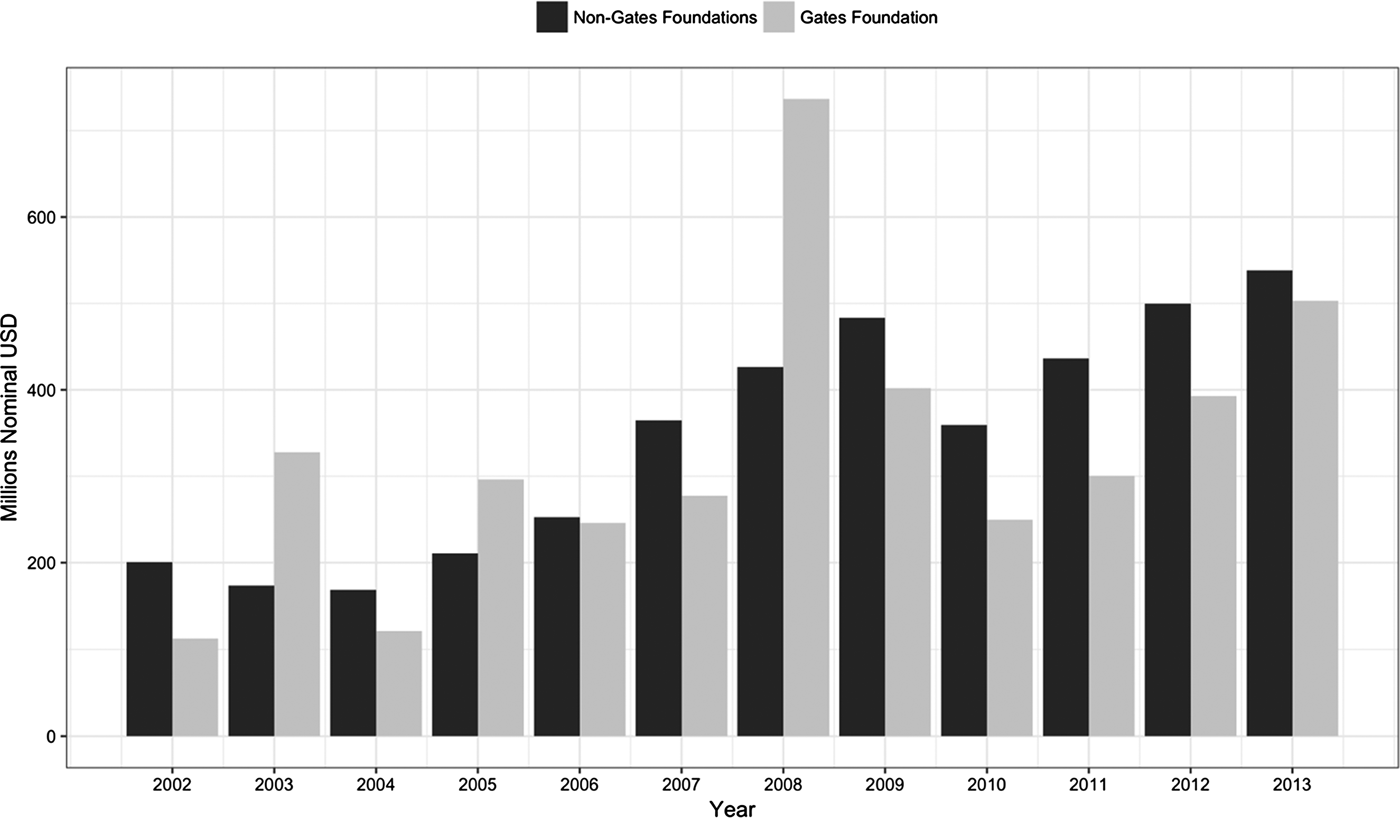
Given the extent of its spending, the Gates Foundation has had a significant impact on the dynamics and impact of funding for women's empowerment. Founded in 1994, the Gates Foundation merged with the Gates Learning Foundation in 1997. The endowment and number of grants increased steadily after U.S. investor Warren Buffet announced in June 2006 that he would contribute another US$30 billion to the Gates Foundation over the next several decades. As of March 2015, the Gates Foundation endowment was estimated to be US$39.6 billion, of which it awarded approximately US$4.2 billion in total grants that year. Beginning in 2000, the Gates Foundation began to invest significantly in women's empowerment programs, with a very high the proportion of its funds for women and girls directed outside the United States; by 2013, nearly 100% of its funds were spent outside the United States, with a mere 0.2% tagged as domestic (see Figure 3). The Gates Foundation currently gives almost as much funding to women's empowerment programs abroad as all other foundations combined, spending more than US$500 million in 2013.
Gates Foundation spending comparison: Gates and non-Gates international spending on women's empowerment, 2002–2013.

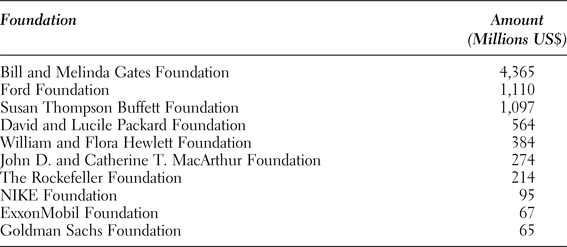
Although U.S. foundation giving has increased significantly in the last two decades, foundations’ interest in women's empowerment is not new. Starting in the 1970s, the Ford Foundation shifted its attention from domestic programs focused on women's rights to international funding for gender and women's empowerment throughout the world. Shortly thereafter, it began to expand its focus on women's status as an offshoot of population planning toward a broader conception of women's empowerment programming (Korey Reference Korey2007). The first United Nations (UN) World Conference on Women in 1975 provided an opportunity for the Ford Foundation to broaden its strategy, including its strong financial support for a host of subsequent UN conferences on women and women's issues. Thus, what began as isolated programs focused on women's education, employment, and family planning evolved into a defining characteristic of the Ford Foundation. By the 1990s, the Ford Foundation's groundbreaking activities and approach emphasized women's rights as human rights, based on women's social, economic, and political equality, and it remains the second-largest historical funder of women's empowerment programs internationally, after the Gates Foundation (see Table 1).
Top 10 international funders: Foundations by total international giving to women's empowerment, 1992–2013

Many U.S. foundations profess a strong commitment to movement building in their program descriptions and thematic focus. Certainly, the program directors with whom we spoke had a keen appreciation for the importance of women's movements for achieving the goal of women's empowerment, describing them as “crucial” for any critical change.”Footnote 5 Indeed, several of the largest U.S. foundations have undergone reorganization in their gender equality programs in the past five years, ostensibly to improve this among other outcomes.Footnote 6 In the process, foundation staff and leadership have engaged in serious and substantive discussion about when, where, and how to best fund women's rights and empowerment. At the same time, they also have acknowledged the difficulty of devising an effective strategy for funding movement building; as one program director put it, she is “alert to the fragility of women's movements” and the challenges of supporting them at the local and national level.Footnote 7 When and how to fund women's movements is a source of serious concern and debate.
In the following section, we consider whether U.S. foundations are funding in ways that may strengthen rather than weaken women's organizing. Using our framework for women's movements, we consider whether and how U.S. foundations have funded the movement-building arenas of creating capacity, finding voice, and forging alliances. Measuring the impact of foundation funding and other sources of funding women's organizations may receive is outside the scope of this article. Rather, we are concerned here with whether U.S. foundations themselves are funding in ways we argue are crucial to sustaining and supporting women's movements.
FUNDING MOVEMENTS
Perhaps the place to begin is to ask, first, whether U.S. foundations are funding women's organizations that are already in place, with the understanding that they are the main building blocks of strong women's movements, and second, whether they are funding them to engage in political advocacy and activism rather than simply service provision. Funding organizations alone does not constitute a comprehensive strategy of supporting transformational politics. Indeed, the failure to distinguish analytically and practically between NGOs and women's movements has hindered clear thinking about effective funding strategies among foundation staff and feminist scholars alike. As several scholars of women's movements have pointed out, “NGOs are neither movements nor surrogates for them” (Basu Reference Basu2010). Nevertheless, women's organizations are crucial elements of any successful women's movements, and support for local, national, and transnational groups is essential to this success. Yet a recent study of 170 gender equality initiatives sponsored by U.S. foundations and the corporate sector determined that only 9% of the funds were disbursed directly to women's organizations (Miller et al. Reference Miller, Arutyunova, Clark and Chu2013, 28). Many U.S. foundations prefer to launch their own initiatives or to channel funds through international NGOs whose primary focus and experience is often not in the area of women's empowerment (Miller et al. Reference Miller, Arutyunova, Clark and Chu2013).
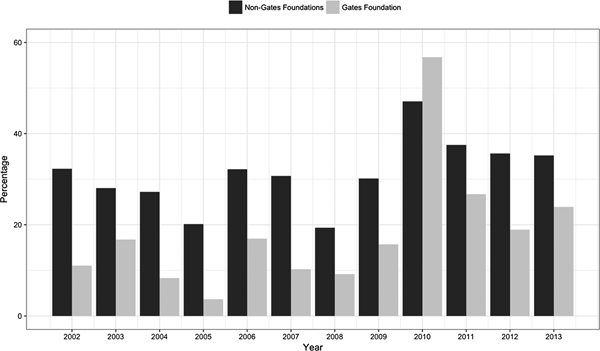
Investing in organizations with a political mission is crucial since these organizations drive efforts to create real structural change. Evidence suggests that assistance to women's equality organizations has a significant impact on gender equality laws and policies (Baliaoune-Lutz Reference Baliaoune-Lutz2016). Of the funds that reach women's organizations, how much are directed toward organizations that are engaged in political advocacy or policy reform? In our empirical analysis, we focus on funding for organizations and activities with a primary mission of promoting women's political empowerment, rights, and gender equality (see the online appendix, Section 2, for coding rules). Organizations that have this mission as their focus will be referred to as “women's political organizations.” According to our data, political funding has increased as a proportion of spending, with the funding share increasing from about 32% in 2002 to approximately 35% in 2013 (see Figure 4). The proportion of Gates Foundation funding going to political projects has increased faster, starting at around 11% of total spending on empowerment organizations and programs and ending at 21%.
Trends in political funding: All foundations’ and Gates Foundation's political international giving as a percentage of their total international women's empowerment giving, 2002–2013.

The concern that the proportion of funding has dropped for organizations engaged in political work, particularly with the entrance of foundations such as the Gates Foundation, is not supported by our data. Moreover, the total amount of funding for women's empowerment has risen significantly during the past decade. Nevertheless, it is clear that the lion's share of funding, almost three-quarters, still goes to nonpolitical activities such as service delivery, with little to no engagement in efforts to change public policies or practices. Thus, although the trend is slightly upward in terms of the share of funding of organizations with an explicit focus on promoting political change, the amount spent on organizations with a political mission remains relatively low. Moreover, the overall amount of funding for what we define as political organizations and activities tells us little about whether this funding supports the crucial tasks of creating capacity, finding voice, and forming alliances.
CREATING CAPACITY
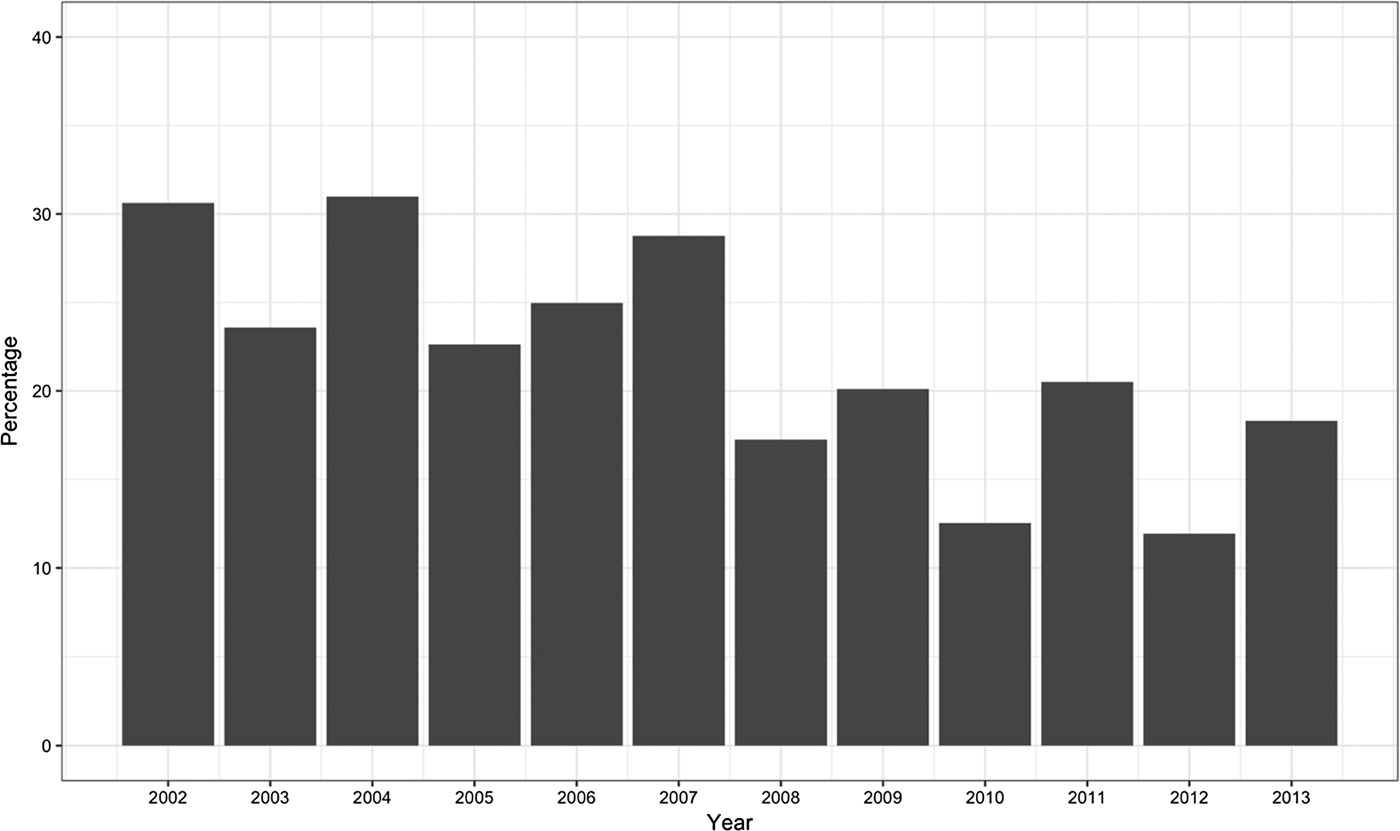
Two elements are crucial to donor funding for creating capacity: providing general operating support over a long period of time and investing in strong and effective leadership at all levels of organization, including rural and urban groups. General operating support has been identified by women's organizations and feminist scholars alike as an essential element in building capacity, since it allows organizations the flexibility to respond to local conditions and maximum control over the content and direction of their work (Eyben Reference Eyben2011; Miller et al. Reference Miller, Arutyunova, Clark and Chu2013; Mukhopadhyay Reference Mukhopadhyay2016). According the AWID survey of women's organizations worldwide, support for this aspect of capacity building is vitally important to them (Arutyunova and Clark Reference Arutyunova and Clark2013). Our data indicate, however, that the share of U.S. foundation funding directed toward general operating support for groups that engage in some form of political advocacy for gender equality has been dropping steadily over the past decade (see Figure 5). While the funds disbursed to these organizations in 2002 totaled around 30%, in 2013, the amount had dropped to 15%. Critics of donor practices suggest that this will have a negative effect on capacity building for women's political advocacy organizations.
Funding general operating support: Percentage of international political funding by all foundations designated for operating costs, 2002–2013.

We also know that capacity building requires leadership training. Indeed, funding leadership training is a constant refrain from many popular corporate initiatives as well as more established U.S. foundations. According to the women's organizations surveyed by AWID, which include both urban and rural groups, it is as an essential component of increasing their capacity (Arutyunova and Clark Reference Arutyunova and Clark2013, 117). Network structures, which bring women's organizations together across the often cavernous urban-rural divide, are also essential to building capacity (these will be treated more fully later in the article). Our data indicate that the trend in U.S. foundation funding shares for leadership training of women's organizations with some kind of political or advocacy mission has also been steadily declining, from an already low level of around 2.2% of the total funds disbursed to these organizations and activities in 2002 to less than 0.6% in 2013 (see the online appendix, Section 4, for coding details and outliers). U.S. foundation funding initiatives for women and girls have a strong discursive commitment to “training the next generation of leaders,” which does not appear to be reflected in the overall proportion of funds directed to this aspect of capacity building.
FINDING VOICE
Several elements have been identified by feminist scholars as important in finding voice, which encompasses both inward-looking and outward-facing activities. The inward-looking aspect of finding voice includes raising consciousness and building solidarity across multiple identities and oppressions. These are often encouraged through convenings and conversations or dialogues to analyze and strategize—what Andrea Cornwall (Reference Cornwall2016) calls “stopping places” for women to reflect and exchange “route-maps” on their empowerment journeys. The program directors with whom we spoke stressed the importance of this “relational activity” to finding voice.Footnote 8 The outward-facing aspect involves identifying and framing issues around which to structure political action and advocacy, promoting gender issues that resonate with women's organizations membership and wider public alike (Okeke-Ihejirika and Franceschet Reference Okeke-Ihejirika and Franceschet2002; Razavi Reference Razavi2001). These can best be encouraged by reaching out to the base through grassroots organizing and through researching and communicating issues effectively to the public.
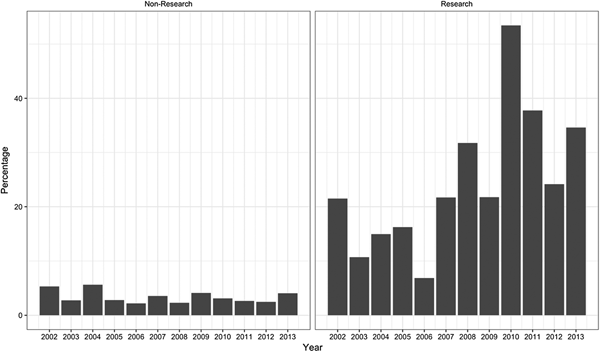
According to critics of donor funding practices, the growing emphasis of the philanthropic sector as a whole on technical solutions for individual women means that support for voice-finding activities may not be easily forthcoming, and this concern is borne out by the evidence. Women's organizations see intragroup communication and information as among their top priorities for funding support. Yet they report little support for these activities among funders (Arutyunova and Clark Reference Arutyunova and Clark2013, 117). In order to further explore the spending patterns of U.S. foundations, we constructed an indicator of the activities that might contribute to both the inward- and outward-facing aspects of finding voice, including convenings, grassroots organizing, public outreach, audience development, marketing, building virtual structures, publications, and research (see coding criteria in the online appendix, Section 5). Using this indicator and considering funding only for women's organizations and activities related to political advocacy, we find that support for most aspects of finding voice is low and dropping, although funding for research has increased significantly. For example, convenings as a percentage of total funding to women's political organizations and activities dropped from 1.06% in 2002 to 0.14% in 2013. Other areas of funding for creating solidarity and identifying issues such as grassroots organizing never exceeded 5% in any given year. At the same time, a significant portion of funding is directed toward research, up from around 15% at the beginning of the period to close to 40% of overall funding by the end of the period (see Figure 6). This increase could suggest greater support for framing and presenting issues to the public and greater concern with evaluating the impact of funding and programs. It is difficult to make the case, however, that funding research alone reflects a stronger emphasis on finding voice, particularly when it comes to the consciousness raising and solidarity building essential to this process. Tracking spending designed to support issue framing activities is challenging, but our data suggest that the funding possibilities for finding voice through coming together in conversation and solidarity are limited.
Giving to finding voice: Percentage of political international giving by all foundations designated for research and for all other nonresearch voice-finding activities, 2002–2013.

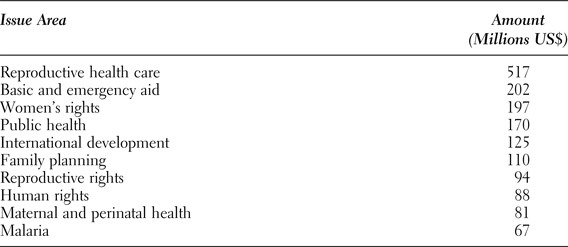
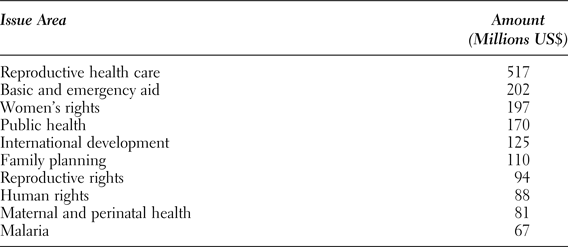
Issue framing, by its very nature, must evolve within local women's movements and speak to their own contexts. As several studies conclude, identifying and framing important issues cannot be imposed through a process of program development in foundation headquarters (Cornwall and Edwards Reference Cornwall and Edwards2014; Hemment Reference Hemment2007). Thus, to some extent, the priorities of donors and recipient women's organizations should converge around a common set of themes and issues. Nevertheless, there are significant discrepancies between the issues that women's organizations identify as their top concerns and the areas to which U.S. foundations direct their funds. According to the AWID survey, when asked to rank the issues that were most important to them, women's organizations, both political and nonpolitical as we define them, listed violence against women their first priority (59%), followed by women's leadership and empowerment and economic empowerment (Arutyunova and Clark Reference Arutyunova and Clark2013, 115). Although many large U.S. foundations have long-standing programs directed at these issues, our data indicate that their overall funding priorities differ significantly. This is evident from the top 10 issue areas in terms of funding from 2002 to 2013 (see Table 2). U.S. foundations direct the lion's share of their funding for women toward health, in particular reproductive health initiatives, with 8 of the 10 issues they fund focused on health concerns. Although our data are not directly comparable, this disjunction between what women's organizations in the AWID survey identify as their top priorities and the areas in which U.S. foundations are spending may result in diverting resources from issues that women's organizations themselves identify as a higher priority.
Top 10 most-funded issue areas: Issue areas by amount of political funding designated, 2002–2013
FORMING ALLIANCES
An additional challenge for funding women's movements is related to the issue of when and how to promote collaborations among organizations and across movements. If the critique of funding is correct—that it often results in increased competition among women's groups and a resulting fragmentation of women's movements—this would appear to be a particularly important area in which to direct funds. The foundation staff we interviewed acknowledged the need for promoting collaborations and partnerships, although they expressed well-founded skepticism about “forced marriages” and “donor advised” collaborations among recipient organizations.Footnote 9 Despite their stated goal of incentivizing collaborations and alliances, however, it appears that very little funds are directed toward this end. In order to measure funding levels for alliance building, we constructed an indicator that included activities related to the categories of networking, coalition building, and conferences (conferences and exhibits, hosting conferences, attending conferences, and presenting at conferences). According to existing research, these activities have proved useful in promoting collaborations among civil society actors (Helms Reference Helms2003; Irvine Reference Irvine2007). We also considered a second indicator based on the extent of giving to organizations tagged as including multiple organizations in a coalition and/or alliance.
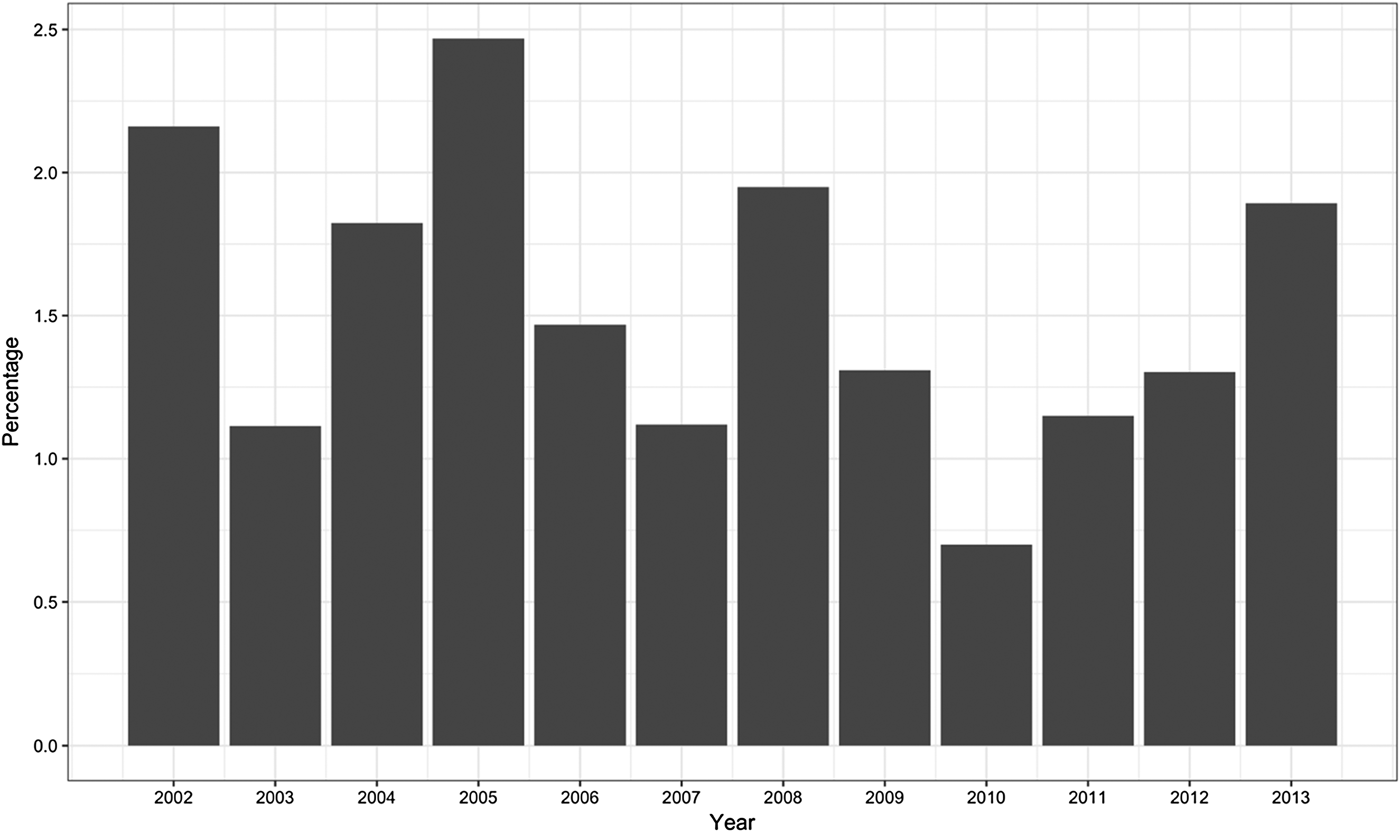
As Figure 7 indicates, aggregate funding for all aspects of alliance and coalition building is very low and dropping. In most years between 2002 and 2013, it made up between 1% and 2% of money directed toward women's political organizations. Of the funds spent to promote alliance building, the activity that received the most support was tagged conferences and exhibits, with more than 90% of alliance-building funds going to conferences in the majority of years. An average of only 6.8% of overall funding for women's political organizations was directed toward groups that are tagged in the data set as alliances or coalitions. Given the strong critique of funding as resulting in the fragmentation of women's movements and organizations, greater attention should be paid to funding (and tracking) opportunities for activists and organizations from multiple identities and backgrounds as well as multiple sectors of society to come together to strategize about joint issues and actions.
Giving to alliance building: Percentage of political international giving by all foundations designated for alliance building, 2002–2013.

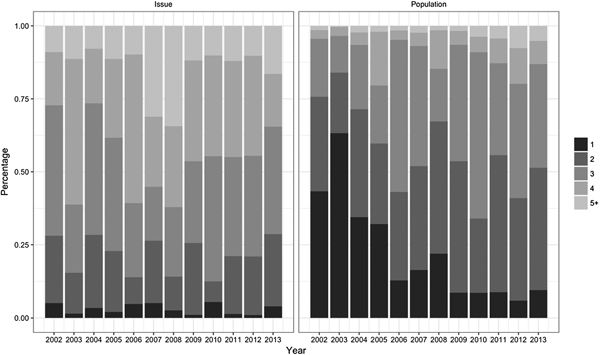
At the same time that funding for networking and coalition building is low, funding for grants targeting multiple populations and multiple issues has increased significantly. This increase in grants targeting women from different groups in the population suggests an increasing concern with intersectionality, although there has been very little research about how funding can be directed to support intersectional activism. Foundation staff with whom we spoke expressed a keen appreciation for the importance of “working across identities and issues that advance multiple constituencies’ interests.”Footnote 10 This concern appears to be reflected in U.S. foundation funding trends for women's empowerment. In 2002 and 2003, close to 60% of grants to women's political organizations were targeted for one population group. By 2013, this number had dropped to less than 10%, with more than 50% spent on grants to women's political organizations targeting three or more population groups (see Figure 8). While single-issue grants were already rare in 2002, the proportion of funding going to grants with four or more issues increased from 25% in 2002 to 43.7% and 34.1% in 2012 and 2013, respectively. Whether this funding strategy is effective at promoting intersectionality in feminist activism and movement building is an area for further research.
Giving by number of issues and populations: Percentage of international political giving by all foundations designated for 1, 2, 3, 4, and 5+ issues or populations, 2002–2013.

ACTING POLITICALLY
Critics of foundation funding have argued that if the stated purpose of donor assistance is to empower women, then the goal must be to effect fundamental social and political change. During the nineteenth and twentieth centuries, disenfranchised or marginalized groups expanded citizenship rights and inclusion in the polity through social movements—what McAdams, Tarrow, and Tilly (Reference McAdam, Tarrow and Tilly2001) describe as “contentious politics.” The inclusion of women, effected through women's movements and contentious politics, has been no exception. Social movement research assumes that women's empowerment will likely involve extensive mobilization, transformational goals, and demands on the state. Foundations must be attuned to the need to support political activism and contentious politics if they really wish to support gender equality more than rhetorically. As we have argued, foundation funding should be directed at creating capacity, finding voice, and forging alliances that will make such action possible and allow local groups to choose their own strategies for acting politically.
While foundation staff with whom we spoke endorsed this goal of promoting fundamental and enduring change through political action, funding priorities were not always directed toward this end. Although we do not measure impact here, nor can we rule out the possibility that women's organizations may be receiving funds from sources other than U.S. foundations that fund in different ways, several observations about the impact of U.S. foundation funding trends on the ability of women's movements and activists to act politically are possible. Given its growing importance in the funding arena, U.S. foundation funding is likely to have a strong effect on overall funding priorities and practices. The bad news is that with funding shares for general support and leadership training dropping, organizations’ ability to create capacity may be weakened. Similarly, although there is a high level of support for research, very few of the other activities that might contribute to finding voice receive funding from U.S. foundations. Moreover, it appears that there is a lack of alignment between the issues that women's organizations prioritize such as the campaign against violence toward women and women's rights and the issues that U.S. foundation funders prioritize such as women's health. Finally, U.S. foundations are increasingly attuned to the need to target multiple groups among women, reflecting a move away from understanding women as a homogenous category. However, they show little interest in funding activities to build coalitions and alliances across identities and groups. These funding shortcomings may weaken the ability of women's movements and gender equality activists to act politically to achieve the goal of women's empowerment.
Despite these shortcomings, there is also cause for optimism. U.S. foundation programs for women's empowerment are often staffed by individuals who are activists themselves and understand the need for movement building and political engagement. Support for women's organizations engaged in political advocacy and activism has not dropped as a percentage of overall funding and, given the steady increase in overall funding for women's empowerment, this means that such organizations and activities are steadily receiving more funds. Moreover, an increasing percentage of funding is directed toward multiple issues and groups, reflecting a greater awareness of the need for intersectional political goals and activism. These trends suggest that the fragmenting impact of funding may be less than some critics expect.
CONCLUSION: TOWARD A NEW RESEARCH AGENDA
As we have demonstrated, U.S. foundations are increasingly important funders of gender equality initiatives globally, and they are shaping the discourse and contexts in which gender equality is enacted. Nevertheless, there is much we do not know about how funding decisions are made and implemented. Feminist scholars, we believe, can do more to understand and improve the ways in which funding occurs. For example, feminist biographies of international aid officials have offered a fruitful approach to understanding the life goals and experiences of officials in various institutions as a way of understanding the organizational dynamics and impact of these institutions themselves (Krause Reference Krause2014; Roth Reference Roth2015). A closer examination of the experiences and trajectories of foundation staff in women's empowerment divisions, many of whom have moved between activism and foundation work, would shed crucial light on the organizational imperatives shaping gender equality programs, as well as the ways in which foundation staff navigate the space between women's movements and activists and the funding community.
Feminist institutionalist approaches could contribute to this task differently, using the work on the ways in which gender is institutionalized to understand how gender equality agendas are set and implemented by foundation funders. This approach will illuminate differences among various funders as well as the contexts in which foundation staff operate. Foundations not only engage in transnational activism but also operate through country offices, often acting as enduring institutions that shape women's organizing and the policy-making process. Drawing on the insights of the gendered institutionalist literature, we might usefully understand foundations as entailing a set of formal and informal norms that provide the context in which gender equality politics occurs in many countries.
Feminist discourse analysis could further provide an essential tool for understanding the ways in which foundations are shaping discourse around aid and assistance. The entrance of corporate funders who focus centrally on women's empowerment has proved a powerful reinforcement to a stereotype of the “heroic” third-world woman who, with a little funding and opportunity, is capable of saving her village and perhaps even her country. Similarly, third-world men often are depicted as lazy, unreliable, and unworthy of significant investment or aid. This discourse powerfully shapes what funds are raised for and directed toward, and it reinforces both neoliberal values and the ways in which gender upholds them (Cornwall and Eade Reference Cornwall and Eade2011; Lewin Reference Lewin2010). Analyzing the elements and impact of this discourse can tell us much about the ways in which gender is instrumentalized in maintaining the current global political and economic order.
Finally, with the emergence of foundations on the international scene as norm setters, feminist research on global governance will have important insights on the interaction between private and public actors in gender equality initiatives, as well as the ways in which new funding norms may hinder or help women's organizing on the global, regional, national and local scales. National governments are still the largest funders internationally of women's empowerment, but foundations are catching up; some, such as the Gates Foundation, have shaped some of the largest women's empowerment initiatives through public-private partnerships in the last decade. How foundation funders interact with international NGOs, intergovernmental organizations, and national governments to shape the discourse and initiatives concerning gender equality is a subject to which feminist research on global governance can contribute. As research on foundation funding moves forward, feminist scholars can and should play a crucial role in understanding and evaluating the funding landscape shaping women's empowerment and gender equality initiatives around the world.
SUPPLEMENTARY MATERIAL
To view supplementary material for this article, please visit https://doi.org/10.1017/S1743923X18000314