Introduction
Knowledge gaps in biodiversity, particularly in understudied megadiverse regions, remain a significant challenge (Amano et al. Reference Amano, Lamming and Sutherland2016). In these areas, scientific publications often lack detailed descriptions of key aspects of biodiversity (Braschler et al. Reference Braschler, Mahood, Karenyi, Gaston and Chown2010). Collaborations between citizen and professional scientists can address these gaps by contributing valuable information on the ecology of various taxonomic groups (Schubert et al. Reference Schubert, Manica and Guaraldo2019; Tulloch et al. Reference Tulloch, Possingham, Joseph, Szabo and Martin2013a) and their interactions (Maritz and Maritz Reference Maritz and Maritz2020). For birds, citizen-collected data have expanded our understanding of species distribution and movement ecology (Rueda-Uribe et al. Reference Rueda-Uribe, Herrera-Alsina, Lancaster, Capellini, Layton and Travis2024), as well as the diet of lesser-known species (Berryman and Kirwan Reference Berryman and Kirwan2021), including ophiophagy (Souza et al. Reference Souza, Lima-Santos, Entiauspe-Neto, dos Santos, de Moura and Hingst-Zaher2022), age- and sex-related differences in predation patterns of raptors (Panter and Amar Reference Panter and Amar2021), and unusual feeding behaviours (Oliveira et al. Reference Oliveira, Mesquita and Tubelis2022). Nonetheless, the potential of citizen-science to uncover novel mutualistic interactions remains underexplored (but see Bosenbecker et al. Reference Bosenbecker, Anselmo, Andreoli, Shimizu, Oliveira and Maruyama2023; Díaz et al. Reference Díaz, Reynoso, Pellón, Camarena, Tataje, Quispe-Torres and Hein2024).
Species are embedded in complex interaction networks that shape their survival, reproduction, and distribution across spatial scales (Tylianakis and Morris Reference Tylianakis and Morris2017). Among these, trophic interactions are particularly important, as they structure food webs and influence biodiversity patterns and ecosystem functioning (Guimarães Reference Guimarães2020). Despite their ecological relevance, interactions among species remain poorly understood and are rarely incorporated into conservation planning and biodiversity modelling (Lees et al. Reference Lees, Rosenberg, Ruiz-Gutierrez, Marsden, Schulenberg and Rodewald2020). This knowledge gap largely reflects the high diversity and temporal variability of interactions, which are difficult to observe and quantify, for example, 171 hours of observation yielded only 55% interaction sampling completeness (Chacoff et al. Reference Chacoff, Vázquez, Lomáscolo, Stevani, Dorado and Padrón2012). The lack of comprehensive data on biotic interactions is known as the ‘Eltonian shortfall’, a term that highlights our limited understanding of the ecological roles that species play within communities, as originally conceptualised by Charles Elton in his definition of the Eltonian niche (Elton Reference Elton1927; Hortal et al. Reference Hortal, de Bello, Diniz-Filho, Lewinsohn, Lobo and Ladle2015). Addressing this shortfall is crucial for advancing ecology and for improving predictions about species responses to environmental change.
With nearly 350 species, hummingbirds (Trochilidae) constitute the second most diverse bird family in the Neotropics (Winkler et al. Reference Winkler, Billerman, Lovette, Billerman, Keeney, Rodewald and Schulenberg2020). They play a pivotal role in Neotropical ecosystems by pollinating more than 1,200 species of flowering plants (Zanata et al. Reference Zanata, Dalsgaard, Passos, Cotton, Roper, Maruyama, Fischer, Schleuning, Martín González, Vizentin-Bugoni, Franklin, Abrahamczyk, Alárcon, Araujo, Araújo, de Azevedo-Junior, Baquero, Böhning-Gaese, Carstensen and Chupil2017; Rodríguez-Flores et al. Reference Rodríguez-Flores, Ornelas, Wethington and Arizmendi2019). At broad spatial scales, these specialised mutualistic interactions form highly connected networks structured by ecoregion (Araujo et al. Reference Araujo, Martín-González, Sandel, Maruyama, Fischer, Vizentin-Bugoni, Araújo, Coelho, Faria, Kohler, Las-Casas, Lopes, Machado, Machado, Machado, McGuire, Moura, Oliveira, Oliveira, Rocca and Svenning2018). Citizen-science has proven valuable for uncovering antagonistic interactions among species (Berryman and Kirwan Reference Berryman and Kirwan2021; Souza et al. Reference Souza, Lima-Santos, Entiauspe-Neto, dos Santos, de Moura and Hingst-Zaher2022), and we expect that photographs can also provide meaningful information on plants visited by hummingbirds (Bosenbecker et al. Reference Bosenbecker, Anselmo, Andreoli, Shimizu, Oliveira and Maruyama2023). Recent studies also show that citizen-science data can reveal large-scale patterns, such as seasonal movements and shifts in ecosystem use by hummingbirds (Rueda-Uribe et al. Reference Rueda-Uribe, Herrera-Alsina, Lancaster, Capellini, Layton and Travis2024). Owing to their striking iridescent and vibrant plumage, hummingbirds are particularly attractive to bird observers and nature photographers (Piacentini and Ribenboim Reference Piacentini and Ribenboim2017; Schuchmann Reference Schuchmann, del Hoyo, Williott and Sargatal1999). Therefore, they represent an excellent biological model for exploring the potential of citizen-science to help bridge the Eltonian shortfall in animal–plant interactions. Building upon this idea, a recent study investigated hummingbird–plant interactions using citizen-science data, demonstrating the potential of these platforms to reveal novel ecological information (Bosenbecker et al. Reference Bosenbecker, Anselmo, Andreoli, Shimizu, Oliveira and Maruyama2023).
The Pantanal, the largest continuous tropical wetland on Earth, spans central South America, with most of its area located in Brazil (Swarts Reference Swarts2000). Each year, hundreds of thousands of tourists are drawn to this ecoregion by its remarkable diversity and abundance of wildlife (Alho Reference Alho2019). Yet, despite its ecological importance, only 3.9% of the Pantanal is legally protected (Oliveira et al. Reference Oliveira, Soares-Filho, Paglia, Brescovit, De Carvalho, Silva, Rezende, Leite, Batista, Barbosa, Stehmann, Ascher, Vasconcelos, Marco, Löwenberg-Neto, Ferro and Santos2017) and there are severe threats to biodiversity, including habitat loss by grazing and fires (Garcia et al. Reference Garcia, Szabo, Roque, Pereira, Cunha, Damasceno-Júnior and Ribeiro2021). Compared to other Brazilian ecoregions, substantial knowledge gaps remain regarding pollinator–flower interactions in the region (Wolowski et al. Reference Wolowski, Agostini, Rech, Varassin, Maués, Freitas, Carneiro, Bueno, Consolaro, Carvalheiro, Saraiva, Ci and Padgurschi2019). This limited protection, coupled with the lack of information on biodiversity and ecological interactions, heightens the vulnerability of local species to anthropogenic threats (Harris et al. Reference Harris, Tomas, Mourão, Silva, Guimarães, Sonoda and Fachim2005). Engaging citizen scientists alongside traditional scientists offers an opportunity to address these knowledge gaps and to inform conservation strategies through the documentation of plant–animal interactions in the Pantanal (Eaton et al. Reference Eaton, Keuroghlian, Maria do Carmo, Desbiez and Sada2017). Although Bosenbecker et al. (Reference Bosenbecker, Anselmo, Andreoli, Shimizu, Oliveira and Maruyama2023) recently explored hummingbird–plant interactions using citizen-science data in Brazil, they relied on a single platform (WikiAves) with limited sampling in the Pantanal. Therefore, our work provides more comprehensive assessments in this ecoregion.
Here, we examine how citizen-collected data can help address the Eltonian shortfall related to hummingbirds visiting flowers in the Brazilian Pantanal, using records from three citizen-science platforms. We assess the potential of these databases to uncover previously undocumented hummingbird–plant interactions and compare then to data published in the scientific literature. Specifically, we (i) compile and describe hummingbird–plant interactions reported in the scientific literature and citizen-science records, (ii) compare the unique and shared diversity of hummingbirds, the plant species they visit, and pairwise interactions between them, (iii) evaluate the temporal complementarity between citizen-science and literature-based records, (iv) compare the contribution of three citizen-science platforms to documenting hummingbird–plant interactions, (v) identify hummingbird species for which information on their Eltonian niche remains lacking in the Pantanal, and (vi) suggest improvements to citizen-science protocols for interaction studies.
Materials and methods
Plant–hummingbird interactions in the Pantanal reported in the literature
To compile records of hummingbird–plant interactions in the Pantanal, we searched the Web of Science, SciELO, and Scopus databases in August 2021 using the terms “Pantanal AND (hummingbird OR pollinat* OR mutualis* OR flower visit*)” in English and Portuguese (Table S1). After removing duplicates and screening, seven articles met the inclusion criteria (Table S2). We also searched the profiles of the authors of these seven articles on Brazilian Lattes Platform (lattes.cnpq.br) in September 2021 using the keyword “pollinat*” (Table S3), resulting in three additional articles. To ensure temporal consistency with the citizen-contributed photographs, we searched the database again in May 2023, but no additional studies were identified. In total, 10 articles were retained. Detailed search and screening procedures are provided in the Supplementary Material (Figure S1). Most studies documented hummingbird–plant interactions through direct observations of flower visitation (n = 8), whereas one study combined direct observations with video recordings and another relied exclusively on video recordings (Table S4).
Plant–hummingbird interactions in the Pantanal based on citizen-science data
We searched for photographs depicting hummingbirds interacting with plants in the Pantanal on three citizen-science platforms: eBird (ebird.org; Sullivan et al. Reference Sullivan, Wood, Iliff, Bonney, Fink and Kelling2009), iNaturalist (inaturalist.org), and WikiAves (wikiaves.com.br; WikiAves 2026). Analysing data from multiple platforms allows the identification of potential biases associated with different sampling regimes (Stoudt et al. Reference Stoudt, Goldstein and Valpine2022). iNaturalist is a generalist platform that hosts photographic and audio records of organisms worldwide. In contrast, eBird and WikiAves are bird-focused databases: eBird has a global scope and accepts bird observations with or without accompanying media evidence, while WikiAves is a Brazilian platform that hosts bird photographs and recordings of vocalisations. These platforms are widely used by amateur naturalists, bird observers, and professional biologists and are recognised as reliable sources of information on Brazilian birds (Schubert et al. Reference Schubert, Manica and Guaraldo2019) and were found to be complementary to one another (Forti et al. Reference Forti, Passetti, Oliveira, Freitas, Costa, Lima Maia and Szabo2024). Each photograph on these platforms is associated with a unique, permanent identifier, which can serve as a proxy for specimen vouchers in scientific research.
We assessed all available hummingbird photographs on the three citizen-science platforms in May 2023. For eBird and iNaturalist, we applied a state-level filter to select records from Mato Grosso and Mato Grosso do Sul states, which encompass the Brazilian part of the Pantanal ecoregion. From these records, we selected only those that included visible flowers in the photograph (Table S6). We then verified the geographic coordinates of each observation and excluded those located outside the boundaries of the Pantanal. Our analysis was limited to the Brazilian Pantanal to ensure comparability with WikiAves, a platform that focuses exclusively on bird records from Brazil. On WikiAves, spatial precision is limited to the level of municipality—a secondary administrative division in Brazil. Therefore, we selected only records from municipalities where at least 30% of the territory overlaps with the Pantanal, based on the ecoregion boundaries defined by IBGE (2020a). To select relevant municipalities, we overlaid a map of Brazilian municipalities with the boundaries of the Pantanal ecoregion (IBGE 2020a, 2020b) using QGIS version 3.16.14 (QGIS 2021) and maintained municipalities with>30% spatial overlap (Table S5). We acknowledge that citizen-science records may include spatial uncertainty in reported localities. To mitigate this issue, we also cross-checked the locality descriptions provided by observers to ensure that all selected records were located within the Pantanal, excluding any observations that occurred outside of the limits of the ecoregion, as defined by IBGE (2020a).
We included in the analysis photographs showing hummingbirds with their bills inserted into the corolla of a flower (Figure 3B), as well as individuals hovering within approximately 1 cm of the flowers, estimated based on the bill length of the given hummingbird species (Figure 3C). In both cases, we assumed the hummingbird was visiting the plant species. In total, we examined 2,054 photographs and selected 194 images in which both the hummingbird and the flower were visible (Tables S5–S7).
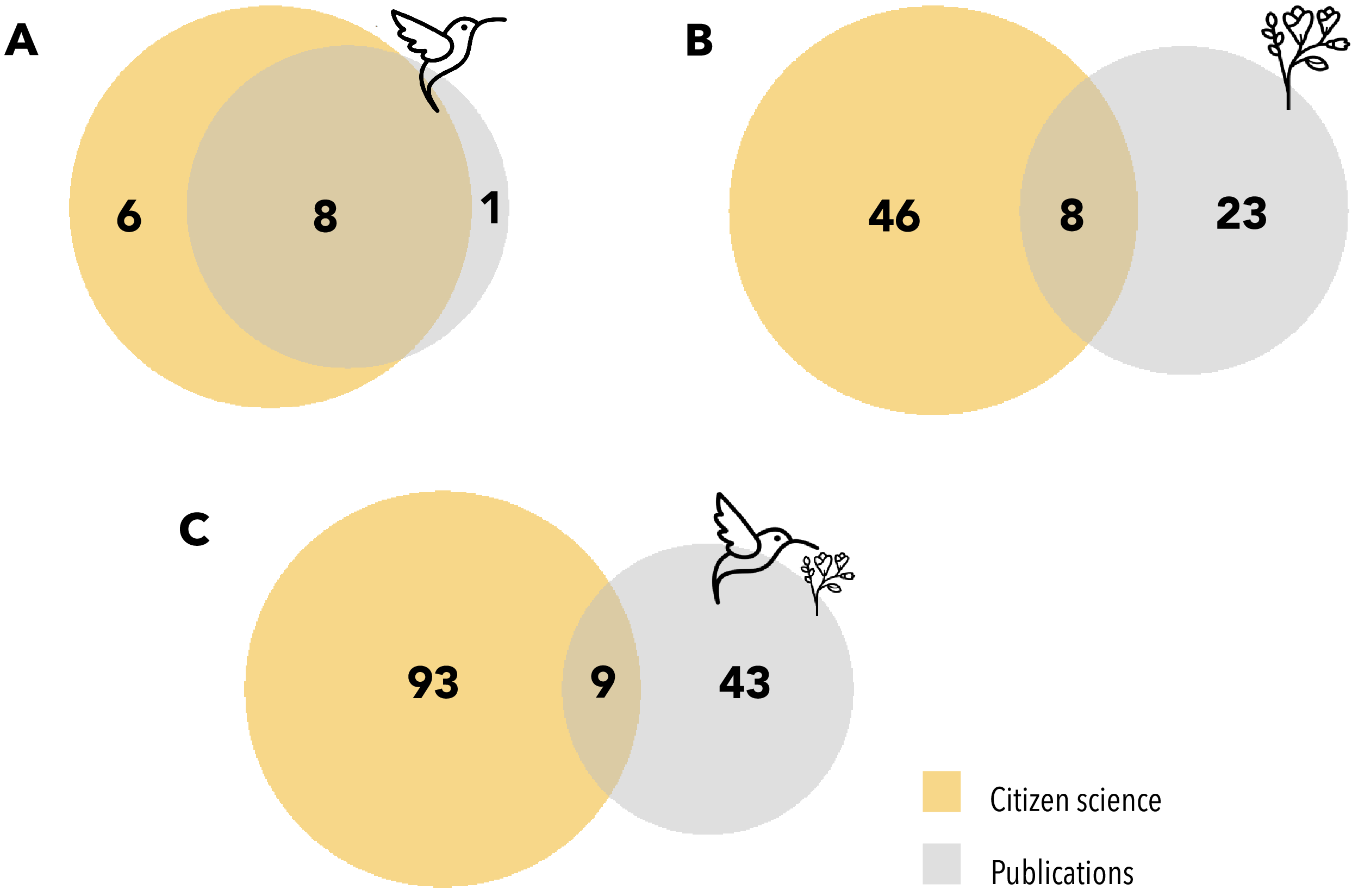
Venn diagrams of the unique and shared diversity of hummingbird–plant interactions in the Pantanal, based on photographs contributed by citizen scientists (yellow circles) and data compiled from published studies (grey circles). (A) Hummingbird species; (B) plant species; (C) hummingbird–plant interaction pairs. The hummingbird icon was created by Andy Horvath and the flower icon by Freepik (FlatIcon; www.flaticon.com).

Number of species per plant family visited by hummingbirds in the Pantanal ecoregion. Data were compiled from photographs available on three citizen-science platforms (yellow bars) and from published studies (grey bars). The hummingbird icon was created by Andy Horvath and the flower icon by Freepik (FlatIcon; www.flaticon.com).

(A) Bipartite network of hummingbird–plant interactions in the Brazilian Pantanal recorded from published studies and citizen-science databases. Interactions and species were classified according to their source of occurrence: exclusively reported in scientific publications (grey), shared between the literature and citizen science (orange), or exclusively recorded by citizen science platforms (yellow). Upper nodes represent hummingbird species, and lower nodes represent plant species. Links indicate observed interactions between species. (B) Hylocharis chrysura visiting flowers of Erythrina fusca (photo by Hilton Oliveira, https://www.wikiaves.com.br/3501978). (C) Phaethornis nattereri hovering in front of flowering Fridericia tuberculata (photo by Kennedy Borges-Road, https://www.wikiaves.com.br/1751317). (D) Chionomesa fimbriata visiting flowers of Inga vera (photo by Dina Lúcia Lucas Bessa, https://www.wikiaves.com.br/212071). Photographs are used with permission. The hummingbird icon was created by Andy Horvath and the flower icon by Freepik (FlatIcon; www.flaticon.com).

A recent review of citizen-science records revealed that nearly 20% of the photographs of a hummingbird and a flower depicted nectar-robbery events (Bosenbecker et al. Reference Bosenbecker, Anselmo, Andreoli, Shimizu, Oliveira and Maruyama2023). Given this frequency, we included both pollination and nectar robbing in our compilation, as we aimed to identify all types of use of floral resources by hummingbirds. Only interactions identified at the species level were considered. Consequently, one record, Hylocharis chrysura visiting an unidentified member of Bignoniaceae, was excluded from the dataset (Araújo and Sazima Reference Araujo and Sazima2003). Each unique combination of a hummingbird and a plant species was considered a distinct pairwise interaction.
Species taxonomy and plant traits
The hummingbird assemblage in the Pantanal has been reported to comprise 23 species (Nunes et al. Reference Nunes, Posso, Frota, Vitorino, Laps, Donatelli, Straube, Pivatto, Oliveira, Carlos, Melo, Tomas, Freitas, Souza, Benites, Mamede and Moreira2021). However, records of five species—Sombre Hummingbird (Aphantochroa cirrochloris), Sapphire-spangled Emerald (Chionomesa lactea), Black Jacobin (Florisuga fusca), Horned Sungem (Heliactin bilophus), and White-throated Hummingbird (Leucochloris albicollis)—were excluded from our analyses due to their questionable occurrence in the region. These species are strongly associated with the Atlantic Forest and adjacent ecoregions and either lack precise locality data for the Pantanal or are best interpreted as rare vagrants (e.g., L. albicollis; Piacentini and Ribenboim, 2017; Piacentini V.Q., pers. obs.). Given the potential for geographic imprecision in some databases, particularly WikiAves, this conservative approach was adopted to avoid the inclusion of spurious records from other ecoregions. We also revised the taxonomic identification of all hummingbirds present in the selected photographs to correct potential misidentifications. Taxonomic updates were applied as necessary, following the most recent classification provided by the Brazilian Ornithological Records Committee (Pacheco et al. Reference Pacheco, Silveira, Aleixo, Agne, Bencke, Bravo, Brito, Cohn-Haft, Maurício, Naka, Olmos, Posso, Lees, Figueiredo, Carrano, Guedes, Cesari, Franz, Schunck and Piacentini2021).
We identified plant species present in the photographs with hummingbirds by comparing them to voucher specimens and images available in online botanical repositories, including REFLORA (https://reflora.jbrj.gov.br/), Flora e Funga do Brasil (https://floradobrasil.jbrj.gov.br/), JABOT (https://jabot.jbrj.gov.br/), and SpeciesLink (https://www.splink.org.br/). To confirm identifications, we also consulted specialised botanical literature (Lorenzi Reference Lorenzi2015; Pott and Pott Reference Pott and Pott1994, Reference Pott and Pott2000; Ribeiro et al. Reference Ribeiro, Lohmann and Soares-Lopes2021; Ribeiro et al. Reference Ribeiro, Lohmann and Soares-Lopes2024; Sasaki et al. Reference Sasaki, Zappi, Milliken, Henicka and Piva2010; Souza et al. Reference Souza, Flores, Colleta and Coelho2018; Souza and Lorenzi Reference Souza and Lorenzi2019). When necessary, we consulted taxonomic experts to validate the identifications of specimens belonging to the families Bignoniaceae, Fabaceae, Loranthaceae, Malvaceae, and Vochysiaceae. We excluded photographic records for which plant identification was not possible to at least the genus level (n = 17). We followed Flora e Funga do Brasil (2020) for plant taxonomy, origin (native or non-native), and life form classification. The complete list of identified species, along with the platforms where they were recorded and their respective life forms, is provided in the Supplementary Materials (Table S7).
Data analyses
We summarised hummingbird–plant interactions using adjacency matrices, with plant species arranged in rows and hummingbird species in columns. Each cell in the matrix indicates the presence or absence of an interaction between a given pair of species (Dormann et al. Reference Dormann, Frueund, Bluethgen and Gruber2009). We constructed separate bipartite networks to represent interaction patterns derived from the published literature and from photographic records and generated a combined network incorporating data from both sources to visualise the overall interaction structure. The network graph was created using the packages ‘ggplot2’ (Wickham Reference Wickham2016) and ‘ggforce’ (Pedersen Reference Pedersen2025) in R v. 4.4.2 (R Core Team 2025).
We quantified species niche breadth using degree, a network metric that represents the number of interaction partners each hummingbird or plant species has within the ecological network, calculated separately for the literature-based dataset and for interactions recorded from photographs. Degree values were calculated using the bipartite v. 2.15 (Dormann et al. Reference Dormann, Frueund, Bluethgen and Gruber2009) in R package. To compare unique and shared interactions among published studies and citizen-science platforms, assessing their complementarity in documenting hummingbird–plant interactions, we generated Venn diagrams. We further quantified the relative contributions of each platform (eBird, iNaturalist, and WikiAves) by partitioning records into exclusive and overlapping components. Analyses were conducted separately for hummingbird species, plant species, and hummingbird–plant interaction pairs. Venn diagrams were generated using the VennDiagram package v. 1.6.20 (Chen Reference Chen2018) in R.
Results
We compiled 52 pairwise interactions between nine hummingbirds and 31 native plant species in the Pantanal from 10 published articles (Figure 1). These interactions involved 17 plant families, with Fabaceae being the most frequently visited, represented by six species (Figure 2). Notably, the tree Erythrina fusca (Fabaceae) was the most visited plant, attracting individuals of five hummingbird species. Among the hummingbirds, the Gilded Hummingbird (Hylocharis chrysura) exhibited the broadest niche, interacting with 25 plant species (Figure 3; see Table S4 in Supplementary materials for the complete list of interactions).
Based on photographs from WikiAves, eBird, and iNaturalist, we compiled 102 pairwise interactions involving 14 hummingbird species and 54 plant species (Figure 1; see Table S7 in Supplementary materials for the complete list of interactions). Most plant species (72%, n = 39) were native and belonged to 25 families (Figure 2). The patterns of floral use were broadly consistent with those reported in the literature: Fabaceae was the most species-rich family (13 species), and H. chrysura interacted with the largest number of plant species (n = 20; Figures 2 and 3). Conversely, Inga vera (Fabaceae), a native tree, was the most generalist species, visited by seven hummingbirds (Figure 3).
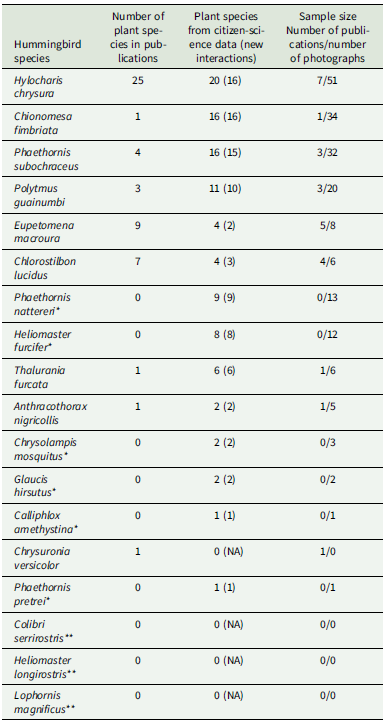
Analyses of photographs from citizen scientists increased our knowledge of the Eltonian niche of hummingbirds in the Pantanal (Figures 1–3, Table 1). Specifically, all hummingbirds documented by citizen-scientists had 1–16 pairwise interactions that were not previously reported in the scientific literature (Figure 3A). Incorporating photographic records to describe the niche breadth of the hummingbirds altered the taxonomic ranking of interaction specialisation. This indicates that for some species, citizen-science photographs captured floral resource use more comprehensively than the scientific publications (Table 1). Additionally, citizen scientists revealed floral interactions for six hummingbird species with no previously published records from the Pantanal (Amethyst Woodstar Calliphlox amethystina; Ruby-topaz Hummingbird Chrysolampis mosquitus; Rufous-breasted Hermit Glaucis hirsutus; Blue-Tufted Starthroat Heliomaster furcifer; Cinnamon-throated Hermit Phaethornis nattereri; and Planalto Hermit Phaethornis pretrei; Figures 1A). However, we still lack information on the White-vented Violetear (Colibri serrirostris), Long-billed Starthroat (Heliomaster longirostris), and Frilled Coquette (Lophornis magnificus), as floral resource use by these three species in the Pantanal remains undocumented in both published literature and citizen-science records (Table 1). We identified 12 previously unreported plant families (Figure 2) and 46 plant species used as floral resources by hummingbirds in the Pantanal, documented exclusively through citizen-science records (Figure 1B). There was limited overlap between the plant communities reported in the literature and those recorded by citizen scientists (Figures 1B and 2). A similar pattern was observed for pairwise interactions, with the citizen-science dataset containing more unique interactions (Figures 1C and 3).
List of hummingbird species recorded in the Pantanal (adapted from Nunes et al. Reference Nunes, Posso, Frota, Vitorino, Laps, Donatelli, Straube, Pivatto, Oliveira, Carlos, Melo, Tomas, Freitas, Souza, Benites, Mamede and Moreira2021). The table shows the number of plant species visited by each hummingbird species, compiled from published studies (P) and citizen-science datasets from eBird, iNaturalist, and WikiAves (CS). Sample sizes correspond to the number of publications (P) and the number of photographs of hummingbirds visiting flowers on citizen-science platforms (CS).

Table 1. Long description
A table comparing hummingbird species, plant species visited, and sample sizes from publications and citizen-science data. The table has 19 rows and 4 columns. The columns are labeled ‘Hummingbird species’, ‘Number of plant species in publications’, ‘Plant species from citizen-science data (new interactions)’, and ‘Sample size Number of publications/number of photographs’. Each row lists a different hummingbird species and the corresponding data for each column. For example, the first row lists Hylocharis chrysura with 25 plant species in publications, 20 plant species from citizen-science data (16 new interactions), and a sample size of 7 publications and 51 photographs. The table provides a detailed comparison of the plant species visited by each hummingbird species through different data sources.
* Species with floral resources in Pantanal reported only by citizen-collected photos.
** Species with missing information about the plant species visited in the Pantanal ecoregion.
The scientific studies that our literature review identified were published between 2001 and 2020 and comprised fieldwork observations conducted between 1997 and 2016. In contrast, citizen-science records retrieved from WikiAves, eBird, and iNaturalist spanned from 1997 to 2023, with a peak between 2018 and 2019 (Tables S4, S7 and Figure S2). While there is temporal overlap between the two approaches, citizen-science records fill a gap of at least seven years since the last field observations reported in the scientific literature within the period evaluated here.
We obtained 32, 21, and 141 records from eBird, iNaturalist, and WikiAves, respectively. WikiAves contributed the highest number of unique records across all the three platforms, particularly for unique interaction pairs. The overlap among the three databases was low, indicating strong complementarity among citizen-science platforms (Figure 4).
Venn diagrams illustrating the unique and shared diversity of hummingbird–plant interactions in the Pantanal, based on data from eBird (yellow), iNaturalist (orange), and WikiAves (green). (A) Hummingbird species; (B) plant species; (C) hummingbird–plant interaction pairs. The hummingbird icon was created by Andy Horvath and the flower icon by Freepik (FlatIcon; www.flaticon.com).

Discussion
Our study highlights the potential of citizen-science to help bridge the Eltonian shortfall in biodiverse yet understudied regions that are also intensively visited by tourists, and demonstrates how these datasets can fill knowledge gaps on mutualistic interactions. We found higher species diversity and more hummingbird–plant interactions in citizen-science datasets than in scientific publications. Nonetheless, the hummingbird species with the widest niche breadth and the highest diversity of plant families visited were consistent between the literature and the photographs contributed by citizen scientists. The analysis of bird photographs from citizen-science platforms provided novel information on the plant species visited by all recorded hummingbird species. The limited overlap between plant diversity and plant–hummingbird interactions data from scientific publications and citizen-science suggests that these two approaches are complementary and should be integrated to understand species interactions better across broader spatial scales, such as ecoregions.
The higher diversity of hummingbird–plant interactions revealed by citizen-science data suggests that opportunistic observations by non-specialists can substantially broaden our understanding of mutualistic networks. Additionally, our analysis of bird photographs from citizen-science platforms revealed previously undocumented plant species that were visited by hummingbirds, expanding the known ecological niche of all 15 hummingbird species. This increase in knowledge, however, can likely reflect differences in the spatial and temporal scales of the two approaches, as increased sampling effort increases the probability of detecting additional species and interactions (Chacoff et al. Reference Chacoff, Vázquez, Lomáscolo, Stevani, Dorado and Padrón2012). Studies conducted by professional scientists are generally limited in both space and time due to the intensive effort required to document species interactions (Araújo and Sazima Reference Araujo and Sazima2003; Paulino-Neto Reference Paulino-Neto2007). In contrast, citizen-science databases encompass observations collected over larger geographic areas and longer periods (Dickinson et al. Reference Dickinson, Zuckerberg and Bonter2010). Taken together, these differences and the observed expansion of knowledge on plant–hummingbird interactions in the Pantanal underscore the need to integrate citizen-science observations with systematic field surveys to build a more complete understanding of interaction networks across regional scales, such as ecoregions.
We found limited overlap between scientific publications and citizen-science data on plant diversity and plant–hummingbird interactions. This result supports the idea that citizen-collected data are particularly valuable in poorly studied yet frequently visited ecoregions (Tulloch et al. Reference Tulloch, Mustin, Possingham, Szabo and Wilson2013b). The Pantanal is an example of such an ecoregion, where decades of scientific research have still been insufficient to identify the plant species visited by many hummingbird species. However, this pattern may also reflect differences in the sampling locations typically visited by each group. Although both professional and citizen scientists often collect data near cities, roads, and lodges (Tulloch and Szabo Reference Tulloch and Szabo2012), formal scientific studies are more frequently conducted in relatively undisturbed natural areas (Tulloch et al. Reference Tulloch, Mustin, Possingham, Szabo and Wilson2013b). This tendency likely increases the probability that researchers detect hummingbird and plant species associated with less modified habitats dominated by native vegetation (Ramírez-Burbano et al. Reference Ramírez-Burbano, Amorim, Torres-González, Sonne and Maruyama2022). In contrast, cultivated or exotic plants are more common in gardens and other anthropogenic habitats, which are more accessible and therefore more frequently sampled by citizen scientists (Díaz et al. Reference Díaz, Reynoso, Pellón, Camarena, Tataje, Quispe-Torres and Hein2024; Ramírez-Burbano et al. Reference Ramírez-Burbano, Amorim, Torres-González, Sonne and Maruyama2022). Indeed, this pattern was also evident in our dataset, as exotic plant species were recorded exclusively in citizen scientist observations. Finally, methodological differences between professional studies and citizen-science initiatives may further explain the limited overlap in species diversity: traditional ecological research tends to focus on plants as the sampling unit, whereas photographers are generally bird-oriented. Sampling biases have been reported for both approaches, resulting in a low degree of overlap in recorded interaction diversity (Vitorino et al. Reference Vitorino, Frota, Maruyama, Silva Nunes and Vizentin-Bugoni2022). Moreover, photographs taken at feeders could increase records of hummingbird diversity due to the attraction of birds to these resources (Meehan et al. Reference Meehan, Dale, Lebaron, Rowden, Michel, Wilsey and Langham2020) but still would not contribute to expanding our understanding of hummingbird–flower interactions.
When comparing the published literature and citizen-contributed photographs, we found that the same hummingbird species exhibited the widest niche breadth and that the same plant family contained the highest number of species visited by hummingbirds. This similarity suggests that photographs contributed by citizen scientists could be effectively used to identify generalist visitors and the primary plant species visited by hummingbirds in other regions, where community-level data on hummingbird–plant interactions remain limited, such as the Amazon and several ecoregions in North America (Dalsgaard et al. Reference Dalsgaard, Maruyama, Sonne, Hansen, Zanata, Abrahamczyk, Alarcón, Araujo, Araújo, Buzato, Chávez-González, Coelho, Cotton, Díaz-Valenzuela, Dufke, Enríquez, Dias-Filho, Fischer, Kohler and Martín-González2021). The ecological factors potentially associated with the broad niche breadth of these taxa include their abundance, morphology, and diversity. For instance, the prevalence of the Gilded Hummingbird visiting numerous plant species may be linked to the high abundance of this bird in the Pantanal (Piacentini and Ribenboim Reference Piacentini and Ribenboim2017; Simmons et al. Reference Simmons, Vizentin-Bugoni, Maruyama, Cotton, Marín Gómez, Lara, Rosero-Lasprilla, Maglianesi, Ortiz-Pulido, Rocca, Rodrigues, Tinoco, Vasconcelos, Sazima, Martín-González, Sonne, Rahbek, Dicks, Dalsgaard and Sutherland2019). In addition to being common, this species has a straight, medium-length bill that allows access to a wide range of floral resources compared to species with shorter or more curved bills (Dalsgaard et al. Reference Dalsgaard, Maruyama, Sonne, Hansen, Zanata, Abrahamczyk, Alarcón, Araujo, Araújo, Buzato, Chávez-González, Coelho, Cotton, Díaz-Valenzuela, Dufke, Enríquez, Dias-Filho, Fischer, Kohler and Martín-González2021). From the plant perspective, the large number of Fabaceae species visited by hummingbirds likely reflects the high diversity and dominance of this family in the Pantanal flora (Pott et al. Reference Pott, Oliveira, Damasceno-Junior and Silva2011). Together, these findings highlight how both morphological versatility and taxonomic diversity shape the structure of hummingbird–plant interaction networks in this ecosystem.
The plant species visited by the White-vented Violetear (Colibri serrirostris), Long-billed Starthroat (Heliomaster longirostris), and Frilled Coquette (Lophornis magnificus) in the Pantanal remain unknown. These three hummingbirds are locally rare, and their occurrence within the Pantanal is marginal (Piacentini and Ribenboim Reference Piacentini and Ribenboim2017). The Long-billed Starthroat is restricted to the northern Pantanal, a region with the fewest studies on mutualistic interactions (Zeferini and Zanata, unpubl. data). Both this species and the Frilled Coquette also show irregular seasonal occurrence in the biome, further reducing the likelihood of detection (Piacentini and Ribenboim Reference Piacentini and Ribenboim2017; Piacentini V.Q., pers. obs.). These traits likely explain the low number of records for these hummingbirds in both citizen-science datasets and published studies. However, to help address these knowledge gaps, citizen-science platforms could be used to highlight target species with missing records, thereby encouraging observers to document rare or regionally underrepresented taxa.
The temporal overlap between published studies and citizen-science records indicates that these approaches are complementary rather than mutually exclusive. Because these two types of data source exhibit different temporal biases, their integration can provide a more continuous representation of biodiversity data than either source alone (Boakes et al. Reference Boakes, McGowan, Fuller, Chang-qing, Clark, O.’Connor and Mace2010; Speed et al. Reference Speed, Bendiksby, Finstad, Hassel, Kolstad and Prestø2018). While scientific studies were conducted between 1997 and 2016, citizen-science records extended temporal coverage until 2023, filling a gap of at least seven years. This pattern suggests that citizen-science platforms can function as a continuous source of ecological information, particularly in regions where long-term monitoring and repeated field surveys remain limited (Cuervo-Robayo et al. Reference Cuervo-Robayo, Rodríguez, Vázquez-Miranda, Vázquez-Flores, Ramírez-Barahona, Nori and Martínez-Meyer2026). The recent temporal expansion of citizen-science records was accompanied by a marked increase in observations after 2010, likely reflecting the growing popularity of online biodiversity platforms and advances in digital photography (Amano et al. Reference Amano, Lamming and Sutherland2016; Prenda et al. Reference Prenda, Domínguez-Olmedo, López-Lozano, Fernández de Villarán and Negro2024). Together, these findings highlight the value of integrating citizen-science and traditional research to improve the temporal continuity of biodiversity data.
We identified high exclusivity and low overlap among the three citizen science platforms. The predominance of exclusive records in WikiAves likely reflects its strong user base in Brazil (Almeida et al. Reference Almeida, Gonsioroski, Marques, Fava, Da Silva Abreu, Da Silva, Missagia, Lopes, De Oliveira, Guimarães, Souza-Filho and Tavares2025; Schubert et al. Reference Schubert, Manica and Guaraldo2019), which increase the probability of capturing new species and interactions that are often missed by other platforms. This pattern suggests that data-rich citizen-science systems can disproportionately expand the known interaction space, particularly for pairwise relationships (Bosenbecker et al. Reference Bosenbecker, Anselmo, Andreoli, Shimizu, Oliveira and Maruyama2023). At the same time, the minimal overlap among sources indicates that differences in observer communities contribute to distinct subsets of interactions. Similarly, combining multiple platforms increased endemic bird species coverage in Brazil’s Atlantic Forest, revealing both overlap and a large proportion of unique records per platform (Forti et al. Reference Forti, Passetti, Oliveira, Freitas, Costa, Lima Maia and Szabo2024). Such complementarity reinforces the view that no single data source adequately represents plant-hummingbird diversity and interactions. Therefore, integrating multiple platforms can achieve a more complete depiction of ecological relationships in tropical environments.
Although citizen-collected information has proven to be a valuable source of data to address the Eltonian shortfall, as demonstrated by our and previous studies (Bosenbecker et al. Reference Bosenbecker, Anselmo, Andreoli, Shimizu, Oliveira and Maruyama2023), citizen-science data often lacks detailed metadata on species interactions, such as information about the legitimacy of pollination or seed dispersal events. For flower–animal interactions in particular, users should be made aware of the importance of photographs that clearly document identifiable interactions. For example, lateral views of corollas are preferable to frontal views, as they can better confirm that the bird had contact with the reproductive structures of the flower. The inclusion of complete metadata with each record would provide additional and highly useful information for interaction ecology. Encouraging users of citizen-science platforms to add such details and emphasising their contribution to reducing knowledge gaps in species interactions would be a valuable improvement (Groom et al. Reference Groom, Pernat, Adriaens, De Groot, Jelaska, Marčiulynienė and Roy2021). Observers should also be encouraged to upload photographs showing both partners in the interaction, in this case, the animal and the plant. One of the significant challenges we faced in this study was identifying plant species from images centred on birds, since WikiAves and eBird, two of the three platforms analysed here, are primarily designed for bird observations. Users could also be advised to post multiple photographs from different angles and distances, allowing for a more accurate documentation of pairwise interactions (e.g., bird-plant or bird-arthropod). It would also be extremely helpful if contributors added a specific tag (e.g., ‘plant–animal interaction’) to their photos, which would greatly reduce the need to examine each image individually. Moreover, platforms should emphasise that, from a scientific standpoint, the key feature of a photograph is its ability to allow accurate species identification, rather than aesthetic quality. Finally, although there is a Brazilian citizen-science platform and smartphone application dedicated explicitly to documenting plant–animal interactions (https://guardioesdospolinizadores.com.br/), most of its uploads focus on flower–insect interactions, and among the 16 bird observations, only two show a hummingbird interacting with a flower (accessed May 16, 2026). Nonetheless, our study reveals that generalist citizen-science platforms already host a substantial amount of information on avian mutualistic interactions. Establishing a network for data sharing and cross-promotion among platforms would therefore increase the accessibility, integration, and scientific utility of citizen-collected data in the study of ecological interactions.
In conclusion, our study reinforces the potential of citizen-science as an effective tool to help bridge the Eltonian shortfall, particularly in megadiverse yet understudied ecoregions that are also intensively visited by nature observers. The use of biological data generated by citizen scientists is especially valuable for studying ecological interactions, which are characterised by high diversity and complexity and therefore require substantial field effort to achieve adequate sampling. We hope that our findings will stimulate stronger collaboration among researchers, platform administrators, and users. This interaction could lead to improved policies and user practices, ultimately contributing to filling fundamental ecological knowledge gaps.
Supplementary material
The supplementary material for this article can be found at https://doi.org/10.1017/S0266467426100662.
Data availability statement
All data generated in this study are included within this manuscript.
Acknowledgements
We thank all bird observers who shared their observations on citizen-science platforms, especially those who responded to our queries with additional information. We are also grateful to Aluísio F. Júnior, Dennis R. da Silva, Francismeire Bonadeu, and Gustavo Shimizu for their assistance with plant identification. This research is part of the INCT Pollination project: Knowledge, Conservation, and Sustainable Use of Pollinators (CNPq 406976/2022-8; CAPES 88887.953442/24; FAPERJ).
Author contributions
TBZ, ACG, JKS, and VQP conceived the study and designed the methodology. TBZ, CYHZ, LARAR, and LCP collected the data. AKK and RSR identified the plant species, and VQP revised the locality data and hummingbird identifications. TBZ performed the data analyses, and TBZ, ACG, JKS, and VQP led the writing of the manuscript. All authors contributed to the drafts and approved the final version for publication. Language editing assistance was provided using ChatGPT (OpenAI) under the direct supervision of the authors to enhance the clarity and fluency of the manuscript.
Financial support
This study was partially funded by grants from the Institutional Training Program of the National Council for Scientific and Technological Development (PCI/CNPq, grant no. 301395/2021-7) and the National Institute for the Atlantic Forest (INMA, process no. 01239.000296/2019-56) awarded to RSR. CYHZ received funding from the Mato Grosso State Research Foundation (FAPEMAT), and both CYHZ and LARAR were supported by the National Student Assistance Program. ACG was partially funded by a National Council for Scientific and Technological Development – CNPq Fellowship (process no. 301057/2025-7).
Competing interests
The authors have no relevant financial or non-financial interests to disclose.
Use of artificial intelligence tools
Language editing assistance was provided using ChatGPT (OpenAI) under the direct supervision of the authors to enhance the clarity and fluency of the manuscript.