1. INTRODUCTION
For decades, there has been an ongoing debate concerning how lawyers should engage with the Chinese legal system. Specifically, the debate has centred on whether lawyers are responsible for promoting social change (e.g. redressing social problems, closing legal loopholes, and advocating political reforms) or they should focus on advancing their clients’ aims. With the rise of human-rights advocacy,Footnote 1 a growing number of lawyers have exhibited a keen interest in rights-protection (weiquan) cases. Weiquan lawyering initially refers to a legal and political process in which lawyers are actively dedicated to using legal or quasi-legal strategies to promote social change to address a public issue. However, in the name of weiquan lawyers, certain lawyers have endeavoured to achieve their personal ends and shoot to fame by taking a stance on public-interest issues. Within this pool of lawyers, in addition to those lawyers who are driven by public interest, some lawyers who have eagerly labelled themselves as weiquan lawyers are profit-oriented in nature.
There has been a proliferation of scholarly articles and media reports explaining the varieties of coping strategies that weiquan lawyers have adopted.Footnote 2 According to Fu and Cullen, weiquan lawyering can be moderate, critical, or radical, depending on their coping strategies that they have developed in the courtroom.Footnote 3 Fu and Cullen’s groundbreaking studies have provided by far the most compelling scholarly accounts of this unique population of lawyers. Nevertheless, given the similarities and fluidity of lawyering strategies, varieties of weiquan lawyers cannot be easily distinguished. Furthermore, few studies have uncovered the mindset of weiquan lawyers, by jointly taking into consideration the lawyers’ motivations and adaptive strategies. Though Liu and Halliday examined the political motivation and coping tactics of criminal defence lawyers in their everyday workplaces, their scholarship focused on the criminal defence lawyers sui generis. Instead of encompassing a broader definition of motivation, Liu and Halliday developed their analyses based purely on lawyers’ political motivations. In fact, in addition to political-related motivations, the roots of weiquan lawyering may lie elsewhere. For example, they could be grounded in ethical values, social values, religious beliefs, or some other personal considerations and interests.
This paper aims to provide a new typology to present a better understanding of the role of weiquan lawyers. In the following paper, the term “weiquan lawyers” refers to all lawyers who engage in the weiquan cases. It includes lawyers who fight for not only civil rights and public interests, but also other private goals. Given the variations in their ideological motivations and adaptive strategies, weiquan lawyers in China can be divided into four ideal categories: routine practitioners, rational activists, progressive reformers, and cynical criticizers. The following sections set out a more detailed discussion of each category, primarily focusing on their features, daily operations, tactics, contributions, as well as limitations. This paper will also take a close look at a special fraction of lawyers, known as “die-hard” (sike) lawyers. In recent years, die-hard lawyers emerged from the legal practice and rocketed to fame. Owing to their “tough-as-nails” lawyering pattern and fighting spirit, die-hard lawyers effectively distinguish themselves from conventional weiquan lawyers.Footnote 4 Mainstream scholars and mass media have portrayed this group of lawyers as taking legal procedure seriously and battling fiercely with authorities, with a sharp focus on procedural justice.Footnote 5 They make their legal arguments against the existing legal and political system by aggressively challenging the authority of the court and the government, and emotionally expressing their discontentment and resentment against the social reality in China. As Shen Deyong, the executive vice president of the Supreme People’s Court opined: “We are now seeing a very strange phenomenon, lawyers are not in a confrontation with prosecutors, but instead are having confrontations with the presiding judge in the case.”Footnote 6
2. THE TYPOLOGY OF CHINESE WEIQUAN LAWYERS
The primary aims of this section are to suggest a basic typology of weiquan lawyers and analyze each type of weiquan lawyer, based on features, daily operations, tactics, contributions, and limitations. In this regard, two variables have been developed. The first variable concerns the debating skills and lawyering strategies employed by weiquan lawyers. By lawyering within the law, some lawyers properly confine their legal arguments within the boundaries of legal rules and resolve issues within the Chinese courts. For such lawyers, legal reasoning is employed as their exclusive tactic in the process of lawyering. In contrast, the weiquan lawyers who practise their professional duties beyond the law handle their cases by using both legal and extra-legal techniques. Apart from the legal process, such lawyers sort out issues outside the courts using some unconventional means.
The second variable refers to the prevailing motivation for lawyers to take on weiquan cases. Driven by a set of internal and external forces, weiquan lawyers have distinct purposes in practising law, which basically includes the objectives of public and private interests. The public-interest-oriented lawyers are engaged on behalf of clientsFootnote 7 and endeavour to reconcile clients’ objectives within the legal framework,Footnote 8 as well as through the lawyers’ direct engagement in public service.Footnote 9 Instead of representing powerful economic interests, such lawyers strive to advocate for otherwise underrepresented individuals. Driven by their core values, public-interest-oriented lawyers not only fight for the fundamental rights of citizens, but also struggle for core political rights and basic legal freedom. For example, many articulate political-liberal values and seek to promote political change within the state apparatus. They devote themselves to pursuing proceduralism, protecting the basic legal rights of citizens, and facilitating constitutional reforms under authoritarian governance in China.Footnote 10 In contrast, the private-interest-oriented lawyers frequently owe their entire devotion to the immediate concern of their clients. For these lawyers, the legal profession is no different from any other occupation, which is merely a type of paid work for economic survival. In crude terms, income and profit serve as the dominant motivations for private-interest-oriented lawyers to step into weiquan issues.
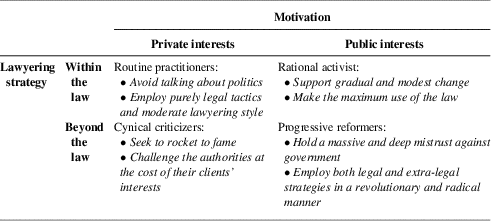
In fact, motivation is a complex combination of perceptions, aspirations, and environmental interactions. Instead of being driven by sui generis motivation, a weiquan lawyer may subconsciously or unconsciously be incentivized by the mixed motivations, encompassing both private and public interests. To avoid doubt, the term “lawyering motivation” used in this paper refers to the prevailing and dominant force of weiquan lawyering. When two different types of motivations (i.e. those who are pursing public interests and those who are chasing private interests) are conjoined with the two types of lawyering tactics (i.e. those within the law and those beyond the law), the resulting combinations fall within the four boxes in Table 1.
Four types of activist lawyers

This typology is a descriptive-analytical tool to uncover the mindset of lawyers who are involved in weiquan cases. In legal practice, weiquan lawyers do not fall neatly into a single identified category, but adapt their professional identities and lawyering styles to cope with different scenarios. Given the fluid and dynamic nature of weiquan lawyering, the boundaries between routine practitioners, rational activists, progressive reformers, and cynical criticizers are frequently crossed and re-crossed. In other words, these categories are ideal types, and a lawyer may change from one category to another or belong to multiple categories (in different cases) at the same time. Essentially, the categories displayed in Table 1 represent lawyers’ strategies, not those of individuals.
The term “routine practitioners” refers to the vast number of ordinary lawyers who are primarily motivated by private interests and perform their professional duties by strictly following legal norms. Instead of working for its own sake (e.g. doing the work for itself and for the pleasure and satisfaction derived from participation), they practise law merely to meet their basic needs to survive and thrive. Their motivation to engage in weiquan cases is mainly centred on economic considerations. To keep themselves out of trouble, this group of lawyers are less politicized in confronting state institutions. Concerning their performance during trial, routine practitioners merely argue on narrow legal issues within the law’s boundaries.
“Rational activists” are those weiquan lawyers who articulate liberal values and employ the law in a comparatively proactive and strategic manner. In order to promote judicial justice within Chinese courtrooms, this group of activist lawyers employ the law as a tool to influence public opinion and promote legal consciousness. Literally, the term “legal consciousness” can be used as an analytical description of understanding law that is circulating in social relations.Footnote 11 Thus, in the process of applying, interpreting, and critiquing legal norms, rational activists may influence individuals’ feelings of efficacy vis-à-vis the law, as well as their evaluation of the legal system. Furthermore, the legal arguments developed by rational activists may help to shape judicial decisions or may greatly influence the Chinese legal process.Footnote 12 Fundamentally, rational activists seek to utilize the legal norms to their maximum benefit. Such lawyers frequently go beyond merely relying on the legal rules, using them in a dynamic way.Footnote 13 Compared with routine practitioners, rational activists usually play a much more active role in proposing both policy and legislative reforms.Footnote 14 They are active in contributing to the capacity of constitutional development and legal advocacy in China.
The view of “progressive reformers” is that existing legislation is unable to protect activist lawyers from the injustices of systemic brutality and abuses. Thus, they seek to redress social problems via quasi-legal avenues as well as extra-legal avenues. Despite the fact that this group of lawyers is dissatisfied with the legal environment in China, they have never given up hope,Footnote 15 but endeavour to act beyond the law and improve the law.Footnote 16 For the sake of political activism, such lawyers devote themselves to exposing societal injustice, organizing “hunger strikes” and initiating “civil disobedience.”Footnote 17
The term “cynical criticizers” refers to lawyers who are accustomed to employing an aggressive and cynical manner in developing their legal representation. Fundamentally, their main purpose is to use trials as fora to advance their own objectives by demonstrating their defiance against the government and persons in power.Footnote 18 Compared with progressive reformers, cynical criticizers are generally driven by self-interest instead of a selfless pursuit of rights activism. In practice, they aggressively make legal arguments beyond the boundaries of the law and emotionally express both their discontent and resentment with the social reality. In this regard, die-hard lawyers do not fall neatly into a single identified category, but cross the different categories, owing to their complex motivations. A die-hard lawyer would be categorized as a progressive reformer when he/she is public-interest-oriented, while being regarded as a cynical criticizer if his/her prevailing incentive is chasing self-interest.
In conclusion, there are radically different views among weiquan lawyers about how to define their role in judicial practice and about how to manage their relationship with the courts. For different types of weiquan lawyers, their working motivations, political stances, and lawyering strategies have multiple characteristics in legal practice. Two relevant issues arise accordingly. First, what is the role of these lawyers in Chinese courtrooms? Second, can such lawyers effectively promote political liberalism and basic legal freedom in China? In the following sections of this paper, this framework will be employed to analyze the lawyers’ defence strategies in different cases.
3. THE FLUIDITY OF WEIQUAN LAWYERING
Given the variations in lawyering strategies and motivations, a variety of lawyers make up the pool of weiquan lawyers, including routine practitioners, rational activists, progressive reformers, and cynical criticizers. In practice, the boundaries among these lawyers are frequently crossed and re-crossed. A lawyer’s coping strategies, political stances, as well as their professional identities may suffer significant changes for various reasons.
The case of Gao Zhisheng provides a typical example of how a rational activist became radical and the consequential impact it had on their work and their life. It illustrates the experience of one prominent rights defender, Gao Zhisheng, in his efforts to try to play by the rules for a Falun Gong practitioner in 2004. The difficulties he encountered during the process of trying abide by a system gradually radicalized his legal strategies.Footnote 19
In 2004, Gao was involved in a politically sensitive case in which he defended a Falun Gong practitioner known as Huang Wei. In 2004, Huang was sent to a detention centre and was accused of participating in evil cult activities to undermine the implementation of state laws, without due process of law.Footnote 20 By the end of 2004, Gao submitted the case to court and sought to challenge the administrative detention imposed on Huang. During the trial, Gao developed his defence based on Article 37 of the Constitution of the People’s Republic of China Constitution:
Freedom of the person of citizens of the People’s Republic of China is inviolable. No citizen may be arrested except with the approval or by decision of a people’s procuratorate or by decision of a people’s court, and arrests must be made by a public security organ. Unlawful detention or deprivation or restriction of citizens’ freedom of the person by other means is prohibited, and unlawful search of the person of citizens is prohibited.
As he stressed, the administrative detention mechanism was outside the criminal justice system and the primary legislation should be presumed to be ultra vires. Furthermore, he claimed that the police officers had significantly undermined procedural justice during the investigation stage. One of the police officers unhurriedly signed Huang’s name on the interrogation report in front of Huang and put his fingerprint on it. The officers not only forged Huang Wei’s signature in the protocol of interrogation, but also brutally assaulted him.Footnote 21
After taking up the case, and in the course of dealing with the administrative and judicial authorities, Gao discovered a series of sordid phenomena that were beyond his imagination. These phenomena existed in both the legislative and judicial realms. After experiencing myriad difficulties and frustrations, Gao eventually realized that the law was being ignored, and that justice was never upheld under the repressive systems in China. Litigation was incapable of serving as an effective solution for Huang Wei’s case due to the institutional limits on rights protection and constitutionalism in China’s fragmented legal environment. From his point of view, the authoritarian system was the root cause of the problem. The rule of law would never be genuinely practised until the political system and the Communist Party of China (CPC)’s authoritarian leadership were challenged head on.
Ultimately, Gao went beyond the law and made significant changes to his lawyering style. He started to address the issue in a progressive manner, arguing in terms of rights and duties rather than simply based on legal formalities. Gao’s critique was that discussing the law with the authorities would be like playing piano for a buffalo.Footnote 22 Subsequently, Gao published three open letters online in which he called for an immediate resolution to the issues faced by Falun Gong practitioners through an appropriate legal procedure.Footnote 23 He further urged that these open letters should be regarded as accusations and demands for further investigation. Given China’s concern with political stability, Gao was labelled as a reactionary by the authorities when he went beyond legal representation by organizing and leading clients in extra-legal political confrontations. As a consequence of his actions, he was unable to continue to practise law and was put under strict surveillance; meanwhile, his law firm, which is known as the Shengzhi Law Firm, was suspended from practice for one year.Footnote 24
The experience of Gao evinces the fluid nature of weiquan lawyering. In China’s political context, weiquan lawyers might make changes to their lawyering strategies and/or their self-identities when needed. For instance, weiquan lawyers may adapt their legal strategies and tactics to secure their survival in an unfavourable judicial environment. The current legal rules are unable to offer adequate protection against the injustices of systemic brutality and abuse. Therefore, in order to survive in this unfavourable legal system, weiquan lawyers have developed complex coping strategies in practice. On occasion, lawyers strategically combine their use of legal processes with advocacy, media engagement, and social mobilization, despite the fact that they initially intended to act within the law. In this context, various coping strategies are employed by such lawyers to strengthen their individual positions and their collective power. For example, they may seek to obtain political embeddedness with state agencies, mobilize congressional deputies to influence the courts, and use the media to mobilize the support of the wider public.
Under the authoritarian governance in China, politics continues to control the law.Footnote 25 The courts in China act as the loyal subordinates of the party-state instead of the Palace of Justice. Given their politically embedded nature, judges have neither the will nor the capacity to resist political interference.Footnote 26 The role of judges is no different from the factory workers on an assembly line, blindly and subconsciously carrying out their routine work without paying close and meticulous attention to quality control. In this regard, the boundaries between legal issues and political affairs are often murky and gloomy. It is difficult for lawyers to walk the thin line between law and politics, to keep themselves entirely separate from political affairs, and to genuinely confine their arguments to the law. In the midst of law and politics, lawyers who persist in weiquan practice often need to find ways to reduce the difficulties and dangers of lawyering. Thus, some lawyers have ultimately opted to shift their lawyering styles from “within the law” to “beyond the law” for the sake of survival and self-protection.
Apart from that, weiquan lawyers may construct and reconstruct their professional identities as a result of their experiences. Notably, previous work experience in the Chinese justice system has had a significant effect on lawyers’ political motivations and liberal values. For example, a rational practitioner may become radical or even cynical if he/she is unfairly treated in an unfavourable judicial environment and runs into barriers at every turn. Such a transformation also could occur if a lawyer fails to establish and maintain a good relationship with law-enforcement institutions (e.g. the police, the prosecutors, and the courts) and suffers from such strained relations. As previously demonstrated, the case of Gao Zhisheng provides a typical example of how a rational activist can become progressive reformer. After suffering from maltreatment in his legal practice, Gao was enlightened and identified the root cause of the problems. Eventually, he decided to push for institutional reforms, despite the fact that his own survival was dependent on the system that he sought to change. Conversely, radical reformers may abandon their preferential beliefs and turn a blind eye to social problems after experiencing frustrations and resentments. They may pick up fresh insights and reshape their personal and social identities accordingly. For example, the more problems and troubles they have experienced, the more salient their motivation to provide betterments to society as a whole has become. In this regard, they may shift their identities from rational activities to routine practitioners, and correspondingly switch their professional area from public-interest cases to pure commercial issues.
4. ROUTINE PRACTITIONERS
Routine practitioners frequently participate in legal-aid services and public-interest litigation, with a focus on cases having comparatively low political ramifications. Their motivation to engage in weiquan cases is mainly centred on private considerations and egotism, which mainly stems from market-based incentives and regulatory-compliance incentives. Concerning the market-based incentives, it appears in many weiquan cases that lawyers practise their professional duties for the sake of commissions, handling fees, as well as the positive impact on their personal reputation. Commentators and officials note that some lawyers, in the name of weiquan lawyers, undertake pro bono cases primarily to advertise themselves rather than to help indigent clients.Footnote 27
With regard to the regulatory-compliance incentives, the 1996 Lawyers Law marked the first time China imposed an affirmative obligation on lawyers to engage in legal-aid work.Footnote 28 Where formal requirements are in place, lawyers are mandated to take on a certain number of legal-aid cases per year.Footnote 29 In some cities, the legal-aid centre may refer cases to law firms, but not to individual lawyers. In this context, many lawyers, especially lawyers with seniority, may seek to avoid legal-aid work, assigning it to junior practitioners or retired lawyers.Footnote 30 Lacking any privileged background or connection to judicial agencies, junior lawyers have little choice but to take on any type of cases assigned to them. For these lawyers, the routine practice of weiquan lawyering is thrust upon them as a condition of survival. For the sake of career development, routine practitioners engage in legal-aid services to meet the basic requirements of regulations.
4.1 Staying Out of Trouble: The Situation of Routine Practitioners
Routine practitioners are unwilling to get involved in political issues or to develop any extra-legal arguments beyond the boundaries of the law. This is because they deeply comprehend the futility and risk involved in engaging in political arguments. Accordingly, moderate lawyering is adopted by routine practitioners for survival and self-protection purposes. Compared with the other three types of lawyers, routine practitioners are more willing to establish close connections with state actors in the legal system. They rarely adopt a politically aggressive manner in their legal arguments; as a result, it is more likely for state actors to be caught off guard and to develop positive relationships with them. In other words, routine practitioners seek a fairly pragmatic strategy in their legal practice by tactically turning judges, procurators, and even police officers from enemies into allies in their everyday work. This is because these connections and experiences provide them with substantial protection from retaliation and persecution in the system.Footnote 31 Therefore, another reason that routine practitioners refrain from extra-legal mobilization is that they attempt to maintain and consolidate their ongoing relations with the authorities. As Liu and Halliday demonstrated, political embeddedness within the state is often more effective than other channels for lawyers to protect themselves and defend their clients.Footnote 32
4.2 The Practice of Routine Practitioners and the Outcomes of Cases
Routine practitioners have engaged in myriad cases associated with the daily basic rights and interests of citizens, such as consumer protection, equality, and anti-discrimination lawsuits. Concerning their performance during the trial, routine practitioners merely argue on narrow legal issues within the law’s boundaries. The lawyers of this type frequently confront large caseloads that pressure them to handle work routinely, expending the least possible resources in disposing of clients’ issues. They are accustomed to developing their advocacy moderately, citing legal rules carefully, and submitting legal arguments properly to convince the judges in a technical manner.
4.2.1 Wang Hai Phenomenon
Wang Hai is a famous consumer advocate who shot to prominence in the mid-1990s for his use of the “double compensation” provision of the Consumer Protection Law.Footnote 33 He became well known for intentionally purchasing fake goods and returning them to demand compensation. Both Wang Hai and his lawyer were initially hailed as heroes for taking on suppliers of clearly defective or fake commodities. Nevertheless, by 2000, they began to be accused of merely “cashing in” on the business of consumer rights; for instance, a national television programme airing in March of 2000 was heavily critical of their motives.Footnote 34
While handling the case of Wang Hai, the responsible lawyer deployed his legal argument based on a careful analysis of both the facts and the law. He argued that the court should not strictly construe the definition of consumer, but rather should apply a more flexible interpretation to allow the legislation to fulfil its objective in advancing the rights and interests of consumers.Footnote 35 Based on the persuasive argument developed by the lawyer, the decision in this case significantly expanded the scope of consumer-protection cases. By adopting this case as a leading case, the Supreme People’s Court highlighted the importance of consumer protection; meanwhile, individual consumers have been expressly encouraged to defend their rights and interests in a more proactive and dynamic manner.Footnote 36 While the root of the claim is grounded on economic motivations, the outcome of the case has surprisingly promoted and facilitated rights consciousness in the area of consumer rights.
4.2.2 The Case of Xia Junfeng
Xia Junfeng, a street food vendor, was accused of murdering two urban enforcement officials in 2009. He stabbed two officials to death because the officials had stopped him from trading and sought to punish him for operating a food stall without proper authorization.Footnote 37 According to Chinese law, if a street vendor, such as Xia, violates the urban-management rules, the urban enforcement officials (chengguan) have the power to enforce their authority by seizing the vendor’s property.Footnote 38 However, the officials not only seized the gas tank that Xia was using, but also deprived him of his personal freedom by placing him in an unwarranted detention. Most importantly, the officials had unlawfully exercised their power by using violence through deliberation, which substantively triggered the killing.
At the first instance, the private lawyer employed by Xia’s wife adopted a moderate style of criminal defence.Footnote 39 In court, the lawyer submitted that Xia had acted in self-defence by stabbing the two officials after he had suffered from their brutality and violence.Footnote 40 However, the lawyer made the concession in his defence that Xia’s act of self-defence might have been excessive (partial self-defence).Footnote 41 Based on the PRC criminal law, a person shall not bear any criminal responsibility when he commits an act in order to protect his own or other legal concerns.Footnote 42 On this basis, the lawyer argued that the court should consider the element of partial defence in deciding both liability and sentencing. Subsequently, the lawyer pointed out that Xia should bear criminal responsibility but should be exempted from punishment or at least be given a punishment with mitigating factors. Additionally, there was no evidence showing that Xia had any intention to cause death, either directly or indirectly. Moreover, Xia had no prior criminal record. Most importantly, it was argued that Xia had voluntarily surrendered himself to the police and, at the same time, had admitted to and confessed his crime. At the first instance, the lawyer made the routine arguments with extreme caution, by strictly adhering to the legal rules. The initial judgment ruled that Xia had committed murder and sentenced him to death.Footnote 43 This case caused a huge media frenzy and public outrage. Routine practitioners were broadly blamed for failing to deal with problems that are deeply rooted in the system.Footnote 44 In conclusion, the conservative tactics employed by routine practitioners could serve as an effective solution to mundane cases with no or low political sensitives, while it is unable to resolve issues that are ingrained in the system itself.
4.3 Social and Political Ramifications
Routine practitioners may serve as an effective solution for dispute resolution, but not as a catalyst for social improvements or political changes. In practice, they are less likely to take drastic actions against the state, directly or indirectly. Regardless of their motivations for lawyering, some routine practitioners have substantively contributed to applying the law to protect marginalized groups and society’s underclasses. For instance, they have been active in public-interest issues, including environmental protectionFootnote 45 and labour-rights enforcement.Footnote 46 In this process, routine practitioners are capable of educating the general public in the realm of understanding legal procedures and understanding how to speak in a legal venue. Nevertheless, moderate lawyering has a limited impact on the development of civic awareness, civic responsibility, and civic engagement in China.
5. RATIONAL ACTIVISTS
Rational activists are highly critical of the authoritarian political system and the legal system, but they clearly recognize the powerlessness of the role of human-rights lawyers. They sharply criticize the whole system but, meanwhile, they are cautious about the language they use and the manner through which their criticism is developed. Rational activists litigate individual cases and simultaneously remain active in advocating policy and legislative reforms. In legal practice, such lawyers embrace both short-term goals and long-term plans to reform the system through legal action and advocacy. For example, in order to promote judicial justice, rational activists employ the law as a tool to influence public opinion and promote legal consciousness. Despite the fact that they frequently employ laws in a comparatively proactive and aggressive manner, rational activists are reluctant to be expressly political and avoid being “too close to the high-voltage” political lines. However, in the political context of China, it is difficult for rational activities to walk the thin line between law and politics, to keep themselves entirely separate from political affairs, and to genuinely confine their arguments to the law. As witnessed, a number of rational activists are regarded as political dissidents by the authorities, even though this group of lawyers endeavours to avoid any radical advocacy and approach cases with great caution.
5.1 Walking on Thin Ice: The Situation of Rational Activists
Overall, no lawyer is completely safe when navigating the Chinese judicial system, especially those who are politically motivated and driven by liberal values: they are exposed to extreme danger that can be likened to walking in a minefield filled with trenches and bombs. In practice, the state security apparatus possesses its own gradient of coercive threats and punishments. Its penalties differ in their degree of severity and include: (1) calling lawyers into a public security office for a serious and deep conversation; (2) keeping lawyers and their residences under covert surveillance; (3) placing lawyers under house arrest and limiting their right to move, meet, and speak freely with their clients or families; (4) inflicting both physical and psychological violence on lawyers; and (5) threatening lawyers that they will disappear from a certain place during a sensitive period or for a limitless period of time.Footnote 47 The gradient of punishments ratchets up and down, depending on the severity of the threat that the human-rights lawyers supposedly present to public and state security.
Unlike routine practitioners, who heavily rely on the law, rational activists advocate a more critical approach that goes beyond reliance on legal rules. In addition to providing legal reasoning and interpretation, they question judges’ professional and impartial standing.Footnote 48 For rational activists, the strategy is to get as close as possible to the edge without falling over the cliff. Their political values and motivations could lead to a suicidal career move or could even jeopardize their personal safety in their legal practice. In this regard, the experience of Xu Zhiyong serves as a typical example.
As one of China’s leading rational activists, Xu Zhiyong has worked on many path-breaking weiquan cases.Footnote 49 At the height of his activism, Xu gained prominence in 2003 after helping victims of tainted baby formula and migrant workers without access to health care and education.Footnote 50 Jeffrey Prescott, the deputy director of Yale’s China Law Centre, commented that:
He (Xu Zhiyong) is doing careful, thoughtful, and important work of international calibre—not much different than what mainstream public interest lawyers and scholars do every day in the US or anywhere else. Xu and his colleagues are doing research into China’s problems, making efforts to promote constructive ideas for legal reform, and helping provide legal assistance to weak and marginalised groups in society …. Any of this would make Dr. Xu an important figure. But, above all, it is his human qualities that make him truly compelling. He is someone of rare idealism, judgment, commitment to law, selfless dedication, and fundamental decency.Footnote 51
In legal practice, Xu has never set out to undermine the one-party rule; he is enforcing rights guaranteed in the Chinese Constitution.Footnote 52 Despite the fact that Xu avoids employing any violent and drastic activities, he was arrested in 2013 for the release of activists and campaigning against government abuses.Footnote 53 During the trial, Xu made the following final statement:
Over the last ten years, we consistently pushed for progress through peaceful means, and we tried to effect change in specific policies through involvement in public incidents. We did so for the sake of freedom, justice, love, and for the sake of our long-held dreams.Footnote 54
Freedom, justice, and love: these are the core values and what guide the rational activists, like Xu, in action. Rational activists share the dream that one day China will be transformed into an oasis of freedom and justice. To live their dream, such lawyers consistently conduct the legal struggles in a mild and rational manner; this is because they deeply understand that Rome was not built in a day. It is important to maintain the social stability in the process of social reform. However, rational activists in China have not only hope, but also fear and frustration. Under the authoritarian governance in China, the difficulties in practice stem not only from low incomes, but also from the risks of excessive harassment, intimidation, and repression from the CPC. In this political context, such lawyers must carefully strike a balance between advocating rights activism and maintaining the legitimacy of their work within the system.
5.2 The Practice of Rational Activists and the Outcomes of Cases
Motivationally, rational activists seek to make concrete changes to public policy and the encompassing system through small acts; to push the country along the path to a democratic rule of law through rational activities. Driven by their core values, this group of lawyers have taken on a large number of public-interest litigation, proactively defending the rights of peaceful assembly, free speech, and the freedom of association.Footnote 55 For example, rational activists have defended Christians who have been arrested for unofficial house church activities, calling for broader religious freedoms in China.Footnote 56 Besides that, they also voiced for vulnerable groups, struggling for the basic rights for children, women, and migrant workers.Footnote 57
Concerning the case of Sanlu Group Inc. (Sanlu), a group of lawyers, acting without payment, lodged a joint civil lawsuit on behalf of the disempowered. In 2008, Sanlu’s melamine-tainted milk scandal in China shocked the world.Footnote 58 As estimated, the melamine-tainted milk caused serious health problems for over 300,000 children and caused the deaths of six children in China.Footnote 59 The aggrieved parents filed the lawsuit, asking for appropriate compensation from the manufacturer. However, given the potential ramification of the trial, the judge declined to hear the case. In China, tainted infant formula is the latest in a long string of food-and-drug safety problems that have exposed corruption and inefficiency among regulators.Footnote 60 Before the outbreak of Sanlu’s scandal, companies that produce shoddy goods rarely faced penalties from the legal system, run by the CPC; the courts in China remain passive pawns in the party’s efforts to handle big disputes behind closed doors.Footnote 61
In this regard, Xu Zhiyong and other responsible lawyers were devoted to seeking redress for the victims, bringing lawsuits all the way to the Supreme People’s Court, to more than 100 courts across China, and to a court in Hong Kong.Footnote 62 Meanwhile, they proposed fair-compensation schemes in accordance with the law, while working with the victims to successfully push the issuance of a government-led settlement plan.Footnote 63 Eventually, two managers and suppliers of raw milk were sentenced to death, and Sanlu filed for bankruptcy in December 2008.Footnote 64 Nevertheless, the government’s compensation package was far from adequate for the damages suffered by many children. At the end of the rope, this group of lawyers voluntarily initiated fundraising events nationwide and subsequently sent a settlement of RMB 1 million to the home of victims.Footnote 65 As Xu stated: “I am forever proud of that moment, and we will not give up our promise to the disempowered even when we ourselves are in trouble.”Footnote 66
As witnessed, rational activists not only seek the immediate interests of their clients, but also pursue a long-term solution for potential victims. In order to avoid an undesirable confrontation with the CPC and the state, such lawyers seek to redress the social problems and systemic deficiencies via a gradual transformation. In contrast to progressive reformers, rational activists avoid using aggressive words to escalate the issue, but they endeavour to work with the law and the judicial system. Moreover, they strive to redress political controversies through legal solutions. However, given the political nature of the cases, it is unlikely that every political and social issue can be converted into a legal one. Thus, rational activists are unable to provide a panacea for all sorts of social causes. Fundamentally, their effectiveness is principally restricted by the following factors: the inferior role lawyers play in the political and judicial system, the inadequate resources accumulated for rights litigation, and the lack of civic consciousness and political understanding among citizens.
5.3 Social and Political Ramifications
Compared with routine practitioners, rational activists engage not only in cases that have a potential social and economic impact, but also in those that have certain political ramifications. Concerning the effectiveness of this type of lawyering, it has contributed to the construction of a better legal system by taking politically sensitive cases to court, bringing public attention to them, and effecting changes in attitudes that ultimately translate into actual amendments of the law. In addition to amendments of the law, it may even precipitate changes in social perceptions and attitudes.Footnote 67 The movements initiated by rational activists have contributed to the transplantation of liberal and democratic values into the Chinese context.Footnote 68 In this process, they have set up channels of expression, paved avenues of redress based on such values, and have aimed to influence the outcome of decision-making processes in both legal cases and policy reforms. They vehemently believe that legal justice is derived only from the institution of liberal-legal procedures.
Furthermore, rational activists play an effective role in promoting the development of legal consciousness among Chinese citizens. As law-and-society scholars have broadly noted, lay expectations regarding the legal system can be distorted and misleading.Footnote 69 Some citizens may have excessively high expectations about the predictability and rationality of the legal system, and may overestimate the role of the courts in dispute resolution.Footnote 70 Such unrealistic expectations are subject to myriad factors. First, the state’s heavy-handed push toward the law through political propaganda has created rising expectations among Chinese citizens regarding the efficacy of the law. Second, mass media are blamed for supplying shallow and useless resources for expectations concerning the legal system. On the other hand, others maintain that the law is incapable of acting as a source of righteousness, justice, and equality. From their perspective, social inequality is rampant, and the formal legal system is dauntingly inaccessible. On this basis, they underestimate the role of the law and broadly opt for disruptive routes of conflict resolution as opposed to the proper, formal legal channels. Rational activists have contributed by injecting additional external influences to reshape and remould the unrealistic expectations of the general public regarding the law’s efficacy in China.
As for the former, rational activists have contributed to a realistic view of the legal system. Generally, the public has a generalized sense of justice; however, it may be incongruent with legal norms. Fundamentally, their legal perceptions are shaped by the morals and ethics ingrained in Chinese history, literature, and cultural practices. However, they have no idea about how to protect and reclaim their rights via legal channels, owing to the complexity and abstruseness of the law. In response, rational activists have opted to lift the veil from Chinese judicial practice rather than to remain silent. For the sake of public enlightenment, the interactions between rational activists and their clients are not merely restricted to legal matters, but also refer to the values of human rights and social equity. Compared with progressive reformers, rational activists are more willing to rhetorically convince and educate their clients. They are proficient in advancing both clarity and the power of expression by avoiding the use of aggressive words and intransigent attitudes. Based on such lawyer–client interactions, the acquisition of legal and political knowledge acts as a key aspect of the legal mobilization process. As a result, the people are better able to evaluate the ability of the courts to issue fair decisions. In addition, they have learned how to properly work “with the law” within the current system. In effect, rational activists have contributed to filling the gap between the law in the context of books and the law in action.
As for the latter, rational activists have contributed in taking cases back to courts and settling conflicts through legal solutions. In this regard, the legal profession is more capable of channelling individuals’ grievances and public outrage into legal challenges. Compared with others, rational activists possess an advantageous position for translating politically related disputes from raw stories into a legal category. This is because they are more capable of seeking a balance between two competing interests—that is, advocating their liberal values whilst struggling to advance the clients’ aims. Moreover, they help their clients develop a better understanding of their best interests from both legal and political perspectives. While many people are frustrated and disappointed with many aspects of the legal system, rational activists persistently seek to shed light on remedies for grievances.
6. PROGRESSIVE REFORMERS
Progressive reformers are effective in politicizing legal issues and reaching out to gain broader social and political support for their cases.Footnote 71 Rather than deploying their arguments by relying on the thin line of the law, progressive reformers reach out for broader social support from foreign donors and call for more significant mobilization from the media. For such lawyers, the law and legal institutions are often seen as part of the problem rather than the solution.Footnote 72 It is clear that they recognize systemic injustice and abuse, and they examine the political roots of problems as a means for designing structural remedies accordingly. In essence, progressive reformers are proficient in establishing swift connections between an individual case and China’s future democracy.
In this category, there are a certain number of die-hard lawyers who devote themselves to continuous improvement of due-process rights in order to ensure a fair trial and adherence to the existing rule of law. As a lawyer known as Wang Wanqiong stated:
I am defined as a typical die-hard lawyer in practice, even though I never agreed. As an ordinary litigator specialising in Criminal Law, I seek only to fulfil my professional duties, and do so by strictly adhering to the legal rules; besides that, I strived to win cases relied on the professional knowledge and sophisticated tactics rather than any forms of hype and headlines. In developing the legal arguments, I do not possess with any intentions to challenge the authority of the judge or breed strife for no reasons …. However, I am not afraid to be categorised as a die-hard lawyer, because only the squeaky wheel gets the oil. Legal justice can only be attained through continuous struggles.Footnote 73
As Wang Wanqiong believes, their struggles could steer the existing system—which has been derailed by injustices, special interests, and political extremism—back onto its supposed track. In addition, the ongoing efforts to improve the rule of law could result in a number of wrongful convictions being overturned. With regard to miscarriages of justice, despite the fact that some cases do occasionally rise to the surface and receive an opportunity for rectification, there have been a large number of wrongful convictions that have been concealed by misleading verdicts. As a certain number of criminal defence lawyers have revealed, only cases that have successfully gained attention from either law enforcement or the public are likely to be rectified. Generally, the public are merely interested in cases filled with dramatic stories and unconventional relationships, such as crimes of passion or revenge killings. In contrast, cases with mundane facts are broadly neglected and excluded from retrials.
For example, in the case of Chen Man, an innocent man was held in custody for over 20 years until his case was catapulted into the limelight.Footnote 74 As Chen’s defence lawyer, Wang Wanqiong, explained:
Both competent authorities and general public gave poor responses to Chen’s case, because the facts of this case are too dreary and tedious to attract public attention. In this context, mass media is served as our last resort …. In effect, criminal defence is like a game of chess. Thus, the role of media can be used as a chessman to exert a beneficial influence on the case; through acting upon planned decision, every move of pieces is essential to the success.Footnote 75
In regard to the miscarriage of justice, “as the lawyer, we possess limited power to seek the truth from facts, and inevitably, certain truths might be lost forever. As a response, we can only try to recover them with pieces of evidence.”Footnote 76 In the name of die-hard lawyers, progressive reformers such as Wang have never abandoned their faith and seek to strengthen the rule of law and uphold procedural fairness.
6.1 The Struggle for Existence: The Situation of Progressive Reformers
Generally, progressive reformers possess both sophisticated techniques and extraordinary bravery in their legal practice; nevertheless, as has been repeatedly seen, their blunt opposition to authoritarianism has often resulted in harsh restrictions against and persistent oppression of both their clients and themselves. For example, China sentenced a prominent weiquan lawyer known as Jiang Tianyong to two years in prison for inciting the subversion of state power.Footnote 77 Jiang has previously advocated for Tibetans, petitioners, and other vulnerable groups in China. As a matter of fact, over the past several years, countless numbers of weiquan lawyers and activists have been disbarred, detained, or even tortured by Chinese authorities on numerous occasions.
Likewise, Li Heping, as a prominent weiquan lawyer, has dedicated his life to defending the powerless and disenfranchised. Li has built a reputation for defending the powerless in politically sensitive cases, including Christians arrested for unofficial house church activities,Footnote 78 victims of forced evictions in house-demolition cases,Footnote 79 and practitioners of the banned Falun Gong spiritual movement.Footnote 80 Moreover, Li has served as a defence lawyer for the political dissident known as Yang Zili,Footnote 81 as well as the imprisoned environmental activist, Tan Kai.Footnote 82 As a result of such activities, he has been placed under extremely tight police surveillance, and his freedom of movement has been persistently restricted.
In the eyes of Beijing, Li has become more dangerous than Bin Laden.Footnote 83 Li Heping, who insists on radical evolution and political transition in China through strengthening both law and the Constitution, is viewed as an internal hostile force who has significantly threatened the stability and harmony of society. The authorities have responded with fear, and thus have resorted to an array of penalties including force, coercion, torture, disappearances, and imprisonment.Footnote 84
In the legal practice, Li is proficient in putting forward criminal defences in a radical style. Nonetheless, he has been warned to practise law within permissible limits and to stay away from politics.Footnote 85 In essence, progressive reformers in socialist regimes are perceived as threatening the state’s interests. Moreover, the existence of such lawyers is widely regarded by judicial actors as a nuisance and a hindrance to their work.Footnote 86 For progressive reformers, the role of the law is to merely act as a political tool that serves the interests of the state. The existing judicial system is fundamentally aimed at compliance and strict observance of the law in accordance with the spirit of the party. As a result, the current legal rules are unable to offer adequate protection against the injustices of systemic brutality and abuses; therefore, this type of lawyer is less willing to employ legal rules in the process of lawyering.
6.2 The Practice of Progressive Reformers and Outcomes of Cases
In practice, progressive reformers are effective at politicizing legal issues and reaching out for broader social and political support for their cases.Footnote 87 Nevertheless, they appear to be incapable of addressing highly political issues. Regardless of the outcomes of lawyering, progressive reformers have contributed to revealing the state’s unjust actions and, at the same time, to improving transparency within the legal practice. Most significantly, they have effectively awakened public awareness, which is related to legal freedom and political liberalism.
Concerning the case of Xia Junfeng, Teng Biao took over as the defence lawyer in Xia’s appeals, in which Teng pleaded that Xia was not guilty of murder based on the ground of self-defence.Footnote 88 He pleaded that Xia had engaged in a natural response in the sense that stopping the unlawful infringement of civilian rights, which was committed by the chengguan, was the right thing to do.Footnote 89 In contrast to a moderate lawyer, who worked within the law, Teng aggressively challenged the boundaries of traditional criminal law. He opted to address such issues directly against the chengguan system, arguing that both brutality and violence are embedded in the chengguan culture.Footnote 90 As Teng proclaimed, there is a lack of statutes and authoritative regulations covering this area; as a result, the abuses of power are no longer merely acts committed by individuals, but have been institutionalized as the chengguan’s modus operandi.Footnote 91 For the sake of survival and self-protection, Xia employed a justifiable defence against such violence and the illegal exercise of state power that had endangered him and put his life at stake.Footnote 92
As Teng criticized, Xia had been unjustly convicted during a trial that was rife with irregularities.Footnote 93 The imposition of the death sentence on Xia would serve to perpetuate state violence within the chengguan institution, as such a decision would undermine both the dignity and the authority of the law, and harm its ethical and moral foundation in society.Footnote 94 For progressive reformers such as Teng, the current legal rules are incapable of adequately protecting citizens and they therefore challenge the problematic system in an aggressive manner, struggling to offer structural remedies accordingly.Footnote 95
The radical tactics employed by Teng Biao pushed the issue to the climax of populism, which is like throwing a cat amongst the pigeons. As a response, Zhou Qiang, the Chief Justice and president of the Supreme People’s Court of China, emphatically stated that “it would be hazardous if the person like Xia is exempted from the capital punishment …. The [Chinese] society would be in chaos if the malicious act conducted by Xia is unfairly regarded as self-defence.”Footnote 96 Encountering the double whammy of political repression and a populist surge, the presiding judge was put under considerable pressure to make a decision. Consequently, the Liaoning High People’s Court dismissed the appeal, and the Supreme People’s Court endorsed the decision made by the High Court.Footnote 97
As the outcome of Xia’s case displayed, neither the routine practitioner nor the progressive reformer successfully saved Xia from a desperate situation. The progressive arguments made by Teng Biao during the appeals process was equally unsuccessful. It seems that lawyering did not work, regardless of the tactics employed by the lawyers. In fact, the effectiveness of lawyering strategies merely served as one of the basic factors that shaped the outcome of the case, but it failed to have the last word. Occasionally, the arguments framed by the lawyers cannot ultimately reverse the final outcome, but it may impress the judges and incentivize them to consider changes. Indeed, there is no single solution that can ensure a “successful” judgment in China. Apart from lawyering strategies, the outcomes of cases are also influenced by several other factors: the type/nature of the case (e.g. mundane cases, politically sensitive cases, and purely political cases)Footnote 98; the potential social ramifications that could be produced by the judicial decisionsFootnote 99; the professionalization of the presiding judges; the institutional quality of the courtFootnote 100; and the policy direction and preference of the state.Footnote 101
6.3 Social and Political Ramifications: Impulses from Below
Progressive reformers vehemently believe that the combination of their impetus with facilitating circumstances and precipitating events will ultimately lead to legal and political transformation. Their struggles are usually carried on in the name of the law, but they are fights that are ultimately aimed at political change.Footnote 102 They believe that all social, legal, and political movements have beginnings, usually with a few outspoken leaders, more discreet followers, and many more secret sympathizers; in other words, big things have small beginnings. Albeit some of those movements eventually die, others live on and lead to transformation. Driven by such political values, progressive reformers tend to employ a bold and even heroic manner in dealing with politically sensitive cases.
In practice, their political advocacies have suffered a string of defeats. At the same time, their struggles have provoked furious backlash. Based on the authoritarian regime, it is unlikely that the dominant party will shrug its shoulders and accept the democratic values that oppose the state’s deeply held principles. Such lawyers allege that the existing authoritarian regime is inherently corrupt, and the only course of action for political change is a military coup d’état, despite the fact that this would involve serious and massive personal sacrifices.Footnote 103 Nevertheless, they have failed to accumulate sufficient political and social capital to launch a credible attack against the state’s power. As history has proven, the mobilization initiated by the legal profession has rarely achieved any breakthroughs without substantive support from both the political society and the state apparatus.Footnote 104 No country is regarded as sui generis, although it can be conceded that all countries exhibit distinctive characteristics.
Taking the view of the longue durée, it is difficult to predict the fate of progressive reformers. This is because liberal-legal impulses frequently do not generate short-term transformations in law or politics, while illiberal regimes could be sustained for decades or even centuries.Footnote 105 In China, the past few decades have witnessed the emergence of the legal profession. For instance, activist lawyers have forged their own forms of social organization, which protect the vulnerable individual lawyer from the clenched fist of a fused law-enforcement apparatus. In addition, China has enacted criminal and procedural laws resembling legal liberalism, in which the professional identity of lawyers is being crafted.Footnote 106
Despite the fact that the legal literacy and awareness of social groups remain incomplete in China,Footnote 107 progressive reformers have contributed to awakening both civic awareness and legal consciousness in Chinese society. Such lawyers are proficient in establishing swift connections between an individual case and China’s future democracy. In the process of lawyering, such lawyers have contributed to planting the seeds of political-liberal values in the hearts of the Chinese people. In effect, an emerging group of citizens has been broadly inspired to struggle for justice in politically sensitive cases.
Nonetheless, the literature has shown the prevalence and seriousness of the issues that progressive reformers have employed in a fairly aggressive and intensive manner in advocating their liberal values. In response, the public are likely to experience dissonance when confronted with values that are inconsistent with their entrenched beliefs, attitudes, or behaviours.Footnote 108 Thus, these people may oppose, counter, and resist persuasive attempts, adopting strategies such as counterarguments or avoidance.Footnote 109 In essence, the development of a legal consciousness is an agonizing process, involving not only delightful transitions, but also unfavourable backlashes. History has demonstrated the emergence of a legal consciousness among Chinese citizens, which has moved from naïve to critical, from a vague sense of rights to a detailed list of grievances.Footnote 110 In effect, progressive reformers have contributed to triggering such developments and transitions, although at a high cost.
In conclusion, both the political values and social ramifications produced by progressive reformers bear a symbolic meaning rather than a substantive one. Although such lawyers are incapable of providing substantive improvements to the existing legal and political systems, radical lawyering has symbolic effects on citizens’ attitudinal, cultural, and behavioural shifts. As a result of the movements initiated by such lawyers, the Chinese judicial system has witnessed a series of changes. Procedurally, at least, it has gradually become more responsive to citizens’ interests and inputs. The political system may, therefore, be perceived as fairer and may be evaluated more positively among the general public. As a result, such symbolic effects may increase the citizens’ confidence in, and evaluations of, the political and judicial systems.
7. CYNICAL CRITICIZERS
The term “cynical criticizers” is used to describe those lawyers who engage in weiquan cases for private interest and pursue their goals by hook or by crook. For example, such lawyers frequently resort to quasi-legal or even extra-legal strategies in the legal practice. If there were a guideline for cynical criticizers in China, it would be summarized as follows: they “must be combative, dramatic, and have a flair for social media.”Footnote 111 In this context, a part of die-hard lawyers shall be included with this category, because they are cynical in nature.
7.1 Diving into the Deep Abyss: The Situation of Cynical Criticizers
The personal safety of these cynical lawyers is frequently at extreme risk. For instance, the judicial authorities may round up these lawyers and label an event as “disparaging the judiciary.”Footnote 112 As reported, many of these lawyers have been subjected to all sorts of attacks from the authorities, including having their licences revoked, physical threats, summonses for questioning, false imprisonment, and torture.Footnote 113 In recent years, the Chinese authorities have increasingly sought to silence their critics. The courts have handed down harsh sentences against this faction of lawyers. As a lawyer stated: “the authorities have stepped up the use of spurious charges as they escalated their attack against weiquan lawyers and activists.”Footnote 114 The China Human Rights Lawyers Concern Group estimated that roughly 317 lawyers and activists have suffered from forcible repression in a sweeping crackdown on rights advocates since July 2015.Footnote 115
Furthermore, the regulations have been tightened to exert greater control over the lawyers who practise cynical lawyering. For example, law firms are strictly prohibited from employing practices commonly associated with such lawyers.Footnote 116 In addition, Article 50 of the revised measures explicitly prohibits six types of conduct, including “the fabrication of public opinion to pressure or disparage judicial authorities or the judicial system through joint petition signature campaigns, illegal online gatherings, support statements, discussions around specific cases and other scornful tactics.”Footnote 117 As a result, cynical criticizers in China face a dilemma, as they are confronted by unprecedented risks in practising law.
7.2 The Practice of Cynical Criticizers and Outcomes of Cases
To some extent, the legal strategies and provocative movements initiated by cynical criticizers are direct, focused, and enterprising. They bolster their legal cases by leveraging public opinion and pointing out the legal system’s deficiencies. Alternatively, they resort to extra-legal strategies as a means of overcoming the limitations of lawyering. For example, they speak collectively through the Internet, utilizing social media as a platform to widely disseminate their ideologies to the public sphere. In addition, the public display of a hunger strike may be initiated by such lawyers to ignite a media frenzy.
In response to hair-trigger protests and petitions, some courts have hastily decided cases in favour of lawyers who are able to create the most aggressive and dynamic disruptions. Put in the spotlight, the judicial authorities must take into account issues of public policy. For the sake of maintaining social stability, the presiding judges are placed under considerable pressure to reach a resolution and to appease public grievances. Ultimately, the judges may alter their judicial decisions to curry favour with aggrieved citizens. This relatively positive outcome, though far from perfect, has encouraged progressively more cynical criticizers to take advantage of such disruptive tactics. In essence, such an arrangement serves as a temporary cure aimed at preventing protests from escalating into bloody incidents. The state has the ultimate power in deciding case outcomes, as well as the effectiveness of any means of rights activism. Despite the fact that cynical criticizers have broadly developed sophisticated tactics in shaping public opinion and mobilizing support, it seems very implausible that they would be permitted to cross the line without being disbarred or heavily sanctioned by the government. The effectiveness of their lawyering strategies fundamentally depends on the reactions of the authorities.
This group of lawyers has been criticized for the practice of cherry-picking.Footnote 118 They tend to strategically avoid engaging in cases that lack market-based values, albeit such cases reveal the desperate straits of marginalized groups in society or display the imperative demands of the judicial system. Moreover, such lawyers are criticized for their aggressive performance at trial. The trial advocacy developed by cynical criticizers is disparaged as barbarous and savage, merely focusing on confrontation rather than seeking any co-operation and compromise.Footnote 119 Without communication and negotiation, the crossing of verbal swords in court is nothing but a means of catharsis. Most importantly, these lawyers seek confrontations not only with public prosecutors, but also with the presiding judges in the courts. From an institutional perspective, it has eroded the independent role of the judges; as a result, it is difficult for judges to remain above the fray or to provide any impartial assessment of the facts.Footnote 120
A lawyer known as Chen Youxi objected that a professional lawyer is expected to deploy a parley within the courtroom, not protest on the street. From Chen’s point of view, lawyers should fulfil their professional duties with professional ethics, developing their legal arguments based on the laws and equipping themselves by amassing knowledge.Footnote 121 Neither lawyers’ personal interests nor their political preferences should be permitted to dilute their duty and loyalty toward their clients. Instead, the professional judgments of lawyers should be exercised solely for the benefit of their clients and should be free of compromising political influences and loyalties. According to Chen, cynical criticizers have significantly stigmatized the fame of lawyers by initiating a series of aggressive and indecent activist movements outside the courts.Footnote 122 Succinctly put, if lawyers behave in such a vulgar manner, over time, they will lose both their reputation and value in practice.Footnote 123 These lawyers’ personal preferences and desires have adversely affected the advice given or the services rendered to their prospective clients. Thus, it is difficult for such lawyers to exert their best efforts to ensure the rights of clients or sincerely have respect for their clients’ intentions, motives, or interests.
In addition, given the stereotype of cynical lawyers, judges are less likely to be convinced or influenced by such lawyers. As a trial judge opined:
The emergence of these lawyers has rendered judicial tenure insecure and undermined the position of respect in which judges are traditionally held. In this regard, judges are provided with a strong incentive to narrow the ability of the cynical lawyering. For example, a presiding judge may use his discretion, as allowed by the law, to rule against such lawyers to ultimately minimise their interests. Generally, these lawyers charge a contingency fee in most cases. It refers to a fee charged for a lawyer’s services only if the lawsuit is successful or is favourably settled out of court. Obviously, it is unlikely for the court to uphold the claims made by such lawyers and serve for their self-interests... In practice, a large number of cynical lawyers persistently struggle to challenge the authority of the court. With the escalation of such conflicts, the accused or defendant has become the ultimate victim of cynical lawyering.Footnote 124
7.3 Social and Political Ramifications
In the process of cynical lawyering, lawyers have aggressively questioned the legitimacy of the ruling party-state, aiming to unleash a firestorm of condemnation in Chinese society. By putting the authorities in the public eye, cynical criticizers could benefit from the populist wave and therefore influence judicial decisions. To achieve a preferred outcome in trial, such lawyers frame their arguments in terms of their own values and publicize the information through selective disclosure. They place particular emphasis on half-truths that support their claims, while dismissing facts that do not support them.
For instance, a man known as Yang Jia, who was accused of murdering six policemen, was portrayed as a sort of national hero through media propaganda.Footnote 125 In addition, Yang was compared to Wu Song, one of the legendary heroes in Chinese literature, who killed a tiger with his bare hands. Instead of condemnation, Yang received widespread approval and adulation from Chinese netizens. After the attack, a swirl of rumours significantly shifted the direction of public opinion.Footnote 126 Concerns grew when the mass media indicated that Yang had suffered both physical and psychological injuries during the police interrogation.Footnote 127 As the reports were framed, Yang retaliated due to the ultra vires violence of the police.Footnote 128 Furthermore, several Chinese papers implied that Yang had been wronged and demanded a fair trial. The headlines read “So, There Are Actually So Many Who Support Yang Jia, and Who Hate the Police”Footnote 129 and “If the Yang Jia Case is Not Held Openly in Another Location, It will be Difficult to Please the Public.”Footnote 130 Through media propaganda, the image of Yang Jia was transformed from a criminal to a national hero who had dared to speak out and act. Based on limited information and a swirl of rumours, the public faced a dilemma. Succinctly put, there is no truth, but only perspectives utilized in the process of cynical lawyering.
Similarly, in the case of Chen Shuizong,Footnote 131 public attention was effectively drawn away from the case itself; instead, the deficiencies of the Chinese bureaucratic system were highlighted.Footnote 132 In this mass murder-suicide attack, an itinerant worker known as Chen set off an explosion that engulfed a bus in flames and caused 47 causalities. Despite popular condemnation, the life story of Chen attracted an unprecedented level of public sympathy on Chinese social media. The lawyers implied that the death of Chen was conspicuously orchestrated by the authorities in order to cover up their political scandals and restore their credibility.Footnote 133 Based on such politically oriented criticism, many netizens suspected that Chen could have been made a scapegoat due to the corrupt bureaucracy and the injustices in China.Footnote 134 As witnessed, Chinese society has paid a huge price for all kinds of propaganda, from both the authorities and the cynical criticizers.
8. CONCLUSION
As the idiom goes, birds of a feather flock together. This ancient proverb is frequently used to portray the phenomenon of people associating with those with have similar characteristics and tastes. However, in the name of weiquan lawyers, myriad lawyers flock together with different beliefs and diverse values. Given the variations in their ideological motivations and lawyering strategies, the outcome of weiquan lawyering remains similar. In this paper, the outcomes of such lawyers were evaluated using three perspectives: (1) whether such lawyers can survive and sustainably fulfil their professional duties within the Chinese judiciary; (2) the effectiveness of weiquan lawyering in dispute resolution, and whether such lawyers are capable of delivering favourable outcomes in their cases and defending their clients’ interests; and (3) the outcomes of weiquan lawyering and the social ramifications and influences produced by such lawyers.
As previously illustrated, no lawyer is completely safe when navigating the Chinese judicial system, especially those who are politically motivated and driven by liberal values; they are exposed to extreme danger that can be likened to walking in a minefield filled with trenches and bombs. For the sake of survival and self-protection, weiquan lawyers employ various coping strategies to strengthen their individual positions and their collective power. Rather than simply working “with the law,” many opt to go “beyond the law” when necessary. While the use of lawyering strategies may produce positive impacts in the most common cases, it has limited effects in politically sensitive cases. To be sure, the impact and purpose lawyering are usually related, but they are analytically distinct. To ask what impact a type of lawyering has had is not the same as asking whether lawyering has fulfilled its purpose. Though four types of weiquan lawyering have distinct purposes in the first place, they share the same Achilles’ heel when it comes to the issue of impact: none can have the final word in highly political situations. Concerning purely political cases or highly political cases, neither routine practitioners nor progressive reformers can make substantive changes in this bleak situation.
In the midst of law and politics, the potency of weiquan lawyering is influenced by various factors. In addition to the effectiveness of the lawyering strategies, it is also affected by the nature of the case, the potential social ramifications related to the case, the professionalization of the presiding judges, the institutional quality of the court, as well as the policy direction and preferences of the state. Most importantly, its potency is determined by the social and political environment in China. Without sufficient power and social resources, it is difficult for weiquan lawyers to advocate core political rights and legal freedom in a situation in which their own survival fundamentally relies on the system that they seek to reform.Footnote 135
As witnessed in many societies, the promotion of rights activism and social change has been inspired by the actions of lawyers. According to Kantorowicz, lawyers will be allowed to expand their agenda to radical and democratic changes if they have credibility and legitimacy in the eyes of the dominant holders of political and economic power, but do not threaten their existing dominant position.Footnote 136 In Barry Weingast’s well-known formulation, the survival of the rule of law demands that political officials have a strong incentive to honour a range of limits on their behaviour.Footnote 137
In certain Asian countries, some activist lawyers have successfully developed strategies for gaining power in the state and have achieved potentially profitable legal notoriety by championing excluded groups against authoritarian governmental activities. Scholars have compared the roles of activist lawyers in India,Footnote 138 Singapore,Footnote 139 Malaysia,Footnote 140 the Philippines,Footnote 141 and Indonesia,Footnote 142 which have regional and cultural affinity. The examples of the Philippines and India demonstrate the conversion of activist lawyers’ work in leading transnational and national businesses into political campaigns against authoritarianism.Footnote 143 Moreover, in Singapore, Lee Kwan Yew has successfully revamped the role of lawyers, equipping legal elites with substantial power in the move toward independence.Footnote 144 In contrast, the same strategy has resulted in poor consequences in Malaysia.Footnote 145 Lawyers in Malaysia are less capable of accumulating sufficient political and social capital to launch credible attacks against state power.Footnote 146 As a result, they have occupied and continue to occupy a marginal position politically.
Fundamentally, the potency of weiquan lawyering relies on the availability of a vibrant pre-existing support structure. Its outcome inevitably depends on political, legal, and social resources possessed by lawyers. In crude terms, the legal, political, and social foundations in China remain deeply fragmented. Albeit both the procuracy and the judiciary have started to become professionalized over the past few decades, and an increasing number of prosecutors and judges have emerged who share lawyers’ liberal ideas, antagonism between the authorities and the weiquan lawyers remains entrenched. Based on their weak position in politics, weiquan lawyers in China are incapable of softening the edge of the current system and eventually liberalizing it. In the meantime, they may cause further entrenchment of arbitrary rule.Footnote 147 From the authorities’ perspective, rights activism is regarded as a serious political threat to both national security and social stability. Further, weiquan lawyering is defined as one kind of political confrontation of the leadership position of the ruling party. As a result, the authorities have tended to apply enhanced violence and repressiveness as a response to the emergence of weiquan lawyering. Although it is very important for the effectiveness of weiquan lawyering to improve, it will become a more vigorous approach to rights activism when the rule of law becomes more established and accepted in China.