Introduction
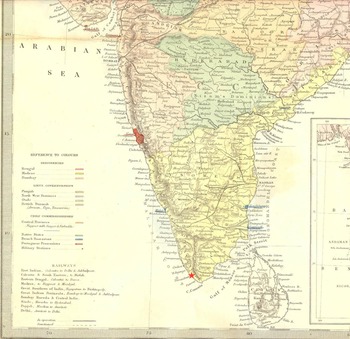
In 1840 the raja of Travancore, Swathi Thirunal Rama Varma (ruled 1829–1846), writing of a desire for his new observatory to ‘prove of use to the interests of science’, would offer to contribute to a sprawling geomagnetic research programme recently organized and promoted by the British Association for the Advancement of Science (BAAS).Footnote 1 Largely coextensive with the present-day state of Kerala, the domain of the princely state of Travancore stretched from the southern tip of the Indian subcontinent north-west along the Malabar Coast to Cochin and inland to the Western Ghats (Figure 1). The third-most-populous of more than six hundred ‘native’ or ‘princely’ states on the subcontinent, Travancore was formally independent of British rule. However, its royal government, or Sircar, had since 1795 been tied through treaty with the Honourable East India Company. This treaty initially promised military protection in exchange for trading rights; by the early nineteenth century, it gave the East India Company not only control of external trade from the region, but also the right to an annual tribute from the Sircar and the power to install an adviser to the raja – the British resident. Typically the East India Company also influenced the designation of the raja's second in command, his chief minister or dewan.
Map showing the location of Trivandrum. Author's modified version of J. Walker and C. Walker, India, London: Edward Stanford for the Society for the Diffusion of Useful Knowledge, 1861.

Since 1839, the BAAS had been developing a coordinated system of global magnetic observations. Strung across stations from North America to Eurasia, and down through Australasia towards Antarctica, thirty-three observatories formed a more or less synchronized, more or less global network of delicate magnetic instrumentation.Footnote 2 On fixed dates, at certain hours of certain days, all of the observatories would record local magnetic and meteorological conditions. When stitched together, this data would, it was hoped, help to unravel the nature and cause of terrestrial magnetic variation. In joining what the Dublin magnetician Humphrey Lloyd called the ‘magnetic crusade’, Travancore would enter scientific company with other British stations (funded by the Admiralty, the East India Company and the former governor of New South Wales, Sir Thomas Mackdougall Brisbane) and another Indian princely state, Oudh. It also joined scientific forces with the governments of Egypt, Russia, Prussia, Bavaria, Spain, Austria, Belgium and France, plus several private colleges in the United States.Footnote 3
Over the next three decades, the Trivandrum observatory would pursue fundamental terrestrial magnetic research. These efforts would culminate in the publication of the Trivandrum Magnetical Observations (original spelling Trevandrum Magnetical Observations), published in 1874.Footnote 4 The surviving records of this production, including letters of the Trivandrum Observatory's first two directors, John Caldecott and John Allan Broun, together with archives related to the observatory held at the National Archives of India and the National Library of Scotland, allow us to reconstruct in some detail the working relationship between Trivandrum Observatory and the British scientific establishment. Using these sources, this article reconstructs the production of the Trivandrum Magnetic Observations and presents a new view of the geography of scientific production in the British Empire.Footnote 5
Back in Britain, in 1845, John Herschel turned to the magnetic crusade during his presidential address at the annual meeting of the BAAS. ‘Do we call for facts?’ he asked his audience. (The audience, we might imagine, called back, ‘Facts! Facts!’) And yet, Herschel cautioned, might the sciences be gathering too many? ‘They are poured upon us in such profusion as for a time to overwhelm us, like the Roman maid who sank under the load of wealth she called down upon herself’.Footnote 6 When describing the state of scientific affairs for the year – and with particular reference to the BAAS's ‘system of simultaneous magnetical observations’ – Herschel conjured images of drowning and burial, a burdensome overabundance: ‘Witness the piles of unreduced meteorological observations which load our shelves and archives; witness the immense … catalogues of stars which have been and still are pouring in from all quarters’.Footnote 7 As Herschel's audience was well aware, Britain's imperial expansion was enriching not only the financiers in the City of London but also the data archives of scientific societies and institutions throughout the country. As the century progressed, the scope and scale of data collection continued to expand; in the same speech, for example, Herschel also went on to call for expanding data-gathering infrastructures, pushing for ‘the establishment of physical observatories as part of the integrant institutions of each nation calling itself civilized’.Footnote 8 And, perhaps with Travancore in mind, he gave special words of encouragement to the ‘emulative’ colonial states that were then investing in new observatories.Footnote 9 (In the same year, however, the BAAS would also make recommendations that ultimately led to the closure of the East India Company's physical observatories at Simla and Singapore.)
While data collection was accelerating, the handling of observations was also undergoing changes that would further increase the amount of labour involved in processing: measurements became more numerous, instrumentation became more complex, and the list of factors for which observations had to be corrected continued to expand. Methodologies were transforming as the collection of data expanded to new corners of the globe. ‘Physical geography’ of the kind most associated with Alexander von Humboldt would become a dominant approach in Britain the 1830s and 1840s. For Humboldt, the key to identifying and explaining physical patterns was to be sought in the linking of broad sets of local data in order to obtain a picture of global processes.Footnote 10 The BAAS's magnetic crusade is now often presented as a prime example of a particularly ‘Humboldtian’ (and a particularly British) empirical enterprise.Footnote 11
In dwelling upon ‘the predicament in which we stand, in reference to the immense mass of data already accumulated’, Herschel was pointing to the fact that the new scale of data collection created new challenges along with new opportunities. Growth could be problematic for day-to-day scientific practice.Footnote 12 All of this Herschel knew from personal experience. He had spent the last five years buried under the astronomical data gathered during his years at Cape Town, working to prepare it for publication. These growing ‘piles’ of unprocessed observations ran up against a broader reorganization of scientific labour, practices, networks and resources. Herschel's imagery of drowning in data riches thus captures both this ‘Humboldtian’ moment and the imperial dimension of mid-century scientific culture.
Most writing on terrestrial magnetism in the middle decades of the nineteenth century has focused on how these practical and theoretical developments played out within the BAAS itself. Susan Cannon has explored debates over intellectual developments within the scientific community in Britain. John Cawood describes the role of inter-imperial rivalry, especially between Britain and France, as an impetus driving the growth of the BAAS's magnetic crusade. For both Cannon and Cawood, the ‘passion for fact gathering’ at the BAAS was very much influenced by both theoretical and methodological debates, often between British and Continental geomagnetic traditions.Footnote 13 Diane Josefowicz, too, explores a fascinating debate between various centres of accumulation, in this case between Herschel and Carl Friedrich Gauss, in Göttingen, over the challenges of relying on data produced abroad.Footnote 14
This essay considers the significance of such sprawling, data-intensive projects not in terms of metropolitan debates over scientific method or data analysis but rather in terms of their operation within the geography of scientific practice under British imperialism. The above accounts of transformation, conflict and change at the BAAS are here situated within the context of the broader imperial political economy within which such labour-intensive global enterprises then operated.Footnote 15
In what follows, I focus in particular on the inter-regional dynamics of the practical domain that so worried Herschel and many of his contemporaries: the work of processing observations and producing published reports. It was the fast-growing archives of unprocessed (‘unreduced’) manuscript data that caused the most acute anxiety. If the 1820s and 1830s saw the build-up of, as Ian Hacking puts it, an ‘avalanche of printed numbers’ for the sciences, then even more distressing was the quantity of data that remained unprinted.Footnote 16 In what follows, I pursue such problems of scientific production as they appear in nineteenth-century Travancore. In the process, I hope to add to Jahnavi Phalkey’s goal of expanding our understanding of ‘colonial’ science by asking ‘what did people actually do’,Footnote 17 when engaged in what we now call ‘colonial science’.
In this particular realm of scientific production, we find evidence of what both connected and divided the scientific communities in Travancore and Britain. Such commonalities and differences included variations across regions in labour costs, training and expertise. As we will see, as much as the historical geography of scientific practice across the British Empire was developing centre–periphery ‘divides’, it was also generating increasingly connected infrastructures and economies. In the case below, the now-familiar story of growing centres of accumulation in the nineteenth-century sciences in Britain is shown to be coextensive with, and dependent in various ways upon, the participation of Asian political actors.Footnote 18
Imports from Europe
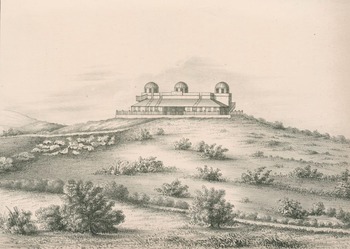
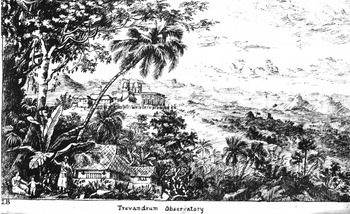
Travancore's magnetic crusade would be organized out of the raja of Travancore's astronomical, meteorological and magnetic observatory at the royal city of Trivandrum (now Thiruvananthapuram, Kerala, India – Figures 2 and 3).Footnote 19 Swathi Thirunal had founded a new observatory near the palace and temple in 1836. This was a period of institutional growth in the royal city. In addition to the observatory, the raja's government also established a public library, a collection of Sanskrit manuscripts (later to become the Oriental Research Institute and Manuscript Library), and the Free School (later to become the University of Kerala.)
‘Trevandrum Observatory … from the North West’, after W.H. Horsley, Plate 2, from John Caldecott, Description of an Observatory Established at Trevandrum by His Highness the Rajah of Travanacore, Madras 1837, repr. London, 1839. By permission of the Royal Society (img RS.10146).
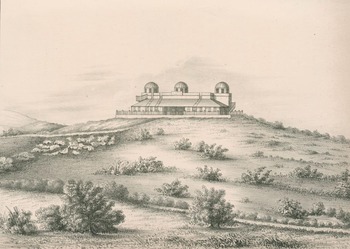
‘Trevandrum Observatory’, by ‘I.B.’, Plate 1, John Allan Broun, Report on the Observatories of His Highness the Rajah of Travancore at Trevandrum and on the Agustier Peak of the Western Ghats, Trivandrum: Sircar Press, 1857.

In the 1830s, there were over a dozen major native states and hundreds more minor principalities or semi-autonomous regions throughout the subcontinent. Travancore was unique among native states in many ways, but its patronage of science was not one of these. Asian rulers contributed significantly to the material and social construction of modern science both within the Indian subcontinent and across the globe. In the physical sciences, for example, between the rush of observatory construction in the 1720s under Maharaja Jai Singh II and the establishment of the Indian Institute of Science by the maharaja of Mysore in 1909, at least nine astronomical observatories were established on the subcontinent, and four of these were funded by princely states.Footnote 20 While the influence of indigenous capital and culture within the history of science in India is recognized, still the princely states are largely absent from the historiography of science in India.Footnote 21 If princely state patronage of the kind discussed in this essay may seem to be rare or exceptional, in fact, as S.P. Nair's recent work on the princely state of Tanjore suggests, this may only be because of a lack of research in the area.Footnote 22
Focusing on the astronomical sciences at the Trivandrum observatory in the nineteenth century, Joydeep Sen has presented a picture that foregrounds the agency and ‘professional ambitions’ of the British observatory directors while downplaying the influence of the Travancore government.Footnote 23 But, as we will see below, when also taking into account the geomagnetic sciences, such a picture does not seem to capture the role of the rajas, the residents and the dewans in the history of the observatory sciences in Travancore.
Certainly in terms of the magnetic research pursued at the Trivandrum Observatory, the interests of British magneticians and the BAAS's ‘magnetic lobby’ would be immensely influential. The royal city of Trivandrum lies very near the magnetic equator: a shifting band around the globe within which magnetic dip – the angle at which a compass needle will point up or down in the vertical plane – is zero.Footnote 24 The magnetic equator had been a target of interest in Europe since at least 1834, when François Arago proposed mapping its features as part of the Bureau des longitudes's ambitious geomagnetic surveys.Footnote 25 For this and other reasons, it is clear that the work of Travancore's two British directors, John Caldecott and John Allan Broun, was directly related to the larger research agenda promoted by the BAAS and European counterparts.
At the same time, however, in order to make sense of how the geomagnetic programme unfolded in practice at Trivandrum, the interest and influence of the Sircar must be taken into account. At every stage, the plans and desires of the observatory director were funnelled through the Sircar bureaucracy, where they ran up against matters of state and the sometimes contradictory opinions of the British resident, the raja and the dewan. Furthermore, as all three would stress, Broun's service to the state required particular forms of scientific production, which the Sircar would lay out in some detail. And for decades the raja and the dewan pushed hard to ensure that the observatory data would finally make it into a respectable published form. From the Sircar's perspective, as we will see, Broun was an instrument through which Travancore would ‘give to the scientific world’ by way of the observatory reports that he was contracted to produce.Footnote 26 In all of these ways, princely state patronage did not merely provide funds that gave a European astronomer ‘the freedom to pursue his own researches’, as Sen suggests was the case in Trivandrum.Footnote 27
Following the raja's hiring in 1836 of one of his English commercial agents, John Caldecott (1800–1849), as a government astronomer, the Madras Engineers were contracted to build an observatory on a hill near the raja's palace. Caldecott was a cotton factor and spice trader who had been working variously in Bombay, Cochin and Travancore since 1820.Footnote 28 Caldecott had his own small astronomical observatory in the port of Aleppy, and the new observatory in Trivandrum was originally designed to house his instruments, but the plan later expanded to include the purchase of new apparatus from Europe. In 1838 Caldecott returned to Britain for a shopping trip to outfit the new observatory. With a generous budget, the set of observing instruments he obtained – from makers such as Dollond, Troughton and Simms, and Dent – were comparable to those possessed by many observatories in Europe. For example, Trivandrum's new equipment was similar to that at the Cambridge University Observatory, and was considerably better than that at the observatory at Oxford.Footnote 29 Arriving in London just at the time when the BAAS had succeeded in persuading the Admiralty and the East India Company to fund three years' worth of coordinated magnetic observations, Caldecott was eager to join what by then was already a high-profile endeavour. Having obtained permission from the raja to offer the services of Travancore, he made contact with two of the main organizers, army officer Edward Sabine and Trinity College Dublin professor Humphrey Lloyd, and returned to Trivandrum in 1841 in the company of not only an astronomical arsenal but also a complete set of the same magnetic instruments (made by Grubb of Dublin) that were being used at the Admiralty and East India Company observatories.
Stopping over at Cadiz and Cairo, and inspecting two other stations contributing to the magnetic crusade, Caldecott arrived back in ‘the neighbourhood of the magnetic equator’ in April 1841.Footnote 30 By June he was already sending ‘term day’ (i.e. the days on which coordinated observations were to be made) data back to Sabine. While it is unclear whether or not Caldecott received the same training in the use of these instruments that had been given to the officers of the British stations, he did have Lloyd's instructions and Sabine's promise of support and assistance.
The Trivandrum Observatory was of a very different character than the observatories run by the East India Company at Bombay (Colaba) (established 1826) and Madras (established 1786), both of which were also contributing data to the BAAS's plan.Footnote 31 Those observatories were military establishments based within forts, while the Trivandrum Observatory was part of a growing complex of educational and cultural institutions.Footnote 32 From the late 1830s to the 1870s, the observatory would form a visible and broadly engaged centre for scientific culture in the region. This was, it should be stressed, in spite of the often tepid – and sometimes hostile – attitude towards the observatory held by some of the British residents and European missionaries. During Caldecott's absence, Travancore had received a new resident, William Cullen (resident 1840–1860). Cullen would later become a supporter of new scientific institutions in Trivandrum, but in the early 1840s he was unenthusiastic about the observatory and thought it a bad use of government funds. The raja, however, was a steady supporter, and accused Cullen of trying to stir trouble between himself and Caldecott.Footnote 33 The few surviving letters between Caldecott and the raja show them united against Cullen's scepticism. Swathi Thirunal complained that Cullen's favoured new dewan (Krishna Rao, whom Raja called ‘a low, ignorant Brahmin … a vulgar minded man’) had ‘endeavoured to persuade me that there is no utility by the continuance of the observatory establishment’. But the raja defended the observatory:
I used to check him [Rao] and at the same time express to him my sense of the high advantages derived from this establishment in a scientific point of view, and I am fully sensible that by reason of my patronizing it, my name, however undeserving of any celebrity[,] is favourably noticed even in distant regions among the scientific personages of the present day.Footnote 34
‘Celebrity’ of this kind, it should be noted, also appealed to Caldecott. In reply to the raja he explained that in running the observatory ‘my object is not money so much as the opportunity of acquiring scientific fame and honour’.Footnote 35
The Trivandrum observatory had some strengths that the Colaba and Madras observatories lacked. Being free of military duties such as chart making, timekeeping and instrument rating, the patrons and directors at Trivandrum had relative flexibility in choosing what questions or research to pursue. This was the same flexibility that would, just at this time, give a generation of amateur astronomers in Britain a central role in shaping the direction of astronomical research. But, as it would turn out, joining an international effort organized out of Europe was exactly the kind of project that turned Travancore's independence from the Admiralty or the East India Company into somewhat of a liability. Because it was about remote coordination, the smooth execution of the project relied as much on communication systems as it did on local expertise and observatory instrumentation. It is precisely here that Travancore, as a princely state, was at a disadvantage. The East India Company observatories had free, frequent and reliable communication to and from Britain by way of the Company's regular packet service. Importantly, they were also on the list of institutions that would receive any new observatory publications, reports or catalogues automatically and free of charge. The Trivandrum observatory had none of these connections. Caldecott, for example, had trouble obtaining publications such as Greenwich observations and Herschel's report from the Cape of Good Hope (finally published in 1847), which he found to be ‘not purchasable for money’ in his part of the world.Footnote 36 Making the case for the Trivandrum observatory being entitled to free publications of this kind, Caldecott entreated Sabine ‘to remind the parties concerned that there is a public observatory in this place’, and assured him that his own observations when published would be freely and widely distributed.Footnote 37
Even worse was the slow and unreliable communication from Sabine and his other scientific correspondents in Europe. Caldecott was assiduous in sending letters and updates back to Sabine at the Royal Society, and his letters seem to have been received within the usual three months that mail between India and Britain took at that time. But Sabine's letters to Caldecott took six to nine months, and sometimes even longer. It took a full year before any of Sabine's letters first arrived in Travancore, even though he had replied relatively quickly to Caldecott's early letters.Footnote 38 During that long period of silence, Caldecott became sure he had been abandoned by the scientific community in Britain. Along with his regular sets of data he began to send increasingly distraught notes in which he threatened to quit the magnetic crusade and observatory work entirely: ‘the effect of this strange omission [of even acknowledgement of his communications] will in all feasibility be the abandonment of these magnetic observations and my consequent resignation’.Footnote 39 Caldecott was especially frustrated, once Sabine's letters (together with periodicals and papers of recent magnetic work) finally did arrive, to discover that the magnetic committee in London had been changing the times of the coordinated observations, ‘a bad annoyance to all of us and at the same time attended with heavy loss’.Footnote 40 To make matters worse, Sabine had also complained to Caldecott that the Royal Society had been obliged to pay high postage fees for receipt of his packages.
Despite all of this, Caldecott succeeded in getting some form of magnetic data for the years 1841–1842 to Sabine's growing magnetic archive at the Royal Society. Like many station directors, Caldecott was expecting Sabine and his assistants to generate the publications in a series of reports. This would not be the case; the fate of these observations is unclear. As we will see, printing and publication would present a whole new set of challenges for Travancore's engagement with the scientific community in Europe.
Data production at the observatory under Broun
For the next few years Caldecott's attention shifted to meteorological work and an effort to publish his record of over five years' worth of hourly meteorological observations. Before this could happen, first Swathi Thirunal and then Caldecott died. Swathi Thirunal was succeeded by Uthram Thirunal Martanda Varma (ruled 1846–1860). Uthram Thirunal practised medicine, was involved in producing materia medica and invested in a chemical laboratory. He also extended the college and observatory buildings to include a zoo, public gardens and a museum of natural history.Footnote 41
With Caldecott's death in 1849, the Sircar sought to recruit a new director, asking the advice of the Admiralty and of prominent scientific figures in Britain. On the advice of John Herschel and Piazzi Smyth, the Astronomer Royal for Scotland, an offer was made to Broun, who at the time was director of Sir Thomas Mackdougall Brisbane's observatory in Makerstoun, Scotland.Footnote 42 Brisbane's observatory was the only privately funded British station to participate in the BAAS plan of simultaneous magnetic observations.Footnote 43 Broun had led these observations, and was thus a veteran of the magnetic crusade. Broun had also been at the BAAS meeting in 1845 when Herschel gave his presidential address, and when the BAAS magnetic committee had arranged an international delegation to discuss the future of the system. John Cawood has described the 1845 meeting as the high point of the magnetic crusade; but Edward J. Larson points out that while this particular project began to unwind after this date, magnetism remained a major focus of British research until much later in the century.Footnote 44 Broun was one figure who would carry terrestrial magnetic studies forward for several more decades.
Despite the challenges of moving with his wife and four children to the southern tip of the Indian subcontinent, Broun accepted the higher salary offered by the raja and resigned his position as Brisbane's observatory director. The Broun family arrived in Trivandrum in 1851. Over the next fourteen years, Broun and his two head assistants, J. Kochukunju (Cochoocoonjoo) and E. Kochiravi (Cocheravey) Pillai, along with a half-dozen other observers and computers, would take daily – often hourly – readings from a dozen instruments. The Trivandrum Magnetic Observations would be the published archive of these observations – ultimately over 350,000 of them – each one having been vetted, organized and reduced.
Broun's style of research neatly captures the globe-spanning big-data projects now associated with British Humboldtianism. For example, by comparing data from Singapore, Trivandrum and Scotland, Broun was able to demonstrate that the annual variation in horizontal magnetic force was a globally synchronous phenomenon.Footnote 45 In addition to this kind of mapping, magneticians such as Broun also sought to explain the hourly, daily and yearly changes in compass behaviour with respect to other physical properties such as barometric pressure, temperature, and especially lunar and solar cycles. Broun employed comparative analysis of large data sets to query solar and lunar patterns of horizontal magnetic change as well as barometric, seasonal and annual cycles of magnetic variation. Broun also showed that large irregular disturbances were caused by solar activity. Like Humboldt, Broun was particularly interested in altitudinal variation; hence the Trivandrum Magnetic Observations contain parallel recordings at sea level (at the Trivandrum observatory) and from an observatory he had constructed at a height of six thousand feet, on the peak of Agasthya Malai (Agastier Malley) in the Western Ghats.
Much of Broun's results would be communicated in short articles published in journals such as the Transactions of the Royal Society of Edinburgh and Nature. As head of the observatory, however, his primary duty was to the publication of observation reports. When Broun had arrived in 1852, the Sircar made the ‘scientific objects’ or objectives clear: that a regular series of observations would begin, and that the observations should be published ‘as rapidly as possible’, typically annually.Footnote 46 A functional observatory therefore also required a means of printing large amounts of tabular data as well as – for terrestrial magnetism – charts and graphs. When the observatory was being constructed in 1836 the only press in Trivandrum was owned by the Church Missionary Society, so the Sircar had also ordered a new printing press to be built under the observatory's direction.Footnote 47 Decades later, this would become the government press (the Sircar Press). Roman type was obtained for the press in 1837, and Caldecott began printing astronomical ephemerides from 1838–1840. Apparently, annual observatory reports were not completed during Caldecott's time, although the observatory did for a number of years produce a popular astronomical almanac for the region in both English and Malayalam. Caldecott, it seems, had spent much of the mid-1840s trying to get his meteorological observations printed. ‘We cannot do it here’, he wrote to Sabine in 1843, ‘but I hope you may be able to effect it through the [British] Government at home’.Footnote 48 This letter accompanied four manuscript copies of the observations. These he wanted to present to societies in London, Edinburgh and Berlin in the hope that one of them might take on the task of publication. In the end, even after Caldecott returned to Britain to argue his case, these data would not find a European sponsor.
Like Caldecott, Broun did use the press to produce other kinds of scientific literature such as histories of the observatory, an account of the construction of the sister observatory on Agasthya Malai, and a report on the new museum and public gardens established near the observatory grounds.Footnote 49 But as for regular publications of observation data, even after a decade in Trivandrum, Broun had yet to produce a single volume. By 1863, the dewan was demanding that Broun provide the Sircar with a concrete plan of ‘the mode of publishing the work or works which are to give science the benefit of your labours in Travancore’.Footnote 50 In defence of his poor publishing record, Broun was quick to blame the observatory press. Broun alleged that he had been ready to print back in 1855, but that shoddy superintendence of the press, coupled with a long-standing shortage of paper, had stalled the work. And, he complained, when the press did finally start printing his observations in 1859 the pace was too slow – four pages per week – to be of any real use.Footnote 51
That Broun, Kochukunju, Kochiravi Pillai and their crew of assistants had been hard at work over the last decade, having recorded hundreds of thousands of magnetic observations (both in the observatory in Trivandrum and at the one atop Agasthya Malai), was beside the point. That during this time Broun had published well-received articles in leading European journals was also beside the point. The Sircar required, as would have the Admiralty or the East India Company, a ‘benefit to science’ in the specific form of an observatory report. Broun, for his part, entirely agreed; for him as well, the observatory report was necessarily the ultimate product of the observatory, since, in his view, it was also the means by which the record of magnetic variation at Trivandrum, which he had painstakingly constructed for over a decade, could potentially be made useful for the future.
Outsourcing analysis and printing to Europe
This increased scrutiny of the observatory's publication record coincided with a marked tightening of the Sircar budget. When Ayiylam Thirunal (ruled 1860–1880) succeeded Uttaram Thirunal as raja, he installed a new dewan, T. Madhava Rao.Footnote 52 Rao was an ambitious and effective administrative reformer. Intent on trimming Sircar expenditure and clearing debt, he pursued a number of controversial cost-cutting measures. One of these measures involved a review of the observatory and its budget. In the midst of this period of financial strain, Broun seized the opportunity to propose a new situation for himself: he would continue observations until 1865, at which point he would return to Europe with the mass of yet-to-be-printed data plus a life pension from the raja; once back in Europe, he assured the Sircar, he would finally put together the publications.Footnote 53
There was a precedent for Broun's proposal to return to Europe with a pension, manuscript data and a plan of publication. Just a few years earlier, the naturalist and physician Edward John Waring had been granted a generous retirement package on his return to Britain. Waring was residency surgeon at Travancore from 1853, becoming in 1856 the physician to the raja. Back in England, Waring was provided with a generous life pension by the Sircar; he went on to produce several widely read works on Indian pharmaceuticals and European health abroad.Footnote 54
Broun's case would not go so smoothly. The British resident, W. Fisher, now pressed for the observatory to be shuttered. Rather than devote funds to abstract questions of terrestrial magnetism, so the resident argued, Travancore should restrict itself to agricultural research (particularly related to famine relief) and modernizing engineering works: ‘the available resources of the State … will for years to come be best employed in developing the resources of the country by carrying out of works meeting the requirements of the public’.Footnote 55 But on this subject Fisher was not in tune with the government of Travancore. Since the late 1830s, the Sircar had pursued a much more expansive vision for the sciences in Travancore, and it would continue to do so for several more decades.Footnote 56 Things were less clear for Broun and the still non-existent observatory publications.
Ultimately the Sircar decided to keep the magnetic and meteorological wings of the observatory open, while scaling back on the astronomical work and spending no new funds on instrument upgrades. Although the dewan was willing to grant Broun a pension for his service to the Sircar, he was reluctant to allow Broun to return to Europe before he had finished the work of publication. Initially it set the terms of Broun's pension such that reduction and printing had to be done in Trivandrum. But Broun was adamant that it was ‘essential to have it performed in Europe’.Footnote 57 Thus began a protracted debate about the value, costs and benefits of manufacturing the report in Europe versus in Travancore.
Above all else, Broun stressed cost and efficiency. Broun estimated that the total number of printed pages for the Trivandrum Observatory would exceed three thousand, while the Sircar press could only produce about four pages per week – roughly two hundred per year. More compositors and press men could be hired, and perhaps the press could achieve fourteen pages per week, meaning that it would take two years to print each volume in Trivandrum. But at this point, Broun claimed, it would in fact be cheaper to have the printing done in Britain. He allowed that the graphic plates – the ‘formulae, woodcuts and engraved curves’ – would cost more to print in Europe, but he also claimed that such printing could not be done well in Trivandrum, ‘nor indeed well in India’. And in a final sweep of generalization, Broun argued for the overall benefits of industry organized under private enterprise versus a state institution: ‘it must be remembered that in a private printing establishment workmen are paid according to what they do, and the various excuses which have been accepted here for doing nothing would be of no avail where the proprietors’ own interests were involved’.Footnote 58 According to Broun, then, as with machine-loom cloth, so with scientific reports: machines (steam presses), the division of labour (ready-trained printers and computers) and private capital (a profit-oriented press) combined to give Europe an economic edge in transforming the raw material (data) into a finished product (the report).
Regarding the huge amount of data processing to be performed – e.g. instrument correction, and reductions for temperature, barometer and celestial cycles – Broun's cost and efficiency arguments were more speculative, because here, unlike printing, there was little technical or skill gap between Europe and Travancore, which had a trained staff of observers and computers. Many of the assistants would come from the maharaja's Free School. In Broun's first administrative report, submitted to the raja in 1857, he describes himself as both a moral and a scientific educator for the staff of the observatory. Since arriving, he had run a sort of college within the observatory, giving lectures, examining the assistant's notes, and offering prizes for the best work. Broun claimed that his new training scheme was such a success that the assistants' skills were equal to those of assistants in Europe.Footnote 59
Given the well-trained staff in Travancore, Broun had little ground for arguing that the calculations and reductions should be done in Europe. His strategy was thus to suggest, perhaps misleadingly, that the next stages of the work were ‘not at all mechanical like that of the ordinary calculations’, which had for years been the domain of Pillai and Kochukunju. Rather, this was ‘head work requiring the mind to be undisturbed by other matters and devoted continuously to the one subject of thought’. Broun did not attempt to argue that the ordinary calculations could be done more cheaply in Europe, though he did point out that in Europe calculators were not very expensive: ‘young lads for ordinary calculation … may be had for about £1 a week’. But for the ‘head work’ of discussing results and drawing conclusions, Broun fell back on the common climatic claim that, for a European anyway, the North was more amenable to hard intellectual labour: ‘There can be no doubt, I believe, that a European will do much more of the work here referred to as discussion in Europe rather than in this country in the same time’.Footnote 60
Clearly both the British resident and the dewan were wary of allowing Broun to return to Europe before completing the publications. The British resident had warned Broun that the Sircar was unlikely to be amenable to moving the printing to Europe. Fisher was right; the dewan was sceptical of Broun's accounts of the observatory press and its inefficiencies. Eventually Madhava Rao did agree to Broun's plan, but only after imposing a set of financial incentives that would, so he hoped, ensure the rapid completion of the Trivandrum Observations. The dewan also decided that a significant part of the work would continue at Trivandrum. The ‘ordinary’ calculations would continue at the observatory under the direction of Kochivari Pillai, with the results periodically shipped on to Broun to be incorporated into the ‘head work’.
By December of 1863 the conditions under which the work would be divided between Europe and Trivandrum had been generally settled. The dewan was careful to spell out the details of the expected publication and set incentives, such as promising, in addition to his base pension of £420 per annum, an additional sixty pounds per year for each new volume published. If, at the end of six years, Broun had successfully completed all six projected volumes, the sixty pounds would be permanently added to his life pension.Footnote 61 There were also extra funds for a computer and for the purchase of periodicals. For his part, Broun fought against this scheme. Rather than seeing the extra sixty pounds as bonus, he saw it as an order: produce six volumes in six years, with a ‘penalty’ to be imposed if he did not succeed. He expressed indignation at being given a deadline at all, and was offended at the very idea that his remuneration would depend upon a timescale of production. Implying that Madhava Rao did not understand the conventions of scientific practice in Europe, Broun complained to the resident that his work was not ‘ordinary mechanical work whereby implying a sufficient number of hands it can certainly be finished within a given time, there can be no difficulty’. In the case of ‘scientific deduction, as in the case of literary composition’, no such plan ‘has ever been thought desirable’.Footnote 62 The resident, however, was on the side of the dewan. Though ‘no precise and definitive arrangement can be made to guard effectively against … contingencies that may arise in preparing his work for the press’, the resident thought that Madhava Rao was right in attempting to install incentives:
It may be in his own interest to publish the work, but at the same time his service to the state is not complete until it is published … the principle on which remuneration in addition to his pension is arranged is therefore just and not to be departed from.Footnote 63
In the end, however, the dewan agreed to remove the time frame of six volumes in six years, instead paying Broun the sixty-pound bonus whenever the publications should be completed. The total cost of publication on Broun's transcontinental plan, with most of the calculations being done in Trivandrum but the ‘head work’ and printing to be completed in Edinburgh, was put at 21,000 rupees. The Sircar considered the sum ‘very moderate with reference to the quantity of work to be done. But … large relatively to the resources of this country’. ‘It is of course’, continued the dewan in a letter to the resident in late 1865, ‘very desirable that, after having incurred the expenses of maintaining an observatory for so many years, the state should give to the scientific world the results or data obtained[,] provided these are worth the additional charge now required’.Footnote 64 Evidently the Sircar concluded that the promise of the Trivandrum Observatory finally producing a report was worth the further investment. With the terms settled, Broun and his family returned to Europe in 1865.
Data to the market: valuing the Trivandrum Magnetic Observations
Five years later, despite what may have been Broun's best intentions, and despite the Sircar's financial strategizing, the world was still awaiting the first publication of Travancore's data. Madhava Rao was close to abandoning the project. He now worried that ‘Broun had drawn his money regularly but had contributed nothing to science in exchange’.Footnote 65 During this time, Broun had produced publications of other kinds and had communicated important results from his analysis of the Trivandrum data in several articles. And although Broun called attention to this work, telling the Sircar ‘these papers give a more popular [i.e. widely read] view of some results than the volume itself’, and had copies sent to Travancore, none of this satisfied Broun's contract with the Sircar.Footnote 66
As the resident and the dewan together tried to settle on a plan that would ensure the observatory investment would eventually pay off, Broun's character came under increased scrutiny. Accusations about money mismanagement surfaced. The Sircar claimed that the money charged for a computer, fifty pounds annually, had in fact simply been pocketed. In fact the computers had for the most part been Broun's own children. The project had become a family cottage industry: working out of his home and with the help of his sons or eldest daughter (the girl's work, he assured the Sircar, was thoroughly double-checked), Broun inched slowly towards publication.Footnote 67
Broun, now cast as the untrustworthy native, projected a life of extreme thrift and tireless devotion: ‘I have worked from dawn to the sunset never leaving the house till late, and then forced to take a walk rather than fall ill and be thus prevented from working’.Footnote 68 Living on the Continent was more ‘economical’, so the family stayed first in Lausanne and later in Stuttgart before finally returning to London. He blamed his slow progress on the overwhelming amount of calculations to be done: ‘There were errors to be cleared up requiring my investigations. I have gone over all the observations of magnetic declinations made with two instruments hourly from 1854 to 1869, in order to detect the smallest error’.Footnote 69 Moreover, he insinuated that the computers in Travancore, who were still at work on the calculations for the lunar variation of declination, were a key reason for the delay: ‘this arrangement, made for economical reasons, was bad and I have suffered greatly from it’.Footnote 70
Increasingly concerned that the publication would never appear, the resident and the dewan together decided upon a new measure of pressure: the first volume must be completed by 1875 or else the raja would abandon the plan of publishing it altogether. In addition, the payments for a computer and other incidental expenses would be stopped. Lastly, as for any subsequent volumes, the Sircar suspended support for now, pending the perceived success of the first volume: ‘when the opinion of the scientific world has been ascertained … it will be decided whether publication of the second volumes will be continued’.Footnote 71
Broun affected deep offence at the idea that the value of his future publications would be judged in such way. According to Broun, government officials, whether British or Malayali, were in no position to judge the value of a scientific work. And even if the Sircar purported to make its decisions based on the opinion of ‘the scientific world’, contemporary opinion, he argued, could say nothing of the long-term value, the unforeseen benefits, of such a publication. This, he claimed, was simply not how things were done in science, and he obtained a letter from the Royal Society of London that backed his position. However, both the resident and the Sircar had, by now, very little interest in the project and even less in Broun's pursuit of further funds. ‘It is obviously impossible’, wrote the resident to the dewan, ‘to satisfy a gentleman who considers it apparently a hardship not to be allowed in addition to [his generous pension] £50 per annum for a computer and pocket the money’.Footnote 72 The ultimatum remained in place: Broun had to produce the first volume by 1875 or all support for publication would be withdrawn, and support for future volumes would depend upon the Sircar's determination of the first volume's ‘scientific value’.
As work on publication intensified, the issue of how to determine the ‘scientific value’ of the work, and of who was positioned to judge such a thing, became entangled with a parallel debate over the monetary value of the work. One area of uncertainty in Broun's contract with the Sircar had to do with how many volumes of the work would be given to him for his own use. Back in the early 1860s, the dewan had proposed that the majority of the volumes would be given to Broun as a form of payment.Footnote 73 This was after Broun had suggested that some of the costs of printing would be covered by sales of the work, claiming ‘this was the case with my former works’.Footnote 74 When Broun had been director of Brisbane's observatory in Makerstoun, he had had close dealings with Neil and Co., the well-known Edinburgh printer of scientific texts. Now, from Trivandrum, it was to Edinburgh once again that Broun turned for printing. He wrote both to Neil and Co. and to the printers Smith, Elder & Co. He asked the latter about the profits from the sale of Edward Sabine's reports of magnetic observations at Toronto (1845), at the Cape of Good Hope (1851) and at Hobart Town (1850).Footnote 75 The company replied that Sabine's sales were less than half a dozen for each volume. Smith & Elder also noted that another large observatory report – and one of the most famous of the period – John Herschel's Results of Astronomical Observations Made … at the Cape of Good Hope (Smith, Elder & Co., 1847) (the same that Caldecott had said ‘was not purchasable for money’ in south India), cost five guineas and sold ‘very limited’ numbers. The printers explained that the minuscule number of copies sold was due to the fact that ‘large numbers’ were distributed ‘gratuitously’ to ‘observatories and distinguished scientific men throughout the world’. Worse yet, they surmised,
had only a few copies of both the above-mentioned works been gratuitously distributed we fear that the sale of them would have been very small and slow; as it is customary for the printed results of observations made at public observatories to be presented to other scientific observers of the same class of phenomena.Footnote 76
On the eve of publication, Broun now reversed course on the profitability of sales and used the custom of gratis distribution to argue against any payment in terms of volumes, arguing that such an arrangement would induce Broun himself to seek profit from the works, and this would be detrimental to the ‘great object of His Highness's government’:
If the sale is to become a matter of pecuniary moment whether to myself or to the Sircar indirectly or directly, as few copies would be distributed gratis as possible on the hopes that all who really desire to use the volume may be induced to buy it. In this way however the great mass of persons for whom the work is really intended will never see it, or with difficulty in some public library. It is not possible of course to judge, if it were desirable, whether each and such a philosopher or institution would probably buy the work or not.
I venture to think that it is not in this spirit that the Sircar would desire to act. It is not in the way that other governments (or even prominent individuals having published their observations) have noted. The custom has been to present the work of public and private observatories to observatories, libraries of scientific bodies, public libraries, and to the scientific men who have devoted themselves more or less to the subjects treated of and to spread the work abroad wherever it is likely to serve the object for which it was made, that is, wherever it is likely to be made use of.Footnote 77
According to Broun, then, in this strange print economy of such texts, scientific value and monetary value were at odds, and the Sircar had to choose to pursue one or the other. Tensions such as these would surface several times between the Sircar and Broun, often at the point at which state patronage met the print market. This was not unusual for scientific publication at this time; in the case of Herschel's Cape of Good Hope observations, for example, similar arguments erupted between Herschel, his patron the Duke of Northumberland, and his printer–publisher Smith, Elder & Co.Footnote 78
Once again, the Sircar accommodated Broun's concerns, and the issue of payment in volumes was taken off the table. As for how the volumes would be distributed, Broun based a tentative list of the gratis recipients on one used by the Radcliffe Observatory in 1856, and suggested that the number of such free copies ‘should be fixed at 200, of which 30 would probably suffice for India, while 50 or more amply satisfy any chance sales and any individuals or bodies which might have been neglected in a first distribution’.Footnote 79 By 1874, these delays had deeply strained Broun's relationship with his patron. It had also become fodder for the gossip columns of the Madras Times, a popular liberal biweekly. What, asked the paper, had Broun been doing all this time while on the Raja's generous pension? ‘Apparently nothing … tarrying in Germany, perhaps engaging in the education of his family, and now and again putting forth little brochures on the subject of magnetism.’ The poor Sircar, meanwhile, was ‘dying with curiosity and anxiety to scan the results of his labours in Travancore’.Footnote 80
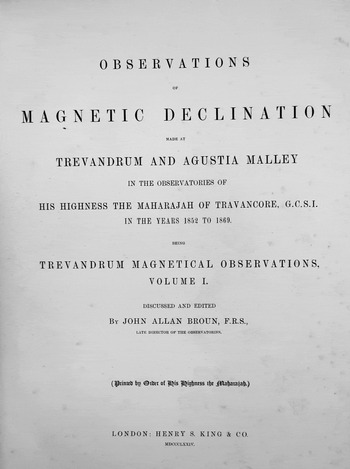
Finally, nearly a decade after Broun had returned from Trivandrum to Europe, the first volume was published (Figure 4). It was printed in Edinburgh by Neil and Co., and published in London by Henry S. King & Co., who offered it for £3 3s. Presentation copies (‘Presented by His Highness the Maharajah of Travancore, G.C.S.I.’) were offered to dozens of institutions and individuals in Europe and India and across the globe.Footnote 81 If Broun's final distribution list for this publication was anything like that for his reports from the Makerstoun Observatory, an important destination for the report would also be colonial observatories, such as those at St Helena, the Cape of Good Hope, Madras, Bombay, Parramatta (New South Wales), Toronto and Hobart Town.Footnote 82 It is unknown how many copies, if any, were ever sold.
Frontispiece to J.A. Broun, Trivandrum Magnetical Observations, London: King, 1874.

Drawn across a decade and between two continents, the production of the Trivandrum Observations was no simple matter of centralized data accumulation, nor of British science being showered with colonial data wealth. Such a protracted production history is also not all that unusual. Some of the other reports from magnetic observatories around the Indian subcontinent would follow a similar trajectory. The report from the BAAS-led simultaneous observations during 1841–1845 at the East India Company's station at Simla, for example, would not appear until 1872.Footnote 83 It would also be printed and published in Britain. As for the Company's main observatory at Madras, the observations from 1841 to 1845 were also, as with the Trivandrum data, brought back to Britain by the director, S.O.E. Ludlow. The plan was for Ludlow to have them compiled and printed in London, but this never happened, and the manuscript data were shipped back to Madras, and put into the hands of the observatory's long-serving senior assistant, R. Ramanajulu Naidu (Ramanajooloo Naidoo), who completed the reductions and preparations for publication. The work came out in 1884.Footnote 84 (‘What can be thought of a system of administration under which observations are reduced about half a century after they are made?’ asked an incredulous Balfour Stewart in a Nature review of the Madras observations. ‘Surely there is something in this system which requires putting right’.Footnote 85 ) At Lucknow in Oudh there was some debate over publication: the observatory director had wanted to publish in London, but the nawab had insisted it be done in Oudh or perhaps Company territory. Apparently, none of Oudh's magnetic observations made it to print.Footnote 86 Other East India Company magnetic reports, however, would be published much more quickly, and would be done in India: the Singapore data from 1841–1845 were published in Madras in 1850;Footnote 87 the Colaba observatory produced a regular series of magnetic reports in Bombay, in twenty-one volumes, from 1845 to 1870.Footnote 88
The long-awaited appearance of the Trivandrum Observations was met with a mixture of praise, relief and cynicism. The colonial daily Madras Times was unimpressed with the publication. Again presenting Broun as a freeloader, it worried that
Mr Brown's [sic] contribution to science will cost the Sircar a pretty penny … It is only to be hoped that the value of the contributions will equal the amount of money to be expended on them during the further time of M. Brown's natural life, which is a very good one.Footnote 89
Nature gave the report a friendlier reception. Balfour Stewart's review begins with a backhanded compliment to the raja:
We have heard a great deal lately about the native rulers of India, and the worst features of one of them have been brought very prominently before us; but it is a pleasing reflection that they are not all like the potentate of Baroda [Malharro, accused in 1875 of squandering funds and of poisoning the British resident], while some of them might even read a lesson to the paramount power.Footnote 90
Stewart quickly moves on to more typical territory for Nature, summarizing Broun's results and raising a question or two about how the data were handled (particularly the vexed issue of how to treat outlying data.)
Fifty volumes of the Trivandrum Observations were shipped back to Travancore. This might be compared to the geographical distribution of Herschel's Results of the Astronomical Observations Made … at the Cape of Good Hope. Steve Ruskin reports that, of 337 gratis copies, only two were distributed back to recipients in the southern hemisphere.Footnote 91 Back in India, the Trivandrum Observations lived on in various ways. In 1935, for example, a Madras publisher reprinted parts of the work, turning it, as far as was possible, into an entertaining colonial memoir. It was stripped of all of the data and technical discussion, leaving only Broun's lengthy, anecdotal narratives of life at the observatories, which include plenty of encounters with elephants, tigers, remote tribes and leech-infested forests.Footnote 92
Data to the archives: new and old centres of accumulation
Broun did not live long enough to bring the remaining volumes to print. At his death in 1879, he left behind a huge mass of unpublished data, particularly meteorological records. Among some in Britain, the future of this latter data in particular would become a subject of concern. In southern India in the mid-1870s, drought conditions were followed by devastating famines that had killed millions by 1879. Although some contemporaries called attention to the role played by changing grain market conditions, many others – and physical scientists in particular – sought a solution to the drought–famine cycles in a better understanding of India's climate patterns.Footnote 93 At the Meteorological Congress held at Rome in April of 1879, a ‘resolution passed expressive of the great interest which is attached to the series of meteorological observations made at Trivandrum’. George Stokes, secretary of the Royal Society of Edinburgh, explained all of this in a solicitous letter to the raja in November of 1879. Now connecting observatory (meteorological) work to the great challenge of food security in the region, the Royal Society of London sought financial assistance from Travancore. The Royal Society was suggesting nothing so expensive as the Trivandrum Magnetic Observations, but rather a more pared-down ‘digest … a quarto volume of from 200 to 300 pages’.Footnote 94 In 1880, Sir William Thomson arranged an audit of the remaining data, with an eye to having someone continue the project. Neil and Company were quick to assert to the India Office and the Sircar its right to act as printer of any future works, particularly because the cost they had offered for the printing of the first volume of the Trivandrum Magnetic Observations had been based upon a quote for six volumes in total, and thus was ‘at a very low price’.Footnote 95 Perhaps unsurprisingly, however, by this point the raja ‘did not appear disposed to incur any further expense in connection with the publication of Mr. Broun's observations’.Footnote 96
With no patronage for the processing and publication of the data in Europe, it was finally arranged for the majority of the remaining data to be shipped back to India, to be claimed by a newly organized centre of accumulation, the Meteorological Office of the Government of India at Calcutta.Footnote 97 From here, John Eliot, the first meteorological reporter to the government of India, supervised further collation, reduction and publication (at Simla and Calcutta) in the Indian Meteorological Memoirs between 1894 and 1899.Footnote 98 Not everything was returned to India. Back in Britain, other portions of Broun's papers – personal papers and sets of workbooks, as well as some of the data – were first sent to the Meteorological Office in London, and then to Greenwich, where the papers were partially catalogued in an attempt to determine whether any further use could be made of them.Footnote 99 In 1891, Peter Guthrie Tait at the University of Edinburgh had Broun's archive sent back to his office in Edinburgh, where it was stored in the hope that it might have some future utility.Footnote 100
Conclusion
On its publication in 1874, the Trivandrum Magnetical Observations would share shelf space with other archives of far-flung natural phenomena: the night sky in Cape Town in 1837, the reptiles of India, air temperature and pressure at Toronto in 1850, samplings of the world's oceans in 1874. They gathered together, perhaps at the Madras Observatory, or the Royal Society of Edinburgh, or in the library of Charles Darwin or of Humboldt's heirs. It was hoped that, in these places, these reports would become the basis for a scientist to discover and explain further patterns of change and variation in nature. The production and circulation of data archives in the form of such reports were a key feature of scientific practice at the time. The growing archives of large data publications were accompanied by a specific culture and economy of knowledge production. It was not only scientists who placed value upon this kind of scientific product. Although questions of ‘scientific value’ and ‘financial value’ remained up for debate, patrons of all kinds agreed that for an observatory to contribute to science, it must publish and distribute its data within certain networks.
Travancore's investment in this kind of science was one means by which the Sircar would seek, as one official put it, to ‘keep pace with the advances of science of Europe’ and to ‘partake with European nations in scientific investigations’.Footnote 101 Engaging in the magnetic crusade was part of a broader drive to narrow what Ayiylam Thirunal had seen as a dangerous knowledge gap:
the realisation of our hopes depends not in a great measure, but entirely, upon … advancement in moral and intellectual culture. If knowledge is power in individuals, it is equally a source of power to communities. It is knowledge which now chiefly constitutes the difference between one nation and another.Footnote 102
Perhaps the observatory's political supporters would not have objected to being labelled ‘emulative’ by the likes of Herschel. They may also have agreed with Herschel's description of the ‘civilizing’ effects of a scientific statecraft oriented so strongly towards the imperial metropole. For those in Travancore who supported the idea of contributing to the magnetic crusade, local ‘advancement’ could be achieved by shipping European magneticans to Trivandrum and exporting equatorial data back to Britain. For others, however, participation in such projects as the BAAS's magnetic crusade was a cultural luxury in which the princely state should not indulge. By and large, the observatory's supporters, including both Swathi Thirunal and Ayiylam Thirunal, carried the argument; for over thirty years the Travancore government doggedly maintained its patronage of terrestrial physics. Far from consisting of uninterested princes or passive patrons, the Sircar had clear expectations for the observatory and actively sought to bring its labours to print. And in wishing to further ‘the cause of science’Footnote 103 and to ‘give to the scientific world’,Footnote 104 the observatory's supporters would seem to have expressed a commitment to some type of scientific universalism.
Likewise, the growth of European scientific capital in this period would depend in part upon the general appeal of such a vision of ‘the scientific world’ within the broader cultural and political geography of the empire. Because the production of such reports required dozens of hands and decades of labour, their history can reveal much about the concrete working relationship between so-called ‘centres’ and ‘peripheries’ of scientific practice. The Trivandrum Magnetic Observations were produced within a global economy of science in which Travancore sometimes had the upper hand: instruments and expertise were relatively easily imported from Europe to Travancore. For highly trained workers such as Broun, better salaries and pensions could be obtained in Travancore. Skilled calculators were cheaper in Trivandrum, while printing would cost more. With the crucial exception of the printing presses, it would seem that there were few technical or financial gaps that could not be relatively easily closed by the Sircar. At the same time, data and scientific productions tended to accumulate (at least for a time) in Europe, where ultimately the consumers of scientific products and the arbiters of ‘scientific value’ also largely remained. Broun, in arguing that the ‘head work’ of analysis was only possible back in his native region, seems to have felt that the most valuable scientific products could be produced only in a European context. And institutions such as the BAAS tended to benefit substantially from Travancore's scientific investment. Thus, within the sprawling economic, political and cultural geography of science that linked geomagnetic research in Travancore and Europe, the relative strengths and weaknesses of each region would cut in many different directions.
The consequences for Travancore of such a geography of science under British imperialism are similarly complex. By joining the magnetic crusade, the princely state would find itself pursuing a science of the globe by means that would, in some ways, bring it into the very ‘centre’ of British geomagnetism. In other ways, however, by contributing materially and financially to the centralization of data and expertise, or the growth of scientific capital, in Europe, it could also be argued that Travancore would reinforce its own position as a ‘peripheral’ state science actor relative to the particular centre of mid-century Britain. Some postcolonial scholars of the ‘modernization’ of Travancore during the nineteenth century have argued that, for Travancore, what modernization primarily involved was an overhaul of the region's economy that would link it to the global economy in a dependent, subordinate position.Footnote 105 The same might be argued for the consequences of the ‘modernization’ of science in Travancore. But even as it suggests some of the processes by which ‘centres’ and ‘peripheries’ become differentiated, the history of the Trivandrum Magnetic Observations also reveals an increasingly connected, if also increasingly uneven, political economy of scientific practice.