Isolated ventricular septal defect is the most frequent congenital heart anomaly,Reference Marelli, Mackie, Ionescu-Ittu, Rahme and Pilote 1 and the prognosis after surgical repair in infancy or early childhood is generally good. Previous studies showed low complication rates on both short- and long-term basis,Reference Bol-Raap, Weerheim, Kappetein, Witsenburg and Bogers 2 , Reference Roos-Hesselink, Meijboom and Spitaels 3 and ventricular septal defect-corrected patients are considered just as healthy and physically fit as their peers.Reference Meijboom, Szatmari and Utens 4
However, data are inconsistent when it comes to exercise capacity as a measure of cardiopulmonary function. It is generally accepted that post-operative ventricular septal defect patients do not differ significantly from healthy controls in terms of maximal workload on an ergometer cycle.Reference Meijboom, Szatmari and Utens 4 – Reference Binkhorst, van de Belt, de Hoog, van Dijk, Schokking and Hopman 6 Reports also demonstrate uncompromised peak oxygen uptake and anaerobic threshold compared with healthy adolescents for up to 12 years after surgery.Reference Binkhorst, van de Belt, de Hoog, van Dijk, Schokking and Hopman 6 , Reference Perrault, Drblik and Montigny 7 In contrast, other reports show significantly lower thresholds for aerobic capacity over a shorter period of follow-up.Reference Durmala, Rokicki, Kohut and Pilis 8 , Reference Reybrouck, Rogers and Weymans 9
Our aim was to test the hypothesis of impaired physical fitness among ventricular septal defect-operated patients compared with healthy age- and gender-matched controls on a long-term basis. We therefore investigated the cardiopulmonary exercise capacity in young adults 18 years post-operatively. Our main focus was peak exercise parameters and determination of aerobic capacity.
Materials and methods
Design
Between 1990 and 1995, a total of 182 patients underwent surgical closure of a congenital ventricular septal defect at Aarhus University Hospital, Denmark. These children form a homogeneous group of patients, who were treated by the same team of surgeons and anaesthetists. All procedures were performed through a median sternotomy on cardiopulmonary bypass with a cross-clamp on the aorta. Moderate hypothermia and crystalloid cardioplegia were used during the procedure. After review of the medical records, 117 patients were excluded according to the following exclusion criteria: coexistence of other congenital heart defects than ventricular septal defect, operation through a ventricular approach, other arrhythmias than right bundle branch block, syndromes, and missing chart. None of the patients had severe pulmonary hypertension at the time of ventricular septal defect closure. The remaining 65 patients were all asked to participate, and 30 patients accepted our invitation.
In a long-term follow-up, we therefore enrolled 30 patients and 30 healthy controls in the period from November, 2011 until November, 2012. The controls were recruited from our local area and matched on age and gender. Of the enrolled patients, four had minimal and haemodynamically insignificant, residual shunting post-operatively and at the time of our investigation. There were eight patients who had their defects closed with direct suture and 22 patients with patch insertion. In five cases, the pulmonary artery had been previously banded. Bandings were removed at the time of ventricular septal defect closure. All the enrolled patients had undergone simple surgery with no significant complications.
Measurements
Exercise data were collected using Jaeger MasterScreen® CPX software system. Before each test, the gas-analysing system was calibrated with defined gas mixtures. Body mass and height were assessed under standardised conditions, and a standard 12-lead electrocardiogram was obtained. All participants were tested on a Lode Corival® ergometer cycle (Lode Corival Ergometer, Groningen, The Netherlands).
Before the exercise test, an individual workload protocol was chosen on the basis of the subject’s body mass, gender, and exercise habits. A gradually incremented test protocol was used in all cases with increases varying from 2 W/6 seconds to 4 W/8 seconds. In order to assure that steady state was obtained, a test time between 8 and 12 minutes was targeted. The participants were thoroughly instructed to maintain a cycling speed of 60 to 70 rounds/minute, not to talk or stand up in the pedals during testing, and to keep pedalling until complete exhaustion.
During the test, continuous 6-lead electrocardiographic monitoring was made along with blood pressure measurements every 2 minutes and every minute after 5 minutes. Gas exchange parameters were simultaneously measured breath-by-breath, but averaged for 15-second intervals and expressed as minute values. The participants were strongly encouraged throughout the test to ensure complete exhaustion. The test was considered valid if either oxygen uptake or heart rate was levelling of. None of the tests were terminated prematurely; 24 participants levelled off on oxygen uptake and 36 participants levelled off on heart rate.
Each test was preceded by a spirometry test to measure forced vital capacity, forced expiratory volume in 1 second, and peak expiratory flow using the same equipment. The same instructions were given to all participants, and measurements were determined as the best out of three attempts. After the test, an echocardiography was performed to evaluate left ventricular systolic function; ejection fraction and systolic global strain were determined.
Our endpoints fell into two categories: effort-dependent endpoints determined at peak exercise and effort-independent endpoints defined as the point at which lactic acid started to accumulate in the blood stream. Effort-dependent measures were peak oxygen uptake and maximal workload; both were determined at peak exercise and therefore reflect maximal physical capacity, that is, anaerobic plus aerobic capacity. Effort-independent endpoint was ventilatory anaerobic threshold, a measure that is non-perceptible for the participant and completely independent of the participant’s determination and motivation during the test. The latter can be considered as a measure of aerobic capacity as it reflects the highest exercise intensity at which anaerobic metabolism starts to supplement to a large amount. The anaerobic threshold is displayed both as an absolute number and relative to the maximal physical capacity. The threshold was automatically determined on the Jaeger MasterScreen® CPX software system using the V-slope method.Reference Beaver, Wasserman and Whipp 10
Each participant was asked to fill out two questionnaires; International Physical Activity Questionnaire and the SF-36 health survey to assess the weekly amount of physical activity and general Health-Related Quality of Life. Identical oral information was given.
Statistical analyses
Continuous results are, if appropriate, reported as mean±standard deviation, otherwise as median with 95% confidence intervals or total range. Continuous data were compared using unpaired Student’s t-tests or, for non-normal distributed data, the Mann–Whitney–Wilcoxon rank-sum test. Binominal data are presented as percentages, and compared applying χ 2 test. Correlations were checked using simple regression analyses. Scores from the SF-36 health survey were converted into norm-based scores with an SF-36 online calculator using norms from Sweden. p-values <0.05 were considered statistically significant. All analyses were performed with Stata/IC 12.1 for Mac (StataCorp, Texas, United States of America).
Ethics
Before enrolment of patients, The Danish Data Protection Agency (chart: 2010-41-5600) and The Regional Committee on Biomedical Research Ethics of the Central Denmark Region (chart: 20110078) approved the study, and a registration has been made on clinicaltrials.gov (identifier: NCT01480908). All participants or parents, if relevant, gave their informed consent.
Results
At the time of examination, three patients were secondarily excluded – one patient because of pregnancy in the first trimester; the second patient because of comorbidity in the form of Henoch–Schönlein purpura requiring daily anti-inflammatory therapy; and the third exclusion was because of the discovery of an atrial tumour on the day of examination. In the remaining 27 patients and 30 controls, complete sets of data were collected, except for two spirometries. The test was missing in one of our controls, and one patient’s spirometry was excluded because of obvious failure to perform the test correctly.
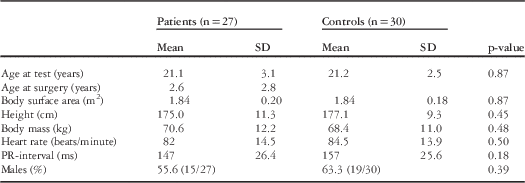
Demographics are displayed in Table 1. Overall, basic characteristics are similar in the two groups. All participants were asymptomatic and for the entire group of ventricular septal defect patients, check-up had been ended, which, in the majority, was shortly after surgery.
Demographics and clinical characteristics.

Heart rate=heart rate at rest; PR-interval=PR-interval at rest
Echocardiography was performed just before surgery in all patients, revealing a mean ventricular septal defect size of 8.5±3.8 mm and a mean gradient of 55.2±30.4 mmHg. In 11 patients, a catheterisation was performed, demonstrating a mean Qp/Qs of 2.6±0.8. At the time of investigation, left ventricular systolic function was assessed with echocardiography, and in terms of ejection fraction and left ventricular global strain no difference was found. Ejection fraction was determined using Simpson’s biplane. Diastolic function was, however, not systematically evaluated, but no visual dysfunction was present.
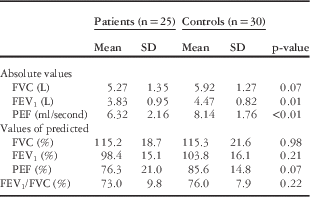
Spirometry outcomes are displayed in Table 2 and lower forced expiratory volume in 1 second and peak expiratory flow were revealed in the ventricular septal defect group compared with the control group. In contrast, the groups were basically similar when measurements were related to standardised predicted values.
Spirometric outcomes in young adults operated for ventricular septal defect and healthy controls.

FEV1=forced expiratory volume in 1 second; FVC=forced vital capacity; PEF=peak expiratory flow
Data of exercise habits are visualised in Table 3. The weekly amount of vigorous exercise did not differ between the groups, but the patients were more physically active than the controls in terms of moderate and low-intensity exercise.
Data for the International Physical Activity Questionnaire in young adults operated for ventricular septal defect and healthy controls

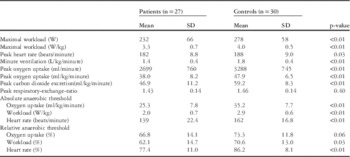
Exercise outcomes are summarised in Table 4. Ventricular septal defect-operated patients performed significantly poorer than the control group at peak exercise. Peak heart rate was also lower among patients (182±9 beats/minute) than among controls (188±9 beats/minute). Furthermore, at ventilatory anaerobic threshold, a lower oxygen uptake, workload, and heart rate were found compared with the control group, which indicates compromised aerobic capacity. Moreover, when aerobic capacity was related to maximal exercise capacity, ventilatory anaerobic threshold was also relatively lower in the ventricular septal defect group in comparison with the control group. Lastly, peak respiratory exchange ratio was not significantly different between the groups.
Exercise outcomes in young adults operated for ventricular septal defect and healthy controls.

Data on Health-Related Quality of Life were compared in the two groups. Ventricular septal defect patients had significantly lower norm-based scores in physical functioning (p=0.02), role physical (p=0.047), and social functioning (p=0.02) than controls, but no other significant differences was found between the two groups.
Among patients and controls, physical component summary were: 56.3 (95% confidence interval 55.7–57.1) and 57.1 (95% confidence interval 55.8–57.4), respectively, and mental component summary were: 53.4 (95% confidence interval 50.0–54.7) and 53.3 (95% confidence interval 51.8–55.0), respectively. p-values were p=0.32 and p=0.56, respectively.
Our results were unrelated to age at surgery, coexistent presence of right bundle branch block, closure with patch or direct suture, pre-operative banding, and residual shunting if any. None of these subgroups differed significantly from the rest of the ventricular septal defect group. In terms of the potential impact of surgical age, we compared age groups with half-year intervals and we performed simple regression analyses. The median age at surgery was 1.9 (95% confidence interval 1.1–2.8 years). Lastly, we tested for correlation between peak oxygen uptake and the following parameters: peak heart rate, pre-operative ventricular septal defect size, and ventricular septal defect gradient. No correlations were found using simple regression analyses.
Discussion
We performed cardiopulmonary exercise testing in a cohort of ventricular septal defect-operated young adults with a mean time of post-surgical follow-up exceeding 18 years. Currently, patients are operated at an earlier age than 20 years ago, but a large number of patients are living with the consequences of the past treatment and for these patients this study has large implications. We found a lower peak oxygen uptake, maximal workload, and ventilatory anaerobic threshold compared with healthy controls. Our follow-up of 18 years is far longer than any follow-up previously reported, and the finding of lower exercise capacity among adult ventricular septal defect-operated patients is rather new. One may have hypothesised that a potential difference in exercise capacity between ventricular septal defect-operated patients and controls would level out over time; our results speak against that. Peak oxygen uptake and maximal workload were determined at peak exercise and the data were held against our control group; values were around 20% lower (21% and 18%, respectively) in the ventricular septal defect group. Moreover, we observed a subnormal peak heart rate of ∼6 beats/minute in the ventricular septal defect group. A power gap of this magnitude, when, for instance, riding a bike uphill, seems hard to compensate, and in a young population whose activity level generally is above average such a massive difference is unquestionable of clinical significance.
We found a significantly lower ventilatory anaerobic threshold, a measure that is independent of effort. First, the absolute values of oxygen uptake, workload, and heart rate were lower at ventilatory anaerobic threshold. Second, the same parameters were related to the respective levels at peak exercise and relative thresholds were either lower or similar in the ventricular septal defect group compared with the control group. Thus, the impaired peak-exercise capacity in the ventricular septal defect group is primarily due to lower aerobic capacity than in the control group.
In terms of the SF-36 health survey, the patients scored significantly lower in physical functioning, role physical, and social functioning. Physical functioning refers to the ability or limitations to perform physical activities, and role physical refers to the impact of physical health on the range and extent of physical activities one is able to perform. Social functioning refers to the impact of physical and emotional health on the ability to perform normal social activities. Scores from the Health-Related Quality of Life uncover the same pattern as the exercise outcomes. We found an impaired physical capacity in the ventricular septal defect group compared with the control group: a finding according to self-estimated health. In a previous study conducted by Pedersen et al,Reference Pedersen, Ropcke and Hjortdal 11 the same questionnaire was applied and a similar relation between functional and self-perceived health status was found in patients operated for aortic coarctation. Young adults, who have undergone cardiac surgery, therefore seem highly aware of their functional health status.
In a healthy Danish population of both genders (n=641) between 16 and 24 years, norm-based scores of physical component summary and mental component summary have been reported: 54.5±5.5 and 53.9±7.2, respectively.Reference Kjoller, Rasmussen and Keiding 12 In our study, patients and controls score approximately the same in both physical component summary: 56.3 (95% confidence interval 55.7–57.1) and 57.1 (95% confidence interval 55.8–57.4), respectively, and in mental component summary: 53.4 (95% confidence interval 50.0–54.7) and 53.3 (95% confidence interval 51.8–55.0), respectively. Although the norm-based scores in our two groups are calculated using norms from Sweden, there is no reason to believe that any of our groups differ notably from the Danish population in general.
NormalReference Perrault, Drblik and Montigny 7 or only slightly subnormal peak oxygen uptake and ventilatory anaerobic thresholdReference Durmala, Rokicki, Kohut and Pilis 8 , Reference Reybrouck, Rogers and Weymans 9 have been found in smaller groups of ventricular septal defect-operated patients. We enrolled a relatively large number of patients and our results show significant functional impairment. A couple of large-scale studies with 227 and 324 patients have been published. Both Cumming et alReference Cumming 13 and Driscoll et alReference Driscoll, Wolfe and Gersony 14 used the Bruce treadmill exercise protocol with exercise duration as their main endpoint. Their results must therefore be interpreted with caution because circumstantial factors like motivation and encouragement strongly influence the duration of exercise. In contrast, we applied respiratory gas exchange analysis, which enables effort-independent measurements in terms of ventilatory anaerobic threshold and determination of peak respiratory exchange ratio, a measure of effort at peak exercise. As discussed previously, the percentage of exercise performed past the point of ventilatory anaerobic threshold, which represents the anaerobic capacity, was relatively larger in the ventricular septal defect group than in the control group. Owing to the fact that only the anaerobic part of the exercise test is susceptible to lacking effort, and because peak respiratory exchange ratio was not different between the groups, lacking effort can be practically ruled out.
Cooper et alReference Cooper, Weiler-Ravell, Whipp and Wasserman 15 evaluated aerobic and anaerobic parameters in a cross-sectional study of normal children and young adults. In this population, the peak oxygen uptake was 50±8 ml/kg/minute in boys older than 13 years, and 34±4 ml/kg/minute in girls older than 11 years. Binkhorst et alReference Binkhorst, van de Belt, de Hoog, van Dijk, Schokking and Hopman 6 report a peak oxygen uptake of 48±8 ml/kg/minute in their control group consisting of healthy adolescents with a mean age of 15 years. With a mean peak oxygen uptake of 48±7 ml/kg/minute and a slightly higher mean age, our control group is comparable with Cooper’s and Binkhorst’s control group.
In accordance with previous findings,Reference Norozi, Gravenhorst, Hobbiebrunken and Wessel 5 – Reference Perrault, Drblik and Montigny 7 we found a significantly lower peak heart rate among patients than among controls. Norozi et alReference Norozi, Wessel and Alpers 16 moreover investigated the prevalence of chronotropic incompetence, defined as failure to achieve ≥80% of predicted peak heart rate,Reference Katritsis and Camm 17 in patients with a corrected left-to-right shunt. They reported a difference that was not statistically significant. In our cohort that consisted exclusively of ventricular septal defect operated patients, only one patient could be defined as chronotropically incompetent.
A plausible explanation for the lower peak heart rate is sinus node dysfunction due to either intrinsic or extrinsic factors. None of our patients used cardiac medication, nor had additional cardiac disease and extrinsic factors can be ignored. In contrast, the chronotropic limitation may be caused by intrinsic factors in the form of sinoatrial or atrioventricular damage.Reference Tamer, Wolff and Ferrer 18 , Reference Ohuchi, Watanabe, Kishiki, Wakisaka and Echigo 19 Atriotomy has been shown to cause atrial fibroelastosis that may damage the supraventricular conduction system.Reference Bharati and Lev 20 Disturbances in the sinoatrial or atrioventricular conduction system would lead to prolonged PR-intervals, wherefore our resting and peak-exercise electrocardiograms have been evaluated. Owing to noise of motion caused by pedalling, P-waves could neither be satisfactorily identified during exercise nor during early recovery, but no loss of R-waves could be found. PR-intervals at rest were not significantly different between the groups. An alternate reason is failure in sinus regulation due to cardiac autonomic dysfunction in the form of either postsynaptic desensitisation of the β-adrenergic receptor pathway or simple denervation per-operative. The first has been described in patients suffering from chronic congestive heart failure,Reference Colucci, Ribeiro and Rocco 21 , Reference Roche, Pichot and Da Costa 22 and Ohuchi et alReference Ohuchi, Watanabe, Kishiki, Wakisaka and Echigo 19 demonstrated cardiac autonomic dysfunction in a cohort of patients operated for various congenital heart defects. Binkhorst et alReference Binkhorst, van de Belt, de Hoog, van Dijk, Schokking and Hopman 6 investigated ventricular septal defect-operated patients and unoperated ventricular septal defect patients; in the latter, the peak heart rate was not different from controls. This suggests that the surgical treatment plays a substantial role in the pathogenesis of this chronotropic limitation, although the exact mechanism cannot be fully clarified.
Some study limitations need to be discussed. One may speculate that the demonstrated differences in exercise outcomes are due to simple deconditioning in the ventricular septal defect group compared with the control group. However, there was an early awareness among the investigators, and the results from the International Physical Activity Questionnaire practically exclude it. We assessed self-reported levels of physical activity in the groups, and the levels of vigorous exercise were not statistically different between the groups. Interestingly, the weekly amounts of moderate and low-intensity exercise were higher in the group of ventricular septal defect-operated patients than in the control group. However, numerous controls were students from high school or other educational institutions, whereas most ventricular septal defect patients had less sedentary jobs. On the basis of the self-reported levels of exercise, physical restrictions due to overprotective attitude among ventricular septal defect patients can be ruled out, and it seems fair to conclude that the demonstrated reduction in exercise capacity does not limit the patient’s participation in their daily activities. In addition, the demonstrated impairment in exercise capacity can therefore not be explained by deconditioning. Lastly, we demonstrated a significantly lower peak heart rate in the ventricular septal defect group. Owing to the fact that peak heart rate is unaffected by deconditioning, we have demonstrated existence of cardiac abnormalities that cannot be explained by habitual levels of exercise.
Spirometry outcomes do not reveal any significant differences between the two groups, when the results are compared with the predicted values. However, there is a trend towards poorer results in the ventricular septal defect group, especially regarding peak expiratory flow, which could explain the peak-exercise outcomes. However, it is very unlikely that pulmonary function restricts exercise capacity in this group of young adults, and ventilatory anaerobic threshold is not ventilation restricted.
In perspective, currently most ventricular septal defects are closed at an earlier age than 20 years ago and today’s patients may experience a better long-term outcome than former patients, even if we found no association between exercise capacity and age at surgery in this cohort. One must keep in mind that this study was not designed to explain the causes of the reported dissimilarities. Consequently, it cannot be fully clarified whether our results reflect the 2.6 years of left-to-right shunting in early childhood. Nevertheless, a study conducted by Möller et alReference Möller, Brun and Fredriksen 23 demonstrated elevated pulmonary vascular pressure during exercise. This strongly indicates that the impaired functional capacity is due to the left-to-right shunting causing damage to the pulmonary vascular endothelium. The discovery by Möller et alReference Roche, Pichot and Da Costa 22 was, similar to our findings, unrelated to the age at surgery. On the other hand, neither intrinsic abnormalities in oxygen utilisation nor subclinical ventricular dysfunction in ventricular septal defect patients can be ruled out. An evaluation of right ventricular systolic and diastolic function would particularly be of great interest.
In conclusion, we demonstrated significantly lower cardiopulmonary exercise capacity in ventricular septal defect-operated patients than in healthy controls; data include both effort-dependent and effort-independent measurements. Our results heavily suggest that these patients’ physical fitness should not be seen as fully uncompromised, even on a long-term basis. Whether our results are due to the shunting or the operative interference cannot be explained, and will need further studies.
Acknowledgements
The authors are profoundly thankful to Lotte Sorensen for her enthusiastic contribution to the exercise testing and involvement in the recruitment of healthy controls.
Financial Support
This work received no specific grant from any funding agency, commercial or not-for-profit sectors.
Conflicts of Interest
None.
Ethical Standards
The authors assert that all procedures contributing to this work comply with the ethical standards of The Regional Committee on Biomedical Research Ethics of the Central Denmark Region and with the Helsinki Declaration of 1975, as revised in 2008, and has been approved by the institutional committees.